International Journal of COPD 2018:13 2237–2244
International Journal of COPD
Dove
press
submit your manuscript | www.dovepress.com 2237
S t u Dy P r O t O C O l
open access to scientific and medical research
Open Access Full text Article
Evaluation of the COPDnet integrated care model
in patients with COPD: the study protocol
Eleonore H Koolen1
Philip J van der Wees2
Gert P Westert2
richard Dekhuijzen1
yvonne F Heijdra1
Alex J van ’t Hul1
1Department of Pulmonary Diseases,
radboud university Medical Center, Nijmegen, the Netherlands;
2radboud Institute for Health
Sciences, IQ Healthcare, radboud university Medical Center, Nijmegen, the Netherlands
Background: Projections on the future suggest a further rise in the prevalence of patients with COPD, and in COPD related morbidity, mortality, and health care costs worldwide. Given the substantial impact on the individual and on society, it is important to establish a care process that maximizes outcomes in relation to the costs and efforts made. In an attempt to bridge this gap, we set out to develop an evidence-based model of integrated care for patients with COPD, named the COPDnet integrated care model.
Purpose: The current study protocol sets out to 1) evaluate the feasibility of employing the COPDnet model in present real-life care within the context of the Dutch health care system, 2) explore the potential health status benefits, and 3) analyze the costs of care of this model.
Patients and methods: In this prospective study, feasibility and health status changes will be evaluated with an experimental before and after study design. The costs of the diagnostic trajectory will be calculated according to a standard economic health care evaluation approach. Furthermore, the feasibility and cost of care studies will comprise both quantitative and qualita-tive data collection. For the studies on the feasibility and change in health status, all new patients qualifying for shared care by primary and secondary care professionals according to the Dutch Standard of Care for COPD, and patients referred by their general practitioners to one of the COPDnet hospitals will be included. To evaluate the feasibility and costs of care, semi-structured interviews will be held with patients, hospital personnel, health care professionals in the affili-ated primary care region, and hospital and primary care group managers.
Conclusions: The COPDnet integrated care model for COPD patients has been designed according to the current insights regarding effective care for patients with a chronic condition in general, and for patients with COPD in particular. It will be evaluated for its feasibility, potential health status benefits, and the costs of care of the diagnostic trajectory in secondary care.
Keywords: COPD, COPD management, integrated care, chronic care model, health status
Introduction
COPD is defined as a common, preventable, and treatable disease that is characterized
by persistent respiratory symptoms and airflow limitation.1 Moreover, COPD is a
complex and heterogeneous disease with highly variable clinical manifestations.2,3
Even when COPD patients are in a relatively stable phase of their disease or only have mild-to-moderate airway obstruction, COPD often puts a significant burden of
disease on those affected.2 The impact of COPD also places a high burden on health
care resources, given the significant direct and indirect costs of care.4 Projections on
the future suggest a further rise in the prevalence of patients with COPD, morbidity,
mortality, and health care costs worldwide.5
Given the substantial impact on the individual and on society, it is important to establish a care process that maximizes outcomes in relation to the efforts and Correspondence: Eleonore H Koolen
Department of Pulmonary Diseases, radboud university Medical Center, PO Box 9101, 6500 HB Nijmegen, the Netherlands
tel +31 24 361 0325 Fax +31 24 361 0324
Email [email protected]
Journal name: International Journal of COPD Article Designation: Study Protocol Year: 2018
Volume: 13
Running head verso: Koolen et al
Running head recto: Evaluation of the COPDnet integrated care model: study protocol DOI: 153992
International Journal of Chronic Obstructive Pulmonary Disease downloaded from https://www.dovepress.com/ by 118.70.13.36 on 22-Aug-2020
For personal use only.
Dovepress
Koolen et al
costs made.6 There is evidence to suggest that COPD disease
management programs, providing integrated holistic care in an integrated care process, have the potential to better both health outcomes and costs compared with single-dimensional
medical approaches.7 A recent review shows that better
outcomes may be achieved with an integrated disease management program of at least 3 months duration with a follow-up ranging from 3 to 24 months on disease-specific quality of life and exercise capacity, and also, a reduction in respiratory-related hospital admissions and hospital days per
person.8 The clinical impression is, however, that integrated
care models are, as yet, only in limited use in our present care delivery pathways. This was confirmed in a recently performed survey in five European Union countries, includ-ing the Netherlands. In this paper, the authors concluded that COPD health care pathways are fragmented and care is not
integrated properly.9
In an attempt to bridge this gap, we set out to develop an evidence-based model of integrated care for patients with
COPD, named the COPDnet integrated care model.10 The
COPDnet integrated care model has the ambition to innovate, simultaneously, both the content of care, ie applying a holistic approach, as well as the organization of care, ie, providing coherent, integrated care within the Dutch health care system. The use of such a model holds a promise to generate better outcomes of care for patients with COPD, as well as an
overall reduction in the health care costs.11
As we acknowledge that it is a challenge to implement
this highly complex COPDnet integrated care model,12 the
current study protocol sets out 1) to evaluate the feasibility of employing the COPDnet model in present day real-life care within the context of the Dutch health care system, 2) to explore the potential health status benefits from the patients’ perspective, and 3) to analyze the costs of care of this model.
Objectives of the study protocol
To realize the objectives of the current research project, a series of interrelated studies will be conducted with the following aims:
• To evaluate the feasibility of the implementation of the
COPDnet integrated care model.
• To evaluate changes in health status over time in COPD
patients who were offered care according to the COPDnet integrated care model.
• To evaluate the costs of care of the diagnostic trajectory
in secondary care, as a component of the COPDnet inte-grated care model.
The objective of this article is to present the rationale and the different methods of this prospective study.
Intervention
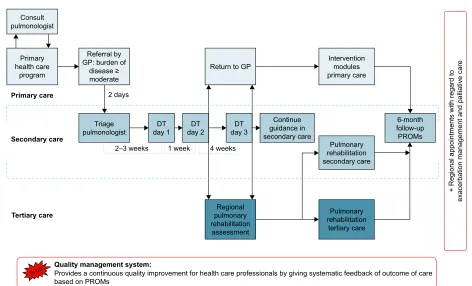
The COPDnet integrated care model describes a trans-parent and highly standardized outpatient care process. Figure 1 represents a graphical overview of all elements of the COPDnet integrated care model, that is, a diagnostic trajec-tory carried out in secondary care, a non-medical intervention program provided in primary care, and a pulmonary rehabilita-tion service in tertiary care. The model also includes a quality management system based on patient-reported outcome mea-surements (PROMs), and regional appointments pertaining to exacerbation management and palliative care. Principles of the model include the following: 1) an individual care plan based on an assessment of the individual determinants of the burden of disease, 2) which is carried out closely to the natural habitat of the patient, and 3) looks for opportunities to initiate behav-ioral change, ie reinforcement of patients’ self-management capabilities. Full details of the COPDnet integrated care model
can be found in a recently published article by Koolen et al.10
Methods and analyses
Study setting and design
The series of studies of this research project will be carried out in three hospitals and their affiliated primary care region, that is, the outpatient clinic of the Department of Pulmonary Diseases of Radboudumc (Nijmegen), Bernhoven Hospital (Uden), and Canisius Wilhelmina Hospital (Nijmegen).
In this prospective study, feasibility and health status changes will be evaluated with an experimental before and after study design. The costs of the diagnostic trajectory will be calculated according to a standard economic health care evaluation approach. Furthermore, the feasibility and cost of care studies will comprise both quantitative and qualitative data collection and analyses.
Study population
Patients
For the studies on the feasibility of the implementation of this COPDnet integrated care model and of the change in health status, patients will be included based on the following two criteria:
• New patients qualifying for shared care by primary and
secondary care professionals according to the Dutch
Standard of Care for COPD13
• Patients referred by their general practitioners (GPs) to the
outpatient clinic of Radboudumc, Bernhoven Hospital, or Canisius Wilhelmina Hospital.
International Journal of Chronic Obstructive Pulmonary Disease downloaded from https://www.dovepress.com/ by 118.70.13.36 on 22-Aug-2020
Dovepress Evaluation of the COPDnet integrated care model: study protocol
Patients will be excluded if
• the patient is unable to complete questionnaires because
of cognitive impairment and
• the patient is unable to speak or understand the Dutch
language.
Health care professionals
To evaluate the feasibility and costs of care, the following health care professionals, providing care according to the COPDnet integrated care protocol, will be included in these studies:
• Primary care: GPs nurse practitioners, physiotherapists,
dieticians, occupational therapists, and primary care group managers.
• Secondary care: pulmonary specialists, respiratory nurse
specialists, pulmonary function technicians, medical secretaries, staff of the clinometric department, and hospital care group managers.
Outcomes
Feasibility
The feasibility of implementing the COPDnet integrated care model will be evaluated from three different perspec-tives, that is, patient perspective, health care perspective,
and organizational perspective, applying both quantitative and qualitative methods.
Quantitative evaluation
The following questionnaires will be used for the evaluation of the patient outcomes: the Consumer Quality Index Asthma
and COPD14 and the Patients Assessment Chronic Illness
Care15; to evaluate the health care professional perspective,
the Assessment of Chronic Illness Care,16 the Clinician
Support for Patient Activation Measure,17 and the
Assess-ment of Primary Care Recourses and Supports for Chronic
Disease Self-Management;18 and finally, for the evaluation of
the organizational perspective, the Care Process Self
Evalu-ation Tool will be applied.19
Qualitative evaluation
First of all, two authors (EHK and AJvH) will develop semi-structured interview guides, which should enhance the feasibility of using the COPDnet model in contemporary health care within the context of the Dutch health care system. The semi-structured interview guides will be tailored specifi-cally to patients, hospital personnel, health care professionals in the affiliated primary care region, and hospital and primary care group managers.
Figure 1 Graphical overview of the COPDnet integrated care model.
Abbreviations: Dt, diagnostic trajectory; GP, general practitioner; PrOMs, patient-reported outcome measurements.
&RQVXOW SXOPRQRORJLVW
5HIHUUDOE\ *3EXUGHQRI
GLVHDVH PRGHUDWH 3ULPDU\
KHDOWKFDUH SURJUDP
7ULDJH
SXOPRQRORJLVW GD\'7 GD\'7 GD\'7
5HWXUQWR*3 ,QWHUYHQWLRQPRGXOHV
SULPDU\FDUH
&RQWLQXH JXLGDQFHLQ VHFRQGDU\FDUH
PRQWK IROORZXS 3520V
5HJLRQDODSSRLQWPHQWVZLWKUHJDUGWR
H[DFHUEDWLRQPDQDJHPHQWDQGSDOOLDWLYHFDUH
3XOPRQDU\ UHKDELOLWDWLRQ VHFRQGDU\FDUH
3XOPRQDU\ UHKDELOLWDWLRQ
WHUWLDU\FDUH 5HJLRQDO
SXOPRQDU\ UHKDELOLWDWLRQ
DVVHVVPHQW
3ULPDU\FDUH GD\V
±ZHHNV ZHHN ZHHNV
6HFRQGDU\FDUH
7HUWLDU\FDUH
3/86
4XDOLW\PDQDJHPHQWV\VWHP
3URYLGHVDFRQWLQXRXVTXDOLW\LPSURYHPHQWIRUKHDOWKFDUHSURIHVVLRQDOVE\JLYLQJV\VWHPDWLFIHHGEDFNRIRXWFRPHRIFDUH EDVHGRQ3520V
International Journal of Chronic Obstructive Pulmonary Disease downloaded from https://www.dovepress.com/ by 118.70.13.36 on 22-Aug-2020
Dovepress
Koolen et al
The patients will be selected based on the purposive sampling from the three COPDnet hospitals. We will seek a varied sample of patients based on age, sex, and burden of disease. The respiratory nurse specialists will invite these patients for participation in one of the interviews after they have completed the full trajectory of the COPDnet integrated care model. EHK will invite the professionals by telephone or e-mail. All participants will receive written information about the purpose and procedure of the interviews and they will be asked to confirm their participation by e-mail or telephone. Moreover, EHK will use the interview guides to conduct the semi-structured interviews, either by telephone or face-to-face, after obtaining written informed consent.
Analysis of the patient perspective, health care profes-sional perspective, and organizational perspective ques-tionnaires, patient health records and the semi-structured interviews will be carried out between 12 and 36 months after the implementation of the COPDnet model in the three participating hospitals.
Health status
An analysis will be made of the potential improvements in health status through measuring changes in health status in patients enrolled in the COPDnet model, using widely accepted and validated PROMs. Primary outcome measure will be the Clinical COPD Questionnaire (CCQ). The results of the health status of enrolled patients at baseline, and at 6 months after the diagnostic trajectory in
the COPDnet hospitals, will be compared.20 The CCQ is
a self-administrated questionnaire and the psychometric
properties are well documented.20 In addition to the primary
outcomes, the following secondary outcome measurements will be systematically registered in the COPDnet hospitals:
the Patient Activation Measure,21,22 the Nijmegen Clinical
Screening Instrument,23,24 and physical activity measured
with the Marshall Questionnaire.25 All data will be collected
at baseline during the first visit at the hospital, at discharge after completion of the diagnostic trajectory of the COPDnet model and, finally, after 6-month follow-up. Also, patient characteristics and the following health status characteristics will be registered at baseline: the medication prescribed in primary care, comorbidities, smoking behavior, pulmonary function, blood gas analysis, 6-minute walking distance, physical activity measured with an activity monitor, medical diagnosis, and the classification of the burden of disease.
Costs of care
Costs of care will be analyzed on the basis of completed and registered care activities performed during the diagnostic
trajectory in the participating hospitals of the COPDnet model, complying with the principles of Time-Driven Activity-Based Costing (TDABC) in value-based health
care.26 TDABC requires the estimation of two parameters:
the costs per time required to supply resources to the activi-ties and the time required to perform activiactivi-ties in service
deliveries.26 We will use the seven-step approach to the
appli-cation of the TDABC in our health care setting.27 By using
the TDABC model, we will be able to understand the cost of
care delivery and control costs.28 We will develop TDABC
models for all COPDnet hospitals, in which direct costs and indirect costs for delivering the diagnostic trajectory are taken into account.
Cost mapping will be performed on 1) calculation of the total (internal) costs of the COPDnet model on the basis of factual delivery of care activities and time spent to carry out these activities and 2) comparing the (internal) costs of the diagnostic trajectory with the reimbursement fees of the health insurance companies. Data source for cost map-ping is the Hospital Information System of the participating hospitals.
TDABC models have been using different methods with respect to the time required to perform activities, which
may result in different costs of patient care.28 Therefore,
our TDABC models will be developed on the basis of three methods. First of all, we will evaluate the direct and indirect (non-) patient-related time through an objective measurement of time. Therefore, we will measure the time of each step in the diagnostic trajectory by using a stopwatch. Second, we will evaluate the direct and indirect (non-) patient-related time subjectively, by interviewing all the participating health care professionals. Third, we will interview the hospital care group managers, so that they may estimate the invested time of each step in the diagnostic trajectory in the secondary care setting. Differences and similarities between these three approaches will be evaluated. Finally, we will compare the TDABC models with the average costs of usual care, which was provided before the introduction of the COPDnet model, based on health care records.
Qualitative evaluation
EHK and AvtH will also develop the semi-structured inter-view guides for the participating health care professionals and hospital care group managers, in which the focus will be on an estimate of the time that the professionals have to invest to meet the requirements of the COPDnet model. All the participating health care professionals and hospital care group managers from the three COPDnet hospitals, who work according to the model, will be invited. EHK will invite the
International Journal of Chronic Obstructive Pulmonary Disease downloaded from https://www.dovepress.com/ by 118.70.13.36 on 22-Aug-2020
Dovepress Evaluation of the COPDnet integrated care model: study protocol
professionals by telephone or e-mail, and if they want to participate, they will receive written information about the purpose and procedure of the interview. EHK will use the interview guides to conduct the semi-structured interviews, either by telephone or face-to-face, after obtaining written informed consent.
Sample size
Feasibility
On each location, semi-structured interviews will be held with patients, clinicians, and managers. We anticipate on including five patients on each location – dependent on data saturation. Also, on each location, two pulmonary specialists, two respiratory nurses, and, of each discipline, two allied health care professionals will be invited to participate in the interviews. The to be interviewed pulmonary specialists and respiratory nurse specialists include all health care pro-fessionals, actually providing care following the COPDnet model in the three participating hospitals. Finally, a conve-nient sample of hospital and primary care group managers will be interviewed on what working with the COPDnet model means from an organizational perspective and how this affects feasibility.
Health status
The sample size for the secondary objective is estimated using G-power with an a priori paired t-test, based on an estimated difference between two dependent means. A total of 199 patients are required to detect a small effect size of 0.2 on the CCQ, with a significance of 5% and a power of 80%. However, anticipating a dropout rate of 25%, we will include 250 patients.
Costs of care
To evaluate the time invested, semi-structured interviews will be held with two pulmonary specialists, two respiratory nurses, one pulmonary function technician, one medical secretary, and one hospital care group manager, on each location.
recruitment
All patients, qualifying for shared care in primary and secondary care settings (according to the Dutch Standard
of Care for COPD13) and who are referred by their GP
to secondary care will be automatically enrolled into the COPDnet model, in the outpatient clinic of the Radboudumc (Nijmegen), in the Bernhoven Hospital (Uden), or in the Canisius Wilhelmina Hospital (Nijmegen). Within these three hospitals, the COPDnet integrated care model has
been accepted as the new standard care pathway for all new patients with COPD. All patients will be examined accord-ing to the new standard patient care pathway in one of the COPDnet hospitals mentioned above. Furthermore, patients will not be exposed to extra questionnaires, tests, or site visits. Only a minority of the purposively selected patients
(10–15/200=5%–8%), and all of the participating COPDnet
health care professionals, will be asked to participate, volun-tarily, in a semi-structured interview. Therefore, patients and health care professionals in this study will not be exposed to any additional health-related risk. Patients will be informed about the study by the way of a patient information form. All patients receiving usual care, according to the COPDnet model, will be included in these studies and will be excluded only when they say they are unwilling to participate.
Data management
All study data will be handled confidentially. The handling of the personal data will be fully compliant with the Dutch Personal Data Protection Act (de Wet Bescherming Persoon-sgegevens). Study data will be kept for 15 years.
Statistical analyses
Quantitative analyses
Descriptive statistics, including means, SD, frequencies, medians, and interquartile ranges will be used to summarize our collected data. Handling missing data will be carried out according to the guidelines of the different questionnaires.
To evaluate the feasibility of the COPDnet model, a two-tailed paired sample t-test or Wilcoxon signed rank test will be used to analyze the differences between the different measurement instruments at baseline and after implementa-tion of the COPDnet model. To evaluate the potential health status benefits by testing the differences between baseline PROMS and follow-up PROMS, a two-tailed paired sample
t-test or the Wilcoxon signed rank test will also be used. A
priori, a two-sided level of significance will be set at p#0.05.
For data analysis, SPSS V.22.0 will be used.
The economic evaluation of the cost of care of the COPDnet model, based on the different TDABC models, will be analyzed with appropriate descriptive statistics and will be displayed graphically.
Qualitative analyses
To evaluate the feasibility and the costs of care, all semi-structured interviews of the COPDnet model will be audio-taped after obtaining the respondent’s permission. Subsequently, the audio tapes will be transcribed verbatim and entered into Atlas.ti qualitative software for analysis.
International Journal of Chronic Obstructive Pulmonary Disease downloaded from https://www.dovepress.com/ by 118.70.13.36 on 22-Aug-2020
Dovepress
Koolen et al
We will use qualitative content analysis with a directed
approach.29 We will conduct a thematic analysis of the
implementation of the COPDnet model. Results from the qualitative analyses will be triangulated with results from the quantitative analyses to identify concordant and disparate results across the data sources.
Ethics and dissemination
The Research Ethics Committee of the Radboud University Medical Center has passed a positive judgment on the study. The Committee considered that the study protocol does not fall within the remit of the Medical Research Involving Human Subjects Act (WMO) (ref: 2017/3597). Patients, health care professionals, and organizational managers will be asked to sign an Informed Consent form before partici-pating in a semi-structured interview. This project will be conducted according to the Declaration of Helsinki and the Agreement on Medical Treatment Act (In Dutch: Wet op de Geneeskundige Behandelingsovereenkomst or WGBO).
Discussion
This study protocol focuses on the challenge to implement the COPDnet integrated care model into three hospitals and affiliated primary care regions. It will evaluate the feasibility of integrating the COPDnet model into actual care within the context of the Dutch health care system. It will evaluate the potential health status benefits from the patient’s perspec-tive, and it will evaluate the direct and indirect costs, on the basis of TDABC models, of the diagnostic trajectory as a component of the COPDnet model. This study protocol has strengths and limitations, which will be discussed below.
Strengths
A major strength of this study protocol is that we evaluate Dutch real-life care, derived from the care delivered by the implemented COPDnet integrated care models. Although
the number of real-life studies on COPD is growing,30 little
scientific data are available on the outcome of real-life COPD
care outside the remit of treatment or exacerbations.31 The
first publications on the outcome of this real-life COPD care suggest room for improvement on the organization of care,
the content of care, and the cost-effectiveness of care.9,32–35
This study will generate knowledge about the COPDnet model, which is founded on the principles of the CCM. The aim of the CCM is to transform daily care for patients with chronic illnesses from acute and reactive, to proactive,
planned, and population-based.36 The use of the principles
of the CCM in the context of COPD holds the promise to
generate better outcomes of care.11
Furthermore, this study protocol describes a multisite study. The COPDnet model will be implemented in three hospitals, each with a different character, and, subsequently, in different allied primary care regions. Although the COPDnet integrated care model was designed for the Dutch health care system, it is deemed applicable, mutatis mutandis, in every country that sets out to apply an integrated approach in an integrated health care chain. We based the development of the COPDnet model on evidence and frameworks avail-able in the international literature. We think that our model is applicable in other health care systems, when tailored to national and local context.
Finally, this study protocol will provide a multiperspec-tive evaluation of the COPDnet model. Our COPDnet model is an integrated care model, and its evaluation is an integral part of it. Our analysis will focus on patient perspective, health care professional perspective, and organizational perspective in primary and secondary care settings.
limitations
This study protocol has two limitations. First, this study protocol lacks a controlled design. This means that we have to be careful with the conclusions we draw from our study and we can apply the recommendations only to the local geo-graphic context of our three COPDnet hospitals and primary care regions. However, randomized controlled trials may have a high internal validity, whereas real-life studies have
high generalizability.30 Nevertheless, we consider the current
study as a proof of concept of the deployment of the COPDnet model, that is of the feasibility of working with the model, rather than a study on its effectiveness. Second, we have developed the current COPDnet model as it stands, but we are aware of its fragility. After the diagnostic trajectory in a secondary care setting, patients may be referred for further guidance and intervention to either a primary care setting or a form of pulmonary rehabilitation in secondary or tertiary care settings. Referrals are based on the assessment of the burden of disease and actual individual traits. For this purpose, guide-lines on decision making were developed. Even so, uptake, completion, and quality of the delivered intervention(s) can only be partly controlled for. As a result, changes in health status over time may be difficult to interpret.
Clinical consequences
This study protocol will provide prime insights with respect to feasibility, health status benefits, and cost of care of the
International Journal of Chronic Obstructive Pulmonary Disease downloaded from https://www.dovepress.com/ by 118.70.13.36 on 22-Aug-2020
Dovepress Evaluation of the COPDnet integrated care model: study protocol
diagnostic trajectory of the COPDnet integrated care model in three hospitals and their affiliated primary care regions. It is anticipated that adjustments of the current model are to be made. Subsequently, a follow-up study may be performed with a controlled design to evaluate the clinical (cost)-effectiveness of the model.
Conclusion
The COPDnet integrated care model for patients with COPD has been designed according to current insights regarding effective care for patients with a chronic condition in general and for patients with COPD in particular. It will be evaluated for its feasibility, potential health status benefits, and the costs of care of the diagnostic trajectory in secondary care.
Acknowledgments
Jeanine Antons, Heleen van der Niet, and Jan Vercoulen are thanked for their valuable contributions during the design-ing process of the COPDnet integrated care model. Renata Straver is thanked for her linguistic support. This study was funded by unrestricted grants from AstraZeneca, Glaxo Smith Klein, Novartis, Chiesi, Takeda, Mundipharma, Teva, and Boehringer-Ingelheim.
Disclosure
The authors report no conflicts of interest in this work.
References
1. The Global Strategy for the Diagnosis, Management and Prevention of COPD, Global Initiative for Chronic Obstructive Lung Disease (GOLD) 2017. Available from: http://goldcopd.org/gold-reports-2017/. Accessed March 29, 2018.
2. Agusti A, Calverley PM, Celli B, et al. Characterisation of COPD heterogeneity in the ECLIPSE cohort. Respir Res. 2010;11:122. 3. Vestbo J, Agusti A, Wouters EF, et al. Should we view chronic
obstruc-tive pulmonary disease differently after ECLIPSE? A clinical perspec-tive from the study team. Am J Respir Crit Care Med. 2014;189(9): 1022–1030.
4. Wouters EF. Economic analysis of the Confronting COPD survey: an overview of results. Respir Med. 2003;97(Suppl C):S3–S14. 5. Mannino DM, Buist AS. Global burden of COPD: risk factors,
preva-lence, and future trends. Lancet. 2007;370(9589):765–773.
6. Porter ME. What is value in health care? N Engl J Med. 2010;363(26): 2477–2481.
7. Boland MR, Tsiachristas A, Kruis AL, Chavannes NH, Rutten-van Molken MP. The health economic impact of disease management programs for COPD: a systematic literature review and meta-analysis.
BMC Pulm Med. 2013;13:40.
8. Kruis AL, Smidt N, Assendelft WJ, et al. Integrated disease management interventions for patients with chronic obstructive pulmonary disease.
Cochrane Database Syst Rev. 2013;10:CD009437.
9. Kayyali R, Odeh B, Frerichs I, et al. COPD care delivery pathways in five European Union countries: mapping and health care professionals’ perceptions. Int J Chron Obstruct Pulm Dis. 2016;11:2831–2838. 10. Koolen EH, van der Wees, PJ, Westert GP, Dekhuijzen PNR, Heijdra YF,
van ’t Hul AJ. The COPDnet integrated care model. Int J Chron Obstruct
Pulmon Dis. 2018;13:2225–2235.
11. Adams SG, Smith PK, Allan PF, Anzueto A, Pugh JA, Cornell JE. Systematic review of the chronic care model in chronic obstructive pulmonary disease prevention and management. Arch Int Med. 2007; 167(6):551–561.
12. Grol R, Grimshaw J. From best evidence to best practice: effective implemen-tation of change in patients’ care. Lancet. 2003;362(9391):1225–1230. 13. Long Alliantie Nederland LAN. Zorgstandaard COPD [Care
Stan-dard COPD]. 2016. Available from: http://www.longalliantie.nl/ zorgstandaard-copd. Accessed March 29, 2018. Dutch.
14. Doorontwikkeling CQ-index Astma en COPD: validatie van een verko-rte vragenlijst voor het meten van de kwaliteit van astma/COPD-zorg vanuit het perspectief van patiënten [Further development CQ-index Asthma and COPD, Validation of a shortened questionnaire for measur-ing the quality of asthma / COPD care from the perspective of patients]. Available from: https://www.nivel.nl/sites/default/files/bestanden/CQ-index%20Astma%20en%20COPD%202014.pdf. Accessed March 29, 2018. Dutch.
15. Wensing M, van Lieshout J, Jung HP, Hermsen J, Rosemann T. The Patients Assessment Chronic Illness Care (PACIC) questionnaire in The Netherlands: a validation study in rural general practice. BMC Health
Serv Res. 2008;8:182.
16. Bonomi AE, Wagner EH, Glasgow RE, VonKorff M. Assessment of chronic illness care (ACIC): a practical tool to measure quality improve-ment. Health Serv Res. 2002;37(3):791–820.
17. Hibbard JH, Collins PA, Mahoney E, Baker LH. The development and testing of a measure assessing clinician beliefs about patient self-management. Health Expect. 2010;13(1):65–72.
18. Brownson CA, Miller D, Crespo R, et al. A quality improvement tool to assess self-management support in primary care. Jt Comm J Qual
Patient Saf. 2007;33(7):408–416.
19. Vanhaecht K, De Witte K, Depreitere R, et al. Development and valida-tion of a care process self-evaluavalida-tion tool. Health Serv Manag Res. 2007; 20(3):189–202.
20. van der Molen T, Willemse BW, Schokker S, ten Hacken NH, Postma DS, Juniper EF. Development, validity and responsiveness of the Clinical COPD Questionnaire. Health Qual Life Outcomes. 2003;1:13. 21. Hibbard JH, Mahoney ER, Stockard J, Tusler M. Development and
test-ing of a short form of the patient activation measure. Health Serv Res. 2005;40(6 Pt 1):1918–1930.
22. Hibbard JH, Stockard J, Mahoney ER, Tusler M. Development of the Patient Activation Measure (PAM): conceptualizing and measuring activation in patients and consumers. Health Serv Res. 2004;39(4 Pt 1): 1005–1026.
23. Peters JB, Daudey L, Heijdra YF, Molema J, Dekhuijzen PN, Vercoulen JH. Development of a battery of instruments for detailed measurement of health status in patients with COPD in routine care: the Nijmegen Clinical Screening Instrument. Qual Life Res. 2009;18(7):901–912. 24. Vercoulen JH. A simple method to enable patient-tailored treatment
and to motivate the patient to change behaviour. Chron Respir Dis. 2012;9(4):259–268.
25. Marshall AL, Smith BJ, Bauman AE, Kaur S. Reliability and validity of a brief physical activity assessment for use by family doctors. Br J
Sports Med. 2005;39(5):294–297; discussion 294–297.
26. Kaplan RS, Anderson SR. Time-driven activity-based costing. Harv
Bus Rev. 2004;82(11):131–138, 150.
27. Kaplan RS, Porter ME. How to solve the cost crisis in health care. Harv
Bus Rev. 2011;89(9):46–52, 54, 56–61 passim.
28. Keel G, Savage C, Rafiq M, Mazzocato P. Time-driven activity-based costing in health care: a systematic review of the literature. Health
Policy. 2017;121(7):755–763.
29. Hsieh HF, Shannon SE. Three approaches to qualitative content analysis.
Qual Health Res. 2005;15(9):1277–1288.
30. Saturni S, Bellini F, Braido F, et al. Randomized Controlled Trials and real life studies. Approaches and methodologies: a clinical point of view. Pulm Pharmacol Ther. 2014;27(2):129–138.
31. Porter ME, Larsson S, Lee TH. Standardizing patient outcomes measurement. N Eng J Med. 2016;374(6):504–506.
International Journal of Chronic Obstructive Pulmonary Disease downloaded from https://www.dovepress.com/ by 118.70.13.36 on 22-Aug-2020
International Journal of COPD
Publish your work in this journal
Submit your manuscript here: http://www.dovepress.com/international-journal-of-chronic-obstructive-pulmonary-disease-journal
The International Journal of COPD is an international, peer-reviewed journal of therapeutics and pharmacology focusing on concise rapid reporting of clinical studies and reviews in COPD. Special focus is given to the pathophysiological processes underlying the disease, intervention programs, patient focused education, and self management protocols.
This journal is indexed on PubMed Central, MedLine and CAS. The manuscript management system is completely online and includes a very quick and fair peer-review system, which is all easy to use. Visit http://www.dovepress.com/testimonials.php to read real quotes from published authors.
Dovepress
Dove
press
Koolen et al
32. Worth H, Buhl R, Criee CP, Kardos P, Mailander C, Vogelmeier C. The ‘real-life’ COPD patient in Germany: the DACCORD study. Respir
Med. 2016;111:64–71.
33. Buhl R, Criee CP, Kardos P, et al. A year in the life of German patients with COPD: the DACCORD observational study. Int J Chron Obstruct
Pulmo Dis. 2016;11:1639–1646.
34. Haughney J, Gruffydd-Jones K, Roberts J, Lee AJ, Hardwell A, McGarvey L. The distribution of COPD in UK general practice using the new GOLD classification. Eur Respir J. 2014;43(4):993–1002.
35. Ke X, Marvel J, Yu TC, et al. Impact of lung function on exacerbations, health care utilization, and costs among patients with COPD. Int J Chron
Obstruct Pulm Dis. 2016;11:1689–1703.
36. Coleman K, Austin BT, Brach C, Wagner EH. Evidence on the Chronic Care Model in the new millennium. Health Affairs. 2009;28(1):75–85.
International Journal of Chronic Obstructive Pulmonary Disease downloaded from https://www.dovepress.com/ by 118.70.13.36 on 22-Aug-2020