IJEDR1404065
International Journal of Engineering Development and Research (www.ijedr.org)3778
A Survey on Expert System using Classification
Concept
1
Jatin Patel,
2Nikita S. Patel,
3Nikita D. Patel
1PG student, 2Asst. Professor, 3Asst. ProfessorDepartment of computer engineering, Kalol institute of Technology and Research Centre.
________________________________________________________________________________________________________ Abstract - In many expert systems classifier technique is successfully applied. Expert system means the system which makes decision based on provided knowledge by human expert and displays the result. Expert System contains knowledge provided by field expert in terms of rules. These rules are match with the system input and display the appropriate result of it. To minimize the effort of rule matching we apply classifier technique. By using decision tree classifier we reduce the size of the records for compare with previously design rules. After find the reduced set we apply rule matching on it and find out the exact rule match with user input.
Index Terms - Expert System, classification, Decision Tree classification, Naïve Bays classification
________________________________________________________________________________________________________
I.INTRODUCTION
Expert system is the system which is take input from the user about specific domain and gives the probabilistic result based on the knowledge store in the system in terms of rules. This type of system is known as the Rule-based expert system. Rules are defined by knowledge engineer. Expert system is use for taking decision from the facts in real world.
In Rule-based expert system, system takes some facts from the real world and makes decision based on those facts. But the efficiency of the system is decrease when size of problem domain is large. To improve the efficiency and accuracy we use classification technique in expert system. As we know classification is technique to classify the large data into small classes. Data classification process contains two steps. 1Learning step: In this classifier model is constructed using training dataset. 2. Classification step: In this step constructed model is use to classify the testing data. So, in expert system we try to make small size database using classification.
II.INTRODUCTION TO RULE BASED EXPERT SYSTEM
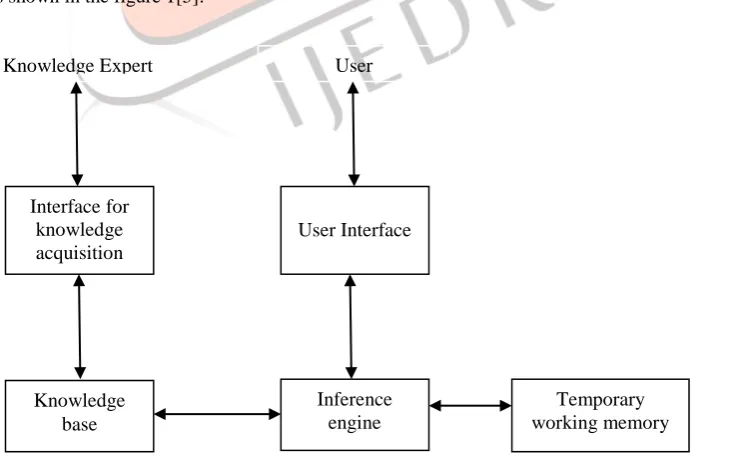
In this section first of all we understand what are expert system and its working. In expert system knowledge represent is in terms of if-then rules. Rule based expert system means the system which declare rules using if-then statements. Expert system contains components as shown in the figure 1[5]:
Figure 1: Components of Rule-Based Expert System
As shown in figure1 these are the components of expert system. Knowledge base is a main component of this system. It is also called Rule base. Knowledge base is a collection of rules which are produce by the knowledge engineer through knowledge acquisition. Knowledge is acquired from the knowledge expert. User interface provide the input for the system. After getting the input from the user the Inference engine is come into the work. Inference engine takes input from the user interface and then
Knowledge Expert User
Interface for knowledge acquisition
User Interface
Temporary working memory Knowledge
base
IJEDR1404065
International Journal of Engineering Development and Research (www.ijedr.org)3779
perform the matching with the predefined rules which is store in the knowledge base. When it finds the perfect match then it takes decision as describe in the system. For this process of rule matching temporary working memory is used. At last the decision made by the system is transfer to the user or client using user interface.III.DIFFERENT CLASSIFICATION TECHNIQUES USED IN EXPERT SYSTEM
Classification plays important role in Data mining. Data classification process contains two steps. 1Learning step: In this classifier model is constructed using training dataset. 2. Classification step: In this step constructed model is use to classify the testing data. So, in expert system we try to make small size database using classification. Now, we examine the classification techniques used in expert system. Generally Naïve Bays and Decision tree are use for classification in expert system. But other techniques like SVM, Ada-Boost are also applied in expert system.
Popular classification methods are:
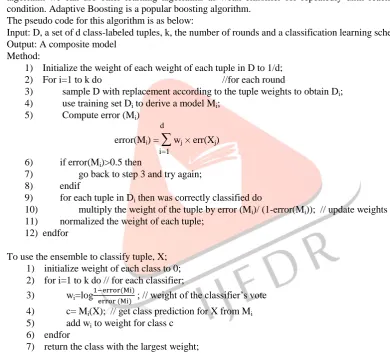
a) Adaptive Boosting (Ada-Boost) Algorithm: Adaptive-Boosting [2] is a meta-algorithm. It is used with other classification techniques. By using this algorithm performance is increase. This algorithm is sensitive to noisy and outliers. In this algorithm we can use other learning algorithms as weak classifier for repeatedly until reach to specified terminating condition. Adaptive Boosting is a popular boosting algorithm.
The pseudo code for this algorithm is as below:
Input: D, a set of d class-labeled tuples, k, the number of rounds and a classification learning scheme. Output: A composite model
Method:
1) Initialize the weight of each weight of each tuple in D to 1/d;
2) For i=1 to k do //for each round
3) sample D with replacement according to the tuple weights to obtain Di; 4) use training set Di to derive a model Mi;
5) Compute error (Mi) d
error(Mi) =
∑
wj × err(Xj) i=16) if error(Mi)>0.5 then
7) go back to step 3 and try again; 8) endif
9) for each tuple in Di then was correctly classified do
10) multiply the weight of the tuple by error (Mi)/ (1-error(Mi)); // update weights 11) normalized the weight of each tuple;
12) endfor
To use the ensemble to classify tuple, X; 1) initialize weight of each class to 0; 2) for i=1 to k do // for each classifier; 3) wi=log
; // weight of the classifier’s vote
4) c= Mi(X); // get class prediction for X from Mi 5) add wi to weight for class c
6) endfor
7) return the class with the largest weight;
Figure 2: Adaboost, a boosting algorithm
b) Decision tree algorithm: Decision tree [3] is a structure which is look like a flowchart structure, in this algorithm we perform specific test on an attribute which represented as a internal node of tree and leaf node represents the class label. Tree contains only one root node which indicates the starting of tree. This algorithm is simple and fast. Rules are easily converted to this algorithm. The accuracy of the decision tree algorithm is good. C4.5 is the most efficient and useful algorithm used for decision tree-based approach. In this algorithm initially dataset is sorted according to attribute value. This procedure is continuing until all the attributes are classified. When node of a tree contains same attribute records then that node is consider as a leaf node as represent the class label. Decision tree is performing well when size of a dataset is large. This algorithm is deal with the different types of attributes 1) Discrete valued: in this type, possible value of node N is known and the procedure of splitting is performing based on these values. 2) Continuous valued: in this splitting condition is define and based on this condition node N have only two possible outputs.3) Discrete valued but a binary tree must be produced: for this we check where the value of attribute is match with the condition or not. It generates only two branches yes or no.
The pseudo code of this algorithm is as below:
IJEDR1404065
International Journal of Engineering Development and Research (www.ijedr.org)3780
Output: a decision treeMethod:
1) create a node N;
2) if tuples in D are all of the same class C then 3) return N as a leaf node labeled with the class C; 4) if attribute_list is empty then
5) return N as a leaf node labeled with the majority class in D; //majority voting 6) apply Attributr_selection_method(D,attributr_list) to find the best splitting_criterion; 7) label node N with splitting_criterion;
8) if splitting_attribute is discrete value and multiple splits allowed then
9) attribute_list attribute_list-splitting_attribute; 10) for each outcome j of splitting_criterion
11) let Dj be the set of data tuples in D satisfying outcome j; 12) if Dj is empty then
13) attach a leaf labeled with the majority class in D to node N;
14) else attach the node return by generate_decision_tree(Dj, attribute_list) to node N; 15) endfor
16) return N;
Figure 3: basic algorithm for inducing a decision tree from training tuples
c) Naïve- Bays algorithm: This algorithm is created based on Bay’s theorem. It is based on the posterior probability. It is a statistical classifier. They can predict class membership probabilities such as the probability that a given tuple belongs to a particular class. Naïve Bayesian classifiers assume that the effect of an attribute value on a given class is independent of the values of the other attributes. This algorithm is perform accuratly when the size of the dataset is medium or large. The result of both algorithm decision tree and naïve bays are very comparitive in different domains.
Figure 4: Architecture of Expert System using Naïve-Bays classification [4]
This architecture in figure is proposed expert system using the naïve bays classification. In initial step the dataset is minimize using the simple selection step on real dataset. Then Naïve Bayesian classification was considered that optimal dataset for further classification. By using the classification in expert system we increase the efficiency of the system. IV.COMPARISION
As mention in previous section different classification techniques are used in different domain of expert system. Before choosing the classification technique we compare the different classifier using weka. In different paper comparison of different classification is given. Most probably Decision tree C4.5 and Naïve bays are used in expert system. Here I represent the confusion matrix of these two algorithms based on “DECISION TREE AND NAÏVE BYES ALGORITHM FOR CLASSIFICATION AND GENERATION OF ACTIONABLE KNOWLEDGE FOR DIRECT MARKETING.” [3]
Table 1: confusion matrix of C4.5 algorithm
Predicted class
Actual class
Yes
No
Yes
337
184
No
89
3911
Dataset
Optimal Extraction
Optimal dataset Naive
Bayesian classifier
Testing data
IJEDR1404065
International Journal of Engineering Development and Research (www.ijedr.org)3781
Table2: confusion matrix of Naïve Bays algorithmPredicted class
Actual class
Yes
No
Yes
264
257
No
298
3702
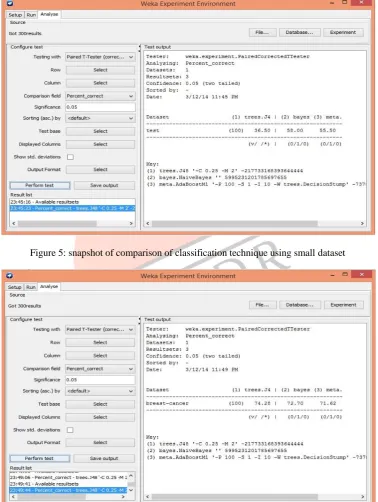
Comparison between the performance of different classification techniques on same dataset is perform using the weka tool easily before using that technique in particular domain of expert system. Here, I represent the comparison based on the size of dataset used in system Figure 5 indicates the result when the size of the dataset is small and same classification technique is perform differently when the size of dataset is large.
Figure 5: snapshot of comparison of classification technique using small dataset
IJEDR1404065
International Journal of Engineering Development and Research (www.ijedr.org)3782
V.CONCLUSION AND FUTURE WORKThis survey contains information of classification techniques applied in expert system. In this survey we study about where to apply the classification techniques in expert system. Different technique of classification is performing differently in different environment. Accuracy of the classification is dependent on the problem domain dataset. In one environment it works better and in other it not performs efficiently. So it is based on the problem domain which classification technique is applied. In future you can apply any classification technique in expert system. Expert system is broadly used in medical domain, business decision making and so many areas. So, you can apply classification to improve the result of the expert system.
VI.ACKNOWLEDGMENT
The authors would like to thank the reviewers for their precious comments and suggestions that contributed to the expansion of this work.
REFERENCES
[1] Han Jiawei and Kamber Micheline, Data Mining: Concepts and Techniques, second edition, pp. 285-296.
[2] M.S Prasad Babu, Venkatesh Achanta, N.V. Ramana Murty, Swapna K. “Development of Maize Expert System using Ada-Boost algorithm and Naïve Bayesian Classifier” IJCATR Volume 1-Issue 3, 89-93, 2012
[3] Masud karim, Rashedur M. Rahman “Decision tree and Naïve Byes algorithm for classification and generation of actionable knowledge for Direct Marketing.” Journal of software engineering and applications,2013,6,196-206
[4] A.Ambika, Satyanarayana Gandi, Amarendra Kothalanka “An Efficient Expert system for Diabetes By Naïve Bayesian classifier ” IJETT- Volume 4 Issue 10-Oct 2013
[5] Maitri patel, Atul patel, Paresh virparia “Rule based Expert System for Viral Infection Diagnosis” IJARCSSE Volume 3, Issue 5, May 2013
[6] V. Krishnaiah, Dr.G.Narsimha,Dr.N.Subhash Chandra “Diagnosis of Lung Cancer Prediction System using Data Mining Classification Techniques” IJCSIT Volume 4(1),2013,39-45
[7] G. Dimitoglou, J. A. Adams and C. M. Jim, “Comparison of the C4.5 and a Naïve Bayes Classifier for the Predic- tion of Lung Cancer Survivability,” Journal of Comput-ing, Vol. 4, No. 2, 2012, pp. 1-9.
[8] P. S. Vadivu and V. K. David, “Enhancing and Deriving Actionable Knowledge from Decision Trees,” Interna- tional Journal of Computer Science and Information Se- curity (IJCSIS), Vol. 8, No. 9, 2010, pp. 230-236.
[9] J. Huang, J. Lu and C. X. Ling, “Comparing Naïve Bayes, Decision Trees, and SVM with AUC and Accuracy,” Proceedings of Third IEEE International Conference on Data Mining (ICDM 2003), 19-22 November 2003, pp. 553-556.
[10]Weka Data Mining Tool. http://www.cs.waikato.ac.nz/ml/weka/
[11]Dan W. Patterson , “Introducation to Artificial Intelligence And Expert System”,2010.
[12]E. D. Lehmann, “Application of computers in clinical diabetes care,”Diab. Nutr. Metab, vol. 10, pp. 45–59, 1997. [13]MICHAEL NEGNEVITSKY, “Artificial Intelligence a Guid to Intelligent System”, Second Edition 2005 .
[14]Dr. B D C N Prasad, P E S N Krishna Prasad and Y Sagar, “A Comparative Study of Machine Learning Algorithms as Expert Systems in Medical Diagnosis (Asthma)” –CCSIT 2011, Part I, CCIS 131, pp 570– 576.
[15]A. J. M. Abu Afza, Dewan Md. Farid, and Chowdhury Mofizur Rahman, “A Hybrid Classifier using Boosting, Clustering, and Naïve Bayesian Classifier”, World of Computer Science and Information Technology Journal (WCSIT) ISSN: 2221-0741 Vol. 1, No. 3,105-109, 2011.
![Figure 4: Architecture of Expert System using Naïve-Bays classification [4] This architecture in figure is proposed expert system using the naïve bays classification](https://thumb-us.123doks.com/thumbv2/123dok_us/8605985.1395693/3.595.136.501.376.513/figure-architecture-expert-naive-classification-architecture-proposed-classification.webp)