Theses and Dissertations
2017
Formative Assessment Strategies for Mathematical
Thinking: A Qualitative Action Research Study
Benjamin J. Sinwell
University of South Carolina
Follow this and additional works at:https://scholarcommons.sc.edu/etd Part of theCurriculum and Instruction Commons
This Open Access Dissertation is brought to you by Scholar Commons. It has been accepted for inclusion in Theses and Dissertations by an authorized administrator of Scholar Commons. For more information, please [email protected].
Recommended Citation
By
Benjamin J. Sinwell
Bachelor of Arts Vassar College, 1999
Master of Education Boston University, 2003
Submitted in Partial Fulfillment of the Requirements
For the Degree of Doctor of Education in
Curriculum and Instruction
College of Education
University of South Carolina
2017
Accepted by:
Susan Schramm-Pate, Major Professor
Suha Tamim, Committee Member
Kenneth Vogler, Committee Member
Vic Oglan, Committee Member
ii
© Copyright by Benjamin J. Sinwell, 2017
iii
ACKNOWLEDGEMENTS
I wish to thank my dissertation chair and my committee for their comments and
feedback through the dissertation process. I also wish to thank my wife, Nicole Bannister
Sinwell, for supporting me and my family while I completed this degree while continuing
to work full time. I also wish to acknowledge those on social media who supported me
with their comments, suggestions and ideas. In particular would like to thank Mikel Cole
for his guidance throughout all of the stages of the dissertation process. In addition, I
would like to acknowledge Ed Dickey for advising me on mathematical thinking and the
early stages of the dissertation process. Finally, I would like to thank my students, my
colleagues, co-workers and the mathematicians and mathematics educators who I have
iv ABSTRACT
Developing Formative Assessment Strategies for Mathematical Thinking is a
qualitative action research study that investigates how one mathematics teacher
implements formative assessment strategies aimed at impacting students’ mathematical
thinking in two geometry classes a southern Title I public high school. This study is
predicated on the notion that when students share their mathematical thinking in class, it
stimulates classroom discussion and discourse and provides evidence vis-à-vis formative
assessments that the teacher can use to improve mathematics curriculum and
instruction. The study is theoretically grounded in Wiliam and Thompson’s (2007) Five
Key Formative Assessment Strategies that include: 1. Clarifying and Sharing; 2.
Engineering Effective Classroom Discussions; 3. Providing Feedback; 4. Activating
Students as Instructional Resources; and 5. Activating Students as Owners. These
assessment strategies were implemented and qualitative data on student mathematical
thinking was collected in the form of the written reflections of student-participants.
Other data included samples of student-participants’ work and a teacher journal. Data
was examined using the constant comparative analysis method in the spirit of a
qualitative educational action research paradigm in order to provide a rich, thick
description of the different ways that formative assessment strategies impacted these high
school students’ mathematical thinking. The findings of the study include how the
v
student-participants: 1) used mathematical thinking to think about and learn mathematics
while problem solving, 2) engaged in metacognitive processes while solving problems, 3)
discussed and engaged in mathematical thinking while working and learning
collaboratively, 4) described the importance of presence of mind, motivation and emotion
to mathematical thinking, and 5) described their beliefs about actions they could take to
improve their mathematical thinking. The findings were reflected upon and shared with
student-participants and other teachers in the teacher-researcher’s school district. The
Action Plan that was derived from the present study will be put into action in the
teacher-researcher’s classroom and findings will be disseminated at regional and national
mathematics professional conferences.
Keywords: formative assessment, action research, constant comparative method,
vi
TABLE OF CONTENTS
ACKNOWLEDGEMENTS ... iii
ABSTRACT ... iv
LISTOFFIGURES ... viii
CHAPTERONE:RESEARCHOVERVIEW ...1
CHAPTERTWO:RELATEDLITERATUREREVIEW ...23
CHAPTERTHREE:METHODOLOGY ...54
CHAPTERFOUR:FINDINGSANDIMPLICATIONS ...72
CHAPTERFIVE:SUMMARYANDCONCLUSIONS ...121
REFERENCES ...139
APPENDIXA:RESEARCHPLANNINGSCHEDULESHEET ...151
APPENDIXB:ASSENTTOBEARESEARCHSUBJECT ...153
APPENDIXC:FIELDNOTETEMPLATE ...155
APPENDIX D: FIRST CYCLE CODING CATEGORIES FOLLOWED BY INITIAL AND DESCRIPTIVE CODES ...156
APPENDIX E: SUMMARIZED DATA FOR THEME ONE ORGANIZED BY FOUR SUB-THEMES ...158
APPENDIX F: SUMMARIZED DATA FOR THEME TWO ORGANIZED BY FOUR SUB-THEMES ...161
APPENDIX G: SUMMARIZED DATA FOR THEME THREE ORGANIZED BY TWO SUB-THEMES ...164
vii
viii
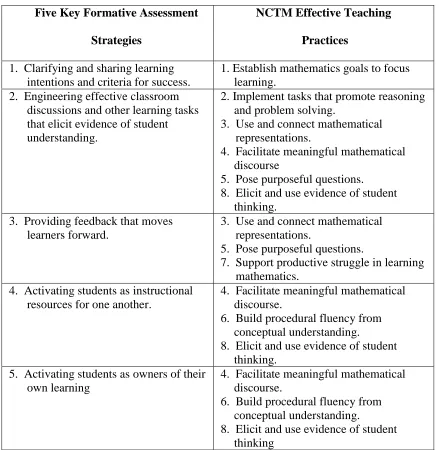
Figure 2.1 Alignment of the Five Key Formative Assessment Strategies with NCTM’s
effective teaching practices ...35
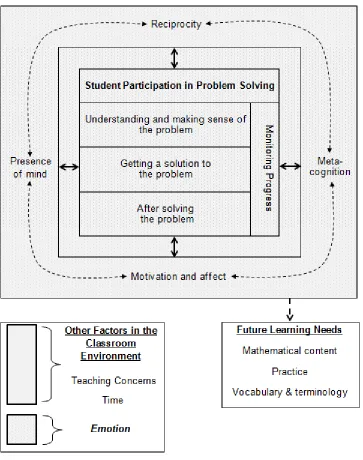
Figure 4.1 Problem solving and mathematical thinking in the classroom ...78
Figure 4.2Problem solving, mathematical thinking and emotion in the classroom ...114
1
CHAPTER ONE: RESEARCH OVERVIEW
Introduction
Topic
Problem solving and mathematical reasoning is currently a focus of mathematics
education in the United States (NCTM, 2000, 2009, 2014; CCSSM, 2009). This is
evidenced by two of the Common Core State Standards for Mathematics’ (CCSSM,
2009) eight Standards of Mathematical Practice: 1) “make sense of problems and
persevere in solving them” and 2) “construct viable arguments and critique the reasoning
of others” (CCSSM, 2009, p. 6). At the same time that these standards were released, the
National Council of Teachers of Mathematics called for a focus on reasoning and sense
making in secondary mathematics classrooms ((NCTM, 2009). In Principles to Actions
(NCTM, 2014), the National Council of Teacher of Mathematics:
identified a number of principles of learning that provide the foundation for
effective mathematics teaching. Specifically, learners [of mathematics] should
have experiences that enable them to—
engage with challenging tasks that involve active meaning making and
support meaningful learning;
connect new learning with prior knowledge and informal reasoning and, in
the process, address preconceptions and misconceptions;
2
and transfer and apply knowledge to new situations;
construct knowledge socially, through discourse, activity, and interaction
related to meaningful problems;
receive descriptive and timely feedback so that they can reflect on and
revise their work, thinking, and understandings; and
develop metacognitive awareness of themselves as learners, thinkers,
and problem solvers, and learn to monitor their learning and performance.
(p. 8)
These principles of learning are at the heart of creating a classroom
environment where students can better learn to do mathematics and to explain
their mathematical thinking. The National Council of Teachers of Mathematics
links the aforementioned principles of learning to eight effective mathematical
teaching practices:
Establish mathematics goals to focus learning.
Implement tasks that promote reasoning and problem solving.
Use and connect mathematical representations.
Facilitate meaningful mathematical discourse.
Pose purposeful questions.
Build procedural fluency from conceptual understanding.
Support productive struggle in learning mathematics.
3
The National Council of Teachers of Mathematics (2000, 2009, 2014) has
identified and made clear the types of experiences students should have as
learners and the types of teaching practices that should be taking place in effective
mathematics classrooms. The Council points out that effective implementation is
“possible only when school mathematics programs have in place a commitment to
access and equity” (NCTM, 2014, p. 59) and that “all students have access to a
high-quality mathematics curriculum, effective teaching and learning, high
expectations, and the support and resources needed to maximize their learning
potential” (p. 59). The question that arises from this is: What can the teacher do
to help all students develop and express how they think about mathematics? As a
teacher leader, the teacher-researcher is “determined to become the architect of
vibrant professional communities in which teachers take the lead in inventing new
possibilities for their students and for themselves” (Lieberman & Miller,
2004/2013, p. 422). The teacher-researcher shares NCTM’s vision of access and
equity that “includes both ensuring that all students attain mathematics
proficiency and increasing the numbers of students from all racial, ethnic, gender,
and socioeconomic groups who attain the highest levels of mathematics
achievement” (NCTM, 2014, p. 60).
The Problem of Practice
The problem of practice in this dissertation is that high school geometry students
routinely do not show evidence of mathematical thinking while working on or after
working on mathematical tasks. The mathematical pedagogical strategies that the
4
focused on memorization and the application of mathematical procedures rather than on
how to make sense of and reason with mathematics – to think mathematically. Students
were rarely asked to explain their mathematical thinking on assignments or assessments
and often had limited opportunities to learn mathematics via social interactions with other
students. In short, studentswere not enabled to explicitly show and develop their
mathematical thinking in prior mathematics classes. In the years leading up to this study,
the teacher-researcher had struggled to get his students to show evidence of mathematical
thinking and to engage in thinking mathematically. The teacher-researcher aimed to
bring his mathematics classroom into the 21st century where students would not only
learn how to do mathematics but also how to learn mathematics and to think
mathematically. To accomplish this, the teacher-researcher sought to improve his own
practice and elected to use Wiliam and Thompson’s (2007) Five Key Formative
Assessment Strategies during instruction to enable students to develop and show
evidence of mathematical thinking.
Consider the following three hypothetical vignettes representing everyday
interactions from secondary mathematics classrooms:
Vignette One. Mr. Salois asks his geometry students to estimate the surface area
of the walls in his classroom. He tells them that they need a mathematical explanation
that goes with their estimate. Within a few seconds, some groups are out of their seats
and recording the number of square tiles on the floor. Another group is looking up at the
ceiling tiles and talking about how big they are. The group sitting by the window is silent
and still. Mr. Salois walks over and asks the group by the window if they understand the
5
measure the room. They take it, and the group walks to the corner with a notebook and
holds the yardstick to the wall. A few more minutes pass while the teacher checks in
with the other groups. The teacher tells all of the students to go back to their seats and
discuss how they estimated the area and to provide a written mathematical explanation of
their method. The room fills immediately with the voices of students talking about the
task. Sandra, one of the students in the group by the window is writing in her notebook.
The rest of the students in her group shake their heads in agreement and Sandra puts her
pencil down. Sandra’s paper says, “We used a yardstick and got 800.” The actual
surface area of the walls was approximately 825 square feet.
Vignette Two. Mrs. Howorth asked her students to write a rule that describes
each of the following patterns:
Pattern 1: 3, 5, 7, 9, …
Pattern 2: 6, 12, 18, 24, …
Pattern 3: 30, 60, 90, 120, …
Students were asked to work quietly through the problem for three minutes and then
asked to share their thinking with their partner. The teacher observed the work students
had on their papers and listened to the students talk about mathematics. It appeared to
her that everyone had solved the problem. During the whole class discussion, students
shared their rules and provided sound mathematical explanations. To finish the task,
Mrs. Howorth asked the class if anybody had any other rules. Jennifer raised her hand
and said that “multiplying by two works for all of them.” After much debate between
Jennifer, the teacher and other students about her rule, she came to the board and pointed
6
subtract the number that comes before it [she points to the 5]. Two times seven minus
five equals nine. This works for all of them.” She was correct.
Vignette 3. Ms. Miller brings in a box of ice cream cones during the final week
of school and asks her students to work in pairs to find the volume of one of the ice
cream cones. As she observed students measuring the cones, she saw that Dalton, whose
partner was absent from class, was measuring the thickness of the cone to calculate the
interior radius and the interior height of the cone. During the class discussion, the teacher
found that the rest of the students in the class had used two methods: 1) they estimated
the interior height and radius of the ice cone to find out how much ice cream would fit in
the cone or 2) they found height and radius of the ice cream cone and found its volume as
if it were a geometric solid. She knew that Dalton had found the volume of the ice cream
cone (the baked part) itself. She asked him to explain how he found the volume of the ice
cream cone. Dalton explained, “I found the thickness of the ice cream cone and
subtracted.” Ms. Miller pressed him for more explanation, but he offered no more. She
finished the class by showing, on the board, how Dalton had solved the problem on his
paper.
These vignettes illustrate everyday interactions in typical high school
mathematics classrooms, and each scenario raises questions about student engagement in
mathematical explanations. In Vignette One, the group by the window had trouble
getting started (making a plan) with solving the problem. They were “not inclined to
communicate their thinking” (Szetela & Nicol, 1992, p. 43). However, the group by the
7
answer that lacked mathematical explanation. What could the teacher do next to get this
group to explain their reasoning?
In Vignette Two, the teacher seems satisfied with her lesson, perhaps because her
mathematical goals had been met. Though the teacher might have been ready to move
on, Jennifer’s explanation of her method for solving the problem caused additional
discussion about her idea. Jennifer’s explanation appears incorrect at first, but after some
discussion, Jennifer describes a rule that works for all three patterns. What was the
impact of the teacher asking students for ‘other rules’ on their mathematical
explanations? If the teacher had dismissed Jennifer’s method by providing a
counterexample (i.e. in Pattern 1, three times two does not equal five) and merely
re-stated the previous rules, would the class ever have gotten to hear Jennifer’s powerful
mathematical explanation?
Dalton (Vignette Three) was the only student in the class to find the volume of the
ice cream cone itself. He subtracted the inner volume (air) from the total volume (air and
the cone itself). His method combined the two methods shared by other students in the
class. The teacher shared Dalton’s method for solving the problem with the class. How
does the teacher know if the students understand Dalton’s method? Do the students know
that Dalton’s solution was the only correct method that was presented to the class? What
moves could the teacher have made to move the thinking in the class forward on this
problem?
The teachers portrayed in each vignette promoted reasoning through mathematical
explanations by observing the written work of students, monitoring task completion, and
8
able to make sense of student thinking and to make in vivo adjustments to their
curriculum and pedagogy to optimize student learning. We know that a teacher’s
“attention to minute-by-minute and day-by-day formative assessment is likely to have the
biggest impact on student outcomes” (Wiliam, 2011, p. 27). Formative assessment in the
form of observations of student interactions in class dialogue requires a certain teacher
skill set. Postmodern curriculum studies value qualitative data and the promotion of class
dialogue and discourse. Furthermore, class dialogue and discourse are part of the
foundation for creating an equitable mathematics classroom (Horn, 2012; Moschkovich,
2013; NCTM, 2014). Enabling mathematics teachers to engage in a pedagogical
approach whereby students feel free to articulate the issues they are having in the
mathematics classroom is challenging and a worthwhile endeavor. Sfard’s (2007; 2008a)
‘commognitive’ framework allows us to make the connections between all of the
teaching and learning interactions that are happening in the classroom because they are
discursive. Her theory accounts for the thoughts of both the students and the teacher and
includes them as part of the classroom discourse. This is particularly important to
formative assessment since it is in those “moments of contingency” (Black & Wiliam,
2009, p. 10) in the classroom during which the teacher must decide what choices to make
to foster learning. William and Thompson (2007) have identified the following Five Key
Formative Assessment Strategies that the teacher can use to implement formative
assessment in their teaching:
1. Clarifying and Sharing learning intentions and criteria for success;
2. Engineering Effective Classroom Discussions and other learning tasks that
9
3. Providing Feedback that moves learners forward;
4. Activating Students as Instructional Resources for one another; and
5. ActivatingStudents as Owners of their own learning. (Wiliam &
Thompson, 2007, p. 53)
The use of any of Wiliam and Thompson’s (2007) Five Key Formative Assessment
Strategies during instruction creates an environment in which students are given
opportunities to modify or extend their discourse (learning) and to “make sense of the
world around them” (Sfard, 2007, p. 575). The teacher-researcher in this action research
study adopted these Five Key Formative Assessment Strategies into his teaching
practices in an effort to get students to show evidence of mathematical thinking while
working on or after working on mathematical tasks.
Research Question
1. How does the use of Wiliam and Thompson’s (2007) Five Key Formative
Assessment Strategies impact students’ mathematical thinking?
Purpose Statement
The purpose of this study is to investigate how one mathematics teacher’s
implementation of the Five Key Formative Assessment Strategies (William & Thompson,
2007) impacted student-participants’ mathematical thinking in his two high school
geometry classes. The teacher-researcher used the Five Key Formative Assessment
Strategies while students worked on mathematical tasks. The teacher-researcher used
these strategies to enable the classroom to be more constructivist and progressivist in
nature where students were encouraged to engage in discussion and discourse about
10
process. The teacher-researcher used these strategies to “elicit evidence of students’
current mathematical understanding” (NCTM, 2014, p. 53) and to develop the
mathematical thinking of the student-participants.
This qualitative action research study took place in two geometry classrooms
where students were free to articulate their perceptions and feelings about mathematics
content and instruction. This was possible because the teacher-researcher took a
progressivist approach to his instruction. This enabled the teacher-researcher to use this
feedback as a formative assessment strategy in order to alter pedagogical practices to
meet students “where they are.” Meeting students “where they are” is more than just a
cliché, it is a “key characteristic of equitable classrooms” (Horn, 2012, p. 15) and “fits in
the broader landscape of equitable mathematics teaching: modes of instruction that
optimally support meaningful learning for all students” (p. 9). Data was collected in the
form of a teacher journal, student-participant reflections and student-participant work and
was analyzed using the constant-comparative method. This DiP describes what happened
to the mathematical thinking of the students in this action research study.
The teacher-researcher employed action research methodology in his classroom in
order to implement Wiliam and Thompson’s (2007) Five Key Formative Assessment
Strategies. The use of these Five Key Formative Assessment Strategies in mathematics
education is an area of active research (Swan & Burkhardt, 2014; Evans & Swan, 2014).
Evans and Swan (2014) report that there are “early indications” (p. 27) that formative
assessment strategies can help improve student mathematical thinking and indicate that
this is an area for further study. The teacher-researcher used Wiliam and Thompson’s
11
mathematical tasks to further his pedagogical goal of assessing student progress in “live”
time (Black et al., 2004). These formative strategies are aligned to “equitable
mathematics teaching” (Horn, 2012, p. 9) and will be carried out during “moments of
contingency” (Black & Wiliam, 2009, p. 10) which are those times during the
instructional process where the teacher makes a decision based on what is happening in
the class with the intention of improving learning (2009). In the present action research
study, one of the instructional goals, in addition to any geometry-specific goals (i.e.
applying the Pythagorean Theorem), was to “elicit evidence of students’ current
mathematical understanding” (NCTM, 2014, p. 53) in the form of mathematical
explanations. The teacher-researcher plans to share his findings with the
student-participants and with other teachers in his school, his district and with other teachers at
the National Council of Teachers of Mathematics’ professional development institutes
and conferences. This will provide “even greater opportunities for professional dialogue,
reflection and brainstorming” (Mertler, 2014, p. 249) and help the teacher-researcher to
lead others by making public his “understandings about students, strategies for learning,
and the organization of the curriculum” (Lieberman & Miller, 2004/2013, p. 421).
Rationale
The importance of formative assessment on student learning has been well
documented (Black & Wiliam, 1998, 1999, 2009; Swan & Burkhardt, 2014; Wiliam,
2011; Wiliam & Thompson, 2007). Black and Wiliam (2009) define formative
assessment as:
Practice in a classroom is formative to the extent that evidence about student
12
to make decisions about the next steps in instruction that are likely to be better, or
better founded, than the decisions they would have taken in the absence of the
evidence that was elicited. (p. 9)
Black and Wiliam’s (2009) work towards a theory of formative assessment includes a
focus on “issues of psychology, curriculum and pedagogy [because] such a focus allows
the teacher to engage with these issues in a way that is directly and immediately relevant
to their practice” (p. 28). Their theory attempts to “bring into relationship the three
spheres: the teacher’s agenda, the internal world of each student, and the inter-subjective”
(Black & William, 2009, p. 26). This metaphor, in combination with the vignettes
described earlier, help us to think about the complex interactions that occurred in the
classroom where this study took place. Black and Wiliam’s work toward developing a
theory of formative assessment provides a theoretical framework that ties together
theoretical work on curriculum, pedagogy, social learning theory, cognition and
classroom discourse that provides the justification for the use of the Five Key Formative
Assessment Strategies in this DiP. What follows in the next section are the specifics
about curriculum, pedagogy, social learning theory, cognition and classroom discourse as
they relate to the Five Key Formative Assessment Strategies and student mathematical
explanations.
Pedagogy and mathematics. The National Council of Teachers of Mathematics
(2014) writes the following about teaching mathematics:
The teaching of mathematics is complex. It requires teachers to have a deep
understanding of the content that they are expected to teach and a clear view of
13
It also calls for teachers to be skilled at using instructional practices that are
effective in engaging students in meaningful learning through individual and
collaborative experiences that promote their ability to make sense of mathematical
ideas and reason mathematically. (p. 7)
This description helps to further justify the use of the Five Key Formative Assessment
Strategies because the strategies align with what it means to be an effective mathematics
teacher (NCTM, 2014). This alignment will be further described in the review of the
related literature in Chapter 2. The importance of student mathematical explanations is
evidenced in the above description of mathematics teaching when it refers to students
being able “to make sense of mathematical ideas and reason mathematically” (NCTM,
2014, p. 7).
Civil rights leader Robert Moses states that “the absence of math literacy in urban
and rural communities throughout this country is an issue as urgent as the lack of black
voters was in Mississippi in 1961” (Moses & Cobb, 2001, p. 5). Effective mathematics
teaching requires a “commitment to access and equity” (NCTM, 2014, p. 59) and this
commitment can be translated into practice using Horn’s (2012) “four principles for
equitable mathematics teaching” (p. 13). These principles are:
Principle 1: Learning is not the same as achievement.
Principle 2: Achievement gaps often represent gaps in opportunities to learn.
Principle 3: All students can be pushed to learn mathematics more deeply.
Principle 4: Students need to see themselves in mathematics. (Horn, 2012, p. 19)
A description of how these principles relate to formative assessment and a review of the
14
Mathematical explanations in the curriculum. Student mathematical
explanations in the classroom are usually explanations provided by students in response
to thinking about solving, solving or attempting to solve mathematical tasks or problems.
The importance of problem solving, what it looks like and ways to measure it are well
researched topics in mathematics education (Charles, Lester & O’Daffer, 1987; Polya,
1945; Schoenfeld, 1985; Schoenfeld, 1992). The Common Core State Standards for
Mathematics describe Standards for Mathematical Practice (CCSSM, 2009, p. 6) that
stress the importance of problem solving and thinking mathematically. The National
Council of Teachers of Mathematics (2014), describes the importance of the effective
mathematical teaching practice labeled “facilitate meaningful mathematical discourse”
(p. 10) using a quotation from Carpenter, Franke, and Levi (2003):
Students who learn to articulate and justify their own mathematical ideas, reason
through their own and others’ mathematical explanations, and provide a rationale
for their answers develop a deep understanding that is critical to their future
success in mathematics and related fields. (p. 3)
The direct connection of student mathematical explanations to the Key Formative
Assessment Strategy of “engineering effective classroom discussions and other learning
tasks that elicit student understanding” (Wiliam & Thompson, 2007, p. 53) provides
further justification for this action research study’s focus on formative assessment
strategies and student mathematical explanations.
Social learning theory, cognition and classroom discourse in
mathematics. The interplay between feedback and learning as a social process is
15
feedback can help to engage students in productive mathematical struggle and to
become more successful at solving problems (Kilpatrick, Swafford, & Findell,
2001; Carpenter et al., 2003; Sfard, 2007). Sfard (2007) tells us that:
Without other people’s examples, children may have no incentive for changing
their discursive ways. From the children’s point of view, the discourse in which
they are fluent does not seem to have any particular weaknesses as a tool for
making sense of the world around them. (p. 577)
When students share their mathematical explanations, they are acting as “instructional
resources for one another” (Wiliam & Thompson, 2007). Sfard’s (2007) theory of
‘commognition’ helps us to further understand the connections between the Five Key
Formative Assessment Strategies and mathematical explanations. The neologic
‘commognition’ is a blend word that combines communication and cognition (thinking).
Commognition theory operates under the premise “that thinking is a form of
communication and that learning mathematics is tantamount to modifying and extending
one's discourse” (Sfard, 2007, p. 565). This theory helps us to understand what
“activating students as the owners of their learning” (Wiliam & Thompson, 2007, p. 53)
means. Owning one’s learning implies that the individual has learned something and
Sfard (2007) argues that this learning, albeit intrapersonal (thinking), is inherently linked
to the interpersonal communication (i.e., classroom discourse) that influenced it. This
theory of commognition, in particular, the view of “thinking as communication” (Sfard,
2008a) helps underline the importance of “engineering effective classroom discussions
and other learning tasks that elicit evidence of student understanding” (Wiliam &
16
non-verbally) in a classroom environment, they are making their own intrapersonal
discourse (thinking) become part of the larger interpersonal discourse taking place
throughout the classroom. Sfard (2007) also posits that the “learning-teaching
agreement” is a “condition for learning” and that “routines of mathematizing” (p. 605)
need to be agreed upon between the teacher and the learner. This provides a theoretical
context for the importance of William and Thompson’s (2007) strategy of “clarifying and
sharing learning intentions and criteria for success.” The teacher and learner must engage
in a “social agreement” (Sfard, 2007, p. 605) for learning to flourish (Yackel & Cobb,
1996). Sfard’s (2007) theory of commognition provides an interpretive framework with
which to connect Wiliam and Black’s (2009) theory of formative assessment (rationale
for using the Five Key Formative Assessment Strategies) directly to mathematical
learning (mathematical explanations as an extension of one’s discourse (thoughts and
utterances) (Sfard, 2007, p. 565)).
Glossary
Action Research: “any systematic inquiry conducted by teachers, administrators,
counselors, or others with a vested interest in the teaching and learning process or
environment for the purpose of gathering information about how their particular schools
operate, how they teach, and how their students learn” (Mertler, 2014, p. 305).
Acquisitionism: “A research discourse grounded in the “metaphor of learning as
an act of increasing individual possession - as an acquisition of entities such as concepts,
knowledge, skills, mental schemas – comes to this scholarly discourse directly from
everyday expressions, such as acquiring knowledge, forming concepts or constructing
17
Commognition: “term that encompasses thinking (individual cognition) and
(interpersonal) communicating; as a combination of the words communication and
cognition, it stresses the fact that these two processes are different (intrapersonal and
interpersonal) manifestations of the same phenomenon” (Sfard, 2008a, p. 296).
Communication: “a collectively performed rules-driven activity that mediates
and coordinates other activities of the collective” (Sfard, 2007, p. 567).
Constant Comparative Method: “a research design for studies involving
multiple data sources, where data analysis begins early in the study and is nearly
completed by the end of data collection” (Mertler, 2014, p. 306).
Discourse: “rule-governed mulitmodal communicational activity” (Sfard &
Cobb, 2014, p. 558).
Equitable Mathematics Teaching: teaching that “involves using modes of
instruction that optimally support meaningful mathematical learning for all students”
(Horn, 2012, p. 9). Formative assessment is “consonant with the four principles for
equitable mathematics teaching” (p. 56).
Formative Assessment:“Practice in a classroom is formative to the extent that
evidence about student achievement is elicited, interpreted, and used by teachers,
learners, or their peers, to make decisions about the next steps in instruction that are
likely to be better, or better founded, than the decisions they would have taken in the
absence of the evidence that was elicited” (Black & Wiliam, 2009, p. 9).
Learning: “change of discourse” (Sfard, 2008a, p. 255; Sfard & Cobb, 2014, p.
18
Metacognition: “the ability to monitor one’s current level of understanding and
decide when it is not adequate” (Bransford et al., 2000, p. 47).
Moments of Contingency:those times during the instructional process where the
teacher makes a decision based what is happening in the class with the intention of
improving learning (Black & Wiliam, 2009).
Participationism: “research discourse grounded in the metaphor of learning as
improving participation in historically established forms of activity” (Sfard, 2008a, p.
301).
Reification: “the process of giving form to our experience by producing objects
that congeal this experience into ‘thingness’” (Wenger, 2000, p. 58). It includes cases
when “aspects of the human experience and practice are congealed into fixed forms and
given the status of an object” (Wenger, 2000, p. 59).
Thinking: “an individualized form of (intrapersonal) communicating” (Sfard,
2008a, p. 81).
Methodology
The research tradition used in this classroom-based action research study was a
qualitative research design (Mertler, 2014). The qualitative approach that was taken in
this action research study was an observational study in which the teacher-researcher was
a “full participant” (Mertler, 2014, p. 95). Participant observation allowed the
teacher-researcher to “learn firsthand how the actions of the participants correspond with their
words, to see patterns of behavior, [and] to experience that which was unexpected”
(Mertler, 2014, p. 93). The data in this study was analyzed using the constant
19
Participant Selection and Research Site
This action research study took place in two geometry classes at a southern Title I
public high school of approximately 800 students. The mathematics courses taught at
this high school follow a traditional sequence (Algebra I, Geometry, Algebra 2).
Students attend classes that meet for 88 minutes on every other day and all students have
access to personal Chromebooks provided by the school and excellent internet access
during the school day. This action research study took place with one teacher, the
teacher-researcher, and the students from two of his geometry classes over the course of
eight weeks during the fall of the 2016-2017 school year. Improving mathematical
explanations was one of the instructional goals for the classes. Consenting students from
these two classes were the participants selected for this study and they represent a
convenience sample. The teacher-researcher is currently teaching several different
courses at his school and has taught a variety of others over the last several years. The
rationale for selecting two geometry classes is that geometry represents the class that the
teacher-researcher has taught the most consistently at his school. The rationale for
selecting two classes is that this number represents the total number of geometry classes
that the teacher-researcher teaches. The number of students in each class is 28 and 24
respectively. The teacher-researcher is in his fifteenth year of teaching, is a National
Board certified teacher, holds a Master’s of Education degree in mathematics education
and a Bachelor of Arts degree in Biology. He is a regular speaker at mathematics
education conferences,provides professional development at the local, state and national
20
provide an opportunity for the teacher-researcher to disseminate more broadly the
findings of this DiP (Mertler, 2014).
Sources of Data Collection
The primary source of data was the written reflections of the student-participants
to the following prompts:
1. Describe how you came up with your mathematical explanation or your
mathematical understanding of today’s problem. What helped you? What
didn’t?
2. Reflect on anything that you found important, challenging or otherwise
notable about the problem solving process that you or your classmate(s) used
to work through today’s mathematical task.
3. What could help you get better at coming up with a mathematical
explanation?
This source of data served a dual-purpose for the teacher-researcher: 1) it provided data
that related directly to the research question of this study, and 2) the prompt itself and the
resulting reflections provided evidence of one of the Five Key Formative Assessment
Strategies in action. The second source of data was classroom artifacts in the form of
written mathematical explanations that students produced as part of routine classroom
activities. The third and final data source was a teacher journal containing field notes
about this teacher-researcher’s use of the Five Key Formative Assessment Strategies and
relevant observations of student interactions. The teacher-researcher also used the
21
in regards to student mathematical explanations at the end of each class period, when
appropriate and feasible.
Summary of the Findings
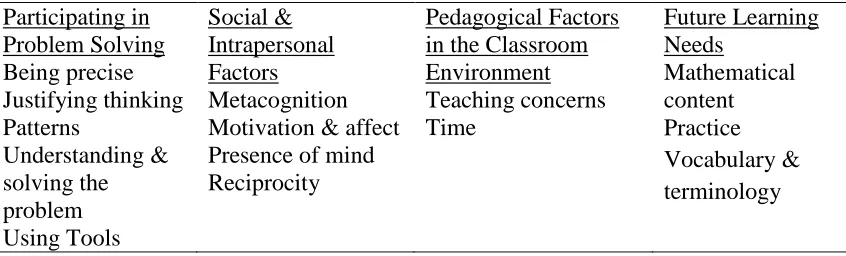
The findings of this study fall under four themes: 1) student-participant
participation in problem solving, 2) social and intrapersonal factors in the classroom
environment, 3) pedagogical factors in the classroom environment, and 4) future learning
needs. This first theme provides evidence that student-participants: 1) made sense of
problems using prior knowledge and figured out how to get started solving the problem,
2) solved problems (and thought about) solving problems in a variety of ways while using
a variety of tools, 3) explained or made sense of their mathematical solution or solution
path in different ways, and 4) monitored their progress during the problem solving
process. The second theme found evidence that reciprocity (working together), presence
of mind (attention), metacognition, motivation and affect were social and intrapersonal
factors important to mathematical thinking. The third theme found evidence that
instructional decisions (pedagogy) and time (timing) had an impact on mathematical
thinking. Finally, theme four found that student-participants identified that the following
four activities could help them to better explain their mathematical thinking in the future:
1) practicing more, 2) learning more mathematical vocabulary and terminology, 3)
learning more mathematical content, and 4) studying. The following section provides an
overview of this DiP.
Dissertation Overview
This section provides an overview of the remaining chapters of this DiP. Chapter
22
discussion of literature related to formative assessment and the participationist
perspective as part of the theoretical framework. In addition, it includes a discussion of
the literature related to action research and the constant comparative method. Chapter
Three, methodology, describes the qualitative action research methodology used in this
dissertation. In addition, it describes the plan for data analysis, plan for reflecting with
participants on data, and the plan for devising an Action Plan. Chapter Four, findings and
implications, provides a detailed description of the findings of this DiP. In addition, it
describes the implications of the findings as they relate to the related literature, to the
teacher-researcher, and to the student-participants. Chapter Five, summary and
conclusions, includes a summary of the study, the focus of the study, the major points of
the study, a detailed Action Plan including sharing data with student-participants and a
timeline of actions to be taken by the teacher-researcher, suggestions for future research,
23
Introduction
Throughout his teaching career, the teacher-researcher has observed that students
find it difficult to express their mathematical thinking. To be an effective mathematics
teacher, it is essential that students express their mathematical thinking and that the
teacher establishes an environment where the expression of mathematical thinking is
fostered and elicited (NCTM, 2014). Formative assessment requires teachers to monitor
and solicit evidence of student mathematical thinking during instruction. By observing
the written work of students, monitoring task completion, and facilitating classroom
discourse, teachers can employ formative assessment strategies that gauge student
progress and help ascertain how pedagogy needs to be altered to meet students “where
they are.” Problems arise when teachers are not able to use formative assessment to
enable their students to talk with each other or the teacher about the issues they are
having in the classroom regarding mathematics. The question that arises from this
problem is: What can the teacher do to help students develop and express how they think
about mathematics?
Chapter Two of this Dissertation in Practice (DiP) involves a literature review of
the theoretical foundation and the historical contextualization of formative assessment
strategies in United States schooling, specifically mathematics classrooms. The Chapter
begins with a discussion of the importance of a literature review and is followed by a
24
associated with this DiP and the identified ‘problem of practice’ surrounding the impacts
of the use of formative assessment in secondary mathematics classrooms.
The Problem of Practice
The problem of practice in this dissertation is that high school geometry students
routinely do not show evidence of mathematical thinking while working on or after
working on mathematical tasks. The mathematical pedagogical strategies that the
students in this study were exposed to before they entered high school geometry were
more focused on memorization and the application of mathematical procedures rather
than on how to make sense of and reason with mathematics – to think mathematically.
Students were rarely asked to explain their mathematical thinking on assignments or
assessments and often had limited opportunities to learn mathematics via social
interactions with other students. In short, studentswere not enabled to explicitly show
and develop their mathematical thinking in prior mathematics classes. In the years
leading up to this study, the teacher-researcher had struggled to get his students to show
evidence of mathematical thinking and to engage in thinking mathematically. The
teacher-researcher aimed to bring his mathematics classroom into the 21st century where
students would not only learn how to do mathematics but also how to learn mathematics
and to think mathematically. To accomplish this, the teacher-researcher sought to
improve his own practice and elected to use Wiliam and Thompson’s (2007) Five Key
Formative Assessment Strategies during instruction to enable students to develop and
25
Research Question
1. How does the use of Wiliam and Thompson’s (2007) Five Key Formative
Assessment Strategies impact students’ mathematical thinking?
Purpose Statement
The purpose of this study is to investigate how one mathematics teacher’s
implementation of the Five Key Formative Assessment Strategies (William and
Thompson, 2007) impacted student-participants’ mathematical thinking in his two high
school geometry classes. The teacher-researcher used the Five Key Formative
Assessment Strategies while students worked on mathematical tasks. The
teacher-researcher used these strategies to enable the classroom to be more constructivist and
progressivist in nature where students were encouraged to engage in discussion and
discourse about mathematics and mathematical thinking throughout the eight week data
collection process. The teacher-researcher used these strategies to “elicit evidence of
students’ current mathematical understanding” (NCTM, 2014, p. 53) and to develop the
mathematical thinking of the student-participants.
Importance of a Literature Review
The literature review is important to this DiP because it “is the foundation and
inspiration for substantial, useful research” (Boote & Biele, 2005, p. 3) and it is “an
essential component of research” (Maxwell, 2006, p. 31). Boote and Biele (2005) state
that “a substantive, thorough, sophisticated literature review is a precondition for doing
substantive, thorough, sophisticated research” (p. 3) and that “a researcher cannot
perform significant research without first understanding the literature in the field” (p. 3).
The literature review process is critical to “constructing a foundation on which research
26
differentiate between “what has been done from what needs to be done” (Hart, 1999, p.
27). The literature review assisted the teacher-researcher in “choosing a productive
dissertation topic and appropriating fruitful methods of data collection and analysis”
(Boote & Biele, 2005, p. 3). It also traces the evolution of various theories that have
allowed the teacher-researcher to establish the theoretical framework of this DiP. In
particular, this related literature review discusses Wiliam and Thompson’s (2007) Five
Key Formative Assessment Strategies which include: 1. “Clarifying and Sharing”; 2.
“Engineering Effective Classroom Discussions”; 3. “Providing Feedback”; 4. “Activating
Students as Instructional Resources”; and 5. “Activating Students as Owners” (p. 53).
These Five Key Formative Assessment Strategies were employed in order to
supply the qualitative data on student mathematical thinking that was collected in the
form of teacher field notes, sample student-participant work, and student-participant
reflections. Within the spirit of action research, this related literature review allows the
teacher-researcher to share and reflect upon mathematical curriculum pedagogy with his
colleagues, in the scholarly literature, and in contemporary discourse on formative
assessment in mathematics education.
Theoretical Base
The related literature review of this DiP describes “theoretical perspectives and
previous research findings regarding the problem at hand” (Leedy & Ormrod, 2005, p.
64). It defines the theoretical framework of this study and situates it in the larger context
of educational research on formative assessment, learning, and student mathematical
thinking. By organizing and synthesizing the literature on formative assessment,
27
with an understanding of how this action research study connects with and contributes to
knowledge in the field. The theoretical base section of this dissertation conceptualizes
and provides a justification for the theoretical framework of this DiP.
Methodology
The review of the literature related to action research (Herr & Anderson, 2005;
Mertler, 2014) and the constant comparative method (Glaser & Strauss, 1967; Merriam,
2009) provides a justification of the qualitative methods of data collection and data
analysis that were used in this action research study. The teacher-researcher uses
supporting literature to describe the methods that were used in this action research study
to help prepare the reader for Chapter 3 (methodology) of this DiP. In addition, the
teacher-researcher provides examples of other qualitative action research studies that
have used the constant comparative method of data analysis in contexts that are similar to
the context of the present action research study.
Historical Context
This literature review situates this action research study in a historical context to:
1. Explain the evolution of the theories and concepts that laid the groundwork
for this study;
2. Demonstrate the state-of-the-art developments in formative assessments in
mathematics; and
3. Suggest avenues for further research upon completion of the present action
research study.
By providing a historical context, the teacher-researcher demonstrates to the reader his
28
historical literature review serves “not only to summarize the existing literature but also
to synthesize it in a way that permits a new perspective” (Boote & Biele, 2005, p. 4).
More specifically, it provides historical background for the participationist theory of
learning in order to establish the significance of and to provide additional framing for the
theoretical base of this research.
Glossary
The glossary provides the reader with definitions of key terms that are specific to
the problem of practice in this DiP. The definitions serve to inform the reader and to
situate the terms in the context of this DiP. The glossary allows the reader easy access to
the definitions of words or phrases that may have different or nuanced meanings for
different readers. It also serves to clarify for the reader what is meant when certain terms
are used. Citations of and the sources for the definitions in the glossary are also
provided.
METHODOLOGY
This section will review the literature on action research and the constant
comparative method to position this study in educational research.
Action Research
Action research is defined by Mertler (2014) as:
Any systematic inquiry conducted by teachers, administrators, counselors, or
others with a vested interest in the teaching and learning process or environment
for the purpose of gathering information about how their particular schools
operate, how they teach, and how their students learn. (p. 305)
Research has shown that “the place to find out about classroom practices is the
29
(Gladson-Billings, 1995, p. 163). This action research DiP functions “to deepen their
[the teacher-researcher’s] own practice toward problem solving and professional
development” (Herr & Anderson, 2005, p. 29). “Unlike traditional dissertations that
insist on a dispassionate, distanced attitude toward one’s research, action research is often
chosen by doctoral students because they are passionate about their topic, their setting
and co-participants” (p. xvii). It is that passion that has drawn the teacher-researcher to
action research and to this topic. It is also this passion that helped drive the
teacher-researcher to take action in the classroom and to share results of this DiP in his school,
district, state and beyond.
The problem of practice in this dissertation is that high school geometry students
routinely do not show evidence of mathematical thinking while working on or after
working on mathematical tasks. The solution practice for this DiP is to use the Five Key
Formative Assessment Strategies during instruction to help students improve (Wiliam &
Thompson, 2007). As the teacher-researcher engaged in the reflective and iterative
process of carrying out this action research study, the routines became “intimately
embedded in [his] practice” (Rust, 2009, p. 1883) as his result instruction likely
improved. This belief is supported by the work of Rust and Myers (2006) who have
“shown us that when teachers question their practice and gather and analyze data using
tools easily incorporated into everyday teaching, an improvement in practice is a logical
outcome” (p. 73). In addition, the findings of this DiP have the potential to reach many
others through the teacher-researcher’s extensive professional outreach and leadership
activities in the field of mathematics education. The focus of this study is on student
30
The teacher-researcher took up the qualitative research tradition to approach this
action research study. Teacher action research “describes a form of qualitative inquiry
that draws on techniques that are generally already part of the instructional tool kit of
most practitioners” (Rust, 2009, p. 1883). The qualitative nature of the inquiry that takes
place in regular classroom interactions makes the qualitative research tradition a natural
fit (Herr and Anderson, 2005; Mertler, 2014). Data was collected in the form of
student-participant written reflections, samples of student-student-participant work, and a teacher journal
(field notes) and the constant comparative method was used to analyze the data. The next
sub-section reviews the literature on the constant comparative method.
Constant Comparative Method
Thedata collected in this study was classroom artifacts (student-participant work
and student-participant reflections) and observations in the form of field notes (a teacher
journal). The rationale for using these qualitative data sources is that they were likely to
yield evidence of student mathematical thinking (Merriam 2009; Mertler, 2014). The
constant comparative method was used to analyze the data from these sources. The
constant comparative method was originally developed as the basis of grounded theory
research by Glaser and Strauss (1967) and now “the constant comparative method of data
analysis is widely used in all kinds of qualitative studies” (Merriam, 2009, p. 31). The
constant comparative method is defined as “a research design for studies involving
multiple data sources, where data analysis begins early in the study and is nearly
completed by the end of data collection” (Mertler, 2014, p. 306). This method involves,
as its name indicates, constantly comparing one type of data to another (i.e., field notes to
31
student’s reflection on the same day or one student’s reflections from one day to another)
(Saldana, 2009). The constant comparative method was appropriate for use in this study
due to the multiple qualitative data sources that were used in this study and because the
“apparent cyclical nature” (Mertler, 2014, p. 95) of the constant comparative method
“epitomizes classroom-based action research” (Mertler, 2014, p. 95).
Merriam (2009) provides us with a description of how the constant comparative
method is operationalized:
Basically, the constant comparative method involves comparing one segment of
data with another to determine the similarities and differences. Data are grouped
together on similar dimension. The dimension is tentatively given a name; it then
becomes a category. The overall object of this analysis is to identify patterns in
the data. (p. 30)
As these categories are defined, they are given a code, and this code is assigned to the
portion of the data in which it occurs. Glaser and Strauss (1967) give a “defining rule for
the constant comparative method: while coding an incident for a category, compare it
with previous incidents in the same and different groups coded in the same category” (p.
106). Throughout the data collection process, the researcher reviews the data and the
codes to search for patterns and insight into the data (Fram, 2013; Glaser and Strauss,
1967; Merriam, 2009). In a study of a mathematics classroom, Staples (2007) used
“coding and constant comparison to identify initial patterns and themes” about “students'
participation in mathematical activities” (p. 169). This coding process is subject to
researcher bias and subjectivity that are “natural and acceptable in action research as long
32
teacher-researcher attended to these areas of potential bias and subjectivity by validating
his coding procedure and categories with critical friends (Lomax et al., 1996; Herr &
Anderson, 2005). To make the coding and data analysis process as transparent as
possible, the teacher-researcher also recorded notes of his thinking throughout the
process.
Lo and Wheatley (1994) have also used the constant comparative method to study
how “the negotiation of social norms makes possible the negotiation of mathematical
meaning” (p. 145). The work of Staples (2007) and Lo and Wheatley (1994) illustrates
the constant comparative method being used to help the researcher understand and
analyze interactions in the classroom and their relationship to the learning of
mathematics. This action research study uses the constant comparative method to help
understand the impact of the use of the Five Key Formative Assessment Strategies on
student mathematical thinking.
Theoretical Base
The purpose of this study is to investigate how one mathematics teacher’s
implementation of the Five Key Formative Assessment Strategies impacts student
mathematical thinking in his two high school geometry classes. What follows is a review
of the literature on formative assessment, mathematical thinking, and learning as it relates
to the purpose of this study.
Formative Assessment
One of NCTM’s (2014) eight effective mathematical teaching practices is to
“elicit and use evidence of student [mathematical] thinking” (p. 53). NCTM (2014)
33
toward mathematical understanding and to adjust instruction continuously in ways that
support and extend student learning” (p. 10) and calls to our attention studies of
formative assessment (Black & William, 2009; William, 2007; Leahy, Lyon, Thompson
& Wiliam, 2005). Supporting and extending learning for all students aligns with Horn’s
(2012) third principle for “equitable mathematics teaching” (p. 9) which states that “all
students can be pushed to learn mathematics more deeply” (p. 14). Black and Wiliam
(2009) give the following definition of formative assessment:
Practice in a classroom is formative to the extent that evidence about student
achievement is elicited, interpreted, and used by teachers, learners, or their peers,
to make decisions about the next steps in instruction that are likely to be better, or
better founded, than the decisions they would have taken in the absence of the
evidence that was elicited. (p. 9)
Chapman and King (2012) tell us that “the goal of formative assessment is to use the
most appropriate tool [strategies] for the learner to demonstrate knowledge and skills” (p.
7). Wiliam and Thompson (2007) identify the following Five Key Formative Assessment
Strategies that the mathematics teacher can use to implement formative assessment in
their teaching:
1. Clarifying and Sharing learning intentions and criteria for success;
2. Engineering Effective Classroom Discussions and other learning tasks that
elicit evidence of student understanding;
3. Providing Feedback that moves learners forward;
4. Activating Students as Instructional Resources for one another; and
34
While the second of these strategies certainly shows a specific connection to the
mathematical teaching practice of “elicit and use evidence of student thinking” (NCTM,
2014, p. 53), all five are aligned with NCTM’s (2014) larger list of eight effective
mathematical teaching practices. The Five Key Formative Assessment Strategies align
with NCTM’s effective mathematics teaching practices (see Figure 2.1). Evans and
Swan (2014) describe how engaging students as “instructional resources for one another”
and “as owners of their own learning” (Wiliam & Thompson, 2007, p. 53) can result in
“metacognitive acts in which students reflect on their own decisions and planning actions
during mathematical problem solving” (p. 1).
Equity and formative assessment. Black and Wiliam’s (2009) definition of
formative assessment and the Five Key Formative Assessment Strategies are “consonant
with the [following] four principles for equitable mathematics teaching” (Horn, 2012, p.
56):
Principle 1: Learning is not the same as achievement.
Principle 2: Achievement gaps often represent gaps in opportunities to learn.
Principle 3: All students can be pushed to learn mathematics more deeply.
Principle 4: Students need to see themselves in mathematics. (Horn, 2012, p. 19)
Horn (2012) elaborates on this consonance in the following statements:
Firstly, by emphasizing learning, they [formative assessments] distinguish
learning and achievement. Second, by becoming a part of the feedback teachers
use in their instructional design, these forms of assessment do not punish students
for having missed opportunities. Third, the focus on learning over summative
35
Five Key Formative Assessment
Strategies
NCTM Effective Teaching
Practices
1. Clarifying and sharing learning intentions and criteria for success.
1. Establish mathematics goals to focus learning.
2. Engineering effective classroom discussions and other learning tasks that elicit evidence of student understanding.
2. Implement tasks that promote reasoning and problem solving.
3. Use and connect mathematical representations.
4. Facilitate meaningful mathematical discourse
5. Pose purposeful questions. 8. Elicit and use evidence of student
thinking. 3. Providing feedback that moves
learners forward.
3. Use and connect mathematical representations.
5. Pose purposeful questions.
7. Support productive struggle in learning mathematics.
4. Activating students as instructional resources for one another.
4. Facilitate meaningful mathematical discourse.
6. Build procedural fluency from conceptual understanding.
8. Elicit and use evidence of student thinking.
5. Activating students as owners of their own learning
4. Facilitate meaningful mathematical discourse.
6. Build procedural fluency from conceptual understanding.
8. Elicit and use evidence of student thinking
Figure 2.1 Alignment of the Five Key Formative Assessment Strategies with NCTM’s effective teaching practices.
assessments for learning give students a role in classroom design when teachers adapt
lessons to students’ learning needs. Likewise, opportunities for self-assessment give
students the chance to participate in the evaluation of their own learning. (pp. 56-57)
The consonance of formative assessment and “equitable mathematics teaching” practices
(Horn, 2012, p. 9) supports the rationale for using the Five Key Formative Assessment
36
notable that standardized testing data is not mentioned in Black and Wiliam’s (2009)
definition of formative assessment or in the principles of “equitable mathematics
teaching” (Horn, 2012, p. 9). Gutiérrez (2008) points out that many researchers (Ilana
Horn is not one of those many) focus “on a single [equity] issue – the ‘achievement gap’
– to the exclusion of others” (p. 357) and that “it is a moral imperative to move beyond
this ‘gap-gazing’ fetish” (p. 357). The formative assessment focus of this DiP allows the
teacher-researcher to focus on both the longitudinal mathematical achievement of
individuals and their progress towards meeting and exceeding high expectations
(excellence). “A focus on excellence alongside gains is important to avoid a false sense
of security in seeing student scores increase if that increase does not also accompany a
shift in one’s relative position in society” (Gutiérrez, 2008, p. 362). Along these lines, it
is important to note that the teaching of mathematics has the potential to have a positive
impact on social justice issues (Gutiérrez, 2008; Martin, 2006; Moses & Cobb, 2001).
Horn (2012) challenges us to “re-create our classrooms and departments in ways that will
increase the opportunities for students across achievement levels to learn by thinking
mathematically” (p. 14).
Mathematical Thinking and Learning
Schoenfeld (1992) conceptualizes, provides a literature review for, and discusses
the implications of thinking mathematically. In addition, he reminds us that “the absence
of math literacy in urban and rural communities throughout this country is an issue as
urgent as the lack of black voters was in Mississippi in 1961” (Moses & Cobb, 2001, p.
5) and that “metacognition, belief and mathematical practices are considered critical
37
State Standards for Mathematics’ (CCSSM, 2009) eight Standards of Mathematical
Practice are:
1. Make sense of problems and persevere in solving them.
2. Reason abstractly and quantitatively.
3. Construct viable arguments and critique the reasoning of others.
4. Model with mathematics.
5. Use appropriate tools strategically.
6. Attend to precision.
7. Look for and make use of structure.
8. Look for and express regularity in repeated reasoning. (p. 6)
Schoenfeld (1992) would describe the eight standards above as “mathematical practices”
(p. 363) that are meant to help incorporate mathematical thinking into the teaching of
content standards. The importance of problem solving to the teaching of mathematics
and to the field of mathematics is well documented (Halmos, 1980; Polya, 1945;
Schoenfeld, 1985; NCTM, 2000, 2009, 2014). The importance of mathematical thinking
in learning mathematics can be seen in the work involving student conceptual learning in
mathematics and its practical applications (Neimi, 1994; Neimi, 1996; Smith & Stein,
2011; Horn, 2012; NCTM, 2014). To understand the connections between problem
solving, formative assessment, mathematical thinking and learning it is necessary to
review the literature related to theories of learning. Schoenfeld (1992) directs us to
sociocultural theories of learning when he talks about mathematical learning in relation to
“interactions with others” (p. 363) and “in terms of the mathematical communities in