© 2018 IJSRCSEIT | Volume 3 | Issue 3 | ISSN : 2456-3307
A Robust Reputation-Based Trust Aware Cloud Model In Cloud
Environment
Om Prakash Singh1, P. Srinivas2
1M. Tech Student, Department of CSE, Malla Reddy Engineering College (A), Telangana, India
2Associate Professor, Project Guide, Department of CSE, Malla Reddy Engineering College (A) Telangana, India
ABSTRACT
Trust management is one of the most challenging issues for the adoption and growth of cloud computing. The highly dynamic, distributed, and non-transparent nature of cloud services introduces several challenging issues such as privacy, security, and availability. Preserving consumers’ privacy is not an easy task due to the sensitive information involved in the interactions between consumers and the trust management service. Protecting cloud services against their malicious users (e.g., such users might give misleading feedback to disadvantage a particular cloud service) is a difficult problem. Guaranteeing the availability of the trust management service is another significant challenge because of the dynamic nature of cloud environments. In this article, we describe the design and implementation of A Robust Enhancement Is Trust Aware Cloud System For Cloud Usage, a reputation-based trust management framework that provides a set of functionalities to deliver Trust as a Service (TaaS).
Keywords: TaaS, Trust Aware Cloud System, Cloud Services, Sybil Attacks Detection
I.
INTRODUCTION
The extremely dynamic, distributed, and nontransparent nature of cloud services create the trust management in cloud environments a big challenge. In line with researchers at Berkeley, trust and security area unit graded one among the highest ten obstacles for the adoption of cloud computing. Indeed, Service-Level Agreements (SLAs) alone square measure inadequate to determine trust between cloud shoppers and suppliers owing to its unclear and inconsistent clauses. Consumers’ feedback could be a smart supply to assess the trustiness of cloud services. many researchers have recognized the importance of trust management and projected solutions to assess and manage trust supported feedbacks collected from participants. In reality, it's commonplace that a cloud service experiences malicious behaviors (e.g., collusion or Sybil attacks) from its users. This paper focuses on up
trust management in cloud environments by proposing novel ways in which to confirm the believability of trust feedbacks. Especially, we tend to distinguish the subsequent key problems with the trust management in cloud environments shoppers Privacy.
Cloud Services Protection. It’s commonplace that a cloud service experiences attacks from its users. Attackers will disadvantage a cloud service by giving multiple dishonorable feedbacks (i.e., collusion attacks) or by making many accounts (i.e. Sybil attacks). Indeed, the detection of such malicious behaviors poses many challenges. Firstly, new users are a part of the cloud setting and recent users leave round the clock. This client dynamism makes the detection of malicious behaviors (e.g. feedback collusion) a major challenge. Secondly, users could have multiple accounts for a selected cloud service that makes it tough to discover Sybil attacks.
II.
EXISTING SYSTEM
In the Existing system, the approach is developed employing a centralized design and uses compliant management technique to determine trust between cloud service users and cloud service suppliers. In contrast to previous works that use policy-based trust management techniques, we have a tendency to assess the trait of cloud service victimization reputation-based trust management techniques. Name represents a high influence that cloud service users have over the trust management system, particularly that the opinions of the varied cloud service users will dramatically influence the name of a cloud service either absolutely or negatively. Some analysis efforts additionally contemplate the name based mostly trust management techniques. It is noted that data owners lose ultimate control over the fate of their outsourced data; thus, the correctness, availability and integrity of the data are being put at risk.
III. PROPOSED SYSTEM
In the planned system, the system is conferred novel techniques that facilitate in detective work name based mostly attacks and permitting users to effectively establish trustworthy cloud services.
trust feedbacks from collusion attacks however conjointly detects Sybil attacks irrespective of these attacks happen in an exceedingly long or short amount of your time (i.e., strategic or occasional attacks respectively). We have a tendency to conjointly develop associate convenience model that maintains the trust management service at a desired level. We’ve got collected an outsized range of consumer’s trust feedbacks given on real-world cloud services (i.e. over 10,000 records) to gauge our planned techniques.
ALGORITHM
Sybil Attacks Detection
Since users have to be compelled to register their credentials at the Trust Identity register, we tend to believe that Multi-Identity
Recognition is applicable by comparison the values of users’ credentials attributes from the identity records I. the most goal of this issue is to safeguard cloud services from malicious users UN agency use multiple identities (i.e., Sybil attacks) to govern the trust results. in an exceedingly typical Trust Identity register, the whole identity records I area unit whole Cp_Ca (Consumer’s Primary Identity-Credentials’ Attributes) Matrix, denoted as IM, covers all users UN agency registered their credentials in TMS. The credentials attribute price for a specific client vc;t is keep in TMS while not as well as credentials with sensitive info victimization the ZKC2P
Collusion Attack Detection
feedbacks jV(s)j given to cloud services throughout a amount of your time. A sudden modification within the feedback behavior indicates possible associate occasional feedback collusion as a result of the modification of the amount of trust feedbacks given to a cloud service happen short in an exceedingly short amount of your time. To sight such behavior, we have a tendency to live the proportion of
occasional modification within the total variety of feedbacks among the full feedback behavior (i.e., users’ behavior in giving feedbacks for a particular cloud service).
Architecture Diagram
Figure 1. Architecture Diagram for A Robust Reputation-Based Trust Aware Cloud model in Cloud
Environment
Experimental Results
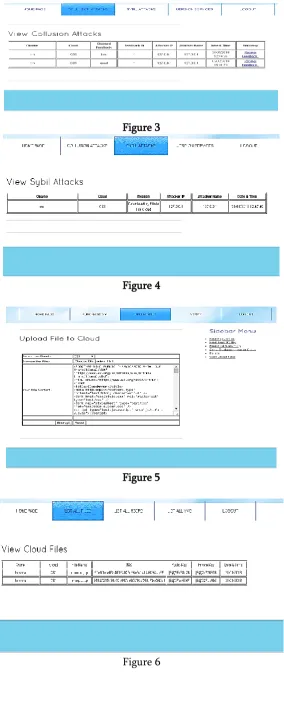
Figure 3
Figure 4
Figure 5
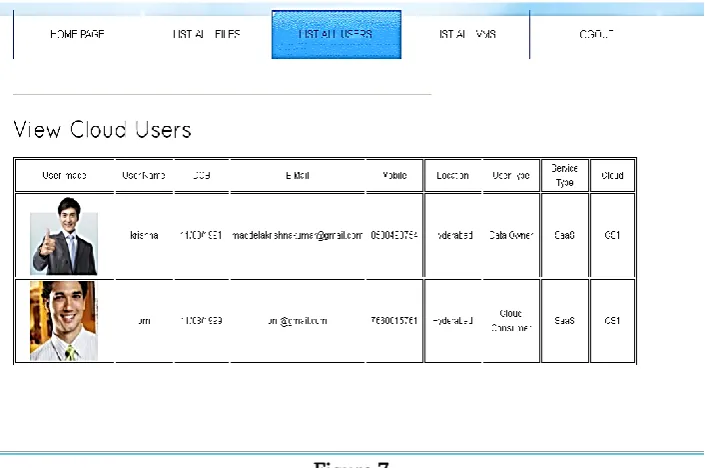
Figure 7
IV. CONCLUSION
Given the extremely dynamic, distributed, and nontransparent nature of cloud services, managing and establishing trust between cloud service users and cloud services remains a major challenge. Cloud service users’ feedback may be a smart supply to assess the trait of cloud services. However, malicious users could collaborate along to i) disadvantage a cloud service by giving multiple dishonest trust feedbacks (i.e. collusion attacks) or ii) trick users into trusting cloud services that aren't trustworthy by making many accounts and giving dishonest trust feedbacks (i.e., Sybil attacks). During this paper, we've got conferred novel techniques that facilitate in detection name based mostly attacks and permitting users to effectively determine trustworthy cloud services. specially, we have a tendency to introduce a credibleness model that not solely identifies dishonest trust feedbacks from collusion attacks however additionally detects Sybil attacks regardless of these attacks happen in an exceedingly long or short amount of your time (i.e., strategic or occasional attacks respectively). We have a tendency to additionally develop AN accessibility model that maintains the trust management service at a desired level. We’ve got collected an outsized variety of consumer’s trust feedbacks given on real-world cloud
services (i.e., over 10,000 records) to gauge our planned techniques.
The experimental results demonstrate the relevance of our approach and show the aptitude of detection such malicious behaviors.
V.
FUTURE SCOPE
There are many directions for our future work. We have a tendency to arrange to mix totally different trust management techniques appreciate name and recommendation to extend the trust results accuracy. Performance optimization of the trust management service is another focus of our future analysis work.
VI. REFERENCES
[1]. A. Bates, B. Mood, J. Pletcher, H. Pruse, M. Valafar, and K. Butler, "On detecting co-resident cloud instances using network flow watermarking techniques," Int. J. Inf. Secur., vol. 13, no. 2, pp. 171– 189, Apr. 2014.
CCSW ’14. New York, NY, USA: ACM, 2014, pp. 9–20.
[3]. F. Koeune and F.-X. Standaert, "Foundations of security analysis and design iii," A. Aldini, R. Gorrieri, and F. Martinelli, Eds. Berlin, Heidelberg: Springer-Verlag, 2005, Ch. A Tutorial on Physical Security and Side-channel Attacks, pp. 78–108.
[4]. S. Habib, S. Hauke, S. Ries, and M. Mhlhuser, "Trust as a facilitator in cloud computing: a survey," Journal of Cloud Computing, vol. 1, no. 1, 2012.
[5]. J.Huang and D. Nicol, "Trust mechanisms for cloud computing," Journal of Cloud Computing, vol. 2, no. 1, 2013.
[6]. R.Ko,P.Jagadpramana, M.Mowbray, S. Pearson, M. Kirchberg,
[7]. Q. Liang, and B. S. Lee, "Trust cloud: A framework for accountability and trust in cloud computing," in Services (SERVICES), 2011 World Congress on, July 2011, pp. 584–588. [8]. Wood and J. Stankovic, "Denial of service in
sensor networks,"Computer, vol. 35, no. 10, pp. 54–62, Oct 2002.
[9]. M. Jain and H. Kandwal, "A survey on complex wormhole attackin wireless ad hoc networks," in Proceedings of International Con-ference on Advances in Computing, Control, and Telecommunication Technologies (ACT ’09), 28-29 2009, pp. 555 –558.
[10]. Krontiris, T. Giannetsos, and T. Dimitriou, "Launching a sink-hole attack in wireless sensor networks; the intruder side," in Proceedings of IEEE International Conference on Wireless and Mobile Computing, Networking and Communications(WIMOB ’08), 12-14 2008, pp. 526 –531.
[11]. L. Bai, F. Ferrese, K. Ploskina, and S. Biswas,