Comparative Analysis of verbal alignment in human-human and human-agent
interactions
Sabrina Campano, Jessica Durand, Chlo´e Clavel
Institut Mines-T´el´ecom, T´el´ecom ParisTech, CNRS LTCI 37-39, rue Dareau, 75014 Paris, France
[email protected], [email protected], [email protected]
Abstract
Engagement is an important feature in human-human and human-agent interaction. In this paper, we investigate lexical alignment as a cue of engagement, relying on two different corpora : CID and SEMAINE. Our final goal is to build a virtual conversational character that could use alignment strategies to maintain user’s engagement. To do so, we investigate two alignment processes : shared vocabulary and other-repetitions. A quantitative and qualitative approach is proposed to characterize these aspects in human-human (CID) and human-operator (SEMAINE) interactions. Our results show that these processes are observable in both corpora, indicating a stable pattern that can be further modelled in conversational agents.
Keywords:engagement, human-agent interaction, corpus analysis
1.
Introduction
Engagementcan be considered as “the value that a partici-pant in an interaction attributes to the goal of [...] continu-ing the interaction” (Poggi, 2007 in Peters et al., 2005). It is an important feature in human-human interaction, as well as in human-agent interaction (between a human and a vir-tual character). In this paper, we aim at characterizing ver-bal alignment processes that can be considered as cues of engagement: shared vocabulary and other-repetitions. Our final goal is to build a virtual conversational character able to detect and display such cues, in order to maintain user’s engagement.
Alignment refers to the endorsement of an activity in progress (Gorisch et al., 2012). It can be defined as the convergence of two participants on several aspects. Low-level aspects include lexical repetitions (Ward and Litman, 2007) (Bertrand et al., 2013), linguistic style (Niederhoffer and Pennebaker, 2002), or speech activity (Campbell and Scherer, 2010). High-level aspects include concepts (Bren-nan and Clark, 1996), or inter-comprehension (Shockley et al., 2009). Low-level and high-level aspects are interdepen-dant, and often analyzed simultaneoulsy.
Participants use lexical repetition to show their involvement (Tannen, 1992), a concept that seems very close to en-gagement. As engagement is necessarily a two-participant process, in this paper we focus on other-repetitions (or allo-repetitions). Other-repetition occurs when a speaker repeats one or several words said previously by another speaker. Other-repetition has several functions, as convey-ing the understandconvey-ing of an emotional stance (Svennevig, 2004), the receipt of a message (Perrin et al., 2003) (Tan-nen, 1992) (Bazzanella, 2011), or the contribution to the topic of the conversation (Halliday, 1967) cited in (Tannen, 1992). These functions allow us to assess whether partici-pants are involved in the interaction process. Hence, other-repetitions could be used in human-agent interaction to fos-ter user’s engagement. This is why we need to study their features, and how they are related to user’s engagement.
In this paper, we investigate : (i) the quantitative evolu-tion of shared vocabulary between two speakers, and (ii) the detailed occurrences of other-repetitions, that is, which words are other-repeated and when. Shared vocabulary is a measure related to other-repetitions, allowing us to iden-tify general trends over time. Our study is grounded on two corpora: the SEMAINE corpus (McKeown et al., 2010), containing human-agent interactions, and the CID corpus (Bertrand et al., 2008), containing human-human interac-tions. The outline of the paper is as follows: the corpora are described and compared in Section 2.. Section 3. pro-poses statistics on shared vocabulary, giving insights on some alignment processes. Methods for visualising shared vocabulary and other-repetitions are proposed in Section 4., and finally an in-depth analysis of the resulting figures is provided in Section 5..
2.
Corpora Overview
2.1. SEMAINE and CID
Figure 1: Showing speech activity per participant on 3 minutes (LISA tool) -1st session : CID,2ndand3rd sessions : SEMAINE
shares its vocabulary with an operator. This could be ex-plained by several factors : (i) the user speaks more than the operator, hence uses more vocabulary, and (ii) the oper-ator has to play a role, hence uses a restrained vocabulary specific to its role. Then, in human-agent interaction, when a user has a lowSVI(p1)score compared to an agent, it should not be interpreted as a low alignment of the user to-wards the agent.
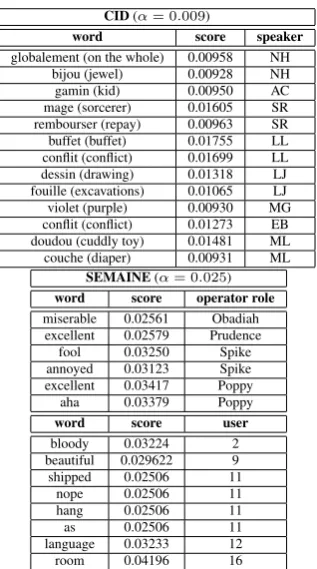
3.2.2. Shared Vocabulary and Operator’s Role In SEMAINE, we also measured whether the affective style of each operator (Poppy, Prudence, Obadiah and Spike) is correlated with the SVI(p1, p2)score. For each role, we computed the mean SVI(p1, p2)score for all the sessions where the operator is playing this role. We found that the scores are different between roles (Obadiah : µ = 0.274,
σ = 0.080 ; Poppy : µ = 0.248, σ = 0.049 ; Pru-dence : µ = 0.233, σ = 0.051 ; Spike : µ = 0.279,
σ = 0.072). The shared vocabulary between operator and user is higher for Spike and Obadiah than for Poppy and Prudence. Hence, negative emotions could be associated with more shared vocabulary. However, these differences are not statistically significant. We have to be cautious with this hypothesis that needs to be tested on more samples. We only observe a significant result for the meanSVI(p1)score for users on the pairP rudence/Spike(t = −2.948,p < 0.01). This means that a user shares more of its own vocab-ulary with Spike (µ= 0.40,σ= 0.13) than with Prudence (µ = 0.29, σ = 0.08). This may be because when an operator playing Spike is offending the user, the user some-times reacts in repeating operator’s words. On the contrary, as Prudence is the most even-tempered of the four roles, it may trigger less affective alignment. The correlation be-tween anger and alignment has been mentioned by other research work (Niederhoffer and Pennebaker, 2002).
4.
Visualizing Lexical Alignment
4.1. Evolution of Shared VocabularyWe computed the evolution of shared vocabulary measure on sliding time windows, and displayed it on figures (one figure per session). This procedure allows us to visu-ally identify increases and decreases of shared vocabulary trough a session, and to figure out where these variations could come from. One example can be seen in Figure 2. The goal is to provide a qualitative analysis of these curve variations, and to establish whether they are linked to en-gagement cues.
Shared vocabulary measure was computed on sliding win-dows with varying lengths. The principle of this approach is to fragment temporal data (uttered words) in several over-lapping time frames, and to compute the shared vocabulary
SVI(p1, p2)mean value for each time frame (see section 3.1. for details on the computation ofSVI(p1, p2)). Then, the values can be displayed on a figure. The window length
lw can be expressed according two units of duration: the number of conversational turns and the time in millisec-onds. As shared vocabulary depends on a conversational process, we focused on turns. The overlap between the frames was set at 50%. We performed this computation with two different window lengths: 2 and 16 turns. 2 al-lows us to identify when a speaker repeated other speaker’s words in the immediate successive turn. This is useful to lo-calize short-distance other-repetitions. After an analysis of the transcripts, we found out that 16 seems to be the max-imum number of turns during which a topic is discussed in SEMAINE. According to Langlet and Clavel (2014), the average number of high-level topics per SEMAINE session is 4, which tends to confirm our observations. A window length of 16 is then useful to localize the evolution of shared vocabulary that depends on topic change.
4.2. Other-Repeated Words
For each session, we displayed on a figure the word occur-rences for each speaker along a time axis. Our aim is to vi-sually identify which words are other-repeated, and when. We recall that another-repetitionoccurs when a speaker re-peats a word previously said by another speaker (Guardiola and Bertrand, 2013).
We draw one figure for each interaction. Thexaxis repre-sents time units, whereas theyaxis represents words. Time units are expressed in turns, and in milliseconds (different figures were generated for each time unit). An example can be seen on figure 3. In these figures, it is possible to iden-tify what is the distance between a word occurrence and its other-repetition. Distance is an important feature to distin-guish other-repetition functions (Perrin et al., 2003).
4.3. Selected Pre-processing
not relevant, and it alters the visibility of relevant data. As an example, we found on a figure an increase corresponding to the fact that the two participants used both the words “I”, “am” and “you” in the same time window. If such words are removed, the remaining increases are more relevant. It is then possible to clearly identify when two speakers are talking about the same topic (“sports”), or express the same emotion words (“happy”). The same principle applies to figures with other-repeated words. If function words are not removed, then a lot of irrelevant words are remaining, and identifying interesting data is more difficult. The coun-terpart of this approach is that some relevant displays of words could be missing.
4.4. Additional Pre-processing for CID
The CID corpus is originally segmented in InterPausal Units (IPUs). IPUs are blocks of speech bounded by silent pauses over 200 ms. In order to compare CID with SE-MAINE, we converted IPUs in turns. To do so, we aggre-gated the IPUs of a same speaker that are not separated by the intervention of the second speaker.
5.
In-depth Analysis
In this section, we present an analysis of shared vocabulary and word occurrences figures generated from SEMAINE and CID corpora (as explained in Section 4.). In order to il-lustrate alignment processes appearing in these figures, we present a review of the analysis of 4 SEMAINE sessions (∼20 minutes), and 1 CID session (∼one hour). We se-lected randomly 4 SEMAINE sessions with the same user and 4 different operator roles (Prudence, Poppy, Obadiah and Spike), and one CID session.
5.1. Methodology
Our analysis of each session is grounded on the following methodology. First, we analyzed the curve variations in the shared vocabulary figure. If an important increase or decrease was found at a given turn (e.g., turn 32), we an-alyzed the corresponding phase in corpus transcripts and video recordings (e.g., if a decrease is found at turn 32, the corresponding phase is from turn 24 to turn 40 because the window length is 16). Doing so, we try to find an explana-tion for the observed curve variaexplana-tions. Second, we analyzed theword occurrence figureby looking at the words occur-ring in the corresponding phase. Our aim is to know which type of words are other-repeated and if other-repetitions are related to a specific lexical field (e.g., opinion, topic).
5.2. Review of observed phenomena
We give here a list of the main phenomena observed during the analysis illustrated by examples.
User’s interest in the topic and user’s emotional involve-ment in SEMAINE sessions We identify two interest-ing phenomena that seem to be associated to the peaks of shared vocabulary curve: the user’s interest in the topic and the user’s emotional involvement.
An example of the first phenomenon (user’s interest) can be found in Session 70 (Prudence). The figure of shared vocabulary (window length = 16 turns) shows two peaks, at turns 24 and 56 (see Figure 2) corresponding to phases
[16-32] and [48-64]. During these two phases, we observe a special interest by the user in the current topic (“holidays” in [19-32] turns and “trip” in [50-64] turns). Between these two phases, there is a gap in the shared vocabulary curve: the user is effectively not pleased about the topic of “work” and at turn 50, says that the topic is boring.
An example of the second phenomenon (user’s emotional involvement) can be found in Session 73 (Spike). There are two peaks of shared vocabulary in this session at turns 24 and 64 (figure not shown). During phase [56-72], the user tells that he is often mistaken for an american, whereas he is canadian and seems to be annoyed by this confusion. Op-erator empathizes with the user, using expressions “that’s a lot”, “piss me off”. These expressions are other-repeated by the user almost identically at the following turn. As the role of Spike is to make the user angry, these expres-sions are employed as a strategy to reinforce user annoy-ance. A function of other-repetitions is to express emo-tional stances(Svennevig, 2004). We also found in Sec-tion 3.2.2. that verbal alignment is stronger when operators play Spike.
Other-repetition of appraisal expressions There are nu-merous examples of appraisal expressions in SEMAINE and CID. We focus on 3 extracts found in the corpora thanks to word occurrence and shared vocabulary figures.
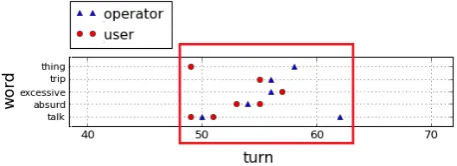
In Session 70 (Prudence), during the “trip” topic, two in-teresting words are repeated several times by the user and the operator: the words “excessive” and “absurd’ (see Fig-ure 3). They are other-repeated in order to display the same stance. According to Bazzanella (2011) , other-repetitions can be used to show that onesshare attitudes and opin-ions.
Figure 3: Word occurrences for user and operator (cut onx
andyaxes), session 70, SEMAINE corpus.
In session 72 (Obadiah), we found many appraisal expres-sions. This seems related with Obadiah affective style. In this role, the operator expresses attitudes about life and about the user, which triggers short-distance repetitions. Here are two examples:
37 - Obadiah: “Lifeis hardsometimes.”
38 - User: “(Nods).Lifecan sucksometimes. I agree.”
41 - Obadiah: “Yeah. But you can’t becheeryall the time.” 42 - User: “(Shakes head). Oh God I’m not cheery
(laughs). [...]”
Figure 2: Evolution of shared vocabulary score, session 70, SEMAINE corpus (window length = 16 turns)
observe a large number of other-repetitions related to affect, as “happy”, “feel”, “sad”, “bored”, “interesting”. Accord-ing to Martin and White (2005), these words express affect evaluations.
In CID, we observed some occurrences of the expression of surprise during the narration of a story. As an exam-ple, a peak of shared vocabulary is found when AB talks about an old woman who stayed all the night in a bedroom with an opened window and snow coming through it. CM repeats large parts of other participant sentences, showing astonishment and empathy for the old woman. This peak is shown on Figure 4. As previously said,expressing emo-tional stancesas surprise is a function of other-repetitions (Svennevig, 2004).
Figure 4: Peak of shared vocabulary in CID corpus
Other-repetitions and listening behavior A hearer can express that he is listening to the speaker in several ways. He may use short verbal or non verbal feedbacks, or repeat the words said by speaker. This function of other repetition is defined asTaking Into Account function (TIA)by Per-rin et al., 2003 ). We give examples of these phenomena in CID and SEMAINE.
The Figure 5 represents the evolution of shared vocabulary during the first half of a story telling in CID (turns [180-250]). AB is narrating an unusual story to CM. On this figure, we observe a peak of shared vocabulary, followed by a flat phase (low shared vocabulary). At the beginning of this story, CM repeats AB words in order to show that she takes them into account: “feu d’artifice” (fireworks), “bonne soeur” (nun). This short sharing activity is then followed by a long flat phase, where CM is narrating a story. During this phase, AB simply provides non verbal or short verbal feedbacks as “mh mh” or “ouais” (yeah).
In SEMAINE, we also observe these two types of listen-ing behavior. In Session 71 (Poppy), there is a gap in
Figure 5: Evolution of shared vocabulary score, session AB-CM, extract from CID corpus (window length = 16 turns)
shared vocabulary corresponding to phase [24-32]. During this phase, the operator provides feedbacks such as “hmh”, “yeah”, “ok”, “ah”, but does not repeat user’s words. At other moments, the operator repeats what the user said, adding an evaluative stance besides the TIA function, as in “Australia will be cool.” after the user has talked about a trip in Australia.
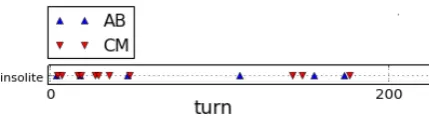
Other-repetitions and definition of a word in CID In CID, participants are given the instructions to talk about unusual stories. Figure 6 shows that at the beginning of the session, both speakers use the word “insolite” (unusual) several times in the phase [0-50]. During this phase, speak-ers are discussing about the meaning of the word “insolite” (unusual). As shown by the figure, the repetition of this word occurs at other moments in the interaction. This indi-cates that speakers are trying to find unusual stories to tell about.
Figure 6: Occurrences of the word “insolite” (figure cut on
Kate G Niederhoffer and James W Pennebaker. 2002. Lin-guistic style matching in social interaction. Journal of Language and Social Psychology, 21(4):337–360. Laurent Perrin, Denise Deshaies, and Claude Paradis.
2003. Pragmatic functions of local diaphonic repetitions in conversation. Journal of Pragmatics, 35(12):1843 – 1860.
Christopher Peters, Catherine Pelachaud, Elisabetta Be-vacqua, Maurizio Mancini, Isabella Poggi, and Univer-sita Roma Tre. 2005. Engagement capabilities for ecas. InAAMAS05 workshop Creating Bonds with ECAs. Isabella Poggi. 2007. Mind, hands, face and body: a goal
and belief view of multimodal communication. Weidler. Jacques Savoy. 1999. A stemming procedure and stopword
list for general french corpora. JASIS, 50(10):944–952. Kevin Shockley, Daniel C Richardson, and Rick Dale.
2009. Conversation and coordinative structures. Topics in Cognitive Science, 1(2):305–319.
Jan Svennevig. 2004. Other-repetition as display of hear-ing, understanding and emotional stance. Discourse studies, 6(4):489–516.
Deborah Tannen. 1992. Talking voices: Repetition, di-alogue, and imagery in conversational discourse, vol-ume 6. Cambridge University Press.