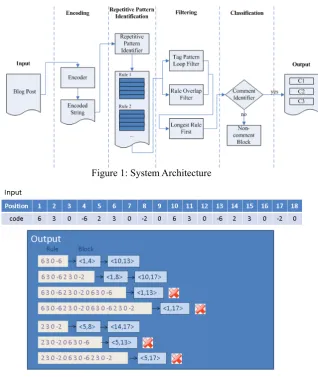
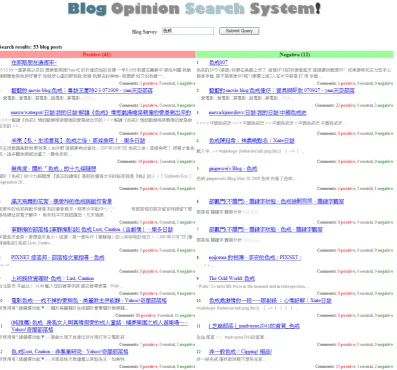
Figure 1: System Architecture
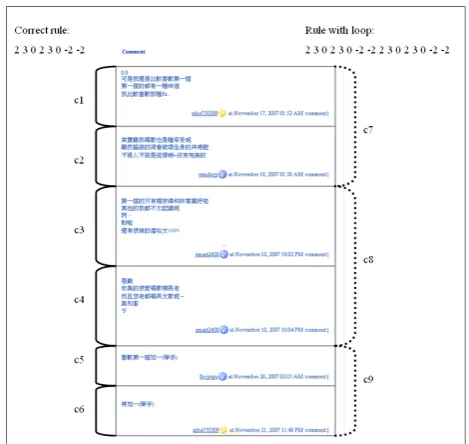
Figure 2: An Example of Repetitive Pattern Identification
HTML Tag Code String Class Non-tag Text 0 string
STRUCTURE 1 begin DIV CLASS 2 3 begin with attribute DIV ID 2 4 begin with attribute DT CLASS 5 3 begin with attribute LI CLASS 6 3 begin with attribute DD CLASS 7 3 begin with attribute TR CLASS 8 3 begin with attribute /STRUCTURE -1 end /DIV -2 end /DT -5 end
/LI -6 end
/DD -7 end /TR -8 end Other Tags 0 string
Table 1: Coding Scheme for Repetitive Pattern Identification
Figure 2 shows an encoded string ‘6 3 0 -6 2 3 0 -2 0 6 3 0 -6 2 3 0 -2 0’ corresponding to an HTML document denoting a blog post. Table 1 lists all the tags and the corresponding codes used by the encoder. We mine seven rules and corresponding blocks from this string. We remove those rules (3rd, 4th, 6th, and 7th) with only one
block, and keep the remaining repetitive patterns (1st, 2nd
and 5th). Finally, 6 candidates are proposed and sent to the
next stage.
2.3 Filtering Strategies
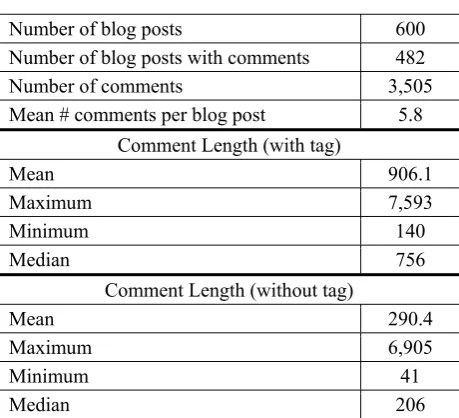
Figure 3: Correct Rule vs. Rule with Loop
Figure 4: Correct Rule vs. Rule with Overlap
Figure 5: The Longest Rule First
Strategy Recall Precision F-measure
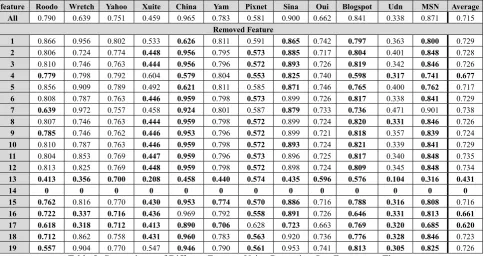
13 0.413 0.356 0.700 0.208 0.458 0.440 0.574 0.435 0.596 0.576 0.104 0.316 0.431
5.
Conclusion
This paper presents a prototyped system to identify comments from blog posts and applies them to opinion mining. The best F-measure, recall, and precision of comment extraction are 0.801, 0.855, and 0.780, respectively, by using all of the three filtering strategies together with some selected features. After comment extraction, each comment is also categorized into positive, negative, or neutral comment by the same opinion mining algorithm as the one used in post content.
Many kinds of irrelevant comments are posted. For example, spam comments may carry advertisements with few links. Besides, commenter may just leave a message for greeting. Identifying relevant comments is an important and challenging issue for correctly fining the opinion of readers.
6. Acknowledgment
s
Research of this paper was partially supported by National Science Council, Taiwan, under the contract
96-2628-E-002-240-MY3.
7.
References
Cao, D.L., Liao, X.W., Xu, H.B. and Bai, S. (2008). Blog Post and Comment Extraction Using Information Quantity of Web Format. In Proceedings of 2008 AIRS. LNCS 4993, pp. 298--309.
Hu, G., Sun, A., and Lim, E.P. (2007). Comment-Oriented Blog Summarization by Sentence Extraction. In
Proceedings of 6th ACM CIKM. pp. 901--904.
Liu, Y., Huang, X., An, A., and Yu, X. (2007). ARSA: A Sentence-Aware Model for Predicting Sales Performance Using Blogs. In Proceedings of SIGIR 2007. pp. 607--614.
Chen, Y.W. and Lin, C.J. (2005). Combining SVMs with Various Feature Selection Strategies.
http://www.csie.ntu.edu.tw/~cjlin/papers/features.pdf Ku, L.W. and Chen, H.H. (2007). Mining Opinions from the Web: Beyond Relevance Retrieval. JASIST. Vol. 58, No. 12, pp. 1838--1850.