Proceedings of Recent Advances in Natural Language Processing, pages 222–230,
Graph-based Event Extraction from Twitter
Amosse Edouard
Universit´e Cˆote d’Azur Inria, CNRS, I3S, France
Elena Cabrio
Universit´e Cˆote d’Azur Inria, CNRS, I3S, France
Sara Tonelli
Fondazione Bruno Kessler Trento, Italia
Nhan Le-Thanh
Universit´e Cˆote d’Azur Inria, CNRS, I3S, France
Abstract
Detecting which tweets describe a spe-cific event and clustering them is one of the main challenging tasks related to Social Media currently addressed in the NLP community. Existing approaches have mainly focused on detecting spikes in clusters around specific keywords or Named Entities (NE). However, one of the main drawbacks of such approaches is the difficulty in understanding when the same keywords describe different events. In this paper, we propose a novel approach that exploits NE mentions in tweets and their entity context to create a temporal event graph. Then, using simple graph the-ory techniques and a PageRank-like algo-rithm, we process the event graphs to de-tect clusters of tweets describing the same events. Experiments on two gold standard datasets show that our approach achieves state-of-the-art results both in terms of evaluation performances and the quality of the detected events.
1 Introduction
Twitter has become a valuable source of timely information covering topics from every corner of the world. For this reason, NLP researchers have shown growing interest in mining knowledge from Twitter data. As a result, several approaches have been proposed to build applications over tweets, e.g. to extract structured representations/summary of newsworthy events (McMinn and Jose, 2015;
Katragadda et al.,2017), or to carry out sentiment analysis to study users reactions (Agarwal et al.,
2011; Kouloumpis et al., 2011). However,
pro-cessing tweets is challenging task, since informa-tion in Twitter stream is continuously changing in real-time, while at the same time there might be a high volume of redundant messages referring to the same issue or event.
In this work, we focus on event extraction from Twitter, consisting in the automated clustering of tweets related to the same event based on rele-vant information such as time and participants. Al-though there is no consensus in the NLP commu-nity on what an event is (Sprugnoli and Tonelli,
2017), our approach relies on the event definition byDou et al.(2012), i.e. “an occurrence causing change in the volume of text data that discusses the associated topic at a specific time. This oc-currence is characterized by topic and time, and often associated with entities such as people and location”.
Existing approaches to the task create clusters of tweets around event-related keywords (Parikh and Karlapalem, 2013), or NEs (McMinn and Jose, 2015). However, such approaches fail i) to capture events that do not generate spikes in the volume of tweets; andii) to distinguish between events that involve the same NEs and keywords. Other approaches model the relationships between terms contained in the tweets relying on a graph representation (Katragadda et al., 2016), and re-tain the nodes with the highest number of edges as event candidates. However, the main drawbacks of these approaches are thati)they generate highly dense graphs, andii)trending terms not related to events may be considered as event candidates.
To address such limitations, in this work we propose an unsupervised approach to detect open-domain events on Twitter, where the stream of tweets is represented through temporal event
graphs, modeling the relations between NEs and the terms that surround their mentions in the tweets.
2 Related Work
Existing approaches to extract events from tweets can be divided into two main categories, namely closed-domain and open-domain event detection systems (Atefeh and Khreich, 2015). In the closed-domain, approaches are mainly focused on extracting a particular type of event, as for instance natural disasters (Panem et al., 2014). Works in the closed-domain scenario are usually cast as su-pervised classification tasks that rely on keywords to extract event-related messages from Twitter (Wang et al., 2012), to recognize event patterns (Popescu et al.,2011) or to define labels for train-ing a classifier (Anantharam et al., 2015; Sakaki et al.,2010).
The open-domain scenario is more challenging, since it is not limited to a specific type of event and usually relies on unsupervised models. Among the works applying an unsupervised approach to event detection on Twitter, (McMinn and Jose, 2015) create event clusters from tweets using NE men-tions as central terms driving the clusters. Thus, tweets mentioning the same entities are grouped together in a single cluster. Experiments on a pub-lic dataset of tweets show that this strategy outper-forms other approaches such as Latent Sensitive Hashing (Petrovi´c et al.,2010). Similarly, (Hasan et al.,2016) create clusters based on cosine simi-larity among tweets. Both works do not consider the temporal aspect of events and fail to capture terms or entities involved in different events at dif-ferent time periods.
Very recently, Zhou et al. (2017) use a non-parametric Bayesian Mixture Model leveraged with word embeddings to create event clusters from tweets. In this approach, events are mod-eled as a 4-tuplehy, l, k, dimodeling non-location NEs, location NEs, event keywords and date. The work was focused on detecting events given a set of event-related tweets, which is however not applicable to a real scenario, where the stream of tweets can also contain messages that are not event-related. This scenario is simulated in the second experiment presented in this paper.
3 Approach description
In this section, we describe our approach for detecting open-domain events on tweets. The pipeline consists of the following components: Tweet pre-processing, Named Entity recognition and linking, graph creation, graph partitioning, event detection and event merging. Each step is described in the following subsections.
3.1 Tweet Preprocessing
The workflow starts by collecting tweets published during a fixed time window, which can be set as in-put parameter (e.g. 1 hour). Then, we apply com-mon text preprocessing routines to clean the in-put tweets. We use TweetMotifs (O’Connor et al.,
2010), a specific tokenizer for tweets, which treats hashtags, user mentions and emoticons as single tokens. Then, we remove the retweets, URLs, non ASCII characters and emoticons. It is worth men-tioning that at this stage we do not perform stop word removal since stop words can be part of NEs (e.g. United States of America). As for hash-tags, we define a set of hand-crafted rules to seg-ment them into terms, is possible. We also try to correct misspelled terms using SymSpell1, which matches misspelled tokens with Wordnet synsets (Fellbaum,1998).
3.2 Named Entity Recognition and Linking
We use NERD-ML (Van Erp et al.,2013), a Twit-ter specific Named Entity Recognizer (NER) tool, to extract NE mentions in the tweets, since Der-czynski et al.(2015) showed that it is one of the best performing tools for NER on Twitter data. Besides, NERD-ML not only recognizes the most common entity types (i.e. Person, Organization and Location), but tries also to link any term listed in external knowledge bases such as DBpedia2 or Wikipedia. These are then associated with seman-tic classes in the NERD ontology.
3.3 Graph Generation
Previous works using graph-based methods to model relations between terms in text considered all terms in the input document as nodes and used their position in text to set edges (Andersen et al.,
2006;Xu et al.,2013). Such approaches may gen-erate a dense graph, which generally requires high computational costs to be processed.
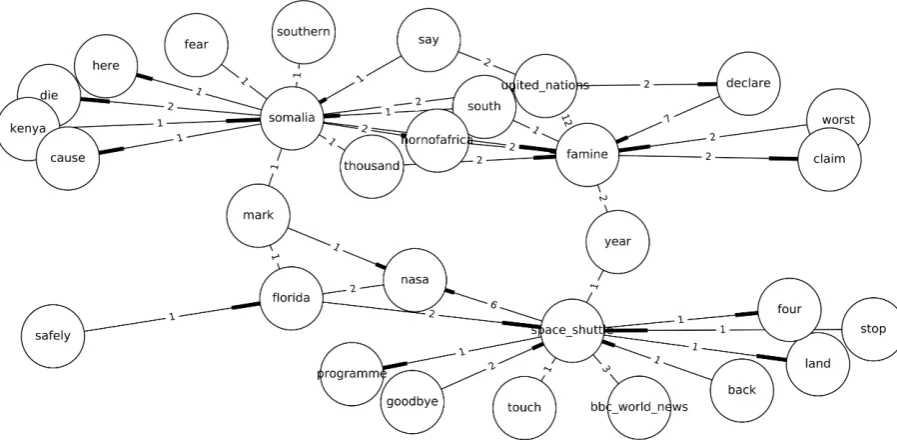
sur-Figure 1: Graph generated on day “2011-07-07” from a sample of tweets related to the events about the famine in Somalia and the space shuttle to Mars.
candidate we select the highest weighted prede-cessors and sucprede-cessors as keywords for event can-didates (Lines 4-9). After removing the edges be-tween the keywords from the graph, if it becomes disconnected, we also consider the disconnected nodes as keywords for the event candidate (Lines 10-13). Based on the semantic class provided by the NER tool (see Section3.2), we divide the key-words related to an event in the following subsets: what(i.e., the type of the event),where(i.e., the lo-cation in which the event happens), who(i.e., the person or organization involved). As for the date, we select the oldest tweets that report the event.
In the second stage of Algorithm1, we further process the event candidates. First, we merge du-plicate event candidates (Lines 22-35), i.e. those sharing common terms and having the same loca-tion or participants in the considered time window. A new event is thus built from the combination of terms and entities of the two event candidates. An event is considered as valid if at least a NE is in-volved, and if it occurs in a minimum number of tweets provided as input parameter.
3.6 Event Merging
We consider events in different time-windows as duplicate if they contain the same keywords, enti-ties (e.g. person, organization, location) in an in-terval of k days, where k is an input parameter. When a new event is found as duplicate, we merge it with the previous detected event.
4 Experiments
Given a set of tweets, our goal is to cluster such tweets so that each cluster corresponds to a fine-grained event such as “Death of Amy Winehouse” or “Presidential debate between Obama and Rom-ney during the US presidential election”. We first describe the datasets, then we present the experi-mental setting. This section ends with a compari-son of the obtained experimental results with state-of-the-art approaches.
4.1 Dataset
We test our approach on two gold standard cor-pora: the First Story Detection (FSD) corpus (Petrovi´c et al., 2012) and the EVENT2012 cor-pus (McMinn et al.,2013).
FSD The corpus was collected from the Twit-ter streaming API3 between 7th July and 12th September 2011. Human annotators annotated 3,035 tweets as related to 27 major events oc-curred in that period.After removing tweets that are no more available, we are left with 2,342 tweets related to one out of the 27 events. To re-produce the same dataset used by other state-of-the-art approaches, we consider only those events mentioned in more than 15 tweets. Thus, the final dataset contains 2,295 tweets describing 20 events.
EVENT2012 A corpus of 120 million tweets collected from October to November 2012 from
0 1 2 3 4 0
0.2 0.4 0.6 0.8 1
Cutting parameter
Performance
score
Precision Recall F-score
(a) Effect on FSD
0 0.5 1 1.5 2 2.5 3 3.5 4
0 0.1 0.2 0.3 0.4 0.5 0.6 0.7 0.8 0.9 1
Cutting parameter
Performance
score
Precision Recall F-score
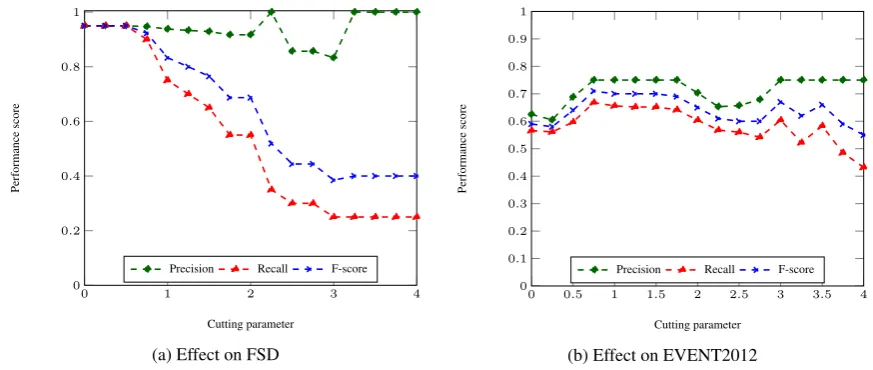
(b) Effect on EVENT2012 Figure 4: Effect of the cutting parameter (α) on the performance of our approach.
dangling parameterαis used to separate the nodes of the event graph into high-ranked and low-ranked nodes, where the high-low-ranked nodes are used to extract keywords related to event candi-dates. We experiment different values for “α” and we evaluate their impact on the performance of our approach on both datasets.
In Figure 4a we show the performance of our model for 0 < α ≤ 4 on the FSD dataset. We observe that higher value ofαgives higher preci-sion while lowering the recall. More specifically, for α ≥ 3 we obtain 100% precision and recall lower than50%. On the other hand, the best per-formance is obtained forα ≤0.5. Since the FSD dataset contains ∼ 6,000 unique words, at each time window the generated graph is strongly con-nected, thus the average minimum score of the nodes is higher than 0.5. For values higher than
0.5, important terms referring to events are ig-nored, mainly when they are related to events that do not generate a high volume of tweets. In our experiments, we also observe that higher values of
αmostly affect the recognition of events with low number of tweets.
Figure4bshows the performance of our model for different values of α on the EVENT2012 dataset. We observe that for different values of
α, both precision and recall are affected. More specifically, the recall of the model tends to de-crease for lower values of α. Without edge cut-ting (i.e. α = 0), the recall of our model is simi-lar to EDO. Overall, the impact ofα is bigger on the EVENT2012 dataset than on FSD dataset. The variation of precision and recall curves is smaller for consecutive values ofα w.r.t. to FSD. There
are two main reasons for that: i)the EVENT2012 dataset has a richer vocabulary, and ii) many events in the EVENT2012 dataset are similar to each other.
5 Conclusions and Future Works
In this paper, we described a model for detecting open-domain events from tweets by modeling re-lationships between NE mentions and terms in a directed graph. The proposed approach is unsu-pervised and can automatically detect fine-grained events without prior knowledge of the number or type of events. Our experiments on two gold-standard datasets show that the approach yields state-of-the-art results. In the future, we plan to in-vestigate whether linking terms to ontologies (e.g. DBpedia, YAGO) can help in detecting different mentions of the same entity, for instance “German chancellor” and “Angela Merkel”, as preliminarily shown in (Edouard et al.,2016). This can be used to reduce the density of the event graph. Another possible improvement would be to enrich the con-tent of the tweets with information from external web pages resolving the URLs in the tweets.
References
Apoorv Agarwal, Boyi Xie, Ilia Vovsha, Owen Ram-bow, and Rebecca Passonneau. 2011. Sentiment analysis of twitter data. InProceedings of the work-shop on languages in social media. Association for Computational Linguistics, pages 30–38.
Marieke Van Erp, Giuseppe Rizzo, and Rapha¨el Troncy. 2013. Learning with the web: Spotting named entities on the intersection of nerd and ma-chine learning. In# MSM. Citeseer, pages 27–30. Xiaofeng Wang, Matthew S Gerber, and Donald E
Brown. 2012. Automatic crime prediction using events extracted from twitter posts. InSocial Com-puting, Behavioral-Cultural Modeling and Predic-tion, Springer, pages 231–238.
Wei Xu, Ralph Grishman, Adam Meyers, and Alan Ritter. 2013. A preliminary study of tweet summa-rization using information extraction. NAACL 2013 page 20.
Deyu Zhou, Liangyu Chen, and Yulan He. 2011. A simple bayesian modelling approach to event extrac-tion from twitter.Atlantispage 0.