Computational Linguistics and Chinese Language Processing
Vol. 22, No. 2, December 2017, pp. 87-98 87
The Association for Computational Linguistics and Chinese Language Processing
A Novel Trajectory-based Spatial-Temporal Spectral
Features for Speech Emotion Recognition
Chun-Min Chang
, Wei-Cheng Lin
and Chi-Chun Lee
Abstract
Speech is one of the most natural form of human communication. Recognizing emotion from speech continues to be an important research venue to advance human-machine interface design and human behavior understanding. In this work, we propose a novel set of features, termed trajectory-based spatial-temporal spectral features, to recognize emotions from speech. The core idea centers on deriving descriptors both spatially and temporally on speech spectrograms over a sub-utterance frame (e.g., 250ms) - an inspiration from dense trajectory-based video descriptors. We conduct categorical and dimensional emotion recognition experiments and compare our proposed features to both the well-established set of prosodic and spectral features and the state-of-the-art exhaustive feature extraction. Our experiment demonstrate that our features by itself achieves comparable accuracies in the 4-class emotion recognition and valence detection task, and it obtains a significant improvement in the activation detection. We additionally show that there exists complementary information in our proposed features to the existing acoustic features set, which can be used to obtain an improved emotion recognition accuracy.
Keywords: Emotion Recognition, Speech Processing, Spatial-Temporal
Descriptors, Mel-Filter Bank Energy
1.
Introduction
The blooming of research effort in affective computing (Picard, 1997) in the past decade has started to enable machines to become capable toward sensing and synthesizing emotional expressive behaviors. Numerous technological applications, e.g., advanced human-machine interface (Bach-y Rita & Kercel, 2003; Swartout et al., 2006) and interactive robotic design(Hollinger et al., 2006; Hogan, Krebs, Sharon & Charnnarong, 1995), and even
Department of Electrical Engineering, National Tsing Hua University
88 Chun-Min Chang et al.
emerging cross-cutting research fields, e.g. social signal processing (Vinciarelli, Pantic & Bourlard, 2009) and behavioral signal processing (Narayanan & Georgiou, 2013), have all benefited from the vast amount of research advancements in affective computing. Speech is the most natural form of human communication that encodes both linguistic content and paralinguistic information (Schuller et al., 2013), e.g., emotion (Nwe, Foo & De Silva, 2003; Scherer, 2003), gender (Childers & Wu, 1991), age (Dobry, Hecht, Avigal & Zigel, 2011), personality (Mairesse & Walker, 2006), etc. Development of suitable algorithms to robustly model emotional content in speech continues to be a prevalent topic in emotion recognition research.
There exists a vast amount of research in modeling speech acoustics for emotion recognition, topics ranging from lowlevel feature engineering, machine learning algorithms, to even joint feature-label representations (Calvo, D’Mello, Gratch & Kappas, 2014; Lee & Narayanan, 2005; Mower, Matarić & Narayanan, 2011). In this work, we aim at proposing a new set of long-term low-level features, named trajectory-based spatial-temporal spectral features, derived directly from the speech spectrograms to perform emotion recognition. Most of the current speech-based emotion recognition rely on extracting a set of commonly-used short-durational features (acoustic low-level descriptors - LLDs), e.g., those could be related spectral features (e.g., MFCCs), prosodic characteristics (e.g., pitch intonation), voicing quality (e.g., jitter), Teager-energy operater etc (Schuller et al., 2007). Then, depending on the choice of emotion recognition framework, researcher would either apply global statistical functionals to be used in statics discriminative framework (e.g., support vector machine (Campbell, Sturim & Reynolds, 2006) or deep neural network (Kim, Lee & Provost, 2013) or using time-series model on these short durational low-level descriptors (e.g., hidden Markov model (Nwe et al., 2003; Li et al., 2013) in order to incorporate the feature’s temporal characteristics to perform utterance-level emotion recognition.
A Novel Trajectory-based Spatial-Temporal Spectral Features for 89 Speech Emotion Recognition
this work, we utilize these descriptors, i.e., trajectory-based spatial-temporal spectral features, to perform speech-based emotion recognition.
To the best of our knowledge, vast majority of the works in the speech emotion recognition literature have utilized short durational (25ms) LLDs which do not share the same concept with our proposed features. There are a few works that utilized auditory perception-inspired modulation spectral features (Chaspari, Dimitriadis & Maragos, 2014; Chi, Yeh & Hsu, 2012), i.e., temporal characteristic of spectral energy, for emotion recognition; these modulation spectrum features have been demonstrated to be robust under noisy conditions compared to features such as MFCCs and fundamental frequencies. In this work, we perform utterance-level categorical (4-emotion classes) and dimensional (valence and activation) emotion recognition on the USC IEMOCAP database (Lee, Mower, Busso, Lee & Narayanan, 2011). We additionally construct two set of features to compare our trajectory-based spatial-temporal spectral features (Traj-ST) to:
• Conv-PS: applying statistical functionals over a frame of conventional acoustic feature set • OpEmo-Utt: state-of-the-art exhaustive utterance-level feature extraction using the
OpenSmile toolbox (Eyben, Wöllmer & Schuller, 2010)
Our proposed features obtain comparable unweighted average recall on the task of 4-class emotion recognition and significantly outperform on the task of activation recognition compared to Conv-PS and OpEmo-Utt. Furthermore, by fusing Traj-ST with either Conv-PS and/or OpEmo-Utt, we achieve an improved recognition rate for the 4-class emotion recognition. It demonstrates the complementary information that our proposed features possess when combining with the well established acoustic features for emotion recognition. The rest of the paper is organized as follows: section 2 describes the database and the trajectory-based spatial-temporal spectral features, section 3 describes experimental setups and results, and section 4 is the conclusion and future work.
2.
Research Methodology
2.1 The USC IEMOCAP Database
90 Chun-Min Chang et al.
the inter-evaluator agreement is about 0.4, this database remains to be a challenging emotion database for algorithmic advancement. In this work, we conduct two different emotion recognition tasks on this database: 1) four-class emotion recognition 2) three-levels of valence and activation dimension recognition. For the categorical emotion recognitions, the four emotion classes are happy, sad, neutral and angry, and we consider samples with the label of ‘excited’ to be the same as ‘happy’. The labels are determined based on the majority vote. The three levels of valence and activation are defined as: low (0 - 1:67), mid (1:67-3:33), and high (3:33-5), where the value of each sample is computed based on the average of the raters. The following lists the number of samples for each type of labels,
• Four-Emotion Classes:
happy: 531, sad: 576, neutral: 411, angry: 378 • Arousal Dimension:
low: 331, mid: 1228, high: 337 • Valence Dimension:
low 653, mid: 820, high:423
2.2 Trajectory-based Spatial-Temporal Spectral Features
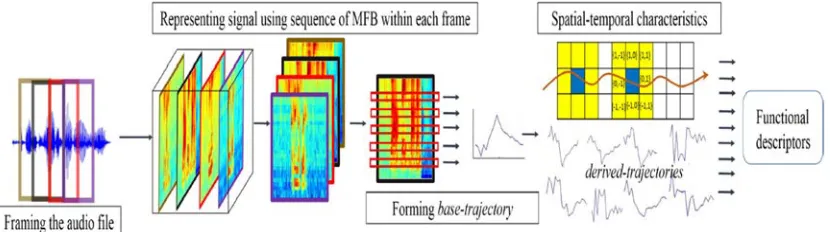
Figure 1 depicts the complete flow of our trajectory-based spatial-temporal spectral features extraction approach. Given an audio file, the following is the steps of the feature extraction:
Figure 1. It demonstrates the complete flow of trajectory-based spatial-temporal spectral feature extraction: framing the utterances, representing the signal within each frame using a sequence of MFB, forming base-trajectory of each MFB coefficient, computing grid-based spatial-temporal characteristics and derive 8 additional derived-trajectory, finally frame-level features are extracted by computing 4 statistical functionals on these 9 Χ 26 trajectories.
A Novel Trajectory-based Spatial-Temporal Spectral Features for 91 Speech Emotion Recognition
(1) Framing the signal:
Segment the entire utterance into regions of frames, where each frame is of length L (L = 250ms , 150ms).There is a 50% overlap between frames.
(2) Representing the segment:
Represent the signal within each frame using a sequence of 26 Mel-filter bank energy (MFB) output - can also be imaged as spectrogram. The window size for MFB is set to be 25ms with 50% overlap. The upper bound of frequency for MFB computation is capped at 3000 Hz.
(3) Forming base-trajectory:
The energy profile for each of the 26 filter output form a base-trajectory over the duration of each frame.
(4) Computing spatial-temporal characteristics:
For each base-trajectoryi, at t = 1, we compute the first-order difference with respect to its neighboring grid (8 total: marked as yellow in Figure 1); then we move along the time axis and compute these grid differences until we reach the end of frame. Hence, we obtain 8 extra trajectories (so called, derived-trajectories) to form a total of 9 trajectories (1 base-trajectory+8 derived-trajectories) per frame for each of the 26 filter outputs (a real example of trajectories can be seen in Figure 1).
(5) Frame-level spatial-temporal descriptors:
We derive the final frame-level trajectory-based spatial-temporal descriptors by applying 4 statistical functionals, i.e., maximum, minimum, mean, and standard deviation, on a total of 26 Χ 9 trajectories - forming the final set of 936 features per frame.
The basic idea of our newly-proposed features is to essentially track spectral energy changes within a long-durational frame in both the directions of frequency-axis (spatial) and time-axis. Since the framework is inspired from video descriptor’s extraction approach, the physical meaning related to speech production/perception can be difficult to establish. However, this framework provides a straightforward approach to quantify various inter-relationship between spectral-temporal characteristics in the speech signal directly from the time-frequency representations without much higher-level processing.
3.
Experimental Setup and Results
92 Chun-Min Chang et al.
• Exp I: Comparison and analysis of our proposed Traj-ST with Conv-PS and OpEmo-Utt
features in the three emotion recognition tasks
• Exp II: Analysis of recognition accuracy after fusion of Traj-ST with Conv-PS and/or
OpEmo-Utt features in the three emotion recognition tasks
The Conv-PS feature extraction approach is similar to the Traj-ST, but instead of computing spatial-temporal characteristics on trajectories of Mel-filter bank output, we compute 45 low-level descriptors including fundamental frequency (f0), intensity (INT), MFCCs, their delta, and delta-delta every 10ms. We then derive the frame-level features by applying the 7 statistical functionals (max, min, mean, standard deviation, kurtosis, skewness, inter-quantile range) on these LLD features. This results in a total of 315 features per frame for Conv-PS. OpEmo-Utt is an exhaustive utterance-level feature set (i.e., emoLarge.config in the Opensmile toolbox) that has been used across many paralinguistic recognition tasks (Schuller et al., 2013; Schuller et al., 2014). It includes 6668 features in total per utterance. All features are znormalized with respect to an individual speaker. All evaluation is done via leave-one-speaker-out cross validation, and the accuracy is measured in unweighted average recall. Univariate feature selection based on ANOVA test is carried out for both Traj-ST and Conv-PS feature sets.
3.1 Recognition Framework
In Exp I, for Traj-ST and Conv-PS feature sets, we use Gaussian Mixture Model (M = 32) to generate a probabilistic score, pi;t, for each class label at the frame-level, and then we perform utterance-level recognition using the following simple rule:
where i refers to the class label, t refers to the frame index, and N refers to the total number of frames in an utterance. For OpEmo-Utt, since it is a large-dimensional utterance-level feature vector, we utilize the GMM-based method after performing principal component analysis (90% of variance) and also linear-kernel support vector machine multi-class classifier.
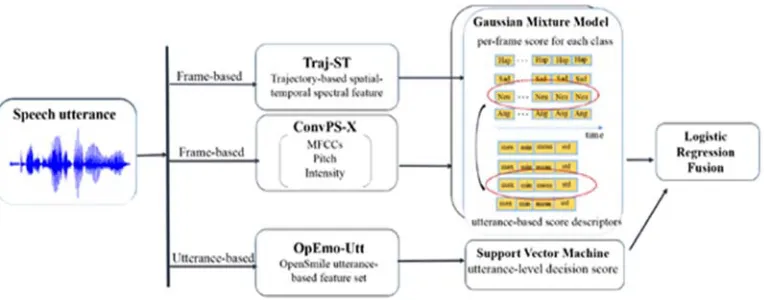
In Exp II, the fusion methodology of Traj-ST with Conv-PS and OpEmo-Utt is depicted in Figure 2. The fusion framework is based on logistic regression. For Traj-ST and Conv-PS, the fusion is operated on the statistical functionals, i.e., mean, standard deviation, max, and min, applied on the pi;t; and for OpEmo-Utt, the fusion is operated on the decision scores outputted from the one-vs-all multiclass support vector machine.
A Novel Trajectory-based Spatial-Temporal Spectral Features for 93 Speech Emotion Recognition
Figure 2. It depicts the fusion method for the three feature sets. Frame-based features are fused using statistical functionals of probabilistic scoring outputted from GMM model, utterance-level features are fused using decision score directly from the SVM classifier.The final fusion model utilized is logistic regression.
3.2 Exp I: Results and Discussions
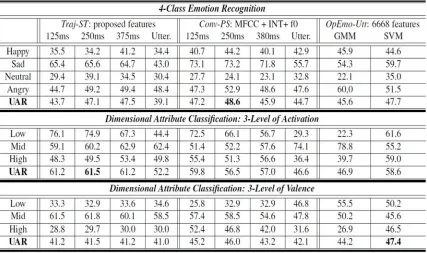
Table 1 summarizes the detailed results of Exp I. For Traj-ST and Conv-PS, we report UARs of GMM model with different frame-length utilized for feature extraction, i.e., 125ms, 250ms, 375ms, and full-utterance length. For OpEmo-Utt, we report both UARs on using GMM and SVM models.
94 Chun-Min Chang et al.
Table 1. It summarizes the detailed results of Exp I for three different emotion recognition tasks: 4-class emotion recognition, 3-level activation/valence recognition. For Traj-ST and Conv-PS, we report UARs of GMM model with different frame-length utilized for feature extraction. For OpEmo-Utt, we report both UARs on using GMM and SVM models.
The frame duration also plays an important role in achieving the optimal accuracy for Traj-ST (also for Conv-PS). Our empirical finding seems to implicate that a duration of roughly 250ms is the optimal frame-duration - a result that corroborates findings in the previous use of long-term spectral features for emotion recognition (Chaspari et al., 2014; Chi et al., 2012). Furthermore, the feature selection output from Traj-ST shows that the top three directions of spatial-temporal characteristics are the {0,0} - base-trajectory, {1,0} - higher-spatial-equivalent-temporal directional trajectory, and {1,-1} - higher-spatial-earlier-temporal directional trajectory. These three constitutes 50% of the selected features. It is interesting to see that modeling not just the temporal changes but also the spatial (i.e., in the direction of frequency) can be beneficial; in specific, additional investigation will also need to be carried out to understand the reason to the finding that there seems to be a higher emotional discriminability in these specified trajectories, which quantify the spectral energy changes in direction toward higher-frequency bands.
A Novel Trajectory-based Spatial-Temporal Spectral Features for 95 Speech Emotion Recognition
3.3 Exp II: Results and Discussions
Given that in Exp I, each set of features seem to be capable of recognizing different representation of emotions. A natural experiment is to fuse the three different set of features. Table 2 lists the various fusion results. OpEmo-Utt refers to fusing the outputted decision scores from the SVM model.
Table 2. Exp II summary results on fusion of three different feature sets: Traj-ST, Conv-PS, OpEmo-Utt. The number presented is computed using UAR
There are a couple observations to be made with the results. The first is that fusion of different feature sets all improves the best single-feature set’s result. In specifics, the best fusion accuracy of 4-class emotion recognition is 53.2% (4.6% absolute improvement over the best single-feature set) obtained by fusing all three sets of features; the best fusion result for 3-level valence is 48.4% (1.0% absolute improvement over the best single-feature set, OpEmo-Utt); lastly, the best fusion result for 3-level activation is 62.4% (0.9% absolute improvement over the best single-feature set, Traj-ST). We see that our newly propose features, Traj-ST, are indeed capable of additionally improve the recognition rate for categorical emotion recognition and activation level detection under this fusion framework - signifying the complementary information of our features possess with regard to emotional content that is originally lacking in these two well-established state-of-arts feature sets.
In summary, we have demonstrated that our novel trajectory-based spatial-temporal spectral features can be utilized in combination with the two popular and well-established acoustic feature sets in order to obtain improved emotion recognition rate.
4.
Conclusions
96 Chun-Min Chang et al.
overall emotion recognition accuracy. Overall, it is quite promising to see these low-level features do possess emotional discriminatory power beyond the exhaustive set of established acoustic parameters.
There are several future directions. One of the immediate future direction is that we observe these features do not possess enough modeling power of the valence dimension; one of the possible causes may due to the fact that the grid-based differential operator may only capture the spatial-temporal interrelationship locally, and the statistical functionals may not be enough to quantify the suprasegmental information. We will immediately extend this grid-based differential operator to incorporate a wider range both in time and in space with different scales to capture the valence-related acoustic properties. Secondly, one of our main goals is to minimize the effort of raw signal processing required as we derive these features. We will replace the MFB portion of spectral representation to even lower-level (or employ sparse representation to ensure robustness) time-frequency representation while maintaining low computational complexity. Lastly, on the longer term, once these (raw) low-level features are developed, they can be suitable inputs to deep learning algorithms to learn various hierarchical representations of speech acoustic that are relevant for emotion perception. The ability to robustly recognize emotion will continue to be at the fore-front of developing human-centric applications
Acknowledgment
Thanks to Ministry of Science and Technology (103-2218-E-007-012-MY3) for funding.
References
Bach-y Rita, P. & Kercel, S. W. (2003). Sensory substitution and the human-machine interface. Trends in cognitive sciences, 7(12), 541-546. doi:10.1016/j.tics.2003.10.013
Busso, C., Bulut, M., Lee, C.-C., Kazemzadeh, A., Mower, E., Kim, S.,...Narayanan, S. S. (2008). IEMOCAP: Interactive emotional dyadic motion capture database. Language Resources and Evaluation, 42(4), 335-359. doi: 10.1007/s10579-008-9076-6
Calvo, R. A., D'Mello, S., Gratch, J. & Kappas, A. (2014). The Oxford handbook of affective computing. Oxford, England: Oxford University Press.
Campbell, W. M., Sturim, D. E. & Reynolds, D. A. (2006). Support vector machines using gmm supervectors for speaker verification. IEEE Signal Processing Letters, 13(5), 308-311. doi: 10.1109/LSP.2006.870086
98 Chun-Min Chang et al.
Narayanan, S. & Georgiou, P. G. (2013). Behavioral signal processing: Deriving human behavioral informatics from speech and language. In Proceedings of IEEE Inst Electr Electron Eng., 101(5), 1203-1233. doi: 10.1109/JPROC.2012.2236291
Nwe, T. L., Foo, S. W. & De Silva, L. C. (2003). Speech emotion recognition using hidden markov models. Speech communication, 41(4), 603-623. doi: 10.1016/S0167-6393(03)00099-2
Oneata, D., Verbeek, J. & Schmid, C. (2013). Action and event recognition with fisher vectors on a compact feature set. In Proceedings of ICCV '13 Proceedings of the 2013 IEEE International Conference on Computer Vision, 1817-1824. doi: 10.1109/ICCV.2013.228 Picard, R. W. (1997). Affective computing. Cambridge, MA: MIT press.
Scherer, K. R. (2003). Vocal communication of emotion: A review ofresearch paradigms. Speech communication, 40(1-2), 227-256. doi: 10.1016/S0167-6393(02)00084-5
Schuller, B., Batliner, A., Seppi, D., Steidl, S., Vogt, T., Wagner, J.,...Aharonson, V. (2007). The relevance of feature type for the automatic classification of emotional user states: low level descriptors and functionals. In Proceedings of INTERSPEECH 2007, 2253-2256.
Schuller, B., Steidl, S., Batliner, A., Burkhardt, F., Devillers, L., MüLler, C. & Narayanan, S. (2013). Paralinguistics in speech and languagestate-of-the-art and the challenge. Computer Speech & Language, 27(1), 4-39. doi: 10.1016/j.csl.2012.02.005
Schuller, B., Steidl, S., Batliner, A., Epps, J., Eyben, F., Ringeval, F.,...Zhang, Y. (2014). The interspeech 2014 computational paralinguistics challenge: cognitive & physical load. In Proceedings of INTERSPEECH 2014, 427-431.
Swartout, R. W., Gratch, J., Hill Jr, R. W., Hovy, E., Marsella, S., Rickel, J. & Traum, D. (2006). Toward virtual humans. AI Magazine, 27(2), 96-108. doi: 10.1609/aimag.v27i2.1883
Vinciarelli, A., Pantic, M. & Bourlard, H. (2009). Social signal processing :Survey of an emerging domain. Image and Vision Computing, 27(12), 1743-1759. doi: 10.1016/j.imavis.2008.11.007
Wang, H., Kläser, A., Schmid, C. & Liu, C.-L. (2011). Action recognition by dense trajectories. In Proceedings of 2011 IEEE Conference on Computer Vision and Pattern Recognition (CVPR), 3169-3176. doi: 10.1109/CVPR.2011.5995407
Wang, H., Kläser, A., Schmid, C. & Liu, C.-L. (2013). Dense trajectories and motion boundary descriptors for action recognition. International journal of computer vision, 103(1), 60-79. doi: 10.1007/s11263-012-0594-8