Corry, Val (2017) Academically able boys’ perceptions of their learning: a
grounded theory analysis. PhD thesis.
http://theses.gla.ac.uk/8094/
Copyright and moral rights for this work are retained by the author
A copy can be downloaded for personal non-commercial research or study, without prior permission or charge
This work cannot be reproduced or quoted extensively from without first obtaining permission in writing from the author
The content must not be changed in any way or sold commercially in any format or medium without the formal permission of the author
When referring to this work, full bibliographic details including the author, title, awarding institution and date of the thesis must be given
Enlighten:Theses http://theses.gla.ac.uk/
Academically able boys’ perceptions of their learning: a grounded theory analysis.
Val Corry
B.Sc. (Engineering) (Hons), PGD: School Leadership and Management (SQH)
Submitted in fulfilment of the requirements for the Degree of Doctor of Philosophy
School of Education College of Social Sciences
University of Glasgow
Abstract
In one secondary school in Scotland, there was a trend that girls performed significantly better than boys at the more challenging levels of external examinations. The focus of this thesis has been an exploration of 16 to 18-year-old, academically able boys’ perceptions of their learning in this school, to seek an explanation for this phenomenon.
The literature review considers the concept of gender in education; the policy landscape and national attainment data in relation to gender and attainment; and the key
reviews/studies carried out in this field to provide governments with a deeper understanding of gendered performance, and recommendations for educational
professionals to bring about improvements. These reviews/studies focused on all boys and not on this particular subset of academically able boys.
A central issue in gender equity in education is the lived experiences of different groups of learners in schools. The stance taken in this research is to consider the learning of selected boys (who are high attaining, or who have the potential to achieve highly academically) from the senior year groups in one school by exploring, through interview, their personal experiences, views, perceptions and opinions about learning: the factors that facilitate and hinder progress in learning. For the case study approach adopted, groups of girls, teachers and parents in the school were also interviewed to triangulate the findings from the boys’ interviews. A grounded theory approach, using methods developed by Strauss and Corbin (1990, 2008) and Glaser (1992), and supplemented by techniques advocated by Charmaz (2014), was used for the interviewing and the analysis of the empirical data collected: using line-by-line coding, conceptualisation, categorisation and theory generation. The advantage of grounded theory is that it is ‘grounded’ in the empirical data. This
interpretative approach makes no attempt to select and ‘test’ factors that could be influencing the phenomenon, rather exploring widely to seek understanding from the perspective of the subjects.
The grounded theory that emerged from the case study in School A was that these boys realise what is required of them to be successful in their learning, and what hinders their learning, but their success is limited by adopting an essentialist construction of their gender with gender stereotypical characteristics.
The phenomenon is not unique to this one school and so a similar case study approach was undertaken in two further schools, Schools B and C, to consider the transferability of the theory emerging from the data collected in School A. School B had a similar gendered attainment profile to School A, whereas in School C there was little or no difference in attainment by gender.
The thesis concludes with some recommendations for policy and practice: professional learning of teachers, working with parents on understanding gender, and the privileging of ‘pupil voice’ as a way of exploring issues such as gender.
Contents
Abstract ... 2
Tables and figures ... 7
Acknowledgements ... 8
Author’s declaration ... 9
Chapter 1: The context and the purposes of the study ... 10
1.1 Chapter overview ... 10
1.2 Introduction ... 10
1.3 Synopsis of thesis ... 11
1.4 The concepts of attainment, achievement and ‘underachievement’ ... 13
1.5 Professional context ... 14
1.5.1 School improvement ... 15
1.5.1.1 Rationale and vision of a new management structure ... 15
1.5.1.2 Pupil support service ... 16
1.5.1.3 Outline of the management structure ... 17
1.5.1.4 Focus on learning and teaching ... 18
1.5.1.5 Professional learning ... 18
1.5.1.6 Self-evaluation ... 19
1.5.1.7 Strategies to improve attainment ... 20
1.5.1.8 Impact of mentoring and support on attainment ... 20
1.5.1.9 Intervention in 2010 improve support for some boys ... 21
1.6 Purposes of the research study ... 23
Chapter 2: The research questions and the statistical background ... 25
2.1 Chapter overview ... 25
2.2 Introduction ... 25
2.3 Research questions ... 26
2.4 Explanation of the statistics presented ... 27
2.5 Gendered patterns of attainment from the statistics ... 28
2.6 Concluding remarks ... 34
Chapter 3: The concept of gender in education ... 35
3.1 Chapter overview ... 35
3.2 The significance of gender in education ... 36
3.2.1 Historical perspective ... 37
3.2.2 ‘Crisis’ of boys’ underachievement ... 39
3.3 Gender and gender identity from a feminist stance ... 42
3.3.1 Modernist stance ... 42
3.3.2 Postmodernist/poststructuralist stance ... 44
3.3.2.1 Sociological/cultural stance……… ... 45
3.3.2.2 Philosophical stance……… ... 46
3.3.3 Different feminist stances: Is there mutual exclusivity? ... 49
3.4 The contested nature of gender and gender identity ... 50
3.5 Gender in the classroom ... 52
3.5.1 Identity and the classroom ... 52
3.5.2 Relationality ... 53
3.5.3 Classroom policy and feminist solutions ... 55
3.6 Intersectionality ... 58
3.7 Concluding remarks ... 61
Chapter 4: Gender and Attainment ... 62
4.1 Chapter overview ... 62
4.2 The policy context - equality ... 62
4.2.1 A Scottish policy perspective ... 62
4.3 Gendered patterns of attainment - UK ... 80
4.4 International perspective: Gender: Attainment ... 82
4.5 Accountability: gender and attainment ... 83
4.6 Concluding remarks ... 84
Chapter 5: Studies on factors/influences and interventions ... 86
5.1 Chapter overview ... 86
5.2 Introduction ... 86
5.3 Overview of factors and explanations for the gender difference in attainment outcomes ... 87
5.3.1 External factors ... 88
5.3.2 In-school factors ... 89
5.4 Analysis of the key studies ... 91
5.4.1 Response to policy ... 91
5.4.2 Chronology ... 92
5.4.3. Focus on academically able pupils ... 92
5.4.4 Methodology of the study ... 93
5.4.5 Factors proposed to explain differential patterns of attainment amongst boys and girls ... 94
5.4.6 Strategies and interventions ... 97
5.4.7 Impact ... 98
5.4.8 Conclusion - the key studies ... 99
5.5 Concluding remarks ... 104
Chapter 6: Research methodology ... 106
6.1 Chapter overview ... 106
6.2 Rationale for the study and the methodology ... 106
6.3 Theoretical perspective ... 108
6.3.1 Research Paradigm ... 108
6.3.2 Grounded theory ... 110
6.3.3 Case study methodology ... 112
6.3.3.1 Validity, Reliability and triangulation ... 116
6.3.3.2 Researcher as research ‘tool’ ... 118
6.4 Methods employed to gather qualitative data through interview ... 121
6.4.1 Ethical approval ... 122
6.4.2 Sampling – Selection of participants ... 123
6.4.2.1 In School A ... 124 6.4.2.2 In Schools B and C ... 129 6.4.3 Interviewing ... 132 6.4.4 Interviewing process ... 133 6.4.4.1 Interview protocol ... 133 6.4.4.2 Focus groups ... 134 6.4.4.3 Questioning ... 137 Transcription of interviews ... 140
6.5 Data analysis using a grounded theory approach ... 141
Chapter 7: Discussion of the methodology for data analysis – the grounded theory approach ... 142
7.1 Chapter overview ... 142
7.2 Principles of analysis ... 142
7.2.1 Definitions of terms ... 143
7.2.2 Process of analysis ... 148
7.2.3 Induction, deduction and abduction ... 151
7.2.4 Impact of researcher on analysis ... 152
7.2.5 Saturation ... 154
7.2.7 Perspectives on ‘emergent’ theory ... 158
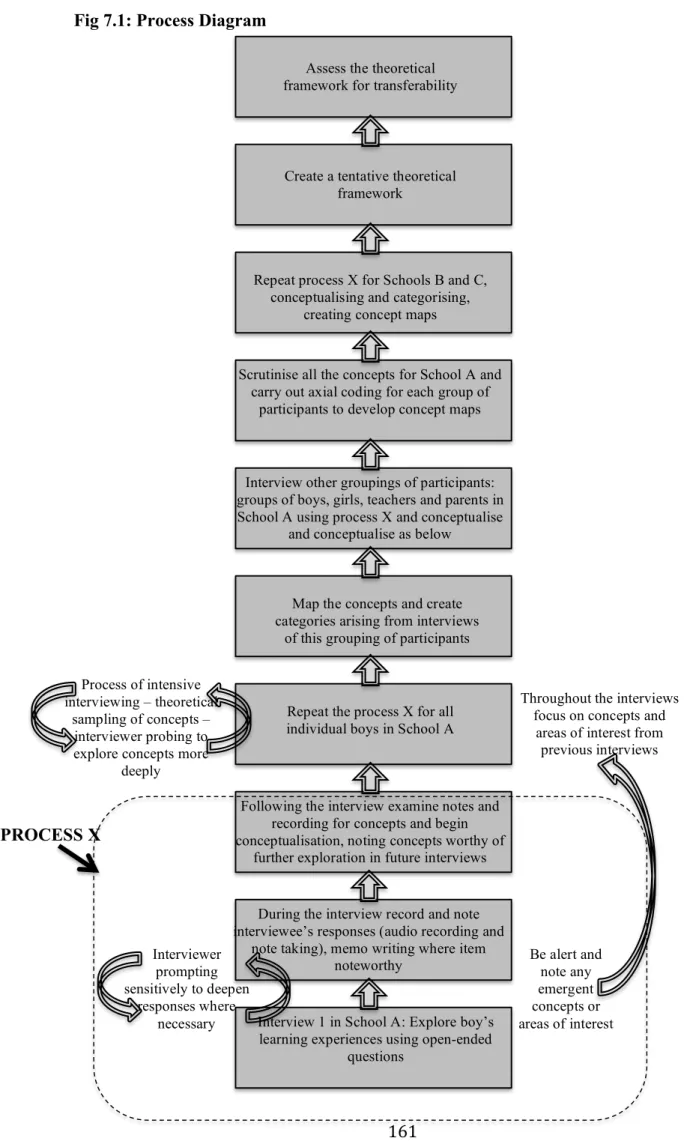
7.3 Analytical method (including diagram of process) ... 159
Chapter 8: Presentation of the grounded theory analysis of the empirical data gathered through interview ... 163
8.1 Chapter overview ... 163
8.2 Research questions ... 163
8.3 Rationale for presentation of analysis of empirical data ... 163
8.4 Presentation of analysis: School A – boys ... 166
8.5 Comparison between the findings from the individual boys’ and the focus groups of boys’ interviews in School A ... 170
8.6 The emergence of a tentative theoretical framework based on the boys’ views ... 171
8.7 Presentation of analysis: School A – girls, teachers and parents ... 172
8.8 Comparison between findings from the girls’ focus groups and the boys’ focus groups in School A ... 175
8.9 Comparison between the findings from the teachers and the boys in School A ... 178
8.10 Comparison between the findings from the parents and the boys in School A ... 182
8.11 Triangulation of findings in School A ... 184
8.12 Presentation of analysis: School B – boys, girls and teachers ... 186
8.13 Triangulation of findings in School B ... 192
8.14 Presentation of analysis: School C – boys, girls and teachers ... 193
8.15 Triangulation of findings in School C ... 198
8.16 Comparison of findings from all three schools ... 198
Chapter 9: Discussion of the analysis of the findings from all three schools ... 200
9.1 Chapter Overview ... 200
9.2 Boys’ perceptions of their learning (in School A) ... 200
9.2.1 Self-awareness of effective learning and the barriers to effective learning ... 201
9.2.1.1 The learning experience ... 202
9.2.1.2 Involvement of parents ... 209
9.2.1.3 Personal characteristics of boys from their perspective ... 210
9.2.2 Perceptions of gender identity ... 213
9.2.3 Summary ... 217
9.3 Transferability ... 218
9.4 Emergent grounded theory ... 218
9.5 Concluding remarks ... 219
Chapter 10: Summary and recommendations ... 220
10.1 Chapter Overview ... 220
10.2 Review of the study’s purposes ... 220
10.2.1 Literature review and policy background ... 221
10.2.2 Methodological approach ... 223
10.2.2.1 Evaluation of the grounded theory approach ... 224
10.2.2.2 Evaluation of the case study approach ... 230
10.2.3 Findings ... 232
10.2.3.1 Response to the research questions ... 232
10.2.4 Conceptual mapping ... 236
10.2.4.1 Emergent grounded theory ... 241
10.2.4.2 Critique of the theory ... 241
10.3.4 Recommendations for policy and practice ... 242
10.3.4.1 Policy and practice related to policy ... 243
10.4 Summary ... 249
10.5 Learning transcending gender? ... 253
Appendix 1: School A’s attainment data for S4 and S5 - 1999 to 2002 ... 254
Appendix 2: School A’s attainment data for S4 and Higher for 2002 and 2003 Respectively ... 256
Appendix 3: School A’s attainment data for S5 -1999 to 2012 ... 257
Appendix 4: School A’s attainment data for S4 and S5 - 1999 to 2012. ... 258
Appendix 5: 2010 attainment data for School A’s comparator school group and other high achieving mainstream secondary schools in Scotland (run by local authorities) ... 260
Appendix 6: Test for statistical significance – t-test ... 261
Appendix 7: Literature review methodology ... 263
Appendix 8: Comparative analysis of ten key studies (1996 to 2008) ... 264
Appendix 9: Sample of consent form and plain language statement ... 270
Appendix 10: Explanation of the process of coding, conceptualisation and categorisation of the data (illustrated in Fig. 7.1) ... 273
Tables
Table 2.1: S4: Differences in % between males and females ... 29
Table 2.2: S5: Differences in % between males and females ... 30
Table 4.1: Percentages of S4 males and females gaining five or more Standard Grade awards in 1999 ... 78
Table 4.2: S4 pupils achieving Standard Grades by gender, 2004/05-2006/07 ... 80
Table 6.1: Definition of a case study ... 114
Table 6.2: Boys selected for individual interview in School A ... 126
Table 6.3: School A – Groups interviews ... 127
Table 6.4: Staff interviewed in School A broken down by subject and gender ... 128
Table 6.5 School B – School with similar demographics and attainment profile ... 131
Table 6.6 School C – School with similar demographics and a different attainment profile .. 131
Table 8.1: Coding for the individuals and groups interviewed ... 166
Figures Fig 2.1: S4 'whole school' performance data for '5+ Level 5' ... 32
Fig 2.2: S5 'whole school' performance data for '3+ Level 6’ ... 32
Fig 2.3: S5 'whole school' performance data for '5+ Level 6' ... 33
Fig 4.1: Average tariff scores of S4 pupils, by Gender, Scotland, 2000/01 to 2004/05 ... 68
Fig 4.2: Pupils in S4 gaining 5+ Awards at SCQF Level 5, by Gender, Scotland, 2000/01 to 2004/05 ... 69
Fig 4.3: Percentage of school leavers with 4+ Highers passes by gender ... 76
Fig 4.4: Trends in highest % levels of attainment of Scottish school leavers by gender: 1965-98 ... 77
Fig 6.1: Interview programme in School A ... 129
Fig 6.2: Interview programme in Schools B and C ... 132
Fig 7.1: Process diagram ... 161
Fig 8.1: Emergent categories ... 164
Fig 8.2: Category: ‘Self-awareness of effective learning’– individual boys ... 167
Fig 8.3: Category: ‘Self-awareness of barriers to learning’– individual boys ... 168
Fig 8.4 Category: ‘Perception of gender identity’ – individual boys ... 168
Fig 8.5: Category: ‘Self-awareness of effective learning’ – boys’ focus groups (School A) .. 169
Fig 8.6: Category: ‘Self-awareness of barriers to learning’– boys’ focus groups (School A) . 169 Fig 8.7: Category: ‘Perception of gender identity’ – boys’ focus groups (School A) ... 170
Fig 8.8: Category: ‘Self-awareness of effective learning’– girls’ focus groups (School A) ... 172
Fig 8.9: Category: ‘Self-awareness of barriers to learning’ – girls’ focus groups (School A) 173
Fig 8.10: Category: ‘Perception of gender identity’ – girls’ focus groups (School A) ... 173
Fig 8.11: Category: ‘Perceptions of factors influencing boys’ learning’ – teachers (School A) 174 Fig 8.12: Category: ‘Perceptions of factors influencing boys’ learning’ – parents (School A) 175 Fig 8.13: Category: ‘Self-awareness of effective learning’ – boys’ focus groups (School B) 187
Fig 8.14: Category: ‘Self-awareness of barriers to learning’ – boys’ focus groups (School B) 188 Fig 8.15: Category: ‘Perception of gender identity’ – boys’ focus groups (School B) ... 188
Fig 8.16: Category: ‘Self-awareness of effective learning’ – girls’ focus groups (School B) . 189 Fig 8.17: Category: ‘Self-awareness of barriers to learning’ – girls’ focus groups (School B) 190 Fig 8.18: Category: ‘Perception of gender identity’ – girls’ focus groups (School B) ... 191
Fig 8.19: Category: ‘Perceptions of factors influencing boys’ learning’- teachers (School B) 191 Fig 8.20: Category: ‘Self-awareness of effective learning’ – boys’ focus groups (School C) 193
Fig 8.21: Category: ‘Self-awareness of barriers to learning’ – boys’ focus groups(School C) 193 Fig 8.22: Category: ‘Self-awareness of effective learning’ – girls’ focus groups (School C) . 195 Fig 8.23: Category: ‘Self-awareness of barriers to learning’ – girls’ focus groups (School C) 195 Fig 8.24: Category: ‘Perception of gender identity’ – girls’ focus groups (School C) ... 196
Acknowledgements
This research would not have been possible without the engagement of the pupils, staff and parents who volunteered to be part of the study. My sincerest thanks to them for their participation, their insight and their honesty. My thanks also go to the Local Authorities and Head Teachers who made possible my visiting their schools. I will be ever grateful for the unstinting support, wisdom and challenge of my supervisors, Professor Christine Forde and Dr Margery McMahon. Special thanks for the support of my family, but especially to Pete who has been there for me throughout this journey.
Author’s declaration
I declare that, except where explicit reference is made to the contribution of others, that this dissertation is the result of my own work and has not been submitted for any other degree at the University of Glasgow or any other institution.
Signature:
Chapter 1: The context and the purposes of the study 1.1 Chapter overview
This chapter raises the issue of the gendered patterns of attainment found within the academically able cohort of pupils within one secondary school in Scotland (School A). The synopsis of this thesis summarises the trajectory of the research from the identification of a gendered pattern of attainment to the exploration of boys’ perceptions of their learning and the generation of a grounded theory. The context of this study, both my professional role as a Head Teacher in School A and the approaches taken to provide opportunities and support for all pupils in the school, are outlined. The purposes of this study conclude the chapter.
1.2 Introduction
Gender in education has attracted significant attention over the last 40 years. In the 1970s the issue of girls being disadvantaged was raised as a concern and the focus was on
providing the same educational opportunities for girls as for boys, particularly equal access to all areas of the curriculum (Forde, 2008). In the last 20 years, there has been an
increasing focus on boys’ underachievement (Epstein et al., 1998; Tinklin et al., 2001; Forde, 2008) with attainment statistics showing the difference between boys’ and girls’ performances, with boys appearing to underperform in national examinations when compared to girls (Scottish Executive, 2006; Scottish Government, 2008a, 2008c, 2013).
This study has contributed to research that is seeking to understand the ‘gender gap’ in attainment. Other research in this area has tended to focus on all boys and not on
considering which boys, that is studies have tended to treat boys as a homogeneous group rather than look at the position and progress of specific groups of boys. The focus in this study is on academically able boys. This is an area that appears to be under-researched despite statistical evidence examined at school level and nationally as part of this research showing that this is a cohort where there is a statistically significant difference in
attainment between able boys and girls. This research has provided findings from three secondary schools in Scotland that point to boys’ construction of their gender limiting their success as learners. The use of grounded theory methodology, in this context of seeking to understand the gender gap, has also provided new insight into the effectiveness of
the voices of academically able male pupils, and learning from these boys’ views of their own learning has added to the body of knowledge and has the potential to support policy makers and teachers in their professional learning about gender and the implications for teachers’ practice.
1.3 Synopsis of thesis
The first two chapters describe my journey as a head teacher that led me to this research study and set out the basis of my research. Chapter 1, as outlined above, gives the context for this study and sets out the key purposes of this research. Chapter 2 begins by setting out the research questions. These are followed by an explanation and analysis of the available attainment data from School A, which triggered this study. This shows the phenomenon, as seen in School A, of the significant difference between the attainment of academically able boys and girls, with boys performing less well than girls. The chapter also examines data from other similar schools in order to explore the differences in attainment by gender, with a particular focuson those schools that have been used in this study to consider
transferability of the findings from School A. As a result of the findings from the statistical analysis of the attainment data, a small-scale intervention was undertaken in School A, which is summarised briefly in this chapter. The practice and ideas that emerged from the intervention reinforced my conviction to embark on this research study and helped to inform the purposes of this study, which conclude this chapter.
To explore the phenomenon and set the context for the research, a literature review was carried out to understand gender and gender issues in education, the policy context for gender with a specific focus on attainment, and the key studies that had been funded by governments to seek solutions for this issue of boys’ underachievement. The literature review in Chapter 3 was not limited to academically able pupils but considered a wide range of literature in this field. Exploring gender theory from a modernist and
postmodernist/poststructuralist stance gave deeper insight into the concept of gender, gender identity and gender equity. What became clear was the complexity of this area and particularly gender construction, and how this can influence the lived experiences of learners. Chapter 4 examines the policy related to gender and attainment, both in Scotland and in other areas of the UK, and the expectations on schools and local authorities to respond to this policy. Attainment data was examined to set this phenomenon in a national and international context. The focus was on the academically able cohorts. In response to this phenomenon, governments around the world have funded reviews/studies to try to
make sense of the issue, and to make recommendations to help practitioners. Chapter 5 analyses the key reviews/studies carried out in Scotland, other parts of the UK and in Australia. All the studies used a method of testing a hypothesis and drawing from ‘good practice’. No study used the boys themselves as subjects, to explore their lived experiences as learners or carried out any research that would allow inferences to be made about boys’ perceptions of their identity as learners. What became evident from these specific
reviews/studies was that their impact was inconclusive. More importantly in the context of this research study, there was little focus on the academically able groups of boys.
Chapter 6 details the rationale and the methodology adopted to explore boys’ perceptions of their learning. The phenomenological paradigm using a case study approach is
explained, and how empirical data from case studies in three schools was gathered. (School A was the main test site with data gathered from boys, girls, teachers and parents to
triangulate the findings from the boys’ perceptions of their learning. The case studies in Schools B and C were carried out to consider transferability of the findings from School A). The grounded theory approach used to analyse the data is explained: conceptualisation, categorisation and theory generation. In Chapter 6 the contested nature of the interviewer, particularly in School A where I had ‘insider’ status; and the interviewing of individuals and focus groups, is discussed from a critical stance.
Chapter 7 explains the principles of analysis of the data using the grounded theory method: the coding of the data, identification of patterns, conceptualisation and categorisation grounded in the data, and the emergence of a grounded theory. Chapter 8 presents the findings from the analysis of all the data gathered through interview in all three schools, using conceptual maps as the method of presenting the findings, and concludes with a summary of the findings.
In Chapter 9 the key concepts emerging from the grounded theory analysis are discussed critically in the context of the research literature: both literature on factors that focus on boys’ underachievement, and literature exploring the concept of gender and gender construction. The chapter concludes with the presentation of the grounded theory that is emergent from all the data analysed.
The final chapter, Chapter 10, reviews the purposes of the research, including the grounded theory proposed to explain the findings. A response is made to the research questions underpinning this study. The chapter concludes with some recommendations for policy
makers and practitioners, in terms of gender, to begin to understand and respond to the gender related issues in education related to the phenomenon investigated in this study, and more widely. The potential to employ the type of methodology used in this study in other fields is discussed.
1.4 The concepts of attainment, achievement and ‘underachievement’ in the context of this study
This study focuses on attainment, specifically measures of performance in external examinations. In the literature, both ‘attainment’ and ‘achievement’ are used to denote performance in tests and examinations but to avoid confusion attainment is the term used throughout this thesis. This focus does not diminish the importance of looking at equality from a wider perspective, that of achievement. Achievement includes skills and attitudes underpinned by values (Halstead and Taylor, 1996), or the ‘growth mindset’ advocated by Carol Dweck (Dweck, 2007), which is wider than the learning that is tested through examinations. The gaining of these wider attributes is the ambition for Curriculum for Excellence (Scottish Government, 2008b): Scotland’s framework for learning.
Achievement is an indicator of the success in acquiring this wider range of attributes (Ward et al.,1996; Power et al., 1998; Gems Education, 2010). The specific aspect of
attainment is an element of this wider field.
This doctoral study focusses on those who are academically able or ‘high attaining’ and specifically on the gendered pattern of attainment amongst the most academically able secondary pupils in the 16 to 18 age range. There is no specific definition given in the literature for what would constitute attaining highly. Tinklin, whose work looks at the high attainment of girls from 1978 to 1994, defines high attaining as gaining “four or more Higher Grade passes at A-C by the time of leaving school” (Tinklin, 2000: 2). Croxford use three or more Highers as their definition for the high attaining group (Croxford et al., 2003: 136). ‘High attaining’ for the purposes of this study are those who have, or
potentially could achieve five or more qualifications in S41 at SCQF level 52 in S4, and
1S4: Fourth year of secondary school and the first year where all of the pupils take external examinations in all the subjects studied in school. These examinations are set by the SQA (Scottish Qualifications Authority) (SQA, online a).
2The examinations in S4 at the time of this study were available at three levels SCQF levels 3, 4 and 5, with 5 being the highest and most demanding level (SQA, online b). On a rare occasion a very able pupil might attempt level 6 (Higher).
three or more Highers3 in S54, with a focus on five or more Highers in S5.
‘Underachievement’ in this doctoral study is not ‘low’ achievement but is used as a term to describe where performance has not reached the expected level, predicated by perceived potential (Smith, 2003). In considering ‘able’ boys, they are still performing well
compared to others, both boys and girls, but they are not doing as well as expected.
1.5 Professional context
Underachievement of boys is a reality for many head teachers in Scotland, and was for me as a secondary head teacher. The gendered pattern of attainment amongst the academically able group was evident as I examined the performances in national examinations at the end of each school year from the time of my taking up post in 2002. The school I led, School A, is a rural school of medium size relative to other Scottish secondary schools, with a roll in the region of 900. The school had a low FME5 indicator of approximately 4% during the lifetime of this study. There would therefore be an expectation of high attainment based on national statistics. In 2002, the school’s overall performance was in the top 10% of
Scottish schools.
As a head teacher, my duty was to maximise achievement and attainment in order to provide all pupils with the best opportunity to be successful in their lives. I was accountable for the provision of a service to pupils that would maximise this success including pupils’ performance, both in the early years of their school careers and in the external examinations that are used for entrance to training, the work place, and further and higher education.This accountability for pupils’ performance is enshrined in the Standard in Scotland’s Schools etc. Act 2000 (Scottish Parliament, 2000a) and was an expectation of Her Majesty’s Inspectorate of Education (HMIE) in Scotland as referenced in their
publication How Good Is Our School? (SEED, 2002). It has continued to be so in updates
3
The most demanding level of examination in S5 and used for university entrance. On a rare occasion a very able pupil might attempt level 7 (Advanced Higher).
4
S5: Fifth year of secondary school with all pupils sitting external examinations at the end of the year for all their subjects studied in school.
5 FME – Free meal entitlement was a measure used to give an indication of the level of disadvantage in schools. This school level indicator is based on the number of pupils registered for a free meal in that school. This data has been available in local authorities since 1982/1983. This deprivation indicator is used in schools to benchmark performance. In Scotland, there is a correlation between deprivation and attainment with those living with deprivation having lower attainment than those who are not (Scottish Government, online d).
of How Good Is Our School? (Education Scotland, 2015). (The How Good Is Our School? resource has been intended to support schools on their improvement journey through the provision of a framework for self-evaluation).
Statistical data for the examination results for each school were available to schools from 1991, which allowed head teachers to use the data to look at the attainment trends and consider how to make changes to bring about improvement in the performances in these external examinations. The data was also an important source for local education
authorities as they fulfilled their duty of accountability in challenging and supporting schools to improve performance. Local authorities are also required to report annually to Scottish Government on improvement planning: how schools in their authority aim to improve, including raising attainment. The statistical dataprovided by the Government was STACS (Statistical Tables and Charts) (Cowie et al., 2007), which are explained in more detail in Chapter 2. The tables also included information about performance by gender, which gave schools the opportunity to identify any differences by gender.
With this gendered pattern of attainment in evidence there was a need to begin to examine strategies to try to reverse this trend. This led me, through a self-evaluation process, to examine the support and learning experiences that were being provided and to begin to explore ways of improving outcomes for all learners.
1.5.1 School Improvement
The following sections give a summary of the changes introduced in the school from 2002 to bring about improvement to provide better support and opportunities for all pupils. This gives a context for the school from 2002 to 2012, the years for which the statistical data is used, and sets the scene for the research study.
1.5.1.1Rationale and vision of a new management structure
For the Teaching Profession for the 21st Century Agreement (Scottish Executive, 2001), the Scottish Executive had worked in partnership with representatives of teachers’
employers (local authorities) and teachers’ representatives to agree a range of reforms that would provide professional conditions of service for teachers which would support them in the delivery of the “shared objective of a world class education service which will fit our children well for the 21st century” (p. 1). This was a major policy development for the
teaching profession in Scotland which included reforms to: the career structure of teachers; teachers’ duties, including the duty to give advice and guidance to pupils about their learning; principal teachers being involved in pastoral care as well as the curriculum; and professional learning being an entitlement and a requirement for teachers.
In the autumn of 2002, the local authority for School A resolved to take advantage of these reforms by working with schools to restructure the management of all secondary schools in the local authority. This mandate from the local authority allowed me, with the support of the rest of the senior management team (the three depute head teachers), to explore and develop a structure that would provide the strongest focus on the learning and success of every child. The restructuring was underpinned by a vision of having the ‘child’ at the heart of the change to the structure: meeting the needs of every pupil through successful learning provided by effective teaching and through an effective individualised support service for pupils. This vision was predicated on developing and maintaining strong
interpersonal and professional relationships amongst staff. ‘Relationships’ was made a core value of the school with the aim of this being embraced by all in the school community. Building a strong positive ethos was fundamental. To realise the vision demanded the development of staff to become critically reflective and accomplished teachers, working together in a climate of collegiality, to provide a richer learning environment and a support service for pupils that would maximise outcomes for all learners, all underpinned and supported by robust self-evaluation. This fitted with the principles outlined in Teaching Profession for the 21st Century Agreement (Scottish Executive, 2001).
1.5.1.2 Pupil support service
The Teaching Profession for the 21st Century Agreement signalled a change to the role and responsibilities of teachers, moving away from curriculum delivery as being the sole function, to being responsible for assessing and supporting individual pupils’ learning and progress. This included working with a child’s parents and other professionals. Raising achievement was also stated as one of the keyduties of teachers. Taking advantage of these roles and responsibilities detailed in the report, the new support service within School A was designed to ensure that every pupil was known well by an assigned teacher, both from a learning and a pastoral perspective, and the pupil was provided with advice and support as required.
This new support service was phased in with one year group at the beginning of session 2003/2004 and was fully phased in and implemented by session 2007/2008. The
fundamental aspect of this new service was that pupils were assigned to a teacher (Form Class Leader) who only had a small number of pupils (no more than twenty) to support. The aim was that this teacher would ideally stay with the group throughout the group’s school career. Other aspects of note are that the form class leader would meet with his/her group daily as well as being the group’s subject teacher and teacher of personal and social education in their first and second year in secondary school. This would allow the teacher to build strong relationships with the pupils in the group. The teacher would also track and monitor the progress and successes as well as the needs of each pupil. Working closely with a child’s parents was also one of the important roles of the form class leader, providing early and informed information about their child’s learning but also working with the parent where there were needs to be addressed. The expectation was that this new system of support would improve outcomes, including attainment, through early
identification of need and timeous intervention.
From session 2004/2005, Principal Teachers also had a key role in the service (see below), providing back up support for Form Class Leaders and moving a pupil to their ‘case load’ if the needs of the pupil demanded it to ensure that the pupil was receiving the correct and best intervention for their identified needs. Depute Head Teachers had overall
responsibility for the effective running of the service and occasionally worked directly with pupils by way of support.
1.5.1.3 Outline of the management structure
Following the introduction of the support service in 2004, the new management structure was introduced. Teachers were grouped in learning and teaching teams led by a principal teacher. Previously, teachers had been grouped by subject into ‘departments’ led by a principal teacher, whose primary duty was to deliver the curriculum of that subject, and managing the staff in that department.This new middle leadership role was more wide- ranging. The key responsibilities of the principal teacher leading the learning and teaching team were: learning and teaching; line management of approximately eight classroom teachers and development of their professional learning; coordinating
curriculum development (but the lead on curriculum development was the province of the subject teachers themselves) and overall pastoral care of about one hundred pupils. This pastoral care responsibility included supporting the five/six Form Class Leaders, in their
learning and teachingteam, and taking up the case of a pupil when additional support was identified beyond the support given by the Form Class Leader. The principal teacher also had an important quality assurance role covering all aspects of their responsibilities. There were other principal teachers who had a more intensive role in supporting pupils with greater pastoral and learning needs.
School improvement became inclusive, with Principal Teachers having lead
responsibilities in whole school improvement, and all teachers being involved in an area of the school improvement agenda. Pupils’ views were also important in addressing improvement in the school. Parents had a voice through the School Board (and more recently the Parent Council) as well as being part of specific focus groups and responding through questionnaires.
This new structure had pedagogy as the focus rather than curriculum content, and supported the professionalising of the teaching workforce to be leaders of learning.
1.5.1.4 Focus on learning and teaching
As Head Teacher, it was one of my key responsibilities to improve pupils’ learning experiences as well as the outcomes. I believed that developing learning and teaching methodology that was active and relevant, but also challenging, with a focus on learning rather than teaching, would have a strong influence on engaging pupils positively in their learning and have an impact on achievement. Cooperative learning (Pederson and Digby, 2014), assessment principles (Black and Wiliam, 2006), information technology to enhance learning, a focus on numeracy, literacy and health and wellbeing were all key priorities for school improvement and this relentless focus began to see a shift in
pedagogy. Learning was not just confined to subject teaching but extended to a wide range of activities and opportunities for pupils to engage in outwith classroom time to further develop relationships, citizenship, responsibility, confidence and to simply enjoy working and being with others.
1.5.1.5 Professional learning
From 2002, there was a strong focus on developing professionalism and collegiality. The context for professional learning was improving learning experiences and meeting learners’ needs. The learning and teaching focus was developed through collaborative
working amongst staff across subject disciplines. This was facilitated by teachers being in learning and teaching teams and in school improvement teams, with several unpromoted staff taking lead roles. Encouraging and supporting teachers to become involved in professional discourse and action research, through school-based and university-based events and programmes, began to see the development of teachers who recognised their responsibilities as learners and leaders of learning.
1.5.1.6 Self-evaluation
From 2002 to 2012, during my tenure as Head Teacher, self-evaluation had a high profile with the rationale always to focus self-evaluation on improving outcomes for pupils. Initially, this involved all Senior Leaders (the head teacher and the depute head teachers) and Principal Teachers visiting teachers’ classes to evaluate learning, both experiences for learners and how their needs were being met. This involved the class teachers critically reflecting on practice through engaging in professional dialogue with the ‘observer’, with the focus on learning and meeting learners’ needs.
In 2010, a new way of working, based on the Learning Rounds6 model, evolved. This saw every teacher being part of a group of three teachers who visited each other’s classrooms on a nonjudgmental basis examining a whole school theme of learning, teaching and assessment. The group met to discuss findings. The whole staff then met in groups, to discuss strengths and further improvements and a possible future theme for the next round of visits. This self-evaluation proved to be very powerful. Teachers have the opportunity to have professional dialogue with other colleagues with outcomes for pupils as the focus.
In addition to the pupils having conversations with their teachers about their own learning, the views of pupils were sought each year on what they believed were the school’s
strengths and suggested changes to improve learning to inform improvement planning. Some pupils were also involved in class visits and discussion with staff as part of learning rounds model of self-evaluation.
6 Learning Rounds is a way for professionals to learn from and with each other (Philpott and Oates, 2015).
Originating in the medical field, the work of Richard Elmore (Elmore, 2007) on ‘instructional rounds’ has inspired learning rounds in the Scottish educational context. Elmore believes that this model fosters teachers as “coproducers and learning partners” (Roberts, 2012: x).
1.5.1.7 Strategies to improve attainment
Taking advantage of the new support structure, with the early identification of need and targeted support being possible for all who needed it, pupils who had the potential to achieve highly but who were judged to be underachieving were identified. This was not specifically focused on boys initially. It was decided, as a first step, to focus on mentoring pupils in S4 working at SCQF level 5, for almost all in S4 the highest and most
challenging level of examinations undertaken at the end of S4. There were two reasons for this decision. Firstly, the difference between the boys’ and girls’ performance at this level was significant, and as a head teacher this raised questions for me. Secondly, the rationale was that supporting pupils in S4 would impact positively on their performance and
confidence to achieve both in S4, and in subsequent years.7
In 2004, as a first step to try to identify where support would be best placed, all the data on performance for every pupil at the beginning of S4 was collected. This was based on teachers’ judgments backed up by assessment evidence. This data was analysed and those pupils who were predicted to be successful in some subjects at SCQF level 5 but who were in danger of not achieving at least five subjects at this level, were mentored by the depute head teachers. The results at the end of the year improved. As the new pastoral care system was phased in, this way of collating and identifying underachievement for S4 was expanded to include the data for S5. This data was used by subject teachers to provide support for pupils in their subject and by Form Class Leaders and their principal teacher, with their overall responsibility for support, to mentor and support pupils in their pastoral care groups. Depute Head Teachers had an overview and carried out a quality assurance role.
1.5.1.8 Impact of mentoring and support on attainment
By 2008, the overall attainment in external examinations had improved with the most significant increase seen in the performance data for external examinations in S5. The overall performance of the most academically able pupils in S5 increased significantly relative to 2007 and this improvement in attainment wassustained in subsequent years. (It is worth noting that the S5 group in 2008 were the first cohort to go through the school
7 Generally, it is recommended that learners have a pass at SCQF level 5 in S4 to progress to studying Higher in S5 – the level used for university entrance. Achieving less than SCQF level 5 in S4 would mean that in most cases a pupil would not progress to studying Higher in S5.
supported by the pupil support service introduced in 2003). However, this significant improvement in overall attainment in S5 did not have an impact on the gender gap in attainment.
Over the preceding six years, 2002 to 2008, much had been accomplished in realising the vision set out in 1.5.1.1. In particular the support in the school was personalised, with ongoing monitoring, mentoring and intervention where required; and meeting learners’ needs was the highest priority for teachers who saw themselves as part of a professional learning community.
Tinklin et al. (2001), commissioned by the Scottish Executive, had carried out research to seek information on the reasons for the attainment gap and as a result suggested strategies for use in Scottish schools to address the gap. The authors did identify the complexity of this subject. Many of the recommendations made by Tinklin et al. had been implemented in the school and appeared to be working well, through pastoral support, active learning, assessment for learning, literacy, and ‘pupil voice’. Pupils considered equal opportunities from the perspective of gender within their personal and social education programme. The Ofsted Report HMI 1659 (Ofsted, 2003), reporting in England, added, in line with the findings of Tinklin et al., that although the strategies recommended were to address underachievement of boys, they were just elements of good learning and teaching practice within a positive learning climate. This was my rationale in 2002. However, despite the changes made, resulting in an overall improvement in attainment, this had not made the expected difference to the ‘gap’ in attainment between some academically able boys and girls. It must be stressed that it was not all boys who underachieved, not even the majority, but those boys who were not achieving as well as might be expected deserved to have this investigated.
1.5.1.9 Intervention in 2010 to improve support for some boys
In response to the continued seeming underachievement of some boys and in line with the ongoing improvement in mentoring and support, a small-scale intervention was tried. This intervention was informed by some of the research in this area (Tinklin et al., 2001; Younger and Warrington, 2005; Condie et al., 2006; Estyn, 2008; Forde, 2008). Groups of boys in S3, S4 and S5 in the ‘academically able’ category who, from attainment data and teachers’ judgment, appeared to be underachieving were interviewed: 17 boys in total.
(Some boys and some girls who were not considered to be underachieving were also interviewed to compare and contrast the findings). The aim was to try to find out what support the boys felt they needed, and the learning and teaching strategies that could have an impact. The groups of boys in question were interviewed by small groups of teachers and thereafter their progress was tracked as part of the pupil support service. The notable points made by the boys generally were their desire for an environment that was providing good learning opportunities, with the relevance of learning explained, and what appeared to them to be a barrier was their general lack of ambition and drive. There did appear to be gender differences in approaches to study and ambition when comparing the boys’ and girls’ responses. The groups’ views were not always in accord and it was felt by the teachers that the outcomes of the discussion groups were inconclusive. Some of the points raised by the literature and the points raised by the boys were shared with staff to promote awareness and to try to address the needs of the boys. Modern Languages and English tried single sex teaching.
There appeared to be some success arising from the intervention based on the ongoing learning conversations with the boys, the tracking by teachers, and the attainment data at the end of the session 2010/2011. This led to the belief that the intervention had an impact by heightening awareness amongst staff, improving learning and teaching strategies to be more inclusive for boys, and providing support that was more focussed on addressing the gender issues. However, the SQA results of 2012 once again showed a wide gap between attainment of boys and girls.
These types of interventions are what schools do to try to identify issues and bring about improvement. I was aware that to improve the practice and potential outcomes
consideration should be given to ‘good’ research practice. In this case an attempt was made to make the questions open ended, for example, “In which three classes do you learn best? Why?” However, each group was interviewed by different teachers, compromising validity and reliability and it was difficult to be certain how the interviews were conducted in terms of the interviewer leading the discussion, although the brief was to ‘have a discussion’. The analysis of the empirical data collected was not done systematically but was by ‘reading through’ rather than using any qualitative analysis method.
1.6 Purposes of this research study
The statistical data and the small-scale intervention triggered this research study with the focus on academically able boys and perceptions of their learning. The academic literature and research examined as part of this pilot tended to focus on all boys and all girls, or with a focus on the disadvantaged or disengaged group of boys. There also appeared to be little consideration of gender as a construct or interplay of gender and learning in considering underachievement of boys. A range of factors that could have an influence was cited but there appeared to be no evidence of sustainability in improvement from the literature examined. This led to my decision to look in depth at this phenomenon, focusing on the academically able grouping, not only because it appeared to be an issue in this one school but was seen in statistics in many other schools in Scotland (discussed in Chapters 2 and 4).
The intervention in the school in 2010 had used the views of the boys themselves to try to identify specific support. This was not a common methodology in the studies examined. I therefore decided to use a methodology that sought systematically the views of boys to look at this phenomenon from their perspective, exploring not what they believed were factors that impacted on their attainment, but to find out their views on their learning: looking not from an a priori theoretical position but from a position that made no assumptions about what could be the reason for this phenomenon.
The purposes of the research study that underpinned this study are listed below.
• To review critically the literature from a Scottish, UK and international perspective, related to gender and gender construction specifically in education.
• To appraise critically current policy in Scotland on gender in education, and to examine how this, and associated support, offer insight and practices to support schools, particularly to improve performance.
• To appraise critically key studies on gender and attainment previously carried out from the field of research and consider how these support thinking and practice in the area of gender and attainment.
• To identify and use research methods that privilege the authentic voices of boys. • To examine academically able advantaged boys’ perceptions of their learning and
• To examine the perceptions of others (girls, teachers, parents) in relation to learning and gender.
• To generate conceptual maps of academically able advantaged boys’ perceptions of their learning.
• To explore critically the application of the findings to policy and practice related to gender in schools and make recommendations for further development to effect change in the education system specifically about gender.
• To make recommendations based on the findings to effect change and improvement in the education system more generally.
The next chapter poses research questions and begins to seek answers to the first question by analysing and discussing the data, and patterns of attainment that emerged, for School A as well as exploring the attainment by gender in schools similar to School A.
Chapter 2: The research questions and the statistical background 2.1 Chapter overview
This chapter begins with the research questions underpinning this study and goes on to discuss evidence in response to the first question posed about attainment in external examinations of boys compared to girls in School A. Examination statistics are presented and explained to show the gendered pattern of attainment and the trend that was evident from 1999 to 2012. Other statistics are presented and discussed to illustrate that the pattern was not confined to School A.
2.2 Introduction
From 1999 to 2013 nationally generated examination statistics, in the form of STACS, were made available to schools and local authorities annually8 from the Scottish Government’s Education Analytical Services Division, ScotXed (Scottish Exchange of Educational Data) (Scottish Government, online a). This was the main source of data of this type available to secondary schools. STACS data was wide-ranging and detailed. The data was aggregated at school and subject level. There were also comparisons made between schools nationally.
The other information useful to this study was the grouping of schools in Scotland. These schools were grouped based on a principal components analysis (PCA)9 in an attempt to put schools into groups that were closest in demographics, and by 2008 there was a starring system introduced to give a ‘closeness’ in statistical terms (ScotXed, online a). This allowed the examination data for schools in the comparator group closest in
demographics to School A to be examined. There are some who have questioned this way
8 The data provided is now ‘Insight’ (from 2014) and is not in the same format as STACS. Each school’s data is made available to that school and their local authority. There is not the same access to other schools’ data. Instead comparisons are made to a ‘virtual’ school to provide a relative performance indicator (Scottish Government, online b). Insight now provides attainment data by SIMD (Scottish Index of Multiple
Deprivation) to give a break down for schools of how pupils perform by level of deprivation assigned due to where they live (Scottish Government, online e).
9 PCA includes
local area measures of the percentage of women with degrees and households where the main householder has never worked, together with the percentage of pupils entitled to free meals, living in the 15% most deprived data zones, those who have additional support needs (ASN) or live in urban areas (Cowie et al., 2007: 46).
of grouping schools (Croxford and Cowie, 2008), but, used judiciously as in this study, comparator schools have been useful.
Croxford and Cowie (2008) raised limitations of STACS in that there was no pupil-level data, nor was there the facility to track a pupil’s progress. Although not providing this level of detail, the data did give schools and local authorities a means to self-evaluate to identify where performance was strong, where performance would suggest areas for improvement, and any trends over time. Because of the lack of pupil-level data STACS did not provide the full picture. Teachers were able to provide this level of assessment data to supplement the STACS data.
The data pertinent to this study is the whole school performance by year group.10 This data had been examined annually from 1999 and there continued to be differences in attainment by gender. The use of this STACS data was the background to this research and triggered this research enquiry, and was also used as additional information for the case studies.
2.3 Research questions
To begin to explore this gendered pattern and the reasons to explain the difference in attainment between the boys and girls who had the potential to perform at the highest level in external examinations, a number of research questions were posed and are listed below. Each of the high level questions has a subset (a., b., and so on) that helped to operationalise the research enquiry.
Research questions:
1. How do boys perform compared to girls in assessments, notably external examinations administered by the SQA?
a. Are there gender differences in attainment in SQA examinations? b. Are there identifiable patterns of gender differences across all levels of
attainment?
2. What are the perceptions of academically able advantaged boys of their learning, including learning experiences that help learning and learning experiences that
10 STACS data can provide a deeper analysis – gendered patterns by subject for example but these are not a subject of enquiry of this study.
hinder learning?
a. How do academically able advantaged boys describe their learning? b. What do academically able advantaged boys see as facilitating their
learning?
c. What do academically able advantaged boys see as hindering their learning? 3. What part, if any, does gender and gender construction play in influencing an
academically able advantaged boy’s learner identity?
a. What views, if any, do boys express about their learner identity? 4. What are the perceptions of learning from the perspective of girls, teachers and
parents and how do these compare with the perceptions of academically able advantaged boys?
a. What are the perceptions of learning from the perspective of girls, teachers and parents in School A?
b. What are the perceptions of learning from the perspective of girls and teachers in School B?
c. What are the perceptions of learning from the perspective of girls and teachers in School C?
d. What are the similarities and differences between the perceptions of boys and the perceptions of the other sub-samples?
2.4 Explanation of the statistics presented
Before beginning to respond to question 1, a brief explanation and overview is given of the data that was scrutinised, with an explanation of the tables provided in Appendices 1 to 4.
The STACS data gave an analysis of the performance in the examinations set by the SQA. These examinations are available at a number of levels.11 Pupils take their first diet of
11 The examinations provided were to assess performance at different levels based on a universal framework: SCQF (Scottish Credit Qualifications Framework) (SCQF, online a). At the time of this study pupils in S4, in School A and in most other schools, would sit examinations at levels 3, 4, or 5, depending on their progress in a subject, with level 5 being the most demanding. (Almost all pupils in S4 would be presented for eight subjects). The following year, in S5, those who were coping with the most demanding work would be presented at level 6 (Higher) in their subjects of choice, progressing from level 5 in S4. (Almost all pupils in S5 would be presented for five subjects). Others who needed a slower pace of working and who had achieved at level 4 in S4 would generally be presented for a level 5 examination. In S6, there tends to be more
variation in a pupil’s choice of subjects and levels. Those who had been successful at level 6 in a subject might proceed to level 7 (Advanced Higher) but generally this was a small number relative to those studying Higher in S5. Others might choose to study another Higher. Pupils in S6 tended to study between three and four subjects. The diagram on the SCQF website shows the progression through the levels (SCQF, online b).
examinations in S4.12 The ‘whole school’ STACS data was the focus of scrutiny. This data gave the overall pupils’ performance, both as a whole and by gender, as a year group for the three year groups S4, S5 and S6, in these external examinations. The percentage attainment was given as a percentage of the S4 roll and this same S4 roll figure was also used for S5 and S6 even though some of the pupils left school at the end of S4 and a further group left at the end of S5. In the case of the performance by gender, the attainment for ‘males’ and ‘females’ was given as a percentage of the number of boys and girls
respectively as a percentage of the S4 roll.
The whole school data also provided a national comparator: how each school performed in the various measures relative to schools nationally. This allowed a school to compare their performance against other schools and to compare the performance on a year-by-year basis. The ‘measure’ for this relative performance was the National Comparison Decile (NCD). For example, if the performance put the school in the top 10% of schools in Scotland it would be assigned NCD ‘1’; if in the top 20% of schools NCD ‘2’ and so on. The tables in Appendices 1 to 4 include the NCDs. It is important to point out that any trends for a year group with time are not based on the same cohort of pupils and so
conclusions must be treated with caution, but it does give some indication of improvement or otherwise and trends that could be linked to school practice, for example changes to learning and teaching. Progression could be ‘measured’ by comparing the performance data for S5 with the data for S4 for the same year group. This gave information about how pupils had progressed.13 Although data could be interrogated to determine strengths and development needs either from a whole school perspective or at subject level, it did not give comparative data on pupils’ individual performance.
2.5 Gendered patterns of attainment from the statistics
This section presents and discusses the statistics for School A provided by STACS for the years 1999 to 2012.
In the beginning as Head Teacher – 1999 to 2002
Appendix 1 gives an extract from the data that I examined at the end of my first year as Head Teacher as part of my accountability role for performance. I had access to the
12 There were some exceptions during the period under study with some pupils sitting English in S3. This data was carried over and was included in the analysis of the performance by the end of S4.
13 Subject data provided by STACS included a measure of progression but this has not explored here as it is not pertinent to the research questions posed.
STACS data for the four years up to and including 2002 when I took up post. As a new head teacher finding out about the school, I had previously been aware of a gender difference in performance at whole school level between some boys and some girls through scrutiny of the data for the three years before my arrival in the school. The data used to compare boys’ and girls’ performance was the whole school attainment for those in S4 and S5. (S6 was not used because of the fewer number of subjects studied and the number of pupils who left at the end of S5). Examining the data for S4 and S5 allowed me to begin to identify difference in performance by gender that appeared to be pronounced, and to identify trends over the four years. There was an exception to the trend in the S5 data, where in 2001 there was little difference in attainment by gender, Girls’ attainment had dropped, whereas boys’ overall performance that year remained similar to other years.
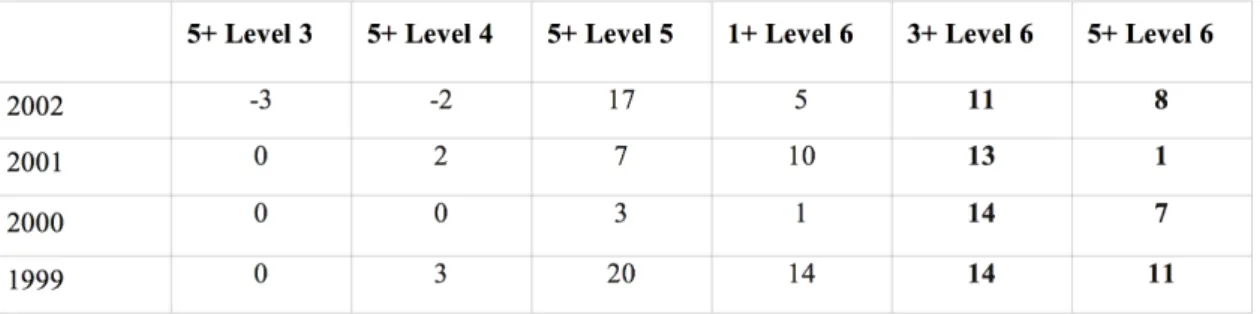
The performance data in Appendix 1 shows the overall performance for S4 and the performance by gender as supplied in the form of STACS, and some analysis of the data. The analysis of this data, to show the variation in performance by gender at the different levels, is given below in Table 2.1. In S4, the boys in the category of ‘% S4 roll achieving 5 or more at level 5 or better’ shown as ‘5+ Level 5’ shows the greatest difference in performance by gender, with the largest difference being in 2002. The differences at ‘5+ Level 3’ and ‘5+ Level 4’ are small with at most 2% points of a difference.
As an illustration of the magnitude of this difference by gender at level 5, the most demanding level, the statistics for 2002 are examined. 69% of girls achieved 5 passes or more at level 5 or better by the end of S4 compared to 47% of boys: a difference of 22 percentage points. This equates to 45 boys out of a total of 95 boys in that year group achieving 5 passes at level 5 or better. If the boys had achieved at least as well as the girls that year, in this level 5 category, this would have improved the attainment of an additional 21 boys from the 50 boys who did not achieve, equal to 42% of this cohort of boys who did not achieve this level of performance. This lower performance of boys could limit the progression of some of these boys as they moved into S5. Not achieving level 5 in S4
could mean that they would be unlikely to be studying at level 6 (Higher level) in that subject in S5. They could progress to Higher level in S6, but overall this lower
performance at S4 could reduce options for transition to higher education in future years. To confirm the apparent significance of the differences in attainment by gender, t-tests were carried out for the different measures (‘5+ Level 3’, ‘5+ Level 4’ and so on) for 1999 to 2002, and other years discussed in this chapter. The computation of t-tests for 1999 to 2002 is given in Appendix 6. From the calculations, for the attainment in 1999 to 2002, there is no significant difference at ‘5+ Level 3’ and ‘5+ Level 4’ but there is a significant difference between boys’ and girls’ attainment in S4 in ‘5+ Level 5’ equating to the pupils attaining at the highest level in S4.
The data for S5 is also given in Appendix 1. The 2002 data for S5 shows variation in the performance by gender with once again this being noteworthy at the most demanding level, level 6 (Higher), as shown below in Table 2.2. Considering the difference shown for the ‘1+ Level 6’, and particularly ‘3+ Level 6’ and ‘5+ Level 6’, which are measures associated with the performance of the most able pupils (Croxford et al., 2003), the gender differences in performance continued to be significant. For example, in 2002 19% of boys achieved five or more Highers compared to 27% of girls: an 8% percentage points
difference and the computation in Appendix 6 confirms the statistical significance.
As mentioned earlier, considering the trend using data for a given year group for a number of years is not comparing the same cohort of pupils. Considering the progression of a group moving from S4 to S5 is possible using the data in the tables. An example is shown in Appendix 2 for the comparative data for S4 (2002) and S5 (2003). Comparison of the ‘5+ Level 5’ figure for the ‘2002’ S4 cohort with the level 6 measures for S5 in 2003 continues to show a difference between some boys’ and some girls’ performance. Another observation is that for pupils who may not have been successful in S4 in achieving at least
five awards at level 5, but who had achieved this in S5, continued to show a similar
differential by gender as this same measure for the ‘2002’ S4 cohort. This suggests that the boys did not make up the difference as they progressed through S5.
2008
As part of the self-evaluation exercise for the school, this whole school data was examined annually and, together with the subject data, were the focus of discussions with the
principal teachers and teachers in the school both to raise the profile of any areas of
strengths and to determine if this was the result of changes that had been made, and also to identify key priorities as part of the school improvement planning process.
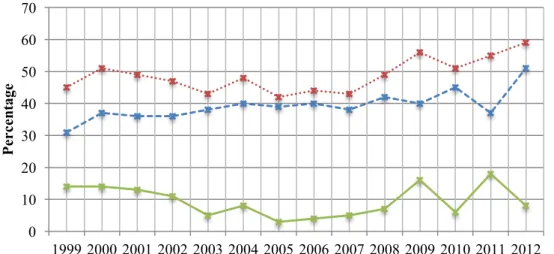
By 2008 the overall attainment for all candidates had improved with the largest increase in S5 (Appendix 3). The ‘5+ Level 6’ measure had increased from 19% to 29%. This
increase was due to the increase in performance of the girls from 20% in 2007 to 37% in 2008 (Appendix 4 shows a breakdown by gender for S4 and S5 from 1999 to 2012). There was little difference in how the boys performed overall in 2008, but there were some increases in their attainment in later years. This increase in performance of the girls was sustained in subsequent years and hence the whole school attainment remained at this higher level. The t-tests for 2008 to 2012 showed that the gender difference in attainment remained significant despite the increase in boys’ attainment. It is worth noting that S5 in 2008 was the first cohort through the school supported by the pastoral care system
introduced in 2003. This may have had an impact. However, there was no similar improvement seen in the S4 cohort (Appendix 4). Despite a focus on improvement to better meet learners’ needs and the self-evaluation processes in the school, no explanation was found for the S4 attainment not increasing.
2010
In 2010, the intervention outlined in Chapter 1 was instigated and there was an
improvement in some S4 boys’ attainment in the examination diet of 2011. This may have been due to the intervention or could have been a statistical variation. The S4 data for 2012 again showed a gender difference that followed the pattern of previous years suggesting that the intervention had not had longer-term impact. The improvement in some boys’ performance in S4 in 2011 could have been one reason for the increased attainment in 2012 in S5 (the same cohort of pupils). The boys’ attainment at ‘5+ Level 6’ increased to 29% (the highest performance in the 14 years reviewed) compared to girls’