Adaptive Multi-level Blocking Optimization
for Sparse Matrix Vector Multiplication on GPU
Yusuke Nagasaka
1, Akira Nukada
1, and and Satoshi Matsuoka
1Tokyo Institute of Technology, Tokyo, Japan
Abstract
Sparse matrix vector multiplication (SpMV) is the dominant kernel in scientific simulations. Many-core processors such as GPUs accelerate SpMV computations with high parallelism and memory bandwidth compared to CPUs; however, even for many-core processors the perfor-mance of SpMV is still strongly limited by memory bandwidth and lower locality of memory access to input vector causes further performance degradation. We propose a new sparse matrix format called the Adaptive Multi-level Blocking (AMB) format, which aggressively reduces the memory traffic in SpMV computation to improve performance. By several optimization tech-niques such as division and blocking of the given matrix, the column indices are compressed and the reusability of input vector element in the cache is highly improved. An auto-tuning mech-anism determines the best set of parameters for each matrix data by estimating the memory traffic and predicting the performance of a given SpMV computation. For 32 matrix datasets taken from the Sparse Matrix Collection collected by the University of Florida, AMB format achieves speedups of up to x2.92 compared to NVIDIA’s cuSparse library and up to x1.40 com-pared to yaSpMV, which was recently proposed and has been the best known library to date for fast SpMV computation.
Keywords: Sparse matrix format, GPU, SpMV
1
Introduction
Many-core processors such as GPU have numerous computing cores and high-bandwidth mem-ory to increase computational capability. A vast number of codes and algorithms have been ported to many-core processors and successfully accelerated. Especially in case of GPUs, many threads are executed concurrently in order to hide the latency of accessing the device mem-ory. Although this works efficiently for contiguous memory access, random or indirect memory access degrades the performance. Sparse matrix vector multiplication (SpMV) is a memory in-tensive kernel that is dominant in various numerical algorithms such as conjugate gradient (CG)
method and page ranks [26]. SpMV typically requires random memory access to input vector
element and, thus, exhibits poor performance. Although there has been many existing work to improve the performance of SpMV computation on GPU or other many-core processors, their
Volume 80, 2016, Pages 131–142
ICCS 2016. The International Conference on Computational Science
Selection and peer-review under responsibility of the Scientific Programme Committee of ICCS 2016 c
The Authors. Published by Elsevier B.V.
improvements are limited to memory bandwidth and they do not exploit the computational capability of many-core processors.
We propose a state-of-the-art sparse format that reduces memory traffic to dramatically accelerate SpMV computation on GPU. Our new format is called the Adaptive Multi-level Blocking (AMB) format and employs multiple levels of division and blocking. The AMB format improves the reusability of input vector elements in GPU cache by column-wise segmentation of the matrix and compresses the column index of each non-zero element. The AMB format requires very little memory traffic in total, and this is crucial for memory bound kernels. We evaluate the performance of our AMB format for 32 matrix datasets taken from the Sparse
Matrix Collection at University of Florida [5], and AMB achieves a maximum speedup of x2.92
and an average of x1.74 over NVIDIA’s cuSparse [23]. AMB also reports x1.40 and x1.13 for
peak and average speedups, respectively, over yaSpMV [14]—the recently proposed and most
notably fast SpMV computation library. To utilize our sparse format in practical situation, we also propose fast auto-tuning mechanism that searches the best set of parameters of AMB for each matrix dataset by estimating the memory traffic and predicting the performance of SpMV computation.
2
Sparse Matrix Formats
Sparse matrices in various scientific and engineering applications are generated by using a kind of discretization such as FEM and FDM. Matrix sizes are very large, however, most of the elements are actually zeros. For these matrices, sparse matrix formats are designed to reduce memory usage as well as amount of computations. Coordinated (COO) and Compressed Sparse Row (CSR) are widely-used sparse formats. More recently, numerous sparse formats have been proposed for specific processor architectures or matrices in order to achieve better performance
of SpMV computation [12, 13, 10, 15]. In particular, many researchers have been optimizing
SpMV computation for many-core processors such as GPUs [22, 1, 4]. While CSR format has
been extended for GPU [2, 19, 7, 3, 20], many sparse matrix formats that store the matrix
data in column major ordering have been developed since they have favorable properties for
vector processors and many-core processors. JDS (Jagged Diagonal Storage) format [27], which
was designed for vector processors, has also been optimized for GPU [8, 9], and ELLPACK
[25] based sparse formats have been proposed. Existing sparse formats focused on the issues
specific to many-core processors. Some sparse formats alleviate the load imbalance caused by
concurrent execution of many threads [17,6], while other sparse formats improved the locality
of memory access to input vector [18,24].
The ELLPACK format compresses the non-zero elements along each row, and the numbers of elements are made to be same with zero-filling in order to store the matrix data in column major ordering. ELLPACK is suitable if the rows have similar numbers of non-zero elements like a banded matrix. In contrast, it is inefficient if the numbers are not balanced because the number of zero-filling is much larger. There have been several sparse formats extended from ELLPACK to alleviate this problem.
Bellet al. proposed the Hybrid format, which combines the ELLPACK and COO formats
[2]. The matrix data is basically covered by ELLPACK and remaining part is represented in
COO format in order to reduce the number of zero-fillings. Hybrid format is implemented in the cuSparse library provided by NVIDIA as well as the CSR format optimized for NVIDIA’s GPU.
Kreutzeret al. proposed the SELL-C-σformat [11], which sorts everyσrows by the number
and conversion, SELL-C-σ format effectively reduces the number of zero-fillings. The sorting
scope ’σ’ is usually smaller than the matrix size to keep memory access locality in the original
ordering. The parameter ’C’ is the chunk size, which should be set to an architectural property such as vector register length, warp size or wavefront size.
Segmented formats are our previously proposed formats, which focus on the locality of
memory access to input vector in SpMV computation [18]. Segmented formats divide a matrix
along the column uniformly and each sub-matrix is converted to JDS or SELL-C-σ format,
which has favorable properties for many-core processors. Although our Segmented formats are able to improve the reusability of the input vector elements in caches, they proportionally increase the number of additional memory access as the number of the segmentations and total memory traffic in SpMV computation becomes larger. To alleviate this problem, we also proposed Non-Uniformly Segmented (NUS) formats, which reorder a matrix by the number of non-zero elements per row and segments the matrix with a variety of segmentation widths. NUS formats can reduce the number of segmentations with keeping high reusability of the input vector elements in caches. For large size matrices, however, the additional memory access strongly affects the performance down because of its sparsity. Therefore, NUS formats can improve the performance of SpMV only for specific small size matrices.
3
Proposal
Our previous proposals, Segmented and NUS formats, successfully improved the locality of memory access to input vector in SpMV computation on GPU. However, total memory traffic became huge and the performance of SpMV computation did not improve for large size ma-trices. The performance of SpMV computation is strongly limited by the memory bandwidth. Therefore, the reduction of the memory traffic is important to alleviate the memory bound. We propose AMB format, which largely reduces memory traffic not only to matrix data but also to input vector. First, we explain how AMB format reduces memory traffic. Next, we explain the kernel of SpMV computation and estimation of memory traffic. Finally, we explain the scheme of format conversion with auto-parameter tuning.
3.1
AMB Format
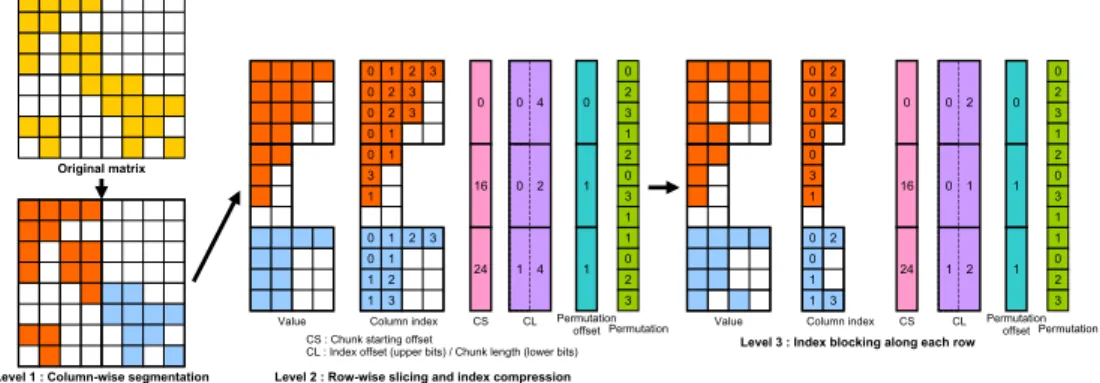
AMB format aims to reduce the memory traffic in SpMV computation by being constructed in three levels of division and blocking; first level is column-wise segmentation, second level is row-wise slicing and third level is blocking of column indices. We call column-wise division
segmentation and row-wise division slicing. Figure 1 shows the state of each level of AMB
format.
First level is column-wise segmentation. AMB format sets one segmentation width and divides a matrix along the column uniformly. By executing SpMV computation for each sub-matrix, the locality of memory access to input vector is improved and the memory traffic can be reduced. Although Segmented formats set the segmentation width to match the cache
size, AMB format limits the segmentation width to 65,536 (= 216) columns, which is not an
architecture specific value, for the compression of column index in the second level division. Second level is row-wise slicing. Each sub-matrix generated by segmentation in first level
is converted into extended SELL-C-σ format. In the same way as SELL-C-σ, AMB format
also sorts each σrows by the number of non-zero elements per row and converts each C rows
into ELLPACK in order to reduce zero-filling. AMB format stores the starting offset and the length of each chunk and the original row index of non-zero elements per row represented in
Original matrix 0 0 0 0 1 1 2 2 2 3 3 3 0 1 1 3 0 0 1 1 1 1 2 2 3 3 0 2 3 1 3 1 2 0 2 3 1 0 0 16 24 0 0 1 4 2 4 0 0 0 0 2 2 2 0 1 3 0 0 1 1 2 3 0 16 24 0 0 1 2 1 2
Value Colum n in dex CS CL
P erm utation
Value Colum n in dex CS CL
L evel 2 : R ow-wise sl icing and index compression
L evel 3 : I ndex b lock ing al ong each row
CS : Ch un k startin g offset
CL : Index offset (upper bits) / Ch un k len gth (lower bits)
0 1 1 P erm utation offset 0 2 3 1 3 1 2 0 2 3 1 0 P erm utation 0 1 1 P erm utation offset
L evel 1 : Column-wise segmentation
Figure 1: AMB format
’CS’, ’CL’ and a pair of ’Permutation offset’ and ’Permutation’ arrays in Figure1 respectively.
There are three extensions from original the SELL-C-σformat. One is the elimination of the
empty chunk which has no non-zero elements. Second is the compression of column index by representing 16-bit integer. The AMB format stores the remainder when the original index is divided by segmentation width as column index. The quotient is stored to upper 16-bit of the ’CL’ array, while the chunk length can be represented in lower 16-bit integer since segmentation
width is not greater than 216and the chunks, whose length is equal to zero, are removed. Third
is the compression of permutation array. The AMB format sets sorting scope as 32,768 (= 215)
since the zero-filling is enough reduced without setting largerσ. The AMB format stores the
remainder when the original row index is divided byσas permutation offset and the quotient
is stored to ’Permutation’. This extended SELL-C-σextremely reduces the memory usage and
the memory traffic in SpMV computation from original SELL-C-σformat.
Third level is blocking of column indices along row. Since AMB sorts the rows in second
level, blocking is limited in a row. One block size is set for each matrix data and AMB
compresses the contiguous column indices. Although the compression rate of column index can be improved when block size is larger, the number of zero-filling in value array may increase in some circumstances. Therefore, the block size should be carefully chosen for each matrix.
3.2
SpMV Kernel in CUDA and Estimation of Memory Traffic
The SpMV kernel of each format affects the performance of SpMV computation and should be carefully implemented to match the architecture and programming language. We propose the SpMV kernel for AMB format in CUDA environment. SpMV computation of AMB is constructed in two CUDA kernels. The first kernel initializes the output vector with zero, and the second kernel executes matrix vector multiplication. In the second kernel, one thread is assigned to each row, and the result of each row is accumulated in the output vector by atomic operation since column-wise segmentation causes conflicting memory accesses to the same output vector elements. If the block size set in the third level is larger, the chunk length of the column index becomes shorter and the number of iteration during the matrix vector multiplication of each row is reduced. This has the same advantage as loop unrolling.
Since SpMV computation is a memory intensive kernel, the performance of SpMV can be predicted by appropriately estimating the memory traffic. We estimate the memory traffic of
Algorithm 1 Format conversion scheme with parameter auto-tuning
Input: Matrix data in CSR
Output: Matrix data in AMB with Best Set of Parameters
1: Column-wise segmentation (segment width = 216)
2: Convert each segment to SELL-C-σ(C= 32,σ= 215)
3: Eliminate empty chunks and compress column index and permutation to 16bit
4: block size←1
5: whileblock size≤10do
6: Blocking with block size
7: Estimate the memory access and update best block size
8: block size←block size + 1
9: end while
10: Blocking with best block size
11: thread block size←64
12: whilethread block size≤512do
13: Execute SpMV and update best thread block size
14: thread block size←thread block size∗2
15: end while
variants after format conversion as follows;vis a sizeof floating point number,nzzf is a number
of value elements with zero-filling,b is a block size in third level, C is a chunk size in second
level andnC is a number of the chunk. The estimated memory traffic for the matrix data is a
sum of ’value’, ’column index’, ’CS’, ’CL’, ’Permutation offset’ and ’Permutation’ since they are read only once. Because of column-wise segmentation in the first level, accessed input vector elements will be in the cache and the number of global memory access to each input vector element is expected to be one. For the output vector, in addition to initialization in first kernel of SpMV computation, atomicAdd, which requires one read and one write memory accesses, is executed for each row. In the result, the estimated memory traffic in SpMV computation for
AMB format is: nzzf∗(v+ 2/b) +nC∗(2∗v∗C+ 2∗C+ 10) + (M +N)∗v.
3.3
Format Conversion for GPU with Parameter Auto-Tuning
For AMB format, the set of parameters such as block size affects the performance of SpMV computation. However, searching all combination of the parameters with executions of SpMV requires expensive preprocessing and it is inefficient in case of real applications. We propose the conversion scheme for the AMB format to minimize the cost of searching the parameter space. We devise a fast format conversion using GPU and auto-tuning mechanism, which searches the best set of parameters of AMB format by estimating the memory traffic and the performance
of the SpMV computation. Algorithm1shows the auto-tuning mechanism for AMB format. In
this scheme, the matrix data in CSR format is stored on GPU as input data and is converted into AMB format. The conversion is done from first level segmentation to third level blocking. In third level, this scheme searches the best block size for each matrix. The scheme converts the matrix data into the AMB format with setting the block size from 1 to 10 and estimates the memory traffic. When the mechanism searches the best block size in the third level, it does not require redundant conversion of first level segmentation and second level slicing. The block size with minimum estimated memory traffic is regarded as best block size. After the mechanism finds out the best block size, it starts searching for best thread block size, which
Table 1: Matrix Data
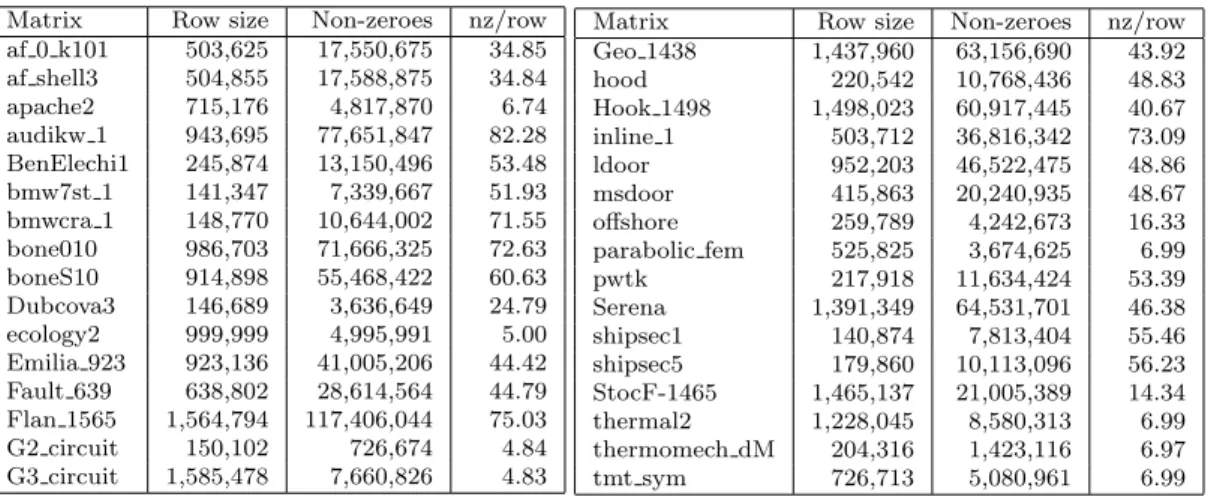
Matrix Row size Non-zeroes nz/row af 0 k101 503,625 17,550,675 34.85 af shell3 504,855 17,588,875 34.84 apache2 715,176 4,817,870 6.74 audikw 1 943,695 77,651,847 82.28 BenElechi1 245,874 13,150,496 53.48 bmw7st 1 141,347 7,339,667 51.93 bmwcra 1 148,770 10,644,002 71.55 bone010 986,703 71,666,325 72.63 boneS10 914,898 55,468,422 60.63 Dubcova3 146,689 3,636,649 24.79 ecology2 999,999 4,995,991 5.00 Emilia 923 923,136 41,005,206 44.42 Fault 639 638,802 28,614,564 44.79 Flan 1565 1,564,794 117,406,044 75.03 G2 circuit 150,102 726,674 4.84 G3 circuit 1,585,478 7,660,826 4.83
Matrix Row size Non-zeroes nz/row Geo 1438 1,437,960 63,156,690 43.92 hood 220,542 10,768,436 48.83 Hook 1498 1,498,023 60,917,445 40.67 inline 1 503,712 36,816,342 73.09 ldoor 952,203 46,522,475 48.86 msdoor 415,863 20,240,935 48.67 offshore 259,789 4,242,673 16.33 parabolic fem 525,825 3,674,625 6.99 pwtk 217,918 11,634,424 53.39 Serena 1,391,349 64,531,701 46.38 shipsec1 140,874 7,813,404 55.46 shipsec5 179,860 10,113,096 56.23 StocF-1465 1,465,137 21,005,389 14.34 thermal2 1,228,045 8,580,313 6.99 thermomech dM 204,316 1,423,116 6.97 tmt sym 726,713 5,080,961 6.99
affects the performance of GPU executions. The mechanism evaluates the performance of the SpMV computation by setting the thread block size as 64, 128, 256 or 512 and executing the kernel.
4
Performance Evaluation
We compare the performance of our AMB format and major existing sparse formats, and evaluate the cost of conversion to AMB format. For our performance evaluations, we utilize the
matrices from the Sparse Matrix Collection at University of Florida [5]. The name and size of
the matrices are summarized in Table 1. We selected 32 positive definite symmetric matrices
whose row size is larger than 131,072 (= 217) from the collection.
We evaluate the performance of SpMV on NVIDIA Tesla K20X GPU installed on TSUBAME-KFC. The GPU has 6 GBytes of device memory, being sufficient for storing all the matrices used in this performance evaluations. The bandwidth of device memory is up to 250 GB/sec and ECC is disabled. The Kepler-generation GPU has 1.5 MByte L2 cache memory shared by 14 SMX, and each SMX has 48 KByte read-only cache. Input vector elements and arrays
representing the starting offset and size of each chunk in SELL-C-σand AMB format (CL and
CS arrays in Fig. 1) and ’Permutation offset’ in AMB format are assigned to read-only cache.
Memory accesses to the other arrays bypass the read-only cache. GPU codes are implemented in CUDA 7.0 and are executed on CentOS Linux 6.4 OS 64bit.
4.1
Performance of SpMV
For the performance evaluation of SpMV computation, we utilize two sparse matrix libraries,
cuSparse and yaSpMV [14], and also we prepare SELL-C-σ, Segmented-SELL-C-σ and
NUS-SELL-C-σ formats. We select CSR, Hybrid and BSR (Block CSR) from cuSparse library, and
the best result of three formats is represented as the performance of cuSparse. The block size of BSR’s parameter is set to from 1 to 4. BCCOO format and its conversion scheme are provided in
"+*&.'0*(-(*$%* #, 1 1 /")!
Figure 2: Performance of SpMV computation in single precision
%$!(")$#'#$ $ & * *
Figure 3: Performance of SpMV computation in double precision
it achieved large performance gain compared to existing SpMV library including cuSparse. In the evaluation, yaSpMV library searches the best parameters for each matrix data, and the result of SpMV using those best parameters is used as the performance of yaSpMV. The kernel in double precision is not provided by yaSpMV. We evaluated the performance of
SELL-C-σ with various sorting scopes and select best one for each matrix. For AMB format, SpMV
is executed for all set of parameters and the best result is regarded as AMB’s performance;
segmentation width in first level is 65536 (= 216), block size in third level is set from 1 to 10,
and thread block size is set as 64, 128, 256 or 512.
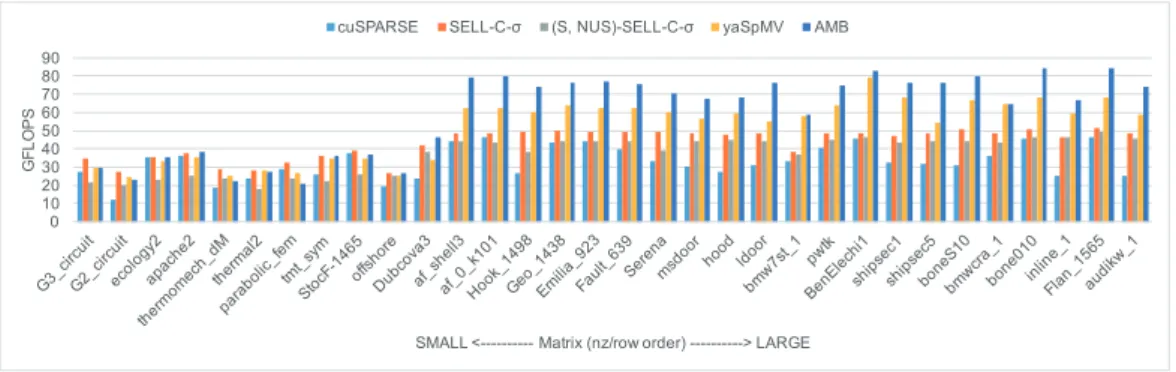
Figure 2 shows the performance of SpMV computations in single precision. Matrices are
listed in ascending order of the average number of non-zero elements per row (= nz/row). If nz/row is larger than 24, the performance of SpMV computation is high, and especially the speedup of AMB format is superior to other formats. Our AMB format achieves speedups of x2.92 on maximum and x1.74 on average compared to cuSparse library, and x1.40 on maximum
and x1.13 on average compared to yaSpMV library. Figure3shows the result of double
preci-sion. As well as single precision, our AMB format achieves high speedups compared to existing formats. However, since the memory traffic of value data is larger and the compression rate becomes lower, the speedups of AMB format are relatively small.
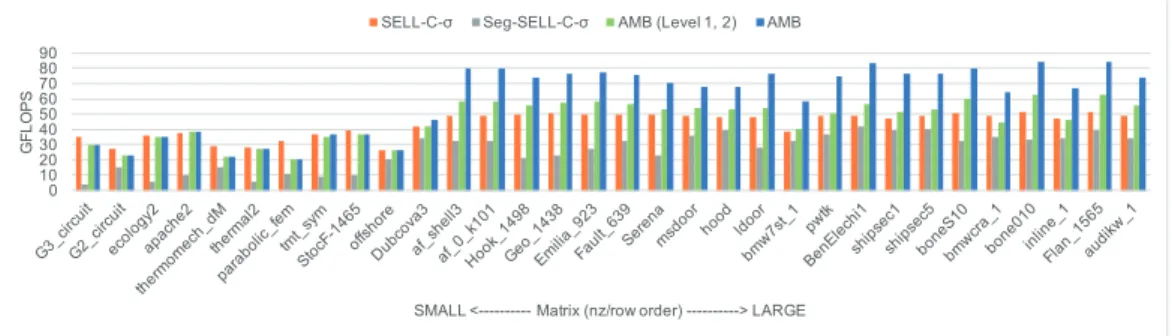
Figure4shows the speedups of each level compared to SELL-C-σformat in single precision.
For Seg-SELL-C-σ, the segmentation width is set to 216. Seg-SELL-C-σ employs only first
('#+%,'&*&' !' - !"- !)!$
Figure 4: Speedup of each level compared to SELL-C-σformat in single precision
"$ ( $ % " " #$ %" %$'!)$"&"$$ * (#
Figure 5: Memory Access Ratio in single precision
Seg-SELL-C-σ does not outperform SELL-C-σ because the additional memory traffic, which
Seg-SELL-C-σ format requires, is larger than the reduced memory traffic for input vector by
column-wise segmentation. AMB (Level 1, 2) sets the block size in third level to 1. For
most of matrices, AMB (Level 1, 2) achieves speedups compared to SELL-C-σ format. We
find the elimination of needless chunks and compression of the column index to 16-bit integer contribute the speedups of the performance of SpMV. AMB selects best block size in third level, and shows further speedups. The result also shows the blocking optimization in third level does not improve the performance when nz/row is small. This is because there are not enough non-zero elements which have contiguous column indices in each row.
Figure 5 shows the ratio of the memory traffic compared to CSR format for each matrix
data. We evaluate the memory traffic of SELL-C-σ, BCCOO from yaSpMV and AMB format.
The result shows AMB format effectively reduces the memory traffic if nz/row is larger. That is why AMB format shows superior performance to other formats. On the other hand, in smaller nz/row, the memory traffic of AMB format is not minimum in compared formats, and
SELL-C-σis most efficient format in terms of memory traffic. For these matrices, AMB format requires
atomicAdd operations for output vector, which occupy large percentage in total memory traffic. For most of matrix data, the format with minimum memory traffic shows best performance of SpMV computation compared to other sparse formats.
Figure 6: Measured and Estimated Memory Traffic
# ! " $
Figure 7: Memory Traffic and Execution Time
4.2
Evaluation of Format Conversion
Figure 6 shows the measured and estimated memory traffic of AMB format with best set of
parameters. As the correlation coefficient between the measured and estimated memory traffic is 0.999, which is enormously high score, the estimation of the memory traffic is correct.
We evaluate whether the estimation of memory traffic predicts the performance of SpMV.
Figure7shows the estimation of the memory traffic and execution time of SpMV computation
for AMB format with best set of parameters. The performance of SpMV computation depends on the memory traffic and we are able to predict the performance of SpMV computation by estimating the memory traffic. For several matrices, the execution time of SpMV computation is longer than predicted. We find load imbalance degrades the performance of SpMV compu-tation for these matrices. In addition, we evaluate the estimation of memory traffic and the performance of SpMV computation by changing the block size in third level. The block size which requires smaller memory traffic basically shows better performance of SpMV computa-tion. Therefore, we are able to predict the best block size in third level by estimating the memory traffic. However, if the difference between the estimation of memory traffic is small, the prediction of best block size in third level may fail.
We evaluate the performance of SpMV computation with auto-tuning mechanism for 32 matrix data. In the result, the mechanism selects best set of parameters for 29 matrix data in single precision and 28 in double precision. The performance down is up to 8.01% in case that the best block size for matrix data is not precisely selected. We conclude that our auto-tuning mechanism selects enough appropriate parameters. The average cost of format conversion into AMB format is 304 times execution of SpMV computation for AMB format, which can be negligible in iterative method such as CG method.
5
Related work
There have been several past work focusing on reducing memory traffic on GPUs in SpMV computation.
Maggioni et al. proposed Compressed Adaptive ELL (CoAdELL) format, where column
index is represented in 16-bit or 8bit integer [21]. CoAdELL format is based on delta encoding
technique to utilize the column distances between contiguous non-zero elements in each row. If the difference of column indices between non-zero elements is small, the distances can be
represented in 16-bit or 8-bit integer and the memory footprint is reduced. Since CoAdELL cannot compress the column index when the non-zero elements is scattered, the compression rate of CoAdELL is not high. AMB format ensures the compression to 16-bit integer for any matrices.
Tanget al. proposed Bit-Representation-Optimized (BRO) compression schemes for GPU
[16]. BRO format is also based on delta encoding and the difference of column indices is
represented in more precise number of bits. Although these bit representation techniques have been proposed for CPU, they do not work efficiently on GPU because the schemes sequentially execute. BRO format is optimized for GPU by removing these processing. Although BRO format successfully reduces the memory footprint, the performance of SpMV computation is not improved so much since it requires additional decompression schemes.
Yan et al. proposed BCCOO format, which focuses on both reduction of memory traffic
for matrix data and improving load balance [14]. BCCOO stores the matrix data in extended
COO format with blocking the matrix to reduce the memory usage of the column and row index. Row index is represented in a bit-flag being different from original COO format. When the computation result of each block is accumulated in SpMV computation, local memory such as shared memory on GPU is effectively utilized to avoid the access to global memory. Since BCCOO format requires the precise setting of many parameters such as block size and strategy in SpMV computation, yaSpMV library provides the auto-tuning mechanism. However, the cost of preprocessing of parameter tuning is extremely huge since the parameter space of BCCOO format is large. Our performance evaluation shows AMB format reduces the memory traffic and achieve better performance in SpMV computation compared to BCCOO format since BCCOO format itself is based on COO format, which requires high memory bandwidth.
6
Conclusion
Accelerating SpMV computation, which is a dominant kernel in many scientific calculations, is one of the critical issues for scientific and engineering applications. We propose a sparse matrix format, called AMB, that overcomes the two major bottlenecks of SpMV computation: memory intensive kernel and high cache miss rates caused by random memory accesses to input vector elements. AMB employs multiple levels of division and blocking optimization techniques to compress column indices and improve input vector access locality. This results in lower cache miss rates and significantly reduced memory traffic. AMB achieves superior performance to competing formats on NVIDIA Kepler GPU, demonstrating up to x2.92 speedup over NVIDIA’s cuSparse and up to x1.40 over the notable yaSpMV. We also find out the performance of SpMV computation strongly depends on the memory traffic, and we devise the auto-tuning mechanism for AMB format with best set of parameters by estimating memory traffic precisely.
For future work, we plan to investigate the effectiveness of our AMB format on other many-core processors such as AMD GPUs and Xeon Phi.
Acknowledgment
This work was supported by JSPS KAKENHI Grant Number 23220003, JST-CREST (Research Area: Advanced Core Technologies for Big Data Integration), and NVIDIA GPU Center of Excellence.
References
[1] M. . Baskaran and R. Bordawekar. Optimizing Sparse Matrix-Vector Multiplication on GPUs using
Compile-time and Run-time Strategies.IBM Reserach Report, RC24704 (W0812-047), 2008.
[2] N. Bell and M. Garland. Implementing Sparse Matrix-vector Multiplication on
Throughput-oriented Processors. InProceedings of the Conference on High Performance Computing
Network-ing, Storage and Analysis, pages 18:1–18:11. ACM, 2009.
[3] M. Daga and J. L. Greathouse. Structural agnostic spmv: Adapting csr-adaptive for irregular
matrices. In2015 IEEE 22nd International Conference on High Performance Computing (HiPC),
pages 64–74, Dec 2015.
[4] Hoang-Vu Dang and Bertil Schmidt. CUDA-enabled Sparse Matrix–Vector Multiplication on
GPUs using atomic operations. Parallel Computing, 39(11):737 – 750, 2013.
[5] T. Davis. The University of Florida Sparse Matrix Collection.
[6] A. Ashari et al. An Efficient Two-dimensional Blocking Strategy for Sparse Matrix-vector
Multi-plication on GPUs. InProceedings of the 28th ACM International Conference on Supercomputing,
ICS ’14, pages 273–282, New York, NY, USA, 2014. ACM.
[7] A. Ashari et al. Fast Sparse Matrix-Vector Multiplication on GPUs for Graph Applications.
InSC14: International Conference for High Performance Computing, Networking, Storage and Analysis, pages 781–792, Nov 2014.
[8] Ali Cevahir et al. Fast Conjugate Gradients with Multiple GPUs. InComputational Science–ICCS
2009, pages 893–903. Springer, 2009.
[9] Ali Cevahir et al. High performance conjugate gradient solver on multi-GPU clusters using
hy-pergraph partitioning. Computer Science-Research and Development, 25(1-2):83–91, 2010.
[10] B. C Lee et al. Performance Models for Evaluation and Automatic Tuning of Symmetric Sparse
Matrix-Vector Multiply. InICPP 2004: International Conference on Parallel Processing 2004,
pages 169–176. IEEE, 2004.
[11] M. Kreutzer et al. A Unified Sparse Matrix Data Format for Efficient General Sparse
Matrix-Vector Multiplication on Modern Processors with Wide SIMD Units.SIAM Journal on Scientific
Computing, 36(5):C401–C423, 2014.
[12] R. Nishtala et al. When cache blocking of sparse matrix vector multiply works and why.Applicable
Algebra in Engineering, Communication and Computing, 18(3):297–311, 2007.
[13] S. Williams et al. Optimization of sparse matrix-vector multiplication on emerging multicore
platforms. Parallel Computing, 35(3):178–194, 2009.
[14] S. Yan et al. yaSpMV: Yet Another SpMV Framework on GPUs. InProceedings of the 19th ACM
SIGPLAN Symposium on Principles and Practice of Parallel Programming, PPoPP ’14, 2014. [15] V. Karakasis et al. Perfomance models for blocked sparse matrix-vector multiplication kernels. In
ICPP’09: International Conference on Parallel Processing 2009., pages 356–364. IEEE, 2009.
[16] W. Teng Tang et al. Accelerating Sparse Matrix-Vector Multiplication on GPUs using
Bit-Representation-Optimized Schemes. InProceedings of SC13: International Conference for High
Performance Computing, Networking, Storage and Analysis, page 26. ACM, 2013.
[17] X. Liu et al. Efficient Sparse Matrix-Vector Multiplication on x86-Based Many-Core Processors. InProceedings of the 27th international conference on supercomputing, pages 273–282. ACM, 2013.
[18] Y. Nagasaka et al. Cache-aware Sparse Matrix Formats for Kepler GPU. In20th IEEE
Interna-tional Conference on Parallel and Distributed Systems (ICPADS), pages 281–288, Dec 2014. [19] J.L. Greathouse and M. Daga. Efficient Sparse Matrix-Vector Multiplication on GPUs Using
the CSR Storage Format. InSC14: International Conference for High Performance Computing,
Networking, Storage and Analysis, pages 769–780, Nov 2014.
[20] Y. Liu and B. Schmidt. Lightspmv: Faster csr-based sparse matrix-vector multiplication on
26th International Conference on, pages 82–89, July 2015.
[21] M. Maggioni and T. Berger-Wolf. CoAdELL: Adaptivity and Compression for Improving Sparse
Matrix-Vector Multiplication on GPUs. In 2014 IEEE International Parallel and Distributed
Processing Symposium Workshops (IPDPSW), pages 933–940. IEEE, 2014.
[22] A. Monakov and A. Avetisyan. Implementing Blocked Sparse Matrix-Vector Multiplication on
NVIDIA GPUs. InEmbedded Computer Systems: Architectures, Modeling, and Simulation, pages
289–297. Springer, 2009.
[23] NVIDIA Corporation. cuSPARSE Library.
[24] P. Nguyen Quang Anh et al. Reducing Vector I/O for Faster GPU Sparse Matrix-Vector
Multi-plication. In2015 IEEE International Parallel and Distributed Processing Symposium (IPDPS),
pages 1043–1052, May 2015.
[25] John R. Rice and Ronald F. Boisvert.Solving Elliptic Problems Using ELLPACK. Springer-Verlag
New York, Inc., 1984.
[26] A. Rungsawang and B. Manaskasemsak. Fast Pagerank Computation on a GPU Cluster. In20th
Euromicro International Conference on Parallel, Distributed and Network-Based Processing (PDP 2012), pages 450–456, 2012.