Multilinear and Integer Programming for Markov Decision
Processes with Imprecise Probabilities
Shirota Filho, R., Cozman, F. G., Trevizan, F. W., de Campos, C. P., & de Barros, L. N. (2007). Multilinear and Integer Programming for Markov Decision Processes with Imprecise Probabilities. In Proceedings of the 5th International Symposium on Imprecise Probability: Theories and Applications. (pp. 395-404)
Published in:
Proceedings of the 5th International Symposium on Imprecise Probability: Theories and Applications
Document Version: Peer reviewed version
Queen's University Belfast - Research Portal:
Link to publication record in Queen's University Belfast Research Portal
Publisher rights Copyright the author 2007
General rights
Copyright for the publications made accessible via the Queen's University Belfast Research Portal is retained by the author(s) and / or other copyright owners and it is a condition of accessing these publications that users recognise and abide by the legal requirements associated with these rights.
Take down policy
The Research Portal is Queen's institutional repository that provides access to Queen's research output. Every effort has been made to ensure that content in the Research Portal does not infringe any person's rights, or applicable UK laws. If you discover content in the Research Portal that you believe breaches copyright or violates any law, please contact [email protected].
5th International Symposium on Imprecise Probability: Theories and Applications, Prague, Czech Republic, 2007
Multilinear and Integer Programming for Markov Decision
Processes with Imprecise Probabilities
Ricardo Shirota Filho Escola Polit´ecnica,
Universidade de S˜ao Paulo, SP, Brazil [email protected]
Fabio Gagliardi Cozman Escola Polit´ecnica,
Universidade de S˜ao Paulo, SP, Brazil [email protected]
Felipe Werndl Trevizan Departamento de Tecnolog´ıa, Universitat Pompeu Fabra, Barcelona, Spain
Cassio Polpo de Campos Escola de Artes, Ciˆencias e Humanidades
Universidade de S˜ao Paulo, SP, Brazil [email protected]
Leliane Nunes de Barros Instituto de Matem´atica e Estat´ıstica Universidade de S˜ao Paulo, SP, Brazil
Abstract
Markov Decision Processes (MDPs) are extensively used to encode sequences of decisions with probabilis-tic effects. Markov Decision Processes with Imprecise Probabilities (MDPIPs) encode sequences of decisions whose effects are modeled using sets of probability dis-tributions. In this paper we examine the computation of Γ-maximin policies for MDPIPs using multilinear and integer programming. We discuss the application of our algorithms to “factored” models and to a recent proposal, Markov Decision Processes with Set-valued Transitions (MDPSTs), that unifies the fields of prob-abilistic and “nondeterministic” planning in artificial intelligence research.
Keywords. Markov Decision Processes with Im-precise Probabilities, Γ-maximin criterion, multilinear and integer programming.
1
Introduction
In this paper we are concerned with the computation of policies, or plans, that aim at maximizing reward over a possibly countably infinite sequence of stages. At each stage, our decision maker finds herself in a
stateand she must select anaction. As a result of this decision, she gets a reward, and she moves to a new state. The process is then repeated. We focus on sit-uations where transitions between states are modeled bycredal sets; that is, by sets of probability distribu-tions. Thus we focus on Markov Decision Processes with Imprecise Probabilities (MDPIPs), following a sizeable literature that has steadily grown in the last
few decades. We review the basic concepts on MD-PIPs in Section 2; we offer a relatively long review as we attempt to capture, in a somewhat organized form, various concepts dispersed in the literature. There are several possible criteria that we might use to evaluate policies in an MDPIP. The termoptimal pol-icyis used in this paper in connection with Γ-maximin expected total discounted reward; that is, highest ex-pected total discounted reward under the worst pos-sible selection of probabilities.
We show how to reduce the generation of optimal policies for an MDPIP tomultilinear/integer program-mingin Section 3. We also discuss in that section the practical reasons to pursue such a programming solu-tion. We comment on the relationship between multi-linear programming and “factored” models in Section 4. We then move, in Section 5, to a recently pro-posed special type of MDPIP that has particularly pleasant properties and important applications, the Markov Decision Process with Set-valued Transitions (MDPSTs).
2
Background
In this section we review basic facts about MDPs, MDPIPs, evaluation criteria, and algorithms.
2.1 MDPs
Markov Decision Processes (MDPs) are used in many fields to encode possibly infinite sequences of decisions under uncertainty. For historical review, basic techni-cal development, and substantial reference to related
literature, the reader may consult books by Puter-man [29] and Bertsekas [5]. In this paper we consider MDPs that are described by:
• a countable setT ofstages; a decision is made at each stage.
• a finite setS ofstates.
• a finite set ofactionsA; the set of actions may be indexed by states, but we simplify notation here by assuming a single set of actions for all states.
• a conditional probability distribution Pt that
specifies the probability of transition from state
sto state rgiven actionaat staget. We assume that probabilities are stationary (do no depend ont) and writeP(r|s, a).
• areward functionRt that indicates how much is
gained (or lost, by using a negative value) when action a is selected in state s at stage t. We assume the reward function to be stationary and writeR(s, a).
We refer to the state obtained at stage t, in a par-ticular realization of the process, as st; likewise, the
action selected at stagetis referred to asat.
The history ht of an MDP at stage t is the
se-quence of states and actions visited by the pro-cess, [s1, a1, . . . , at−1, st]. The Markov assumption
that is adopted for MDPs is that P(st|ht−1, at) =
P(st|st−1, at); consequently:
P(ht|s1) = P(st|st−1, at−1)P(st−1|st−2, at−2)
. . .×P(s3|s2, a2)P(s2|s1, a1). (1)
A decision rule dt(s, t) indicates the action that is
to be taken in state s at stage t. A policy π is a sequence of decision rules, one for each stage. A policy may be deterministic or randomized; that is, it may prescribe actions with certainty, or rather it may just prescribe a probability distribution over the actions. A policy may also be history-dependent or not; that is, it may depend on all states and actions visited in previous stages, or just on the current state. A policy that is not history-dependent is calledMarkovian. A Markovian policy induces a probability distribution over histories through Expression (1).
We also assume that an MDP with infinite horizon (that is, with infiniteT) may always stop with some probability. In fact, we assume that the process stops with geometric probability: the process stops at stage
t with probability (1−γ)γt−1 (independently of all
other aspects of the process). Then γ is called the
discountfactor of the MDP [29, p. 125].
2.2 MDPIPs
Additional realism and flexibility can be attached to MDPs by allowing imprecision and indeterminacy in the assessment of transition probabilities. A deci-sion process with states, actions, stages and rewards as described before, but where a set of probability distributions is associated with each transition, has been called aMarkov Decision Process with Imprecise Probabilities (MDPIP) by White III and Eldeib [44], a name we adopt in this paper. Satia and Lave Jr. use instead the nameMDP with Uncertain Transition Probabilities [31], in what may be the first thorough analysis of this model in the literature; Harmanec uses the term generalized MDPto refer to MDPIPs [21]. MDPIPs can represent incomplete and ambiguous be-liefs about transitions between states; conflicting as-sessments by a group of experts; and situations where one wishes to investigate the effect of perturbations in a “base” model. MDPIPs have also been investigated as representations for abstracted processes, where de-tails about transition probabilities are replaced by an enveloping set of distributions [17, 20]. Similar mod-els are encoded by the controlled Markov set-chains
by Kurano et al [26, 24]. Slightly less related are the vector-valued MDPs by Wakuta [41]. Some of these efforts have also adopted interval-valued rewards; in this paper we focus on imprecision/indeterminacy only in transition probabilities.
Thus an MDPIP is composed of a set of stages T, a set of states S, a set of actions A, a reward func-tionRtand sets of probability distributions, each
con-taining transition probabilities Pt. We assume T to
be the non-negative integers, S and A to be finite, and A to be constant for all states. We assume Rt
to be a stationary function R(s, a). We also assume stationarity for the sets K(r|s, a) of probability tributions. Note, however, that now we have to dis-tinguish two situations. First, the sets of transition probabilities may be identical across stages, while a history of the process may be associated with dif-ferent draws within these sets (that is, probabilities are selected from sets that do not depend on t, but the selection depends on t). We might refer to these MDPIPs as set-stationary. Alternatively, it may be that each history ht is associated with stationary
probability distributions P(st|st−1, at−1) that
them-selves satisfy the Markov condition (and of course
P(st|st−1, at−1) ∈ K(st|st−1, at−1)). We might refer
to the second MDPIPs as elementwise-stationary or simply stationary. In this paper we only deal with elementwise-stationary MDPIPs; in fact it does not seem that set-stationary MDPIPs have received any attention in the literature.
In the remainder of this paper we will use the follow-ing notation and terminology regardfollow-ing sets of proba-bility distributions. A set of probaproba-bility distributions is called a credal set [27]. The credal set K(X) con-tains distributions for variableX, and the conditional credal setK(X|A) contains conditional distributions for variable X given event A. Conditioning is ele-mentwise: K(X|A) is obtained fromK(X) by condi-tioning every distribution in K(X) on the event A. The notationK(X|Y) represents asetof credal sets: there is a credal set K(X|Y =y) for each nonempty event {Y = y}. A set of credal sets K(X|Y) is
separately specified if the joint credal set K(X, Y) is such that, whenever P(X|Y = y1) ∈ K(X|Y =y1),
P(X|Y =y2)∈K(X|Y =y2), thenP(X|Y =y1) and
P(X|Y = y2) are conditional distributions obtained
from a singleP(X, Y) inK(X, Y). That is,K(X|Y) is separately specified if we can select conditional dis-tributions independently from its sets, an assumption we make throughout for our credal sets. We loosely useK(r|s, a) to indicate a separately specified collec-tion of credal sets, for a given accollec-tiona, where rand
srefer to states.
Given a credal set K(X), we can compute lower
and upper probabilities respectively as P(A) = infP∈KP(A) and P(A) = supP∈KP(A). We can also compute lower and upper expectations for any bounded function f(X) as E[f] = infP∈KE[f] and
E[f] = supP∈KE[f], and likewise for conditional
lower/upper probabilities/expectations. We assume all credal sets to be closed, so infima and suprema can be replaced by minima and maxima.
2.3 Evaluation criteria and algorithms Given an MDP that starts at states, we might eval-uate a policyπby its expected reward:
Vπ(s) =Es,π " ET " T X t=1 R(st, at) ## ; (2) that is, the expectation of the expected reward assum-ing the process stops at stage T. Now if the process has a geometric probability of stopping at T, with parameterγ, we have [29, p. 126]: Vπ,γ(s) =Es,π "∞ X t=1 γt−1R(s t, at) # . (3) We refer to Vπ,γ(s) as the expected total discounted
reward. There are other criteria to evaluate poli-cies in MDPs; for example, the expected total re-ward Es,π[P
∞
t=1R(st, at)], and the average reward
limT→∞(1/T)Es,π h PT t=1R(st, at) i [5, 29]. These cri-teria may be useful in specific problems but they are
usually less realistic than Expression (2) and the asso-ciated discounted reward (3). We focus on the latter in this paper.
When we move to MDPIPs, we find that several crite-ria may be used to evaluate policies, even if we adopt total discounted reward. Three possible criteria are:
• Select the policy that yields the largest value of minVπ(s), where the minimum applies to all
transition probabilities, subject to the fact that these probabilities must belong to given credal sets [4]. That is, the optimal policy produces the highest expected total discounted reward even when probabilities are most unfavorable. This is the Γ-maximin total discounted reward, where an optimal policy starting from statesmust yield
max
π minP Vπ,γ(s),
where we append a subscriptP in the minimiza-tion operator, to emphasize that it applies with respect to all transition probabilities that are im-precise/indeterminate.
• Select the policy that yields, when starting from states,
max
π maxP Vπ,γ(s).
That is, both decisions and probabilities can be selected so as to maximize expected total dis-counted reward. This criterion is referred to as Γ-maximax total discounted reward.
• Select any policy (or perhaps select all of those policies) that maximizesVπ,γ(s) for at least one
choice of transition probabilities. This is the cri-terion of E-admissibility [27].
Note that Γ-maximin and Γ-maximax create a com-plete order over policies, while E-admissibility is con-tent to explore the partial order of policies induced by credal sets in any convenient way. To date, most authors have adopted the Γ-maximin criterion. An exception is Harmanec’s algorithm [21] which employs
interval dominance(Harmanec presents his algorithm as providing maximal policies, however [14, 38] ar-gue that in fact is adopts interval dominance). Sev-eral other criteria can be found in the literature [14, 37, 38].
In this paper we focus on Γ-maximin total discounted reward; we refer to it as ΓETDR (for Expected Total Discounted Reward)1. The work of Satia and Lave
1
It is not our goal to discuss here the adequacy of the Γ-maximin criterion; it is investigated in this paper because of its wide application in MDP problems. Other criteria will be investigated by the authors in the future. For discussions on the different criterions see [4, 25, 34, 32, 37, 42].
Jr. has derived several important results for this situ-ation [31]. First, there exists a deterministic stsitu-ation- station-ary policy that is optimal. Second, the optimal policy induces a value function that is the unique solution of
V∗ (s) = sup a inf P R(s, a)+γ X r P(r|s, a)V∗ (r) ! . (4) We can take maximum and minimum in this equation whenever the set of actionsAis finite and the credal setsK(r|s, a) have finitely many vertices. We assume this to be true in the remainder of this paper. Expression (4) can be compactly written as V∗ = VV∗
, by lumping the supremum, infimum, and sum-mation into the operatorV. Whenever the transition probabilites are fixed (or are precisely specified) at some valueP, we indicate it through the operatorVP
(where the infimum is either suppressed or unneces-sary). In fact, for an MDP with transition probabil-itiesP, the optimal policy satisfiesV∗
=VPV∗, the
Bellman equation.
2.4 Algorithms for MDPs and MDPIPs Consider now algorithms that solve the Bellman equa-tion. There are three “classic” algorithms for generat-ing optimal policies in MDPs: value iteration, policy iteration, and reduction to linear programming [5, 29]. Most of the literature focuses on value or policy itera-tion. However, there are at least three reasons to pay attention to linear programming solutions to MDPs. First, a linear program produces an exact solution without the need to specify any stopping criteria (as needed for value and policy iteration). This property is useful in practice and particularly important while testing other algorithms. Second, several algorithms based on approximating the value function by lower dimensional functions are based on linear program-ming [19, 22, 33]. Third, and perhaps more impor-tantly, linear programs seem to offer the only orga-nized way to deal with problems where maximization of expected total discounted reward is subject to ad-ditional constraints on expected rewards [1, 29]. The linear programming algorithm for MDPs solves the equation V∗
= VPV∗ for the precisely specified
transition probabilities as follows [16]: min V∗ X s V∗ (s) (5) s.t. V∗(s)≥R(s, a) +γX r P(r|s, a)V∗(r),
where each pair (s, a) corresponds to a constraint. Policy and value iteration have known counterparts for ΓETDR. Satia and Lave Jr. presented a policy
iteration algorithm for ΓETDR. The results by Satia and Lave Jr., and by Denardo [15], produce a value iteration algorithm as indicated by White III and El-deib [44]; the same algorithm was later derived in the special case of Bounded-parameter Markov Decision Processes (BMDPs) [17]. The value iteration algo-rithm starts with a candidate value function V′
0(s) and iterates: V′ i+1=VV ′ i (6) until ||V′ i+1−V ′
i|| is sufficiently small.2 Convergence
of this procedure is based on the fact that the operator V is a contraction mapping.3
3
A multilinear/integer solution for
Γ
ETDR
Expression (5) describes the linear program for solv-ing MDPs with precisely specified probabilities. It does not seem possible to produce a linear program-ming solution for ΓETDR; however, as we show in this section, it is possible to generate solutions using well known programming problems. We do not attempt to produce algorithms that surpass value/policy iter-ation in execution time; rather, our reasons to pursue a programming solution mirror the reasons why oth-ers have investigated linear programming for MDPs (summarized in Section 2.4). First, the results pro-duced by multilinear and integer programming, and in particular the latter, depend on combinatorial proper-ties of credal sets, and can be produced exactly; this is useful, for instance, while evaluating other algorithms that only promise ǫ-optimal policies. Second, several approximate algorithms for MDPs that can possibly be extended to MDPIPs depend on linear program-ming; we conjecture that these potential extensions to MDPIPs will depend on the results in this section. In fact, it seems that multilinear programming is un-avoidable in factored models, as we discuss in Section 4. Third, solutions based on optimization seem to be the only way to handle constraints on expected re-wards, a topic we wish to pursue in connection with planning (Section 5).
Our main result is, in essence, simple. We start from Expression (4), and note that its solution can be found by solving the following optimization problem:
min V∗ X s V∗(s) (7) s.t. V∗ (s)≥R(s, a) +γmin P X r P(r|s, a)V∗ (r). 2
The norm||V||= maxsV(s) is typically used in the
liter-ature. 3
A mapping V :U → U, whereU is a complete normed linear space, is a contraction mapping iff ||Vu1−Vu2|| ≤
This can be shown to be an instance of bilevel pro-gramming [8, 40]. Similar problems have been tack-led before in connection with linear programming with uncertainty, with obvious application to ΓETDR [2, 3]. Current algorithms for bilevel programming are complex, and convergence guarantees are not as sharp as one would like. It would be interesting to reduce Program (7) to a form that were closer to existing, well studied optimization problems. We do this by reducing Program (7) to multilinear and then to in-teger programming.
The multilinear program we consider is: min V∗,P X s V∗(s) (8) s.t. V∗ (s)≥R(s, a) +γX r P(r|s, a)V∗ (r). Denote by (V∗ R, P ∗
R) a solution of Program (7) and
by (V∗
G, P
∗
G) a solution of Program (8). In order to
use Program (8), we must prove thatV∗
G andV ∗ R are identical. Theorem 1 V∗ G=V ∗ R
Proof. Let ΩR and ΩG be the solution spaces for
Programs (7) and (8) respectively. We prove that ΩR
is a subset of ΩG. Then, we show that no solution in
ΩG\ΩRcan have better performance than one in ΩR.
We have: ΩR={(V, P) :V ∈ V, P = arg min P∈P X r P(r|s, a)V(r)}, ΩG={(V, P) :V ∈ V, P ∈ P}.
Given that the solution space in the second case is the whole spaceV × P, while in the first case P can only be in a subspace V × PR of V × P (hence
re-stricted), Program (8) produces a value function at least as low as Program (7). So, V∗
G ≤ V ∗ R, because ΩG⊃ΩR. Now supposeVG∗< V ∗ R. For a states∈ S we haveV∗ G(s) =R(s, a)+γ P rP ∗ G(r|s, a)V ∗ G(r), with P∗
G(r|s, a) 6= arg minPPrP(r|s, a)V(r). If we take
P′
(r|s, a) = arg minPPrP(r|s, a)V(r), thenV
′ (s) = R(s, a) +γP rP ′ (r|s, a)V∗ G(r)< V ∗ G(s) andV ∗ G is not optimal. SinceV∗
G isoptimal (given that it considers
the whole state space), then V∗
G 6< V ∗ R. This implies thatV∗ G=V ∗ R. •
Apparently we have moved from a difficult problem (bilevel programming) to another difficult problem (multilinear programming). However, the significance of this result is that multilinear programming is a widely studied field, with close connections to geo-metric and linear programming [18, 23, 28, 35, 39]. Implementations can deal with hundreds of variables;
in our tests we resort to Sherali and Adams’ algorithm [35], a branch-and-bound scheme based on linear pro-gramming relaxations. Our implementation is an op-timized version of this algorithm, that has been used to solve a variety of large and challenging multilinear programs [10, 11, 13, 12]. The examples presented later in this section were solved using this implemen-tation.
An even more interesting result obtains if we assume that the vertices of credal sets K(r|s, a) are known. Consider a list of vertices (each vertex is a distribu-tion over S) for a credal setK(r|s, a), {p1, . . . , pM}.
Every distribution in this credal set can be expressed as a convex combinationPM
i=1αipiwhereαi≥0 and
P
iαi= 1. We can then write our goal as:
min V∗,αi,s,a X s V∗(s) (9) s.t. V∗ (s)≥R(s, a) + γX r X i αi,s,api(r|s, a)V ∗ (r), αi,s,a ≥0, X i αi,s,a= 1,
where we explicitly indicate that αi,s,a depends on
(s, a).
We now use the fact that a multilinear program has a maximum at the vertices of the credal sets; thus we necessarily have αi,s,a ∈ {0,1} at a
solu-tion. We then resort to the following transformation to produce an integer program out of the multilin-ear program (9), just assuming that we can bound
V∗
from above and below (such bounds can be pro-duced quite generally using results by White III and Eldeib [44]). First, we replace V∗
(r) ∈ [l, u] by
l + (V∗
(r)− l), and create a new variable βr =
V∗
(r)−l ∈ [0, u−l]. Each αi,s,api(r|s, a)V∗(r) is
thus replaced by αi,s,api(r|s, a)l+αi,s,api(r|s, a)βr.
Note that αi,s,api(r|s, a)l is easy to evaluate. As
αi,s,a can be restricted to 0 or 1, we take each term
αi,s,api(r|s, a)βr and replace αi,s,aβr by a new
vari-able βi,r,s,a. To ensure that this replacement does
not change the original problem, we introduce linear restrictions:
0≤βi,r,s,a ≤βr,
βi,r,s,a≤αi,s,a(u−l),
βr−(u−l) +αi,s,a(u−l)≤βi,r,s,a.
The first and second restrictions are obvious (limi-tations on βr and αi,s,a. The last restriction
im-poses the following. When αi,s,a = 1, βr ≤ βi,s,a.
However, since from the first restriction βi,s,a ≤ βr,
then βi,s,a = βr, and the full V∗(r) will be
βr−(u−l)<0 (sinceβr≤(u−l)), soβi,r,s,a= 0, and
this non-optimal pair state-action will not be consid-ered.
We end up with the following integer program: min V∗,αi,s,a X s V∗(s) (10) s.t. V∗ (s)≥R(s, a) + γX r X i [αi,s,api(r|s, a)l+ pi(r|s, a)βi,r,s,a] αi,s,a≥0, X i αi,s,a= 1 βr=V∗(r)−l 0≤βr≤u−l 0≤βi,r,s,a≤βr βi,r,s,a≤αi,s,a(u−l) βr−(u−l) +αi,s,a(u−l)≤βi,r,s,a
We close this section with two examples of MDPIPs. We focus on multilinear programming solutions; later we will consider examples where integer programming is used.
3.1 A small MDPIP
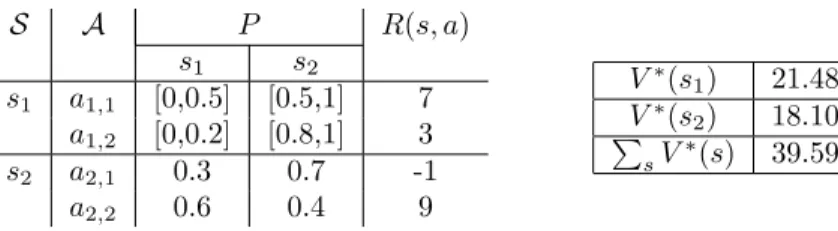
This is a very simple, abstract example. Consider two states, s1 and s2. In each state, the decision maker
can choose between two actions. In s1 the
transi-tion probability for both actransi-tions are imprecisely spec-ified, while transition probabilities ins2are precisely
specified. Probabilities and rewards are presented in Table 1 (left). The transition probabilities are de-fined from the states in the first column (origin states) to the states on the first row under P (destination states). The solution given by multilinear program-ming leads to the optimal solution; the value function
V∗ is shown in Table 1 (right).
3.2 Planning airplane maintenance through MDPIPs
This example is based on a problem described by White [43, p. 171]:
An airline classifies the condition of its planes into three categories, viz. excellent, good and poor. The annual running costs for each cate-gory are 0.25×10⁶, 106 and 2×10⁶ [monetary units] respectively. At the beginning of each year the airline has to decide whether or not to overhaul each plane individually. With no overhaul a plane in excellent condition has prob-abilities of 0.75 and 0.25 of its condition being
excellent or good, respectively, at the beginning of the next year. A plane in good condition has probabilities of 0.67 and 0.33 of its condition be-ing good or poor, respectively, at the beginnbe-ing of the next year. A plane in poor condition will remain in a poor condition at the beginning of the next year. An overhaul costs 2×10⁶ and takes no significant time to do. It restores a plane in any condition to an excellent condition with probability 0.75, and leaves it in its current condition with probability 0.25. The airline also has an option of scrapping a plane and replacing it with a new one at a cost of 5×10⁶. Such a new plane will be in excellent condition initially. There is an annual discount factor ofγ= 0.5.
We consider a variant of this problem where proba-bilities are specified as in Table 2 (left). Multilinear programming produces the value function in Table 2 (right).
4
Factored MDPs
The specification of transitions between states is par-ticularly burdensome in large MDPs. One strategy that has been often employed is to encode transi-tion probabilities infactoredform; usually this means that transition probabilities are encoded byBayesian networks [7]. Here the state space is defined by the configurations of variables{X1, . . . , Xn}. We denote
by Xi,t the ith variable at stage t. For each action
a, we specify a bipartite directed acyclic graph con-taining 2nnodes denoted by Xi+ and Xi−; nodeXi−
andXi+represent respectivelyXi,t−1andXi,tfor any
t >0. One layer of the graph contains nodesX−
i for
alli, and no edge between them. The other layer con-tains nodes Xi+ for all i, and edges between them. Edges are allowed from nodes in the first layer into
the second layer, and also between nodes in the sec-ond layer. We denote by pa(Xi+) the parents ofXi+
in the graph. The graph is assumed endowed with the following Markov condition: a variable Xi+ is condi-tionally independent of its nondescendants given its parents. This implies the following factorization of transition probabilities: P(X1+, . . . , Xn+) = n Y i=1 P(Xi+|pa(Xi+)). (11)
Now suppose that conditional probability distribu-tions P(Xi+|pa(Xi+)), or a subset of them, are not known precisely, but rather up to inclusion in credal sets K Xi+|pa(Xi+)
. We assume the Markov condi-tion to operate over all combinacondi-tions of distribucondi-tions from these credal sets, thus producing a possibly large set of joint distributions, each one of them satisfying
S A P R(s, a) s1 s2 s1 a1,1 [0,0.5] [0.5,1] 7 a1,2 [0,0.2] [0.8,1] 3 s2 a2,1 0.3 0.7 -1 a2,2 0.6 0.4 9 V∗ (s1) 21.486474 V∗ (s2) 18.108099 P sV ∗(s) 39.594573
Table 1: Specification of simple MDPIP example (left), and value functionV∗
(right). S A P R(s, a) s1 s2 s3 a1,1 [0.5,1] [0,0.4] [0,0.1] −0.25×10⁶ s1 a1,2 1 0 0 −2×10⁶ a1,3 1 0 0 −5×10⁶ a2,1 0 [0.67,1] [0,0.33] −106 s2 a2,2 [0.75,1] [0,0.25] 0 −2×10⁶ a2,3 1 0 0 −5×10⁶ a3,1 0 0 1 −2×10⁶ s3 a3,2 [0,0.25] [0.5,0.8] [0,0.25] −2×10⁶ a3,3 1 0 0 −5×10⁶ V∗ (s1) -1265664.1604 V∗ (s2) -2496240.6015 V∗ (s3) -4000000.0 P sV ∗ (s) -7761904.7619
Table 2: Specification of MDPIP for plane maintenance (left), and value functionV∗
(right). the factorization in Expression (11) — the resulting
structure is acredal networkfor each action [9]. The main point of this section is to indicate that Ex-pression (11) defines a multilinear product for the probabilities that appear in Program (8). Thus, the multilinear character of Program (8) is left un-changed: the computation of Γ-maximin policies is still a matter of multilinear programming. The devel-opment of algorithms that produce optimal policies and that exploit the factorization in Expression (11) is left for the future; this is a promising avenue of re-search as the most advanced algorithms for factored MDPs do use all available structure encoded in the factorization [19, 22].
5
MDPSTs
In this section we explore the properties of a class of MDPIPs that have an important application in the field of artificial intelligence planning. Roughly speaking, planning in artificial intelligence focuses on sequential decision making problems that are speci-fied using high-level languages. There are many vari-ants of AI planning, depending on the properties of the specification language; for example, we have de-terministic planning, where actions have determinis-tic effects; probabilisticplanning, where actions have probabilistic effects; and nondeterministic planning, where an action may cause a transition to a set of states without any clue at to what state will be moved
into [30]. The latter name is somewhat unfortunate as “nondeterminism” is an overloaded term, but it is the usual terminology in the field. Typically deterministic and nondeterministic planning are tackled by search through state spaces, while probabilistic planning is tackled by generation of equivalent MDPs.
There has been considerable effort in the field of AI planning to develop general algorithms that can be instantiated for different types of planning prob-lems [6]. However, until recently no model consid-ered actions with simultaneously “probabilistic” and “nondeterministic” effects. In response to this situ-ation, Trevizan et al. have proposed a jointly prob-abilistic/nondeterministic framework, based on MD-PIPs [36]. Their proposal is based on a class of MDPIPs, called Markov Decision Processes with Set-valued Transitions (MDPSTs), defined as follows. An MDPST is composed by a set of stages T, a set of states S, a set of actions A, a reward functionR, a state transition function F(s, a) mapping states s
and actions a∈ A into reachable sets ofS, i.e., into nonempty subsets ofS, and a set of mass assignments
m(k|s, a) for all s, a∈ A, and k ∈F(s, a). Here we also assumeT to be the non-negative integers,S and
A to be finite, A to be constant for all states, and
R(s, a) to be a stationary function. The state transi-tion functransi-tion F(s, a) and mass assignmentsm(k|s, a) are also stationary. MDPSTs satisfy a simplified
ver-sion of Expresver-sion (4) [36]: V∗ (s) = max a∈A R(s, a)+γ X k∈F(s,a) m(k|s, a) min r∈kV ∗ (r) . (12) MDPSTs form a strict subset of MDPIPs [36]; thus Programs (8) or (10) can be used to solve MDPSTs. These solutions require an enumeration on mass as-signmentsm(k|s, a). However we can produce simpler programs if we study Expression (12) carefully. Given any action a ∈ A, we can collect all feasi-ble k ∈ F(s, a), and define a binary vector I(s, a) with as many elements as sets of states in F(s, a), such that Ii(s, a) ∈ {0,1} for i ∈ {1, . . . , N}, and
P
iIi(s, a) = 1. Because each Ii(s, a) can only be
equal to 0 or 1, and their sum is equal to one, only an uniqueIi(s, a) can be equal to one at a time. We
now write Expression (12) as:
V∗ (s) = max a∈AR(s, a) + (13) γ X k∈F(s,a) m(k|s, a) k X i=1 Ii(s, a)V ∗ (ri).
We now transform each product Ii(s, a)V∗(ri) into
a new variable, following the procedure outlined in Section 3. We first replaceV∗(r
i) byl+ (V∗(ri)−l),
whereV∗(r
i)∈[l, u]; we then define βi =V∗(ri)−l,
with βi ∈ [0, u−l]. We define a variable βi,s,a =
Ii(s, a)βi, and add the necessary constraints to the
optimization problem. The final integer program is very similar to the Program (10):
min V∗,I X s V∗(s) (14) s.t. V∗(s)≥R(s, a) + γX k X i [Ii(s, a)m(k|s, a)l+ m(k|s, a)βi,s,a] Ii(s, a)≥0, X i Ii(s, a) = βi=V ∗ (ri)−l 0≤βi≤u−l 0≤βi,s,a≤βi βi,s,a≤Ii(s, a)(u−l) βi−(u−l) +Ii(s, a)(u−l)≤βi,s,a.
This is a very useful transformation, once integer programming is much simpler than multilevel pro-gramming. There are many powerful integer program solvers that guarantee global optimal solutions, where multilevel program solvers only achieve global opti-mals in certain specific cases.
5.1 A small MDPST
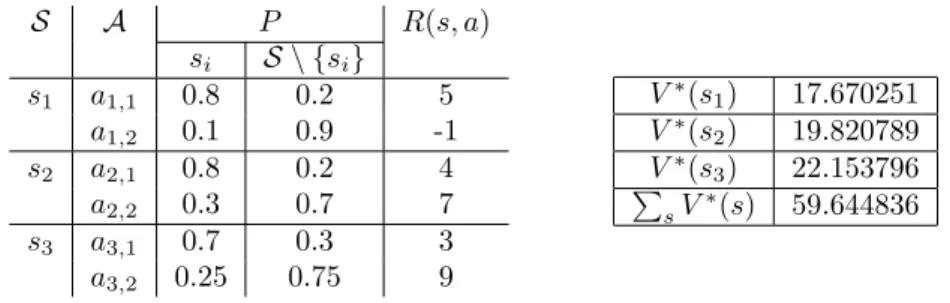
Consider 3 states,s1,s2ands3. At statesi, there are
actions ai,1 and ai,2. All actions define probabilistic
transitions from one state to itself or to the set com-posed by the other 2 states, however with different assignments of rewards and transition probabilities. The values assigned to each state and action can be found in Table 3. The optimal solution was obtained by solving an integer program.
5.2 Probabilistic/nondeterministic planning of airplane maintenance
Consider the example of airplane maintenance in Sec-tion 3. Suppose that transiSec-tion probabilities follow Table 4 (left); a transition that “fills” more than a column is a nondeterministic one. The optimal solu-tion obtained can be seen in Table 4 (right).
6
Conclusion
We have reviewed the basic theory of MDPIPs under the criterion of Γ-maximin expected total discounted reward, and we have shown how to produce policies using multilinear and integer programming. This type of solution may be useful to handle problems with further constraints on expected rewards, and to deal with factored models and factored approximations. We plan to continue the present work by exactly ad-dressing such constraints and factorizations.
We have then looked into the recently proposed MDP-STs. We have briefly reviewed the application of these processes as a unifying language for “proba-bilistic” and “nondeterministic” planning, and then showed how these processes nicely lead to integer pro-gramming solutions. As indicated previously, one of the reasons to investigate a programming solution for MDPIPs is the promise it holds for treating problems with constraints on policy. For instance, it may be required that a policy, besides maximizing minimum expected total discounted reward, also guarantees the probability of some set of states to be higher than some value (in practice: maximization of profit for a company, subject to the probability that a client is left unattended being smaller than a given value). Markov decision processes subject to such constraints are calledconstrained MDPs[1, 29], and the main method of solution there is linear programming. We conjec-ture that constrained MDPIPs will require solutions based on multilinear/integer programming. This will be even more important in the context of MDPSTs, because “nondeterministic” planning is usually asso-ciated with contraints on policies.
S A P R(s, a) si S \ {si} s1 a1,1 0.8 0.2 5 a1,2 0.1 0.9 -1 s2 a2,1 0.8 0.2 4 a2,2 0.3 0.7 7 s3 a3,1 0.7 0.3 3 a3,2 0.25 0.75 9 V∗ (s1) 17.670251 V∗ (s2) 19.820789 V∗ (s3) 22.153796 P sV ∗ (s) 59.644836
Table 3: Specification of small MDPST (left), and value functionV∗
(right). S A P R(s, a) s1 s2 s3 a1,1 0.5 0.5 −0.25×10⁶ s1 a1,2 1 0 0 −2×10⁶ a1,3 1 0 0 −5×10⁶ a2,1 0 1 −106 s2 a2,2 0.75 0.25 0 −2×10⁶ a2,3 1 0 0 −5×10⁶ a3,1 0 0 1 −2×10⁶ s3 a3,2 0.8 0.2 −2×10⁶ a3,3 1 0 0 −5×10⁶ V∗ (s1) -1666666.6666 V∗ (s2) -3000000.0 V∗ (s3) -4000000.0 P sV ∗ (s) -8666666.666
Table 4: Specification of MDPST for plane maintenance (left), and value functionV∗
(right).
Acknowledgements
This work has been supported by FAPESP grant 2004/09568-0; the first author is supported by FAPESP grant 05/58090-9; the second author is par-tially supported by CNPq grant 3000183/98-4; the third author is supported by CAPES grant BEX 4248-05-8; the fifth author is partially supported by CNPq grant 308530/03-9.
Tests were run in a multilinear programming solver that calls AMPL and CPLEX in its internal loops.
References
[1] E. Altman. Constrained Markov decision processes. Chapman & Hall, Boca Raton, Florida, 1999. [2] I. Averbakh. On the complexity of a class of
combina-torial optimization problems with uncertainty. Math-ematical Programming, 90(2):263–272, 2001.
[3] A. Ben-Tal and A. Nemirovski. Robust solutions of undertain linear programs. Operations Research Let-ters, 25(1):1–13, 1993.
[4] J. O. Berger. Statistical Decision Theory and Bayesian Analysis. Springer-Verlag, 1985.
[5] D. P. Bertsekas. Dynamic Programming and Opti-mal Control (Vol. 1, 2). Athena Scientific, Belmont, Massachusetts, 1995.
[6] B. Bonet and H. Geffner. Learning Depth-First Search: A unified approach to heuristic search in
deterministic and non-deterministic settings, and its application to MDPs. In Proc. of the 16th ICAPS, 2006.
[7] C. Boutilier, S. Hanks, and T. Dean. Decision-theoretic planning: Structural assumptions and com-putational leverage. Journal of Artificial Intelligence Research, 11:1–94, 1999.
[8] B. Colson, P. Marcotte and G. Savard. Bilevel pro-gramming: A survey.Quaterly Journal of Operations Research, 3(2):87–107, 2005.
[9] F. G. Cozman. Graphical models for imprecise prob-abilities. International Journal of Approximate Rea-soning, 39(2-3):167–184, 2005.
[10] F. G. Cozman, C. P. de Campos, J. S. Ide, and J. C. F. da Rocha. Propositional and relational Bayesian networks associated with imprecise and qualitative probabilistic assessments. InUncertainty in Artificial Intelligence, pages 104–111. AUAI Press, 2004. [11] C. P. de Campos and F. G. Cozman.
Infer-ence in credal networs using multilinear program-ming. In Second Starting AI Researchers’ Sym-posium (STAIRS), pages 50–61, Amsterdam, IOS Press, 2004.
[12] C. P. de Campos and F. G. Cozman. Belief updat-ing and learnupdat-ing in semi-qualitative probabilistic net-works. InUncertainty in Artificial Intelligence, pages 153–160, Edinburgh, United Kingdom, 2005. [13] C. P. de Campos and F. G. Cozman. Computing
lower and upper expectations under epistemic inde-pendence. In Fourth International Symposium on
Imprecise Probabilities and Their Applications, pages 78–87, Dulles, Virginia, 2005.
[14] G. de Cooman and M. C. M. Troffaes. Dynamic programming for deterministic discrete-time systems with uncertain gain. International Journal Approxi-mate Reasoning, 39(2-3):257–278, 2005.
[15] E. V. Denardo. Contraction mappings in the the-ory underlying dynamic programming.SIAM Review, 9(2):165–177, 1967.
[16] F. D’Epenoux. A probabilistic production and inven-tory problem. Management Science, 10(1):98–108, 1963.
[17] R. Givan, S. M. Leach, and T. Dean. Bounded-parameter Markov decision processes. Artificial In-telligence, 122(1-2):71–109, 2000.
[18] W. Gochet and Y. Smeers. A branch-and-bound method for reversed geometric programming. Oper-ations Research, 27(5):983–996, September/October 1979.
[19] C. Guestrin, D. Koller, R. Parr, and S. Venkatara-man. Efficient solution algorithms for factored MDPs.
Journal of Artificial Intelligence Research, 19:399– 468, 2003.
[20] V. Ha and P. Haddawy. Theoretical foundations for abstraction-based probabilistic planning. In Uncer-tainty in Artificial Intelligence, pages 291–298, San Francisco, California, United States, 1996. Morgan Kaufmann.
[21] D. Harmanec. Generalizing Markov decision pro-cesses to imprecise probabilities. Journal of Statis-tical Planning and Inference, 105:199–213, 2002. [22] M. Hauskrecht and B. Kveton. Linear program
ap-proximations for factored continuous-state Markov decision processes. InAdvances in Neural Informa-tion Processing Systems 16, pages 895–902. 2004. [23] R. Horst and H. Tuy. Global Optimization:
Deter-ministic Approaches. Springer-Verlag, 1995.
[24] M.Hosaka, J. Nakagami, and M. Kurano. Controlled Markov set-chains with set-valued rewards – the av-erage case. International Transactions in Operations Researach, 9:113–123, 2002.
[25] D. Kikuti, F. G. Cozman, and C. P. de Campos. Par-tially ordered preferences in decision trees: comput-ing strategies with imprecision in probabilities. In IJ-CAI Workshop on Advances in Preference Handling, pages 118–123, Edinburgh, United Kingdom, 2005. [26] M. Kurano, J. Song, M. Hosaka, and Y. Huang.
Con-trolled Markov set-chains with discounting. Journal Applied Probability, 35:293–302, 1998.
[27] I. Levi. The Enterprise of Knowledge. MIT Press, Cambridge, Massachusetts, 1980.
[28] C.D. Maranas and C.A. Floudas. Global optimization in generalized geometric programming. Computers and Chemical Engineering, 21(4):351–370, 1997. [29] M. L. Puterman. Markov Decision Processes. John
Wiley and Sons, New York, 1994.
[30] S. J. Russell and P. Norvig. Artificial Intelligence: a Modern Approach. Prentice Hall, New Jersey, 1995. [31] J. K. Satia and R. E. Lave Jr. Markovian decision
processes with uncertain transition probabilities. Op-erations Research, 21:728–740, 1970.
[32] M. Schervish, T. Seidenfeld, J. Kadane, and I. Levi. Extensions of expected utility theory and some lim-itations of pairwise comparisons. In Third Inter-national Symposium on Imprecise Probabilities and their Applications, pages 496–510. Carleton Scien-tific, 2003.
[33] P. J. Schweitzer and A. Seidmann. Generalized poly-nomial approximations in Markovian decision pro-cesses. Journal of Mathematical Analysis and Ap-plications, 110(2):568–582, 1985.
[34] T. Seidenfeld. A contrast between two decision rules for use with (convex) sets of probabilities: γ-maximin versuse-admissibility. Synthese, 140(1-2), 2004. [35] H.D. Sherali and W.P. Adams. A
Reformulation-Linearization Technique for Solving Discrete and Continuous Nonconvex Problems. Kluwer Academic Publishers, 1999.
[36] F. W. Trevizan, F. G. Cozman, and L. N. de Barros. Planning under risk and Knightian uncertainty. In
20th IJCAI, pages 2023–2028, 2007.
[37] M. C. M. Troffaes. Decision making with imprecise probabilities: A short review. SIPTA Newsletter, pages 4–7, 2004.
[38] M. C. M. Troffaes. Learning and optimal control of imprecise Markov decision processes by dynamic pro-gramming using the imprecise Dirichlet model. pages 141–148, Berlin, 2004. Springer.
[39] H. Tuy. Convex Analysis and Global Optimization, volume 22 ofNonconvex Optimization and Its Appli-cations. Kluwer Academic Publishers, 1998.
[40] L. N. Vicente and P. H. Calamai. Bilevel and multi-level programming: A bibliography review. Journal of Global Optimization, 5(3):291–306, 1994.
[41] K. Wakuta. Vector-valued Markov decision processes and the system of linear inequalities. Stochastic Pro-cesses and their Applications, 56:159–169, 1995. [42] P. Walley.Statistical Reasoning with Imprecise
Prob-abilities. Chapman and Hall, London, 1991.
[43] D. J. White.Markov Decision Processes. John Wiley and Sons, 1993.
[44] C. C. White III and H. K. El-Deib. Markov decision processes with imprecise transition probabilities. Op-erations Research, 42(4):739–749, July-August 1994.