ISTANBUL TECHNICAL UNIVERSITYFGRADUATE SCHOOL OF SCIENCE ENGINEERING AND TECHNOLOGY
Face Track Retrieval and Recognition Across Age
M.Sc. THESIS Esam Ghaleb
Department of Computer Engineering Computer Engineering Programme
ISTANBUL TECHNICAL UNIVERSITYFGRADUATE SCHOOL OF SCIENCE ENGINEERING AND TECHNOLOGY
Face Track Retrieval and Recognition Across Age
M.Sc. THESIS Esam Ghaleb
(504131515)
Department of Computer Engineering Computer Engineering Programme
Thesis Advisor: Assoc. Prof. Dr. Hazım Kemal EKENEL
˙ISTANBUL TEKN˙IK ÜN˙IVERS˙ITES˙IFFEN B˙IL˙IMLER˙I ENST˙ITÜSÜ
Ya¸slar Arası Yüz ˙Iz Çıkarımı ve Tanıması
YÜKSEK L˙ISANS TEZ˙I Esam Ghaleb
(504131515)
Bilgisayar Mühendisli˘gi Anabilim Dalı Bilgisayar Mühendisli˘gi Programı
Tez Danı¸smanı: Assoc. Prof. Dr. Hazım Kemal EKENEL
Esam Ghaleb, a M.Sc. student of ITU Graduate School of Science Engineering and Technology 504131515 successfully defended the thesis entitled “Face Track Re-trieval and Recognition Across Age”, which he/she prepared after fulfilling the re-quirements specified in the associated legislations, before the jury whose signatures are below.
Thesis Advisor : Assoc. Prof. Dr. Hazım Kemal EKENEL ... Istanbul Technical University
Jury Members : Prof. Dr. Muhittin Gökmen ... MEF University
Prof. Dr. Zehra Çataltepe ... Istanbul Technical University
...
Date of Submission : 17 August 2015 Date of Defense : 21 August 2015
FOREWORD
Video face recognition is a very popular task and has come a long way. The primary challenges such as illumination, resolution and pose are well studied through multiple datasets and have extensive researches. However, age invariant face recognition still lacks enough studies and there are no video-based datasets dedicated to study the effects of aging on facial appearance. Unlike previous works that deal with studying age progression using still images, our study focuses on face track retrieval and recognition across age using video based dataset. We present a challenging face track dataset, Harry Potter Movies Aging dataset (Accio), to study and develop age invariant face recognition methods for videos. In addition we conduct an extensive study on the dataset for purpose of proving the aging factor in the dataset and for obtaining an age invariant face track retrieval and recognition. Our dataset not only has strong challenges of pose, illumination and distractors, but also spans a period of ten years providing substantial variation in facial appearance. It consists of large number of face tracks for variant characters and age groups. It provides a good environment and case to study the impact of age progression together with other technical challenges in face recognition in videos such face pose variation, expression, illumination and resolution. We make the dataset publicly available for further exploration in age-invariant video face recognition.
We propose two primary tasks: within and across movies face track retrieval and recognition; and three protocols which differ in their freedom to use Accio or external data. We achieve retrieval experiments, which are evaluated using two popular measures: (i) mean average precision (mAP), and (ii) precision @ k. We present baseline and improved results for the retrieval using a state-of-the-art face track descriptor (Fisher vector). Our baseline experiments show clear trends of reduction in performance as the age gap between the query or test and database or train movies increases. In order to improve the performance of baseline: we adopt three metric learning techniques: (i)joint metric learning, (ii)low-rank Mahalanobis metric learning, and (iii)diagonal metric learning. We use these metric learning algorithms in two different scenarios: (i) metric learning on pairwise movies, which obtain a metric model from a percentage of face tracks of two movies and (ii) metric learning on all movies which combine a percentage of face tracks from all movies. In both scenarios, we observe an improvement over the baseline results in case of using joint and low-rank Mahalanobis metric learning in term of both mAP and precision @k. They reduce the gap between cross movies’ results that emerge due to facial changes across movies and they increase the results of mAP and precision @k. The best average improvement compared to the baseline is obtained in case of using joint metric learned from all movies which reach to 42.2%. Most of improvements are between movies with large gap between their release date. This due to the ability of the used metric learning to capture the similarity features across ages.
In addition, we apply linear Support Vector Machines (SVMs) on the dataset for both evaluation tasks in order to assess of the performance of face track recognition across age on this dataset. The accuracy results of this experiment support the trend we obtain
in retrieval evaluation by giving results in similar similar behavior. We always obtain higher recognition rate from the evaluation within the same movies, however the rate decreases as we test across movies especially when the years’ gap increases.
As a part of our aforementioned study, we measure the performance of the state-of-the-art face verification method: Fisher vector. We carry out several experiments on Fisher vector using different dataset, Facial Recognition Grand Challenge (FRGC), rather than Label Face in the Wild (LFW). In addition we benefit from Gabor filters as local descriptor rather than Scale Invariant Feature Transformation(SIFT). In addition we use various settings of data and Fisher vector such as, face alignment, Gaussian Mixture Model (GMM) size, Principal Component Analysis ( PCA) dimensions on features, and the information augmentation local descriptors. We evaluate each of these parameters separately in order to check their impact on the Fisher vectors on face verification task. In this work we provide an expanded analysis of each parameter with comparison to different setting.
The major contributions of the this work can be summarized as following: we present “Harry Potter Movies Aging Dataset (Accio)”, provide a baseline and improved face track retrieval results using Fisher vector face track descriptor and metric learning techniques. We apply face track recognition evaluation which also endorse the retrieval baseline results to prove aging factor in Accio dataset. Finally we carry out Fisher vector analysis to evaluate its performance on face verification.
ACKNOWLEDGMENT
I would like to express my deepest expression and thanks for everyone who helped me to complete this thesis. First, I would like to express my gratitude to Assoc. Prof. Hazım Kemal Ekenel for his supervision of my thesis, patience, and providing me with a great atmosphere for doing research in Smart Interaction, Mobile Intelligence, and Multimedia Technologies (SiMiT) Research Group. I also thank everyone in SiMiT Lab for their support and having great time with them during my work.
I would like to thank Prof. Rainer Stiefelhagen for providing me an opportunity to work on my thesis during my summer visits to Computer Vision for Human Computer Interaction (CVHCI) Laboratory in Karlsruhe Institute of Technology (KIT). It had been a great experience with the inspiring research group in CVHCI. I would like to thank all the members of the laboratory who made my stay fantastic.
Very special thanks goes to Makarand Tapaswi, for being excellent advisor and for his untiring help. I am very grateful to have him as an advisor. I thank him for suggesting this exciting work of my thesis. It was his idea to work on face track retrieval and recognition across age using challenging and novel face track dataset called “Harry Potter Movies Aging Dataset (Accio)”. I also thank him for helping me to prepare and release the dataset. I appreciate his vast knowledge and skills in many areas ( e.g., guidance, vision, research), sharing his experience, and his assistance in writing and developing this work. Makarand Tapaswi is a person who truly made difference in my life. Without his motivation and encouragement I would not have complete this work. I am also grateful for Ziad Al-Halah for his suggestions and directions during my work. He always asks the right questions and we have interesting discussions during our meet with Makarand Tapaswi.
In addition, this work is funded by the German Research Foundation under contract no. STI-598/2-1; TUBITAK within the CHIST-ERA project titled CAMOMILE, project no. 112E176; and a Marie Curie FP7 Integration Grant in the 7th EU Framework. Last but not least, I want to thank my family in Yemen: my parents, my sisters, and my brothers who always guide and support me spiritually to excel throughout my life.
TABLE OF CONTENTS
Page
FOREWORD... xi
TABLE OF CONTENTS... xiii
ABBREVIATIONS ... xv
LIST OF TABLES ...xvii
LIST OF FIGURES ... xix
SUMMARY ... xxi
ÖZET ... xxv
1. INTRODUCTION ... 1
1.1 Motivation and Hypothesis... 4
1.2 Problem Definition ... 6
1.3 Thesis Outline... 6
2. RELATED WORK ... 9
2.1 Face Identification ... 9
2.2 Data Sets ... 10
2.3 Face Track Retrieval ... 10
2.4 Age Invariant Face Recognition ... 11
3. THEORETICAL FOUNDATION... 13
3.1 Shot Boundary Detection ... 13
3.2 Face Detection and Tracking ... 14
3.2.1 Modified census transformation ... 14
3.2.2 Boosting and cascade classifiers... 15
3.2.3 Face tracking... 15
3.2.4 Face alignment... 16
3.3 Face Image and Track Representation... 17
3.3.1 Fisher vector for face recognition... 18
3.4 Metric Learning ... 21
3.4.1 Large margin dimensionality reduction... 21
3.4.2 Low-rank joint metric learning... 23
3.4.3 Diagonal metric learning ... 24
3.5 Linear Support Vector Machines (SVMs) ... 25
3.6 Performance Evaluation Methods ... 26
3.6.1 Receiving operator characteristic (ROC) curve: ... 27
4. FACE TRACK RETRIEVAL AND RECOGNITION ACROSS AGE ... 29
4.1 Accio: Harry Potter Movies Aging Dataset ... 29
4.1.1 Data source ... 29
4.1.2 Face track descriptors ... 31
4.2 Experiments ... 33
4.2.1 Evaluation protocol... 33
4.2.2 Baseline evaluation on all face tracks... 34
4.3 Improving Baseline Face Track Retrieval Results... 37
4.3.1 Metric learning on pairwise movies ... 37
4.3.2 Metric learning on all movies data ... 47
4.4 Face Track Recognition ... 55
5. FACE VERIFICATION ANALYSIS USING FISHER VECTORS... 59
5.1 Face Recognition Grand Challenge(FRGC) Data Set ... 59
5.2 Experiments: FRGC’s Fourth Experiment ... 60
5.2.1 SIFT features ... 60
5.3 Fisher Vectors Using Gabor Filters ... 61
5.3.1 Spatial, scale and orientations augmentations: ... 62
5.4 Experiments and Results ... 63
5.4.1 Effect of face alignment ... 63
5.4.2 Effect of PCA dimension size ... 64
5.4.3 Effect of spatial, scale and orientation augmentation... 64
5.4.4 Effect of GMM size:... 65
5.4.5 Final experiment ... 66
6. CONCLUSION AND FUTURE WORK ... 69
6.1 Conclusion ... 69
6.2 Future Work ... 70
REFERENCES... 73
CURRICULUM VITAE ... 79
ABBREVIATIONS
mAP :Mean Average Precision AP :Average Precision
SVMs :Support Vector Machines FRGC :Facial Grand Challenge
SIFT :Scale Invariant Feature Transformation GMM :Gaussian Mixture Model
PCA :Principal Component Analysis MCT :Modified Census Transformation LFW :Label Face in The Wild
DFD :Displaced Frame Difference ROC :Receiving Operator Curve SGD :Stochastic Gradient Descent
LIST OF TABLES
Page
Table 4.1 : Number of tracks and characters across the movies. ... 32
Table 4.2 : Actors age distribution. ... 32
Table 4.3 : Comparison of age-invariant face recognition datasets... 33
Table 4.4 : Within movies evaluation. ... 35
Table 4.5 : across movies face track retrieval performance (MAP). ... 35
Table 4.6 : Comparison of MAP scores for adult vs. young actors. The queries are taken here from HP-1 movie. ... 37
Table 4.7 : Comparison of number of pairs when using different percent of face tracks from pair movies... 38
Table 4.8 : Pairwise baseline’s cross movies FT retrieval: mAP. ... 38
Table 4.9 : Pairwise joint metric’s cross movies FT retrieval: mAP. ... 40
Table 4.10 : The average differences of the precision @k between baseline and joint metric learning that show the improvement in tasks 1 and 2 results for different k values... 40
Table 4.11 : Cross movies FT retrieval: mAP. ... 42
Table 4.12 : Full dimensional Fisher vectors: The average differences of the precision @k between baseline and joint metric learning that show the improvement in tasks 1 and 2 results for different k values... 43
Table 4.13 : Pairwise low rank Mahalanobis metric’s cross movies FT retrieval: mAP. ... 43
Table 4.14 : The average differences of the precision @k between baseline and low-rank Mahalanobis metric learning that show the improvement in tasks 1 and 2 results for different k values... 44
Table 4.15 : Pairwise diagonal metric’s cross movies FT retrieval: mAP. ... 44
Table 4.16 : The average differences of the precision @k between baseline and diagonal metric learning that show the improvement in tasks 1 and 2 results for different k values... 44
Table 4.17 : All movies baseline’s cross movies FT retrieval: mAP. ... 47
Table 4.18 : All movies joint metric’s cross movies FT retrieval: mAP. ... 48
Table 4.19 : Metric learning from from all movies: The average differences of the precision @k between baseline and joint metric learning that show the improvement in tasks 1 and 2 results for different k values. 49 Table 4.20 : Full dimensional Fisher vectors - All movies joint metric’s cross movies FT retrieval: mAP. ... 50
Table 4.21 : Metric learning from from all movies on full dimensional Fisher vectors: The average differences of the precision @k between baseline and joint metric learning that show the improvement in tasks 1 and 2 results for different k values... 51
Table 4.22 : All movies low-rank Mahalanobis metric’s cross movies FT retrieval: mAP. ... 51 Table 4.23 : Metric learning from from all movies: The average differences of
the precision @k between baseline and joint metric learning that show the improvement in tasks 1 and 2 results for different k values. 51 Table 4.24 : All movies diagonal metric’s cross movies FT retrieval: mAP. ... 53 Table 4.25 : Metric learning from from all movies: The average differences of
the precision @k between baseline and joint metric learning that show the improvement in tasks 1 and 2 results for different k values. 54 Table 4.26 : SVM accuracy: overall. ... 56 Table 4.27 : F1 score of face recognition for Harry Potter character in Accio
dataset. ... 57 Table 4.28 : F1 score of face recognition for Hermione character in Accio
dataset. ... 57 Table 4.29 : F1 score of face recognition for Ron Weasley character in Accio
dataset. ... 57 Table 5.1 : Evaluation results of LFW splits in term of ROC = ( 1 - EER). ... 60 Table 5.2 : Using SIFT features: AUC and [email protected] FAR% of FRGC’s fourth
experiment... 61 Table 5.3 : Effect of face alignment: AUC and [email protected]% FAR of FRGC’s
fourth experiment... 64 Table 5.4 : Effect of PCA Dimensions AUC and [email protected]% FAR of FRGC’s
fourth experiment... 64 Table 5.5 : Effect of Augmentation: AUC and VR@FAR = 0.1% FAR of
FRGC’s fourth experiment... 65 Table 5.6 : Effect of GMM size: AUC and [email protected]% FAR of FRGC’s fourth
experiment... 66 Table 5.7 : Final Results of AUC and [email protected]% FAR of FRGC’s fourth
experiment... 66 Table 5.8 : Comparison between SIFT and Gabor results of AUC and
[email protected]% FAR of FRGC’s fourth experiment. ... 68
LIST OF FIGURES
Page
Figure 1.1 : Change in character appearance across the movies... 2
Figure 1.2 : Across movies evaluation hypothesis: Dominant matrix. ... 5
Figure 3.1 : Shot boundary example [1]... 13
Figure 3.2 : Face detection with MCT features and cascade classifiers [2]. ... 15
Figure 3.3 : Face tracks obtained by face tracker in Harry Potter movie series.... 17
Figure 3.4 : Aligned faces with different eye distances and eye rows. ... 18
Figure 3.5 : Fisher vector implementation pipeline [3]... 18
Figure 3.6 : Gabor wavelets with 8 orientations and 5 scales. ... 20
Figure 3.7 : Positive and negative pairs are separated with a margin by metric learning [3]... 22
Figure 4.1 : Actors age progression. Each line represents the age span for that actor appearing in the movies. ... 30
Figure 4.2 : Change in character appearance across the movies... 31
Figure 4.3 : Precision @ k results for across movies retrieval. This figure is best viewed in color. ... 36
Figure 4.4 : Baseline pairwise precision @ k results for across movies retrieval. This figure is best viewed in color. ... 39
Figure 4.5 : Pairwise joint metric learning’s precision @ k results for across movies retrieval. This figure is best viewed in color... 41
Figure 4.6 : Full dimensional Fisher Vectors: Pairwise joint metric learning’s precision @ k results for across movies retrieval. This figure is best viewed in color. ... 42
Figure 4.7 : Pairwise low-Rank Mahalanobis metric learning’s precision @k results for across movies retrieval. This figure is best viewed in color... 44
Figure 4.8 : Pairwise diagonal metric learning’s precision @ k results for across movies retrieval. This figure is best viewed in color... 45
Figure 4.9 : Confusion matrices of difference between baseline and applied pairwise metric learning mAPs... 46
Figure 4.10 : FT from all movies: Baseline’s precision @k results for across movies retrieval. This figure is best viewed in color... 48
Figure 4.11 : FT from all movies: Joint’s precision @ k results for across movies retrieval. This figure is best viewed in color... 49
Figure 4.12 : FT from all movies: Joint’s precision @ k results for across movies retrieval. This figure is best viewed in color... 50
Figure 4.13 : FT from all movies: Low-rank Mahal.’s precision @kresults for across movies retrieval. This figure is best viewed in color... 52
Figure 4.14 : FT from all movies: Diagonal metric’s precision @kresults for across movies retrieval. This figure is best viewed in color... 53 Figure 4.15 : Difference between baseline mAP and applied data from all
movies metric learning mAPs. ... 54 Figure 4.16 : Sample images for characters that satisfy that SVM training criteria. 55 Figure 5.1 : Still images taken in one session under controlled conditions
(Studio Settings) [4]... 60 Figure 5.2 : Two uncontrolled still images[4]. ... 60 Figure 5.3 : Pipeline of Gabor filters representations for face image [5]... 62 Figure 5.4 : Two different aligned faces... 63 Figure 5.5 : The three ROC curves plot of the fourth experiment of FRGC
using low-rank Mahalanobis metric learning... 67
Face Track Retrieval and Recognition Across Age
SUMMARY
In this work we focus our study on two subjects: face track retrieval and recognition across age, and the analysis of Fisher vector on face verification. Age invariant face recognition lacks enough researches and dataset based on video. In our study, we present a novel face track dataset called “Harry Potter Movies Aging Dataset (Accio). The dataset is harvested from Harry Potter movie series. It provides face recognition challenges such as variant face pose and expression, illumination, and more importantly a challenge of facial appearance changes due to age progression since the movies span a period of ten years. As a result, this dataset introduces a great environment for studying face track retrieval and recognition across age. Previous datasets conducted on age invariant face recognition use still images (FGNET, MORPH, CACD) either contains small number of data or the data spans small range of years. Our dataset contains large number of face tracks (nearly 38K face tracks) with variant age groups that span an age range between 10 to 88 years. Typically face track recognition is harder than still image face recognition due to effects of tracking, motion blur and pose variation. Each movie of the dataset has different number of face tracks and characters. Nearly 60% of the face tracks are named as they appear in the movies and the rest of face tracks act as distractors or in retrieval evaluation. Our dataset contains great distribution for age group and most of face tracks belong to young characters. This is an important property to study the impact of aging factor since facial appearance changes is more in early ages than older ones. For face track representation, we use the state-of-the-art descriptor: Fisher vector. Fisher vector encoding aggregates large set of local descriptors of all face images into one high dimensional single vector representation.
We define two primary tasks for retrieval and recognition: within and across movies evaluation. (i) Within moviestask uses the data of the individual movies for training and testing once to evaluate the performance against challenges such as pose and illumination variation. (ii) Across movies task adopts evaluation between pairwise movies. Such as training data from HP-1 and testing data from HP-2 or vice versa. The purpose of this task is to assess the impact of aging factor across movies as the years’ gap between movies increases. following the definition of evaluation tasks, we suggest three benchmark protocols for the dataset for the evaluation for future studies and researches: (i)restricted: that uses only face track query for training and retrieval or recognition models should not use other Accio face tracks or any external data. The aim of this protocol is to compare the performance of face track descriptors. (ii) Unrestricted: this protocol allows only for the usage of external data to train learning model for the retrieval and recognition evaluation on Accio dataset. (iii) Free-for-all protocol which allows the usage of internal and external data for training.
Using the suggested retrieval and recognition tasks, we introduce an extensive study for face track retrieval and recognition across age. The retrieval evaluation uses two popular performance measures: (ii) Mean Average Precision (mAP) and (ii) precision @k. We apply different experiments on Accio dataset. First Experiment is the across and within movies evaluation on all face tracks with full dimensional Fisher vector. The mAP and Precision @k results of this experiment show clearly the impact of age progression across movies. The performance of within movies evaluation is better than the performance of across movies evaluation due to the facial changes between movies. Following the baseline experiment, and in order to capture the similarity features of face tracks across movies and to improve the performance of this evaluation, we benefit from three metric learning algorithms: (i) low-rank Mahalanobis metric learning, (ii) joint metric learning, and (iii) diagonal metric learning. These metric learning techniques serve two aims: (i) reducing the dimensions of Fisher vectors to make learning more applicable on large datasets, and (ii) increasing the face track retrieval and recognition performance by making the Fisher vectors more discriminative in the new projected subspace.
Prior to the experiments of within and across movies retrieval using metric learning, we reduce the dimensionality of Fisher vectors of face tracks by PCA and then apply the learning algorithms. We use metric learning approaches in two scenarios: (i) metric learning on pairwise movies which combines percentage of face tracks for training a metric model and the uses it for the evaluation on the rest tracks for the two tasks of the evaluation, and (ii) metric learning on data from all movies which combines a percentage of face tracks from all Accio movies and uses them to obtain metric model. Then this model is used to evaluate on the rest of test face tracks for two evaluation tasks. In both scenarios of metric learning, low-rank and joint metric learning improve the results of the evaluation for both measures, mAP and precision @k which reflects their ability to capture variant facial changes through movies and to learn the similarity features between them. However diagonal metric is more basic and leads to slightly worse results than baseline results. For example, the average improvement in between the baseline and the joint learned from all movies is 42.7%. In addition there is a great improvement in precision @k such that the gaps between query and database movies is minimized. This shows the efficiency of these two approaches in learning the similarity between variant facial features across movies. Unlike the baseline where the performance declines for larger k values, results of precision @k is stable for different values in different k values.
The last experiment on Accio dataset is face recognition across age. In this experiment and similar to retrieval tasks, we have within and across movies evaluation. We apply 5 fold across validation test on movies using linear SVMs models. SVM models are obtained from each movies’ characters, and we use this model for the validation within the same and across movies. As expected, recognition accuracy in within movies evaluation is higher than accuracy in across movies’ evaluation, because of the facial appearance variation between the data of training model and testing data.
In the second part of this work, we evaluate and measure the performance of Fisher vector that we use in face track retrieval and recognition. Fisher vector is successful method and gives great results on face verification task using LFW dataset. However, in our work, the aim is to assess the performance of Fisher vector, using different dataset and features with various parameters. We use FRGC dataset rather than LFW.
Specifically we evaluate its fourth experiment which has one set for training and two sets for test: query and target sets. We use Gabor filter as local descriptors rather than SIFT. We study the effect of spatial, scale and orientation augmentation to the features on the results of face verification. In addition we change the parameters of Fisher vectors such as the number of Gaussian Mixture Models and Feature-PCA dimension. In each experiment, we change one parameter while keeping the others fixed during the evaluation to see the impact of that parameter on the performance of Fisher vectors on face verification task. Since Fisher vector is efficient encoding system in features space, augmentation of the feature information improve the performance greatly. Furthermore, PCA dimension of features has an influence on the results when the dimensions are low, while GMM size does not have big impact on the results.
Ya¸slar Arası Yüz ˙Iz Çıkarımı ve Tanıması
ÖZET
Videoda yüz tanıma popüler bir ara¸stırma konusudur ve çok yol katedilmi¸stir. I¸sıklandırma, çözünürlük ve açı gibi zorluklar çe¸sitli veri setleri kullanılarak iyice incelenmi¸stir. Fakat, yüzdeki ya¸slanmayı ara¸stırma yönelik video tabanlı hiçbir veri seti bulunmamaktadır. Videolarda ya¸stan ba˘gımsız yüz tanıma teknikleri geli¸stirmek ve incelemek için bu zorlu veri setini takdim ediyoruz: “Harry Potter Movies Aging Data Set (Accio)”. Veri setimiz sadece açı, aydınlanma ve parazit veriler bakımından zorluklara sahip olmayıp aynı zamanda yüz görünümündeki önemli de˘gi¸sikliklere dair on yıllık bir süreci kapsamaktadır. Yüz çıkarımını bir Harry Potter filminin sadece kendisinden veya di˘ger Harry Potter filmlerinin herhangi birinden yapmak üzere iki temel görev uyguluyoruz ve harici veri seti kullanımındaki serbestlik açısından de˘gi¸skenlik gösteren iki farklı protokol kullanılmasını öneriyoruz. Son model bir yüz takibi özniteli˘gi kullanarak çıkarım performansını ana hatlarıyla sunuyoruz. Deneylerimizde yüz çıkarımından alınan sorguyla veritabanı arasındaki ya¸s farkı arttıkça performansta net bir azalma e˘gilimi görülmektedir. Videolarda ya¸stan ba˘gımsız yüz tanıma alanındaki ara¸stırmaların daha ileriye gidebilmesi için veri setimiz kamuya açık olacaktır.
Videolarda yüz tanıma zorlayıcı bir konu oldu˘gu için son yıllarda çok fazla ilgi çekmi¸stir. TV karakterlerini belirmek, gözetim kamerlarından ¸süphelileri tanımak gibi birçok pratik kullanımı vardır. Aydınlatma, yüz açısı, ifadesi ve çözünürlük sorunlarını çözmek için önemli geli¸smeler kaydedilmi¸stir. Bu çalı¸smada, oldukça ihmal edilen ya¸slanmaya ba˘glı yüz görünüm de˘gi¸siklerinin etkisini incelemeye odaklandık. Ya¸s varyansyonunu analiz etmek için sabit görüntünün birden fazla veri seti varken (FGNET, MORPH, CACD), bildi˘gimiz kadarıyla video tabanlı veri seti bulunmamaktadır. Ayrıca, yüz izi kullanarak, yüz takibi nedeniyle haraket bunalıklı˘gı, ve ¸siddetli poz de˘gi¸simi nedenleriyle sabit yüz imgesine göre yüz tanıma sorunu daha zor oldu˘gu barizdir. Böyle bir veri seti, ya¸s de˘gi¸siminin sorunun video bazlı çözülmesine sa˘glayacaktır.
Ya¸stan ba˘gımsız yüz tanıma sistemlerini de˘gerlendirmek ve geli¸stirmek için geni¸s ve zorlu yüz izi veri seti sunmaktayız. Veri seti Harry Potter serisinde olu¸smaktadır. Filmler on yıllık bir dönemi kapsar ve videoda yüz tanıma di˘ger zorluklarıyla birlikte ya¸s varyasyon etkilerini incelemek için güçlü bir ortam sunmaktadır. Ayrıca, veri setinde ya¸slanma etkilerini en belirgin oldu˘gu döneme ( genç yüzleri) ait çok sayıda yüz izi bulunmaktadır. De˘gi¸sik ya¸s gruplarına sahip olan çok sayıda adlandırılmı¸s karakterlerle birlikte veri seti birçok distraktör olarak adlandırreedı˘gımz ismi olmayan yüz izleri içeriyor.
Bu veri seti on yıllık bir süre içinde yayınlanan sekiz Harry Potter film serisini kullanarak toplanıp düzenlemi¸stir. Her film kendi içinde birkaç zorluklar içermektedir.
(i) Aydınlatma: birçok parlak ve karanlık sahne vardır. (ii) poz: ön pozlu olmayan yüz izleri ve genelikle aktörler kameraya bakmamaktadır. (iii) çözünürlük: - izler 25’ten 500’a kadar çözünürlü˘gü olabilir. (iv) distraktörler: yüz izlerin yakla¸sık %40’sı arka planda gözüken ve ismi olmayan karakterlere ait ve bu yüz izi tanıma görevinde sorunları yaratabilir. Son olarak, ya¸slanmadan dolayı yüzdeki görünüm de˘gi¸simi sekiz filmi kullanımı iyi bir kaynak olarak görülmektedir.
Yüz izleri elde etmek için ilk ba¸sta video çekim sınırları tespit edilmi¸stir. Her çekim içinde, gibi parçacık filtresi yüz yakalamayla yüz izi elde edilmi¸stir. Tüm yüz kaydırma ve silindir açılarını kapsayan çoklu poz yüz yakalama yöntemi de kullanılmı¸stır. Veri seti genç aktörler (ya¸sı < 20 ) için çok sayıda yüz izleri içermektedir. Ço˘gu yüz görünümü de˘gi¸siklikleri erken ya¸sta oldu˘gu için bu önemli bir özelliktir.
Veri setinde yüz izleri temsil etmek için son model olarak bilinen Fisher Vector Faces (FV2) özniteli˘gi kullanılmı¸stır. Bu makalede yüz tanımak için öznitelik vektörü(FV2) imgeden yerine yüz izinden çıkartılmı¸s ve buna video pooling denmektedir. Yüz izindeki bütün yüz imgelerinin öznitelik vektörleri bir vektörde birle¸stirilmi¸s.
Her filmde ikiye bölünmü¸s adlandırılmı¸s ve bilinmeyen (distraktör) yüz izlerin sayısı sunulmaktedir. Veri set yakla¸sık 38,464 yüz izleri içermektedir. Bunların %59.4 yani 22830 121 farkli karekterlerle filmlerde gözüktü˘gü gibi adlandırılmı¸s yüz izleridir. Yüzlerin geri kalanı yani %40.6 adlandırılmamı¸s oyunculara ait ve yüz izlerin çıkarımında distraktör olarak kabul edilmi¸stir. Her Harry Potter film serisinde yüz izleri de˘gi¸sen sayıda bulunmaktadır. Aktörlerin ya¸sları 10 ile 88 arasındaki ya¸sları kapsamaktadır. Ya¸sları filme yayınma tarihine göre hesapladı˘gımız için ya¸sta hafif bir tutarsızlık olabilir. ˙Ilk filmde ve son filmde rol alan aktörlerin yüz izlerini ya¸s farkı maximum on sene olabilir ve böylece en büyük ya¸s farkı 10 sene olarak kabul edilmektedir.
˙Ilk olarak filmin aynısını ikinci olarak di˘ger filmleri kullanarak yüz izi çıkarımı olmak üzere iki temel görev uyguluyoruz:
(i) Filmin kendisi: Bu ayarlarda, her film bireysel olarak görülmü¸stür ve kendi içinde de˘gerlendirme yapılmı¸stır. Aynı film içinde adlandırılmı¸s her yüz izi sorgu olarak kullanılırken di˘ger kalan yüz izleri ( distraktör de dahil) veritabanı olarak olu¸sturmu¸stur. Bu ortamda, poz ve aydınlatma gibi tipik yüz tanımı sorunlarına maruz kalan çıkarım performansı de˘gerlendirilmi¸stir.
(ii) Filmler arasında: By ayarlarda, di˘ger Harry Potter de˘gi¸sik filmleriyle yüz iz çıkarımını de˘gerlendirerek, aktörler arasında ya¸s de˘gi¸sininin ektisini analiz edilmektedir. Herhangi film içinden (örne˘gin HP- 1) her adlandırılmı¸s yüz izi sorgu olarak kullanırken de˘ger bir filmin (örne˘gin) bütün yüz izleri veritabanı olu¸sturmaktadır.
LFW ve YouTube Faces setleri gibi verilerin kısıtlı, kısıtsız ve serbest bir ¸sekilde kullanımının ayarlarını öneriyoruz. Görevleri içeren iki protokol öneriyoruz, fakat denetimli ve denetimsiz modelleri ö˘grenmek için hangi ve ne dereceye verlerin kullanılaca˘gına göre de˘gi¸sir.
(i) Kısıtlı Protokol: Bu protokolda deneylerde harici veriler kullanılmamalıdır. Bunun positif e˘gitim örne˘gi olarak sadece sorgu izi mevcut oldu˘guna anlamına gelir. Çıkarım modelleri di˘ger Accio yüz izleri veya harici iz/imge kullanarak e˘gitimi kullanılmamalıdır. Bu sadece farklı yüz izin özniteliklerini kar¸sıla¸stırmak
için veya sorgu geni¸sleme ve alan adaptasyon gibi otomatik ve denetimsiz yöntemleri de˘gerlendirmek için kullanılabilir.
(ii) Kısıtsız Protokol: Bu ortamda, ara¸stırmacılar e˘gtim modeli elde etmek için harici verilerini kullanmalarına izin verilir. Örne˘gin, ya¸slanma sürecinde yüz görünümü modellemek için harici verileri kullanılabilir. Fakat, aktörlerin modellerini e˘gitiminde Accio veri setinden herhangi bir yüz izi kullanılmamalıdır.
Son olarak, veriler önceki protokollara göre uymadan farkli bir ¸sekilde kullanılırsa, örne˘gin yüz izi sınıflandırma amacıyla kullanılması, ara¸stırmacılar buna tüm-serbest düzeni olarak bahsedebilir.
Çıkarım deneyleri iki popüler önlemleri kullanarak de˘gerlendirildi: (i) ortalama kesinlik (Mean Average Precision mAP) (ii) @K Kesinlik, bu de en iyi yüz izlerin sonucunun K de˘gerine kar¸sılık gelir.
Bu çalı¸sma zorlukları, ayarları, ve anahat geli¸stirilmi¸s sonuçlarını sunuyoruz. Ilk ba¸sta, Kısıtlı protokol kullanarak aynı filme ait yüz iz çıkarımı ( birinci görev) sonuçlarını takdim ediyoruz. Her film için adlandırılmı¸s yüz izleri sorgu olarak kullanırken aynı filmdedki bütün izler veritabnı olu¸sturmaktadır. Örne˘gin, ilk film ilk filmde HP-1’de teker teker alınan adlandırılmı¸s 3243 izler ver ve sorgu izi haric bütün 5248 yüz izleri veritabnı olarak kullanılır.
Aynı filme poz ve aydınlatma gibi zorluklarının performansı de˘gerlendirirken, (görev 2) ya¸slanma soruna bakıyoruz. Ya¸s farkı oldukça az old˘gunda çıkarım performansını iyi oldu˘gunu varsayarak, aynı zamanda filmler arasında de˘gerlendirme yaptı˘gımız zaman ve ya¸s farkı arttıkça (orne˘gin HP-1 vs HP-8) performans kötüle¸smesini görüyörüz.
Sonuçlar bölümünde, sonuçların ana hattını geli¸stirmek amacıyla ve görev 1 ve 2 sonuçlarınında farkını azaltmak için metric ö˘grenme tekniklerinden yararlanyoruz. Deneylerde elde edilen yüksek boyutlu FV metric ö˘grenme kullanarak sıkı¸stırılıp ayrıt edici bir temsil ortaya çıkarmaktadır. Sıkı¸stırma do˘grusal projeksiyon kullanılarak gerçekle¸stirilir ve iki amaca hizmet eder:
(i) Yüz öznitelikleri azaltır, büyük ölçüde ve büyük ölçekli veri setleri için geçerli hale gelir.
(ii) Alt uzay üzerine projeksiyon, ayrımcı Öklid mesafe ile tanıma performansını artırır Bu çalı¸smada da Mahalanobis metrik yanında da diyagonal metrik ve joint metric kullanılmı¸stır.
Metric ö˘grenme uygulamadan önce de, FV boyutlarını azatlmak için üzerinde PCA uyguluyoruz. Metric ö˘grenme teknikleri iki farklı ¸sekilde kullandık:
(i) Çift film üzerinde metrik ö˘grenme: iki filmden e˘gitim için bir oran veri alınıyor ve daha sonra bunlarla metrik model elde ediliyor. Bu model kullanarak, kalan veri üzerinde test ediyoruz.
(ii) Bütün filmler üzerinde metrik ö˘grenme: bu tip kullanmada, bütün filmlerin yüz izlerinde bir oran (örnek: 10%) toplanıp ve üzerinde metric ö˘grenme e˘gitimi yapıyoruz. Kalan yüz izleri iki çıkarım görevlerini uyguluyoruz.
˙Iki senaryoda, joint ve low-rank Mahalanobis teknikleri, iki çıkarım görevlerinde mAP ve kesinlik sonuçlarını artırmaktadır. Bu iki ö˘grenme metodlarının sonuçların arasındaki farkı azalmakta ve de˘gerlerini oldukça geli¸stirmektedir. Bunun nedeni,
metric ö˘grenme yüzdeki ya¸stan dolayı bigisini alıp özniteliklerini aynı domaina sıkı¸stırıp benzerliklerini ö˘grenmesinden kaynaklanmaktadır. Fakat diyagonal metrik ö˘grenme, öncekilerine göre daha basit oldu˘gu için, ya¸stan dolayı özniteliklerinin farkını ö˘grenmesi için yeterli de˘gildir. Bu yüzden, bu teknik anahat sonuçlarından daha kötü oldu˘gunu görüyörüz.
Ayrıca linear SVM kullanarak yüz iz tanıma deneyleri gerçekle¸stirdik. Ya¸s etkisi görmek ve performansı de˘gerlendirmek için iki çıkarım görevlerini de tanıma için uyguluyoruz. De˘gerlendirme için 5 çapraz do˘grulama (5 fold cross valildation) yöntemi kullanılmaktadır. ˙Ilk ba¸sta, de˘gerlendirme yapılmadan önce, en az 3 filmlerde ve 50 yüz izi olan karakterler de˘gerlendirmelerde dâhil edilmi¸stir. Kullanılan karakterler için mutli-class SVM e˘gitimi ve de˘gerlendirilmesi uygulandı. Örne˘gin, ilk Harry Potter filminde 23 karakter için SVM e˘gitimi yapıldı ve daha sonra test için elde edilen SVM modelleri hem aynı filmde hem de di˘ger filmlerde test edilmektedir. Test sonuçlarına göre e˘gitim seti ile test seti aynı filmden seçildi˘ginde ba¸sarım yüksek çıkmı¸stır. Test verisi e˘gitilen modelden farklı bir filmden seçildi˘ginde ise ba¸sarımın dü¸stü˘gü görülmü¸stür. Bu da veri setimizde ya¸s faktörü ne kadar güçlü oldu˘gunu göstermektedir.
Tezin ikinci çalı¸smasında, kullandı˘gımız ve Fisher vektör yönteminin ba¸sarmını ölçmek için analiz ediyoruz. Bu yöntemi kullanarak LFW kısıtlı deney setinde en iyi sonuçlardan birini vermektedir. Kısıtlı olmayan deneylerde de oldukça ba¸saralı ve yüksek sonuçlar vermektedir. “Fisher Vector Faces in the Wild” makalesinde önerilen yöntemi SIFT öznitelik ve metrik ö˘grenme yöntemleri kullanarak farklı öznitelikleri, ve parameterleri test edilmektdedir.. Önerilen FV yöntemi, farklı veri seti üzerinde nasıl çalı¸stı˘gını ve performans nasıl etkilendi˘gini ölçmek için, bu yöntemi Face Recognition Grand Challange (FRGG) veri setinin dördüncü deney üzerinde de˘gerlendirdik. FRGC veri setinde e˘gitim kümesi 222 ki¸siye ait 12,776 imgeden olu¸sur. Test için galerisi ve prob setleri ki¸si ba¸sına tek hareketsiz görüntülerden olu¸sur. Bu deneyde test için 466 ki¸siye ait, sorgu veri setinde kontrolsüz 8014 ve hedef veri setinde 16028 kontrolü imgeden olu¸sur. Genelde performans, ROC e˘grisinde 0,1%’inde do˘grulma oranı (FAR) olarak elde edilir. Üç tane ROC e˘grisi var, ROC 1 imgeler aynı dönemde, ROC 2 imgeler aynı senede ve ROC 3 imgeler iki dönem arasında çekildi˘gini ifade ediliyor. Sonuçlar, ROC E˘grisinin altında kalan alan (Area Under the Curve) olarak de˘gerlendirildi.
FV yüz tanıma için SIFT’ten farklı öznitelik kullanıldı˘gında performansı görmek için Gabor filter öznitelikleri kullandık. Her bloktan 256 boyutlu öznitelik vektörüne, Gabor filtresine ait hangi ölçek, oryantasyon ve blo˘gun x ve y bilgileri eklendi˘gi halde, performans nasıl de˘gi¸sti˘gini incelendi. Özniteliklerin bilgileri eklendi˘ginde iyi sonucu FV vermektedir. Bu bilgiler eklenmedi˘gi halde sistemin ba¸sarımı dü¸sük oldu˘gunu görüyürüz.
Yüz imgesinin her blo˘gundan, 256 boyutlu öznitelik vektörü elde edildikten sonra, PCA tekni˘gin kullanarak daha dü¸sük boyutlu vektör haline dönü¸stürüldü. Bu deneyde, sadece PCA boyutu de˘gi¸stirirken, di˘ger deney parametreleri GMM, Örtü¸sme, Eklenme sabit tutuldu. Sistemin performansı dü¸sük boyutlarda daha iyi çalı¸stı˘gını fark edilmektedir. Yapılan önceki deneylerden sonra, en iyi sonuç veren parametreleri seçip bu parametreleri kullandıktan sonra, sistemin ba¸sarımı karekök normalle¸stirme, örtü¸smeyen bloklar, az PCA boyut ve ölçek, oryantasyon ve mekânsal bilgileri eklenme parametreleriyle en iyi sonucu verdi˘gini görülmektedir.
1. INTRODUCTION
Face track retrieval and recognition in videos has received lots of attention in recent years, and is a hard subject in computer vision [6–8]. It has many practical applications such as security surveillance [9], finding missing children and recognizing people across age in videos s [7]. However it still lacks enough interest and focus. Technical challenges such as illumination, occlusion and variant pose and face expression have been studied well in the past few decades. Nonetheless, face recognition still a hard problem under real world conditions. In addition, challenge such as facial appearance changes due to aging is not well analyzed and solved. In this thesis we study and analyze face verification and face track retrieval and recognition across age using state-of-art Fisher vector representation.
In the first part, we study and analysis face track retrieval and recognition across age and present challenging video based dataset using Harry Potter movie series called “Harry Potter Movies Aging Dataset (Accio1)”. Due to the lack of video based face recognition dataset with age variation, we introduce and make available a large, and challenging this face track dataset ( Accio: see Sec. 4.1). The aim of this work is to investigate the facial appearance challenge caused by aging. This will help to further evaluate and develop age invariant face recognition systems, specifically in videos. To the best of our knowledge, the dataset is gathered from the eight movies of the Harry Potter series.
Harry potter movies dataset contains many challenges such as illumination, occlusion, video quality and other face recognition challenges. Since the movies span a period of ten years, dataset present strong settings to study the effects of age variation along with all other challenges of video face recognition. As a result it provides an interesting and excellent case study to improve and get face recognition techniques that would overcome challenges due to the time gap between videos taken in different years for some identities. The set includes diverse identities that appeared in Harry Potter
1The Summoning CharmAccioin the Harry Potter series retrieves an object at a distance, here used
(a) Harry (age 12, 16, 22) (b) Hagrid (age 52, 56, 61)
(c) Ron (age 13, 17, 23) (d) Snape (age 56, 60, 65)
(e) Hermione (age 11, 15, 21) (f) McGonagall (age 67, 71, 76)
Figure 1.1: Change in character appearance across the movies.
movies and shows distinct facial changes through eight movies. It shifts the scope of previous still image based sets (FGNET [10], MORPH [11], CACD [12]) to a broad and face track age invariant face recognition due to its size and its source. Often, face track recognition proves to be harder than still image face recognition due to effects of tracking, motion blur and pose variation. Such a dataset will help untangle the challenge of age variation catering specially to the broadcast video domain. Furthermore, the dataset features a large number of face tracks with young faces (age < 20) where the effects of aging on facial appearance are most prominent. Along with a large number of named characters and varying age groups, the dataset also contains many unknown tracks which act as distractors. Fig. 5.2 shows the changes in facial appearance for six characters taken from movies first, fourth and eighth Harry Potter movies. Note that these images are deliberately chosen to have frontal pose and decent illumination to highlight the variation in their age.
As a benchmark for the face track retrieval and recognition across age, we evaluate the following scenarios:
• Face track retrieval within movies
• Face track retrieval across movies
• Face track recognition
Similar to LFW [13] or YouTube Faces [14] we also propose the usage of data in a restricted, unrestricted setting, and free-for-all protocol that allow using the dataset’s face tracks for learning goals. Sec. 4.2 presents more details about the challenges, and baseline and improved results benefiting three metric learning:
• Low-rank Joint Metric Learning[15,16]
• Low-rank Mahalanobis Metric Learning [17]
• Diagonal Metric Learning
To improve the baseline results, we use metric learning with two different settings: (i) metric learning on pairwise movies: which obtains a metric learning model from Accio dataset’s two movies, for example first and second movies and test on the rest of tracks. (ii) Metric learning from all movies: which gets a metric learning model using data from all Accio dataset’s movies and test on the rest of tracks. We notice an improvement over the baseline results using both metric learning scenarios and with the two metric learning methods: low-rank and joint metric learning.
For face track recognition across movies we use Linear Support Vector Machine (SVMs) as a classifier and we present the recognition accuracies of within and across movies recognition. In addition, we present recognition results of specific and major characters that appear in all movies and show great facial changes across movies due to aging.
To promote researchers on face track media retrieval we include a baseline retrieval results and we will make the dataset including details and experiment settings available to download.
In the second part of this thesis we analyze the performance of Fisher vectors by evaluating the fourth experiment of the Face Recognition Grand Challenge (FRGC) dataset. The aim is to see how Fisher vectors for face verification would perform using different dataset, features and settings. In this work, we use the pipeline of Fisher vectors for face verification as suggested and implemented in [3] which uses root Dense-SIFT as local descriptors, Gaussian Mixture Models (GMM) as visual words
and then encode these local features by aggregating them into one single Fisher vector. Following this we use Gabor filters as local descriptors for face images as proposed in [5] prior the steps of GMM training and Fisher vectors encoding. In addition, to study the performance of Fisher vectors related to specific settings, we use variant face alignments, parameters of features, Principal Component Analysis(PCA) dimensions, and GMM sizes.
1.1 Motivation and Hypothesis
Our motivation behind the studying of age invariant face track retrieval and recognition in videos is due to the lack of work in this area and a video based dataset that deal with the facial changes due to aging factor. The existing studies use still images not videos and they either contains small number of data or the data spans small range of years. Our dataset introduces challenging settings primarily based on age challenge since the source videos (Harry Potter movie series) span ten years. Additional challenges such as large illumination changes, occlusion, face pose and expression also exist. Furthermore, we want to analyze the state-of-art method Fisher vectors on this task combined with successful metric learning algorithms.
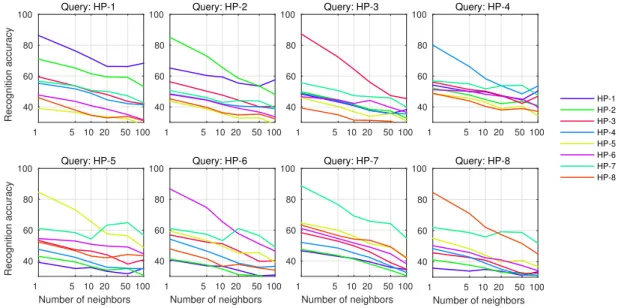
Prior to learning a model on Accio face tracks, we expect within movies performance to be always high compared to the across movies results. Cross movies results are obtained from the retrieval of pair movies, for example first and second movies. Figure 1.2 illustrates the dominant matrix of within and across movies evaluation results. In the figure the diagonal elements are dominant with highest energy since they present within movies results where retrieval and classification is subjected only to standard challenges of face recognition in videos such as illumination and pose variation. The off diagonal elements are less dominant and has less energy, since they provide the across movies results where face track retrieval and recognition are subjected to the aging factor across age and to the other challenges of face recognition in videos. In our experiments, this hypothesis is proved and mostly the performance is high in the diagonal elements and around it, and it decreases as we go farther from the diagonal elements where the years gap increases due to the aforementioned reasons.
Face verification is a popular task that received considerable attention during recent years. Many studies achieved good performance using datasets such as LFW. Recently
HP-1
HP-2
HP-3
HP-4
HP-5
HP-6
HP-7
HP-8
HP-1
HP-2
HP-3
HP-4
HP-5
HP-6
HP-7
HP-8
Figure 1.2: Across movies evaluation hypothesis: Dominant matrix.
LFW is the most popular evaluation benchmark and widely used to test the proposed and published methods for face verification. Fisher Vector Faces in the Wild [3] is one of the successful approaches which use Fisher vector encoding for large sets of local descriptors. It achieves good results under LFW’s restricted and unrestricted settings. Nonetheless, face verification is still considered a hard task under real world conditions. Our motivation of the Fisher vector analysis in this work is to evaluate the performance of this well-known technique and use it during our study of face track retrieval and recognition across age in videos. The aim is to measure its performance using different datasets other than LFW, and different local descriptors such as Gabor filters with varying settings. This work presents a detailed analysis given in chapter 5.
1.2 Problem Definition
In face track retrieval and recognition, there are two tasks: (i) within movies and (ii) across moviesretrieval and recognition. For example, In within movies retrieval, named tracks in each movie are used as query once, while the rest are used as database. In face recognition within movies, supervised model such as linear SVM is trained on part of face tracks and used for test on the rest part of face tracks. In this task, a regular track retrieval and recognition are applied which regards standard technical challenges such as illumination and variant face pose. In across movies retrieval and recognition task, it is applied on pairwise movies for example named tracks queries are taken from the first movie and the database from the second movie’s all tracks. Similarly, for across movies face track recognition, a model obtained from a movie is used for test on another movie. In this task retrieval and recognition evaluations measure the impact of aging progression across movies. It is important to mention that, in face track retrieval for the two tasks, only we select only named tracks as queries while for the database we use all tracks including the distractors. In face track recognition, only named characters which have at least 50 face tracks and appear in at least three movies are included in the evaluation.
In face recognition, face verification is the task where to decide whether a given pair images are for the same person or not. The aim is to maximize the distance between negative pair images of different people and minimize the distance between positive pair images of the same person.
1.3 Thesis Outline
Chapter 1 introduces the two tasks of this work: (i)face track retrieval and recognition across age, and (ii) analysis of Fisher vectors on face verification. It gives an explanation, the motivation, and the definition of the two tasks in this work.
Chapter 2 presents the previous work on both face verification and age invariant face recognition. In this chapter we give a brief summary of previous studies on face verification. In addition we outline related work on age invariant face recognition and
explain previously used datasets for age invariant face recognition. We also illustrate some work on face track retrieval.
Chapter 3 deals with the theoretical foundations related to face identification on still images and videos. First section presents shot boundary detection which simplify the process of face detection and tracking in videos. Then we explain the pipeline of face identification which starts with face detection and tracking, then face alignment, and finally feature extraction. For these tasks, we summarize the approaches we use in this work such as Modified Census Transformation (MCT) for face detection, particle filters for face tracking, similarity transformation using eye centers for face alignment, and Fisher vectors for feature extraction. Following the pipeline of face identification, this chapter describes the learning algorithms used in this work: (i) joint metric learning, (ii) low-rank Mahalanobis metric learning, (iii)diagonal metric learning, and (iv) linear support vector machines (SVMs). Finally we discuss the evaluation metrics that we apply to measure the performance of face track retrieval, recognition and verification tasks.
Chapter 4 explains the first part of this work: face track retrieval and recognition across age using Accio dataset. It starts by providing all the details of the novel dataset such as the number of face tracks, characters, age range and some statistics on age groups. In addition, in this chapter we compare the dataset with previous datasets for age invariant face recognition based on still images. Then we describe Fisher vector method which is used for face track description. The chapter also introduces across and within movies evaluation tasks on the dataset with restricted and unrestricted settings. Then we describe the experiments using different metric learning with two variant scenarios: metric learning on pairwise movies which combines the two movies training face tracks to obtain a metric learning model, and metric learning based on training face tracks from all movies to produce metric learning model. Then we provide all experiments’ results and compares them to the baseline evaluation. Last section of this chapter presents the baseline results of face track recognition by applying linear SMV learning. Finally we give the recognition F1 score of some major characters from the movies.
Finally chapter 5 gives the analysis of Fisher vector in face verification using FRGC dataset, SIFT features, and Gabor filters. It starts by explaining FRGC dataset and its
fourth experiment. Then we describe Fisher vector with SIFT features and provides the evaluation results. As a part of Fisher vector analysis, we adopt Gabor filters as local descriptors for Fisher vector and shows the effects of using these features with various Fisher vector’s parameters on face verification task. The chapter provides all details of the experiments and the comparison of different scenarios.
Chapter 6 summarizes the contribution of this thesis and presents a direction for potential future research related to the subject.
2. RELATED WORK
2.1 Face Identification
Face identification typically includes the following pipeline steps: face detection, facial landmark detection, face alignment, face description, and finally face classification. Nonetheless, studies usually focus separately on each of these steps. Viola Jones face detector[18] is widely used since it is open source and has implementation in OpenCV library[19]. However in this thesis we adopt Modified Census Transformation (MCT) [20] for face detection. These two methods are early and widely used for face detection and they are both based on scanning window and cascade classifiers. In facial landmark detection, Supervised Descent Method [21] is successful face shape regression technique. It begins with an initialS0face shape and progressively predicts the final face shape in iterative way. For our study we benefit from facial landmark provided by SDM mainly for face alignment.
Various methods are used for face alignment. Similarity transformation based on facial points aligns faces such that they are fit in a similar size and position. For example [22] applies similarity transformation using 9 facial points to transform a face to a canonical frame.
There are many studies for face description. The aim is to find robust and discriminative face representation such that faces of negative pairs of different people are more separated and positive face pairs of same person are closer in feature space. These studies include [3,5,23,24].
For face classification, Support Vector Machines (SVMs) are widely used [25–
27]. In addition many metric learning algorithms have been proposed recently [15,28]. In discriminative metric learning there are two major aims: (i) reducing the dimensionality of face descriptors and (ii) preserving the discriminative features. This is done by learning a low-rank linear projection matrix W on the descriptors. The metric is learned from given positive and negative pair images which captures the
similarity and the difference between the pair images such that the Euclidean distance between positive pair images is minimized while it is maximized when the pair images belong to different people. For example learning a Mahalanobis matrix M=WTW which is a problem with convex formulation [17]. LearningM is practical only with low dimensional feature vectors. As a results, usually a dimensionality reduction, for example by PCA, is used to reduce dimensions into applicable numbers and then performing metric learning.
Previously there are several works for face verification, our work is guided by Fisher vector faces in the wild [3] and multi-resolution local appearance-based face verification [5] papers. Our case study of face verification is an analysis of the performance of fisher vector using different dataset and features. In this thesis we use Gabor and SIFT features for training and encoding Fisher Vectors. Then we evaluate the method on the fourth experiment of FRGC dataset using variant parameters.
2.2 Data Sets
There are several datasets based on still images to study face verification problem such as LFW [13], FRGC [4] and MORHP [11]. You-Tube Faces [14] is also popular dataset for studying face recognition in video. Nonetheless, these datasets do not consider the face pairs matching cross ages. Prior face recognition datasets which deal with the problem of aging are all using still images [10–12,29]. Datasets for video face track recognition are usually collected from TV series or one movie [6,7] which means they do not have age variation. To best of our knowledge, in this thesis we present the first video based face track retrieval and recognition dataset which is gathered from Harry Potter movie series and has challenging settings. More importantly it shows clear trends of effects of the aging factor.
2.3 Face Track Retrieval
Among the first researches of face recognition on videos, most works were limited to the frontal faces [30] and few of them included profile faces [31–34]. Apart from face poses, representations of face tracks generally followed two approaches, the first one represents face in a track individually and uses face track as a set of images. The benefit of these methods is to allow using the developed representations of still images
for face tracks. The second type of approaches represents a face track as a whole to a single feature vector such as [8], 3D model or manifold. These techniques can be generative or statistical. For example, [35,36] try to build 3D model from the data and use it to explain the new data. Statistical methods such as [30,37], learn local features across the face track images and then represent them into BoW model or GMM model. This leads to a single feature vector representation of the whole images of a face track.
As an example of early face track retrieval works is [30], where they detect frontal faces, and for tracking they use region-tracking technique and then adopt SIFT as local descriptor around 4 facial landmarks for verification. This helps to find corresponding shots in a video where a person of query track appears. Similarly, [38] includes non-frontal faces and [39] provides a compact descriptor for face track matching. Everingham et al. [7] paper made an evolutionary step and since then most researches are about on the assigning a name to all face tracks (for example [6]). This method requires finding transcripts which is not always possible.
2.4 Age Invariant Face Recognition
There are multiple studies which consider the problem of aging in face recognition. While age estimation [40–46] and simulation [47–53]are extensively studied, researches that explicitly deal with developing age invariant face recognition systems are not enough. Researches which consider the problem of aging in face recognition can be roughly divided into two subcategories: Generative and discriminative techniques. (i) Generative approaches [50,54–56] resemble the face image at a certain age and then perform face recognition. Usually this is done by building 2-D or 3-D generative model to simulate the aging process for face matching. For example[56] uses facial landmarks to estimate the facial growth parameters and predicts the appearance at certain age. However these approaches have drawbacks in many aspects, they are based on parametric assumptions that may results in unrealistic simulation and they have high complexity during computation.
(ii)Discriminativeapproaches: [12,57–59] use learning methods to build age invariant face recognition systems. For example, Chen et al. [12] uses a reference set representations for each person, his/her age, and for specific facial landmarks. They
model the task as least square and pool across the age space to obtain an age-invariant representation for face recognition.
Different from previous approaches, some studies of modeling the facial appearance through latent space. For example,Gong et al. [60] proposes to use two latent factors, an identity factor for age-invariant face recognition, and an age factor affected by aging to capture the aging process features. Then observed facial appearance is modeled by the fusion of the two factors, and separating the observation enables performing recognition on the identity part.
3. THEORETICAL FOUNDATION
The aim of the thesis is to address challenging face track retrieval and recognition across ages using Harry Potter Movies and also study and analyze the efficiency of Fisher vectors using different features and datasets with variant settings. In this chapter, we explain theoretical background, machine learning and computer vision technologies used in the thesis. We describe the techniques adopted to obtain Accio dataset such as shot boundary detection, face detection and tracking, the descriptor used for representation of still images and face tracks. Finally we discuss the learning algorithms and evaluation methods of the tasks.
3.1 Shot Boundary Detection
In order to simplify the process of face recognition, face detection and face tracking in videos, shots of a video are detected and faces on every shot are tracked to obtain face tracks. Shot represents a sequence of frames taken by a camera for a continuous action. Multiple of logical and sequence shots construct what is called scene in a video [61]. Shot boundary is the transition between two shots that can be hard cuts or soft (fade, dissolve, wipe ...etc.). Figure 3.1 illustrates two shots of one scene.
Figure 3.1: Shot boundary example [1].
There are many approaches to detect shot boundaries. In this work, we use Displaced Frame Difference (DFD) [62] for shot boundary detection since it achieves an acceptable accuracy with a good speed. DFD works well in case when we the motion between two consecutive frames is not too much. For a sequence ofN frames F(r,1)....F(r,t)...F(r,N), wherer indicates the pixel position, the comparison of two
consecutive frames in one shot can be given by the following sum formula
FD(t+1) =kF(r,t+1)−F(r,t)k (3.1) It can be decided whether the two frames belong to the same shot or not by using a learned threshold of cut locations. If FD(t+1) is above a certain threshold or sufficiently high, it indicates that the frame is different from the previous one a timet and a shot boundary is accepted.
3.2 Face Detection and Tracking
Face detection is essential step in face recognition pipeline. It is the first step in the face recognition systems. Face detection is extensively studied and searched during the past few decades. There have been many methods proposed for face detection. Viola Jones [18] had made an evolutionary step in face detection. It uses Haar features selection, creating integral image, Adaboost training and cascade classifiers. It works well on detecting frontal faces.
In Accio dataset, to obtain face tracks for all movies, we use MCT for face detection [2] and we follow [6] for face tracking which uses particle filter based on tracking by detection. This enables obtaining face tracks of each character within a shot. MCT is robust against illumination and pose variations with very high rate of detection rate. It is a practical method and efficiently fast.
3.2.1 Modified census transformation
Census Transform(CT) is a structure kernel feature to capture the local spatial structure of the image. It is basically computed for each pixel by comparing a pixel with its neighbors of a kernel size 3×3. LetN(x)be spatial neighborhood of a central pixelx which we want to compute its CT feature. The obtained CT feature is a bit of binary string resulted from the logical function computed as,
λ(I(x),I(y)) =
(
1 ifI(x)<I(y)
0 ifI(x)>I(y) (3.2) This function checks the intensity of the neighbor pixel, if it is less thanxthen it gives 1, and 0 otherwise. The CT transformation is obtained by
CT(x) =⊕y∈N(x)λ(I(x),I(y)) (3.3) 14
Where⊕refers to the concatenation operation for the logical function to generate CT string. Since there is 8 neighbors, the CT feature has a range between 0−255 values.
MCT is a modified version of the aforementioned CT. The previous method results in 256 subsets of the structure kernel of 3×3spatial neighborhood, however in order to compute all structure kernels, the central pixel should be included in the logical and comparison function rather than fixing its value to zero.
3.2.2 Boosting and cascade classifiers
In face detection the MCT detector analyzes patches W of 18×18 size. During boosting and cascade classifiers steps, each window is decided to be a face or a background. The decision is made in a sequence of tests for efficiency in boosting process which combines several classifiers. The window can be rejected after any test stage. In this thesis, the system consist of four stages that can be displayed in 3.2. As shown in the figure, in first face, block white dots show the positions of the elementary classifiers in the selected window. These white dots are increased in each stage. Early three stages can classify the given window as a background, however only the final stage can decide whether the given window is a face or not.
Figure 3.2: Face detection with MCT features and cascade classifiers [2].
3.2.3 Face tracking
Face tracking is essential since face detection in every sequence of frames in a video is not efficient and it degrades the performance of the system. Tracking faces’ motion in a video sequence that have variant expressions, scales and illumination is a hard task. Face tracking has many usages such as human surveillance, interaction application, and face or object model structuring. Many well-known algorithms have been developed in order to track objects for examples mean shift, Kalman filter, and particle filtering. Face detection, tracking and labeling tool provided in CVHCI laboratory is used to
obtain face tracks in this work. Following [6] particle filter based on face detection is adopted in this tool. Particle filtering is a recursive Bayesian filter. It is used to estimate the posterior density of the state spaceXt given the observation variablesZt, p(Xt|Zt). Particle filter is based on using particles to represent the posterior density of the state space. It is well known and efficient for nonlinear and non-Gaussian estimations[63]. In the face tracking and annotating tool provided by CVHCI laboratory, MCT face detector is integrated with particle filter based on detection. At first, faces are detected then the locations around detected faces are evaluated since they are likely to contain the faces. Each tracked face by particle filter has particles with state x={x.y,s,α}, where(x,y)gives particle location in the 2-D image,sis its size andα is the yaw angle of the particle.
Following shot boundary detections in videos, faces within a shot are detected in first frame by scanning the whole frame at varying scale and head pose angles. These detections are initialized for face tracks, if an occlusion is emerged due to the intervention of two face tracks, one of the tracks is terminated. MCT is run to evaluate and assign scores for the generated particles. The final decision of the tracked face position is given based on the weighted average of the individual particles. A face track is terminated when no faces are found within certain number of detections. The initialization of the face tracks are performed every 5 frames to detect new faces that may appear.
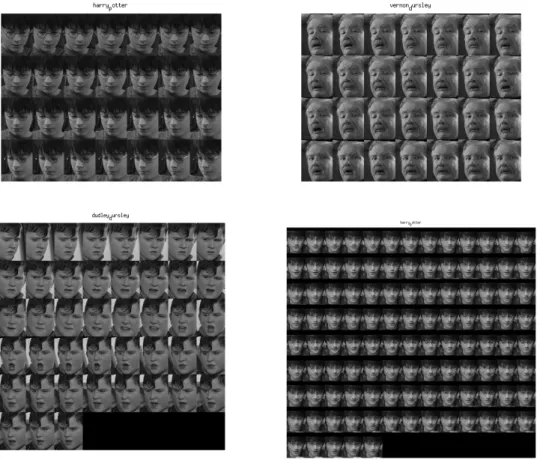
Figure 3.3 shows an examples of face tracks that contain different number of images. These tracks are obtained from Harry potter movies which are the source dataset (Accio) for face track retrieval and recognition tasks in this work.
3.2.4 Face alignment
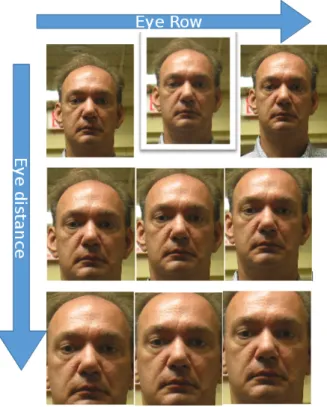
Face alignment is important step in face recognition. It is the process of aligning facial landmarks, for instance: eyes, nose, mouth, and chin to canonical frame [64]. This process fixes the landmarks positions in aligned images and it is carried out by similarity transformation. In our work we use facial landmarks provided by SDM landmark detector and perform similarity transformation that aligns based on eye centers coordinates. Examples of aligned faces according to the distance between eyes and row distances are shown in figure 3.4
Figure 3.3: Face tracks obtained by face tracker in Harry Potter movie series.
3.3 Face Image and Track Representation
This work adopts Fisher vector implementation in [3,8] in order to obtain the face images and face tracks descriptors. For Fisher Vectors analysis, a apart from the Fisher vector pipeline suggested in th paper, GABOR features were used in order to test and evaluate the performance of Fisher Vectors. This section explain Fisher vector implementation for face recognition. The pipeline typically starts by obtaining face images and tracks as explained in the previous sections, then extracting the dense root-SIFT features, dimensionality reduction of the SIFT features by PCA, augmenting of spatial information of SIFT blocks, training Gaussian Mixture Models, and then encoding the large sets of SIFT features by aggregating them into a single Fisher vector using GMM. We illustrate the aforementioned steps of fisher vector implementation in figure 3.5


![Figure 3.7: Positive and negative pairs are separated with a margin by metric learning [3].](https://thumb-us.123doks.com/thumbv2/123dok_us/1288011.2672820/52.892.123.725.415.587/figure-positive-negative-pairs-separated-margin-metric-learning.webp)