Adaptive Hypermedia Systems for E-Learning
AAMMOU Souhaib1, KHALDI Mohamed1, IBRAHIMI Ahmed1, EL KADIRI Kamal Eddine21
Ecole Normale Supérieure (ENS), Tetwan, Morocco 2
Faculty of Sciences, Tetwan, Morocco
Abstract—The domain of traditional hypermedia is revolu-tionized by the arrival of the concept of adaptation. Cur-rently the domain of Adaptive Hypermedia Systems (AHS) is constantly growing. A major goal of current research is to provide a personalized educational experience that meets the needs specific to each learner (knowledge level, goals, motivation etc...). In this article we have studied the possibil-ity of implementing traditional features of adaptive hyper-media in an open environment, and discussed the standards for describing learning objects and architectural models based on the use of ontologies as a prerequisite for such an adaptation.
Index Terms—e-learning, learner modeling, adaptive educa-tional hypermedia, ontologies, RDF, IMS LIP
I. INTRODUCTION
E-learning is a very dynamic domain, constantly grow-ing, which refers to educational content or learning ex-periences delivered or made through digital technologies. The development of this domain has a direct impact on teaching quality and reducing costs. E-learning today is dominated by Learning Management Systems (LMS) such as Blackboard, Moodle, ATutor or Claroline, which are integrated systems that provide support for a wide area of activities in the e-learning process. Thus, teachers can use the LMS for course creation and test suites, to communi-cate with students, to monitor and evaluate their work. Students can learn, communicate and collaborate through LMS.
The problem is that LMS does not offer personalized services, presents the same educational resources to dif-ferent learners, regardless of difdif-ferent levels of knowl-edge, interest, motivation and objectives. As Morrison [1] stated:”Just as people differ in many respects, so do ways in which they learn differ”. Some of these differences are evident in the types of experiences that each person needs to learn. It is therefore essential to start the process of planning, attention to the characteristics, capabilities and experiences of learners - as a group and as individuals. "Adaptive Educational Hypermedia Systems (AEHS) try to provide an alternative approach to non-individualized, providing various services, tailored to the learner profile. The purpose of this adaptation is to maximize the subjec-tive satisfaction of the learner, the learning speed (effi-ciency) and assessment results (effectiveness).
There are two basic questions in AEHS:
What can we adapt to? The answer includes several learner characteristics, such as knowledge, goals, tasks or interest, background and experience, learn-ing style, context and environment.
What can be adapted? The answer includes the pres-entation (adapting the actual content, the prespres-entation
of that content, or the media used) as well as the navigation (adapting the link anchors that are shown, the link destinations, and the overviews for orienta-tion support).
In addition, Adaptive hypermedia systems (AHS) for e-learning represent a continuously growing research do-main, involving knowledge from several fields (adaptive systems, adaptive hypermedia, learning management systems, user modeling, educational psychology, instruc-tional science).
Adaptation can take 3 forms [2]:
Adapted systems: in which adaptation is hard-wired by the application designer; in this case, the system is customized to a particular user profile, which is de-fined beforehand, at design time.
Adaptable system: in which adaptation is explicitly required by the user. More precisely, the user can specify her/his own preferences, by manually creat-ing her/his profile; thus the system is dealcreat-ing with a fixed profile, which can only be modified by user's intervention.
Adaptive systems: in which adaptation initiative be-longs to the system itself, based on continuous obser-vation of user preferences and needs. The user's pro-file is no longer static, it is dynamically updated by the system, after tracking and analyzing user behav-ior.
II. ADAPTIVITY IN E-LEARNING
A conceptual definition of adaptivity in e-learning re-fers to the creation of educational experiences that adjust based on various conditions (personal characteristics, pedagogical approach, user interactions, learning out-come) during a certain amount of time in order to improve performance indicators (e-learning efficiency: results, time, costs, user satisfaction). The functional definition refers first of all to the main characteristics provided by the system. An adaptive system must be capable of man-aging learning paths adapted to each user, monitoring user activities, interpreting them using specific models, infer-ring user needs and preferences and exploiting user and domain knowledge to dynamically facilitate the learning process [3].
We can identify three major development paradigms in Artificial Intelligence in Education:
Intelligent Computer-Assisted Instruction, using clas-sic mainframes and mini-computers as platforms. The main goal of these systems was the transfer of knowledge to the student, therefore the learning ma-terial consisted mainly of presentations and also some exercises and problems. Correspondingly, the
most popular technologies were curriculum sequenc-ing and intelligent solution analysis [4].
Intelligent Tutoring Systems, using personal com-puters as the support platform. The main goal shifted from educational material presentation to supporting the student in solving problems and procedural knowledge formation. Consequently the core tech-nology became interactive problem solving support.
Web-based educational systems, having the WWW as support platform. The goals of these systems be-came more complex and diverse, including at the same time content delivery, problem solving support and collaborative work support. Consequently multi-ple technologies were employed, ranging from adap-tive curriculum sequencing, adapadap-tive hypermedia, adaptive information filtering, intelligent solution analysis, intelligent collaborative learning, class monitoring.
Our research is oriented towards the adaptive and intel-ligent Web-based educational systems. Adaptive systems are those systems that try to behave differently toward each student, based on the information accumulated in the student model, while intelligent systems apply artificial intelligence techniques in order to comply with the needs of their users.
III. ADAPTATION COMPONENTS
In what follows, we present the components of adapta-tion, to examine briefly adaptation levels and technology, adaptation models and ways of representing adaptation knowledge.
A. Adaptation Levels and Technologies
A method is defined as a notion of adaptation that can be presented at the conceptual level. A technique is a way to implement a specific method. Techniques operate on actual information content and on the presentation of hypertext links. It may be possible to implement the same method through different techniques and to use the same technique for different methods [5].
According to the most recent classification there are two levels of adaptation:
Adaptation to the level of content and presentation adaptation
Link level adaptation navigation or support adapta-tion.
Indeed, by abstracting hypermedia as a graph, we can either adapt its nodes (content level adaptation) or its edges (navigation level adaptation). Figure 1 provides a summary of the adaptive hypermedia technologies.
While the distinctions of the taxonomy are important for identification and classification of adaptive systems, the implementation of these techniques can be achieved using a small selection of fundamental data structures that can be combined to create powerful AH systems.
B. Adaptation Models
The Adaptive Hypermedia Application Model (AHAM) provides a framework to express the functionality of adap-tive hypermedia systems by dividing the storage layer into three parts that specify what should be adapted, according to what features it should be adapted, and how it should be adapted.
Figure 1. Updated taxonomy of adaptive hypermedia technologies [6]
Figure 2. Architecture of Adaptive Hypermedia Applications
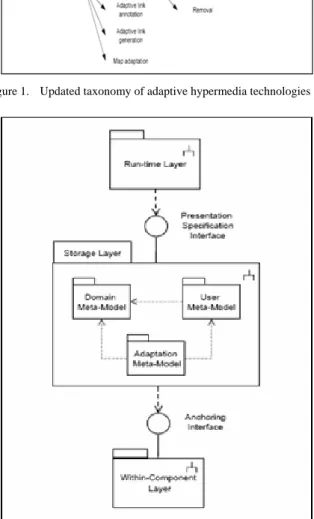
The Munich Reference Model preserves the three-layer structure of the Dexter Model describing the network of nodes and links and the navigation mechanism. It extends the functionality of each layer to include the user model-ing and adaptation aspects. The Run-Time Layer, the Storage Layer and the Within-Component Layer are rep-resented as UML subsystems as it is illustrated in Figure 2.
The Run-Time Layer contains the description of the presentation of the nodes and links. It is responsible for user interaction, acquisition of user behavior and man-agement of the sessions.
The Storage Layer has more functionality than just stor-ing information about the hypermedia structure. To sup-port adaptation the Storage Layer is divided into three sub-models:
The Domain Meta-Model that manages the basic network structure of the hypermedia system in terms
of mechanisms by which the links and nodes are re-lated and navigated. The nodes are treated as general data containers.
The User Meta-Model manages a set of users repre-sented by their user attributes with the objective to personalize the application.
The Adaptation Meta-Model consists of a set of rules that implement the adaptive functionality, i.e. per-sonalization of the application.
The content and structure within the hypermedia nodes are part of the Within- Component Layer, which is not further detailed as its structure and content depend on the application. The functionality of adaptive hypermedia systems is specified by three types of operations included in the classes of the reference model:
Authoring operations are needed by adaptive hyper-media systems to update components, rules and user attributes, e.g. to create a link or a composite compo-nent, to create a rule, to add an user attribute to the model, to delete components or rules.
Retrieval operations are required to access the hy-permedia domain structure and the User Model, e.g. to get a component, to get all rules triggered by a user’s behavior or another rule.
Adaptation operations are used to dynamically adapt the User Model content to the user behavior and to adapt the presentation to the current state of the User Model, e.g. the adaptive resolver, the constructor or the rule executor.
The remainder of this paper presents the visual specifi-cation (slightly simplified) of the layers of the reference model and includes a few constraints of the formal speci-fication out of a total of seventy constraints that comprise the complete specification of the Munich Reference Model [7].
C. Representation of Adaptation Knowledge
We can identify several ways of addressing the issue of procedural knowledge, for more detail see [8]; in our case we are interested in the use of ontologies. Because, from our point of view, different types of knowledge relevant to the adaptive learning could be represented using ontolo-gies based on the use of Resource Description Framework (RDF).
There are several authors that propose the use of on-tologies, such as Cristea [9] (appropriate ontologies for each layer of the LAOS model, namely: domain, goal and constraint, user, adaptation, and presentation ontologies), Henze et al.[10] (domain ontology, user ontology, obser-vation (interaction) ontology and presentation ontology).
IV. INTEGRATING ADAPTIVE HYPERMEDIA
TECHNIQUES
In this section we discuss the possibilities of using stan-dardized metadata to describe and classify information stored in a Resource Description Framework database to describe the knowledge, preferences and experiences of users accessing that information. In addition, we will illustrate how to implement features of adjustment with the ultimate goal of implementing a personalized access to learning.
A. Using RDF Metadata
Resource Description Framework (RDF) is a graph model for formally describing Web resources and their Metadata, to enable automatic processing of such descrip-tions. Developed by the W3C RDF.
A document structured in RDF is a set of triplets. An RDF triple is an association: {subject, predicate, object}
The subject is the resource to describe;
The predicate is a type of property applicable to this resource;
The subject is given one or another resource: the value of the property.
To annotate resources, we have identified a subset of best practices of 15 elements which are summarized in Table I, using the categories defined in the LOM [11]. It was found that these 15 attributes are enough to annotate and query our resources, and represent a compromise between sets of annotations more abstract and more de-tailed. Annotations of an entire course can be included in a single RDF file. All RDF triples are then imported into a relational database to customize the display of resources and to ask others.
TABLE I.
THE 15 ATTRIBUTES TO ANNOTATE AND QUERY OUR RESOURCES
Title dc:title Language dc:language General Description dc:description Lifecycle Contribute dc:creator with a lom:entity and the author in vCard format "name surname"
dcq:created with the date in W3C format
Rights Description dc:rights
Relation dcq:hasFormat dcq:isFormatOf dcq:hasPart dcq:isPartOf dcq:hasVersion dcq:isVersionOf dcq:requires dcq:isRequiredBy Classification
dc:subject for content classification. This attribute links
to an entry in a hierarchical ontology,
that is an instance of lom_cls:Taxonomy
(see next section)
B. Topic Ontologies for Content Classification
Personalized access means that resources are tailored according to some relevant aspects of the user. Which aspects of the user are important or not depends on the personalization domain. For educational scenarios it is important to take into account aspects like whether the user is student or a teacher, whether he wants to obtain a certain qualification, has specific preferences, and, of course, which is his knowledge level for the topics cov-ered in the course.
Taking user knowledge about topics covered in the cur-rent account is complicated, because it requires Cognitive Styles (see also [12]). The general idea is that we annotate
each document by the topics covered in this document. Topics can be covered by sets of documents, and we will assume that a user fully knows a topic if he understands all documents annotated with this topic.
To be more general, we use ontologies that are already part of classification systems are internationally recog-nized.
ACM CCS as a topic ontology for learning objects. The ACM Computer Classification system ([13]) has been used by the Association for Computing Machinery since several decades to classify scientific publications in the field of computer science. On the basic level, we find 11 nodes that split up in two more levels.
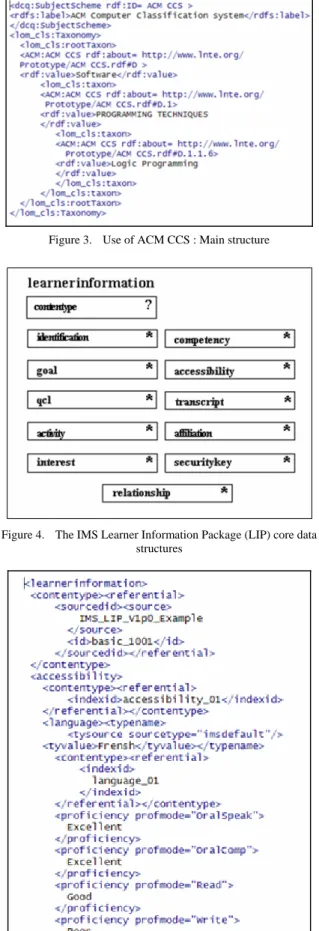
To classify a resource, the IEEE Learning Object RDF Binding Guide ([14]) suggests the use of dc:subject with elements of a taxonomy that must be found on the Inter-net. Such a taxonomy hierarchy is an instance of lom-cls:Taxonomy and must be formatted in a RDF file where the topics and subtopics are separated using lom_cls:Taxon and lom_cls:rootTaxon. As discussed, we used ACM CCS, The main structure is depicted in Fig-ure 3.
C. Describing Users
In recent years there have been some efforts to standardize the information about a user, which should be maintained by a system.we choose the IMS Learner In-formation Package [15].
IMS LIP is a structured information model. An XML binding is included but is not meant to exclude other bind-ings. The information model contains both data and meta-data about that meta-data. The model defines fields into which the data can be placed and the type of data that may be put into these fields. Typical data might be the name of a learner, a course or training completed, a learning objec-tive, a preference for a particular type of technology, and so on.
The Learner information is separated into eleven main categories (as shown in Figure 4). These structures have been identified as the primary data structures that are required to support learner information. This composite approach means that only the required information needs to be packaged and stored.
An example of accessibility category data is repre-sented in Figure5.
The identification category represents demographic and biographic data about the user. The goal category repre-sents learning, career and other objectives of the learner. The QCL category is used for identification of qualifica-tions, certificaqualifica-tions, and licenses from recognized authori-ties. The activity category can contain any learning related activity in any state of completion. The interest category can be any information describing hobbies and recrea-tional activities. The relationship category aims for rela-tionships between core data elements. The competency category serves as slot for skills, experience and knowl-edge acquired. The accessibility category aims for general accessibility to learner information by means of language capabilities, disabilities, eligibility, and learning prefer-ences. The transcript category represents institutional-based summary of academic achievements. The affiliation category represents information records about member-ship of professional organizations. The security key is for set passwords and keys assigned to a learner.
Figure 3. Use of ACM CCS : Main structure
Figure 4. The IMS Learner Information Package (LIP) core data structures
V. SYSTEM DESCRIPTION
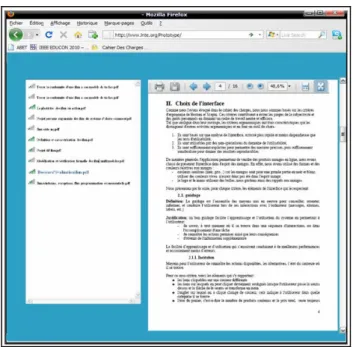
Our system is under development, we present here a primary prototype interface. (Figure 6)
Information will be presented in two different frame-works. The left frame displays the course structure based on metadata. The user can navigate through this structure and can open documents in the right frame. Each resource is annotated according to the current user profile to express its relevance to the user. For annotations, we use a metaphor of wireless connection.
VI. CONCLUSION
In this article we have studied the possibility of implementing traditional features of adaptive hypermedia in an open environment, and discussed the standards for describing learning objects and architectural models based on the use of ontologies as a prerequisite for such an adaptation.
We discussed how this information can be expressed as RDF metadata and how we can use queries over this metadata. We also discussed the architecture of our hypermedia all based on the Munich Reference Model. We finally present our system (adaptive hypermedia), which has been implemented as a prototype.
In our work, we will continue to improve links RDF. We will also experiment with compositions of resources and techniques of presentation and adaptation of different types of applications tailored functionality.´
Figure 6. Protoype of the user interface
REFERENCES
[1] G. R. Morrison, S. M. Ross, J. E. Kemp (2001). Designing Effec-tive Instruction. John Wiley & Sons.
[2] E. A. Edmonds (1981). Adaptive Man-Computer Interfaces. Computing skills in the user interface, Computer and People se-ries, New York, Academic Press.
[3] J.G. Boticario, O.C. Santos, P. van Rosmalen (2005). Issues in Developing Standardbased Adaptive Learning Management Sys-tems. EADTU 2005 Working Conference: Towards Lisbon 2010: Collaboration for Innovative Content in Lifelong Open and Flexi-ble Learning.
[4] E. B. Koffman, J. M. Perry (1976). A Model for Generative CAI and Concept Selection. International Journal on the Man-Machine
Studies, 8, pp. 397-410.
[5] N. Stash (2007). Incorporating Cognitive/Learning Styles in a General-Purpose Adaptive Hypermedia System. PhD Thesis, Eindhoven University of Technology, Netherlands.
[6] Brusilovsky, P. (2001). “Adaptive hypermedia”. User Modeling and User-Adapted Interaction, Ten Year Anniversary Issue 11 (Al-fred Kobsa, ed.), pp 87-110.
[7] Koch N. (2000). Software Engineering for Adaptive Hypermedia Systems: Reference Model, Modeling Techniques and Develop-ment Process. PhD. Thesis, Uni-Druck.
[8] M. Kravcik, D. Gasevic (2007). Leveraging the Semantic Web for Adaptive Education. Journal of Interactive Media in Education (Adaptation and IMS Learning Design. Special Issue, ed. Daniel Burgos).
[9] A. Cristea (2004). What can the Semantic Web do for Adaptive Educational Hypermedia? Educational Technology & Society, 7 (4), pp. 40-58.
[10] N. Henze, P. Dolog, W. Nejdl (2004) Reasoning and Ontologies for Personalized ELearning in the Semantic Web. Educational Technology & Society, 7 (4), pp. 82-97.
[11] P. Barker (2005). What is IEEE Learning Object Metadata (the LOM) / IMS Learning Resource Meta-data?. CETIS,
[12] E. Brown, T. Brailsford, T. Fisher, A. Moore, H. Ashman (2006). Reappraising Cognitive Styles in Adaptive Web Applications, Proc. WWW 2006, May 23-26, 2006, pp. 327-335.
[13] Henze, N., and Nejdl, W. Knowledge modeling for open adaptive hypermedia. In Proccedings of the 2nd International Conference on Adaptive Hypermedia and Adaptive Web-Based Systems (AH 2002) (Malaga, Spain, May 2002).
[14] Nilsson, M. Expressing Dublin Core metadata using the Resource
Description Framework (RDF).
[15] IMS LIP. IMS learner information package specification. Avail-able at: cessed on September 10, 2009
AUTHORS
AAMMOU Souhaib, KHALDI Mohamed, IBRA-HIMI Ahmed are with Laboratory of New Technology Educative (LNTE) of Ecole Normale Supérieure (ENS), Tetwan, Morocco ([email protected] )
EL KADIRI Kamal Eddine is with Laboratory of In-formatics, Research Operational and Statistic Applied (LIROSA) at Faculty of Sciences, Tetwan, Morocco.
Submitted March 24th, 2010. Published as resubmitted by the authors October 30th, 2010.