EDISON Discussion Document
Data Science Competence Framework (CF-DS): Approach and First
Working Version
Project acronym: EDISON
Project full title: Education for Data Intensive Science to Open New science frontiers Grant agreement no.: 675419
Actual Date 10 March 2016
Document Author/s Yuri Demchenko, Adam Belloum
Version 0.6 (updated based on EDISON deliverable D2.1)
Dissemination level PU
Status DRAFT
Document approved by
This work is licensed under the Creative Commons Attribution 4.0 International License. To view a copy of this license, visit http://creativecommons.org/licenses/by/4.0/
Document Version Control
Version Date Change Made (and if appropriate reason for change)
Initials of Commentator(s) or Author(s)
0.1 2/11/2015 Initial draft YD
0.2 4/11/2015 Updated after comments by AB, TW, and with
new figures YD, AB, TW
0.3 6/11/2015 Minor revision and added more focused
discussion questions YD, WL
0.4 30/11/2015
Added information about DS skills based on analysed information, reference to ACM Information Technology Competency model
YD 0.5 30/12/2015 Update version for public comments YD
0.6 10/03/2016
Re-structured for better readability, extended with the proposed taxonomy of occupations and knowledge areas
YD, TBC
Document Change Commentator or Author Author
Initials
Name of Author Institution
YD Yuri Demchenko University of Amsterdam
AB Adam Belloum University of Amsterdam
AM Andrea Manieri Engineering
TW Tomasz Wiktorski University of Stavanger
WL Wouter Los University of Amsterdam
This work is licensed under the Creative Commons Attribution 4.0 International License (CC BY). To view a copy of this license, visit http://creativecommons.org/licenses/by/4.0/
This license lets others distribute, remix, tweak, and build upon your work, even commercially, as long as they credit you for the original creation.
Executive summary
The EDISON project is designed to create a foundation for establishing a new profession of Data Scientist for European research and industry. The EDISON vision for building the Data Science profession will be enabled through the creation of a comprehensive framework for Data Science education and training that includes such components as Data Science Competence Framework (CF-DS), Data Science Body of Knowledge (DS-BoK) and Data Science Model Curriculum (MC-DS). This will provide a formal basis for Data Science professional certification, organizational and individual skills management and career transferability.
The definition of the Data Science Competence Framework (CF-DS) is a cornerstone component of the whole EDISON framework. CF-DS will provide a basis for Data Science Body of Knowledge (DS-BoK) and Model Curriculum (MC-DC) definitions, and further for the Data Science Professional certification. It is intended that the CF-DS will be defined in compliance with the European e-Competence Framework (e-CF3.0) and will provide suggestions for e-CF3.0 extension with the Data Science related competences and skills. This work will be supported by the taxonomy of educational and training materials on Data Science.
The intended EDSION framework comprising of the mentioned above components will provide a guidance and a basis for universities to define their Data Science curricula and courses selection, on one hand, and for companies to better define a set of required competences and skills for their specific industry domain in their search for Data Science talents, on the other hand. Similar to e-CF3.0, the proposed CF-DS, will provide a basis for building interactive/web based tool for building custom Data Science profiles and (self-)evaluate candidates compliance with a created profile.
This document presents initial results of the Data Science Competence Framework definition based on overview and analysis of existing frameworks for Data Science and ICT competences and skills, and supported by the analysis of the demand side for Data Scientist profession in industry and research.
The presented CF-DS defines five groups of competences for Data Science that include the commonly recognised groups Data Analytics, Data Science Engineering, Domain Knowledge (as defined in the NIST definition of Data Science) and extend them with the two new groups Data Management and Scientific Methods (or Business Process management for business related occupations) that are recognised to be important for a successful work of Data Scientist but are not explicitly mentioned in existing frameworks.
The report suggests possible extensions to e-CF3.0 on the Data Science related competences. It also provides observation that e-CF model, which is primarily based on the organisational workflow, is not natively compatible with the Data Science functions that are rather data life cycle oriented.
The document also describes initial version of the proposed taxonomy for Data Science family of professional occupations that is built based on and proposed as an extension to the ESCO taxonomy (that is a European standard for skills, competences and occupations definition). The presented initial version of the Data Science taxonomy is built as a subset of the ACM CCS (2012) and contains a number Computer Science disciplines that corresponds to the main competences areas and main knowledge areas of the DS-BoK.
The document provides an open list of questions for discussion, in particular for the ELG meeting consultations and future experts’ interview.
TABLE OF CONTENTS
1 Introduction ... 5
2 EDISON framework and timeline ... 6
2.1 EDSION project objectives and structure of activities ... 6
2.2 EDISON activities and deliverables ... 7
3 Existing frameworks for ICT and Data Science competences and skills definition ... 8
3.1 NIST definition of Data Science ... 8
3.2 European e-Competence Framework (e-CF) ... 9
3.3 CWA 16458 (2012): European ICT Professional Profiles ... 11
3.4 ESCO (European Skills, Competences, Qualifications and Occupations) framework and platform [6] .. 13
3.5 ACM Computer Science classification ... 15
3.6 ACM Information Technology Competencies Model ... 17
3.7 Components and concepts related to CF-DS definition ... 17
3.7.1 Scientific Data Lifecycle Management Model ... 17
3.7.2 Scientific methods and data driven research cycle ... 19
3.7.3 Business Process Management lifecycle ... 19
4 EDISON definition of the Data Science Competence Framework (CF-DS) ... 21
4.1 Relation to and use of existing framework and studies... 21
4.2 Selecting sources of information ... 22
4.3 EDISON approach to analysis of collected information ... 23
4.4 Identified Data Science Competence Groups ... 23
4.5 Identified Data Science Skills ... 27
4.6 Proposed e-CF3.0 extension with the Data Science related competences ... 30
4.7 Possible Data Scientist roles and profiles (as extension to CWA 16458 ICT profiles) ... 30
4.8 Other results and recommendations ... 31
4.8.1 Data Scientist inter-personal skills ... 31
4.8.2 Data Scientist mission/expectation in organisation ... 31
4.8.3 Relation between Data Scientist and Subject Domain specialist ... 31
4.8.4 Needs for general Data Science literacy in organisations ... 32
4.9 Usage example: RDA IG-ETRD definition of competences and skills for e-Infrastructure management (ICT/technical) ... 33
5 Defining Data Science Taxonomies ... 35
5.1 Taxonomy of Data Science Occupations ... 35
5.2 Taxonomy of Scientific Disciplines and Knowledge Areas ... 37
6 Conclusion and further developments ... 41
6.1 Summary of findings ... 41
6.2 Further developments to formalize CF-DS ... 41
7 Topics for discussion (targeted for ELG and experts interview) ... 43
8 References ... 44
Acronyms ... 46
Appendix A. Overview: Studies, reports and publications related to Data Science competences and skills definition ... 47
A.1. O’Reilly Strata Survey (2013)... 47
A.2. Skills and Human Resources for e-Infrastructures within Horizon 2020... 48
A.3. UK Study on demand for Big Data Analytics Skills (2014) ... 49
A.4. IWA Data Science profile ... 49
A.5. Other studies, reports and ongoing works on defining Data Science profiles and skills ... 50
1
Introduction
The definition of the Data Science Competence Framework (CF-DS) is a cornerstone component of the whole EDISON framework. CF-DS will provide a basis for Data Science Body of Knowledge (DS-BoK) and Model Curriculum (MC-DC) definitions, and further for the Data Science Professional certification. It is intended that the CF-DS will be defined in compliance with the European e-Competence Framework (e-CF3.0) and will provide suggestions for e-CF3.0 extension with the Data Science related competences and skills.
The intended EDSION framework comprising of the mentioned above components will provide a guidance and a basis for universities to define their Data Science curricula and courses selection, on one hand, and for companies to better define a set of required competences and skills for their specific industry domain in their search for Data Science talents, on the other hand. Similar to e-CF3.0, the proposed CF-DS, will provide a basis for building interactive/web based tool for building custom Data Science profiles and (self-)evaluate candidates compliance with a created profile.
This document presents initial results of the Data Science Competence Framework definition based on overview and analysis of existing frameworks for Data Science and ICT competences and skills, and supported by the analysis of the demand side for Data Scientist profession in industry and research.
The presented CF-DS defines the five groups of competences for Data Science that include the commonly recognised groups Data Analytics, Data Science Engineering, Domain Knowledge (as defined in the NIST definition of Data Science) and extends them with the two new groups Data Management and Scientific Methods (or Business Process management for business related occupations) that are recognised to be important for a successful work of Data Scientist but are not explicitly mentioned in existing frameworks.
The deliverable report has the following structure. Section 3 provides an overview of existing frameworks for ICT and Data Science competences and skills definition including e-CF3.0, CWA 16458 (2012) European ICT profiles, European Skills, European Competences, Qualifications and Occupations (ESCO) framework, ACM Computing Classification System (2012). Furthermore, Section 3 surveys other important components for CF-DS and DS-BoK definition such as data lifecycle management models, scientific methods, and business process management lifecycle models. Section 4 presents the first version of CF-DS that includes identified competence groups and skills, and required technical knowledge of relevant Big Data platforms, analytics and data management tools, and programming languages. Section 5 provides initial definition of the Data Science taxonomies: one for the Data Science related occupations that is proposed as an extension to ESCO taxonomy, and the second one for Data Science knowledge areas and scientific disciplines that is built as a subset of the ACM CCS (2012) classification.
Appendices to this document contain important supplementary information: overview of known studies, reports and publications related to Data Science competences and skills; and information about data sets used for deriving the proposed CF-DS competences groups and vocabulary.
2
EDISON framework and timeline
2.1
EDSION project objectives and structure of activities
The EDISON project objectives are defined as follows:
1 Promote the creation of Data Scientists curricula by an increasing number of universities and professional training organisations.
2 Provide conditions and environment for re-skilling and certifying Data Scientists expertise to graduates, practitioners and researchers throughout their careers.
3 Develop a sustainable business model and a roadmap to achieve a high degree of competitiveness for European education and training on Data Science technologies, provide a basis for formal recognition of the Data Scientist as a new profession, including supporting the future establishment of formal certification for practicing “self-made” Data Scientists.
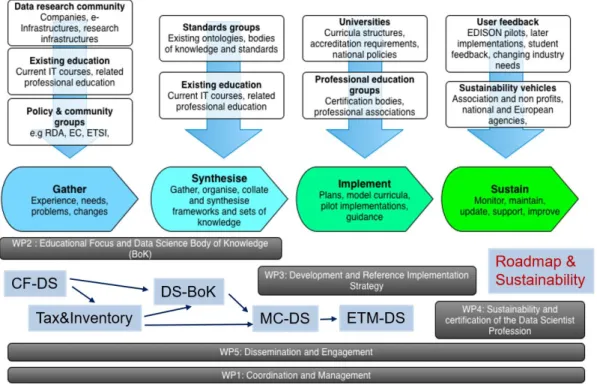
The project will achieve these objectives through an integrated framework of activities based around the creation of some key documents: the Data Science Competence Framework (CF-DS) as a basis for definition of the Data Science Body of Knowledge (DS-BoK) and a Model Curriculum (MC-DS) that altogether will provide a basis for Data Science Education and Training Model (ETM-DS) definition and implementation. The project will develop the Roadmap for the proposed framework and individual products and services sustainability.
The following diagram Figure 1 provides an overview of this framework. The individual work packages will develop and facilitate implementation of the mentioned above elements, including project wide execution of the Dissemination and Engagement Plan (DEP) by WP5 that will ensure engagement of multiple stakeholders into the project activity.
Figure 1. Project workflow, related activities and work packages
All work packages will work in tight cooperation to deliver products and components that will smooth execution of the complex of tasks from the definition of the Data Science domain and Data Scientist as a new profession to providing the strong basis for implementing and delivering necessary education and training by universities and professional training organisation, and ensuring sustainability of this process after the project ends.
2.2
EDISON activities and deliverables
Work package 2 (WP2) activities and deliverables will provide a basis for all other activities and developments in the project. WP2 includes the following tasks:
Task 2.1 Education and training needs and required competencies
Task 2.2. Inventory and taxonomy of existing curricula, training programmes and related educational resources Task 2.3. Data Scientist: Body of Knowledge (DS-BoK) and Data Science Competence Framework (CF-DS) profiles The following are WP2 deliverables
Deliverable Deliverable title Month
D2.1. Data Scientist Competences and Skills Framework (CF-DS) and BoK definition (first version)
M6 D2.2 Existing educational and training resources inventory and analysis M9 D2.3 Final versions of the DS-BoK definition, competence framework (CF-DS) and
resulting e-CF3.0F compliant Data Scientist profile definition
M22
The first pillar of the EDISON project is to define the Data Science Professions in a formal way in terms of required Competences Framework and Skills Profile (CF-DS) and mapping them to the available knowledge domains and academic disciplines currently taught at universities whilst also defining what new disciplines and training subjects/topics still need to be created. The CF-DS will include the common hard and soft skills (i.e., technical and collaborative skills) required for successful Data Scientists to work as a part of a team and be an actor in the modern agile data-driven enterprise, as well as subject-specific knowledge and skills related to different scientific and technical domains across the labour market.
The present document is the result of the research done by WP2 Task 2.1 and Task 2.3 to define the CF-DS and DS-BoK that has been presented at multiple community forums and discussed by EDISON Liaison Groups (ELG). It will be further discussed with wide expert community and major stakeholders in defining and setting up the new profession of the Data Scientist.
3
Existing frameworks for ICT and Data Science competences and skills
definition
This section provides a brief overview of existing standard and commonly accepted frameworks for defining Data Science and general Computer Science and ICT competences, skills and subject domain classifications that can be, with some alignment, built upon and re-used for better acceptance from research and industrial communities... The information in this section is also complemented with the overview of individual works and publications to define required Data Science competences and skills placed in Appendix A.
3.1
NIST definition of Data Science
NIST Big Data Working Group (NBD-WG) published their first release of Big Data Interoperability Framework (NBDIF) in September 2015 [1]1 consisting of 7 volumes. Volume 1. Definitions provides a number of definitions in particular Data Science, Data Scientist and Data Life Cycle, which we will use as a starting point for our analysis: Data science is the extraction of actionable knowledge directly from data through a process of discovery, or hypothesis formulation and hypothesis testing. Data science can be understood as the activities happening in the processing layer of the system architecture, against data stored in the data layer, in order to extract knowledge from the raw data.
Data science across the entire data life cycle incorporates principles, techniques, and methods from many disciplines and domains including data cleansing, data management, analytics, visualization, engineering, and in the context of Big Data, now also includes Big Data Engineering. Data science applications implement data transformation processes from the data life cycle in the context of Big Data Engineering.
A data scientist is a practitioner who has sufficient knowledge in the overlapping regimes of business needs, domain knowledge, analytical skills, and software and systems engineering to manage the end-to-end data processes in the data life cycle.
Data scientists and data science teams solve complex data problems by employing deep expertise in one or more of these disciplines, in the context of business strategy, and under the guidance of domain knowledge. Personal skills in communication, presentation, and inquisitiveness are also very important given the complexity of interactions within Big Data systems.
The data life cycle is the set of processes in an application that transform raw data into actionable knowledge. The term analytics refers to the discovery of meaningful patterns in data, and is one of the steps in the data life cycle of collection of raw data, preparation of information, analysis of patterns to synthesize knowledge, and action to produce value. Analytics is used to refer to the methods, their implementations in tools, and the results of the use of the tools as interpreted by the practitioner. The analytics process is the synthesis of knowledge from information.
The BDIF Volume 1 also provides overview of other definitions of Big Data and Data Science from IDG, McKinsey, O’Reilly reports and popular blogs published by experts in a new technology.
Figure 1 from the BDIF publication provide graphical presentation of the multi-factor/multi-domain Data Science definition.
1 Yuri Demchenko (UvA) contributed to the NBD-WG standardisation process and NBDIF authoring during work on the documents in 2013-2015
Figure 1. Data Science definition by NIST BD-WG [1].
3.2
European e-Competence Framework (e-CF)
The EDISON CF-DS development (WP2) will follow the European e-Competences Framework (e-CF) guiding principles:
CF-DS will adopt a holistic e-CF definition: “Competence is a demonstrated ability to apply knowledge, skills and attributes for achieving desirable results” in organisational or role context.
Competence is a durable concept and although technology, jobs, marketing terminology and promotional concepts within the ICT environment change rapidly, the e-CF remains durable requiring maintenance approximately every three years to maintain relevance.
CF-DS should work as an enabler for multiple applications that can be used by different types of users from individual to organisational; it should support common understanding and not mandate specific implementation.
A competence can be a part of a job definition but cannot be used to substitute similar named job definition; one single competence can be assigned to multiple job definitions.
The European e-Competence Framework (e-CF) [2, 3, 4] was established as a tool to support mutual understanding and provide transparency of language through the articulation of competences required and deployed by ICT professionals (including both practitioners and managers).
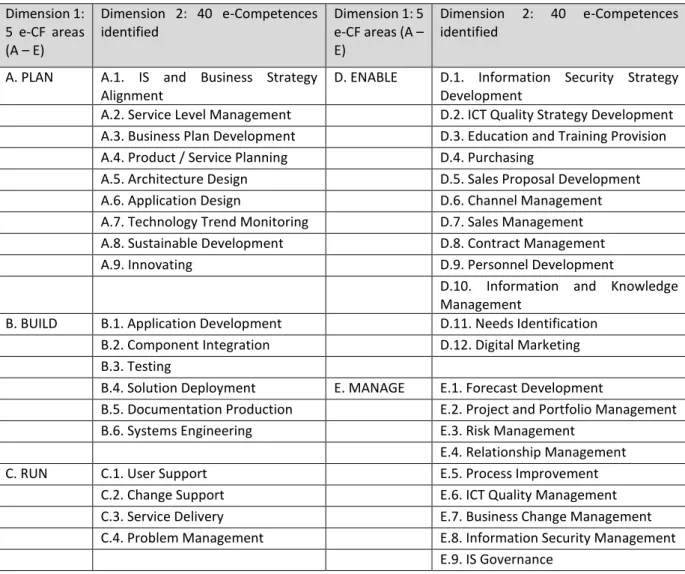
The e-CF is structured from four dimensions: Dimension 1:
5 e-Competence areas, derived from the ICT business processes PLAN – BUILD – RUN – ENABLE – MANAGE Dimension 2:
A set of reference e-Competences for each area, with a generic description for each competence. 40 competences identified in total provide the European generic reference definitions of the e-CF 3.0.
Dimension 3:
Proficiency levels of each e-Competence provide European reference level specifications on e-Competence levels e-1 to e-5, which are related to the EQF levels 3 to 8.
Dimension 4:
Samples of knowledge and skills relate to e-Competences in dimension 2. They are provided to add value and context and are not intended to be exhaustive.
Whilst competence definitions are explicitly assigned to dimension 2 and 3 and knowledge and skills samples appear in dimension 4 of the framework, attitude is embedded in all three dimensions.
Dimension 1. Competence Area defined by ICT Business Process stages from organisational perspective: A. Plan: Defines activities related to planning services or infrastructure, may include also elements of design and trends monitoring.
B. Build: Includes activities related to applications development, deployment, engineering, and monitoring C. Run: Includes activities to run/operate applications or infrastructure, including user support, change support, and problems management
D. Enable: Includes numerous activities related to support production and business processes in organisations that include sales support, channels management, knowledge management, personnel development and education and training.
E. Manage: Includes activities related to ICT/projects and business processes management including management of risk, customer relations, and information security.
e-competences in Dimension 1 and 2 are presented from the organisational perspective as opposed to from an individual’s perspective. Dimension 3 which defines e-competence levels related to the European Qualifications Framework (EQF), is a bridge between organisational and individual competences. Table 2.1 below contains competences defined for areas A-E. For more detailed definition of e-CF3.0 dimensions 1-3 and dimension 4 refer to the original document [3].
Table 2.1. e-CF3.0 competences defined for areas A-E Dimension 1: 5 e-CF areas (A – E) Dimension 2: 40 e-Competences identified Dimension 1: 5 e-CF areas (A – E) Dimension 2: 40 e-Competences identified
A. PLAN A.1. IS and Business Strategy Alignment
D. ENABLE D.1. Information Security Strategy Development
A.2. Service Level Management D.2. ICT Quality Strategy Development A.3. Business Plan Development D.3. Education and Training Provision A.4. Product / Service Planning D.4. Purchasing
A.5. Architecture Design D.5. Sales Proposal Development
A.6. Application Design D.6. Channel Management
A.7. Technology Trend Monitoring D.7. Sales Management
A.8. Sustainable Development D.8. Contract Management
A.9. Innovating D.9. Personnel Development
D.10. Information and Knowledge Management
B. BUILD B.1. Application Development D.11. Needs Identification B.2. Component Integration D.12. Digital Marketing B.3. Testing
B.4. Solution Deployment E. MANAGE E.1. Forecast Development
B.5. Documentation Production E.2. Project and Portfolio Management
B.6. Systems Engineering E.3. Risk Management
E.4. Relationship Management
C. RUN C.1. User Support E.5. Process Improvement
C.2. Change Support E.6. ICT Quality Management
C.3. Service Delivery E.7. Business Change Management
C.4. Problem Management E.8. Information Security Management
E.9. IS Governance
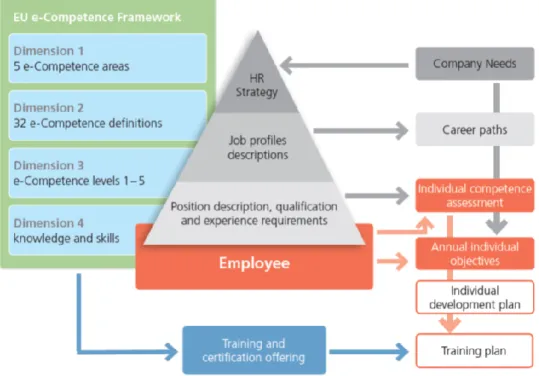
Figure 2 illustrates the multi-purpose use of the European e-Competence Framework within ICT organisations. The e-CF has a multidimensional structure. The e-CF is a competence-based and is flexible in using for different
purposes, it can be easy adopted for organisation specific model and roles. The alternative, job-profile approach as adopted in CWA 16458 (see next section 3.3), is less flexible, making local adaptation difficult. However, combining competences from different competence areas and using them as building blocks can allow flexible job-profiles definition. This enables the derived job-profiles to be easily updated by substituting or deleting competences without the need to restructure the entire profile.
Figure 2. e-CF3.0 structure and use for definition of the job profile definition and training needs. When using e-CF3.0 as a basis for CF-DS definition, the project will address the following additional goals: Link scientific research lifecycle, organizational roles, competences, skills and knowledge
Define Data Science Body of Knowledge (DS-BoK)
Map CF-DS competences to DS-BoK and learning outcome in related curricula
Provide a basis for individual competence profile assessment and suggest necessary (self) training for intended certification
3.3
CWA 16458 (2012): European ICT Professional Profiles
The European ICT Professional Profiles CWA 17458 (2012) was created to provide a basis for compatible ICT profiles definition by organisations and a basis for defining new profiles by European stakeholders [5].
The CWA defines 23 main ICT profiles the most widely used by organisations by defining organisational roles for ICT worker, that are grouped into the six ICT Profile families:
Business Management Technical Management Design
Development
Service and Operation Support
The European ICT Profile descriptions are reduced to core components and constructed to clearly differentiate profiles from each other. Further context-specific elements can be added to the Profiles according to the specific environments in which the Profiles are to be integrated. Figure 3 illustrates six ICT profile families and related main profiles which are non-exhaustive.
Figure 3. European ICT Profile Family Tree – Generation 1 and 2 as a shared European reference [5] The 23 profiles constructed in CWA combined with e- competences from the e-CF3.0, provide a pool for the development of tailored profiles that may be developed by European ICT sector players in specific contexts and with higher levels of granularity. The 23 Profiles cover the full ICT Business process; positioning them into the e-CF Dimension 1 demonstrates this. Figure 4 below illustrates this together with the ICT Profiles family structure (as it is adopted from [5]).
Figure 4 illustrates mapping between CWA families and e-CF3.0 competence areas and also CWA ICT profiles allocation to families and competence areas.
Figure 4. European ICT Professional Profiles structured by six families and positioned within the ICT Business Process (e-CF Dimension 1) (adopted from [5] and extended)
3.4
ESCO (European Skills, Competences, Qualifications and Occupations) framework
and platform [6]
The Commission services launched the ESCO project in 2010 with an open stakeholder consultation. Currently, DG Employment, Social Affairs and Inclusion coordinates the development of ESCO with the support by the European Centre for the Development of Vocational Training Cedefop. Stakeholders are closely involved in the development and dissemination of ESCO.
The ESCO classification identifies and categorises skills, competences, qualifications and occupations relevant for the EU labour market and education and training. It systematically shows the relationships between the different concepts. ESCO has been developed in an open IT format, is available for use free of charge by everyone and can be accessed via the ESCO portal.
The first version of ESCO v0 was published on 23 October 2013. This version is based on the EURES classification but includes an enhanced semantic structure, cross-sector skills and competences and an initial small sample of qualifications. It includes the results of the Cross-Sector Reference Group, but not yet any sectoral updates. ESCO v0 contains 4 761 occupations, around 5 000 skills and competences as well as some qualifications. As each concept in ESCO exists in all ESCO languages this amounts to more than 250 000 terms.
The qualifications pillar in ESCO v0 contains a small sample list of qualifications regulated at European level, international qualifications and certificates and licences linked to tasks, technologies, occupations or sectors. The list will be further developed in the next releases of ESCO. In addition, National Qualifications databases developed by the Member States and referenced to the European Qualifications Framework (EQF) will, in the future, feed into the development of ESCO.
ESCO called for community review and contribution with the deadline of 31 December 2015
2.
Until end of 2016 the classification will be completely revised. The final product will be
launched in 2017 as ESCO v1.
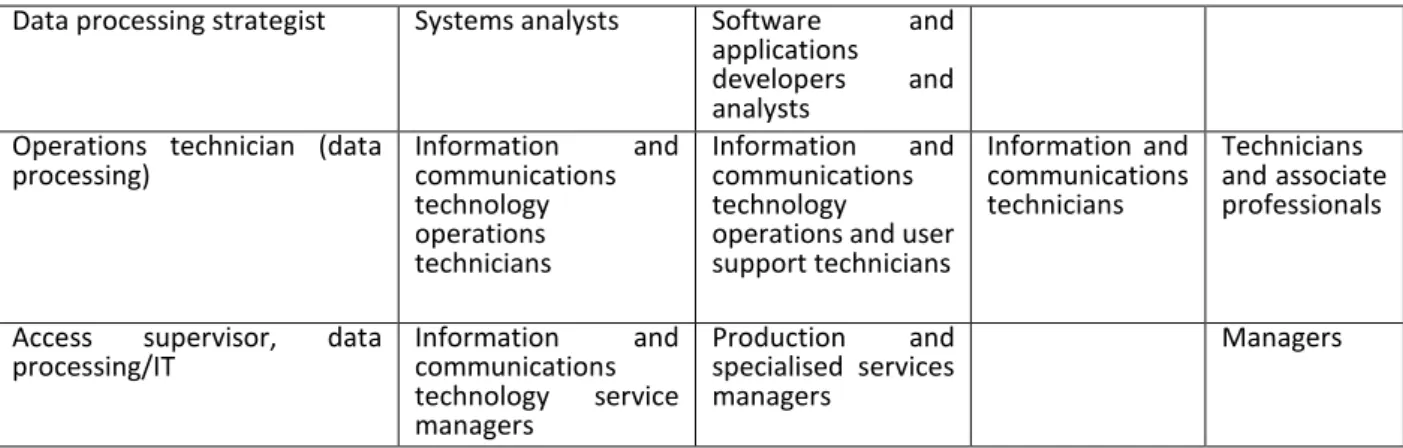
Table 2.2 contains data related occupations extracted from the ESCO classification together with related hierarchies. Table 2.3 is included for reference purposes to presents the ESCO top level occupations classification where data related occupations of different groups are highlighted in bold.
Table 2.2. Data related occupations in ESCO (2015) taxonomy
2 EDISON project provided a number of comments and suggestions to Data Science and education methods related terms and definitions.
Occupations Skills/Comp group Hierarchy Hierarchy Top hierarchy
Security director (data
processing/IT) Database network and professionals not elsewhere classified Database and network professionals Information and communications technology professionals Professionals Security analyst (data
processing/IT)
Supervisor (data processing) Data processing investigator
Data recorder Database designers
and administrators Operations manager (data
processing)
Data processing manager Data processing analyst Data processing supervisor
Data processing consultant Systems administrators
Table 2.3. ESCO top occupation hierarchy
Data processing strategist Systems analysts Software and applications developers and analysts
Operations technician (data
processing) Information communications and technology operations technicians Information and communications technology
operations and user support technicians Information and communications technicians Technicians and associate professionals
Access supervisor, data
processing/IT Information communications and technology service managers Production and specialised services managers Managers
ESCO Occupations top level hierarchy Armed forces occupations
Clerical support workers
Numerical and material recording clerks Other clerical support workers
Customer services clerks General and keyboard clerks Craft and related trades workers
Elementary occupations Managers
Administrative and commercial managers Chief executives, senior officials and legislators Hospitality, retail and other services managers Production and specialised services managers Plant and machine operators and assemblers
Professionals
Teaching professionals
Science and engineering professionals Health professionals
Legal, social and cultural professionals Business and administration professionals
Information and communications technology professionals Service and sales workers
Skilled agricultural, forestry and fishery workers Technicians and associate professionals
Health associate professionals
Information and communications technicians
Legal, social, cultural and related associate professionals Science and engineering associate professionals Business and administration associate professionals
3.5
ACM Computer Science classification
The 2012 ACM Computing Classification System (CCS) [7] has been developed as a poly-hierarchical ontology that can be utilized in semantic web applications. It replaces the traditional 1998 version of the ACM Computing Classification System (CCS), which has served as the de facto standard classification system for the computing field for many years (also been more human readable). The ACM CCS (2012) is being integrated into the search capabilities and visual topic displays of the ACM Digital Library. It relies on a semantic vocabulary as the single source of categories and concepts that reflect the state of the art of the computing discipline and is receptive to structural change as it evolves in the future. ACM provides a tool within the visual display format to facilitate the application of 2012 CCS categories to forthcoming papers and a process to ensure that the CCS stays current and relevant.
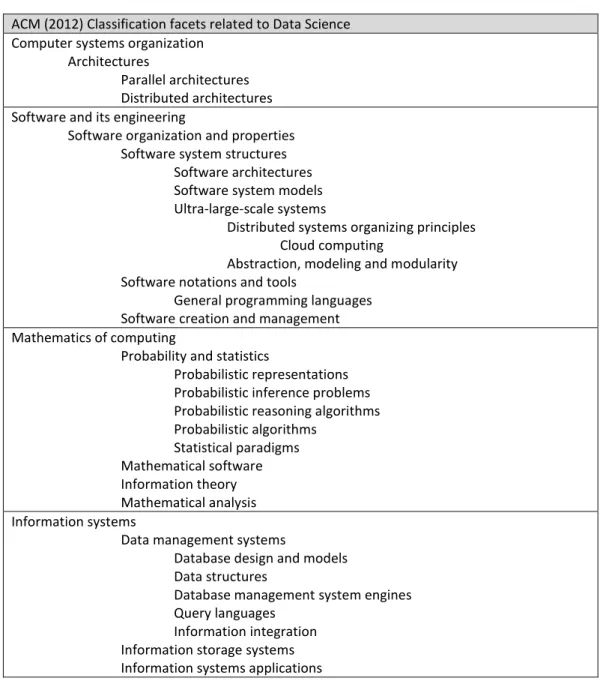
However, at the moment none of Data Science, Big Data or Data Intensive Science technologies are reflected in the ACM classification. The following is an extraction of possible classification facets from ACM CCS (2012) related to Data Science what reflects multi-subject areas nature of Data Science:
Table 2.4. ACM Classification (2012) facets related to Data Science ACM (2012) Classification facets related to Data Science Computer systems organization
Architectures
Parallel architectures Distributed architectures Software and its engineering
Software organization and properties Software system structures
Software architectures Software system models Ultra-large-scale systems
Distributed systems organizing principles Cloud computing
Abstraction, modeling and modularity Software notations and tools
General programming languages Software creation and management Mathematics of computing
Probability and statistics
Probabilistic representations Probabilistic inference problems Probabilistic reasoning algorithms Probabilistic algorithms Statistical paradigms Mathematical software Information theory Mathematical analysis Information systems
Data management systems
Database design and models Data structures
Database management system engines Query languages
Information integration Information storage systems Information systems applications
Enterprise information systems
Collaborative and social computing systems and tools Decision support systems
Data warehouses Expert systems Data analytics
Online analytical processing Multimedia information systems Data mining
Digital libraries and archives Information retrieval
Specialized information retrieval Computing methodologies
Artificial intelligence
Natural language processing
Knowledge representation and reasoning Search methodologies Machine learning Learning paradigms Supervised learning Unsupervised learning Reinforcement learning Multi-task learning Machine learning approaches Machine learning algorithms Modeling and simulation
Model development and analysis Simulation theory
Simulation types and techniques Simulation support systems Applied computing
Physical sciences and engineering Life and medical sciences
Law, social and behavioral sciences Computer forensics
Arts and humanities
Computers in other domains Operations research Education
Document management and text processing Social and professional topics
Professional topics
Management of computing and information systems Computing education
Computing and business Computing profession Computing / technology policy User characteristics
As an example, the Cloud Computing that is also a new technology and closely related to Big Data technologies, currently is classified in ACM CCS (2012) into 3 groups:
Networks :: Network services :: Cloud Computing
Computer systems organization :: Architectures :: Distributed architectures :: Cloud Computing Software and its engineering :: Software organization and properties :: Software Systems Structures :: Distributed systems organizing principles :: Cloud Computing
It is anticipated that based on current study the project will propose necessary extensions to correctly reflect knowledge areas and academic subjects related to Data Science (see chapter 5 for initial suggestions).
3.6
ACM Information Technology Competencies Model
The ACM Information Technology Competency Model (IT-CM) of Core Learning Outcomes and Assessment for Associate-Degree Curriculum (2014) has been developed by ACM Committee for Computing Education in Community Colleges (ACM CCECC) [8-11].
ACM currently categorizes the overarching discipline of computing into five defined sub- disciplines (ACM, 2005): computer science, computer engineering, software engineering, information systems and information technology. This report specifically focuses on information technology defined by the ACM CCECC as follows:
Information Technology involves the design, implementation and maintenance of technology solutions and support for users of such systems. Associated curricula focus on crafting hardware and software solutions as applied to networks, security, client- server and mobile computing, web applications, multimedia resources, communications systems, and the planning and management of the technology lifecycle (ACM CCECC, 2009).
The document refers to the U.S.
Department of Labor Information Technology Competency Model [19]
that was one of sources that provided a foundation for the curricular guidance outlined in IT-CM report
Competencies are used to define the learning outcome. In formulating assessment rubrics, the ACM
CCECC uses a structured template comprised of three tiers: “emerging”, “developed”, and “highly
developed”, that can actually be mapped to the level of Bloom’s verbs from the lower order thinking
skills (LOTS) to the higher order thinking skills (HOTS), including “analysing” and “evaluating.”
The ACM Competencies Model provides a basis for the Competency -based learning that is Instead of
focusing on how much time students spend learning a particular topic or concept (Carnegie unit credit
hour), the outcomes-based model assesses whether students have mastered the given competencies,
namely the skills, abilities, and knowledge.
The document defines 50 learning outcomes (that also define the Body of Knowledge) that represent
core or foundational competencies that a student in any IT-related program must demonstrate.
Curricula for specific IT programs (e.g., networking, programming, digital media, and user support) will
necessarily
include additional coursework in one or more defined areas of study. The core IT learning outcomes are grouped into technical competency areas and workplace skills.The ACM CCECC classification is supported by the web portal http://ccecc.acm.org/. The portal provides related information, linking and mapping between different classification systems, in particular:
ACM Computing Classification System 2012 U.S. Dept. of Labor IT 2012 Competency Model [12] Bloom's Revised Taxonomy [13]
European E-Competence Framework 3.0 (Proficiency Levels 1 & 2)
3.7
Components and concepts related to CF-DS definition
This section provides important definitions that are needed for consistent CF-DS definition in the context of organisational and business processes, e-Infrastructure and scientific research. First of all, this includes definition of typical organisational processes and scientific workflow or research data lifecycle.
3.7.1
Scientific Data Lifecycle Management Model
Data lifecycle is an importance component of data centric applications, which Data Science and Big Data applications belong to. Data lifecycle analysis and definition is addressed in many domain specific projects and
studies. Extensive compilation of the data life cycle models and concepts is provided in the CEOS.WGISS.DSIG document [14].
For the purpose of defining the major groups of competences required for Data Scientist working with scientific applications and data analysis we will use the Scientific Data Lifecycle Management (SDLM) model [15] shown in Figure 5 (a) defined as a result of analysis of the existing practices in different scientific communities. Figure 5 (b) illustrates the more general Big Data Lifecycle Management model (BDLM) involving the main components of the Big Data Reference Architecture defined in NIST BDIF [1, 16, 17]. The proposed models are sufficiently generic and compliant with the data lifecycle study results presented in [14].
The generic scientific data lifecycle includes a number of consequent stages: research project or experiment planning; data collection; data processing; publishing research results; discussion, feedback; archiving (or discarding). SDLM reflects complex and iterative process of the scientific research that is also present in Data Science analytics applications.
(a) Scientific data lifecycle management - e-Science focused
(b) Big Data Lifecycle Management model (compatible with the NIST NBDIF definition)
Figure 5. Data Lifecycle Management in (a) e-Science and (b) generic Big Data Lifecycle Management model. Both SDLM and BDLM require data storage and preservation at all stages what should allow data re-use/re-purposing and secondary research on the processed data and published results. However, this is possible only if the full data identification, cross-reference and linkage are implemented in Scientific Data Infrastructure (SDI). Data integrity, access control and accountability must be supported during the whole data during lifecycle. Data
curation is an important component of the discussed data lifecycle models and must also be done in a secure and trustworthy way. The research data management and handling issues are extensively addressed in the work of the Research Data Alliance3.
3.7.2
Scientific methods and data driven research cycle
For Data Scientist that is dealing with handling data obtained in the research investigation understanding of the scientific methods and the data driven research cycle is essential part knowledge that motivate necessary competences and skills for the Data Scientists for successfully perform their tasks and support or lead data driven research.
The scientific method is a body of techniques for investigating phenomena, acquiring new knowledge, or correcting and integrating previous knowledge [18, 19, 20]. Traditional steps of the scientific research were developed over time since the time of ancient Greek philosophers through modern theoretical and experimental research where experimental data or simulation results were used to validate the hypothesis formulated based on initial observation or domain knowledge study. The general research methods include: observational methods, opinion based methods, experimental and simulation methods.
The increased power of computational facilities and advent of Big Data technologies created a new paradigm of the data driven research that enforced ability of researchers to make observation of the research phenomena based on bigger data sets and applying data analytics methods to discover hidden relations and processes not available to deterministic human thinking. The principles of the data driven research were formulated in the seminal work “The Fourth Paradigm: Data-Intensive Scientific Discovery” edited by Tony Hey [21].
The research process is iterative by its nature and allows scientific model improvement by using continuous research cycle that typically includes the following basic stages:
Define research questions
Design experiment representing initial model of research object or phenomena Collect Data
Analyse Data Identify Patterns Hypothesise Explanation Test Hypothesis
Refine model and start new experiment cycle
The traditional research process may be concluded with the scientific publication and archiving of collected data. Data driven and data powered/driven research paradigm allows research data re-use and combining them with other linked data sets to reveal new relations between initially not linked processes and phenomena. As an example, biodiversity research when studying specific species population can include additional data from weather and climate observation, solar activity, other species migration and technogenic factor.
The proposed CF-DS introduces research methods as an important component of the Data Science competences and knowledge and uses data lifecycle as an approach to define the data management related competences group. This is discussed in section 3.4 below.
3.7.3
Business Process Management lifecycle
New generation Agile Data Driven Enterprises (ADDE) [22] use Data Science methods to continuously monitor and improve their business processes and services. The data driven business management model allows combining different data sources to improve predictive business analytics what allows making more effective solutions, faster adaptation of services, and more specifically target different customer groups as well as do optimal resources allocations depending on market demand and customer incentives.
Similarly, to the research domain the data driven methods and technologies change how the modern business operates attempting to benefit from the new insight that big data can give into business improvement including internal processes organisation and relation with customers and market processes. Understanding Business
Process Management lifecycle [23, 24] is important to identify necessary competences and knowledge for business oriented Data Science profiles.
The following are typical stages of the Business Process Management lifecycle: Define the business target: both services and customers
Design the business process Model/Plan
Deploy and Execute Monitor and Control Optimise and Re-design
The need for the Business Process management competences and knowledge for business oriented Data Science profiles is reflected in the proposed CF-DS definition as described in section 3.4.
4
EDISON definition of the Data Science Competence Framework (CF-DS)
This section describes the first version of the Data Science Competence Framework (CF-DS). It serves as a foundation for the definition of the Data Science Body of Knowledge and Data Science Model Curriculum. The section explains the approach used to analyse the collected data and information related to existing Data Science competence and skill frameworks. The reviewed in the previous section existing competences and skills models and definitions provided limited view and did not allow the consistent CF-DS definition that would reflect real job market demand in Data Science competences and skills. The presented here results have been achieved by combining initial desk research based on the existing publications, works and standards, and deep analysis of sample set of data from job advertisements on IEEE Jobs portal and LinkedIn jobs advertised in Netherlands, that allowed us to identify commonly recognised competence and skill groups and identify new competence groups not recognised in previous works and studies. The presented CF-DS model and taxonomy of competences will be used for extended analysis and collection of information from technology or scientific domains and different geographical regions and countries.4.1
Relation to and use of existing framework and studies
The following describes how existing frameworks and documents were used for the analysis
of initial competences and skills.
a) NIST NBDIF Data Science and Data Scientist definition [1]
It provided the general approach to the Data Science competences and skills definition, in particular, as having 3 groups: Data Analytics, Data Science Engineering, and Domain expertise, that may define possible specialisation of actual Data Science curricula or individual Data Scientists competences profile.
b) European e-Competence Framework (e-CFv3.0) [3]
e-CF3.0 provided a general framework for ICT competences definition and possible mapping to Data Science competences. However, it appeared that current e-CF3.0 doesn’t contain competences that reflect specific Data Scientist role in organisation. Furthermore, e-CF3.0 is built around organisational workflow while anticipated Data Scientist’s role is cross-organisational bridging different organisational roles and departments in providing data centric view or organisational processes.
c) European ICT profiles CWA 16458 (2012) [4]
European ICT profiles and its mapping to e-CF3.0 provided a good illustration how individual ICT profiles can be mapped to e-CF3.0 competences and areas. Similarly, the additional ICT profiles are proposed to reflect Data Scientist’s role in the organisation.
d) European Skills, Competences, Qualifications and Occupations (ESCO) [6]
ESCO provides a good example of a standardised competences and skills taxonomy. The presented study will provide contribution to the definition of the Data Scientist as new profession or occupation with related competences, skills and qualifications definition. The CF-DS definition will re-use, extend and map the ESCO taxonomy to the identified Data Science competences and skills.
e) ACM Computing Classification System (ACM CCS2012) [7]
ACM Computing Classification System will be used as a basis to define the proposed Data Science Body of knowledge, and extension to ACM CCS2012 will provided to cover the identified knowledge and required academic subjects. Necessary contacts will be done with the ACM CCS body and corresponding ACM curriculum defining committees.
It was a first extensive study on Data Scientist organisational roles, profiles and skills. Although skills are defined as very technically and technologically specific, the proposed definition of profiles is important for defining required competence groups, in particular identification of Data Science Creative and Data Science Researcher profiles indicates an important role of scientific approach and need for research method training in Data Scientist professional education. This group of competences is included in the proposed CF-DS.
g) EC Report on the Consultation Workshop (May 2012) “Skills and Human Resources for e-Infrastructures within Horizon 2020” [26].
This report provided important information about EC and European research community vision on the needs for Data Science skills for e-Infrastructure, in particular to support e-Infrastructure development, operation and scientific use. The identified nine skills gap areas provide additional motivation for specific competences and skills training for future Data Scientists who will work in e-Infrastructure that in particular include data management, curation and preservation.
4.2
Selecting sources of information
To verify existing frameworks and potentially identify new competences, different sources of information have been investigated:
First of all, job advertisements that represent demand side for Data Scientist specialists and based
on practical tasks and functions that are identified by organisations for specific positions. This
source of information provided factual data to define demanded competences and skills.
Structured presentation of Data Science related competences and skills produced by different
studies as mentioned above, in particular NIST definition of Data Science that provided a basis for
definition of initial 3 groups of skills, namely Data Analytics, Data Science Engineering, and Domain
expertise. This information was used to correlate with information obtained from job
advertisements.
Blog articles and community forums discussions that represented valuable community opinion.
This information was specifically important for defining practical skills and required tools.
It appeared that the richest information can be collected from job advertisements on such popular job search and employment portals such as IEEE Jobs portal and LinkedIn Jobs advertised. Important to admit that although IEEE Jobs designed to post international job openings, the advertisements are mostly from US companies and universities. LinkedIn posts vacancies related to region or country from where the request is originated and many job ads are posted in national language. In particular case of this report, it was possible to collect information from LinkedIn for Netherlands, however it was quite representative due to a large number of advertisements. This means that at the following stage, the information needs to be collected by EDISON partners in their own countries. The same relates to collecting information from different scientific, technology and industry domains what should take place at next stage of this study.
If referred to the category of job openings such as academic positions or industry and business
related positions, the academic positions didn’t provide valuable information as they don’t specify
detailed competences and skills but rather search for candidates who are capable to teach, create
or support new academic courses on Data Science.
In this initial stage we used set of Data Science job openings from IEEE Jobs portal (around 120)
and LinkedIn Netherlands (around 140) collected in period of mid-September to beginning of
October 2015. A number of Data Science related key words were used like Data Science, Big Data,
Data Intensive technologies, data analytics, machine learning. Initial analysis of collected
information allowed to make assumption that collected information from more than 250 samples
was sufficiently representative for initial study, taking into account that Netherlands is one of
leading countries in relation to Big Data and Data Science technologies acceptance and
development. See Appendix B for more details about collected data.
4.3
EDISON approach to analysis of collected information
1) Collect data on required competences and skills
2) Extract information related to competences, skills, knowledge, qualification level, and education; translate and/or reformulate if necessary
3) Split extracted information on initial classification or taxonomy facets, first of all, on required competences, skills, knowledge; suggest mapping if necessary
4) Apply existing taxonomy or classification: for purpose of this study we used skills and knowledge groups as defined by the NIST Data Science definition (i.e. Data Analytics, Domain Knowledge, and Engineering) [1] 5) Identify competences and skills groups that don’t fit into initial/existing taxonomy and create new
competences and skills groups
6) Do clustering and aggregations of individual records/samples in each identified group
7) Verify the proposed competences groups definition by applying to originally collected and new data 8) Validate the proposed CF-DS via community surveys and individual interviews4.
The Data Science competences and skills defined in this way will be used to provide input to existing professional competence frameworks and profiles:
Map to e-CF3.0 if possible, suggest new competences
Map to CWA ICT profiles where possible, suggest new profiles if needed
Identify inconsistencies in using current e-CF3.0 and CWA ICT profiles and explore alternative
frameworks if necessary.
The outlined above process has been applied to the collected information and all steps are tracked in the two Excel workbooks provided as supplementary materials to this report that are available on the project shared storage and later to be available via project wiki
4.4
Identified Data Science Competence Groups
The results of analysis presented here provides a basis and justification for defining two (new) competence areas that have not been explicitly defined in previous studies and frameworks. In particular, the proposed CF-DS competence and skills groups include:
3 competence groups identified in the NIST document and confirmed by analysis of collected data: Data Analytics including statistical methods, Machine Learning and Business Analytics Engineering: software and infrastructure
Subject/Scientific Domain competences and knowledge
2 new identified competence groups that are highly demanded and are specific to Data Science Data Management, Curation, Preservation (new)
Scientific or Research Methods (new)
Data Management, curation and preservation is already being conducted within existing (research) data related professions such as data archivist, data manager, digital data librarian, and others. Data management is also important component of European Research Area policy. It is extensively addressed by the Research Data Alliance and supported numerous projects, initiatives and training programmes5.
Knowledge of the scientific research methods and techniques is something that makes Data Scientist profession different from all previous professions.
4 This activity will be done at the next stage and results will be reported in the final deliverable D2.3 5 Research Data Alliance Europe https://europe.rd-alliance.org/
From the education and training point of view the identified competences can be treated or linked to expected learning or training outcome. This aspect will be discussed in more detail as part of the definition of the Data Science Body of Knowledge (DS-BoK) and Data Science Model Curriculum (MC-DS).
New identified competence areas provide a better basis for defining education and training programmes for Data Science related jobs, re-skilling and professional certification.
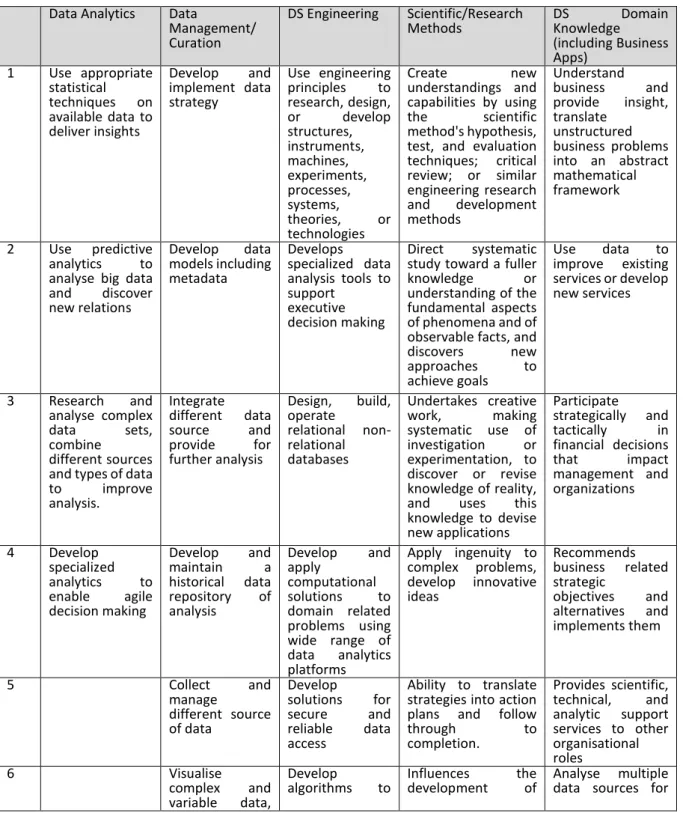
Table 3.1 provides an example of competences definition for different groups that are extracted from the collected information. It indicates that all identified groups are demanded by companies and they have expected place in the corporate structure and activities.
Table 3.1. Example of competences definition for different Data Science competence groups Data Analytics Data
Management/ Curation
DS Engineering Scientific/Research
Methods DS Knowledge Domain (including Business Apps) 1 Use appropriate statistical techniques on available data to deliver insights Develop and implement data strategy Use engineering principles to research, design, or develop structures, instruments, machines, experiments, processes, systems, theories, or technologies Create new understandings and capabilities by using the scientific method's hypothesis, test, and evaluation techniques; critical review; or similar engineering research and development methods Understand business and provide insight, translate unstructured business problems into an abstract mathematical framework 2 Use predictive analytics to analyse big data and discover new relations Develop data models including metadata Develops specialized data analysis tools to support executive decision making Direct systematic study toward a fuller
knowledge or
understanding of the fundamental aspects of phenomena and of observable facts, and discovers new approaches to achieve goals Use data to improve existing services or develop new services 3 Research and analyse complex data sets, combine different sources and types of data to improve analysis. Integrate different data source and provide for further analysis Design, build, operate relational non-relational databases Undertakes creative work, making systematic use of investigation or experimentation, to discover or revise knowledge of reality, and uses this knowledge to devise new applications Participate strategically and tactically in financial decisions that impact management and organizations 4 Develop specialized analytics to enable agile decision making Develop and maintain a historical data repository of analysis Develop and apply computational solutions to domain related problems using wide range of data analytics platforms Apply ingenuity to complex problems, develop innovative ideas Recommends business related strategic objectives and alternatives and implements them 5 Collect and manage different source of data Develop solutions for secure and reliable data access Ability to translate strategies into action plans and follow
through to completion. Provides scientific, technical, and analytic support services to other organisational roles 6 Visualise complex and variable data, Develop
including
domain specific. analyse multiple source of data organizational objectives marketing purposes
7 Prototype new data analytics applications Analyse customer data to identify/optimise customer relations actions
Figures 6 (a) and (b) provide graphical presentation of relations between identified competence groups as linked to Scientific Methods or to Business Process Management. The figure illustrates importance of Data Management competences and skills and Scientific/Research Methods or Business Processes knowledge for all categories and profiles of Data Scientists.
(b) Data Science competence groups for business oriented profiles.
Figures 6. Relations between identified Data Science competence groups for (a) general or research oriented and (b) business oriented professions/profiles: Data Management and Scientific/Research Methods or Business Processes Management competences and knowledge are important for all Data Science profiles.
The Scientific Methods typically include the following stages (see section 2.7.2 for reference to existing scientific methods definitions): Design Experiment Collect Data Analyse Data Identify Patterns Hypothesise Explanation Test Hypothesis
There are a number Business Process Operations models depending on their purpose but typically they contain the following stages that are generally similar to those for Scientific methods, in particular in collecting and processing data (see reference to exiting definitions in section 2.7.3):
Design Model/Plan Deploy & Execute Monitor & Control Optimise & Re-design
The identified demand for general competences and knowledge on Data Management and Research Methods needs to be implemented in the future Data Science education and training programs, as well as to be included into re-skilling training programmes. It is important to mention that knowledge of Research Methods does not mean that all Data Scientists must be talented scientists; however, they need to know general research methods such as formulating hypothesis, applying research methods, producing artefacts, and evaluating hypothesis (so called 4 steps model). Research Methods training are already included into master programs and graduate students.
In summary, consolidation of the presented initial version of CF-DS was challenging task due to variety of information and required expertise. It is anticipated that it will undergo further improvement involving external and subject domain experts via EDISON Liaison Group and community involvement. Other project activities will provide feedback on necessary improvements and details.
It is a challenging task to include all required subjects and knowledge into education and training programs. It will require search for new approaches in Data Science education what will be a subject for subsequent EDISON project activities and work items.
4.5
Identified Data Science Skills
Another outcome of the current analysis of Data Science job advertisements and numerous blog articles6 is the identification of required/demanded Data Science skills (also referred to as Big Data skills) that can split on 3 groups:
General Data Science skills or required (provable) experience
Knowledge and experience with Big Data hardware and software platforms
Programming language: general and those having extended statistics libraries that are generally related to Data Science Engineering skills but in many cases are treated as a separate group of skills.
It is essential to mention that for such complex professional domain as Data Science the minimum required experiences with related methods, tools or platform is 2-3 years, some companies explicitly require experience up to 5 years.
Table 3.2 lists identified Data Science skills related to the following groups Data Analytics and Machine Learning
Data Management/Curation (including both general data management and scientific data management)
Data Science Engineering (hardware and software) skills Scientific/Research Methods
Personal, inter-personal communication, team work (also called social intelligence or soft skills) Application/subject domain related (research or business)
The Data Analytics and Machine Learning group is the most populated what reflect real picture of required skills primary in this area as a basis for Data Science methods.
Table 3.2. Identified Data Science skills Skill Grou ps Data Analytics and Machine Learning Data Management/ Curation Data Science Engineering (hardware and software) Scientific/ Research Methods Personal/Int er-personal communicati on, team work Application/subj ect domain (research or business) 1 Artificial intelligence, machine learning Manipulating and analysing complex, high-volume, high-dimensionality data from varying sources Design efficient algorithms for accessing and analysing large amounts of data Interest in
data science Communication skills Recommender or Ranking system
6 It is anticipated that for such new technology domain as Data Science the blog articles constitutes valuable source of information. Information extracted from them can be correlated with other sources and in many cases provides valuable expert opinion. Opinion based research is one of basic research methods and can produce valid results.
2 Machine Learning and Statistical Modelling Data sources and techniques for data improvement for better business insight and customer focus Big Data solutions and advanced data mining tools Analytical, independent, critical, curious and focused on results Inter-personal intra-team and external communicati on Data Analytics for commercial purposes 3 Machine learning solutions and pattern recognition techniques Data models
and datatypes Multi-core/distribut ed software, preferably in a Linux
environment
Confident with large data sets and ability to identify appropriate tools and algorithms Network of contacts in Big Data community Data sources and techniques for business insight and customer focus 4 Supervised and unsupervised learning Experience of working with large data sets
Databases, database systems, SQL and NoSQL Flexible analytic approach to achieve results at varying levels of precision Mechanism Design and/or Latent Dirichlet Allocation
5 Data mining (non)relational
and (un)-structured data Statistical analysis languages and tooling Exceptional
analytical skills Game Theory
6 Markov Models, Conditional Random Fields Cloud based data storage and data management Cloud powered applications design Copyright and IPR 7 Logistic Regression, Support Vector Machines Data management planning 8 Predictive analysis and statistics (including Kaggle platform) Metadata annotation and management 9 (Artificial) Neural Networks Data citation, metadata, PID (*) 10 Statistics 11 Natural language processing 12 Computer Simulation
(*) Persistent Identifier (PID), Data Types Registries, and Data Management Policies are outcome and products by Research Data Alliance (RDA) [27]
Table 3.3 lists identified required skills and knowledge of the Big Data platforms (hardware and software) divided into groups:
Big Data Analytics platforms Math& Stats tools
Databases
Data Management and Curation platform Data and applications visualisation
It is essential to mention that all modern Big Data platforms and general data storage and management platforms are cloud based. The knowledge of Cloud Computing and related platforms for applications deployment and data
![Figure 1. Data Science definition by NIST BD-WG [1].](https://thumb-us.123doks.com/thumbv2/123dok_us/10878786.2976802/9.892.259.622.109.421/figure-data-science-definition-nist-bd-wg.webp)
![Figure 3. European ICT Profile Family Tree – Generation 1 and 2 as a shared European reference [5]](https://thumb-us.123doks.com/thumbv2/123dok_us/10878786.2976802/12.892.143.755.119.533/figure-european-profile-family-generation-shared-european-reference.webp)