April ... May, 1985
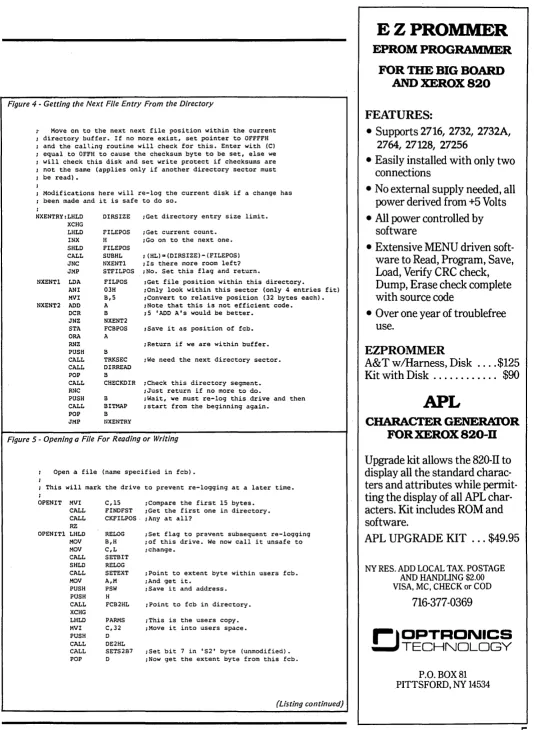
TABLE OF CONTENTS
Automatic Disk Re .. logging With CP/M 2.2 ...
4
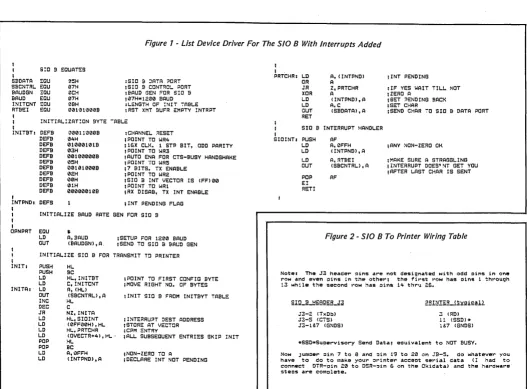
Interrupt Driven Serial Print Driver... 18
Review: Microsphere RAM Disk . . . 41
Do It Yourself Smart Video Controller... 43
In .. line Object Code In Turbo Pascal... 51
An Inspired Turbo Tutor.. . . 60
New Strokes for KSTROKES . . . 63
A Low Cost EPROM Eraser ... . . . 63
Pascal and C Compilers Benchmarked
~...65
Running CP/M's TPA ... 67
Ready To Use Files .. _ ...
:t~,-... ; ..
<' .. :.: ... : ...
81
Regular Features
The S .. 100 Bus...
9
On Your Own... 72
In The Public Domain... 13
Technical Tips... 74
The Xerox Column... 21
C'ing Clearly... 25
The Slicer Column... 32
The Kaypro Column. . . 35
Pascal Procedures... 52
FOR THwords ... 58
Culture Corner ... .. .. .. 82
Future Tense
Tidbits ... -. . . 83
Review: Epson PX .. 8 ... 84
The Last Page .. .. .. .. .. .. .. .. 88
They
said
it
couldn't
be done.
Borland
Did
It. Turbo Pascal
ao
The industry standard
With more than 250,00Q users worldwide Turbo Pascal is the industry's de facto standard. Turbo Pascal is praised by more engineers, hobbyists, students and.professional programmers than any other development environment in the history of microcomputing. And yet, Turbo Pascal is simple and fun to use!
COMPILATION SPEED ,,:"
EXECUTION SPEED
CODE SIZE
BUILT-IN INTERACTIVE EDITOR
ONE STEP COMPILE (NO LINKING NECESSARY) COMPILER SIZE
TURTLE GRAPHICS
BCD OPTION
PRICE
Portability
Turbo Pascal is available today for most computers running PC DOS, MS DOS. CPIM 80 or CPIM 86. A XENIX version ofTurbo Pascal will soon be announced. and before the end of the year, Turbo Pascal will be running on most 68000 based microcomputers.
An Oller You Can't Reluse
Until Jl:me 1st, 1985, you can get Turbo Pascal 3.0 for only $69.95. Turbo Pascal 3.0, equipped with either the BCD or 8087 options, is available for an additional $39.95 or Turbo Pascal' 3.0 with both optiotls for only $124.95. As a matter of fact, if you own a 1"6 Bit computer and are serious about programming, you might as well get both options right away and save
almost $25. •
Update policy
As always, our first commitment is to our customers. You built Borland and we will always honor your support.
50,'to make your upgrade tathe fl)«;iting new version of Turbo Pascal 3.0 easy, ,we will accept your original Turbo Pascal disk (ina bend-proof container) for a trade-i!'""~ c . credit of $39.95 and your Turbo87 original disk for
$59.95. This trade-in credit may only ,be applied toward
the purchase of Turbo Pascal 3.0 and its additional BCD and 8087 options (trade-inoffer isonly vand directly through Borland and until Juneist, 1985), ',' ,
TURBO
3.0
TURBO
2.0
, PASCAL
MS
(*) Benchmark run on an IBM PC using MS Pascal version 3,2 and the DOS linker version 2.6. The 179 line program used is the "Gauss-Seidel" program out of Alan R. Miller's book: Pascal programs for
scientists and engineers (Sybex. page 128) with a 3 dimensional
non·singular matrix and a relaxation coefficient of 1.0.
I
BORlAnD
I.
INTERNATIONAL
_ Software's Newest Direction
4113 ScottsValleyDnve Scotts Valley, Califorma 95066 TELEX,' 172373
The best just got better:
Introducing Turbo Pascal 3.0
We just added a'whole range of exciting new features to Turbo Pascal:• First, the world's fastest Pascal compiler just got faster. Turbo Pascal 3.0 compiles twice as fast as Turbo PascaI2.0! No kidding.
• Then, we totally rewrote the file 110 system, and . . we also now support 110 redirection.
• For the IBM PC versions, we've even added 'turtle graphics" and full tree directory support. • For all 16 Bit versions, we now offer two
addi-tional options: 8087 math coprocessor support for intensive calculations and Binary Coded Decimals (BCD) for business applications. • And much much more.
The Critics' Choice.
Jeff Duntemann, PC Magazine: "Language deal of the century . .. Turbo Pascal: It introduces a new programming environment and runs like marjic."
Dave Garland, Popular Computing: "Most Pascal compilers barely fit on a disk, but Turbo Pascal packs an editor, compiler, linker, and run-time library into just 29K bytes ofJandom-access memory."
MICRO CORNUCOPIA
P.O. Box 223
Bend, Oregon 97709
503-382-5060 Orders Only
503-382-8048 Tech. 9 - Noon
Editor & Publisher David J. Thompson
Operations Manager David Pogue
Assistant Editors
Rebecca Ozrelic Gary Entsminger
Accounting Sandra Thompson
Graphic Design
Craig Lannes Michael Odell
Technical Department Dana Cotant Eric Roby Bruce Berryhill Laine Stump
Advertising Director Alice Holbrow
Staff Assistants
Dorcas Dsenis Tracey Braas Cary Gatton Carla Miller
Laura Pendley
Secretary Christina Donaldson
Typography Patti Morris & Martin White
Irish Setter
MICRO CORNUCOPIA supports systems programming languages and builders of single board and 5-100 systems.
Application to mail at second class postage rates is pending at Bend, OR 97701. Published bimonthly by Micro Cornucopia Inc., 155 NW Hawthorne, Bend, OR 97701. Postmaster: Send address change to Micro Cornucopia Inc., PO Box 223, Bend, OR 97709.
SUBSCRIPTION RATES:
1 yr. (2nd Class) $16.00 1 yr. (Canada & Mexico) $22.00 1 yr. (Other foreign) $30.00 Make all orders payable in U.S. funds on a U.S. bank, please.
ADVERTISING RATES: Available on request (call Alice Holbrow).
CHANGE OF ADDRESS: Please send your old label and new address.
SOFTWARE, HARDWARE, AND BOOK VENDORS: We would very much like to re-view your software, Single Board, and 5-100 products. Send materials to the Review De-partment, Micro Cornucopia.
Copyright 1985 by Micro Cornucopia Inc.
All rights reserved
ISSN 0747·587X
111110 1101111110.11
April-May 1985
The Micro Technical Journal
No. 23
April
Fool
SOGIV
If you saw the list of folks who have already signed up for the SaG this year, you'd be surprised (we're certainly sur-prised).
Ezra Shapiro, West Coast technical ed-itor for Byte, will be our keynote speak-er. His talk will be titled "The Demise of Innovation." Ezra will be sharing with us his very definite ideas about the 'me-too' designs.
Slicer will be having a board construc-tion party again (they'll throw in a bare expansion board free if you build one this year), plus they'll be bringing all the rest of their new products to demon-strate and selL Call them to reserve a board.
The Ampro folks will be bringing up their Little Board and they are going to be holding a construction class (at special prices). In fact, you'll be able to put to-gether a complete Little Board system complete with Integrand cabinet and drives, right at the SaG. they'll have something new to demonstrate. The lit-tle Board folks will also be giving a talk on designing with the Z80. (Actually the Ampro folks think they are giving it.)
Integrand will be here displaying their Little Board cabinet (if you're surprised, go back and reread the previous para-graph). They'll also be doing a presenta-tion on cabinet design and system cool-ing.
We've invited Philippe Kahn back, this time to talk about Modula-2 (Turbo style), and to toot his own horn (he plays a mean sax). We're still waiting to hear if he can come.
Speaking Of Music
In fact, we have a very musical group working at Micro C. Gary and Craig play
guitar (semi-professionally); Bruce plays the flute; Jean (his other half) plays fid-dle, and I have one of those fancy Yama-ha synthesizers (the DX7), so I can pre-tend to be just about anything (even an editor).
My little MSX computer also contains a pretty decent synthesizer (rhythm any-one?), so we should be be able to come up with something interesting.
In fact, we will have a jam session Thursday evening after the Kickoff Cookout. You are all encouraged to bring your woodwinds, bongos, strings, horns, synthesizers, kazoos, speech generators, Integrands, tin ears, every-thing .... If we come up with someevery-thing that even approximates music, maybe we'll have a lunch-time performance on Saturday.
White Water Rafting
This year we'll have the 21/2 hour raft trip (just like last year), plus an all-new, all-day affair. The all-day white water trip will feature a total of 41/2 hours on the McKenzie River (not counting the one-hour lunch on the bank). There will be an incredibly beautiful P/2 hour van ride to the starting point through some of the most beautiful alpine terrain in the Northwest.
Reservations
There are limitations on the number of people we can accommodate in the dorm (there are only 25 double rooms). The rafting trips shouldn't be any problem because the guides will run as many groups as necessary. But please call us to verify space if you want to stay in the dorm.
Trenton
The 10th annual Trenton Computer Festival will be held April 20 and 21 at Trenton State College, Trenton NJ. They say it's the oldest computer fair in the country. I've also heard they have one of the best flea markets going (a whole parking lot full of tables and tractor trail-ers). When I mentioned that I would be attending, Sol Libes suggested that I come in a truck.
Go Winnie!
I have enjoyed your publication very much during the past year. In fact, I re-cently changed my subscription to first class and submitted two gift subscrip-tions.
I have a comment on the closing para-graph of your Kaypro column for Octo-ber.
We have had three Kaypro lOs with this same 'status 02' error over the last six months. Each time the error occurred, the hard disk was not up to speed when the Kaypro 10 tried to read it. In all three cases the problem stemmed from the hard disk controller board. After the boards were replaced, the 'status 02' er-ror problem was resolved.
StanleyD. Watson 4745 Convention Street Baton Rouge LA 70806
Editor's note:
I
also got a call from a local dealer about this
problem. He had contacted two of the drive
manufacturers and found out that some of the
drives Kaypro is using are the low current
versions which start very slowly. (In fact,
they often won't start at all if the head gets
left somewhere other than in the safety
posi-tion and is resting on the disk.)
He has found that if he lubricates the
win-chester's stepper arm with a little silicon
spray, the head will return to the safety
posi-tion between data fetches and the drive will
start properly the next time the system is
turned on.
ZCHESS & Ticks
I certainly wouldn't begin to complain about the value of your users disks. But I would like to point out a bug or two.
First, on ZCHESS from K3 there have been several occasions when the com-puter playing black thinks it's entitled to move two pawns two spaces at once from other than the second rank. This wouldn't bother me so much except that it won't let me cheat in the same way.
Now, there's certainly twelve bucks worth of other stuff on that disk, but it would be nice if the main attraction for , me didn't have that bug. (The CRC checks out, by the way, although I guess there could be some obscure memory problem in my machine causing this slip.) Anyway, I wonder if there's a
ver-LETTERS
sion of ZCHESS out there somewhere without the bug?
The other thing I wonder about is that the version of ZCPR on your second re-lease of it (haven't tried the first) puts a /I'
at the end of each comment it makes, in-cluding each listing in a directory. Minor little mark, and it's so damned useful that it's certainly overlookable. But what the heck is it doing there? And can the thing be exorcised? (By the way, rm run-ning it on an '83 II.)
Whitney Blauvelt 505 E. Denny Way #507 Seattle WA 98122
Editor's note:
Due to papular demand we changed ZCPR
to display special characters (the normal CCP
doesn't let them reach the screen, but people
wanted to display them and
sowe ... ).
Any-way, that little tick you see on the screen is
what the Kaypro displays when it sees a null
(0) byte. Every other system I've seen simply
discards the null, but not the Kaypro (there
are a number of situations where the null can
be very irritating).
Soit is not without malice
of forethought that our Pro-Monitor ROMs
throwaway nulls.
Pro-8 Installation
Someone once said that the devil dwells in the details. I found this to be true when I recently did the Pro-8/Plus-4 upgrade on my Kaypro II, installing two Mitsubishi half-height, quad density drives (4853) in place of the original 'A' drive. I would like to pass along what I learned about some of the details of this upgrade.
The existing screws holding the Tan-don drives require a 7/64" allen wrench. This is a size not found in most of the common allen wrench sets.
The screws from the Tandon do not fit the Mitsubishis. You need 3m x 1m sock-et head cap screws which are not avail-able in most hardware stores.
To install two half-height drives in place of one full-height drive the entire drive enclosure must be removed from the computer case and new holes drilled in it. This is not particularly difficult, but laying out the new holes is tedious. This wouldn't even need to be done if only one new drive were being installed.
The power connector for the drives is
not sold in Radio Shack or in most elec~ tronic supply houses. Nor could I find it in most computer stores which claim to have a service department.
The Micro C Plus-4 Decoder Board does not go on the obvious way. The numbers on the decoder board must cor-respond with those on the main board, which means that the decoder board will cantilever out over the drive enclosure. When the cover is put back on, every-thing shorts out. This probably never happens to the Micro C folks who never put their covers back on. The problem can be fixed up with some electrical tape and cardboard, but it would be better if
the designer went back to the drawing board.
Neither the problems nor their solu-tions were very profound, but resolving them took about three quarters of the time needed for the entire installation. Everything is working nicely now. WalterB. Whitcher
319 E. 24th Street New York NY 10010
Editor's note:
You are right about our covers. They come
off when the machine comes out of the box and
they usually stay off. Forever. Now, we are
using a new low profile connector (the part
that hangs out over the drives)
sofolks'
cir-cuits shouldn't be
soshort any longer.
Xerox 820 Info
I've recently 'discovered' Micro Cor-nucopia and I am enjoying it. It's nice to see a magazine that gets down to the basics. I wrote the Apple Cart column in Creative Computing for three years when an author could still do some of the things you do in your publication. Now,
if you aren't reviewing someone else's software, no one wants your articles.
The parts of Micro C that I am most interested in are those about the original 820 CPU. I was the senior electrical man-ufacturing engineer on the program from its beginning. From that perspec-tive I'd like to make a few comments.
All the schematics for PWA etches 1 and 2 are there, as are the listings for versions 1.0 and 2.0 of the monitor ROMs. There is a wealth of other information includ-ing programminclud-ing data for the SIOs, PIOs, the CTC and the FDC chips. Per-haps you could get permission to reprint this as a project for Micro C magazine.
About disk drives, software, and other things. Most people know that the 820 'was designed for single-sided 51/4" drives. Later, the double-sided drives were added and so were single-sided 8" drives. With the etch 1 CPU, it was not directly possible to use DS 8" drives. For DS 51/4" drives, version 3.0 of the CP/M
operation system was issued. This al-lowed the user to initialize and copy on two-sided media.
In the process of developing test pro-cedures and equipment for the two-sid-ed drives, I discovertwo-sid-ed that the software was really looking at four separate sin-gle-sided drives. Once a diskette was initialized with the 3.0 INIT program, I used my DS system as four drives in the sequence A,C and B,D; worked fine, too. I could get the equivalent of four single-sided drives in a two-drive package. Otherwise, the original system was ca-pable of four single-sided drives any-way. The user would only need to prop-erly wire and encode the drive block on the individual drives. Shugart's SA400 manuals show how to do this.
Chuck Carpenter 3714 Bishop Hill Dr. Carrollton TX 75007
Fixing The SBASIC Sorts
In Jack Rodenhi's SBASIC column (Is-sue 19) there seems to be some confusion about SBASIC's rules governing recur-sion. Rodenhi states, "In the manual's example program on recursion, X2 seems equivalent to our variable List-Size. In the discussion of their program, they claim that X2 would not be duplicat-ed when P3 is callduplicat-ed from P4." Jack is correct that ListSize is equivalent to X2 and that it is indeed duplicated. Howev-er, he is incorrect in saying that this cor-responds to P4's calling P3 on line 20 of the manual's example program.
In SSSORT (Jack's procedure which contains ListSize), it is SSSORT itself which calls its nested procedure
READ-LITTIRS
RECORDS (causing ListSize to be treat-ed recursively). The corresponding call is on line 26 of the manual's example program, where P2 calls P3. There it clearly shows that X2 will be duplicated. Although the example program cor-rectly indicates how SBASIC's recursion occurs, the manual does not. (So what else is new?) Recursion occurs when a procedure calls itself or when one nested procedure calls another nested proce-dure (including the situation where a nested procedure calls the unnested pro-cedure which contains it). Recursion will also occur when a nested procedure is called by the procedure which contains it. (Anyone for Peter Piper?)
Also, arrays are treated differently than variables in recursive calls because arrays are not duplicated. (If the call causes the DIM statement to re-execute, however, the array may be reinitialized.) This provides at least four ways for Jack to fix his program:
1. Procedures (such as READ-RECORDS) which change one of the variables he ,describes as "global in the procedure SSSORT" could be rewritten as subroutines.
2. Those same procedures could in-stead be rewritten as functions which re-turn the value of the changed variable (in use this might look like "ListSize = READRECORDS (ListSize(O)").
3. The variables in question (such as ListSize) could instead be declared as one-element integer arrays (e.g., List-Size (0)).
4. Those same variables could be made global to SSORT by moving their declaration outside of the procedure (of course, that would make them global to the rest of the program as well).
Richard Levine
3105 Meadow Grove Dr. San Diego CA 92110
Run CP/M On An IBM?
I need your help with a CP/M
prob-lem. I haven't been able to locate any products that will do what I want.
I am writing software in Turbo Pascal under MS-DOS. I want to port over fin-ished software to run on CP/M ma-chines. For this conversion, are there co-processor boards I can add to my PC-compatible system so it will look like
Micro Cornucopia, Number 23, April-May 1985
a CP/M system to a CP 1M Turbo Pascal compiler? Are there any products for the PC that emulate the Z80 or 8080 to do what I want?
Please supply the names and address-es of any suppliers of suitable boards and emulators. Many thanks for your help. , Frank
J.
MihmBox 622 Aptos CA 95001
Editor's note:
What a refreshing request. For
a
while there, I thought everyone was going in the other direction. OK, there are several clones (or semi-clones) that say they can run both: Rainbow, Chameleon, and, I believe, one of the Heath systems. However, I am not aware of any plug-in boards that will handle this. Any suggestions, anyone?The obvious option would be to get a Kay-pro and transfer the software over serially. Kaypro also has a utility that is supposed to be able to read MS-DOS disks and transfer files to CP 1M. So far, we haven't been able to get it to work. What are you working on, by the way?
Speed-Up Problem
I purchased a Pro-Set II so I could up-grade my 1983 Kaypro II to 5MHz (and then do a program for the Palm Beach KUG). In the process, I learned a few things.
First, my Kaypro II is really a 4 inside so I had to exchange the Pro-Monitor II ' for a Pro-Monitor 4. Second, the Z80B costs between $12 and $45 depending on where you buy. Third, I'm still having a problem because at 5MHz the system runs for about a minute and a half and then locks up.
Gene Klein
12775 Builford Circle West Palm Beach FL 33414
Editor's note:
You are not the only person who has a II
with the heart of a 4. Anyone with an older Kaypro II (pre-84-which means it has the standard full-width Tandon drives and no graphics) should take the top off his or her Kaypro II and read the paper stuck to the top of the monitor ROM (there are two chips with paper on top-the one nearest the front
(Continued on Page 64)
Automatic Disk Re-Iogging With CP
1M
2.2
By Clark A. Calkins
If you've felt like resetting the parity bit on the person who installed "BDOS ERROR ON A: DISK R/O" in your com-puter's vocabulary, then you're in the right spot. In this article we'll cover why CP/M makes a disk "read only." Plus, you'll find out what you're really telling the operating system when you hit ctrl-C. Doing this mod is (almost) never hav-ing to say "warm boot."
I'll show you how to modify the source of CP/M (see reference 1) rather than asking you to patch bits and pieces of the executable code.
CPIM Is Smart
When the CP/M V2.2 operating sys-tem first accesses a disk, it scans the di-rectory and makes a map showing which spaces (or blocks) on the disk contain da-ta and which spaces are available for use. This map is called a bit map and is updat-ed when space is allocatupdat-ed (a file is creat-ed or expandcreat-ed) or when space is re-leased (a file is erased).
The map is kept in memory, so unless CP /M does some checking, you could destroy data simply by changing disks. You see, when CP/M writes data to the new disk, it writes the data into the areas that the bit map says are available. (Of course, these areas might not be avail-able on the new disk, so it would be writ-ing over valid data.)
To prevent this, CP/M keeps a con-densed record of the directory (actually, this is a series of checksum bytes) in or-der to tell if the disk directory has changed. When this occurs, CP/M will tag this disk as 'read only,' so you can't write to it. Nice, huh? The only problem is that you get a "BDOS ERROR ON A: DISKR/O."
Of course, this means you need to type ctrl-C to let CP 1M know the disk has
been changed -after CP 1M just told you
that the disk had changed. (Oh well, no-body said operating systems had to be both smart and helpful.)
Making CPIM Helpful
The modifications described below will force CP /M to update the bit map (and the directory check) whenever a disk is changed, as long as the update
(Continued on Page 6)
4
[image:6.615.219.568.116.731.2]1907 Alvarado Ave. Walnut Creek CA 94596
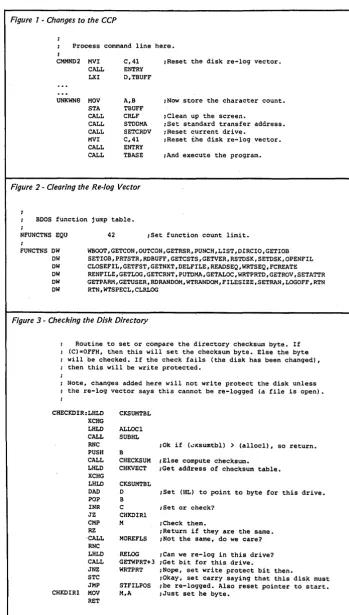
Figure 1 • Changes to the CCP
J Process command line here.
,
CMMND2 MVI C,41 ;Reset the disk re-log vector.
CALL ENTRY
LXI O,TBUFF
UNKWN8 MOV
STA CALL CALL CALL MVI
CALL CALL
A,B ;Now store the character count.
TBUFF
CRLF ;Clean up the screen.
STOOMA ;Set standard transfer address.
SETCRDV ;Reset current drive.
C,41 ;Reset the disk re-log vector.
ENTRY
TBASE ;And execute the program.
Figure 2· Clearing the Re·/og Vector
,
J BOOS function jump table.
NFUNCTNS EQU 42 ;Set function count limit.
FUNCTNS OW OW
ow
OW DW DW
WBOOT,GETCON,OUTCON,GETRSR,PUNCH,LIST,OIRCIO,GETIOB SETIOB,PRTSTR,RDBUFF,GETCSTS,GETVER,RSTDSK,SETOSK,OPENFIL CLOSEFIL,GETFST,GETNXT,OELFILE,READSEQ,WRTSEQ,FCREATE RENFILE,GETLOG,GETCRNT,PUTOMA,GETALOC,WRTPRTO,GETROV,SETATTR GETPARM,GETUSER,RDRANDOM,WTRANDOM,FILESIZE,SETRAN,LOGOFF,RTN RTN,WTSPECL,CLRLOG
Figure 3 . Checking the Disk Directory
; Routine to set or compare the directory checksum byte. If
; (C)=OFFH, then this will set the checksum byte. Else the byte ; will be checked. If the check fails (the disk has been changed), ; then this will be write protected.
; Note, changes added here will not write protect the disk unless ; the re-log vector says this cannot be re-logged (a file is open).
CHECKDIR:LHLD CKSUMTBL
XCHG
LHLD ALLOCl
CALL SUBHL
RNC ;Ok if (~Ksumtbl) > (allocl), so return.
PUSH B
CALL CHECKSUM ;Else compute checksum.
LHLD CHKVECT ;Get address of checksum table.
XCHG
LHLO CKSUMTBL
DAD D ;Set (HL) to point to byte for this drive.
POP B
INR C ;Set or check?
JZ CHKDIRl
CMP M ;Check them.
RZ ;Return if they are the same.
. CALL MOREFLS ;Not the same, do we care?
RNC LHLO CALL JNZ STC JMP
CHKDIRl MOV
RET
RELOG JCan we re-log in this drive?
GETWPRT+3 ;Get bit for this drive.
WRTPRT ;Nope, set write protect bit then.
;Okay, set carry saying that this disk must
STFILPOS ;be re-logged. Also reset pointer to start.
M,A ;Just set he byte.
Figure 4 -Getting the Next File Entry From the Directory
Move on to the next next file position within the current directory buffer. If no more exist, set pointer to OFFFFH and the cal~~ng routine will check for this. Enter with (C) equal to OFFH to cause the checksum byte to be set, else we will check this disk and set write protect if checksums are not the same (applies only if another directory sector must be read).
Modifications here will re-log the current disk if a change has been made and it is safe to do so.
NXENTRY:LHLD DIRSIZE ;Get directory entry size limit. XCHG
LHLD FILEPOS ;Get current count. INX H ;Go on to the next one. SHLD FILEPOS
CALL SUBHL ; (HL)=(DIRSIZE)-(FILEPOS) JNC NXENTl ;Is there more room left? JMP STFILPOS ;No. Set this flag and return. NXENTl LOA
ANI MVI NXENT2 ADD OCR JNZ STA ORA RNZ PUSH CALL CALL POP CALL RNC PUSH CALL POP JMP
FILPOS 03H B,s A
B
NXENT2 FCBPOS A
B
;Get file position within this directory.
;Only look within this sector (only 4 entries fit) ;Convert to relative position (32 bytes each). ;Note that this is not efficient code. ;5 'ADD A's would be better.
;Save it as position of fcb. ;Return if we are within buffer. TRKSEC ;We need the next directory sector. DIRREAD
B
CHECKDIR ;Check this directory segment. ;Just return if no more to do.
B
BITMAP
B
NXENTRY
;Wait, we must re-log this drive and then ;start from the beginning again.
Figure 5 - Opening a File For Reading or Writing
Open a file (name specified in fcb).
This will mark the drive to prevent re-logging at a later time. OPENIT MVI
CALL CALL
RZ
OPENITl LHLD MOV MOV CALL SHLD CALL MOV PUSH PUSH CALL XCHG LHLD MVI PUSH CALL CALL POP
C,ls ;Compare the first 15 bytes. FINDFST ;Get the first one in directory. CKFILPOS· ;Any at all?
RELOG B,H C,L SETBIT RELOG SETEXT A,M PSW
H
FCB2HL
;Set flag to pravent subsequent re-logging ;of this drive. We now call it unsafe to ;change.
;Point to extent byte within users fcb. ;And get it.
;Save it and address. ;Point to fcb in directory. PARMS ;This is the users copy. C,32 ;Move it into users space.
o
DE2HL
SETS2B7 ;Set bit 7 in '52' byte (unmodified).
o ;Now get the extent byte from this fcb.
(Listing continued)
Micro Cornucopia, Number 23, April-May 1985
EZPROMMER
EPROM PROGRAMMER
FOR THE BIG BOARD
AND XEROX 820
FEATURES:
• Supports
2716, 2732, 2732A,
2764, 27128, 27256
• Easily installed with only two
connections
• No external supply needed, all
power derived from +5 Volts
• All power controlled by
software
• Extensive MENU driven
soft-ware to Read, Program, Save,
Load, Verify CRC check,
Dump, Erase check complete
with source code
• Over one year of troublefree
use.
EZPROMMER
A&T w /Harness, Disk .... $125
Kit with Disk . . . .. $90
APL
CHARACTER GENERATOR
FOR XEROX 820-D
Upgrade kit allows the 820-11 to
display all the standard
charac-ters and attributes while
permit-ting the display of all APL
char-acters. Kit includes ROM and
software.
APL UPGRADE KIT ... $49.95
NY RES. ADD LOCAL TAX. POSTAGE AND HANDLING $2.00 VISA, MC, CHECK or COD
716-377 -0369
r
JOPTRONICS
TECHNOLOGY
P.O. BOX 81
PITTSFORD, NY 14534
AUTOMATIC DISK
RE-LOGGING _ _ _ _ _ _ _ _ _ _ _ _ _ _ _ _ _ _ _ _ _
_
(continued from page 4)
can be done safely.
In the following figures, it is unsafe to alter the tables only while a file is open. Therefore, application programs (Dbase II, WordS tar, SuperCalc, etc.) are pro-tected, while still allowing maximum flexibility on disk changes.
You can enter the modifications with any good editor (we all have our favor-ites). Check the listed routines against your source code to be sure you under-stand which lines have been inserted or changed. Then re-assemble the source and combine it with the BIOS code. Fi-nally, you can SYSGEN a new disk.
Changes To The CCP
The console command processor (CCP) needs to be modified to clear the disk re-Iog vector after each command and prior to the execution of a user's pro-gram. I've added a new BDOS function (#41) for doing this. If you are using ZCPR or other new 'front end,' then these changes must be placed at the ap-propriate locations within the code in Figure 1. Consult local talent if you are not sure what to do (or where to do it).
Changes To The BOOS Function Jump Table
An added function (#41) in Figure 2 allows the re-Iog vector to be cleared without having to reset all the disks.
Changes To The Routine CHECKDIR The routine in Figure 3 is used to check the disk directory against the stored check value. If the disk needs to be re-logged, the carry flag is set. (The disk will be marked 'read only' if the check values don't match and it is not OK to re-Iog the disk.) Note that changes are marked with a vertical line in the left column.
Changes To Routine NXENTRY Figure 4 shows a routine which is called to get the next file entry from the directory. It will check to see if a disk has been changed by calling the routine in Fig. 3 (if a new segment is to be read froni. the disk). The modifications here will cause the disk bit map to be re-computed if a disk change is detected and the disk is not write-protected.
Changes To The OPEN IT Routine The routine in Figure 5 will open a file for reading or writing. When this occurs successfully, we will mark this drive so it cannot be 're-Iogged in the event of a disk change. Note that there is no way to de-termine whether the file has been closed (making it safe once again for re-Iog-ging). So, we have to issue a reset com-mand when we close a file.
Disk Reset Function
This routine (Figure 6) resets all disks. The result is that disk A is logged in and all other disks are write-enabled. The routine clears the disk re-Iog vector if it was set.
Figure 5 - Listing continued
LXI H,l2
DAD 0
~into (Cl.
Added Routine CLRLOG
The routine in Figure 7 has been added to clear the re-Iog vector. It allows the CCP to reset this without forcing the sys-tem to re-read all the disks. Use this when you know that changing the disks is safe. Locate this routine after the RSTDSK routine in Figure 6.
Storage Area Changes
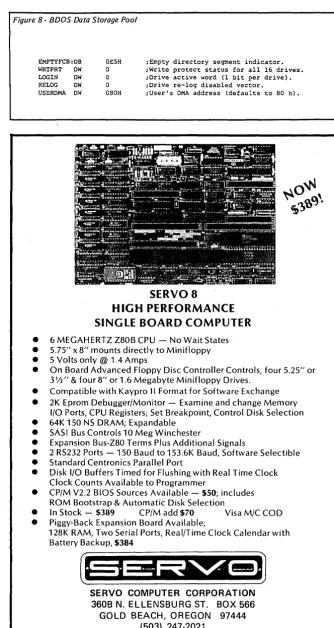
To accommodate the extra storage space needed, the changes shown in Fig-ure 8 are necessary, making the BDOS 36 bytes longer. If it is critical that the BDOS remain the same size (as it usually is), some space must be found. Have no fear, there is plenty of room for improve-ment.
MOV LXI
DAD
MOV POP
C,M H,lS
o
B,M
H
~Now get the record count byte into (B).
~keep the same extent as the user had originally. POP PSW
MOV M,A MOV
CMP MOV JZ MVI JC MVI OPENIT2 LHLO
LXI
DAD
MOV RET
A,C
M
~Is this the same as in the directory fcb? A,B ;If yes, then use the same record count. OPENIT2
A,O ;If the user specified an extent greater than OPENIT2 ;the one in the directory, then set count to O. A,l28 ;Otherwise set to maximum.
PARAMS ;Set record count in users fcb to (A). 0,15
o ;Compute relative position. M,A ;And set the record count.
Figure 6 - Resetting the Disks
; Function to reset the disk system. ; Changed to also clear the relog vector.
;
RSTOSK CALL SHLD SHLO STA LXI SHLD CALL JMP
CLRLOG ;Clear the re-log vector (returns HL=O) WRTPRT ;Clear write protect vector.
LOGIN ;Also the disk log in vector. ACTIVE ;Select drive A:.
H,TBUFF ;Setup default OMA address. USERDMA
OEFOMA
LOGINDRV ;Now log in drive A:.
Figure 7 - Clearing the Re-Iog Vector (again)
; Function #41 to re-log all disks. ;
CLRLOG XRA A ;Set (A) and (HL) to zero also. MOV H,A
MOV L,A
The following entry points end with a jump instruction and may simply be moved in front of the destination, thus saving the three bytes for the jump. The code for these is not shown here, but upon examination, the section of code to move should be apparent.
SETOSK OPENFIL CLOSEFIL GETNXT OELFILE READSEQ WRTSEQ FCREATE
It should go without saying that any experimentation must be done on a spare disk, and the resulting system should be tested thoroughly with all common applications before converting all of your disks. I have tested this for a few months now, but I still have not changed my business disks. I certainly don't want to chance a problem with my main inventory and expense record disk. The IRS just wouldn't buy it!
Editor's note: Clark Calkins wrote the utility to generate source from your CP/M system image. See the following References for in-formation on how to get this package.
References
1. SCG22, A Source Code Generator For
CP / M V2. 2. This will generate source code complete with labels and com-ments for the CP/M 2.2 operating sys-tem. Available from
c.c.
Software, 1907 Alvarado Ave., Walnut Creek CA 94596 for $45 plus $1 shipping ($2.50 foreign) and 6.5% sales tax for those lucky enough to live in California.2. CP/M Plus, User's Guide, Digital Re-search, Pacific Grove, California. Refer to Section 2 for disk change information.
3. CP/M Plus, Programmer's Guide,
Digital Research, Pacific Grove, Califor-nia. Contains a good discussion of how the CCP and the BDOS work together in Section 1.
•
••
[image:9.617.234.569.118.747.2]Micro Cornucopia, Number 23, April-May 1985
Figure 8 -BDOS Data Storage Pool
EMPTYFCB:OB WRTPRT OW LOGIN OW RELOG OW USERDMA OW
OESH Empty directory segment indicator.
0 Write protect status for all 16 drives.
0 Drive active word (1 bit per drive).
0 Drive re-log disabled vector.
OaOH User's DMA address (defau:ts to ao h).
SERVO 8
HIGH PERFORMANCE
SINGLE BOARD COMPUTER
• 6 MEGAHERTZ Z80B CPU - No Wait States • 5.75" x 8" mounts directly to Minifloppy • 5 Volts only @ 1.4 Amps
• On Board Advanced Floppy Disc Controller Controls, four 5.25" or 3 Y2" & four 8" or 1.6 Megabyte Minifloppy Drives.
• Compatible with Kaypro II Format for Software Exchange • 2K Eprom Debugger/Monitor - Examine and change Memory
I/O Ports, CPU Registers; Set Breakpoint, Control Disk Selection • 64K 150 NS DRAM; Expandable
• SASI Bus Controls 10 Meg Winchester
• Expansion Bus-Z80 Terms Plus Additional Signals
• 2 RS232 Ports - 150 Baud to 153.6K Baud, Software Selectible • Standard Centronics Parallel Port
• Disk I/O Buffers Timed for Flushing with Real Time Clock Clock Counts Available to Programmer
• CP/M V2.2 BIOS Sources Available - $50; includes ROM Bootstrap & Automatic Disk Selection
• In Stock - $389 CP/M add $70 Visa M/C COD • Piggy-Back Expansion Board Available;
128K RAM, Two Serial Ports, Real/Time Clock Calendar with Battery Backup, $384
SERVO COMPUTER CORPORATION
360B N. ELLENSBURG ST. BOX 566 GOLD BEACH, OREGON 97444
(503) 247-2021
With the MRS/OS Source Code,
you can see the light.
If you own a CP/M compatible operating system, you've had to put up with the mistakes and quirks of someone else's programming. Until now. Now you can see the light with MRS/OS. In fact, MRS is a full operating system designed to replace CP/M 2.2 or COOS and it comes with complete source code. MRS is designed for Z80 processors, runs
CP/M software, and can interface directly to a
CP/M BIOS, saving you a lot of sysgen time. With MRS, you get more than what you pay for. For under forty dollars you receive fully commented source code for standard and extended BOOS functions, a sample BIOS, our all-in-one utility package and a 130 page manual.
So if you're tired of being in the dark with some other guy's program, here's the answer to your prayers.
( includes shipping & handling in N. America; oversea~ add S12)
Ma~s. orders include ';'X. sales tax
Order by phone
24hours a day!
(617) 478-3102
~
Tech. inquiries: 7:30pm-1O:30pm EST (Wed. ONLY)
•
I
~~I
Inc.
SPECIAL FREE OFFER
TO
8" DISK USERS!
ACT NOW and receive qur ultra-fast, flexible disk format program, FREE! FORMAT can format a 77
track 8" disk in just 25 seconds and provides you with four of the most common disk formats used with CP/M based systems:
• 8" SSSO 128 byte sectors, 26 sectors/track,
76 tracks
• 8" SSOO 256 byte sectors, 26 sectors/track,
76 tracks
• 5.25" SSOO 256 byte sectors, 18 sectors/track, 40 tracks
• 5.25" SSOO 512 byte sectors, 10 sectors/track, 40 tracks
.---
I
I
I YFS!
Please send me - - MRS/OS SourceI
I
Code(s) for just $39.9S each on D H" SSSD disk orI
I
D SI/4 " Kaypro format disk. If I act rightnow,
I'llI
I
receive a FREE FORMAT program included on theI
I
disk (W' disk users ONlY).I
I
D VISA/Mastercard # - - - -expo date - - - -I
I
(
circle one)I
I
D
CheckI
I
D
Please send more informationI
I
Name _______________________________I
I
Address _ _ _ _ _ _ _ _ _ _ _ _ _ _ _ _I
I
I
I
City _______ State - - - Zip - - -I
I
Phone ______________________I
I
Send to: OCCO, Inc.I
CP/M is a registered trJueffiark of Digital Research Corp.
I
.
28 Claflin St., Milford, MA 01757I
The
5-100 Bus
By Dave Hardy
As we will see in future 'S-100 Bus' columns, the IEEE-696 (S-100) bus can do things that most other computer bus-ses cannot. But before we get into such exciting stuff as multi-processing, TMA, and Master-Slave operating procedures, we have to be familiar with the simpler operations of the S-100 bus. Probably the easiest thing we can do to become famil-iar with the S-100 bus is add some simple I/O circuits. This month's column will teach you how to do that.
Some Simple 1/0 Circuits
Unlike most other types of small com-puters, an S-100 machine offers the great advantage of (almost) painless I/O ex-pansion. If the user needs another print-er port or a digitizprint-er input, he needs only to plug an additional board into the S-100 bus, interface his software, connect the wires, and go.
[image:11.613.40.392.438.753.2]S-100 boards are available in several flavors to do just about anything a com-puter board can do. In fact, if the user is incredibly cheap (or frugal, which is how I refer to myself) he can even build his own I/O boards with a little pain, a little grief, and very few bucks.
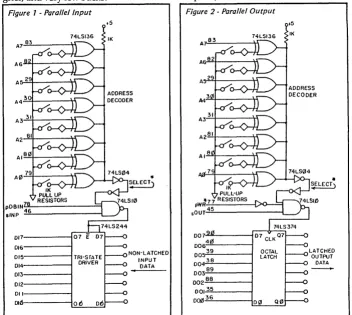
Figure 1 - Parallel Input
74LSI36
A6~1---l,~"""'"
pDBNU461...---~ slNP
DI7----~07 E 07 DI6----~
015----~TRI-SrATE
014 DRIVER
0 1 3 - - - t
DI2----~
0 1 1 - - - 1
DI~---IO 0 DO
.5
IK
NON-LATCHED
INPUT
DATA
In fact, most S-100 users don't know how easy it is to add additional 110 to their machines. The circuits shown in Figures 1 and 2 illustrate some simple 'bare-bones' parallel input and output circuits that can be added to any S-100 machine for less than $50 (including the cost of a prototype board and all parts). Of course, the prototype card would have room for a lot more than a single 1/
o
port. A resourceful builder could probably cram about 50 of these ports onto a single board (and then he could share the other 49 with his friends and neighbors).If you are confused by the circuits in Figures 1 and 2, don't worry. If you have any experience with TTL circuits, the function of these circuits should be read-ilyapparent. If not, at the end of this col-umn, I will recommend some books you can buy to transform yourself into an S-100 wizard in just a few hundred pages. (Of course, it would also help to read fu-ture issues of Micro C.)
Now for the hard stuff. Following is probably the world's shortest introduc-tion to S-100 board design (at least, for 1/
o
ports).Figure 2 - Parallel Output
14LS136
A4~3~---~
AI~8~ _ _ _ ~--...
D07M---...rn~~~
0064:!.!(lJ~-_~
005..:::.39=---1
004~3.:;:.8 - - - - I
003..::.89~--~ D02..::.aa~----I
OOI""'35~ _ _ ---I
OCTAL LATCH
0~..:::.3~6----ID~ Q0
.5
IK
li
_ / ' ,S .. ELECT)
LATCHED
OUTPUT DATA
Micro Cornucopia, Number 23, April-May 1985
II 0 Addressing
736 Notre Dame Grosse Pointe MI 48203
In order to send data between a pe-ripheral device like a printer or a bank of LEDs and the S-100 bus, an interface must monitor several of the S-100 lines to determine when the bus is ready to input or output a piece of data. In addi-tion, the interface must also decide if the data about to be transferred is to be transferred by it, or by s~me other inter-face. The interface does this by reading the S-100 bus address lines to see if its own unique I/O port number (or group of port numbers) is being addressed (see the ADDRESS DECODER section of Fig-ure 1). This procedFig-ure is called "Address Decoding."
If the number it reads doesn't match its own address (port) number, then it does nothing. If the number it reads does match its own address, then it assumes that the S-100 bus might want to talk to it. The address match causes the SE-LECT* line (shown in Figure 1) to go true (that is, it goes to a logic 0, since SE-LECT* is a "low true" signal), which en-ables the rest of the interface.
Still More Decoding
After determining that the I/O address is proper, a few other things still need to be determined by the interface. First, all the address decoder does is read the ad-dress lines and tell the interface when they match. In the S-100 bus, I/O ad-dressing and memory adad-dressing are both done on the same lines, so the next thing that must be determined is wheth-er the address the decodwheth-er is seeing is an I/O address or a memory address. This is done by looking at the sINP and sOUT lines, which indicate if the read or write operation about to take place is an I/O operation, or a memory operation.
Once the interface has decided that the bus operation about to take place is at its own address, and that it is an I/O op-eration, it then monitors the pWR* (for output) or pDBIN (for input) line to de-termine exactly when to transfer the data from or to the bus.
The following are definitions for the S-100 bus lines we'll be using. These defi-nitions should help you understand what is happening in the examples.
(Continued on Page 11)
No""
there is a choice I
SEND ORDERS TO:
PHOENIX ELECTRONIC DEVELOPMENT CORPORATION
618 Venice Boulevard
Marina Del Rey, CA 90291
(213) 827-2511
5-100 BU5 _ _ _ _ _ _
_
(continued from page 9)Line Descriptions
pDBIN (processor Data Bus IN) pin 78, active high-A generalized read strobe, asserted for memory read, I/O read, and interrupt acknowledge cycles. Used to enable a slave's data output bus drivers to gate data onto the 5-100 bus.
pWR* (processor WRite) pin 77, active low-A generalized write strobe, as-serted for memory and I/O write cycles. Indicates to slave that the data output bus contains valid data.
slNP (status INPut) pin 46, active high-Active when 5-100 bus is execut-ing an input cycle and readexecut-ing from an 1/
o
port address.sOUT (status OUTput) pin 45, active high-Active when 5-100 bus is execut-ing an output cycle and writexecut-ing data to an I/O port address.
Although these definitions are not complete, and are not strictly in agree-ment with the IEEE-696 standard, they should be adequate for most simple 5-100 interfacing projects.
Homework
If you want to know more about the 5-100 (IEEE-696) bus, I would recommend the following book: "Interfacing to 5-100/IEEE-696 Microcomputers" by Sol Libes and Mark Garetz (Osborne/Mc-Graw-Hill 1981, ISBN 0-931988-37-3). You might also want to get a copy of IEEE Task 696 (The S-100/IEEE-696 standard) directly from the IEEE, although the pre-liminary standard is contained in the book mentioned above.
Next Time
The next "5-100 Bus" will demon-strate some ways to see what your ma-chine's bus is doing, introduce the IEEE-696 concept of multiple processing, and answer some reader questions about 5-100 system expansion and troubleshoot-ing.
•••
Micro Cornucopia, Number 23, April-May 1985
Z
sets
you
FREE!
Z - yes! Synergistic combination of ZCPR3 and ZRDOS2 produces flexible state-of-the-art Z80 operating system with tremendous produc-tivity features.
Z-System consists of software modules, dynamic loading segments, and tools permitting optimum computer usage ranging from produc-tion program development to turnkey, password-controlled, end-user installations. Facilities include: multiple commands per line, file search paths, named directories, I/O redirection, command flow control, screen-oriented menu generators, complete housekeeping file and directory management, shells, alias (scripts) and nested-alias genera-tion, and complete online help.
Seventy-six support utilities, five tool packages, and two application programs available now! Fully upward compatible with CP/M-80.
Z can now be purchased as auto-install program (Z-Com) or as manual-install ZCPR3 with semi-auto install ZRDOS package (Z-System). Our latest versions, to be released this year, support Zilog Z800 and Hitachi HD62801/64180 high-technology chips, chips run existing 8080 and Z80 programs!
Echelon eight-bit operating systems written in Assembly Language, using linkable macro subroutine libraries, offer performance parallel-ing best sparallel-ingle-user 16/32-bit microcomputer systems.
1. Z-Com Full-up Z Operating System with input/output redirection running under CP/M-80, online command and utility documentation and help system ... $219.95
2. Z-System Manual-install ZCPR3 and ZRDOS2, easily tailored by programmer to custom needs; source code to core and utilities; similar to Item 1 ... , ... $199.95
3. Z-Tools Four software development system packages permitting advanced, structured program design, macro relocating assembler, linking loader, librarian, cross-reference generator, debugger, mne-monic and pseudo-op translators, and interactive disassembler. Super $315.00 package val ue ... $200.00
4. DSD Dynamic Screen Debugger offers high-level features never before found in microcomputers; simultaneous display of dual-memory segments, stack, cpu states, and flags, with software In-Circuit-Emulation ... ' ... $149.00
5. The Libraries Linkable ZCPR31ibraries (Vlib, Z3lib, and Syslib3) of over 400 subroutines used for Assembly Language program writing. Simplifies structured, efficient code production; online help system and full source code provided ... $45.00 Syslib3 alone ... $29.00
6. Term3 New generation communication program permits menu control of computer/modem operations between operator and time-share services, bulletin-boards and other remote computer systems; auto-answer to command-line prompt ... $99.00 7. Discat Fancy file and disk catalog program running under Z-System, menu driven and easily customized by operator ... $49.00
Fortnighter newsletter, 24-hour BBS Z-Node System keep Z users informed of microcomputer happenings. Write or call for brochure or order now! State disk format desired; add $3.00 shipping & handling; Californians please add 6-1/2% sales tax. Visa/MC, check, money or' purchase order accepted. (Program names are trademarks of their respective owners.)
(-=
i1
Echelon, Inc.
101 First Street. Los Altos, California 94022 • 415/948-3820
THE WORLD'S FASTEST
S-100 Z-80 SLAVE PROCESSOR
TurboS/ave
I
• 8 Mhz Z-80H • 128k Ram with parity • Data transfers to 1
mbyte/second
• 2 RS-232 Ports. 50-38.k baud • &100 IEEE-696 compatible • F.I.F.O. communications • 4k Monitor rom • On board diagnostics • Low parts count • Low power consumption • No paddle boards • TurboDOS compatible • GUARANTEED COMPATIBLE WITH ALL S-100 SYSTEMS
RUNNING TURBODOS
INTRODUCTORY PRICE $495
Includes TurboDOS drivers (a $100 value) and TurboSlave I'with 128k ram.
....
~
EARTH COMPUTERS=
®
.
~
~---. ~
---
---P.O. Box 8067, Fountain Valley, CA 92728 TELEX: 9109976120 EARTH FV
FOR MORE INFORMATION AND QUANTITY DISCOUNTS
CALL: (714) 964-5784
Registered trademarks: ·Z-SOH, Zilog Inc.; TurboDOS Software 2000, Inc.
••• IBM PC YERSION COMING SOON •••
POWER SUPPLY
$110
For the BIG BOARD and other SBC's Assembled. tested and burned-in 48 hours
PLUS S5 S&H • + 5V @ 4A + DVP. 24 V (jj; 2.5A. :t: 12V @ .2A
• All supplies have over-current protection • Bell circuit and Piezo speaker lor BB • Low line warning circuit - brown out • Input 105-120 VAC 50/60 Hz @ 1.0 A • 4.5"H. 3.8"0. 11"L- 5 lb.
1i'EBig
Mouth
For Orders or DemosCall (714) 734-6006
DEALER INQUIRIES INVITEDI LISTEN! Your computer could be lalking to you through the BIG MOUTH from ASTROTRONICS. True speech synthesis for ANY compuler through your printer port. (parallel or serial). Using our BIG MOUTH speech synthesizer with its Z80 CPU and SSI-263 third generation phonetin speech synlhesizer.
• Text to speech • No software required • Will run on any comDuter • 400 character buffer
• Embed phonemes in texl for those special words that don't fillhe rules. names foreign words etc.
• Programmable: vocal-traci frequency. inllection rale. duralion pitch. articluation amplitude ... for all 64 phonemes
• Can be programmed to make sound eHecls and can even be programmed it to SING!
• PCB lit EPROM with Instruction Complete PCB Kit with Inslruelion
Complete Kit Including Case Speaker lit Power Supply • Completed Unit A lit T
$74 + $1 Slit H
$161 + $3 SIItH
$199 + $3 S& H
$249 + $5 Slit H Coming next month a 56K smart Printer Buffer, order your own 'son of a buffer'
Kit for only $99 plus + $3 S & H
~~
CALENDAR/CLOCK
$69
KIT- WORKS WITH ANY Z-80 BASED COMPUTER
- PIGGYBACKS IN Z80 SOCKET
- USES NATIONAL MM58167 CLOCK CHIP,
AS FEATURED IN MAY '82 BYTE.
- BATTERY BACKUP KEEPS TIME WITH
CPU POWER OFFI
- EASY TO USE SOFTWARE INCLUDED TO
SET AND READ THE CLOCK IN BDS C, JRT PASCAL, TURBO PASCAL, AND MICROSOFT BASIC, WITH ALL SOURCE.
- SOFTWARE IS AVAILABLE ON 8" SSSD,
5" XEROX 820, KA YPRO 2, OSBORNE, NORTHSTAR, CROMEMCO, APPLE CP/M DISKS AND OVER A MODEM FOR OTHER COMPUTERS.
- PACKAGES AVAILABLE:
FULLY ASSEMBLED AND TESTED $99
COMPLETE KIT $69
BARE BOARD AND SOFTWARE $29
N.Y. STATE RESIDENTS ADD 7% SALES TAX. PERSONAL CHECKS, MONEY ORDERS, PURCHASE ORDERS, AND C.O.Do'S ACCEPTED.
KENMORE COMPUTER TECHNOLOGIES 20 Landers Road - Kenmore, New York 14217 - (716)877-0617
DOUBLE DENSITY HARDWARE
DAUGHTER BOARD FOR THE W02795 OS DO CONTROLLER
S29
KIT .nnoul COMPATIBLE WITH WD 2795 ANY COMPJTfRS59
WD USING WPl771 2795 OHlY$100S&HS79
KIT .nn C"}teep! DRAWINGSAT LAST! DO SOFTWARE 525 . SOLD WITH KIT ONLY
BIG BOARD
The "'LA CAJA" Enclosure w/Power Supply
$299
PLUS $20Slit H STANDARD FEATURES INCLUDE • Power Supply
5V (il 4A + OVP. 24V @ 2.5A. ± 12V (if, .2A All voltages are current protected
• Reset Switch • Fan
AMP
CONNECTORS FOR YOUR DISK DRIVE
KIT OF .2 EACH WITH PINS $5 Plus S1 S & H
IN STOCK! • Key-lock Power • Solid State AC Rela,,!,y . . . . • Bell Circuit and Piezo Speaker
• 2 AC Outlets. One Switched • Color. Beige and Chocolate
.6" H x 12" W x 16" D 24"W for 2 Drive Unit
.. La Cala" can be supplied lully wired lor the Big Board with all ports dis k DC and timed AC lor $150.00
NAKED! Yes now you can buy the LA CAJA stripped for only
$11 9
fans, line fliers. etc. available. $15 S & H.California residents add 6% tax on all items
~
AstroTronics
1137 TOPAZ STIn The Public Domain
By
Sol Libes
In my last column I gave an introduc-tion to public domain software which in-cluded its history and some background on the organizations which publish and distribute PDS. In this column I'll dis-cuss the high level languages available in the public domain.
Latest SIG/M Releases
Before launching into the column, however, I've listed the latest SIG/M disk releases below (each disk is referred to as a volume):
Volume-Description
210-CP/M-86 Utilities (SQ, USQ, CRC, etc.)
211-CP/M-86 Kermit Communications package
212-CP/M+ Utilities, Kaypro multi-disk formats, C programs, etc.
213-REC (Regular Expression Compil-er) Vol. 1
214-REC Vol. 2 215-RECVol. 3
216-CP/M-86 MODEM package 217-:-CP/M-80 emulator for CP/M-86, dBase-II Toolkit, BBS security system, CP/M-86 MODEM overlays
Language Software In The Public Domain
BASIC holds a particular fascination for me. I still remember the day, back in 1975, when"1 placed a paper tape con-taining MITS Basic (later to become Mi-crosoft Basic) in myoid teletype (that was when we thought 10 characters per second was fast), toggled in a little loader program with the switches and lights on the front panel of my Altair 8800 com-puter (it contained all of 4K of memory and ROM memory was unheard of) and waited several minutes for BASIC to load and execute. After several tries I jumped for joy when the word 'READY" appeared on the paper (who had a CRT in those days?).
It was the first high level language I'd ever seen, and its level of intelligence amazed me. Always being curious about how things worked, I immediately wanted to know about BASIC. But I was always frustrated because the versions I used were only available in machine code form, so decoding them was a hor-rendous task. Thus, when I saw versions
of BASIC including the full source code in the PDS software libraries, I was in a state of delight. If you are as interested as I am in how things work, or would like to create your own personal version of BASIC, get a copy of these programs and dig right in!
Eight Is Enough
I count eight different versions of BASIC in the public domain, and most (not all) include the source code. It is probably best to start with the smallest version of BASIC. It is on volume 11 of the CPMUG library and is called "TIN 1-DISK." Many people refer to this as "Tiny BASIC." It is a version of Wang's Palo Alto BASIC originally published in Dr. Dobb's Journal. The disk contains .ASM and. COM versions as well as full instructions in its use in a .DOC file. The .COM file is only 3Kbyte in size. This version of BASIC may be lacking the power of more recent versions, but its small size makes it easier to study the structure of a high level language. Also on the disk you 'will find a version of Star Trek (it takes up 6K bytes) that runs un-der TINIDISK.
BASIC/S
A more elaborate version of BASIC in the CPMUG library is a disk version of Processor Technology's "BASIC/5." This was writteh to run under CP/MV1.3 and occupies about 8K of memory. PT manu-factured 5-100 systems that were pri-marily cassette-based, and when the company went out of business much of its software was put in the public domain and enhanced for disk operation.
Tarbell BASIC
CPMUG volumes 31 and 32 contain an even more advanced version of BASIC called Tarbell BASIC. Tarbell is another 5-100 manufacturer, still in business, which has put much of its software into the public domain. This version still has bugs in it and its editor leaves something to be desired. However, it does have some very powerful features such as WHILE .... WEND.
LL-BASIC
Probably the most popular public do-main BASIC interpreter is the version of
Micro Cornucopia, Number 23, April-May 1985
Box 1192 Mountainside NJ 07092
Lawrence Livermore BASIC (usually re-ferred to as "LL-BASIC") found in CP-MUG volumes 2 and 10. This was writ-ten at Lawrence Livermore Labs in California using public funding and hence is in the public domain.
EBASIC
Another publicly funded BASIC pro-ject was EBASIC written by Gordon Eubanks. EBASIC is a semi-compiler with a runtime interpreter. Gordon later created enhanced commercial versions of EBASIC sold under the names CBA-SIC, CBASIC-2 and CB-80.
EBASIC is the most powerful of the PDS BASICs, and is found on SIG/M volume 26 with a help file on volume 14 (you will need HELP.COM on volume 13). The original source code, written in PUM for the compiler and runtime in-terpreter, is on CPMUG volumes 29 and 30. Also, volume 53 of CPMUG contains EBASIC floating point routines. EBASIC is a structured version of BASIC in that it does not require line numbers except in statements that are targets for GaTOs and GOSUBs.
An EBASIC compiler written in the Forth-83 language is on SIG/M volumes 204 (CP/M-80 version) and 205 (CP/M-86 version).
Pascal, C And The Like
Several versions of Pascal are available in the public domain, with a Pascal help file found on SIGIM volume 14.
First is the Pascal compiler on SIG/M volume 8. This disk includes a .COM version as well as the .ASM modules and documentation and is written in Pascal, thus providing an excellent example of how to use the language. This Pascal is different than UCSD Pascal in that it generates 8080 object code linked to a runtime library.
SIG/M volume 82 contains the JRT Pascal compiler. This program was first sold commercially, became quite popu-lar, and developed a loyal following. Un-fortunately, JRT was a poorly managed company and is no longer in business.
SIG/M volume 162 contains a concur-rent Pascal compiler called PASCAL-So
(Continued next page)
IN THE PUBLIC
DOMAIN _ _ _ _ _ _ _ _ _ _ _ _ _ _ _ _ _ _ _ _ _ _ _ _ _
_
(continued from page 13)
C
Only one version of the C language is available so far. This is a version of small-C, which appeared several years ago in Dr. Dobb's Journal, implemented for CP/M-86. The complete source code and documentation are included for anyone interested in translating it to 8080 or Z80 code.
FOCAL
FOCAL is another procedure-oriented language similar to BASIC. It was first introduced by Digital Equipment Corpo-ration for the early PDP-8 minicompu-ters. This program is found on CPMUG volume 16.
ALGOLIM
ALGOLlM, an Algol-60 implementa-tion, is on CPMUG volume 28. It in-cludes full documentation, as well as a set of test and demo programs. An Algol help file is contained on SIG/M volume 14.
RATFOR
CPMUG volume 24 contains a version of RATFOR (RATional FORtran), a pre-processor for Fortran source programs.
It permits structures such as IF. .ELSE, WHILE, REPEAT UNTIL, FOR. . NEXT, BREAK and INCLUDE and generates standard Fortran statements. A Z80 ver-sion ofRATFOR, which runs faster, is on CPMUG volume 49 along with the full source code, documentation, and demo programs. The programs produced with RATFOR must be compiled with Micro-soft's Fortran-80 compiler.
FORTH And Other Threaded Languages
Threaded languages employ a block structure allowing the user to define ex-tensions to the language. The versions in the public domain are all interactive, use RPN (Reverse Polish Notation), and generate fast, compact object. For these reasons these languages are very popu-1ar with micro hackers and have pro-duced many versions in the public do-main.
FORTH11
There are six versions of FORTH. FORTH11, which is actually Fig-FORTH
V1.1, is found on SIG/M volume 13. Al-though documentation is included, the author recommends that the user obtain a copy of the Fig-FORTH manuals first. SIG/M volume 70 contains an upgraded version of this program called FORTH110, in source form. FORTH130 is another version intended primarily for
Apple-CP/M systems, but will run on
many other systems, and is on SIG/M volume 116.
SMFORTH
SMFORTH is a minimal version of FORTH found on SIG/M volume 67. The source code version is provicied without documentation. F83, another popular 8080 version of FORTH with documtation, is on SIG/M volume 154. An en-hanced version comes on volume 204, and a 68000 version is located on volume 205 along with a BASIC Compiler writ-ten in F83. SIG/M volume 150 contains a version of FORTH for Z8000-based ma-chines. (Editor's note: Micro C's Bruce Ber-ryhill is a FORTH fanatic, and he couldn't stahd the idea that we didn't have a complete FORTH 83-since it has a built-in editor
and all-on a Kaypro disk. So now we have
one.)
STOIC
STOIC, a FORTH-like language, is in-cluded on CPMUG volume 23, and for many applications produces even more compact code than FORTH. PISTOL, wntten in BDS-C, evolved from FORTH and STOIC and is located on SIG/M vol-ume59.
LISP
LISP is the most popular language used in writing AI (Artificial Intelligence) programs. It is based on list processing. The versions in the public domain are limited implementations but will give the user a good feel for the language.
SIG/M volume 71 contains a version written in Pascal. However, no docu-mentation is included. INITLISP, oil SIG/M volume 148, is also written in Pascal and includes documentation. XLISP, complete with documentation and examples, comes on SIG/M volume 118 with a CP/M-86 version on SIG/M volume 153.
Another example of LISP is on SIG/M
volume 166 and is written in the REC language, described later. Several LISP program examples are included on the disk.
Other Languages
ACTOR is a string processing lan-guage found on CPMUG volume 4. It in-cludes a complete manual and sample programs.
PILOT is used to write CAl (Computer Assisted Instruction) programs, and is located on CPMUG volume 12. The doc-umentation was published in Dr. Dobb's Journal in April and May 1977.
SAM-76, on CPMUG volume 34, is a very powerful macro and string process-ing language that can be extended some-what.
SIG/M volume 43 includes PIDGIN, a systems programming language useful for writing a compiler, and TINCMP, a special purpose compiler written in PIDGIN.
META is a CP/M-86 systems program-ming language and a version ofTINCMP written with META as an example. Both are located on SIG/M volume 159. The documentation, however, is in Dr. Dobb's Journal of August '81. Versions of META written in FORTH-83 are on SIG/M volumes 204 (CP/M-80) and 205
(CP/M-86). An 8080 version ofMETA4 is
on SIG/M volume 208.
REC (Regular Expression Compiler~ along with a very comprehensive sub-routine library, is located on SIG/M vol-umes 213, 214, and 215 (an earlier ver-sion comes on volumes 164, 165, 166, and 167). REC includes translators to convert programs written in REC into other languages such as C.
PLO, a Wirth PLIO compiler, and some sample programs are on SIG/M volume 163.
And, as if all this weren't enough, there is a version of ye olde COBOL on SIG/M volume 209. (Editor's note: Don't let this get out-someone might try to use
it!)
In Conclusion
I think there are enough languages in the public domain to keep a computer language addict in a state of euphoria for months. In all, I count nearly 40 lan-guage interpreters and compilers. It is
interesting to note that the PC/MS-DOS public domain libraries contain fewer than 10 high level languages, even though the amount of overall software is greater.
I suggest you obtain copies of the CP MUG, SIG/M and PC/BLUE (for those interested in MS-DOS) printed catalogs (see below). Also, both SIG/M and PC/ BLUE furnish an information disk (la-beled "Volume a") which contains an up-to-date listing of all the software in their libraries along with a program to help you find which particular volume contains the program you want. The disk also contains a listing of the clubs across the country that distribute the disks.
Order the SIG/M and/or PCIBLUE printed catalogs (each $3, $4 foreign) or Volume-O information disk ($7, $9 for-eign) from: SIG/M-PC/BLUE, Box 97, Iselin NJ 08830. The CPMUG printed catalogs can be ordered from the New York Amateur Computer Club, Box 106, Church Street Station, NY NY 10008, or call their hot line, (212) 864-4595. The CPMUG printed catalog comes in sever-al volumes, and you will have to csever-all or write for the price.
•••
Micro Cornucopia, Number 23, April-May 1985
SPEECH
SYNTHES IZER
FOR THE BIG BOARD AND XEROX 820
are cost, quality and capability! cnbes:
1) The physical specifications, features, and control popular printers and plotters.
2) Printer and plotter interfacing, problem areas and how to cor-rect them. Some are hard to interface. Most can be
memory-UPF.;tt;.~nt; ~~~;_~~~gm~p~ t!~de ~~~O~~e;.sde~tions in the purchase ant)p~i~~?~ ~fif~:~~~s ~~i~~iirrCHERS. Independently switch one/two printers or plotters to one/two computers without discon-necting either. Schematics of Centronics Parallel, RS-232C and 20 ma.5fu~~di~i~~~I"sections devoted to PRINTER TYPES, PLOTTER TYPES, EXPANDING MEMORY, INTERFACING, ELECTRONIC TYPEWRITERS, RIBBON RE-INKING SECRETS, PAPER,
PATCH-~~rC~:J.r~&s~PEED RATINGS, BUYING STR .... TEGY, and R5-6) BUFFERS, SPOOLERS, MEMORY UPGRADES, ELECTRO-GRAPHIC, TRACTOR-FEED, DIP AND PANEL SWITCHES, DOT-MATRIX, DAISYWHEEL, INK JET, LASER, FLAT-BED, ROLLER-BED, DRUM, WORDPROCESSING, DATAPROCESSING, CAD/CAM, TIME-OUT PROBLEM, GRAPHICS TABLET, CALLIGRAPHY, PS TYPESETTING, ADVERTISING, PUBLICATION LAYOUTS, etc.
i ng7!t,~r~e:ia ~~~nr,r~~~(r"'ar~~le~~t!~d-i~~!~