NAVAL
POSTGRADUATE
SCHOOL
MONTEREY, CALIFORNIA
THESIS
Approved for public release; distribution is unlimited EXAMINING THE RETURN ON INVESTMENT OF A SECURITY INFORMATION AND EVENT MANAGEMENT
SOLUTION IN A NOTIONAL DEPARTMENT OF DEFENSE NETWORK ENVIRONMENT
by
Matthew P. Warnecke June 2013
Thesis Advisor: Thomas Housel
REPORT DOCUMENTATION PAGE Form Approved OMB No. 0704–0188
Public reporting burden for this collection of information is estimated to average 1 hour per response, including the time for reviewing instruction, searching existing data sources, gathering and maintaining the data needed, and completing and reviewing the collection of information. Send comments regarding this burden estimate or any other aspect of this collection of information, including suggestions for reducing this burden, to Washington headquarters Services, Directorate for Information Operations and Reports, 1215 Jefferson Davis Highway, Suite 1204, Arlington, VA 22202–4302, and to the Office of Management and Budget, Paperwork Reduction Project (0704–0188) Washington DC 20503.
1. AGENCY USE ONLY (Leave blank) 2. REPORT DATE
June 2013
3. REPORT TYPE AND DATES COVERED Master’s Thesis
4. TITLE AND SUBTITLE
EXAMINING THE RETURN ON INVESTMENT OF A SECURITY
INFORMATION AND EVENT MANAGEMENT SOLUTION IN A NOTIONAL DEPARTMENT OF DEFENSE NETWORK ENVIRONMENT
5. FUNDING NUMBERS
6. AUTHOR(S) Matthew P. Warnecke
7. PERFORMING ORGANIZATION NAME(S) AND ADDRESS(ES) Naval Postgraduate School
Monterey, CA 93943–5000
8. PERFORMING ORGANIZATION
REPORT NUMBER
9. SPONSORING /MONITORING AGENCY NAME(S) AND ADDRESS(ES) N/A
10. SPONSORING/MONITORING AGENCY REPORT NUMBER
11. SUPPLEMENTARY NOTES The views expressed in this thesis are those of the author and do not reflect the
official policy or position of the Department of Defense or the U.S. Government. IRB Protocol number ____N/A____.
12a. DISTRIBUTION / AVAILABILITY STATEMENT
Approved for public release; distribution is unlimited
12b. DISTRIBUTION CODE 13. ABSTRACT (maximum 200 words)
Sophisticated cyber threats represent a significant adversary in the evolving world of the cyber domain. Furthermore, determining whether or not an attack has taken place and the extent of the damage caused requires significant resources. In order to guarantee reliable detection, prevention and mitigation of these advanced threats, the Department of Defense (DoD) must invest in advanced information security technologies that increase the defensive capabilities of its information networks.
This thesis focuses on Security Information and Event Management (SIEM) systems as an enabling technology that possesses the advanced security capabilities required to address sophisticated, evolving cyber threats. The research explores the capabilities of this technology in terms of the speed of detection, depth of investigative power, and additional value provided. Additionally, this research attempts to quantify the return on investment that a SIEM solution could provide when deployed in a notional DoD network architecture. Ultimately, the research provided in this thesis endeavors to justify DoD investment in SIEM technology.
The focus of this research revolves around a qualitative description of the inherent capabilities of SIEM products and utilizes several Return on Security Investment models in an attempt to quantitatively define the value of these capabilities in a DoD network.
14. SUBJECT TERMS Security Information and Event Management, Security Event
Correlation, Incident Response, Return on Investment, Return on Security Investment, Return on Security, Network Intrusion
15. NUMBER OF PAGES 107 16. PRICE CODE 17. SECURITY CLASSIFICATION OF REPORT Unclassified 18. SECURITY CLASSIFICATION OF THIS PAGE Unclassified 19. SECURITY CLASSIFICATION OF ABSTRACT Unclassified 20. LIMITATION OF ABSTRACT UU
NSN 7540–01–280–5500 Standard Form 298 (Rev. 2–89) Prescribed by ANSI Std. 239–18
Approved for public release; distribution is unlimited
EXAMINING THE RETURN ON INVESTMENT OF A SECURITY INFORMATION AND EVENT MANAGEMENT SOLUTION IN A NOTIONAL
DEPARTMENT OF DEFENSE NETWORK ENVIRONMENT
Matthew P. Warnecke Lieutenant, United States Navy B.S., United States Naval Academy, 2007
Submitted in partial fulfillment of the requirements for the degree of
MASTER OF SCIENCE IN INFORMATION TECHNOLOGY MANAGEMENT
from the
NAVAL POSTGRADUATE SCHOOL June 2013
Author: Matthew P. Warnecke
Approved by: Dr. Thomas Housel Thesis Advisor
Dr. Johnathan Mun Thesis Co-Advisor
Dan C. Boger
ABSTRACT
Sophisticated cyber threats represent a significant adversary in the evolving world of the cyber domain. Furthermore, determining whether or not an attack has taken place and the extent of the damage caused requires significant resources. In order to guarantee reliable detection, prevention and mitigation of these advanced threats, the Department of Defense (DoD) must invest in advanced information security technologies that increase the defensive capabilities of its information networks.
This thesis focuses on Security Information and Event Management (SIEM) systems as an enabling technology that possesses the advanced security capabilities required to address sophisticated, evolving cyber threats. The research explores the capabilities of this technology in terms of the speed of detection, depth of investigative power, and additional value provided. Additionally, this research attempts to quantify the return on investment that a SIEM solution could provide when deployed in a notional DoD network architecture. Ultimately, the research provided in this thesis endeavors to justify DoD investment in SIEM technology.
The focus of this research revolves around a qualitative description of the inherent capabilities of SIEM products and utilizes several Return on Security Investment models in an attempt to quantitatively define the value of these capabilities in a DoD network.
TABLE OF CONTENTS
I. INTRODUCTION ... 1
A. PROBLEM STATEMENT ... 2
B. PURPOSE AND THESIS STATEMENT ... 2
C. BACKGROUND ... 3
1. Threats Facing the Nation ... 3
2. DoD/National Cyberspace Strategy ... 4
3. DoD Budget ... 5
4. Benefits of the Study ... 5
5. Security Information and Event Management ... 6
6. Methodology ... 7
7. Thesis Structure ... 7
II. SECURITY INFORMATION AND EVENT MANAGEMENT ... 9
A. BACKGROUND ... 9
1. Traditional Information Technology Security ... 9
2. Advanced Threats ... 11
3. Alternate SIEM Adoption Trends ... 12
B. DEFINITION ... 14
1. Log Management ... 14
2. Security Information Management and Security Event Management ... 15
3. Security Information and Event Management ... 15
4. Fundamental Aspects of SIEM ... 17
C. SYSTEM FUNCTIONALITY ... 17 1. Collection ... 17 2. Normalization ... 19 3. Correlation ... 19 4. Notification ... 21 D. USE CASES ... 22
1. Models of SIEM Applications ... 22
2. Threat Management ... 22
3. Compliance ... 23
4. Operational ... 24
E. CONSIDERATIONS ... 24
1. Implementation ... 24
2. Network and Hardware Issues ... 25
3. Ethical Considerations ... 26
III. DETERMINING THE VALUE OF A SIEM SOLUTION ... 29
A. BACKGROUND ... 29
B. THE ECONOMIC VALUE OF INFORMATION SECURITY ... 30
1. Background ... 30
3. Cost of Deploying Security ... 33
4. Risk Management ... 34
C. METHODS OF QUANTIFYING THE ROI OF A SIEM SOLUTION .... 35
1. Background ... 35
2. Cost Avoidance ... 36
3. Annualized Loss Expectancy ... 37
4. Return on Security Investment ... 38
5. Return on Security ... 39
6. ROSI and ALE Hybrid Models ... 40
D. ADDITIONAL VALUATION OF SIEM SOLUTIONS ... 40
1. Soft Benefits ... 40
2. Compliance ... 41
3. Productivity ... 42
E. CASE STUDIES ... 43
1. Background ... 43
2. Security Event Management ... 43
3. Increased Productivity ... 44
4. Regulatory Compliance ... 44
5. Other Sources of Value ... 45
IV. APPLICATION OF INFORMATION SECURITY ROI MODELS TO A SIEM SOLUTION IN A NOTIONAL DOD ENVIRONMENT ... 47
A. ASSUMPTIONS ... 47
1. Single-Point Estimate Models ... 47
B. COST REDUCTION ... 48
1. Model Description ... 48
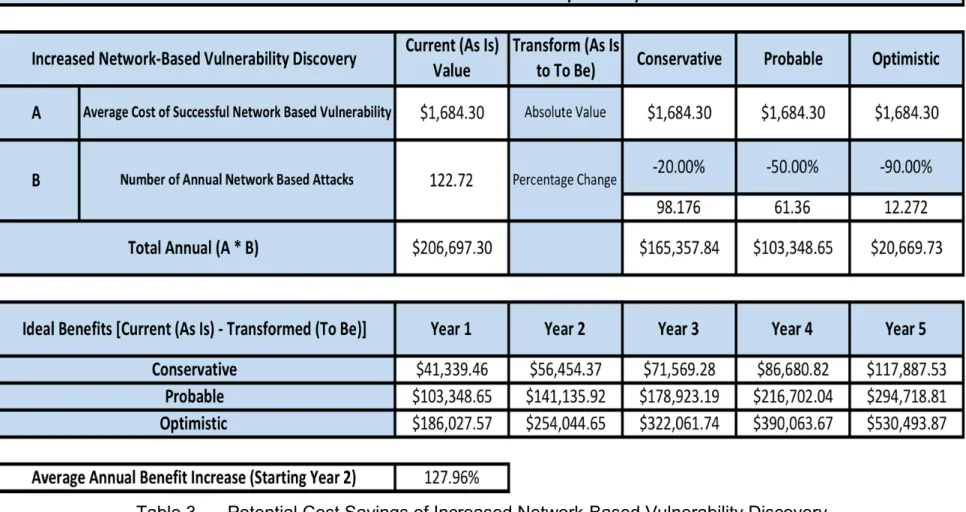
2. Increased Network-Based Vulnerability Discovery ... 49
3. Integrated Threat Detector ... 51
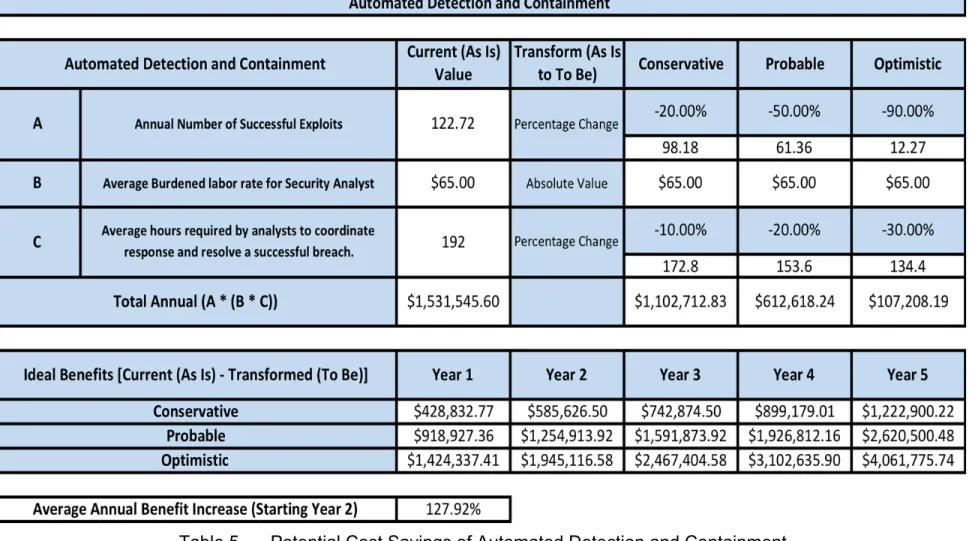
4. Automated Detection and Containment... 53
5. End User Productivity ... 56
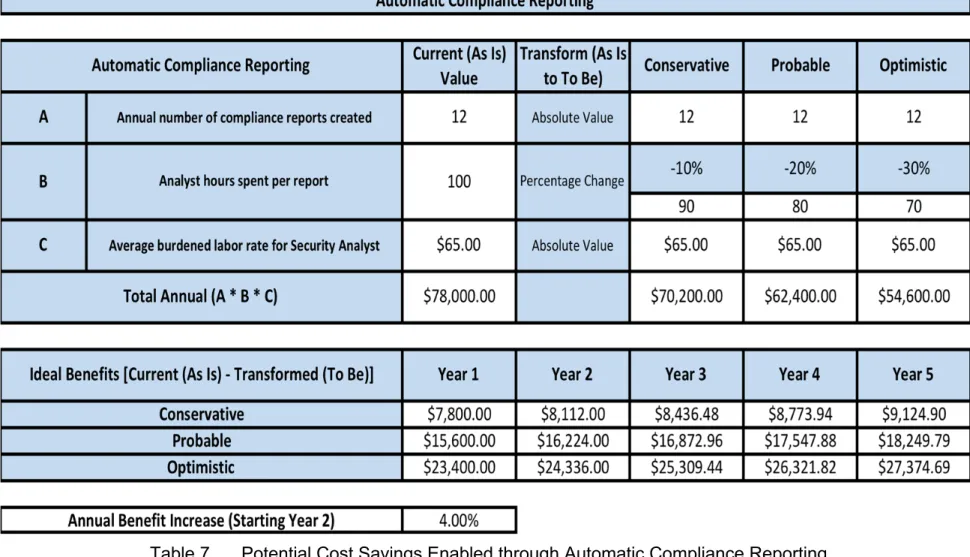
6. Automatic Compliance Reporting ... 59
C. RISK MANAGEMENT AND LOSS AVOIDANCE ... 61
1. Background ... 61
2. Current State Versus Future State ... 62
V. CONCLUSIONS ... 71 A. POTENTIAL RISKS ... 71 B. LIMITATIONS ... 71 1. Current Study ... 71 2. Future Study ... 72 C. POTENTIAL BENEFITS ... 73
1. Advanced Security Intelligence ... 73
2. Functional Value ... 73
APPENDIX A. ATTACK CLASSES ... 75
APPENDIX C. IMPACT ON FUTURE STATE ... 79
LIST OF REFERENCES ... 81
LIST OF FIGURES
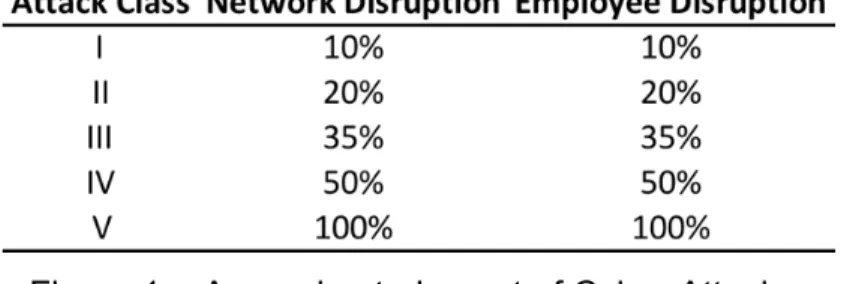
Figure 1. Approximate Impact of Cyber Attacks ... 62
Figure 2. Distribution of Potential Impact on the Current State ... 66
Figure 3. Distribution of the Potential Impact on the Future State ... 66
Figure 4. Distribution of Potential Impact on Current State with 90%
Confidence Intervals ... 67
Figure 5. Distribution of Potential Impact on Future State with 90%
Confidence Intervals ... 68
Figure 6. Distribution of Potential Impact on Current State with a Left-Tail
95% Confidence Interval ... 69
Figure 7. Distribution of Potential Impact on Future State with a Left-Tail 95%
LIST OF TABLES
Table 1. Number of Cyber Incidents Against Federal Agencies Reported to
U.S. CERT ... 47
Table 2. Average Cost of a Single Cyber Incident ... 48
Table 3. Potential Cost Savings of Increased Network-Based Vulnerability
Discovery ... 50
Table 4. Potential Cost Savings Leveraging SIEM Integrated Threat
Detection ... 52
Table 5. Potential Cost Savings of Automated Detection and Containment ... 55
Table 6. Projected Cost Savings Based on Increased User Productivity ... 58
Table 7. Potential Cost Savings Enabled through Automatic Compliance
Reporting ... 60
Table 8. Estimated Cost of Cyber Attack on Current State versus Future
State Security Architectures ... 63
Table 9. Estimated Annual Rate of Occurrence of Cyber Attacks ... 64
LIST OF ACRONYMS AND ABBREVIATIONS
SIEM Security Information and Event Management SIM Security Information Management
SEM Security Event Management IDS Intrusion Detection System IPS Intrusion Prevention System
DoD Department of Defense
ALE Annualized Loss Expectancy CTM Critical Threat Multiplier
EF Exposure Factor
SLE Single Loss Expectancy ROI Return on Investment
ROSI Return on Security Investment
ACKNOWLEDGMENTS
To my wife, Lauren, who has always supported me throughout every endeavor, academic or otherwise, and has always been my biggest source of inspiration.
To my son, Grant, for teaching me humility, patience and unconditional love.
I. INTRODUCTION
Emerging cyber threats indicate a significant obstacle to Department of Defense (DoD) assets and operations worldwide. Contemporary information assurance strategy promotes a defense-in-depth paradigm, where network security devices exist in layers to counter specific threats or monitor specific activity. Further, financial justification for these investments hinges upon the notion of security as a cost of doing business. However, in an era of limited budgetary consideration for computer network defense investments, funding a new implementation of a security investment requires not only a dynamic range of prevention and incident response capabilities, but must also provide an acceptable return on investment (RoI).
In the DoD, this presents a unique situation that juggles capability enhancement versus the sunk cost of a security investment. After all, an investment in security represents a sunk cost because it does not generate revenue for the organization (Stephenson, 2012). But, justification of an investment in security resides in the avoidance of potential costs that the capability aims to mitigate or minimize.
A Security Information and Event Management (SIEM) implementation offers the ability to leverage the current defense-in-depth- strategy employed throughout the DoD while also offering increased defensive capabilities to further secure DoD networks and information systems. Furthermore, an investment in SIEM technology exhibits the potential for a significant return on security investment (RoSI) because of the enhanced capabilities offered inherently within the technology as well as the ability to correlate data from disparate network and network security devices, thereby increasing their effectiveness. Essentially, SIEM closes the gaps between the layers of a defense-in-depth security architecture and combines disparate security devices into a nimble, cohesive defense.
Despite the potential that SIEM technology represents to increase DoD network security, agility and efficiency, investment in the technology still requires quantifiable justification. However, as the typical measurement used to justify investments fails to apply to both the DoD as an organization as well as the security realm, exploring alternative measurements of calculating return require thoughtful consideration. Furthermore, an examination of several Return on Security (RoS) or Return on Security Investment (RoSI) methods offers insight into justification of an SIEM solution as well as a basis for considering future security investment options.
A. PROBLEM STATEMENT
Modern information systems face significant and sophisticated threats on a persistent basis. Traditional methods of thwarting cyber threats involve the application of perimeter security devices as well security solutions designed to mitigate specific threats. While altogether effective, this method leaves significant gaps in the ability to detect or prevent exploitation. Furthermore, most attacks go unnoticed for large amounts of time or until significant damage has already occurred. In order to effectively mitigate modern cyber security threats, organizations must consolidate security efforts into a single cohesive effort.
B. PURPOSE AND THESIS STATEMENT
The purpose of this study is to understand the value a SIEM solution can provide, both economically and operationally within a nominal DoD environment. Effectively, how can a SIEM application enhance network security and mitigate the risk of advanced cyber threats? Secondly, what potential return on investment could a SIEM application implemented on a DoD network provide? On the surface, SIEM applications improve network security by integrating isolated network security devices via the aggregation and correlation of their associated log data, effectively forcing a potential attacker to attempt to bypass all security devices at once rather than individually. Despite this remarkable
increased capability, but also remain economically justifiable. This study will utilize various methods to determine the economic value of a SIEM solution, while also qualitatively determining the additional value provided by the system in the form of capability enhancement and increased knowledge of the host information system. Ultimately, this thesis will attempt to answer the questions a SIEM application enhance network security and mitigate the risk of advanced cyber security threats?
C. BACKGROUND
1. Threats Facing the Nation
Growing interconnectivity and information sharing capability brought about by networked information systems has changed the way that Americans communicate, conduct business and even view the world around them. However, increased reliance on information systems also represents one of the largest threats to the nation, primarily due to the evolution of advanced security threats. The sophistication and proliferation of cyber security threats throughout the world demand increased vigilance to innovate new methods to detect and mitigate them before they cause harm.
Federal agencies are not immune from these threats, but the detective and preventative capabilities across the nation are significantly lacking. For example, in 2012, 92% of security breaches were not detected by the affected organization and required a third party to determine that a breach had in fact taken place (Honan, 2012). Furthermore, most of those breaches were avoidable because the attacks themselves were not highly difficult to accomplish (Honan, 2012). However, the most staggering statistic of all from the data collected in 2012 is the fact that 85% of these breaches took at least one week to discover (Honan, 2012). Applying these statistics to the understanding that in 2011 federal agencies reported a total of 42,887 security incidents creates even more uncertainty surrounding the effectiveness of current network security measures (Wilshusen, 2012)
Federal systems are not sufficiently protected to consistently detect or mitigate advanced cyber security threats (Wilshusen, 2010). Effectively intrusion detection and prevention requires advanced capabilities not found within the current federal information security architecture. It is only through investment in enabling technologies like SIEM solutions that federal agencies have any hope of mitigating advanced cyber threats. This is of particular concern given the recent observation of malicious software affecting physical damage in the real world (Constantine, 2011). Malicious software and enterprising hackers can do more than just steal information, disrupt operating systems or evade perimeter security devices, and advanced security tools must increase their detective and preventative capabilities in kind.
2. DoD/National Cyberspace Strategy
The DoD maintains that cyber space is a critical war-fighting domain that requires continued attention to provide security to U.S. interest and maintain continuity of operations. The National Strategy to Secure Cyberspace explicitly defines advanced network security as a critical requirement, emphasizing the requirements to “prevent cyber attacks against America’s critical infrastructure, reduce national vulnerability to cyber attacks and minimize damage and recovery time from cyber attacks that do occur” (Office of the President of the United States, 2003). In order to accomplish these requirements the nation must develop advanced cyber security intelligence that offers enhanced trend analysis related to evolving threats and vulnerabilities (Office of the President of the United States, 2003). Furthermore, as defined in the DoD IT Enterprise Strategy and Roadmap, these capabilities will enable the DoD to bolster its predictive and preventative capabilities, reducing the risk of successful attacks on data and networks (Officer of the Secretary of Defense, 2011).
Application of a SIEM solution also advances the special IT initiatives defined in the DoD IT Enterprise Strategy and Roadmap in several ways. Primarily, the SIEM application will drastically improve the cyber security situation
awareness across the department. However, as existing network security architecture focuses primarily on securing the perimeter of the DoD network, phased replacement of these systems would allow for a SIEM implementation in concert with a system refresh, advancing the capability to combat emerging threats and advance perimeter and enterprise wide security initiatives.
Additionally, the DoD endeavors to cultivate capabilities inherent in SIEM applications, as defined in the DoD Strategy for Operating in Cyberspace. SIEM solutions offer the DoD the ability to leverage automated tools and continual assessments against perimeter security efforts as well as internal monitoring and information management, which are in line with the DoD strategic initiatives (United States Department of Defense, 2011). Furthermore, employment of a SIEM represents a movement toward active cyber defense capabilities to discover, detect, analyze and mitigate threats in real-time (United States Department of Defense, 2011).
3. DoD Budget
Despite an austere fiscal horizon, securing defense information networks from intrusion is one of the critical areas highlighted for investment in the coming fiscal years (United States Department of Defense, 2013). As a national priority, continued investment in advanced network security requires not only innovation, but also strategic investment in capabilities that complement and support existing security investments. By leveraging the information provided by existing IT security investments throughout the DoD, a SIEM solution represents a security investment that not only enhances capability but also preserves and increases the value of the existing network security endeavors.
4. Benefits of the Study
The potential benefit of this thesis study includes economic justification of a security technology investment as well as an increased understanding of the inherent value provided by a SIEM solution. In addition to the financial incentive determined through this thesis study by determining the potential RoI of a SIEM
solution, this thesis will also describe operational benefits achieved through SIEM solutions such as increased network efficiency, enhanced compliance enforcement, threat detection and prevention, and an overall increase in real-time knowledge of the information system.
5. Security Information and Event Management
The forerunners of the technology that became Security Information and Event Management (SIEM) systems first arrived on the market in the early 1990s (Chuvakin, 2010). Effectively, SIEM solutions represent a combination of advanced log management systems and security event detection and notification. When combined, both of these technologies, known separately as Security Information Management (SIM) and Security Event Management, respectively, offer the ability to actively detect and investigate potential security threats in near real-time. In order to effectively accomplish this, the knowledge that each device creates about a network through extensive log files is combined into a single cohesive picture of the information system, allowing managers to distill threat patterns from disparate events from the aggregated, correlated data. Originally, the premise of SIEM applications was explored in interest in order to reduce the number of false positives encountered by Intrusion Detection Systems (IDS) and Intrusion Prevention Systems (IPS) (Chuvakin, 2010). However, as log file management systems achieved greater capability and efficiency, these applications developed into more of a security management solution, increasing the detective and preventative capability of any security architecture by combining their individual efforts into a single cohesive force.
Fundamentally, the application of a SIEM solution to a network provides absolutely no additional security (Dorigo, 2012, 2012). The stimulus for installing a SIEM solution comes from the added knowledge of the network and systems connected to it that the SIEM inherently provides. This knowledge can be used to effectively identify threats, provide compliance reporting, assist in forensic or
diagnostic investigation as well as offer a number of other advanced security operations.
6. Methodology
Initial research methods will primarily involve secondary research focused on SIEM technology and valuation of information security investments. These efforts will include case studies of SIEM solutions, descriptions of the capabilities provided by SIEM technology, and a comparative analysis of existing methods of determining the return on security investment.
Additional research to expand the subject as it relates to DoD network security will attempt to justify the investment in a SIEM solution by examining the results of an investment model applied to the implementation of a SIEM solution in a notional DoD network.
7. Thesis Structure
This thesis is organized into the following chapters.
Chapter I provides an introduction and overview of this thesis.
Chapter II gives a synopsis of SIEM solutions. This chapter provides a basic overview of the definition of SIEM, its background and components as defined by the current market state of the technology.
Chapter III describes methods of estimating return on a security investment. This chapter provides detailed descriptions on the various developing models of valuing investment in a particular security technology.
Chapter IV describes the application of a Return on Security Investment (ROSI) model to a SIEM solution in a DoD environment. This chapter describes the potential return on investment that a SIEM solution could provide when implemented in an environment similar to most DoD network environments, as well as the potential added benefits that the system provides.
II. SECURITY
INFORMATION
AND EVENT MANAGEMENT
A. BACKGROUND
1. Traditional Information Technology Security
Current methods of enterprise information technology (IT) security revolve around the application of point defense systems in a defense-in-depth strategy. While this strategy stands the test of time, as nation states have known for centuries that point security measures, such as border controls and passports, have a quantifiable effect on the overall security of the nation, it remains inherently flawed (Tarzey & Longbottom, 2012). Point defenses fundamentally mitigate a single vulnerability, or a single type of vulnerability. However, in a world of evolving advanced cyber threats, appliance security systems fail to address the overall risk of attack and leave systems vulnerable. Effectively, leaving disparate security devices in isolation removes the ability to leverage the information they produce, and reduces their overall effectiveness at combatting the risk they were intended to mitigate.
The most troubling aspect of the traditional IT security practices remains the fact that the application of point security products provides no collective mitigation of risk. Essentially, the whole is lesser than the sum of the parts. For example, an intrusion detection system (IDS) or intrusion prevention system (IPS) may prevent multiple failed attempts to access a resource, but may miss the single successful penetration from the same source (Tarzey & Longbottom, 2012thm). Or, a virus scanner may protect a system from multiple attacks by malicious code, but may not detect a zero-day exploit. The result of traditional IT security strategy is that every security incident that is detected is addressed in isolation from the perspective of the intended security product based on its “inherently limited knowledge of its relation to other security incidents” (Tripwire, 2012). The application of a defense-in-depth strategy through point security devices effectively creates a scenario where an intruder can attack an
information system by learning how to evade each individual protection, having learned how to penetrate the preceding device (Swift, 2006). The downfall of each security product lies in its isolation from other security products. An intruder need only have the patience to develop a method to bypass each individual device and the entire security strategy crumbles.
Historically, application of IT security boils down to a singular factor, cost. In effect, security is about “managing risk at some cost” (RSA, 2010). Often, the most cost effective method of managing IT security risks is with the application of point security products aimed at mitigating specific threats (Tarzey & Longbottom, 2012thm). The amount of cost incurred to apply these point security products relates directly to the inherent value of the assets at risk. Furthermore, the current approach to costing these products is based on the deliverables provided at each point device. Effectively, the cost of managing the risk of cyber threat equates to the “number of scanners or monitors in use” and the value provided by the “amount of time they spend scanning or monitoring” (Tripwire, 2012).
This trend of managing IT security risk through application of point devices stifles the strategic potential of enterprise IT security. Further, failing to recognize the strategic importance of enterprise security relegates the application of it to a “jumble of silos – among them [Information Assurance Management], application security, endpoint protection, network security and data security” (Tripwire, 2012). The popularity of point security systems also suppresses the shift toward enterprise IT security because of the simplicity of these devices. The effort involved in the installation and management of point security products is almost negligible (Chuvakin, 2004). For example, the installation of a lock in the front door of a home provides a measure of security against intruders and is simple to install and manage. However, this point security device thwarts the risk of an intrusion only enough to force an intruder to discover another method of entry into the home. In order to effectively minimize the risk of advanced cyber threats,
organizations must recognize that protection entails moving beyond traditional point security products (Tarzey & Longbottom, 2012).
A more comprehensive approach to enterprise IT security must assert itself over the more traditional, disjointed methods. Vulnerabilities can no longer be considered in isolation. One cannot count of the individual devices to confer with one another on the significance of a group of events from disparate systems, nor can one rely on the ability of a security analyst to recognize the significance of individual events across security platforms (Hutton, 2007). In order to effectively mitigate the existing risk of exploitation that each point security device is intended to thwart, all of these assets must be aggregated and correlated across the entire enterprise network (Stephenson, 2012). Effectively, the integration of each point security device into a comprehensive approach enables advanced security intelligence, “improved analytics and optimal decision-making” (Tripwire, 2012).
2. Advanced Threats
Modern cyber security threats represent sophisticated, committed forces that are proven effective against existing security point defenses. In fact, there are many existing threat that have recently emerged “that can only be detected by correlating information from a wide range of sources, including point security products themselves” (Tarzey & Longbottom, 2012). Furthermore, if an attack represents an aspect of a broader campaign than the application of countermeasures may exceed the realm of enterprise IT security. However, in order to effectively combat these campaigns, application of countermeasures beyond the scope of IT security still may require information collected and correlated by IT security products (Tarzey & Longbottom, 2012). Effectively, combatting advanced cyber security threats requires more consideration than simply a tactical application of point security devices. Combatting modern, advanced cyber threats requires an integrated approach to security that leverages strategy rather than tactical proficiency.
3. Alternate SIEM Adoption Trends
Implementation of SIEM systems represents a trend toward solving a number of enterprise IT problems. Traditional SIEM, combined with log management technology, has the potential to deliver a multitude of functionality to the enterprise, from security incident response to regulatory compliance, system management and application troubleshooting (Chuvakin, 2010). Overall, the application of SIEM delivers advanced knowledge about the IT landscape that can deliver results in a number of different ways.
Log management functionality inherent in SIEM applications is another driving force in the adoption of SIEM systems. Every device, application and interface generates log data. SIEM applications allow organizations to efficiently manage these logs, offering not only collection solutions but also the ability to conduct comprehensive review of these logs lending immense knowledge of the IT environment to network managers. Furthermore, effective log management in SIEM applications streamlines the entire process, allowing organizations to easily and routinely collect, store and review logs at any point, not just after an incident (Chuvakin, 2010).
In addition to security applications, one of the primary drivers of SIEM application adoption is the capability that the technology lends to meet external compliance goals. There are multiple legal requirements imposed upon organizations that require effective management of log files. In fact, meeting regulatory compliance requirements is the main reason for 80% of all SIEM projects (Karlzen, 2009). Nearly every organization operating an information system on a network must meet baseline requirements for log file management, according to several legislative articles. The Payment Card Industry Data Security Standard (PCI DSS) mandates specific logging details including log retention and daily log review (PCI DSS). The Health Information Portability and Accountability Act of 1996 (HIPAA) requires log management for securing electronic protected health information (HIPAA). Additionally, the Federal
in order to maintain successful and efficient log management infrastructures, to include generation, analysis, storage and monitoring (44 U.S.C. CHAPTER 35, 2002). A SIEM implementation underpins the effort to achieve any internal or external regulatory compliance goal.
From a security standpoint, organizations adopt SIEM technology in order to develop a comprehensive knowledge base of the entire IT security architecture. One of the biggest obstacles that organizations faced was that they could not objectively discern whether or not an attack had taken place without significant effort. Adding a SIEM security implementation helps to mitigate this by reducing “the number of security events on any given day to a manageable, actionable list and to automate analysis such that real attacks and intruders can be discerned” (Swift, 2006). Further confusing the issue, different devices might report the same event on the network in a different way, increasing both the number and complexity of security events and leaving no way to discern the truth of their relationship (Chuvakin, 2004). Automating the correlation of disparate security events significantly alleviates the strain on security engineers, whom, no matter how skilled, are generally only able to respond to about 1,000 events per day (Swift, 2006). Furthermore, security applications of SIEM systems also leverage the potential of disparate security devices where, if events are not monitored and correlated, the “total security capabilities of a system will not exceed its weakest link” (Swift, 2006). Application of an SIEM system aids in integrating traditional network management and effectively increases the capability of detecting and responding to network security threats.
Furthermore, SIEM adoption trends by organizations represent a shift in the fundamental understanding of enterprise IT security. A recent RSA study noted that more than 75 % of mid-size organizations ranked real-time security monitoring as essential to their operations, and 90 % of the total respondents implemented SIEM solutions citing security operations as the primary purpose (RSA, 2010). SIEM represents the next step in advanced network security through its aggregation and correlation functionality as well, lending capability to
organizations through intelligent security systems. Effectively, the move away from scanning and monitoring unrelated security silos toward a more integrated approach represents the growing push toward enterprise security intelligence (Tripwire, 2012).
The strength of SIEM as a security application resides in the aggregation and correlation engine of the system. Before SIEM, terabytes of log data were available but unused (Sc eBook, 2010). By processing and correlating the immense amount of data produced by network devices, SIEM applications display the suspicious activity that humans simply could not discover and effectively aids in mitigating cyber threats that otherwise would have gone unnoticed (Tarzey & Longbottom, 2012). It was the lack of advanced security intelligence that lead to the tactical method of deploying point security devices, which can help secure networks. But, the capability to aggregate and correlate data offers organizations the ability to recognize that a device is being used in an unusual way in the context of the broader network (Tarzey & Longbottom, 2012). This capability is the cornerstone of SIEM adoption trends, taking existing intelligence and correlating it with other sources of information in order to foster good decision-making. Integration and correlation expands the breadth of security detection and protection, delivering improved security and advanced business value (Tripwire, 2012).
B. DEFINITION
1. Log Management
Log file management systems provide access to a source of information that lies unused in many network management solutions. Every device, application or system connected to a network produces log files containing information on the network connection or logging interaction between devices (Chuvakin, 2004). Security devices are particularly guilty of added to the ocean of information accumulated in log files (Hutton, 2007). However, the log files by
script to high-end applications (Dorigo, 2012). Effective log management includes comprehensive log collection, aggregation, retention, analysis and presentation (Chuvakin, 2010). Essentially, these defining features of a log file management system enable it to collect gigabytes and even terabytes of log data efficiently and deliver provisions to store it effectively and conveniently. This is not a trivial task as effective log file management is the first step toward a full SIEM environment (Dorigo, 2012). Without the ability to store and access these huge amounts of data effectively provided by log file management systems, SIEM capabilities would not exist.
2. Security Information Management and Security Event
Management
SIM and SEM systems are the precursors for modern SIEM applications. SIM systems represent the log file management aspect of the SIEM architecture while SEM systems evolved out of network anomaly detection and notification systems. SIM focuses on analysis and reporting of log data and efficient storage with provisions for long-term storage and maintaining accessibility (Dorigo, 2012). Similarly, proper deployment of SEM tools also leads to a dramatic increase in the ability to effectively identify an incident in progress through real-time monitoring and notifications. However, the combination of these two systems together leveraged the power of log file analysis with anomaly detection, providing definitive data on real-time security events through integration and correlation. Essentially, it is the “events that trigger alerts, but it’s the information that gets the analysis done” (Stephenson, 2012).
3. Security Information and Event Management
Security Information and Event Management (SIEM) represents the combination of several research fields, including statistics, data mining, data warehousing, distributed data, machine learning and intelligent systems (Dorigo, 2012). Effectively, the combination of Security Information Management (SIM) and Security Event Management (SEM) consolidated the benefits of log file
correlation through log management systems in addition to leveraging anomaly detection into a single application. The technology to do this has existed since the late 1990s and was pioneered in order to develop a “security single pane of glass” (Chuvakin, 2010).
SIEM tools evolved out of the IDS and IPS disciplines. Early SIEM tools were developed in order to collect data from security devices in order to search for patterns indicative of threats (Sc eBook, 2010). Primarily, their original use in the IDS/IPS environment was to reduce false positives, which plagued network IDS/IPS systems at the time (Chuvakin, 2010). However, through their ability to effectively administer the data provided by security devices, they evolved into more of a security management tool.
The primary functionality of SIEM systems is to provide real-time analysis of security events captured by network devices (Aguirre & Alonso, 2012). These devices can be hardware or software, but the emphasis remains on the swift collection and correlation of data across these products in order to facilitate real-time monitoring and incident management (Gartner, 2011). An effective SIEM system combines the functionality of a centralized log file management system and analysis of these logs in real-time into an integrated product.
Done well, an SIEM application produces undeniable benefits. However, the most unique factor of SIEM applications is that they are not inherently security applications. Applying a SIEM solution to a network will not make a network more secure (Dorigo, 2012). However, when implemented properly, like an IDS system, a SIEM system can prove extremely effective at alerting anomalies and identifying threats, and other advanced security operations (Honan, 2012). While operational efficiency and effectiveness and log management are the goals of a SIEM implementation, the primary benefit of a SIEM product is the knowledge of the IT landscape of an organization that it creates (Dorigo, 2012).
4. Fundamental Aspects of SIEM
At the core of the functionality of SIEM products lies the ability to take lots of data from lots of different sources and distill “useful, actionable information from it” (Stephenson, 2012). For that reason, no SIEM tool can exist in isolation. In order to achieve the full functionality desired of an SIEM it must be able to interact with as many devices as possible on the network. Fundamentally, the primary functions of SIEM include log consolidation, threat correlation, incident management and reporting (Swift, 2006). In fact, the ability to correlate data is the defining feature of a SIEM tool, but it cannot be accomplished without aggregation of large amounts of data from many sources and continuous monitoring of events (Aguirre & Alonso, 2012). Effectively, the central aspect of a SIEM implementation is the ability to combine existing network resources into a “cohesive synergistic defense” (Swift, 2006).
C. SYSTEM FUNCTIONALITY
1. Collection
In order to provide the SIEM engine with data, it first has to be collected from the various devices in the IT landscape. Without information from devices on the network, the SIEM is effectively useless. Information is necessary to interpret the events and create knowledge about the network environment. Different SIEM implementations have different methods of employing software or hardware in the IT landscape in order to gather the required information.
In order to collect the data across the enterprise network, most SIEM systems utilize one of two particular methods involving agents. An agent is a particularly piece of programming provided by the SIEM vendor that is capable of forwarding log entries from a host to an SIEM collector over a secure connection (Dorigo, 2012). In the first collection method, an agent is installed on various devices like routers or firewalls throughout the network. These agents capture events processed by the devices on which they are installed and forward them to an intermediate device called collectors for normalization and aggregation. The
other method involves agentless collection where the “device is capable of sending the log entries to a collector themselves, thus mitigating the need for an agent to be installed” (Dorigo, 2012). Agentless collection has its advantages over collection through an installed agent because the device can run smoothly without interruption and without changes to its system (Dorigo, 2012). In order for a device with an installed agent to transmit the collected data to a collector it must intermittently disrupt the operation of the device upon which it is installed, which can have negative effects on the availability of network resources. However, the disadvantages of agentless collection are the facts that devices the lack encryption or compression methods and that the log file must be saved on the host system prior to transfer, which leaves information open to manipulation before arriving to the collector and uses finite resources on the host (Dorigo, 2012). Specific methods of collection usually vary depending on the sensitivity of the environment utilizing the SIEM system.
Collectors are the first step that data takes from the agents on the network toward the centralized SIEM system. They serve as an intermediate between potentially hundreds or thousands of agents around the network and the core of the SIEM application (Dorigo, 2012). Depending on the implementation, they can correlate some data, but their main purpose is to normalize the collected data from the various agents in order to forward more structured, hierarchal log data toward the core SIEM application (Dorigo, 2012). In addition to log data, collectors also gather contextual data on the environment in which the data was collected. This information can include network traffic statistics or user identity information as well as vulnerability assessment results (Chuvakin, 2010). Effectively, collectors accomplish the enormously difficult task of gathering data from every agent on the network, turning it all into something that can be read by the core SIEM application, and forwarding it on to the correlation engine.
2. Normalization
One of the primary obstacles that SIEM systems face before data arrives at the core SIEM application is the fact that each device on the network keeps logs in different formats. A Cisco router keeps logs according to a different schema than a Linux server and a workstation running Windows. Correlating the data contained within the logs of these three devices can be accomplished without normalizing the log file to a common schema, but that process becomes impossible once the system attempts to correlate the log files of hundreds or thousands of devices throughout the enterprise.
Because these file formats are often so different, before the log files collected can be “intelligently categorized, it should be normalized to a common schema” (Chuvakin, 2004). This formatted log data, now in either a universal or proprietary format depending on the vendor, is then forwarded to the core SIEM application.
3. Correlation
The ability to correlate data across disparate network devices is the primary benefit of SIEM systems. Relating different events and contextual data to each other helps sift through immense amounts of diverse data and identify problems, threats or potential attacks. From a security perspective, event correlation refers to the process of threat identification by “looking at not only individual events, but also at their sets, bound by some common parameter” (Chuvakin, 2004). For example, an event detected on a firewall may not be suspicious by itself, but when it can be associated with an escalation of user privilege or an upload of unknown software it then merits further investigation (Honan, 2012). However, without the ability to correlate log data like this than the pattern of events disappears in the ether of hundreds of thousands of network events.
SIEM correlation uses two loosely categorized methods in order to sift through the large amounts of data provided to the application that highlights the
realistic anomalies occurring on the network while at the same time reducing false positives. The first method, rule-based correlation, follows a similar methodology to signature based virus detection (Chuvakin, 2004). The second method employs the knowledge derived from normal network activity accumulated over time and then applies statistical correlation methods to this baseline (Chuvakin, 2004). Furthermore, both of these methods apply to data collected between events and known vulnerabilities, between events and characteristics of the host network and between events from different hosts on the network (Dorigo, 2012). All of these methods applied from each of these perspectives enable the correlation engine of SIEM applications to distill actionable information from hundreds of thousands of seemingly random events.
Rule-based correlation follows a pattern defined by existing knowledge of an attack (Chuvakin, 2004). The correlation engine determines then determines the severity of the threat based explicitly on what is detected in precise terms. Essentially, a series of in-then statements exists within the SIEM application delineating an exact scenario that an attack must follow in order to be detected as a high-severity threat (Chuvakin, 2004). The strength of rule-based correlation lies in the ability to uncover hidden threats or exploitations that are impossible to uncover otherwise, like the typical slow play attack employed by hackers over long periods of time.
Statistical correlation utilizes numerical algorithms to detect deviations from normal event levels and other routine activities (Chuvakin, 2004). Detecting threats through statistical analysis first requires careful base lining of network activity and the establishment of event thresholds (Chuvakin, 2004). Careful institution of these thresholds can help mitigate false positives, but depending on the tolerance of these thresholds it can also assist in detecting low volume threats. Although easy and logical to implement, the implementation of statistical correlation algorithms requires time to trend normal network and host activities, in addition to acceptance of these events as normal activity (Chuvakin, 2004).
Both methods of correlation have inherent challenges both in implementation and in their ability to detect patterns effectively. However, the combination of both of these methods effectively mitigates the shortcomings of them both, leading to coherent correlation and quality threat identification (Chuvakin, 2004). Additionally, effective correlation of collected log data allows security managers to uncover unforeseen attacks and thwart them in progress, should the data be provided to the core SIEM application quickly enough (Tarzey & Longbottom, 2012thm). But, regardless of the collection speed, these correlation methods can be applied to incoming events or historical data as necessary to determine the existence of a threat (Chuvakin, 2004). When done effectively, correlation of log data offers the promise of dramatically reduced response times for routine attacks, automation of threats detected through rules and statistics, identification of suspicious and malicious activities on the network and increased awareness of the network (Chuvakin, 2004).
4. Notification
The most useful feature of SIEM application is its ability to notify managers of what it detects. Reporting on the events that SIEM application observes takes several forms, depending on the threat classification of the correlated events. The initial intent behind SIEM applications was to provide managers with a “single pane of glass” view of their network (Chuvakin, 2004). Accurate, timely reporting from SIEM applications allows manager to effectively view network activity in real or near real-time. Additionally, depending on the severity of the detected threat, the SIEM application can notify management and security response teams via e-mail, SMS messaging, or even enact automatic security controls to mitigate the threat. These measures not only add value to the network, but also significantly increase the knowledge of the organization regarding the tools and services available on their information systems.
D. USE CASES
1. Models of SIEM Applications
Implementation of SIEM application usually follows several main themes, depending on the desires of the organization upon installation of the system. Security implementations, often referred to as threat management, focus on “detecting and responding to attacks, malware infection, data theft and other security issues” (Chuvakin, 2004). This particular implementation focuses on SIEM systems detective and investigative ability in order to achieve heightened security awareness and responsiveness. Another use case of SIEM implementations involves the desire of the organization to achieve regulatory compliance more effectively. This focuses on satisfying local policies as well as satisfying various laws and mandates (Chuvakin, 2004). Finally, organizations implement SIEM systems in order to advance their understanding of their information systems and networks. From this operations standpoint, organizations gain actionable knowledge of their networks in real-time (Chuvakin, 2004). Variations of these implementation themes exist, and organizations often install a SIEM application with the intent to achieve one, but eventually, often unintentionally, exhibit characteristics of all three examples.
2. Threat Management
Security implementations of SIEM systems allow for effective threat management across the enterprise. Collection and correlation of log files via a SIEM application reveals the vital signs of a network, providing a solid base for incident management and threat response (Dorigo, 2012). The realization that “the number of attacks against a network is never zero, nor is the number of suspicious transactions over the network,” when compared against these observed vital signs allows SIEM applications to draw attack vectors and boost incident management capabilities of the organization (Dorigo, 2012). This is insight that cannot be derived from point security tools alone, and SIEM
applications can report on all of them effectively and in a timely manner in addition to reducing the impact of security incidents.
Another motivator of SIEM security applications is the ability to shield organizations from some of the most elusive and complex modern threats. For example, SIEM has the ability to counter insider threats because of the increased monitoring capability and improved identity and access management that the system provides (Karlzen, 2009). Effectively, every user from super administrator to guest access can be monitored swiftly and accurately with automated security controls preventing any unauthorized access or data leakage. Furthermore, SIEM systems have the innate ability to identify weak spots in a network security architecture, allowing security engineers to shore up defenses before they are exploited in real-time.
3. Compliance
SIEM implementations, thanks to their superb log reporting and management capabilities have become synonymous with compliance management systems (RSA, 2010). Effectively, SIEM systems can be configured to automatically enforce current policies and regulations as well as provide extensive log management solutions. Deviation from policy by any user or any device can be detected, correlated and corrected almost instantaneously and, more importantly, cost effectively.
For example, the National Institute of Standards and Technology published special publication 800–53, specifying the security and privacy controls for federal information systems and organizations (NIST, 2013). A SIEM application offers the ability to automatically determine compliance with these standards and generate the required documentation necessary to report this compliance.
4. Operational
The operational advantage and insight that SIEM implementations offer to organizations cannot be understated. SIEM systems provide automation of routine services, reducing the need for staff to conduct time-consuming and expensive data analysis (Tarzey & Longbottom, 2012). Additionally, SIEM applications boost confidence in IT systems, which allows organizations to effectively leverage the business value that IT systems provide. The confidence increase comes from the increased system protection that improves system availability, a more capable IT staff that is no longer burdened under the weight of thousands of potentially threatening events, and readily available information on network health and operations (Tarzey & Longbottom, 2012). However, the ultimate value that a well-deployed SIEM application provides is the improved business continuity and minimal operation and financial impact on services (Butler, 2009). SIEM applications provide the transparency required for seamless network operations in support of the organization while at the same time offer increased capability in protecting and monitoring these assets as well.
E. CONSIDERATIONS 1. Implementation
One of the pitfalls of implementing SIEM systems is the consideration that an SIEM system may not be the most practical solution to the problems found within an enterprise network. For example, in order for a SIEM application to function effectively, an organization must have established risk management objective, security policies and compliance requirements in order to achieve the most return on the investment (RSA, 2010). Otherwise the system will gather and correlate log data with no intended purpose, other than security management, and then the full value of the system never becomes realized. Another problem arises from the network configuration of the organization’s network (Sc eBook, 2010). Just like other network devices, SIEM applications require tuning and adjustment in order to reach their full potential and provide the most value for the
organization. Common indications that the SIEM application is not performing effectively often include reports not accurately reflecting rule sets, or if other sources (mainly network administrators) are reporting incidents before the system has the opportunity (Dorgio, 2012).
Finally, the most important consideration during the implementation of a SIEM application is the status of log files throughout the network. Without log data, a SIEM application is essentially useless. Lack of log data often results from several common configuration errors, including not logging files at all, deleting log files too soon, incorrectly prioritizing logs, or even ignoring the logs, which commonly occurs with internal network devices when organizations only focus on the perimeter (Chuvakin, 2004). Often the most effective mitigation to this problem is to implement a log management system independent of a SIEM application prior to purchasing a SIEM solution in order to ensure that proper log management occurs before adding the ability to correlate log data.
2. Network and Hardware Issues
Implementation of a SIEM application can have particular effects on a network. Mitigating these effects requires that particular attention be paid to both the host network and the SIEM application capabilities. For example, incompatible hardware or insufficient software can limit the amount of data that a SIEM application receives and therefore limits the capability that it can provide. Furthermore, optimum SIEM performance requires that it consolidate as much data from as many sources as possible, which can prove difficult in even the most efficiently designed network.
Hardware issues are common occurrences during SIEM implementations. For example, log collection is generally measured is events per second (EPS) where a single entry in a log file correlates to one event. A generic enterprise network collects approximately 20,000 EPS over eight hours of an ongoing incident, which equates to approximately 576,000,000 data records (Butler, 2009). Conservatively estimating a 300 byte average size of each record
amounts to 172.8 gigabytes of data (Butler, 2009). Memory availability, with respect to storage and RAM capacities are a huge concern when contemplating SIEM applications. Furthermore, limitations in the hardware capabilities of devices can also limit the effectiveness of a SIEM application. As an example, an average high- capacity firewall can process approximately 100,000 EPS, which would indicate that the agent or collector responsible for this device would need to be capable of processing the same amount (Butler, 2009). However, in the event that the installed agent or collector in the SIEM architecture cannot handle these processing speeds, how does one determine which of these 100,000 events are significant? Hardware issues, and in particular memory issues, must be overcome in order to effectively implement any substantial SIEM solution.
Additionally, an organization must also consider its network capacity when installing a SIEM solution as well. Hundreds of gigabytes of data moving across a network in order to support a single application per day can choke the capability of any network, no matter how robust. Speed and capacity are the benchmarks of modern information networks, and anything that could potentially slow them down significantly detracts from their value (Butler, 2009). For example, installing a firewall is a prudent step toward achieving a more secure network, but when that same firewall limits the speed of the network from 10 Mbps to 3 Mbps, security comes at an unreasonable cost. Furthermore, while one can argue that no realistic scenario exists where every device on a network operating at maximum capacity and therefore sending the maximum EPS to the SIEM system, a large portion of these events can still create bottlenecks on the network. In order to maintain an effective SIEM solution that increases capabilities, the network must be able to support the additional load of SIEM data as well.
3. Ethical Considerations
The last remaining consideration in an SIEM solution involves the collection of large amounts of data. Raw log data collected by SIEM solutions
has the potential to contain a large amount of sensitive data. As such, privacy and compliance laws may limit the collection of this data or make it significantly more difficult to collect (Dorigo, 2012). Additionally, SIEM solutions do not just collect data from a selected group of sources, unless they are specifically configured that way. Collecting data from every device about every user has significant implications and can reveal a lot about what is going on within a network and who is doing what, which could potentially be considered an invasion of privacy (Dorigo, 2012). Furthermore, in order to mitigate the risk of privacy issues, additional considerations must be taken when storing log data from certain sources for long periods of time. These ethical issues must be considered when implementing a SIEM solution, and must be accounted for with additional resources and processing if necessary in order to ensure proper operation and compliance of the system and all of its products.
III. DETERMINING
THE
VALUE OF A SIEM SOLUTION
A. BACKGROUND
Investments in information security capabilities present significant challenges to organizations. Modern cyber threats have the potential to cause massive damage to information systems while at the same time burdening organizations with monetary damage, corporate liability and tarnished credibility (Cavusoglu, 2003). Additionally, effective metrics for determining the value of security investments as well as their potential return on investment are difficult to determine. Defining security investment metrics also proves difficult due to the dynamic nature of the security environment. Evolving threats and countermeasures generate massive amounts of confusion in security investment strategy, often leading organizations to follow a security investment strategy geared toward alleviating fear, uncertainty and doubt (FUD). This is of particular concern when the cost of cyber crime worldwide is measured in trillions of dollars, and the average security budget claims only a fraction of the IT investment budget.
Security investments, unlike traditional investments, are by definition incapable of generating revenue. Specifically, “no one buys a SIEM solution to generate revenue” (RSA – ROI). However, determining the best methods to mitigate the threats facing an organization is a difficult task with minimal budgets and a wide variety of security technologies in the market. Furthermore, added investment in security only provides so much capability before additional security measures become either ineffective or cost prohibitive (Cavusoglu, 2003). Effectively, determining the most prudent range of security capabilities is a multifaceted task, composed of risk assessment, technology architecture, policies and procedures (Cavusoglu, 2004).
Regardless of the method of justifying a particular security investment, the costs associated with a security breach continue to rise and, more importantly,
are becoming more frequent occurrences amongst organizations of all kinds. In a recent study of the cost of cyber crime in 2012, researchers discovered that the average annualized cost of cyber crime is “$8.9 million per year, with a range of $1.4 million to $46 million” (Ponemon, 2012). This cost also represents a 6% increase from the study conducted in the previous year. Furthermore, one hundred and four successful attacks were reported among the participating organizations per week, marking an average 1.8 successful attacks per company per week (Ponemon, 2012).
The cost of cyber crime also has lasting external costs associated with a successful breach of security systems. For example, a recent study uncovered that the announcement of a successful security breach also precipitates significant negative stock market reaction (Yayla & Hu, 2011). On average, a security breach results in a loss of 2.1% of the organization’s market value within two days of the event (Cavusoglu, 2003). Furthermore, this activity often leads to a perception of low security at the affected organization, which can often lead to future or successive attacks, or may “signal to the market a lack of concern for customer privacy and/or poor security practices” (Cavusoglu, 2003). Effectively, in order to contain both the internal and external costs associated with a security breach, an organization must not only invest in an effective security architecture, but must also cultivate the perception of a robust security architecture. Ironically, the most effective way to ensure both of these requirements is through thoughtful and persistent investment in advanced security systems.
B. THE ECONOMIC VALUE OF INFORMATION SECURITY
1. Background
As the complexity of information systems increase in turn with the sophistication of the threats facing them, organizations continue to justify further investment in information security as merely a sunk cost. Most often, the value of a security investment, or even an existing security architecture can be difficult to
qualitative means. These justifications lead to investment in information security on the understanding that security is a cost of doing business, or akin to insurance costs, or that security is one aspect of risk management (Lockstep, 2004). Despite these justifications, information security should be viewed as a “value creator that supports and enables” the organization, rather than simply just a cost of doing business (Cavusoglu, 2003). More effective methods of determining information security investment strategy often acknowledge the qualitative reasoning involved with security spending, but also utilize economic returns and technical performance to further enhance their decision making (Iheagwara, 2004).
Economic evaluation of a security investment remains the largest obstacle to implementing a new security technology. Measuring the return the investment could potentially provide is difficult because the methods of quantifying this value are determined by measuring the costs associated with something not happening to an organization. For example, the value of a firewall could be determined by the average costs associated with a security breach that were mitigated from the installation of the firewall. However, the value of the firewall remains unclear. The model for determining the RoI of the firewall cannot distinguish a mitigated attack from an attack that never occurred, so the value derived from not experiencing an attack is inherently ambiguous.
Further inquiry into the value of a security investment according to the existing methods of valuation also fails to acknowledge the security architecture as a whole. Economic evaluation of IT security investments often does not account for how different security technologies interact with each other, which is a significant issue in determining the value of a particular investment. Security controls throughout the IT architecture may substitute or complement others, but the true value of a security mechanism, with respect to the capability it provides, depends on the capabilities of the surrounding mechanisms (Cavusoglu, 2003). This is the basic tenant of a Defense-In-Depth strategy. Effectively, complementary technologies implies that the value of a security investment is