© 2016, IRJET | Impact Factor value: 4.45 | ISO 9001:2008 Certified Journal | Page 534
Survey of Different Data Delivery Mechanism for Dynamic Mobile Ad Hoc
Networks
Ravindra Zarekarl
1, Santosh Sambare
21 Department of Computer Engg., Pimpri Chinchwad College of Engg., Savitribai Phule Pune University, India. 2 Asso. Professor, Department of Computer Engg., Pimpri Chinchwad College of Engg., Savitribai Phule Pune University,
India.
1[email protected] 2[email protected]
---***---Abstract- A Mobile ad hoc network (MANET) is a set of nodes where node having transciever capability. This type of networks are self-organizing ,self-configurable, multi-hop mobile wireless network. The data transfer/delivery in dynamic mobile ad hoc networks is one of the fundamental challenging issue now days.
The problem of delivering/transferring data packets for dynamic mobile ad hoc networks in an efficient and timely manner is challenging issues in Mobile Ad hoc Network (MANET). Presently most of the ad hoc routing mechanisms are affected due to moving nature of node, mostly for networks which are large. For this issue Position/Location-based Routing mechanisms which take advantage geographic routing and the broadcast nature of wireless environment. Geographic routing makes use of location information of nodes to forward data packets, in a hop-by-hop routing way. Greedy forwarding is used to select next hop forwarder with the highest positive progress toward the destination. Existing traditional routing protocols are prone due to node movement. Where this Position based routing mechanisms is based on Geographic Routing is used to transfers the data packet based on the location of the destination.
Keywords- MANET, Geographic Routing; Position based routing, Data Delivery.
1. INTRODUCTION
Mobile ad hoc network (MANET) is a self-organizing, self-configurable, infrastructure less multi-hop mobile wireless network. Each node in a MANET is capable of moving independently, thus the network topology can change
continuously and dramatically. One of the important features of MANET is that, each node in a network must be able to act as a router to find out the optimal and ideal path to forward a packet. In MANET wireless mobile nodes establishes the temporary network without using any network infrastructure or centralized administration. MANETs provide an efficient and emerging technology for military and civilian applications. Since the medium of the communication is wireless, only some reserved limited bandwidth is available for communication. MANETs have gained a great deal of attention because of its significant advantages brought about by infrastructure less, multi-hop transmission.
In MANET maintaining a route is difficult due to the vastly changing network topology. Traditional topology-based MANET routing protocols routing protocols are susceptible to node mobility particularly for large-scale networks. One of the main reasons is due to the pre-estimation of an end-to-end route before data transmission. Owing to the constant and even fast changing network topology, it is very difficult to sustain a deterministic route. The detection and recovery procedures are also energy and time consuming. Once the path breaks, data packets will be delayed or get lost for a long time Causing failure in transmission.
Geographic routing (GR) also called georouting is
a routing principle that relies on geographic position
information. Geographic routing (GR) [1] uses location
© 2016, IRJET | Impact Factor value: 4.45 | ISO 9001:2008 Certified Journal | Page 535 the largest positive progress toward the destination while
void handling mechanism is triggered to route around communication voids. Many of geographic routing protocols (GRP), only one-hop geographic information of neighbouring nodes is exploited. Thus, geographic routing need not to require the establishment or maintenance of complete routes from sources to destinations [1]. The localized operation and the stateless feature of geographic routing make it simple and scalable and also use of geocasting service for delivery of packets to all nodes in a specified geographic region.
2. LITERATURE SURVEY
2.1Geographic routing (GR)[1]
Geographic routing (also called georouting or position-based routing) is a routing principle that relies on geographic position information. Geographic routing for communication in ad-hoc wireless networks has recently received increased attention. In geographic routing (GR) requires that each node have knowledge of their location information either via Global Positioning System (GPS) or network localization algorithms, and broadcasts its location information to other nodes periodically. The Geographic routing requires that each node can determine its own location and that the source is aware of the location of the destination. With this a message can be routed to the destination without knowledge of the network topology or a prior route discovery.
Geographic routing (GR) forward data packets in a hop-by-hop routing fashion, to forward data packets it uses location information. Greedy forwarding is used to select next hop forwarder with the largest positive progress toward the destination while void handling mechanism is triggered to route around communication voids [1]. No end-to-end routes need to be maintained, leading to GR’s high scalability and efficiency. However, GR is very sensitive to the faulty and inaccurate location information. In greedy forwarding mechanism, the neighbor which is almost far away from the sender is chosen as the next hop. If node moves out of the sender’s coverage area causing failure in the data transmission.
2.2Greedy Perimeter Stateless Routing (GPSR)[2]
Greedy Perimeter Stateless Routing (GPSR), a novel routing protocol for wireless datagram networks that uses
the positions of routers and a packet’s destination to make packet forwarding decisions [3]. The GPSR adapts a greedy forwarding strategy and perimeter forwarding strategy to route messages.
In greedy forwarding the source node knows the geographic locations of the destination node. This information about the position of a node will be integrated into the route request packet. During communication each node maintains a local table where the positions of the entire neighboring nodes in its valid range are listed. The node which have to deal with the route request packet checks its local table for a node which is now nearest to the destination and forwards the data packet to the corresponding node. This method continues as long as possible, and in some cases until the packet reaches the destination. When the packet arrives at a node where it cannot find a neighbor node which is nearer to the destination with the greedy forwarding then a recovery strategy called the perimeter Forwarding is used.
Packet mode will be changed into perimeter mode when a node reaches a point where with the Greedy Forwarding algorithm it is unable to find a neighbor node nearer to the destination. Consider Fig. 1, here x is nearer to D than w and y. Although there exist two paths,
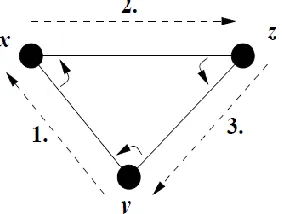
(x -> w -> v -> D) and (x-> y->Z ->D), X will not choose to forward to w or y. Considering the location of destination D, x lies on local maximum. The packet mode will be set to perimeter mode and the second algorithm will be active. In perimeter mode forwarding the right-hand rule is applied to traverse the edges of a void. The right hand rule is used to find out a possible path around a void to the destination node. Right hand rule states that when arriving at node x from node y, the next edge to be traversed is the next one sequentially counter clockwise about x from edge (x, y). The right-hand rule traverses the interior of a closed polygonal region in clockwise order. In Fig. 2 edges are traversed in the order (y -> x --> z --> y). This cycle-traversing property is exploited to route around voids.
© 2016, IRJET | Impact Factor value: 4.45 | ISO 9001:2008 Certified Journal | Page 536 Fig 1: Node x’s void with respect to destination D.
Fig 2: The right-hand rule (interior of the triangle)
However, this method fails for topologies that do not have a uniform distribution of nodes or contain voids.
2.3Position-based Opportunistic Routing (POR) [4] Traditional MANET routing protocols are quite susceptible to link failure as well as vulnerable to malicious node attack. In this Position based Opportunistic Routing (POR) which takes full advantage of the broadcast nature of wireless channel.
The design of POR is based on geographic routing and opportunistic forwarding. Geographic routing allows routers to be nearly stateless, and requires propagation of topology information for only a single hop: each node need only know its neighbors’ positions. The self-describing nature of position is the key factor to geography’s usefulness in routing. The nodes are assumed to be aware of their own location and the positions of their direct neighbors during communication. Neighborhood location information can be exchanged using one-hop beacon or piggyback in the data
packet’s header. While for the position of the destination, we assume that a lookup service and location registration.
Fig 3: (a) The operation of POR in normal situation. (b) The operation of POR when the next hop fails to receive the packet.
The basic routing behavior of POR can be simply illustrated in Fig. 3. In normal situation without link failure, the packet is forwarded by the next hop node (e.g., nodes A, E) and the forwarding candidates (e.g., nodes B, C; nodes F, G) will be suppressed (i.e., the same packet in the Packet List will be dropped) by the next hop node’s transmission. In case node A fails to deliver the packet (e.g., node A has moved out and cannot receive the packet), node B, the forwarding candidate with the highest priority, will take the packet and suppress the lower priority candidate’s forwarding (e.g., node C) as well as node S. By using the feedback from MAC layer, node S will remove node A from the neighbor list and select a new next new hop node for the subsequent packets.
2.4Opportunistic Overlays: Efficient Content Delivery in Mobile Ad Hoc Networks.[7]
[image:3.612.74.265.106.241.2] [image:3.612.345.547.152.281.2] [image:3.612.104.245.292.399.2]© 2016, IRJET | Impact Factor value: 4.45 | ISO 9001:2008 Certified Journal | Page 537 protocols implemented in a Java-based publish/subscribe
infrastructure.
Fig 4: System Model
In this paper system model adopts an overlay network approach. As illustrated in Figure 1, a system contains producers, consumers, and a broker network. It is an overlay across the physical network, composed of broker processes connected via links. Each overlay link is a path between a broker node pair in the physical network. Each producer/consumer (mobile client) connects to one of the brokers (usually the nearest one) via one or more wireless links. This broker is called the client's home broker. A consumer also provides a content-based subscription function called as modulator, which operates on event contents to dynamically tailor them to the consumer's current needs. A consumer's modulator executes in an intermediate broker's address space on behalf of consumer. An event generated by a producer is first sent to the producer's home broker, after that it routed from the producer's home broker to the consumer's home broker, processed using the consumer's modulator, and then it is delivered to the consumer via some wireless network links.
2.5SOAR: Simple Opportunistic Adaptive Routing Protocol for Wireless Mesh Networks. [8]
The SOAR is one of the proactive link state routing protocol. In this, a sender selects the default path and a list of (next-hop) forwarding nodes which are eligible for forwarding the data. It then broadcasts a data packet also including this information. Upon hearing the transmission, the nodes that are not on the forwarding list simply discard
the packet. Nodes on the forwarding list store the packet and set forwarding timers based on their proximity to the destination. A node closer to the destination uses a smaller timer and forwards the packet earlier. Upon hearing this transmission, other nodes will remove the corresponding packet from their queues to avoid duplicate transmissions. Like all other existing opportunistic routing protocols, SOAR broadcasts data packets in fixed data rate.
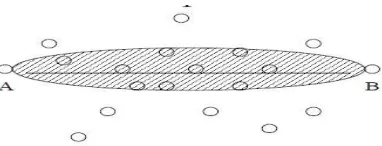
Fig 5: Forwarding Default Path Selection.
SOAR constrains the nodes involved in routing a packet to be near the default path; nodes in the shaded region participate in forwarding packets from A to B, as shown in Figure 5. This prevents routes from diverging and minimizes duplicate transmissions
2.6 Energy based reliable multicast routing protocol for packet forwarding in MANET [10]
In this paper they are providing the concept of Residual Energy based Reliable Multicast Routing Protocol (RERMR) is proposed to attain more network lifetime and increased packet delivery and forwarding rate. A multicast backbone is constructed to achieve more stability based on node familiarity and trustable loop. They have also demonstrated that residual energy of paths aids to provide maximum network lifetime.
In the proposed protocol, source nodes find all the remaining nodes through multicast routes. The paths are found with more energy and stability. Packets are forwarded through the proposed path reliability criterion. Energy consumption is minimized through the energy model.
[image:4.612.69.270.143.289.2] [image:4.612.351.542.218.291.2]© 2016, IRJET | Impact Factor value: 4.45 | ISO 9001:2008 Certified Journal | Page 538 Fig 6: Convex Hull Formation
The angle at A(u0, v0) selects a neighbor node B(u1, v1) as it makes minimum angle P rather than neighbor node C(u2, v2) which makes an angle Q with the condition that P<Q once if traced in clockwise direction.
[image:5.612.53.257.111.248.2]3. ANALYTICAL STUDY
Table -1: comparison of some data delivery mechanisms.
Optimal Path
Complexity Scalability Reliabilit y
GPSR No Medium Yes No
POR Yes Low Yes Yes
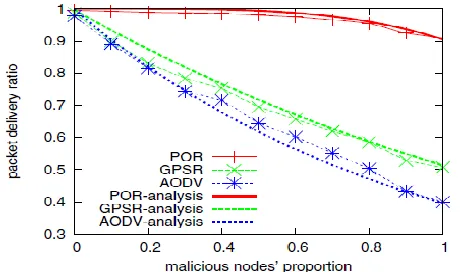
Comparing the performance of the three protocols in graph with different malicious nodes proportion. We can see that the multicast nature makes POR quite robust. As the proportion of malicious nodes increases, the delivery ratio of GPSR and AODV decreases significantly, more or less linearly, while POR maintains delivery ratio..
Chart -1: Packet delivery ratio in critical situations
In above routing mechanisms POR performs well and even better than geographic routing protocols (e.g. GPSR) and on demand routing protocols (e.g.AODV).
4. CONCLUSION
The data delivery in dynamic mobile ad hoc networks is challenging issue now days. In this paper we study the various routing mechanisms, as well as the existing routing protocol mechanism to solve the major problem of data delivery in dynamic mobile ad hoc networks. Continuously altering the network topology makes traditional ad hoc routing protocols incapable of providing satisfactory performance.
In this survey, we know that position based routing mechanisms in MANET gives better performance than other geographic routing protocols.
REFERENCES
[1] M. Mauve, A. Widmer, and H. Hartenstein, “A Survey on Position-Based Routing in Mobile Ad Hoc Networks,” IEEE Network, vol. 15, no. 6, pp. 30-39, Nov./Dec. 2001. [2] B. Karp and H.T. Kung, “GPSR: Greedy Perimeter Stateless
Routing for Wireless Networks,” Proc. ACM MobiCom, pp. 243- 254, 2000.
[3] N.NagaNandhini, P.Narendran,“Surveyof Reliable Data Delivery for Highly Dynamic Mobile Ad Hoc Networks” ,International Journal of Computer Trends and
Technology (IJCTT) –volume 4 Issue 7–July 2013 [4] ShengboYang, ChaiKiatYeo, and Bu Sung Lee, “Toward
[image:5.612.328.558.112.248.2]© 2016, IRJET | Impact Factor value: 4.45 | ISO 9001:2008 Certified Journal | Page 539 Networks”, IeeeTransactions On Mobile Computing, Vol.
11, No. 1, January 2012.
[5] S. Mueller, R. Tsang, and D. Ghosal, “Multipath Routing in Mobile Ad Hoc Networks: Issues and Challenges,” Performance Tools and Applications to Networked Systems, pp. 209-234, Springer, 2004.
[6] Alarmelu.V, R. Poonkuzhali, M.Y. Sanavullah, “An Efficient Void Handling Technique for Geographic Routing in MANET: A Survey”, IJARCSSE, December 2012.
[7] Yuan Chen and Karsten Schwan, “Opportunistic Overlays: Efficient Content Delivery in Mobile Ad Hoc Networks” College of Computing, Georgia Institute of Technology, USA, 2005.
[8] E. Rozner, J. Seshadri, Y. Mehta, and L.Qiu, “SOAR: Simple Opportunistic Adaptive Routing Protocol for Wireless Mesh Networks” , 2009.
[9] T. Srinivasa Rao, Gagandeep Singh, “Enhanced Secure Protocol for Reliable Data Delivery ”, International Journal of Computer Applications (0975 – 8887) Volume 116 – No. 8, April 2015.
[10] S. Gopinath, N. Nagarajan ,“Energy based reliable multicast routing protocol for packet forwarding in MANET”, Journal of Applied Research and Technology 13 (2015) 374-381, April 2015
BIOGRAPHIES
Ravindra Zarekar- has completed his B.E. degree in Computer Engineering from Savitribai PhulePune University in 2012 and is pursuing his M.E. degree in Computer Engineering at Pimpri Chinchwad College of Engg., Savitribai Phule Pune University, India. His research interests include Web Security, Online Social Network and Ad-hoc Network.