ISSN: 0975-766X
CODEN: IJPTFI
Available Online through
Research Article
www.ijptonline.com
IN VITRO ANTIOXIDANT ACTIVITY OF AQUEOUS EXTRACTS OF
AMARANTHUS CAUDATUS L.
Merina Paul Das*, L.Jeyanthi Rebecca
Department of Industrial Biotechnology, Bharath University, Chennai, India. Email: [email protected]
Received on 15-08-2015 Accepted on 30-08-2015
Abstract
Reactive oxygen species (ROS) are highly unstable molecules, include hydroxyl radicals, superoxide anion, hydrogen peroxide and nitric oxide are generated during normal physiological function. These reactive species are most chemically active, which participate in oxidative damage of nucleic acids, proteins, and lipids. Antioxidants are the first line of defense against the free radical damage, and are critical for maintaining optimum health and wellbeing. In this context, this study was undertaken to investigate the antioxidant potential of aqueous leaf extract of Amaranthus caudatus L. by using different in vitro models, such as, 1,1-diphenyl-2-picryl hydrazyl hydrate (DPPH), hydrogen peroxide, nitric oxide, metal chelating method. All these various antioxidant activities were compared with standard reference antioxidant compounds. The aqueous extract of A. caudatus at 100 g/ml showed strongest scavenging activity by DPPH (80.10 %), hydroxyl radical (79.45 %), nitric oxide (67.53 %) scavenging and ferrous ion metal chelating (73.49 %) activity. The findings of this study support this fact that aqueous extract of A. caudatus is a promising source of potential antioxidants and may be used as efficient herbal drug against some fatal diseases.
Keywords: Reactive oxygen species, Antioxidant activity, Amaranthus caudatus L., Radical scavenging.
Introduction
In the past decades, oxidation mechanisms and free radical role in living systems have gained increased attention 1. Oxidation is a chemical reaction that transfers electron from a substance to an oxidizing agent. Oxidation reactions can produce free radicals, which start chain reactions that damage cells 2. These free radicals are fundamentals to any biochemical process and represent an essential part of aerobic life and metabolism. The majority of the diseases /disorders
Merina Paul Das*et al. International Journal Of Pharmacy & Technology are mainly linked to oxidative stress due to the free radicals 3. Damage from free radicals and reactive oxygen species has been linked to some neurodegenerative disorders and cancers, and oxidation of low-density lipoprotein is a major factor in the promotion of coronary heart disease (CHD) and atherosclerosis 4. Reactive Oxygen Species (ROS) and Reactive Nitrogen Species (RNS) are produced continuously in the human body as a consequence of normal metabolic processes. These reactive species produced in the living cells include hydroxyl radicals, superoxide anion, hydrogen peroxide and nitric oxide 5. They are very transient species due to their high chemical reactivity that leads to lipid peroxidation of the membrane lipids, causing damage of the cell membrane of phospholipids, lipoprotein by propagating a chain reaction cycle 5-7, and also acts as important mediators of damage to proteins and nucleic acids, results oxidative stress 8.
Antioxidants terminate these chain reactions by removing free radicals intermediates, and inhibit other oxidation agents such as thiols, ascorbic acid or polyphenols 9. Antioxidants act by: removing O2 or decreasing local O2 concentrations, removing catalytic metal ions, removing key ROS, e.g. O2˙ ¯and H2O2, scavenging initiating radicals, e.g. OH˙, RO˙ , RO2¯ , breaking the chain of an initiated sequence, quenching or scavenging singlet oxygen, enhancing endogenous antioxidant defences by up-regulating the expression of the genes encoding the antioxidant enzymes, repairing oxidative damage caused by radicals, increasing elimination of damaged molecules and not repairing excessively damaged molecules in order to minimize introduction of mutations 10, 11.
Normally all these harmful effects of free radicals and ROS and RNS are neutralized by the enzymatic and nonenzymatic antioxidants present as an inbuilt antioxidant mechanism by the antioxidant action of non-enzymatic antioxidants in addition to antioxidant enzymes in the body 12, 13. Despite the presence of the cell’s antioxidant defence system to counteract oxidative damage from ROS and RNS, oxidative damage accumulates during the life cycle, and radical-related damage to DNA, to proteins and to lipids has been proposed to play a key role in the development of age-dependent diseases such as cancer, arteriosclerosis, arthritis, neurodegenerative disorders and other conditions 14. There is some synthetic antioxidant compounds such as butylated hydroxytoluene (BHT) and butylated hydroxyanisole (BHA), commonly used in processing foods. However, it has been suggested that these compounds have some side effects 15, 16. Thus natural antioxidants especially of plant origin are the best alternative to balance the adverse health effects of ROS and free radicals. Amaranthus caudatus Linn. belongs to the family Amaranthaceae, occurs naturally in Southern Asia. A. caudatus is a small herbs, known for its high anti-oxidant, anti-hypercholesterolemic, anti-atherogenic, anti-arthritic and
anti-microbial properties. Various type of phytoconstituents such as Gallic acid (GA), Caffeic acid (CA), Rutin (RU), Ferulic acid (FA) and Quercetin (QU) present in A. caudatus are mainly responsible for their medicinal properties 17
. Hence the present study has been undertaken to investigate the antioxidant activity of aqueous leaf extract of A. caudatus using different in vitro models.
Materials and Methods
Collection and extraction of Plant Material
The fresh plant material was collected from local market of Tambaram, Chennai, India. The plant was botanically identified as Amaranthus caudatus L. and authenticated by National Institute of Siddha, Medicinal Plants of Research Unit, Tambaram, Chennai. The leaves of A. caudatus were thoroughly washed under running tap water, dried in oven (50
C) for 4-5 d. Then the dried materials were homogenized to fine powder and kept in sterile plastic air-tight container for further use. For extraction, about 100 g of plant powder was mixed with 300 ml of solvent (water). The extraction was carried out by continuous percolation method using Soxhlet apparatus for 36 h accompanying with occasional shaking and stirring. The extract was underwent a coarse filtration by muslin cloth followed by a filtration through Whatmann filter paper. Each extract was concentrated by distilling off the solvent and evaporated to dryness under vacuum. The crude extracts were used for further analysis.
In vitro antioxidant assay
The assessment of antioxidant capacity of the aqueous extracts of Amaranthus caudatus L. was done through their measurement of activities in scavenging of different free radicals including hydroxyl, nitric oxide, chelating activity and total antioxidant activity with DPPH. All the tests were done in triplicates.
2,2-Diphenyl-1-Picrylhydrazyl (DPPH) Scavenging System
DPPH free radical scavenging assay was measured using DPPH free radical test, by employing the method of Wong et al.
18
. The different concentrations of each of the extracts were prepared in water and were added to 3 ml of 0.1 mM aqueous solution of DPPH. The tubes were shaken vigorously and allowed to stand for 30 min at room temperature in the dark. Changes in absorbance of samples were measured at 517 nm. A control reading was obtained using water instead of the extract. Ascorbic acid served as the standard. Free radical scavenging activity was expressed as inhibition percentage and was calculated using the following formula,
Merina Paul Das*et al. International Journal Of Pharmacy & Technology
DPPH scavenging activity % =A A C−A S e × 100 Where A is the absorbance.
Hydroxyl radical scavenging activity
The ability of extracts to scavenge hydrogen peroxide was determined with little modification 19. The solution of hydrogen peroxide (100 mM) was prepared instead of 40 mM in phosphate buffer saline of (pH 7.4), at various concentration of aqueous extract (1-100 g/ml) were added to hydrogen peroxide solution (2 ml). Absorbance of hydrogen peroxide at 230 nm was determined after 10 min against a blank solution containing phosphate buffer without hydrogen peroxide. For each concentration, a separate blank sample was used for back ground subtraction. In case of control takes absorbance of hydrogen peroxide at 230 nm without sample extracts. The standard taken as L-Ascorbic acid was used as positive control. The percentage inhibition activity was calculated from,
% Inhibition =A C A C−A S e × 100 Where A is the absorbance.
Nitric oxide radical scavenging assay
Sodium nitroprusside (SNP) gives rise to nitric oxide that under interaction with oxygen produce nitrite ions measured by Griess Illosvoy reaction 20. The chromophore generated was spectrophotometrically measured at = 540 nm agai
nst blank sample. The same reaction mixture without extract of plant but with equivalent amount of 0.5 M phosphate buffer served as control. Ascorbic acid was used as a standard. The percentage inhibition of nitric oxide radical generation was calculated using the following formula:
% Inhibition =A C A C−A S e × 100 Where A is the absorbance.
Chelating Activity
The chelation of ferrous ions by extracts was estimated by method of Dinis et al. 21. Briefly, 50 l of 2 mM FeCl2
was added to 1 ml of different concentrations of the extract. The reaction was initiated by the addition of 0.2 ml of 5 mM ferrozine solution. The mixture was vigorously shaken and left to stand at room temperature for 10 min. The absorbance
of the solution was thereafter measured at 562 nm. The percentage inhibition of ferrozine–Fe2+ complex formation (chelating power) was calculated as [(A0- As)/ As] × 100, where A0 was the absorbance of the control, and As was the absorbance of the extract. L-Ascorbic acid was used as positive control.
Statistical Analysis: The data were statistically analyzed by analysis of variance (ANOVA) and least significance difference (LSD) at a significance of probability 5 % 22
.
Results and Discussions
In the present statues, there is a strong need for an effective antioxidants from natural sources as alternatives to synthetic antioxidant in order to prevent the free radicals implicated diseases like cancer, cardiovascular diseases, Age related macular degeneration, atherosclerosis, etc 23
. This present study was aimed to evaluate the antioxidant activity of aqueous leaf extracts of Amaranthus caudatus L. at in vitro conditions.
Antioxidant Activity by DPPH Scavenging
Antioxidant can be generally categorized into two main groups, namely primary antioxidants and secondary antioxidants. DPPH assays often used to measure the ability of primary antioxidants in plants where these primary antioxidants react to scavenge the free radical from DPPH solution hence suppress the formation of initiation chain of free radical and destroy the propagation chain by donating hydrogen atom or electron so that the free radical can be changed to a more stable form of products 24, 25
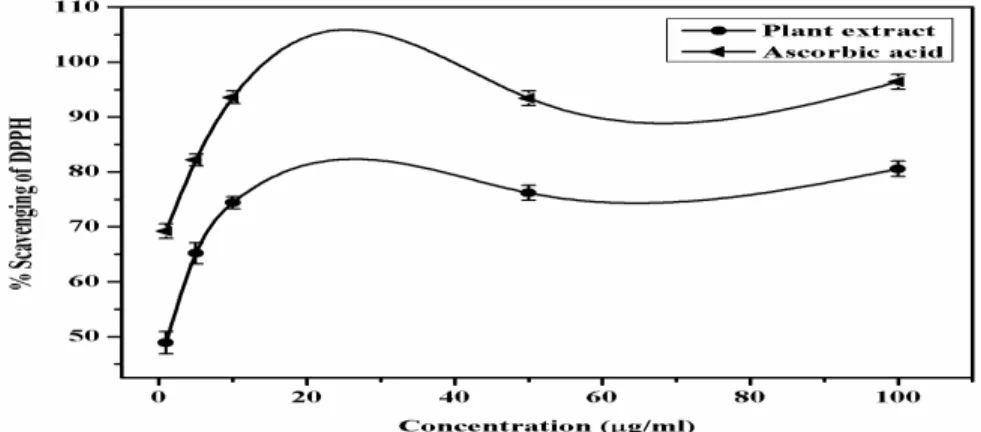
. Figure 1 shows that the aqueous extract was found to have antioxidant property in dose dependent manner. The aqueous extract of A. caudatus was found to be an effective DPPH radical scavenger (80.10 %) which almost equivalent to ascorbic acid, a standard free radical stabilizing agent. Thus, it can be put forward as a fact that the extracts truly work as antioxidant.
Merina Paul Das*et al. International Journal Of Pharmacy & Technology
Hydroxyl radical scavenging assay
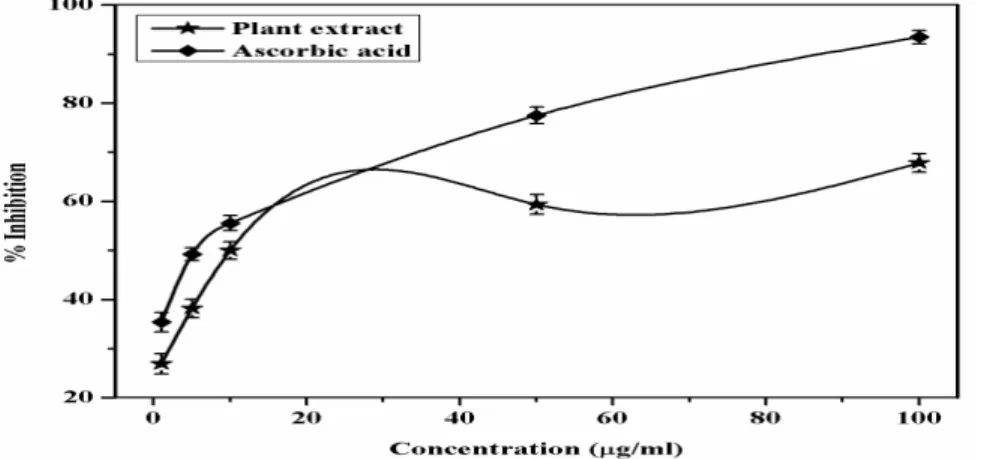
The ability of aqueous extract of A. caudatus leaf to scavenge hydroxyl radical was determined. Hydrogen radical scavenging activity of A. caudatus at the used concentration (10 g/ml) was found to be 51.6 %. Figure 2 shows that maximum 79.45 % of inhibition at 100 g/ml concentration where the standard reagent showed 99 % of inhibition at the same concentration. These results showed that this plant has an effective hydroxyl radical scavenging activity.
Figure 2: Hydroxyl radical scavenging activity of different concentrations of aqueous extract and reference antioxidant
Nitric oxide radical scavenging assay
Nitric oxide was generated by the decomposition of sodium nitroprusside and measured on the basis of Griess reaction. Aqueous extract of A. caudatus leaf is found to posses scavenging effect on nitric oxide radical in a concentration dependent manner % of inhibition (Figure 3). Sample of 100 g/ml inhibited the production of nitric oxide radical by 70.53 % showing strong scavenging activity. Within the same concentration range, the scavenging activity of L-ascorbic acid showed weak scavenging activity on nitric oxide.
Ferrous ion chelating activity
The main strategy to avoid ROS generation that is associated with redox active metal catalysis involves chelating of the metal ions 26.Transition metal ions such as those of iron are important catalyst for the generation of highly reactive hydroxyl radicals via the Fenton reaction in both in vivo and in vitro systems. Ligands that bind to metal ions can alter the redox potentials of these ions, which would render the ions catalytically silent. As secondary antioxidants, compounds can act as effective ligands that sequester copper and ferrous ions by ‘‘wrapping’’ themselves around this ion. These ligands could help intercept and suppress radicals formed via catalysis from fuelling a chain reaction 27
.
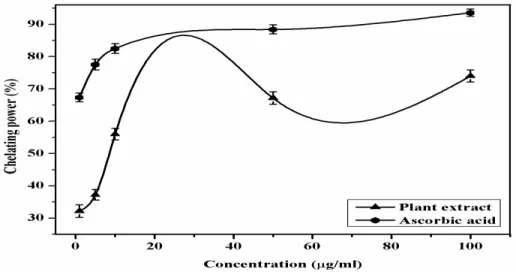
The chelating activity was measured against Fe2+ as shown in Figure 4. Chelating power assay was carried out to assess the chelating capacity of the crude extracts which illustrated that the crude methanol extract of leaves of A. caudatus possessed remarkable chelating power at 100 g/ml (73.49 %). A. caudatus the most active extract interfered with the formation of ferrous and ferrozine complex, suggesting that it has significant chelating activity and captures ferrous ion before ferrozine.
Figure 4: Metal chelating activity of different concentrations of aqueous extract and reference antioxidant Conclusion
Antioxidant plays a very important role in the body defense system against reactive oxygen species. The results of in vitro antioxidant data showed a significant free radical scavenging activity of aqueous extract of Amaranthus caudatus L. in a dose dependent manner. Thus, A. caudatus is a promising source of naturally occurring potential antioxidants and may be efficient in preventing innumerable health disorders related to oxidative stress including cardiovascular diseases, neurodegenerative diseases and cancer. However the results of this study provide the information about the significant
Merina Paul Das*et al. International Journal Of Pharmacy & Technology antioxidant properties of A. caudatus by in vitro methods, these effects need to be further confirmed by employing different in vivo models.
Acknowledgments
The authors convey their thanks to Bharath University, Chennai, for providing laboratory facilities.
References
1. Halliwell, B., Gutteridge, J.M.C., Free Radicals in Biology and Medicine. Clarendon Press, Oxford 1989, pp23–30. 2.V.D. Aher, A. Wahi, A.M. Pawdey, A. Sonawane, 2011, Vol 3,pp 8–10.
3. S. Velavan, K. Nagulendran, R. Mahesh, V.H. Begum, 2007, Vol 3, pp26–33.
4. L.S. Einbonda, K.A. Reynertsona, Xiao-DongLuo, M.J. Basileb, E.J. Kennelly, 2004, Vol 84, pp23–28 5. J.M. Mate´s, 2000, Vol 153, pp83–104.
6. A. Braca, C. Sortino, M. Politi, I. Morelli, J. Mendez, 2002, Vol 79, pp379–381. 7. S.R. Maxwell, 1995, Vol 49, pp345–361.
8. G. Poli, G. Leonarduzzi, F. Biasi, E. Chiarpotto, 2004, Vol 11, pp1163–1182. 9. H. Sies, 1997, Vol 82, pp291–295.
10. J.M. Gutteridge, 1994, Vol 91, pp133–140.
11. L.G. Wood, P.G. Gibson, M.L. Garg, 2006, Vol 86, pp2057–2066.
12. I.C. Jang, J.H. Park, E. Park, H.R. Park, S.C. Lee, 2008, Vol 63, pp205–210. 13. B. Halliwell, 1996, Vol 16, pp33–50.
14. Halliwell, B., Gutteridge, J.M.C., Free Radicals in Biology and Medicine, 3rd (Eds.), Oxford University Press, 1999. 15. A.L. Branien, 1975, Vol 52, pp29–63.
16. N. Ito, S. Fukushima, A. Hassegawa, M. Shibata and T. Ogiso, 1983, Vol 70, pp343–347. 17. Merina Paul Das, Dhiraj Kumar, 2013, Vol 1,pp195–198.
18. C.K. Wong, V.E.C. Ooi, P.O. Ang, 2000, Vol 41, pp173–176.
19. I.I. Koleva, , T.A. Van Beek, J.P.H. Linssen, A. De Groot, L.N. Evstatieva, 2002, Vol 13, pp 8–17. 20. B. Hazra, S. Biswas, N. Mandal, 2008, Vol 8, pp63–75.
22. Steel, R.G., Torrie, J. H., Principles and procedure of statistics analysis. Biometrical approach. 2nd (ed.) MC Graw-Hill Book Co. INC New York, New York 1980.
23. O.L. Aruoma, 1998, Vol 75, pp199–212.
24. R. Nurliyana, I. Syed Zahir, K. Mustapha Suleiman, M.R. Aisyah, K. Kamarul Rahim, 2010, Vol 17, pp367–375. 25. L.Y. Yan, L.Y. Teng, T.J. Jhi, 2006, Vol 3, pp9–20.
26. Mohammad Ali Ebrahimzadeh, Fereshteh Pourmorad, Ahmad Reza Bekhradnia, 2008, Vol 7, pp3188–3192. 27. O.I. Aruoma, M. Grootveld, B. Halliwell, 1987, Vol 29, pp289–299.
Corresponding Author: Merina Paul Das*,