THE DESIGN OF THE KERNEL ARCHITECTURE FOR THE EUROTRA* SOFTWARE
R.L. Johnson**, U.M.I.S.T., P.O. Box 88, Manchester M60 IQD, U.K. S. Krauwer, Rijksuniversiteit, Trans 14, 3512 JK Utrecht, Holland M.A. RUsher, ISSCO, University of Geneva, 1211 Geneve 4, Switzerland G.B. Varile, Commission of the European Conm~unities, P.O. Box 1907, Luxembourg
ABSTRACT
Starting from the assumption that machine translation (MT) should be based on
theoretically s o u n d grounds, we argue that, given the state of the a r t , the only v i a b l e solution for the designer of software tools for MT, is to provide the linguists building the MT system with a generator of highly specialized, problem oriented systems. We propose that such theory sensitive systems be generated
automatically by supplying a set of definitions to a kernel software, of which we give an informal description in the paper. We give a formal functional definition of its architecture and briefly explain how a prototype system was built.
I. INTRODUCTION
A. Specialized vs generic software tools for MT Developing the software f o r a s p e c i f i c task or class of tasks requires that one knows the structure of the tasks involved. In the case of Machine Translation (MT) this structure is not a priori known. Yet it has been envisaged in the planning of the Eurotra project that the software development takes place before a general MT theory is present. This approach has both advantages and disadvantages. It is an advantage that the presence of a software framework will provide a formal language for expressing the MT theory, either explicitly or implicitly. On the other hand this places a heavy responsibility on the shoulders of the software designers, since they will have to provide a language without knowing what this language will have to express.
We are grateful to the Commission of the European Communities for continuing support for the Eurotra Machine Translation project and for permission to publish this paper; and also to our colleagues in Eurotra for many interesting and stimulating
d i s c u s s i o n s .
There are several ways open to the software designer. One would be to create a framework that is sufficiently general to sccomodate any theory. This is not v e r y attractive, not only because this could trivially be a c h i e v e d by selecting a n y e x i s t i n g p r o g r a m m i n g l a n g u a g e , b u t a l s o b e c a u s e t h i s w o u l d n o t be o f a n y h e l p f o r t h e people doing the linguistic work. Another, equally unattractive alternative would be to p r o d u c e a v e r y s p e c i f i c a n d s p e c i a l i z e d formalism and offer this to the linguistic community. Unfortunately there i s no way to d e c i d e i n a sensible way i n which d i r e c t i o n s this formalism should be specialized, and hence it would be a mere accident if the device would turn out to be adequate. What is worse, the user of the formalism would spend a c o n s i d e r a b l e amount of h i s time t r y i n g to overcome its deficiencies.
In other words, the difficulties that face the d e s i g n e r of s u c h a software system is that it is the user of the system, in our case the linguist, who knows the structure of the problem domain, but is very often unable to articulate it until the language for the transfer of domain knowledge has been
established. Although the provision of such a language gives the user the ability to express himself, it normally comes after fundamental decisions regarding the meaning of the language have been frozen into the system architecture. At this point, it is too late to do anything about it: the architecture will embody a certain theoretical conTaitment which delimits both what can be said to the system, and how the system can handle what it is told. This problem is particularly severe when there is not one user, but several, each of whom may have a different approach to the problem that in their own terms is the best one.
I n o r d e r t o b e s t s u i t t h e s e a p p a r e n t l y c o n f l i c t i n g r e q u i r e m e n t s we h a v e t a k e n t h e f o l l o w i n g d e s i g n d e c i s i o n s :
1. On t h e one h a n d , t h e s o f t w a r e t o be d e s i g n e d w i l l be o r i e n t e d t o w a r d s a c l a s s o f abstract systems (see below) rather than one specific system. This class should be so r e s t r i c t e d t h a t t h e d e c i s i o n s t o be t a k e n d u r i n g t h e l i n g u i s t i c d e v e l o p m e n t o f t h e end u s e r s y s t e m h a v e d i r e c t r e l e v a n c e t o t h e l i n g u i s t i c p r o b l e m d o m a i n , w h i l e p o w e r f u l e n o u g h ~o accommodate a v a r i e t y o f l i n g u i s t i c s t r a t e g i e s .
2. On t h e o t h e r h a n d , j u s t s p e c i f y i n g a c l a s s o f s y s t e m s w o u l d be i n s u f f i c i e n t , g i v e n o u r e x p e c t a t i o n t h a t t h e h i g h l y e x p e r i m e n t a l n a t u r e o f t h e l i n g u i s t i c d e v e l o p m e n t p h a s e w i l l g i v e r i s e t o a v a s t number o f e x p e r l m e n t a l i n s t a n t i a t i o n s o f t h e s y s t e m , w h i c h s h o u l d n o t l e a d t o c o n t i n u o u s l y c r e a t i n g c o m p l e t e l y new v e r s i o n s o f t h e s y s t e m . What i s n e e d e d i s a c o h e r e n t s e t o f s o f t w a r e t o o l s t h a t e n a b l e t h e s y s t e m d e v e l o p e r s t o a d a p t t h e s y s t e m t o c h a n g e s w i t h a m i n i m a l amount o f e f f o r t , i . e . a s y s t e m g e n e r a t o r .
T h u s , we r e j e c t t h e v i e w that the
a r c h i t e c t u r e s h o u l d a c h i e v e t h i s f l e x i b i l i t y by s i m p l y e v a d i n g t h e o r e t i c a l c o m m i t m e n t . I n s t e a d i t s h o u l d be c a p a b l e o f d i s p l a y i n g a w h o l e r a n g e o f h i g h l y s p e c i a l i z e d b e h a v i o u r s , and t h e r e f o r e be c a p a b l e o f a h i g h d e g r e e o f i n t e r n a l
r e c o n f i g u r a t i o n a c c o r d i n g t o e x t e r n a l l y s u p p l i e d s p e c i f i c a t i o n s . I n o t h e r w o r d s we aim a t a s y s t e m w h i c h i s t h e o r y s e n s i t i v e .
In o u r p h i l o s o p h y t h e r e c o n f i g u r a t i o n o f t h e s y s t e m s h o u l d be a c h i e v e d by s u p p l y i n g t h e new s p e c i f i c a t i o n s t o t h e s y s t e m r a t h e r t h a n t o a t e a m i n c h a r g e o f r e d e s i g n i n g t h e s y s t e m w h e n e v e r new n e e d s f o r t h e u s e r a r i s e .
T h e r e f o r e t h e p a r t o f t h e s y s t e m t h a t i s v i s i b l e t o t h e l i n g u i s t i c u s e r w i l l be a s y s t e m
g e n e r a t o r , r a t h e r t h a n an i n s t a n c e o f an MT system.
B. C o m p u t a t i o n a l P a r a d i g m f o r MT S o f t w a r e
The c o m p u t a t i o n a l p a r a d i g m we h a v e c h o s e n f o r t h e s y s t e m s t o be g e n e r a t e d i s t h e o n e o f e x p e r t s y s t e m s b e c a u s e t h e d e s i g n o f s o f t w a r e f o r an MT s y s t e m o f t h e s c o p e o f g u r o t r a h a s much i n common w i t h t h e d e s i g n o f a v e r y l a r g e e x p e r t s y s t e m . I n b o t h c a s e s s u c c e s s f u l
operation relies as much on the ease with which the specialist knowledge of experts in the p r o b l e m d o m a i n can be c o m m u n i c a t e d t o and u s e d by t h e s y s t e m a s on t h e p r o g r a m m i n g s k i l l o f t h e s o f t w a r e d e s i g n e r s and i m p l e m e n t e r s . T y p i c a l l y , t h e d e s i g n e r s o f e x p e r t s y s t e m s a c c o m m o d a t e t h e n e e d t o i n c o r p o r a t e l a r g e a m o u n t s o f s p e c i a l i s t k n o w l e d g e i n a f l e x i b l e way by a t t e m p t i n g t o b u i l d i n t o t h e s y s t e m d e s i g n a s e p a r a t i o n b e t w e e n k n o w l e d g e o f a d o m a i n and t h e way i n
w h i c h t h a t k n o w l e d g e i s a p p l i e d . The c h a r a c t e r i s t i c a r c h i t e c t u r e o f an e x p e r t
s y s t e m i s i n t h e f o r m o f a P r o d u c t i o n S y s t e m ( P S ) ( c f D a v i s & King 1 9 7 7 ) .
A p r o g r a n u u i n g scheme i s c o n v e n t i o n a l l y p i c t u r e d a s h a v i n g two a s p e c t s ( " A l g o r i t h m s + D a t a = P r o g r a m s " ) - - ( c f W i r t h 1 9 7 6 ) ; a p r o d u c t i o n s y s t e m h a s t h r e e : a d a t a b a s e , a s e t o f r u l e s ( s o m e t i m e s c a l l e d ' p r o d u c t i o n s ' - - h e n c e t h e n a m e ) , and an i n t e r p r e t e r . I n p u t t o t h e c o m p u t a t i o n i s t h e i n i t i a l s t a t e o f t h e d a t a b a s e . R u l e s c o n s i s t , e x p l i c i t l y o r i m p l i c i t l y , o f two p a r t s : a p a t t e r n and an a c t i o n . C o m p u t a t i o n p r o c e e d s by p r o g r e s s i v e m o d i f i c a t i o n s t o t h e d a t a b a s e a s t h e
i n t e r p r e t e r s e a r c h e s t h e d a t a b a s e and a t t e m p t s t o m a t c h p a t t e r n s i n r u l e s and a p p l y t h e c o r r e s p o n d i n g a c t i o n s i n t h e e v e n t o f a s u c c e s s f u l m a t c h . The p r o c e s s h a l t s e i t h e r when t h e i n t e r p r e t e r a t t e m p t s t o a p p l y a h a l t i n g a c t i o n o r when no m o r e r u l e s c a n be a p p l i e d .
T h i s k i n d o f o r g a n i s a t i o n i s c l e a r l y a t t r a c t i v e f o r k n o w l e d g e - b a s e d c o m p u t a t i o n s . The d a t a b a s e can be s e t up t o m o d e l o b j e c t s i n t h e p r o b l e m d o m a i n . The r u l e s r e p r e s e n t s m a l l , m o d u l a r i t e m s o f k n o w l e d g e , w h o s e s y n t a x c a n be a d j u s t e d t o r e f l e c t f o r m a l i s m s w i t h w h i c h e x p e r t u s e r s a r e f a m i l i a r . And t h e
i n t e r p r e t e r e m b o d i e s a g e n e r a l p r i n c i p l e a b o u t t h e a p p r o p r i a t e way t o a p p l y t h e e x p e r t k n o w l e d g e c o d e d i n t o t h e r u l e s . G i v e n an a p p r o p r i a t e p r o b l e m d o m a i n , a good e x p e r t s y s t e m d e s i g n c a n make i t a p p e a r a s i f t h e s t a t e m e n t o f e x p e r t k n o w l e d g e i s e n t i r e l y d e c l a r a t i v e - - t h e i d e a l s i t u a t i o n f r o m t h e u s e r ' s p o i n t o f v i e w .
A m a j o r aim i n d e s i g n i n g E u r o t r a h a s b e e n t o a d a p t t h e e s s e n t i a l d e c l a r a t i v e s p i r i t o f p r o d u c t i o n s y s t e m s t o t h e r e q u i r e m e n t s o f a s y s t e m f o r l a r g e s c a l e m a c h i n e t r a n s l a t i o n . The r e a s o n f o r a d a p t i n g t h e a r c h i t e c t u r e o f c l a s s i c a l e x p e r t s y s t e m s t o o u r s p e c i a l n e e d s was t h a t t h e s i m p l e p r o d u c t i o n s y s t e m s c h e m e
i s l i k e l y t o be i n a d e q u a t e f o r o u r p u r p o s e s .
I n f a c t , t h e s u c c e s s o f a c l a s s i c a l PS m o d e l i n a g i v e n d o m a i n r e q u i r e s t h a t a n u m b e r o f a s s u m p t i o n s be s a t i s f i e d , n a m e l y :
1. t h a t t h e k n o w l e d g e r e q u i r e d c a n be a p p r o p r i a t e l y e x p r e s s e d i n t h e f o r m o f p r o d u c t i o n r u l e s ;
2. t h a t t h e r e e x i s t s a s i n g l e , u n i f o r m p r i n c i p l e f o r a p p l y i n g t h a t k n o w l e d g e ;
3. f i n a l l y , t h a t t h e p r i n c i p l e o f a p p l i c a t i o n i s c o m p a t i b l e w i t h t h e n a t u r a l e x p r e s s i o n o f s u c h k n o w l e d g e by an e x p e r t u s e r .
In machine translation, the domain of knowledge with which we are primarily
concerned is that of language. With respect to assumption (I), we think automatically of rewrite rules as being an obvious way of expressing linguistic knowledge. Some caution is necessary, however.
First of all, rewrite rules take on a number of different forms and interpretations d e p e n d i n g on t h e l i n g u i s t i c t h e o r y w i t h w h i c h t h e y a r e a s s o c i a t e d . I n t h e s i m p l e s t c a s e , t h e y a r e m e r e l y c r i t e r i a o f t h e w e l l - f o r m e d n e s s o f strings, and a c o l l e c t i o n o f such r u l e s i s s i m p l y e q u i v a l e n t t o a r e c o g n i t i o n d e v i c e . Usually, however, they are also understood as describing pieces of tree structure, although in some cases -- phrase structure rules in
particular -- no tree structure may be
explicitly mentioned in the rule: a set of such rules then corresponds to some kind of
transducer rather than a simple accepting automaton.
The point is that rules which look the same may mean different things according to what is
implicit in the formalism. When such rules are used t o d r i v e a c o m p u t a t i o n , everything w h i c h is i m p l i c i t becomes t h e r e s p o n s i b i l i t y o f t h e i n t e r p r e t e r . T h i s h a s two c o n s e q u e n c e s :
a. if there are different interpretations of rules according to the task which they are supposed to perform, then we need different interpreters t o i n t e r p r e t them, w h i c h i s contrary to assumption (2); an obvious case is the same set of phrase structure rules u s e d to drive a builder of phrase structure trees given a string as input, and to drive an integrity checker given a set of possibly well-formed trees;
b. alternatively, in some cases, information which is implicit for one type of interpreter may need to be made explicit for another, causing violation of assumption (3); an obvious case here is the fact that a phrase structure analyser can be written in terms of
transductions on trees for a general rewrite interpreter, but at considerable cost in clarity and security.
Secondly, it i s not evident that 'rules', in either the pattern-action or the rewrite sense, are necessarily the most appropriate representation for all linguistic description. Examples where other styles of expression may well be more fitting are in the description of morphological paradigms for highly inflected languages or the formulation of judgements of relative semantic or pragmatic acceptability. The organisational complexity of Eurotra also poses problems for software design. Quite separate strategies for analysis and synthesis
will be developed independently by language groups working in their own countries,
a l t h o u g h t h e r e s u l t s o f t h i s d e c e n t r a l i s e d and distributed development will ultimately h a v e to be combinable together into one integrated translation system. What is more, new l a n g u a g e s o r s u b l a n g u a g e s may be added a t a n y t i m e , r e q u i r i n g new s t r a t e g i e s and modes o f d e s c r i p t i o n .
Finally, the Eurotra software i s intended not only as the basis for a single, large MT s y s t e m , b u t a s a g e n e r a l p u r p o s e f a c i l i t y f o r r e s e a r c h e r s i n MT and c o m p u t a t i o n a l
linguistics i n g e n e r a l .
These extra considerations impose requirements of complexity, modularity, extensibility and transparency not commonly expected of today's expert systems.
The conclusion we have drawn from these and similar observations is that the
inflexible, monolithic nature of a simple PS is far too rigid to accommodate the variety of diverse tasks involved in machine
translation. The problem, however, is one of size and complexity, rather than of the basic spirit of production systems.
The above considerations have led us to adopt the principle of a controlled production system, that is a PS enhanced with a control language (Georgeff 1982). The elements of the vocabulary of a control language are names of PSs, and the well-formed strings of the language define just those sequences of PS applications which are allowed. The user supplies a control 'grammar', which, in a concise and perspicuous way, specifies the class of allowable application sequences. Our proposal for Eurotra supports an enhanced context free control language, in which names of user-defined processes act as non-terminal symbols. Since the language is context free, process definitions may refer recursively to other processes, as well as to gran~aars, whose names are the terminal symbols of the control language.
A grammar specifies a primitive task to be performed. Like a production system, it consists of a collection of declarative statements about the data for the task, plus details of the interpretation scheme used to apply the declarative information to the data base. Again, as in a production system, it is important that the information in the
The d e v i c e o f u s i n g a c o n t r o l l a n g u a g e t o d e f i n e t h e o r g a n l s a t i o n o f a c o l l e c t i o n o f grs~muars p r o v i d e s t h e u s e r w i t h a p o w e r f u l t o o l f o r s i m u l a t i n g t h e p r o c e d u r a l k n o w l e d g e i n h e r e n t i n c o n s t r u c t i n g and t e s t i n g s t r a t e g i e s , w i t h o u t d e p a r t i n g r a d i c a l l y f r o m an e s s e n t i a l l y
d e c l a r a t i v e f r a m e w o r k .
An important feature of our design methodology is the commitment to interaction with potential users in order to delineate the class of tasks which users themselves feel to be necessary. In this way, we aim to avoid the error which has often been made in the past, of presentin 8 users with a fixed set of selected generally on computational grounds, which they, the users, must adjust to their own requirements a s best t h e y c a n .
II OVERVIEW OF THE SYSTEM GENERATOR The t a s k o f o u r u s e r s i s t o d e s i g n t h e p r o b l e m o r i e n t e d m a c h i n e h e r e c a l l e d " e u r o t r a " . Our c o n t r i b u t i o n t o t h i s t a s k i s t o p r o v i d e t h e m w i t h a m a c h i n e 1 i n t e r m s o f w h i c h t h e y c a n e x p r e s s t h e i r p e r c e p t i o n o f s o l u t i o n s t o t h e p r o b l e m ( b e a r i n g i n mind a l s o t h a t we may n e e d t o accommodate i n t h e f u t u r e n o t o n l y
m o d i f i c a t i o n s t o u s e r s ' s p e r c e p t i o n o f t h e s o l u t i o n b u t a l s o t o t h e i r p e r c e p t i o n o f t h e p r o b l e m i t s e l f ) .
I t i s c l e a r l y u n r e a s o n a b l e t o e x p e c t u s e r s t o e x p r e s s t h e m s e l v e s d i r e c t l y i n t e r m s o f some c o m p u t e r , e s p e c i a l l y g i v e n t h e c h a r a c t e r i s t i c s o f t h e c o n v e n t i o n a l von Neumann c o m p u t e r s w h i c h we can e x p e c t t o be a v a i l a b l e i n t h e i n u u e d i a t e f u t u r e . The n o r m a l s t r a t e g y , w h i c h we a d o p t i s t o d e s i g n a p r o b l e m - o r i e n t e d l a n g u a g e w h i c h t h e n becomes the users' interface to a special purpose virtual machine, mediated by a compiler which transforms solutions expressed in the p r o b l e m - o r i e n t e d l a n g u a g e i n t o p r o g r a m s w h i c h can be r u n d i r e c t l y on t h e a p p r o p r i a t e
c o m p u t e r . F u n c t i o n a l l y , can e x p r e s s t h i s i n t h e f o l l o w l n g way :
We use the term "computer" to refer to a p h y s i c a l o b j e c t implemented in h a r d w a r e , w h i l e " m a c h i n e " i s t h e o b j e c t w i t h w h i c h a p r o g r a m m e r c o m m u n i c a t e s . The e s s e n c e o f t h e t a s k o f d e s i g n i n g s o f t w a r e t o o l s i s t o t r a n s f o r m a c o m p u t e r i n t o a m a c h i n e w h i c h c o r r e s p o n d s a s c l o s e l y a s p o s s i b l e t o t h e t e r m s o f t h e p r o b l e m domain o f t h e u s e r f o r w h o m the tools are written.
e u r o t r a = c o m p i l e r : u s d 2
w h e r e u s d s t a n d s f o r " u s e r s o l u t i o n
d e f i n i t i o n " . We c a n d e p i c t t h e a r c h i t e c t u r e g r a p h i c a l l y a s :
u s d
COMPILER
,L
s o u r c e text --~ COMPUTER - - ~ target text F i g . 1
I n S y m b o l s :
( c o m p i l e r : u s d ) : t e x t - 9 t e x t
The p i c t u r e a b o v e i s c l e a r l y s t i l l an o v e r s i m p l i f i c a t i o n . I n t h e f i r s t p l a c e , s u c h a c o m p i l e r w o u l d be e n o r m o u s l y d i f f i c u l t t o w r i t e and m a i n t a i n , g i v e n t h e t r e m e n d o u s c o m p l e x i t y o f t h e p o s s i b l e s o l u t i o n s p a c e o f M a c h i n e T r a n s l a t i o n p r o b l e m s w h i c h t h e c o m p i l e r i s i n t e n d e d t o r e p r e s e n t . S e c o n d l y , e s p e c i a l l y i n t h e l i g h t o f o u r o b s e r v a t i o n a b o v e t h a t t h e u s e r s ' v i e w o f t h e p r o b l e m s p a c e i t s e l f may c h a n g e , i t w o u l d be v e r y u n w i s e t o i n v e s t e n o r m o u s e f f o r t i n t h e c o n s t r u c t i o n o f a v e r y c o m p l e x c o m p i l e r w h i c h may t u r n o u t i n t h e end t o be c o n s t r u c t e d t o a c c e p t s o l u t i o n s t o t h e w r o n g c l a s s o f p r o b l e m s .
F o l l o w i n g w e l l - e s t a b l i s h e d s o f t w a r e e n g i n e e r i n g p r a c t i c e , we c a n c o m p e n s a t e f o r t h i s d i f f i c u l t y by u s i n g a c o m p i l e r g e n e r a t o r t o g e n e r a t e a p p r o p r i a t e c o m p i l e r s r a t h e r t h a n b u i l d i n g a c o m p l e t e new c o m p i l e r f r o m
s c r a t c h . A p a r t f r o m m a k i n g t h e a c t u a l p r o c e s s o f c o m p i l e r c o n s t r u c t i o n more r a p i d , we o b s e r v e t h a t u s e o f a c o m p i l e r g e n e r a t o r h a s i m p o r t a n t b e n e f i c i a l s i d e e f f e c t s . F i r s t l y , i t e n a b l e s u s t o c o n c e n t r a t e on t h e c e n t r a l i s s u e o f l a n g u a g e d e s i g n r a t h e r t h a n s e c o n d a r y q u e s t i o n s o f c o m p i l e r i m p l e m e n t a t i o n .
S e c o n d l y , i f we c h o o s e a w e l l - d e s i g n e d c o m p i l e r g e n e r a t o r , i t t u r n s o u t t h a t t h e d e s c r i p t i o n o f t h e u s e r l a n g u a g e w h i c h i s i n p u t t o t h e g e n e r a t o r may be v e r y c l o s e t o an a b s t r a c t s p e c i f i c a t i o n o f t h e l a n g u a g e , and h e n c e i n an i m p o r t a n c e s e n s e a d e s c r i p t i o n o f t h e p o t e n t i a l o f t h e u s e r m a c h i n e .
2 F o r t h e r e m a i n d e r o f t h i s s e c t i o n we s h a l l u s e t h e n o t a t i o n
x : y - ~ z
w i t h t h e i n f o r m a l m e a n i n g o f " a p p l i c a t i o n o f x t o y y i e l d s r e s u l t z " , o r " e x e c u t i o n o f x w i t h i n p u t y g i v e s o u t p u t z " .
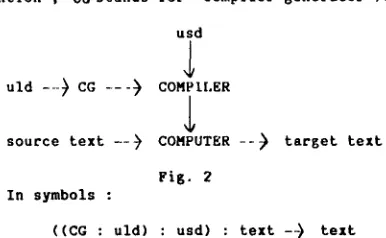
A f t e r t h e i n t r o d u c t i o n o f a c o m p i l e r g e n e r a t o r t h e p i c t u r e o f o u r a r c h i t e c t u r e l o o k s l l k e t h i s ( u l d s t a n d s f o r " u s e r l a n g u a g e d e f i n t i o n " ; C G s t a n d s f o r " c o m p i l e r g e n e r a t o r " ) :
usd
uld ---~ CG ---9 COMPILER
source text -- ~ COMPUTER -- target text Fig. 2
In s y m b o l s :
((CG : uld) : usd) : text - ~ text For many software engineering projects this might be an entirely adequate architecture to
support the design of problem oriented systems. In OUr case, however, an architecture of this kind only offers a partial resolution of the two important issues already raised above :
incomplete knowledge of the problem domain, and c o m p l e x i t y o f t h e s e m a n t i c s o f any p o s s i b l e s o l u t i o n s p a c e . The u s e o f a c o m p i l e r g e n e r a t o r c e r t a i n l y h e l p s u s t o s e p a r a t e t h e p r o b l e m o f d e f i n i n g a good u s e r l a n g u a g e f r o m t h a t o f
implementing it. It also gives us the very important insight that the use of generators as design tools means that in optimal cases input to the generator and formal specification of the machine to be generated may be very close or even identical. However, we really only are addressing the question of finding an
appropriate syntax in which users can formulate solutions in some problem domain; the issue of d e f i n i n g t h e s e m a n t i c s u n d e r l y i n g t h a t s y n t a x , o f s t a t i n g f o r m a l l y w h a t a p a r t i c u l a r s o l u t i o n means i s still open.
We can perhaps make the point more explicitly by considering the conventional decomposition of a compiler into a parser and a code generator (cf, for example, Richards and Whitby-Strevens 1979). The function of the parser is to transform a text of a programming language into a formal object such as a parse t r e e w h i c h i s s y n t a c t i c a l l y u n i f o r m and e a s y t o d e s c r i b e ; t h i s o b j e c t i s t h e n t r a n s f o r m e d by t h e code generator into a semantically equivalent t e x t i n t h e l a n g u a g e o f t h e t a r g e t m a c h i n e . W i t h i n t h i s a p p r o a c h , i t i s p o s s i b l e t o c o n t e m p l a t e an o r g a n i s a t l o n w h i c h , i n l a r g e measure, separates the manipulation of the syntax of a language from computation of its meaning. Since the syntactic manipulation of programming languages is by now well understood, we can take advantage of this separation to a r r i v e a t f o r m a l d e f i n i t i o n s o f l a n g u a g e s y n t a x w h i c h can be u s e d d i r e c t l y t o g e n e r a t e t h e s y n t a c t i c c o m p o n e n t o f a c o m p i l e r . The p r o c e s s of automatically computing the meaning of a program is, unfortunately much more obscure.
Our t a s k i s r e n d e r e d d o u b l y d i f f i c u l t by t h e f a c t t h a t t h e r e i s no o b v i o u s r e l a t i o n b e t w e e n t h e k i n d o f u s e r p r o g r a m we can e x p e c t t o h a v e t o t r e a t and t h e s t r i n g o f von Neumann i n s t r u c t i o n s w h i c h e v e n t h e m o s t a d v a n c e d s e m a n t i c a l l y o r i e n t e d c o m p i l e r g e n e r a t o r i s l i k e l y t o be t u n e d t o p r o d u c e .
We can g a i n some i n s i g h t i n t o a way r o u n d t h i s d i f f i c u l t y by c o n s i d e r i n g s t r a t e g i e s l i k e t h e one d e s c r i b e d f o r BCPL ( R i c h a r d s and Whitby-Strevens, clt). In this two-stage c o m p i l e r , t h e i n p u t p r o g r a m i s f i r s t t r a n s l a t e d i n t o t h e l a n g u a g e o f a p s e u d o - m a c h i n e , known a s O - c o d e . The i m p l e m e n t e r t h e n h a s t h e c h o i c e o f
i m p l e m e n t i n g an O - c o d e m a c h i n e d i r e c t l y a s an i n t e r p r e t e r o r of w r i t i n g a s e c o n d stage c o m p i l e r w h i c h t r a n s l a t e s an O - c o d e p r o g r a m i n t o an e q u i v a l e n t p r o g r a m w h i c h i s r u n n a b l e d i r e c t l y on t a r g e t m a c h i n e . T h i s t e c h n i q u e , which is relatively well established, is normally used as a means Of constructing easily portable compilers, since only the second-stage intermediate code to target code translation need be changed, a job which is rendered much easier by the f a c t that the
input language to the translation is invariant over all compilers in the family.
C l e a r l y we c a n n o t a d o p t t h i s m o d e l d i r e c t l y , s i n c e O - c o d e i n o r d e r t o be
optimally portable is designed as the language of a generic stack-oriented yon Neumann machine, and we have made the point repeatedly that yon Neumann architectures are not the
appropriate point of reference for the semantics of MT definitions. However, we can also see the same organisation in a different light, namely as a device for allowlng us to build a compiler for languages whose semantics are not necessarily fully determined, or at least subject to change and redefinition at short notice. In other words, we want to be able to construct compilers which can compile code for a class of machines, so as to concentrate attention on f i n d i n g the most appropriate member of the class for the task i n h a n d .
we now have a system architecture in which user solutions are translated into a
[image:5.612.113.306.97.216.2]them d y n a m i c a l l y , i f n e c e s s a r y ; t h e y t y p i c a l l y h a v e a v e r y s i m p l e s y n t a x - n o r m a l l y c o m p o s e d o n l y o f a t o m s and t u p l e s - w h i c h i s s i m p l e f o r a c o m p i l e r t o g e n e r a t e ; and t h e f u n c t i o n
d e f i n i t i o n s h a v e , i n p r o g r a m m i n g t e r m s , a v e r y t r a c t a b l e s e m a n t i c s w h i c h we can e x p l o i t i n i d e n t i f y i n g an i n s t a n c e o f an e x p e r i m e n t a l i m p l e m e n t a t i o n w i t h a f o r m a l s y s t e m d e f i n i t i o n .
W i t h t h e a d d i t i o n o f t h e i n t e r p r e t e r s l m u l a t i n g t h e a b s t r a c t m a c h i n e , o u r i n f o r m a l p i c t u r e now l o o k s l i k e t h i s :
u l d - - ~ C G - - ~
s o u r c e text --3
usd
COMPILER
INTERPRETER --~
COMPUTER
t a r g e t text
F i g . 3
o r i n s y m b o l s :
(INTERPRETER : ((CG:uld) : usd)) : text - ~ text
We now t u r n t o t h e k i n d o f d e f i n i t i o n s w h i c h we s h a l l w a n t t o i n t r o d u c e i n t o t h i s s y s t e m . We d e c o m p o s e t h e f u n c t i o n o f t h e m a c h i n e n o t i o n a l l y i n t o c o n t r o l f u n c t i o n s and d a t a m a n i p u l a t i o n f u n c t i o n s ( t h i s d e c o m p o s i t i o n i s i m p o r t a n t b e c a u s e o f t h e g r e a t i m p o r t a n c e o f p a t t e r n - d i r e c t e d c o m p u t a t i o n s i n ~rr).
I n f o r m a l l y , i n d e f e r e n c e t o t h e i n t e r n a l o r g a n i s a t i o n o f more c o n v e n t i o n a l m a c h i n e s , we s o m e t i m e s r e f e r t o t h e f u n c t i o n a l i t y o f t h e s e two parts with the terms CPU and MMU,
respectively. What we want to do is to make the " e m p t y " k e r n e l m a c h i n e i n t o a c o m p l e t e and e f f e c t i v e c o m p u t i n g d e v i c e by t h e a d d i t i o n o f a s e t o f d e f i n i t i o n s w h i c h :
a l l o w t h e k e r n e l i n t e r p r e t e r t o d i s t i n g u i s h b e t w e e n c o n t r o l o p e r a t i o n s and d a t a o p e r a t i o n s i n an i n p u t l a n g u a g e c o n s t r u c t ;
d e f i n e t h e c o m p l e t e s e t o f c o n t r o l o p e r a t i o n s ;
d e f i n e t h e domain o f l e g a l d a t a c o n f i g u r a t i o n s and o p e r a t i o n s on t h e m .
W i t h t h e s e a d d i t i o n s , t h e c o m p l e t e a r c h i t e c t u r e h a s t h e f o r m :
FP : c o n t r o l d e f - - ~
REL : d a t a d e f - - ~
l a n g u a g e s
u s d
LR(k) : uld - ~ CG - - ~ COMPILER
i n n e r prog.
CPU l
I I
~ w
!
! KERNEL I
$
COMPUTER
F i g . 4
o r s y m b o l i c a l l y , w r i t i n g " a d d e r " f o r t h e name o f t h e f u n c t i o n w h i c h a d d s d e f i n i t i o n s :
(((adder : controldef,datadef ) : KERNEL) : ((CG : uld) : usd)) : text - ~ text
Capitalized symbols denote components which are part of the system generator, while lower case symbols denote definitions to generate a system instance.
An alternative way of describing Fig 4. is to see the system generator as consisting of a set of generators (languages and programs). The languages of the generator are :
a. an LR(k) language for defining the user
language syntax (cf Knuth 1965);
b. a f u n c t i o n a l p r o g r a m m i n g (FP) l a n g u a g e f o r d e f i n i n g t h e s e m a n t i c s o f t h e u s e r s u p p l i e d c o n t r o l ( f o r FP c f Backus 1 9 7 8 ) ;
c . a r e l a t l o n a l l a n g u a g e (REL) f o r d e f i n i n g t h e s e m a n t i c s o f u s e r d e f i n e d p a t t e r n d e s c r i p t i o n s ;
d. t h e d e f i n i t i o n o f t h e i n n e r p r o g r a m s y n t a x ( s e e APPENDIX).
The p r o g r a m m e o f t h e s y s t e m , w h i c h , s u p p l i e d w i t h t h e a p p r o p r i a t e d e f i n i t i o n s , w i l l g e n e r a t e s y s t e m i n s t a n c e s , a r e :
e. a compiler-compiler defined functionally
by a. and d. in such a way that for each token of u s e r l a n g u a g e s y n t a x d e f i n i t i o n and e a c h t o k e n o f u s e r p r o g r a m e x p r e s s e d i n t h i s s y n t a x i t w i l l g e n e r a t e a u n i q u e t o k e n o f i n n e r p r o g r a m .
f. a CPU, which is essentially an FP system, to be complemented with the definitions of
point b. The CPU is responsible for
interpreting the scheduling (control) parts of
the user program. It can pass control to the MMU at defined points.
g. a MMU to be complemented with the definitions of point c. The MMU is responsible for manipulating the data upon request of the CPU.
Given t h e above scheme, a t o k e n o f a p r o b l e m o r i e n t e d system f o r p r o c e s s i n g u s e r
programs i s o b t a i n e d by s u p p l y i n g t h e d e f i n i t i o n o f :
- t h e u s e r language s y n t a x ;
- the semantics o f the control descriptions; - the semantics of the data pattern
descriptions;
- the expansion of certain nonterminal symbols o f the inner program s y n t a x . Note that a primitive (rule-)execution scheme ( i . e . a g r a m m a r ) , i s o b t a i n e d r e c u r s i v e l y i n t h e same way, modulo t h e m o d i f i c a t i o n
n e c e s s a r y g i v e n t h e d i f f e r e n t m e a n i n g o f t h e c o n t r o l d e f i n i t i o n .
I I I . FORMAL DEFINITION OF THE
SYSTEM GENERATOR'S ARCHITECTURE This section presupposes some knowledge of FP and FFP (cf. Backus cit, Williams 1982). Readers unfamiliar with these formalisms may skip this section.
We now give a formal definition of the generator's a r c h i t e c t u r e by f u n c t i o n a l l y
d e f i n i n g a m o n i t o r M f o r t h e m a c h i n e d e p i c t e d i n F i g . 4. We w i l l do s o by d e f i n i n g M as an FFP f u n c t i o n a l ( i . e . h i g h e r o r d e r f u n c t i o n ) ( c f . Backus c i t , Williams c i t ) .
An FP system has a set of functions which is fully determined by a set of primitive functions, a set of functional forms, and a set of definitions.
The main difference between FP systems and FFP systems is that in the latter objects (e.g. sequences) are used to represent functions, which has as a consequence that in FFP one can create new functionals. The monitor M is just the definition of one such'functional.
Sequences in FFP represent functionals in the following way : there is a representation function D (which belongs to the representation system of FFP, not to FFP itself) which
associates objects and the functions they represent.
The association between objects and functions is g i v e n by the following rule
( m e t a c o m p o s i t i o n ) :
( p < x l . . . x n > ) : y =
(o
x l ) : ~ x l . . . xn> ,y>The formal definition o f the overall architecture of the system is obtained by the following FFP definition of its monitor M :
D ~ M , uld, cd, d d ~ : usd = ~ M ) : < < p M , uld, cd, dd > , u s d > w i t h :
M E a p p l y . [ c a p p l y , l ' [ a p p l y l " [ a p p l y 2 " [ y a p p l y , 2 - 1 ] , 23,
apply.[~(3-1), 'CD3 , a p p l y ' [ ~ ( 4 " l ) , ' D D T ] ]
where :
M is the name of the system monitor uld is the user language definition in BNF cd is the control definition (controldef in
F i g 4.)
dd is the data definition (datadef in Fig 4.) usd is the user solution definition
The meaning of the definition is as follows :
M is defined to be the application of capply to the internal programe ip
apply : <capply, ip.>
capply is the semantic definition of the machine's CPU (see below).
ip is obtained in the following way : a p p l y l : ~ a p p l y 2 : ~ y a p p l y , u l d > , u s d >
Where apply2 : C y a p p l y , u l d ~ yields the COMPILER which is then applied to the usd.
For a definition of applyl, apply2, yapply see the section on the implementation.
a p p l y " [;(3-1), ' C D ] and
apply" [4(4"1), 'DD ]
just add definitions to the control, reap. data definition stores of the CPU and the MMU respectively.
is the 'store' functional of FFP. A. Semantic Definition of the CPU
As mentioned earlier, the bare CPU consists essentially of the semantic definition of an FP-type application
The a p p l i c a t i o n m e c h a n i s m o f t h e CPU i s c a l l e d c a p p l y , and i t s d e f i n i t i o n i s a s f o l l o w s :
p(x) = x s A ~ • ;
x = < x l . . . xn> ~ ( ~ x l . . . ~xn > ;
• = (y:z)
(yeA & (~:DD) = T ~ m a p p l y : ~ y , z > ; y e a & (~:CD) = # ->~((py) (~z)); yaA & (~:CD) = w ->~(w:z); y = < y l . . . y n ) ~ ( y l : < y , z > ) ; ~ ( ~ y : z ) ) ;
b e i n g t h e FFP s e m a n t i c f u n c t i o n d e f i n i n g t h e m e a n i n g o f o b j e c t s and e x p r e s s i o n s ( w h i c h b e l o n g s t o t h e d e s c r i p t i v e s y s t e m o f FFP, n o t t o FFP i t s e l f , ( c f Backus c i t ) ) .
The f u n c t i o n a l i t y o f ~ i s
: E x p r e s s i o n -> O b j e c t
t h a t i s , ~ a s s o c i a t e s to e a c h FFP e x p r e s s i o n an o b j e c t w h i c h i s i t s m e a n i n g . It i s d e f i n e d i n t h e f o l l o w i n g way :
x i s an o b j e c t -> ~x = x
e = < e l . . . en> i s an e x p r e s s i o n -> ~ e f ~ e l ... pen>
i f x , y a r e o b j e c t s -> ~ ( x : y ) = ~ ( ~ : y )
w h e r e OX i s t h e f u n c t i o n r e p r e s e n t e d by t h e o b j e c t x .
i s t h e FFP f u n c t i o n a l ' f e t c h ' DD i s t h e d e f i n i t i o n s t o r e o f t h e MMU CD i s t h e d e f i n i t i o n s t o r e o f t h e CPU # i s t h e r e s u l t o f an u n s u c c e s f u l s e a r c h m a p p l y i s t h e a p p l y m e c h a n i s m o f t h e MMU
The e x e c u t i o n o f a p r i m i t i v e ( i . e . a granuuar) r e p r e s e n t s a r e c u r s i v e c a l l t o t h e m o n i t o r M, m o d u l o t h e d i f f e r e n t f u n c t i o n o f t h e c o n t r o l i n t e r p r e t e r ( t h e CPU).
F o r t h e r e s t , a s f a r a s t h e u s e r l a n g u a g e d e f i n i t i o n i s c o n c e r n e d t h i n g s r e m a i n u n c h a n g e d
( r e m e m b e r t h a t i f a p p r o p r l a t e , t h e l a n g u a g e f o r e x p r e s s i n g k n o w l e d g e i n s i d e a gratmuar a s w e l l a s t h e d a t a s t r u c t u r e c a n be r e d e f i n e d f o r
d i f f e r e n t p r i m i t i v e s ) .
The r e c u r s i v e c a l l o f M i s c a u s e d by c a p p l y w h o s e d e f i n i t i o n h a s t o be a u g m e n t e d b y
i n s e r t i n g a f t e r l i n e 6 Of t h e d e f i n i t i o n g i v e n a b o v e ~he f o l l o w i n g e o n d t % i o n |
y = a p p l y p r l m 9
<M,uld,cd,dd)
:xw h e r e x i s t h e s p e c i f i c a t i o n o f t h e p r i m i t i v e ( e . g . t h e r u l e s e t ) .
IV. EXPERIMENTAL IMPLEMENTATION
An e x p e r i m e n t a l i m p l e m e n t a t i o n o f t h e a r c h i t e c t u r e d e s c r i b e d a b o v e h a s t o a c c o m o d a t e two d i s t i n c t a i m s . F i r s t , i t m u s t r e f l e c t t h e p r o p o s e d f u n c t i o n a l i t y , w h i c h i s t o s a y , r o u g h l y , t h a t t h e p a r t s o u t o f w h i c h i t i s made c o r r e s p o n d i n c o n t e n t , i n f u n c t i o n and
i n t e r r e l a t i o n s h i p t o t h o s e l a i d down i n t h e d e s i g n . S e c o n d , i t m u s t , when s u p p l i e d w i t h a s e t o f d e f i n i t i o n s , g e n e r a t e a s y s t e m i n s t a n c e t h a t i s b o t h c o r r e c t , and s u f f i c i e n t l y r o b u s t t o be r e l e a s e d i n t o t h e u s e r c o m m u n i t y t o s e r v e a s an e x p e r l m e n t a l t o o l .
The e n t i r e i m p l e m e n t a t i o n r u n s u n d e r , and i s p a r t l y d e f i n e d i n t e r m s o f t h e U n i x * o p e r a t i n g s y s t e m . The m a i n r e a s o n f o r t h i s c h o i c e i s t h a t f r o m t h e s t a r t , Unix h a s b e e n c o n c e i v e d a s a f u n c t i o n a l a r c h i t e c t u r e . What t h e u s e r s e e s i s e x t e r n a l l y d e f i n e d , b e i n g t h e r e s u l t o f a p p l y i n g t h e U n i x k e r n e l t o a s h e l l p r o g r a m . F u r t h e r m o r e , t h e s t a n d a r d s h e l l , o r c s h , i t s e l f p r o v i d e s u s w i t h a l a n g u a g e w h i c h c a n b o t h d e s c r i b e and c o n s t r u c t a c o m p l e x s y s t e m , e s s e n t i a l l y by h a v i n g t h e v o c a b u l a r y and t h e c o n s t r u c t s t o e x p r e s s t h e
d e c o m p o s i t i o n o f t h e w h o l e i n t o m o r e p r i m i t i v e p a r t s . We s h a l l s e e some e x a m p l e s o f t h i s b e l o w .
A n o t h e r r e a s o n f o r t h e c h o i c e o f U n i x i s t h e a v a i l a b i l i t y o f s u i t a b l e , r e a d y - m a d e s o f t w a r e t h a t h a s t u r n e d o u t t o be s u f f i c i e n t , i n l a r g e m e a s u r e , t o c o n s t r u c t a r e s p e c t a b l e
first approximation to the system. Finall~,
t h e d e c e n t r a l i s e d n a t u r e o f o u r p r o j e c t demands t h a t e x p e r i m e n t a l i m p l e m e n t a t i o n s s h o u l d be m a x i m a l l y d i s t r i b u t a b l e o v e r a p o t e n t i a l l y l a r g e number o f d i f f e r e n t h a r d w a r e c o n f i g u r a t i o n s . At p r e s e n t , Unix i s t h e o n l y p r a c t i c a l c h o i c e .
A. System Components
The system consists of 4 main parts, these b e i n g :
a . A u s e r l a n g u a g e c o m p i l e r g e n e r a t o r . b . A c o n t r o l d e f i n i t i o n g e n e r a t o r . c . a k e r n e l CPU.
d . A d a t a d e f i n i t i o n g e n e r a t o r .
T h e s e m o d u l e s , t o g e t h e r w i t h a u s e r l a n g u a g e d e s c r i p t i o n , a c o n t r o l d e s c r i p t i o n , and a d a t a d e s c r i p t i o n , a r e s u f f i c i e n t t o s p e c i f y an i n s t a n c e o f t h e s y s t e m .
1. U s e r L a n g u a g e C o m p i l e r G e n e r a t o r
Y A C C
After r e v i e w i n g a n u m b e r of
c o m p i l e r - c o m p i l e r s , i t was d e c i d e d t o u s e YACC
* UNIX i s a t r a d e m a r k o f t h e B e l l L a b o r a t o r i e s
(Johnson 1915). Quite apart from its
availability under Unix, YACC accepts an LALR(1) grammar, a development of LR(k)
grammars (Knuth cit; Aho & Johnson (1974). LALR parsers (Look Ahead LR) give considerably smaller parsing tables than canonical LR tables. The reader is referred to Aho & Ullman (1977) which gives details of how to derive LALR parsing tables from LR ones.
LEg
LEX (Lesk 1975) generates lexlcal anslysers, end is designed to be used in conjunction with YACC. LEg accepts a specification of lexical rules in the form of reBular expressions. Arbitrary actions may be performed when certain strings are recognised, although in our case, the value of the token recognised is passed, and an entry in the symbol table created.
2. Control Generator
A user programe presupposes, and an inner program contains a number of control constructs for organlslng the scheduling of processes, end the performance of complex database
m a n i p u l a t i o n s . The m e a n i n g t h a t t h e s e c o n s t r u c t s s h a l l h a v e i s d e t e r m i n e d by t h e d e f i n i t i o n s p r e s e n t i n t h e c o n t r o l s t o r e o f t h e kernel.
The language in which we have chosen to define such constructs is FP (Backus cit). It follows that the generator must provide
compilations of these defintions in the language of the kernel machine. The implementation of the control generator is an adaptation of B a d e n ' s (1982) FP i n t e r p r e t e r . T h i s i s a stand-alone program that essentially translates FP definitions into kernel language ones. 3. Kernel CPU
We are currently using the Unix Lisp interpreter (Foderaro & Sklower 1982) to stand in for FFP, although an efficient interpreter for the latter is under development. Notice that an FFP (or Lisp) system is necessary to implement the appllcative schema described in section Ill, since these systems have the power to describe their own evaluation mechanisms; FP itself does not.
4. Data Definition Generator
Unfortunately, we know of no language as suitable for the description of data as FP for the description of control. The reason is that at this moment, we are insufficiently confident of the basic character of data in this domain to make any definitive claims about the nature of an ideal data description ]anguage.
We have therefore chosen to express data definitions in the precise, but over general
t e r m s o f f i r s t o r d e r l o g i c , w h i c h a r e t h e n e m b e d d e d w i t h v e r y l i t t l e s y n t a c t i c
transformation into the database of a standard Prolog implementation (Pereira & Byrd 1982). The augmented interpreter then constitutes the MMU referred to above. The data definition for the current experiment presents the user with a database consisting of an ordered collection of trees, over which he may define a r b i t r a r y transductions.
The CPU and MMU run in parallel, and communicate with each other through a pair of Unix pipelines usin 8 a defined protocol that minlmises the quantity of information passed. A small bootstrap program initlelises the MMU and sets up the pipelines.
B. ConstructinK the S y s t e m
The decomposition of a system instance into parts can be largely described within the shell language. Figure 5. below summarises the organisation using the convention that a module preceded by a colon is constructed by executing the shell commands on the next l i n e . The r u n n a b l e v e r s i o n o f f i g u r e 4. ( t h a t c o n t a i n s r a t h e r m o r e odd s y m b o l s ) c o n f o r m s t o t h e i n p u t r e q u i r e m e n t s o f t h e U n i x ' m a k e ' p r o g r a m .
targettext :
( ( c p u < b o o t s t r a t p ) < eurotra)< sourcetext > targettext / * c a p p l y * / eurotra :
c o m p i l e r < u s d > e u r o t r a / * a p p l y I * /
COMPILER :
y a c c < u l d [ c c ~ c o m p i l e r / * a p p l y 2 * /
c o n t r o l d e f :
f p c o m p < c d > c o n t r o l d e f
MMU :
e c h o ' s a v e ( m m u ) ' I p r o l o g dd
CPU :
echop '(damplisp cpu)' I l i s p < c o n t r o l d e f F i g . 5
V. CONCLUSION We have arBued for the need of
theory-specific software for computational linguistics.
We h a v e p r o p o s e d a s o l u t i o n by w h i c h , s t a r t i n g f r o m t h e n o t i o n o f a c o m p i l e r g e n e r a t o r d r i v e n by an e x t e r n a l d e f i n i t i o n , one a r r i v e s a t a way o f b u i l d i n g r u n n a b l e , p r o b l e m - o r i e n t e d s y s t e m s w h i c h a r e a l m o s t e n t i r e l y e x t e r n a l l y d e f i n e d . I n o u r v i e w , t h i s a p p r o a c h h a s t h e a d v a n t a g e , f o r a d o m a i n w h e r e t h e c l a s s o f p r o b l e m s t o be s o l v e d i s u n d e r d e t e r m i n e d , t h a t the s e m a n t i c s of the u n d e r l y i n g m a c h i n e can be r e d e f i n e d r a p i d l y in a c l e a n and e l e g a n t way. By a c a r e f u l c h o i c e of d e f i n i t i o n l a n g u a g e s , we c a n u s e t h e d e f i n i t i o n s s i m u l t a n e o u s l y a s i n p u t t o a g e n e r a t o r f o r e x p e r i m e n t a l p r o t o t y p e i m p l e m e n t a t i o n s and as t h e c e n t r a l p a r t o f a f o r m a l s p e c i f i c a t i o n o f a p a r t i c u l a r
a p p l i c a t i o n - o r i e n t e d m a c h i n e .
V I R E F E R E N C E S
Aho, A.V & J o h n s o n , S . C . ( 1 9 7 4 ) - LR p a r s i n g . C o m p u t i n g S u r v e y s 6 : 2
Aho, A . V . & U l l m a n , J . V . ( 1 9 7 7 ) -
P r i n c i p l e s o f C o m p i l e r D e s i g n . A d d i s o n - W e s l e y .
B a c k u s , J (1978) - Can p r o g r a m m i n g be l i b e r a t e d f r o m t h e von Neumann s t y l e ? Comm. ACM 21 : 8.
Baden, S. (1982) - B e r k e l e y FP U s e r ' s M a n u a l , r e v 4 . 1 . D e p a r t m e n t o f C o m p u t e r S c i e n c e , U n i v e r s i t y o f C a l i f o r n i a , B e r k e l e y .
D a v i s , R. & K i n g , J . J .
(1977)
- An o v e r v i e w o f p r o d u c t i o n s y s t e m s , i n : E l c o c k , E.W. & M i c h i e , D. ( e d s ) - Machine I n t e l l i g e n c e B: Machine r e p r e s e n t a t i o n o f k n o w l e d g e , E l l i s Horwood.F o d e r a r o J.K. & S k o w l e r K. (1982). T h e F r a n z L i s p Manual. U n i v e r s i t y of C a l i f o r n i a .
G e o r g e f f , M.P. (1982) - P r o c e d u r a l c o n t r o l i n p r o d u c t i o n s y s t e m s . A r t i f i c i a l I n t e l l i g e n c e 18 : 2.
J o h n s o n , S . C . ( 1 9 7 5 ) - Yacc : Y e t a n o t h e r C o m p i l e r - C o m p i l e r , C o m p u t i n g S c i e n c e T e c h n i c a l R e p o r t No. 32, B e l l L a b o r a t o r i e s , NJ
Knuth, D.E. (1965) - On the t r a n s l a t i o n of l a n g u a g e s f r o m left to right. I n f o r m a t i o n a n d C o n t r o l 8:6.
L e s k , M.E. ( 1 9 7 5 ) - L e x : a L e x i c a l A n a l y z e r G e n e r a t o r , C o m p u t i n g S c i e n c e T e c h n i c a l R e p o r t No. 39, B e l l L a b o r a t o r i e s , NJ.
P e r e i r a & Byrd ( 1 9 8 2 ) - C - P r o l o g ,
Ed
CAAD, D e p a r t m e n t o f A r c h i t e c t u r e , U n i v e r s i t y o f E d i n b u r g h .R i c h a r d s , M & W h i t b y - S t r e v e n s , C. ( 1 9 7 9 ) - BCPL: The l a n g u a g e and i t s c o m p i l e r , C a m b r i d g e U n i v e r s i t y Press.
W i l l i a m s , ( 1 9 8 2 ) - N o t e s on t h e FP f u n c t i o n a l s t y l e o f p r o g r a m m i n g , i n :
D a r l i n g t o n , J . , H e n d e r s o n , P. and T u r n e r , D.A. ( e d s ) , F u n c t i o n a l p r o g r a m m i n g and i t s
a p p l i c a t i o n s , CUP.
W i r t h , N. (1976) - A l g o r i t h m s + D a t a S t r u c t u r e s = P r o g r a m s , P r e n t i c e Hall, E n g l e w o o d Cliffs,
New
Jersey.V I I . APPENDIX
Below we g i v e a BNF d e f i n i t i o n o f t h e i n n e r p r o g r a m s y n t a x . C a p i t a l i z e d s y m b o l s d e n o t e n o n - t e r m i n a l s y m b o l s , l o w e r e a s e s y m b o l s d e n o t e t e r m i n a l s .
PROC : : =
< q u I ~ >
Q U I N T ::= ~ N A M E E X P E C T N F O C U S B O D Y
GOALL>
N A M E ::= I D E N T I F I E R I D E N T I F I E R ::= "" E X P E C T N ::= P A T I nil F O C U S ::= V A R P A I R V A R P A I R ::= ~ A R G A R G >
VAR ::= VARID
V A R I D ::= **
B O D Y ::= < n o n p r i m C E X P ~ p r i m PRIMSP> C E X P ::= C O M P L E X I S I M P L E X
C O M P L E X ::= ~ C O N T R L T Y P C E X P + > S I M P L E X ::= N A M E
C O N T R L T Y P ::= s e r i a l [ p a r a l l e l J l t e r a t e P R I M S P ::= ~ R U L E + >
R U L E ::= < P A T P A T > G O A L L : := < P A T z
P A T : :ffi ~ S Y M B T A B A S S E R T > S Y M B T A B : : = A R G L
A R G L ::= < A R G + >
A S S E R T ::= ~ b A S S E T A S S R T > I
<vASSRT ASSRT ~(~ASSI~>
A S S E T ::= S I M P L A S S R T I A S S E R T S I M P L A S S R T ::= ~ E E L N A M T E R M L >
EELNAM : : =
>1< I =l *l
I D E N T I F I E R [ p r e c [ d o m J p r e f i x I s u f f i x I i n f i x T E R M L : : ffi < T E R N ~ >
T E ~ : := ~ G ! <FUSC T E R m . >
ARG ::= ( T Y P VAR>[ L I T E R A L n u l l L I T E R A L ::ffi "*
F U N C ::ffi I D E N T I F I E R I l e n g t h
TYP : : = n o d e
I
t r e ei
c h a i n I b o u n dF o r e a c h i n s t a n c e o f t h e s y s t e m , t h e r e i s an i n s t a n c e o f t h e i n n e r p r o g r a m s y n t a x w h i c h d i f f e r s f r o m t h e b a r e i n n e r p r o g r a m s y n t a x i n t h a t c e r t a i n s y m b o l s a r e e x p a n d e d d i f f e r e n t l y d e p e n d i n g on o t h e r d e f i n i t i o n s s u p p l i e d t o t h e s y s t e m .
** t r i v i a l e x p a n s i o n s o m i t t e d h e r e . : = PAT*