The Scope of IMF Conditionality
Randall W. Stone1
March 16, 2007
Abstract
IMF conditionality is more differentiated than its critics typically claim, taking a wide range of patterns and varying in scope in response to domestic and international politics. We use a dataset drawn from the IMF’s records of conditionality to assess the degree of autonomy the Fund enjoys vis-à-vis its borrowers and principals and the ways in which conditionality reflects bargaining. Three findings point to constraints on the scope of IMF conditionality. First, conditionality has been narrower where the borrowing country was an important recipient of U.S. aid and also faced external vulnerability. Second, the Fund has refrained from imposing maximum levels of conditionality when countries are vulnerable, instead relaxing conditionality for countries actively seeking Fund support and hence already facing compelling incentives to reform. Third, conditionality has been scaled back in deference to domestic political opposition.
1 Associate Professor, Department of Political Science, University of Rochester, Rochester NY
14627. Telephone: (585) 273-4761. Fax: (585) 271-1616. Email: [email protected]. Collaboration with Ashoka Mody, comments from Jim Boughton, Morris Goldstein, Jacques Polak, Miguel Savastano, and John Williamson, and research assistance by Adrian de la Garza in compiling the conditionality data are gratefully acknowledged.
1. Introduction
Popular and academic critics of the International Monetary Fund (IMF, or simply, the Fund) broadly agree on a negative assessment of conditional lending—the practice of
requiring countries that draw on IMF funds to promise to make policy changes—but they disagree on the diagnoses. Is the IMF an international organization run amok and promoting its own agenda, or is it a tool that powerful states use to advance their own interests? Is the problem that the Fund is too independent, or that it is not independent enough? The
difficulties are compounded because generalizations about the content of conditionality are rarely supported by quantitative data, since the Fund has only recently begun to publish documents that reveal the details of conditionality and to allow researchers access to its archives. An assertion that enjoys almost universal acceptance—but that turns out to be incorrect—is that the IMF applies conditionality uniformly to countries with very different circumstances (e.g. Stiglitz 2002). This paper uses data on the conditions applied under all IMF programs between 1992 and 2002 to provide the most comprehensive study of the politics of conditionality to date. We argue that conditionality is the outcome of a bargaining process, and we use the pattern of bargaining outcomes to answer questions about the degree of the IMF’s autonomy from its shareholders, the organization’s objectives, and its
borrowers’ motivations.
The degree of the IMF’s autonomy is controversial. The IMF was not designed to be the independent world central bank that Keynes envisaged; from the beginning, its members, most notably the United States, expressed a preference for a member-controlled organization rather than a supranational one. However, the Fund’s management and staff have gradually gained autonomy from the shareholding countries represented on its Executive Board (Martin
2006). Critics of the IMF fear that this autonomy goes much too far, and that the Fund imposes excessive and counterproductive forms of conditionality for reasons of its own that have very little to do with economic theory. The public choice view (Vaubel 1986, Vaubel and Dreher 1994, Przeworski and Vreeland 2000, Vreeland 2003), which influences
prominent policy recommendations such as the Meltzer Commission Report (Meltzer 2000), views this as an expression of an organizational interest in promoting mission creep. On the other hand, other critics have argued that the IMF is insufficiently independent from its principals, the countries that hold most of its shares, and that this may jeopardize its credibility (Stone 2002, 2004).
The theoretical setting has implications for the appropriate econometric strategy. Because bargaining affects the design of conditionality and because bargaining is the
strategic use of threats of non-participation, we use the probability of participation to test for bargaining effects. We first estimate the probability of participating in an IMF program.2 We use a bivariate probit model with partial observability, which, unlike single-equation
selection models, captures the fact that participation depends upon decisions made both by the IMF and by the borrowing country (Przeworski and Vreeland 2000, Vreeland 2003).3 The model generates two predicted marginal probabilities: the probability that a country applies
2 In addition to addressing our substantive interest in bargaining, this approach addresses the problem
of selection bias: if the process of program selection is not independent of the determinants of conditionality, analyses of conditionality that do not control for selection may be biased.
3 We do not observe whether a non-participating country applied for a program and was rejected, or
would have been approved but chose not to seek IMF support. Nevertheless, it is possible to draw inferences about the effects of particular variables on the countries’ and the IMF’s choices by making identifying assumptions that rely upon strong priors (Poirier 1980).
to the IMF for support and the probability that the IMF is willing to approve a program. These probabilities can be interpreted as measures of expected utilities that the researcher cannot observe: governments that are motivated to accept IMF financing are more likely to apply, and countries that the IMF or its principals have incentives to support are more likely to be approved.4 They therefore measure the bargaining power of the borrower and the Fund, respectively. In the second stage of the analysis, we analyze the substantive scope of
conditionality. We employ a negative binomial event count model, where the dependent variable is the number of categories of conditions that apply at each test date during a program.
The empirical analysis leads to four main findings. First, there is no basis to the charge that the IMF imposes a one-size-fits-all template of conditions. Second, lending to important recipients of U.S. foreign aid is associated with narrower conditionality, but only when these countries are vulnerable to changes in external conditions. We interpret this to mean that the United States uses its position on the Executive Board to restrain the Fund from insisting on broader application of conditionality, but only does so when important aid recipients have urgent need for IMF support. Third, we reject the implications of the public choice view of the Fund as a bureaucratic agency that pushes for influence and strives to maximize conditionality (Vaubel 1986, Dreher and Vaubel 2004). To the contrary, the Fund typically refrains from exploiting conditions of high economic vulnerability to impose additional conditions. Fourth, while the bargaining between the Fund and the borrowing
4 The bivariate probit estimates two latent variables that represent the expected utility of participation
to each actor, and the predicted probabilities represent the probabilities that these utilities are positive in each observation.
member can be adversarial (as insiders such as Polak 1991 and Fischer 1999 recognize), the outcome is responsive to domestic political constraints. The evidence again rejects the public choice view that constrained governments evade public accountability under the cover of a Fund program (Vreeland 2003). Instead, domestic political constraints appear to enhance a borrower’s bargaining position vis-à-vis the Fund, leading to more narrowly targeted programs of policy reform (Putnam 1988).
The rest of this paper is organized as follows: Section 2 provides a theoretical backdrop for the empirical analysis. Section 3 describes our data and the pattern of IMF conditionality. Section 4 describes the estimation strategy and presents our first-stage estimation of the factors influencing participation in IMF programs. Section 5 evaluates the determinants of the scope of conditionality, controlling for the probability of program participation. Section 6 concludes.
2. Public Choice and Constrained Autonomy
Following the breakdown of the Bretton Woods par value system, developments in the world economy fundamentally changed the relationship of the International Monetary Fund (IMF) with its borrowing members (Polak 1991). First, the explosive development of international trade and capital flows rendered the Fund a much smaller actor in the global economic system. Had the Fund maintained its size relative to international trade in 1945, it would have been nine times larger by the turn of the century; and had it kept pace with cross-border capital flows, it would have been larger still (Fischer 1999). While the fitful nature of international capital flows kept alive the Fund’s role as a source of funds, the capacity to assemble financial packages and coordinate the actions of key players acquired greater
importance. Second, the Fund expanded its lending to a broad range of developing countries, which its critics regarded as an effort to counter its diminished financial importance. In doing so, the Fund went beyond temporary financing of balance of payments difficulties and
embarked upon a more complex and persistent agenda of structural adjustment and reform. Polak (1991) dates this shift to 1974, when the Fund introduced the Extended Fund Facility with an explicit recognition of medium-term considerations.
A metric of this new relationship was the increased use of conditionality in IMF lending. Conditionality is not stipulated in the IMF’s Articles of Agreement, and was originally instituted at the insistence of the United States and over the objections of the rest of the membership. As late as the 1970s, only 26 percent of IMF loan disbursements
involved explicit conditionality. Driven by the Latin America debt crisis in the 1980s and the intractable development problems of Africa, this figure increased to 66 percent by the end of the 1980s (Boughton 2001, 561). In the subsequent decade covered by the present study, the number of conditions associated with an IMF program increased steadily in response to new substantive problems, including the transition from state planning to the market in Eastern Europe and the East Asian financial crisis. At the same time, the scope of conditionality ventured into areas of domestic economic structure and policies outside the Fund’s traditional purview and competence.
It did not take long for the Fund’s conditionality to come under severe criticism. Williamson (1983) summarized the charges to include a doctrinaire adherence to free markets, insensitivity to individual country conditions, and the overriding of national sovereignty. These charges, which were leveled in response to the limited conditionality of the 1970s that sought to control only macroeconomic variables, have increased their currency
as the reach of conditionality has expanded in the past two decades. The IMF continues to be criticized for applying one-size-fits-all policy prescriptions without sensitivity to context, ignoring borrowers’ domestic political constraints, and promoting the interests of major shareholding governments (or their elites) at the expense of borrowing countries’ needs (e.g., Meltzer 2000, Easterly 2001, and Stiglitz 2002). Especially following the Asian crisis, the IMF was faulted for conditionality that sought to control too many policy variables, many of which extended beyond its traditional areas of competence (Feldstein 1998, Hills, Peterson and Goldstein 1999, Goldstein 2001); moreover, it was claimed, such conditionality did not help and may even have hurt economic prospects (Feldstein 1998).5 Sympathetic insiders and the Fund itself have conceded that conditionality may, as a consequence of these
shortcomings, have been superficially implemented, requiring a shift to greater “ownership” of reform by country authorities (Khan and Sharma 2001 and Drazen 2002) and
“streamlining” of its content (see IMF 2005).6
Implicit or explicit in most critiques of IMF autonomy is a public choice view of international institutions: the Fund is an autonomous agent that seeks to maximize conditionality, and once released from Pandora’s box, it exploits opportunities for
5 An extreme example of the proliferation of conditions is the program introduced in Ukraine on the
eve of its financial collapse in 1998, which contained 227 prior actions and performance criteria (Ukraine 1998). Goldstein (2001) judged conditionality to have been excessively intrusive during the Asian crisis. Based on their conclusion that IMF-supported programs are associated with lower GDP growth rates, Przeworski and Vreeland (2000) inferred that lending is conditioned on inappropriate policy measures.
6 Even studies showing beneficial outcomes of IMF programs, while recognizing the value of
commitment to policy reform, question whether the form or scope of conditionality is crucial to achieving the needed commitment (Mody and Saravia 2006).
conditional lending to further its own influence in the international system (Vaubel 1984, Dreher and Vaubel 2004). The principals, in this view, are unable or unwilling to monitor the behavior of their agent very closely, so the Fund enjoys wide latitude to select loan recipients and to design conditionality.7 Expanding the number of loan recipients and the invasiveness of its preferred policy reforms makes the IMF a more vital player in the international
economy, and thereby promotes the careers and improves the outside options of its employees. The IMF has the most discretion to determine the scope and nature of
conditionality when a country’s short-term economic prospects critically depend on receiving IMF financial support. Therefore, if the IMF’s objective is to maximize conditionality, the conditions should be most extensive when borrowers are most vulnerable. We test this proposition. The null hypothesis is that, rather than attempting to maximize conditionality, the IMF seeks to negotiate a package of reforms based on a technical conception of
conditionality, reflecting national circumstances.
A domestic variant of the public choice approach focuses on agency problems within the borrowing country, emphasizing that autonomy can be deleterious if Fund policies undermine political participation and representation in the countries to which the IMF lends. This may be the case if governments participate in Fund programs in order to escape
accountability to voters or otherwise evade domestic political constraints, and critics have argued that governments do this in order to depress real wages and transfer wealth to economic elites (Vaubel 1986, Przeworski and Vreeland 2000, Vreeland 2003). Even if a
7 Martin (2006) argues that distributional conflict among the shareholders leads to a multiple
principal problem, which makes it impossible for any of the principals to control the Fund’s actions in detail.
government negotiates a reform program with the Fund that represents its true preferences, it may have incentives to blame the Fund for imposing these reforms upon it against its will. This allows the government to confront domestic actors that are not privy to the negotiations with a fait accompli: they must either support the government’s program in spite of their misgivings or forfeit IMF support. While they might be tempted to punish the government for putting them in this position, they do not know whether its claim of duress is true or false, so they may decide not to oppose the government if this entails some costs. The testable implication of this domestic variant of the public choice critique is that governments will have greater incentives to accept conditions if they are highly constrained by hostile legislative majorities or numerous coalition members, because conditions are a means for leaders to evade the constraints of domestic politics. The null hypothesis—also an influential view—is that borrowing countries categorically prefer fewer conditions and will exercise any leverage they have to reduce the scope of conditionality (Krasner 1985, Dreher and Vaubel 2004). In this view, represented by the literature on two-level games, domestic constraints represent bargaining leverage, and should be associated with fewer conditions (Putnam 1988, Haggard and Kaufman 1995).
In contrast to the public choice critique, a growing body of literature suggests that limits to IMF autonomy create the potential for time inconsistency. The IMF’s principals— the members of the Executive Board, who represent the countries that are the major
shareholders—have long-term objectives that are reflected in the Fund’s Articles of Agreement and official lending policies. However, the shareholders also have short-term interests that can be sufficiently compelling to induce them to take a direct hand in particular decisions. Principals may find it convenient to use IMF programs as an inexpensive form of
foreign aid. They may draw upon their influence at the Fund to attempt to induce recipient governments to support their foreign policy objectives, and they may be reluctant to risk destabilizing friendly regimes by withholding support. The principals’ long-term interests in promoting economic development and open markets suffer when they subordinate the Fund’s priorities to these other objectives, because this undermines the credibility of the loans-for-reforms contract. Indeed, if they could commit themselves in advance to refrain from these inefficient practices, they might do so. In the absence of an effective commitment device, however, short-term interests may outweigh long-term ones. Recent studies indicate that major shareholders are able to skew the distribution of IMF loans (Thacker 1999, Barro and Lee 2002, Dreher and Jensen 2007, Eichengreen, Gupta, and Mody 2006) and subsequently to undermine the enforcement of conditionality (Stone 2002, 2004). Similarly, countries that enjoy special relationships with the Fund’s principals may be able to use them to avoid the rigors of extensive conditionality (Polak 1991, Dreher and Jensen 2007). The null hypothesis is that the IMF enjoys effective autonomy in the process of designing conditionality, either because its principals are committed to nonintervention or because they find it more convenient to intervene at other stages of the loan cycle.
3. Describing IMF Conditionality
This paper uses a new dataset extracted from the IMF’s Monitoring of Agreements Database (MONA), which covers the 96 countries that participated in IMF programs between 1992 and 2002. We reorganized the data in terms of country-month units. Thus, for each country-month, we identify whether the country was participating in an IMF program and, if so, which performance criteria were currently applicable. We coded IMF conditionality in
nineteen categories, representing the most frequently applied types, ranging from fiscal and monetary policy to exchange rate restrictions and structural reforms.
The data measure performance criteria, which are the key yardstick of compliance with conditionality. Performance criteria are formal conditions that must be met by a corresponding test date, or officially waived by the Executive Board in the event of non-compliance, in order for scheduled disbursements to be made under IMF programs. This measure of conditionality excludes two other categories of conditions, prior actions and benchmarks.8 Prior actions are part of the bargaining process; these are conditions that must be met before a program begins, so excluding them means that we focus on the elements of conditionality that a country promises to implement in the future when it contracts with the Fund. Benchmarks are normative objectives that are used to determine a country’s
compliance with a program, but are not considered sufficiently important to serve as a cause for suspending IMF support. By excluding these, we focus only on enforceable
commitments and the most important issues. Both prior actions and benchmarks have
proliferated since the early 1990s, and they have come to play increasingly important roles in the design of IMF programs. Performance criteria are the most important elements of
conditionality, however, and focusing exclusively on performance criteria lends clarity to the interpretation of our results.
The dependent variable of primary interest is the number of categories of conditions subject to test in the forthcoming review. We code this variable retrospectively based upon
8 Dreher and Jensen (2007) find political influences on the numbers of prior conditions and
benchmarks, but none on performance criteria. In contrast, our data show political effects on this more central measure of conditionality.
program reviews, so that the conditions prevailing in April and May are those that will be the basis for the review to be held in June. This measure of conditionality captures the scope— or, to the Fund’s critics, the intrusiveness—of conditionality. This definition of conditionality focuses on the range of obligations that constrain country authorities at any given point in time. Unlike assessments of conditionality that depend on letters of intent (Gould 2003, Dreher and Jensen 2007, and Copelovitch 2004), our measure has the advantage of capturing changes in an IMF program over time. As IMF authors have emphasized, conditionality evolves over the course of a program in response to country policies and unanticipated events, so the scope of a program contained in a Letter of Intent may give a misleading snapshot of what is really a moving target (Mussa and Savastano 1999).
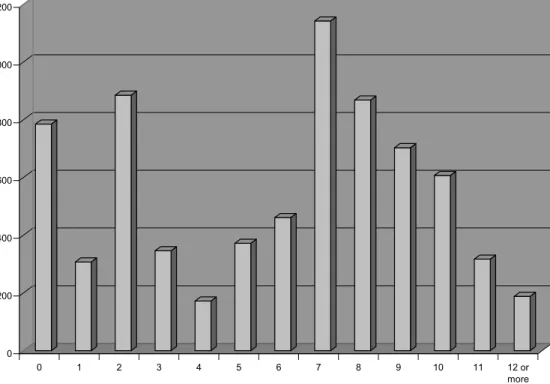
Figure 1: Scope of Conditionality
(Country-Months in which Each Number of Categories of Conditions Applied)
0 200 400 600 800 1000 1200 Countr y Month s 0 1 2 3 4 5 6 7 8 9 10 11 12 or more Number of Categories of Conditions
In an average month, six categories of conditions were subject to test at the next review; about two-thirds of the time, at least two and no more than ten types of conditions were under review. In about 11 percent of program months, no conditions were tested
because the program remained open after the final review. Figure 1 illustrates the variation in the number of categories of conditionality applied. For the statistical analysis reported below, we include only observations that fall on test dates to avoid inflating the number of
observations in the raw data. [Figure 1 about here.]
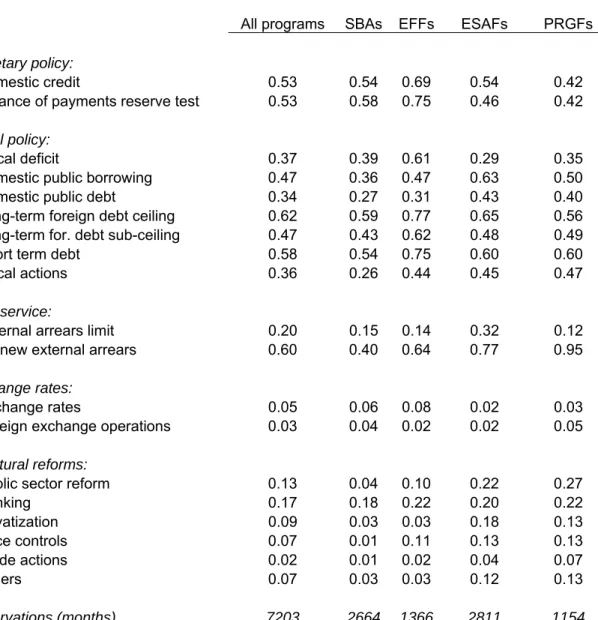
Table 1 illustrates the substantive variety of IMF conditionality. Some aspects of IMF conditionality are very consistent: domestic credit is constrained and reserve targets are set about half the time, and there is almost always some limit on public debt or government spending, although the forms of those restrictions vary. There is a strong emphasis on avoiding foreign debt arrears. Some programs involve extensive regulation of public
spending, taxation, borrowing, and the maturity structure of domestic and foreign debt, while others simply set deficit targets. However, the frequent criticism (Hills, Peterson, and
Goldstein 1999; Meltzer 2000; Stiglitz 2002) that the IMF systematically supported
particular exchange rate regimes or adjustments in the 1990s is not supported by the data on conditionality. Although structural conditions of some sort are tested 43 percent of the time, even our coarse breakdown of structural reforms into six categories indicates that structural conditionality varies enormously across countries. In fact, the way we have aggregated the data understates the case. Our experience with the raw data revealed that many structural reforms are very country-specific and refer to proper names of institutions and organizations to be reformed, so a six-fold categorization of structural reforms exaggerates the similarity of conditions across countries.
Table 1: Coverage of Conditions under IMF programs, 1992–2002
All programs SBAs EFFs ESAFs PRGFs
Monetary policy:
Domestic credit 0.53 0.54 0.69 0.54 0.42
Balance of payments reserve test 0.53 0.58 0.75 0.46 0.42
Fiscal policy:
Fiscal deficit 0.37 0.39 0.61 0.29 0.35
Domestic public borrowing 0.47 0.36 0.47 0.63 0.50
Domestic public debt 0.34 0.27 0.31 0.43 0.40
Long-term foreign debt ceiling 0.62 0.59 0.77 0.65 0.56
Long-term for. debt sub-ceiling 0.47 0.43 0.62 0.48 0.49
Short term debt 0.58 0.54 0.75 0.60 0.60
Fiscal actions 0.36 0.26 0.44 0.45 0.47
Debt service:
External arrears limit 0.20 0.15 0.14 0.32 0.12
No new external arrears 0.60 0.40 0.64 0.77 0.95
Exchange rates:
Exchange rates 0.05 0.06 0.08 0.02 0.03
Foreign exchange operations 0.03 0.04 0.02 0.02 0.05
Structural reforms:
Public sector reform 0.13 0.04 0.10 0.22 0.27
Banking 0.17 0.18 0.22 0.20 0.22 Privatization 0.09 0.03 0.03 0.18 0.13 Price controls 0.07 0.01 0.11 0.13 0.13 Trade actions 0.02 0.01 0.02 0.04 0.07 Others 0.07 0.03 0.03 0.12 0.13 Observations (months) 7203 2664 1366 2811 1154
The scope of conditionality varies across types of IMF programs. Stand-by facilities (SBAs) are typically one- to two-year programs offered to the relatively high-income borrowers, and they test an average of five categories of conditions per month; Extended Fund Facilities (EFFs) are typically three-year arrangements with more ambitious goals, and they average seven test categories. Extended Structural Adjustment Facilities (ESAFs) and
Poverty Reduction and Growth Facilities (PRGFs) are long-term programs for poor
countries, and their average levels of conditionality were intermediate between the other two. The replacement of the ESAF program by the PRGF ushered in new poverty-reduction targets and increased the emphasis on debt arrears, but otherwise generally scaled back the application of conditionality.
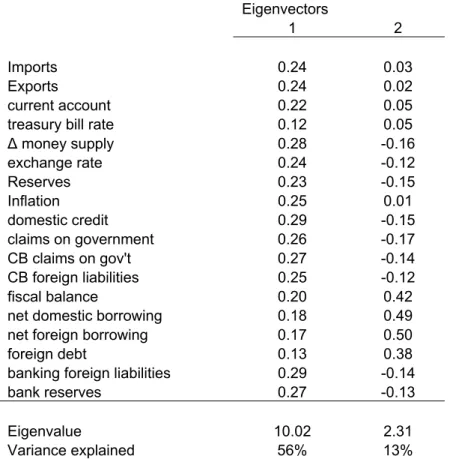
A principal components analysis of the categories did not reveal any clear pattern of clustering of types of conditions; thus, it is not the case that conditionality follows, for example, one, two, or more typical patterns. Rather, conditions are applied idiosyncratically and apparently in response to local circumstances. Only one component was revealed to be important, and it reflected the number of categories applied, so in the analysis that follows we use the number of categories of conditions as our measure of the breadth of
conditionality.
4. Participation in IMF Programs
In the first stage of our analysis, we model participation in IMF programs using a bivariate probit model with partial observability.9 The dependent variable for the analysis is an indicator variable coded 1 when a country participates in a program and 0 when it does
9 This model is due to Poirier (1980), and has been used in studies of IMF conditionality by
Przeworski and Vreeland (2000) and Vreeland (2003). The model is bivariate probit because the dependent variable is modeled as the product of two dichotomous decisions (one made by the country and the other by the IMF). It is a model with partial observability because we only observe ones when both the country and the IMF choose a program; when we observe zeros we do not know whether the country, the IMF, or both rejected a program. In contrast to Vreeland (2003, 105–6), we do not assume that the two decisions are independent, so the model includes a parameter for the correlation between the error terms.
not. We treat this variable, z, as the product of two decisions: G t i
d, , the government’s decision to participate, and IMF
t i
d, , the IMF’s decision to approve a program. We observe zi,t=1 only when G t i d, =1 and IMF t i
d, =1. The sample includes only observations in which there is no prior program in force, so the model explains program initiation.
The government’s value of participating in an IMF-supported program is expressed by the latent equation:
G t i G G t i G t i X d * , , , = β +ε
Similarly, the IMF’s value of participation is: IMF t i IMF IMF t i IMF t i X d * , , , = β +ε
The probability of observing z=1 is the probability that both latent variables are positive, where the disturbance terms (εi,t) are distributed normally with correlationρ. If Φdenotes
the bivariate standard normal distribution, then the probability of program initiation is:
(
,β , IMF, βIMF;ρ)
t i G G t i i X X p =ΦSeveral macroeconomic and domestic political variables, as well as time series controls, are assigned to both equations, implying that they influence both decisions (see Table 4, below). For example, an extensive literature on participation in IMF programs finds that the level of foreign reserves, changes in reserves, and changes in the exchange rate are correlated with program initiation. In addition, we allow for the degree of democracy, the number of countries participating in programs, and the government’s legislative support, left-right policy inclinations, and number of coalition partners to influence both decisions. At this point, however, a set of priors is needed to identify the latent equations, which allow us
to distinguish the country’s decision to apply for a program from the IMF’s decision to extend support. Multiple identification restrictions are required for global identification (Poirier 1980, 213).10 We identify our model by assigning the variables specified in Table 2 to only one equation.
Table 2: Identifying Conditions
Government Decision to Enter a Program IMF Decision to Support a Program
Foreign Debt /GDP Foreign Debt
Current Account Deficit /GDP Current Account Deficit
Budget Deficit /GDP Institutional Weakness (Missing Data 1)
Past Participation in IMF Programs Institutional Effort (Missing Data 2)
GDP per capita U.S. Aid Recipient
Net Foreign Direct Investment UN Voting (S-Score with U.S.)
Proximity to an Election Year IMF Quota
OECD Aid
To make our results comparable to previous work, we follow Przeworski and Vreeland (2000) and Vreeland (2003) in assigning several macroeconomic aggregates normalized by GDP to the government’s decision, while assigning the same aggregates in absolute terms to the IMF’s approval decision. The substantive import of this assumption is that the IMF may have special concerns about the impact of a country’s instability on international markets that the country’s own government does not share. We expect that governments’ interest in participating in programs depends on the frequency of past
participation, which allows for the possibility of recidivism (Bird, Hussain, and Joyce 2004).
10 In our experience, the model is unstable until the equations are pinned down by a few instruments
In addition, governments of poorer countries and those that are not sustained by substantial inflows of foreign direct investment should have more interest in participating in a program. In addition, we expect that governments will be more willing to assume the political risks of unpopular policies shortly after winning an election.
An important identifying assumption for the approval equation is that the IMF’s willingness to extend a program depends upon a country’s technical capacity to implement one, but a country’s interest in participating does not. Our measure of institutional capacity is derived from the pattern of missing data in the information reported to the IMF and published in International Financial Statistics.11 Principal components analysis of the pattern generates two variables. Low institutional capacity is measured by the first principal component of the missing data, which captures the overall prevalence of missing data. The second principal component has a mix of positive and negative loadings, and a larger value appears to represent the effort that countries make to comply with IMF reporting standards.12 In
11 For each of eighteen key variables, we coded a dummy variable to take the value 1 if data were
missing in a given month and zero otherwise. The eighteen variables were: imports, exports, current account, the interest rate on treasury bills, the change in the money supply (M1), the exchange rate, international reserves, inflation, aggregate domestic credit, claims on the central government, central bank claims on the central government, central bank foreign liabilities, budget balance, net domestic borrowing, net foreign borrowing, foreign debt, commercial bank foreign liabilities and commercial bank reserves. Principal components analysis of these series revealed two main components
(eigenvalues of 10.0 and 2.3, respectively), which together account for 68 percent of the variation along the eighteen dimensions. The scoring coefficients for the two components are in Appendix Table A1.
12 The interpretation of the first component is clear, because all of the loadings are positive, but the
interpretation of the second component (missing data 2) is more complex. It has positive loadings for budget balance, foreign and domestic borrowing, and foreign debt, so it represents the tendency to fail to report those variables; however, it has negative loadings for a range of less frequently available macroeconomic and banking indicators. A larger value of this component, therefore, represents the tendency to report data that low-capacity governments would not ordinarily generate without prodding from the IMF.
addition, following a growing literature that shows that IMF lending depends upon ties with the United States and other leading IMF shareholders, we allow for the possibility that the Fund’s willingness to support a program will be affected by U.S. foreign aid to the borrowing country, the association in UN voting patterns between the potential borrower and the
United States, and development aid from other OECD countries (Thacker 1999; Barro and Lee 2002; Dreher and Jensen 2007; Stone 2002, 2004).13 Also, the size of a country’s claim on IMF resources (IMF quota) may affect the Fund’s willingness to extend a program.
Our results, presented in Table 4, indicate that country decisions to apply for IMF support are related to long-term capital needs, macroeconomic vulnerability, and the timing of elections. [Table 4 about here.] All else equal, poorer countries (those with lower per capita incomes) are more likely to seek IMF assistance. Foreign exchange reserves play an important role in seeking IMF support. The average country in the sample held 3.5 percent of GDP in reserves, but a country that held one standard deviation more in reserves, or 65.5 percent of GDP, was 54 percent less likely to apply for an IMF program. Higher foreign debt also appears to motivate countries to turn to the Fund, but the quantitative effect is small. A larger fiscal deficit (smaller fiscal balance) appears to steer a country away from the Fund, suggesting that governments expect conditionality to be onerous in a situation of rising public debt. The average country in the sample had a budget deficit of 1.6 percent of GDP, but a country that had a deficit one standard deviation greater, or 5.5 percent, was 14 percent less likely to apply for a Fund program. Similarly, although low reserves move a country
13 A series of influential studies support the argument that the United States uses aid as an instrument
toward a Fund program, countries with deteriorating foreign reserves appear to be reluctant borrowers (p=.07). Domestic political constraints appear to weigh heavily on borrowers’ minds, because a government is 42 percent more likely to apply in the year after it has won an election. Democracies, however, show more interest in program participation, suggesting congruence between democracy and economic reforms.
Recipients of U.S. aid are 39 percent more likely to have their programs approved. Strikingly, aid from other members of the OECD does not have a discernible influence on IMF decisions to approve programs. Institutional weakness, measured by missing data, is negatively related to IMF decisions to extend programs, implying that general weakness in institutional capacity reduces the IMF’s willingness to support a program. A one-standard deviation increase in the prevalence of missing data reduces the probability of program approval by 28 percent. Conversely, a government that makes an effort to comply with IMF reporting standards raises the probability that it will be approved for a program: the variable Institutional effort is positively related to program approval, with a one-standard deviation shift increasing the probability that the Fund grants a program by 16 percent. Finally,
countries that have substantially devalued their exchange rates, or that have recently suffered from exchange rate crises, are more likely to be approved for IMF programs, presumably because program targets more likely to be achieved.
These results support one hypothesis derived from the public choice perspective: governments prefer to wait until after elections to turn to IMF programs, to avoid electoral accountability for the short-term pain of reforms. However, several other public choice hypotheses are rejected. Vreeland (2003) argues that governments with large numbers of coalition members should be eager to participate in IMF programs in order to commit
themselves to carry out reforms that would otherwise be blocked by veto players; in contrast, the IMF should be less interested in initiating programs under those circumstances. We find no support for either hypothesis. Vreeland further argues that the Fund’s interest in pushing loans should be reflected in a decreasing probability of extending new programs when many countries are concurrently participating, as its interest in expanding its influence becomes satiated and its resources become tightly stretched. We find no such effect.
In sum, countries are eager to apply when their need for emergency financing is severe, but reluctant when the rates of change of macroeconomic aggregates indicate that the Fund will prescribe tough fiscal and monetary discipline. Democracies are more likely to apply for programs, but will generally wait until after an election to come to grips with politically risky reforms. The probability that the IMF will approve a program is higher when the borrower is a recipient of U.S. foreign aid, when the country has high levels of
institutional capacity and also makes an effort to collect the data that the IMF requires, and when the borrower’s currency has recently depreciated. These results provide a plausible basis for using the predicted probabilities from our two equations as measures of the interest of the borrower and the willingness of the IMF, respectively, to initiate an IMF program.
5. The Scope of Conditionality
The dependent variable is the number of categories of conditions subject to test in the current month, ranging from 0 to 19, and we use a negative binomial event count model to
analyze variation in the scope of conditionality. 14 Observations are defined whenever new information about conditionality appears in the MONA database: when a new program is initiated, when a program review occurs, and when a disbursement is scheduled or actually takes place.
Conditional Autonomy
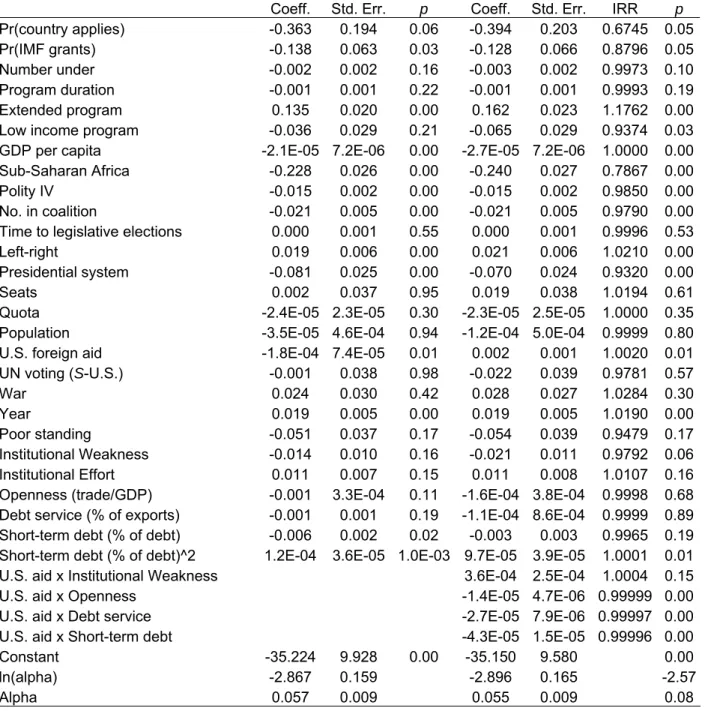
We hypothesized that if the IMF’s autonomy to determine conditionality were constrained, variables associated with borrowers’ relationships with the leading shareholders should affect conditionality. We found that countries that received U.S. foreign aid were more likely to be approved for IMF programs, and the results in Table 5 indicate that countries that are more likely to be approved are also offered programs with narrower conditionality. This is consistent with the interpretation that the United States restrains the IMF’s ability to impose conditions on U.S. aid recipients, and we will discuss this result further below. First, we turn to a more direct test of this hypothesis, that U.S. aid should be
14 Negative binomial regression is a generalization of the Poisson event count model. Unlike the
Poisson, it does not assume that the rate of occurrence, λ, is constant across events in an observation. Instead, it is parameterized by the gamma distribution, with E(λ)=φ and ν(λ )= φ(σ2-1). For our purposes, this means that the marginal probability of observing an additional condition can vary within a particular month; for example, conditions could be characterized by contagion. The distribution of the dependent count variable is given as:
( )
2 1 2 2 2 2 2 1 2 1 ! 1 ) , | ( − − ⎟⎟ ⎠ ⎞ ⎜⎜ ⎝ ⎛ − ⎟ ⎠ ⎞ ⎜ ⎝ ⎛ − Γ ⎟ ⎠ ⎞ ⎜ ⎝ ⎛ + − Γ = σ λσ
σ
σ
σ
λ
σ
λ
σ
λ
i y i i i nb y y y fassociated with narrower conditionality. The results indicate that countries that receive substantial amounts of U.S. foreign aid are subject to dramatically reduced degrees of conditionality. This effect, indeed, is substantively important enough to overwhelm the effects of all other factors in the countries that are the largest aid recipients. This is not the full story, however. Closer examination of these effects reveals a pattern that suggests that the United States intervenes in the design of conditionality selectively, rather than
systematically. It appears that the Fund enjoys conditional autonomy to design conditionality: the United States becomes involved only when the borrower has a pressing need for IMF support, and is less willing to intervene on behalf of countries with weak institutional capacity. While a simple correlation between aid and conditionality might be attributed to a variety of confounding factors, this particular pattern of results appears too purposive to be coincidental.
The first model presented in Table 5 indicates that U.S. aid is associated with
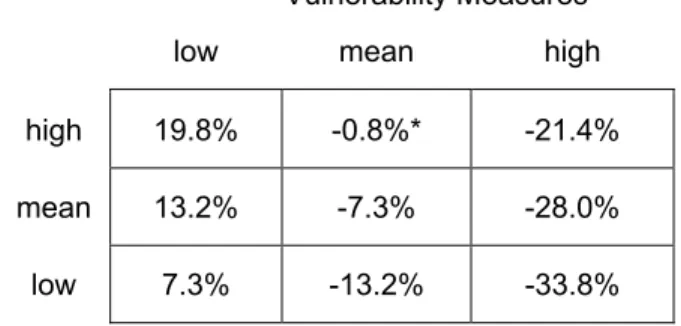
narrower conditionality. These effects are important enough to warrant further investigation, so we estimated a second model to determine the conditions under which it operates. The second model interacts U.S. foreign aid with three measures of vulnerability: Openness (trade/GDP, reflecting dependence on continued access to international markets), Debt service, and Short-term debt (representing rollover risk), and our measure of Institutional weakness. These interactive effects require interpretation, so Figure 2 presents substantive effects of the variables based on Model 2.
Figure 2: Effects of U.S. Foreign Aid Conditional on Vulnerability15
Vulnerability Measures
low mean high
Institutional Weakness high 19.8% -0.8%* -21.4%
mean 13.2% -7.3% -28.0%
low 7.3% -13.2% -33.8% *Not statistically significant.
The entries in the cells are the substantive effects of a one standard-deviation increase in U.S. foreign aid; because of the interactions, these effects depend upon the vulnerability and institutional capacity of the borrower. (The vulnerability measures are correlated and have similar effects, so for ease of presentation we vary them simultaneously.) U.S. aid is associated with reduced conditionality, but only when countries are at least as vulnerable as the average program participant—i.e., when debt service amounts to 18 percent of exports, 10 percent of debt is short term, and trade accounts for two-thirds of GDP. We interpret this to indicate that the influence represented by aid is a resource both for the United States and for the aid recipient, and recipients are reluctant to spend this resource when it is not necessary to do so. When they are not vulnerable, aid recipients choose not to spend their influence by calling on the United States to influence the Fund. When vulnerability is high, however, this effect can be large. In a high-capacity state with high vulnerability, a one
15 Vulnerability measures include the ratio of trade to GDP, debt service as a share of exports, and the
percentage of total debt held in short-term instruments. High and low are one standard deviation above and below the mean, respectively. For ease of presentation, the three measures are varied simultaneously because their effects are qualitatively the same. U.S. aid in these models is measured in millions of U.S. dollars. The results were qualitatively the same when U.S. aid was measured as a percentage of GDP.
standard-deviation increase in U.S. aid has the effect of reducing the breadth of conditionality by one-third.
On the other hand, borrowers that are less vulnerable than the average program participant according to all three measures are subject to greater conditionality: the estimates indicate that the effect of one standard deviation of U.S. aid in a low-capacity state with low vulnerability is to expand the scope of conditionality by about 20 percent. When the United States does not interfere on behalf of a country that has substantial latent influence, the Fund management may seize the opportunity to impose a robust set of conditions that will provide strong grounds for suspending financing in the future in the event of non-compliance. It is important to note, however, that the number of observations of IMF programs in cells with low vulnerability on all dimensions is relatively small and, hence, this effect refers to relatively few recipients of IMF support.
The United States appears to be less willing to intervene on behalf of low-capacity states (those with substantial missing data), which are more penalized for aid when not vulnerable and less advantaged by their influence with the United States when vulnerable. This suggests that the substantive significance of U.S. foreign aid for a country’s relationship with the United States is very different for strong states than for weak states. Strong states are more nearly equals, and the fact that they are important enough to the United States to receive aid indicates that they have leverage that they can use to demand concessions. Weak states in Africa, in contrast, may depend upon foreign aid for ten percent of GDP and as much as two-thirds of government consumption, and are in no position to make demands. Consequently, the aid that they receive may not indicate that they have substantial excess leverage to apply when they need help negotiating with the Fund.
IMF Objectives
As noted above, the bivariate probit model employed at the selection stage generates two predicted probabilities: the marginal probability that a country applies to the IMF for support, and the marginal probability that the IMF is willing to approve a program. We treat these predicted values as measures of bargaining power.16 The expectation of bargaining theory is that the probability that a country seeks a program should be associated with wider conditionality and the probability of program approval should be associated with narrower conditionality.
The public choice model offers a clear-cut prediction about the first of these
variables: the IMF imposes the maximum possible level of conditionality, so countries that are motivated to accept IMF support are compelled to accept more conditions. Our results, however, indicate that countries that are eager to receive loans accept no more restrictions than those that are reluctant. Instead, we see a pattern in which the IMF imposes more conditions on reluctant borrowers and fewer on countries that are eager to participate.
Perhaps IMF staff judge that countries that are highly motivated to seek IMF loans also have strong internal incentives to carry out reforms without explicit IMF conditionality, and that it is the reluctant reformers who require extensive surveillance. For our purposes, however, it is significant that we observe that the IMF refrains from imposing maximum levels of
16 Because these probabilities are estimated, it is necessary to correct the standard errors in the second
stage for the variance of the estimated regressors. In the absence of an analytical solution for the particular combination of models used here, we use a bootstrap approach. Bootstrapping involves drawing multiple samples of size N from the data with replacement, replicating the procedure multiple times, averaging the coefficients and calculating the standard errors from the empirical distribution of beta.
conditionality when it has the opportunity to do so; this is behavior that is inconsistent with the image of an out-of-control agency seeking to expand its influence.
The bargaining expectation is borne out for the probability of program approval: countries that are most likely to be approved receive programs with the narrowest
conditionality. This could be consistent with alternative interpretations, depending upon the determinants of program approval. The public choice perspective predicts that the IMF should offer programs with fewer conditions when its own organizational incentives make it disposed to make loans. However, the results of the first-stage analysis did not support public choice hypotheses about the IMF’s motivations for making loans.17 To the contrary, the most impressive influence on the IMF’s willingness to lend was whether a country was a recipient of U.S. foreign aid. This gives the coefficient in the second stage—countries likely to be approved receive less intrusive programs—an interpretation consistent with our earlier findings about the constraining effect of U.S. aid: the Fund is constrained by its principals, and the same factors that lead to program approval act to limit the extent of conditionality. Countries that are favored in the distribution of IMF programs receive more attractive terms because they know that the Fund’s threat to withhold support if they do not accept its policy recommendations is not credible.
17 The IMF does lend more readily to countries that consistently publish data, that make an effort to
collect the data that the IMF demands, and that have devalued their currencies, all factors that should satisfy organizational incentives to approve programs only if they are likely to be successful.
However, since these factors also indicate that less conditionality may be necessary for technical reasons that have nothing to do with organizational biases, they do not represent clean tests of a public choice hypothesis.
Another important dimension of bargaining power is the borrower’s need for external financing. Countries that use a large portion of their exports for debt service and that owe a large proportion of their foreign debt in short-term instruments (resulting in greater rollover risk of external financing) should be particularly dependent upon non-market sources of financing. Indeed, we found above that countries with significant external debt are more likely to seek IMF support, and they should therefore be willing to accept more conditions in return for that support. The IMF, on the other hand, aware of its strong bargaining position, should be able to push for far-reaching reforms in this situation (Stallings 1992). The public choice perspective indicates that the Fund should not hesitate to exploit these opportunities to extract extensive reform commitments. Similarly, countries with more open economies are likely to be more vulnerable to international supply and demand shocks, and the IMF should therefore enjoy a bargaining advantage.
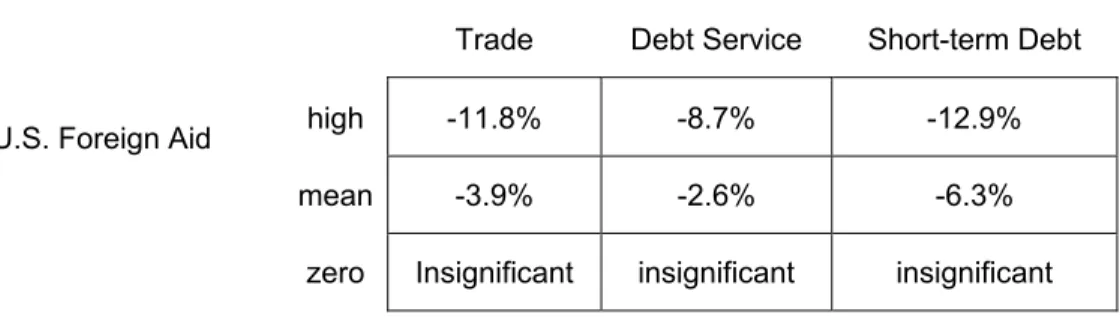
Our results reject these expectations, however.18 When these forms of vulnerability have any effect, it is to reduce rather than to increase the incidence of conditionality. As discussed above, vulnerability interacts with U.S. foreign aid in determining the
conditionality outcome, so it is necessary to evaluate these interaction effects in order to assess the effects of vulnerability. Figure 3 explores the substantive effects of various
measures of vulnerability, which depend upon the level of U.S. foreign aid. In each column, one vulnerability measure varies by one standard deviation while the others are held constant.
18 We also hypothesized that countries with large populations or large IMF quotas, which roughly
track the size of the national economy, trade and reserves, and capture a country’s weight in IMF Board votes, would enjoy extra bargaining leverage. However, there is no evidence that these variables have any effect.
Figure 3: Effects of Vulnerability Conditional on U.S. Foreign Aid
Vulnerability Measures
Trade Debt Service Short-term Debt
U.S. Foreign Aid high -11.8% -8.7% -12.9%
mean -3.9% -2.6% -6.3%
zero Insignificant insignificant insignificant
In no case do countries receive more ambitious program targets because they are dependent upon foreign trade flows, are heavily indebted, or are in imminent need of debt restructuring; if these factors affect conditionality, it is only to reduce it. Thus, contrary to popular
criticisms of Fund policies during the East Asian crisis of 1997, international vulnerability has not, on average, led to more conditionality. When the IMF faces a particularly vulnerable country, it typically refrains from imposing the maximum possible degree of conditionality. However, none of the three variables that indicate vulnerability has any effect on
conditionality in countries that receive no U.S. foreign aid, which implies that vulnerability influences conditionality only because it triggers the latent effects of U.S. aid. In countries that do receive generous amounts of U.S. aid, these forms of vulnerability are reflected in substantially reduced degrees of conditionality. Countries that are both vulnerable and influential in Washington find ways to bring their influence to bear on the IMF, and this is reflected in the pattern of conditionality.
The effect of one form of vulnerability appears to support the public choice view, but our two-stage research design provides explanatory leverage that suggests an alternative
explanation. Poor countries receive programs with more extensive conditions. Dreher and Jensen (2007) have a similar finding and argue that poor countries have a weak bargaining position and are compelled to accept more conditions. If so, we ought to find this result reflected through the effects of our measures of bargaining power. We do indeed find that poor countries more actively seek support, which appears to support the view that the IMF is able to insist upon extensive reforms when the recipient has intense need for a program. However, as we saw above, the motivated borrowers that actively seek support are subject to less extensive conditionality, rather than more, which contradicts the public choice
hypothesis. Thus, the effect of poverty cannot act through bargaining. Instead, the most plausible interpretation is that IMF staff believe that sweeping reforms are more appropriate or necessary in low-income countries than in middle-income countries.
Borrower Objectives
The effects of domestic political conditions and state capacity, furthermore,
overwhelmingly reject the domestic variant of the public choice hypothesis, which held that governments use the Fund strategically to misrepresent their preferences to voters. To the contrary, the evidence points to conventional bargaining effects, with bargaining strength deriving from domestic constraints (Putnam 1988). First, countries with democratic
institutions receive markedly fewer conditions: an increase of one standard deviation on the Polity scale, or 5.5 points on a 21-point scale, results in an eight percent decrease in the scope of conditionality. This finding is subject to two possible interpretations, both consistent with a bargaining hypothesis. It may be that the Fund is sensitive to the criticism that its
Alternatively, it could be that democratic governments insist on more lenient programs because they face more domestic policymaking constraints than authoritarian governments. In either case, the IMF apparently accommodates the constraints of democratic politics.
Controlling for the degree of democracy, presidential systems receive seven percent fewer conditions than parliamentary democracies. This effect is consistent with a two-level bargaining interpretation: presidents lack some of the institutional advantages for legislating reform that prime ministers enjoy, and domestic weakness is associated with international bargaining power (Putnam 1988, Mansfield, Milner and Rosendorff 2000, Martin 2000). Again, this evidence contradicts the hypothesis that presidents turn to the Fund to tie their hands vis-à-vis the legislature because they lack the legislative powers of prime ministers. Political coalitions, which play an insignificant role in determining participation in IMF programs, nevertheless figure prominently in program design. Vreeland (2003) argues that fragmented governments are particularly eager to adopt binding conditions because their numerous coalition members block any movement away from the status quo. Leaders who desire reform in those circumstances find the IMF a convenient scapegoat, because they can use the prospect of losing IMF support as bargaining leverage within their own coalitions. To the contrary, we find that the more fragmented is the coalition government, the narrower is the scope of conditionality. Each additional party added to a coalition government reduces the breadth of conditionality by approximately two percent. In addition, governments with leftist ideologies receive less expansive reform targets. Governments of the Left are more resistant to expansive proposals for sweeping reform, and the bargaining outcome reflects their preferences. We see no evidence that left-wing governments are particularly anxious to
establish credibility or to avoid the policy consequences of populist electoral mandates (Milesi-Ferreti 1995, Cukierman and Tommasi 1998).
Finally, state capacity variables provide further evidence of bargaining. Controlling for per capita income levels, the weak states in sub-Saharan Africa received 21 percent fewer conditions. Low-interest rate facilities (SAF, ESAF and PRGF), available only to
low-income countries with generally weak states, are associated with approximately six percent narrower conditionality. Finally, countries with one standard deviation lower administrative capacity than the mean received four percent fewer conditions. Countries that are unlikely to be able to implement sweeping reforms apparently leverage their weaknesses into bargaining strength. They bargain for reduced conditionality rather than using the IMF as a cover to implement expansive reforms.
6. Conclusions
We reach conclusions about the scope and variability of conditionality, about the autonomy of the IMF, and about the organizational objectives of the Fund and the motivations of its borrowers.
The extent and composition of conditionality vary greatly across countries and over time, so there is no evidence for “one-size-fits-all” conditionality. The average program review covers performance criteria in six of the nineteen possible categories. While certain conditions relating to external vulnerability are common, there remains substantial variation across programs, both in terms of their overall breadth and in terms of their substantive objectives.
Our analysis of the decisions that lead to program initiation confirms some findings of previous research, but fails to support public choice arguments that IMF lending reflects an organizational imperative to push loans or an effort by borrowers to escape accountability to voters. Countries seek programs when they face serious external vulnerability, whereas the Fund prefers to select programs in countries where institutional capacity is strong enough to provide good prospects of adjustment and recovery. We also find that U.S. foreign aid recipients are substantially more likely to be granted IMF programs, which is consistent with previous studies. The various public choice hypotheses find little support. The IMF’s
willingness to lend does not appear to depend upon variations in its budget constraint, measured either in terms of a country’s quota or of the number of countries currently participating in IMF programs. Neither is there evidence that governments turn to the IMF because they face domestic opposition to reform, or that the IMF is less willing to lend to governments facing significant domestic opposition.
Turning to the pattern of conditionality, we find substantial evidence of U.S. influence, but with important qualifications. Countries that receive large amounts of U.S. foreign aid negotiate less ambitious applications of conditionality, and the effects of U.S. aid on conditionality are substantively very important. We interpret this to mean that the IMF cannot credibly threaten to withhold support from countries that enjoy the strong support of its largest shareholder, the United States, and consequently these countries enjoy a substantial bargaining advantage. The qualification is that these effects operate only when the borrowing country suffers from above-average levels of vulnerability to international shocks compared to the sample of program participants, which make IMF financing particularly urgent. We interpret this finding to mean that countries are reluctant to draw on their reserves of
influence with the United States when their need for financing is less urgent, leaving the IMF free to negotiate conditionality according to its own objectives. We describe this situation as conditional autonomy: the IMF is autonomous when the borrower is unimportant to the United States or the borrower is unwilling to spend the influence needed to call upon U.S. assistance in dealing with the Fund. Aid recipients with weak institutional capacity accept broader conditionality, indicating that the relationship between aid donors and recipients depends on the strength of the recipient state. Strong states can bargain with the United States on a more equal footing; weak states accept what they must.
Where the IMF is able to exercise discretion, it does not systematically attempt to maximize conditionality. In particular, countries that are anxious to borrow are subject to narrower conditionality. High levels of foreign debt and financial weakness impel countries to turn to the Fund for support, but neither debt service, rollover risk nor trade exposure are associated with more extensive conditionality. Rather than exploiting this bargaining leverage, the Fund apparently relies on the incentives that markets impose on vulnerable borrowers to institute effective reform programs. It is the case that the use of conditionality has steadily increased over time and has reached more deeply into domestic economic policy. However, in light of the evidence that the Fund avoids imposing intrusive conditionality on the most vulnerable borrowers, there is reason to think that these trends reflect changing views on how best to address the underlying causes of difficult development problems and macroeconomic instability rather than a boundless ambition to expand conditionality.
The domestic variant of the public choice hypothesis, which maintains that
governments turn to the IMF in order to overcome domestic opposition, and therefore adopt more extensive commitments when the opposition is stronger, fares no better. To the
contrary, the effects of democracy, division of powers, fragmented coalitions, and state capacity indicate that domestic constraints reduce the scope of conditionality. Borrowers use their domestic weaknesses to their bargaining advantage, and the IMF acquiesces in this outcome, either because it has little choice or because it responds to domestic realities.
The trade-off between autonomy and legitimacy dominates proposals to reform the IMF and to redistribute voting shares among its members, but to date the debate has been inadequately informed by empirical data. Academic and popular treatments alike assume that IMF conditionality is inflexible, failing to take into account the economic circumstances in which countries find themselves, and failing to adjust to the political realities on the ground that may make dangerous nonsense of idealistic policy reforms. Policy briefs representing the public choice view (Meltzer 2000) see the IMF as excessively autonomous, with a tendency to mission creep. This study rejects these conclusions. We find that conditionality varies widely, and that the Fund apparently refrains from maximizing the scope of conditionality when countries are highly motivated to adopt IMF programs. In addition, whether by design or by necessity, conditionality accommodates international and domestic political constraints. The Fund typically exercises autonomy, but that autonomy can be revoked. This leads to the uneven application of conditionality, and perhaps to credibility problems. The evidence suggests that the dangers of an autonomous IMF have been greatly overstated, and that the limitations on the Fund’s autonomy may be a more serious concern.
Table 4. Participation in IMF programs, 1990–2002 (full model)
Partial observability bivariate probit Number of observations = 14,440 (country months)
(robust standard errors adjusted for clustering by country)
Country Decisions IMF Decisions
Coef. Std. Err. p Coef. Std. Err. p
Reserves/GDP -0.0087 0.0025 0.00 0.0021 0.0016 0.19
∆ reserves 0.0004 0.0002 0.07 -9.0E-06 1.7E-05 0.60
∆ exchange rate -0.0008 0.0012 0.52 0.0691 0.0297 0.02 Polity IV 0.0238 0.0125 0.06 0.0169 0.0120 0.16 Seats 0.0000 0.1665 1.00 -0.0762 0.2555 0.77 Left-right 0.0492 0.0493 0.32 0.0208 0.0402 0.60 No. in coalition 0.0616 0.0416 0.14 -0.0228 0.0236 0.33 Number under -0.0093 0.0049 0.06 0.0108 0.0082 0.19
GDP per capita -0.0001 4.98E-05 0.01
Fiscal bal/GDP 0.0338 0.0154 0.03
Current acct./GDP 0.0005 0.0008 0.56
Foreign debt/GDP 5.0E-10 1.2E-10 0.00
FDI -5.2E-12 1.10E-11 0.64
Prior participation -0.1802 0.4478 0.69
Election 0.3502 0.1844 0.06
Current account 0.0001 0.0001 0.39
Foreign debt 1.64E-11 2.2E-11 0.45
Institutional Weakness -0.1144 0.0475 0.02
Institutional Effort 0.0939 0.0364 0.01
U.S. aid recipient 0.3314 0.1667 0.05
UN Voting (S-U.S.) -0.0353 0.1218 0.77
foreign aid (DAC) -6.4E-05 0.0002 0.75
Quota -0.0006 0.0006 0.27 Spline1 0.0134 0.0214 0.53 -0.0424 0.0169 0.01 Spline2 -0.0172 0.0071 0.02 0.0001 0.0040 0.99 Spline3 0.0101 0.0036 0.01 0.3240 0.8436 0.70 Constant -0.8590 0.4375 0.05 -1.9803 0.3255 0.00 ρ 0.9076 0.2519 0.29
Table 5. Conditionality under IMF Programs, 1990–2002
Negative binomial regression
No. of obs. 2794
Bootstrap estimates, 500 repetitions
Coeff. Std. Err. p Coeff. Std. Err. IRR p
Pr(country applies) -0.363 0.194 0.06 -0.394 0.203 0.6745 0.05
Pr(IMF grants) -0.138 0.063 0.03 -0.128 0.066 0.8796 0.05
Number under -0.002 0.002 0.16 -0.003 0.002 0.9973 0.10
Program duration -0.001 0.001 0.22 -0.001 0.001 0.9993 0.19
Extended program 0.135 0.020 0.00 0.162 0.023 1.1762 0.00
Low income program -0.036 0.029 0.21 -0.065 0.029 0.9374 0.03
GDP per capita -2.1E-05 7.2E-06 0.00 -2.7E-05 7.2E-06 1.0000 0.00
Sub-Saharan Africa -0.228 0.026 0.00 -0.240 0.027 0.7867 0.00
Polity IV -0.015 0.002 0.00 -0.015 0.002 0.9850 0.00
No. in coalition -0.021 0.005 0.00 -0.021 0.005 0.9790 0.00
Time to legislative elections 0.000 0.001 0.55 0.000 0.001 0.9996 0.53
Left-right 0.019 0.006 0.00 0.021 0.006 1.0210 0.00
Presidential system -0.081 0.025 0.00 -0.070 0.024 0.9320 0.00
Seats 0.002 0.037 0.95 0.019 0.038 1.0194 0.61
Quota -2.4E-05 2.3E-05 0.30 -2.3E-05 2.5E-05 1.0000 0.35
Population -3.5E-05 4.6E-04 0.94 -1.2E-04 5.0E-04 0.9999 0.80
U.S. foreign aid -1.8E-04 7.4E-05 0.01 0.002 0.001 1.0020 0.01
UN voting (S-U.S.) -0.001 0.038 0.98 -0.022 0.039 0.9781 0.57 War 0.024 0.030 0.42 0.028 0.027 1.0284 0.30 Year 0.019 0.005 0.00 0.019 0.005 1.0190 0.00 Poor standing -0.051 0.037 0.17 -0.054 0.039 0.9479 0.17 Institutional Weakness -0.014 0.010 0.16 -0.021 0.011 0.9792 0.06 Institutional Effort 0.011 0.007 0.15 0.011 0.008 1.0107 0.16
Openness (trade/GDP) -0.001 3.3E-04 0.11 -1.6E-04 3.8E-04 0.9998 0.68
Debt service (% of exports) -0.001 0.001 0.19 -1.1E-04 8.6E-04 0.9999 0.89
Short-term debt (% of debt) -0.006 0.002 0.02 -0.003 0.003 0.9965 0.19
Short-term debt (% of debt)^2 1.2E-04 3.6E-05 1.0E-03 9.7E-05 3.9E-05 1.0001 0.01
U.S. aid x Institutional Weakness 3.6E-04 2.5E-04 1.0004 0.15
U.S. aid x Openness -1.4E-05 4.7E-06 0.99999 0.00
U.S. aid x Debt service -2.7E-05 7.9E-06 0.99997 0.00
U.S. aid x Short-term debt -4.3E-05 1.5E-05 0.99996 0.00
Constant -35.224 9.928 0.00 -35.150 9.580 0.00
ln(alpha) -2.867 0.159 -2.896 0.165 -2.57