c
MINING NOVEL SOURCES OF KNOWLEDGE TO IDENTIFY CAUSAL
INFORMATION IN TEXT
BY
MEHWISH RIAZ
DISSERTATION
Submitted in partial fulfillment of the requirements
for the degree of Doctor of Philosophy in Computer Science
in the Graduate College of the
University of Illinois at Urbana-Champaign, 2014
Urbana, Illinois
Doctoral Committee:
Associate Professor Roxana Girju, Chair
Professor ChengXiang Zhai
Assistant Professor Julia Hockenmaier
Abstract
The abundance of information on the internet has impacted the lives of people to a great extent. People take advantage of the internet to acquire information for several day to day social and political activities. Though the plenty of information on the internet is of great use, it takes lot of time to go through a number of text articles to understand events and the causal relations between events that build a particular social or political news story. In this thesis, we focus on the problem of automated extraction of causal information in text. This can be of great assistance to the people who strive to acquire the flow of events in text to make various decisions and predict consequences of their decisions.
In natural language, causal relations can be encoded using various linguistic constructions. Each con-struction with its own semantics can pose various challenges for the problem of identifying causality. In this thesis, we address the tasks of identifying causality between two verbs and a verb and a noun by deeply analyzing semantics of these constructions. After the successful use of linguistic features for various Natural Language Processing (NLP) tasks, several approaches have been proposed to identify causality using such features in the framework of supervised learning. However, it is not practical to depend merely on these features because there are many factors involved in identifying causality such as background knowledge, semantic and pragmatic features of events, world knowledge, etc. In addition to the above, the supervised learning approaches are sensitive to the size of training corpus and the type of contexts of training instances. For example, the unambiguous training instances do not provide a better supervision for the ambiguous and implicit instances of semantic relations including causality [Sporleder and Lascarides 2008]. Therefore, in this work instead of merely relying on the linguistic features extracted from the contexts of training instances, we propose an approach to derive novel sources of knowledge for identifying causal information in text. In the first part of this thesis, we introduce methods to acquire background knowledge and the knowledge of causal semantics of verbs for the task of identifying causality between the two state of affairs represented by verbs. After the knowledge acquisition step, we integrate the above types of knowledge with a supervised classifier employing linguistic features to obtain optimal predictions for the current task. Similarly, in the second part of this thesis, we propose methods to acquire and employ the knowledge of causal semantics
of nouns, verbs and verb frames to identify causality between the two state of affairs represented by verbs and nouns. With the addition of novel sources of knowledge, our models for the current tasks gain lots of progress in performance over the baseline of supervised classifiers relying merely on linguistics features. Moreover, in comparison with these supervised classifiers, performance of our models is more robust on all types of context –i.e., unambiguous, ambiguous and implicit contexts.
Acknowledgments
I strongly believe that my PhD dissertation would not have been completed without the guidance of my adviser Roxana Girju. I want to start with expressing my deepest gratitude to my adviser for her support and encouragement throughout my graduate studies. During initial days of my graduate studies, she was the one who guided me to develop ideas to deal with various challenging research problems. In order enhance my research skills, she advised me on which courses should I take to acquire in-depth knowledge of Natural Language Processing (NLP). She always encouraged me to go deep into the natural language semantics to address the topic of my PhD thesis research and other research areas in NLP. Moreover, Roxana helped me a lot in developing well written research papers.
I owe special thanks to my PhD committee members Prof. ChengXiang Zhai, Prof. Julia Hockenmaier and Prof. Barbara Di Eugenio for their valuable suggestions on my research work. I got opportunity to discuss my research with them during and after my prelim exam. I found those discussions very effective in improving my thesis research.
I also want to convey thanks to the Semantic Frontiers research group members Brandon Beamer, Michael Paul, and Rania Al-Sabbagh supervised by my adviser. My discussion with Brandon Beamer on the topic of causality was quite helpful for me in understanding the notion of causality and developing an approach for identifying causality in text. In general our research group’s discussions on various topics of NLP helped me a lot in developing research skills.
Some part of my PhD studies was financially supported in terms of full and partial Sohaib and Sara Abbasi Computer Science Fellowships. I am highly obliged to Sohaib Abbasi, CEO of Informatica, and his wife Sara Abbasi for their generous financial support for me.
Finally, I am truly grateful to my parents, husband, sister and brother for their love and support required to achieve various milestones of graduate studies.
Table of Contents
List of Tables . . . viii
List of Figures . . . xi
Chapter 1 Introduction . . . 1
1.1 Automated Identification of Causal Information . . . 3
1.2 Research Questions . . . 5
1.3 Thesis Contributions . . . 8
1.3.1 Background Knowledge . . . 9
1.3.2 Causal Semantics of Verbs . . . 10
1.3.3 Causal Semantics of Nouns . . . 11
1.3.4 Causal Semantics of Verb Frames . . . 11
1.4 Thesis Organization: . . . 12
Chapter 2 Relevant Work . . . 13
2.1 Identification of Causality in Natural Language Text . . . 13
2.2 Identification of Events, Semantic Classes and Temporal Relations . . . 17
Chapter 3 Knowledge Acquisition for Verb-Verb Pairs . . . 20
3.1 Identification of Causality via Linguistic Features . . . 22
3.1.1 Acquisition of Training Corpus . . . 22
3.1.2 Linguistic Features . . . 26
3.2 Extraction of Background Knowledge . . . 29
3.2.1 Explicit Causal Association (ECA) . . . 30
3.2.2 Implicit Causal Association (ICA) . . . 32
3.2.3 Forms of Background Knowledge . . . 35
3.3 Identification of the Causal Semantics of Verbs . . . 36
3.3.1 Linguistic Definition of Events . . . 36
3.3.2 Semantic Classes of Events . . . 37
3.4 Summary . . . 43
Chapter 4 Identifying Causality in Verb-Verb Pairs . . . 44
4.1 Model for Identifying Causality . . . 44
4.1.1 Knowledge on Context . . . 44
4.1.2 Background Knowledge . . . 45
4.1.3 Knowledge of Causal Semantics of Verbs . . . 48
4.1.4 Integer Linear Program: ILPKB1 . . . 52
4.1.5 Integer Linear Program: ILPKB2 . . . 53
4.2 Empirical Study . . . 53
4.2.1 Evaluation Data . . . 54
4.2.2 Assessment of the Knowledge of Context . . . 55
4.2.4 Assessment of the Causal Semantics of Verbs . . . 64
4.2.5 Error Analysis and Discussion . . . 68
4.3 Conclusion . . . 71
Chapter 5 Knowledge Acquisition for Verb-Noun Pairs . . . 73
5.1 Identification of Causality via Linguistic Features . . . 74
5.1.1 Acquisition of Training Corpus . . . 75
5.1.2 Linguistic Features . . . 76
5.2 Identification of the Causal Semantics of Nouns . . . 77
5.2.1 Semantic Classes of Nouns . . . 78
5.2.2 Metonymies . . . 80
5.3 Identification of the Causal Semantics of Verbs . . . 86
5.4 Identification of the Causal Semantics of Verb Frames . . . 87
5.5 Identification of Indistinct Verbs and Nouns . . . 90
5.6 Summary . . . 91
Chapter 6 Identifying Causality in Verb-Noun Pairs . . . 93
6.1 Model for Identifying Causality . . . 93
6.1.1 Knowledge of Context . . . 93
6.1.2 Knowledge of Causal Semantics of Nouns . . . 94
6.1.3 Knowledge of Causal Semantics of Verbs . . . 95
6.1.4 Knowledge of Causal Semantics of Verb Frames . . . 96
6.1.5 Knowledge of Indistinct Verbs and Nouns . . . 97
6.2 Empirical Study . . . 98
6.2.1 Evaluation Data . . . 98
6.2.2 Assessment of the Knowledge of Context . . . 99
6.2.3 Assessment of the Knowledge of Causal Semantics of Nouns . . . 99
6.2.4 Assessment of the Knowledge of Causal Semantics of Verbs . . . 102
6.2.5 Assessment of the Knowledge of Causal Semantics of Verb Frames . . . 102
6.2.6 Assessment of the Knowledge of Indistinct Verbs and Nouns . . . 103
6.2.7 Error Analysis and Discussion . . . 105
6.3 Conclusion . . . 108
Chapter 7 Conclusions . . . 110
7.1 Summary . . . 110
7.2 Future Work . . . 112
Appendix A Human Annotations . . . 114
A.1 Verb-Verb Pairs . . . 114
A.2 Verb-Noun Pairs . . . 115
Appendix B Frame Elements for the Cause and Non-cause Relations . . . 116
Appendix C Frame Elements for the Semantic Classes of Nouns . . . 119
List of Tables
3.1 A list of unambiguous discourse markers employed for the acquisition of a training corpus of evi-evj pairs encoding causal and non-causal relations. . . 25 3.2 The instances of linguistics features employed by the supervised classifier for identifying
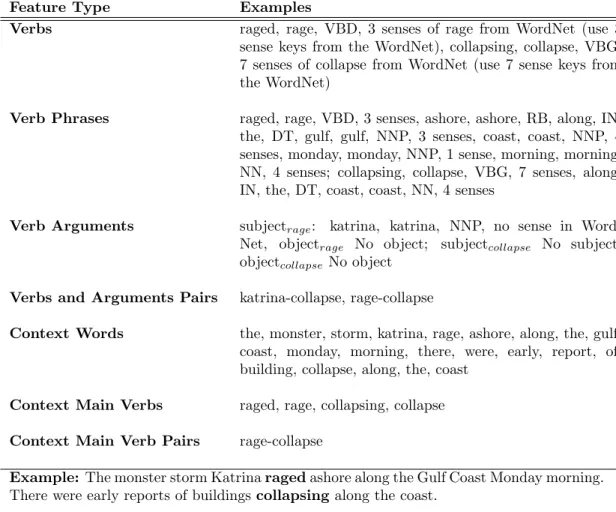
causal-ity in evi-evj pairs. . . 27 3.3 A list of causal discourse markers and the assignment of roles to the events of causal relations
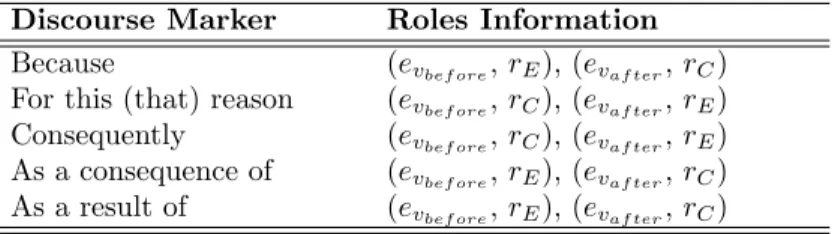
signaled by these markers. The eventevbef ore (evaf ter) is represented by the verb appearing
before (after) the causal discourse marker in text, respectively. . . 33 3.4 The linguistic features introduced by Bethard and Martin (2006) to identify events and
non-events and the semantic classes of non-events. . . 38 4.1 The total number of instances (Total), the number of total instances on which human
an-notators agreed and these instances are used for evaluation (Test Instances), the percentage of “Test Instances” with the label C (%C), the percentage of “Total” instances on which human annotators agreed to each other (% Agreement) and kappa value for the human inter-annotator agreement on the “Total” instances (Kappa). Bethard and Martin (2008) have not provided the total number of instances on which their human annotators applied the labels
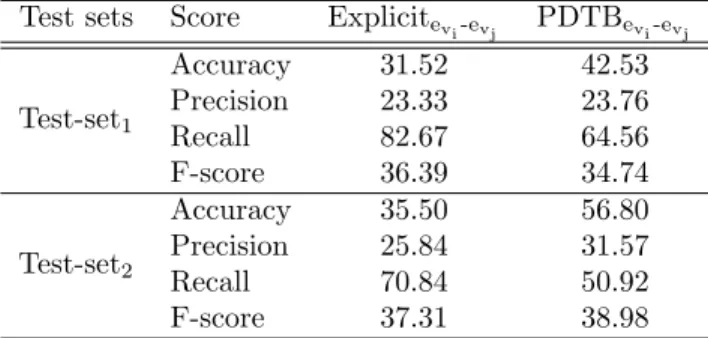
C and¬C. . . 55 4.2 The performance of supervised classifiers on Test-set1 and Test-set2 using the Explicitevi-evj
and PDTBevi-evj training corpora. The results are provided using NB classifier. Using the
Explicitevi-evj corpus, MaxEnt classifier gives a very low F-score of around 20% on both test
sets. Using the PDTBevi-evj corpus, MaxEnt classifier produces 34.13% (35.21%) F-score on
Test-set1 (Test-set2), respectively. . . 56
4.3 The performance of supervised classifier trained using the Explicitevi-evjcorpus and the models
with the addition of background knowledge of form KB1 to the supervised classifier. The
background knowledge is acquired using one of the following four metrics: (1) CEA, (2) ECA, (3) ICA and (4) BCA. . . 59 4.4 The performance of supervised classifier trained using the Explicitevi-evjcorpus and the models
with the addition of background knowledge of form KB2 to the supervised classifier. The
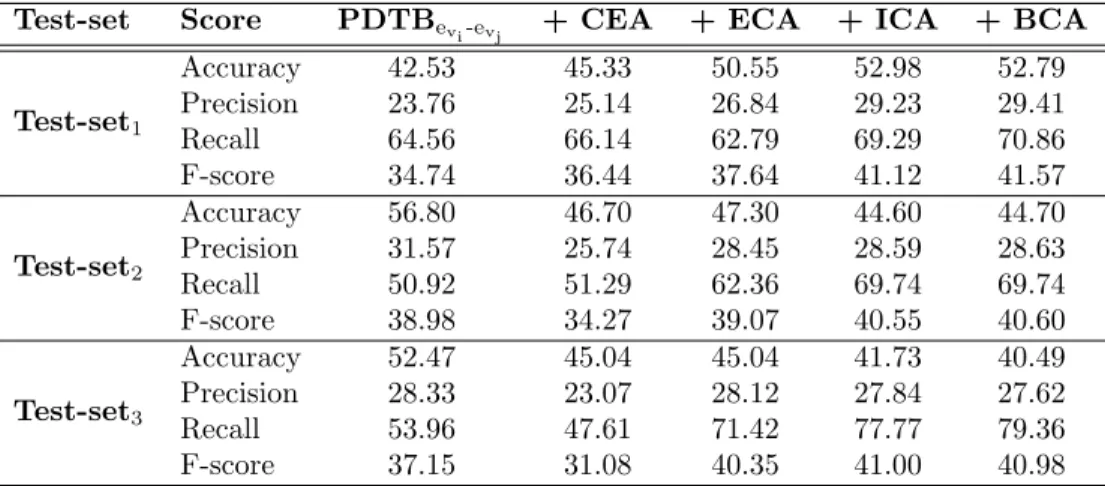
background knowledge is acquired using one of the following four metrics: (1) CEA, (2) ECA, (3) ICA and (4) BCA. . . 59 4.5 The performance of supervised classifier trained using the PDTBevi-evj corpus and the models
with the addition of background knowledge of form KB1 to the supervised classifier. The
background knowledge is acquired using one of the following four metrics: (1) CEA, (2) ECA, (3) ICA and (4) BCA. . . 60 4.6 The performance of supervised classifier trained using the PDTBevi-evj corpus and the models
with the addition of background knowledge of form KB2 to the supervised classifier. The
background knowledge is acquired using one of the following four metrics: (1) CEA, (2) ECA, (3) ICA and (4) BCA. . . 61
4.7 The performance of supervised classifier trained using the Explicitevi-evjcorpus and the models
with the addition of background knowledge (i.e., + KB1ICA) and the knowledge of causal
semantics of verbs. The knowledge of causal semantics of verbs is incorporated by adding information about the linguistic definition of events (i.e., +LD) and the semantic classes of events with a high and low tendency to encode causation (i.e., +¬Cev ={(R)EPORTING}OR +¬Cev ={(R)EPORTING, (S)STATE} OR +¬Cev ={(A)SPECTUAL}). The performance is provided in terms of the following (S)cores: (A)ccuracy, (P)recision, (R)ecall and (F)-score. 65 4.8 The performance of supervised classifier trained using the Explicitevi-evjcorpus and the models
with the addition of background knowledge (i.e., + KB1BCA) and the knowledge of causal
semantics of verbs. The knowledge of causal semantics of verbs is incorporated by adding information about the linguistic definition of events (i.e., +LD) and the semantic classes of events with a high and low tendency to encode causation (i.e., +¬Cev ={(R)EPORTING}OR +¬Cev ={(R)EPORTING, (S)STATE} OR +¬Cev ={(A)SPECTUAL}). The performance is provided in terms of the following (S)cores: (A)ccuracy, (P)recision, (R)ecall and (F)-score. 65 4.9 The performance of supervised classifier trained using the PDTBevi-evj corpus and the models
with the addition of background knowledge (i.e., + KB1ICA) and the knowledge of causal
semantics of verbs. The knowledge of causal semantics of verbs is incorporated by adding information about the linguistic definition of events (i.e., +LD) and the semantic classes of events with a high and low tendency to encode causation (i.e., +¬Cev ={(R)EPORTING}OR +¬Cev ={(R)EPORTING, (S)STATE} OR +¬Cev ={(A)SPECTUAL}). The performance is provided in terms of the following (S)cores: (A)ccuracy, (P)recision, (R)ecall and (F)-score. 66 4.10 The performance of supervised classifier trained using the PDTBevi-evj corpus and the models
with the addition of background knowledge (i.e., + KB1BCA) and the knowledge of causal
semantics of verbs. The knowledge of causal semantics of verbs is incorporated by adding information about the linguistic definition of events (i.e., +LD) and the semantic classes of events with a high and low tendency to encode causation (i.e., +¬Cev ={(R)EPORTING}OR +¬Cev ={(R)EPORTING, (S)STATE} OR +¬Cev ={(A)SPECTUAL}). The performance is provided in terms of the following (S)cores: (A)ccuracy, (P)recision, (R)ecall and (F)-score. 67 5.1 Some examples of the assignments of frame elements of FrameNet to the labelsC and¬C. . 75 5.2 The instances of linguistics features employed by a supervised classifier for identifying causality
in verb-noun phrase pairs. . . 77 5.3 Some examples of the assignments of frame elements of FrameNet to the classes Cnpand¬Cnp. 78
5.4 The assignments of WordNet’s senses of nouns to the classes Cnp and¬Cnp. . . 80
5.5 The fields of a knowledge base of verb frames. The FrameNet (FN) annotations are provided in this table along with the labels for the semantic classes of nouns (i.e., Cnp and ¬Cnp).
These annotations are used to populate the fields of knowledge base i.e., Verb, Grammatical Relation, CountCnp and Count¬Cnp. CountCnp (Count¬Cnp) is the count of the class Cnp (¬Cnp) associated with the verb frame of form {v, gr} where v is the verb and gr is the
grammatical relation with respect to the verb v. . . 82 5.6 The fields of a knowledge base of verb frames with respect to the labels C and ¬C. The
FrameNet (FN) annotations are provided in this table along with the labelsCand¬C. These annotations are used to populate the fields of knowledge base i.e., Verb, Grammatical Relation, CountC and Count¬C. CountC (Count¬C) is the count of verb frames (i.e.,{v, gr}) of the
labelsC (¬C), respectively. . . 88 6.1 The total number of instances (Total), the number of total instances on which two human
annotators agreed and these instances are used for evaluation (Test Instances), the percentage of “Test Instances” with the label C (%C), the percentage of “Total” instances on which human annotators agreed to each other (% Agreement) and kappa value for the human inter-annotator agreement on the “Total” instances (Kappa). . . 99 6.2 The performance of the supervised classifier using both NB and MaxEnt classification
6.3 The performance of the supervised classifier (i.e., SC) and the model after the addition of information of semantic classes of nouns. The column NER represents the model in which the semantic classes of nouns are identified by merely relying on NER. The term (SCN¬M)
is used to refer the model with information of semantic classes of nouns but the information regarding Metonymies is not yet available. The information of the semantic classes of nouns is acquired using a NER and a supervised classifier for the labels Cnpand¬Cnptrained via either
WNETnp or FNET-WNETnpcorpus. The first (second) row of the table presents results over
the supervised classifier (SC) executed using NB (MaxEnt) classification algorithms, respectively.100 6.4 The performance of the supervised classifier (SC) and the model after the addition of
infor-mation of semantic classes of nouns with no knowledge of metonymies (SCN¬M), information
of semantic classes of nouns and metonymies derived via method M1 (SCNM1), information of semantic classes of nouns and metonymies derived via method M1GR (SCNM1GR) and in-formation of semantic classes of nouns and metonymies derived via methods M1GR and M2 (SCNM1GR+M2) . . . 101 6.5 The performance of the supervised classifier (SC) and the model after the addition of
knowl-edge of causal semantics of nouns (SCNM where M = M1GR+M2), knowledge of causal se-mantics of verbs with¬Cev ={R}and¬Cev ={R,I S}. . . 102 6.6 The performance of the model after the addition of knowledge of causal semantics of nouns
(SCNM), causal semantics of verbs with¬Cev ={R,I S} and causal semantics of verb frames (VF). . . 103 6.7 The performance of the supervised classifier (SC), the model after the addition of knowledge
of causal semantics of nouns, verbs, and verb frames and the knowledge of indistinct verbs and nouns (IVN). . . 103
List of Figures
1.1 A number of events encoding causality in the Egyptian Revolution of 2011 and Hurricane Katrina. . . 2 3.1 A model for identifying causality for a set EP of instances of evi-evj pairs – i.e., EP ={evi-evj
| evi and evj are the events represented by the verbs vi and vj}. The output of this model is the set L of instances of evi-evj pairs with the assignments of labels C or ¬C – i.e., L=
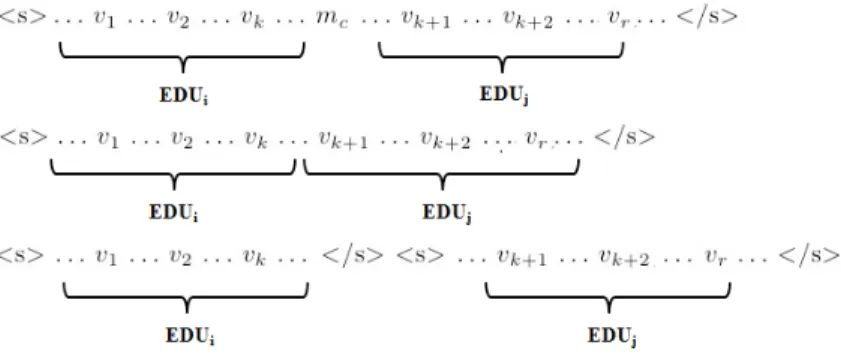
{(evi-evj, l)|evi and evj are the events represented by the verbs vi and vjandl∈ {C,¬C}}. . 21 3.2 The three possible structures of EDU-EDU pairs acquired from the PDTB corpus. . . 26 4.1 The interpolated precision-recall curves for the supervised classifier and the models with the
addition of background knowledge of formKB1. The supervised classifiers are trained using
the Explicitevi-evj (shown on left) and PDTBevi-evj (shown on right) corpora. The background
knowledge is acquired using one of the following four metrics: (1) CEA, (2) ECA, (3) ICA and (4) BCA. The thresholdγ increases in the increments of 0.1 from left to right and produces different precision and recall values for each of the above stated models. . . 62 4.2 The interpolated precision-recall curves for the supervised classifier and the models with the
addition of background knowledge of formKB2. The supervised classifiers are trained using
the Explicitevi-evj (shown on left) and PDTBevi-evj (shown on right) corpora. The background
knowledge is acquired using one of the following four metrics: (1) CEA, (2) ECA, (3) ICA and (4) BCA. The thresholdγ increases in the increments of 0.1 from left to right and produces different precision and recall values for each of the above stated models. . . 62 4.3 The interpolated precision-recall curves for the supervised classifier trained using the PDTBevi-evj
corpus, the models PDTBevi-evj+KB1BCAand PDTBevi-evj+KB1BCA+LD+¬Cev ={R}. The thresholdγincreases in the increments of 0.1 from left to right and produces different precision and recall values for each of the above stated models. . . 68 5.1 The model for identifying causality for a set VNP of instances of v-np pairs – i.e., VNP =
{v-np|v is the main verb and np is the noun phrase}. The output of this model is the set K of instances of v-np pairs with the assignments of labels C or ¬C – i.e., L={(v-np, l) |v is the main verb and np is the noun phrase andl∈ {C,¬C}}. . . 74 6.1 The interpolated precision-recall curves for the supervised classifier (SC) and the models SC
+ SCNM, SC + SCNM + ¬Cev ={R,I S}, SC + SCNM +¬Cev ={R,I S} + VF and SC + SCNM + ¬Cev ={R,I S} + VF + IVN. The threshold γ increases in the increments of 0.1 from left to right and produces different precision and recall values for each of the above stated models. . . 104
Chapter 1
Introduction
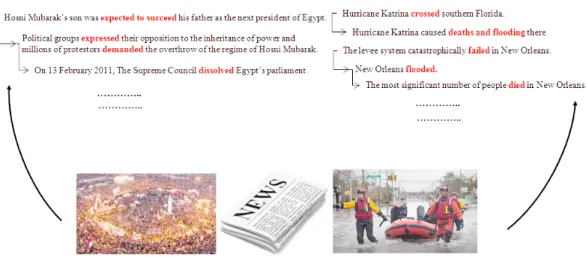
The current era with abundance of information on the internet has impacted the lives of people to a great extent. People take advantage of the internet to acquire information for their several day to day activities ranging from finding the location of a shopping center to getting news on the probe for the missing Malaysian airplane. Though the plenty of information available on the internet is of great use, it takes lot of time and energy to manually process this unstructured information to reach to a point of interest. For example, a person may need to go through a number of news articles to understand the flow of events that build a particular social or political story. Let us consider Figure 1.1 where the stories of Egyptian Revolution of 2011 and Hurricane Katrina extracted from the news articles are characterized by a number of events in causal relations. For example, for these two stories we observe the following causal relations taken from Figure 1.1:
• Egyptian Revolution of 2011: Hosni Mubarak’s son was expected to succeed his father as the next president of Egypt. Due to this show of inheritance of power, the political groups expressed opposition and millions of people demanded the overthrow of the Mubarak’s government. And as a result of protests, the Egypt’s parliament was dissolved on 13 February 2011.
• Hurricane Katrina: The levee system catastrophically failed in New Orleans which led to the flooding of New Orleans. As a result of the flooding event, a significant number of people died in New Orleans. A real challenge for current natural language understanding systems is to process text effectively to iden-tify events and the pairs or chains of events encoding causality. In this thesis, we focus on the problem of identifying causal information in text. The automated extraction and presentation of events encoding causality can be of great assistance to the people who strive to acquire the flow of events in text to make various decisions and predict consequences of their decisions. Moreover, in natural language processing, the recognition of semantic relations including causality has always been considered an important topic of research because success in this area is critical for various language processing applications such question answering, document summarization, generation of coherent ordering of events and prediction of future, etc.
Figure 1.1: A number of events encoding causality in the Egyptian Revolution of 2011 and Hurricane Katrina.
[Girju 2003, Chklovski and Pantel 2004, Barzilay et al. 2002, Radinsky and Horvitz 2013] For example, a question answering system should rely on a model for identifying causality to answer the following question:
Why did American Airlines cancel the last flight from New York to Florida on Tuesday?
Similarly, in order to generate a coherent summary of document(s), it is important to know the order of events i.e., which event happens before another event or is caused by another event [Barzilay et al. 2002, Chklovski and Pantel 2004].
Before discussing the task of identifying causality in text, we need to formally define the cause-effect (or causal) relations. Given various perspectives involved in describing a cause-effect relation, there is a number of notions of causality available to us from the areas of logic, philosophy, statistics, economy, computer science, etc [Menzies 2008, Woodward 2008, Suppes 1970, Granger 1969, Pearl 2000]. Just to give a flavor, three notable notions of causality are as follows:
• Counterfactual Theory of Causality: Menzies’s counterfactual theory of causality determines truth of the following three conditions to determine if a cause-effect relation is encoded between the two events a and b or not: (1) event a must temporally precede or overlap event b in time, (2) the effect event b must wholly depend on the cause event a and (3) if event a has not taken place then b must also have not taken place [Menzies 2008, Beamer and Girju 2009]. This notion has a shortcoming that the condition (2) above does not consider the case when an event has more than one cause [Beamer and Girju 2009].
• Manipulation Theory of Causality: Woodward’s manipulation theory of causality determines truth of the following two conditions to determine if a cause-effect relation is encoded between the two
events aand bor not: (1) event amust temporally precede or overlap event bin time and (2) while keeping as many state of current affairs constant as possible, modifying eventamust entail predictably modifying eventb[Woodward 2008, Beamer and Girju 2009].
• Probabilistic Theory of Causality: Suppes (1970) adopted the probabilistic theory of causation to determine if a cause-effect relation is encoded between the two events a and bor not. According to this theory if bis the effect of event a then the probability of occurrence of event bwhen a has occurred should be greater than the probability of occurrence of event bby itself.
In previous work [Beamer and Girju 2009, Riaz and Girju 2010], NLP researchers have relied on manip-ulation theory of causality to annotate events in text with cause and non-cause relations. Since, this notion of causality has proven to be an objective notion of causality for the NLP annotations task [Beamer and Girju 2009], in this work we rely on this notion to define a cause-effect relation.
1.1
Automated Identification of Causal Information
In natural language, causal relations can be encoded using various constructions e.g., between two verbs, two nouns, a verb and a noun, two discourse segments and even between two documents. Each construction with its own semantics can pose various challenges for the problem of identifying causality [Girju 2003, Girju et al. 2009, Bethard and Martin 2008, Sporleder and Lascarides 2008]. In order to effectively tackle this broad problem it is useful to split this problem into the smaller tasks. Therefore, in this thesis we focus on the tasks of identifying causality between two verbs and a verb and a noun by deeply analyzing the semantics of these constructions. Consider the following examples:
1. Yoga buildsstamina because youmaintainyour poses for a certain period of time. 2. At least 1,833 peoplediedin thehurricane.
Here, in example (1) two events represented by the verbs “build” and “maintain” and in example (2) two events represented by the verb “die” and the noun “hurricane” are encoding causal relations. In example (1), two verbs appearing in the same sentence are causally connected by an explicit and unambiguous discourse marker (i.e., “because”). However, in English, not all the discourse markers unambiguously identify causality [Prasad et al. 2008]. For example, Bethard and Martin (2008) proposed a corpus of 1000 causal and non-causal verb-verb pairs where the two verbs are conjoined by the ambiguous marker “and”. Consider the following examples taken from this corpus:
3. The man who had brought it in for an estimate had returned to collect it and was waitingin the hall1.
4. Indeed , the ”art of doctoring” doescontributeto better health results anddiscouragesunwarranted malpractice litigation .
In example (3) “and” can be replaced by the expression “and as a result”. However, in example (4) the verb-verb pair conjoined by the marker “and” does not encode a cause relation. The causal relations can also be encoded in implicit contexts - i.e., those where no discourse marker is present. In example (5), two verbs “rage” and “collapse” are appearing in different sentences and there is no causal marker to signal a cause relation between them. According to a rough estimate by Sporleder and Lascarides (2008), around half of the sentences in the British National Corpus (BNC) lack a discourse marker.
5. The monster storm Katrina raged ashore along the Gulf Coast Monday morning. There were early reports of buildings collapsingalong the coast.
In this thesis, we propose a model for identifying causality between two verbs appearing in the same and different sentences of text. Also, two verbs can appear in any context i.e, explicit and unambiguous, ambiguous or implicit context. Therefore, the ambiguity of natural language and the implicit encoding of causality are two of the serious challenges to be tackled for the current task.
Besides the verb-verb constructions, we also focus on the task of identifying causality in verb-noun pairs i.e., identify causality between the state of affairs represented by a verb and a noun. Girju (2003) pointed out that the association of figurative (non-literal) readings with natural language expressions (e.g., nouns) can complicate the task of identifying causality. Consider example (6) where the noun phrase “The United States” refers to an event of “raid in Abbottabad on May 2, 2011” rather than merely referring to the country. Here the association of the figurative reading with “the United States” results in encoding of causality between “the United States” and an event represented by the verb “kill”. Note that a country cannot physically kill someone. It is the event of “raid in Abbottabad on May 2, 2011 by the United States” that led to “killing of Osama bin Laden”. Similarly in example (7) the noun “Vietnam” (a country) refers to an event of “war in Vietnam” and thus encodes a cause relation with an event represented by the verb “haunt”. However, in example (8) the pair “hit-Cuba” encodes a non-cause relation with no figurative reading associated with the noun “Cuba”. Therefore a model for identifying causality should know the real reading of a natural language expression to identify causality.
6. The United States haskilledOsama bin Laden and has custody of his body.
7. Sex, drugs, andVietnamhavehauntedBill Clinton’s campaign2. 8. Sandy hit Cubaas a Category 3 hurricane.
In the next section, we present some research questions which we address in this thesis to devise a better approach for the current tasks.
1.2
Research Questions
Despite the importance of the problem of identifying causal information in text, NLP researchers have not yet got successful in solving this problem with a very high performance. After the successful use of linguistic features (e.g., lexical items, part-of-speech tags, syntactic structures, senses of words, etc.) for various NLP tasks, several approaches have been proposed to identify causality using such features in the framework of supervised learning [Girju 2003, Bethard and Martin 2008, Sporleder and Lascarides 2008, Pitler and Nenkova 2009, Pitler et al. 2009]. On the task of disambiguating the lexico-syntactic patterns of form <Noun Phrase1 verb Noun Phrase2 > (e.g., Earthquakes generate tidal waves3) for the cause and
non-cause relations, Girju (2003) has reported around 80% F-score using a supervised classifier employ-ing lemploy-inguistic features. The performance of the Girju (2003)’s supervised classifier on the instances of above mentioned lexico-syntactic patterns is very encouraging. However, performance of the supervised classifiers employing linguistic features drops significantly on other types of constructions e.g., for verb-verb pairs or pairs of discourse segments [Bethard and Martin 2008, Sporleder and Lascarides 2008]. On the task of identifying causality in verb-verb pairs where two verbs represent events, Bethard and Mar-tin (2008) achieved 37.1% F-score using a supervised classifier. Bethard and Martin (2008) attributed low performance of their supervised classifier to the lack of enough training data. Since performance of a supervised classifier is sensitive to the size of training corpus, researchers have previously utilized unam-biguous discourse markers to automatically acquire a large training corpus of discourse relations such as explanation, result, contrast, etc. [Sporleder and Lascarides 2008, Marcu and Echihabi 2002]. For example, the unambiguous marker “because” (“although”) represents explanation (contrast) relation, respectively. Using a large training corpus, Sporleder and Lascarides (2008) performed a detailed analysis of the super-vised classifiers for the task of identifying discourse relations including causality. Although a large number of training instances of discourse relations can be acquired effortlessly using explicit and unambiguous dis-course markers, these instances are representative of only one type of context –i.e., explicit and unambiguous
2The example is taken from Markert and Nissim (2009). 3The example is taken from Girju (2003).
context. Sporleder and Lascarides (2008) showed that even with supervision from the millions of training instances of unambiguous contexts, a supervised classifier brings a very low performance for identifying discourse relations in the ambiguous and implicit contexts [Sporleder and Lascarides 2008]. Later, Pitler et al. (2009) took advantage of the manual annotations of implicit discourse relations in Penn Discourse TreeBank (PDTB) [Prasad et al. 2008] to build a supervised classification model for implicit discourse re-lations. They compared their model with the baseline of a supervised classifier trained using automatically generated training corpus with the help of unambiguous discourse markers. With a best combination of features, Pitler et al. (2009)’s supervised classifier achieved 16% improvement in F-score for identifying implicit contingency (causal) discourse relations over the baseline. Unfortunately, to the best of our knowl-edge there is no big manually generated training corpus available for the task of identifying causality in verb-verb pairs. Our current research is motivated by the above stated observations of previous researchers [Bethard and Martin 2008, Sporleder and Lascarides 2008, Pitler et al. 2009] regarding the supervised clas-sifiers. In this work, we study the research question of how to build a model with the capability to identify causality in all types of contexts (i.e., explicit and unambiguous, ambiguous and implicit contexts) with a better performance. Since there is no large training corpus of verb-verb pairs available to us, we also take advantage of explicit and unambiguous discourse markers to automatically acquire a training corpus for the current task. Using this training corpus, we build a supervised classifier for verb-verb pairs employing the linguistic features introduced in Bethard and Martin (2008) and some features we introduce in this work. Moreover, in order to perform well on all types of context, we propose to incorporate additional sources of knowledge such as background knowledge on top of the supervised classifier for verb-verb pairs. In this thesis, we show that our model brings lot of improvement in performance over the supervised classifier for the current task. In addition to this, performance of our model remains robust on all types of contexts in comparison with the above stated supervised classifier.
The supervised classifiers [Girju 2003, Bethard and Martin 2008, Sporleder and Lascarides 2008, Pitler et al. 2009] introduced earlier in this section mainly depend on linguistic features to identify semantic relations including causality. Although these features provide useful knowledge about the context of the sentence(s), humans also make use of other information such as background knowledge to comprehend causality. The complexity of the task of detecting causality stems from the fact that there are many factors involved, such as linguistic features of an instance, background knowledge, semantic and pragmatic features of events, world knowledge, etc. Therefore, a model employing the knowledge sources other than linguistic features is critically needed to achieve progress on the current tasks [Girju 2003, Riaz and Girju 2013]. In this work, for the task of identifying causality in verb-verb pairs we acquire background knowledge in the form of causal
associations of these pairs. We learn these causal associations using a large collection of unlabeled text. In previous work [Riaz and Girju 2010, Do et al. 2011], researchers have proposed methods to learn causal associations between two events in an unsupervised fashion. These events can be represented by either verbs or nouns. Do (2012) used causal associations between events as a source of background knowledge to identify causality. Riaz and Girju (2010) and Do et al. (2011) learned these causal associations by relying on the probabilities of co-occurrences of events acquired through a large collection of unlabeled text. The metric Cause-Effect Association proposed by Do et al. (2011) identifies causal associations mainly using PointWise Mutual Information (PMI) scores for the event predicates and the arguments of these predicates. In this work, through the empirical analysis of this metric we observe that the PMI scores employing the probabilities of co-occurrences of events do not distinguish well causality from any other type of correlation. Considering this observation, we study the question of how to devise the methods capable to distinguish causal associations from any other type of correlation to provide a better source of background knowledge. In this work, we propose a novel method in which the prior information of causal associations is acquired by mainly relying on the probabilities of co-occurrences of verb-verb pairs and then this information is improved by considering supervision from a large training corpus of cause and non-cause relations. In addition to this, our method takes care of unambiguous as well as ambiguous and implicit contexts of verb-verb pairs to derive a better source of background knowledge as compared to the previously proposed approach of Do et al. (2011).
Do et al. (2011) have previously studied the task of identifying causality in verb-noun pairs but they focused only on a small list of predefined nouns representing events. In this work, we introduce a supervised classifier by employing a set of linguistic features for the current task. This supervised classifier depends merely on linguistic features and requires more sources of knowledge to identify causality with a better performance. For example, Girju and Moldovan (2002) observed that noun phrases must represent events, conditions, states, phenomena, processes or facts in order to encode causation in the lexico-syntatic patterns of form<Noun Phrase1 verb Noun Phrase2>(or<NP1 verb NP2>). The supervised classifier lacking this
information about nouns can lead to lot of noise in predictions. Girju and Moldovan (2002) employed the following 5 senseshuman action, phenomenon, state, psychological feature andeventof WordNet to identify the semantics of nouns. They argued the pattern <NP1 verb NP2 >has the highest tendency to encode
causation if all senses of the head noun of each noun phrase lie in the semantic hierarchies originated by the above 5 senses. Notice that this approach works for the relatively unambiguous nouns with all of their senses lying in the above mentioned 5 senses of WordNet. Later Girju (2003) used 9 noun hierarchies of WordNet i.e.,entity, psychological feature, abstraction, state, event, act, group, possession andphenomenon
as features of a supervised classifier for identifying causality in the lexico-syntatic patterns of form <NP1
verb NP2>. For each of two noun phrases, the above 9 noun hierarchies are used as features. Each of these
features is set to 1 if any sense of the head noun of a noun phrase lies in that hierarchy, otherwise set to 0. On the limited context of patterns<NP1 verb NP2 >, Girju (2003) reported a very high F-score (i.e.,
80% F-score). However, in this work we observe that these features are not very effective for the verb-noun pairs where a verb and a noun do not need to appear in any specific lexico-syntactic pattern. Therefore for the current task we study the question of how to identify semantics of both ambiguous and unambiguous nouns and use the semantics of nouns to identify causality in verb-noun pairs. In this work, we propose a method which employs the annotations of FrameNet corpus [Baker et al. 1998] for noun phrases to identify tendencies of nouns to encode a cause or non-cause relation. This information is then used in our model to reduce noise in the predictions of a supervised classifier for the verb-noun pairs. In addition to the above, we propose an approach to identify the association of figurative readings with nouns because such readings can alter the meaning of an instance as demonstrated by examples (6) and (7) in the last section.
1.3
Thesis Contributions
As discussed in section 1.1, we study the tasks of identifying causality in verb-verb and verb-noun pairs. In order to perform well on these tasks, we deeply exploit the semantics of verbs, nouns, verb-verb and verb-noun pairs to extract the knowledge useful for the current tasks. Specifically, we propose an approach to acquire the following four types of knowledge for the current tasks: (1) Background Knowledge, (2) Causal Semantics of Verbs, (3) Causal Semantics of Nouns and (4) Causal Semantics of Verb Frames. We integrate the above types of knowledge with the supervised classifiers for the tasks of identifying causality in verb-verb and verb-noun pairs. These supervised classifiers identify causality using linguistic features extracted from the instances of verb-verb and verb-noun pairs. After the acquisition of the above types of knowledge, we allow our models to automatically analyze instances of verb-verb and verb-noun pairs from multiple dimensions – i.e., the dimensions of linguistics features acquired from the contexts of such instances, background knowledge, causal semantics of verbs, nouns and verb frames. We take advantage of the learning and inference framework of Integer Linear Programming (ILP) for NLP [Roth and Yih 2004] to integrate all of the above types of knowledge for the current tasks. Do et al. (2011) have previously used the ILP framework to acquire minimal supervision for the tasks of identifying causality in verb-verb and verb-noun pairs. For example, using the ILP framework, they forced their model to assign a label of non-cause relation to all the verb-verb and verb-noun pairs from the two discourse segments connected by a non-causal marker.
However, in this work we employ the ILP framework to incorporate the above four types of knowledge in our models for identifying causality.
In the rest of this section, we briefly introduce the background knowledge, the knowledge of causal semantics of verbs, nouns and verb frames we acquire and employ for the current tasks.
1.3.1
Background Knowledge
Humans often rely on background knowledge to perform causal reasoning on events. For example (5), our background knowledge allows us to recognize the causal relation between rage and collapse even when no causal discourse marker is available. In this work we propose a method to learn causal associations in verb-verb pairs by distinguishing well the cause-effect relations from any other type of correlation. In addition to this, our method also takes care of unambiguous as well as ambiguous and implicit contexts of verb-verb pairs to derive a better source of background knowledge. We exploit the information available from a large number of unlabeled instances of verb-verb pairs to mine causal associations in these pairs. We also introduce two novel forms in which the background knowledge can be provided to our model.
We store the information regarding causal associations of verb-verb pairs in a resource named the knowl-edge base of causal associations (KBc). In this resource, we keep the scores of likelihood of each verb-verb
pair to encode causation. Depending on the likelihood of causality in verb-verb pairs, we create three cat-egories of these pairs: Strongly Causal, Ambiguous and Strongly Non-causal. The category strongly causal (strongly non-causal) contains the verb-verb pairs with the highest (least) likelihood to encode causal rela-tions, respectively. However, the category ambiguous contains the verb-verb pairs which have the tendency to encode both cause and non-cause relations. For example, the pair (kill, arrest) has a high tendency to encode causation irrespective of the context of an instance in which it is used, thereby a good indicator of causality. Unlike this pair, the pair (build, maintain) seems ambiguous because it can encode both cause and non-cause relations depending on the context, as shown by examples 1 (cause) and 9 (non-cause). Thus, a model for identifying causality should have knowledge about which of the verb-verb pairs are strongly causal (non-causal) in nature and for which pairs the context of an instance plays an important role to signal causality. The resource KBc introduced above provides a rich source of background knowledge for
identifying causality in verb-verb pairs [Riaz and Girju 2013, Riaz and Girju 2014b].
9. Republicans had not cut the funds formaintainingthe levee andbuildingup the ecological protec-tions.
1.3.2
Causal Semantics of Verbs
Philospher Jaegwon Kim [Kim 1993] (as cited by Girju and Moldovan (2002)) pointed that the entities representing either causes or effects are often events, but also conditions, states, phenomena, processes, and facts. Considering this observation, Girju and Moldovan (2002) stressed that the noun phrases must represent events, conditions, states, phenomena, processes or facts in order to encode causation in the lexico-syntactic patterns of form <NP1 verb NP2 >. Following the previous work of Girju and Moldovan
(2002), we assume that in order to identify causality in verb-verb pairs, it is important for a model to know if in an instance of verb-verb pair both verbs represent events or not. In linguistics and computa-tional linguistics, researchers mainly categorize words (or phrases) into two aspectual classes: STATE and EVENT [Dowty 1979, Saeed 1997, Verkuyl 1972, Vendler 1957, Pustejovsky et al. 2003]. STATE describes an unchanging situation over a period of time (e.g., know, love) and an EVENT describes a situation which involves internal structure (e.g., run has an internal structure of raising a foot in air, moving it forward and putting it down on floor4). In NLP, several approaches have been proposed to categorize verbs into
the classes of EVENT and STATES [Bethard and Martin 2006, Sauri et al. 2005]. Benefiting from these approaches we identify if both verbs of an instance of verb-verb pair represent events or not and provide this information to our model for identifying causality.
In addition to the above, we also incorporate the semantic classes of events to learn the causal semantics of verbs. Verbs play a key role in language to represent events and these events can be of various semantic types. For example, for the TimeBank’s corpus, Pustejovsky et al., (2003) have categorized the instances of verbal events into seven semantic classes – i.e., OCCURRENCE, PERCEPTION, ASPECTUAL, STATE, I STATE, I ACTION and REPORTING. Based on the definitions of these classes [Pustejovsky et al. 2003], we argue that each verb can have its own causal semantics depending on the class of event it represents. For example, the reporting verbal events (i.e., events represented by the verbs such as say, tell, etc.) merely explain the action of a person or discuss another event instead of encoding causality with it. In order to support our argument we propose a data intensive method to identify tendencies of each of the above stated semantic classes and provide this information to our model for identifying causality. We acquire and employ the knowledge of causal semantics of verbs for identifying causality in verb-verb and verb-noun pairs [Riaz and Girju 2014a, Riaz and Girju 2014b, Riaz and Girju 2014c].The empirical evaluation of our models in this thesis reveals that this type of knowledge is quite useful for identifying causality in both verb-verb and verb-noun pairs.
1.3.3
Causal Semantics of Nouns
As discussed in section 1.2, in order to identify causality in verb-noun pairs it is important for our model to have the knowledge of semantics of nouns. In this work, we propose a method which automatically acquires the semantic classes of nouns with a high and low tendency to encode causal relations. In our model, the information about these semantic classes of nouns is referred to as the knowledge of causal semantics of nouns. We use this type of knowledge to filter false positives. For example, a named en-tity such as LOCATION or any noun expression representing a location may not encode a causal relation unless a figurative reading (or metonymy) is associated with it. Therefore, in addition to acquiring the above stated semantic classes of nouns, we identify the association of metonymies with the nouns (or noun phrases) by using an approach proposed in this thesis. The empirical analysis of our model reveals that the information about the semantic classes of nouns helps reduce lots of false positives. Moreover, the infor-mation of metonymies boosts performance of our model by knowing which nouns are being used in literal or non-literal (figurative) sense in the instances of verb-noun pairs. We leverage the FrameNet annotations [Baker et al. 1998] to identify the semantic classes of nouns and the association of metonymies with nouns [Riaz and Girju 2014a, Riaz and Girju 2014c].
1.3.4
Causal Semantics of Verb Frames
We identify the causal semantics of verb frames and use this knowledge to identify causality in verb-noun pairs [Riaz and Girju 2014c]. In order to understand this type of knowledge, consider the following two examples5:
10. The Great Storm of October 1987 almost totally destroyed the eighty year old pinetum at Nymans Garden in Sussex.
11. The explosion occurredin the city’s main business area.
The above two examples show that the verbs “destroy” and “occur” have their own tendencies to encode causation with their subjects. Particularly, in above examples the verb frames of form{destroy, subject}
and{occur, subject} encode a cause and non-cause relation, respectively. In this work, we leverage the an-notations of verbs in FrameNet [Baker et al. 1998] to identify tendencies of verb frames to encode causation. In addition to above, we also determine the likelihood of a subject (or any grammatical relation) of any verb to encode causation with its verb.
1.4
Thesis Organization:
The rest of this thesis is organized as follow:
• Chapter 2 provides an overview of the previous work to identify causal information in text. In this chapter, we provide details of the models proposed earlier to identify causal information in text. We also discuss approaches proposed in NLP for the tasks of identifying event mentions, semantic classes of events and temporal relations. These tasks are related to our current research for identifying causality.
• Chapter 3 presents our approach for acquiring knowledge for the task of identifying causality in verb-verb pairs. We propose methods to derive the background knowledge and the knowledge of causal semantics of verbs. In this chapter, we first introduce a novel method to acquire a training corpus of verb-verb pairs. This training corpus is employed to build a supervised classifier. On top of this classifier, the additional sources of knowledge are added to achieve progress on the current task.
• Chapter 4 provides the details of our model for identifying causality in verb-verb pairs. In this model, we integrate various types of knowledge necessary for the current task. This chapter also provides a detailed experimental study for assessing performance of our model with addition of each type of knowledge acquired for the current task.
• Chapter 5 discusses the process of knowledge acquisition for the task of identifying causality in verb-noun pairs. In this chapter, we first introduce a supervised classifier for the current task and then propose methods to derive the knowledge of causal semantics of nouns, verbs and verb frames. We also introduce our methods to identify the association of metonymies with the noun phrases. In addition to above, we determine if a verb and a noun represents the same or distinct state of affairs to help making better predictions for the current task.
• Chapter 6 provides the details of our model for identifying causality in verb-noun pairs. In this model, we incorporate various types of knowledge to identify causality. The experimental study provided in this chapter presents the contribution of each type of knowledge towards solving the current task.
• Chapter 7 concludes the current research by summarizing the current work and identifying the future research directions to achieve more on the problem of identifying causality.
Chapter 2
Relevant Work
Causation has long been studied from various perspectives by philosophers, logicians, statisticians, linguistics, bio scientists, data-mining researchers and computer scientists [Menzies 2008, Woodward 2008, Suppes 1970, Sanders et al. 1992, Cooper 1997, Silverstein et al. 2000, Pearl 2000]. In this chapter, we present previous work by focusing on the research done in natural language processing to identify causality in text. In addition to this, we discuss research for the related tasks of identifying event mentions, semantic classes of events and the temporal ordering between events.
2.1
Identification of Causality in Natural Language Text
The natural language provides a rich set of linguistic constructions to express causality. Girju and Moldovan (2002) have provided a comprehensive overview of explicit causative constructions (e.g., causal connectives, causative verbs, conditionals, causative adverbs and adjectives) and implicit causative constructions (e.g., complex nominals, implicit causality of verbs and discourse relations) for the English Language. In NLP, various approaches have been proposed to identify causal information in text by considering specific types of constructions e.g., lexico-syntactic patterns [Girju 2003, Chklovski and Pantel 2004, Khoo et al. 2000], verb-verb pairs [Bethard and Martin 2008, Beamer and Girju 2009, Riaz and Girju 2010, Do et al. 2011], noun-noun pairs [Girju 2003, Chang and Choi 2006, Girju et al. 2009], verb-noun-noun pairs [Do et al. 2011] and pairs of discourse segments [Marcu and Echihabi 2002, Sporleder and Lascarides 2008, Pitler and Nenkova 2009, Pitler et al. 2009].
In NLP, several approaches have been proposed earlier for identifying causality using the supervised, unsupervised and minimally supervised learning frameworks. The bulk of research using the supervised learning framework depends on the linguistic features extracted from the contexts of training instances [Girju 2003, Chang and Choi 2006, Bethard and Martin 2008]. For example, Girju (2003) proposed to dis-ambiguate the lexico-syntatic patterns of the form <NP1 verb NP2 > (e.g., Earthquakes generate tidal
waves1) for cause and non-cause relations using linguistic features. The features she employed for her model are head nouns of the noun phrases, the verb (or words of the verbal phrase) and the WordNet’s senses for head nouns of the noun phrases. She used 9 noun hierarchies from WordNet (i.e., entity, psychological feature, abstraction, state, event, act, group, possession, phenomenon) as features to obtain the semantics of each of two noun phrases of the pattern <NP1verb NP2 >. For example, each of these 9 features is set
to true for a noun phrase only if any sense of its head noun lies in that semantic hierarchy. Using these features, her model achieved 73.91% precision and 88.69% recall (80.60% F-score) for the disambiguation of the above stated patterns – i.e., <NP verb NP>where the verb belongs to a class of 60 verbs. These 60 verbs are semantically similar to the causative verb “cause”. Though her approach achieves a quite better performance, it is yet to be determined how this approach scales up for the patterns with verbs not belonging to the above mentioned class of 60 verbs.
Another example of supervised learning models is the discriminative classification model of Bethard and Martin (2008) for identifying causality in verb-verb pairs. For their model, they used a set of linguistic features (e.g., verbs, words of the verb phrases, part-of-speech tags of verbs, etc.) to set up a supervised classifier using SVM classification algorithm. In order to generate the training and evaluation data for the verb-verb pairs, they focused only on a simple linguistic structure in which the two verbs of each instance should be conjoined by the marker “and”. They generated a set of 1000 instances annotated with causality and temporal relations (BEFORE, AFTER and OVERLAP). They employed 697 (303) instances for training (evaluation) purpose, respectively. Using the above linguistic features, they reported 27% precision and 59.4% recall (37.1% F-score) on this problem. Though their model did not achieve a very high performance, their analysis of results brought important insights into this problem. For example, Bethard and Martin (2008) linked the low precision of their model with the lack of training data by showing the direct relationship in the steady improvement of precision and the percentage of verbs seen during training. Considering the issue of small size of a training corpus, we introduce a novel method in this work to automatically generate a large training corpus of verb-verb pairs encoding cause and non-cause relations. This saves us from the trouble of annotating verb-verb pairs to acquire a training corpus. Moreover, it allows us to focus more on the task of acquiring additional sources of knowledge other than linguistic features to achieve progress in performance for identifying causality. Another interesting observation from the work of Bethard and Martin (2008) is the improvement of 15% in F-score with the addition of features of the gold-standard labels for temporal relations between two verbs. Although the gold-standard labels for temporal relations boost the performance of their model, it is not always possible to acquire such features for any real data set. Moreover, the current classifiers
for temporal relations are quite far from achieving a performance close to the humans [Mani et al. 2006, Chambers et al. 2007, Bethard and Martin 2008, Bethard et al. 2007, Do and Roth 2012].
In recent years, researchers have shifted their attention from the supervised identification of causality and have employed the unsupervised metrics and the minimal supervision for this problem [Beamer and Girju 2009, Riaz and Girju 2010, Do et al. 2011]. For example, Riaz and Girju (2010) proposed an unsupervised met-ric, Effect-Control Dependency (ECD), to identify cause-effect relations between two events of various news scenarios. Do et al. (2011) later introduced an improved version of the metric ECD. Their metric known as Cause-Effect Association (CEA) depends on Pointwise Mutual Information (PMI) and a component of the metric ECD to predict causal relations in verb-verb, verb-noun and noun-noun pairs. They studied the noun-noun and verb-noun pairs by considering a small list of predefined nouns representing events. However, in this work, we identify causality in verb-noun pairs where nouns can be of any type. Do et al. (2011) showed that their metric achieves a very high performance in comparison to the metric ECD. Therefore, in this work, we compare the performance of our model with the state-of-the-art CEA metric for the unsuper-vised identification of causality. Do et al. (2011) also acquired minimal superunsuper-vised for the current problem by exploiting discourse markers. For example, using the ILP framework, they force their model to assign a label of non-cause relation to all the event-event pairs from the two discourse segments connected by a non-causal marker. Do et al. (2011) have used the ILP framework to acquire minimal supervision. In this work, we also take advantage of this framework to combine the entirely novel types of knowledge as discussed in the section 1.3. Do et al. (2011) evaluated their model on a set of 20 documents and achieved 38.6% F-score using the metric CEA. With the addition of minimal supervision they acquired 3.1% improvement in F-score. On verb-verb pairs, they reported 38.3% F-score and 1-2% improvement in F-score with addi-tion of minimal supervision. Do et al. (2011) discussed that it is very difficult to achieve a higher human inter-annotator agreement on the annotations of cause-effect relations for a highly skewed data set. On their evaluation data set they achieved 58% human inter-annotator agreement on causal relations. This results in around 2-3% causal instances in their evaluation set, respectively.
In NLP, researchers have also proposed models to automatically identify causal relations between two discourse segments. Various theories have been proposed in linguistics to interpret discourse relations e.g., Rhetorical Structure Theory (RST), Discourse Representation Theory (DRT) and Segmented Discourse Rep-resentation Theory (SDRT) [Mann and Thompson 1987, Kamp and Reyle 1993, Asher and Lascarides 2003]. In these theories, the term of contingency discourse relations is used to refer to the relations of cause, pur-pose, explanation and reason, etc. Since the release of the RST corpus [Carlson et al. 2002] and Penn Discourse Treebank (PDTB) [Prasad et al. 2008] with instances of the discourse relations, a number of
su-pervised classification approaches have been proposed to identify the discourse relations in both explicit and implicit contexts [Soricut and Marcu 2003, Pitler and Nenkova 2009, Pitler et al. 2009]. These models depend on the linguistic features e.g., word pairs selected from the two discourse segments, polarities of words, Levin verb classes [Levin 1993], etc. Instead of relying on the manually labeled training corpus, some researchers exploited the unambiguous discourse markers to automatically label a massive number of instances of discourse segments with the relations of Contrast, Explanation, Result, Summary and Contin-uation, etc. [Marcu and Echihabi 2002, Sporleder and Lascarides 2008]. Using this method, Sporleder and Lascarides (2008) employed a massive training corpus to identify discourse relations in unambiguous, am-biguous and implicit contexts by omitting the discourse markers from the training instances. They observed that their training instances are representative of only explicit and unambiguous context and thus do not provide accurate supervision for the ambiguous and implicit contexts. Due to this reason, the performance of their supervised classifier drops significant on both ambiguous and implicit instances of discourse relations. Inspired by the work of Sporleder and Lascarides (2008), we automatically generate a training corpus of verb-verb pairs to identify causality to avoid the trouble of manual generation of a massive training cor-pus. In addition to this, we incorporate additional sources of knowledge discussed in section 1.3 to identify causality with a better performance on explicit and unambiguous, ambiguous and implicit contexts.
As discussed in the section 1.3, our objective is to employ the novel sources of knowledge to identify causation. For this purpose, we introduce a method to acquire a resource of background knowledge. We derive the background knowledge in terms of the causal associations of verb-verb pairs. We cannot de-pend on state-of-the-art resources on verbs semantics, such as WordNet, VerbNet, Levin Verb Classes, etc. [Miller 1990, Levin 1993, Kipper et al. 2000] to acquire the causal associations in verb-verb pairs because these resources mainly provide information about the semantic classes, thematic roles and selectional restric-tions of verbs. Among these, WordNet is the only resource which provides information about the cause-effect relations between verbs, but it has a very limited coverage. VERBOCEAN, a semi-automatically generated
resource, with fine-grained relations on verb-verb pairs is relevant to our task but it also has a limited cover-age. To generate this resource, Chklovski and Pantel (2004) used explicit lexico-syntactic patterns as means of mining enablement (cause-effect) relations between verbs. For example, they consider the pattern “verb * by verb” to extract enablement relations where the unambiguous marker “by” signals this relation. Such approaches help detecting causality with a high precision but suffer from the limited coverage due to the consideration of only explicit and unambiguous contexts of causality of certain forms. Moreover, the current resources do not provide any information about the likelihood of causal relations encoded by verb-verb pairs. Therefore, we derive our own resource for the causal associations of verb-verb pairs. However, in order to
derive the other types of knowledge i.e., the causal semantics of verbs, nouns and verb frames, we leverage the annotations of the TimeBank and FrameNet corpus [Pustejovsky et al. 2003, Baker et al. 1998]. Using these annotations, we acquire the semantic classes of verbs and nouns with a high and low tendency to encode causation and the tendencies of the verb frames to encode cause and non-cause relations.
2.2
Identification of Events, Semantic Classes and Temporal
Relations
In a related line of research to the tasks being considered for this thesis, several models have been pro-posed for identifying event mentions, their semantic classes and temporal order of events. As described in section 1.3.2, in linguistics and computational linguistics researchers mainly categorize words (or phrases) into two aspectual classes: STATE and EVENT where STATE describes an unchanging situation over a period of time (e.g., know, love) and an EVENT describes a situation involving internal structure (e.g., run). Pustejovsky et al. (2003) closely followed the above definition of events to annotate 8312 instances of TimeBank with labels of event and non-event. However, there are some exceptions in their annotations. For example, they considered some states as events depending on the context. In the example “Theylived
in U.N.-run refugee camps for 2 1/2 years.”, the verb “lived” is a state that persists for a long time but Pustejovsky et al. (2003) considered this as an event. Pustejovsky et al. (2003) organized the instances of events into the following seven semantic classes2:
• OCCURRENCE: These events describe something that happens or occurs in the world. Some examples are launched, exploded, landed.
• PERCEPTION:These events involve the physical perception of another event. Some examples are see, watch, view.
• ASPECTUAL:These events focus on different facets of an event’s history. Some examples are begin, start, commence.
• STATE:These events refer to the circumstances in which something holds true for a certain period of time. In the example “Theylivedin U.N.-run refugee camps for 2 1/2 years.” the event “lived” is the state that persists for 2 1/2 years.
• I STATE: These events are intentional states that refer to an alternative or possible world (or state of affairs). In the example “Russia now feelsthe US must hold off at least until UN secretary general
Kofi Annan visits Baghdad.”, the event “feels” is the I STATE event referring to the state of affairs shown in italic.
• I ACTION: These events are intentional actions which introduce an event argument describing an action from which we can infer something given its relation with the I ACTION. In the example “The Organization of African Unity willinvestigatethe Hutu-organizedgenocide of more than 500,000 mi-nority Tutsis.”, the event “investigate” is the I ACTION event which introduces the event “genocide”.
• REPORTING: These events describe the action of a person or an organization, declare something, narrate another event, etc. Some examples are say, tell, report.
In order to identify events and their semantic classes, researchers [Bethard and Martin 2006, Sauri et al. 2005] have proposed supervised machine learning and rules based models build on the TimeBank corpus [Pustejovsky et al. 2003]. Bethard and Martin (2006) addressed this problem in the framework of word-chunking by assigning labels B-I-O (i.e., B (Beginning of event), I (Inside event) and O (Outside of event)) to words and building a classification model on top of these these labels. Their model also predicts the semantic class of an event by enhancing the semantic class labels with B-I-O tags (e.g., OCCURRENCE label is learned and predicted as B OCCURRENCE, I OCCURRENCE). Using linguistic features (e.g., lexical items, morphological features, part-of-speech tags and the syntatic chunk labels), they have reported 88.3% and 70.7% F-scores for the tasks of identifying verbal events and their semantic classes, respectively. In this thesis, we employ the annotations of TimeBank corpus for events and semantic classes of events to learn the knowledge of causal semantics of verbs.
The TimeBank corpus also has annotations for the temporal relations (e.g., IBEFORE, BEGINS, ENDS, SIMULTANEOUS, INCLUDES, BEFORE). Benefiting from these annotations of the temporal relations, researchers have also proposed supervised learning models for identifying such relations [Mani et al. 2006, Chambers et al. 2007]. These models rely either on the gold-standard features or the features automat-ically learned for this task. Another interesting research in this direction is the automated induction of the narrative event chains sharing a common protagonist. For example, “ accused X → X claimed
→ X argued → dismissed X” is a narrative chain of events for the scenario of “Firing of Employee” [Chambers and Jurafsky 2008, Chambers and Jurafsky 2009]. Chambers and Jurafsky (2008) are perhaps the first who studied the automated induction of such chains. They used distributional similarity metric – Pointwise Mutual Information (PMI) – to build the chain of events by focusing only on those verbs which share arguments with each other. To interpret the order of the events contained in a chain, they applied a classifier to arrange events using BEFORE relation. We believe that in the future these chains of events can