Implementation of Spectrum Sensing Techniques for
Cognitive Radio Systems
A thesis submitted in partial fulfillment of the requirements for the degree of Doctor of Philosophy (Ph.D.) to:
Electronic and Computer Engineering, School of Engineering and Design,
Brunel University, United Kingdom. by: Nazar Radhi July 2011 Supervised By:
Abstract
This work presents a method for real-time detection of secondary users at the cognitive wireless technologies base stations. Cognitive radios may hide themselves in between the primary users to avoid being charged for spectrum usage. To deal with such scenarios, a cyclostationary Fast Fourier Transform accumulation method (FAM) has been used to develop a new strategy for recognising channel users under perfect and different noise environment conditions. Channel users are tracked according to the changes in their signal parameters, such as modulation techniques. MATLAB® Simulation tool was used to run various modulation signals on channels, and the obtained spectral correlation density function shows successful recognition between secondary and primary signals. We are unaware of previous efforts to use the FAM characteristics or other detection methods to make a distinction between channel users as presented in this thesis.
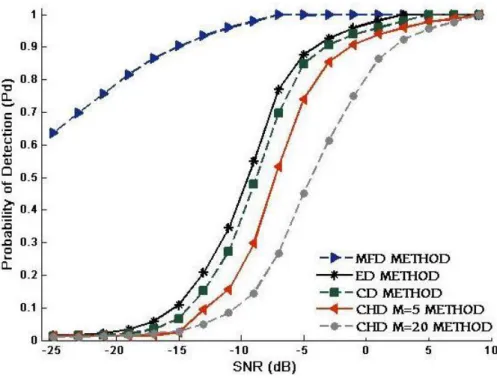
A novel combination of both cognitive radio technology and ultra wideband technology is interdicted in this thesis, looking for an efficient and reliable spectrum sensing method to detect the presence of primary transmitters, and a number of spectrum-sensing techniques implemented in ultra wideband and cognitive radio component (UWB-CR) under different AWGN and fading settings environments. The sensing performance of different detectors is compared in conditions of probability of detection and miss detection curves. Simulation results show that the selection of detectors rely on the different fading scenarios, detector requirements and on a priori knowledge. Furthermore, result showed that the matched filter detection method is suitable for detecting signals through UWB-CR system under various fading channels. A general observation is that the matched filter detector outperforms the other detectors in all scenarios by an average of SNR=-20 dB in the level of probability of detection (Pd) , and the energy detector slightly outperforms the cyclostationary detector, in the level Pd at SNR=-20 dB.
Furthermore, the thesis adapts novel detection models of cooperative and cluster cooperative wideband spectrum sensing in cognitive radio networks. In the proposed schemes, wavelet-based multi-resolution spectrum sensing and a proposed approach scheme are utilized for improving sensing performance of both models. On the other hand, cluster based cooperative spectrum sensing with soft combination Equal Gain Combination (EGC) scheme is proposed. The proposed detection models could achieve improvement of transmitter signal detection in terms of higher probability of detection and lower probability of false alarm. In the cooperative wideband spectrum sensing model, using traditional fusion rule, existing worst performance of false alarms by measurement is 78% of the sensing bands at an average SNR=5 dB; this compares with the proposed model, which is by measurement 19% false alarms of scanning spectrum at the same SNR for cluster cooperative wideband spectrum sensing. The proposed combining methods shows improvements of results with a high probability of detection (Pd) and low probability of false alarm (Pf) at an average SNR=-16 dB compared with other traditional fusion methods; this is illustrated through numerical results.
Acknowledgments:
I am grateful to the creator who taught the names to Adam and gave human being authority to pass beyond the zones of heavens and earth, without his blessing and mercy, this thesis would not have been possible.
I like to thank my wife and my daughters for their constant support and encouragement.
I also owe my deepest gratitude to my mother, brothers and my sisters without whom I would not have made it through my PhD degrees. Their tremendous help and prayers showed me the way and always guided me to the end of the tunnel.
It is my pleasure to thank all those who made this thesis possible. I am heartily thankful to my supervisor, Professor Hamed Al-Raweshidy and my brother, Dr Haidar Radi whose encouragement, guidance and support from the initial to the final level enabled me to develop an understanding of this work. I appreciate all their help and support. I am indebted to my many of my colleagues at the WNCC and friends at Brunel University. I would like to show my gratitude to all staff at Brunel University, I would like to thank their encouraging and supportive attitude.
I would like to express gratitude to those who helped me to finalize my thesis; without them, I could not have written this thesis.
Lastly, I offer my regards to all of those who supported me in any respect during the completion of the project.
Table of Contents
Chapter-1: Introduction ……….. 1
Introduction ……….. 1
1.1 Motivations……… 1
1.2 Aims and Objectives ……….. 3
1.3 Contribution to Knowledge ………. 5
1.4 Research Methodology ……….. 6
1.5 Thesis Structure ………. 7
Chapter-2: Cognitive Radio System ………... 9
Cognitive Radio System ………... 9
2.1 Cognitive Radio System ………... 9
2.1.1 Main Function ……….. 9
2.1.2 Cognitive Cycle ……….. 10
2.2 Spectrum Sensing ……….. 11
2.2.1 Challenges & Spectrum Sensing ……… 12
2.2.2 Multi-dimensional Space for Spectrum Sensing ………. 13
2.3 Spectrum Sensing Technique ……….. 16
2.3.1 Uncooperative Spectrum Detection (Transmitter Detection) ……… 16
2.3.1.1 Energy Detection ………. 16
2.3.1.2 Matched Filter Detection ……… 17
2.3.1.3 Cyclostationary Detection ………. 18
2.3.2.1 Centralized Sensing Method ………. 23
2.3.2.2 Distributed Sensing Method ………. 23
2.3.3 Primary Receiver Detection ……….. 2.4 Limitations and Challenges in Spectrum Sensing ……….. 24 25 Chapter-3: Cyclostationary Detection of Hidden Cognitive Radio Users ……… 28
Cyclostationary Detection of Hidden Cognitive Radio Users……….... 28
3.1 Introduction and Motivation ………. 28
3.2 Scenarios to Detect Hidden Cognitive Radio ………. 29
3.2.1 Sensing Spectrum Channel with free SNR ………. 29
3.2.2 Sensing Spectrum Channels with low SNR ………. 30
3.3 proposed approach ……… 31
3.4 Detection Method in the proposed approach ……… 32
3.4.1 Cyclostationary Processing Theory ……….. 3.4.2 Fast Fourier Transform Accumulation Method (FAM)……….. 3.4.3 Procedure of Signal Detection Method………. 32 36 37 3.5 Comparative performance analysis of the proposed approach ……… 38
3.6 Simulation Scenarios and Results ………. 39
3.7 Summary ………. 53
Chapter-4: Performance of Spectrum Sensing Methods for UWB-CR System …………. 54
Performances of Spectrum Sensing Methods for UWB-CR System ……… 54
4.1 Introduction ………. 54
4.2 Ultra Wideband System ………. 55
4.3.1 Decrease Interference to licensed users ………. 59
4.3.2 Dynamic Spectrum ……….. 59
4.3.3 Adaptable Transmit Power ……….. 59
4.3.4 Adjustable Multiple Access ………. 60
4.3.5 Limited Cost ………. 60
4.4 Combining UWB with Cognitive Radio ………. 60
4.5 Characteristics of the Transmitter Signal ……….. 60
4.6 Spectrum Sensing Algorithms ……… 61
4.6.1 Matched Filter Detection (MFD) ……… 61
4.6.2 Energy Detection (ED) ………. 62
4.6.3 Cyclostationary Detection (CD) ……….. 64
4.6.4 Channelized Detection (CHD) ………. 66
4.7 Performance of Detection Schemes ………. 68
4.7.1 Simulation Scenarios and Results ……… 68
4.8 Summary ……….. 81
Chapter-5: Cooperative Spectrum Sensing in Cognitive Radio System ……… 82
Cooperative Spectrum Sensing in Cognitive Radio System……….. 82
5.1 Introduction ………. 82
5.2 Collaborative Wideband Spectrum Sensing in Cognitive Radio Network ……… 84
5.3 Multi-Resolution Spectrum sensing Method ……… 86
5.3.1 Wavelet-based Multi Resolution Spectrum sensing ……… 86
5.4.1 Soft Combining ………... 90
5.4.2 Hard Combining ………... 91
5.4.3 Two-bit Hard Combining Scheme ………. 93
5.4.4 proposed approach Scheme ………... 94
5.5 Simulation Results ………... 96
5.6 Cluster-Based Cooperative Wideband Spectrum ………. 109
5.6.1 Description of Scenario Model ………. 110
5.6.1.1 Local Spectrum Sensing ……….. 111
5.6.1.2 Local Sensing Decision (Equal Gain Combination Scheme) ……… 111
5.6.1.3 Global Sensing Decision (proposed approach scheme) ……… 112
5.6.2 Summary of the Proposed Method ……… 112
5.6.3 Cluster Model Simulation and Results ……… 113
5.7 Summary ……… 117
Chapter-6: Conclusion and Future Work ……….. Conclusions and Future Work ………. 118 118 6.1 Conclusion ………. 118 6.2 Future Work ……….. 118 List of Publications……….. 120 References ... 122
List of Figures
Figure 1-1: Geographical Spectrum Holes ……….. 2
Figure 1-2: Time Domain Spectrum Holes ……….. 2
Figure 2-1: Fundamental Cognitive Cycle ……… 11
Figure 2-2: Hiding Primary User Problem in Cognitive Radio System ……… 12
Figure 2-3: Spectrum Opportunity in the Frequency and Time Domain Dimensions ……….. 13
Figure 2-4: Spectrum Opportunity in the Geographic Dimension ………. 14
Figure 2-5: Spectrum Opportunity Code Dimension ……….. 14
Figure 2-6: Spectrum Opportunity in Angle Dimension ……… 15
Figure 2-7: Spectrum Opportunity in Wave Dimension ……… 15
Figure 2-8: Implementation of an Energy Detector ………. 17
Figure 2-9: Implementation of a Matched Filtering Detector ……….. 18
Figure 2-10: Implementation of Cyclostationary Feature Detector ……….. 19
Figure 2-11: Primary Transmitted Detection: (I) Receiver uncertainty and (II) Shadowing uncertainty ……… 21
Figure 2-12: Cooperative Primary Transmitter Signal Detection high Fading and Shadowing problem ………. 22
Figure 2-13: Primary Receiver Detection ……….. 25
Figure 3-1: Proposed approach ……… 30
Figure 3-2: Time-Variant Spectral Period Gram ……….. 34
Figure 3-3: Series of Frequency Products for each small Time FFT ………. 35
Figure 3-4: FAM block Diagram ………. 36
Figure 3-5: Detection Procedure ………. 37
Figure 3-7: Contour Figure of the DSB-AM Signal ……… 40
Figure 3-8: Cyclic Spectrum of the BPSK Signal ………. 41
Figure 3-9: Contour Figure of the BPSK Signal ……….. 42
Figure 3-10: Cyclic Spectrum of the DVB-T Signal with Free noise ……….. 43
Figure 3-11: Cyclic Spectrum of the AM Signal With free Noise ……… 44
Figure 3-12: Contour Figure of the DVB-T Signal ……… 44
Figure 3-13: Contour Figure of the AM Signal ………. 45
Figure 3-14: Cyclic Spectrum of the DVB-T Signal with SNR=5 ……… 45
Figure 3-15: Cyclic Spectrum of the AM Signal with SNR=5 ……….. 46
Figure 3-16: Contour Figure of the DVB-T Signal with SNR=5 ……….. 47
Figure 3-17: Contour Figure of the AM modulation signal with SNR=5 ……… 47
Figure 3-18: Cyclic Spectrum of the DVB-T Signal with SNR=0 ………. 48
Figure 3-19: Cyclic Spectrum of the AM Modulation Signal with SNR=0 ………. 48
Figure 3-20: Contour Figure of the DVB-T Modulation Signal with SNR=0 ………. 49
Figure 3-21: Contour Figure of the AM Modulation signal with SNR=0 ……….. 49
Figure 3-22: Cyclic Spectrum of the DVB-T Signal with SNR= -10 ……….. 50
Figure 3-23: Cyclic Spectrum of the AM Signal with SNR= -10 ……… 51
Figure 3-24: Contour Figure of the DVB-T Modulation Signal with SNR= -10 ……….. 51
Figure 3-25: Contour Figure of the AM Modulation Signal with SNR= -10 ………. 52
Figure 4-1: Model of Implementation different Spectrum Sensing Methods with different fading Channels ……… 56
Figure 4-2: Demonstrates the Presenting FFC limits of limits of different UWB application …… 58
Figure 4-3: UWB Channelize with M subband ………. 67
Figure 4-4: Probability of Detection (Pd) versus SNR for AWGN Channel Scenario (I) ………. 69
Figure 4-6: Probability of Detection (Pd) versus SNR for Rayleigh Channel scenario (III) …………. 71 Figure 4-7: Probability of Detection (Pd) versus SNR for Rice Channel Scenario (IV) ……….. 72 Figure 4-8: Probability of Detection (Pd) versus SNR for Rayleigh and Shadowing Channel scenario (V) ……….. 72 Figure 4-9: Probability of Miss Detection (Pmd) versus SNR for AWGN channel Scenario (I) … 73 Figure 4-10: Probability of Miss Detection (Pmd) versus SNR for Shadowing channel Scenario (II) ……… 74 Figure 4-11: Probability of Miss Detection (Pmd) versus SNR for Rayleigh channel Scenario (III) 74 Figure 4-12: Probability of Miss Detection (Pmd) versus SNR for Rice channel Scenario (IV) …… 75 Figure 4-13: Probability of Miss Detection (Pmd) versus SNR for Rayleigh and Shadowing channel Scenario (V) ……….. 75 Figure 4-14: Probability of Detection (Pd) versus SNR for AWGN channel with various Pfa in different Sensing Method ………. 76 Figure 4-15: Probability of Detection (Pd) versus SNR for Rayleigh and Shadowing channel with various Pfa in different Sensing Methods ……… 76 Figure 4-16: Probability of Miss Detection (Pmd) versus SNR for (CD, CHD M=5 and CHD M=20) Methods with various Fading Channels……….. 77 Figure 4-17: Probability of Miss Detection (Pmd) versus SNR for (ED, CD, CHD M=20) with various Fading Channels ……….. 77 Figure 4-18: Probability of Miss Detection (Pmd) versus SNR for (MFD, ED and CD) Methods with various Fading Channels ……….. 78 Figure 4-19: Probability of Miss Detection (Pmd) versus SNR for (CHD M=5, ED and MFD) Methods with various Fading Channels ……… 78 Figure 4-20: Probability of Miss Detection (Pmd) versus SNR for (ED, CHD M=20 and MFD) Methods with various Fading Channels ……….. 79 Figure 4-21: Probability of Miss Detection (Pmd) versus SNR for (MFD, CD and CHD M=20) Methods with various Fading Channels ……….. 79
Figure 5-1: A Scenario of Cognitive Radio Network to Detect Primary Transmitter ……… 83
Figure 5-2: Block Diagram of the Proposed Model Stages ………. 85
Figure 5-3: Block Diagram of Wavelet-Based MRSS Technique ………. 87
Figure 5-4: Output for Different Primary signal using MRSS Spectrum Sensing Technique …… 88
Figure 5-5: MRSS result for coarse resolution Sensing ……….. 89
Figure 5-6: MRSS result for fine resolution Sensing ………. 89
Figure 5-7: Regions of Observation Energy in the Two-bit Hard Combination ………. 93
Figure 5-8: Regions of Observation Energy in the proposed approach scheme ………. 94
Figure 5-9: Probability of Detection (PD) vs. with number of CR nodes ……… 101
Figure 5-10: Probability of Detection (PD) vs. with Different values of SNR ……… 101
Figure 5-11: Probability of Detection (PD) vs. Number of CR nodes with Different ……….. 102
Figure 5-12: Probability of Detection (PD) vs. Number of CR nodes with Different value of SNR 103 Figure 5-13: Probability of Detection (PD) vs. SNR (dB) with Different ……….. 104
Figure 5-14: Probability of Detection (PD) vs. SNR (dB) with Number of CR nodes ……….. 104
Figure 5-15: Probability of Detection (PD) vs. SNR (dB) with Different Schemes ……… 106
Figure 5-16: Probability of Miss Detection (PMD) vs. SNR (dB) with Different Schemes ………….. 106
Figure 5-17: Scenario Cluster Model ……….. 110
Figure 5-18: Probability of Detection vs. SNR at the Common Receiver ……… 114
Figure 5-19: Probability of False Alarm vs. SNR at the Common Receiver ……….. 114
Figure 5-20: Probability of Miss Detection vs. SNR at the Common Receiver ……… 115
List of Tables
Table 2-1: Uncooperative versus Cooperative Detection ……… 23 Table 5-1: False Alarm Channel with SNR (dB) for Different Schemes ……….. 107
List of Abbreviations
AM Amplitude Modulation
AP Access Point
AWGN Additive White Gaussian Noise
BPPM Biorthogonal Pulse Position Modulation BPSK Binary-Phase Shift Keying
CAF Cyclic Auto-Correlation Function
CC Cognitive Cycle
CD Cyclostationary Detection
CEPT European Conference of Postal Telecommunication Administrations
CHD Channelized Detection
CP Cyclic Prefix
CR Cognitive Radio
CRoF Cognitive Radio over Fibre
CRN Cognitive Radio Network
CSD Cyclic Spectrum Density
DARPA Defence Advanced Research Project Agency DSB-AM Double Side Bands-Amplitude Modulation DSSS Direct Sequence Spread Spectrum
DTT Digital Terrestrial Television
DVB-T Digital Video Broadcasting Terrestrial
ED Energy Detection
EGC Equal Gain Combination
ETSI European Telecommunication Standards Institute
FAM FFT Accumulation Method
FCC Federal Communication Commission FFT Fast Fourier Transformer
FH Frequency Hoping
GUESS Gossiping Updates for Efficient Spectrum Sensing IEEE Institute of Electrical and Electronic Engineering IR-UW Impulse Radio Based UWB
ITU International Telecommunication Union
LAN Local Area Network
LNA Low Noise Amplifier
LO Local Oscillator
MAC Medium Access Control
MFD Matched Filter Detection
MRSS Multi-Resolution Spectrum Sensing
PD Probability of Detection
PHY Wireless Radio System Physical Layer PMD Probability of Miss Detection
PSD Power Spectral Density
PU Primary User
PUs Primary Users
PPM Pulse Position Modulation
QoS Quality of Service
RF Radio Frequency
RoF Radio over Fibre
RSSI Receiver Signal Strength Indicator SCD Spectral Correlation Density
SNR Signal to Noise Ratio
SU Secondary User
SUs Secondary Users
TH Time Hopping
UWB Ultra Wide Band
UWB-CR Ultra Wide Band Cognitive Radio System
UWB-OFDM Ultra Wide Band based Orthogonal Frequency Division Multiplexing WiMAX Worldwide Interoperability for Microwave Access
WLAN Wireless Local Area Network WPAN Wireless Personal Area Network
Introduction
1.1
Motivations
In recent decades, there has been massive increase in wireless communication systems. The usage of frequency bands, or spectrum, is strongly regulated and allocated to specific communication technologies. The enormous majority of frequency bands are allocated to licensed users, which are also steered by standards. There are several organizations working on standards for frequency allocation, such as the European Telecommunications Standards Institute (ETSI), the International Telecommunication Union (ITU) and the European Conference of Postal and Telecommunications Administrations (CEPT).
Spectrum is a scarce resource, and licensed spectrum is proposed to be used only by the spectrum owners. Various studies of spectrum utilization have shown unused resources in frequency, space and time [1]. Cognitive radio is a new method of reusing licensed spectrum in an unlicensed manner [2]. The vacant resources are often referred to as spectrum holes or white spaces. These spectrum holes could be reused by cognitive radios, sometimes called secondary users. There might be geographical positions where some frequency bands are allocated to a primary user system, but not currently used. These unused, geographical spectrum holes could be exploited by secondary users, as shown in Figure 1.1. There might also be certain time intervals for which the primary system does not use the licensed spectrum, as shown in Figure 1.2. These time domain spectrum holes could also prospectively be employed by secondary users.
Figure 1-1: Geographical Spectrum Holes.
The introduction of cognitive radios will unavoidably create increased interference and thus degrade the quality of service of the primary system. The effect on the primary system, for example in conditions of increased interference, must be kept minimal. To keep the collision interference at an acceptable level, secondary users must sense the spectrum to detect its availability. Secondary users must be able to detect very weak primary user signals [3]. Spectrum sensing is one of the most fundamental components of cognitive radio.
Figure 1-2: Time domain Spectrum Holes.
1.
Spectrum sensing
Spectrum sensing is considered necessary in cognitive radios in order to find opportunities for agile use of spectrum. Moreover, it is essential for managing the level of interference caused to primary users (PUs) of the spectrum. Additionally, sensing provides intelligence about the radio operating environment. A cognitive radio may then adapt its parameters such as power, carrier frequency and waveforms dynamically in order to provide the best obtainable connection and to meet the user's needs within interference constraints.
2.
Cooperative Detection
In a fading environment, however, spectrum sensing is challenged by the uncertainty due to channel fading since the secondary user has to differentiate between a white space, where there is no primary signal, and a deep fade where it is hard to detect the primary signal. Similar difficulties arise in the case of shadowing. To deal with these issues, different secondary users can cooperate to detect the presence of primary signals . The diversity gain achieved through collaboration helps to ameliorate the fading and shadowing effects. Cooperative sensing also helps in improving the detection performance [4].
1.2
Aims and Objectives
The research aims in this thesis are summarized as follows:
1. To develop a new strategy for recognizing channel users and providing flexible and dynamic spectrum utilization, by using the cyclostationary detection method, which is one of the spectrum sensing techniques in wireless base stations .
2. To provide good spectrum sensing performance and reliable detection with less information knowledge from the primary user by considering different spectrum sensing methods with various fading environments in UWB-CR systems.
3. To develop a new technique at the fusion centre for cooperative sensing which reduces the time sensing delay and amount of data needed to make a reliable final decision.
4. To reduce the reporting error and to improve the sensing performance by using the clustering method.
The research primarily focuses on achieving the following objectives:
1. Combining cognitive radio functions with other wireless technologies brings some advantages to wireless networks, such as a certain CR may transmit illegally falls outside the current definitions of cognitive networks. Additionally, cognitive radios can use their technical advances to adapt their carrier frequencies to transmit on a certain channel when the primary user is not operating. FAM is presented as the algorithm for cyclic spectrum analyzing. This method is derived from the cyclostationary detection technique which is widely accepted as the most effective sensing procedure for cognitive radios.
2. The second objective in this thesis is to evaluate and study numerous spectrum sensing detection methods for detecting primary signals in ultra wide band cognitive radio systems (UWB-CR), with different fading environments and to select a reliable method to use in the UWB-System. The various detectors, such as Energy detectors, matched filter and feature cyclostationary detectors are considered and their results compared.
3. The third objective is to implement collaborative spectrum sensing in Cognitive Radio Networks. The aim is to determine the frequencies of the signals in the air. Additional objectives are to reduce the computational complexity, decrease error reporting detection information with cluster cooperative detection and increase the sensing performance.
To achieve these objectives, a cognitive radio network and clustering cognitive radio network based collaborative wideband spectrum sensing scheme are proposed. This scheme uses a wavelet-based multi-resolution spectrum sensing
(MRSS) method for spectrum sensing, a modified new two-bit hard combination technique for collaboration detection.
1.3
Contribution to Knowledge
This thesis follows the single antenna terminal methods. The key contributions are summarized as follows:
1. A method for real–time detection of secondary users at the base station. Cognitive radios may hide themselves in between the primary users in one channel without SNR or between the primary users and rental secondary users under different SNR conditions. To deal with such scenarios to detect the hiding cognitive radio users and for QoS of the cognitive radio and other primary license networks operating is same converge area. These proposed models are discussed as follows:
a. Cyclostationary Fast Fourier Transform FFT Accumulation Method (FAM) has been used to develop a new strategy for the recognition of channel users.
b. Channels users are tracked according to changes in their signal parameters, for instance modulation techniques.
c. Testing different kinds of primary and secondary signals transmitted in one channel under different values of SNR.
d. Using the FAM technique, the obtained spectral correlation density function shows successful recognition between different signals with and without different values of SNR.
2. To compare different spectrum sensing methods, the detection performances are investigated for detecting primary signals in different fading channels in the UWB-CR system.
a. Detection methods such as Energy detection, matched filter detection, cyclostationary detection and channelized receiver detection are used to detect primary users with different fading environment.
b. The different noise channels models with AWGN, shadowing channel, Rayleigh channel and Ricean channel are used to investigate the detection performance of different detectors.
3. To improve detection performance among the cognitive radio nodes and also increase the life of the nodes by decreasing the detection time required. We propose a collaborative wideband spectrum sensing and cluster-based cooperative wideband spectrum sensing in cognitive radio networks.
a. The scheme uses a wavelet-based multi-resolution spectrum sensing (MRSS) method to determine the primary signals, unoccupied and weak channels in the air, and a modified two-bit hard combination method for cooperation.
b. With the MRSS technique, sensing time and power are decreasing significantly because with this technique, the whole bandwidth of the system is not examined comprehensively [5].
c. An additional aim is to use the above scheme to maximize the sensing performance and minimize the computational complexity and reduce the error reporting in the cluster method.
1.4
Research Methodology
The proposed models and a range of components were designed and simulated in MATLAB® software. MATLAB® offers an easy interactive environment and fast mathematical algorithms. It allows matrix handling, plotting of functions and data, and algorithm implementations.
1.5
Structure of Thesis
The thesis consists of six chapters. Chapter 2 gives an introduction to the spectrum sensing techniques in cognitive radio applications, specifically focusing on the issues to which the later three chapters will refer. The aim is to supply sufficient information to understand the spectrum sensing techniques in cognitive radio applications. A background of cognitive radio, previous work and the most common types of the cognitive radio
function are discussed in detail, and the reasons behind applying spectrum sensing techniques in cognitive radio systems are examined.
Chapter 3 explains a method for real–time detection of secondary users at the base station of wireless networks; the method aims to reduce the likelihood of secondary users making use of the channel bands at the right time without paying for the service. The method can increase the capacity of wireless networks by servicing primary and secondary users. A cyclostationary detection-based spectrum sensing method is used, which monitors the presence of users in the radio channels and ensures that the secondary user nodes will not access spectrum without permission. Another benefit can be provided by combining the CR function with wireless techniques, improving system reliability by utilizing spectrum without causing interfering to different users.
Based on the other model, chapter 4 describes the main spectrum sensing techniques of cognitive radio application. The performance of spectrum sensing methods of the UWB-CR system for detecting primary signal users in AWGN and different fading channels is proposed, which is an extension to the UWB-CR system; it works efficiently using the reliable spectrum sensing method with higher detection performance. The model implemented different spectrum sensing methods under various fading channels; detection results show the performance of methods under such environments, and which technique can be selected for use in the UWB-CR systems.
Chapter 5 focuses on cooperative spectrum sensing in cognitive radio networks, and proposes two models, the first considers collaborative wideband spectrum sensing in cognitive radio network, and the second studies cluster-based cooperative wideband spectrum sensing. The Multi Resolution Spectrum Sensing (MRSS) method and the modified two-bit hard combination schemes are used to improve detection performance and reduce error detection in cluster models. By deploying CR nodes and grouping the CR nodes in an area, every CR node sends information concerning the presence of primary transmitters to the decision node that makes the final detection decision or sends to the common receiver in the cluster model for the final decision, which is based upon detection performance under different scenarios, such as the number of cognitive radio nodes, different average powers of the received signal and signal to noise ratio, as investigated in the first proposal model. Additionally, the detection performance of the proposed approach is compared
with traditional hard combination schemes. The proposed methods show better detection performance for both the employed cooperative models.
Cognitive Radio System
2.1
Cognitive radio: BACKGROUND
Cognitive Radio (CR) is a form of wireless communication in which a transceiver can intelligently detect the spectrum band in which channels are in use and which are not, and can then instantaneously move to vacant channels thus avoiding occupied ones. This optimizes the use of available radio-frequency (RF) spectrum whilst reducing interference to other users. The main objectives for cognitive radio are highly reliable communication wherever and whenever needed, and efficient utilization of the radio frequency spectrum.
The idea behind cognitive radio was first presented by Joseph Mitola at the Defence Advanced Research Project Agency (DARPA) in the United States [6]. Radio spectrum is a natural resource, the exploitation of which is licensed by government. In November 2002, the Federal Communications Commission (FCC) published a report by the spectrum-policy task force [7], which showed that radio spectrum is extremely underutilized. Cognitive Radio offers a novel technique of solving this underutilization problem [8-10].
2.1.1 Main Functions
1. Spectrum Sensing: this is a fundamental function in CR to enable cognitive radio users (CRs) to detect the underutilized spectrum of primary systems and improve overall spectrum efficiency.
2. Spectrum Management: functions are required for CR to achieve users’ communication needs by capturing the best available spectrum; CR should
decide on the best spectrum band and the channels within it to meet the QoS requirements over all available spectrum channels.
3. Spectrum Mobility: this is the process whereby cognitive radio users change their frequency of operation. Cognitive radio networks aim to use the spectrum dynamically by allocating the radio terminals to operate in the greatest available frequency channels.
4. Spectrum Sharing: this is one of the main challenges in open spectrum usage, providing efficient and fair dynamic spectrum allocation methods to distribute the unoccupied spectrum of primary users to the competitive secondary users.
2.1.2
The CognitiveCycle
The cognitive cycle consists of three main mechanisms: (a) sensing the Radio Frequency (RF) spectrum; (b) cognition / management, and (c) control [6].
1. Spectrum Sensing:
Detection of unused spectrum bands or estimation of the total interference in the radio environment.
Estimation of channel state information (Signal to Noise Ratio (SNR)). Expectation of channel capacity for use by the transmitter.
2. Cognition / Management:
Spectrum management which controls opportunistic spectrum access. Traffic shaping.
Routing.
Provisioning Quality of Service (QoS). 3. Control action
Adaptive coding and modulation. Control of transmission power. Control of transmission rate.
Figure 2-1: Fundamental Cognitive Cycle [9].
Task 1 (RF sensing) deals with spectrum sensing, physical layer issues and is described in the next three chapters. Task 2 (cognition management) undertakes dynamic spectrum allocation, using Game theory. Figure 2.1 shows the tasks in the Cognitive Radio Cycle (CC)..
2.2
Spectrum Sensing
One of the most important elements of cognitive radio is its capability to measure, sense, learn and be aware of the radio channel’s characteristics and parameters . Users who have the highest priority on the use of a specific part of the spectrum are defined as primary users; users who have lower priority are defined as secondary users. Secondary users reuse this spectrum in such a way that they do not cause harmful interference to primary users. Therefore, secondary users need to have CR capabilities such as spectrum sensing in order to detect available channels in the RF spectrum and thus exploit the vacant part of spectrum (spectrum ‘white space’).
‘Spectrum sensing’ is the most important function for cognitive radio management. Usually understood as determining the spectral content, or measuring the interference temperature over the spectrum, spectrum sensing involves obtaining the spectrum usage characteristics across multiple dimensions such as frequency, code space and time. It also characterises the type of signals that occupy the spectrum, including the carrier frequency, modulation and bandwidth.
2.2.1 Challenges & Spectrum Sensing
Challenges related to spectrum sensing for cognitive radio are:
Hidden primary users problem: this problem can be caused by multipath fading and shadowing, causing secondary users to fail to detect the existence of primary users. As an example, Figure 2.2 below shows the hidden node problem - the signal from the primary transmitter cannot be detected, because of the location of the cognitive radio devices; this will cause unwanted interference to the primary user if cognitive radio devices try to access this occupied spectrum.
Sensing time: in order to avoid interference to and from primary users (licensed), cognitive radio users (unlicensed) must be able to recognize the presence of primary users as quickly as possible and should leave the band immediately. This creates performance limits on the spectrum sensing methods for cognitive radio design.
Other challenges that need to be considered when designing spectrum sensing methods include power consumption, competition, robustness, cooperation, computational complexity, coherence times and the presence of multiple secondary users.
2.2.2
Multi-dimensional Space for Spectrum Sensi
n
gThere are a variety of RF spectrum dimensions/parameters to consider, which are summarised below with their corresponding measurement sensing requirements [11].
1. Frequency:
By assessing/measuring the frequency usage of channels will allow determination of available spectrum; some parts of bands might be available for opportunistic use.
2. Time:
Sensing the usage of spectrum in the time domain will determine vacant time slots for opportunistic use. Figure 2.3 shows the usage opportunity in the frequency and time domains.
Figure 2-3: Spectrum Opportunity in the Frequency and Time domain Dimensions [11].
3. Geography:
At any given time the spectrum might be occupied in some fraction of the geographical area whilst it is available in other locations. CR can take advantage of propagation loss (path loss)since the signal strengths of primary users may be sufficiently low. The required measurements depend on interference temperature, i.e., we can determine the existence of a primary
transmission in a local area from the location of interference existing in that area. However, the problem of hidden terminals may exist that requires a careful determination and decision. Figure2.4 shows two areas A and B; region A can be used by secondary CR users.
Figure 2-4: Spectrum Opportunity in the Geographic Dimension [11].
4. Code Dimension:
Figure 2.5 below shows the spectrum usage opportunity for CR in the code dimension. Wideband spectrum may be in use through spread spectrum and frequency hopping techniques. Within the code domain simultaneous use avoiding interference with primary users is possible. It is necessary to determine the used codes and multipath parameters such as frequency hoping (FH), time hopping (TH) and spreading codes.
5. Angle Dimension (Directionality):
Spectrum usage opportunities may be created from knowledge of the location and position of the primary users’ signal direction. This can allow secondary users to
transmit in a different direction distinct from the primary user’s direction thus avoiding interference with the primary user. Figure 2.6 illustrates this.
Figure 2-6: Spectrum Opportunity in Angle Dimension [11].
6. Signal Dimension (Orthogonality):
Secondary users and primary users may be transmitting simultaneously in the same band and geographical area. Transmitting a signal orthogonal to the primary user, the secondary user can establish communications without interfering with primary users. This needs waveform identification. Figure 2.7 shows this spectrum usage opportunity.
2.2
Spectrum Sensing Techniques
As previously mentioned, spectrum sensing may be defined as scanning and examining the RF spectrum to determine occupied and unoccupied bands to exploit unused frequency bands for cognitive radio communications. Spectrum sensing technique can be classified into two categories [11], as described below.
2.3.1 Uncooperative Spectrum Detection (Transmitter Detection)
The cognitive radio user must be able to determine whether a signal from a primary user is locally present in the spectrum band(s) of interest. Below is an overview of the three well-known spectrum sensing methods for a single cognitive radio user, as reported in the literature.
2.3.1.1 Energy Detection
The technique of energy detection is optimal for the detection of any signal and can be applied to cognitive radio users [12]. In energy detection received signal strength indicator (RSSI) is determined. The received signal is measured over an observation time in order to detect the presence of the signal. As seen in figure 2.8, the received signal is filtered, converted to digital form, squared and integrated over the observation interval. The energy output of integrator is then compared with a threshold to decide on the presence or absence of a primary user, i.e., a binary decision is made:
where is the threshold which depends on the receiver noise.
Although energy detection can be implemented without any a priori knowledge of the primary user signal, the technique has some problems. Firstly, it can only detect the signal of the primary user if the detected energy is greater than the threshold. The choice of the threshold level is not straight-forward, since it is highly susceptible to the changing background noise and interference, especially. A second difficulty is that the energy approach cannot distinguish the primary user from other secondary users sharing the same channel. This is a critical challenge when the primary users of multiple systems co-exist in
cognitive radio networks, which we discuss later. The third problem occurs at low signal–to– noise ratio (SNR), e.g., at an SNR of -40dB , the energy detector requires more detection time compared to the match filter detector.
Multi-resolution spectrum sensing is a kind of energy detection based sensing technique and is an improved energy detector [13]; this detector is presented in Chapter 5.
Figure 2-8: Implementation of an Energy Detector.
2.3.1.2 Matched Filter Detection
When the transmitted signal is known, the optimum spectrum detection technique is the matched filter detector [14]. Matched filter detection uses a priori knowledge of the received signal, such as frequency, bandwidth, modulation type, pulse shaping, etc. [15]. Figure 2.9 shows an implementation of the matched filtering technique; the pilot signal provides a priori knowledge of the primary signal. To detect the primary user signal, the pilot is correlated with the received signal and then compared to a threshold to determine the presence of the primary user signa (a binary decision) l, as shown in the equation below.
where is the threshold.
To achieve a certain probability of missed detection or false alarm positives, matched filtering requires a shorter detection time compared with cyclostationary detection and energy detection. The main disadvantage in the matched filter approach is the
requirement for a priori knowledge. A further disadvantage is the need for synchronization between transmitter and receiver. Additionally, the correlation adds significantly to the implementation complexity.
Figure 2-9: Implementation of a Matched Filtering Detector.
2.3.1.3 Cyclostationary Detection
The cyclostationary feature of the modulated primary user signals is exploited in the cyclostationary detection technique [16]. Cyclostationary features are caused by periodicity of the modulated signal, such as sine wave carriers, pulse trains, hopping sequences, cyclic prefixes, or repeated spreading. Modulated signals are cyclostationary with spectral correlation, due to the in-built periodicity. Figure 2.10 shows implementation of the cyclostationary sensing technique. The figure shows that the spectral mechanisms of the input signal are calculated through the fast Fourier Transform (FFT) [13], as:
Then the spectral correlation function (SCF) is estimated by spectral correlation performed on these spectral components.
where
This spectral correlation function is also called cyclic, which is a function of two dimensions (frequency and cyclic frequency ( )). The spectrum is analyzed by searching for the unique cyclic frequency matching the peak in the SCF and deciding whether the signal of primary users are detected. The next chapter provides further details aboutthe use of the Cyclostationary Fast Fourier Transform Accumulation Method (FAM).
Figure 2-10: Implementation of Cyclostationary Feature Detector.
2.3.2 Cooperative Spectrum Detection:
Spectrum sensing may be conducted locally by one cognitive radio user; the idea behind cooperative spectrum sensing is that this data can be combined from different cognitive radio users.
There are many problems that cooperative spectrum detection can solve, such as those that arise fading and shadowing noise uncertainty; it decreases the probability of false alarms and miss-detection, decreases sensing time and solves the problem of hidden primary users[17]. These difficulties are summarized below.
Received and shadowing uncertainty spectrum detection problem:
Due to the lack of information about the signals from primary transmitters (see Figure 2.11(I)), the cognitive radio user alone cannot avoid causing interference to primary users since the CR user cannot detect the primary transmitter.
A further problem is that the cognitive radio may have a good line of sight to a primary transmitter, but may be unable to detect the signal from the primary transmitter,
because of shadowing as shown in Figure 2.11(II). Other cognitive radio users sensing information is required for a more reliable primary transmitter signal detection, this is referred to as comparative spectrum detection.
(I)
(II)
Figure 2-11: Primary Transmitted Detection: (I) Receiver uncertainty and (II) Shadowing uncertainty.
Cooperative primary transmitter detection under faded and shadowed problem:
As shown in Figure 2.12, let us assume that there are many CR users. Because of multipath fading, with the low SNR, CR user 2 receives a weak signal and it cannot detect the signal from the primary transmitter. CR user 1 also cannot detect the signal of the primary user, because it is in the shadowing area.
The only one that can detect the primary transmitter is CR user 3. So, CR user 1 and CR user 2 make their decisions to transmit on their local operations, causing interference to the primary user. However, by exchanging sensing information between the CR users (1, 2 and 3), even though they are under fading and shadowing conditions, all CR users can detect the existence of the primary user.
Figure 2-12: Cooperative Primary Transmitter Signal Detection under high faded and shadowed problem.
Sensing Time problem:
One of the main advantages in cooperative detection for multi CR users is decreasing the sensing time. Spectrum sensing precision by a single CR user increases with the time of sensing. Because of the sensing capabilities of CR users, a suitable precision may be
achieved after long sensing times. In some cases the uncertainty in noise, sensing times may approach infinity. This problem has lead to the idea of cooperative sensing techniques.
Table 2-1 below shows the advantages and disadvantages of non-cooperative and cooperative spectrum detection techniques.
Table 2-1: Uncooperative versus Cooperative detection
1.1.1.1.1.1 Sensing Technique 1.1.1.1.1.2 Advantages 1.1.1.1.1.3 1.1.1.1.1.4 Disadvantages 1.1.1.1.1.5 Uncooperative Detection Simplicity of implementation
hiding nodes problem
1.1.1.1.1.6 Cooperative Detection High accuracy
Reduced sensing time
No problem with hiding and
shadowing
Higher complexity of
system collaboration and of sensor
Overhead traffic
Cooperative spectrum detection can be implemented either centralized or distributed [4].
2.3.2.1Centralized Sensing Method:
In this method, the Access Point (AP), such as the master node or base station collects sensing information from the cognitive radio users and makes a decision on whether the primary signal is present and delivers this information to other cognitive radio users. The aim is to increase detection performance by mitigating fading effects of the channel [18]. However, the sensing information can be classified into hard and soft information combining tasks as explained in more detail in Chapter 5. These information combining tasks can be investigated for increased probability of detection and decreased probability of miss-detection. However, Chapter 5 illustrates the hard combination method for miss-detection.
2.3.2.2Distributed Sensing Method:
In this method cognitive radio users make their own decision, adding to the information shared between each CR user. However, with the distributed sensing method,
there is no need for a backbone infrastructure, which is the main advantage of this method compared to the centralized sensing method.
Research has been conducted concerning the distributed sensing method [4] such as the Gossiping Updates for Efficient Spectrum Sensing (GUESS) algorithm: this is proposed for performing efficient coordination between cognitive nodes in distributed cooperative sensing. This algorithm has low complexity with reduced overhead, is robust to changing networks and has fast convergence.
The proposed second algorithm of the distributed cooperation method performs cooperation between two cognitive users in different locations. One cognitive user is located closer to the primary signal transmitter and has a better chance to detect primary user transition and cooperate with another cognitive user which is further from the primary transmitter.
Multi-cognitive radio nodes can share sensing information amongst themselves by the distributed sensing method, in order for the cognitive radio users to share the final decision that achieves reducing network overhead due to the cooperation. If any one of cognitive user nodes sends to the other user nodes H1 (meaning that the node has decided that the signal of the primary transmitter is present), than the final decision made is that the signal of the primary transmitter is present for all CR users, this fusion rule is known as the OR-rule.
The distributed sensing method research using cooperative detection shows that performance improvements can be achieved.
2.3.3 Primary Receiver Detection:
Cooperative decision-making can minimize the probability of interference. The best way to detect spectrum holes is by detecting the primary users that are receiving signal within the local communication of the cognitive radio users rather than detect the primary transmitter’s signal. Figure 2-13 shows that the primary receiver usually emits local oscillator (LO) leakage power from its radio frequency (RF) circuitry. To determine the available unoccupied channels, a secondary receiver detection technique exploits this local oscillator (LO) leakage power to detect the signal from the primary receiver user directly instead of from the
primary transmitter. As in TV receivers or supporting sensor network hardware to the cognitive radio, users in the region with the primary receivers is needed.
Figure 2-13: Primary Receiver Detection.
2.4
Limitations and Challenges in Spectrum Sensing
The field of spectrum sensing motivations for further research in this field are investigated. Jaekwon Lee proposed cyclostationary feature based detection technique that enhances the spectrum sensing measurements. In this approach, the proposed spectrum method is to detect unused spectrum in low SNR, whilst its overall complexity is almost the same as the cyclostationary feature based detection method. Also, this work does not require prior knowledge of the channel or noise information. In [19], adaptive wavelet based edge detection method as a modification to the traditional spectrum sensing techniques is considered. Furthermore, the adaptive algorithm which selects a suitable wavelet scheme by analyzing the nature of spectrum was conducted in this work.
There is much research on wideband spectrum sensing. A wideband spectrum sensing arrangement should be adapted to scan multiple bands at a time. In [20], B. Farhang proposed a filter bank scheme for wideband spectrum sensing in cognitive radio applications. In this approach, for the cognitive radio networks multicarrier communications
are assumed to be used, the wideband spectrum is presented as the output of a bank with different shifted central frequencies. Fanzi, Zhi and Chen were the first to utilize the radio signal by introducing CS to realise wideband spectrum sensing; the design takes advantage of using less samples closer to the information rate, rather than the converse of the band-width to implement wideband spectrum sensing. Wavelet based detection was used to detect the wideband spectrum. In [21], Axell and Larsson considered spectrum sensing of OFDM signals in an AWGN channel by detection of the OFDM signal with a CP of known length. The techniques can be used stand-alone, or they can represent building blocks in a larger spectrum sensing architecture.
In UWB-CR system, research has been focusing on coexistence between UWB system and other wireless technologies such as, WiMAX and WiFi. To explore this issue, combining CR technology with UWB is proposed. In [22], the authors proposed a spectrum sensing algorithm based on Neyman-Person criterion to explore the issues in Coexistence between a cognitive UWB system and WiMax. The authors used an energy detection detector for spectrum sensing to ensure that UWB devices would not interfere with primary users by reliably detecting the primary user signal. Andrea-Tani and Pomano Fantacci focused on a cognitive radio approach based on spectrum sensing method to allow coexistence between UWB and WiMAX [23]. In particular, the authors exploited the cyclostationary property of WiMAX signals to the Cyclic Prefix. In [24], the authors were interested in determining the possible gains in detection performance and improving the UWB system capability to detect the primary transmitter when taking interdependencies into account for practically implementable detection schemes.
In cooperative spectrum detection much research has been conducted with different approaches to solve the detection hiding primary transmitter problem under fading channel conditions. Cooperative spectrum sensing in which a group of cognitive radios collaboratively sense the spectrum through energy detection and introduce the optimality of cooperative spectrum sensing to improve detection performance in an efficient and implementable way is investigated in [25]. The authors considered the optimal voting rule for any detector applied to cooperative spectrum sensing and they employed optimization of the detection threshold when implementing an energy detector.
Kamran-Arshad and Muhammad-Ali studied optimization of collaborative spectrum sensing in terms of optimum decision fusion for soft and hard combination schemes. In this approach, correlated long-normal channel noise shadowing among cooperative users is considered and they show in their paper that correlated shadowing has a direct impact on the optimal fusion rule at the common centre. In [26] the distribution of the ratio of extreme eigenvalues of a complex Wishart matrix is employed. The authors considered the maximum-minimum eigenvalue detector in order to measure the precise decision threshold as a function of the required probability of false alarms. Moreover, the authors show that in the scheme the probability of detection achieves significantly improved performance compared to the performance of just utilising the decision threshold.
Cyclostationary Detection of Hidden Cognitive Radio Users
3.1
Introduction and Motivation
Developments in software radio are continuing, since the cognitive radio defined by [27] is the best considered solution for nearby spectrum crowding. Traditionally, the use of RF bands has been regulated in most countries through the process of spectrum allocation in which the use of a particular frequency band is restricted to the licence holders of the band. Within this framework, spectrum has often been viewed as a scarce resource in high demand. However, measurements have suggested that most licensed spectrum is often under-utilized with large spectral holes at different places at different times [28]. According to an OFCOM consultation report [29], a substantial amount of spectrum, termed as, “white space,” is obtainable subject to time and location. The report shows that over 50% of locations are likely to have more than 150 MHz of interleaved spectrum available and that even at 90% of locations around 100 MHz of interleaved spectrum might be available. In addition, the shifting of the Digital Terrestrial Television (DTT) spectrum eases OFCOM’s task to clear many bands, such as the 800 MHz (channels 61-69) for future cognitive radios.
On the other hand, wireless systems are based on fixed spectrum allocations, allocated fixed spectral bandwidth to licensed users at any time, which leads to sub-optimal use of scarce and expensive spectral resources, resulting in inefficient spectrum utilization. Dynamic spectrum access techniques secure greater spectral-usage efficiency and enhanced access to frequency spectrum based on spectrum pooling [30]. Spectrum pooling is a resource sharing strategy that allows the licensed owner to share a proportion of his licensed spectrum with rental secondary users [31], cognitive radio users are absent until the licensed user is not using the spectrum. The goal of spectrum pooling is to improve spectral efficiency by overlaying new wireless radio systems on a licensed one (the primary users) without interfering with the primary users, and without changing their operations. In
order to keep existing users without harmful interference with rental users, cognitive radio technology must have the ability to detect unused spectrum, a very important process in spectrum pooling system. Therefore, our strategy, explained in later sections, for detecting hidden secondary users will be useful for a spectrum pooling system.
As previously mentioned, one of the most important issues for cognitive radio technology is spectrum sensing, because the CR system needs to recognize the radio environment. If the spectrum sensing does not work properly, the CR system will have inaccurate data about the radio environment, and the system will try to use the same spectrum concurrently with a primary user. This results in several performance degradations for both the cognitive radio system and the primary user [32].
3.2
Scenarios to Detect Hidden Cognitive Radios
There are two scenarios that undefined cognitive radio users need to detect that have been considered: the first scenario is detecting the undefined cognitive radio user in one primary user channel under free SNR, and the second is detecting an undefined cognitive radio users under low SNR conditions. Spectrum sensing continues to emerge as an essential topic for cognitive radio networks where two kinds of users, primary and secondary, will share the band. This chapter proposes methods for real-time detection of secondary users at the base station.
The main idea for the scenarios is that cognitive radios may hide themselves in between the primary users, or using free portions of channels in a spectrum pooling system, under different SNR conditions to avoid being charged for spectrum usage.
3.2.1 Sensing Spectrum Channel with free SNR
In the first scenario the FFT Accumulation Method (FAM) is used to sense spectrum in order to develop a new strategy for recognizing channel users. Channel users are tracked according to changes in their signal parameters, for instance modulation scheme. Therefore, the primary user has a different modulation scheme with respect to secondary users, making it easy to distinguish between them if a secondary user is using a primary user’s channel.
3.2.2 Sensing Spectrum Channels with low SNR
The idea behind the second scenarios to avoid interference between users under low SNR conditions. Two generated signals under low SNR by using the same (FAM) method are considered. Detection performances are then estimated and the primary user and secondary user signals are decreased by Additive Whit Gaussian Noise (AWGN) for different values of SNR.
Figure 3-1 shows different scenarios with primary users using modulation schemes Double Side Band- Amplitude Modulation (DSB-AM), Digital Video Broadcasting Terrestrial (DVB-T), and cognitive radio users using Binary-Phase Shift Keying (BPSK) and Amplitude Modulation (AM). From the diagram, it can be seen that a secondary user can use the spectrum any time when the primary user is absent from the channel by hiding them self between the primary users. Therefore, monitoring at the base station is needed to detect, real-time, any signal with different conditions using the channel.
3.3
Proposal approach
The cognitive radios (CRs) are designed to work in a crowded wireless environment. Thus, inadequate spectrum may lead selfish cognitive networks to use the spectrum illegally. High reconfigurability specifications of cognitive radios make them capable to adapt their signal parameters according to their needs and the channels in which they are working. Although, CR’s design have undergone considerable development, to allow these transceivers to be available in the near future, it is barely understandable how these services will be monitored.
To verify the cognitive network, a supporting sensing network is designed to survey the spectrum. Observed holes suitable to transmit are reported whenever a request to transmit and the opportunity are available. We think that duties for this sensing network should be extended to include the CR’s identification. A wider network may be created by adding awareness abilities to the sensing network to create an innovative robust monitoring system. Newly designed schemes will be capable of noticing the white holes in the spectrum, and to identify each channel user. Such a development requires the amalgamation of the recommended monitoring system and information resources, for instance a Spectrum Broker. The observed data are then sent instantaneously to the decision makers to the main wireless providers for additional processing.
The possibility that a certain CR may transmit illegally falls outside the current definitions of cognitive networks. These bluffer cognitive radios can use their technical advances to adapt their carrier frequencies to transmit on a certain channel when the primary user or other rental secondary users in spectrum pooling system are switched off. However, they still need to transmit using different signal parameters to maintain broadcast dedicated to their end users. This action may occur at any time and can happen rarely or constantly. At the central station, the functionality of the primary user system must be put in place to enable what is usually termed the observe function (spectrum sensing) of the cognitive radio system. The suggested observation scheme will use the FFT Accumulation Method FAM to detect deceptive CR’s behaviour instantaneously. FAM is presented as the algorithm for cyclic spectrum analysing. This method is derived from the cyclostationary
technique which is widely acceptable as the most effective sensing procedure for cognitive radios.
3.4
Detection Method in the proposed approach
The cyclostationary processing theory is proposed here as the algorithm for the developed identification scheme. Briefly this chapter explains the processes of cyclostationary, time-smoothing (FAM) method and how it was implemented. In [33] description of cyclostationary and its properties may be found.
3.4.1 Cyclostationary Processing Theory
The signal processing for cyclostationary theory, as explained by William A. Gardner [33], the cyclostationary feature, as it is reproduced in the periodicities of the second order instants of the signal, can be understood in conditions of the spectral line generation from the signal by passing the signal through a quadratic non-linear transformation. The link between the statistical property and the property of spectral line generation, known as spectral correlation, matched to the correlation that exists between the random of components of the signal, exist in distinct spectral bands. The integral of correlation can be defined as:
Applying an FFT, the Fourier transform pair defined by:
If and g functions in equation (3-1) are different, then h(x) is calledthe cross-correlation functions, and if they are same it is called the autocorrelation function. The auto-correlation signal computes the predictability of the signal at time
based on signal at time [34].
Considering a time sequence of length , the auto-correlation function will be the time average autocorrelation function given by
The non-zero correlation characteristic of time sequences exists in the time domain, if the equation is
where is the cyclic frequency and is the Cyclic Auto-Correlation function (CAF). When the component of equation (3-4) yields the average of time auto-correlation of equation (3-3). Therefore, the process given by (3-4) is able to extract more information from the signal than the process given by equation (3-3).
The Fourier Transformer of the auto-correlation function in equation (3-3) will obtain the Power Spectral Density (PSD) [35].
As given in [33], the Cyclic-Spectrum Density (CSD), or the Spectral-Correlation Density (SCD) may also be achieved from the Fourier Transform of the cyclic autocorrelation function given in equation (3-4),
where is the cyclic frequency and;.
which is the Fourier Transform of the time domain of signal .
The Cyclic Spectral Density (CSD) can be achieved via frequency or time smoothing models. In this chapter we propose that the time smoothing model is given by:
![Figure 2-3: Spectrum Opportunity in the Frequency and Time domain Dimensions [11].](https://thumb-us.123doks.com/thumbv2/123dok_us/8998796.2797679/27.892.271.746.677.882/figure-spectrum-opportunity-frequency-time-domain-dimensions.webp)



![Figure 4-2: Demonstrates the Presenting FFC limits of different UWB Applications [38].](https://thumb-us.123doks.com/thumbv2/123dok_us/8998796.2797679/69.892.222.736.624.952/figure-demonstrates-presenting-ffc-limits-different-uwb-applications.webp)