UC Irvine
UC Irvine Previously Published Works
Title
Spectral Efficiency of One-Bit Sigma-Delta Massive MIMO
Permalink
https://escholarship.org/uc/item/12t7x0ft
Authors
Pirzadeh, Hessam
Seco-Granados, Gonzalo
Rao, Shilpa
et al.
Publication Date
2019
License
https://creativecommons.org/licenses/by/4.0/ 4.0
Peer reviewed
eScholarship.org
Powered by the California Digital Library
arXiv:1910.05491v1 [cs.IT] 12 Oct 2019
Spectral Efficiency of
One-Bit
Σ∆
Massive MIMO
Hessam Pirzadeh
∗, Gonzalo Seco-Granados
†, Shilpa Rao
∗, and A. Lee Swindlehurst
∗∗
Center for Pervasive Communications and Computing, University of California Irvine, Irvine, CA 92697, USA.
Email:
{
hpirzade, shilpar1, swindle
}
@uci.edu
†
Department of Telecommunications and Systems Engineering, Universitat Autonoma de Barcelona.
Email: [email protected]
Abstract—We examine the uplink spectral efficiency of a massive MIMO base station employing a one-bit Σ∆ sampling scheme implemented in the spatial rather than the temporal domain. Using spatial rather than temporal oversampling, and feedback of the quantization error between adjacent antennas, the method shapes the spatial spectrum of the quantization noise away from an angular sector where the signals of interest are assumed to lie. It is shown that, while a direct Bussgang analysis of the Σ∆ approach is not suitable, an alternative equivalent linear model can be formulated to facilitate an analysis of the system performance. The theoretical properties of the spatial quantization noise power spectrum are derived for theΣ∆array, as well as an expression for the spectral efficiency of maximum ratio combining (MRC). Simulations verify the theoretical results and illustrate the significant performance gains offered by theΣ∆
approach for both MRC and zero-forcing receivers.
Index Terms—Massive MIMO, one-bit ADCs, sigma-delta, spectral efficiency.
I. INTRODUCTION
To reduce complexity and energy consumption in large-scale MIMO systems, researchers and system designers have re-cently considered implementations with low-resolution analog-to-digital and digital-to-analog converters (ADCs, DACs). Compared to hybrid analog/digital approaches, fully digital architectures, even with low-resolution sampling, provide in-creased flexibility and fully exploit the potentially large array gain promised by massive MIMO systems. The case of one-bit quantization has received the most attention, both for the uplink [1]–[9] and downlink [10]–[20] scenarios.
While one-bit ADCs and DACs offer the greatest simplicity and power savings, they also suffer the greatest performance loss compared to systems with higher resolution sampling, particularly for moderate to high signal-to-noise ratios (SNRs), and in situations with strong interference. Besides simply increasing the ADC/DAC resolution, mixed-ADC architectures [21]–[24] and temporal oversampling [25]–[27] have been proposed to bridge the performance gap, with a corresponding increase in complexity and power consumption.
Oversampled one-bit quantization has a long history in dig-ital signal processing, particularly using the so-called sigma-This work was supported by the U.S. National Science Foundation under Grants CCF-1703635 and ECCS-1824565.
delta (Σ∆) approach, which quantizes the difference (∆) between the signal and its previously quantized value, and then integrates (Σ) the resulting output [28]–[30]. This has the effect of shaping the quantization noise to higher frequencies, while the signal occupies the low end of the spectrum due to the oversampling. Higher-order Σ∆ modulators can be constructed that provide increased shaping of the quantization noise from low to high frequencies. Compared with a standard one-bit ADC, a Σ∆ADC requires additional digital circuitry to implement the integration, but very little additional RF hardware. Σ∆ ADCs have been commonly used in process control and instrumentation applications, and more recently in the implementation of multi-channel beamformers for ultra-sound imaging systems.
The concept of Σ∆ modulation can also be applied in the spatial as well as the temporal domain. In a spatial Σ∆
implementation, the difference signal is formed by subtracting the quantized output of one antenna’s RF chain from the signal at an adjacent antenna. Coupled with spatial oversampling (e.g., a uniform linear array with elements separated by less than one half wavelength), the quantization noise is shaped to higher spatial frequencies, and significantly reduced for signals arriving in a sector around broadside (0◦). Applying a phase shift to the feedback signal allows one to move the band of low quantization error to different angular regions.
Relatively little research has focused on the spatial Σ∆
architecture. Prior related work has dealt with phased-array beamforming [31], [32], generalized structures for interference cancellation [33], and circuit implementations [34], [35]. Ap-plications of the idea to massive MIMO were first presented in [36], [37], and more recently algorithms have been developed for channel estimation [38] and transmit precoding usingΣ∆
DACs [39].
In this paper, we study the uplink spectral efficiency (SE) of a massive MIMO basestation (BS) that employs one-bit spatialΣ∆quantization, and compare it with the performance achievable by systems with infinite resolution and standard one-bit quantization for maximum ratio combining (MRC) and zero-forcing (ZF) receivers. Past work on quantifying the SE for standard one-bit quantization (e.g., [5], [12]) has relied on a vectorized version of the well-known Bussgang decomposition [40], which formulates an equivalent linear vector model for
the array of non-linear quantizers assuming that the inputs to the quantizers are (at least approximately) jointly Gaussian. However, the vector Bussgang solution is not appropriate for the more complicatedΣ∆architecture, since it leads to a linear model that is inconsistent with the corresponding hardware implementation. Thus, we are led to derive an alternative linear model in which we apply a scalar version of the Bussgang approach to each quanitizer individually. This model is then used in turn to determine the overall sum SE.
The results of the analysis indicate the significant gain of theΣ∆approach compared with standard one-bit quantization for users that lie in the angular sector where the shaped quantization error spectrum is low. For MRC, the one-bitΣ∆
array performs essentially the same for such users as a BS with infinite resolution ADCs. The angular sectorization of users in the spatial domain is not necessarily a drawback in cellular implementations, where cells are typically split into 120◦ regions using different arrays on the BS tower. In addition, there are many small-cell scenarios both indoors and outdoors where the targeted users are confined to relatively narrow angular sectors (auditoriums, plazas, arenas, etc.). Such situations will become even more prevalent as frequencies move to the millimeter wave band. However, the size of the sector of good performance for Σ∆ arrays depends on the amount of spatial oversampling. Unlike the temporal case, where oversampling factors of 10 or higher are not uncommon, the physical dimensions of the antenna and the loss due to increased mutual coupling for closely-spaced antennas places a limit on the amount of spatial oversampling that is possible in massive MIMO. Fortunately, our results indicate that spatial oversampling by factors of only 2-4 is sufficient to achieve good performance for angular sectors ranging from80◦
−150◦.
Furthermore, the ability of theΣ∆array to electronically steer the desired angular sector by means of the feedback phase shift provides desirable flexibility.
In the next section we outline the basic system model, and provide some background on temporal Σ∆ modulation. In Section III we describe the spatial Σ∆ architecture, and develop an equivalent linear model. The model is then applied to analyze the spectral efficiency of the Σ∆ array in Section IV. While the analysis is conducted assuming that perfect channel state information (CSI) is available, we also discuss the impact of imperfect CSI in Section V . Several simulation results are presented in Section V, followed by our conclusions. Notation: We use boldface letters to denote vectors, and capitals to denote matrices. The symbols(.)∗,(.)T, and(.)H
represent conjugate, transpose, and conjugate transpose, re-spectively. A circularly-symmetric complex Gaussian (CSCG) random vector with zero mean and covariance matrix R is denoted n ∼ CN(0,R). The symbol k.k represents the
Euclidean norm. The identity matrix is denoted by I, vector of all ones by1, and the expectation operator byE[.]. We use
diag (C), diag (x), and diag (x1,· · ·, xM) as the diagonal
matrix formed from the diagonal entries of the square matrix
C, elements of vectorx, and scalarsx1,· · · , xM, respectively.
For a complex value, x=xr+jxi, we define xr =Re[x]
andxi=Im[x].
II. SYSTEMMODEL
Consider the uplink of a single-cell multi-user MIMO system consisting of K single-antenna users that send their signals simultaneously to a BS equipped with a uniform linear array (ULA) withM antennas. The M×1 signal received at the BS from theK users is given by
x=GP12s+n, (1) where G = [g1,· · ·,gK] ∈ CM×K is the channel matrix
between the users and the BS and P is a diagonal matrix whose kth diagonal element, pk, represents the transmitted
power of the kth user. The symbol vector transmitted by the users is denoted by s ∈ CK×1 where E
ssH = I K
and is drawn from a circularly symmetric complex Gaus-sian (CSCG) codebook independent of the other users, and,
n∼ CN 0, σ2
nIM
denotes additive CSCG receiver noise at the BS.
We consider a physical channel model described in the angular domain and comprised ofL paths for each user with azimuth angular spreadΘ[41]. In particular, for thekth user, the channel vector is modeled as
gk= r
βk
LAkhk, (2)
whereAk is anM×Lmatrix whoseℓth column is the array
steering vector corresponding to the direction of arrival (DoA)
θkℓ ∈ θ0+−Θ2,Θ2, βk models geometric attenuation and
shadow fading from thekth user to the BS, and the elements of hk ∈ CL×1 are assumed to be distributed identically
and independently as CN(0,1), and model the fast fading propagation. For a ULA, the steering vector for a signal with DoAθkℓ is expressed as a(ukℓ) = h 1, z−kℓ1,· · ·, zkℓ−(M−1) iT , (3)
whereukℓ= sin (θkl),zkℓ=ejωskℓ, and thusω
skℓ = 2π
d λukℓ
represents the spatial frequency assuming antenna spacing d
and wavelengthλ.
In a standard implementation involving one-bit quantization, each antenna element at the BS is connected to a one-bit ADC. In such systems, the received baseband signal at the
mth antenna becomes
ym=Qm(xm) , (4)
whereQm(.)denotes the one-bit quantization operation which
is applied separately to the real and imaginary parts as Qm(xm) =αm,rsign (Re(xm)) +jαm,isign (Im(xm)) ,
(5) whereαm,randαm,irepresent the output voltage levels of the
one-bit quantizer. We will allow these levels to be a function of the antenna indexm, unlike most prior work which assumes that the output levels are the same for all antennas. The necessity for this more general approach will become apparent
(a)
(b)
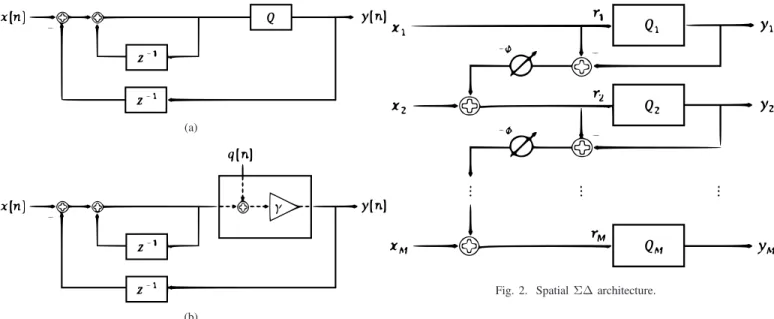
Fig. 1. (a) Block diagram for temporal Σ∆modulator. (b) With equivalent linear model for quantization.
later1. Finally, the received baseband signal at the BS is given
by y=Q(x) = Q1(x1),Q2(x2),· · ·,QM(xM) T . (6) III. Σ∆ARCHITECTURE A. Temporal Σ∆Modulation
In this subsection, we elaborate on temporalΣ∆modulation to clarify the noise shaping characteristics of this technique. Fig. 1(a) shows a block diagram representing the temporalΣ∆ modulator. To shape the quantization noise, the output signal is fed back and subtracted form the input (∆-stage), and then this error is integrated (Σ-stage). To characterize the transfer function of this non-linear system, we substitute the one-bit quantizer with the equivalent linear model depicted in Fig. 1(b). The input-output relationship of the Σ∆ quantizer can then be written as Y(z) = γ 1−(1−γ)z−1X(z)+ γ 1−z−1 1−(1−γ)z−1Q(z), (7) where X(z) = P∞
n=0x[n]z−n denotes the z-transform. Simply stated, the objective of Σ∆ modulation is to pass the signal through an all-pass filter and the quantization noise through a high-pass filter. This objective can be realized by settingγ≈1. Since commercial quantizers are provided with a built-in automatic gain control (AGC), the γ≈1 condition is inherently satisfied in implementations of temporal Σ∆ modulators, and hence this issue is not generally discussed in the literature. However, as we show in the next subsection, the choice of the scaling factor is critical in the mathematical modeling of spatialΣ∆architectures, and we derive a criterion for addressing this issue.
1While the one-bit ADC output levels will be optimized, this is a one-time
optimization and the values do not change as a function of the user scenario or channel realization. Thus the ADCs are still truly “one-bit.”
Fig. 2. SpatialΣ∆architecture.
B. One-Bit SpatialΣ∆ Modulation
As mentioned earlier, the basic premise of temporal Σ∆ modulation can be adopted in the angle domain, in order to spatially shape the quantization noise in a desired way. Instead of forming the∆ component using a delayed sample of the quantized input as in the temporal case, we use the quantization error signal from an adjacent antenna. A direct transfer of the temporal Σ∆ idea to the angle domain as in [36], [37] pushes the quantization noise to higher spatial frequencies, which correspond to DoAs away from the array broadside (|θ| ≫ 0◦), while the oversampling (reduced d/λ)
pushes signals of interest near broadside closer to zero spatial frequency. However, by phase-shifting the quantization error in the feedback loop prior to the ∆ stage, a Σ∆ frequency response can be obtained in which the quantization error is shaped away from a band of frequencies not centered at zero. This bandpass approach has been proposed for both the temporal (e.g.,see [28]) and spatial [39] versions of theΣ∆ architecture.
Fig. 2 shows the architecture of an angle-steeredΣ∆array. Using Fig. 2 and equation (8) at the top of the next page, we can formulate a compact input-output description of the spatialΣ∆ array by defining
U = 1 e−jφ 1 .. . . .. . .. e−j(M−1)φ · · · e−jφ 1 (9) V =U−IM, (10)
and expressing the input to the quantizers as
r=U x−V y. (11) The output of the angle-steered one-bit Σ∆ array is then defined by
ym= (
Q1(x1) m= 1
Qm xm+e−jφ xm−1+e−jφ · · · x2+e−jφ(x1−y1)−y2· · ·−ym−1 m >1
(8)
1) Linear Model: To analyze the performance of spatial Σ∆ processing, analogous to temporalΣ∆, we will represent the one-bit quantization operation in (12) with an equivalent linear model as follows:
y=Q(r) =Γr+q, (13) where Γ is an M ×M matrix and q denotes the effective quantization noise. The value ofΓ that makes the equivalent quantization noise, q, uncorrelated with risΓ0=RHryR−r1. For the case where the elements ofrare all jointly Gaussian, the computation of Rry is possible by resorting to the Buss-gang theorem2 [40]. This was the approach used in [5], [12] for a massive MIMO implementation with standard one-bit quantization, and the resultingΓ0 was a diagonal matrix.
For the case of the Σ∆ architecture, even if the matrix Γ0 could be computed, this decomposition would not be of interest, for at least two reasons. First, the equivalent quantization noise qthat results from settingΓ =Γ0 in (13) bears no connection to the quantization error fed from one antenna to the next as shown in Fig. 2. SettingΓ =Γ0would produce a model in which rm and qm−1 are uncorrelated, but it is clear from Fig. 2 that rm for theΣ∆ array directly
depends on the quantization error from the (m−1)-th stage. Second,Γ0 cannot be a diagonal matrix3, unlike the standard one-bit quantization case considered in [5]. The presence of off-diagonal elements in Γ0 implies that the model in (13) represents the output of each quantizer as a linear combination of the inputs to that quantizer as well as other quantizers in the array. Such a model does not have an apparent connection with the scheme in Fig. 2, where each quantizer produces its output depending only on its input alone. These inconsistencies between the mathematical model based on Γ =Γ0 and the physical block diagram of theΣ∆array in Fig. 2 are the result of attempting to force r andq to be uncorrelated, when the architecture is actually propagating the quantization error from one stage to the next.
Consequently, in order to derive an appropriate model for the analysis of the Σ∆ architecture, we propose to apply the Bussgang decomposition to each quantizer individually. In particular, we formulate the model in (13) using a matrix Γ = diag (γ1, . . . , γM) that is forced to be diagonal. This
is equivalent to imposing a model in which r and q are uncorrelated component-wise: E[rmqm∗] = 0. The elements
2The result can also be extended to cases wherer belongs to a limited
class of distributions, see [42] for details
3 IfΓ
0 were diagonal, it could be made equal to the identity matrix by
a proper scaling of eachym. However,Γ0 can never be the identity matrix
because this implies thatrm=xm−e−jφq
m−1, while simultaneouslyrm
is uncorrelated withqm−1, which is impossible.
ofΓ are given by γm= E[rmy∗ m] E[r2 m] =αm E[|Re[rm]|+|Im[rm]|] Eh|rm|2i , (14) where in the last equality and from now on, we assume that
rm is circularly symmetric. This assumption implies that the
quantizer output levels are identical for the real and imaginary parts, and thus we use αm to represent both αm,r andαm,i.
The expression in (14) has been defined in the literature as the equivalent gain of a non-linear device [42], [43].
As we will see later on, since the elements ofΓ depend only on the signals at one stage of the Σ∆ architecture, they are much easier to compute than the elements ofΓ0. Moreover, the resulting decomposition is consistent with Fig. 2. Given that no precondition is imposed on the correlation E[rmq∗
l]
for m 6= l, the model is compatible with the fact that the quantization noise of one stage appears in subsequent stages.
Plugging (13) into (11) and using some algebraic manipu-lations, we obtain the following mathematical model for the Σ∆architecture:
y= I+ΓV−1ΓU x+ I+ΓV−1q. (15) Equation (15) is the spatial Σ∆ equivalent to the temporal domain Σ∆ description in (7). Similar to the temporal case, (15) indicates thatΓ =Ishould hold for the spatialΣ∆array to work as desired, that is, to pass x and q through spatial all-pass and high-pass filters, respectively. IfΓ =I, then (15) becomes
y=x+U−1q, (16) and them-th element of yis expressed as
ym=xm+ qm−e−jφqm−1 , (17) which explicitly shows the quantization noise-shaping charac-teristic of the spatialΣ∆architecture. The only task remaining to complete our proposed linear model is to calculate the power of the equivalent quantization noise. The condition Γ = I for the adequate operation of the Σ∆ scheme determines the quantization levels that have to be set. Setting (14) equal to 1, we obtain the optimum value ofαm:
α⋆ m= Eh|rm|2i E[|Re[rm]|+|Im[rm]|] = Eh|Re[rm]|2i E[|Re[rm]|] . (18)
It is worth noting that (18) is different from
αm=E[|Re[rm]|], (19)
which leads to the Lloyd-Max one-bit quantizer that minimizes the mean-squared-error (MSE) between the input and the output of the quantizer. However, the Lloyd-Max approach
makes the quantization error uncorrelated with the quantizer output, but not with the input.
While the expression derived in (18) is useful, it is difficult to analytically evaluate the expectations in closed form, and it is not clear how the output level could be tuned using analog processing in the RF chain (e.g., via an AGC or some other type of calibration). To address this issue, we use the assumption that rm is Gaussian inherent in the Bussgang
decomposition to find an approximation forα⋆
mthat is easier
to deal with, both for the subsequent mathematical analysis and from the viewpoint of a hardware implementation. The validity of the approximation will be apparent in the numerical examples presented later. Ifrm is Gaussian, we can write
α⋆m=
r
πEh|rm|2i
2 . (20)
In the discussion below, we show how to express (20) in terms of the statistics of the array output x, which provides an analytical solution and clarifies how the quantizer output levels could be set in a practical setting.
2) Quantization Noise Power: In this section, we calculate the power of the effective quantization noise and the power of the quantizers’ inputs, which is needed to properly set the output levels using (20). WithΓ =I, (13) becomes
y=r+q. (21)
Since rm andqm are uncorrelated, and using (20), we obtain
E |qm|2=E|ym|2−E|rm|2= π 2 −1 E |rm|2. (22) To determineE |rm|2
, we substitute (21) into (11), so that
r=x−U−1V q. (23) It can be shown that
U−1V =e−jφZ −1, (24) where4 Z−1= 0 1 0 .. . . .. . .. 0 . .. 1 0 . (25)
Moreover, following the same reasoning as in Appendix A of [5], it can be shown that E[xm′q∗m] ≈ 0, ∀m, m′ ∈ M =
{1,· · ·, M}. This results inRqx≈0. Therefore,
Rr=Rx+Z−1RqZH−1. (26) Eq. (26) implies that
E|rm|2= ( E |xm|2 m= 1 E |xm|2+E|qm−1|2 m >1 (27) 4Note thatZ
−1is the spatial domain equivalent of the delay operatorz−
1
for the z-transform in the time domain.
Substituting (22) into (27) and noting that E
|r1|2 =
E|x1|2, we obtain the following recursive equality to
calcu-lateE|rm|2 form >1: E|rm|2=E|xm|2+π 2 −1 E|rm−1|2. (28) Let pχ= E |χ1|2,E|χ2|2,· · · ,E|χM|2 T , (29) whereχcan be any element of the set χ∈ {r,x,q}. Then, using (22) and (28), we have
pr=Πpx (30) pq = π 2 −1 Πpx, (31) where Π= 1 0 π 2 −1 1 .. . . .. 1 π 2−1 m . .. . .. . .. .. . . .. . .. . .. . .. π 2 −1 M−1 · · · π 2 −1 m · · · π 2 −1 1 . (32) Equation (30) shows that the calculation of Eh|rm|2i
needed in (20) can be formulated in terms of the power of the antenna outputsEh|xm|2i, for which simple expressions exist
from (1). This further implies that control ofEh|xm|2ivia an
AGC would allow the quantizer output levels to be set without feedback from the digital baseband. In the following remark, we show that, using the optimal quantizer output settings, the power of the quantization noise does not grow withmdespite the fact that is propagated from one antenna to the next.
Remark1. Eq. (31) implies that, by appropriately selecting the quantizers’ output levels, the quantization noise power does not increase without bound. In particular, consider the case where the power of the received signal is constant over the array elements, i.e.,px=px1. Then,
E|qm|2=π 2 −1 1− π 2−1 m 1− π 2 −1 px−−−−→ m→∞ π 2 −1 2−π 2 px, (33) which shows that, in the limit of a large number of antenna elements, the quantization noise power converges to a constant value of approximately 1.33 times the input power.
3) Quantization Noise Power Density: In the time domain, it is well-known that sampling a band-limited signal by a rateN times larger than the Nyquist rate and down-sampling after quantization can reduce the in-band quantization noise power by a factor of 1/N and 1/N3 for standard one-bit and Σ∆ modulation, respectively [44]. In this section, we look for a similar behaviour for quantization across an array in space. More precisely, we want to quantify how spatial oversampling, i.e., decreasing the antenna spacing, d/λ, (or
equivalently, increasing the number of antennas for space-constrained arrays) can reduce the quantization noise power for the in-band angular spectrum. To do so, we define the quantization noise power density as
ρq(u),
1
Ma(u)
H
R a(u), (34) whereRis the covariance matrix of the quantization noise. To differentiate the two cases, we denote the covariance matrix of the quantization noise for standard one-bit quantization as Rq1, and the covariance of the Σ∆ quantization noise as RqΣ∆. Expressions for these covariance matrices will be derived later in this subsection. Hence, the normalized received quantization noise power over some angular region,Θ, is given by5 Pq = 1 2δ Z δ −δ ρq(u)du, (35) whereδ= sin Θ 2
. Next we findPq for standard one-bit and
Σ∆ quantization.
a) One-bit Quantization: Unlike [5], for standard one-bit quantization, we choose the quantizer output levels as αm=
r
πEh|xm|2i/2 so that ym = Q(xm) = xm +qm. This
causes no loss of generality for standard one-bit quantization, since the value of the quantizer output has no impact on the performance of the resulting system. Therefore, the covariance matrix of the quantization noise can be written as
Rq1=Ry−Rx, (36) where the arc-sine law [45], [46] is used to obtain
Ry= diag (Rx) 1 2 sin−1(Υ) diag (Rx) 1 2, (37) and Υ= diag (Rx)−12Re(Rx) diag (Rx)− 1 2+ jdiag (Rx)−12 Im(Rx) diag (Rx)− 1 2. (38) Note that the arc-sine in (37) is applied separately to each element of the matrix argument, and also separately to the real and imaginary parts of the matrix elements.
From [5], we have thatdiag (Ry) =π
2diag (Rx). Since the off-diagonal elements of Υare small, we use the
approxima-tion sin−1(x) ≈ζx, whereζ >1, to obtain Rq1 ≈(ζ−1)Rx+ π 2 −ζ diag (Rx). (39) Moreover, from (1), Rx becomes
Rx= K X k=1 pkβk 1 L L X ℓ=1 a(ukℓ)a(ukℓ)H+σ2nI, (40)
5To simplify the calculation of the quantization noise power, we assume
without loss of generality that theΣ∆array is steered to broadside (θ= 0).
where for L ≫ 1, ukℓ can be taken as a random variable
uniformly distributed in[−δ, δ]. That is, 1 L L X ℓ=1 a(ukℓ)a(ukℓ)H≈E h a(u)a(u)Hi= 1 2δ Z δ −δ a(u)a(u)Hdu. (41) Therefore, Rx= K X k=1 pkβk 1 2δ Z δ −δ a(u)a(u)Hdu+σn2I. (42)
Now we are ready to calculate the standard one-bit quanti-zation noise power,Pq1.
Proposition 1. The normalized quantization noise power for
standard one-bit quantization is
Pq1 = (ζ−1)× " σ2n+ 1 M K X k=1 pkβk M−1 X n=0 M−1 X m=0 sinc2 2πd λ(m−n)δ # + π 2 −ζ M Tr [Rx], (43)
wheresinc (x), sin(x)
x .
Proof. Plugging (42) into (39) results in Pq1 = (ζ−1)× σn2+ 1 4δ2M K X k=1 pkβk δ Z Z −δ a(v) H a(u) 2 dudv + π 2 −ζ M Tr [Rx]. (44)
Using Eq. (10) in [47] yields 1 4δ2 δ Z Z −δ a(v) H a(u) 2 dudv=E a(v) H a(u) 2 = M−1 X n=0 M−1 X m=0 sinc2 2πd λ(m−n)δ , (45)
which completes the proof.
Remark 2. Consider the case thatM ≫1. Then, from (43)
Pq1 (a) ≈(ζ−1)σ2n+ (ζ−1) " 1 2δ d λ −1 −4π12δ2 d λ −2 f d λ # K X k=1 pkβk +π 2 −ζ XK k=1 pkβk, (46) wheref(x), 2 M PM−1 n=1 sin2 (2πxδn)
n and in (a) we have used
Eq. (14) of [47]. Equation (46) states that, for standard one-bit quantization, increasing the spatial oversampling in a large
antenna array (d/λ → 0) increases the quantization noise power proportional to (d/λ)−1.
Remark3. Consider the fixed-aperture case whered0=Mλd
is a constant (i.e., the antenna spacing decreases proportion-ally to the increase in the number of antennas). Then, from (43) Pq1 −−−−→ M→∞ (ζ−1) " σ2 n+M K X k=1 pkβk # +π 2 −ζ XK k=1 pkβk. (47) Equation (47) states that, for standard one-bit quantization, increasing the number of antennas for an array with a fixed aperture, d0, increases the quantization noise power linearly withM.
b) Σ∆ Quantization: From (16), the covariance of the quantization noise for the Σ∆ architecture is RqΣ∆ =
U−1RqU−H. We derive an expression for the normalized quantization noise power of the Σ∆ array,PqΣ∆, in the next proposition.
Proposition 2. The quantization noise power for spatialΣ∆
quantization is PqΣ∆ = 2 M Tr [Rq]−σ 2 qM 1−sinc 2πd λδ +σ 2 qM M , (48) where σ2 qM =E |qM|2 . Proof. Substituting RqΣ∆ = E h U−1qqHU−Hi into (34) leads to PqΣ∆ = 1 M 1 2δ Z δ −δ E a(u) H U−1q 2 du. (49) We set φ = 0 due to the assumption of u ∈ [−δ, δ] in the definition of the quantization noise power, and we note that
U−1=IM−Z−1. (50) Then U−1q= IM−Z−1q= q1 q2−q1 .. . qM −qM−1 . (51)
In addition, from (23), and the fact that Rqx ≈0, it can be readily shown that E
qmq∗m±1
≈0. Hence, for the sake of analysis, we approximateE[qmq∗
m′]≈0, ∀m6=m′∈ M,
and thereforeRq = diag pq . Consequently, E a(u) H U−1q 2 = 1−e j2πd λu 2MX−1 m=1 Eh|qm|2i+Eh|qM|2i= 4 Tr [Rq]−σ2qM sin2 πd λu +σ2qM. (52)
By integrating (52) and using some algebraic manipulation,
we arrive at (48).
Remark 4. Consider the case thatM ≫1. Then, from (48)
PqΣ∆ (a) ≈ 43 π 2 −1 2−π 2 π2δ2 d λ 2 px, (53)
where in (a) we have usedsinc (x)≈1−x2 6 and 1 M Tr [Rq]−σ 2 qM ≈ π 2 −1 2−π 2 px (54)
for M ≫ 1 and assuming px = px1. Equation (53) states
that, by increasing the spatial oversampling (d/λ → 0), the quantization noise power for the Σ∆ array tends to zero proportional to (d/λ)2. This result is in contrast to that for the standard one-bit quantization power, which was shown earlier to increase proportional to(d/λ)−1. Hence, the spatial Σ∆architecture brings about an oversampling gain of(d/λ)3 compared to the standard one-bit architecture. While this is a promising result, as mentioned earlier the practical limitations of placing antenna elements close to each other prevent us from achieving a high degree of spatial oversampling.
Remark 5. Consider the case that d0 = Mdλ is a constant.
Then, from (48) M2PqΣ∆ −−−−→ M→∞ 4 3 π 2 −1 2−π 2 π2δ2d20px. (55)
Equation (55) states that, for spatialΣ∆quantization, increas-ing the number of antennas for an array with a fixed aperture,
d0, decreases the quantization noise power proportional to 1/M2. Hence, the spatial Σ∆ architecture brings about an oversampling gain of M3 compared to the standard one-bit architecture.
In the next section, we study the spectral efficiency of a massive MIMO system with spatial Σ∆ processing and discuss the impact of the spatialΣ∆architecture on the system performance.
IV. SPECTRALEFFICIENCY
In this section, we study the SE of a massive MIMO system with spatial Σ∆ processing. We consider maximum ratio combining (MRC) and zero-forcing (ZF) receivers. We derive here an approximation for the SE of the system with an MRC receiver, and evaluate the SE for the ZF receiver in the next section, numerically. We first present the case where perfect channel state information (CSI) is assumed to be available at the BS, and then we discuss the impact of imperfect CSI on the system performance at the end of the section .
From (1) and (16), the received signal at a BS with aΣ∆ architecture can be modeled as
y=GP12s+n+U−1q. (56) Denoting the linear receiver by W, we have
ˆ
and the kth element ofˆsis given by ˆ sk =√pkwHkgksk+ K X i=1,i6=k √p kwHk gisi+ wHk n+wHk U−1q, (58) where wk is the kth column of W. We assume the BS
treats wH
k gk as the desired channel and the other terms of
(58) as worst-case Gaussian noise when decoding the signal. Consequently, a lower bound for the ergodic achievable SE at the kth user can be written as [48]
Sk =E ( log2 1 + pk wHkgk 2 Ω !) , (59) where Ω = K X i=1,i6=k pk wHkgi 2 +σ2nkwkk2+wkHU−1RqU−Hwk. (60) A. MRC Receiver
For the case of an MRC receiver, W =G. The following proposition presents an approximation for the achievable SE of a massive MIMO system with spatial Σ∆ processing and an MRC receiver.
Proposition 3. For a massive MIMO system employing a
spatial Σ∆ architecture and an MRC receiver, the SE of the
kth user assuming perfect CSI is given by eq. (61) shown at the top of the next page, where Σik, 1
LA H i Ak.
Proof. From [48], an approximation for (59) can be calculated as Sk ≈log2 1 + pk EhwHkgk 2i E[Ω] . (62) By setting wk = gk and using Lemma 2 of [49] and
Lemma 1 of [50], the expected values of the desired signal, interference, and thermal noise can be readily calculated. For the quantization noise term, note that
U−1=IM−e−jφZ−1. (63) Therefore, U−1q= IM −e−jφZ−1 q= q1 q2−e−jφq1 .. . qM −e−jφqM−1 . (64)
In addition, the kth user channel vector can be written as
gk = r βk L L X l=1 hkla(θkl), (65)
wherehkl is thelth element ofhk. Hence,
EhgHkU−1q 2i = βk LE L X ℓ=1 hkl 1−e−jφzkl M−1 X m=1 qmzklm−1+qMzklM−1 2 , (66) which, after some algebraic manipulation, leads to (61) and
the proof is complete.
Remark 6. The noise shaping characteristic of the spatial
Σ∆ architecture is explicitly manifested in (61). A similar characteristic is observed in [39] forΣ∆precoding. It shows the importance of the design parameter φ which should be chosen to minimizeG= 1 L PL ℓ=1sin 2φ−2πd λsin(θkℓ) 2 for all users. By writing the steering angle as φ = 2πd
λsin (θ), we have G= 1 L L X ℓ=1 sin2 πd λ sin (θ)−sin (θkℓ) . (67) Eq. (67) indicates that G could be made arbitrarily small by decreasing the relative antenna spacing d/λ (the spatial oversampling gain) orsin (θ)−sin (θkℓ)(the angle steering
gain). However, physical constraints on the antenna spacing and larger angular spreads, Θ, limit the lower bound onG. For the case that L ≫ 1, sin (θkℓ) = ukℓ can be taken
as a random variable uniformly distributed in [δ1, δ2] where
δ1= sin θ0−Θ2andδ2= sin θ0+Θ2. Hence,
G ≈ δ 1 2−δ1 Z δ2 δ1 sin2 φ−2π d λu 2 ! du= 1 2+ 1 4π d λ −1 1 δ2−δ1 (b0sin (φ)−b1cos (φ)), (68) where b0= cos 2πd λδ2 −cos 2πd λδ1 b1= sin 2πd λδ2 −sin 2πd λδ1 .
In this case, the optimal value of the steering angle that minimizesG can be simply derived as
φ⋆= ( 0 δ2=−δ1 −tan−1b0 b1 otherwise (69) which indicates that the optimal steering angle is dependent onδ1,δ2, and the relative antenna spacingd/λ.
B. ZF receiver
For the ZF receiver,W =GGHG−
1
. After substituting this forW in (62), the SE achieved for thekth user with the Σ∆ architecture and ZF receiver can be written as in (70) at the top of the next page. Although (70) does not provide direct insight into the effect of the shaped quantization noise on
Sk ≈log2 1 + pkβk |Tr [Σkk]|2+ TrΣ2kk PK i=1,i6=kpkβkTr h ΣikΣH ik i +σ2 nβkTr [Σkk] +4Lβk Tr [Rq]−σ2qM PL ℓ=1sin 2φ−2πd λsin(θkℓ) 2 +βkσq2M (61)
the SE, in Section V we numerically evaluate this expression and show the superior performance of the Σ∆ architecture compared with standard one-bit quantization.
V. NUMERICALRESULTS
In this section, we numerically evaluate the SE performance of Σ∆ massive MIMO systems in various scenarios. We assume static-aware power control in the network [51] so that pk =p0/βk. In all of the cases considered, we assume
M = 100 antennas, K = 10 users, L = 50 coherent paths per user, and an angular spread of Θ = 40◦ centered at θ0= 30◦. The DoAs for each user are drawn uniformly from the interval [10◦,50◦], which corresponds to u = sin(θ) ∈
[0.17,0.77], and the steering angle of theΣ∆ array is set to
φ= 2πd
λsin (θ0). The SNR is defined to beSNR, p0
σ2 n. Fig. 3 shows the simulated and analytically derived quanti-zation noise power density, i.e., ρq(u), u∈[−1,1], forΣ∆
and standard one-bit quantization when the relative antenna spacing isd=λ/4. We see that the quantization noise power for theΣ∆array is substantially lower over the angles where the users are present, while the effect is the opposite for standard one-bit quantization – the quantization noise is higher for angles where the amplitude of the received signals is larger. We also observe that there is excellent agreement between the simulations and our theoretically derived expressions for both cases. Note that the careful design of the quantizer output levels is a critical aspect for achieving the desired Σ∆ noise shaping characteristic shown here.
The impact of spatial oversampling on the shape of the quantization noise spectrum is illustrated in Fig. 4. We see from the figure that, as discussed in Remarks 2, the quan-tization noise power for the standard one-bit ADC architec-ture grows as d/λ decreases. Analogously to temporal Σ∆ modulation where increasing the sampling rate helps to push the quantization noise to higher frequencies and widen the quantization-noise-free band, we can reduce the quantization noise power over wider angular regions by placing the antenna elements of the array closer together. For example, when
d = λ/2, the Σ∆ quantization noise power is below that of the standard one-bit quantizer over a beamwidth of 40◦.
This beamwidth increases to about 80◦, 150◦, and 180◦ for d = λ/4, d = λ/8, and d = λ/16, respectively. Mutual coupling will impact these results as d decreases, but both the standard one-bit and Σ∆ approaches would be expected to degrade.
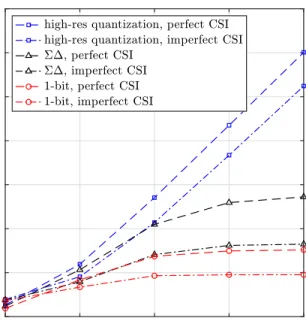
In Fig. 5, we compare the SE performance ofΣ∆and stan-dard one-bit quantization for the case of an MRC receiver. It is clear that the derived theoretical SE expression very closely
matches the simulated value. The one-bitΣ∆implementation achieves a significantly increased SE compared with standard one-bit quantization, and performs nearly identically to an MRC receiver with infinite resolution ADCs. It should be emphasized that this performance gain is achieved without paying a significant penalty in terms of power consumption (as with mixed-ADC architectures) or complicated processing (as required by non-linear receivers).
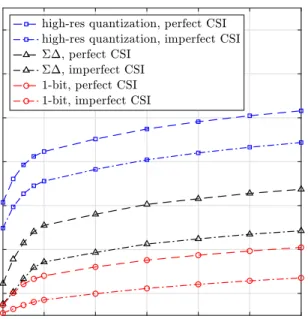
In Fig. 6, we numerically evaluate the SE when the ZF receiver is employed. The SE improvement ofΣ∆processing is much greater than for the case of MRC. For example, at SNR = 0 dB, about a 50% improvement in SE can be achieved by the spatial Σ∆ architecture compared with standard one-bit quantization, which confirms its ability to provide high SE with a simple architecture and low power consumption.
The effect of channel estimation error on the performance of the algorithms is also shown in Fig. 6 for the ZF receiver. For these results, we used a least squares (LS) channel estimator for each of the algorithms. Fig. 7 shows the performance of the ZF receiver with and without perfect CSI versus the number of antennas. The presence of imperfect CSI obviously degrades all of the algorithms, but we see that the Σ∆ architecture provides a way to successfully bridge the performance gap between standard one-bit and high-resolution quantization with only a minimal increase in hardware complexity.
VI. CONCLUSION
In this paper, we studied the performance of massive MIMO systems employing spatial one-bitΣ∆ quantization. Using an element-wise Bussgang approach, we derived an equivalent linear model in order to analytically characterize the spectral efficiency of a massive MIMO base station with a Σ∆array, and we compared the results with the performance achieved by an array that employs standard one-bit quantization. Our results demonstrated that the spatialΣ∆architecture can scale down the quantization noise power proportional to the square of the spatial oversampling rate. This can be interpreted as scaling down the quantization noise power proportional to the inverse square of the number of antennas at the BS for space-constrained arrays. This result gains more importance by noting that in standard one-bit quantization, the quanti-zation noise power grows proportional to the inverse of the spatial oversampling rate, or equivalently, proportional to the number of antennas at the BS in space-constrained arrays. Furthermore, it was shown how this capability allows the spatialΣ∆architecture to bridge the SE gap between infinite resolution and standard one-bit quantized systems. For the ZF
Sk ≈log2 1 + pkβk E[kwkk2]σ2 n+E GHG −1 GHU−1RqU−HG GHG −1 kk (70) -1 -0.5 0 0.5 1 -10 -5 0 5 10 15 20
Fig. 3. Spatial spectrum of the quantization noise for theΣ∆and standard one-bit architectures whend=λ/4andSNR = 0 dB.
-1 -0.5 0 0.5 1 -10 -5 0 5 10 15 20 0.2 0.4 0.6 0.8 -5 0 5 10 15
Fig. 4. Spatial spectrum of the quantization noise for theΣ∆and standard one-bit architectures for different antenna spacings whenSNR = 0 dB.
-20 -10 0 10 20 SNR [dB] 4 6 8 10 12 14 16
Sum Spectral Efficiency (b/s/Hz)
Fig. 5. SE versus SNR for MRC receiver andd=λ/4.
-20 -10 0 10 20 SNR [dB] 0 20 40 60 80 100 120 140
Sum Spectral Efficiency (b/s/Hz)
Fig. 6. SE versus SNR for ZF receiver with and without channel estimation error.d=λ/4.
100 150 200 250 300 350 Number of Antennas M 20 40 60 80 100 120 140
Sum Spectral Efficiency (b/s/Hz)
Fig. 7. SE versus M for ZF receiver with and without channel estimation error.d=λ/4,SNR = 10dB.
receiver, the spatial Σ∆architecture can outperform standard one-bit quantization by about 50%, and achieve almost the same performance as an infinite resolution system for the MRC receiver. While these results were obtained by assuming the availability of perfect CSI at the BS, we showed that the ability to steer the spatialΣ∆architecture to different angles allows the system to cope with the impact of channel estimation error and, hence, leads to a design that is robust against imperfect CSI.
The Σ∆ array reduces the quantization error over a given sector of angles, and shapes it to spatial frequencies outside the sector. Thus, performance for users within the sector is improved relative to standard one-bit quantization, while interference outside the sector should be removed prior to signal detection. The concept of cell sectorization is consistent with current cellular implementations that divide the cell into 120◦ regions using separate antenna arrays and antenna
elements with non-uniform angular responses. The size of the sector of “good performance” for the Σ∆ array is a function of the amount of spatial oversampling in the array; the closer the antennas are placed to each other, the wider the sector. While temporal Σ∆receivers can be designed to oversample by factors of 10 or more to achieve a very high degree of quantization noise reduction, the physical dimensions of the antennas and the deleterious effect of mutual coupling prevent such large oversampling factors for theΣ∆array. Fortunately, as shown by the numerical results in this paper, reducing the antenna spacing by only a factor of 2 is sufficient to realize large spectral efficiency gains with theΣ∆architecture. Oversampling by 2 does not create a sector as large as 120◦,
but the ability of the Σ∆ array to electronically control the center point of the angular sector provides important flexibility. For example, multiple sectors could be serviced in parallel with a single antenna array by deploying a bank of Σ∆ receivers tuned to different spatial frequencies, in order to cover a wider angular region.
REFERENCES
[1] L. Fan, S. Jin, C. Wen, and V. Zhang, “Uplink achievable rate for massive MIMO systems with low-resolution ADCs,” IEEE Commun. Lett., vol. 19, no. 12, pp. 2186-2189, Dec. 2015.
[2] J. Zhang, L. Dai, S. Sun, and Z. Wang, “On the spectral efficiency of massive MIMO systems with low-resolution ADCs,” IEEE Commun. Lett., vol. 20, no. 5, pp. 842-845, May. 2016.
[3] J. Choi, J. Mo, and R. W. Heath, “Near maximum-likelihood detector and channel estimator for uplink multiuser massive MIMO systems with one-bit ADCs,” IEEE Trans. Commun., vol. 64, no. 5, pp. 2005–2018, May 2016.
[4] C. Moll´en, J. Choi, E. G. Larsson, and R. W. Heath, “Uplink performance of wideband massive MIMO with one-bit ADCs,”IEEE Trans. Wireless Commun., vol. 16, no. 1, pp. 87–100, Jan 2017.
[5] Y. Li, C. Tao, L. Liu, A. Mezghani, G. Seco-Granados, and A. Swindle-hurst, “Channel estimation and performance analysis of one-bit massive MIMO systems,”IEEE Trans. Signal Process., vol. 65, no. 15, pp. 4075-4089, May 2017.
[6] S. Jacobsson, G. Durisi, M. Coldrey, U. Gustavsson, and C. Studer, “Throughput analysis of massive MIMO uplink with low-resolution ADCs,”IEEE Trans. Wireless Commun., vol. 16, no. 6, pp. 4038–4051, June 2017.
[7] P. Dong,et al., “Performance analysis of multiuser massive MIMO with spatially correlated channels using low-precision ADC,” IEEE Commun. Lett., vol. 22, no. 1, pp. 205-208, Jan. 2018.
[8] Z. Shao, R. C. de Lamare, and L. T. N. Landau, “Iterative detection and decoding for large-scale multiple-antenna systems with 1-bit ADCs,” IEEE Wireless Commun. Lett., vol. 7, no. 3, pp. 476–479, June 2018. [9] Y. Jeon, N. Lee, S. Hong, and R. W. Heath, “One-bit sphere decoding for
uplink massive MIMO systems with one-bit ADCs,”IEEE Trans. Wireless Commun., vol. 17, no. 7, pp. 4509–4521, July 2018.
[10] A. Mezghani, R. Ghiat, and J. A. Nossek, “Transmit processing with low resolution D/A-converters,” inProc. 16th IEEE Int. Conf. Electron., Circuits, Syst., Dec 2009, pp. 683–686.
[11] A. K. Saxena, I. Fijalkow, and A. Swindlehurst, “Analysis of one-bit quantized precoding for the multiuser massive MIMO downlink,” IEEE Trans. Signal Process., vol. 65, no. 17, pp. 4624–4634, Sept 2017. [12] Y. Li, C. Tao, A. L. Swindlehurst, A. Mezghani, and L. Liu, “Downlink
achievable rate analysis in massive MIMO systems with one-bit DACs,” IEEE Commun. Lett., vol. 21, no. 7, pp. 1669–1672, July 2017. [13] O. Castaneda, S. Jacobsson, G. Durisi, M. Coldrey, T. Goldstein, and
C. Studer, “1-bit massive MU-MIMO precoding in VLSI,”IEEE J. Emerg. Sel. Topics Circuits Syst., vol. 7, no. 4, pp. 508–522, Dec 2017. [14] S. Jacobsson, G. Durisi, M. Coldrey, T. Goldstein, and C. Studer,
“Quantized precoding for massive MU-MIMO,”IEEE Trans. Commun., vol. 65, no. 11, pp. 4670–4684, Nov 2017.
[15] A. Swindlehurst, A. Saxena, A. Mezghani, and I. Fijalkow, “Minimum probability-of-error perturbation precoding for the one-bit massive MIMO downlink,” in Proc. IEEE Int. Conf. Acous., Speech, Signal Process. (ICASSP), Mar. 2017, pp. 6483–6487.
[16] L. T. N. Landau and R. C. de Lamare, “Branch-and-bound precoding for multiuser MIMO systems with 1-bit quantization,” IEEE Wireless Commun. Lett., vol. 6, no. 6, pp. 770–773, Dec 2017.
[17] H. Jedda, A. Mezghani, A. L. Swindlehurst, and J. A. Nossek, “Quan-tized constant envelope precoding with PSK and QAM signaling,”IEEE Trans. Wireless Commun., vol. 17, no. 12, pp. 8022–8034, Dec 2018. [18] A. Li, C. Masouros, F. Liu, and A. L. Swindlehurst, “Massive MIMO
1-bit DAC transmission: A low-complexity symbol scaling approach,” IEEE Trans. Wireless Commun., vol. 17, no. 11, pp. 7559–7575, 2018. [19] F. Sohrabi, Y.-F. Liu, and W. Yu, “One-bit precoding and constellation
range design for massive MIMO with QAM signaling,” IEEE J. Sel. Topics Signal Process., vol. 12, no. 3, pp. 557–570, 2018.
[20] M. Shao, Q. Li, W.-K. Ma, and A. M.-C. So, “A framework for one-bit and constant-envelope precoding over multiuser massive MISO channels,” arXiv preprint arXiv:1810.03159, 2018.
[21] W. Tan, S. Jin, C. Wen and Y. Jing, “Spectral efficiency of mixed-ADC receivers for massive MIMO systems,” IEEE Access, vol. 4, pp. 7841-7846, Aug. 2016.
[22] J. Zhang, L. Dai, Z. He, S. Jin, and X. Li, “Performance analysis of mixed-ADC massive MIMO systems over Rician fading channels,” IEEE J. Sel. Areas in Commun., vol. 35, no. 6, pp. 1327-1338, June 2017. [23] H. Pirzadeh, and A. L. Swindlehurst, “Spectral efficiency under energy
constraint for mixed-ADC MRC massive MIMO,” IEEE Sig. Process. Lett., vol. 24, no. 12, pp. 1847-1851, Oct. 2017.
[24] J. Park, S. Park, A. Yazdan and R. W. Heath “Optimization of Mixed-ADC multi-antenna systems for Cloud-RAN deployments,”IEEE Trans. Commun., vol. 65, no. 9, pp. 3962-3975, Sep. 2017.
[25] A. B. ¨Uc¸¨unc¨u and A. ¨O. Yilmaz, “Oversampling in One-Bit Quantized Massive MIMO Systems and Performance Analysis,” IEEE Trans. Wireless Commun., 2018 (to appear).
[26] A. Gokceoglu, E. Bj¨ornson, E. G. Larsson, and M. Valkama, “Spatio-Temporal Waveform Design for Multiuser Massive MIMO Downlink With 1-bit Receivers,” IEEE J. Sel. Topics Sig. Proc., vol. 11, no. 2, pp. 347–362, March 2017.
[27] M. Schluter, M. Dorpinghaus, and G. P. Fettweis, “Bounds on channel parameter estimation with 1-bit quantization and oversampling,” in International Workshop on Signal Processing Advances in Wireless Com-munications (SPAWC), June 2018.
[28] P. M. Aziz, H. V. Sorensen, and J. Van Der Spiegel, “An overview of sigma-delta converters: How a 1-bit ADC achieves more than 16-bit resolution,”IEEE Signal Process. Mag., vol. 13, no. 1, pp. 61–84, 1996. [29] R. T. Baird and T. S. Fiez, “Linearity enhancement of multi-bit A/D and D/A converters using data weighted averaging,”IEEE Trans. Circuits Syst., vol. 42, pp. 753–762, Dec. 1995.
[30] I. Galton, “Delta–sigma data conversion in wireless transceivers,”IEEE Trans. Microw. Theory Tech., vol. 50, no. 1, pp. 302–315, Jan. 2002. [31] D. P. Scholnik, J. O. Coleman, D. Bowling, and M. Neel,
“Spatio-temporal delta-sigma modulation for shared wideband transmit arrays,” inProc. IEEE Radar Conf., 2004, pp. 85–90.
[32] J. D. Krieger, C. P. Yeang, and G. W. Wornell, “Dense delta-sigma phased arrays,”IEEE Trans. Antennas Propag., vol. 61, no. 4, pp. 1825– 1837, April 2013.
[33] V. Venkateswaran and A. van der Veen, “MultichannelΣ∆ADCs with integrated feedback beamformers to cancel interfering communication signals,” IEEE Trans. Signal Process., vol. 59, no. 5, pp. 2211–2222, May 2011.
[34] A. Nikoofard, J. Liang, M. Twieg, S. Handagala, A. Madanayake, L. Belostotski, and S. Mandal, “Low-complexity N-port ADCs using 2-D sigma-delta noise-shaping for N-element array receivers,” inProc. Int. Midwest Symposium Circuits Syst. (MWSCAS), 2017, pp. 301–304. [35] A. Madanayake, N. Akram, S. Mandal, J. Liang, and L. Belostotski,
“Improving ADC figure-of-merit in wideband antenna array receivers using multidimensional space-time delta-sigma multiport circuits,” in Proc. Int. Workshop Multidimensional (nD) Syst. (nDS), Sept 2017. [36] R. M. Corey and A. C. Singer, “Spatial sigma-delta signal acquisition
for wideband beamforming arrays,” inProc. Int. ITG Workshop Smart Antennas (WSA), March 2016.
[37] D. Barac and E. Lindqvist, “Spatial sigma-delta modulation in a mas-sive MIMO cellular system,” Master’s thesis, Department of Computer Science and Engineering, Chalmers University of Technology, 2016. [38] S. Rao, H. Pirzadeh and A. Swindlehurst, “Massive MIMO channel
estimation with 1-bit spatial Sigma-Delta ADCs,” inProc. IEEE Int. Conf. Acous., Speech, Signal Process. (ICASSP), May 2019, pp. 4484–4488. [39] M. Shao, W.-K. Ma, Q. Li and A. Swindlehurst, “One-Bit Sigma-Delta
MIMO Precoding,”arXiv preprint arXiv:1903.03319, 2019.
[40] J. J. Bussgang, “Crosscorrelation functions of amplitude-distorted Gaussian signals,” Res. Lab. Electron., Massachusetts Inst. Technol., Cambridge, MA, USA, Tech. Rep. 216, 1952.
[41] H. Q. Ngo, E. G. Larsson, and T. L. Marzetta, “The multicell multiuser MIMO uplink with very large antenna arrays and a finite-dimensional channel,” IEEE Trans. Commun., vol. 61, no. 6, pp. 2350-2361, June 2013.
[42] F. J. Barrett and D. G. Lampard, “An expansion for some second order probability distributions and its application to noise problems,”IRE Trans. Inform. Theory, vol. 1, no. 1, pp. 10-15, Mar. 1955.
[43] R. Booton, “Nonlinear control systems with random inputs,” in IRE Trans. Circuit Theory, vol. 1, no. 1, pp. 9–18, March 1954.
[44] Alan V. Oppenheim, and Ronald W. Schafer, Discrete-Time Signal Processing. Upper Saddle River, NJ, USA: Prentice-Hall, 2009.
[45] J. Van Vlack and D. Middleton, “The spectrum of clipped noise,” in Proc. IEEE, vol. 54, no. 1, pp. 1–19, Jan. 1966.
[46] G. Jacovitti and A. Neri, “Estimation of the autocorrelation function of complex Gaussian stationary processes by amplitude clipped signals,” in IEEE Trans. Info. Theory, vol. 40, no. 1, pp. 239–245, Jan. 1994. [47] C. Masouros and M. Matthaiou, “Space-constrained massive MIMO:
Hitting the wall of favorable propagation,”IEEE Commun. Lett., vol. 19, no. 5, pp. 771-774, May 2015.
[48] Q. Zhang, S. Jin, K-K. Wang, H. Zhu, and M. Matthaiou “Power scaling of uplink massive MIMO systems with arbitrary-rank channel means,” IEEE Journal of Sel. Topics Sig. Process., vol. 8, no. 5, pp. 966-981, Oct. 2014.
[49] E. Bj¨ornson, M. Matthaiou, and M. Debbah, “Massive MIMO with non-ideal arbitrary arrays: Hardware scaling laws and circuit-aware design,” IEEE Trans. Wireless Commun., vol. 14, no. 8, pp. 4353-4368, Aug. 2015. [50] H. Pirzadeh and A. Lee Swindlehurst, “Space-Constrained Mixed-ADC Massive MIMO,” in Proc. IEEE Int. Workshop on Signal Processing Advances in Wireless Communications (SPAWC), July 2019.
[51] E. Bj¨ornson, E. G. Larsson, and M. Debbah, “Massive MIMO for maximal spectral efficiency: How many users and pilots should be allocated?,” IEEE Trans. Wireless Commun., vol. 15, no. 2, pp. 1293-1308, Feb. 2016.