Prepared for BMC Software, Inc.
December 27, 2006
The Total Economic Impact™ Of The BMC
Atrium Configuration Management Database
(CMDB) Solution
Multi-Company Analysis
Table Of Contents
Executive Summary ... 3
Forrester’s Definition Of A CMDB... 6
About The BMC Atrium CMDB ... 7
Description Of Sample Composite Organization... 8
The Sample Organization Chooses The BMC Atrium CMDB ... 9
Costs, Benefits And Risks... 10
Financial Summary: The Sample Organization... 13
Conclusions ... 14
Appendix A: Total Economic Impact Overview ... 15
Appendix B: About The Project Director... 16
© 2006 Forrester Research, Inc. Circulation or disclosure in whole or in part of this report outside the authorized recipient organization is expressly forbidden without the prior written permission of Forrester Research, Inc. Forrester, Forrester Oval Program, Forrester Wave, WholeView 2, Technographics, TechRankings, Total Economic Impact, and TEI are trademarks of Forrester Research, Inc. All other trademarks are the property of their respective companies. Information is based on best available resources. Opinions reflect judgment at the time and are subject to change.
Executive Summary
In August 2006, BMC Software commissioned Forrester Research to examine the financial impact and potential benefits from implementing the BMC Atrium Configuration Management Database (CMDB) solution, hereafter referred to as the BMC Atrium CMDB. To determine the impact,
Forrester examined the specific costs, benefits, flexibility, and risk elements that a representative or sample BMC customer may experience when it implements the BMC Atrium CMDB. In support of this, Forrester conducted in-person, roundtable interviews with 17 key decision-makers at 10 organizations currently using the BMC Atrium CMDB solution. Forrester used the shared common inputs from these organizations to create a sample composite organization for this study to describe the potential benefits of the BMC Atrium CMDB solution (a description of the sample composite organization is on page 8).
Purpose
The purpose of this study is to provide readers with a framework to evaluate the potential financial impact of the BMC Atrium CMDB solution. Forrester’s aim is to clearly show all calculations and assumptions that go into the analysis. This study should be seen as a guide to better understand and evaluate the BMC Atrium CMDB.
Methodology
BMC selected Forrester for this project because of our expertise in IT management technologies and Forrester’s Total Economic Impact™ (TEI) analysis methodology. TEI not only measures costs and benefits (areas that are typically accounted for within IT) but also weighs the enabling value of a technology in increasing the effectiveness of overall business processes. Forrester’s TEI
methodology serves an extremely useful purpose by providing a complete picture of the total economic impact of purchase decisions (see Appendix A for additional information on the TEI methodology).
Approach
Forrester used a four-step approach for this study:
1. Forrester interviewed BMC marketing and sales employees to fully understand the value proposition of the BMC Atrium CMDB.
2. Using knowledge of the BMC Atrium CMDB, as well as input from existing Forrester research, a Forrester representative conducted in-person, roundtable interviews with 17 key individuals (e.g., IT directors/managers or more senior representatives) from 10 organizations to better understand the value of the BMC Atrium CMDB. Each
interviewed organization had been using the BMC Atrium CMDB for more than six months.
3. Forrester constructed a financial value model representative of the data collected in the interviews.
4. Forrester created this study, which represents and examines the estimated value of the findings derived from the customer interview and analysis process and from Forrester’s independent research.
The Interviewed Organizations
Brief descriptions of each of the 10 organizations are listed below. Each organization requested to remain anonymous.
• A highly diversified financial services organization located in North America with total assets of $300 billion and more than 30,000 employees providing a broad range of retail and investment banking products and solutions.
• One of the largest pharmacy benefit management companies in North America, providing services for millions of people nationwide through employers, managed care plans, and government entities.
• A large, high-end gift and collectables designer and manufacturer whose products include tableware, stoneware, earthenware, crystal stemware, and flatware.
• One of the leading diversified natural gas companies in the US engaged in the transportation, storage, gathering, processing, and distribution of natural gas.
• One of the largest diversified food and drug retailers in North America with almost 2,000 retail locations.
• A Fortune 500 leading manufacturer of construction and mining equipment, diesel and natural gas engines, and industrial gas turbines employing 30,000 people worldwide.
• A 35,000-employee organization that designs, develops, manufactures, and markets a broad range of semiconductors and complete system solutions to selected industries.
• A software and services provider of banking and payment technologies to financial services firms and businesses worldwide.
• A leading provider of financial services to individual investors and independent investment advisors with client assets totaling more than $1 trillion.
• The auto-racing division of one of the world’s largest automobile manufacturers. (Forrester note: The interview with this European organization was conducted via telephone and was not part of the roundtable discussions).
Key Findings
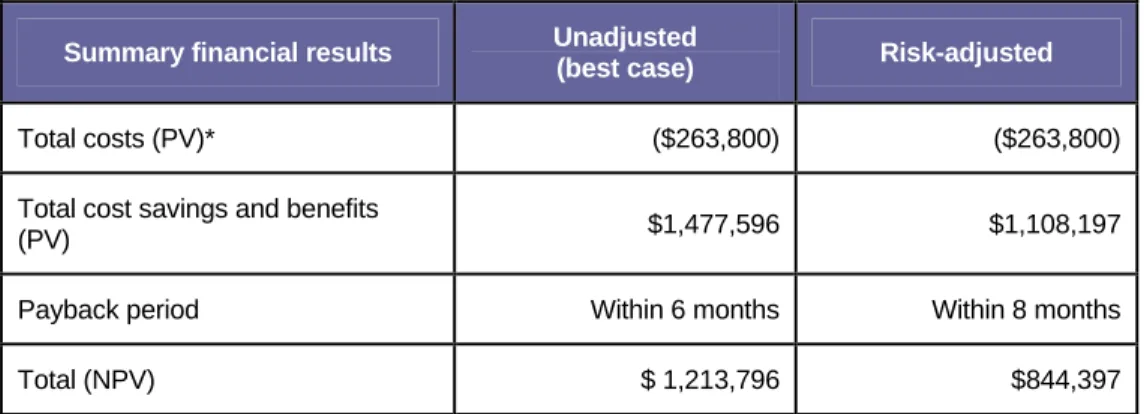
Table 1 represents a summary of the net present value (NPV) of savings the sample composite organization realized over a three-year period by deploying the BMC Atrium CMDB.
Table 1: Three-Year Summary Financial Results — Sample Composite Organization Summary financial results Unadjusted
(best case) Risk-adjusted
Total costs (PV)* ($263,800) ($263,800) Total cost savings and benefits
(PV) $1,477,596 $1,108,197 Payback period Within 6 months Within 8 months
Total (NPV) $ 1,213,796 $844,397
* Forrester used a discount rate of 12% to calculate PV and NPV. Source: Forrester Research, Inc.
The three-year, risk-adjusted total NPV (net present value) of $844,397 represents the net cost savings and benefits attributed to using the BMC Atrium CMDB when compared with a pre-implementation environment where relationships between IT assets was unknown, which made effective IT management more difficult and resulted in significantly higher risk to the business. You may review the details of this analysis below in the Costs, Benefits and Risks sections.
The objective of this study is not to illustrate savings that other enterprises can obtain by deploying the BMC Atrium CMDB but rather to identify savings experienced by the representative sample composite organization. These results can be used as a guide to allow other enterprises to determine the appropriate benefits for their particular environment.
Disclosures
The reader should be aware of the following disclosures associated with this study:
• The study was commissioned by BMC Software and delivered by the Forrester Consulting group.
• BMC reviewed and provided feedback to Forrester, but Forrester maintained editorial control over the study, its findings, and financial data. Forrester did not accept any changes to the study that contradicted its findings, obscured the meaning of the study, or changed any of the data collected.
• The customer names for the interviews were provided by BMC.
• Forrester makes no assumptions as to the potential NPV of savings other enterprises will receive within their own environment. Forrester strongly advises that the reader use his or her own estimates within the framework provided in the study to determine the
• This study is not an endorsement by Forrester of BMC Software or its offerings.
• The study is not a competitive product analysis.
Forrester’s Definition Of A CMDB
Over the past several months, Forrester has interviewed 67 different IT infrastructure managers at $1 billion-plus companies about their key challenges in running their corporate IT infrastructure. The top five issues organizations are currently struggling with (all of which could benefit from a well-implemented CMDB) are as follows: 1) consistent end-to-end application and service performance guarantees; 2) unplanned infrastructure changes resulting in incidents and downtime;
3) unanticipated infrastructure consequences of consolidation and new application projects; 4) misconfiguration of network objects; and 5) wide-area network performance.
Forrester defines a CMDB as a fundamental component of the information technology infrastructure library (ITIL) framework that provides a unified repository of data about configuration items (CI) — any system component with configurable attributes — and describes the relationships between those CIs. From this, we can derive the main characteristics of a CMDB:
• A CMDB is a repository of information about all configurable IT components. This repository should include all the physical, logical, and human elements used in the production of IT services.
• A CMDB component has configuration attributes. Configuration attributes are all the parameters that determine the behavior of a component during production. They could be characterized as physical, logical, organizational, or financial.
• A CMDB contains component relationships. The components are linked together to provide a service, and it is the service that links these components to the business process. The service may be as simple as an application, but it may also include several applications that are logically grouped to provide a complete service to support the business process.
• A CMDB is a fundamental component of the ITIL framework. All information recorded in the CMDB exists solely to support the information technology service management (ITSM) processes described by ITIL. Therefore, a complete CMDB contains information dictated by ITIL. Because its content is guided by ITIL, building a CMDB must start with the
management process to the CI, the CI attributes, and its relationships to other CIs.
• Today's CMDB is mostly a combination of discoverable asset information. — physical CIs, such as servers, routers, switches, or storage devices — and of discoverable relationships between CIs derived from either configuration tables or the observation of transactional traffic. This limits the "first-generation" CMDB to supporting ITIL processes that use runtime information of applications communicating through the network. However, some CMDB technologies also include the ability to discover and model logical CIs and their relationships, including business processes and business services. These logical elements can be automatically linked to the IT
infrastructure CIs, providing a business view of how IT infrastructure elements support higher-level business processes.
The best way to implement CMDB architectures is to use a federated approach, enabling companies to construct different views of the data for different purposes, while at the same time storing and updating the data in local data stores. Forrester has reviewed a number of ITIL, CMDB, and asset management projects over the past 18 months. Given proper planning and execution,
cost savings and business benefits should accrue quickly for most organizations with a payback period of within 12 months.
About The BMC Atrium CMDB
According to BMC Software, the BMC Atrium CMDB provides a shared set of enabling technologies that bring business relevance to BMC and third-party IT solutions through a single, federated configuration management database, a business service model, and common views that provide business relevance to IT management. The BMC Atrium CMDB supports tight integration across IT processes saving the IT organization time and money.
The BMC Atrium CMDB is an intelligent data repository that offers greater alignment of disparate IT functions to common business priorities with accurate, pervasive, and business-aware visibility into the dependencies between business processes, users, and IT infrastructure. It provides a single source of truth for an IT environment, thus ensuring a consistent approach to managing IT processes, such as incident, problem, change, configuration, asset, and service impact
management. With the BMC Atrium CMDB, organizations can deliver the best-practice process structure and control specified by key industry standards, such as ITIL.
According to BMC, the BMC Atrium CMDB:
• Eliminates the fragmentation of IT tools and data sources by providing both a common data model and service model to infuse business relevance into an industry-standards approach to managing IT data.
• Ensures an accurate and up-to-date view into IT infrastructure components and
relationships by automatically populating and maintaining the BMC Atrium CMDB with BMC Discovery.
• Includes a patent-pending reconciliation engine that merges data from multiple discovery tools into a single, reliable data set.
• Provides federation management capabilities to build a single, logical data store that can rely on multiple data sources, eliminating the need for a monolithic repository.
• Includes open interfaces to integrate business processes and third-party IT management tools with business service management (BSM).
• Allows IT process users to launch a view into the BMC Atrium CMDB to quickly view CI and relationship data relevant to their needs through graphical interfaces.
As illustrated below, BMC believes it provides a seamless implementation experience for the BMC Atrium CMDB by automatically installing it with a number of out-of-the-box BMC products, including BMC Remedy Service Desk, BMC Remedy Change Management, BMC Remedy Asset
Management, and BMC Service Impact Manager. In addition, the BMC Atrium CMDB has been built to support all major ITIL Service Support and Service Delivery processes, creating a potential upside in value as more and more processes take advantage of this single source for configuration management.
In addition, for organizations that want to implement the BMC Atrium CMDB independent of other BMC applications, they may take advantage of its many capabilities through the BMC Atrium CMDB Enterprise Manager, a standalone version of the BMC Atrium CMDB.
Description Of Sample Composite Organization
The sample composite organization shares key attributes, strategies, goals, and objectives from the 10 interviewed organizations. It is modeled as a Fortune 2,000 US-based financial services
organization with more than 10,000 employees located in major offices in Chicago, Singapore, and London, and 20 other regional offices throughout the world. During the last five years, the sample composite organization acquired several other organizations, where the resulting consolidation of IT departments was a challenge (or an afterthought).
Characteristics of the sample organization’s IT and business environment include:
• Each employee has been issued a laptop or desktop using Windows XP and Microsoft Office 2003. Laptops represent 30% of the users; desktops represent 70%.
• The data center environment is made up of more than 50 business applications that support 10,000 end users as well as external partner organizations. These 50 business applications are supported by 500 servers made up of a mix of Unix-, Windows-, and Linux-based environments. There is also an IBM mainframe environment to host financial and other back-office transactional applications. The sample organization is looking to leverage virtualization in order to consolidate workload and reduce its number of servers. The average server is running at 15% capacity.
• The sample organization’s most critical business applications and technologies include:
o SAP for financial management
o PeopleSoft/Oracle for HR data
o Microsoft Exchange for email
o Oracle and Microsoft SQL Server databases
o IBM DB2, IMS, and CICS for the mainframe
• The sample organization currently manages IT component availability by function (e.g., network, databases, and servers) rather than by business service. The stated performance goals are 99% availability, which most of the components regularly meet. However, because the organization does not currently manage from a business service perspective, there are numerous cases where the network is not available when the application is up and running — or the reverse, leading to application-level availability below what the business finds
acceptable, which in turn poorly reflects on IT’s ability to meet business needs.
• The sample organization is currently using the following BMC products: BMC Remedy Change Management, BMC Remedy Service Desk, BMC Remedy Asset Management, BMC Discovery, and BMC Service Level Management.
The Sample Organization Chooses The BMC
Atrium CMDB
The sample organization shares similar goals and objectives with the 10 interviewed organizations around managing business risks, avoiding unnecessary downtime and driving more efficient IT processes. The sample composite organization chose the BMC Atrium CMDB for the following short- and long-term reasons, with each of the 10 customers agreeing that the BMC Atrium CMDB offers the ability to:
• Provide a service-oriented view of the IT infrastructure. The BMC Atrium CMDB provides the ability to store information about configuration items and their relationships to each other as well as to the business services supported by the IT infrastructure.
• Make IT more responsive to business needs. Having centralized current information about configuration items within the BMC Atrium CMDB enables IT to make better planning decisions to respond to business needs.
• Share critical IT data across functions. As IT departments adopt processes that span IT functions, there is a need to share data about the infrastructure and the services it
supports.
• Coordinate IT processes and automate them. With the BMC Atrium CMDB, IT organizations can use a more integrated approach with tools because they use common data, which makes it easier to use automated tools.
• Facilitate compliance and audits. The BMC Atrium CMDB supports audits and compliance with government regulations such as Sarbanes-Oxley, SEC, HIPAA, etc., by providing control over critical changes and monitoring the history of those changes.
• Reduce the impact of both planned and unplanned changes. The BMC Atrium CMDB, along with effective change and configuration management processes, enables
• Make the service desk more efficient. IT service desk staff are able to significantly reduce the time and effort of providing IT service support by using the BMC Atrium CMDB as well as accelerating the successful resolution of support calls.
Costs, Benefits And Risks
To calculate the NPV of benefits for the sample organization, Forrester analyzed the costs, benefits and risks associated with deploying the BMC Atrium CMDB.
Costs
The key cost categories associated with implementing the BMC Atrium CMDB total $263,800 and are as follows:
• BMC Atrium CMDB license. The software license fees and software application (code) for the BMC Atrium CMDB solution are automatically included in the following BMC products: BMC Remedy Service Desk, BMC Remedy Change Management, BMC Remedy Asset Management, and BMC Service Impact Manager.
Note: Although this study focuses solely on the value that existing BMC business service management customers experience from a BMC Atrium CMDB implementation, for organizations that want to implement the BMC Atrium CMDB independent of the above solutions, BMC sells the BMC Atrium CMDB Enterprise Manager, a standalone version of the BMC Atrium CMDB.
• BMC Professional Services: $100,000. This fee is a one-time expense for the complete deployment of the BMC Atrium CMDB solution including design, discovery, and population of CIs.
• ITIL training: $45,000. This cost is to train 30 IT staff on the Information Technology Infrastructure Library (ITIL). This user education training focuses on how to use and manage the BMC Atrium CMDB with respect to ITIL best-practice standards.
• BMC Atrium CMDB implementation: $118,800. This includes 12 senior IT and business stakeholders spending 33% of their time over three months planning the implementation (average fully-loaded cost of a senior person is $120,000 annually). Their planning tasks included:
o Creating a systematic approach to understanding and analyzing the IT and business requirements, defining the scope of the project and gathering data on configuration items (CIs) as the BMC Atrium CMDB becomes the backbone of any IT service management process.
o Making a plan for the ability to reconcile all enterprise configuration data in a single "gold copy" of the BMC Atrium CMDB. Multiple asset and infrastructure databases already existed in their enterprise from network discovery and asset management. The sample organization wanted to reconcile these with the BMC Atrium CMDB into a single, master data repository.
o Meeting with IT and business stakeholders to identify any compliance reports that will need to be built and building these reports to track and ensure that IT and business support teams are following the defined processes.
o Clearly communicating to all stakeholders how configuration item data is going to be captured and populated in the BMC Atrium CMDB.
o Determining how the CMDB will identify how each group’s needs are affected or tied in with other areas of the business.
o Planning for ease of access to the BMC Atrium CMDB information. As a foundation for service management, a number of processes will have to use the BMC Atrium CMDB including change and configuration management, end-to-end application performance management, and service-level management. CMDB
implementations need a well-designed interface that provides a rapid way to select the right information for the right process.
Benefits: Business Results And Quantifiable Benefits
The sample composite organization experienced three significant and quantifiable benefits resulting from implementation of the BMC Atrium CMDB; these benefits total $1,852,500.
• Reduced impact of both planned and unplanned changes: $990,000. Along with an effective change and configuration management process, the organization discovered that the BMC Atrium CMDB more efficiently enabled management of the ever-increasing number of changes to its environment. For example, the BMC Atrium CMDB helps the service desk get information about recent changes to CIs that will help improve first-time fix rates, reducing failed changes from 20% to 10%. With an average of 2,200 changes per year, prior to implementing the BMC Atrium CMDB, 20% (or 440) of those changes failed; since implementing the BMC Atrium CMDB, the rate has been reduced to 10% (or only 220) failed changes. The average failed change requires 25 hours of IT staff remediation effort at a fully-loaded cost of $60 per hour or $1,500 per failed change. The sample organization was able to reduce failed changes by 220 per year, saving $330,000 annually ($990,000 over three years) in reduced labor costs.
• Reduction in technical support call times: $562,500. The sample organization found that it was able to significantly reduce the time and effort involved with technical assistance calls using the BMC Atrium CMDB. Prior to implementing the BMC Atrium CMDB, the organization handled 7,500 technical assistance calls per year at a cost of $100* per call (total annual cost $750,000). After implementing the BMC Atrium CMDB, the organization was able to accelerate the successful resolution of these calls, reducing time and effort involved by an average of 25% per call and saving the organization $187,500 annually or $562,500 over the three years of this analysis.
*Note: Forrester composite cost estimate.
• Single source of IT environment data: $300,000. Using the BMC Atrium CMDB and automated discovery, the organization applied configurable business rules to automatically merge data from multiple discovery tools into a single database and retired its existing multiple configuration databases, hence saving on its maintenance and support. After significant testing and six months after implementation, the organization was able to eliminate the costs associated with managing and supporting two databases and three
Business Results. In addition to the above quantified benefits, the interviewed organizations were able to describe additional, un-quantified business benefits as a result of implementing the BMC Atrium CMDB, including:
• Improved business continuity and planning for backup sites. Understanding the
dependencies of critical applications leads directly to more efficient and error-free planning of disaster recovery sites for enterprises.
• Easier application mapping. This allows firms to understand which applications run on which servers and how these servers depend on each other — enabling more efficient and error-free server consolidation.
• Improved productivity from being able to identify specific users (names) who will be affected by a change or downtime and sending notification emails to only those affected employees, not hundreds or thousands of unaffected employees, improving productivity.
• When a major incident or shutdown occurs it is possible to quickly prioritize and determine which servers to bring back up first, based on which servers support the most critical business services.
• Savings on license, support, and maintenance contract costs on servers that no longer exist or no longer need to be licensed/supported. One customer cited a 40% reduction in servers needing support and maintenance, which saved the company $50 per unused server, per year.
• Easier integration of merged assets for organizations that acquire new companies.
• Increased visibility into CIs and their relationships allowing for more accurate, timely, and effective release management processes. To comply with regulations, the BMC Atrium CMDB allows the ability to track changes. Companies can keep, trace, and audit all changes for compliance purposes.
• A decrease in the documentation required to initiate changes and add new applications. One interviewed customer achieved savings by not having to fill out the 15 forms
associated with her organization’s change management processes, instead relying on the BMC Atrium CMDB to capture change management data for compliance purposes.
• Elimination of the manual mapping of CIs by up to 95%, according to several interviewees.
• The ability to more effectively comply with government regulations such as Sarbanes-Oxley and HIPAA and to provide more relevant information to internal and external auditors.
Risks And Risk Mitigation Strategies
There are two aspects of risk and risk mitigation considered in this study: project risks and the risks associated with the estimates of costs and benefits. Below is a summary of each.
Project Risk And Mitigation
There are risks associated with IT projects in general and specifically with the BMC Atrium CMDB solution, however most of the interviewed customers indicated that there were more risks to the business in not implementing the BMC Atrium CMDB. Each viewed the BMC Atrium CMDB as a
decision and risk analysis/mitigating solution in itself, citing the BMC Atrium CMDB’s ability to facilitate infrastructure changes with more confidence and less risk.
One of the specific project implementation risks cited by customers was “cultural” in nature, whereby IT staffers might view the BMC Atrium CMDB as an expansion of the IT bureaucracy that would more closely monitor the employees and the quality of their work. When asked how other organizations might mitigate this cultural risk, customers cited better communication between IT management and staff in outlining the broad benefits of the BMC Atrium CMDB.
Another risk relates to ITIL adoption, with interviewees citing the importance of ITIL certification training for staff that will be leveraging the BMC Atrium CMDB to adopt ITIL best practices.
Risks Associated With Estimates Of Costs And Benefits
Risk- and non-risk-adjusted NPV of savings are both discussed in this study. Since the future cannot be accurately predicted, there is risk inherent in any project. Risk assessments provide a range of possible outcomes based on the risks associated with IT projects in general and specific risks relative to moving toward a particular technology solution.
With the benefit of hindsight, each interviewed customer believes that its investment in the BMC Atrium CMDB carried a lower level of risk when compared to the pre-implementation environment where IT infrastructure relationships were unknown, making effective IT management more difficult which resulted in significantly higher risk to the business.
In this case study, Forrester chose not to risk-adjust the implementation costs, as these were firm quotes from reliable vendors. Forrester has risk-adjusted the benefit estimates downward by 25% to reflect the somewhat discretionary election and/or possible postponement of implementing the BMC Atrium CMDB. As with most organizations, when resources are constrained, projects such as the BMC Atrium CMDB are second priority to projects responsible for the direct production of revenue.
Financial Summary: The Sample Organization
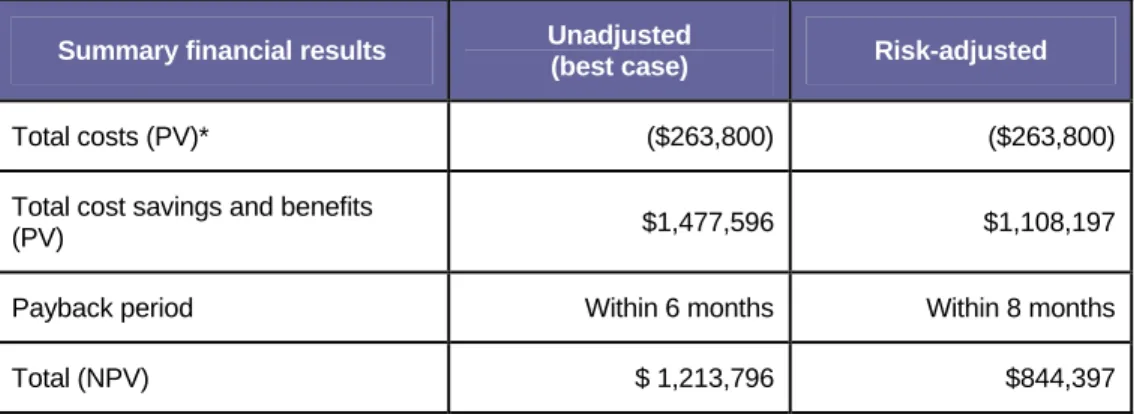
Table 1 (below; repeated from Executive Summary) represents a summary of the costs and quantifiable benefits that the sample composite organization expects to achieve during the three-year period by using the BMC Atrium CMDB.
Table 1: Three-Year Summary Financial Results — Sample Composite Organization (Repeated From Executive Summary)
Summary financial results Unadjusted
(best case) Risk-adjusted
Total costs (PV)* ($263,800) ($263,800) Total cost savings and benefits
(PV) $1,477,596 $1,108,197 Payback period Within 6 months Within 8 months
Total (NPV) $ 1,213,796 $844,397
The three-year, risk-adjusted total NPV (net present value) of $844,397 represents the net cost savings and benefits attributed to using the BMC Atrium CMDB when compared with the pre-implementation environment where IT infrastructure relationships were unknown, making effective IT management more difficult, which resulted in significantly higher risk to the business.
If a risk-adjusted NPV of benefits still demonstrates a compelling business case, it raises
confidence that the investment is likely to succeed, because the risks that threaten the project have been taken into consideration and quantified. The risk-adjusted numbers should be taken as “realistic” expectations since they represent the expected value considering risk. Assuming normal success at mitigating risk, the risk-adjusted numbers should more closely reflect the expected outcome of the investment.
Conclusions
This study is meant to provide the reader with a framework to examine the costs and benefits of implementing the BMC Atrium CMDB. Based on our in-depth discussions with BMC Atrium CMDB customers, Forrester projects a three-year, risk-adjusted NPV savings of $844,397.
For the sample composite organization, a successful, well-planned implementation allowed significant cost savings to be achieved by the IT organization. The sample composite organization also reflects the belief by BMC’s customers that an investment in the BMC Atrium CMDB gives them the future flexibility of using the BMC Atrium CMDB to facilitate ITIL adoption, more effectively comply with government regulations such as Sarbanes-Oxley and HIPAA and to provide more relevant information to internal and external auditors.
Other organizations that are likely to see beneficial results implementing the BMC Atrium CMDB are:
• Targeting the BMC Atrium CMDB as a key ingredient of service management, whether in conjunction with adopting ITIL or in its technology and product implementation in business service management (BSM).
• Relying on servers and/or data management supporting mission-critical business services applications.
• Seeking more control over change management processes.
• Able to link their IT infrastructure to key business services.
• Existing BMC BSM customers.
For our subject organization, the BMC Atrium CMDB carries a relatively low level of risk, a very favorable $844,397 (NPV), and a reasonable (within) 8-month horizon to recoup the investment. Forrester makes no assumptions regarding the effects of the BMC Atrium CMDB at other organizations. This study examines the financial impact attributable to a sample composite organization based on interviews with 10 BMC customers. The underlying objective of this document is to provide guidance to technology decision-makers seeking to identify areas where value can potentially be created by using the BMC Atrium CMDB.
Appendix A: Total Economic Impact Overview
Total Economic Impact is a methodology developed by Forrester Research that enhances a company’s technology decision-making processes and assists vendors in communicating the value proposition of their products and services to clients. The TEI methodology helps companies demonstrate, justify, and realize the tangible value of IT initiatives to both senior management and other key business stakeholders.
The TEI methodology consists of four components to evaluate investment value: benefits, cost, flexibility, and risk.
Benefits
Benefits represent the value delivered to the user organization — IT and/or business units – by the proposed product or project. Often product or project justification exercises focus just on IT cost and cost reduction, leaving little room for analysis of the impact of the technology on the entire
organization. The TEI methodology and resulting financial model places equal weight of the measure of benefits to that of costs, allowing for a full examination of the impact of the technology on the entire organization. Calculation of benefit estimates involves a clear dialogue with the user organization to understand the specific value that is created. In addition, Forrester also requires that there be a clear line of accountability established between the measurement and justification of benefit estimates after the project has been completed. This ensures that benefit estimates tie back directly to the bottom line.
Cost
Costs represent the investment necessary to capture the value, or benefits, of the proposed project. IT or the business units may incur costs. These may be in the form of fully-burdened labor,
subcontractors, or materials. Costs consider all the investment and expenses necessary to deliver the value proposed. In addition, the cost category within TEI captures any incremental costs over the existing environment for ongoing costs associated with the solution. All costs must be tied to the benefits that are created.
Flexibility (analyzed but not discussed in this study)
Within the TEI methodology, direct benefits represent one part of the investment value. While direct benefits can typically be the primary way to justify a project, Forrester believes that organizations should be able to measure the strategic value of an investment. Flexibility represents the value that can be obtained for some future additional investment building on top of the initial investment already made. For instance, an initial investment in an enterprisewide upgrade of an office productivity suite can increase standardization (to increase efficiency) and reduce licensing costs. Later, the sample organization may decide to take advantage of an embedded collaboration feature, which may translate to greater worker productivity if activated. However, this collaboration feature can only be used with an additional investment in user training. The ability to capture the benefit associated with this collaboration feature has a present value that can be estimated. The flexibility component of TEI captures that value using the Black-Scholes option pricing model.
Risk
Risk is the fourth component of the TEI methodology. It is a measurement of the uncertainty of benefit and cost estimates contained within the investment. Uncertainty is measured in two ways: 1) the likelihood that the cost and benefit estimates will meet the original projections, and 2) the likelihood that the estimates will be measured and tracked over time.
Appendix B: About The Project Director
Bob Cormier
Principal Consultant
Bob is a principal consultant for Forrester’s Total Economic Impact™ (TEI) service. He specializes in advising clients on the TEI framework — services that help organizations make decisions about the overall financial value of IT strategies and investments.
Bob came to Forrester through its acquisition of Giga Information Group and has more than 20 years of experience in the IT and consulting industries. Prior to joining Giga, he held senior-level positions at two leading eBusiness consulting firms, ZEFER and Cambridge Technology Partners. Bob has successfully led company efforts to optimize financial, operational, and resource planning activities, incorporating leading-edge, professional service automation (PSA) applications and enterprise resource planning (ERP) systems. He has also held management positions at Digital Equipment and Anixter International.
Bob earned an M.B.A. from Bentley College and a B.S. in business from the University of New Hampshire. As an adjunct professor, he has taught finance and economics courses for more than 10 years at Southern New Hampshire University and Daniel Webster College.