Title
Coordinative Entities: Forms of Organizing in Data Intensive Science Permalink https://escholarship.org/uc/item/1wx341fw Authors Paine, D Lee, CP Publication Date 2020 DOI 10.1007/s10606-020-09372-2 Peer reviewed
Coordinative Entities: Forms of Organizing in
Data Intensive Science
Drew Paine# and Charlotte P. Lee*
#Data Science & Technology Department, Lawrence Berkeley National Laboratory *Human Centered Design & Engineering, University of Washington
[email protected], [email protected]
Abstract. Scientific collaboration is a long-standing subject of CSCW scholarship that typically focuses on the development and use of computing systems to facilitate research. The research presented in this article investigates the sociality of science by identifying and describing particular, common forms of organizing that researchers in four different scientific realms employ to conduct work in both local contexts and as part of distributed, global projects. This paper introduces five prototypical forms of organizing we categorize as coordinative entities: the Principal Group, Intermittent Exchange, Sustained Aggregation, Federation, and Facility Organization. Coordinative entities as a categorization help specify, articulate, compare, and trace overlapping and evolving arrangements scientists use to facilitate data intensive research. We use this typology to unpack complexities of data intensive scientific collaboration in four cases, showing how scientists invoke different coordinative entities across three types of research activities: data collection, processing, and analysis. Our contribution scrutinizes the sociality of scientific work to illustrate how these actors engage in relational work within and among diverse, dispersed forms of organizing across project, funding, and disciplinary boundaries.
Keywords: Articulation work, Coordinative entities, Coordinated actions, Cyberinfrastructure, Data intensive science, Data science, Human infrastructure, Infrastructure, Synergizing
1
Introduction
Data intensive scientific research is accomplished through the construction and maintenance of complex sociotechnical systems supported by varied funding paradigms that bring together diverse arrangements of individuals, groups, and organizations (Edwards et al., 2007; Kaltenbrunner 2017; Lee et al., 2006; G. Olson et al., 2008a). It is now commonplace for scientists to engage with instruments located in geographically remote locations in concert with colleagues distributed across universities and institutes around the world, forming and engaging with multimorphous human infrastructures (Lee et al., 2006). Foundational work in Science and Technology Studies underscores how the production of scientific knowledge is a social endeavor (Fujimura 1996; Knorr-Cetina 1999; Latour 1987; Latour and Woolgar 1986) and within Computer Supported Cooperative Work (CSCW) studies of scientific collaboration typically examine particular endeavors to create and sustain sociotechnical infrastructures and their resources (Jirotka et al., 2013; Jirotka et al., 2006; Ribes and Lee 2010).
These infrastructure projects, often referred to as cyberinfrastructure (CI) within the United States funding paradigm, particularly focus on scientific needs when facilitating access to remote instruments (Borgman 2015; Finholt 2002) and enabling the journeys of data among sites and
across disciplinary lines as research projects evolve (Bates et al., 2016; Leonelli 2016). The visions for these cyberinfrastructure projects, in essence, are what Bowker and Star (1999) characterize as boundary infrastructures, those that “do the work that is required to keep things moving along” by having sufficient “play” to allow for local variation combined with consistent structure at scale to be stable through a “differing constitution of information objects within the diverse communities of practice that share a given infrastructure” (p.314). Infrastructures enable the multiple communities of practice at hand to readily “pull out the kinds of information objects” they respectively require in spite of their differences. Simultaneously local work infrastructures must emerge to support specific work tasks and practices as opposed to the “simple and universal services provided by traditional infrastructures” (Hanseth and Lundberg 2001).
Research on infrastructures and infrastructuring leaves us with conceptualizations of the interconnected, relational nature of information objects, stakeholders, projects and so on; long noting the need to operate among different embedded forms of organizing (Star and Ruhleder 1996). Yet too often our endeavors are not directly inspecting the forms and arrangements of organizing that the people doing the work create as they work within and among multiple overlapping sociotechnical infrastructures. In Lee and Paine (2015) we argue that there is a need in CSCW for conceptual models that describe and inspect our models of work rather than leaving them left to “linger in the shadows, designed for but unarticulated” since the work of design when building systems is in fact implicitly modeling sociality. CSCW needs theory of and for the field drawing out insights across scales as the increasing variety of sociotechnical arrangements leaves the community struggling to keep up and in “dire need of conceptual grounding” as we plunge forward in an “exciting era of research” (p.179). With CSCW’s work to support data intensive science and infrastructure projects we are at a point where we need to examine more closely the conceptualizations of scientific sociality, specifically the forms of organizing used in different coordinated actions, that researchers and their infrastructural endeavors are building with and for— often all too implicitly. This is essential as scientific endeavors require the efforts of many allied communities of practice in the conduct of particular coordinated actions (e.g. interdisciplinary efforts). With this paper we shift focus, moving our collective perspective from particular infrastructure projects or funding structures to scrutinize the sociality of scientific work. We turn our attention to examining the myriad forms of organizing that data intensive scientists rely upon and create as they grow and sustain diverse human infrastructures to conduct their work through different overlapping and intersecting coordinated actions (interdependent efforts of two or more actors who through their individual activities are working towards a particular goal through fields of work (Lee and Paine 2015, p. 184)). Rather than another example of infrastructuring or design, our empirical contribution is an articulation of these recurrent ways of organizing that appear across our four research sites which we characterize as coordinative entities.
Schmidt and Wagner (2004) posit that “contemporary cooperative work is generally characterized by heterogeneous and often widely ramified arrangements of actors immersed in complex interdependencies of varying scope, intensity, and degrees of coupling”; what we call coordinated actions. A key enabler of the visions underlying sociotechnical infrastructure projects and data intensive work has been the ability to foster, and the necessity of employing, new arrangements of stakeholders (Bietz et al., 2010; Lee et al., 2006). Clarke and Star (2008) describe the situation of infrastructures in and among social worlds by observing that “infrastructures can
be understood, in a sense, as frozen discourses that form avenues between social worlds” (p.115) and the database development studied by Bietz and Lee (2009) illustrates how a component of a nascent infrastructure unfolds as a boundary negotiating artifact (Lee 2007) on the path to freezing in place as a particular discourse, aligning and solidifying different social worlds. This is essential as accomplishing collaborative scientific work and the enactment of infrastructural components requires scientists craft “doable problems” by aligning across multiple scales or forms of organizing (Fujimura 1987, 1996).
Elucidating more about the ways people craft these avenues and frozen discourses while attempting to arrive at doable problems is a complex task when data intensive research practices are constantly evolving. This requires our continued focus and this paper’s conceptual contribution is a step towards identifying arrangements scientists rely upon while working within and among varying social worlds through myriad different coordinated actions. Building upon the human infrastructure (Lee et al., 2006) and synergizing notions (Bietz et al., 2010) our study traces the webs of collaboration of four scientific groups, from four different disciplines. Furthermore, we investigate how these groups create and draw upon these webs as they work across project, infrastructure, institutional and organizational, and disciplinary boundaries to conduct scientific research. By following what has been called the careers (Harper 2000) or journeys (Bates et al., 2016; Leonelli 2016) of software, data, instruments, and so on, we develop a new lens for understanding aspects to the diverse ecologies of work fundamental to accomplishing contemporary data intensive science. We answer the question: How are scientists (re)organizing when conducting data intensive work over time?
2
Background
CSCW investigations of scientific work span early research on collaboration and collaboratories to more recent studies of cyberinfrastructure and the myriad social and technical elements of such projects. Here we examine key points in the trajectory of this work from teams and tools to infrastructure projects to highlight a gap in our understanding of the social arrangements and forms of organizing in collaborative scientific work that our study addresses.
2.1
Teams, Projects, Tools, and Scientific Collaboration
Investigations of collaborative scientific work in CSCW reach back to the field’s formation. This work tended to not focus on the dynamics of ongoing research among and across diverse organizational boundaries as our work is doing. This work was often tool and/or team centric, often in service of particular projects or organizational endeavors.
Kraut et al. (1988, 1986) study collaborative pairs and posit that scientific relationships form to combine material and intellectual resources to be able to do work and that proximity influences researchers ability and willingness to work together—foreshadowing Olson and Olson’s (2000) point that distance matters. Kraut et al. (1988) offer an early typology of tools to support scientific collaborations (communication tools, coordination and management tools, and task-oriented tools). Contemporaneously, Latour and colleagues’ (Latour 1987; Latour and Woolgar 1986)
classic studies of laboratories characterized the relations among different elements in scientific work, asserting that social worlds exist in relationships between human and non-human “actants,” reshaping the way ethnographers explored the work of teams in laboratories. Chompalov and Shrum (1999) in turn investigated the formation of teams of scientists from multiple organizations to demonstrate how technological practice serves as a predictor for success in routines and in part to advocate for studying more than just singular laboratories, which CSCW collaboratory studies accomplished too.
Subsequently, CSCW scholars studied collaboratories as systems built to facilitate cooperative scientific work independent of location or time (Finholt 2002; Wulf 1993). J. Olson et al. (2008b) synthesize a theory of remote scientific collaboration from studies of collaboratories to offer suggestions of what makes for successful collaboratory projects and tools. Bos et al. (2008) use the same dataset to offer a taxonomy of seven types of collaboratories, exploring key technology organizational issues so as to identify organizational patterns to support funders and project managers creating new projects. Similarly, a 2015 United States National Research Council report examines how to improve the effectiveness of “team science” and offers a taxonomy of this type of work defining seven dimensions (National Research Council 2015). With dimensions such as “diversity of team or group membership,” “team or group size,” and “permeable team and organizational boundaries” (p.26) this taxonomy is again focused on characterizing particular forms of collaborative scientific projects and not how science unfolds in day-to-day contexts. These are useful perspectives which provide insights with which to shape particular tools or to influence the structure of projects. But more is needed to clarify and describe day-to-day arrangements PIs employ to accomplish their research across project and organizational boundaries over time.
Following investigations of collaboratories and teams, a vast body of CSCW work has emerged studying particular projects building infrastructures for scientific collaboration, in the US commonly characterized as cyberinfrastructure and in Europe as e-Research (Jirotka et al., 2013; Ribes and Lee 2010). Cyberinfrastructure studies draw upon Star and Ruhleder’s (1996) relational infrastructure orientation as part of the work of characterizing evolving infrastructuring projects (Borgman 2007; Edwards 2010; Edwards et al., 2007). This body of work examines issues of design and development across disciplinary boundaries and time scales in particular projects, while better characterizing the impediments and opportunities to sharing scientific resources such as data and software across domains with varying cultures.
2.2
Beyond Individual Cyberinfrastructure Projects
Studies of cyberinfrastructure development continue to usefully inform our understanding of project dynamics. However, the historic tendency of CSCW (Ribes and Lee 2010) to focus on the development of individual infrastructure projects leaves missing, at least in part, richer understandings of the ways in which day-to-day scientific work, including tool and system development, are achieved. Going forward, instead of focusing on particular infrastructure projects and the funding structures that enable them we need to examine the different organizational arrangements scientists form and engage in as they seek to discover the limitations and opportunities of their data, method, theory, instruments, and projects. Individual scientists and
their groups do not participate solely in relatively well defined projects. They function entrepreneurially, working across project boundaries. We understand this in part due to cyberinfrastructure work that examines and emphasizes the multiple, overlapping roles of stakeholders in human infrastructures who engage in synergizing work as we examine in the next section.
Science-oriented infrastructure studies have described numerous sociotechnical challenges inherent in developing, growing, and sustaining distinct infrastructure projects as research interests and funding prerogatives change (Bietz et al., 2012; Karasti et al., 2010; Ribes 2014, 2017; Steinhardt and Jackson 2014). Designing, building, and sustaining such distinct endeavors surfaces complex social dynamics and tensions where domain scientists goals need to align with computer science research interests (Ribes and Finholt 2009). Projects have to determine how decision making should be accomplished, whether top down by management or bottom up by individual researchers, all while managing information exchange across sites of work (Lawrence 2006). Infrastructuring endeavors must also navigate the overarching funding structures that instantiate the conditions for work and enable diverse stakeholders to come to the table and be successful over time across funding streams with varying policy demands (Kaltenbrunner 2017; Kee and Browning 2010). The temporal scales of these projects, both planned and actual, also change the dynamics of researchers work; design goals and actions shift when building for decadal time spans rather than the short term alone (Cohn 2016; Ribes and Finholt 2009).
Challenges that are often outside the bounds of designated infrastructure development efforts include the facilitation of the sharing of the products of these efforts, namely software and data (Birnholtz and Bietz 2003). Cyberinfrastructure studies underscore the recurring issue of trust scientists face when sharing and reusing data (Edwards et al., 2011; Faniel and Jacobsen 2010; Zimmerman 2008). Scientists reusing data must be able to determine the appropriate questions to ask of this product to understand the contexts of its production and how they may appropriately employ this product for new questions (Rolland and Lee 2013). There is a need to examine and explain different cultures of work around data as behaviors of openness and secrecy vary among different fields (Velden 2013) and even within projects of one organization in the same broad discipline (Vertesi and Dourish 2011). Sharing scientific software raises similar issues as the incentives to make complex custom work available to others vary based on community cultures and the requirements of funders and publishers (Howison and Herbsleb 2011).
Many of the pressing questions that have been surfaced by the study of infrastructure development and use are questions that we can also ask more broadly of scientific collaboration in general. With the advent of new technologies more kinds of science are becoming simultaneously increasingly collaborative and data-intensive. In data-intensive science most collaborations are not infrastructure development efforts per se, however, they do usually overlap, plug into, draw on, and crisscross infrastructure in very interesting ways. This paper, however, is focused not on infrastructure. This paper is focused on the interesting ways that scientists organize themselves in order to accomplish science, specifically the scientific steps of: data collection, processing, and analysis. These notions have a great deal of resonance with earlier work on human infrastructure
2.3
Human Infrastructure, Synergizing Work, and Gaps in Understanding Forms
of Organizing
Scientific infrastructure studies in CSCW surfaces some organizational forms that emerge as work is completed over time. Theorizing about the human infrastructure of cyberinfrastructure as a lens has been useful for clarifying that multiple forms of organizing are necessary in order for diverse stakeholders to work together to develop infrastructural components and that these forms of organizing may occur in parallel, forming and dissolving as needed (Berman 2001; Lee et al., 2006). The follow-on concept of synergizing (Bietz et al., 2010) further unpacks how different actors come together and foster different relationships in order to enable new work to happen. These insights help us to frame a gap in our understanding: that of identifying key regular forms or arrangements of organizing, necessary for getting data intensive science done in the face of constantly changing technologies, organizational contexts, and scientific knowledge.
The human infrastructure of cyberinfrastructure has come to refer to not only the necessity for complex endeavors to rely and draw upon a variety of collaborative forms over time and often simultaneously (e.g. groups, teams, networks, organizations, etc.), but also the complex interactions between the activities of networks, place-based organizations, groups, and consortia (Bietz et al., 2010). These collaborative structures configure, and are configured by, infrastructure creation—they are enacting different coordinated actions to address myriad overlapping, shifting common fields of work. Collaborative work on such resources can both draw upon and contribute to various infrastructures and infrastructural resources (components of infrastructure such as software, data, practices, etc.) and have very different characteristics (e.g. networks vs. teams) which may be invoked serially and in parallel (Lee et al., 2006). Human infrastructure posits that participation takes many forms and that no one type such as teams, networks, or organizations can account for the whole—human infrastructure is complex and heterogeneous. Participation may take some or all of these forms simultaneously, and participants in a CI may not even be fully aware of the breadth of forms they are involved in at any given time.
Bietz et al. (2010) defined the notion of synergizing as a social process that is fundamental to scientific cyberinfrastructure work. The concept of synergizing was established to refer to the work necessary to enact productive infrastructural relationships. It is a concept where strategic coordinated actions are undertaken “in pursuit of greater combined effects than individuals, groups, or organizations could effect on their own” since synergy can emerge from bringing different individuals or collaborative arrangements, or resources, together in a productive relationship as an entity rather than “from scratch” (Bietz et al., 2010, p. 252). Synergizing understands the embeddedness and relational structure of cyberinfrastructure as both a development goal and as a resource for development work. Synergizing includes two key development activities: leveraging and aligning. Leveraging refers to using existing relationships as a resource to create or maintain existing relationships. Aligning is the work required to make an infrastructural relationship productive by ensuring that there is compatibility among components, it is essential to ensuring that a common field of work for a cooperative work arrangement exists. Building upon synergizing, subsequent work in healthcare infrastructure development characterized the potential opposite case of reverse synergy which can directly lead to breakdown of productive relationships and an instantiated infrastructure (Langhoff et al., 2018). Reverse
synergy happens when the effort individuals need to exert to align diverse coordinated actions “creates enough cracks in the inertia in a given information infrastructure, erodes enough social capital, or in other ways require an amount of alignment work, articulation work, or other types of coordination” (p.51) to be greater than the potential benefits of successfully synergizing. This cautionary tale reminds us that there are potential downsides to the process of synergizing where fields of work already stably exist. No matter what, in collaborative work diverse sets of relationships must be built among diverse sets of entities (whether technologies, people, organizations, communities, or so on) that will vary depending on context. Sometimes this will be productive and positive, in others counterproductive and negative.
Schmidt (1990) developed a broad framework for analyzing cooperative work and the notion of cooperative work arrangements to describe entities CSCW scholars investigate. He describes cooperative work as “constituted by work processes that are related as to content, that is, processes pertaining to the production of a particular product or type of products” (p.10). Cooperative work arrangements emerge when multiple individuals with diverging interests and motives come together to complete a task (p.12). A given cooperative work arrangement exists in relation to a particular common field of work that is creating particular products. In the context of scientific collaboration and infrastructure this could be any number of products, from datasets or data analysis software to particular organizational policies. Schmidt continues to explain that collaborative work requires an “organizational form” where “an organization is conceived as a stable pattern of cooperative relations” (p.38).
A challenge we face in CSCW today is more consistently identifying and understanding common forms of organizing through which we can identify synergizing and reverse synergizing. We need a conceptual lens that helps us identify and trace out these heterogenous coordinated actions. While Bietz et al. (2010) were primarily concerned with understanding how diverse entities come together to be productive and was not “overly concerned with creating comprehensive lists of relationships and entities” we find that there is a need to identify and to undertake listing of some common forms of organizing that emerge. Our work here is concerned with types of entities, with the understanding that this is not a comprehensive list, and tracing some of their relationships in the context of data intensive science. We return to this discussion about common forms and link it with a discussion of explorations of meso-level theory in the Discussion.
3
Research Sites & Methods
Our qualitative study was designed to investigate the work of four different scientific groups and their webs of work. We identified four Principal Investigators (PIs) and members of their research groups including graduate students, postdoctoral researchers, and research scientists at the University of Washington in Seattle, WA engaging in data intensive work with a variety of collaborators. We intentionally began our inquiry with PIs and their groups instead of a particular cyberinfrastructure project so that we can follow the journeys and trajectories of work outward from a clearly bounded starting point. We chose PIs at a university as a starting point since they are a key way funding is distributed in the United States and elsewhere, setting research programs, fostering the careers of other researchers and students, and distributing and managing resources
(cf. Knorr-Cetina 1999; Latour and Woolgar 1986). In order to get closer to the actual work of creating and sustaining collaborations when doing data intensive research among different contexts, we interviewed not only PIs but also their graduate students and, when applicable, postdocs, research scientists, and undergraduate researchers. The names of individuals, groups, and projects are referenced here using pseudonyms to protect our informants’ privacy as much as possible.
3.1
Research Sites: Four Principal Investigator’s Research Groups
All of our research sites were chosen for their self-identified data and software intensive research and willingness to participate in a longitudinal study—further details about our initial sampling is available in (Paine et al., 2014). All four groups are engaged in multiple research projects and where possible, we aimed to follow two active projects that were identified with the help of each PI to make our investigation feasible given our own resource limitations. Due to the variation among the work of the groups the number of projects being studied does vary.
3.1.1 Hank: Climate Science Modeling
Hank is an atmospheric scientist studying the interaction of different Earth processes that shape the global climate cycle. Hank’s group had four Doctoral students (Anita, Bryan, Dane, and Palmer) during our study. Each PhD student was working on individual dissertation projects examining the effect of low-frequency changes of different variables on the sensitivity of climate models.
3.1.2 Waldo: Marine Geophysics
Waldo is a marine geophysicist studying submarine volcanoes and mid-ocean ridge hydrothermal systems to better understand how the Earth’s physical structure is changing. Waldo’s research group was composed of three Doctoral students (Dahl, Rollin, and Megan) working on two underseas seismology projects using ocean cruises to collect data to input in computational models.
3.1.3 Martin: HIV Microbiology
Martin is a virologist studying the Human Immunodeficiency Virus (HIV) with wet lab and computational biological research to examine the efficacy of vaccines and the evolution of different strains of HIV in the search for effective treatments. Martin’s research group is composed of multiple doctoral and undergraduate students, postdoctoral researchers, and a large research scientist staff. Our inquiry focused on two projects where the group used pyrosequencing techniques that required the development of new wet lab molecular techniques and subsequently new data processing and analysis software and practices.
3.1.4 Magnus: Cosmology with Radio Telescope Arrays
Magnus is an observational cosmologist studying a period of the Universe’s development known as the Epoch of Reionization (EoR) using novel radio telescopes. Magnus’s research group was composed of three postdoctoral researchers (Brianna, Igor, and Jonah) with three doctoral students
(Abner, Nima, and Peg) and a rotating cast of undergraduate students. They were primarily focused on the development of data analysis software for use with the Widefield Radio Telescope (WRT), an instrument producing petabytes of data for analysis that requires new software analysis approaches (Paine 2016; Paine and Lee 2014, 2017).
3.2
Research Methods: Data Collection and Analysis
Our qualitative study relies upon three forms of iterative data collection and analysis that took place over 2011–2015. We collected almost 40 hours of interviews and 47 hours of observation among the four sites over repeated episodes. This inquiry was intentionally oriented around the work of a PI and their laboratory or group since these bounded entities are a key source of synergizing activity. Magnus’s group was the focus of deeper ethnographic inquiries as the first author conducted dissertation work. We conducted semi-structured interviews with the PIs and researchers in each group to have them walk us through their research work, when possible attended meetings of the groups to learn about ongoing tasks, and collected and analyzed artifacts from the groups to augment our observations and interviews. Artifacts ranged from publications to internal Wikis, email threads, software and data repositories, and public websites. The findings in this paper are derived from analysis of the interviews with contextual details for the cases filled in with our other sources of data. Our semi-structured interviews took place over multiple rounds. Each interview was recorded and professionally transcribed and cleaned by the member of the research team who conducted it.
The first round of interviews took place with PIs so that we could learn about their research. The four interviews were scheduled for around an hour in Spring 2011 and ranged between 52 and 82 min (avg. 66 min)—the four discussed in this paper are a subset of 20 PIs who we interviewed before enrolling this subset in our longitudinal study. The second and third rounds with members of each group (students, post-docs, research scientists) drew out information about the work these individuals take part in as part of a PI’s group. The second round of interviews took place in Spring 2013, ranged from 25 to 78 min (avg. 47 min), and were conducted with: ten members of Martin’s group, four members of Magnus’s group, three members of Waldo’s group, and five members of Hank’s group. The third round was conducted in Winter 2014, ranged from 55 to 125 min (avg. 73 min) and were conducted with four members of Martin’s group, four members of Magnus’s group, two members of Waldo’s group, and four members of Hank’s group. Eleven of the thirteen individuals interviewed in round three were previously interviewed in round two.
The PI interviews (round one) and first interviews with research group members (round two) were designed to provide us with a baseline understanding of each research group’s science, different projects, types and sources of data, software being created and used, and the collaborators they work with. We followed the trajectories or journeys of resources (Harper 1997) such as data and software across and among different research groups and their collaborators over time to trace out arrangements of relationships necessary to achieving scientific goals and enacting infrastructures as they work to create, access, use, and share a variety of resources.
Our initial open coding analysis of these interviews began to surface what we came to describe as different “entities” involved in the collaborative work of each group. For our third round of interviews we re-interviewed group members to have them walk us through their work in-depth.
This interview protocol specifically asked interviewees about their work collecting or producing data, processing data, analyzing data, sharing data, and archiving data as well as who was involved in each activity. This guided our focused coding of all of the interviews to surface the entities we were seeing and to guide axial coding to elicit the different characteristics of each entity.
Analysis of this data took place over multiple iterations to guide our ongoing data collection. The round one and two interviews were closed coded for the questions in our protocol and open coded for emergent themes about each individual and group’s work (Charmaz 2014; Emerson et al., 1995; Weiss 1995). Using this coding our research team wrote memos on, and created diagrams of, each group’s projects and work to draw out themes from which we began to see the different entities in our typology emerging. As we analyzed this data we found it difficult to disentangle the complexity of the organizations of these collaborations and their work with data. This difficulty as well as literature reviews led us to decompose the activities our interviewees were engaging in as well as to try to categorize the different relationships they form to do this scientific work. Through this analysis we began to develop distinctions between a local research group, intellectually close collaborators, and collaborators whose work is more diffused from our interviewee’s day-to-day concerns yet still connected.
This initial analysis and initial categorization and decomposition of our subject’s work informed the design of our round three interview protocol. This protocol was designed to not only explicitly focus on different research activities but also attempted to further draw out the involvement of different entities throughout this work based on our initial categorizations. We open coded these interviews and wrote memos comparing each group’s project work to our prior analysis to help us better define the different types of entities we were seeing emerge in our data. To re-assess and triangulate our initial findings about these entities, the first author and two members of our research team then re-coded all of the round one, two, and three interviews using this emerging framework of coordinative entities as our code book in a round of focused coding. New memos were written to describe how each research group collaborates to accomplish different research activities over time. These final memos informed the cases presented in this paper and our prior publications about cosmology software development (Paine and Lee 2014, 2017) and data processing work (Paine et al., 2015). From this analysis we have developed this typology of coordinative entities.
Due to the breadth of the work undertaken, we are limited in our ability to assess when such differences arise from variations in disciplinary practices. We are also not yet able to richly describe the dynamics and evolution of these collaborations as this initial study was not ethnographic. Our first step is necessary to begin to develop a language and framework to guide our desired, longer-term ethnographic inquiries.
4
Five Types of Coordinative Entities
Building on previous research on human infrastructure and synergizing (Bietz et al., 2010; Lee et al., 2006), we have developed the notion of forms of organizing we call coordinative entities since data intensive science can often be organizationally intensive. Just as the process of developing infrastructures for science requires synergizing, so too does the conduct of science over the course of various research activities (data collection, processing, and analysis), institutions and funding
structures, and disciplinary boundaries. We define five prototypical coordinative entities, particular forms of organizing, that appear and reappear in our empirical data; although we anticipate that other coordinative entities exist and that studies by us or others would uncover more. Our goal is not to exhaustively list entities or characteristics, but rather to put forth a conceptual lens that can frame, seed, motivate, and contextualize further inquiries into understanding, designing, and developing for complex collaborative work in science and beyond. Our analysis identified three variable characteristics for each coordinative entity: organizing focus, formality of organization, and planned permanence.
4.1
Three Characteristics that Define a Coordinative Entity
Here we draw out three characteristics that define the coordinative entities that are created or engaged with as forms of organizing in the scientific work we studied. These characteristics emerge from our axial coding of our qualitative data. Through future work we expect that additional characteristics may be derived, and the three existing characteristics further developed.
Organizing Focus. Organizing focus is the combined scoping and motivation for creating an organizational form. Each coordinative entity’s focus and reason for existence can vary widely, sometimes with multiple connected reasons. We currently find three common focii in our data: 1) advancing a particular research program; 2) to complete specific intermediary tasks; and 3) to provision and sustain resources. Example reasons include: a Principal Investigator wants to advance their agenda; a funding agency or community body wants to create and sustain particular resources for diverse scientific goals; individuals need to share a resource to accomplish a task.
Formality of Organization. Formality of organization refers to how binding agreements are constructed and used in a coordinative entity, the particular organizing of relations administering and directing a given coordinative entity. An obligation is imposed on an individual or entity to do some task by means of an agreement (whether formalized or not). This ranges from no formal structure for nascent, ad-hoc arrangements to formal with codified rules and regulations governing the entity’s existence. Can be structured with a commercial or monetary contract (e.g. Co-PIs or services for hire) or informal but potentially detrimental to professional reputation or relationships. Example formalities of organization include: none; formal where individuals join a group as researchers through a defined process and must abide by a set of rules; informal where individuals from one entity come together with those from another entity to accomplish a task.
Planned Permanence. Planned permanence is the intended permanence of a given coordinative entity to exist over time. Planned and not known “because it often cannot be predicted how long” a given entity may last (Lee and Paine 2015, p. 186). Regardless of whether the entity is temporary or permanent, shared practices, artifacts, and terms need to be created. Examples include: short-term to access resources (e.g. datasets, instruments, software); long-short-term to sustain a research agenda; variable-term until a task is completed.
4.2
Five Types of Coordinative Entities
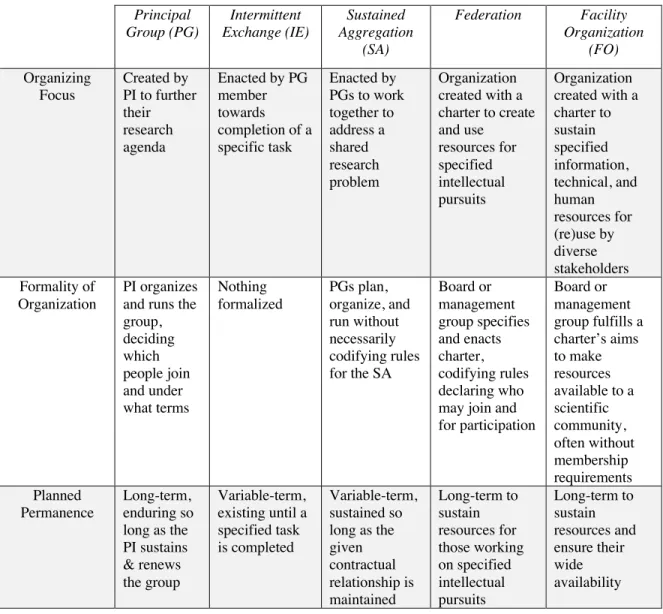
There are five coordinative entities in our typology today, Fig. 1 (summarized in Table 1).
Principal Group (PG). The Principal Group entity is the organizing of a particular scientific Principal Investigator (PI) and the members of that group. Principal Investigators are managers who have control over monetary and human resources with significant autonomy in an organization. The organizing focus of a PG is to advance the PI’s research agenda, even as all members of the PG have agency and individual goals that align and diverge with the PI’s. Individuals may include undergraduate, masters, and doctoral students; postdoctoral researchers; research scientists; research staff; and laboratory managers. The Principal Group’s formality of organization is defined by the PI organizing and running the group (and often delegating responsibilities), determining which individuals join and under what conditions. The planned permanence of a PG is long-term with the intention of enduring over time so long as the PI sustains and renews the group.
Intermittent Exchange (IE). An Intermittent Exchange’s organizing focus is to work towards the completion of a specific task by creating a common field of work between members of a PG and individuals from other organizations. IEs have no formality of organization because this type of entity emerges to accomplish a task. This entity’s planned permanence is variable-term. The intention may be to last for a short period of time yet end up being carried on for a long period of time if a task or common field of work are complex.
Sustained Aggregation (SA). A Sustained Aggregation’s organizing focus is to bring together at least two Principal Groups (along with their resources) to address a common, potentially evolving, research problem by creating and sustaining the necessary common fields of work. The formality of organization of SAs can span a wide spectrum depending on the wishes of the PGs. They may have a formal organization if grant proposals are co-authored with multiple investigators or there may simply be an informal agreement among PIs choosing to pool resources to tackle a shared problem of interest. SAs are planned and run without necessarily formally codifying rules for an administrative structure. A given SA’s planned permanence is variable-term, existing so long as the PG’s wish to continue work on a shared research problem and maintain the relationship.
Federation. A Federation’s organizing focus is to create scientific resources (instruments, datasets, software, etc.) for a set of scientific pursuits specified through a charter. The charter provides a written agreement that is contractual in nature in that it articulates arrangements but need not be a legal document or legally enforceable. Federations are formally organized, with a board or management group tasked with fulfilling the charter’s intellectual aims by setting forth
rules and guidelines for membership and participation. A Federation’s planned permanence is long-term so that the resources it creates can be sustained over time to address the scientific aims identified. In practice a Federation may only exist for a short or medium term. Many of the cyberinfrastructure projects studied by CSCW researchers would be categorized as Federations.
Table 1. The five coordinative entities and their characteristics.
Principal Group (PG) Intermittent Exchange (IE) Sustained Aggregation (SA) Federation Facility Organization (FO) Organizing Focus Created by PI to further their research agenda Enacted by PG member towards completion of a specific task Enacted by PGs to work together to address a shared research problem Organization created with a charter to create and use resources for specified intellectual pursuits Organization created with a charter to sustain specified information, technical, and human resources for (re)use by diverse stakeholders Ch ar ac te ri st ic s of e ac h en ti
ty Organization Formality of PI organizes and runs the
group, deciding which people join and under what terms Nothing formalized PGs plan, organize, and run without necessarily codifying rules for the SA Board or management group specifies and enacts charter, codifying rules declaring who may join and for participation Board or management group fulfills a charter’s aims to make resources available to a scientific community, often without membership requirements Planned Permanence Long-term, enduring so long as the PI sustains & renews the group Variable-term, existing until a specified task is completed Variable-term, sustained so long as the given contractual relationship is maintained Long-term to sustain resources for those working on specified intellectual pursuits Long-term to sustain resources and ensure their wide availability
Facility Organization (FO). A Facility Organization’s organizing focus is to sustain information, technical, and human resources specified through a charter. FOs are not organized to sustain particular intellectual aims, they sustain resources produced by other entities so that they may be used or reused by such parties who have particular intellectual purposes in mind—a key difference from Federations. Again, here a formal charter indicates a written agreement that is contractual in nature in that it articulates arrangements but need not be a legal document or legally enforceable. The formality of organization for FOs also results in a board or management group taking responsibility for fulfilling the charter’s aims and providing resources, often without
membership requirements. FOs may provide resources (such as software or datasets) freely to anyone via an open system. They may also provide resources as a service in exchange for currency (e.g. genome sequencing firms offering sequencing as a service). FOs have long-term planned permanence to ensure the wide availability of the entity’s resources over time.
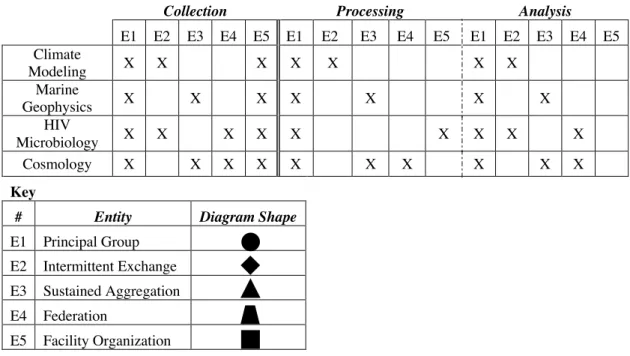
In our findings section we will use these entities to discuss work in our four research sites for three types of research activities. We will then reflect on these entities and our cases in the discussion.
5
Examining Four Cases
Following the threads of scientific data among individuals, data, and software we see these five entities employed across our four different research sites. We draw attention here to the ways work producing, processing, and analyzing data is accomplished through these forms of organizing so that different stakeholders, scientific problems, and resources can be aligned and productively combined in the course of this collaborative work.
5.1
Hank: Climate Modeling Using Facility Organization Resources
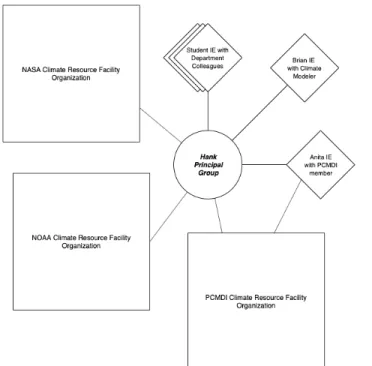
The threads of climate research we followed in Hank’s Principal Group offers a baseline of scientific work with relatively (especially if compared to Magnus’s PG described later) non-complex forms of organizing across the multiple key research processes. Hank’s PhD students complete individual projects by utilizing Facility Organization climate models and datasets from FOs and obtaining advice from varying IEs, Fig. 2. Students in Hank’s PG study a variety of different phenomena by iterating these existing climate models—complex software assemblages of theory, data, and past executions of the model (cf. Edwards 2010)—through adjustments of variables and the integration of different datasets to test new hypotheses. This PGoriented work contrasts to the often more organizationally complex work of the FOs that are creating and sustaining climate models. Instead of working with dozens of people, e.g. doing “very large collaborations” Dane a PhD student noted, members of this PG may interact with two or three others through Intermittent Exchanges when completing tasks. This case demonstrates work where entities are invoked with short-term planned permanence.
Our group doesn’t do very large collaborations. Some people do very, very large collaborations like 20 people or so, typically [Hank’s] group, only work with like two or three people. A lot of people will just go through their entire graduate degree with basically two author papers with [Hank]. (Dane, PhD student).
The processes of Hank’s PG’s collecting data and climate models most commonly relies upon accessing a Facility Organization entity’s openly available resources through the internet to bring an item to their local computing clusters. Dane, Bryan, Anita, and Palmer each turn to FO entities to obtain climate models. This dynamic with the group’s data and model collection efforts emerges because creating climate models from scratch is an undertaking more complex than any single graduate student or even PG would typically have the resources to undertake. It is more time and cost effective to start this group’s data journeys by leveraging a product from another entity. Hank noted that among his twenty plus students only one crafted their own model and it took them nine
years to finish a PhD (longer than the typical 5–6 years our interviewees noted). Instead these researchers rely upon the resources of Facility Organization entities such as NASA, the US National Oceanic and Atmospheric Administration (NOAA), or US Department of Energy funded Program for Climate Model Diagnosis and Intercomparison (PCMDI) that support the global infrastructures of climate knowledge. These FO entities sustain their respective climate models or satellite datasets as resources, regularly publishing updates and details about changes widely to the community, while embedding varying practices and assumptions in these complex software assemblages.
We also learned that some sources of data that will be integrated into these models come from other researchers conducting field work. Students acquire this data by invoking an Intermittent Exchange through email or other direct communication with the purpose of accessing such a resource and obtaining any needed help. Anita, for example, was writing python scripts to pull data from the beta version of the PCMDI FO’s system. During her testing process she enacted an IE with a member of this FO to work through bug testing processes as she probed the FO’s data system, even sharing her unfolding code. This fleeting engagement was created to acquire and solidify access to a resource but not sustained over time and did not have a preexisting relationship to draw upon. Her engagement with the FO required synergizing work to develop a relationship necessary for aligning and leveraging resources. Another student, Bryan, also noted how the creator of a model he uses for his work puts in the effort to email known users when an update or bug fix is pushed out. This individual model builder’s effort contrasts with the structured efforts of the FO and demonstrates a contrasting ad hoc, fleeting form of organizing to ensure work can consistently be accomplished by interested parties.
Figure 2. Hank’s PG invokes climate resource FOs for data and models while various Intermittent Exchanges are invoked as students conduct work and assess hypotheses.
So the guy who wrote this model occasionally will send out emails when someone finds a bug in it. He keeps sort of a list there of the people – that’s one of the reasons like we ask for permission to use the model so that he knows who’s using it. Then he can send out an e-mail and say like, ‘Oh, either I or someone else has found this bug in the model so I’ve made an update. So if you are using an older version, you’ll want to fix this for any future simulations you’re doing.’ (Bryan, PhD student).
Gathering climate models and datasets melds into the longer-term work of processing and analyzing data. Once members of the PG have assembled resources they will iteratively clean data and select variables necessary to answer their research questions—what we have previously described as data processing work (Paine et al., 2015) but extends into analysis work in practice. Through this work these PhD students will generate outputs and discuss them with Hank or another colleague then iteratively adjust the model to test their hypotheses. They will have to unpack the embedded historical journey of the resource before it reached this point, then adapt the model for the new analysis they are carving out. One such key task is examining the different sources for individual data points in a model and assessing their ability to produce quality, relevant data for the question at hand. This data processing effort is necessary to set the stage for scientifically appropriate analyses as Dane explains.
So a lot of my current project is going through and saying, “Okay, to know something about this particular physical variable, we should really use this data this satellite, because this satellite is a radar [sensor] and therefore is sensitive to ice content,” for instance. But we wouldn’t want to use to track liquid water because liquid water is not very bright and not very reflective in the radar, so a lot of it is hypothesis driven. (Dane, PhD student).
The work of Hank’s PG is collaborative, just among a few people rather than part of a large, amorphous organization of researchers. This first case is relatively simple but illustrates how Intermittent Exchange entities planned permanence (how long the arrangements are planned to endure over time) and nascence (how new the collaboration is and how well routines are or are not established) may be ephemeral. IEs emerge and are invoked strategically when needed, rather than organizing into Sustained Aggregations. The doctoral students—Dane, Bryan, Anita, and Palmer—work on their projects and discuss results with Hank. Anita notes that she shares an office and some computing resources with Hank’s other students, but they don’t work on the same projects since everyone is studying different climate phenomena using a wide array of climate models and datasets. Overall these climate science researchers form ephemeral Intermittent Exchanges with committee members, other colleagues in their department, and occasionally researchers beyond Seattle. The examples of IEs described by students in Hank’s PG are not continually sustained interactively on a day-to-day basis. They solidify at disconnected moments when findings or difficulties need to be discussed, particularly when someone is working out details about a piece of data in a model.
5.2
Waldo: A Marine Geophysics Sustained Aggregation
With Waldo’s marine geophysics and underseas seismology PG, we see continual collaboration between his PG and collaborators (another PG) at another university in the Pacific Northwest, Fig. 3. This enduring collaboration is a Sustained Aggregation, the Underseas Seismology SA, that has existed for many years across different grant funded projects, unlike the fleeting IEs we found in Hank’s PG, yet still faces nascent challenges as well as ebbs and flows to the relationships and forms of organizing invoked among different members. The Principal Investigators create a stable
base upon which varying arrangements of members come and go over time, demonstrating a case of planned permanence with long-term intentions without a codified organizational structure. During our study Waldo’s PG was focused on working with data from an ocean expedition to map the structure of the Earth’s crust off of the Pacific Northwest coast. We refer to this as the Ridge Experiment.
Collecting data for the Ridge experiment is a moment offlux for Waldo’s PG and the Underseas Seismology SA where the most visible engagement with entities beyond the SA occurs by invoking an Ocean Seismometer Facility Organization. Once data is collected the Ocean Seismometer FO in turn invokes the IRIS FO to deposit data. Data collection work requires organizing varying pieces of complex work using multiple overlapping entities and their processes, resources, and members to temporarily align and stabilize a productive human infrastructure. The invocation of the Ocean Seismometer FO demonstrates a case of significant engagement and interaction with an FO’s members and resources as members of the two PGs in the SAwork with FO staff twenty four hours a day during an ocean cruise to craft a dataset that will be long lived. This contrasts with the more ephemeral, simple alignment with the IRIS FO where the collected data is deposited through a computational system once without involving FO staff directly. This latter situation is akin to what we just saw with Hank’s PG and their use of climate FOs but depositing a data resource into instead of collecting it from the FO.
The Underseas Seismology SA relies on competitive grants received from their US funding agency to temporarily align with the Ocean Seismometer FO entity for a few weeks on a data collection cruise. The funding agency contracts with this FO to operate and maintain a large research ship as well as the seismometers or other research equipment that are brought to sites being studied. The funding agency’s proposals are designed with a process where a PI requests the use of a particular set of instruments for a cruise in a specified location where these researchers shoot off a seismic source (air gun) from the ship. If a proposal is funded, then the PI and their collaborators join the vessel and its staff to collect data during a carefully scheduled cruise.
… we used a seismic source that was on a ship, and we used ocean bottom seismometers that were displayed in a network around the ridge axis. We made explosions over a period of several weeks at sea. And then we are mapping how the sonic waves travel through the earth’s crust in the vicinity of the network that we’ve built. … So I think
Figure 3. Waldo’s PG sustains the Underseas Seismology SA with the Pacific PG. For the Ridge Experiment the SA invokes the Ocean Seismometer FO to collect data. Upon completion of the ocean expedition the Ocean Seismometer FO is mandated by its funding agency to place a copy of the collected data in the IRIS FO as a public resource in addition to providing the SA with a copy.
the [Ridge] experiment [data] costs about $5 million dollars to collect. We’ll study it for 15 years. (Dahl, PhD student).
This formal organizational process enables Waldo’s PG and the Underseas Seismology SA to leverage the FO’s resources. We categorize this as instance an example of a Facility Organization and not a Federation because this entity is purely contracted to enable PGs or SAs to collect data. The FO is not helping answer research questions that the Ridge Experiment PIs have developed. This multi-million dollar experiment’s cruise results in data that Waldo’s PG and their SA colleagues can subsequently spend more than a decade processing and analyzing in various forms. During the data collection cruise, members of the Sustained Aggregation joined the crew of the FO vessel where FO technicians helped them shoot air cannons into the ocean so that the seismometers can record the reflected sound waves. The technicians employed by the FO maintain the seismometers and are in charge of verifying the data collected at sea. SA members had to balance their research needs with rules for where and when air cannons can be shot to protect wildlife. In the field quality control by members of the PG and FO is essential to ensuring a viable product for long-term research yet the individuals from the FO do not have any involvement in the subsequent work with the data produced, they don’t have a long-term stake in the experiment, like they would if this were an example of a Federation entity.
There are technicians on the ship that are making sure that each shot has the same sound to it, the same source. … And once we start collecting the instruments we have to bring the digital waveforms into a computer and take a quick look to make sure that it recorded everything that we thought it should record. (Rollin, PhD student).
The funding mandates for data collected by the Ridge Experiment’s expedition require the raw products be shared, whether members of the SAwant this to happen immediately or not. The FO’s seismometer technicians deposit the raw data by invoking the openly accessible Incorporated Research Institutions for Seismology (IRIS) FO data repository. IRIS is a non-profit Facility Organization supported by universities in the United States dedicated to sustaining resources for seismology researchers. This repository is similar to the FO entities providing climate models in Hank’s PG as part of a global knowledge infrastructure accessible to a wide ranging community. Data processing is an undertaking between Waldo’s PG and their SA colleagues that can also blur the line into analysis efforts. The initial verification task completed by FO technicians noted above is processing work but necessarily conducted during the cruise so that revised data could be collected if needed. Within the SA data processing work is a variety of activities undertaken by the PhD students, including cleaning different parts of the dataset (e.g., mapping & correcting the locations of seismometers, marking bad data, etc.) and verifying that signals captured are mapped to correct seismometer locations. Subsequently different students will select subsets of data to analyze that is relevant to their given research tasks. Rollin explained how he had to manually process 90,000 air gun shots to “pick” the correct arrival time of the soundwave at the seismometer before he could proceed to analyzing it in a computational model he was developing. Rollin noted how one of the PIs elsewhere in the SAwould engage him in detailed discussions about the particular picks he was making, conveying his experience with this type of data to help Rollin craft the best product possible. Rollin noted how this process has “a learning curve about, well, you shouldn’t have made this pick so sharply” and that this PI from the SA might suggest that Rollin “adjust [a pick] in order to make it a little bit smoother.” These two individuals had a productive, sustained relationship through the established SA since Rollin had been a member for a few years
by the time he undertook this work. This contrasts with the ephemeral Intermittent Exchanges we saw with students in Hank’s PG engaging with individuals outside the PG as they had to process data using FO resources.
Data analysis work involves Waldo’s PG and the SA segmenting the processed data to answer the multiple research questions their project is asking. Frequently this will entail re-processing elements as their analyses unfold and discussions take place among various members. The forms and nature of data at any point in time are the result of dynamic interaction, including but not limited to dialogue, between researchers across these entities and the decisions and knowledge they express through software laden actions. Dahl, Rollin, or other members of the SAwho are working on the experiment divvy up the large dataset and iteratively analyze elements of it over time, each taking particular subsets that often rely upon the processing and analysis work other individuals complete, with common research objectives depending on which students join and leave the individual PGs. Rollin’s research uses Ridge data to model the Earth’s crust from the ocean bottom down for the first few kilometers. Dahl’s research is aligned so that he leverages Rollin’s upper crust modeling to study the segment of crust immediately below the uppermost down to the mantle. This work is necessary in turn for a member of another PG in the SA to engage in other work with the data.
Waldo’s PG works closely with another PG as part of a long-term Sustained Aggregation throughout data collection, processing, and analysis while invoking one FO directly, and another implicitly through the actions of the Ocean Seismometer FO, in the data collection process. Waldo and his PI colleagues have a longstanding relationship to work to acquire funds and produce resources. The PIs who invoked this Sustained Aggregation and undertook the Ridge Experiment leverage their decades long relationships and their continuing desire to have their respective PGs work together to carry on and use this Sustained Aggregation, even as students within come and go as their respective research careers emerge and transform over time. In our effort to categorize this form of organizing it might at first glance be reasonable to perceive this work as a Federation entity. In our inquiry, however, there was not a formalized organizational structure in place nor a charter specifying rules for membership. Waldo and his two PI colleagues are choosing to maintain and sustain alignment of a close set of working relationships between their respective groups.
5.3
Martin: Investigating HIV with Federations, IEs, and FOs
The work of Martin’s PG invokes multiple different entities with varying degrees of planned permanence and formality of organizing to collect and analyze data to study the evolution of HIV, Fig. 4. Martin’s PG conducts molecular and computational work where individuals work with physical samples (e.g., blood and plasma) to produce genetic sequences that can be analyzed computationally. This microbiological work is conducted as part of different Federation entities over time, but the day-to-day activities unfold within the context of this PG or in alignment with Intermittent Exchanges. The Federations handle work ranging from enrolling HIV infected patients in cohort studies and regularly collecting blood samples to analyzing blood samples for different phenomena and developing new vaccines. The various IEs are created when a resource is needed to accomplish a particular research activity, whether using a costly sequencing machine or using outside statistical expertise for analyses that are ultimately not sustained over time.
Martin’s PG invokes Federation, FO, and IE entities in their work collecting data. This process begins with a research scientist in Martin’s PG examining records kept by one of the Federation entities they work with to see if a sample necessary to address a particular research question is available and contains enough quantity of virus to make it viable and cost-effective to use. The PG member does this by examining the metadata stored by the Federation. If the research scientist proceeds with a given sample, then they will use one of the different wet lab protocols (Lynch 2002) that Martin’s PG has designed to “work it up” so that it can be sequenced, a point in which they invoke additional entities.
Then what I do is I essentially go look up how likely this sample is going to give us PCR positives, and depending on that, if it’s a high-viral load, I just go along with our general protocol. If it’s a very, very low viral load, which we think that it’s gonna be very template limiting, then I have to take a few alternate kind of testing steps. (Mony, research scientist).
Martin’s PG does not directly own expensive DNA sequencing machines which consequently requires the research scientists invoke another entity to accomplish this task. One approach for Martin’s PG is to invoke a Facility Organization entity every time through a commercial transaction. This requires the expenditure of grant funds and specification of requirements for the sequencing to be completed, then waiting for this company to finish the work. This may be a variable experience depending on the sequence to be sampled, cost quoted, and how busy a commercial FO entity is at the time. New “pyrosequencing” techniques emerged in the mid-2000s promising increased data volumes opening up new scientific opportunities and Martin’s PG did Figure 4. Martin’s PG is part of an HIV Patient Cohort Federation which gathers patients and collects blood samples. It has other PGs beyond the scope of our study. During data collection Martin’s PG invokes a Sequencer FO and in other situations a Pyrosequencer IE with the collocated Bio PG to access sequencing machines. For data processing Martin’s PG either develops software internally or invokes an FO such as the BROAD Software FO. When analyzing data Martin’s PG invokes an IE with a Stats PG for certain statistical analyses.
not purchase one of these expensive machines or rely upon a commercial sequencing company. Instead Martin’s PG leveraged an existing relationship with a colleague, Professor A with the Bio PG who did purchase one of these expensive machines, by invoking the Pyrosequencer IE. A research scientist in Martin’s PG was trained to run the machine leveraged through the IE to produce data necessary in a temporary alignment.
Martin’s PG undertakes data processing work within the PG but uses software from a Facility Organization when it suits the PG’s research needs. Members of Martin’s PG will have to spend significant amounts of time working to fix insertion and deletion errors that arise because of flaws in this pyrosequencing technology and aligning the overall sequence using automated software and often painful manual intervention. This data processing work entails both creating new software pipelines and adopting software from the larger microbiology community. For their first pyrosequencing project Sharvani, one of Martin’s PhD students, developed a new software pipeline. For their second pyrosequencing project the PG tested a variety of pipeline software before selecting one that is publicly available on the internet from a Facility Organization entity, the Broad Institute in Massachusetts. In this situation Martin’s PG chose to use the Broad FO’s freely available software to support their local work rather than adapt Sharvani’s pipeline or write something from scratch due to the time saved by leveraging this external resource.
So the cleaning process during this one is actually a sort of commercial one. It was made by the Broad Institute. They have a set of sort of scripts and software that you can download that have been validated that will go through and clean your data, and basically what it gives you at the very end is things that it has determined that are real sequences. (Elisa, research scientist).
Data analysis work results in Martin’s PG engaging with the larger Federation entities their projects are a part of as well as different Intermittent Exchanges. Processed and cleaned pyrosequenced data can be analyzed for particular questions, such as comparing sequences of vaccine recipients versus those of a placebo group to see how the virus was forced to evolve in the vaccinated patients. Members of Martin’s PG perform common analysis tasks using a variety of software scripts and Excel spreadsheets. Such tasks include calculating basic evolutionary details about each HIV sequence, the quantity of virus in the sample, and an assessment of how well a patient’s immune system was fighting the virus. Across different projects members of the PG will divide up processing and analysis tasks in parallel to iteratively work through the large quantities of data produced. The PG as a whole regularly shares in-progress work through multiple different weekly meetings, including a computational analysis group meeting with roundtable sessions where emerging results and challenges were discussed.
Analyzing pyrosequenced data often requires crucial immunological metadata about a patient sample that requires Martin’s PG engage with other PGs in their Federations to acquire since they do not conduct immunology work. Sharvani noted there is a “bureaucratic process” she would have to go through where she had to “ask permission formally from them to give me immunological data, and they have to, like, have [Martin] sign off on it saying that this person is valid, this is, you know, part of [Federation] work.” Here Sharvani and Martin leverage membership in this Federation by invoking a defined process to acquire siloed data needed to answer questions and attest to its use for Federation sanctioned research problems.
Conducting other analysis tasks frequently requires the invocation of an Intermittent Exchange with statisticians at another Seattle research center. After Sharvani, Elisa, or another computational