ISSN: 2089-3272 16
Facial Expression Recognition Using SVM Classifier
Vasanth P.C*, Nataraj K.R
ECE Department, SJB Institute of Technology, Bangalore, India e-mail: [email protected]
Abstract
Facial feature tracking and facial actions recognition from image sequence attracted great attention in computer vision field. Computational facial expression analysis is a challenging research topic in computer vision. It is required by many applications such as human-computer interaction, computer graphic animation and automatic facial expression recognition. In recent years, plenty of computer vision techniques have been developed to track or recognize the facial activities in three levels. First, in the bottom level, facial feature tracking, which usually detects and tracks prominent landmarks surrounding facial components (i.e., mouth, eyebrow, etc), captures the detailed face shape information; Second, facial actions recognition, i.e., recognize facial action units (AUs) defined in FACS, try to recognize some meaningful facial activities (i.e., lid tightener, eyebrow raiser, etc); In the top level, facial expression analysis attempts to recognize some meaningful facial activities (i.e., lid tightener, eyebrow raiser, etc); In the top level, facial expression analysis attempts to recognize facial expressions that represent the human emotion states. In this proposed algorithm initially detecting eye and mouth, features of eye and mouth are extracted using Gabor filter, (Local Binary Pattern) LBP and PCA is used to reduce the dimensions of the features. Finally SVM is used to classification of expression and facial action units.
Keywords: face expression and recognition, LBP, PCA, Support vehicle machine, Gabor feature
1. Introduction
Facial feature points encode critical information about face shape and face shape deformation. Accurate location and tracking of facial feature points is important in the applications such as animation, computer graphics, etc. Generally, the facial feature points tracking technologies could be classified into two categories: model free and model-based tracking algorithms. Model free approaches are general purpose point trackers without the prior knowledge of the object. The second type is Model based methods, such as active shape model (ASM), active appearance model (AAM), direct appearance model (DAM), etc, on the other hand, focus on explicit modelling the shape of the objects.
Facial expression recognition systems usually try to recognize either six expressions or the (Action Units) AUs. Over the past decades, there has been extensive research in computer vision on facial expression analysis. Current methods in this area can be grouped into two categories: image-driven method and model-based method. Image-driven approaches, which focus on recognizing facial actions by observing the representative facial appearance changes, usually try to classify expression or AUs independently and statically. Model-based methods make use of the relationships among AUs, and recognize the AUs simultaneously.
The proposed project work consists of two phases training and testing phase. In training
phase extracting features of the eye and mouth and creating the knowledge base. At the time of testing make use of knowledge base extracting Face expressions and action units. The proposed project consists of fallowing blocks face localization, eye and mouth detection, Features extraction and classification. Face localization is a crucial first step for proposed project, here image is input to this block, and first we exploit the colour information to limit the search area to candidate eye and mouth regions. In second block determine the exact eye and mouth position. After detecting eye and mouth region, extracting two types of features of the interested region using Gabor filter and LBP. Features are extracted directly from gray-scale character images by Gabor filters which are specially designed from statistical information of character structures. LBP is a simple yet very efficient texture operator which labels the pixels of an image by Thresholding the neighbourhood of each pixel and considers the result as a binary number.
Due to its discriminative power and computational simplicity, LBP texture operator has become a popular approach in various applications. It can be seen as a unifying approach to the traditionally divergent statistical and structural models of texture analysis. Perhaps the most important property of the LBP operator in real-world applications is its robustness to monotonic gray-scale changes caused, for example, by illumination variations. Another important property is its computational simplicity, which makes it possible to analyze images in challenging real-time settings. The extracted features using Gabor and LBP the features size is large, PCA is used to reduce the features size of eye and mouth. These extracted features are stored in knowledge base for testing purpose. In testing phase applying above method to extract the features and classifying the extracted features using SVM.
2. Methodology
The proposed algorithm methods includes the following modules: a) Gabor Features
b) LBP Features
c) Principal component analysis d) Support Vehicle Machine
The project work consists of two phases training and testing phase. In training phase extracting features of the eye and mouth and creating the knowledge base. At the time of testing make use of knowledge base extracting Face expressions and action units. The proposed project consists of fallowing blocks face localization, eye and mouth detection, Features extraction and classification. Face localization is a crucial first step for proposed project, here image is input to this block, and first we exploit the colour information to limit the search area to candidate eye and mouth regions. In second block determine the exact eye and mouth position. After detecting eye and mouth region, extracting two types of features of the interested region using Gabor filter and LBP. The extracted features using Gabor and LBP the features size is large, PCA is used to reduce the features size of eye and mouth. These extracted features are stored in knowledge base for testing purpose. In testing phase applying above method to extract the features and classifying the extracted features using SVM
.
2.1. Gabor Features
Gabor features constructed from post-processed Gabor filter responses have been successfully used in various important computer vision tasks, such as in texture segmentation, face detection, and iris pattern description. However, only very rarely the main weakness of Gabor filter based features, the computational heaviness, has received any attention even though it may prevent the use of proposed methods in real applications. It is evident that Gabor filters have many advantageous or even superior properties for feature extraction, but if the computational complexity cannot be improved their application areas will remain limited.
Some properties of Gabor filters:
A tunable bandpass filter. Similar to a STFT or windowed Fourier transform. Satisfies the lower-most bound of the time-spectrum resolution (uncertainty principle).
It a multi-scale, multi-resolution filter. Has selectivity for orientation, spectral bandwidth and spatial extent. Has response similar to that of the Human visual cortex (first few layers of brain cells). Used in many applications – texture segmentation; iris, face and fingerprint recognition. Computational cost often high, due to the necessity of using a large bank of filters in most applications.
2.2. LBP Features
LBP is a simple yet very efficient texture operator which labels the pixels of an image by Thresholding the neighbourhood of each pixel and considers the result as a binary number. Due to its discriminative power and computational simplicity, LBP texture operator has become a popular approach in various applications. It can be seen as a unifying approach to the traditionally divergent statistical and structural models of texture analysis. Perhaps the most important property of the LBP operator in real-world applications is its robustness to monotonic gray-scale changes caused, for example, by illumination variations. Another important property is its computational simplicity, which makes it possible to analyze images in challenging real time settings.
2.3. Principal Compnent Analysis
Principal component analysis (PCA) is possibly the dimension reduction technique most widely used in practice, perhaps due to its conceptual simplicity and to the fact that relatively efficient algorithms (of polynomial complexity) exist for its computation. In signal processing it is known as the Karhunen -Loeve transform.
a) PCA is a powerful and widely used linear technique in statistics, signal processing, image processing, and elsewhere.
b) Several names: the (discrete) Karhunen- Loève transform (KLT, after Kari Karhunen and Michael Loève) or the Hotelling transform (after Harold Hotelling). c) In statistics, PCA is a method for simplifying a multidimensional dataset to lower
dimensions for analysis, visualization or data compression.
d) PCA represents the data in a new coordinate system in which basis vectors follow modes of greatest variance in the data.
e) Thus, new basis vectors are calculated for the particular data set
f) The price to be paid for PCA’s flexibility is in higher computational requirements as compared to, e.g., the fast Fourier transform.
2.4. Support Vehicle Machine
Support Vector Machine (SVM) was first heard in 1992, introduced by Boser, Guyon, and Vapnik in COLT-92. Support vector machines (SVMs) are a set of related supervised learning methods used for classification and regression. They belong to a family of generalized linear classifiers. In another terms, Support Vector Machine (SVM) is a classification and regression prediction tool that uses machine learning theory to maximize predictive accuracy while automatically avoiding over-fit to the data. Support Vector machines can be defined as systems which use hypothesis space of a linear functions in a high dimensional feature space, trained with a learning algorithm from optimization theory that implements a learning bias derived from statistical learning theory. Support vector machine was initially popular with the NIPS community and now is an active part of the machine learning research around the world. SVM becomes famous when, using pixel maps as input; it gives accuracy comparable to sophisticated neural networks with elaborated features in a handwriting recognition task [2]. It is also being used for many applications, such as hand writing analysis, face analysis and so forth, especially for pattern classification and regression based applications. The foundations of Support Vector Machines (SVM) have been developed by Vapnik.
3. Results and Discussion
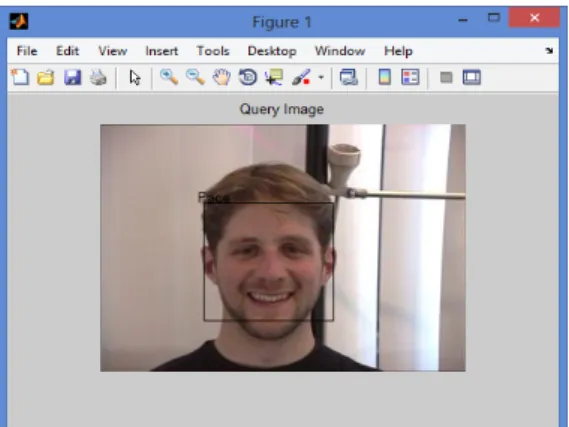
The results are obtained using a MATLAB simulator tool which is licensable software. The simulation results are shown below.
The results which shows face recognition it first creates database of expressions, secondly SVM training of input image then select an query of image then it localizes eyes and mouth and finally face expression recognition is done.
Figure 1. Query image
The above fig shows The figure shows the recognition of eyes and mouth once face detected then exploit color information to limit the search area to candidate eyes and mouth regions. The Gabor and LBP features are used for cropping of eyes and mouth from the face region.
Figure 2. Detecting eyes and mouth .
The figure shows face expression recognition. In the dataset four expressions are given in training phase .The eyes and mouth are detected through the features as the features is large PCA is used to reduce the feature of eyes and mouth the SVM is used for classification of the expression once it is classified then recognition of the expression is done. The above figure shows the recognized expression which is selected as smile.
4. Conclusion
In this project, we have proposed a combination of two methods Gabor and LBP feature to extract the features of eye and mouth. In which Gabor filter which are specially designed from statistical information. LBP operator is used in real world applications then applying PCA to reduce the dimensions of the features matrix that is eyes and mouth. Small size of feature matrix helps to increase the speed of the classification and finally using SVM the extracted features are classified, the classified features have good accuracy displaying the expression and facial action units.
Acknowledgements
I would like to articulate my profound gratitude and indebtedness to my project guide Dr. Nataraj. K.R (Professor & HOD Dept. of ECE, SJBIT), who is always being a constant motivation and guiding factor throughout the project time in and out as well. It has been a great pleasure for me to an opportunity to work under him.
References
[1] Z Zhu, Q Ji, K Fujimura, K Lee. Combining Kalman filtering and mean shift for real time eye tracking under active IR illumination. In Proc. IEEE Int. Conf. Pattern Recognit. 2002; 4: 318–321.
[2] SJ McKenna, S Gong, RP Würtz, J Tanner, D. Banin. Tracking facial feature points with Gabor wavelets and shape models. In Proc. Int. Conf. Audio-Video-Based Biometric Person Authent. 1997; 1206: 35–42.
[3] Y Tong, Y Wang, Z Zhu, Q Ji. Robust facial feature tracking under varying face pose and facial expression. Pattern Recognit. 2007; 40(11): 3195–3208.
[4] J Whitehill, CW Omlin. Haar features for FACS AU recognition. In Proc. IEEE Int. Conf. Autom. Face Gesture Recognit. 2006; 97–101.
[5] L Zhang, D Tjondronegoro. Facial expression recognition using facial movement features. IEEE