Work Organization and Musculoskeletal Health: Clinical Findings from Immigrant Latino Poultry Processing and Other Manual Workers
By: Joseph Grzywacz, Thomas A. Arcury, Dana Mora, Andrea M, Anderson, Haiying Chen, Daryl A. Rosenbaum, Mark R. Schulz, Sara A. Quandt
Grzywacz, J. G., Arcury, T. A., Mora, D., Anderson, A., Chen, H., Rosenbaum D. A., Schulz M. R., Quandt S. A. (2012). Work organization and musculoskeletal health: Clinical findings from immigrant Latino poultry processing and other manual workers. Journal of Occupational and Environmental Medicine, 54 (8), 995-1001. doi:10.1097/JOM.0b013e318254640d
Made available courtesy of Lippincott, Williams & Wilkins: http://dx.doi.org/10.1097/JOM.0b013e318254640d
***© Lippincott, Williams & Wilkins. Reprinted with permission. No further reproduction is authorized without written permission from Lippincott, Williams & Wilkins. This
version of the document is not the version of record. Figures and/or pictures may be missing from this format of the document. ***
Abstract:
Objective: To determine the potential role of differential exposure to work organization hazards in musculoskeletal disorders among immigrant Latino workers.
Method: Self-reported work organization data were obtained from immigrant Latino workers in poultry processing and nonpoultry, manual occupations (N = 742). Clinical evaluations for epicondylitis, rotator cuff syndrome, and back pain were obtained from a subsample (n = 518). Results: Several work organization hazards (eg, low job control, high psychological demands) were elevated among poultry processing workers. Job control predicted epicondylitis (odds ratio [OR] = 0.77) and rotator cuff syndrome (OR = 0.79); psychological demand predicted rotator cuff syndrome (OR = 1.30) and back pain (OR = 1.24); awkward posture and repeated
movements predicted all three outcomes; and management safety commitment predicted rotator cuff syndrome (OR = 1.65) and back pain (OR = 1.81).
Discussion: Immigrant poultry processing workers are exposed to greater work organization hazards that may contribute to occupational health disparities.
Keywords: Occupational Safety | Occupational Health | Latinos | Manual workers | Poultry Processing
Article:
Comprehensive and critical reviews 1–4 of the literature are drawing attention to the “organization of work” (or “work organization”) and its implications for occupational health outcomes. Work
organization is not a single attribute, but rather a constellation of factors at multiple levels that shape production methods, the way jobs are designed and performed (ie, work processes), and the management and human resource policies and activities used within and across industrial sectors.5 More specifically, the primary conceptualization of work organization identifies factors at three specific levels that collectively bear on employee health. Most proximal to health
outcomes are job-specific factors, such as the amount of control workers have over their work and the intensity with which job-related tasks need to be performed. More distal to health outcomes are organization-level factors that can affect health, such as the overall culture or climate for working safely or the general manner in which management interacts with rank and file employees. Most distal to individual health outcomes are external or environmental factors, such as the presence of occupational policies and the rigor of monitoring and enforcing
legislative mandates for occupational safety. Essentially, “work organization” is a short-handed way of describing the inputs and manifestation of “how work gets done,” and it underlies all aspects of workers' experiences on the job.
Work organization likely plays a key role in the creation and escalation of health inequalities on the job and off.1,4,6 The fundamental argument is that capitalist-oriented labor market policies result in disproportionate exposure of some groups of individuals to pathogenic job designs and work characteristics, health-compromising supervisory practices, and injury-prone safety climates. Landsbergis and colleagues,1 for example, point out that immigrants and other racial and ethnic minorities are more likely to find themselves in precarious employment arrangements typified by temporary or limited-term employment with few protections, and that their jobs expose them to low levels of control and high levels of psychological demand. These and other manifestations of work organization have been linked with discrete occupational health
outcomes like work-related musculoskeletal disorder 7–9 and safety-related behavior,10,11 and a variety of other health outcomes such as hypertension, heart disease, and depression.12–14
Several gaps remain in the work organization and occupational health literature. One key gap is the general lack of research documenting the linkage between macro-level sources of variation in work organization and job-related hazards in the daily lives of health disparate workers, like immigrants. Specifically, most previous research uses community-based population samples of immigrant workers 15,16 or occupation-specific samples such as poultry processing,17
day-laborers,18 or workers in the household services 19 or food services.20 Although valuable, neither general population samples nor occupation-specific samples are able to link workers' reported job characteristics such as low job control or psychological demand to organizational or macro-level forces that may give rise to these experiences. That is, general population samples typically do not have information about participants' employers to enable connecting worker experiences with employer or more macro experiences. Likewise, occupation-specific samples may have worker and organizational data, but they typically do not have an occupational comparison group to examine differential exposure to potentially deleterious work organization factors. Without explicit comparisons of comparable workers in similar, yet distinct work arrangements, it is
difficult to discern whether differences in job-related experiences are attributable to the way the work is organized or if they are attributable to some other social or cultural factor.
Another limitation is the relative paucity of research examining clear “occupational health” outcomes. Several studies demonstrate the presumed ill-effects of work organization factors like job control and psychological demand on both general and discrete indicators of health like self-rated health,21 heart disease,13 or depression.12 Comparatively less work organization research has examined more traditional occupational health outcomes like work-related musculoskeletal problems. The research that has examined musculoskeletal problems is based largely on self-reported symptoms,7 with almost all the studies using objective indicators of musculoskeletal problems occurring in Europe.22–29 Notable US exceptions are Gillen and colleagues' study 30 of hospital workers and Silverstein and colleagues' study 31 of manufacturing workers.
The goal of this analysis is to determine the potential health threat of work organization to one health-disparate population, immigrant Latino workers in the United States. To accomplish this goal, the authors use data obtained from a community-based study of immigrant workers in poultry processing and other manual jobs. Poultry processing provides a good model for focusing on the study of work organization because it provides a clear illustration of how forces at
multiple levels shape workers' everyday experiences on the job. Like most organizations
involved in the international supply chain of food commodities, poultry processing is a vertically integrated industry dominated by a small number of large corporations that control the entire production process, from hatcheries through producing fresh or cooked chicken products ready to retail.32 The high level of mechanization involved in modern poultry processing, one aspect of the vertical integration and consolidation of the industry, has brought a host of changes in how poultry processing work is done 33: workers perform rapid repetitive motions for 8 hours or more, there is close physical proximity among workers, the assembly line sets the work speed and results in chronic exposure to ambient noise, and, some suggest, poultry processors deliberately overlook safety standards to minimize their production costs.34 By contrast, other manual labor jobs performed by immigrant Latinos like farm work, construction, child care, or food preparation are typically not highly mechanized, thereby providing a basis of comparison for work organization.
In this analysis, we use data collected from poultry processing workers and immigrant workers in other manual occupations to: (1) describe variation in job design (ie, job control, psychological demands, heavy loads, and awkward postures), and management and supervisory practices (ie, abusive supervision and safety climate) experienced by immigrant Latino poultry and nonpoultry manual workers; and (2) delineate variation in upper-body musculoskeletal clinical findings attributed to features of job design and management and supervisory practices.
MATERIALS AND METHODS Study Design
The data for this analysis are from a cross-sectional survey of Latino poultry and nonpoultry manual workers. The sample design planned to enroll 138 men and 138 women in each of the two worker categories (ie, poultry and nonpoultry manual workers), for a final sample of 552. Because of the relatively few female workers encountered, sample size was increased beyond the planned 552. The survey consisted of an in-home interview followed by a physical examination conducted at a data collection clinic held within 1 month of the interview.
Study Site
Data were collected in Burke, Surry, Wilkes, and Yadkin counties in western North Carolina. These counties are rural and considered “new settlement” areas for Hispanic/Latino residents.35 On the basis of the 2010 US census, the total population of the four counties is 272,331, with 19,310 (7%) of that Hispanic.
Sampling
The issues that Latino immigrants face in the United States make them a complex cohort to conduct research with because they are often a hidden and difficult-to-reach population. The research team did not have access to workplaces, and no census existed of Latino manual workers in the area. Therefore, community-based sampling was used to assure that a
representative sample would be selected.36 A sample frame was developed of dwellings where Latinos lived in the study area. The study team and a community-based organization partnered to map areas mostly populated by Latino residents (enclaves). The research team also surveyed other areas of the counties to identify other dispersed Latino residences. To identify such dwellings, surveyors looked for cultural or behavioral indicators known to characterize Latino residents such as bicycles (a primary form of transportation for many immigrants) and a specific brand of satellite television known to carry a large amount of Latin American broadcasting programming. The lists of enclave and dispersed dwellings contained 4376 possible Latino dwellings, with about two thirds in residential enclaves. The lists were randomized, and assigned proportionately to recruit two thirds from enclaves and one third from dispersed dwellings. Recruitment
Members of the Latino community were hired as recruiters; two to four recruiters worked in each study county. Recruiters visited randomly selected dwellings in order; if no one was home, recruiters returned at different times and on different days. Residents were screened for inclusion criteria: self-identified as being Latino or Hispanic, worked 35 hours or more per week in a manual labor job, and were 18 years or older. Manual labor jobs were defined as employment in nonmanagerial jobs in industries such as landscaping, construction, restaurant work, hotel work, child care, or manufacturing. Nonpoultry manual workers with previous work in poultry
qualified only if lifetime employment in poultry production or processing was 6 months or less, and not within the past 2 years. Work in poultry processing was defined as any type of
from receiving through sanitation but not including workers in quality control. Employees of poultry production farms were excluded. More than one resident per dwelling could be recruited, if eligible. Of 1681 dwellings selected, 965 were screened, for a screening rate of 57%. A total of 1526 residents were screened. Of those eligible, 78% (N = 742) were interviewed; 70% of those interviewed attended the data collection clinic for a physical examination (n = 518). The clinic and interview samples differed such that men, younger participants, and those who spoke an indigenous language in the household during childhood were less likely to attend the clinic. Data Collection
Data collection proceeded in two steps. After screening for eligibility, trained data collectors obtained written informed consent and then completed a face-to-face, interviewer-administered questionnaire. Interviews were conducted in Spanish by trained, native Spanish-speaking interviewers. The interview lasted approximately 60 minutes and it included information about work history, work environment, symptoms and disability, and psychosocial characteristics. Participants were given a $10 incentive.
The 11 interviewers who administered the survey questionnaire underwent thorough training. All 11 interviewers were native Spanish speakers. Each interviewer completed the Collaborative Institutional Training Initiative training module on the ethical conduct of human subjects research. All interviewers also participated in a 1-day training session that provided a thorough review of the study objectives, an overview of standard interview technique, and questionnaire content. Interviewers completed practice interviews during the training session, and were
required to complete a series of progressively more realistic practice interviews before beginning data collection. To ensure data quality, study staff met with each interviewer at least weekly to collect and review completed questionnaires.
Clinical data were collected after the in-home interview at separate events that took place on Sundays at seven different locations throughout the study area. Participants were given the date, location, and an appointment time for the clinic when interviewed at their home. On the day of the clinic, a short questionnaire was administered to assess any changes in occupation or health since the interview and if subjects reported any pain of the elbows, shoulders, or lower back for two consecutive days in the last 30 days. Musculoskeletal examinations were conducted by board-certified physicians with fellowship training in sports medicine. Those who attended the clinic were given a $30 incentive and were also provided with a meal on site. All study
procedures were approved by the Wake Forest University Health Sciences institutional review board.
Measures
The dependent variables in this study are three clinical outcomes based on results of the physical examination completed during the data collection clinic. Rotator cuff syndrome was defined as presence of pain with resisted abduction, internal rotation, external rotation, or forward flexion of the shoulder, or tenderness to palpation over the bicipital groove or lateral shoulder.37
Epicondylitis was defined as presence of pain at the lateral epicondyle with resisted active wrist extension, at the medial epicondyle with resisted active wrist flexion, or tenderness to palpation over the medial and lateral epicondyle regions.37 Low back pain was defined as presence of pain with active flexion, extension, side-bending to right or left, or twisting to right or left, or
tenderness to palpation anywhere in the lumbar region. Work Organization Predictors
Self-reported information obtained from the baseline interviewer-administered questionnaire was used to execute six variables in two distinct domains of work organization. The job design domain was assessed with variables reflecting frequency of exposure to job control,
psychological demand, heavy loads, and awkward posture and repetitive movements. Job control and psychological demand were assessed using items modified from the Job Content
Questionnaire,38 with response options ranging from “seldom/never” coded 1 through “almost always” coded 4. Job control reflects the average of three items ([alpha] = .80), whereas
psychological demands reflects the average of four items ([alpha] = .71); higher values indicate greater exposure to each concept. Exposure to heavy loads and awkward posture and repetitive movements were measured with an established physical workload instrument 39 used in previous research with immigrant Latinos.17 Response options ranged from “seldom/never” coded 1 through “almost always” coded 4. Heavy load was assessed by computing the average of 12 items ([alpha] = .81), and awkward posture and repetitive movements was assessed by
computing the average of six items ([alpha] = .77) coded such that higher values indicate greater exposure.
The management and supervision domain of work organization was also assessed with two instruments. The experience of abusive supervision was assessed with three items from an established instrument 40 that has been used in previous research with immigrant Latinos.17,41 The selected items emphasized retaliatory forms of supervision (eg, “my supervisor could make things unpleasant here” or “my supervisor could give me undesirable job assignments”).
Response options ranged from “strongly disagree” coded 1 through “strongly agree” coded 4. Abusive supervision is the calculated mean of the three items ([alpha] = .80) coded such that higher scores indicate greater abusive supervision. Finally, the commitment of managers and supervisors to safety was assessed with a single item from an established perceived safety
climate scale 42 used in previous research with immigrant Latinos.43 Participants used 1 of the 3 possible responses when asked, “How much do supervisors seem to care about your safety?.” Individuals that responded “they are only interested in doing the job fast and cheaply” were coded 1 for poor safety commitment, whereas individuals reporting “they could do more to make
my job safe” or “they do as much as possible to make my job safe” were coded zero on this variable.
Covariates
All models were adjusted for the effects of age, sex, and indigenous language because a recent review of literature suggested that work organization factors consistently vary between these groups.1 Furthermore, these characteristics differentiated the clinical samples from the interview samples. Age was coded continuously. Sex was coded such that female sex was coded 1 and male sex was coded zero. Indigenous language was assessed by asking individuals what type of language was spoken by adults in the household when the participant was a child. Individuals reporting the use of any indigenous language (eg, Quiche, Aguacateco) were coded 1, whereas individuals reporting the use of either English or Spanish in the household during childhood were coded zero.
Analyses
Data were summarized by using means and standard deviations for continuous variables, and frequencies and percentages for categorical variables. Unadjusted associations between work organization factors and poultry/nonpoultry work were tested using Rao-Scott chi-square tests for categorical variables and analysis of variance for continuous variables. Logistic regression models were used to assess the bivariate associations of these work organization factors with clinical findings of upper body musculoskeletal outcomes (epicondylitis, rotator cuff syndrome, and back injuries). These bivariate models were subsequently adjusted for age, sex, and
indigenous language. A final model was then run for each outcome, including all work organization factors simultaneously and adjusting for age, sex, and indigenous language. All models were fit using SAS version 9.2 (SAS Institute, Inc, Cary, NC), and a generalized estimating equations approach. This approach was used to account for the sampling design and subsequent correlation attributable to the recruitment of multiple participants within the same housing unit, and clustered recruitment sites were employed. Missing data, of which there were few, were handled through listwise omission. A P value of 0.05 was considered statistically significant.
RESULTS
The sample contained more men (57%) than women (43%), and more than 70% of the sample was 39 years of age or younger (Table 1). More than half of the sample reported less than 6 years of education, but nearly 20% reported 10 or more years of education. Half of the sample
immigrated from Mexico, more than one third (38.1%) was from Guatemala, and the remainder predominantly from other Central American countries. Spanish was the dominant language of the sample, although 24.5% reported speaking an indigenous language. More than 40% of the sample had been in the United States for more than 10 years, whereas a comparable percentage of participants had been in the United States for 6 or fewer years and between 7 and 10 years.
TABLE 1. Sociodemographic Characteristics of Latino Workers in North Carolina, by Major Occupation
Average scores for the work organization variables were generally modest, recognizing most had possible scores ranging from 1 to 4 (Table 2). Scores for each of the job design variables and for abusive supervision were approximately “2,” which was anchored with the “sometimes”
descriptor. Approximately 40% of the workers reported a poor safety climate in their workplace. TABLE 2. Variation in Work Organization Among Poultry and Nonpoultry Latino Manual Workers in Eastern North Carolina (N = 742)
Scores for all the work organization variables, except one, differed significantly by major
occupational group. The design of poultry processing jobs was generally poorer than jobs outside poultry. Poultry processing workers reported less frequent opportunities to exert control on their job, greater exposure to psychological demands, and more frequent exposure to awkward postures and repetitive movements than nonpoultry workers. Poultry processing workers
reported less exposure to heavy loads than nonpoultry workers. In terms of supervisory practices, a greater proportion of poultry workers than nonpoultry workers reported a poor safety climate. Abusive supervision was the only work organization factor that did not differ by occupational group.
Rotator cuff syndrome was a common injury. Physical examinations identified 167 participants (32.4%) affected by rotator cuff syndrome, followed by 156 (30.2%) with low back pain and 136 (26.4%) with epicondylitis. Preliminary bivariate analyses yielded no evidence of differences in any of the three injuries between poultry and nonpoultry workers.
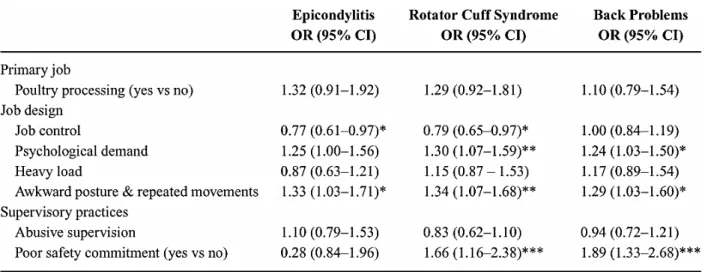
Bivariate analyses suggested that several work organization variables were associated with clinical indicators of musculoskeletal problems (Table 3). Job control was associated with 2 of the 3 outcomes: for every 1-unit increase in job control, the odds of clinical identification of epicondylitis and of rotator cuff problems decreased by 23% and 21%, respectively.
Psychological demand was associated with two outcomes: every 1-unit increase in psychological demand was associated with a 24% increase in the odds of having a rotator cuff problem, and 30% increase in the odds of having low back pain. Awkward postures and repetitive movements was associated with all the three outcomes: every 1-unit increase in this element of job design was associated with a 29% to 34% increase in the odds of identifying epicondylitis, rotator cuff syndrome, and back problems. Finally, poor safety commitment was associated with two of the clinical outcomes: individuals with a poor safety commitment were 66% and 89% more likely than individuals with good commitment to safety to evidence rotator cuff syndrome and back problems, respectively. Heavy load and abusive supervision were not associated with any of the outcomes.
TABLE 3. Bivariate Association of Work Organization Factors With Clinical Findings of
Upper-Body Musculoskeletal Outcomes Among Immigrant Workers in North Carolina (n = 518)
Many of the bivariate results held after adjusting for age, sex, and indigenous language (Table 4, Model 1 for each outcome). Epicondylitis was associated with job control in the expected
direction such that greater job control was associated with lower odds of epicondylitis. Similarly, epicondylitis was associated with exposure to awkward posture and repeated movements in the expected direction. Rotator cuff problems were associated with job control, psychological demands, awkward and repeated movements, and poor safety commitment. Finally, lower back pain was associated with psychological demands, heavy loads, awkward postures and repeated movements, and poor safety commitment.
TABLE 4. Multivariate Associations of Work Organization Factors With Clinical Findings of Upper-Body Musculoskeletal Outcomes Among Immigrant Workers in North Carolina (n = 518)
In multivariate models incorporating all work organization variables simultaneously and adjusting for age, sex, and indigenous language, epicondylitis was only predicted by one factor (Table 4, Model 2 for each outcome). For every 1-unit increase in exposure to awkward posture and repeated movements, the odds of finding epicondylitis increased by 51% (confidence interval = 1.06 to 2.16). For every 1-unit increase in awkward posture and repeated movements, the odds of having rotator cuff problems increased by 37% (odds ratio = 1.00 to 1.87). The odds of back problems were 50% (confidence interval = 1.00 to 2.26) more likely among workers whose supervisors demonstrate poor safety commitment in contrast to those whose supervisors are more committed to safety.
DISCUSSION
Despite growing interest, the evidence base linking work organization to inequalities in occupational health outcomes is relatively sparse. Outside the general indicators of health,21 depression,12 and heart disease,13 little US based research has focused on clinical indicators of poor occupational health outcomes like musculoskeletal problems.1 Furthermore, many of the existing studies are not able to deliberately link observed measures of job design and
management practices to the overarching business model. This study addresses many of the gaps in previous research by comparing workers in a highly mechanized, vertically integrated
production facility with similar workers not exposed to this model of work organization. Our results suggest that the organization of work in poultry processing is more pathogenic than other manual occupations held by immigrant Latinos. This study is not the first to characterize poultry processing in this way 17,33,43; however, it is one of the first to compare similar workers inside and outside poultry processing plants. As in the Lipscomb and colleagues' study,34 we find
that, in contrast to manual workers outside the poultry processing industry, poultry processing workers have less opportunity to control their work, they experience more regular psychological demands, their jobs require awkward postures and repetitive motions more frequently, and management is perceived as having a poor commitment to safety. These findings are meaningful because they shed light on the often-unseen and potentially under-prioritized occupational hazards associated with vertical integration and mechanization.
It is also noteworthy that nonpoultry workers also confronted several work organization hazards, although observed scores were statistically lower than in the case of poultry workers. Non– poultry processing workers had greater exposure to tasks requiring heavy loads, they had similar (albeit statistically lower) exposure to awkward postures and repeated movements, and more than one quarter of non–poultry processing workers perceived their managers as having little interest in occupational safety. These results are consistent with a recent review of the occupational health disparities literature 1 concluding that immigrants as a group are
disproportionately exposed to work organization hazards that have deleterious health effects. Analyses from data obtained from immigrant Latino workers suggest that several work
organization factors are associated with clinical indicators of poor occupational health. Similar to previous research using European samples, results from adjusted bivariate analyses indicated that greater levels of job control are associated with lower odds of physician-identified epicondylitis and rotator cuff problems, and that greater psychological demands are associated with higher odds of physician-diagnosed rotator cuff and back problems.7–9 We also found that greater exposure to awkward postures and repetitive movements and poor safety commitment was associated with greater odds of all the three outcomes. Importantly, these findings held for both poultry and non–poultry processing workers alike. Our findings contribute to this literature by documenting comparable associations in a US based sample of workers, most of whom are vulnerable because of their ethnicity and documentation status.
The overall pattern of results, in connection with previous research, is suggestive of a possible source of health disparities. The results suggest that, among immigrant Latinos in North Carolina, poultry processing workers have greater exposure to work organization hazards like low job control, elevated psychological demand, and repetitive work than nonpoultry manual workers, and that these exposures are linked with increased risk for poor musculoskeletal outcomes. This observation, coupled with reports that the poultry processing workforce is dominated by members of racial and ethnic minority groups, and increasingly foreign-born workers,33 supports a basic precept in the occupational health disparities literature. That is, racial and ethnic minorities are disproportionately exposed to pathogenic job designs and work
characteristics, health-compromising supervisory practices, and injury-prone safety climates that culminate to create an unequal burden of illness and disease among these workers relative to more privileged workers.1,4,6
Although the previous occupational health disparities suggestion is compelling, it needs to be acknowledged that there is minimal evidence of it in these data. There was no evidence that rates of the musculoskeletal outcomes were higher among poultry processing workers relative to nonpoultry processing workers. The only tangible evidence is that our multivariate results do indicate a greater risk, though not significantly greater, of all three outcomes for poultry
processing workers in contrast to nonpoultry processing workers. Furthermore, this elevated risk is reduced and the odds ratio reversed once all the work organization factors are included in the model. Although neither the main effect of major occupation nor the attenuation of effect was statistically significant, the pattern is completely consistent with the occupational health
disparities hypothesis. That is, the occupational health disparities literature fundamentally argues that differences in work organization factors account for, or explain, elevated risk of poor health outcomes among health-disparate workers. More research with larger samples is needed to definitively test this hypothesis.
The results of this study need to be interpreted in light of its limitations. Perhaps the greatest limitation is that these data are cross-sectional; consequently, causal inferences cannot be made. A second limitation is that study participants were sampled from a discrete geographic region; consequently, the generalizability of study findings is unknown. It could also be argued that requiring only one positive examination element for injury diagnosis is too inclusive. Using a stricter case definition requiring two positive findings would have decreased the injury prevalences by one third to one half. Nevertheless, gaining specificity in this manner would reduce sensitivity. A higher threshold for injury diagnosis would result in fewer false positives but could miss milder cases early in the disease process that have the potential for significant future morbidity. All the clinical examinations were held on Sundays when participants were off duty for the day; thus, injuries that flared only while or very shortly after working would not have been detected.
Limitations notwithstanding, this research makes several meaningful contributions to the
literature. The results document how job characteristics systematically differ between workers in a vertically integrated production facility relative to similar workers not exposed to this model, and they suggest that the organization of poultry processing workers has several pathogenic features. The results also contribute to the literature by documenting robust associations between several work organization factors and clinically identified upper-body musculoskeletal problems. Although additional research is needed with a larger sample, the overall pattern of results
suggests that the organization of work may contribute to occupational health disparities in upper-body musculoskeletal problems.
REFERENCES
1. Landsbergis PA, Grzywacz JG, LaMontagne AD, et al. Work organization, job insecurity, and occupational health disparities: an issue paper for discussion at the Eliminating Health and Safety Disparities at Work Conference; Chicago, IL; September 14 and 15, 2011.
2. Bambra C. Work, worklessness, and the political economy of health inequalities. J Epidemiol Community Health. 2011; doi: 10.1136/jech.2009.102103.
3. Benach J, Muntaner C. Precarious employment and health: developing a research agenda. J Epidemiol Community Health. 2007;61:276.
4. Siegrist J, Benach J, Bislimovska J. Review of Social Determinants of Health and the Health Divide in the WHO-European Region Report of Task Group 2: Employment and Working Conditions Including Occupation, Unemployment, and Migrant Workers. Copenhagen, Denmark: World Health Organization Regional Office for Europe; 2011.
5. National Institute for Occupational Safety and Health. The Changing Organization of Work and the Safety and Health of Working People. Washington, DC: US Department of Health and Human Services, National Institute for Occupational Safety and Health; 2002.
6. Lipscomb HJ, Loomis D, McDonald MA, Argue RA, Wing S. A conceptual model of work and health disparities in the United States. Int J Health Serv. 2006;36:25–50.
7. Bongers PM, Kremer AM, Laak J. Are psychosocial factors, risk factors for symptoms and signs of the shoulder, elbow, or hand/wrist?: a review of the epidemiological literature. Am J Ind Med. 2002;41:315–342.
8. Bongers PM, Ijmker S, Van Den Heuvel S, Blatter BM. Epidemiology of work related neck and upper limb problems: psychosocial and personal risk factors (part I) and effective
interventions from a biobehavioural perspective (part II). J Occup Rehabil. 2006;16:272–295. 9. Palmer KT, Smedley J. Work relatedness of chronic neck pain with physical findings—a systematic review. Scand J Work Environ Health. 2007;33:165–191.
10. Probst TM. Layoffs and tradeoffs: production, quality, and safety demands under the threat of job loss. J Occup Health Psychol. 2002;7:211–220.
11. Probst TM, Brubaker TL. The effects of job insecurity on employee safety outcomes: cross-sectional and longitudinal explorations. J Occup Health Psychol. 2001;6:139–159.
12. Bonde JPE. Psychosocial factors at work and risk of depression: a systematic review of the epidemiological evidence. Occup Environ Med. 2008;65:438–445.
13. Eller NH, Netterstrom B, Gyntelberg F, et al. Work-related psychosocial factors and the development of ischemic heart disease: a systematic review. Cardiol Rev. 2009;17:83–97. HTML Full Text
14. Schnall PL, Schwartz JE, Landsbergis PA, Warren K, Pickering TG. A longitudinal study of job strain and ambulatory blood pressure: results from a three-year follow-up. Psychosom Med. 1998;60:697–706.
15. De Castro AB, Gee GC, Takeuchi DT. Job-related stress and chronic health conditions among Filipino immigrants. J Immigr Minor Health. 2008;10:551–558.
16. EduardoSiqueira C, Jansen T. Working conditions of Brazilian immigrants in Massachusetts. J Immigr Minor Health. 2011 [epub ahead of print] doi:10.1007/s10903-011-9488-z.
17. Grzywacz JG, Arcury TA, Marin A, et al. The organization of work: implications for injury and illness among immigrant Latino poultry-processing workers. Arch Environ Occup Health. 2007;62:19–26.
18. Negi NJ. Identifying psychosocial stressors of well-being and factors related to substance use among Latino day laborers. J Immigr Minor Health. 2011;13:748–755.
19. Ahonen EQ, Lopez-Jacob MJ, Vázquez ML, et al. Invisible work, unseen hazards: the health of women immigrant household service workers in Spain. Am J Ind Med. 2010;53:405–416. 20. Tsai JH, Salazar MK. Occupational hazards and risks faced by Chinese immigrant restaurant workers. Fam Community Health. 2007;30(suppl):S71–S79.
21. Borrell C, Muntaner C, Benach J, Artazcoz L. Social class and self-reported health status among men and women: what is the role of work organisation, household material standards, and household labour? Soc Sci Med. 2004;58:1869–1887.
22. Andersen JH, Kaergaard A, Frost P, et al. Physical, psychosocial, and individual risk factors for neck/shoulder pain with pressure tenderness in the muscles among workers performing monotonous, repetitive work. Spine. 2002;27:660–667.
23. Andersen JH, Kaergaard A, Mikkelsen S, et al. Risk factors in the onset of neck/shoulder pain in a prospective study of workers in industrial and service companies. Occup Environ Med. 2003;60:649–654.
24. Bonde JP, Mikkelsen S, Andersen JH, et al. Prognosis of shoulder tendonitis in repetitive work: a follow-up study in a cohort of Danish industrial and service workers. Occup Environ Med. 2003;60:e8.
25. Cassou B, Derriennic F, Monfort C, Norton J, Touranchet A. Chronic neck and shoulder pain, age, and working conditions: longitudinal results from a large random sample in France. Occup Environ Med. 2002;59:537–544.
26. Leclerc A, Landre MF, Chastang JF, Niedhammer I, Roquelaure Y. Upper-limb disorders in repetitive work. Scand J Work Environ Health. 2001;27:268–278.
27. Ohlsson K, Hansson GA, Balogh I, et al. Disorders of the neck and upper limbs in women in the fish processing industry. Occup Environ Med. 1994;51:826–832.
28. Roquelaure Y, Ha C, Rouillon C, et al. Risk factors for upper-extremity musculoskeletal disorders in the working population. Arthritis Rheum. 2009;61:1425–1434.
29. Toomingas A, Theorell T, Michelsen H, Nordemar R. Associations between self-rated psychosocial work conditions and musculoskeletal symptoms and signs. Scand J Work Environ Health. 1997;23:130–139.
30. Gillen M, Yen IH, Trupin L, et al. The association of socioeconomic status and psychosocial and physical workplace factors with musculoskeletal injury in hospital workers. Am J Ind Med. 2007;50:245–260.
31. Silverstein BA, Fine LJ, Armstrong TJ. Occupational factors and carpal tunnel syndrome. Am J Ind Med. 1987;11:343–358.
32. Gillespie J, Davis C, Basarir A, Schupp A. A Comparative Analysis of the Evolution of the Three Major US Meat Industries. Louisiana Agricultural Experiment Station Bulletin. Baton Rouge, LA: Louisiana State University Agricultural Center; 2000.
33. US Government Accountability Office. WDU. Workplace Safety and Health: Safety in the Meat and Poultry Industry, While Improving, Could Be Further Strengthened. Washington, DC: US Government Accountability Office; 2005.
34. Lipscomb HJ, Argue R, McDonald MA, et al. Exploration of work and health disparities among black women employed in poultry processing in the rural south. Environ Health Perspect. 2005;113:1833–1840.
35. Kochhar R, Suro R, Tafoya SM, Center PH. The new Latino south: the context and consequences of rapid population growth. Washington, DC: Pew Hispanic Center; 2005. 36. Arcury TA, Quandt SA. Participant recruitment for qualitative research: a site-based approach to community research in complex societies. Hum Organ. 1999;58:128–133. 37. Sluiter JK, Rest KM, Frings-Dresen MH. Criteria document for evaluating the work-relatedness of upper-extremity musculoskeletal disorders. Scand J Work, Environ Health. 2001;27(suppl 1):1–102.
38. Karasek R, Theorell T, eds. Healthy Work: Stress, Productivity, and the Reconstruction of Working Life. New York, NY: Basic Books; 1990:381.
39. Bot S, Terwee C, van der Windt DAWM, et al. Internal consistency and validity of a new physical workload questionnaire. Occup Environ Med. 2004;61:980–986.
41. Marin AJ, Grzywacz JG, Arcury TA, Carrillo L, Coates ML, Quandt SA. Evidence of organizational injustice in poultry processing plants: possible effects on occupational health and safety among Latino workers in North Carolina. Am J Ind Med. 2009;52:37–48.
42. Gillen M, Baltz D, Gassel M, Kirsch L, Vaccaro D. Perceived safety climate, job demands, and coworker support among union and nonunion injured construction workers. J Safety Res. 2002;33:33–51.
43. Quandt SA, Grzywacz JG, Marin A, et al. Illnesses and injuries reported by Latino poultry workers in western North Carolina. Am J Ind Med. 2006;49:343–351.