The role of myeloid differentiation factor 88
on mitochondrial dysfunction of peritoneal
leukocytes during polymicrobial sepsis
The Harvard community has made this
article openly available.
Please share
how
this access benefits you. Your story matters
Citation
Gong, Yu, Lin Zou, Dunjin Chen, and Wei Chao. 2016. “The role
of myeloid differentiation factor 88 on mitochondrial dysfunction
of peritoneal leukocytes during polymicrobial sepsis.”
Central-European Journal of Immunology 41 (2): 153-158. doi:10.5114/
ceji.2016.60989. http://dx.doi.org/10.5114/ceji.2016.60989.
Published Version
doi:10.5114/ceji.2016.60989
Citable link
http://nrs.harvard.edu/urn-3:HUL.InstRepos:29002426
Terms of Use
This article was downloaded from Harvard University’s DASH
repository, and is made available under the terms and conditions
applicable to Other Posted Material, as set forth at
http://
nrs.harvard.edu/urn-3:HUL.InstRepos:dash.current.terms-of-use#LAA
The role of myeloid differentiation factor 88
on mitochondrial dysfunction of peritoneal
leukocytes during polymicrobial sepsis
Yu GonG
1,2, Lin Zou
2, Dunjin ChEn
3, WEi Chao
21Biomedicine Research Center and Department of Surgery, Key Laboratory for Major Obstetric Diseases of Guangdong Province, Key
Laboratory of Reproduction and Genetics of Guangdong Higher Education Institutes, The Third Affiliated Hospital of Guangzhou Medical University, China
2Department of Anesthesia, Critical Care, and Pain Medicine, Massachusetts General Hospital, Harvard Medical School, USA
3Key Laboratory for Major Obstetric Diseases of Guangdong Province, Institute of Gynecology and Obstetrics, The Third Affiliated Hospital
of Guangzhou Medical University, China
Abstract
Objective: To investigate the role of myeloid differentiation factor 88 (MyD88) on mitochondrial dysfunction of peritoneal leukocytes during polymicrobial sepsis.
Material and methods: Polymicrobial peritonitis, a clinically relevant mouse model of sepsis, was generated by cecum ligation and puncture (CLP) in both male C57BL/6j wild-type (WT) and MyD88 knockout (MyD88–/–) mice. Twenty-four hours after surgeries, peritoneal leukocytes were collected and four parameters of mitochondrial function, including total intracellular and mitochondrial RoS burst, mitochondrial membrane depolarization and aTP depletion, were measured by flow cytometry or aTP assay, and then compared.
Results: Polymicrobial sepsis led to a marked mitochondrial dysfunction of peritoneal leukocytes with total intracellular and mitochondrial RoS overproduction, decreased mitochondrial membrane po-tential and reduced intracellular aTP production. in comparison, there was no significant difference in the extent of mitochondrial dysfunction of peritoneal leukocytes between WT and MyD88–/– septic mice.
Conclusions: MyD88 may be not sufficient to regulate mitochondrial dysfunction of peritoneal leukocytes during polymicrobial sepsis.
Key words: polymicrobial sepsis, peritoneal leukocyte, mitochondrial dysfunction, MyD88. (Cent Eur j immunol 2016; 41 (2): 153-158)
Introduction
Sepsis, defined as a systemic response to infection with
the presence of some degree of an organ dysfunction,is the
main cause of death in the intensive care unit, and can pro-duce mortality rates as high as 30~50% [1].The pathogenesis of sepsis is very complicated and not fully understood yet. In recent years, studies have shown that the progresses of sep-sis and its induced septic shock or multiple organ dysfunc-tion syndrome (MODS) are closely related to mitochondrial
dysfunction.During sepsis, overwhelming inflammatory
re-sponses with the release of a large number of inflammatory cytokines and excessive reactive oxygen species (ROS) pro-duction result in mitochondrial dysfunction, which includes mitochondrial membrane damage, mitochondrial respiratory chain damage, mitochondrial DNA damage and mitochondri-al cmitochondri-alcium overload and finmitochondri-ally leads to cell apoptosis.
There-fore, mitochondrial dysfunction is one of the reasons of sepsis induced-MODS [2].
Toll-like receptor (TLR) is one of the key proteins in-volved in innate immune, a growing number of studies have found that TLR plays an important role in regulat-ing mitochondrial function. Myeloid differentiation factor 88 (MyD88) as a major adaptor protein of TLR signaling pathways, may transduce crucial signals in the TLR mod-ulated-mitochondrial dysfunction process [3-6]. This study
intends to select MyD88 knockout (MyD88–/–) mice as the
research object and employ a mouse model of cecum ligation and puncture (CLP) to generate polymicrobial sepsis; then observe whether mitochondrial dysfunction can be induced in peritoneal leukocytes and analyze whether there is any dif-ference in the extent of mitochondrial dysfunction between
WT and MyD88–/– mice; thus discuss preliminarily whether
MyD88 has a critical influence on polymicrobial sepsis- induced mitochondrial dysfunction in peritoneal leukocytes.
Yu Gong et al.
Material and methods
Animals
Eight- to twelve-week-old gender- and age-matched mice were used for the experiments. WT C57BL/6J mice were purchased from Jackson Laboratories (Bar Harbor,
Maine, USA). MyD88–/– mice were generated by Kawai and
colleagues [7] and had been backcrossed ﹥ 10 generations into the C57BL/6J strain. All animals were housed at the Massachusetts General Hospital (MGH) animal facility for at least one week before the experiments were performed. All animals were housed in pathogen-free, temperature-con-trolled, and air-conditioned facilities under a 12 h/12 h light/ dark cycle and were fed the same bacteria-free diet. All an-imal care and procedures were performed according to the protocols approved by the Subcommittee on Research
Ani-mal Care of MGH and were in accordance with the “Guide for the Care and Use of Laboratory Animals” published by
the National Institutes of Health.
Mouse model of polymicrobial sepsis induced by cecum ligation and puncture (CLP)
A mouse model of polymicrobial sepsis was generated by CLP as described previously [8, 9]. In brief, the cecum was ligated at 1.0 cm from the tip. A through-and-through puncture was made with an 18-gauge needle, and a small amount (droplet) of feces was extruded to ensure the pa-tency of the puncture site before the cecum was returned to the abdominal cavity. The sham-operated mice underwent laparotomy without CLP. The abdominal wall incision was closed in layers. After surgery, pre-warmed normal saline (50 ml/kg body weight) was administered subcutaneously. Postoperative pain control was managed with subcutane-ous injections of bupivacaine (2 ml/kg body weight) and buprenorphine (2 ml/kg body weight).
Peritoneal leukocytes collection
Twenty-four hours after sham or CLP surgery, 6 ml of ice-cold DPBS without calcium and magnesium was injected into the peritoneal space and mixed thoroughly by gentle massage. Five milliliters of the peritoneal lavage were collected and centrifuged at 1,500 rpm for 5 min. The supernatants were discarded and the cell pellets were suspended in RPMI 1640. We have previously shown that more than 90% of the peritoneal cells from the CLP mice are Gr-1+ neutrophils [10].
Reactive oxygen species measurement
Total intracellular H2O2 was measured with dichloro-dihydrofluorescein diacetate (H2-DCF-DA, Cat. D399,
Invitrogen), whereas mitochondrial superoxide (O2–) was
assayed with MitoSOX (Cat. M36008, Invitrogen). Specif-ically, peritoneal neutrophils were harvested, plated in
96-well plate, and incubated with freshly prepared
H2-DCF-DA or MitoSOX at 37˚C in the dark for 30 min. Unstained
controls were handled similarly but dyes were omitted. Dye-loaded cells were re-suspended in cold DPBS con-taining 1% fetal bovine serum and analyzed immediately by flow cytometry at fluorescein isothiocyanate or R-phy-coerythrin channel. Ten thousand cells were routinely counted by flow cytometry, and data were expressed as the median fluorescence intensity (MFI) in arbitrary units from at least three separate experiments.
Mitochondrial membrane potential measurement
TMRE (Cat. 87917, Sigma) was used to measure levels of ΔΨm. TMRE is a cationic dye that is rapidly and reversibly accumulated by healthy mitochondria. A decrease in the levels of TMRE indicates a reduction in mitochondrial membrane potential levels. Experimentally, a fraction of cells (5 × 10⁵) from the peritoneal lavage was labeled with freshly prepared
TMRE at 37˚C in the dark for 30 min. Unstained controls
were treated similarly but dyes were omitted. Dye-loaded cells were immediately re-suspended in cold DPBS contain-ing 1% fetal bovine serum and analyzed immediately by flow cytometry at the R-phycoerythrin channel. Ten thousand cells were routinely collected, and data were expressed as the mean fluorescence intensity in arbitrary units from the average of at least three separate experiments.
ATP assay
The intracellular ATP level was measured using a lu-ciferase-based assay using an ATP Bioluminescence Assay Kit CLS II (Roche Molecular Biochemicals, 1699695). In brief, intracellular ATP was released using a boiling meth-od. Specifically, splenocytes from sham or septic mice were harvested, washed twice with ice-cold DPBS, drained, and re-suspended in boiling buffer (100 mM Tris and 4 mM EDTA, pH 7.75). The suspensions were pipetted, vortexed, and snap frozen in liquid nitrogen. Frozen cells were boiled for 3 min in a water bath, placed on ice for 5 min, and then
centrifuged at 14,000 rpm for 10 min at 4°C. The superna -tants were transferred to fresh tubes and kept on ice until measurements were performed. Finally, 35 µl of luciferase reagent was added to 35 µl of the sample or standard. Ex-periments were performed in triplicate, and the data were standardized to the protein concentrations of the samples using Bradford protein assay reagent (Bio-Rad, 500-0006).
Statistical analysis
Statistical analyses were performed using GraphPad Prism 5 software (La Jolla, CA). Continuous variables are expressed as the mean ± SEM. One-way ANOVA with post-hoc (Tukey) test was used to determine the statistical-ly significant difference between the groups.
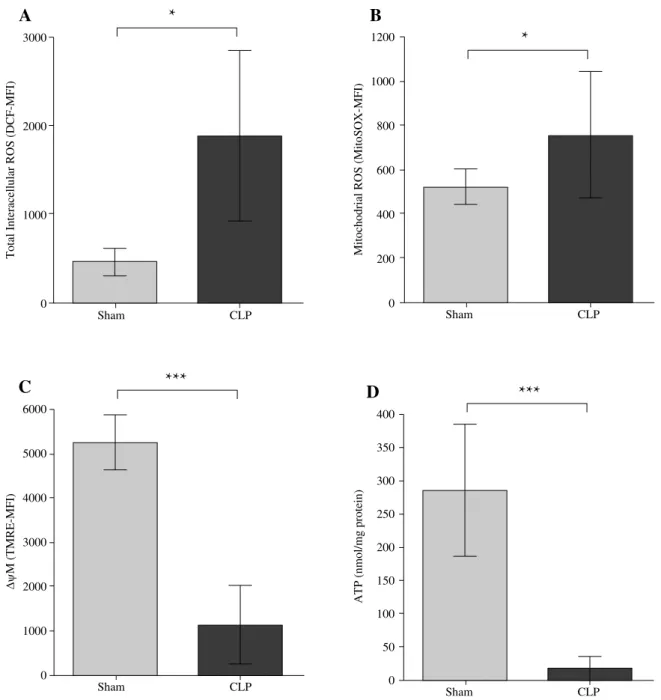
Fig. 1. Polymicrobial sepsis induces mitochondrial dysfunction in peritoneal leukocytes. A) Polymicrobial sepsis in-duces total intracellular ROS production in peritoneal leukocytes. WT mice were subjected to sham or CLP surgery. Twenty-four hours later, peritoneal leukocytes were harvested, stained with DCF and analyzed with flow cytometry for total intracellular ROS production. B) Polymicrobial sepsis induces mitochondrial ROS production in peritoneal leuko-cytes. WT mice were subjected to sham or CLP surgery. Twenty-four hours later, peritoneal leukocytes were harvested, stained with MitoSOX and analyzed with flow cytometry for mitochondrial ROS production. C) Polymicrobial sepsis decreases mitochondrial membrane potential in peritoneal leukocytes. WT mice were subjected to sham or CLP surgery. Twenty-four hours later, peritoneal leukocytes were harvested, stained with TMRE and analyzed with flow cytometry for mitochondrial membrane potential. D) Polymicrobial sepsis decreases intracellular ATP production in peritoneal leuko-cytes. WT mice were subjected to sham or CLP surgery. Twenty-four hours later, peritoneal leukocytes were harvested and analyzed for intracellular ATP level by ATP bioluminescence assay. The data are presented as the mean ± SEM.
n ﹥ 3 mice/group. *P < 0.05 vs. sham
Total Interacellular ROS (DCF-MFI)
3000 2000 1000 0 Sham CLP
A
Δψ M (TMRE-MFI) 6000 5000 4000 3000 2000 1000 0 Sham CLPC
ATP (nmol/mg protein)
400 350 300 250 200 150 100 50 0 Sham CLP
D
Mitochodrial ROS (MitoSOX-MFI)
1200 1000 800 600 400 200 0 Sham CLP
B
*
***
***
*
Yu Gong et al.
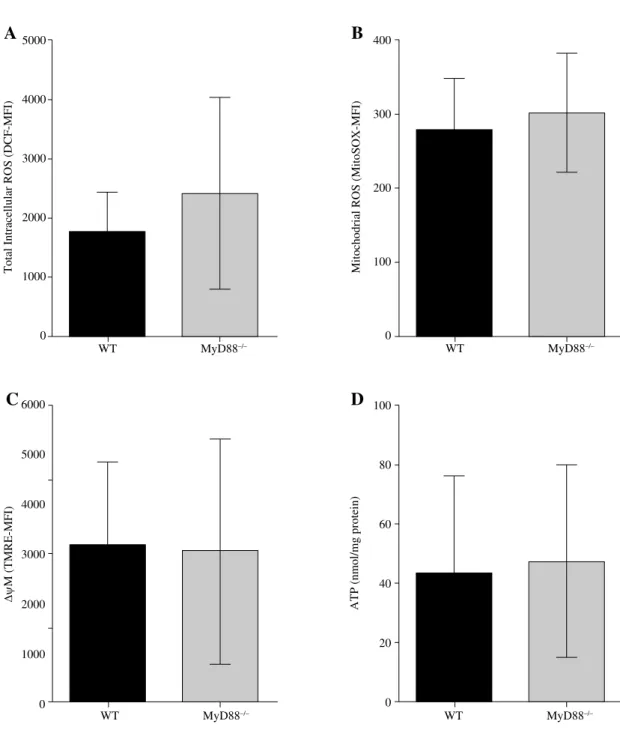
Fig. 2. MyD88 deletion plays an unimportant role in leukocyte mitochondrial dysfunction during polymicrobial sepsis. A) MyD88 plays an unimportant role in total intracellular ROS production in peritoneal leukocytes during
polymicrobi-al sepsis. WT and MyD88–/– mice were subjected to CLP surgery. After twenty-four hours, peritoneal leukocytes were
harvested, stained with DCF and analyzed with flow cytometry for total intracellular ROS production. B) MyD88 plays an unimportant role in mitochondrial ROS production in peritoneal leukocytes during polymicrobial sepsis. WT and
MyD88–/– mice were subjected to CLP surgery. After twenty-four hours, peritoneal leukocytes were harvested, stained
with MitoSOX and analyzed with flow cytometry for mitochondrial ROS production. C) MyD88 plays an unimportant
role in mitochondrial membrane potential in peritoneal leukocytes during polymicrobial sepsis. WT and MyD88–/– mice
were subjected to CLP surgery. After twenty-four hours, peritoneal leukocytes were harvested, stained with TMRE and analyzed with flow cytometry for mitochondrial membrane potential. D) MyD88 plays an unimportant role in intracellular
ATP production in peritoneal leukocytes during polymicrobial sepsis. WT and MyD88–/– mice were subjected to CLP
surgery. After twenty-four hours, peritoneal leukocytes were harvested and analyzed for an intracellular ATP level by
ATP bioluminescence assay. The data are presented as the mean ± SEM. n ﹥ 3 mice/group. ***P < 0.001 vs. sham
Total Intracellular ROS (DCF-MFI)
5000 4000 3000 2000 1000 0 WT MyD88–/–
A
Δψ M (TMRE-MFI) 6000 5000 4000 3000 2000 1000 0 WT MyD88–/–C
ATP (nmol/mg protein)
100 80 60 40 20 0 WT MyD88–/–
D
Mitochodrial ROS (MitoSOX-MFI)
400 300 200 100 0 WT MyD88–/–
B
Results
Polymicrobial sepsis induces mitochondrial dysfunction in peritoneal leukocytes
Sham and CLP operation was performed in WT mice, the parameters of mitochondrial dysfunction were detected in peritoneal leukocytes, including total intracellular ROS production, mitochondrial ROS production, mitochondri-al membrane potentimitochondri-al and intracellular ATP production. As shown in Fig. 1, twenty-four hours later, there was a marked increase in total intracellular and mitochondrial ROS production (Fig. 1A, B), meanwhile there was an ob-vious reduction in mitochondrial membrane potential and intracellular ATP production (Fig. 1C, D), in WT septic mice as compared with the sham control mice. These data clearly suggest that polymicrobial sepsis leads to mito-chondrial dysfunction in peritoneal leukocytes.
Polymicrobial sepsis-induced mitochondrial dysfunction in peritoneal leukocytes via a MyD88-independent mechanism
Furthermore, we subjected WT and MyD88–/– mice
to CLP operation and 24 hours later, the above four pa-rameters of mitochondrial dysfunction were measured in peritoneal leukocytes. As indicated in Fig. 2, there was no significant difference in all four parameters of mito-chondrial dysfunction in peritoneal leukocytes, including total intracellular and mitochondrial ROS production, mitochondrial membrane potential and intracellular ATP
production, between WT and MyD88–/– septic mice. These
results indicated that MyD88 signaling has no impact on polymicrobial sepsis-induced mitochondrial dysfunction in peritoneal leukocytes.
Discussion
So far, mitochondrial dysfunction has been regard-ed as the central part of the development of sepsis in-duced-MODS. But, due to no relevant molecular mecha-nism, clinical application of mitochondrial dysfunction in therapy of sepsis has certain limitations. The current study preliminarily surveys the possible role of MyD88 in medi-ating mitochondrial dysfunction of peritoneal leukocytes in a clinically relevant mouse model of polymicrobial sepsis, by comparing the extent of mitochondrial dysfunction in
WT or MyD88–/– septic mice, including total intracellular
and mitochondrial ROS overproduction, decreased mito-chondrial membrane potential and reduced intracellular ATP production. Our results displayed that polymicrobial sepsis induced an obvious mitochondrial dysfunction of peritoneal leukocytes although MyD88 may be not suf-ficient to modulate it because the four parameters of mi-tochondrial dysfunction were significantly different just
between WT sham and WT septic mice, but not between
WT septic and MyD88–/– septic mice.
Bacterial peritonitis models closely mimic the clinical symptoms of sepsis after bowel perforation, and the most widely used peritonitis model is CLP. Similar to numerous clinical cases of sepsis, the CLP model induces polymi-crobial sepsis [11]. Hotchkiss et al. have proved that both Gram-positive and Gram-negative bacteria exist in blood
cultures from CLP-operated mice, including Proteus
mira-bilis, Streptococcus faecalis, Enterobacter cloacae, Esche-richia coli, Bacillus and so on [12]. A lot of research have confirmed the importance of TLRs family members in the pathogenesis of sepsis through the CLP model. During polymicrobial sepsis induced by CLP, TLR2 deficiency remarkably reduced the mortality rate, improved the cardi-ac function or inhibited mitochondrial dysfunction of peri-toneal leukocytes, particularly lowered mitochondrial ROS production and maintained mitochondrial membrane po-tential [9, 13, 14]. Interestingly, TLR4 deficiency brought completely opposite results, including a higher mortality rate, deterioration of the cardiac function or increased mi-tochondrial ROS production of peritoneal leukocytes [15]. TLR2 mainly recognizes peptidoglycan of Gram-positive bacteria but TLR4 typically identifies Gram-negative bac-teria and their products, which gives us a clue that TLR2 and TLR4 are involved in polymicrobial sepsis induced by CLP through their respective signal transduction pathway, and lead to two distinct outcomes: TLR2 signaling path-ways are destructive whereas TLR4 signaling pathpath-ways are protective. In addition, mice deficient in TLR9, a re-ceptor for unmethylated CpG motifs present in bacterial DNA, were resistant to lethal polymicrobial sepsis and have improved the survival rate [16]. TLR7, regarded as a receptor for viral RNA, pharmacological activation of it
prior to induction of sepsis, improved the host’s capacity
to cope with pathogens [17]. MyD88, serving as one of the key adaptors for all TLRs signaling pathways, except TLR3 which transduces its signal through TRIF. Given the above, we may conclude that MyD88 is not efficient to affect sepsis-induced mitochondrial dysfunction of perito-neal leukocytes because of the final integrated result of all MyD88-dependent TLR signaling pathways.
Feng and colleagues found that in comparison with WT
mice, MyD88–/– mice had prolonged survival with
poly-microbial sepsis induced by CLP [18], which implied that MyD88 may play a bad role during the pathogenesis of sep-sis. Significantly, Peck-Palmer and colleagues discovered
that compared to WT mice, MyD88–/– mice had worse
sur-vival with polymicrobial sepsis induced by CLP [19], which indicated that MyD88 may serve as a good role during the pathogenesis of sepsis. Although both of the two research groups used the same model of sepsis, there were some
dif-ferences in details. Feng’s group used an 18-gauge needle
and showed a mortality rate of up to 80% within 3 days in
Yu Gong et al.
and exhibited that WT mice reached 80% mortality on day 7 after the CLP procedure. We can conclude that MyD88 performs different functions in high-grade and low-grade lethal CLP models. Mitochondrial dysfunction of peritoneal leukocytes may be dependent on MyD88 signaling pathway in a low-grade lethal model of sepsis, and its specific mech-anism needs further discussion.
To sum up, although MyD88 does not play a key role in CLP-induced mitochondrial dysfunction of peritoneal leukocytes in mice, MyD88 cannot be ruled out for par-ticipating in regulating clinical characteristics of sepsis, especially mitochondrial dysfunction caused by multiple organ dysfunction syndrome. Therefore, further revealing and exploring the molecular mechanism will provide a new strategy for clinical intervention of sepsis.
This work was supported financially by Guang-zhou Medical university (2011C43), the Third affiliated hospital of Guangzhou Medical university (2012Y20), and Department of Education of Guangdong Province (2015KQnCX137).
The authors declare no conflict of interest.
References
1. Levy MM, Fink MP, Marshall JC, et al. (2003): 2001 SCCM/ ESICM/ACCP/ATS/SIS International Sepsis Definitions Conference. Crit Care Med 31: 1250-1256.
2. Azevedo LC (2010): Mitochondrial dysfunction during sepsis. Endocr Metab Immune Disord Drug Targets 10: 214-223. 3. Djafarzadeh S, Vuda M, Takala J, et al. (2011): Toll-like
re-ceptor-3-induced mitochondrial dysfunction in cultured hu-man hepatocytes. Mitochondrion 11: 83-88.
4. West AP, Brodsky IE, Rahner C, et al. (2011): TLR signalling augments macrophage bactericidal activity through mitochon-drial ROS. Nature 472: 476-480.
5. Suliman HB, Welty-Wolf KE, Carraway MS, et al. (2005): Toll-like receptor 4 mediates mitochondrial DNA damage and biogenic responses after heat-inactivated E. coli. FASEB J 19: 1531-1533.
6. Bauerfeld CP, Rastogi R, Pirockinaite G, et al. (2012): TLR4-mediated AKT activation is MyD88/TRIF dependent and critical for induction of oxidative phosphorylation and mitochondrial transcription factor A in murine macrophages. J Immunol 188: 2847-2857.
7. Kawai T, Adachi O, Ogawa T, et al. (1999): Unresponsive-ness of MyD88-deficient mice to endotoxin. Immunity 11: 115-122.
8. Wichterman KA, Baue AE, Chaudry IH (1980): Sepsis and septic shock – a review of laboratory models and a proposal. J Surg Res 29: 189-201.
9. Zou L, Feng Y, Chen YJ, et al. (2010): Toll-like receptor 2 plays a critical role in cardiac dysfunction during polymicro-bial sepsis. Crit Care Med 38: 1335-1342.
10. Zou L, Feng Y, Li Y, et al. (2013): Complement factor B is the downstream effector of TLRs and plays an important role in a mouse model of severe sepsis. J Immunol 191: 5625-5635.
11. Rittirsch D, Huber-Lang MS, Flierl MA, Ward PA (2009): Immunodesign of experimental sepsis by cecal ligation and puncture. Nat Protoc 4: 31-36.
12. Hotchkiss RS, Swanson PE, Cobb JP, et al. (1997): Apoptosis in lymphoid and parenchymal cells during sepsis: findings in normal and T- and B-cell-deficient mice. Crit Care Med 25: 1298-1307.
13. Zou L, Feng Y, Zhang M, et al. (2011): Nonhematopoiet-ic toll-like receptor 2 contributes to neutrophil and cardiac function impairment during polymicrobial sepsis. Shock 36: 370-380.
14. Gong Y, Zou L, Feng Y, et al. (2014): Importance of Toll-like Receptor 2 in Mitochondrial Dysfunction during Polymicro-bial Sepsis. Anesthesiology 121: 1236-1247.
15. Zhang M, Zou L, Feng Y, et al. (2014): Toll-like Receptor 4 Is Essential to Preserving Cardiac Function and Survival in Low-grade Polymicrobial Sepsis. Anesthesiology 121: 1270-1280.
16. Plitas G, Burt BM, Nguyen HM, et al. (2008): Toll-like re-ceptor 9 inhibition reduces mortality in polymicrobial sepsis. J Exp Med 205: 1277-1283.
17. Koerner P, Traeger T, Mehmcke H, et al. (2011): Stimulation of TLR7 prior to polymicrobial sepsis improves the immune control of the inflammatory response in adult mice. Inflamm Res 60: 271-279.
18. Feng Y, Zou L, Zhang M, et al. (2011): MyD88 and Trif sig-naling play distinct roles in cardiac dysfunction and mortality during endotoxin shock and polymicrobial sepsis. Anesthesi-ology 115: 555-567.
19. Peck-Palmer OM, Unsinger J, Chang KC, et al. (2008): De-letion of MyD88 markedly attenuates sepsis-induced T and B lymphocyte apoptosis but worsens survival. J Leukoc Biol 83: 1009-1018.