http://wrap.warwick.ac.uk/
Original citation:Chen, Natalie and Juvenal, Luciana (2013) Quality, trade, and exchange rate pass-through. Working Paper. Coventry, UK: Department of Economics, University of Warwick. (CAGE Online Working Paper Series).
Permanent WRAP url:
http://wrap.warwick.ac.uk/59320
Copyright and reuse:
The Warwick Research Archive Portal (WRAP) makes this work of researchers of the University of Warwick available open access under the following conditions. Copyright © and all moral rights to the version of the paper presented here belong to the individual author(s) and/or other copyright owners. To the extent reasonable and practicable the material made available in WRAP has been checked for eligibility before being made available.
Copies of full items can be used for personal research or study, educational, or not-for-profit purposes without prior permission or charge. Provided that the authors, title and full bibliographic details are credited, a hyperlink and/or URL is given for the original metadata page and the content is not changed in any way.
A note on versions:
The version presented here is a working paper or pre-print that may be later published elsewhere. If a published version is known of, the above WRAP url will contain details on finding it.
WORKING PAPER SERIES
Centre for Competitive Advantage in the Global Economy
Department of Economics
Sep 2013
No.165
Quality, Trade, and Exchange Rate Pass-Through
Natalie Chen
University of Warwick, CAGE and CEPR
Luciana Juvenal
Quality, Trade, and Exchange Rate Pass-Through
¤y
Natalie Chen
University of Warwick
,
CAGE,
and
CEPR
Luciana Juvenal
International Monetary Fund
November 8, 2013
Abstract
This paper investigates the heterogeneous response of exporters to real exchange rate ‡uctua-tions due to product quality. We model theoretically the e¤ects of real exchange rate changes on the optimal price and quantity responses of …rms that export multiple products with heterogeneous levels of quality. The model shows that the elasticity of demand perceived by exporters decreases with a real depreciation and with quality, leading to more pricing-to-market and to a smaller response of export volumes to a real depreciation for higher quality goods. We test empirically the predictions of the model by combining a unique data set of highly disaggregated Argentinean …rm-level wine export values and volumes between 2002 and 2009 with experts wine ratings as a measure of quality. In response to a real depreciation, we …nd that …rms signi…cantly increase more their markups and less their export volumes for higher quality products, but only when exporting to high income destination countries. These …ndings remain robust to di¤erent measures of quality, samples, speci…cations, and to the potential endogeneity of quality.
JEL Classi…cation: F12, F14, F31
Keywords: Exchange rate pass-through, pricing-to-market, quality, unit values, exports, …rms, wine.
¤For helpful comments, we thank Illenin Kondo, Logan Lewis, Dennis Novy, Olga Timoshenko, Charles van Marrewijk,
Zhihong Yu, and participants at the CAGE Research Meetings 2013, DC Trade Study Group, ETSG Birmingham 2013, Inter-American Development Bank, International Monetary Fund, Midwest International Trade Meetings 2013, LSE, Nottingham, Utrecht School of Economics, and Warwick for comments. We are grateful to Linda Goldberg for sharing the data on distribution costs. Brett Fawley provided excellent research assistance. The views expressed are those of the authors and do not necessarily re‡ect o¢cial positions of the International Monetary Fund.
yNatalie Chen, Department of Economics, University of Warwick, Coventry CV4 7AL, UK. E-mail:
1 Introduction
Exchange rate ‡uctuations have small e¤ects on the prices of internationally traded goods. Indeed, empirical research typically …nds that the pass-through of exchange rate changes to domestic prices is incomplete (or, in other words, import prices do not fully adjust to exchange rate changes).12 A
challenge for both economists and policymakers is to understand the reasons for incomplete pass-through as the latter has implications for the implementation of optimal monetary and exchange rate policies.3 Possible explanations for partial pass-through include short run nominal rigidities combined
with pricing in the currency of the destination market (Engel, 2003; Gopinath and Itskhoki, 2010; Gopinath, Itskhoki, and Rigobon, 2010; Gopinath and Rigobon, 2008), pricing-to-market strategies whereby exporting …rms di¤erentially adjust their markups across destinations depending on exchange rate changes (Atkeson and Burstein, 2008; Knetter, 1989, 1993), or the presence of local distribution costs in the importing economy (Burstein, Neves, and Rebelo, 2003; Corsetti and Dedola, 2005).4
Thanks to the increasing availability of highly disaggregated …rm- and product-level trade data, a strand of the literature has started to investigate the heterogeneous pricing response of exporters to exchange rate shocks.5 However, evidence on the role of product-level characteristics in explaining
heterogeneous pass-through remains scarce. In order to …ll this gap, this paper explores how incom-plete pass-through can be explained by the quality of the goods exported. We model theoretically the e¤ects of real exchange rate shocks on the pricing decisions of multi-product …rms that are hetero-geneous in the quality of the goods they export, and empirically investigate how such heterogeneity impacts exchange rate pass-through. Assessing the role of quality in explaining pass-through is a challenge as quality is generally unobserved. To address this issue we focus on the wine industry, which is an agriculture-based manufacturing sector producing di¤erentiated products, and combine a unique data set of Argentinean …rm-level destination-speci…c export values and volumes of highly disaggregated wine products with expert wine ratings as a directly observable measure of quality.6
The …rst contribution of the paper is to develop a theoretical model to guide our empirical speci…ca-tions. Building on Berman, Martin, and Mayer (2012) and Chatterjee, Dix-Carneiro, and Vichyanond (2013), we extend the model of Corsetti and Dedola (2005) by allowing …rms to produce and export multiple products with heterogeneous levels of quality. In the presence of additive local distribution costs paid in the currency of the importing country, the model shows that the demand elasticity perceived by the …rm falls with a real depreciation and with quality. As a result, following a change
1For a survey of the literature, see Goldberg and Knetter (1997) and Burstein and Gopinath (2013). 2Incomplete pass-through therefore leads to deviations from the Law of One Price.
3As incomplete pass-through determines the extent to which currency changes a¤ect domestic in‡ation in the
im-porting economy, it has implications for the implementation of domestic monetary policy. In addition, as incomplete pass-through determines how currency depreciations can stimulate an economy by substituting foreign by domestic goods, it also has implications for the evolution of the trade balance and exchange rate policy (Knetter, 1989).
4In addition, Nakamura and Steinsson (2012) show that price rigidity and product replacements lead aggregate import
and export price indices to appear smoother than they actually are, biasing exchange rate pass-through estimates.
5Many papers examine the response of import prices (which include transportation costs) or consumer prices (which
further include distribution costs) to changes in currency values (e.g., Campa and Goldberg, 2005, 2010). For earlier evidence from the perspective of exporters, see Goldberg and Knetter (1997), Kasa (1992), or Knetter (1989, 1993). For more recent evidence, see Berman, Martin, and Mayer (2012), Chatterjee, Dix-Carneiro, and Vichyanond (2013), or Amiti, Itskhoki, and Konings (2012), among others.
6Other papers that focus on speci…c industries include Goldberg and Verboven (2001) and Auer, Chaney, and Sauré
in the real exchange rate, exporters change their prices (in domestic currency) more, and their ex-port volumes less, for higher quality products. Once we allow for higher income countries to have a stronger preference for higher quality goods, as the evidence from the empirical trade literature tends to suggest (Crinò and Epifani, 2012; Hallak, 2006), the heterogeneous response of prices and quanti-ties to exchange rate changes due to quality is predicted to be stronger for higher income destination countries.
The second contribution of the paper is to bring the predictions of the model to the data. The …rm-level trade data we rely on are from the Argentinean customs which provide, for each export ‡ow between 2002 and 2009, the name of the exporting …rm, the country of destination, the date of the shipment, the Free on Board (FOB) value of exports (in US dollars), and the volume (in liters) of wine exported. The level of disaggregation of the data is unique because for each wine we have its name, grape (Chardonnay, Malbec, etc.), type (white, red, or rosé), and vintage year. With such detailed information we can de…ne a “product” in a much more precise way compared to the papers that rely on trade classi…cations such as the Harmonized System (HS) to identify products. For instance, Argentina’s 12-digit HS classi…cation only groups wines into eleven di¤erent categories or “products.” In contrast, as we de…ne a product according to the name of the wine, its grape, type, and vintage year, the sample we use for the estimations includes 6,720 di¤erent wines exported by 209 wine producers. The exporters in the sample are therefore multi-product …rms.
In order to assess the quality of wines we rely on two well-known experts wine ratings, the Wine Spectator and Robert Parker. In both cases a quality score is assigned to a wine according to its name, grape, type, and vintage year which are characteristics we all observe in the customs data so the trade and quality data sets can directly be merged with each other. Quality is ranked on a (50,100) scale with a larger value indicating a higher quality. Our approach to measuring quality is similar to Crozet, Head, and Mayer (2012) who match French …rm-level export data of Champagne with experts quality assessments to investigate the relationship between quality and trade. However, in contrast to our paper they are unable to distinguish between the di¤erent varieties sold by each …rm, so each …rm is assumed to export one type of Champagne only.
higher quality goods. Finally, we …nd that the response of export prices (volumes) to real exchange rate changes increases (decreases) with quality only when …rms export to high income destination countries. Overall, our empirical results …nd strong support for the predictions of the model.
One concern with our estimations is the potential endogeneity of quality in explaining unit values and export volumes. Although both the Wine Spectator and Parker rating systems are based on blind tastings where the price of each wine is unknown, the tasters are told the region of origin or the vintage year and this might a¤ect in a way or the other the scores they assign to the di¤erent wines, leading to an endogeneity bias. In order to overcome this issue, we use appropriate instruments for quality based on geography and weather-related factors, including the total amount of rainfall and the average temperatures during the growing season for each province where the grapes are grown, as well as the altitude of each of the growing regions of Argentina. We show that our main …ndings remain robust to the instrumentation of quality.
The degree of exchange rate pass-through of 89 percent that we …nd, which magnitude is consistent with the estimates of other …rm-level studies, contrasts with the low pass-through that is typically estimated using aggregate or industry-level data. For instance, in a sample of OECD countries, Campa and Goldberg (2005) …nd an average pass-through of 46 percent in the short run and 64 percent in the long run. We therefore investigate whether pass-through estimates su¤er from an aggregation bias. To this aim, we aggregate our data both at the …rm and at the country-levels, re-estimate our benchmark speci…cations, and compare the magnitude of exchange rate pass-through estimated at each level of data aggregation. Interestingly, we …nd that the more aggregated the data, the lower is estimated pass-through, suggesting that aggregate pass-through estimates su¤er from an aggregation bias.
Our paper belongs to two strands of the literature. The …rst one is the vast literature on incomplete exchange rate pass-through and pricing-to-market. Among the papers that explore the determinants of heterogeneous pass-through from the perspective of exporting …rms, Berman et al. (2012) …nd that highly productive French exporters change signi…cantly more their export prices in response to real exchange rate changes, leading to lower pass-through. Chatterjee et al. (2013) focus on multi-product Brazilian exporters and show that within …rms, pricing-to-market is stronger for the products the …rm is most e¢cient at producing. Amiti, Itskhoki, and Konings (2012) …nd that Belgian exporters with high import shares and high export market shares have a lower exchange rate pass-through.7
Our paper is also related to Auer and Chaney (2009) and Auer, Chaney, and Sauré (2012) who explore the relationship between quality and pass-through. However, as the two papers rely on import and consumer prices data, respectively, their empirical analysis investigates exchange rate pass-through rather than the pricing-to-market behavior of exporting …rms. Consistent with our paper, these authors predict that pass-through should be higher for lower quality goods.8 Auer and
Chaney (2009) do not …nd any evidence for such a relationship using import prices data for the US,
7Other …rm-level studies include Campos (2010), Fitzgerald and Haller (2013), Fosse (2012), Li, Ma, Xu, and Xiong
(2012), and Strasser (2013).
8Basile, de Nardis, and Girardi (2012) develop a model based on Melitz and Ottaviano (2008) and predict that
where quality is inferred from trade unit values. In contrast, using a data set on the prices and numbers of cars traded in Europe, Auer et al. (2012) …nd some evidence that pass-through decreases with hedonic quality indices estimated from regressions of car prices on car characteristics such as weight, horse power, and fuel e¢ciency.
Second, this paper relates to the growing literature on quality and trade, which mostly relies on trade unit values in order to measure quality.9 At the country level, Hummels and Klenow (2005) and
Schott (2004) focus on the supply-side and show that export unit values are increasing in exporter per capita income. On the demand-side, Hallak (2006) …nds that richer countries have a relatively stronger demand for high unit value exporting countries. More recently, some papers have started to investigate how quality relates to the performance of exporters using …rm-level data. Manova and Zhang (2012a) focus on Chinese …rm-level export prices and …nd some evidence of quality sorting in exports. Kugler and Verhoogen (2012), Manova and Zhang (2012b), and Verhoogen (2008) highlight the correlation between the quality of inputs and of outputs focusing on Mexican, Chinese, and Colombian …rms, respectively. Closest to our work is Crozet et al. (2012) who explain French …rm-level export prices and quantities of Champagne by experts ratings as a measure of quality.10
The paper is organized as follows. In section 2 we present our model where …rms export multiple products with heterogeneous levels of quality, and show how real exchange rate changes a¤ect the optimal price and quantity responses of exporters. Section 3 describes our …rm-level exports customs data, the wine experts quality ratings, and the macroeconomic data we use. Section 4 discusses how the features of the wine industry conform with the main assumptions of the theoretical model to be tested. Section 5 presents our main empirical results. Section 6 provides robustness checks, while section 7 concludes.
2 A Model of Pricing-to-Market and Quality
Berman et al. (2012) extend the model with distribution costs of Corsetti and Dedola (2005), allowing for …rm heterogeneity where single-product …rms di¤er in their productivity. They show that the elasticity of demand perceived by the exporter falls with a real depreciation and productivity, leading to variable markups which increase with a real depreciation and productivity. This leads to heterogeneous pricing-to-market where more productive exporters change their prices more than others following a change in the real exchange rate.11 In their appendix, Berman et al. (2012) show that a similar result
holds if …rms di¤er in the quality of the (single) good they export: …rms that export higher quality goods change their export prices more than others in response to a real exchange rate change.
so that exchange rate pass-through increases with productivity and quality. In a related study, Yu (2013) shows theoretically that incomplete pass-through results from …rms adjusting both their markups and the quality of their products in response to a change in the exchange rate.
9This approach is criticized by, among others, Khandelwal (2010) who compares exporters’ market shares conditional
on price to infer the quality of exports.
10For additional evidence on the relationship between quality and trade, see Baldwin and Harrigan (2011), Hallak and
Sidivasan (2011), Hummels and Skiba (2004), or Johnson (2012), among others.
11Berman et al. (2012) obtain similar predictions when using the models with endogenous and variable markups of
Chatterjee et al. (2013) extend the model of Berman et al. (2012) to multi-product …rms. Inspired by Mayer, Melitz, and Ottaviano (2011), each …rm is assumed to be most e¢cient at producing a key variety which is the …rm’s “core competency,” and the further away a variety is from the core, the relatively less e¢cient each …rm is at producing this variety.12 In response to a change in the real
exchange rate, exporters vary their prices more for the products closer to their core competency, which in turn have a higher e¢ciency and thereforesmaller marginal costs.
In what follows, we build on Berman et al. (2012) and Chatterjee et al. (2013) and extend the model of Corsetti and Dedola (2005), allowing for …rm heterogeneity in the quality of the goods exported. Given that most …rms in our data set export multiple products, we model them as multi-product …rms which therefore di¤erentiates us from Berman et al. (2012) who focus on single-multi-product …rms. In contrast to the multi-product …rms model of Chatterjee et al. (2013), we however rank the di¤erent goods produced by each …rm in terms of quality rather than e¢ciency, where higher quality is associated withhigher marginal costs (Crinò and Epifani, 2012; Hallak and Sivadasan, 2011; Johnson, 2012; Kugler and Verhoogen, 2012; Manova and Zhang, 2012a; Verhoogen, 2008). We then look at how changes in real exchange rates a¤ect the optimal price and quantity responses of exporters and derive some testable implications that can be taken to the data.
2.1 The Basic Framework
The Home country (Argentina in our case) exports to multiple destinations in one sector characterized by monopolistic competition. The representative agent in destination country has preferences over
the consumption of a continuum of di¤erentiated varieties given by13
() =
·Z
ª
[()()] ¡1
¸ ¡1
(1)
where() is the consumption of variety, () the quality of variety , and 1 the elasticity
of substitution between varieties. The set of available varieties is ª. Quality captures any intrinsic characteristic or taste preference that makes a variety more appealing for a consumer given its price. Therefore, consumers love variety but also quality.
Firms are multi-product and produce goods with di¤erent levels of quality. They are heterogeneous in two dimensions: e¢ciency/productivity and product quality. The parameter, which denotes each
variety, indicates how e¢cient each …rm is at producing each variety so has both a …rm- and a product-speci…c component. Each …rm produces one “core” product, but in contrast to Chatterjee et al. (2013) or Mayer et al. (2011) who consider that a …rm’s core competency lies in the product it is most e¢cient at producing – and which therefore has lower marginal costs – we assume that a …rm’s core competency is in its product of superior quality which entails higher marginal costs (Manova and Zhang, 2012b).
The e¢ciency associated with the core product is given by a random draw©so each …rm is indexed
by©. Let us denote by the rank of the products in increasing order of distance from the …rm’s core,
12Li et al. (2012) also model multi-product …rms by ranking products according to their importance for the …rm. 13For similar preferences see Baldwin and Harrigan (2011), Berman et al. (2012), Crozet et al. (2012), Johnson (2012),
with = 0 referring to the core product with the highest quality. Firms then observe a hierarchy of
products based on their quality levels. A …rm with core e¢ciency© then produces a product with an e¢ciency levelgiven by
(© ) = © (2)
where 1. Products with smaller (higher quality) are closer to the core and therefore have a lower
e¢ciency (© ). Higher quality goods have a lower e¢ciency because they have higher marginal costs
((© )) =
µ
(© )
¶
(3)
where 1 implies that markups increase with quality and is the wage of the Home country
(Berman et al., 2012).14 The closer a product is from the core with the highest quality (i.e., the
smaller), the lower is e¢ciency(© ), and the higher are marginal costs and quality ((© )).
Firms face three types of transaction costs: an iceberg trade cost 1 (between Home and
destination ), a …xed cost of exporting (which is the same for all …rms and products and only
depends on destination ), and an additive (per unit) distribution cost in destination . The latter captures wholesale and retail costs to be paid in the currency of the destination country. If distribution requires units of labor in country per unit sold and is the wage rate in country, distribution
costs are given by((© )). As in Berman et al. (2012), we assume that higher quality goods
have higher distribution costs. Most importantly, as distribution is outsourced so that distribution costs are paid in the currency of the importing country, they are una¤ected by changes in the exchange rate and by the e¢ciency of the exporter in producing each good.
In units of currency of country, the consumer price inof a variety exported from Home to is
()´
((© ))
+((© )) (4)
where () is the export price of the good exported to , expressed in Home currency, and is
the nominal exchange rate between Home and . It is straightforward to see that any change in the exchange rate will lead to a less than proportional change in the consumer price () (i.e.,
incomplete pass-through) given that local distribution costs are una¤ected by currency ‡uctuations.15
The quantity demanded for this variety in country is
() =¡1
·
((© )
((© )) +
¸¡
(5)
where and are country ’s income and aggregate price index, respectively.16 The costs, in
14See Crinò and Epifani (2012) and Hallak and Sivadasan (2011) for models where marginal costs decrease with …rm
level productivity and increase with product quality.
15The evidence in the literature suggests that local distribution costs are economically important. Burstein et al. (2003)
show that distribution costs represent between 40 and 60 percent of the …nal retail prices across countries. Campa and Goldberg (2010) provide some evidence that local distribution costs, which represent between 30 and 50 percent of the total costs of goods exported by 21 OECD countries in 29 manufacturing industries, decrease the pass-through of exchange rates into import prices. For the beer industry, Hellerstein (2008) shows that incomplete pass-through can be explained by markup adjustments and the presence of local costs in roughly similar proportions.
16The aggregate price index in countryis given by
=ª()1¡
currency of the Home country, of producing() units of each good (inclusive of transportation
costs) and selling them to country are
() = ((© ))
(© ) + (6)
Expressed in Home currency, the pro…t maximizing export price for each product the …rm exports to country is
() = ¡1
µ
1 +(© )((© ))
¶
(© ) =((© ))
(© ) (7)
where ´is the real exchange rate between Home and. In contrast to the standard
Dixit-Stiglitz markup (Dixit and Dixit-Stiglitz, 1977), the presence of local distribution costs leads to variable markups((© ))over marginal costs that are larger than
¡1, increase with quality((© )),
the real exchange rate (i.e., a real depreciation), and local distribution costs .17
The volume of exports ()is given by
() =
µ
¡1
¶
¡1
·
(© )((© )) +
¸¡
(8)
so the elasticity (in absolute value) of the exporter’s demand() with respect to the export price () is
=
¯ ¯ ¯
¯(())(()) ¯ ¯ ¯ ¯=
+(© )((© )) +(© )((© ))
(9)
which is decreasing in quality and with a real depreciation. For a product that is closer to the core, quality is higher, the elasticity of demand is smaller, and the markup is higher. The model leads to two predictions on the e¤ects of exchange rate changes on export prices and quantities that can be tested in the data.
Prediction 1 The …rm- and product-speci…c elasticity of the export price () to a change in the real exchange rate , denoted by and which captures the degree of pricing-to-market, increases with the quality of the good exported, ((© )):
=
¯ ¯ ¯
¯()() ¯ ¯ ¯ ¯=
(© )((© )) +(© )((© ))
17To see how the markup increases with quality, let us rewrite the markup as
((© )) = ¡1
1 +(©
)1¡()
Prediction 2 The …rm- and product-speci…c elasticity of the volume of exports () to a change in the real exchange rate , denoted by , decreases with the quality of the good exported, ((© )):
=
¯ ¯ ¯
¯()() ¯ ¯ ¯
¯= +(© )((© ))
Intuitively, the mechanism is the following. A real depreciation reduces the elasticity of demand perceived by exporters in the destination country, which allows all …rms to increase their markups. As higher quality goods have a smaller elasticity of demand, their markups can therefore be increased by more than for lower quality goods. This leads to heterogeneous pricing-to-market which is stronger for higher quality goods (i.e., pass-through is lower). In turn, this implies that the response of export volumes to a real depreciation decreases with quality. This mechanism is similar to Berman et al. (2012) and Chatterjee et al. (2013), although their focus is on productivity di¤erences in driving heterogeneous pricing-to-market across exporters, or exporters and products, respectively.
2.2 Cross-Country Heterogeneity in the Preference for Quality
In the previous section, we assumed that the preference for quality is homogeneous across destination countries. The evidence in the literature however suggests that consumer preferences for quality may vary from one country to the other as preferences are a¤ected by per capita income. In particular, consumers in richer countries are expected to have stronger preferences for higher quality products so the consumption of higher quality goods is increasing in per capita income.18 Hallak (2006) …nds
that rich countries tend to import relatively more from countries that produce higher quality goods. We therefore extend the model to allow for non-homothetic preferences for quality.19
Let us assume that the Home country now exports to only two destinations , where is either
high or low income. We build on Crinò and Epifani (2012) and assume that the preference for quality is increasing in per capita income. The utility function becomes (also, see Hallak, 2006)
() =
·Z
ª
h
()() ()
i¡1
¸ ¡1
(10)
where() captures the intensity of preference for quality with respect to per capita income, and so countries with higher per capita income have a stronger preference for quality. Local
distribution costs are thus higher in high income countries as ()() increases in per capita
income.2021 This allows us to derive two additional predictions that can be tested in the data.
18Crinò and Epifani (2012) …nd that the preference for quality is on average 20 times larger in the richest (the US)
than in the poorest location (Africa) in their sample. Verhoogen (2008) assumes that Northern consumers are more willing to pay for quality than Southern consumers. Manova and Zhang (2012a) …nd that Chinese exporters charge higher FOB prices for the same product when exported to richer destination countries.
19Di¤erences in consumer preferences across countries could also be due to speci…c consumer tastes or needs. For
instance, US consumers have a preference for fruiter wines with less alcoholic content while Europeans prefer less fruity wines with higher alcohol content (Artopoulos, Friel, and Hallak, 2011).
20If wages are assumed to be the same in high and low income countries, distribution costs increase in per capita
income. If, in addition, wages are assumed to be higher in rich than in poor countries, i.e., , then the gap in distribution costs between high and low income countries becomes even larger.
21Using data from the World Bank national income comparison project, Dornbusch (1989) shows that the prices of
Prediction 3 The …rm- and product-speci…c elasticity of the export price () to a change in the real exchange rate , denoted by , increases with the quality of the good exported ((© )), and by more for high income than for low income destination countries:
=
¯ ¯ ¯
¯()() ¯ ¯ ¯ ¯=
(© )((© ))() +(© )((© ))()
Prediction 4 The …rm- and product-speci…c elasticity of the volume of exports () to a change in the real exchange rate , denoted by , decreases with the quality of the good exported ((© )), and by more for high income than for low income destination countries:
=
¯ ¯ ¯
¯()() ¯ ¯ ¯
¯= +
(© )((© ))()
3 Data and Descriptive Statistics
Our data set gathers information from di¤erent sources: …rm-level exports customs data, wine experts quality ratings, and macroeconomic data.
3.1 Firm-Level Exports Customs Data
Before the 1990s, Argentinean wines were rarely exported to international markets. Since then, wine exports started to gain strength thanks to the successful strategies implemented by one of the main wine producers, Nicolás Catena Zapata.22 Catena played a key role in making Argentinean wines
internationally recognized, and the growth in the wine sector that followed was hence spectacular: by the mid-2000s, Argentina was the eighth largest wine exporter and the …fth wine producer in the world.23 During the 2000s, the sector continued to boom and exports more than tripled between 2002
and 2009.
The …rm-level exports data we use are from the Argentinean customs and are provided to us by a private vendor called Nosis. For each export ‡ow we have the name of the exporting …rm, the country of destination, the date of declaration, the 12-digit HS classi…cation code, the FOB value of exports (in US dollars), and the volume (in liters) exported between 2002 and 2009.24 We also have
22For further insights about the Argentinean wine industry, see Artopoulos et al. (2011). Catena is considered as an
“export pioneer” in the Argentinean wine industry as he is the …rst to have established a stable presence in the markets of developed economies thanks to a strong knowledge about foreign markets and in particular the US. For instance, he promoted Argentinean wines by organizing a “promotional tour that included a sophisticated tango-dance show so as to associate his wines with other recognized symbols of high quality in Argentina” (Artopoulos et al., 2011). He also had his wines reviewed by specialized magazines such as the Wine Spectator, and the positive reviews he received helped him to promote his wines abroad.
23For a detailed list of wine production by country, see http://www.wineinstitute.org.
24Due to con…dentiality reasons imposed by Argentinean law, the customs data cannot make the name of the exporter
the name/brand of the wine exported, its type (red, white, or rosé), grape (Malbec, Chardonnay, etc.), and vintage year.25 Figure 1 compares the total value of Argentina’s wine exports from our
customs data set with the value reported in the Commodity Trade Statistics Database (Comtrade) of the United Nations (HS code 2204). The data coincide extremely well.
Given that actual export prices are not available we proxy for them using the unit values of exports in local currency, computed as the ratio of the export value in Argentinean pesos divided by the corresponding export volume in liters.26 In order to convert the value of exports (in US dollars)
into pesos we use the peso to US dollar exchange rate in the month in which the shipment took place. We then aggregate the data at an annual frequency.
We clean up the data in several ways. First, we drop any wine for which either the name, grape, type, or vintage year is missing, cannot be recognized, or is classi…ed as “Unde…ned.” Second, we only keep the export ‡ows recorded as FOB.27 Third, as the experts rankings we rely on to measure
quality are only for red, white, or rosé wines, we drop all sparkling wines, dessert wines, and other special varieties. Fourth, as we are interested in how product quality a¤ects the pricing and export decisions of …rms, and in turn need to control for the performance of wine exporters in the regressions, we restrict our analysis to wine producers and therefore to the manufacturing sector only – which requires us to drop wholesalers and retailers. The Instituto Nacional de Vinticultura’s (INV), the government’s controlling body for the wine industry, provides us with the names of all the …rms authorized to produce and sell wine, as well as their activity classi…cation. We match the exporters names from the customs data with the list of …rms provided by the INV and only keep wine producers. Fifth, we drop a number of typos which we are unable to …x. For instance, we exclude the very few cases where the vintage year reported is ahead of the year in which the exports took place. We also drop the few observations where the value of exports is positive but the corresponding volume is zero. Finally, we also exclude a few outliers: for each exporter, we drop the observations where unit values are larger or smaller than 100 times the median export unit value charged by the …rm.
The recent papers on heterogeneous pass-through typically de…ne a “product” according to trade classi…cations such as the Harmonized System or the Combined Nomenclature (e.g., Amiti et al., 2012; Auer and Chaney, 2009; Berman et al., 2012; Chatterjee et al., 2013). As Table 1 shows, the 6-digit HS classi…cation categorizes wines into four di¤erent categories according to whether they are sparkling or not, and to the capacity of the containers in which they are shipped (i.e., larger or smaller than two liters). Argentina further disaggregates the HS classi…cation at the 12-digit level, but this only enlarges the number of di¤erent categories, or “products,” to eleven.28 The problem is that changes in
unit values de…ned at this level may re‡ect compositional changes rather than price changes as there may be more than one distinct product within a single HS code. In contrast, the detail provided by our data set allows us to de…ne an individual product as a combination between a wine name, type, grape, vintage year, and the capacity of the container used for shipping (identi…ed using the HS code)
25Wines in Argentina follow the tradition ofNew World Wineswhich are produced outside the traditional wine regions
of Europe. Under Argentinean regulations, a wine must contain at least 80 percent of a grape for the grape name to appear on the label. Otherwise it is classi…ed as a blend.
26In the paper we use the terms unit values and prices interchangeably.
27Some ‡ows are recorded as Cost, Insurance and Freight, Delivered Duty Paid or Unpaid, Free Alongside Ship, etc. 28As we drop sparkling wines and sweet wines from the sample, the HS codes listed in Table 1 and which are included
so that compositional changes are unlikely to a¤ect unit values.29 Our cleaned sample includes a total
of 21,647 di¤erent products/wines of which 6,720 can be matched with quality rankings. The 6,720 wines only represent 31 percent of all wines, but 58 percent of the total FOB value exported between 2002 and 2009.30
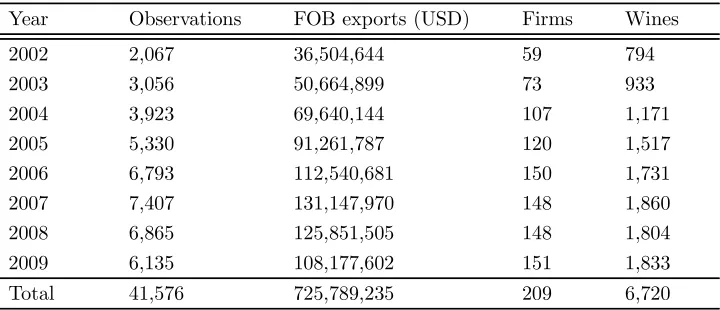
We close this section with descriptive statistics on the sample we use for the estimations. Table 2 summarizes our trade data by year and shows that the exports included in our sample increased threefold between 2002 and 2009. A total of 794 wines were exported by 59 di¤erent …rms in 2002, while in 2009 this increased to 151 …rms exporting 1,833 di¤erent wines. Over the whole period, our sample includes 6,720 wines exported by 209 di¤erent wine producers.31 As shown by Table 3, these
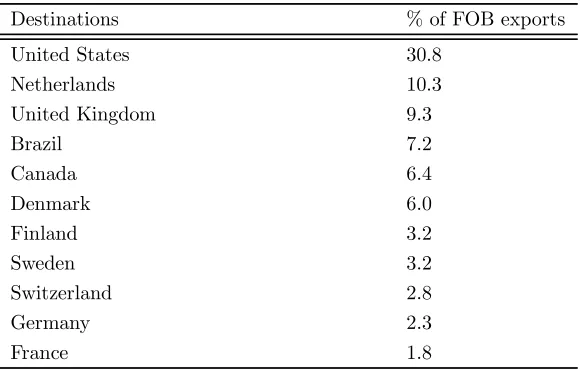
…rms exported an average of 139 di¤erent wines, ranging from a minimum of one to a maximum of 510 (in the sample, only 15 …rms appear as having exported one wine only; in reality, they exported more than one wine but only one could be matched with the quality rankings). Exporters charged between two cents and 381 US dollars per liter of wine exported, with an average of …ve US dollars per liter. Firms exported to an average number of 40 di¤erent destinations, from a minimum of one to a maximum of 88. Table 4 shows that with the exception of Brazil, Argentinean wine exporters mostly sell to developed economies, the United States being the top destination market.
3.2 Quality Ratings
The editors of the Wine Spectator magazine review more than 15,000 wines each year in blind tastings and publish their rankings in several issues throughout the year.32 The rankings are given on a (50,100)
scale according to the name of the wine, its grape, type, and vintage year which are characteristics we all observe in the customs data set. A larger score implies a higher quality. Table 5 lists the six di¤erent categories the wines fall in depending on the score they are given.
We match the wines from the customs data set with the ones reviewed by the Wine Spectator by name, type, grape, and vintage year so that each wine is assigned a single quality ranking.33 We end
up with 6,720 wines exported by 209 …rms over the 2002-2009 period. As can be seen from Table 3, the mean ranking is 85, the lowest-rated wine receives a score of 55, and the highest receives a score of 97. The distribution across wines is very symmetric as the mean and the median are both equal to 85. Note that our approach to measuring quality is similar to Crozet et al. (2012) who match French …rm-level exports data of Champagne with experts quality assessments in order to investigate the relationship between quality and trade. However, due to data limitations they are unable to distinguish between the di¤erent varieties sold by each …rm so each …rm is assumed to export one type of Champagne only. In addition, their ratings are only measured on a (1,5) scale, where a larger value indicates a higher quality.
We rely on the Wine Spectator for our baseline regressions because it has the largest coverage of Argentinean wines. However, in the robustness section we check the sensitivity of our results using an
29Also, in our data set each wine is produced and exported by one …rm only while a product de…ned at the HS level
can instead be produced and therefore exported by more than one …rm.
30The issue of sample coverage is addressed in the robustness section.
31We observe 882 di¤erent wine names, 23 grapes, three types, and 22 vintage years (between 1977 and 2009). 32See http://www.winespectator.com.
33The quality scores are time-invariant. Variations in quality due to ageing should therefore be captured by the vintage
alternative rating produced by Robert Parker.34 Parker is a leading US wine critic who assesses wines
based on blind tastings and publishes his consumer advice and rankings in a bimonthly publication, the Wine Advocate. His rating system also employs a (50,100) point scale where wines are ranked according to their name, type, grape, and vintage year, and where a larger value indicates a higher quality. Table 5 lists the di¤erent categories considered by Parker. Compared to the Wine Spectator, the scores are slightly more generous (for instance, a wine ranked 74 is “Not recommended” by the Wine Spectator, but is “Average” according to Parker).35 We match the customs data and the Parker
rankings for 3,969 wines exported by 181 …rms. Table 3 shows that the scores vary between 72 and 98 with an average of 87. Again, the distribution across wines is very symmetric as the mean and the median are equal. Figure 2 plots the Wine Spectator and Parker rankings. A total of 2,433 wines exported by 135 …rms have rankings from both sources. The correlation between the two rankings is 0.53.
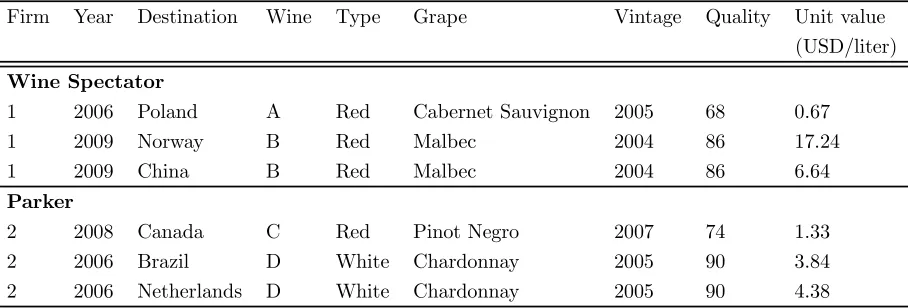
Table 6 provides a snapshot of our data. For con…dentiality reasons we cannot report the exporter nor the wine names so these are replaced by numbers and letters instead. The table shows that, whether we use the Wine Spectator or the Parker ratings, individual …rms export wines with varying levels of quality (between 68 and 86 for Firm 1 and 74 and 90 for Firm 2). In addition, higher quality wines are, on average, sold at a higher price. Finally, the table illustrates that the Law of One Price fails: in 2009, Firm 1 exported the same wine to two di¤erent destinations, but charged 17 US dollars per liter to Norway versus 6.6 dollars per liter to China. Similarly, in 2006 Firm 2 charged 4.4 dollars to the Netherlands versus 3.8 dollars to Brazil for the same liter of wine exported to both destinations.
3.3 Macroeconomic Data
The data on GDPs are from the Penn World Tables, and the consumer price indices (CPI) and nominal exchange rates from the International Financial Statistics (IFS) of the International Monetary Fund (IMF). The real exchange rate is de…ned as the ratio of consumer price indices times the average yearly nominal exchange rate so an increase of the exchange rate captures a real depreciation of the peso. The nominal exchange rates are available for each country relative to the US dollar, which we convert to be relative to the Argentinean peso. The real e¤ective exchange rates are sourced from the IFS and the Bank of International Settlements where an increase indicates a real depreciation.
During the 2002-2009 period, Argentina witnessed major nominal exchange rate ‡uctuations. Figure 3 illustrates the evolution of the monthly nominal exchange rate between the Argentinean peso and the US dollar. After the …nancial crisis of 2001, the …xed exchange rate system was abandoned and as a result the peso depreciated in 2002 by up to 75 percent. The export boom that followed lead to a massive in‡ow of US dollars into the economy which helped to depreciate the US dollar compared to the peso. The peso then remained stable until 2008 when it depreciated again with the advent of the global …nancial crisis and the increase in domestic in‡ation.
34See https://www.erobertparker.com.
4 Wine and Model Assumptions
The model described in section 2 intends to capture a general relation between quality and pass-through which could hold for any particular market. The reason why we analyze the wine market is because we have an observable measure for quality. Although the model is general, it is instructive to see how the features of the wine industry conform with its main assumptions. First, as already discussed and illustrated by Table 6, higher quality wines tend to be exported at a higher price which is consistent with equation (7) of the model.
Second, the model assumes that higher quality wines have higher marginal costs (equation 3). Although the quality of wine depends predominantly on the quality of the grapes which is itself mostly a¤ected by geography and weather-related factors, higher quality wines can be expected to have higher marginal costs (see Crozet et al., 2012, on Champagne). First, higher quality wines may require higher quality and therefore more expensive inputs (Johnson, 2012; Kugler and Verhoogen, 2012; Manova and Zhang, 2012a; Verhoogen, 2008). For instance, wine producers can choose more or less costly additives to be added during the winemaking process (in the various stages of fermentation or as preservatives). Second, achieving higher quality wines may depend on the production methods chosen by producers. One example is to use oak barrels for the ageing and fermentation of wine. Due to the cost of the oak and to the short lifetime of the barrels (the oak ‡avors of the barrels last for three or four vintages only), these barrels turn out to be very expensive and are therefore reserved to producing higher quality wines only.36 Another example is to use “drip irrigation” which
allows producers to limit the yield and therefore increase the potential quality of grapes, but this system is expensive to install. Finally, there is some evidence that in order to produce higher quality wines, Argentinean wineries often produce their own grapes for their best wines (which may need to be pruned and trimmed carefully, requiring more skilled labor), and rely on suppliers for their lower quality wines (Artopoulos, Friel, and Hallak, 2011).
More direct evidence on the positive relationship between price (quality) and marginal costs can be found in Table 7 which breaks down into several components the price of non-EU wines sold in UK retail outlets (Joseph, 2012).37 The last row of the table shows that the amount that goes to the
winemaker, which mainly re‡ects the costs of producing the wine as well as the costs of the bottle, closure, and carton, clearly increases with the price, and therefore most likely with the quality of the wine.38 We were unable to …nd a similar breakdown for Argentinean wines, but we believe that
these …gures for non-EU wines should still provide us with some useful insights on the composition of Argentinean wine prices sold in the UK.
Third, the model assumes that higher quality wines have higher distribution costs (distribution costs((© )) increase with quality((© ))). This is con…rmed by the fourth row of Table
36Ageing in oak barrels adds about £0.50 to the cost of a bottle sold in the UK
(www.thirty…fty.co.uk/spotlight-wine-pricing.asp).
37UK taxes include a duty of £1.90 per bottle and a VAT sales tax of 20 percent which may vary depending on alcohol
content. In the table, shipping costs are stable at around £0.13 per bottle but can increase with the heavier bottles and cartons used for more expensive wines. Non-EU wines are subject to a Common Customs Tari¤ which does not apply to wines from the EU.
7 that shows that distribution costs amount to £0.11 for a £5.76 bottle, and increase to £0.21 for a £7.19 bottle, £0.40 for a £8.83 bottle, and to £0.51 for a £10.09 bottle.
Finally, equation (7) predicts that higher quality wines have higher markups. The second row of Table 7 shows indeed that the margin charged by the retailer increases systematically with the price of the wine (and, therefore, with quality too).39 The margin is £1.92 for a £5.76 wine and increases
to £3.36 for a £10 wine. Unfortunately, the table does not provide any information on the winemaker markup which is the one that is modeled in the theory. However, anecdotal evidence suggests that the producer markup is also likely to increase with the price/quality of the wine: for a £5 wine sold on the UK market, the producer markup is estimated to be approximately £0.40 and to increase to about £10 for a £25 bottle.40
We therefore conclude that the features of the wine industry closely satisfy the key assumptions of the model: higher quality wines tend to be exported at a higher price, and are characterized by higher marginal costs, distribution costs, and markups, both at the retail and producer levels.
5 Empirical Framework
Prediction 1 states that following a real depreciation, exporters increase their export price and this increase is larger the higher quality is. In order to check whether this relationship holds in the data, we estimate the following reduced-form regression
ln = 1ln+2 +3ln£ +4++++
++++ (11)
where
is the export unit value of …rm exporting a product to destination country in
year , expressed in pesos per liter of wine exported and is our proxy for export prices. is the
average real exchange rate between Argentina and country in year (an increase in captures a
real depreciation). The quality of wine is denoted by
where the index refers to the Wine
Spectator rankings. Given the level of disaggregation of the data, changes in real exchange rates are assumed to be exogenous to the pricing (and quantity) decisions of individual …rms.
The export price in the exporter’s currency is a markup over marginal costs (Knetter, 1989, 1993). As a result, in order to identify a pricing-to-market behavior which requires markups to respond to exchange rate changes, the regression needs to control for …rm-speci…c marginal costs which we denote by .41 Without any additional information on the exporters, we rely on a number of proxies that
have been shown in the literature to correlate strongly with productivity/marginal costs. First is the average size of the …rm, , measured by the total volume of FOB exports by each …rm in each
year. Second is the total number of destination countries where each …rm exports to in each year,
39The reason is that the retail margin represents 40 percent of the pre-VAT tax price. For the wine priced at £5.76,
the retail margin is £1.92 which is 40 percent of the pre-VAT tax price equal to £5.76-£0.96=£4.88.
40See http://www.thirty…fty.co.uk/spotlight-wine-pricing.asp.
41The approach of distinguishing changes in marginal costs from changes in markups has …rst been proposed by
.42 Besides, we include year …xed e¤ects to control for aggregate shocks that are common
to all Argentinean exporters. We perform within estimations by including …rm-destination …xed
e¤ects. As product …xed e¤ects cannot be included (they are perfectly collinear with quality), we instead control for product characteristics by including grape, type , vintage year ,
HS , and province of origin …xed e¤ects. Fixed e¤ects for the wine names/brand are not
included as they are collinear with the …rm …xed e¤ects (because each brand is sold by one …rm only).
1 2 3, and4 are coe¢cients to be estimated and is an error term. Given that all variables
are in levels (rather than …rst di¤erences), the estimated coe¢cients can be thought of as capturing the long term response of unit values to changes in each of the explanatory variables. Finally, as quality takes on a single value for each product, robust standard errors are adjusted for clustering at the product level.
Following a real depreciation, exporters are expected to increase their markups and therefore their export prices so1 should be positive.43 Higher quality is expected to increase export prices so 2
should be positive, too. The coe¢cient of interest is 3, the coe¢cient on the interaction between the real exchange rate and quality which captures heterogeneous pricing-to-market. According to Prediction 1, the response of unit values to a real depreciation should increase with quality in which case3 should be positive.
Prediction 2 relates to export volumes. It states that following a real depreciation, exporters increase their volume of exports but by less for higher quality products. To test this prediction we estimate
ln = 1ln+2 +3ln£ +4+5++++
++++ (12)
where
is the FOB export volume (in liters) of …rmexporting a productto destination country in year .44 To be consistent with standard gravity models we include destination-year speci…c
variables such as destination country’s real GDP (de‡ated using each country’s CPI), ,
and real e¤ective exchange rate as a proxy for country’s price index (Berman et al., 2012). If a
real depreciation increases exports,1 should be positive. If this increase is smaller for higher quality
products, the coe¢cient on the interaction term3 should be negative.
5.1 Baseline Results
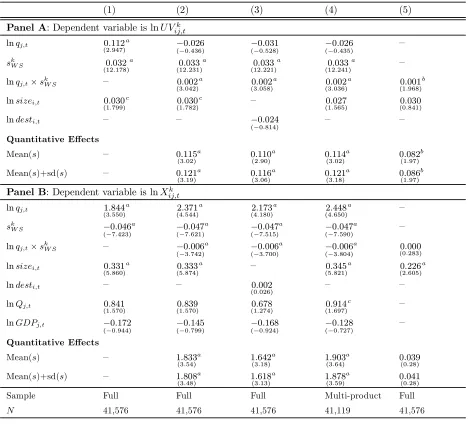
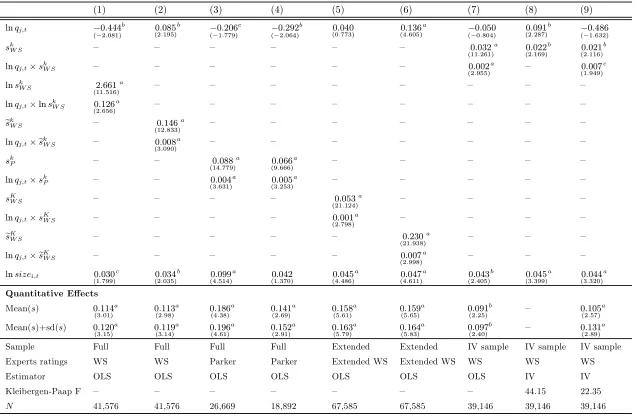
Panel A of Table 8 reports the results of estimating equation (11) for unit values. Column (1) only includes the exchange rate, quality, and …rm size as regressors and shows that higher quality wines are sold at a higher price, which is consistent with equation (7) and with the empirical …ndings of
42Alternatively, we could consider the total number of liters of wine exported by each …rm in each year as a proxy for
…rm size but we do not as this variable appears in the denominator of the unit values ratio.
43When the interaction term between the real exchange rate and quality is excluded from (11),
1 captures the extent to which exporters vary their markups following a change in the exchange rate, and therefore the degree of pricing-to-market. This assumes that changes in marginal costs for goods produced in a given location do not depend on the destination where the goods are shipped. The degree of exchange rate pass-through is given by(1¡1).
44We also tried to use as a dependent variable the value of exports de‡ated by the Argentinean CPI and the number
Crozet et al. (2012) for Champagne.45 When the real exchange rate ‡uctuates, exporters signi…cantly
change their export prices: following a ten percent depreciation they raise their prices (in pesos) by 1.1 percent so that on average pass-through is 89 percent. The large degree of pass-through we …nd for the wine industry is therefore consistent with the …ndings of other papers that use …rm-level data for the whole manufacturing sector. For instance, pass-through is estimated at 92 percent for French exporters (Berman et al., 2012), 94 percent for Chinese exporters (Li et al., 2012), 77 percent for Brazilian exporters (Chatterjee et al., 2013), 86 percent for Danish exporters (Fosse, 2012), and at 79 percent for Belgian exporters (Amiti et al., 2012).
The estimated coe¢cient on the exchange rate reported in column (1) however hides a signi…cant amount of heterogeneity in the degree of pass-through across products. To see this, column (2) adds the interaction term between the exchange rate and quality. Its estimated coe¢cient is positive and signi…cant which is evidence of heterogeneous pass-through, lending support to Prediction 1 in that the elasticity of export prices to a real depreciation increases with quality. These results are consistent with the theoretical predictions of Auer and Chaney (2009) and the empirical results of Auer et al. (2012).
In column (3) we use the number of export destinations for each …rm as an alternative proxy for …rm productivity. Its estimated coe¢cient is not signi…cant, but most importantly our main conclusions regarding heterogeneous pass-through remain una¤ected.46 Column (4) restricts the sample to
multi-product …rms, where a multi-multi-product …rm is de…ned as a …rm-destination-year triplet with strictly more than one wine exported, and the results also remain unchanged.
In column (5) we check if our results hold in a di¤erence-in-di¤erence speci…cation which includes destination-year and product …xed e¤ects instead of the ones speci…ed in equation (11). Both the exchange rate and quality drop from the regression, but the interaction term between the exchange rate and quality can be estimated. Although its estimated coe¢cient decreases in magnitude and in signi…cance, it still indicates that the elasticity of export prices to exchange rates is larger for higher quality wines.
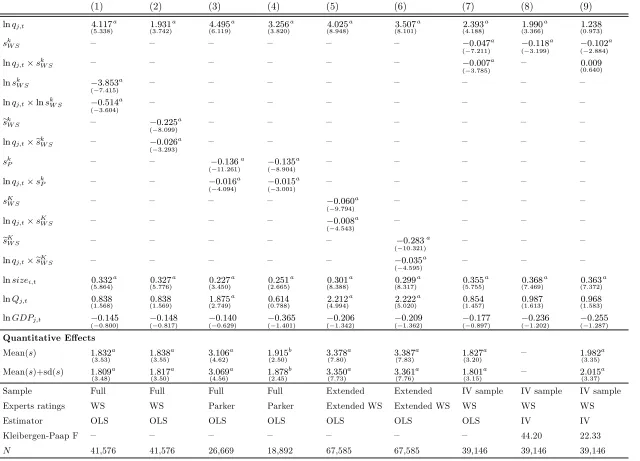
Panel B of Table 8 reports the results of estimating equation (12) for export volumes. From column (1) export volumes react positively to a real depreciation. The elasticity is large and equal to 1.844, which is consistent with evidence in the literature that the trade elasticities for emerging economies are generally larger than for developed countries.47 The coe¢cient on quality is negative and signi…cant
while the literature usually points to a positive relationship between trade and quality (for example, see Crozet et al., 2012). One crucial di¤erence between our regressions and, for instance, Crozet et al. (2012), however, is that we estimate thewithin-…rm e¤ect of quality on export volumes. The negative coe¢cient on quality therefore indicates that when a …rm exports several wines with di¤erent levels of quality to a given destination, the high quality wines are on average exported in smaller quantities than the low quality wines. This is consistent with San Martín, Troncoso, and Brümmer (2008) who observe that more sophisticated, high quality wines are generally produced in smaller quantities.
45In (7), higher quality goods have a higher price because they have both a higher markup and higher marginal costs. 46Instead, Manova and Zhang (2012a) …nd that Chinese exporters supplying more countries charge higher prices. 47Very few studies estimate the sensitivity of exports to real exchange rate changes for Argentina. Using quarterly
The interaction between the exchange rate and quality is included in column (2). Consistent with Prediction 2, it is negative and signi…cant suggesting that the response of export volumes to exchange rates decreases with quality. This …nding remains robust to the use of the number of export destinations as a measure of …rm performance (column 3) and to restricting the sample to multi-product …rms (column 4). The di¤erence-in-di¤erence speci…cation in column (5) does not provide evidence of an heterogeneous response of export volumes to exchange rates driven by quality.48
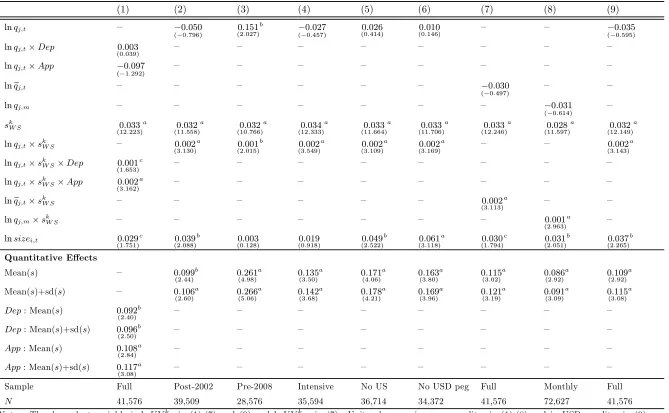
For each regression in Table 8 we report a quantitative evaluation of the economic e¤ects of quality. The lower parts of Panels A and B report the change in the exchange rate elasticities following a one standard deviation increase in quality from its mean level (i.e., a four point increase on the quality scale). In column (2) of Panel A, the unit values elasticity increases from 0.115 to 0.121 which corresponds to a …ve percent increase in pricing-to-market. If we calculate the elasticity (not reported) for the lowest quality wine in the sample (with a ranking of 55), the elasticity is equal to 0.065 and is insigni…cantly di¤erent from zero, suggesting full pass-through. In contrast, for the highest quality wine (with a score of 97) the elasticity is positive and equal to 0.135 (signi…cant at the one percent level) so pass-through drops to 86.5 percent. In column (2) of Panel B, a one standard deviation increase in quality reduces the volume elasticity by one and a half percent from 1.833 to 1.808. The elasticity for the highest quality wine is equal to 1.75 and increases to 2.02 for the lowest quality wine. Overall, the e¤ects of quality on the price and volume elasticities remain very similar across all speci…cations reported in Table 8.
Recall that a key prediction of the model of Corsetti and Dedola (2005), and of our extension to their model, is that pricing-to-market increases with local distribution costs in the importing economy. In turn this implies that the di¤erence in pass-through between high and low quality wines should increase with distribution costs. Berman et al. (2012) use the data on distribution costs computed by Campa and Goldberg (2010) for 21 countries and 29 industries between 1995 and 2001, and …nd that the response of unit values to a real depreciation increases with local costs, especially for high productivity …rms.
In order to explore this prediction of the model we also rely on Campa and Goldberg’s (2010) distribution costs data. Given these are only available between 1995 and 2001 we compute the average distribution costs over time for each of the 21 destination countries and for the “Food products and beverages” industry. Our measure for distribution costs, , is therefore destination-speci…c, and
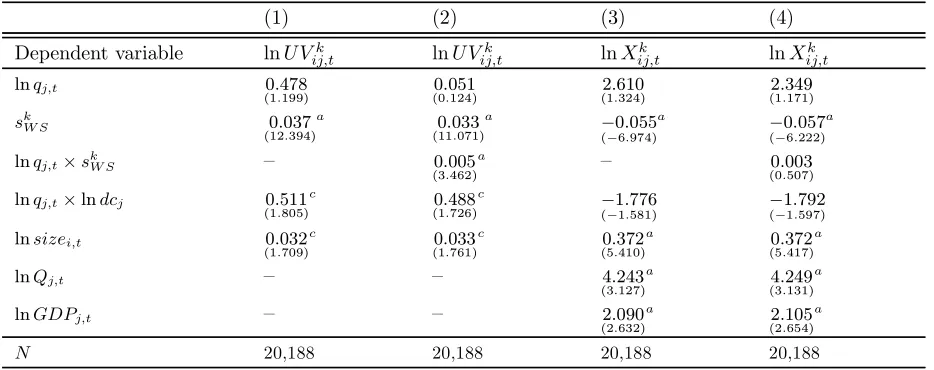
given the limited number of countries for which the data are available the resulting sample size is reduced by half. We estimate regressions (11) and (12) and include an interaction term between the real exchange rate and (log) distribution costs. The results are reported in Table 9. For unit values, column (1) shows that the interaction between the real exchange rate and distribution costs is positive and signi…cant at the ten percent level, suggesting that pricing-to-market increases with local costs which is consistent with the …ndings of Berman et al. (2012) and Campa and Goldberg (2010). Column (2) further includes the interaction between the real exchange rate and quality which
48We also estimated the regressions for unit values and export volumes allowing for non-linearities in the e¤ects of
is positive and signi…cant. Consistent with expectations, this indicates that the di¤erence in pass-through between high and low quality wines increases with the size of local costs. The results for export volumes are reported in columns (3) and (4) of Table 9. The interaction between the exchange rate and local costs is negative, as expected, but is only signi…cant at the 11 percent level.
5.2 Heterogeneity across Destination Countries
Predictions 3 and 4 state that the e¤ects described by Predictions 1 and 2 for unit values and export volumes, respectively, should be stronger for high income than for low income destination countries. This section investigates whether the two predictions can be validated by the data.
The destination countries included in our data set are split between high and low income according to the World Bank’s classi…cation based on GNI per capita in 2011. Low income countries have a GNI per capita of less than $4,035 while high income countries are above that threshold. We then estimate equations (11) and (12) for unit values and export volumes, and interact the real exchange rate, as well as the real exchange rate interacted with quality, with a dummy for high() and a dummy for low() income destination countries.49
The results for unit values are reported in Panel A of Table 10. According to column (1), higher quality is again associated with higher prices, and the coe¢cients on the real exchange rate, both for low and high income countries, are of similar magnitude. However, only the coe¢cient for high income countries is signi…cantly di¤erent from zero so while pass-through is estimated as being complete for low income destinations, it decreases to approximately 90 percent for exports to high income countries. This indicates that price discrimination exists across destination countries and that the Law of One Price fails. This …nding is also consistent with predictions from the literature that pricing-to-market should be stronger for higher income countries. For instance, Devereux, Engel, and Storgaard (2004) predict that a more stable monetary policy in high income destination countries reduces exchange rate pass-through by increasing the probability of invoicing in the currency of the destination country.
Column (2) further interacts the exchange rate with quality and interestingly, the coe¢cient on the interaction term is positive and signi…cant for high income destinations only. As a result, for low income countries, the response of unit values to exchange rate changes does not vary with quality. In contrast, for high income countries, the response of unit values to exchange rate changes increases with quality. A one standard deviation increase in quality increases the exchange rate elasticity from 0.112 to 0.120, i.e., a seven percent increase in pricing-to-market. These …ndings lend support to Prediction 3.
The …nding that pass-through varies with quality for high income destination countries only is robust to the use of the number of destinations as a control for …rm productivity (column 3), to restricting the sample to multi-product …rms (column 4), and to the inclusion of destination-year and product …xed e¤ects (column 5).
Panel B of Table 10 focuses on export volumes. Overall, the results …nd strong support for Prediction 4. Column (1) shows that a real depreciation raises export volumes to both low and high
income destination countries. Consistent with the …ndings in Panel A, column (2) shows that the interaction between the real exchange rate and quality is signi…cantly di¤erent from zero for high income countries only, and its negative sign further indicates that the response of export volumes to a change in the real exchange rate is smaller for higher quality wines. These …ndings remain robust in the other columns of the table, except when destination-year and product …xed e¤ects are included in column (5).50
5.3 Aggregation Bias
As explained above, the degree of exchange rate pass-through that we …nd for the wine industry is consistent with the ones reported in other …rm-level studies, but is larger than many estimates obtained using aggregate or industry-level data.51 Therefore, in this section we investigate whether
pass-through estimates su¤er from an aggregation bias.
To address this issue, we aggregate the data at di¤erent levels, re-estimate our benchmark speci-…cations, and compare the magnitude of exchange rate pass-through estimated at each level of data aggregation. The …rst natural step would be to aggregate the data at the HS level, which classi…es wines into …ve di¤erent categories. However, when doing so it turns out that the majority of …rms actually export in a single HS code. We therefore instead aggregate the data at the …rm-level (so …rms become single-product) in which case the unit values capture the average price charged by each …rm to each destination in each year, and quality is the average quality of all wines exported by each …rm to each destination in each year, denoted by . In a second step, we further aggregate the data
across …rms in which case the unit values represent the average price of wine exported by all …rms in the sample to each destination in each year, and quality is the average quality of all wine exports to each destination in each year and is denoted by .
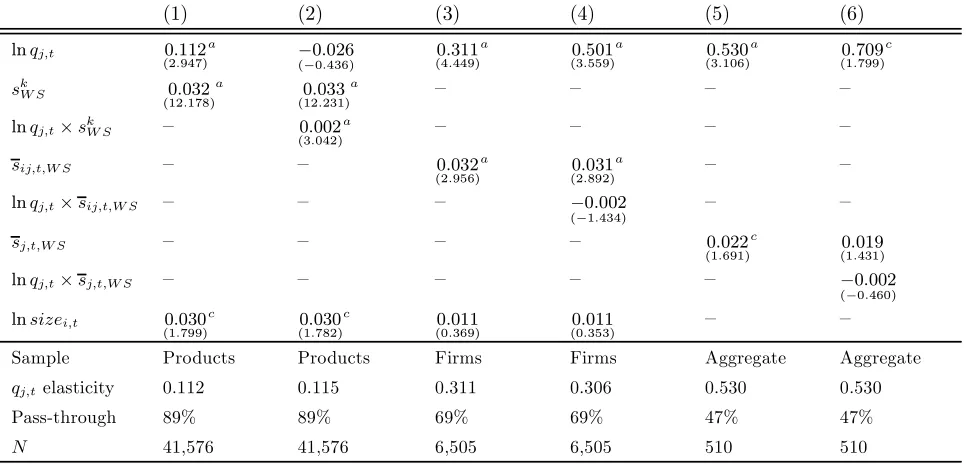
Columns (1) and (2) of Table 11 replicate the benchmark speci…cations for unit values reported in columns (1) and (2) of Table 8. Whether or not we interact the real exchange rate with quality, average pass-through is estimated at 89 percent. Columns (3) and (4) of Table 11 report our two benchmark speci…cations estimated on the …rm-level sample.52 As before, higher quality is associated
with higher prices. The interaction between the exchange rate and quality in column (4) is however insigni…cantly di¤erent from zero, most likely because the averaging of quality across products at the …rm level reduces the variation of quality in the sample substantially. Interestingly, in both columns average pass-through is now estimated at 69 percent, which is 20 percentage points lower than the 89 percent reported in columns (1) and (2). Columns (5) and (6) focus on the aggregate sample.53
Higher quality still leads to higher unit values although its signi…cance is much reduced. In column (6)
50As the local distribution costs data from Campa and Goldberg (2010) are only available for high income countries,
we are unable to explore the di¤erential impact of these costs on the pass-through of high versus low income countries.
51There are exceptions, however. For instance, Gopinath and Rigobon (2008) use detailed transactions level data on
US exports and imports and …nd that exchange rate pass-through into US import prices is low at 22 percent.
52The speci…cation includes year, destination, and …rm …xed e¤ects only. We do not include …rm-destination …xed
e¤ects because a large proportion of the …rms included in the sample export to a single destination only. Standard errors are adjusted for clustering at the …rm level.
53As in Knetter (1989, 1993), the speci…cation only includes time …xed e¤ects to control for marginal costs movements