Improved Features and Grammar Selection for Syntax-Based MT
Greg Hanneman and Jonathan Clark and Alon Lavie Language Technologies Institute
Carnegie Mellon University Pittsburgh, PA 15213 USA
{ghannema, jhclark, alavie}@cs.cmu.edu
Abstract
We present the Carnegie Mellon Univer-sity Stat-XFER group submission to the WMT 2010 shared translation task. Up-dates to our syntax-based SMT system mainly fell in the areas of new feature for-mulations in the translation model and im-proved filtering of SCFG rules. Compared to our WMT 2009 submission, we report a gain of 1.73 BLEU by using the new features and decoding environment, and a gain of up to 0.52 BLEU from improved grammar selection.
1 Introduction
From its earlier focus on linguistically rich ma-chine translation for resource-poor languages, the statistical transfer MT group at Carnegie Mellon University has expanded in recent years to the in-creasingly successful domain of syntax-based sta-tistical MT in large-data scenarios. Our submis-sion to the 2010 Workshop on Machine Transla-tion is a syntax-based SMT system with a syn-chonous context-free grammar (SCFG), where the SCFG rules are derived from full constituency parse trees on both the source and target sides of parallel training sentences. We participated in the French-to-English shared translation task.
This year, we focused our efforts on making more and better use of syntactic grammar. Much of the work went into formulating a more expan-sive feature set in the translation model and a new method of assigning scores to phrase pairs and grammar rules. Following a change of decoder that allowed us to experiment with systems using much larger syntactic grammars than previously, we also adapted a technique to more intelligently
pre-filter grammar rules to those most likely to be useful.
2 System Overview
We built our system on a partial selection of the provided French–English training data, us-ing the Europarl, News Commentary, and UN sets, but ignoring the Giga-FrEn data. After tokenization and some pruning of our training data, this left us with a corpus of approximately 8.6 million sentence pairs. We word-aligned the corpus with MGIZA++ (Gao and Vogel, 2008), a multi-threaded implementation of the standard word alignment tool GIZA++ (Och and Ney, 2003). Word alignments were symmetrized with the “grow-diag-final-and” heuristic. We automati-cally parsed the French side of the corpus with the Berkeley parser (Petrov and Klein, 2007), while we used the fast vanilla PCFG model of the Stan-ford parser (Klein and Manning, 2003) for the English side. These steps resulted in a parallel parsed corpus from which to extract phrase pairs and grammar rules.
Phrase extraction involves three distinct steps. In the first, we perform standard (non-syntactic) phrase extraction according to the heuristics of phrase-based SMT (Koehn et al., 2003). In the second, we obtain syntactic phrase pairs using the tree-to-tree matching method of Lavie et al. (2008). Briefly, this method aligns nodes in par-allel parse trees by projecting up from the word alignments. A source-tree node swill be aligned to a target-tree nodetif the word alignments in the yield ofsall land within the yield oft, and vice versa. This node alignment is similar in spirit to the subtree alignment method of Zhechev and Way (2008), except our method is based on the spe-cific Viterbi word alignment links found for each
sentence rather than on the general word trans-lation probabilities computed for the corpus as a whole. This enables us to use efficient dynamic programming to infer node alignments, rather than resorting to a greedy search or the enumeration of all possible alignments. Finally, in the third step, we use the node alignments from syntactic phrase pair extraction to extract grammar rules. Each aligned node in a tree pair specifies a decompo-sition point for breaking the parallel trees into a series of SCFG rules. Like Galley et al. (2006), we allow “composed” (non-minimal) rules when they build entirely on lexical items. However, to control the size of the grammar, we do not produce composed rules that build on other non-terminals, nor do we produce multiple possible rules when we encounter unaligned words. Another differ-ence is that we discard internal structure of com-posed lexical rules so that we produce SCFG rules rather than synchronous tree substitution grammar rules.
The extracted phrase pairs and grammar rules are collected together and scored according to a variety of features (Section 3). Instead of decod-ing with the very large complete set of extracted grammar rules, we select only a small number of rules meeting certain criteria (Section 4).
In contrast to previous years, when we used the Stat-XFER decoder, this year we switched to the the Joshua decoder (Li et al., 2009) to take advan-tage of its more efficient architecture and imple-mentation of modern decoding techniques, such as cube pruning and multi-threading. We also man-aged system-building workflows with LoonyBin (Clark and Lavie, 2010), a toolkit for managing multi-step experiments across different servers or computing clusters. Section 5 details our experi-mental results.
3 Translation Model Construction
One major improvement in our system this year is the feature scores we applied to our grammar and phrase pairs. Inspired largely by the Syntax-Augmented MT system (Zollmann and Venu-gopal, 2006), our translation model contains 22 features in addition to the language model. In con-trast to earlier formulations of our features (Han-neman and Lavie, 2009), our maximum-likelihood features are now based on a strict separation be-tween counts drawn from non-syntactic phrase ex-traction heuristics and our syntactic rule extractor;
no feature is estimated from counts in both spaces. We define an aggregate rule instance as a 5-tuple r = (L, S, T, Cphr, Csyn) that contains a
left-hand-side label L, a sequence of terminals and non-terminals for the source (S) and target (T) right-hand sides, and aggregated counts from phrase-based SMT extraction heuristics Cphr and
the syntactic rule extractorCsyn.
In preparation for feature scoring, we:
1. Run phrase instance extraction using stan-dard phrase-based SMT heuristics to obtain tuples (PHR, S, T, Cphr,∅) where S and T
never contain non-terminals
2. Run syntactic rule instance extraction as de-scribed in Section 2 above to obtain tuples
(L, S, T,∅, Csyn)
3. Share non-syntactic counts such that, for any two tuples r1 = (PHR, S, T, Cphr,∅)
and r2 = (L2, S, T,∅, Csyn) with
equiv-alent S and T values, we produce r2 = (L2, S, T, Cphr, Csyn)
Note that there is no longer any need to retain PHR rules(PHR, S, T) that have syntactic equiv-alents(L 6=PHR, S, T) since they have the same features In addition, we assume there will be no tuples whereSandT contain non-terminals while Cphr = 0and Csyn > 0. That is, the syntactic
phrases are a subset of non-syntactic phrases.
3.1 Maximum-Likelihood Features
Our most traditional features are Pphr(T|S) and
Pphr(S|T), estimated using only counts Cphr.
These features apply only to rules not con-taining any non-terminals. They are equiva-lent to the phrase P(T|S) and P(S|T) fea-tures from the Moses decoder, even when L 6=
PHR. In contrast, we usedPsyn∪phr(L, S|T)and
Psyn∪phr(L, T|S) last year, which applied to all
rules. The new features are no longer subject to increased sparsity as the number of non-terminals in the grammar increases.
We also have grammar rule probabili-ties Psyn(T|S), Psyn(S|T), Psyn(L|S),
Psyn(L|T), and Psyn(L|S, T) estimated using
Csyn; these apply only to rules where S and T
by the much larger counts from the phrase-based SMT heuristics.
Finally, we estimate “not labelable” (NL) fea-turesPsyn(NL|S)andPsyn(NL|T). WithR
de-noting the set of all extracted rules,
Psyn(NL|S) =
Csyn
P
r′∈Rs.t.S′=SCsyn′
(1)
Psyn(NL|T) =
Csyn
P
r′∈Rs.t.T′=T C
′
syn
(2)
We use additive smoothing (withn= 1for our ex-periments) to avoid a probability of 0 when there is no syntactic label for an(S, T)pair. These fea-tures can encourage syntactic rules when syntax is likely given a particular string since probability mass is often distributed among several different syntactic labels.
3.2 Instance Features
We add several features that use sufficient statis-tics local to each rule. First, we add three binary low-count features that take on the value 1 when the frequency of the rule is exactly 1, 2, or 3. There are also two indicator features related to syntax: one each that fires when L = PHR and when L 6= PHR. Other indicator features analyze the abstractness of grammar rules: AS = 1when the
source side contains only non-terminals, AT = 1
when the target side contains only non-terminals, TGTINSERTION = 1 when AS = 1, AT = 0,
SRCDELETION = 1whenAS = 0, AT = 1, and
INTERLEAVED = 1whenAS = 0, AT = 0.
Bidirectional lexical probabilities for each rule are calculated from a unigram lexicon MLE-estimated over aligned word pairs in the training corpus, as is the default in Moses.
Finally, we include a glue rule indicator feature that fires whenever a glue rule is applied during decoding. In the Joshua decoder, these monotonic rules stitch syntactic parse fragments together at no model cost.
4 Grammar Selection
With extracted grammars typically reaching tens of millions of unique rules — not to mention phrase pairs — our systems clearly face an en-gineering challenge when attempting to include the full grammar at decoding time. Iglesias et al. (2009) classified SCFG rules according to the pat-tern of terminals and non-terminals on the rules’ right-hand sides, and found that certain patterns
could be entirely left out of the grammar without loss of MT quality. In particular, large classes of monotonic rules could be removed without a loss in automatic metric scores, while small classes of reordering rules contributed much more to the suc-cess of the system. Inspired by that approach, we passed our full set of extracted grammar rule in-stances through a filter after scoring. Using the rule notation from Section 3, the filter retained only those rules that matched one of the follow-ing patterns:
S =X1w, T =w X1
S =w X1, T =X1w
S =X1X2, T =X2X1
S =X1X2, T =X1X2
whereX represents any non-terminal and w rep-resents any span of one or more terminals. The choice of the specific reordering patterns above captures our intuition that binary swaps are a fun-damental ordering divergence between languages, while the inclusion of the abstract monotonic pat-tern (X1X2, X1X2) ensures that the decoder is not disproportionately biased towards applying re-ordering rules without supporting lexical evidence merely because in-order rules are left out.
Orthogonally to the pattern-based pruning, we also selected grammars by sorting grammar rules in decreasing order of frequency count and using the top n in the decoder. We experimented with n = 0, 100, 1000, and 10,000. In all cases of grammar selection, we disallowed rules that in-serted unaligned target-side terminals unless the inserted terminals were among the top 100 most frequent unigrams in the target-side vocabulary.
5 Results and Analysis
5.1 Comparison with WMT 2009 Results
System Configuration METEOR BLEU
[image:4.595.313.521.64.201.2]1. WMT ’09 submission 0.5263 0.2073 2. Joshua decoder 0.5231 0.2158 3. New TM features 0.5348 0.2246
Table 1: Dev test results (on news-dev2009b) from our WMT 2009 system when updating decoding environment and feature formulations.
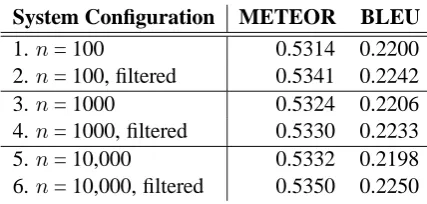
System Configuration METEOR BLEU
1.n= 100 0.5314 0.2200
2.n= 100, filtered 0.5341 0.2242
3.n= 1000 0.5324 0.2206
4.n= 1000, filtered 0.5330 0.2233
5.n= 10,000 0.5332 0.2198
6.n= 10,000, filtered 0.5350 0.2250
Table 2: Dev test results (on news-dev2009b) from our WMT 2009 system with and without pattern-based grammar selection.
BLEU 1.04 (Papineni et al., 2002) and METEOR 0.6 (Lavie and Agarwal, 2007).
Table 1 shows the effect of our new scoring and decoding environment. Line 2 uses the same ex-tracted phrase pairs and grammar rules as line 1, but the system is tuned and tested with the Joshua decoder instead of Stat-XFER. For line 3, we re-scored the extracted phrase pairs from lines 1 and 2 using the updated features discussed in Sec-tion 3.1 The difference in automatic metric scores shows a significant benefit from both the new de-coder and the updated feature formulations: 0.8 BLEU points from the change in decoder, and 0.9 BLEU points from the expanded set of 22 transla-tion model features.
Our next test was to examine the usefulness of the pattern-based grammar selection described in Section 4. For various numbers of rules n, Ta-ble 2 shows the scores obtained with and without filtering the grammar before the n most frequent rules are skimmed off for use. We observe a small but consistent gain in scores from the grammar se-lection process, up to half a BLEU point in the largest-grammar systems (lines 5 and 6).
1
In line 2, we did not control for difference in formulation of the translation length feature: Stat-XFER uses a length ratio, while Joshua uses a target word count. Line 3 does not include 26 manually selected grammar rules present in lines 1 and 2; this is because our new feature scoring requires information from the grammar rules that was not present in our 2009 extracted resources.
Source Target
un rˆole AP1 ADJP1 roles l’ instabilit´e AP1 ADJP1 instability
l’ argent PP1 NP1money une pression AP1 ADJP1 pressure la gouvernance AP1 ADJP1 governance
la concurrence AP1 ADJP1 competition des preuves AP1 ADJP1 evidence les outils AP1 ADJP1 tools
des changements AP1 ADJP1 changes
Table 3: Rules fitting the pattern(S=w X1, T =
X1w)that applied on the news-test2010 test set.
5.2 WMT 2010 Results and Analysis
We built the WMT 2010 version of our system from the training data described in Section 2. (The system falls under the strictly constrained track: we used neither the Giga-FrEn data for training nor the LDC Gigaword corpora for language mod-eling.) We used the provided news-test2008 set for system tuning, while news-test2009 served as our 2010 dev test set. Based on the results in Table 2, our official submission to this year’s shared task was constructed as in line 6, with 10,000 syntactic grammar rules chosen after a pattern-based grammar selection step. On the news-test2010 test set, this system scored 0.2327 on case-insensitive IBM-style BLEU 1.04, 0.5614 on METEOR 0.6, and 0.5519 on METEOR 1.0 (Lavie and Denkowski, 2009).
[image:4.595.73.287.182.284.2]presum-ably quite small, we believe that the key to effec-tive syntactic grammars in our MT approach lies in retaining precise rules of this type for common linguistically motivated reordering patterns.
The above pattern of rule applications is also observed in our dev test set, news-test2009, where 16 distinct rules apply a total of 352 times. Seven of the fully abstract rules and three of the lexical-ized rules that applied on news-test2009 also ap-plied on news-test2010, while a further two ab-stract and four lexicalized rules applied on news-test2009 alone. We thus have a general trend of a set of general rules applying with higher frequency across test sets, while the set of lexicalized rules used varies according to the particular set.
Since, overall, we still do not see as much gram-mar application in our systems as we would like, we plan to concentrate future work on further im-proving this aspect. This includes a more detailed study of grammar filtering or refinement to select the most useful rules. We would also like to ex-plore the effect of the features of Section 3 individ-ually, on different language pairs, and using differ-ent grammar types.
Acknowledgments
This research was supported in part by NSF grant IIS-0534217 (LETRAS) and the DARPA GALE program. We thank Yahoo! for the use of the M45 research computing cluster, where we ran many steps of our experimental pipeline.
References
Jonathan Clark and Alon Lavie. 2010. LoonyBin: Keeping language technologists sane through automated management of experimental (hy-per)workflows. In Proceedings of the Seventh
International Language Resources and Evaluation (LREC ’10), Valletta, Malta, May.
Michel Galley, Jonathan Graehl, Kevin Knight, Daniel Marcu, Steve DeNeefe, Wei Wang, and Ignacio Thayer. 2006. Scalable inference and training of context-rich syntactic translation models. In
Pro-ceedings of the 21st International Conference on Computational Linguistics and 44th Annual Meet-ing of the ACL, pages 961–968, Sydney, Australia,
July.
Qin Gao and Stephan Vogel. 2008. Parallel implemen-tations of word alignment tool. In Software
Engi-neering, Testing, and Quality Assurance for Natural Language Processing, pages 49–57, Columbus, OH,
June.
Greg Hanneman and Alon Lavie. 2009. Decoding with syntactic and non-syntactic phrases in a syntax-based machine translation system. In Proceedings of
the Third Workshop on Syntax and Structure in Sta-tistical Translations, pages 1–9, Boulder, CO, June.
Greg Hanneman, Vamshi Ambati, Jonathan H. Clark, Alok Parlikar, and Alon Lavie. 2009. An improved statistical transfer systems for French–English ma-chine translation. In Proceedings of the Fourth
Workshop on Statistical Machine Translation, pages
140–144, Athens, Greece, March.
Gonzalo Iglesias, Adri`a de Gispert, Eduardo R. Banga, and William Byrne. 2009. Rule filtering by pattern for efficient hierarchical translation. In Proceedings
of the 12th Conference of the European Chapter of the ACL, pages 380–388, Athens, Greece, March–
April.
Dan Klein and Christopher D. Manning. 2003. Fast exact inference with a factored model for natural language parsing. In Advances in Neural
Informa-tion Processing Systems 15, pages 3–10. MIT Press,
Cambridge, MA.
Philipp Koehn, Franz Josef Och, and Daniel Marcu. 2003. Statistical phrase-based translation. In
Pro-ceedings of HLT-NAACL 2003, pages 48–54,
Ed-monton, Alberta, May–June.
Alon Lavie and Abhaya Agarwal. 2007. METEOR: An automatic metric for MT evaluation with high levels of correlation with human judgments. In
Pro-ceedings of the Second Workshop on Statistical Ma-chine Translation, pages 228–231, Prague, Czech
Republic, June.
Alon Lavie and Michael J. Denkowski. 2009. The ME-TEOR metric for automatic evaluation of machine translation. Machine Translation, 23(2–3):105–115.
Alon Lavie, Alok Parlikar, and Vamshi Ambati. 2008. Syntax-driven learning of sub-sentential translation equivalents and translation rules from parsed parallel corpora. In Proceedings of the Second ACL
Work-shop on Syntax and Structure in Statistical Transla-tion, pages 87–95, Columbus, OH, June.
Zhifei Li, Chris Callison-Burch, Chris Dyer, Juri Ganitkevitch, Sanjeev Khudanpur, Lane Schwartz, Wren N.G. Thornton, Jonathan Weese, and Omar F. Zaidan. 2009. Joshua: An open source toolkit for parsing-based machine translation. In
Proceed-ings of the Fourth Workshop on Statistical Ma-chine Translation, pages 135–139, Athens, Greece,
March.
Franz Josef Och and Hermann Ney. 2003. A sys-tematic comparison of various statistical alignment models. Computational Linguistics, 29(1):19–51.
the 40th Annual Meeting of the Association for Com-putational Linguistics, pages 311–318, Philadelphia,
PA, July.
Slav Petrov and Dan Klein. 2007. Improved inference for unlexicalized parsing. In Proceedings of NAACL
HLT 2007, pages 404–411, Rochester, NY, April.
Ventsislav Zhechev and Andy Way. 2008. Automatic generation of parallel treebanks. In Proceedings
of the 22nd International Conference on Compu-tational Linguistics, pages 1105–1112, Manchester,
England, August.
Andreas Zollmann and Ashish Venugopal. 2006. Syn-tax augmented machine translation via chart parsing. In Proceedings of the Workshop on Statistical
Ma-chine Translation, pages 138–141, New York, NY,