Original citation:
Sanborn, Adam N.. (2014) Testing Bayesian and heuristic predictions of mass
judgments of colliding objects. Frontiers in Psychology, Volume 5 . Article number 938.
ISSN 1664-1078
Permanent WRAP url:
http://wrap.warwick.ac.uk/63258
Copyright and reuse:
The Warwick Research Archive Portal (WRAP) makes this work of researchers of the
University of Warwick available open access under the following conditions.
This article is made available under the Creative Commons Attribution 3.0 (CC BY 3.0)
license and may be reused according to the conditions of the license. For more details
see:
http://creativecommons.org/licenses/by/3.0/
A note on versions:
The version presented in WRAP is the published version, or, version of record, and may
be cited as it appears here.
Testing Bayesian and heuristic predictions of mass
judgments of colliding objects
Adam N. Sanborn *
Department of Psychology, University of Warwick, Coventry, UK
Edited by:
Snehlata Jaswal, Indian Institute of Technology, Jodhpur, India
Reviewed by:
Eric-Jan Wagenmakers, University of Amsterdam, Netherlands Shenghua Luan, Max Planck Institute for Human Development, Germany
*Correspondence:
Adam N. Sanborn, Department of Psychology, University of Warwick, Gibbet Hill Rd., Coventry CV4 7AL, UK
e-mail: [email protected]
Mass judgments of colliding objects have been used to explore people’s understanding of the physical world because they are ecologically relevant, yet people display biases that are most easily explained by a small set of heuristics. Recent work has challenged the heuristic explanation, by producing the same biases from a model that copes with perceptual uncertainty by using Bayesian inference with a prior based on the correct combination rules from Newtonian mechanics (noisy Newton). Here I test the predictions of the leading heuristic model (Gilden and Proffitt, 1989) against the noisy Newton model using a novel manipulation of the standard mass judgment task: making one of the objects invisible post-collision. The noisy Newton model uses the remaining information to predict above-chance performance, while the leading heuristic model predicts chance performance when one or the other final velocity is occluded. An experiment using two different types of occlusion showed better-than-chance performance and response patterns that followed the predictions of the noisy Newton model. The results demonstrate that people can make sensible physical judgments even when information critical for the judgment is missing, and that a Bayesian model can serve as a guide in these situations. Possible algorithmic-level accounts of this task that more closely correspond to the noisy Newton model are explored.
Keywords: intuitive physics, Bayesian models, heuristics
INTRODUCTION
The correspondence between people’s intuitive physical judg-ments and Newtonian mechanics has long provided a fascinating window into how people understand the physical world. Despite people’s demonstrated competence in dealing with a complex physical environment, there are mismatches between intuitive physics and Newtonian mechanics (Michotte, 1963; McCloskey et al., 1980; Todd and Warren, 1982). These mismatches have led to the conclusion that people use heuristics to guide behavior, rather than using the decision rules derived from an accurate con-ception of physics (Todd and Warren, 1982; Gilden and Proffitt, 1989).
An interesting case is mass judgments of colliding objects. In the usual mass judgment experiment, two objects start moving, make contact, and then move apart. The task of the participant is to judge which object was heavier, a task that is ecologically rele-vant and therefore one that participants should be able to perform (Gibson, 1966; Runeson, 1983). Despite this, participants show strong biases away from the predictions of Newtonian mechan-ics, most importantly themotor object bias, a bias to believe that the object initially moving faster is heavier (Todd and Warren, 1982; Gilden and Proffitt, 1989; Runeson et al., 2000). This bias has been explained by simple heuristics that incorrectly com-bine the available information. The leading heuristic model for this task was introduced by Gilden and Proffitt (1989)and is referred to here as G&P. This model combines two heuristics:
looking for the object moving faster after contact and looking for the object that ricochets, both imperfect cues that an object is lighter.
However, the interpretation of the motor object bias has been challenged recently by a framework that combines Bayesian infer-ence with prior beliefs based on the correct combination rules from Newtonian mechanics (noisy Newton;Sanborn et al., 2013). This approach also predicts a motor object bias, but does so as a result of plausible prior beliefs about velocities. Because the key behavioral evidence can be produced by two approaches with fundamentally different views of how the mass judgment task is done, this resurrects the original question: How well does people’s behavior correspond to the rules of the physical world?
Sanborn Testing Bayesian predictions
will be limited to using the heuristics that have already been hypothesized.
I chose to adjust the mass judgment task by making one of the objects invisible after they make contact, because as I show below, the two models make very different parameter-free predictions when one or the other final velocity is occluded. The final speed heuristic relies on a comparison of the two final velocities to one another, and the loss of final velocity information can mean the G&P model predicts chance per-formance. In contrast, the noisy Newton model combines the remaining information appropriately to produce above-chance performance, but predicts that the pattern of results will strongly depend on which final velocity is occluded. Below, I describe the task and the normative rule from Newtonian mechanics and the predictions the G&P model and noisy Newton model make. An experiment is presented that tests these predictions using different ways of removing final velocity information and it confirms the predictions of the noisy Newton model over the G&P model. These results show that people display good performance: they conform to task demands when informa-tion is missing and perform better than the G&P model pre-dicts. The implication of the results is that algorithmic-level approaches need to more closely approximate the noisy Newton model in order to successfully predict human behavior, and algorithmic-level approaches that can successfully do so are discussed.
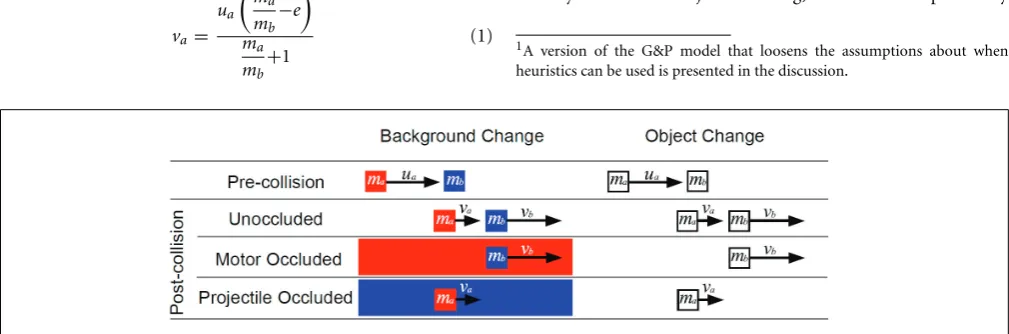
NEWTONIAN MECHANICS FOR COLLIDING OBJECTS Inspired by Michotte (1963), researchers have run a host of experiments investigating judgments of colliding objects. In its most common form, as shown inFigure 1, one of the objects, the motor object,a, begins moving with an initial velocityua.
The motor object comes into contact with an initially station-ary object, the projectile object,b. After contact, the motor and projectile objects move apart with final velocitiesvaandvb
respec-tively. Newtonian mechanics, assuming point masses and no external forces, gives the final velocities
va=
ua
ma
mb−e
ma
mb+
1
(1)
vb=
ua
ma
mb(
1+e)
ma
mb +
1
where ma andmb are the masses of the motor and projectile
objects respectively and e is the coefficient of restitution. The coefficient of restitution reflects the kinetic energy retained rel-ative to the joint center of mass, ranging from e=1, similar to colliding billiard balls, toe=0, similar to colliding balls of wet clay.
The object with the greater mass can be determined from con-servation of momentum using the initial and final velocities, and for all collisions in the experiment below
ma>mbif and only ifva+vb>ua. (2)
The comparison of the sums of initial and final velocities provides a normative answer to the question of which object is heavier. However, the normative rule does not predict a motor object bias and it does not naturally give an answer if one of the final velocities is missing.
HEURISTIC MODEL PREDICTIONS
The G&P model uses a combination of two heuristics to explain the motor object bias: the object that moves faster after colli-sion is lighter and the object that ricochets is lighter (Gilden and Proffitt, 1989). The final speed heuristic produces a strong bias to pick the motor object and the ricochet heuristic allows the bias to be overcome when the projectile object is much heavier than the motor object. Further details are given in the Appendix in Supplementary material.
The G&P model relies on the availability of the velocities, mainly the final velocities, to produce an answer. In previous work, if not enough information was available to determine the ricochet heuristic, then that heuristic was not used (Gilden and Proffitt, 1994). As a result, I assumed that if either final velocity is missing, then the final-speed heuristic cannot be used1. If the final velocity of the motor object is missing, then there is no possibility
1A version of the G&P model that loosens the assumptions about when
[image:3.595.45.550.506.673.2]heuristics can be used is presented in the discussion.
FIGURE 1 | Schematic of the trials shown in the experiment.The pre-collision event occurred in every trial with only the mass ratio andua varying. Velocities to the right are defined as positive and to the left as negative.
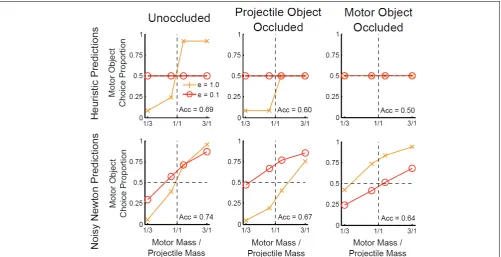
of observing a ricochet either, and as no heuristics apply chance performance is predicted for all mass ratios and values ofe(see
Figure 2).
NOISY NEWTON MODEL PREDICTIONS
The noisy Newton model treats object masses as hidden vari-ables that are inferred from noisy observations of the velocities. Combining the observed velocities with prior beliefs, Bayesian inference is used to calculate the probability thatma>mb. The
parameters used inSanborn et al. (2013)that define the plau-sible prior distributions and psychophysically motivated noise were carried over to this work; details are given in the Appendix in Supplementary material. As in that paper noisy perception was approximated by noisy decision making—instead of feed-ing noisy values into the model and makfeed-ing a deterministic response, the noiseless values were fed into the model and the probability of the outcome was taken as the probability of response.
The motor-object bias is produced by plausible prior distri-butions on the velocities interacting with Newtonian mechan-ics. The prior distribution on ua was set so that slower
objects were considered more likely than faster objects, as moti-vated by velocity judgment experiments (Weiss et al., 2002; Stocker and Simoncelli, 2006). As the prior distribution on ua is both narrower than the prior distribution on va+vb
and centered around zero, this results in a bias to believe ua is less than va+vb. As can be seen in Equation 2, this
bias in beliefs about the velocities is equivalent to a bias in
believing the motor-object is heavier than the projectile object (Sanborn et al., 2013).
Figure 2shows the predictions of the noisy Newton model for the occlusion conditions. Unlike the strong version of the G&P model, this model flexibly uses the available information to make inferences about the mass ratio, which allows the noisy Newton model to predict above chance performance if either final velocity is missing.
In addition, Figure 2 shows the how the predictions of the noisy Newton model depends on which final velocity is miss-ing. First, depending on which final velocity is missing, there will be a reversal in whethere=1 ore=0.1 result in more choices of the motor object. This prediction follows from Newtonian mechanics: a larger va or vb means a higher probability the
motor object is heavier. Equation 1 shows that increasing e increases vb, but decreases va. Thus, when the motor object
is occluded a highere results in a vb which is more likely to
exceedua, and so by Equation 2 the motor object is predicted
to be chosen more with e=1. Conversely, in the projectile object occluded condition a highere results in ava that is less
likely to exceed ua, and thus the prediction that the motor
object is chosen more with e=0.1. I ran a parameter search across all positive values of the noisy Newton parameters for parameters that reversed the order of the effects, but none were found.
[image:4.595.49.551.401.658.2]Second, in addition to the reversal in order, the noisy Newton model predicts that which object is occluded will determine whether the e=1 condition produces a motor object or a
FIGURE 2 | Predictions of the heuristic and noisy Newton models for different types of occlusion conditions in Experiment 1.The horizontal axis is the mass ratio of the motor object to the projectile object. The vertical axis is the proportion of trials on which participants decided the motor object
Sanborn Testing Bayesian predictions
projectile object bias. A motor object bias is predicted if the motor object is occluded, but a projectile object bias is predicted if the projectile object is occluded. This prediction is parameter dependent2.
EXPERIMENT
To test the predictions of the G&P and the noisy Newton model, the motor or the projectile object needs to be occluded after contact. This occlusion was performed as shown in Figure 1: either the occluder suddenly appeared at contact (background change) or one of the objects suddenly disappeared at contact (object change). Both types of occlusion were run in a between-participants design in order to make sure that the results did not depend on the details of the display.
METHODS Participants
Forty-two participants were recruited from the University of Warwick community for this study. Each participant received £5 for one-half hour of participation. Participants viewed one of two types of occlusion: twenty participants viewed object change occlusions and twenty-two participants viewed back-ground change occlusions.
Stimuli
Squares in the object change condition were white or gray and squares in the background change condition were red or blue. In both conditions squares were 1 cm in length. Movies started with the projectile object in the center. The motor object moved toward the projectile object until the edges of the two squares touched, then the objects immediately separated.
On each trial either the motor object, the projectile object, or neither object was occluded. In the object change condition, an occluded object was set to the black background color at contact, rendering it invisible. In the background change condition, the red and blue objects traveled along a white field until contact, at which time the field could change color to match one of the objects, rendering that object invisible.
The mass ratio of the heavier to lighter object was set to be either 1.25 or 3.0. On each trial, the heavier object was set to be the right or left object with equal probability. The initial velocity of the motor object (always the left square) was drawn on each trial from a uniform distribution that ranged from 1.91 to 4.45 cm/s in steps of 0.13 cm/s, while the initial velocity of the projectile object was always zero. The coefficients of restitution used were 1.0 and 0.1 and this parameter was a hidden variable: like the masses it was only discernable through the presented velocities. The final velocities of the two objects were calculated from Equation 1.
Procedure
Participants were instructed that the squares were blocks slid-ing along an invisible smooth surface, to keep their eyes on the left hand object, and to press a key corresponding to whichever
2The projectile object bias does not occur if there is a much smaller
stan-dard deviation of the Gaussian prior on velocity or a much larger stanstan-dard deviation of the noise.
block they thought was heavier. A trial would end automatically after one second, but participants could end the trial at any point by responding. No feedback was given to participants during the experiment.
A total of 192 trials were presented to each participant. There were twelve possible combinations of mass ratio, coefficient of restitution, and occlusion. One example of each combination was shown at the beginning of the experiment to familiarize partici-pants with the displays. No feedback was given and these practice trials were discarded. The test trials consisted of 15 replications of each combination of mass ratio, coefficient of restitution, and occlusion with order of presentation randomized for each participant.
RESULTS
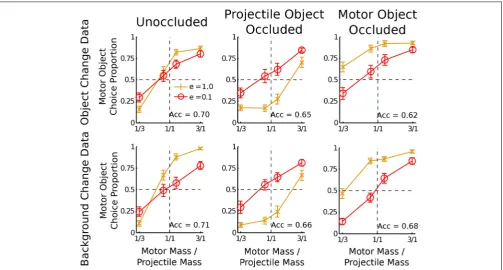
Results are shown inFigure 3. Accuracy was examined witht-tests and Bayesiant-tests (Rouder et al., 2009; measured by the Bayes Factor (BF) likelihood ratio of the alternative model over the null model assuming widthr=1). For both the object change and background change occlusions, participants were significantly more accurate than chance when the motor object was occluded (Ms=0.62 and 0.68 respectively;ts=5.7 and 12.1 respectively; bothps<0.001; both BFs>103), supporting the noisy Newton
model over the heuristic model. Participants were also signifi-cantly more accurate than chance when the projectile object was occluded (Ms =0.65 and 0.66 respectively; ts= 7.6 and 12.5 respectively; bothps<.001; both BFs>103).
The dependence of response bias on the final velocity occluded was examined by subtracting the proportion of motor object responses when e=0.1 from the proportion of motor object choices whene=1. For the projectile object occluded condition, both the object change and background change data showed more choices of the motor object fore=0.1 thane=1 (Ms= −0.25 and−0.29 respectively;ts= −8.82 and−8.15 respectively; both ps<0.001; both BFs>105). For the motor object occluded
con-dition the opposite result was found: both the object change and background change data showed more choices of the motor object fore=1 than e=0.1 (Ms= 0.21 and 0.27 respectively;ts= 6.65 and 11.2 respectively; bothps< 0.001; both BFs>104). This reversal confirmed the first specific prediction of the noisy Newton model.
A motor object bias was found in the motor object occluded
condition: when ma mb =
4
5 and e=1, participants chose the motor object more than chance for both the object change and background change data (Ms = 0.86 and 0.84 respec-tively; ts=8.81 and 9.90 respectively; both ps < 0.001; both BFs>105). A projectile object bias was found in the projectile object occluded condition: when ma
mb =
5
4 and e=1, partici-pants chose the motor object less than chance for both the object change and background change data (Ms=0.24 and 0.27 respec-tively;ts= −3.88 and−4.03 respectively; bothps<0.001; both BFs>39). These biases confirmed the second specific prediction of the noisy Newton model.
FIGURE 3 | Data from the object change and background change participants for different types of occlusion conditions.The horizontal axis is the mass ratio of the motor object to the projectile object. The vertical axis is the proportion of trials on which participants decided the motor object
was heavier. Each plot shows lines for two separate coefficients of restitution:e=1 ande=0.1. A bias is shown if the data lines do not cross the horizontal dotted line at the vertical dotted line. Acc refers to the accuracy in mass judgment.
lower values ofe(Todd and Warren, 1982; Sanborn et al., 2013), an effect which was missing or perhaps reversed here. This was predicted by neither model and is a topic for future research.
The quantitative match of the model predictions to the data was assessed by finding the probability of the data in Experiment 1 with the parameters used to fit the data in Sanborn et al. (2013). For the object change data, the noisy Newton model predicted more accurately (negative log likelihood (NLL) of 937 where lower is better) than the G&P model (NLL=1186). The noisy Newton model (NLL=869) also predicted the background change data better than the G&P model (NLL=1208).
DISCUSSION
The noisy Newton and G&P models are fundamentally differ-ent explanations of how people combine information to make mass judgments, but both have been able to explain the main features of existing data. To test them I introduced the novel manipulation of occluding one of the final velocities, a manipula-tion for which these models make strongly divergent predicmanipula-tions. The noisy Newton model predicted the experiment’s results better than the G&P model.
There are many other algorithmic-level possibilities for how people make mass judgments, some that are closer to the G&P model and some that are closer to the noisy Newton model. One possibility is that a slight change to the G&P model would allow it to predict mass judgments with occluded final velocities. For example, instead of occlusion rendering heuristics inoperable, it
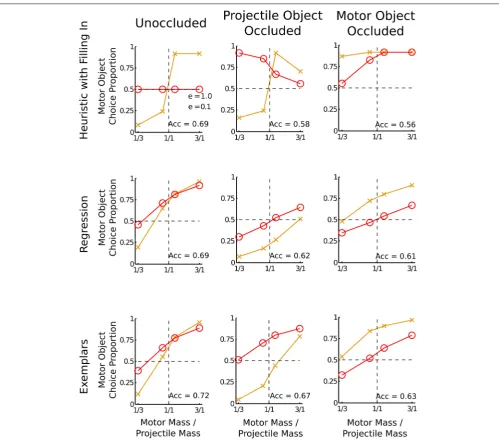
is possible that participants fill in missing final velocity informa-tion with a plausible estimate. Assuming that the filled-in missing value is the mean of that particular velocity when it is visible, the fit of the heuristic model to the data in the experiment is shown inFigure 4. Filling in allows the model to predict slightly above chance performance in the motor-object occluded condition, but the predictions for the projectile-object occluded condition still miss qualitative aspects of the data especially whene=0.1.
A second possibility, one that abandons the G&P model’s col-lection of heuristics, is that people use a pure logistic regression based on the observable velocities. Logistic regression using a linear combination of the observed velocities must be an approx-imation because the correct combination rule is nonlinear. This model does very well, predicting all of the main qualitative effects of the data, using an intercept of−1.0, a weight of−0.10 forua,
a weight of 0.85 forva, and a weight of 0.78 forvb. The signs of
the coefficients are in the same direction as in Equation 2, but the magnitudes of the coefficients allow a better fit to the data. In par-ticular the motor-object bias arises from a smaller absolute weight foruathan the absolute weights forvaorvb. Of course while the
fit to the data is good, as shown inFigure 4, it is very much a descriptive model because there is no easy explanation for why people would have learned these particular coefficients—training with veridical feedback should result in equal coefficients for each of the velocities.
Sanborn Testing Bayesian predictions
FIGURE 4 | Three alternative models for the occlusion conditions.
The horizontal axis is the mass ratio of the motor object to the projectile object. The vertical axis is the proportion of trials on which participants decided the motor object was heavier. Each plot shows lines for two
separate coefficients of restitution:e=1 ande=0.1. A bias is shown if the data lines do not cross the horizontal dotted line at the vertical dotted line. Acc refers to the predicted accuracy in mass judgment. Each alternative model is described in the text.
model using an approximation from computer science and statistics. For the mass judgment task, an approximation called importance sampling is appropriate. With importance sampling, memories of previous collisions are used as a stand-in for an explicit model of Newtonian mechanics, similar to the way that an exemplar model would (Cohen, 2006; Shi et al., 2010; Sanborn et al., 2013)3. For the mass judgment task, the impor-tance sampling approximation works by first comparing the current collision to each remembered to collision to determine the probability that they are the same. Then the judgment is based
3Other proposals are that people have internal physical simulators available
for making these judgments (e.g.,Hamrick et al., 2011; Smith and Vul, 2013).
over 500 simulated participants matches both the noisy Newton predictions as well as the human data, as shown inFigure 4.
The fits of these three intermediate possibilities illustrate how much the data tell us about the correspondence between people’s judgments and physical law: it is strong enough to eliminate the G&P model and very close cousins, but not strong enough to distinguish between algorithmic-level models, such as the logis-tic regression model or the importance sampling approximation, that have a closer correspondence to the noisy Newton model.
More generally, this work stands as a response to a partic-ular critique about Bayesian models of cognition, namely that Bayesian models provide just-so stories, do not predict new behavior, and are rarely directly compared to extant heuristic models (Sakamoto et al., 2008; Jones and Love, 2011; Bowers and Davis, 2012a,b). Bowers and Davis (2012b) in particular described the need for Bayesian models that make novel predic-tions that existing non-Bayesian models miss. This work points toward one type of design, namely those with complex inter-actions between variables and missing information, for which Bayesian models may well predict interesting new behavior better than existing heuristics.
AUTHOR NOTE
The author thanks Tom Griffiths for helpful discussions and Xenia Millar, James Tripp, and Takao Noguchi for collecting pilot data. Adam N. Sanborn was supported by a grant (num-ber ES/K004948/1) from the UK Economic and Social Research Council.
SUPPLEMENTARY MATERIAL
The Supplementary Material for this article can be found online at: http://www.frontiersin.org/journal/10.3389/fpsyg.2014. 00938/abstract
REFERENCES
Bowers, J. S., and Davis, C. J. (2012a). Bayesian just-so stories in psychology and neuroscience.Psychol. Bull.138, 389–414. doi: 10.1037/a0026450
Bowers, J. S., and Davis, C. J. (2012b). Is that what Bayesians believe? Reply to Griffiths, Chater, Norris, and Pouget (2012).Psychol. Bull.138, 423–426. doi: 10.1037/a0027750
Cohen, A. L. (2006). Contributions of invariants, heuristics, and exemplars to the visual perception of relative mass.J. Exp. Psychol. Hum. Percept. Perform.32, 574–598. doi: 10.1037/0096-1523.32.3.574
Gibson, J. J. (1966).The Senses Considered as Perceptual Systems.Boston, MA: Houghton Mifflin.
Gilden, D. L., and Proffitt, D. R. (1989). Understanding collision dynamics.J. Exp. Psychol. Hum. Percept. Perform.15, 372–383. doi: 10.3758/BF03208364 Gilden, D. L., and Proffitt, D. R. (1994). Heuristic judgment of mass ratio in
two-body collisions.Percept. Psychophys.56, 708–720.
Hamrick, J., Battaglia, P., and Tenenbaum, J. B. (2011). “Internal physics mod-els guide probabilistic judgments about object dynamics,” inProceedings of the 33rd Annual Conference of the Cognitive Science Society,(Austin, TX: Cognitive Science Society), 1545–1550.
Hick, W. E. (1950). The threshold for sudden changes in the velocity of a seen object.Q. J. Exp. Psychol.2, 33–41. doi: 10.1080/17470215008416572
Jones, M., and Love, B. C. (2011). Bayesian Fundamentalism or Enlightenment? On the explanatory status and theoretical contributions of Bayesian mod-els of cognition. Behav. Brain Sci. 34, 169–188. doi: 10.1017/S0140525X 10003134
Kaiser, M. K., Jonides, J., and Alexander, J. (1986). Intuitive reasoning about abstract and familiar physics problems. Mem. Cogn. 14, 308–312. doi: 10.3758/BF03202508
Kaiser, M. K., Proffitt, D. R., and Anderson, K. (1985). Judgments of natural and anomalous trajectories in the presence and absence of motion.J. Exp. Psychol. Learn. Mem. Cogn.11, 795–803. doi: 10.1037/0278-7393.11.1-4.795
Marr, D. (1982).Vision. San Francisco, CA: W. H. Freeman.
McCloskey, M., Caramazza, A., and Green, B. (1980). Curvilinear motion in the absence of external forces: naive beliefs about the motion of objects.Science210, 1139–1141. doi: 10.1126/science.210.4474.1139
Michotte, A. (1963).The Perception of Causality.New York, NY: Basic Books. Notterman, J., and Page, D. (1957). Weber’s law and the difference threshold
for the velocity of a seen object.Science126, 652. doi: 10.1126/science.126. 3275.652
Rouder, J. N., Speckman, P. L., Sun, D., Morey, R. D., and Iverson, G. (2009). Bayesian t tests for accepting and rejecting the null hypothesis.Psychon. Bull. Rev.16, 225–237. doi: 10.3758/PBR.16.2.225
Runeson, S. (1983).On Visual Perception of Dynamic Events. Acta Universitatis Upsaliensis: Studia Psychologica Upsaliensia(Serial No. 9). Stockholm: Almqvist & Wicksell. (Original work published 1977).
Runeson, S., Juslin, P., and Olsson, H. (2000). Visual perception of dynamic prop-erties: cue heuristics versus direct-perceptual competence.Psychol. Rev.107, 525–555. doi: 10.1037//0033-295X.107.3.525
Sakamoto, Y., Jones, M., and Love, B. C. (2008). Putting the psychology back into psychological models: mechanistic versus rational approaches.Mem. Cogn.36, 1057–1065. doi: 10.3758/MC.36.6.1057
Sanborn, A. N., Mansinghka, V. K., and Griffiths, T. L. (2013). Reconciling intu-itive physics and Newtonian mechanics for colliding objects.Psychol. Rev.120, 411–437. doi: 10.1037/a0031912
Shi, L., Griffiths, T. L., Feldman, N. H., and Sanborn, A. N. (2010). Exemplar mod-els as a mechanism for performing Bayesian inference.Psychon. Bull. Rev.17, 443–464. doi: 10.3758/PBR.17.4.443
Smith, K. A., and Vul, E. (2013). Sources of uncertainty in intuitive physics.Top. Cogn. Sci.5, 185–199. doi: 10.1111/tops.12009
Stocker, A. A., and Simoncelli, E. P. (2006). Noise characteristics and prior expec-tations in human visual speed perception.Nat. Neurosci. 9, 578–585. doi: 10.1038/nn1669
Todd, J. T., and Warren, W. H. (1982). Visual perception of relative mass in dynamic events.Perception11, 325–335.
Weiss, Y., Simoncelli, E. P., and Adelson, E. H. (2002). Motion illusions as optimal percepts.Nat. Neurosci.5, 598–604. doi: 10.1038/nn858
Conflict of Interest Statement:The author declares that the research was con-ducted in the absence of any commercial or financial relationships that could be construed as a potential conflict of interest.
Received: 29 April 2014; paper pending published: 23 July 2014; accepted: 06 August 2014; published online: 26 August 2014.
Citation: Sanborn AN (2014) Testing Bayesian and heuristic predictions of mass judgments of colliding objects. Front. Psychol.5:938. doi: 10.3389/fpsyg.2014.00938 This article was submitted to Cognitive Science, a section of the journal Frontiers in Psychology.