
Original citation:
Alzahrani, K. A. H. and Deeth, Robert J.. (2016) Density functional calculations reveal a
flexible version of the copper paddlewheel unit : implications for metal organic frameworks.
Dalton Transactions, 45. pp. 11944-11948.
Permanent WRAP URL:
http://wrap.warwick.ac.uk/80760
Copyright and reuse:
The Warwick Research Archive Portal (WRAP) makes this work of researchers of the
University of Warwick available open access under the following conditions. Copyright ©
and all moral rights to the version of the paper presented here belong to the individual
author(s) and/or other copyright owners. To the extent reasonable and practicable the
material made available in WRAP has been checked for eligibility before being made
available.
Copies of full items can be used for personal research or study, educational, or not-for-profit
purposes without prior permission or charge. Provided that the authors, title and full
bibliographic details are credited, a hyperlink and/or URL is given for the original metadata
page and the content is not changed in any way.
Publisher statement:
First published by Royal Society of Chemistry 2016
http://dx.doi.org/10.1039/C6DT01474G
A note on versions:
The version presented here may differ from the published version or, version of record, if
you wish to cite this item you are advised to consult the publisher’s version. Please see the
‘permanent WRAP URL’ above for details on accessing the published version and note that
access may require a subscription.
Dalton Transactions
COMMUNICATION
Received 00th January 20xx, Accepted 00th January 20xx
DOI: 10.1039/x0xx00000x
www.rsc.org/
Density Functional Calculations Reveal a Flexible Version of the
Copper Paddlewheel Unit: Implications for Metal Organic
Frameworks
K. A. H. Alzahrania and R. J. Deetha†
Density functional theory calculations on [Cu2(O2CR)4L2] systems
reveal a change in ground state with increasing Cu-L bond strength. For L = N-heterocyclic carbene (NHC), the Jahn-Teller axis switches from parallel to orthogonal to the Cu-Cu vector and the copper coordination geometry becomes highly flexible. While the calculated dimer/monomer equilibrium for isolated complexes slightly favours monomers, the preformed paddlewheel units embedded in many metal organic frameworks are potential targets for developing novel materials.
Metal Organic Frameworks (MOFs) are porous materials with many potential applications in gas storage, separations and catalysis.1 They consist of nodes, either transition metal centres or small clusters, connected by organic linkers, often polytopic carboxylates. The resulting frameworks are often sufficiently rigid to allow molecules adsorbed in the pores to be removed or replaced without the framework collapsing.
Flexible MOFs are an interesting development.2 The pore size and/or shape responds to the adsorbed species, a property which suggests applications in selectivity and separations. An early example of such flexible MOFs was [Zn(bdc)2(dabco)]n (bdc = 1,4-benzenedicarboxylate; dabco = 1,4-diazabicyclo(2.2.2) octane) which contains layers of four-bladed paddle-wheel {Zn2(O2CR)4} units connected by dabco pillars.3 The unit cell of this material is sensitive to adsorbed species (Figure 1).
Figure 1 Unit cell of [Zn(bdc)2(dabco)]n. Left: as-synthesised material with four
dimethylformamides and a water molecule; centre: after evacuation; right: after uptake of four benzene molecules. (Adsorbed species and H atoms omitted for clarity.)
[image:2.595.353.505.454.562.2]The paddle-wheel motif (Figure 2) is common in flexible MOFs with many zinc and copper examples. Zn(II)-based systems are considered to be more flexible than comparable Cu(II) paddlewheel (CPW) MOFs and this has been attributed to their respective electronic structures.4 The d10 Zn(II) centres have no particular electronic preference so a pentacoordinated Zn(II) would be expected to adopt a trigonal bipyramidal (TBP) structure. This occurs when the axial group is a water ligand5 but N donors favour a square pyramidal (SQP) structure.6 However, the TBP and SQP coordination geometries have similar energies (c.f. the Berry pseudorotation) and the transition from TBP to SQP or vice versa is relatively easy. Hence, the zinc paddlewheel (ZPW) unit is relatively flexible.
Figure 2 Schematic representation of four-bladed paddlewheel complex.
In contrast, d9 Cu(II) CPW centres show a preference for planar CuO4 coordination with the unpaired electron being in the dx2-y2 orbitals on each metal. We will call this state T0 since geometry optimisations are carried out on the ferromagnetic spin triplet surface. We note that while the true ground states are the anti-ferromagnetically coupled singlet states (vide infra), the structures of CPWs are not sensitive to this coupling (see ESI). For T0, the ‘hole’ in the otherwise filled d shell on each metal is localised in the equatorial plane leading to a ‘stereochemical activity’ which shortens the Cu-O distances and concomitantly lengthens the bond to the axial ligand.7 This is the same mechanism by which the Jahn-Teller elongation of six-coordinate Cu(II) complexes may be rationalised.8
[image:2.595.95.239.600.656.2]COMMUNICATION Journal Name
These observations also lead to a dilemma. Since pentacoordinate species are inherently flexible and Cu(II) centres are strongly Jahn-Teller active, CPW units should be
more flexible than their zinc counterparts. In mononuclear CuL6 complexes, the first-order Mexican hat potential energy surface shows that all the structures in the circular minimum have the
same energy despite the large bond length fluctuations associated with the change from a tetragonal elongation along one Cartesian axis through a series of rhombic distortions to a tetragonally compressed structure along a different axis.9 Evidently, the copper centres in the CPW moiety behave differently to a typical CuL6 system. The first indication of this was the anomalously low magnetic moment for the archetypal CPW [Cu2(acetate)4(OH2)2].10 The structure of copper acetate dihydrate was unknown but when its dinuclear nature was revealed,11 the magnetic behaviour could be correlated with anti-ferromagnetic coupling between the two unpaired dx2-y2 electrons. All subsequent studies on copper acetate and related CPW systems have concentrated on characterising the details of this coupling. There does not appear to have been any previous attempt to locate other local minima.
[image:3.595.319.533.93.204.2]Our first step was to search for a ‘compressed’ CPW form. Using the spin triplet surface of [Cu2(formate)4(OH2)2] as a model, all our DFT optimisations12 collapsed back to the elongated form. However, for [Cu2(formate)4(NH3)2] a second stable configuration was located (Figure 3). Interestingly, this does not correspond to a fully compressed structure which would have dz2 as the singly occupied d orbital on each copper. Instead, the spin density distribution corresponds to a mixed dx2-y2/dz2 configuration (state TM, Figure 3, left).
Figure 3 Centre: selected calculated geometrical data for [Cu2(formate)4(NH3)2]. Normal
text for elongated dx2-y2/dx2-y2 state (T0) structure; italics for mixed dx2-y2/dz2 state (TM)
structure. Spin density plots to left and right.
Qualitatively, the presence of this new state is easy to understand. Following Hay, Thibeault and Hoffmann’s analysis,13 the ‘normal’ (i.e. elongated) CPW electronic structure arises from joining two isolated square pyramidal copper species where the apical direction lies parallel to the Cu-Cu vector. This leads to dx2-y2 lying above dz2 as shown on the left of Figure 4. Focusing on the valence, mainly-d orbitals, we generate symmetric (S) and antisymmetric (A) combinations in the dimer. Since the ‘equatorial’ dx2-y2 orbitals are oriented for metal-metal -bonding which is, at best, very weak, the splitting of the symmetric (SEq) and antisymmetric (AEq) molecular orbitals is relatively small, the triplet and anti-ferromagnetic singlet states are close in energy and, at least from a structural perspective, the two ends of the CPW behave like isolated
pentacoordinate SQP copper complexes with comparatively short Cu-Oeq bond lengths and a relatively long Cu-Lax bond.
Figure 4 Schematic partial valence molecular orbital (MO) energy level diagram for copper paddlewheel systems as a function of increasing the axial ligand field. For the MOs, S refers to a symmetric (in-phase) combination of d orbitals, A to an asymmetric combination, Ax = dz2 and Eq = dx2-y2.
With a stronger axial field generated by shortening the Cu-NH3 and lengthening the Cu-O bonds, dz2 becomes the highest energy d orbital for the isolated pentacoordinate system (Figure 4, right). In the dimer, these orbitals are oriented for metal-metal -bonding and the splitting between the S and A combinations is no longer small. The more one tries to force a stronger axial ligand field, the more stabilised the symmetric dz2 MO (SAx) becomes while the antisymmetric dz2 MO (AAx) is increasingly destabilised. The system becomes trapped in an intermediate ‘mixed’ state in which one unpaired electron occupies the AAx dz2 MO and the other the higher of the two dx2-y2 combinations which turns out to be SEq.
This new mixed dx2-y2/dz2 state, TM, is interesting in that the unpaired electron on each copper centre is shared between the dx2-y2 and dz2 orbitals. In the localised picture, we have a resonance mixing of two configurations, one with an unpaired electron in the dz2 orbital on CuA and the other unpaired electron in the dx2-y2 orbital on CuB, and vice versa.
For [Cu2(formate)4(NH3)2], the mixed state is a local minimum but some 5-6 kcal mol-1 higher than the elongated state. However, it provides the clue that using stronger axial donors may eventually favour the mixed state.
In order to maintain strict control over the electronic states, we carried out a series of symmetry-restricted optimisations.14 These structures are only local minima with respect to the applied point group so the calculated values of E(TM-T0) serve only as an approximate guide.
BP86/DZP B3LYPD/TZVP
Complex Point Group E(TM-T0) E(TM-T0)
CuPH.2H2O D2h 16.42 CuPCH3.2H2O D2 18.38 CuPCH3.2NH3 C2h 6.73
CuPCH3.2py D2 7.07 CuPCH3.2CN D2 4.46 CuPCH3.2NHC C2v 0.03
CuPCF3.2NHC C2v -6.17 -2.42
Table 1 Energy differences (kcal mol-1) between T
M and T0 states for symmetry restrained
optimised CPW systems. The B3LYP/TZVP energy difference employed the BP86/DZP-optimised structures.
[image:3.595.62.268.434.539.2]equatorial carboxylate. The former corresponds to increasing the covalency (and hence strength) of the axial ligand field while the latter corresponds to a progressive weakening of the equatorial field. The calculations suggest that the combination of a strong carboxylic acid (hence weak conjugate base) and a highly covalent axial group such as an N heterocyclic carbene (NHC) may be sufficient to make the TM (i.e. mixed) state the lowest energy spin triplet.
[image:4.595.307.551.152.258.2]To explore this possibility, we relaxed all symmetry constraints and carried out full optimisations and frequency calculations for N-methyl NHC complexes. The structures changed significantly compared to the symmetry-constrained cases and the TM state becomes the lowest triplet state already for the acetato species.
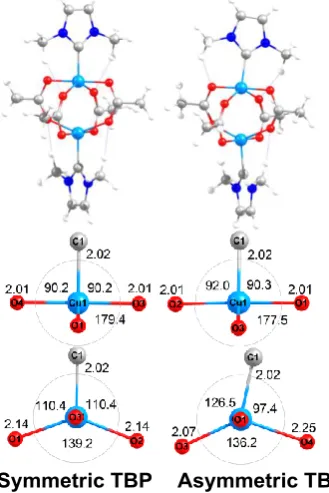
Figure 5 Optimised geometries for [Cu2(acetate)4(Me2NHC)s]. Top: complete structures;
Middle and bottom: local geometrical detail around the metal centres. Numbers with two decimal places are distances in Å; those to one decimal place are angles in °.
Strong-field NHC groups completely change the coordination geometry compared to copper acetate dihydrate. The lowest-energy NHC structure has a ‘symmetric’ TBP geometry but with relatively long equatorial carboxylate bond lengths (2.14 Å) and short ‘axial’ carboxylate contacts of 2.01 Å (Figure 5, left). At almost the same energy is an ‘asymmetric’ TBP geometry (Figure 5, right) where the NHC moiety tilts towards an equatorial oxygen resulting in a lengthening of that Cu-O bond by ~0.1 Å while the other ‘equatorial’ Cu-O distance shortens by 0.07 Å. This type of structural change is well known for pentacoordinate Cu(II) species such as [Cu(bipy)2Cl]+ where the Cu-Cl distance increases from 2.26 Å to 2.36 Å as the equatorial N-Cu-N angle opposite opens up from ~97 ° to ~124 °. Here, the energy difference between ‘symmetric’ and ‘asymmetric’ TBP-like structures is less than 1 kcal mol-1 which now mirrors simple mononuclear Cu(II) complexes where the dz2 and dx2-y2 orbitals mix freely. The shape of the ‘hole’ in the d shell, and its stereochemical activity, is thus highly variable resulting in significant changes in structure for almost no change in energy.
[image:4.595.81.246.230.477.2]The structural change destroys the nominal tetragonal symmetry assumed in the construction of Figure 4 and thus muddies the distinction between Ax and Eq with regard to the d orbitals containing the unpaired spin. The dominant axis is now aligned along the shorter Cu-Oeq bonds (Figure 6). Broken symmetry B3LYP calculations still show that the ground state is antiferromagnetcially coupled (J = -140 cm-115).
Figure 6 Spin density (left) and plots of the molecular orbital housing the two unpaired electrons for the symmetric TBP structure shown in Figure 5, left.
The change in electronic structure thus has a significant effect on the geometric structure and flexibility of the CPW. As shown schematically in Figure 7, the tilting of the NHC causes significant structural changes, more so when we consider that there is an equivalent tilting motion at right angles to that shown at the bottom of Figure 7.
Figure 7 Schematic diagram of the sense of Jahn-Teller elongation (highlighted in pink) for CPW-NHC systems
[image:4.595.340.515.366.496.2]COMMUNICATION Journal Name
acetate hydrate where both the ‘unexpected’ monomer19 and the ‘normal’ dimer11 exist. However, obtaining the species with the higher free energy may require clever synthetic strategies. The formation of an NHC CPW directly from its components may fail but introducing the NHC to pre-formed CPWs, such as those often encountered in MOFs, may succeed.
Several CPW MOFs have large enough pores to accommodate NHC capping groups.20, 21 The question will be whether the NHCs will coordinate to the copper sites and whether any barriers to dissociation are high enough. Simply increasing the Cu-Cu separation in an isolated NHC CPW rapidly increases the energy (see ESI) so the system is at least stable with respect to this dissociation route. Partial capping should also help keep the framework stable. If synthetic strategies to generate CPW NHC MOFs can be developed, the comparison of the structures of AZOGOL with its copper analogue (Figure 8) suggests that a Cu-NHC MOF could behave quite differently to existing CPW MOFs.
Figure 8 Illustrative metal-NHC complexes. AZOGOL is a zinc-NHC paddlewheel [Zn2(OC2CH2Ph)4(N-MesitylNHC)2] while QAXKAC is Cu(II)-{bis(2,5-iPrPh)NHC}(acetate)2.
For the Zn complex, yellow corresponds to the X-ray structure, blue to the DFT optimisation. The CPW is also the computed geometry (BP86/SVP/D3/COSMO).
Flexible MOFs are interesting22 and while NHCs have been incorporated into MOFs,23 simply attaching NHCs to the copper paddlewheel centres has, to our knowledge, not yet been reported. Given the predicted effects on the structures and the fact that the Cu(II)-NHC-carboxylate complex is a hydrosilylation precatalyst,17 the properties of partially- or fully-capped NHC CPW MOFs, if they can be synthesised, are certain to be different and may potentially be very interesting compared to current systems. We are currently extending our first-principles ligand field molecular mechanics24, 25 force field for zinc paddlewheels26 to CPWs in order to model such systems.
Notes and references
Full computational details including methods/basis sets/solvation models, coordinates etc. are included in the ESI.
1. D. Farrusseng, ed., Metal-Organic Frameworks: Applications from Catalysis to Gas Storage, Wiley-VCH Verlag & Co., Weinheim, 2011.
2. A. Schneemann, V. Bon, I. Schwedler, I. Senkovska, S. Kaskel and R. A. Fischer, Chem. Soc. Rev., 2014, 43, 6062-6096.
3. D. N. Dybtsev, H. Chun and K. Kim, Angew. Chem. Int. Ed., 2004,
43, 5033-5036.
4. S. Bureekaew, S. Amirjalayer and R. Schmid, J. Mater. Chem., 2012, 22, 10249-10254.
5. The DFT-optimised structure of [Zn2(acetate)4(OH2)2] has local TBP geometry around the zinc centres. See ESI.
6. S. Vagin, A. K. Ott and B. Rieger, Chem. Ing. Tech., 2007, 79, 767-780.
7. R. J. Deeth and M. Gerloch, Inorg. Chem., 1985, 24, 4490-4493. 8. R. J. Deeth and M. A. Hitchman, Inorg. Chem., 1986, 25,
1225-1233.
9. R. J. Deeth and L. J. A. Hearnshaw, Dalton Trans., 2006, 1092-1100.
10. B. Bleaney and K. D. Bowers, Proc. R. Soc. London, Ser. A, 1952,
214, 451-465.
11. J. N. van Niekerk and F. R. L. Schoening, Acta Crystallographica, 1953, 6, 227-232.
12. ORCA 3.0.3, Becke-Perdew functional, def2-SVP basis set, COSMO aqueous solvation model, Grimme D3 dispersion correction. Full details in ESI.
13. P. J. Hay, J. C. Thibeault and R. Hoffmann, J. Am. Chem. Soc., 1975, 97, 4884-4899.
14. ADF 2014, Becke-Perdew functional, TZP basis on metal, DZP on other atoms, COSMO(aqueous) solvation.
15. The J value should be compared to J = -240 cm-1 calculated for copper acetate using the same protocol versus an experimental value of 286 cm-1.
16. D. Wang, K. Wurst and M. R. Buchmeiser, J. Organomet. Chem., 2004, 689, 2123-2130.
17. J. Yun, D. Kim and H. Yun, Chem. Commun., 2005, DOI: 10.1039/B509964A, 5181-5183.
18. A. M. Magill, K. J. Cavell and B. F. Yates, J. Am. Chem. Soc., 2004,
126, 8717-8724.
19. X.-Y. Wang, X.-T. Deng and C.-G. Wang, Acta Crystallographica Section E, 2006, 62, m3578-m3579.
20. Y. Yan, M. Juríček, F.-X. Coudert, N. A. Vermeulen, S. Grunder, A. Dailly, W. Lewis, A. J. Blake, J. F. Stoddart and M. Schröder, J. Am. Chem. Soc., 2016, 138, 3371-3381.
21. Y. Yan, S. Yang, A. J. Blake and M. Schröder, Acc. Chem. Res., 2013, 47, 296-307.
22. T. D. Bennett, A. H. Fuchs, A. K. Cheetham and F.-X. Coudert,
Dalton Trans., 2016, 45, 4058-4059.
23. C. I. Ezugwu, N. A. Kabir, M. Yusubov and F. Verpoort, Coord. Chem. Rev., 2016, 307, 188-210.
24. M. Foscato, R. J. Deeth and V. R. Jensen, J. Chem. Inf. Mod., 2015, 55, 1282-1290.
25. R. J. Deeth, Coord. Chem. Rev., 2001, 212, 11-34.
[image:5.595.64.266.148.515.2]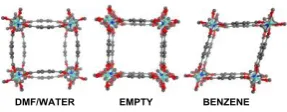
![Figure 3 Centre: selected calculated geometrical data for [Cu2(formate)4(NH3)2]. Normal text for elongated dx2-y2/dx2-y2 state (T0) structure; italics for mixed dx2-y2/dz2 state (TM) structure](https://thumb-us.123doks.com/thumbv2/123dok_us/9464187.452926/3.595.62.268.434.539/selected-calculated-geometrical-normal-elongated-structure-italics-structure.webp)
![Figure 8 Illustrative metal-NHC complexes. AZOGOL is a zinc-NHC paddlewheel [Zn2(OC2CH2Ph)4(N-MesitylNHC)2] while QAXKAC is Cu(II)-{bis(2,5-iPrPh)NHC}(acetate)2](https://thumb-us.123doks.com/thumbv2/123dok_us/9464187.452926/5.595.64.266.148.515/figure-illustrative-complexes-azogol-paddlewheel-mesitylnhc-qaxkac-acetate.webp)
