© 2019, IRJET | Impact Factor value: 7.211 | ISO 9001:2008 Certified Journal | Page 2096
EMOTION BASED MUSIC RECOMMENDATION SYSTEM
H. Immanuel James
1, J. James Anto Arnold
2, J. Maria Masilla Ruban
3, M. Tamilarasan
4,
R. Saranya
51,2,3,4Student , Dept. of Information Technology, Valliammai Engineering College, Chennai ,Tamil Nadu
5Asst.Prof, Dept. of Information Technology, Valliammai Engineering College, Chennai ,Tamil Nadu
---***---Abstract -
The human face plays an important role in knowing an individual's mood. The required input are extracted from the human face directly using a camera. One of the applications of this input can be for extracting the information to deduce the mood of an individual. This data can then be used to get a list of songs that comply with the “mood” derived from the input provided earlier. This eliminates the time-consuming and tedious task of manually Segregating or grouping songs into different lists and helps in generating an appropriate playlist based on an individual's emotional features. Facial Expression Based Music Player aims at scanning and interpreting the data and accordingly creating a playlist based the parameters provided. Thus our proposed system focus on detecting human emotions for developing emotion based music player, which are the approaches used by available music players to detect emotions, which approach our music player follows to detect human emotions and how it is better to use our system for emotion detection. A brief idea about our systems working, playlist generation and emotion classification is given.Key Words: Emotion Recognition, Linear classifier,
Facial Landmark Extraction, SVM Classification.
1. INTRODUCTION
The automatic analysis and understanding of music by the computer is the new possibility in the field of music information retrieval [5]. Since the diversity and richness of music content, are high, a multitude of research topics in this field are pursued by the researchers, ranging from computer science, digital signal processing, mathematics, and statistics applied to musicology. Recent development in music information retrieval include automatic audio genre/mood classification, music similarity computation, audio artist identification, audio-to-score alignment, query-by-singing/humming and so on [7]. Content-based music recommendation is one the feasible application that can be provided. From the context information, we can achieve more intelligent
context-based music recommendation.
© 2019, IRJET | Impact Factor value: 7.211 | ISO 9001:2008 Certified Journal | Page 2097
2. OBJECTIVE
To provide an interface between the music system.
To provide a very good entertainment for the users.
To implement the ideas of machine learning. To provide a new age platform for music
lovers.
To bridge gap between growing technologies and music techniques.
3. RELATED WORK:
Face Detection and Facial Expression Recognition System
Anagha S. Dhavalikar et al [1] proposed Automatic Facial Expression recognition system. In This system there are three phase 1.Face detection 2. Feature Extraction and 3.Expression recognition. The First Phase Face Detection are done by RGB Color model, lighting compensation for getting face and morphological operations for retaining required face i.e eyes and mouth of the face. This System is also used AAM i.e Active Appearance Model Method for facial feature extraction In this method the point on the face like eye, eyebrows and mouth are located and it create a data file which gives information about model points detected and detect the face the an expression are given as input AAM Model changes according to expression.
Emotional Recognition from Facial Expression
Analysis using Bezier Curve Fitting
Yong-Hwan Lee, Woori Han and Youngseop Kim proposed system based on Bezier curve fitting [2]. This system used two step for facial expression and emotion first one is detection and analysis of facial area from input original image and next phase is verification of facial emotion of characteristics feature in the region of interest [1]. The first phase for face detection it uses color still image based on skin color pixel by initialized spatial filtering ,based on result of lighting compassion then to estimate face position and facial location of eye and mouth it used feature map After extracting region of interest this system extract points of the feature map to apply Bezier curve on eye and mouth The for understanding of emotion this system uses training and measuring the difference of Hausdorff distance With Bezier curve between entered face image and image from database.
Using Animated Mood Pictures in Music Recommendation
Arto Lehtiniemi and Jukka Holm et al [3] proposed system on animated mood picture in music recommendation. On this system the user interact with a collection of images to receive music recommendation with respect to genre of picture. This music recommendation system is developed by Nokia researched center. This system uses textual meta tags for describing the genre and audio signal processing .
Human-computer interaction using emotion
recognition from facial expression.
F. Abdat, C. Maaoui et al and A. Pruski et al. They proposed an system fully automatic facial expression and recognition system based on three step face detection, facial characteristics extraction and facial expression classification [4]. This system proposed anthropometric model to detect the face feature point combined to shi and Thomasi method. In this metod the variation of 21 distances which describe the facial feature from neutral face and the classification base on SVM (Support Vector Machine).
Emotion-based Music Recommendation By
Association Discovery from Film Music. Fang-Fei
Kuo et al and Suh-Yin Lee et al.[5] With the growth of digital music, the development of music recommendation is helpful for users. The existing recommendation approaches are based on the users’ preference on music. However, sometimes, recommending music according to the emotion is needed. In this paper, we propose a novel model for emotion-based music recommendation, which is based on the association discovery from film music. We investigated the music feature extraction and modified the affinity graph for association discovery between emotions and music features. Experimental result shows that the proposed approach achieves 85% accuracy in average.
Moodplay: Interactive Mood-based Music Discovery and Recommendation
© 2019, IRJET | Impact Factor value: 7.211 | ISO 9001:2008 Certified Journal | Page 2098
filtering in an interactive interface. We show how MoodPlay allows the user to explore a music collection by latent affective dimensions, and we explain how to integrate user input at recommendation time with predictions based on a pre-existing user profile. Results of a user study (N=240) are discussed, with four conditions being evaluated with varying degrees of visualization, interaction and control.
An Accurate Algorithm for Generating a Music Playlist based on Facial Expressions
Anukriti Dureha et al [7]. In this he proposed Manual segregation of a playlist and annotation of songs, in accordance with the current emotional state of a user, is labor intensive and time consuming. Numerous algorithms have been proposed to automate this process. However the existing algorithms are slow, increase the overall cost of the system by using additional hardware (e.g. EEG systems and sensors) and have less accuracy. This paper presents an algorithm that automates the process of generating an audio playlist, based on the facial expressions of a user, for rendering salvage of time and labor, invested in performing the process manually. The algorithm proposed in this paper aspires to reduce the overall computational time and the cost of the designed system. It also aims at increasing the accuracy of the designed system. The facial expression recognition module of the proposed algorithm is validated by testing the system against user dependent and user independent dataset.
Enhancing Music Recommender Systems with Personality Information and Emotional States
Bruce Ferwerda et al and Markus Schedl et[8] al proposed that the initial research assumptions to improve music recommendations by including personality and emotional states. By including these psychological factors, we believe that the accuracy of the recommendation can be enhanced. The system gives attention to how people use music to regulate their emotional states, and how this regulation is related to their personality.
4. PROPOSED SYSTEM:
The human face plays an important role in knowing an individual's mood. Camera is used to get the required input from the human face. One of the applications of this input can be for extracting the information to deduce the mood of an individual. The “emotion” derived from the input provided earlier are used to get
a list of songs. This tedious task of manually Segregating or grouping songs into different lists are reduced and helps in generating an appropriate playlist based on an individual's emotional features. Facial Expression Based Music Player aims at scanning and interpreting the data and accordingly creating a playlist based the parameters provided. Thus our proposed system focus on detecting human emotions for developing emotion based music player, which are the approaches used by available music players to detect emotions, which approach our music player follows to detect human emotions and how it is better to use our system for emotion detection. A brief idea about our systems working, playlist generation and emotion classification is also given. In this project, we used pycharm tool for analysis.
The outcome of the project is split into 2 phases:
1. Develop a software to recognize user emotion based on facial expression using Python. 2. Integrate the python code into the web service
[image:3.595.313.555.414.633.2]and play the music based on the facial expression.
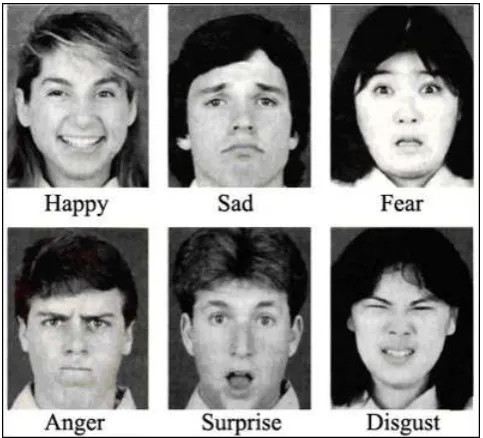
Figure 1: Different Types of Emotions
5. SYSTEM ARCHITECTURE:
© 2019, IRJET | Impact Factor value: 7.211 | ISO 9001:2008 Certified Journal | Page 2099
[image:4.595.48.286.191.590.2]System (FACS) is a system that describes all the facial expressions using combinations of the 64 AUs. After Feature Extraction, the Emotions are classified whether it is Happy, Angry, Sad and Surprise faces. The webservices are integrated with them. They may be of SAAS, IAAS, PAAS. The emotions are transferred and the music are played from the emotions detected.
Figure No.2 Overall Architecture Diagram of the EMOTION BASED MUSIC RECOMMENDATION
SYSTEM.
6. METHODOLOGY:
A. FACE DETECTION:
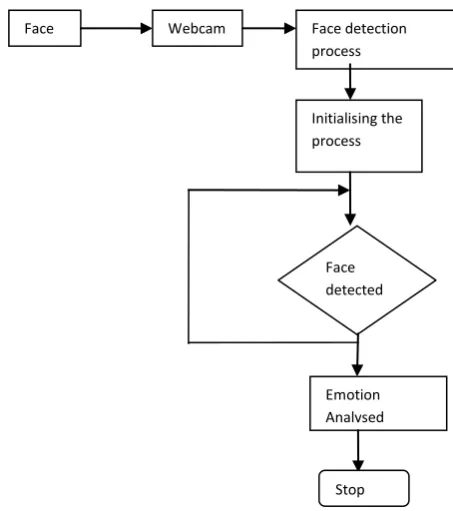
The main objective of face detection technique is to identify the face in the frame by reducing the external noises and other factors. The steps involved in the FACE DETECTION PROCESS are
1. Image pyramid
2. Histogram of Oriented Gradients
3. Linear Classifier
[image:4.595.331.558.321.577.2]The data that are obtained are decomposed into the sampling image using image pyramid into multiple scales. The use of this technique is simply to extract features while reducing the noise and the other factors. The low pass image pyramid technique (also known as Gaussian pyramid) consists of smoothing the frame and subsampling it by decreasing its resolution, the process needs to be repeated a few times in order to obtain a perfect result that in the end of the process we obtain a frame similar to the original one but with a decreased resolution and an increased smoothing level.
Figure 3: Flow diagram of the module – Face Detection
Commonly used to detect objects in images in the field of image processing, HOG is a feature descriptor, a technique that counts occurrences of gradient orientation in a localized portion of an image. The main objective of using this technique is to describe the face within the image with a set of distributions of intensity gradients.
Face Webcam Face detection
process
Initialising the process
Face detected
Emotion Analysed
Stop FACE
WEB CAM
Pre-processing
Segmentation Edging
Feature Extraction Face Detection
Web Services
© 2019, IRJET | Impact Factor value: 7.211 | ISO 9001:2008 Certified Journal | Page 2100
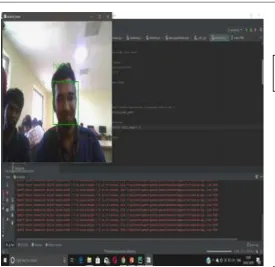
Figure 4: Face Detection Process
The linear classification step is the last step in the face detection process. We simply used the linear classifier instead of the SVM to decrease the computational time that the classification process will take and so to guarantee a faster face detection operation.
B. EMOTION CLASSIFICATION:
When the face is successfully detected, a bounding box will be applied as an overlay on the image to extract the ROI (face) for further analysis. The extracted ROI will next be processed using the “Predictor” function which is also a called script to extract the 68 facial landmark points and save them in an array. Next, the data stored in the features array will be put in as an input into a PCA reduction code that will reduce the size of data and eliminate any correlated coordinates leaving only the necessary points as principal components. The data is a 68x2 array; 68 points, each point with coordinates on x-axes and y-axes. The array will be converted into a vector containing 136 row and 1 column. The facial landmark extraction code “Predictor” is trained with a set of images and landmark maps for each image.
Figure No. 5 Flow diagram of the module – Emotion Classification
The code learns how to extract the facial landmark map of a given face image based on the pixel’s intensity values indexed of each point using regression trees trained with gradient boosting algorithm. After the PCA reduction operation, the obtained data will be used for classification. A multiclass SVM with a linear kernel is employed to compare the inputted data with stored one to see in what class (emotion) it belongs. If one of the three emotions anger, fear, or surprise is detected a speed decreasing command will be executed to reduce the speed of the wheelchair to prevent the user from endangerment.
C. MUSIC RECOMMENDATION:
The input is acquired in real-time so the camera is used to capture the video and then the framing are done.
The hidden markov model classification are used for
processing the framed images. The frames that are obtained are considered in all frames and all pixel formats for the purpose of emotion classification . The value of each landmark in the face is calculated and is stored for future use. The efficiency of classifier is about 90-95%. so that even when there is any changes in the face due to environmental conditions the system can still dentify the face and the emotion being expressed .The emotions are then identified using the values that are obtained that are being set and from the value of the pixel that is received is being compared to that of the values that is present as threshold in the code. The values is transferred to the web service. The song are played from the emotion deteced. The emotions are assigned for every song. When the emotion is transferred the respective song will be
Emotion Classification
Stop Face
Detected
Segmentation
[image:5.595.35.311.81.348.2]© 2019, IRJET | Impact Factor value: 7.211 | ISO 9001:2008 Certified Journal | Page 2101
[image:6.595.36.290.197.449.2]plays. There are four emotions that can be used and the emotions are happy, anger, sad, surprise. When the happy emotion is recognized the songs that are assigned for that particular emotion are played and the same happens with the other emotions as well that is it the songs are played for the emotions detected respectively.
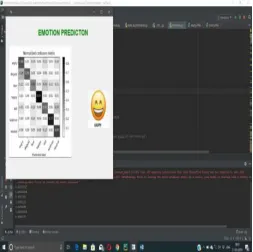
Figure No.6 Emotion detection and music recommendation
7. FUTURE ENHANCEMENT
The music player based on facial recognition system is highly essential for all the person in modern day life ecology. This system is further enhanced with benefit able features for upgrading in future. The methodology of enhancement in the automatic play of songs are done by detection of the facial expression. The facial expression is detected by programming interface with the RPI camera. An alternative method, based on additional emotions which is excluded in our system as disgust and fear. On this emotion included to support the playing of music automatically.
8. CONCLUSION
In this project, we presented a model to recommend a music based om the emotion based detected from the facial expression. This project proposed designed & developed an emotion based music recommendation system using face recognition System. Music are the
one that has the power to heal any stress or any kind of emotions. Recent development promises a wide scope in developing emotion based music recommendation system. Thus the proposed system presents Face based emotion recognition system to detect the emotions and play music from the emotion detected.
9. REFERENCES
[1]. Anagha S.Dhavalikar and Dr. R. K. Kulkarni, “Face Detection and Facial Expression Recognition System” 2014 Interntional Conference on Electronics and Communication System (ICECS -2014).
[2]. Yong-Hwan Lee , Woori Han and Youngseop Kim, “Emotional Recognition from Facial Expression Analysis using Bezier Curve Fitting” 2013 16th International Conference on Network-Based Information Systems.
[3]. Arto Lehtiniemi and Jukka Holm, “Using Animated Mood Pictures in Music Recommendation”, 2012 16th International Conference on Information Visualisation.
[4]. F. Abdat, C. Maaoui and A. Pruski, “Human-computer interaction using emotion recognition from facial expression”, 2011 UKSim 5th European Symposium on Computer
[5]. T.-H. Wang and J.-J.J. Lien, “Facial Expression Recognition System Based on Rigid and Non-Rigid Motion Separation and 3D PoseEstimation,” J. Pattern Recognition, vol. 42, no. 5, pp. 962-977, 2009.
[6] Renuka R. Londhe, Dr. Vrushshen P. Pawar, “Analysis of Facial Expression and Recognition Based On Statistical Approach”, International Journal of Soft Computing and Engineering (IJSCE) Volume-2, May 2012.
[7] Anukriti Dureha “An Accurate Algorithm for Generating a Music Playlist based on Facial Expressions” : IJCA 2014.