Hyper-heuristics with a Case Study in High
School Timetabling Problems
Ahmed Kheiri*
[email protected]University of Exeter
College of Engineering, Mathematics and Physical Sciences Streatham Campus, Harrison Building
Exeter EX4 4QF United Kingdom
Ed Keedwell
[email protected]University of Exeter
College of Engineering, Mathematics and Physical Sciences Streatham Campus, Harrison Building
Exeter EX4 4QF United Kingdom
Abstract
Operations research is a well established field that uses computational systems to sup-port decisions in business and public life. Good solutions to operations research prob-lems can make a large difference to the efficient running of businesses and organisa-tions and so the field often searches for new methods to improve these soluorganisa-tions. The high school timetabling problem is an example of an operations research problem and is a challenging task which requires assigning events and resources to time slots sub-ject to a set of constraints. In this paper a new sequence-based selection hyper-heuristic is presented that produces excellent results on a suite of high school timetabling prob-lems. In this study, we present an easy-to-implement, easy-to-maintain and effective sequence-based selection hyper-heuristic to solve high school timetabling problems using a benchmark of unified real-world instances collected from different countries. We show that with sequence-based methods, it is possible to discover new best known solutions for a number of the problems in the timetabling domain. Through this inves-tigation, the usefulness of sequence-based selection hyper-heuristics has been demon-strated and the capability of these methods has been shown to exceed the state-of-the-art.
Keywords
Hyper-heuristic, Educational Timetabling, Computational Design, Combinatorial Op-timisation, Hidden Markov Model.
1
Introduction
The field of search and optimisation in operations research has a long and varied his-tory. Many methods have been developed that solve specific problems well and rely on
*Ahmed Kheiri ([email protected]) is currently working at Cardiff University.
problem-specific knowledge to function. Although highly computationally efficient, many of these methods are necessarily specific to each problem and so cannot easily be applied to other problems without significant modification. The research commu-nity has therefore looked to meta-heuristics as generic problem solving methods, for example genetic algorithms (Holland, 1975), tabu search methods (Glover, 1986) and other nature-inspired methods such as simulated annealing (Kirkpatrick et al., 1983) are widely used. However, these methods usually require significant expertise to im-plement and tune for specific problems, and in their standard versions at least, are un-able to adapt to changing search spaces. Despite the efforts of the scientific community in developing a variety of search methodologies, there is no known efficient method that offers the best performance for solving different problems and for all possible situ-ations, and in fact it has been proved that this is unachievable (Wolpert and Macready, 1997). Despite this, there has been scientific progress in designing general methods which are valid for a wide range of, rather than all, problem domains. Such systems are applicable to different instances from not only the same domain but also other problem domains. Moreover, they are easy to build and maintain and so are less costly in terms of the investment in time required to apply them to new problems. Hyper-heuristics have emerged as such general purpose high level search methodologies which are mo-tivated by the goal ofselectingor generatingheuristics automatically to solve a wide range of difficult optimisation problems (Burke et al., 2013). This work focuses on the selection type of hyper-heuristics.
Traditional selection hyper-heuristics have focussed on the improvement that sin-gle or paired low level heuristics can bring to an optimisation. The task for these meth-ods is to select the most appropriate and best performing heuristic for a given point in the optimisation. A wide number of methods have been proposed for this task in-cluding the simple random hyper-heuristic, choice function hyper-heuristic and other methods presented in (Burke et al., 2013). However, in scientific fields where sequences are known to be prevalent, for example in bioinformatics and language processing, a key feature is that context is found to be important and that the ‘meaning’ of a token in the sequence cannot be determined unless the context in which it finds itself is also considered. Here it is proposed that it is possible to extend this context principle to the selection of heuristics within the search domain, noting that the effectiveness of search operations is determined to a certain extent by those that have been executed before it. In this paper we extend this principle to investigate the potential for the analysis of sequences of operations in search and optimisation problems to construct building blocks of good heuristic combinations.
This work studies and analyses the performance of two sequence-based meth-ods, a simple fixed parametrised method and a hidden Markov model (HMM) ap-proach (Kheiri and Keedwell, 2015b; Kheiri et al., 2015). A hyper-heuristic with a fixed parametrised sequence size is implemented to allow for experimentation on the se-quence lengths and to discover information regarding the information that can be gained from each such sequence. In addition, the HMM method is shown to learn online the optimum sequence lengths automatically and is able to adapt the probabil-ity of heuristic application and sequence-based acceptance strategy to the search land-scape. Experimentation with these methods is conducted on difficult problems from timetabling, a key problem area in operational research.
the hard constraints and as many of the soft constraints as possible. The importance of the high school timetabling problem stems from its difficulty due to the number of constraints involved, the NP nature of the problem (Even et al., 1976), and the need to perform this hard task by educational institutions everywhere, thus it became neces-sary to search for methods that help with automating this process.
The paper is structured as follows. Section 2 overviews selection hyper-heuristics and high school timetabling problems. Section 3 describes the high school timetabling benchmark used for the experimentation. Section 4 describes the developed method including the algorithmic components and low level heuristics. In Section 5, the perfor-mance of the developed methods is analysed and compared against the state-of-the-art approaches. Section 6 provides conclusions and areas for further work.
2
Background
2.1 Hyper-heuristics
The term hyper-heuristic was used by Cowling et al. (2001) to describe a high level problem-independent method that provides a solution methodology to solve a wide range of optimisation algorithms. Hyper-heuristics can be broadly classified into se-lection hyper-heuristics to select from a set of predefined heuristics, and generation hyper-heuristics which differ from selection methods in that they generate heuristics (Burke et al., 2013). This work focuses on the former class of hyper-heuristics.
Selection hyper-heuristics are motivated by the understanding that each heuris-tic performs differently on different problem instances and an approach that combines them could yield better overall performance (Burke et al., 2013). An iterated selection hyper-heuristic method ( ¨Ozcan et al., 2008) aims to improve the current solution by selectingand applying a low level heuristic from a set of predefined low level heuris-tics (e.g. mutation operators and local search heurisheuris-tics), leading to a new solution, then themove acceptancemethod decides whether to accept or reject the modified solu-tion. This cycle of applying selection and move acceptance methods is repeated until a termination criterion is satisfied. The number of studies on selection hyper-heuristics is growing massively (Burke et al., 2013) and as such space prevents us reviewing all such approaches. However, we will overview the methods that are relevant to those techniques proposed in this study.
The heuristic selection method is described in Section 4 but this must be coupled with a move acceptance method to determine whether to select or reject the generated solutions. A set of well known meta-heuristic inspired move acceptance methods, in-cluding hill climbing (only improving) (HC), simulated annealing (SA), great deluge (GD), record-to-record travel (RR) and late acceptance (LA) methods are used as move acceptance criteria in this study.
A deterministic move acceptance method which accepts only improved solutions is described by Cowling et al. (2001). We refer to this method as the hill climbing move acceptance method.
Simulated Annealing (SA) (Abramson et al., 1999) is a probabilistic meta-heuristic method, motivated by an analogy to the process of annealing in solids. At each step a new solution is generated. The new solution is accepted if it improved the previous solution. To prevent premature convergence on a local optimum, non-improving solu-tions are accepted with a probability ofp=e−∆T, where∆is the quality (cost) change,
temperature, then according to the cooling schedule, the temperature decreases gradu-ally towards the end of the search process. One way of reducing the temperature is to apply the geometric cooling schedule: Ti+1 =Ti.β, whereβcan be empirically tuned for a particular problem domain (Hajek, 1988). Simulated annealing has been used as a move acceptance method within the selection hyper-heuristics in (Bilgin et al., 2007), at which the non-improving solutions are accepted with a probability given by the fol-lowing equation:
p=e
− ∆
F(1−tcurrent
tlimit ) (1)
where∆is the change in the cost at timetcurrent,tlimit is the time limit,F is the ex-pected maximum change in the cost. Note that∆is positive for non-improving moves when the objective is minimising rather than maximising; andF is empirically deter-mined in this work.
The Great Deluge (GD) algorithm was first introduced by Dueck (1993). GD is based on a stochastic framework which allows improving moves by default. Non-improving moves are accepted if the cost of the candidate solution is better than an expected cost, named as the water level at each step. The water level gets updated according to the ‘rain speed’ parameter. Dueck (1993) argued that if the rain speed value is chosen to be very small then the algorithm requires high computational time to produce a high quality solution. The cost value of the first generated candidate solution can be used as the initial level in GD. Great deluge is utilised as a move acceptance method within selection hyper-heuristics in (Kendall and Mohamad, 2004), at which the threshold level (τ) at timetcurrentis updated with the following equation:
τ=f+F×(1−tcurrent
tlimit
) (2)
wheretlimitis the time limit,F is the expected maximum change in the cost, andf is the expected final cost value. In this workFandf are empirically determined.
Dueck (1993) proposed another variant of GD named Record-to-Record Travel (RR) method. The idea of RR is based on the simple notion that any new solution, which is not much worse than the best solution recorded, is accepted.
The late acceptance method (Burke and Bykov, 2008) is a variant of hill climbing method. A candidate solution in the late acceptance method is accepted if its qual-ity is better than a solution which was obtainedLsteps before. The method requires an implementation of a circular queue of sizeLwhich maintains the cost values ofL previously visited solutions.
2.2 High School Timetabling Problems
with a newly designed neighbourhood structure to solve the high school timetabling problem.
One of the earliest studies that applied the tabu search to solve the high school timetabling problem was suggested by Wright (1996). The conducted study produced a timetable for a large comprehensive school in England, using a solution method that involved heuristic search and a form of tabu search. Alvarez-Vald´es et al. (2002) devel-oped an algorithm based on tabu search for teacher assignment in Spanish secondary schools. The algorithm was implemented in three phases. In the first phase a parallel heuristic algorithm is used to build an initial solution, and in the second phase the so-lution is improved using the tabu search to obtain feasible soso-lutions. In the third phase the solution is improved further. The algorithm was applied to 12 Spanish school in-stances and proved to provide better allocations than the manual ones. Jacobsen et al. (2006) developed an approach that generates an initial solution using a construction heuristic with a graph colouring algorithm. The solution is then improved using tabu search. The algorithm was tested on data from German high schools. Bello et al. (2008) treated the high school timetabling problem as a graph colouring problem, and used it in association with the tabu search algorithm. The system was applied to instances from Brazilian high schools.
Colorni et al. (1992) used several meta-heuristics based on genetic algorithms (GA), simulated annealing (SA) and tabu search (TS) and compared them using in-stances of Italian high school data. The research results showed that a hybrid of a ge-netic algorithm with local search could give promising performance. Calderia and Ross (1997) evaluated the use of genetic algorithms to solve instances of school timetabling that are randomly generated. An initial population of feasible timetables are produced in an initial procedure and the GA is used to improve the quality of the generated pop-ulation. A highly constrained school timetabling problem extracted from the require-ments of a German high school was investigated by Buf´e et al. (2001) using a hybrid approach. An evolutionary algorithm combined with local search that uses specific mutation operators to optimise the given timetables was used to find feasible solutions. Filho et al. (2001) used a new representation for the high school timetabling problem by forming clusters from pairs of teachers and classes. The authors applied a con-structive genetic algorithm to solve instances of two Brazilian high schools. Wilke et al. (2002) presented a genetic algorithm for solving the German high school timetabling problem. A hybrid genetic approach is applied using multiple genetic operators which proved to perform better than the traditional genetic algorithm. Beligiannis et al. (2008) solved high school timetabling problem using an adaptive evolutionary algorithm. The algorithm did not employ a crossover operator, and the results showed the suc-cess of the approach when applied on the Greek high school timetabling problem. Raghavjee and Pillay (2008) applied a genetic algorithm to the school timetabling prob-lem. The algorithm is based on creating an initial population of timetables and then applying a mutation operator to refine this population. It was tested with five high school timetabling problems and proved to generate better results than all the meth-ods tested with the same set. Raghavjee and Pillay (2012) compared the performance of a genetic algorithm and genetic programming using Abramson (1991) dataset of five high school timetabling problems. The genetic programming approach proved to give a better performance in the five problems over other approaches including genetic algo-rithm, neural networks, tabu search and greedy search, especially in the large problems in the set.
large neighbourhood search (Sørensen et al., 2012), integer programming (Birbas et al., 2009), particle swarm optimisation (Tassopoulos and Beligiannis, 2012), tiling algo-rithms (Kingston, 2005), bee algoalgo-rithms (Lara et al., 2008), Hopfield neural networks (Smith et al., 2003), walk down jump up algorithm (Wilke and Killer, 2010), greedy ran-domised adaptive search procedure (Moura and Scaraficci, 2010) and constraint pro-gramming approach (Valouxis and Housos, 2003). For the recent survey on high school timetabling problem the reader is directed to (Pillay, 2013).
3
High School Timetabling Benchmark
Due to the different education systems and constraints imposed by different educa-tional institutions, a group of researchers (Post et al., 2012) has proposed a unified high school timetabling format that fits with the different education systems across the world. To encourage scientists and practitioners to provide solution methods for high school timetabling problem, an international timetabling competition (ITC 2011) (Post et al., 2013) using the unified benchmark instances collected from over 10 coun-tries was organised.
The competition consisted of three rounds. In the first and third rounds, com-petitors were expected to submit solutions to a set of instances without any restriction on the resources or techniques used to generate these solutions. In the second round, solvers were submitted to the organisers and tested on a set of instances in a specified time limit of 1000 seconds.
The problem instance consists oftimes which are the intervals of time in which events run;resourceswhich are the entities that attend events; andeventswhich specify the coordination of resources. Solutions to the timetabling problem consist of the al-location of resources to events. The resources that must be allocated are the group of students (known as a class), the teacher and the room in which the event will take place. Each resource has a set of constraints associated with it (e.g. limitations on the number of classes students are required to take in one day, teacher workload and room capac-ities). Events can be single lessons or a set of lessons (an event group) and each event has a number of properties that influence the allocation of resources to them through constraints or other optimality criteria. These are the event duration, passigned re-sources (e.g. some events must take place in certain rooms), the contribution of the event to workload and pre-assigned time slots. Fifteen hard/soft constraintsare ex-pected to be satisfied (Post et al., 2013):
• C01 Assign resource:Assign resource to event.
• C02 Assign time:Assign time to event.
• C03 Split events:Split event into sub-events under specific constraints.
• C04 Distribute split events: Split event into sub-events under constrained dura-tions.
• C05 Prefer resources:Assign specific resource(s) to event.
• C06 Prefer times:Assign specific time(s) to event.
• C08 Spread events:Spread events evenly through the cycle.
• C09 Link events:Assign the same time to a set of events.
• C10 Avoid clashes:Assign resources without having clashes.
• C11 Avoid unavailable times:Avoid assigning resources at unavailable times.
• C12 Limit idle times:Avoid having idle times for resources.
• C13 Cluster busy times:For a number of days, resources must be busy.
• C14 Limit busy times:For a number of times, resources must be busy.
• C15 Limit workload:Schedule the workload without exceeding a limit.
The quality of a solution is evaluated in terms of ( hardViolation-Score,softViolationScore). A solution with a cost of (25,78) indicates an infeasibility value of 25 (sum of weighted hard constraints violations) and objective value of 78 (sum of weighted soft constraints violations). The weight value and whether the constraint is hard or soft per each constraint type are presented in the instance.
The instances used during ITC 2011 are still available online in the competition website, but deprecated. The developers of the benchmark project suggested the focus on solving a set of instances, referred to as XHSTT-2014 instances, which contains a carefully selected set of worldwide instances in their most up-to-date form. However, in this work we used the ITC 2011 instances of round 2 and compared the performance of our approach against the ITC 2011 solvers using the same rules imposed for the second round of the competition. We then applied the developed method on 2014 instances. Table 1 summarises the main characteristics of the ITC 2011 and XHSTT-2014 instances obtained from 12 countries.
Due to space restrictions, we only provided a brief description of the studied prob-lem. For a full description of the problem, the reader is directed to (Post et al., 2012, 2013).
Four competitors (GOAL, HySST, Lectio and HFT) submitted solvers to the sec-ond round of the ITC 2011 competition (Post et al., 2013; Kheiri, 2014). GOAL com-bined iterated local search with simulated annealing (Fonseca et al., 2014). HySST ap-plied a stochastic local search hyper-heuristic (Kheiri et al., 2016). Lectio employed an approach based on adaptive large neighbourhood search (Sørensen et al., 2012). HFT developed an evolutionary algorithm as a solution method (Domr ¨os and Homberger, 2012). The ranking method was based on the average rank of 10 independent trials with 10 seeds chosen at random over eighteen selected instances per team with each run for 1000 seconds. The GOAL team obtained the lowest mean rank and were there-fore deemed the winner of the second round of ITC 2011. Soon after the competition, the results of the GOAL team have been improved using a late acceptance hill-climbing method as reported in (Fonseca et al., 2015).
4
Overall Approach
Hyper-heuristic methods operate above the level of heuristics and so do not deal di-rectly with the problem representation, the low level heuristics provided are designed to work at this level. As such, the proposed hyper-heuristic algorithm works simply by invoking the KHE platform (an open source software tool written by Jeff Kingston
(Kingston, 2014)) which constructs initial solutions using the concept of hierarchical timetabling which utilises a tree structure to represent resource allocations to events. The exact implementation of the solution is not of concern from a hyheuristic per-spective, but the interested reader is directed to (Kingston, 2014). However, an initial produced solution of a given problem instance generally violates many of the problem constraints (see (Kingston, 2014)). The proposed hyper-heuristic is, therefore, used to fix as many of these violated constraints.
Recall that hyper-heuristics are composed of two components: the selection com-ponent and the move acceptance comcom-ponent. In the selection comcom-ponent, a low level heuristic will be selected and applied to a current solution (Scurrent) and that will gen-erate a new solution (Snew). Now, givenScurrentandSnew, the move acceptance will decide whether to accept or rejectSnew. In this work, a sequence-based selection (SS) method described in Section 4.1 is used to select and apply sequences of heuristics. Five different reusable meta-heuristics inspired methods are used as move acceptance including hill climbing local search (HC), simulated annealing (SA), great deluge (GD), record-to-record travel (RR) and late acceptance (LA) methods. For example, if we used HC as a move acceptance, thenSnewwill only be accepted if its quality is better than Scurrent, otherwise it will be rejected. If we used SA, thenSnewwill be accepted if its quality is better thanScurrentor it will be accepted with a given probability.
Most of the parameters involved with the move acceptance methods are set to values which were suggested in previous studies. In the case of solutions with hard constraint violations, the F value in both simulated annealing and great deluge cri-teria is assigned to 0.01% of the cost of the best recorded solution during the search process, otherwise, the value is set to 1% of the cost of the best recorded solution in hand. Similarly, the value off in GD is set to 0.001% of the cost of the best solution in hand, and to 0.1% if the best solution violates only soft constraints. These settings are suggested in (Kalender et al., 2013; Ahmed et al., 2015). The memory sizeLof the LA acceptance method is set to 500 as suggested in ( ¨Ozcan et al., 2009). The RR accepts the non-improving solution if its cost is not worse than the cost of the best recorded solution in hand plus 0,5. This parameter is chosen after light experimentation.
The sequence-based selection hyper-heuristic approach in this study manages a set of fifteen low level heuristics to improve the quality of a single solution:
• LLH0: swap the time slots of two randomly selected events. As an example, as-sume that aGeographyclass event is assigned to the second time slot on Monday and theHistoryclass event is assigned to the third time slot on Friday. LLH0 will assignHistoryclass to the second time slot on Monday, andGeographyclass to the third time slot on Friday.
• LLH1: select two random events and swap their time slots in case they have the same duration or not adjacent, otherwise the swap occurs but the first event is moved to follow the last time slot occupied by the second event. As an example, assume that aGeographyclass event with a duration of one is assigned to the first time slot on Monday and theHistoryclass event with a duration of two is assigned to the second time slot on Monday. LLH1 will assignGeographyclass to the third time slot on Monday (not to the second time slot on Monday), andHistory class to the first time slot on Monday. However, if both events have the same duration, then LLH0 will be invoked.
on Monday. LLH2 will select a new random time slot, for example the last time slot on Tuesday, and then it will unassignMathematicsfrom the first time slot on Monday and then assign it to the last time slot on Tuesday.
• LLH3: randomly select an unassigned event and then assign it to a random time slot. This low level heuristic works similarly to LLH2; however, the event is ex-pected to be unassigned to begin with. As an example, assume that aMathematics class event is unassigned to any time slot. LLH3 will select a random time slot, for example last time slot on Tuesday, and then it will assignMathematicsto the last time slot on Tuesday.
• LLH4: randomly select an assigned event and then unassign it. This low level heuristic is the opposite of LLH3.
• LLH5: randomly assign and unassign several events. This is a ruin and recre-ate low level heuristic which has a parameter that takes a value between 1 to 10. This parameter will be selected randomly each time this heuristic is invoked. The parameter represents the number of events to be assigned or unassigned. If, for ex-ample, the parameter has a value of 5, then LLH5 will select five events at random and then at each selected event the heuristic either applies LLH2, LLH3 or LLH4 (selected randomly with an equal distribution).
• LLH6: shuffle the assignment of several events. This heuristic has a parameter that takes a value between 1 to 10. This parameter will be selected randomly each time this heuristic is invoked. The parameter represents the number of events to be shuffled. If, for example, the parameter has a value of 5, then LLH6 will select five events at random and then shuffle their assignments.
• LLH7: split a randomly selected event into two events. This heuristic divides a randomly chosen event if it has an assignment of a time block of at least two con-secutive time slots into two events such that their durations should sum to the duration of the original event. As an example, assume that aGeographyclass event with a duration of three is assigned to the first time slot on Monday, LLH7 will di-vide the teaching ofGeographyinto two separate (still consecutive) time slots with one event having a duration of one and the other event having a duration of two. This low level heuristic will allow for future moves to operate on those two events separately.
• LLH8:merge two randomly selected events adjacent in time and sharing the same events. This heuristic is the opposite of LLH7.
• LLH9: swap two random resources. As an example, assume that a Geography class event is assigned toClass Room Aand the History class event is assigned to Class Room B. LLH9 will assign History class toClass Room A, and Geography class toClass Room B.
• LLH10: reschedule a resource element of an event. As an example, assume that Class Room Ais assigned to Geography class event. LLH10 could re-assignClass Room Ato History class.
be unassigned to begin with. As an example, assume thatTeacher Ais unassigned to any class. LLH11 will select a random class event and then it will assignTeacher Ato the selected class.
• LLH12:randomly select an assigned resource and then unassign it. This low level heuristic is the opposite of LLH11. As an example, assume thatTeacher Ais as-signed to a given class. LLH12 will unassignTeacher Ato the given class.
• LLH13:randomly assign and unassign several resources. This is a ruin and recre-ate low level heuristic which has a parameter that takes a value between 1 to 10. This parameter will be selected randomly each time this heuristic is invoked. The parameter represents the number of resources to be assigned or unassigned. If, for example, the parameter has a value of 5, then LLH13 will select five resources at random and then at each selected resource the heuristic either applies LLH10, LLH11 or LLH12 (selected randomly with an equal distribution).
• LLH14:shuffle the assignment of several resources. This heuristic has a parameter that takes a value between 1 to 10. This parameter will be selected randomly each time this heuristic is invoked. The parameter represents the number of resources to be shuffled. If, for example, the parameter has a value of 5, then LLH14 will select five resources at random and then shuffle their assignments.
4.1 Sequence-based Selection Hyper-heuristic
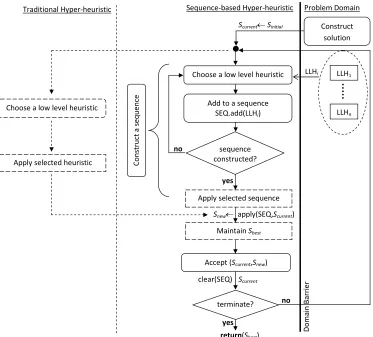
The hyper-heuristic implemented in this study aims to select and apply sequences of heuristics instead of selecting and applying a single heuristic. This section introduces a modified framework for selection hyper-heuristics enabling the operation of selecting sequences of heuristics. Figure 1 illustrates how a generic sequence-based selection hyper-heuristic framework operates.
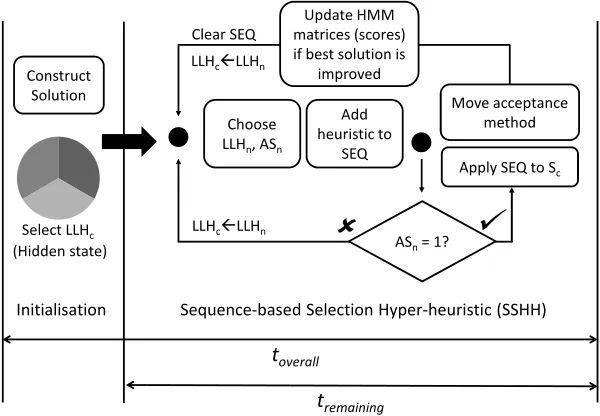
This study applies a hidden Markov model (Baum and Petrie, 1966) approach for the sequence-based selection method (Figure 4). The goal is to learn and generate se-quences of low level heuristics where low level heuristics represent hidden states of the model. Each state (low level heuristic) has a transition probability to move to an-other state (or itself) and a sequence-based acceptance strategy probability to decide whether a sequence of heuristics is constructed or not. Therefore we define two matri-ces: one to store the scores, hence the probabilities, to move from a heuristic to another; and the other to store the scores of the acceptance strategy for each low level heuristic. We refer to the first matrix asT ransitionScoreand the second asASScore. Note that Markov chain model employed in the work in Kheiri and Keedwell (2015a) is a simpler Markov model where the state is directly visible to the observer and therefore the state (low level heuristic) transition probabilities are the only parameters.
Given the current low level heuristic (llhc), the hyper-heuristic uses a roulette wheel selection strategy to select the next low level heuristic (llhn) with a probability given by:
T ransitionScorellhc,llhn ∑
∀j(T ransitionScorellhc,llhj)
(3)
The hyper-heuristic will then select the sequence-based acceptance strategy l for the selected heuristicllhnwith a probability given by:
ASScorellhn,l ∑
∀j(ASScorellhn,j)
Choose a low level heuristic
Accept (Scurrent,Snew)
LLH1
LLHn
Apply selected sequence
LLHi
Construct solution
terminate?
Snew← apply(SEQ,Scurrent)
Scurrent
Scurrent←Sinitial
Maintain Sbest
return(Sbest)
Sequence-based Hyper-heuristic Problem Domain
D
o
m
a
in
B
a
rr
ie
r
yes
no
Add to a sequence SEQ.add(LLHi)
sequence constructed?
yes no
clear(SEQ)
C
o
n
st
ru
ct
a
s
e
q
u
e
n
ce
Apply selected heuristic Choose a low level heuristic
[image:12.612.131.504.221.558.2]Traditional Hyper-heuristic
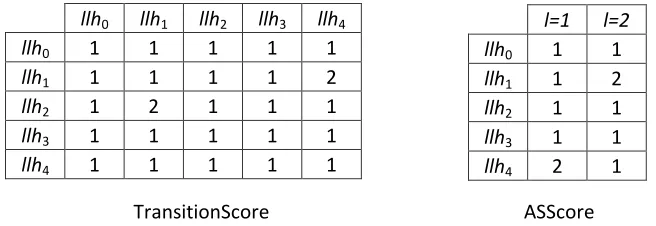
The sequence-based acceptance strategy (AS) has two options. If the first option is selected (i.e. l = 1), this means the sequence of heuristics is now completed and the heuristics in the sequence will be applied to the candidate solution to generate a new solution. The move acceptance of the hyper-heuristic will be applied to decide whether to accept or reject the new solution. The relevant transition and sequence-based acceptance strategy scores will be updated where the new solution has a quality better than the quality of the best solution in hand. If the second option is selected (i.e. l = 2), then the selected heuristic will be added to the sequence of heuristics and no evaluation is conducted. Initially, the hyper-heuristic mechanism assigns an equal probability to move from any heuristic to another and the probability of select-ing the associated sequence-based acceptance strategy in order to allow all the low level heuristics to process the given solutions. In other words,T ransitionScorellhi,llhj = 1
for alli, j; andASScorellhi,l = 1for alli, l. These scores are updated as long as the
best solution recorded in hand is improved. Consequently, after a number of steps the hyheuristic learns and detects a list of sequences of low level heuristics that per-form well. The hyper-heuristic assigns a higher probability of calling and applying these sequences and hence a lower probability of the use of heuristics that generate worsening results. In (Kheiri and Keedwell, 2015b), score values are simply increased by 1 as a reward mechanism as long as the best recorded solution in hand is improved. We provide an example of how the developed method would work on five low level heuristics. Figure 2 shows the initial score values of the two HMM matrices. For example, ifllh2is initially selected as the current low level heuristic and considering the
scores in the transition matrix, the probability to move fromllh2to any other heuristic
is 1/5. The hyper-heuristic applies the roulette wheel selection method to select the next low level heuristic. We assume thatllh1is selected next. The hyper-heuristic will
then select the sequence-based acceptance strategy ofllh1. The probability at this point
of selecting any of the two acceptance strategies is 1/2. We assume that the hyper-heuristic selects the acceptance strategyl = 2, meaning thatllh1 will be added to the
sequence but an evaluation is not conducted. We move on to the next step and that we are now onllh1. Again, we select the next low level heuristic using the scores in the
transition matrix to move fromllh1and in this example,llh4is selected. The probability
of selecting any of the two acceptance strategies forllh4is 1/2. Assume that the
hyper-heuristic uses the roulette wheel selection strategy to select the acceptance strategy l = 1. This means that the sequence of heuristics is now constructed and it will be applied to the current solution. The constructed sequence isllh1,llh4 meaning that a
sequence of heuristics of size 2 is generated. This sequence will be applied sequentially to the current solution, returning a new solution. Assume that the new solution is better than the current best obtained solution during the optimisation. In this case the relevant scores will be updated and increased by 1. The scores of moving fromllh2to
llh1and fromllh1tollh4will be updated. Also the sequence-based acceptance strategy
l= 2ofllh1and the sequence-based acceptance strategyl= 1ofllh4will be updated as
illustrated in Figure 3. Note that if the new solution does not improve the quality of the best solution in hand, then the scores in the HMM matrices will not be updated. The next component of the hyper-heuristic is the move acceptance method. If, for example, we are using HC move acceptance, then the new solution will be accepted if its quality is better than the candidate solution; otherwise, the new solution will be rejected. We are now atllh4, and we continue with the same strategy to construct and apply the next
sequence of heuristics using the new scores and so on.
llh
0llh
1llh
2llh
3llh
4llh
01
1
1
1
1
llh
11
1
1
1
1
llh
21
1
1
1
1
llh
31
1
1
1
1
llh
41
1
1
1
1
TransitionScore
ASScore
l=1
l=2
llh
01
1
llh
11
1
llh
21
1
llh
31
1
[image:14.612.156.478.106.219.2]llh
41
1
Figure 2: Initial score values of the HMM matrices for five low level heuristics
llh
0llh
1llh
2llh
3llh
4llh
01
1
1
1
1
llh
11
1
1
1
2
llh
21
2
1
1
1
llh
31
1
1
1
1
llh
41
1
1
1
1
TransitionScore
ASScore
l=1
l=2
llh
01
1
llh
11
2
llh
21
1
llh
31
1
llh
42
1
Figure 3: Updated score values of the HMM matrices
method. They all adopt a similar selection strategy but differ in the reward mecha-nism.
• Sequence-based Selection Hyper-heuristic with Linear Update (SSHH-L): Cor-responding score values are increased linearly bytas a reward mechanism as long as the best recorded solution in hand is improved; wheretis the time elapsed in seconds.
• Sequence-based Selection Hyper-heuristic with Non-linear Update (SSHH-N): Corresponding score values are increased non-linearly byet/cas a reward mecha-nism as long as the best recorded solution in hand is improved; wheretis the time elapsed in seconds andcis a constant assigned arbitrarily to 30 in this work.
• Sequence-based Selection Hyper-heuristic with Delta Update (SSHH-D): In-stead of a predefined rewarding mechanism, the difference in objective value be-tween the newly generated solution and the best recorded solution after the appli-cation of the selected sequence of heuristics is used as a score value.
5
Results
5.1 Experimental Setup
[image:14.612.153.481.254.367.2]Initialisation Sequence-based Selection Hyper-heuristic (SSHH)
t
remaining LLHcLLHnt
overall LLHcLLHnConstruct Solution
Choose LLHn, ASn
Add heuristic to
SEQ
Move acceptance method
Apply SEQ to Sc
Update HMM matrices (scores) if best solution is
improved
Select LLHc
Clear SEQ
[image:15.612.166.466.108.316.2](Hidden state) ASn= 1?
Figure 4: A sequence-based selection hyper-heuristic utilising HMM; where LLHcand LLHnare the current and next selected low level heuristics, respectively, and ASnis the next selected sequence-based acceptance strategy
used: Given algorithm A versus algorithm B, (i) + (−) denotes that A (B) is better than B (A) and this performance variance is statistically significant, (ii) A≃B indicates that there is no statistical significant between A and B. In the first set of experiments, eight selected instances from the ITC 2011 set (one instance per each country) are used. The termination criterion is set to 200 seconds for the preliminary experiments.
5.2 Comparison of the Different Move Acceptance Methods
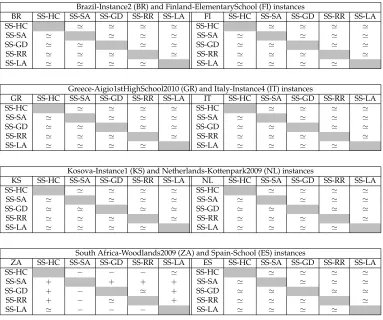
Table 2 summarises the performance of the sequence-based selection (SS) method with the different move acceptance methods, where the SS prefix refers to the Sequence-based Selection approach and the suffixes refer to the various move acceptance meth-ods. As expected, the results confirm that the move acceptance method does not in-fluence the overall performance greatly. Based on the Mann-Whitney-Wilcoxon test with respect to the averages over 10 runs on the selected instances, there is no statisti-cally significant performance differences between the different methods on almost all instances. The only exception is on South Africa-Woodlands2009 instance, at which simulated annealing seems to perform better than the others.
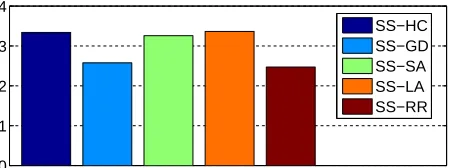
Based on the ranking strategy employed during the second round of ITC 2011, the sequence-based selection method when combined with record-to-record travel move acceptance method seems to perform slightly better than the other hyper-heuristic methods as shown in Figure 5. Hence, SS-RR is taken under consideration from this point onwards for further performance analysis, and we will refer to SS-RR as SSHH.
5.3 Comparison of SSHH to the Parametrised Sequence Approaches
sim-Table 2: Pairwise performance comparison of SS-HC, SS-SA, SS-GD, SS-RR and SS-LA (row vs column) using Mann-Whitney-Wilcoxon test based on average over 10 runs for eight instances
Brazil-Instance2 (BR) and Finland-ElementarySchool (FI) instances
BR SS-HC SS-SA SS-GD SS-RR SS-LA FI SS-HC SS-SA SS-GD SS-RR SS-LA
SS-HC ≃ ≃ ≃ ≃ SS-HC ≃ ≃ ≃ ≃
SS-SA ≃ ≃ ≃ ≃ SS-SA ≃ ≃ ≃ ≃
SS-GD ≃ ≃ ≃ ≃ SS-GD ≃ ≃ ≃ ≃
SS-RR ≃ ≃ ≃ ≃ SS-RR ≃ ≃ ≃ ≃
SS-LA ≃ ≃ ≃ ≃ SS-LA ≃ ≃ ≃ ≃
Greece-Aigio1stHighSchool2010 (GR) and Italy-Instance4 (IT) instances
GR SS-HC SS-SA SS-GD SS-RR SS-LA IT SS-HC SS-SA SS-GD SS-RR SS-LA
SS-HC ≃ ≃ ≃ ≃ SS-HC ≃ ≃ ≃ ≃
SS-SA ≃ ≃ ≃ ≃ SS-SA ≃ ≃ ≃ ≃
SS-GD ≃ ≃ ≃ ≃ SS-GD ≃ ≃ ≃ ≃
SS-RR ≃ ≃ ≃ ≃ SS-RR ≃ ≃ ≃ ≃
SS-LA ≃ ≃ ≃ ≃ SS-LA ≃ ≃ ≃ ≃
Kosova-Instance1 (KS) and Netherlands-Kottenpark2009 (NL) instances
KS SS-HC SS-SA SS-GD SS-RR SS-LA NL SS-HC SS-SA SS-GD SS-RR SS-LA
SS-HC ≃ ≃ ≃ ≃ SS-HC ≃ ≃ ≃ ≃
SS-SA ≃ ≃ ≃ ≃ SS-SA ≃ ≃ ≃ ≃
SS-GD ≃ ≃ ≃ ≃ SS-GD ≃ ≃ ≃ ≃
SS-RR ≃ ≃ ≃ ≃ SS-RR ≃ ≃ ≃ ≃
SS-LA ≃ ≃ ≃ ≃ SS-LA ≃ ≃ ≃ ≃
South Africa-Woodlands2009 (ZA) and Spain-School (ES) instances
ZA SS-HC SS-SA SS-GD SS-RR SS-LA ES SS-HC SS-SA SS-GD SS-RR SS-LA
SS-HC − − − ≃ SS-HC ≃ ≃ ≃ ≃
SS-SA + + + + SS-SA ≃ ≃ ≃ ≃
SS-GD + − ≃ + SS-GD ≃ ≃ ≃ ≃
SS-RR + − ≃ + SS-RR ≃ ≃ ≃ ≃
[image:16.612.128.511.275.595.2]0 1 2 3 4
[image:17.612.203.429.111.195.2]SS−HC SS−GD SS−SA SS−LA SS−RR
Figure 5: Comparisons of the different move acceptance methods when combined with the sequence-based selection method. The vertical axis shows the score values using ITC 2011 ranking strategy over 10 runs from eight instances
ple hyper-heuristic to create and evaluate sequences of heuristics rather than apply-ing sapply-ingle heuristics. Given n low level heuristics {LLH0, . . . , LLHn−1}, we form other sequences of heuristics of size 2 and size 3 and then invoke them successively. The total number of sequences of low level heuristics is n+n2 +n3 in the overall: {LLH0, . . . , LLHn−1, LLH0+LLH0, LLH0+LLH1, . . . , LLHn−1+LLHn−1, LLH0+
LLH0+LLH0, . . . , LLHn−1+LLHn−1+LLHn−1}, whereLLHi+LLHj+LLHk de-notes the sequence of applyingLLHifollowed byLLHjand followed byLLHk.
We are able to present results for a sequence size of up to 3 where 3615 permu-tations are investigated. There are 54240 permupermu-tations of 4 heuristics and an analysis of this space was too computationally complex to execute here. The proposed SSHH does not take the size of sequences as a parameter, but rather it learns the optimum size during the optimisation (in an online manner).
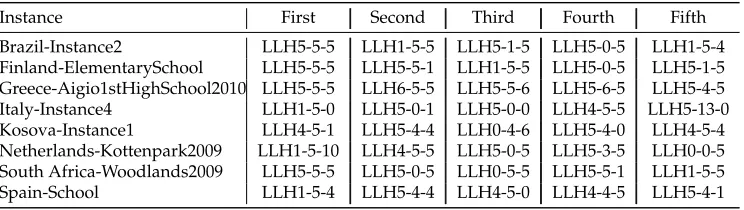
10000 solutions are randomly generated and applied each sequence to these gener-ated solutions over eight ITC 2011 instances (a representative instance from each coun-try). The utilisation rate for each sequence is equal but that does not mean that applying all these sequences would improve the quality of the input solutions. We therefore com-puted the utilisation rate considering only improving moves per sequence and for each instance. Table 3 provides the top five sequences that generate the highest utilisation rate of improving moves. From the table, we observe that sequences of size 3 are the dominants. This is perhaps to be expected as a greater movement in search space can be accomplished with the application of three well selected heuristics, although poorer performance could also perhaps be expected if the heuristics are not well matched. It is clear from the table that heuristic 5 is particularly important for generating new bet-ter solutions in these problems, and the 3-fold combination of LLH5 appears top for 4/8 instances. However, it should also be noted that for the other half, LLH5 is best combined with other heuristics to deliver optimal performance. This study of heuristic sequence behaviour is important in determining heuristic performance in context as part of the overall search process, rather than as single application events.
Table 3: The performance of applying sequences of low level heuristics of size one, two and three and applying them on randomly generated solutions. LLHi-j-k denotes the sequenceLLHi+LLHj+LLHk
Instance First Second Third Fourth Fifth
[image:18.612.202.429.346.467.2]Brazil-Instance2 LLH5-5-5 LLH1-5-5 LLH5-1-5 LLH5-0-5 LLH1-5-4 Finland-ElementarySchool LLH5-5-5 LLH5-5-1 LLH1-5-5 LLH5-0-5 LLH5-1-5 Greece-Aigio1stHighSchool2010 LLH5-5-5 LLH6-5-5 LLH5-5-6 LLH5-6-5 LLH5-4-5 Italy-Instance4 LLH1-5-0 LLH5-0-1 LLH5-0-0 LLH4-5-5 LLH5-13-0 Kosova-Instance1 LLH4-5-1 LLH5-4-4 LLH0-4-6 LLH5-4-0 LLH4-5-4 Netherlands-Kottenpark2009 LLH1-5-10 LLH4-5-5 LLH5-0-5 LLH5-3-5 LLH0-0-5 South Africa-Woodlands2009 LLH5-5-5 LLH5-0-5 LLH0-5-5 LLH5-5-1 LLH1-5-5 Spain-School LLH1-5-4 LLH5-4-4 LLH4-5-0 LLH4-4-5 LLH5-4-1
Table 4: Score of SSHH and FPHH for each selected instance over 10 runs which is com-puted using the scoring scheme utilised in the second round of ITC 2011 competition for ranking different approaches. The best score values are highlighted in bold
Instance SSHH FPHH
Brazil-Instance2 1.45 1.55
Finland-ElementarySchool 1.50 1.50
Greece-Aigio1stHighSchool2010 1.20 1.80
Italy-Instance4 1.40 1.60
Kosova-Instance1 1.20 1.80
Netherlands-Kottenpark2009 1.40 1.60 South Africa-Woodlands2009 1.60 1.40
Spain-School 1.50 1.50
the ranking score of SSHH and FPHH for eight ITC 2011 selected instances over 10 runs using the ITC 2011 ranking method. The table shows that SSHH performs the best in 9 instances including two draws. This provides evidence that the size of the sequences of heuristics should not be fixed, but rather that the hyper-heuristic method should take the responsibility of detecting the optimum size of sequences during the optimisation.
5.4 Comparison of the Different Variants of SSHH
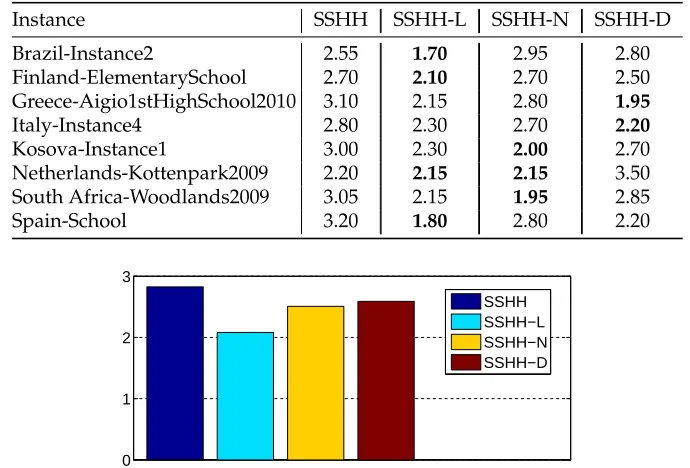
The performance of the different variants of SSHH described in Section 4 are inves-tigated over eight ITC 2011 instances (a representative instance from each country). Table 5 and Figure 6 summarise the performance of each variant based on 10 runs for each selected instance using the ranking strategy employed in the second round of the ITC 2011 competition. The results show that SSHH-L with linear update performs overall better than SSHH, SSHH-N and SSHH-D. SSHH-L generates the best score in four instances including one draw. SSHH-N obtains the best results in three instances including a draw. The ranking results put SSHH-D third with best score in two in-stances. SSHH performs worse than the other algorithms considering that the number of instances for which it produces the best ranking score is zero.
for-Table 5: Score of each SSHH variant for each selected instance over 10 runs which is computed using the scoring scheme utilised in the second round of ITC 2011 competi-tion for ranking different approaches. The best score values are highlighted in bold
Instance SSHH SSHH-L SSHH-N SSHH-D
Brazil-Instance2 2.55 1.70 2.95 2.80
Finland-ElementarySchool 2.70 2.10 2.70 2.50
Greece-Aigio1stHighSchool2010 3.10 2.15 2.80 1.95
Italy-Instance4 2.80 2.30 2.70 2.20
Kosova-Instance1 3.00 2.30 2.00 2.70
Netherlands-Kottenpark2009 2.20 2.15 2.15 3.50
South Africa-Woodlands2009 3.05 2.15 1.95 2.85
Spain-School 3.20 1.80 2.80 2.20
0 1 2 3
SSHH SSHH−L SSHH−N SSHH−D
Figure 6: Overall scores of the different variants of SSHH using ITC 2011 ranking strat-egy over 10 runs from eight instances
ward for the performance comparison to previously proposed approaches.
5.5 An Analysis of SSHH and SSHH-L Methods
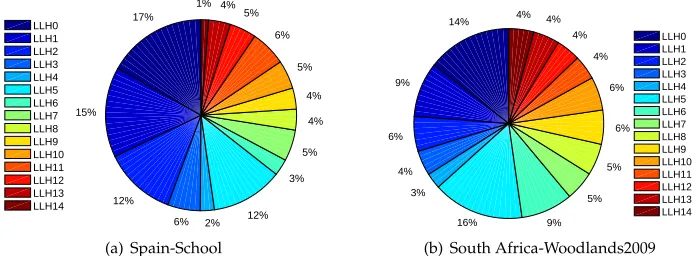
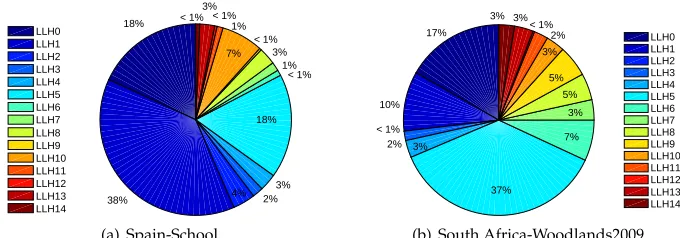
Figure 7 depicts the average heuristic utilisation rate using SSHH over 10 runs of each low level heuristic considering only invocations that generated improvement on the best-of-run solution and AS=1 while solving two selected sample instances of Spain-School and South Africa-Woodlands2009. Figure 8 shows the same but considering both AS=1 and AS=2. It can be observed in Figure 7 that LLH0, LLH1 and LLH5 are the most successful heuristics, generating the highest utilisation rate in both instances. LLH2 seems to perform well in the Spain-School instance, and the same applies to LLH6 in South Africa-Woodlands2009 instance. The remaining heuristics appear to provide poor performance. One may notice from the figure that the most successful heuristics are event-oriented operators (LLH0-LLH8) rather than resource-oriented op-erators (LLH9-LLH14). Having said that and by examining Figure 8, the results show that resource-oriented operators are useful when combined and applied within a se-quence of operations.
[image:19.612.141.486.169.403.2]27%
23% 13% 2% 3% 18% 2% 2% 1% 1% 3% 1% < 1% 2% < 1% LLH0 LLH1 LLH2 LLH3 LLH4 LLH5 LLH6 LLH7 LLH8 LLH9 LLH10 LLH11 LLH12 LLH13 LLH14 (a) Spain-School 22% 11% 1%
3% 4% 22% 16% 4% 2% 5% < 1% 2% 2% 3% 2% LLH0 LLH1 LLH2 LLH3 LLH4 LLH5 LLH6 LLH7 LLH8 LLH9 LLH10 LLH11 LLH12 LLH13 LLH14
[image:20.612.144.483.163.280.2](b) South Africa-Woodlands2009
Figure 7: Average utilisation rate of each low level heuristic considering only invoca-tions that generated improvement on the best-of-run solution and AS=1 from 10 runs using SSHH while solving Spain-School and South Africa-Woodlands2009 instances
17%
15%
12%
6% 2% 12% 3% 5% 4% 4% 5% 6% 5% 4% 1% LLH0 LLH1 LLH2 LLH3 LLH4 LLH5 LLH6 LLH7 LLH8 LLH9 LLH10 LLH11 LLH12 LLH13 LLH14 (a) Spain-School 14% 9% 6% 4% 3% 16% 9% 5% 5% 6% 6% 4% 4% 4% 4% LLH0 LLH1 LLH2 LLH3 LLH4 LLH5 LLH6 LLH7 LLH8 LLH9 LLH10 LLH11 LLH12 LLH13 LLH14
(b) South Africa-Woodlands2009
[image:20.612.142.491.453.581.2]18%
38% 4% 2% 3% 18% < 1% 1% 3% < 1% 7% 1% < 1% 3% < 1% LLH0 LLH1 LLH2 LLH3 LLH4 LLH5 LLH6 LLH7 LLH8 LLH9 LLH10 LLH11 LLH12 LLH13 LLH14 (a) Spain-School 17% 10% < 1% 2% 3% 37% 7% 3% 5% 5% 3% 2% < 1% 3% 3% LLH0 LLH1 LLH2 LLH3 LLH4 LLH5 LLH6 LLH7 LLH8 LLH9 LLH10 LLH11 LLH12 LLH13 LLH14
[image:21.612.144.484.108.227.2](b) South Africa-Woodlands2009
Figure 9: Average utilisation rate of each low level heuristic considering only invoca-tions that generated improvement on the best-of-run solution and AS=1 from 10 runs using SSHH-L while solving Spain-School and South Africa-Woodlands2009 instances
14%
22%
11%
5% < 1% 9% < 1% 4% 7% 3% 9% 5% < 1% 9% < 1% LLH0 LLH1 LLH2 LLH3 LLH4 LLH5 LLH6 LLH7 LLH8 LLH9 LLH10 LLH11 LLH12 LLH13 LLH14 (a) Spain-School 14% 13% 6% < 1%
< 1% 16%
2% 6% 8% 7% 4% 2% 4% 7% 9% LLH0 LLH1 LLH2 LLH3 LLH4 LLH5 LLH6 LLH7 LLH8 LLH9 LLH10 LLH11 LLH12 LLH13 LLH14
(b) South Africa-Woodlands2009
Figure 10: Average utilisation rate of each low level heuristic considering only invo-cations that generated improvement on the best-of-run solution and AS=1 & 2 from 10 runs using SSHH-L while solving Spain-School and South Africa-Woodlands2009 instances
utilisation rate in both instances. We also observe from Figure 10 the involvement of resource-oriented operators showing that they are useful when combined and applied within sequence of heuristics.
Figure 11 provides the average probabilities of the HMM matrices for each low level heuristic over 10 runs using SSHH while solving two selected sample problem in-stances of Spain-School and South Africa-Woodlands2009. By examining the transition figure for Spain-School instance, the following exploitative heuristics LLH0, LLH5 and LLH1 appear to be more successful than others in delivering best-of-run solutions as shown by the probability matrix in South Africa-Woodlands2009 problem instance. In the latter, LLH9 is an exploration heuristic that needs to be combined with (preferably) LLH1.
[image:21.612.139.488.298.427.2](Algo-0 0.2 0.4 0.6 0.8 1 LLH0
LLH1 LLH2 LLH3 LLH4 LLH5 LLH6 LLH7 LLH8 LLH9 LLH10 LLH11 LLH12 LLH13 LLH14
AS=1 AS=2
0 0.2 0.4 0.6 0.8 1 LLH0
LLH1 LLH2 LLH3 LLH4 LLH5 LLH6 LLH7 LLH8 LLH9 LLH10 LLH11 LLH12 LLH13 LLH14
LLH0 LLH1 LLH2 LLH3 LLH4 LLH5 LLH6 LLH7 LLH8 LLH9 LLH10 LLH11 LLH12 LLH13 LLH14
(a) Spain-School
0 0.2 0.4 0.6 0.8 1 LLH0
LLH1 LLH2 LLH3 LLH4 LLH5 LLH6 LLH7 LLH8 LLH9 LLH10 LLH11 LLH12 LLH13 LLH14
AS=1 AS=2
0 0.2 0.4 0.6 0.8 1 LLH0
LLH1 LLH2 LLH3 LLH4 LLH5 LLH6 LLH7 LLH8 LLH9 LLH10 LLH11 LLH12 LLH13 LLH14
LLH0 LLH1 LLH2 LLH3 LLH4 LLH5 LLH6 LLH7 LLH8 LLH9 LLH10 LLH11 LLH12 LLH13 LLH14
[image:22.612.132.516.213.536.2](b) South Africa-Woodlands2009
0 0.2 0.4 0.6 0.8 1 LLH0 LLH1 LLH2 LLH3 LLH4 LLH5 LLH6 LLH7 LLH8 LLH9 LLH10 LLH11 LLH12 LLH13 LLH14 AS=1 AS=2
0 0.2 0.4 0.6 0.8 1 LLH0 LLH1 LLH2 LLH3 LLH4 LLH5 LLH6 LLH7 LLH8 LLH9 LLH10 LLH11 LLH12 LLH13 LLH14 LLH0 LLH1 LLH2 LLH3 LLH4 LLH5 LLH6 LLH7 LLH8 LLH9 LLH10 LLH11 LLH12 LLH13 LLH14 (a) Spain-School
0 0.2 0.4 0.6 0.8 1 LLH0 LLH1 LLH2 LLH3 LLH4 LLH5 LLH6 LLH7 LLH8 LLH9 LLH10 LLH11 LLH12 LLH13 LLH14 AS=1 AS=2
0 0.2 0.4 0.6 0.8 1 LLH0 LLH1 LLH2 LLH3 LLH4 LLH5 LLH6 LLH7 LLH8 LLH9 LLH10 LLH11 LLH12 LLH13 LLH14 LLH0 LLH1 LLH2 LLH3 LLH4 LLH5 LLH6 LLH7 LLH8 LLH9 LLH10 LLH11 LLH12 LLH13 LLH14
[image:23.612.132.517.107.437.2](b) South Africa-Woodlands2009
Figure 12: Average probabilities of the HMM matrices for each low level heuristic from 10 runs using SSHH-L while solving Spain-School and South Africa-Woodlands2009 instances
rithm 1) and the final HMM probability matrices as input for the Spain-School and South-Africa-Woodlands2009 problem instances. Table 6 summarises the results. Al-though single heuristics are frequently used, the approach clearly identifies sequences of size 2 and 3 as useful to the search. In the South Africa-Woodlands2009 instance, the sequences LLH14-LLH5 and LLH9-LLH0 are identified amongst the top 10 generated sequences. An interesting finding is that the exploration heuristics LLH9 and LLH14 are resource-oriented operators whilst LLH0 and LLH5 are event-oriented operators. In the Spain-School instance, the sequence of size 3, LLH13-LLH9-LLH0, is also iden-tified being generated 153 times. It should be noted here that this represents the set of sequences generated from the final learned matrix for each problem and the approach may also have identified alternative sequences during the search process.
5.6 Comparison of SSHH and SSHH-L to the Best Known Methods
Algorithm 1:Simulator
1 LetLLH={llh1, llh2, . . .}represents set of low level heuristics;
2 LetT ransitionScorellhc,llhnrepresents score of moving fromllhctollhn;
3 LetASScorellhn,lrepresents score of applying acceptance strategylforllhn;
4 LetSrepresents the number of sequences to be constructed;
5 llhn←SelectRandom(LLH);AS ←2;
6 fori←1,2, . . . , Sdo
7 SEQ.Clear();
8 whileAS== 2do
9 llhc←llhn;
10 llhn←RouletteWheel(T ransitionScore, llhc);
11 AS←RouletteWheel(ASScore, llhn);
12 SEQ.Add(llhn);
13 end
14 RECORD.Add(SEQ);
15 end
[image:24.612.170.459.501.661.2]16 returnRECORD;
Table 6: The top ten constructed sequences of low level heuristics while solving Spain-School and South Africa-Woodlands2009 instances using the developed simulator
Spain-School South Africa-Woodlands2009
Sequence Count Sequence Count
LLH1 2759 LLH5 1021
LLH0 1081 LLH0 595
LLH5 394 LLH1 338
LLH8+LLH0 333 LLH14 326
LLH10 227 LLH14+LLH5 263
LLH7+LLH1 201 LLH2+LLH5 259
LLH13+LLH1 198 LLH6 229
LLH13+LLH8+LLH0 153 LLH10 200
LLH2+LLH1 145 LLH13 189
0 1 2 3 4 5 6
[image:25.612.202.428.108.237.2]GOAL HySST Lectio HFT SSHH SSHH−L
Figure 13: Comparisons of ITC solvers, SSHH and SSHH-L based on ITC 2011 ranking strategy over 10 runs for each ITC 2011 instances
equivalent totimeLimit=1000 seconds is reached as the competition requires. A bench-marking software tool provided at the competition website is used to report the equiv-alent time value in the used machine. It reported that our machine should take 492 seconds per run. Using the results of the second round of ITC 2011 solvers provided at the competition website, Figure 13 summarises the performance comparison of SSHH and SSHH-L to the ITC 2011 methods (GOAL, HySST, Lectio and HFT) over 18 ITC 2011 instances, each with ten runs. The results show that the SSHH-L method is the winner with a score of 2.22 in the overall, with SSHH slightly behind, indicating that the sequence selection based approach produces best-in-class results on this problem set.
Table 7 summarises the results on XHSTT-2014 benchmark over 10 runs. The solvers (SSHH and SSHH-L) terminate as long as there is no improvement to the best solution in hand for 200 seconds. At time of submission, our solvers managed to de-liver 9 best known solutions, and match the best known solutions in 4 instances. The performance is superior on most of the large instances including those from Australia, Denmark, Netherlands and USA. They also perform well on the problem instances from Greece and Kosova. The performance on the instances from Brazil, Spain, Fin-land, England and Italy is average but still our solvers can deliver near best known solutions. However, they cannot generate the best or near the best known solutions on the problem instances from South Africa.
Considering the averages performance, SSHH-L is the winner in 18 instances in-cluding 3 ties; while SSHH wins in 10 instances inin-cluding 3 ties. Overall, the linear nature of SSHH-L and it’s ability to weight improvements later in the search as more important appears to preserve diversity and improve on the standard SSHH imple-mentation.
6
Conclusion
The goal in hyper-heuristic research is to raise the level of generality by offering search methodologies that are easier to use, cheaper to implement and maintain than knowledge-intensive methods and yet deliver better average-case performance across a range of problems.
In this paper it has been shown:
• That the selection strategy of a hyper-heuristic is more important than the move acceptance method for this range of problems.
• That sequences of heuristics are able to deliver improved performance over single applications of a heuristic and that some problem instances benefit from the use of multiple heuristic types working together in sequence.
• That sequence lengths are better to be optimised on a per instance basis rather than randomly chosen.
• That an approach that prioritises heuristics that are able to generate better solu-tions towards the end of the search performs better than an approach that does not. This stands to reason, because as the search progresses, it becomes increas-ingly difficult to find solutions that achieve better performance than the current solution and so those heuristics capable of discovering these later on in the search should be rewarded accordingly. This method also provides a mechanism for the hyper-heuristic to modify its learned behaviour later in the search, something that is possible, but less prevalent in the standard SSHH method.
In conclusion, the empirical results indicate that the proposed method is powerful and an effective general search methodology performing better than the current state-of-the-art methods in solving high school timetabling problems.
Future work will focus on the automated adaptation of the single parameter of the method within the move acceptance component.
Acknowledgements
This work was supported by EPSRC grant EP/K000519/1. The authors would like to thank David Walker for developing the simulator presented in the results section.
References
Abramson, D. (1991). Constructing school timetables using simulated annealing: sequential and parallel algorithms.Management Science, 37(1):98–113.
Abramson, D. A., Dang, H., and Krisnamoorthy, M. (1999). Simulated annealing cooling sched-ules for the school timetabling problem.Asia-Pacific Journal of Operational Research, 16(1):1–22.
Ahmed, L. N., ¨Ozcan, E., and Kheiri, A. (2015). Solving high school timetabling problems world-wide using selection hyper-heuristics.Expert Systems with Applications, 42(13):5463–5471.
Alvarez-Vald´es, R., Parre ˜no, F., and Tamarit, J. M. (2002). A tabu search algorithm for assigning teachers to courses.TOP, 10(2):239–259.
Baum, L. E. and Petrie, T. (1966). Statistical inference for probabilistic functions of finite state Markov chains.The Annals of Mathematical Statistics, 37(6):1554–1563.
Beligiannis, G. N., Moschopoulos, C. N., Kaperonis, G. P., and Likothanassis, S. D. (2008). Apply-ing evolutionary computation to the school timetablApply-ing problem: the Greek case. Computers and Operations Research, 35(4):1265–1280.
Bilgin, B., ¨Ozcan, E., and Korkmaz, E. E. (2007). An experimental study on hyper-heuristics and exam scheduling. In Burke, E. K. and Rudov´a, H., editors,Practice and Theory of Automated Timetabling VI, volume 3867 ofLecture Notes in Computer Science, pages 394–412. Springer Berlin Heidelberg.
Birbas, T., Daskalaki, S., and Housos, E. (2009). School timetabling for quality student and teacher schedules.Journal of Scheduling, 12(2):177–197.
Buf´e, M., Fischer, T., Gubbels, H., H¨acker, C., Hasprich, O., Scheibel, C., Weicker, K., Weicker, N., Wenig, M., and Wolfangel, C. (2001). Automated solution of a highly constrained school timetabling problem - preliminary results. In Boers, E. J. W., editor,Applications of Evolutionary Computing, volume 2037 ofLecture Notes in Computer Science, pages 431–440. Springer Berlin Heidelberg.
Burke, E. K. and Bykov, Y. (2008). A late acceptance strategy in hill-climbing for exam timetabling problems. InProceedings of the 7th International Conference on the Practice and Theory of Automated Timetabling (PATAT ’08).
Burke, E. K., Gendreau, M., Hyde, M., Kendall, G., Ochoa, G., ¨Ozcan, E., and Qu, R. (2013). Hyper-heuristics: a survey of the state of the art. Journal of the Operational Research Society, 64(12):1695–1724.
Calderia, J. P. and Ross, A. C. (1997). School timetabling using genetic search. InProceedings of the International Conference on the Practice and Theory of Automated Timetabling (PATAT ’97), pages 115–122.
Colorni, A., Dorigo, M., and Maniezzo, V. (1992). A genetic algorithm to solve the timetable problem. Technical Report Technical Report No. 90-060, Politecnico di Milano, Italy.
Cowling, P., Kendall, G., and Soubeiga, E. (2001). A hyperheuristic approach to scheduling a sales summit. In Burke, E. and Erben, W., editors,Practice and Theory of Automated Timetabling III, volume 2079 ofLecture Notes in Computer Science, pages 176–190. Springer Berlin Heidelberg.
Domr ¨os, J. and Homberger, J. (2012). An evolutionary algorithm for high school timetabling. In Proceedings of the 9th International Conference on the Practice and Theory of Automated Timetabling (PATAT ’12), pages 485–488.
Dueck, G. (1993). New optimization heuristics: the great deluge algorithm and the record-to-record travel.Journal of Computational Physics, 104(1):86–92.
Even, S., Itai, A., and Shamir, A. (1976). On the complexity of timetable and multicommodity flow problems.SIAM Journal on Computing, 5(4):691–703.
Fagerland, M. W. and Sandvik, L. (2009). The Wilcoxon–Mann–Whitney test under scrutiny. Statistics in Medicine, 28(10):1487–1497.
Filho, G. R., Antonio, L., and Lorena, L. A. N. (2001). A constructive evolutionary approach to school timetabling. In Boers, E. J. W., editor,Applications of Evolutionary Computing, volume 2037 ofLecture Notes in Computer Science, pages 130–139. Springer Berlin Heidelberg.
Fonseca, G. H. G., Santos, H. G., and Carrano, E. G. (2015). Late acceptance hill-climbing for high school timetabling.Journal of Scheduling, pages 1–13.
Fonseca, G. H. G., Santos, H. G., Toffolo, T. ˆA. M., Brito, S. S., and Souza, M. J. F. (2014). GOAL solver: a hybrid local search based solver for high school timetabling. Annals of Operations Research, pages 1–21.
Glover, F. (1986). Future paths for integer programming and links to artificial intelligence. Com-puters and Operations Research, 13(5):533–549.
Holland, J. (1975).Adaptation in Natural and Artificial Systems. University of Michigan Press, Ann Arbor, MI, USA.
Jacobsen, F., Bortfeldt, A., and Gehring, H. (2006). Timetabling at German secondary schools: tabu search versus constraint programming. InProceedings of the 6th International Conference on the Practice and Theory of Automated Timetabling (PATAT ’06), pages 439–442.
Kalender, M., Kheiri, A., ¨Ozcan, E., and Burke, E. K. (2013). A greedy gradient-simulated anneal-ing selection hyper-heuristic.Soft Computing, 17(12):2279–2292.
Kendall, G. and Mohamad, M. (2004). Channel assignment optimisation using a hyper-heuristic. InProceedings of the 2004 IEEE Conference on Cybernetic and Intelligent Systems (CIS2004), pages 790–795, Singapore.
Kheiri, A. (2014). Multi-stage Hyper-heuristics for Optimisation Problems. PhD thesis, University of Nottingham, School of Computer Science.
Kheiri, A. and Keedwell, E. (2015a). Markov chain selection hyper-heuristic for the optimisation of constrained magic squares.15th UK Workshop on Computational Intelligence (UKCI2015).
Kheiri, A. and Keedwell, E. (2015b). A sequence-based selection hyper-heuristic utilising a hid-den Markov model. InProceedings of the 2015 on Genetic and Evolutionary Computation Confer-ence, GECCO ’15, pages 417–424, New York, NY, USA. ACM.
Kheiri, A., Keedwell, E., Gibson, M. J., and Savic, D. (2015). Sequence analysis-based hyper-heuristics for water distribution network optimisation. Procedia Engineering, 119:1269–1277. Computing and Control for the Water Industry (CCWI2015) Sharing the best practice in water management.
Kheiri, A., ¨Ozcan, E., and Parkes, A. J. (2016). A stochastic local search algorithm with adaptive acceptance for high-school timetabling.Annals of Operations Research, 239(1):135–151.
Kingston, J. H. (2005). A tiling algorithm for high school timetabling. In Burke, E. and Trick, M., editors,Practice and Theory of Automated Timetabling V, volume 3616 ofLecture Notes in Computer Science, pages 208–225. Springer Berlin Heidelberg.
Kingston, J. H. (2014). KHE14: an algorithm for high school timetabling. InProceedings of the 10th International Conference on the Practice and Theory of Automated Timetabling (PATAT ’14), pages 269–291.
Kirkpatrick, S., Gelatt, C. D., and Vecchi, M. P. (1983). Optimization by simulated annealing. Science, 220(4598):671–680.
Kruskal, W. H. (1957). Historical notes on the Wilcoxon unpaired two-sample test. Journal of the American Statistical Association, 52(279):356–360.
Lara, C., Flores, J. J., and Calderon, F. (2008). Solving a school timetabling problem using a bee algorithm. In Gelbukh, A. and Morales, E. F., editors,MICAI 2008: Advances in Artificial Intelligence, volume 5317 ofLecture Notes in Computer Science, pages 664–674. Springer Berlin Heidelberg.
Mel´ıcio, F., Calderia, J. P., and Rosa, A. (2006). THOR: a tool for school timetabling. InProceedings of the 6th International Conference on the Practice and Theory of Automated Timetabling (PATAT ’06), pages 532–535.
Moura, A. V. and Scaraficci, R. A. (2010). A GRASP strategy for a more constrained school timetabling problem.International Journal of Operational Research, 7(2):152–170.
¨