On Extending Scott Modules
Alec Gullon
Department of Mathematics and Statistics
Lancaster University
This dissertation is submitted for the degree of
Doctor of Philosophy
Declaration
Hereby I declare that the present thesis was prepared by me and none of its contents was obtained by means that are against the law.
I also declare that the present thesis is a part of a PhD Programme at Lancaster University. The thesis has never before been a subject of any procedure of obtaining an academic degree.
Acknowledgements
I have enjoyed a very special four years in Lancaster, and there are many people who need to
be thanked and mentioned here. At the top of that list sits my supervisor, Nadia Mazza, who
guided me through the process with superhuman patience. Thank you for sharing your small
corner of the world of mathematics with me and for being so understanding when things got
bumpy.
This thesis could not have been finished without the support of my Lancastrian friends,
and I have had many to lean on these years. Lefteris ‘Uncle Lefty’ Kastis deserves a special
mention, for his kind demeanour, good company in the office and, most importantly of all,
his fine Greek cuisine! Jamie Maunder also stands out as an individual to whom I owe a lot;
thank you for showing me how to cook and bake properly and for inspiring me to take up the
guitar. I am grateful to Mateusz Jurczynski (yes, I had to check it, and yes, I got it wrong
the first time) for sharing and revelling in nerdy pastimes with me and for always having my
back.
My thanks go to the members of STOR-i, who accepted me without suspicion and treated
me as one of their own from the start. The various rotating members of Lancaster’s finest
quiz team ‘Les Quizerables’ deserve a mention, for making me laugh many a Tuesday night
and for sharing the spoils of victory when the questions went our way. Thanks to everyone
at football for making it a highlight of my week: you all know who you are!
I want to thank my parents for their unwavering faith and belief in me that extends back
long before this PhD; my parents may not understand the specifics of what it is that I do, but
they understand how much it means to me, and support me tirelessly in my efforts because
of this. Make no mistake, this thesis exists because of them.
Finally, a special thank you goes to Lucy: for her love and support during the difficult
times; for making the good times so much sweeter; and, without whom, I may have given up
Abstract
We study a variety of questions related to the Scott modules S(G, Q) associated to
a finite group G, where Q denotes a p-subgroup ofG for a given prime p. The main
concept we study is that of a p-extendible group, which we define to be a group in
which the dimension ofS(G, Q) is minimal for allp-subgroupsQ ofG. We study those
Frobenius groups which are p-extendible and complete a classification of the local
subgroups of the sporadic groups which are p-extendible. Furthermore, we study Scott
modules associated to finite classical groups which admit (B, N)-pairs that are split
at characteristic p. The thesis concludes with some considerations about the relative
syzygy Ω2
Table of contents
1 Preliminaries 7
1.1 Representation Theory . . . 7
1.1.1 Induction . . . 11
1.1.2 Relative Projectivity . . . 14
1.1.3 Relatively Projective Resolutions . . . 16
1.1.4 The Green Correspondence . . . 19
1.1.5 Permutation Modules . . . 20
1.2 Group Theory . . . 23
1.2.1 Linear and Classical Groups . . . 27
1.2.2 Fusion . . . 32
1.2.3 p-Nilpotence . . . 35
2 Scott Modules 37 2.1 Existence and Basic Properties . . . 37
2.2 Behaviour Under Induction and Restriction . . . 44
2.3 Bounding dimS(G, Q) . . . 48
2.4 Scott Modules in the Normal Case . . . 58
3 Frobenius Groups and p-Extendibility 65 3.1 Frobenius Groups . . . 65
3.1.1 Solvable Complements . . . 67
3.1.2 Nonsolvable Complements . . . 69
3.2 p-Extendibility . . . 73
3.3 The Focal Subgroup . . . 78
xii Table of contents
3.4.1 Methodology . . . 80
3.4.2 Notation . . . 86
3.4.3 Mathieu Groups . . . 88
3.4.4 Leech Lattice Groups . . . 92
3.4.5 Pariahs . . . 101
3.4.6 Monster Sections . . . 108
4 Classical Groups 125 4.1 (B, N)-Pair Preliminaries . . . 125
4.2 The Subgroup B . . . 128
4.2.1 GLn(q) . . . 129
4.2.2 Other Classical Groups . . . 134
4.3 Parabolic Subgroups . . . 138
5 Relatively Projective Covers 141 5.1 Basic Constructions . . . 141
5.2 Bounding dim Ω2 P /Q(k) . . . 145
Appendix A Loose Ends 151 A.1 MAGMA Code . . . 151
A.1.1 The Case (F i′24,3D) . . . 155
A.2 Subgroups of p1+2+ . . . 155
A.3 Subgroups of Sp4(p) . . . 158
Introduction
This thesis is a contribution to the study of Scott modules, a class of modules which can be traced back to work conducted by Alperin, Burry and Scott from the early 1980s; the first explicit mention of these objects in the literature came in 1982, in Burry’s paper [6]. IfG is a finite group andk is an algebraically closed field of characteristic p,
then a Scott kG-module is a certain indecomposable p-permutation kG-module which
contains a submodule isomorphic to the trivial kG-module in its socle. This provides
one natural perspective to adopt on Scott modules, but others exist. For instance, we may also think of a Scott kG-module as being a certain trivial source kG-module, or
as a relatively projective cover of the trivial kG-module; the clearest unifying feature
behind these ideas is the requirement that the trivial module be contained in the module as a submodule.
Since their early introduction in the 1980s, Scott modules have featured in the literature, albeit in no consistent pattern. Often, results concerning Scott modules seem to draw inspiration from seemingly disconnected areas of mathematics. Recent examples of this phenomenon include [36], where a method is given to calculate Scott modules in the case where G has a cyclic Sylow p-subgroup, using the Brauer tree of
the principal block, and [25] and [20], where it is shown that certain Scott modules remain indecomposable under the Brauer construction. At present, there is no easy method for constructing a given Scott module for an arbitrary finite group and thus plenty of work remains to be done in this area.
If Mis a ScottkG-module, thenMhas vertex Q for ap-subgroupQ≤G, and an
elementary observation is that the permutation kP-module k[P/Q] is always a direct
summand of M↓P wheneverP is a Sylowp-subgroup ofGcontaining Q. The question
2 Table of contents
it the case that every ScottkG-moduleM satisfies the above extension property, i.e., when is it the case that every Scott kG-module M satisfies M↓P ∼=k[P/Q], where Q
is a vertex of M and P is a Sylow p-subgroup of G containing Q? The contents of
this thesis mainly arise from an attempt to study and analyse both of these questions. We also concern ourselves with some special cases where Scott modules M can be described more concretely; specifically, we derive a result which completely describes Scott modules in the case where P is normal in G.
Any given Scott module Mhas vertexQfor ap-subgroupQ≤G. Moreover, given
any p-subgroup Q contained in a Sylow p-subgroup P of G, there exists a unique
Scott module with this vertex, which is denoted by S(G, Q). Therefore, in order to
understand the full range of possible Scott modules that a given finite group G can
have, it is necessary to understand the full range of conjugacy classes of p-groups we
can have within G. At present, the literature is light on answering this question for
finite groups; instead, much more emphasis has been placed on studying the conjugacy classes of p-elements in finite groups. In Chapter 4, we consider the Borel subgroups of
some classical groups of small degree and completely describe all of the Scott modules that they can have; part of our efforts involve classifying the conjugacy classes of
p-subgroups within these Borel subgroups . Our methods, however, fall far short of
providing a general answer to this problem for an arbitrary finite group G.
Main Results
We have mentioned already that there exists no known method which reliably constructs a given Scott module for an arbitrary finite group. In Section 2.4, we derive some theory which helps develop a first step towards answering this question. The following is Theorem 2.4.2 of the thesis.
Theorem. Suppose that G is a finite group and Q≤P ∈Sylp(G) with P ◁ G. Then:
(i) S(P NG(Q), Q)↓P ∼=k[P/Q];
(ii) S(P NG(Q), Q)↑G is indecomposable and hence S(G, Q)∼=S(P NG(Q), Q)↑G.
In particular,
dimS(G, Q) = |G:P|
|NG(Q)|p′
Table of contents 3
In fact, we have S(P NG(Q), Q)=∼k[P NG(Q)/QR], where R is some subgroup of P NG(Q) whose order equals|P NG(Q) : P|. Thus, in the case where P is a normal
subgroup of G,S(G, Q) may be calculated by inducing a known k[P NG(Q)]-module
from P NG(Q) to G and it follows that quite a large amount is known about the
representation theory of S(G, Q) in this case. In the more general context, where P is
not normal in G, the above provides full insight into the properties of the k[NG(P
)]-module S(NG(P), Q), but it is difficult to see how useful it is in understanding the full
structure of the kG-module S(G, Q).
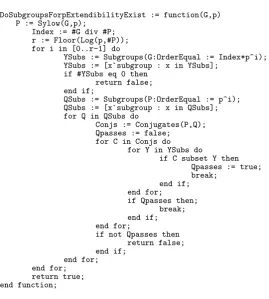
Central to the thesis is the concept of a finite groupGbeingp-extendiblefor a given
primep. We say that a finite group Gisp-extendible if for all P ∈Sylp(G) andQ≤P,
we have S(G, Q)↓P ∼=k[P/Q]. This definition is new and the question that motivates
it has not been explored at present in the literature. It is therefore important to know that the definition is not completely trivial; that is to say, that there exist sufficiently “interesting” groups Gwhich are p-extendible. As a starting point, we know that the p-nilpotent groups are themselves p-extendible, a fact which is derived in Proposition
2.3.7. Indeed, in this case, S(G, Q) is simply equal to the inflation of k[P/Q] along
a normal complement for P in G; thus, S(G, Q) is equal to an obvious extension of k[P/Q], which is not especially interesting. The following result, which is Theorem
3.1.6 of the thesis, gives a richer class of examples to consider.
Theorem. Suppose that G=K⋊H is a Frobenius group with Frobenius kernel K
and Frobenius complement H and p∈π(H). Assume furthermore that H is solvable
and any of the following are true:
(i) p > 3;
(ii) p= 3 andO2(H)̸∼=Q8;
(iii) p= 2 andP is cyclic.
ThenG is p-extendible.
We note that an analogous statement exists for the case where G= K⋊H is a
Frobenius group with a nonsolvable Frobenius complement H, however, the details are
messier than the case where H is solvable; the reader is directed towards Section 3.1.2
4 Table of contents
justify the study of our new definition, since their p-extendibility for the primes under
consideration is a rather surprising fact, in comparision to the p-nilpotent groups.
Layout of Thesis
We indicate here how the thesis is laid out, and what the essential contents of each chapter are.
• Chapter 1 starts by covering all of the necessary preliminaries in order to un-derstand the bulk of the thesis; we introduce here basic notions tied into the theories of modular representations and finite groups.
• In Chapter 2, we present a detailed survey into the well-known properties of Scott modules, and include a proof of their existence, which is accredited to Alperin and Scott. We define ap-extendiblegroup to be a finite groupGin which
S(G, Q)↓P ∼= k[P/Q] for all Sylow p-subgroups P of G and p-subgroups Q of P. We also present some evidence that this definition is not completely trivial;
in particular, we show that p-nilpotent groups satisfy this property, and ifp is
odd, then every abelianp-group is a Sylowp-subgroup of some finitep-extendible
group which is not p-nilpotent. We finish the chapter with a new result, which
describes the dimension of a given Scott module in the case whereGhas a normal
Sylow p-subgroup P in terms of the order of the local subgroup NG(Q).
• In Chapter 3, we start by supplementing our collection of examples of finite groups which are p-extendible, by studying the Frobenius complements in Frobenius
groups. We then follow this up by studying the necessary structure that a
p-extendible group must satisfy, and we demonstrate that the notions of being p-nilpotent andp-extendible are equivalent for p-solvable groups Gwhen p is the
smallest prime divisor of |G|. The second half of this chapter studies the p-local
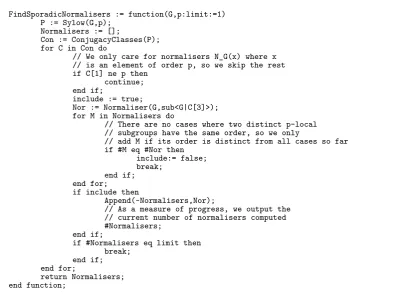
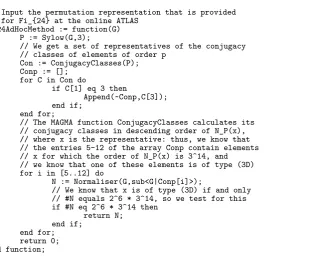
subgroups of the 26 sporadic groups and answers the following question: if N is
ap-local subgroup of a sporadic group and q is a prime divisor of N, when is N q-extendible?
Table of contents 5
(B, N)-pair which defines a classical group and classify the possible dimensions
for Scott modules in some cases of small degree. We also briefly cover Scott modules associated to the parabolic subgroups.
• In Chapter 5, we break from the main pattern of studying Scott modules, to look at relatively projective covers in more generality. The main topic of this chapter is a look into the properties of the second relative syzygy and a result which gives an upper bound on its dimension.
Chapter 1
Preliminaries
We start with a chapter drawing together the background material we shall need concerning kG-modules and finite groups. Most of the material covered in this chapter
is standard, though we include references for less well-known results. We shall take [1] as a standard reference for the topic of representation theory; [17] and [21] will be our main references for group theory.
1.1
Representation Theory
This thesis is ultimately an account of results relating to the modular representation theory of finite groups. We shall adopt a module-theoretic perspective on this theory; thus, the major object of study in this thesis will be the following.
Definition 1.1.1. Let G be a group and k be a field. A (left) kG-module M is a vector space over k together with an action of the group G onMsuch that:
(i) g(m+n) = gm+gnfor all g ∈Gand m, n∈ M;
(ii) g(λm) =λ(gm) for allg ∈G, m∈ M and λ∈k;
(iii) g(hm) = (gh)m for all g, h∈G and m∈ M.
Thus, akG-module Mis a vector space equipped with an action of the group G
8 Preliminaries
therefore be encoded in a homomorphism ρ:G→GL(M), and of course, the reverse is true as well.
We now put in place some of the standard notation we shall use throughout the thesis in relation to kG-modules. We fix a finite group Gand an algebraically closed
field k and assume thatk has positive characteristic p; we assume furthermore that
any groups we work with have order divisible by p, unless we state otherwise. The
dimension of a kG-module M is equal to the dimension of the underlying k-vector
space, and we denote this quantity by dimM. We assume at all times in this thesis that dimM is finite; the category of finite-dimensional kG-modules is denoted by
modkG. By a k-basis of M, we mean a basis of the underlying vector space.
If U,V ≤ Mare submodules of M, then we write M=U ⊕ V if U +V =M and U ∩ V = {0}, and we say that Mis adirect sum of its submodulesU andV. We say that a nonzero kG-module Mis indecomposableif whenever M=U ⊕ V we have eitherU ={0}orV ={0}and we say thatMissimpleifMhas no proper, nontrivial submodules. Thus simple modules are clearly indecomposable, but indecomposable modules need not be simple. If Mis a kG-module and n ∈N, then we set
Mn:=M ⊕ M ⊕ · · · ⊕ M
| {z }
ntimes
.
The symbol M ⊗ N denotes the tensor product of thekG-modulesMandN; thus, the underlying vector space ofM ⊗ N is the tensor product of the vector spaces M and N, and we define a kG-module structure by setting g(m⊗n) =gm⊗gn for all g ∈G, m∈ M and n ∈ N.
If U1, . . . ,Us≤ M are indecomposable submodules of M, then we write
M=
s
M
i=1
Ui
if every vector m ∈ M can be written uniquely as m = u1 +· · · +us for some ui ∈ Ui,1 ≤ i ≤ s, and we refer to the above expression as an indecomposable decomposition of the kG-module M. The Krull-Schmidt theorem [1, Theorem 4.3] states that if
M=
s
M
i=1
Ui = t
M
j=1
1.1 Representation Theory 9
are two indecomposable decompositions for the kG-module M, thens =t and, upon
rearranging the submodules if necessary, we have Ui ∼= Vi for 1 ≤ i ≤ s. Thus, an
indecomposable decomposition for a kG-module is essentially unique and every
finite-dimensionalkG-module has such an indecomposable decomposition, so the classification
of kG-modules can be reduced to the classification of indecomposable kG-modules. If
U ≤ M, we say thatU is a direct summandofMif there exists a submoduleX ≤ M such that M=U ⊕ X; we refer to the module X as a direct sum complementfor
U in M.
For a givenkG-module M, we denote by soc(M) the submodule of M generated by the simple submodules of Mand refer to this as the socle of M; we denote the intersection of all the maximal submodules of Mby rad(M) and call this the radical of M. The trivial kG-module is denoted by kG.
If M is a kG-module and H ≤ G, then we denote by M↓H the restriction of
M to H; thus M↓H is a kH-module with the same underlying vector space as M
and with a kH-module structure defined in terms of how H acts on M. If N is a
kH-module, we say that N can be extended to G if there exists a kG-module M such that M↓H ∼=N, and we refer to the module Mas an extension of N.
We denote by HomkG(M,N) the set of kG-module homomorphisms between M
and N, and Homk(M,N) the set of linear transformations between M and N. If φ : M → N is a kG-module homomorphism, then φH : M↓H → N ↓H denotes the restrictionofφtoH and we say thatφisH-splitif there exists akH-homomorphism γ : N ↓H → M↓H such that φHγ = id. If Mis a kG-module, then M∗ denotes the dual kG-module: thus M∗ = Hom
k(M, k) and for each g ∈ G and φ ∈ M∗, we
define gφ:M → k by (gφ)(m) = φ(g−1m) for all m ∈ M.
If N ◁ G, then InfGG/N : modk[G/N]→modkGdenotes the inflation map; thus, if M is a k[G/N]-module, then InfGG/N(M) denotes the kG-module with the same
underlying vector space as Mand a G-action given by
g·m
| {z }
in InfGG/N(M)
= [g]·m
| {z }
inM
10 Preliminaries
kG-module homomorphism between InfGG/N(M) and InfGG/N(N) induced by inflation. We shall abbreviate InfG
G/N to just Inf when the context is clear.
Ifm1, . . . , mr ∈ M, then⟨m1, . . . , mr⟩denotes thekG-submodule ofMgenerated
by the vectors m1, . . . , mr.
We now briefly cover some of the main results and concepts from the field of modular representation theory that we shall find useful in this thesis. The most important concept we will need to cover first is that of relative projectivity, which serves as a
generalisation of projectivity. Recall that we may regard the group algebra
kG=
X
g∈G
αgg :αg ∈k
as a kG-module with aG-action given by
h·
X
g∈G αgg
=
X
g∈G
αg(hg)
for all h ∈G and αg ∈k; this module is known as the regular kG-module. A free kG-module is a kG-module isomorphic to (kG)n for some n ∈
N.
Definition 1.1.2. [1, Theorem 5.2] We say that a kG-module P is projective if P satisfies any of the following equivalent properties:
(i) P is a direct summand of a freekG-module;
(ii) if φ:M → P is a surjective homomorphism of kG-modules, then φis a G-split
homomorphism;
(iii) if φ : M → N is a surjective kG-homomorphism and ψ : P → N is a kG
-homomorphism, then there exists a kG-homomorphism ρ : P → M such that
φρ=ψ.
It follows from the Krull-Schmidt theorem that ifP is an indecomposable projective module, P is a direct summand of the regular kG-module; such modules are known as
1.1 Representation Theory 11
1.1.1
Induction
The notion of relative projectivity generalises projectivity, but in order to understand it, we need to cover the process of induction. We repeat here for the convenience of the reader the description provided in [1, Section 8]. Suppose that H ≤ G and M is a kH-module. From M we may construct a kG-module, denoted by M↑G
H and
constructed as follows: First we take the vector spacekG⊗ M and quotient this vector space by the subspace spanned by all vectors of the form ah⊗m−a⊗hm, where a ∈kG, h∈H and m ∈ M. We denote the resultant quotient space by kG⊗kH M
and take it to be the underlying vector space of M↑G
H; it is common to abuse notation
slightly and reappropriate the symbol a⊗m to represent the coset of this quotient containing the elementary tensora⊗m ∈kG⊗ M, and we shall adopt this convention. We now define g(a⊗m) = (ga)⊗m for allg ∈G, a∈kGand m∈ M. The resulting
G-action turns M↑G
H into a well-defined kG-module.
Definition 1.1.3. We refer to the module M↑G
H as a module induced fromH to G.
ThusM↑G
H is a kG-module constructed from a kH-module. Other notation used
in the literature includes IndG
H(M) and MG. We shall abbreviate the symbol M↑GH to
just M↑G if the context is clear.
The following omnibus lemma accounts for many of the basic properties that the above induction process satisfies.
Lemma 1.1.4. Suppose that H≤L≤G and letM and N be kH-modules. Then:
(i) dimM↑G =|G:H|dimM;
(ii) if M is a projective kH-module, thenM↑G is a projective kG-module;
(iii) (M ⊕ N)↑G∼=M↑G⊕ N ↑G and (M ⊗ N)↑G∼=M↑G⊗ N ↑G;
(iv) (M∗)↑G ∼= (M↑G)∗;
(v) (M↑L)↑G∼=M↑G.
Proof. Part (i) is Lemma 8.4 in [1]; the remaining parts all appear in Lemma 8.5 of
12 Preliminaries
If M is an indecomposable kH-module, then M↑G
H might not necessarily be
indecomposable; understanding the indecomposable decomposition of M↑G H for a
general kH-module M is a hard open question. The following theorem, known as Green’s Indecomposability Criterion, gives one special case where the answer is straightforward (see [1, Theorem 8.8]).
Theorem 1.1.5 (Green’s Indecomposability Criterion). Suppose that N ◁ G,
|G : N| = pr for some r ∈ N and M is an indecomposable kN-module. Then
M↑G is indecomposable.
The other result we have available to us that helps us handle the structure of M↑G
is known as Mackey’s Theorem. IfH ≤G,g ∈GandMis akH-module, then we can
define a new k[gHg−1]-module Mg by “transport of structure”. That is to say, Mg
has the same underlying vector space as M, and we define an action ofgHg−1 on Mg
by setting
(ghg−1)·m
| {z }
inMg
=h·m
| {z }
inM
for all m ∈ M and h∈H. The following is Lemma 8.7 in [1].
Theorem 1.1.6 (Mackey’s Theorem). Suppose thatH, L≤GandMis akH-module.
Then
(M↑G H)↓L =
M
s∈[L\G/H]
((Ms)↓
L∩sHs−1)↑L,
where [L\G/H] represents a set of double (L, H)-coset representatives in G.
If N ◁ G, we have gN g−1 =N for all g ∈G, soMg is anotherkN-module, which
we refer to as a conjugate kN-module of M. We shall denote Mg by g⊗ M when N ◁ G. Note thatg⊗ M need not be isomorphic to M; we say that Mis G-stable if
g⊗ M and M are isomorphic kN-modules for all g ∈G.
1.1 Representation Theory 13
Theorem 1.1.7 (Frobenius Reciprocity). Suppose that H ≤G, Mis a kG-module
and N is akH-module. Assume furthermore that G is a finite group and Mand N are finite-dimensional modules. Then we have the following isomorphisms of vector spaces:
(i) HomkG(M,N ↑G)∼= HomkH(M↓H,N);
(ii) HomkG(N ↑G,M)∼= HomkH(N,M↓H).
1.1.2
Relative Projectivity
We are now in a position to generalise the notion of a projective module to a relatively projective module. We provide a number of equivalent formulations in the following definition; note the similarity to Definition 1.1.2.
Definition 1.1.8. [1, Proposition 9.1] Let M be a kG-module and H ≤ G be a
subgroup of G. Then we say thatM is relatively H-projective if M satisfies any of the following equivalent properties:
(i) M is a direct summand of (M↓H)↑G;
(ii) if φ:N → Mis a surjective kG-homomorphism and φ is an H-split
homomor-phism, then φis a G-split homomorphism;
(iii) if φ : N → K is a surjective kG-homomorphism and ψ : M → K is a kG
-homomorphism, then there is a kG-homomorphism ρ : M → N such that
φρ = ψ provided there is a kH-homomorphism σ : M↓H → N ↓H such that φHσ=ψH;
(iv) M is a direct summand of N ↑G for some kH-module N.
Thus, a projective module is a relatively {1}-projective module in terms of this new definition. In general, an indecomposable kG-module M can be relatively H
-projective for many subgroupsH ≤G; the possible subgroups for whichMis relatively
H-projective are tightly controlled by a subgroup known as a vertex.
14 Preliminaries
(i) There exists ap-subgroupQofGwhich satisfies the following property: ifH ≤G,
then M is relatively H-projective if and only if H contains a conjugate of Q.
Furthermore, the subgroup Q is unique up to conjugacy in G.
(ii) GivenQ as in (i), there exists an indecomposable kQ-moduleS such that Mis a direct summand ofS↑G.
We refer to the subgroup Qin the above as a vertex ofMand the module S as a
source module of M. We shall write vx(M) to refer to a particular vertex of M; if a module Mhas a trivial module as its source module, we say that M is a trivial source module.
Remarks 1.1.10. (i) The projective modules are precisely those which have vertex
{1}; thus, relative projectivity can be thought of as a measure of how far an indecomposable module is from being projective.
(ii) IfP is ap-group and Q≤P, then the induced module (kQ)↑P is indecomposable
and has vertexQ.
(iii) Since vertices are determined up to conjugacy in G, it follows that any
indecom-posable kG-module is relatively H-projective if H is a subgroup which contains
a Sylowp-subgroup of G.
(iv) If a kG-module Mhas vertex equal to a Sylow p-subgroup of G, then we say
that Mhas maximal vertex.
The calculation of vertices for a given indecomposable kG-module Mis in general a difficult problem; [42] provides an algorithm for computing the vertex of a given module in MAGMA, and these ideas have been developed further in [12] and applied to find the vertices of simple modules defined over the symmetric group in small degree.
1.1.3
Relatively Projective Resolutions
1.1 Representation Theory 15
to be X-split if it is H-split for every H ∈X. Moreover, if Mis a kG-module which
has an indecomposable decomposition
M=
s
M
i=1
Ui,
then we say that Mis relatively X-projectiveif each Ui is relatively H-projective
for some H ∈X.
Definition 1.1.11. Suppose that M is a kG-module andX is a family of subgroups
of G. A relatively X-projective cover of Mis a pair (P, δ) such that:
(i) P is a relatively X-projective module;
(ii) δ :P → M is an X-split kG-homomorphism;
(iii) whenever f ∈EndkG(P) satisfies δf =δ, we have that f is an isomorphism.
Recall that anX-split homomorphism is automatically surjective, which explains
the choice of “cover” in the terminology; (iii) in the above means that we cannot replace P by a proper direct summand and obtain a “smaller” cover, so serves as a minimality condition. When discussing relatively X-projective covers, it is common to
refer to the moduleP alone and leaveδ implicit, although it is an important part of the
definition. In the case where X just consists of the trivial subgroup of G, a relatively X-projective cover of Mis aprojective cover ofM; we denote the projective cover of M byP(M). In the case where X={H} for a single subgroup H ≤G, we shall say
that a relatively X-projective cover ofM is a relatively H-projective coverof M. We say that two exact sequences
0→kerδ→ P −→ M →δ 0 and 0→kerϵ→ P′ −→ Mϵ ′ →0
are isomorphic if there exist isomorphisms φ : kerδ → kerϵ, ψ : P → P′ and
ρ:M → M′ such that the diagram
0 //kerδ
φ
/
/P δ //
ψ
M //
ρ
0
0 //kerϵ //P′ ϵ //
16 Preliminaries
commutes.
It is well-known that modkGsatisfies the following two properties:
(i) every element of modkGis a finite direct sum of indecomposable modules which
is unique up to order and isomorphism between the indecomposable modules, i.e., the Krull-Schmidt theorem holds;
(ii) if M ∈modkGis indecomposable, then EndkG(M) is a local algebra, i.e., every
element of EndkG(M) is either invertible or nilpotent (see [1, Theorem 4.2]).
Thus modkGis a so-called Krull-Schmidt category. On the basis of this, we may deduce the following result.
Proposition 1.1.12. Suppose that M ∈modkGand X is a family of subgroups of G. Then:
(i) the moduleMhas a relatively X-projective cover (P, δ);
(ii) if (P, δ) and (P′, δ′) are both relatively X-projective covers of M, then
0→kerδ → P −→ M →δ 0
and
0→kerδ′ → P′ −→ M →δ′ 0 are isomorphic sequences; in particular, P ∼=P′;
(iii) ifU is a relativelyX-projective module,ϵ:U → Mis anX-splitkG-homomorphism
and (P, δ) is a relatively X-projective cover of M, then there exists a relatively
X-projective module Qsuch that
0→kerδ→ P ⊕ Q −→ M →δ 0
and
0→kerϵ→ U −→ M →ϵ 0
1.1 Representation Theory 17
Proof. Since modkGis a Krull-Schmidt category, (i) follows from [38, Proposition 1.6].
Parts (ii) and (iii) are proved in [38, Proposition 1.3].
Thus relativelyX-projective covers of arbitrary kG-modules in modkG exist and
are essentially unique. Since any finite-dimensional kG-module has a relatively X
-projective cover, we may make the following definition.
Definition 1.1.13. ArelativelyX-projective resolutionof a moduleM ∈modkG
is a positive complex P∗ of relatively X-projective modules and a kG-homomorphism
δ1 :P1 → M such that the sequence:
· · · δ4
−→ P3 δ3
−→ P2 δ2
−→ P1 δ1
−→ M → 0
is exact, each (Pi, δi) is a relatively X-projective cover of kerδi−1 for all i ≥ 2 and
(P1, δ1) is a relatively X-projective cover of M.
We set Ωi
X(M) = kerδi in the above definition, fori∈N, and refer to this kernel
as an X-relative syzygy of M. We set Ωi
G/H(k) = Ωi{H}(kG) for a subgroup H ≤G.
1.1.4
The Green Correspondence
If L≤G, then induction and restriction give a means of relatingkL-modules to kG
-modules and vice versa, and in certain special cases, this relation satisfies some more precise properties. The Green correspondence is one such instance of this phenomenon. Let Q be ap-subgroup of Gand L≤Gwith NG(Q)≤L. If P, R≤G, then P ≤GR
means that Px ≤R for some x∈G.
We define the following three collections of subgroups inG:
X ={Qs∩Q:s∈G, s /∈L},
N ={Qs∩L:s∈G, s /∈L},
and Z ={R:R≤Q, R ̸≤GX for all X ∈ X }.
We denote by Z(G) the set of isomorphism classes of indecomposablekG-modules with
vertex inZ and byZ(L) the set of isomorphism classes of indecomposablekL-modules
18 Preliminaries
Theorem 1.1.14 (The Green Correspondence). If M ∈ Z(G), then any direct
de-composition of M↓L has a unique direct summand S such that vx(S) = vx(M).
Furthermore, if we set S =f(M), then f :Z(G)→ Z(L) is a one-to-one
correspon-dence and:
(i) M↓L =f(M)⊕ U for some relativelyN-projectivekL-module U;
(ii) f(M)↑G=M ⊕ V for some relativelyX-projective kG-module V.
We shall denote the map f : Z(G) → Z(L) in the above result by f(G, L) and
refer to it as the Green correspondence between G and L, or simply the Green correspondence when G and L are clear from the context. The module f(M) is known as a Green correspondent of M. Since restriction and induction commute with dualising, the following property of the Green correspondence is immediate from this theorem.
Proposition 1.1.15. Let f =f(G, L) denote the Green correspondence between G
and L. Then f(M∗)∼=f(M)∗ for all M ∈ Z(G).
Proof. See Corollary 7.2.2 of [24].
1.1.5
Permutation Modules
Most of the material concerning permutation modules in this section is taken from [24, Chapter 11]. We start with the definition of a permutation module.
Definition 1.1.16. Suppose thatM is a nonzero kG-module. We say that a k-basis X of M is a permutation basis if gx∈ X for all g ∈G and x ∈ X. Furthermore,
we say that M is a permutation kG-module if Mcontains a permutation basis X.
Given a G-set X, there is an obviouskG-module, denoted kX, which consists of
the set
kX =
( X
x∈X
αxx:αx ∈k
)
together with a kG-module structure induced by the action of G on X. Then kX is
1.1 Representation Theory 19
Remarks 1.1.17. (i) The regular kG-module kGis an example of a permutation kG-module with permutation basisX =G.
(ii) If [G/H] denotes a set of left coset representatives of H in G, then [G/H] is a G-set and thekG-modulek[G/H] is a permutationkG-module with permutation
basisX = [G/H]. We have already seen this module in this chapter; indeed, it is
well-known that k[G/H]∼= (kH)↑G. If g ∈G, then we denote by [g] the coset of H inG containingg; thus elements of k[G/H] are of the form
X
x∈X αx[x],
where αx ∈k for all x∈X.
(iii) IfM is a permutation kG-module and O1, . . . , Os are theG-orbits of a
permuta-tion basis X of M, then
M ∼=kX ∼= s
M
i=1 kOi.
In light of (iii) in the above, the following more refined definition makes sense.
Definition 1.1.18. Suppose that M is a nonzero kG-module. We say that M is a
transitive permutation kG-module if it contains a permutation basisX such that G acts transitively on X, i.e., the action of Gon X has one orbit.
The following omnibus result contains all the basic facts we shall require concerning permutation kG-modules.
Lemma 1.1.19. Suppose that Gis a finite group. Then the following are true.
(i) Every permutation kG-module is a direct sum of transitive permutation kG
-modules.
(ii) A kG-module M is a transitive permutation kG-module if and only if M ∼= (kH)↑G for some subgroup H ≤G; in particular, if X is a permutation basis for
M and x∈X, then we have M ∼= (kS)↑G, where
20 Preliminaries
(iii) IfP is a p-group and Q≤P, thenk[P/Q]∼= (kQ)↑P is indecomposable and has
vertex Q.
(iv) Let H ≤ G. If M is a permutation kG-module, then M↓H is a permutation kH-module and ifN is a permutation kH-module, then N ↑G is a permutation kG-module. Furthermore, if L≤H, thenk[H/L]↑G ∼=k[G/L].
(v) If Gis a group andH, L≤G, thenk[G/H]∼=k[G/L] if and only if H andL are
conjugate in G.
(vi) If MandN are permutationkG-modules, then M ⊕ N,M ⊗ N andM∗ are
all permutation kG-modules.
Proof. Most of these properties are proved in [24]: parts (i) and (ii) appear in Lemma
11.1.1; part (iii) is Lemma 11.1.5; part (iv) is Lemma 11.1.7 (although the proof is clear from the definitions); and part (vi) is Lemma 11.1.6. Part (v) is well-known and a reference can be found in [4, Lemma 2.3.1].
1.2
Group Theory
We shift focus now to background material related to finite groups. We start by consolidating some standard notation and terminology in one place. We shall assume throughout that all groups considered are finite; typically, if Gdenotes such a finite
group, then we will assume that p divides |G|. The set of Sylow p-subgroups of G
will be denoted by Sylp(G), and we shall frequently use the symbols P to refer to
an arbitrary element of Sylp(G) andQ to refer to an arbitrary p-subgroup of G; the
symbol Pq will be used to denote a Sylow q-subgroup of G for some prime q. We set
|G|p =|P| where P ∈Sylp(G), and we set |G|p′ =|G|/|G|p. A group G is a p′-group
if |G|p = 1. The symbolπ(G) denotes the set of prime divisors of |G| and the order
of an element x ∈ G is denoted by o(x); the exponent of G is the lowest common
multiple of the orders of elements in G. We set [x, y] = x−1y−1xy for all x, y ∈G and
refer to this element as a commutator.
The centre of G is denoted by Z(G), the commutator subgroup by G′ and
1.2 Group Theory 21
only if G′ ≤ N. The symbol Op(G) denotes the largest normal p-subgroup of G,
and Op′(G) denotes the largest normal p′-subgroup of G. A groupG is nilpotent if
Op(G)∈Sylp(G) for all p∈π(G).
Given x, y ∈Gand H ≤G, we write x∼H y if x is conjugate to y in H, i.e., if
there exists h∈H such that xh =y. Similarly, if S, T ⊆Gand H ≤G, thenS ∼H T
means that S is conjugate to T in H. Given elements x1, . . . , xs ∈ G and subsets X1, . . . , Xt⊆G, we write
⟨x1, . . . , xs, X1, . . . , Xt⟩
to denote the subgroup ofGgenerated by the elementsx1, . . . , xsand subsetsX1, . . . , Xt.
If X, Y ⊆G, then XY denotes the set product, i.e., XY = {xy: x∈X, y ∈Y}; we recall that if H, K ≤G, then
|HK|= |H||K| |H∩K|.
Given a subgroup H ≤ G, a set of left coset representatives of H in G will be
known as a left transversal of H in G; similarly, a set of right coset representatives
of H in G will be known as a right transversalof H in G. We denote a fixed left
transversal by [G/H] and a fixed right transversal by [H\G]; we shall always assume
that 1∈[G/H] and 1∈[H\G]. If g ∈G, then [g] denotes the coset ofH in Gwhich
contains g.
We denote by Aut(G) the automorphism group of a finite group G. A subgroup H ≤GischaracteristicinGifφ(H) = Hfor allφ∈Aut(G), and we write HcharG
in this situation. We shall frequently make use of the following two facts for a chain of groups H1 ≤H2 ≤ · · · ≤Hr (see [17, Theorem 2.1.2]):
(i) ifH1charH2charH3char· · ·charHr−1charHr, then H1charHr;
(ii) if H1charH2charH3char· · ·charHr−1◁ Hr, then H1◁ Hr.
Note that if P ◁ G is a Sylow p-subgroup of G, thenP charG.
We write G=N ×K if G is a direct product of two normal subgroups N, K ◁ G
and we write G =N ⋊K if G is a semidirect product of a normal subgroup N and
22 Preliminaries
n, we denote by H≀G thewreath product of H by G; thus H≀G is isomorphic to
the semidirect product K⋊G, where
K =H(1)× · · · ×H(n),
H(i) ∼= H for 1 ≤ i ≤ n and elements of G act on the set {H(i) : 1 ≤ i ≤ n} by
permuting the superscripts{1, . . . , n}. If H and K are groups which each contain a
common central subgroupZ, then H∗ZK denotes the central product ofH andK
with respect to Z; thus H∗Z K ∼= (H×K)/Z.
We shall say that H issubnormal in G if there exists a chain of subgroups
H =H0◁ H1◁· · ·◁ Hr−1◁ Hr =G.
Furthermore, we shall say that G issolvable if there exists a subnormal series
{1}=N0◁ N1◁· · ·◁ Nr−1◁ Nr=G
such that for all i,|Ni/Ni−1|=q for someq ∈π(G); we shall say thatG isp-solvable
if there exists a subnormal series ofG such that for all i,Ni/Ni−1 is either a p-group
or a p′-group. The Feit-Thompson theorem asserts that any group of odd order is
solvable and hence p-solvable for all primesp.
We shall say that G ismetacyclic if G contains a normal cyclic subgroup A such
that G/A ∼= B is cyclic, and we say that G is split metacyclic if G = A⋊B for
cyclic subgroupsA, B ≤G.
If H ≤ G, then a subgroup X of G is said to be a complement of H in G if G=HX andH∩X ={1}. Ifπ⊆π(G), then aHall π-subgroupofGis a subgroup H such that
|H|= Y
q∈π
|G|q.
1.2 Group Theory 23
Proposition 1.2.1. Suppose that Gis a finite group and H is a Hallπ-subgroup of G for some π⊆π(G).
(i) If Gis solvable, then H has a complement inG.
(ii) (Schur-Zassenhaus Theorem). If H ◁ G, thenH has a complement in G.
Proof. Part (i) is [17, Lemma 6.4.1] and part (ii) is [17, Theorem 6.2.1].
We recall that if N ◁ G, then there is a one-to-one correspondence between the
subgroups of G which contain N and subgroups of G/N, induced by the quotient
map G →G/N. We shall express this relation using the bar notation: thus, we set G= G/N and denote subgroups of G by S, where S is the corresponding subgroup of G containingN. Recall that S ◁ G if and only if S ◁ G.
We denote the symmetric group on n letters by Σn and the alternating group onn
letters by An. The cyclic group of order n is denoted Cn.
Definition 1.2.2. We shall frequently make use of the following well-known groups.
(i) If P is abelian and the exponent of P is p, then we say that P is elementary abelian and write P =Epn, where |P|=pn. Note that
Epn ∼=Cp×Cp× · · · ×Cp
| {z }
ntimes
.
(ii) We denote byD2nthedihedral groupof order 2n, i.e., the rotations of a regular n-gon. Thus
D2n=⟨a, b:an=b2 = 1, ab=ba−1⟩ ∼=Cn⋊C2.
(iii) We denote by SD2n the semidihedral group of order 2n for n ≥4, which has
the following presentation:
SD2n =⟨a, b:a2 n−1
24 Preliminaries
(iii) We useQ2n to denote thegeneralised quaternion groupof order 2nforn ≥3;
this group has the presentation:
Q2n =⟨a, b:a2 n−1
=b4 = 1, a2n−2 =b2, ab=ba−1⟩.
(iv) The extraspecial groups of order p3 are given by:
p1+2+ =⟨a, b, c:ap =bp =cp = 1,[a, c] = [b, c] = 1,[a, b] =c⟩
and
p1+2− =⟨a, b:ap2 =bp = 1, ab=bap+1⟩.
These are the two non-abelian groups of order p3 up to isomorphism; note that
21+2
+ ∼=D8 and 21+2− ∼=Q8.
1.2.1
Linear and Classical Groups
We will require an understanding of linear and classical groups in Section 3.4 and Chapter 4. In this section, we remind the reader of how these groups are defined and put in place the notation that will be in force for the rest of the thesis; the reader is referred to [41, Chapter 3] for the proofs of any standard facts.
Suppose that V is an n-dimensional vector space over a finite field F =Fq of order q for some prime power q= pr with r ∈
N. The general linear group, denoted by GLn(q), consists of all the invertible linear transformations φ:V →V. We denote by SLn(q) the special linear group, which consists of those elements in GLn(q) with
determinant 1, and by Ln(q) the projective linear group, which is defined to be the
quotientLn(q) :=SLn(q)/Z(SLn(q)). The general linear groups, special linear groups
and projective linear groups are sometimes referred to loosely aslinear groups. The other classical groups arise as subgroups of general linear groups which fix certain extra structures on the relevant vector space. Recall that a bilinear form is a map f :V ×V →F such that f(λu+v, w) =λf(u, w) +f(v, w) andf(u, λv+w) = λf(u, v) +f(u, w) for all λ ∈ F and u, v, w ∈ V. We say that f is symmetric if
1.2 Group Theory 25
for all x∈F and we shall say that a map f :V ×V →F satisfying
f(λu+v, w) =λf(u, w) +f(v, w)
and f(u, v) =f(v, u)
for all u, v, w ∈V and λ ∈F is a conjugate-symmetric sesquilinear form.
Given a bilinear form or a sesquilinear form f defined on V, we set Isom(V, f)
to denote the set of φ ∈ GLn(q) such that f(φ(u), φ(v)) = f(u, v) for all u, v ∈ V
and call this the isometry group of V with respect to f. Furthermore, we set
Sim(V, f) to be equal to the set of φ∈GLn(q) for which there exists λ∈F such that f(φ(u), φ(v)) = λf(u, v) for all u, v ∈ V; this is the similarity group of V with respect to f.
We are now ready to define the three main types of classical groups; in the following, we denote the (n×n)-identity matrix byIn. If dimV = 2m, then Sp2m(q) denotes the symplectic group of degree 2m over F, which is the isometry group of a nonzero
alternating bilinear form f on V. It is well-known that, up to isomorphism, there is
one such group in any even dimension and for any finite field F. We defineP Sp2m(q)
to be the quotient Sp2m(q)/{±I2m}and call this the projective symplectic group;
we also setGSp2m(q) to equal the similarity group of V with respect tof.
If dimV = n and F =Fq2, then GUn(q) denotes the general unitary group of
degree n over F, which is the isometry group of a conjugate-symmetric sesquilinear
formf onV; note thatGUn(q)≤GLn(q2). We denote bySUn(q) the special unitary group, i.e.,SUn(q) =GUn(q)∩SLn(q2); and byUn(q) theprojective unitary group,
that is to say, the quotient SUn(q)/Z(SUn(q)).
If dimV = n is odd and F = Fq with charF > 2, then On(q) denotes the orthogonal group of degree n over F, which is the isometry group of a nonzero
symmetric bilinear form f on V. In this case, there is up to isomorphism just one
orthogonal group. On the other hand, if dimV = 2m is even, then we get two different
orthogonal groups, depending on certain special properties of the bilinear form f. We
26 Preliminaries
symmetric bilinear forms of the obvious type. When we wish to discuss all three of the above cases generically, we shall revert to the symbol On(q), with the understanding
that for even n, this notation is potentially ambiguous.
Forϵ∈ {+,−,∅}, we denote bySOϵ
n(q) thespecial orthogonal group
correspond-ing toOnϵ(q), i.e.,SOϵn(q) =Onϵ(q)∩SLn(q); by Ωϵn(q), we denote the kernel of the spinor
norm map, which is an index 2-subgroup ofSOϵ
n(q); and we setPΩϵn(q) := Ωϵn(q)/{±In}
when n is even, and PΩϵ(q) := Ωϵ
n(q) if n is odd. For details concerning the spinor
norm map, the reader should refer to [41, 3.7].
Finally, we need to define the orthogonal groups over fields of characteristic 2. If dimV =n is even and greater than or equal to 6, and F =Fq with charF = 2, then
for each vector v ∈V of norm 1, the map defined by
tv :w7→w+f(w, v)v
in terms of a nonzero symmetric bilinear form f on V is known as an orthogonal transvection. The orthogonal group O+
n(q) is defined to be the subgroup of GLn(q) generated by these transvections. Moreover, thequasideterminantof a given x∈O+
n(q) is defined to be 1 or−1 according to whetherx can be written as a product
of either an even number or an odd number of these transvections. The set of elements which are of quasideterminant 1 then form a subgroup of O+
n(q) which we denote
either Ω+
n(q) or, for the purposes of being consistent with our terminology for the
simple classical groups,PΩ+
n(q). A similar construction provides another corresponding
orthogonal group of “minus” type, which we denote by O2−m(q), and this too contains
a subgroup generated by certain transvections, which we denote by either Ω−
n(q) or PΩ−n(q). We refer the reader to the discussion contained in [41, 3.8] for further details
on the constructions for bothO+
n(q) and O
−
n(q) in the case where F has characteristic
2.
1.2 Group Theory 27
Theorem 1.2.3. The following classical groups are all simple:
(i) Ln(q) if n >2 or q >3;
(ii) P Sp2m(q) if m= 1 and q >3, or m= 2 andq >2, or m >2;
(iii) Un(q) if n= 2 andq >3, or n = 3 andq >2, or n >3;
(iv) forϵ∈ {+,−,∅}, PΩϵ
n(q) if n= 5 and q is odd, or n≥6.
In addition to the above theorem, we have the following well-known isomorphisms between classical groups of low degree:
L2(2)∼= Σ3 L2(3) ∼=A4
L2(4) ∼=L2(5)∼=A5 L2(7) ∼=L3(2)
L2(9)∼=A6 L4(2)∼=A8.
At times, we shall provide examples which involve the classical groups described above, and when we do so, we shall find it helpful to think of them as being groups of matrices. Thus, we may think ofGLn(q) as consisting of the (n×n)-matrices with entries
in a finite field of orderq, and we denote this field by Fqand its multiplicative subgroup
by F×q. By a diagonal matrix, we mean a matrix with diagonal (α1, α2, . . . , αn) for
some αi ∈F×q, and zeroes everywhere else; and by ascalar matrix, we mean a matrix
with diagonal (α, α, . . . , α) for some fixed α ∈ F×
q, and zeroes everywhere else. We
denote by eij the matrix with a 1 in its (i, j)-th entry, and zeroes everywhere else. A permutation matrix is a matrix which has precisely one entry equal to 1 in every row and column, and zeroes everywhere else; a monomial matrix is a matrix which is a product of a diagonal matrix and a permutation matrix.
1.2.2
Fusion
Suppose that Gis a finite group and P ∈Sylp(G). Much of the background material
covered in this section is taken from [17, Chapter 7] and [21, Chapter 5]. If x, y ∈P,
then we say thatx andy arefusedin Gifx∼G y, but x̸∼P y; more generally, we say
that two subsets X, Y ⊆P are fusedin Gif X ∼G Y, but X ̸∼P Y. The question of
28 Preliminaries
started roughly around the mid twentieth century (a good summary of the early state of the theory can be found in [16]). Central to the theory is the notion that conjugation is “locally controlled”; that is to say, conjugation inGcan be understood best in terms
of the subgroups of G of the formNG(Q), where Q is a p-subgroup ofG andQ̸= {1}.
In particular, Alperin’s fusion theorem ([17, Section 7.2]) makes this evident.
We now set up some of the standard terminology we require related to these ideas. A subgroup H ≤G is said to be p-local or local if H =NG(Q) for some nontrivial p-subgroup Q. If P ≤H ≤G, then we say that H controls G-fusion of P in G if,
whenever x ∼G y for x, y ∈ P, we have x ∼H y. Burnside’s theorem [17, Theorem
7.1.1] shows that ifP is abelian, then NG(P) controls G-fusion of P in G; however, in
general,NG(P) need not controlG-fusion of P in G.
Given a subgroup K ≤ G and a right transversal T = [G/K], we define a right
action of G on T induced by right multiplication; that is to say, if t ∈T and g ∈G,
then we definet·g to be the element inT such that [t·g] = [tg]. A direct calculation
shows that
Y
t∈T
tg(t·g)−1 ∈K
for all g ∈G and hence the map vG,K :G→K/K′ defined by
vG,K(g) =
" Y
t∈T
tg(t·g)−1
#
.
is well-defined. We refer to this map as the transfer homomorphism of K in G;
note that it is indeed a homomorphism and is independent of the choice of transversal
T (see [21, Theorem 5.1]). We set Ap(G) = kervG,P. Given subgroups P ≤ H ≤G,
we say that H controls p-transfer of P in Gif Ap(H) =H∩Ap(G).
We define the focal subgroup of H in Gto be
FocH(G) =⟨x−1y:x, y ∈H, x∼G y⟩.
1.2 Group Theory 29
Proposition 1.2.4. Suppose that P ≤H ≤G and P ∈Sylp(G).
(i) We have FocP(G) = P ∩G′ = P ∩Ap(G). Moreover, there exists a normal
subgroup K ◁ G such that FocP(G)≤K and G/K ∼=P/FocP(G).
(ii) (Grün’s Theorem) We have
FocP(G) = ⟨P ∩NG(P)′, P ∩Q′ :Q∈Sylp(G)⟩.
(iii) If H controls G-fusion of P in G, then H controls p-transfer ofP in G.
Proof. Part (i) is a combination of Theorem 7.3.1 in [17] and Theorem 5.21 in [21],
and part (ii) is Theorem 7.4.2 in [17]. Part (iii) is Corollary 5.22 in [21].
We shall say thatQ≤P isweakly closed in P with respect to Gif, whenever Qx ≤P for some x∈ G, we have Qx =Q; we shall sometimes simply say that Q is
weakly closed in G if the context is clear. IfZ(P) is weakly closed in P with respect
to G, then we say thatG is p-normal.
Proposition 1.2.5. Suppose that Gis a finite group, P ∈Sylp(G) and Q≤P.
(i) IfQ ◁ P, then Q is normal inG if and only if Qis subnormal and weakly closed
in G.
(ii) IfN ◁ G andG=G/N, then Q is weakly closed inG if Qis weakly closed in G;
furthermore, if N and Q have coprime orders, then Q is weakly closed inG if
and only if Q is weakly closed in G.
Proof. Both these properties are well-known; for a proof of (i), we refer the reader to
[14, Lemma 2.3]. Part (ii) is immediate from the definitions.
1.2.3
p
-Nilpotence
Let P ∈ Sylp(G). If G = Op′(G)⋊P, then we say that G is p-nilpotent, and we
say that Op′(G) is a normal p-complement of P in G. The following theorem of
Frobenius provides an equivalent characterisation for Gto be p-nilpotent in terms of
control of G-fusion; in order to get the statement, we combine Theorems 5.25 and 5.26
30 Preliminaries
Theorem 1.2.6 (Frobenius’ Theorem). Suppose that G is a finite group and P ∈ Sylp(G). Then the following are equivalent:
(i) G isp-nilpotent;
(ii) P controls G-fusion of P in G;
(iii) NG(Q) is p-nilpotent for every Q≤P, Q̸={1};
(iv) NG(Q)/CG(Q) is a p-group for everyQ≤P.
In addition to Frobenius’s Theorem, the following is worth mentioning.
Theorem 1.2.7 (Burnside’s Theorem). Suppose that Gis a finite group, P ∈Sylp(G)