Location of Hand Function in the Sensorimotor Cortex:
MR and Functional Correlation
C. Rumeau, N. Tzourio, N. Murayama, P. Peretti-Viton, 0. Levrier, M. Joliet, B. Mazoyer, and G. Salamon
PURPOSE: To determine the location of hand function in the sensorimotor cortex using MR and
positron emission tomography imaging studies. METHODS: Anatomic and physiological meth.ods were used for this study. Anatomic study was based on the MR analysis of 22 subjects. The length of the sensorimotor cortex was measured in the axial and sagittal planes. Physiologic study was
based on the positron emission tomography studies of 4 subjects. Each of the studies was correlated with MR. RESULTS: We found that the superior genu of the central sulcus corresponds to hand function in the sensorimotor cortex. This level may prove useful for any clinical correlations
or for surgery. CONCLUSIONS: From this study, the hand function area in the sensorimotor cortex is easily understood with its characteristic shape in axial MR scan. The comparison of MR
and positron emission tomography data clearly show anatomic correlations. This may be applied to the functional mapping of the pathologic studies in the sensorimotor cortex regions.
Index terms: Magnetic resonance, experimental; Positron emission tomography (positron emission tomography); Brain, magnetic resonance; Brain, anatomy
AJNR Am J Neuroradio/15:567-572, Mar 1994
Magnetic resonance (MR) imaging is one of the most effective studies used to analyze the detailed configuration of the cerebral cortex. Single-pho-ton emission computed tomography (SPECT) and positron emission tomography (PET) scan techniques, through determination of regional variations of the cerebral blood flow, allow as-sessment of cortical areas activated during the performance of specific sensorimotor activities. Anatomically, the sensorimotor area constitutes a rather easily identifiable structure located around the central sulcus, between the pre- and postcentral sulci. The precentral gyrus is limited by the precentral sulcus and the central sulcus. The postcentral gyrus is limited by the central sulcus and the postcentral sulcus. It displays a
Received November 17, 1992; accepted pending revision February 8, 1993; revision received April 14.
From the Department of Neuroradiology, Hospital La Timone, Mar-seilles, France (C. R., N. M., P. P.-V., 0. L., G. S.); and the Service
Hospitalier Frederic Joliot et Groupe d'lmagerie Neurofonctionnelle, S. H. F. J., CEA, Orsay, and Hopital R. Debre, CHU Bichat, Universite Paris VII, Paris, France (N. T., M. J., B. M.)
Address reprint requests to Pr G. Salamon, CHU La Timone, Bd Jean Moulin, 13385 Marseille Cedex 5, France. Fax: (33) 91 85 83 17
AJNR 15:567-572, Mar 1994 0195-6108/94/1503-0567 © American Society of Neuroradiology
567
small degree of individual variation. This re-stricted definition considers the sensorimotor area as limited to the precentral gyrus and postcentral gyrus. The present study analyzes both anatomic and functional points of view. The purpose of this study was to determine the location of hand function in the sensorimotor cortex by correlating MR and positron emission tomography imaging.
Materials and Methods
Anatomic Study
MR Acquisitions. Twenty-two healthy adult volunteers (19 to 51 years old) were examined in 0.5-T or 1.5-T MR scanners. All were right-handed and had no history of neurologic disease. To maintain strictly the orbitomeatal plane during the examination, the head was immobilized against a suitable head support with adhesive tape. MR scanning was performed in two steps. In the first step, the reference marks of the anterior and posterior commissures were identified by doing sagittal Tl-weighted sequences
centered on the midline. In the second step, 19 contiguous
sagittal planes with a 7-mm-thick section and 16
contig-uous axial and coronal planes with a 7-mm-thick section
were obtained orthogonal to the sagittal plane. The MR scans were acquired as inversion recovery (2000/500/2
[repetition time/echo time/excitations]), inversion recovery
568 RUMEAU
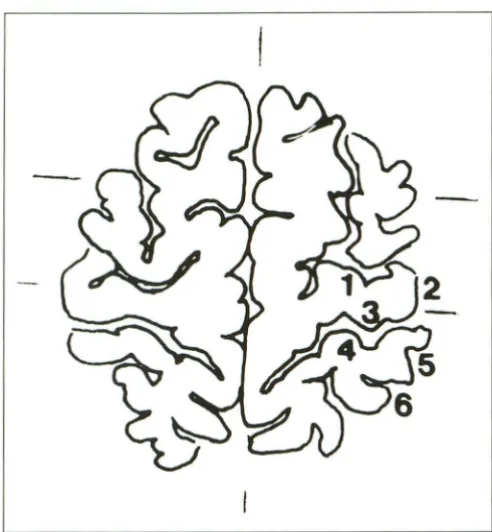
Fig. 1. Segmentation of the profiles of sensorimotor cortex in the axial plane. The length of each segment was measured in the whole series of transparent drawings. 1 indicates precentral sulcus; 2, superficial part of the precentral gyrus; 3, precentral gyrus (depth of the central sulcus); 4, postcentral gyrus (depth of the central sulcus); 5, superficial part of the postcentral gyrus; and 6, postcentral sulcus.
For every MR plane, identification of the sulci was determined by experienced neuroradiologists. All the struc-tures identified were referenced according to the commis-sural plane.
Sensorimotor Cortex Morphologic Quantification. As
shown in Fig 1, the contours of the left sensorimotor cortex were divided into six segments: 1) precentral sulcus, 2) surface of precentral gyrus, 3) frontal slope of precentral gyrus, 4) parietal slope of postcentral gyrus, 5) surface of postcentral gyrus, and 6) postcentral sulcus. The widths of all the segments included in the whole series of sections for each subject were measured on enlarged pictures in the axial and sagittal planes using a Hewlett Packward 9830 A
computer, connected to a Hewlett Packward 9864 A x-Y plotter. The widths obtained were checked against those of a brain directly measured by a curvometer that followed the surface of the brain. The total length of the sensori-motor cortex was calculated by summing up the lengths of the six segments included in either axial or sagittal sections. The motor cortex was defined as the sum of segments 1, 2, and 3 because it is necessary to take into account the deeper part of the motor cortex. Following this same reasoning, the sensory cortex was defined as the sum of segments 4, 5, and 6 to take into consideration both the superficial and the deeper part of the sensory cortex.
AJNR: 15, March 1994
HORIZONTAL PLANE
AC
M
PC
SAGITTAL PLANE
53.
A
B
c
Fig. 2. The axis of the central sulcus in axial and sagittal planes in one case.
[image:2.615.355.517.71.660.2] [image:2.615.54.300.74.340.2]AJNR: 15, March 1994
Fig. 3. The location of the opercular region and anterior com-missure-posterior commissure line. 1 indicates frontal operculum; 2, rolandic operculum; 3, parietal operculum; PRCG, precentral gyrus; PSTCG, postcentral gyrus; AC, anterior comissure; and
PC, posterior comissure.
..
_
7~~+
j-
-Fig. 4. Sagittal view of the brain showing the projection of sensorimotor area and central sulcus. The lengths of the profiles of the unfolded sensorimotor area are also shown to demonstrate that the unfolded sensorimotor cortex exceeds the anteroposterior length of the brain between +49 and +63 mm from anterior commissure-posterior commissure line.
Functional Study
A functional study was done on four healthy
right-handed volunteers 21 to 28 years old. The axial MR and
PET images were acquired on a plane parallel to the
orbitomeatal line. The exact position of the head was
systematically controlled during each MR or PET scan
examination. The study was approved by the French Atomic Energy Ethics Committee and the Ethics
Commit-tee of the French National Institute and Medical Research.
MR Acquisitions. MR scan with T1-weighted sequences
(650/30) was acquired parallel to the orbitomeatal plane with 3 mm thick.
PET Acquisitions. Regional cerebral blood flow images
were acquired using the TTV03 time-of-flight PET system,
which provides seven 9-mm-thick sections, 12 mm apart
with a 7-mm in-plane resolution. Before blood flow studies
a 100 Mevents "transmission" scan was obtained using a
germanium-68 source rotating around the patients. This
data set is used to correct the cerebral blood flow scan for
HAND FUNCTION 569
the autoattenuation of the 511 kev gamma rays in the subject's head. It is also used to reconstruct "transmission"
images that are in fact equivalent to low contrast computed
tomography (CT) scans and that were used to match the
PET and the MR coordinate systems.
Cerebral blood flow experiments consisted of repeated
intravenous bolus injections of 50 mCi of oxygen 15-labeled
water (1, 2). For each injection, data were acquired in the
time span of 2 minutes. For each subject the experimental
protocol included six injections with a constant 20-minute
delay between two injections. Subjects were kept with their
eyes closed and their ears plugged; no order was given except to relax. Two conditions were alternated: "rest" and
"vibration" of the fingers using a vibrator operating at 130
Hz (3). Vibration was started at least 30 seconds before the
water-labeled injection and lasted 2 minutes. Subjects were
told not to grasp the vibrator, but instead to let the
experimenter gently maintain their fingerpads in contact with the vibrator. After each cerebral blood flow acquisition,
data were read from a disk and a single scan (7 axial
sections) was reconstructed that started at the arrival of
the radioactivity in the brain (identified as the time of a
sharp rise in the total number of counts registered by the
tomograph) and that lasted for 80 seconds. Emission
(cer-ebral blood flow) and transmission (attenuation) PET
im-ages were reconstructed using the same size, 128 X 128
with a 2-mm-square pixel size. Reconstruction was per
-formed using a backprojection algorithm and a 5 mm-1
cutoff frequency Hanning filter that translates in a 7-mm in-plane resolution at image center. Image processing was
performed on Microvax II computers coupled to Ramtek
9465 graphic workstations.
Image Analysis. The image analysis procedure that was
designed to use MR individual studies and to match
ana-tomical (MR) and functional (PET) images has been de
-scribed elsewhere (4, 5). Briefly, after conversion to the
same format, PET and MR images were superimposed by
aligning two sets of isodensity contours.
First, MR axial sections were converted to PET image
size ( 128 X 128, 2 mm-square pixel size). The identification
of section levels between the two modalities was checked
using the PET transmission images and the corresponding
MR sections and superimposing isodensity contours
cor-responding to the skin defined on MR and on transmission
sections. Adequacy was visually checked and was found satisfactory in all cases. As a complementary check, these
isodensity contours were also displayed on the cerebral
blood flow images.
For each condition, cerebral blood flow sections were
first normalized by dividing each section pixel value by the
whole brain pixel mean value. This normalization procedure
was used to remove global flow variations from one study
to another. Activation detection was then completed using a difference image obtained by the subtraction of the normalized image at rest from the normalized image under vibration. To assess the relationship between the activation
locus and the central sulcus, the central sulcus was drawn
on the corresponding MR section, and then copied and
[image:3.614.53.298.77.239.2] [image:3.614.55.299.314.443.2]570 RUMEAU AJNR: 15, March 1994
A
8c
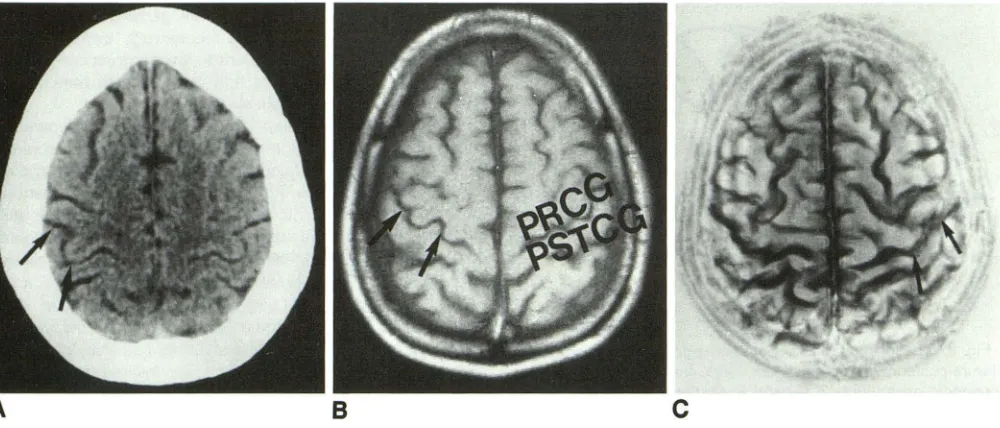
Fig. 5. Characteristic sigmoidal shape of the upper central genu. A, CT section. Arrows show on the right side central sulcus at this
level. B, MR at the same level on Tl-weighted image (arrows on right side). At left side, PRCG indicates precentral gyrus and PSTCG,
postcentral gyrus. C, Surface image according to Katada 's technique ( 19). Arrows on the left side on central sulcus at the hand level.
TABLE 1: Mean sensorimotor cortex length in axial MR sections (22 volunteers)
Section Distance from
Level Anterior Commissure-Posterior Commissure
(mm)
11 +77
10 + 70
9 +63
8 +56
7 + 49
6 + 42
5 + 35
4 + 28
3 + 21
2 + 14
+7
Results
Anatomic Results
Sensorimotor
Cortex Length (mm) 57 157
206 219 190 152
116 109 99
81
56
The central sulcus projected on the axial plane
formed a frontal-open angle whose mean value
was 50° 65
±
4° 11. Sagitally, the projectionformed an occiput-open angle of 48°
± 4°. Thus,
over the two planes sensorimotor cortex projects
obliquely, forming similar angles (Fig 2).
Upwardly, the increment of the distances
sep-arating the frontal, rolandic, and parietal opercula
from anterior commissure-posterior commissure
reflected the ascending obliquity of the sylvian
fissure. Most frequently, the frontal operculum
was located at
+
7 mm from anteriorcommis-sure-posterior commissure, the rolandic
opercu-lum at + 14 mm, and the parietal one from +21
mm to
+
35 mm {Fig 3). The projections of theopercular portion of central sulcus were quite constant. On the contrary, the projections of this sulcus in the paracentral lobule displayed wide dispersion.
The central sulcus, also described as the
su-perior and the inferior genu (6), has two curves. The lower part of the sensorimotor cortex corre-sponded to the projection of the inferior genu, and the upper part to the superior genu. Figure 4 shows the homogeneity of the superior and
inferior genu. The superior genu of the central
sulcus appears on the higher CT and MR sections (Fig 5) as a sigmoidal-shaped structure, a char-acteristic that renders it easily identifiable.
Table 1 indicates the mean length of the SMC
for each of the 7 -mm-thick contiguous brain
sections on the axial and sagittal planes for 22 subjects. On the sections done between +49 and
+63 mm from the anterior commissure-posterior
commissure reference planes, the mean lengths were the longest, attaining 219 mm.
At these levels, the unfolded sensorimotor
cor-tex was 26% longer than the bicommissural axis.
This feature was even more evident when the
length of the unfolded sensorimotor cortex was referred to the section length at the same level
(Fig 4).
Axially, as represented in the sections at
+
7 and+
14 mm from the basal reference line, the [image:4.612.57.557.76.290.2] [image:4.612.52.298.364.530.2]predom-AJNR: 15, March 1994
inant than the cortex of the postcentral gyrus. This paradoxical condition is apparent only be-cause it simply expressed the inclination of the section with respect to the sylvian fissure. In fact,
if the lengths of the parietal and rolandic opercula
are compared, a value of 3.01 mm is obtained, demonstrating a net predominance of the parietal operculum. This finding confirms a classic ana-tomic observation stressing the predominance of the postcentral gyrus at the operculum, in con-trast to the predominance of the precentral gyrus at the paracentral lobule (6).
Functional Results
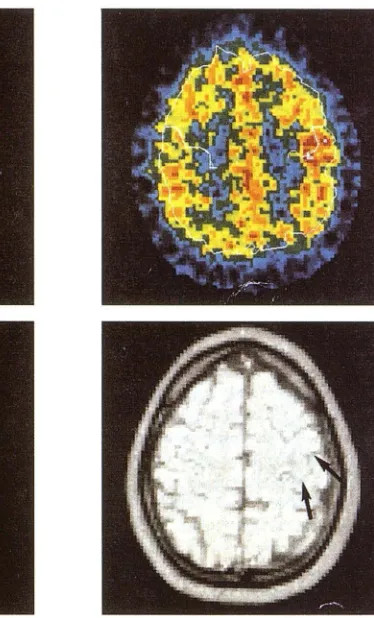
The congruence of the functional images ob-tained with PET with the MR sections performed at the same level demonstrated a strict coinci-dence between the zone of increased blood flow resulting from the vibratory stimulation of the
contralateral palm of the hand and the typical sigmoidal shape of the upper flexure of the central sulcus. This is well shown in Fig 6. This sharp correspondence of in vivo morphologic and func-tional results allowed us to establish that the sigmoidal image found in the upper genu of the central sulcus, appearing in both CT and MR axial
HAND FUNCTION 571
Fig. 6. Typical example of anatomico-functional location of the sensorimotor cor-tex.
Upper left, PET regional cerebral blood flow at rest.
Upper right, PET regional cerebral blood flow during hand vibration (right fingers) at the same level.
Lower left, individual difference image, vibration minus rest shows the activation spot and its relationship with RS as defined on the MR section.
Lower right, Corresponding 9-mm MR section at the same level as PET section. Arrows point out the typical sigmoidal shape of the upper central flexure where the PET scan activation zone was observed.
sections, represents the functional area of the hand.
Discussion
It is clinically important to be able to recognize accurately the projection of the central sulcus. An understanding of the sensorimotor region is
fundamental in studies of cortical hemiplegia and in the research of epilepsy. The ability to recog-nize the motor cortex is also important because this may affect presurgical planning and/or the
embolization of lesions located in and around the motor region.
Anatomic Aspect
The projection of cortical sulci has been greatly researched (7 -9). The proposed proportional sys-tem of identification is a landmark in identifying the motor region and central sulcus in relation to the projection of a commissural system (7, 8). There are three lines of reference in this system:
1 axial line passing through the anterior and posterior commissures and 2 lines perpendicular
to these points.
Numerous anatomic studies have been devoted
[image:5.612.184.371.74.383.2]572 RUMEAU
and on the projection of the central sulcus (10).
However, these studies are difficult to compare
because the slopes of one measurement of
num-bers obtained on a cadaver and those obtained in
vivo are different.
Recent publications ( 11, 12) have demon-strated the anatomic complexity of the cerebral
sulci. Table 1 depicts the study of 22 cases in
which the length of the sensorimotor cortex is measured at 11 different levels above the com-missural line. It is surprising to note that the
length of the sensorimotor area at the level of
hand projection has a measurement of 22 em.
This size matches the image of the homonculus
of Penfield and Rasmussen (13).
Over the external aspect of the hemisphere we
have demonstrated the exact coincidence of
"cen-tral genu" with the longest dimensions of the
unfolded sensorimotor cortex, thus confirming a
classic anatomic description (that considers the
cortical indentation forming the genu as a local-ized increment of the cortical volume). In
com-paring the projection areas of the genu and the
longest projections of the sensorimotor cortex
with the functional projections of Penfield's hom-onculus on the external surface, we believe that the inferior genu corresponds to the projection
area of the face and the upper genu to that of
the hand.
Functional Aspect
Numerous PET studies using 15-oxygen-labeled water bolus injections have dealt with hand sensory and motor activation. Fox's work in 1987 (3) gave for the first time the coordinates in the Talairach system of the projection site of the cutaneous vibration of the fingers pads in the opposite hemisphere cortex in 8 healthy
volun-teers. Using a similar approach, three other
publi-cations ( 14-16) described the activation foci pro-jections from 4.8 to 6 em above the anterior commissure-posterior commissure plane, which we have shown on our anatomic study to be the region
of the longest mean length, corresponding to the
central genu. The right-left and anteroposterior
coordinates gave the sigmoidal shape at the
pro-jection site.
Three other PET studies gave the location of
the hand activation projections but in a purely
qualitative way (16-18). Our study, choosing the
central genu for hand regions as the center of the
PET section for vibration studies, confirmed in
each subject the anatomofunctional correlation.
AJNR: 15, March 1994
On the axial plane, the longest dimensions of
the cortex correspond to the upper genu and is
functionally related to the hand. The
correspond-ing PET scan confirms our in vivo anatomical
findings (Fig 6). The upper genu constitutes an
important folding pattern of the sensorimotor
cortex, representing the functional projection area
of the hand.
References
I. Herscovitch P, Markham J, Raichle ME. Brain blood flow with intra-venous H2
15
0. J Nuc/ Med 1983;24:782-798
2. Raichle ME, Martin WRW, Herscovitch P, et al. Brain blood flow measured with intravenous H2
15
0. II: Implementation and validation.
J Nuc/ Med 1983;24:790-798
3. Fox PT, Burton H, Raichle ME. Mapping human somatosensory
cortex with positron emission tomography. J Neurosurg
1987;67:34-43
4. Salamon G, Tzourio N, Murayama N, U~vrier 0, Orssaud C. Individual MRI mapping of the cerebral cortex for PET scan. J Comput Assist
Tomogr 1993, in press
5. Petit L, Orssaud C, Tzourio N, Salambn G, Mazoyer B, Berthoz A. PET study of voluntary saccadic eye movements in man: basal
ganglia thalamo-cortical system and cingulate cortex involvement. J
Neurophysiol1993; in press
6. Dejerine J. Anatomie des centres nerveux. Tome I. Paris: Masson,
1985
7. Talairach J, Szikla G. Atlas d'anatomie stereotaxique du telencephale.
Etudes anatomoradiologiques. Paris: Masson, 1967.
8. Talairach J, Tournoux P. Coplanar stereotaxic atlas of the human
brain. New York: Georg Thieme, 1988.
9. Schaltenbrand G, Bailey P. Introduction to stereotaxis with an atlas
of the human brain. Stuttgart: Georg Thieme, 1959.
10. Ebeling U, Steinmetz H, Huang Y-X, Kahn T. Topography and identification of the inferior precentral sulcus in MR imaging. AJR
Am J Roentgenol1989;153:1051-1056
11. Duvernay HM. Le cerveau humain. Surface, coupes seriees
tridimen-sionnelles et IRM. Paris: Springer Verlag, 1992
12. Ono M, Kubik S, Abernathey CD. Atlas of the cerebral sulci. Stuttgart:
Georg Thieme, 1990.
13. Penfield W, Rasmussen T. The cerebral cortex in man. A clinical study of localization of function. New York: Macmillan, 1952:56-61.
14. Chollet F, Dipiero V, Wise RSJ, Brooks DJ, Dolan RJ, Frackowiak
RSJ. The functional anatomy of motor recovery· after stroke in humans: a study with positron emission tomography. Ann Neural
1991;29:63-71
15. Colebach JG, Deiber MP, Passingham RE, Friston KJ, Frackowiak
RSJ. Regional cerebral blood flow during voluntary arm and hand
movement in human subjects. J Neurophysiol1991;65:1392-1401
16. Meyer E, Ferguson SG, Zatorre RJ, et al. Attention modulates so-matosensory cerebral blood flow response to vibrotactile stimulation as measured with positron emission tomography. Ann Neural
1991;29:440-443
17. Grafton ST, Woods RP, Mazziotta JC, Phelps ME. Somatotopic mapping of the primary motor cortex in humans: activations studies
with cerebral blood flow and positron emission tomography. J
Neu-rophysiol1991;66:735-743
18. Grafton SG, Mazziotta JC, Woods RP, Phelps ME. Human functional
anatomy of visually guided finger movements. Brain 1992;115:567-587
19. Katada K. MR imaging of brain surface structures: surface anatomy