SELF – REGULATED THERMAL PROCESS, ITS MAIN CHARACTERISTICS AND
Intensive Technologies
ARTICLE INFO ABSTRACT
In the paper an overview on self These specific characteristics of self
and effective heat transfer coefficients and Kondratjev numbers Kn. It is underlined that the real heat transfer coefficients (HTCs) should be
nucleate boiling process and they should refer to boiling point of liquid, not to bath temperature. It is shown that during recipes development for quenching technology, initial austenitizin
may be fixed at 850
this case the duration of transient nucleate boiling mode (self proportional t
and depends on form of product and convective Biot number. Since in heat treating industry historically engineers are dealing with effective HTCs, the new data on ef
are provided to calculate approximately core cooling time and core cooling rate during quenching of steel parts. The obtained results of calculations can be used by engineers and scientists in the field of material and thermal sci
convection.
Copyright © 2016, Nikolai KOBASKO. This is an open access article distribute distribution and reproduction in any medium, provided the original work is properly cited.
INTRODUCTION
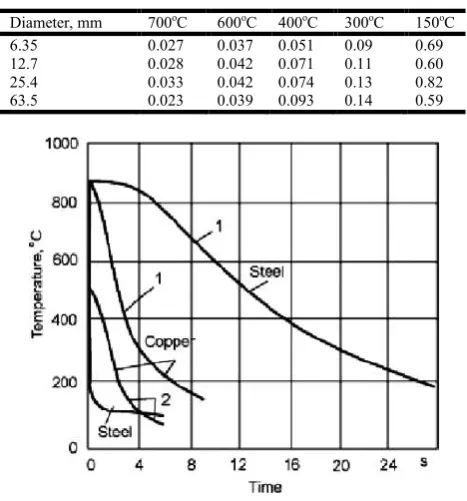
The self – regulated thermal process is duration of transient nucleate boiling mode during which surface temperature of steel part maintains at the level of boiling point of liquid and cannot be below it until core temperature of steel part is low and corresponds to convective Biot number. Fundamental investigation in this field were made by French in 1928 (French, 1930) who measured surface temperature during quenching of small and large spherical steel samples. French for the first time published the data showing that film boiling is completely absent and surface temperature of samples drops from 875oC to 150oC for less than 0.82 seconds (see Table 1). Further with the passing of time the surface temperature maintains at the level of boiling point of liquid (see Fig. 1). In his time, it was impossible to measure correctly overheat of boundary layer to analyze transient nucleate boiling processes. That is why measurement were done in the interval 875 150oC. It was noticed that film boiling is absent when quenching steel samples and film boiling exists when quenching spherical samples made of copper. The film boiling takes place due to high thermal conductivity of copper that
*Corresponding author: Nikolai KOBASKO,
Intensive Technologies Ltd, 68/1 Peremohy Ave., Kyiv, Ukraine
ISSN: 0975-833X
Article History:
Received 10th August, 2016
Received in revised form 22nd September, 2016
Accepted 19th October, 2016
Published online 30th November,2016
Key words:
Transient nucleate boiling, Duration,
Real and effective HTCs, Correlations,
Practical application.
Citation: Nikolai KOBASKO, 2016. “Self – regulated thermal process, its main characteristics and practical application
Research, 8, (11), 41698-41704.
RESEARCH ARTICLE
REGULATED THERMAL PROCESS, ITS MAIN CHARACTERISTICS AND
PRACTICAL APPLICATION
*Nikolai KOBASKO
Intensive Technologies Ltd, 68/1 Peremohy Ave., Kyiv, Ukraine 03113
ABSTRACT
In the paper an overview on self – regulated thermal process and new its characteristics are
These specific characteristics of self – regulated thermal process are widely discussed concerning real and effective heat transfer coefficients and Kondratjev numbers Kn. It is underlined that the real heat transfer coefficients (HTCs) should be considered when calculating temperature fields during transient nucleate boiling process and they should refer to boiling point of liquid, not to bath temperature. It is shown that during recipes development for quenching technology, initial austenitizin
may be fixed at 850oC for all existing steel grades and irons with the accuracy of calculation
this case the duration of transient nucleate boiling mode (self – regulated thermal process) is directly proportional to squared size of steel part, inversely proportional to thermal diffusivity of a material and depends on form of product and convective Biot number. Since in heat treating industry historically engineers are dealing with effective HTCs, the new data on ef
are provided to calculate approximately core cooling time and core cooling rate during quenching of steel parts. The obtained results of calculations can be used by engineers and scientists in the field of material and thermal sciences to predict processes within the transient nucleate boiling mode and convection.
is an open access article distributez under the Creative Commons Attribution License, which and reproduction in any medium, provided the original work is properly cited.
regulated thermal process is duration of transient nucleate boiling mode during which surface temperature of boiling point of liquid and cannot be below it until core temperature of steel part is low and corresponds to convective Biot number. Fundamental investigation in this field were made by French in 1928 (French, 1930) who measured surface temperature during quenching of small and large spherical steel samples. French for the first time published the data showing that film boiling is completely absent and surface temperature of samples drops C for less than 0.82 seconds (see Table 1). her with the passing of time the surface temperature maintains at the level of boiling point of liquid (see Fig. 1). In his time, it was impossible to measure correctly overheat of boundary layer to analyze transient nucleate boiling processes.
hy measurement were done in the interval 875oC - It was noticed that film boiling is absent when quenching steel samples and film boiling exists when quenching spherical samples made of copper. The film boiling
tivity of copper that
Intensive Technologies Ltd, 68/1 Peremohy Ave., Kyiv, Ukraine.
03113
provides high heat flux density exceeding critical value. As known, thermal conductivity of steel is almost 20 times less as compared with copper. That provides lesser initial heat flux density which is below the critical value that is why no film boiling at all. It was noticed by French that surface temperature within one second drops almost instantly to 150
accurate experimental data received by French (French, 1930), the real heat transfer coefficients (HTCs) were evaluated which are shown in Fig. 2 (Kobasko, 2012). During nucleate boiling process, HTCs are huge as compared with convection.
Later, it was shown that classical law of Fourier should be modified to provide finite value of heat distribution (Vernotton, 1961 and Lykov, 1967). The modified Fourier law is written as:
T
q
q
rThe modified law of Fourier generates the hyperbolic heat conductivity equation (Lykov, 1967) which is considered below.
International Journal of Current Research
Vol. 8, Issue, 11, pp.41698-41704, November, 2016
INTERNATIONAL
regulated thermal process, its main characteristics and practical application
REGULATED THERMAL PROCESS, ITS MAIN CHARACTERISTICS AND
Ltd, 68/1 Peremohy Ave., Kyiv, Ukraine 03113
regulated thermal process and new its characteristics are provided. regulated thermal process are widely discussed concerning real and effective heat transfer coefficients and Kondratjev numbers Kn. It is underlined that the real heat considered when calculating temperature fields during transient nucleate boiling process and they should refer to boiling point of liquid, not to bath temperature. It is shown that during recipes development for quenching technology, initial austenitizing temperature C for all existing steel grades and irons with the accuracy of calculation 1%. In regulated thermal process) is directly o squared size of steel part, inversely proportional to thermal diffusivity of a material and depends on form of product and convective Biot number. Since in heat treating industry historically engineers are dealing with effective HTCs, the new data on effective Kondratjev number are provided to calculate approximately core cooling time and core cooling rate during quenching of steel parts. The obtained results of calculations can be used by engineers and scientists in the field of ences to predict processes within the transient nucleate boiling mode and
ribution License, which permits unrestricted use,
provides high heat flux density exceeding critical value. As known, thermal conductivity of steel is almost 20 times lesser as compared with copper. That provides lesser initial heat flux density which is below the critical value that is why no film boiling at all. It was noticed by French that surface temperature within one second drops almost instantly to 150oC. Using accurate experimental data received by French (French, 1930), the real heat transfer coefficients (HTCs) were evaluated which are shown in Fig. 2 (Kobasko, 2012). During nucleate boiling process, HTCs are huge as compared with convection.
r, it was shown that classical law of Fourier should be modified to provide finite value of heat distribution (Vernotton, 1961 and Lykov, 1967). The modified Fourier law
….(1)
The modified law of Fourier generates the hyperbolic heat equation (Lykov, 1967) which is considered
INTERNATIONAL JOURNAL OF CURRENT RESEARCH
Table 1. Surface temperature versus time of steel spheres of different diameters when quenching from 875oC in 5% NaOH
water solution at 20oC moving with 0.9 m/s (French, 1930
Diameter, mm 700oC 600oC 400oC 300oC 150oC
6.35 0.027 0.037 0.051 0.09 0.69
12.7 0.028 0.042 0.071 0.11 0.60
25.4 0.033 0.042 0.074 0.13 0.82
[image:2.595.61.267.402.591.2]63.5 0.023 0.039 0.093 0.14 0.59
Fig. 1. Temperature at the surface and in the core versus time for steel and copper balls of 38.1-mm in diameter, quenched from 875oC in water at room temperature (French, 1930): 1, core; 2, surface
Fig. 2. Shock and nucleate boiling heat transfer coefficients versus time for a sphere of 38.1 mm in diameter quenched from 875oC in a 5 % aqueous NaOH solution at 20oC
Mathematical models of quenching processes
If film boiling is absent, the mathematical model, namely the heat conductivity equation, for quenching process can be written as:
r r r j x
r a r r
r
, , , 1 ,
2 2 2
2
…..(2)
(j1,2,3; j = 1 for a plate; j= 2 for a cylinder; j =3 for a sphere) with the boundary condition (3) that were firstly formulated by authors (Kobasko and Kostanchuk, 1973):
0
R r m S m
T T r
T
.…….(3)
After the transient boiling process is finished, convection starts and the third kind of boundary condition for convective heat transfer mode is used with the boundary condition (4):
0
R r m conv T T
r T
. ……..(4)
A transition from nucleate boiling to convection is determined by equalizing the heat fluxes (Eq. (5), i.e.
conv
nb
q
q
……...(5)Also, initial austenitizing temperature should be added (Eq. (6):
r
,
0
T
0T
. ……... (6)Analytical solutions and their analysis
Analytical solutions of hyperbolic Eq. (2) with the boundary and initial conditions (3) and (6) were obtained and analyzed by authors (Buikis, 2009; Guseynov and Kobasko, 2008; Guseynov, Rimshans et al., 2010). Based on experimental data of French (French, 1930) and analytical solutions of hyperbolic heat conductivity equation, one can come to conclusion that film boiling can be absent completely when quenching steel parts in cold liquid media.
Following reason is for such phenomenon:
5% NaOH water solution at 20oC has twice higher critical heat flux density as compared with cold water which exceeds initial heat flux density.
Speed of heat distribution is a finite value that cannot provide extremely high heat flux density which can be less than critical one.
Prior to boil cold solution should be heated to boiling point and during this time surface temperature drops almost instantly to boiling point of liquid.
Agitation increases critical heat flux density that decreases probability of film boiling process.
Taken into account these facts, authors (Kobasko and Zhovnir, 1979) received an analytical solution of parabolic heat conductivity equation with the boundary condition (3) and boundary condition (4) to calculate duration of transient nucleate boiling process when film boiling is completely absent. As a result, simplified equations Eq. (7) – Eq.(9) were constructed to calculate duration of self – regulated thermal process (Kobasko, 1992).
0.24 3.21ln I nb
II
K k
a
, ……...(7)
0.30
2
1
R
I I
1
0.3II
conv II uh
, ……...(9)
To make correctly calculations, convective HTC should be evaluated at first. When quenching in still water, convective heat transfer coefficient is calculated by Eq. (10) or Eq. (10a):
1/30.13
Pr
Nu
Gr
, ……...(10)1/3
0.13
conv
g
T
a
. …(10a)
Convective heat transfer coefficients (HTCs), when quenching in water flow, is evaluated by equation (11):
0.25
0.8 0.43
Pr
0.021Re
Pr
Pr
m l sf
Nu
……...(11)
Using convective HTCs, it is possible to calculate duration of transient nucleate boiling process.
The generalized equation for calculating the duration of
self – regulated thermal process
When initial austenitizing temperature is fixed at 850oC and
bath temperature at 20oC, then results of calculations, based on
equations (7) - (9), can be presented in simple form (Kobasko,
2009):
2
nb F
D
k
a
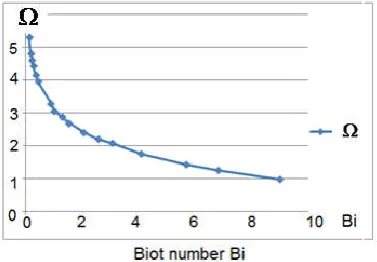
…….(12)The value
is a function of convective Biot number and is provided in Fig. 3.Fig. 3. The value Ω versus convective Biot number Bi depending on size of steel part and HTC during convection
Core temperature versus time during self – regulated thermal process
Fig. 3 and Eqs. (12), (13) allow engineers to perform simplified calculations. Temperature at the core of steel parts during self – regulated thermal process can be calculated at any time approximately by equation Eq. (13) which was provided by author (Kobasko, 1980):
oV V
Bi
Bi
k
K
aKn
ln
873
.
3
095
.
2
1
...……(13)
or
aKn
K
T
T
T
T
k
m m
0
.
24
ln
0
………(13a)Within the self - regulated thermal process Eq. (13a) is used with effective Kondratjev numbers Knef that is considered
below.
Analysis of obtained solutions
Effect of initial temperature
First of all, let’s see (Table 2) how initial austenitizing temperature affect duration of transient nucleate boiling process nbwhen quenching from 800oC and 900oC . The
[image:3.595.305.560.50.139.2]matter is that more than 90% steels and irons are heated within the interval of temperatures 800oC – 900oC and then executed by quenching process. For such interval of temperatures, calculated data are presented in Table 2.
Table 2. Effect of initial temperature T0 on duration
nb oftransient nucleate boiling process when quenching cylindrical 20 mm stainless specimen in water salt solutions at 20oC from
different temperatures
T0, oC I,
oC
II
, oC
nb
, sec
800 25.64 8.28 13.15
850 26.19 8.28 13.40
900 26.72 8.28 13.56
Error of calculation is
1
%
.Thus, for all steel parts and iron products austenitizing temperature during making calculations can be fixed at 850oC that results in
1
%
incorrectness of recipes development.Effect of physical properties on duration of self – regulated thermal process
[image:3.595.63.252.534.665.2]Thermaland physical properties of quenchant represented by value
doesn’t affect significantly duration of self – regulated thermal process (see Table 3).Table 3. Duration of transient nucleate boiling process versus parameter
for cylindrical stainless (AISI 304) probe 20 mm indiameter when quenching in still water ( )
I, oCII
, oCnb
, sec3 29.76 9.43 13.34
3.41 26.19 8.28 13.40
4.3 20.81 6.54 13.43
7* 12.8 3.99 13.50
9* 9.99 3.08 13.60
Error of calculation is
2
%
Core temperature versus size at the end of self – regulated thermal process
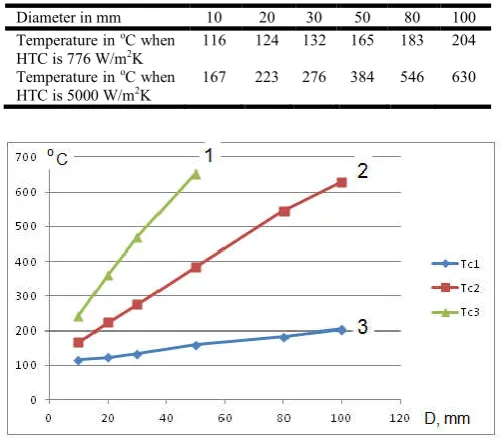
[image:3.595.316.540.654.726.2]transition from boiling to convection is needed. Some results concerning core temperatures are provided in Table 4 and Fig. 4.
Table 4. Temperature at the core of cylindrical samples at the end of transient nucleate boiling process during quenching in water and water solutions at 20oC when convective HTCs are 776 W/m2K and 5000 W/m2K
Diameter in mm 10 20 30 50 80 100
Temperature in oC when
HTC is 776 W/m2K
116 124 132 165 183 204
Temperature in oC when
HTC is 5000 W/m2K
167 223 276 384 546 630
Fig. 4. Core temperature at the end of the self – regulated thermal process versus diameter of cylindrical steel parts: 1, HTC is 10000
W/m2K; 2, HTC is 5000 W/m2K; 3, HTC is 776 W/m2K
Effective Kondratjev numbers Knef during transient
nucleate boiling
[image:4.595.38.289.151.370.2]When using equation (13a) during transient nucleate boiling process, the average effective Kondratjev numbers should be available. Such data are presented in Table 5.
Table 5. Average surface temperature and effective Kondratjev number depending on diameter of cylindrical steel parts when
convective HTC is 776 W/m2K
Diameter,
mm
I , oC I2 II
, oC
Knef Tcore ,oC10 32.17 20.23 4.84 0.54 116
20 26.19 17.23 4.18 0.61 124
30 23.22 15.75 3.79 0.66 132
50 20 14.14 3.30 0.69 165
80 17.34 12.81 2.86 0.736 183
100 16.2 12.14 2.65 0.75 204
Knowing the core temperature Tcore ,oC of steel part at the
moment of finish nucleate boiling process, one can calculate effective Kondratjev number Knef suitable only for core
cooling time calculation during boiling process (see Table 5). It is received by equalizing Eq. (7) and Eq. 13a)
Kn T T
T T k k
m core
m II
I 0.24 ln 1
ln 21 . 3 24 .
0 0
…….(14)
The results of calculations are provided in Fig. 5 where curve 1 is true for still coolant when heat transfer coefficient is 776 W/m2K and curve 2 for agitated coolant when heat transfer coefficient is 5000 W/m2K.
Fig. 5. Effective Kondratjev number Knef versus diameter of
cylindrical steel parts in still and agitated coolants: 1 is still liquid quenchant, convective HTC is 776 W/m2K; 2 is agitated liquid quenchant, convective HTC is 5000 W/m2K
As seen from Fig. 5, effective Kondratjev numbers change insignificantly with changing diameters of cylindrical samples. It creates opportunity to use average Kn numbers dividing curve Kn versus D for several intervals.
Real and effective Kondratjev numbers
Real Kondratjev numbers during quenching of steel parts in water and water salt solutions are within 0.8Kn1. Effective Kondratjev numbers during quenching of steel parts in water and water salt solutions are within
0
.
5
Kn
0
.
8
. It is due to TTmTTs. During immersion of steel parts into [image:4.595.31.293.553.635.2]cold quenchant shock boiling takes place during which within two seconds heat transfer coefficient riches huge value which exceeds 200 kW/m2K and then decreases to 6000 W/m2K and less. Only such huge HTCs can provide immediate decrease surface temperature almost to boiling point as shown in Table 1. Everything is easily explained. The first critical heat flux density of cold NaOH water solution reaches 15 MW/m2 and initial heat flux density can be equal 15 MW/m2K too. According Tolubionsky’s equation, heat transfer coefficient in this case is equal to 193.9 kW/m2K and 242.6 kW/m2K according to Shekriladze equation (Shekriladze, 2012). Equations of Tolubinsky and Labuntsov show approximately the same result (see Table 6).
Table 6. Real heat transfer coefficients according to different well known thermal scientists at the beginning of transient nucleate boiling process during quenching 20 mm probe made of AISI 304 from 850oC in water at 20oC
Author
I
.kW/m2K Comments(Kutateladze, 1963) 261.5 Hot water
(Labuntsov,2000) 207.4
(Shekriladze, 2012) 242.6
(Tolubinsky, 1980) 193.9 Cold water
As it was explained above, average effective Kondratjev numbers Knef are within 0.5Kn0.8 and they can be used
only for core cooling rate and cooling time evaluation during nucleate boiling process.
Cooling time calculation within the nucleate boiling and convection
[image:4.595.324.541.624.683.2]cv nb fb
c
…...(15)As known, film boiling during IQ – 2 and IQ – 3 intensive quenching processes should be completely absent, i.e.
0
fb
Duration of transient nucleate boiling process is evaluated using Eq. (7) or Eq. (12) and duration within the convective heat transfer mode is evaluated as
aKn K
c c
ln …...(16)
and summarized cooling time is
aKn
K
a
D
k
F cc
ln
2
…….(17)In this case simplified Eq. (16) is used because after finishing boiling process regular thermal mode is already established and there is no need to take into account irregular time which contains Eq. (13). Note that initial core temperature in Eq. (16) is 415.6oC when convection at the surface starts. It was calculated by considering the first time of boundary condition (Lykov, 1967). Substituting initial temperature 415.6oC into Eq. (17), we receive:
sec 33 88 . 0 / 10 36 . 5 10 2 . 76 20 200 20 6 . 415 ln / 10 36 . 5 041 . 0 0432 . 0 5 . 1 ln 2 6 2 6 2 6 2 2 s m m s m m aKn K a D kF cc
here Kn = 0.88.
During direct convection (Kobasko, Aronov et al., 2010) cooling time is 32 sec:
sec 32 88 . 0 / 10 36 . 5 10 2 . 76 20 200 20 860 ln 42 .
0 6 2
2 6 s m m C C C C o o o o c
that coincides very well with each other.
Such approach provides accurate calculated data which coincide with the experiments as well.
DISCUSSION
Analytical temperature field calculation for different forms of steel parts is complicated mathematical problem since analytical solutions are available mainly for classical forms. But the practice requires cooling time calculation as for simple and for very complicated forms. In this paper, a general approach is developed to calculate duration of transient nucleate boiling process and period of pure convection. By using this method one can get rather accurate data for any configuration of steel parts. The method was verified in the practice during the last decade. What is the most important here, it is possibility to provide intensive quenching in low agitated liquid coolants when any type of film boiling is
absent. Absence of film boiling, especially local film boiling decreases distortion of steel parts after quenching. When film boiling is absent, surface temperature drops almost instantly to boiling point of liquid and maintains at this level relatively a long time. It is this characteristic of self – regulated thermal process that was used for the development of new technologies, called IQ – 2 and IQ – 3 processes. Moreover, that characteristic and other investigated characteristics were used by engineers to develop appropriate software for recipes elaboration. It should be underlined that such approach provides very precise data when cooling time calculation which is connected with obtaining maximal residual stresses after intensive quenching. The procedure of calculations is as follows:
Using dimensionless Eq. (10) – Eq. (11), convective heat transfer coefficients are calculated for still, agitated quenchant or directed water flow in quenching chambers.
Initial and finish temperature of self – regulated thermal process is evaluated to calculate its duration.
Water flow velocity and criterion which is condition for providing direct convection is calculated.
Average surface temperature of self – regulated thermal process is evaluated and heat conductivity problem with first type of boundary condition is solved to obtain core temperature at the end of nucleate boiling process and a value of Kondratjev form factor K.
Cooling time for any configuration and for any quenchant is calculated which includes duration of nucleate boiling process and convection.
Software provides all mentioned above characteristics. The developed approach is suitable both for intensive quenching processes and for existing conventional quenching technologies. Method of calculation works perfectly when film boiling and local film boiling are absent. As known, they harm the process of hardening. To eliminate full film boiling and local film boiling, it is recommended to use hydrodynamics emitters creating resonance effect (Kobasko, 2016).
Conclusion
1. Self – regulated thermal process is transient nucleate boiling when surface temperature of quenched steel part maintains at the level of boiling point of liquid and cannot be below it until heat flux density going from inside of the part can be taken out by convection without help of departing bubbles.
2. The initial and finish temperatures of self – regulated thermal process differ insignificantly that allows using average surface temperature as the first type of boundary condition to calculate correctly temperature fields in the quenched steel part.
3. According to French, the time of establishing the self – regulated thermal process doesn’t depend on size of steel part and its duration is within 2 seconds.
4. The initial temperature of self – regulated thermal process depends considerably on size of steel part. The finish temperature of self – regulated thermal process depends considerably on convective heat transfer in quench tank.
proportional to squared size of a steel part, inversely proportional to thermal diffusivity of material and depends on form of steel part and convective Biot number in quench tanks filled with a liquid quenchant. 6. The real heat transfer coefficient during transient
nucleate boiling process is very large and can exceed 200 kW/m2K and is evaluated as a ratio of heat flux density to overheat of a boundary layer. The cooling process during nucleate boiling is intensive because real Kondratjev numbers are within
0
.
8
Kn
1
.7. The effective heat transfer coefficient is evaluated as a ratio of heat flux density to the difference of steel surface temperature and bath temperature which can be more than 10 times higher as compared with the overheat in a boundary layer.
8. Effective HTCs can be used only for core cooling time calculations and cannot be used for temperature field calculation in steel parts during nucleate boiling process since big errors appear when surface temperature prediction.
9. Thermal and physical properties of liquid represented by
value don’t affect extensively the duration of self – regulated thermal process since nbconv that considerably simplifies calculations.10. A simplified and accurate method for cooling time calculation, within transient nucleate boiling process and pure convection mode, is proposed. This approach is a basis for designing a software to be widely used for intensive and conventional quenching processes monitoring.
List of Symbols
T is temperature;
is time;
r is time of relaxation;
nbis duration of transient nucleate boiling process in sec; k = 1; 2; 3 for plate like form, cylindrical form and spherical form;I
T
IT
S
,T
I is nucleate boiling start temperature; TS is saturation temperature;
IIT
II
T
S;II
T is nucleate boiling
finish temperature;
K
is Kondratjev form coefficient in m2;a
is thermal diffusivity of material or liquid in m2/s; 3.41depends on physical properties of quenchant or volumetric expansion coefficient of a quenchant in 1/K;
is thermal conductivity of material or liquid in W/mK;R
is radius in m; D is diameter in m;
conv is convective heat transfer coefficient (HTC) in W/m2K; uh TSTm;m
T is bath temperature;
2
9.81 /
g m s ;
is kinematic viscosity in m2/s;
T
isdifference between sample surface temperature and bath temperature; Nu is Nusselt number; Pr is Prandtl number; Gr
is Grashof number; Re is Reynolds number;
l is equal to 1 if L/D > 50; fb means film boiling; nb means nucleate boiling; c and conv mean convection.REFERENCES
Buikis, A. 2009. Some new models and their solutions for intensive steel quenching. Abstracts of MMA, Daugavpils, Latvia, May 27 – 30.
French, H. J. 1930. The Quenching of Steels, American Society for Steel Treating, Cleveland, OH.
Guseynov, Sh. E. and Kobasko, N. I. 2008. On One Nonlinear Mathematical Model for Intensive Steel Quenching and its Analytical Solution in Closed Form. The 5th WSEAS Int. Conf. on Heat and Mass transfer (HMT’08), Acapulco, Mexico.
Guseynov, Sh.E., Rimshans, J.S., Kobasko, N.I. 2010. On one nonlinear mathematical model for intensive steel quenching and Its analytical solution in closed form, Progress in Industrial Mathematics at ECMI (Mathematics in Industry
15), A.D. Fitt et al. Eds., Springer-Verlag, Berlin,
Heidelberg, pp. 857 – 862.
Kobasko, N. I. 1968. Thermal Processes in Quenching of Steel, Metal Science and Heat Treatment, Vol. 10, No. 3. Kobasko, N. I. 2005. Self-regulated Thermal Processes During
Quenching of Steels in Liquid Media, IJMMP, Vol. 1, No. 1, pp. 110–125.
Kobasko, N. I. 2012. Real and Effective Heat Transfer Coefficients (HTCs) Used for Computer Simulation of Transient Nucleate Boiling Processes During Quenching. Materials Performance and Characterization, Vol. 1, Issue 1, 1–20. doi: 10.1520/mpc-2012-0012 .
Kobasko, N. I. and D. M. Kostanchuk, 1973. Calculation of the Cooling Capacity of Quenching Media by Using the Characteristics of the Boiling Process, Metal Science and Heat Treatment, Vol. 15, No. 10.
Kobasko, N. I.,and Zhovnir, H.I. 1979. Analytical Method of Solving Thermal Problems for Steel Quenching, Visnyk of Academy of Sciences of Ukrainian SSR, No. 12, pp. 41–50. Kobasko, N.I. 1980. Steel Quenching in Liquid Media Under
pressure, Naukova Dumka, Kyiv, 206 pages.
Kobasko, N.I. 2000. A Method of Hardening of Alloy Steels, UA Patent, No. 27059, Filed February 17, 1995, # 95020715, Published in Bulletin of Innovation, No. 1, on February 28.
Kobasko, N.I. 2009. Transient Nucleate Boiling as a Law of Nature and a Basis for Designing of IQ Technologies, Proceedings of the 7th IASME/WSEAS International Conference on Heat Transfer, Thermal Engineering and environment (THE’09), Moscow, August 22 – 25, pp. 67 – 75.
Kobasko, N.I. 2016. Improvement of IQ - 3 processes to eliminate crack formation, decrease distortion, and maximize material strength, and ductility, EUREKA:
Physics and Engineering, No. 4, pp. 3 – 10, DOI:
10.21303/2461-4262.2016.00122.
Kobasko, N.I. 2016. Investigation of batch intensive quenching processes when using hydrodynamic emitters in quench tanks, EUREKA: Physics and Engineering, No. 6.
Kobasko, N.I., Aronov, M.A., Powell, J.A. and Totten, G.E. 2010. Intensive Quenching Systems: Engineering and Design, ASTM International, West Conshohocken, 252 pages.
Kondratjev, G.M. 1957. Thermal Measurements, Mashgiz, Moscow.
Kutateladze, S.S. 1963. Fundamentals of Heat Transfer, Academic Press, New York.
Labuntsov, D.A. 2000. Physical Fundamentals of Power Engineering: Selected Works on Heat Transfer, Hydrodynamics and Thermodynamics, MPEI, Moscow. Liscic, B., Tensi, H.M., and Luty, W. Eds., 1992) Theory and
Technology of Quenching, Springer-Verlag, New York, pp. 367 - 389.
Shekriladze, I. 2012. Boiling Heart Transfer: An Overview of Longstanding and New Challenges, J. ASTM Int., Vol. 9, No. 1, 387.
Tolubinsky, V.I. 1980. Heat Transfer at Boiling, Naukova Dumka, Kyiv, 312 pages.
Vernotton, P. 1961. La nouvelle equation de la chaleur. Journ. de la Tranms. de la chaleur.