CHARACTERIZATION AND CORRELATION ANALYSIS FOR YIELD AND YIELD CONTRIBUTING
TRAITS IN MEDIUM DURATION GERMPLASM ACCESSIONS OF
Department of Genetics and Plant Breeding, College of Agriculture, IGKV, Raipur (Chhattisgarh)
ARTICLE INFO ABSTRACT
Undomesticated crops species acquire huge possible and most precious gene which can be successfully utilized in crop improvement to develop high yielding rice varieties. The two hundred fifty eight rice germplasm accessions were used in present study. Simp
standard deviation and coefficient of variation) was measured to have a reflection of the level of genetic variability. Frequency distributions of qualitative traits were short out the genotypes into diverse classes. In quanti
value not much than 10%. On the other hand, most of the characters cover high C.V. values over 10% and prominent to 28.56% for leaf length. Leaf length (r=0.238 at p<0.05) and eff
p<0.05, 0.01) shows significant positive correlation with grain yield. As tillering in rice is a important determinant for panicle production and as a result, it affects total yield. I
desirable traits four rice germpla were identified.
Copyright©2016, Sarawgi and Ojha.Thisis an open access article distributed under the Creative Commons Att distribution, and reproduction in any medium, provided the original work is properly cited.
INTRODUCTION
Rice (Oryza sativa L.) is the world’s very important food crop gathered and a foremost resource of food for more than half the world’s population and forms the cheapest foundation of food, energy and protein. Land races acquire high protein content than high yielding varieties which were developed mainly to optimize yield and not the nutritional value (Sindhumole, 2012). Landraces serve various desirable genes. Breeders can hold the potential and most precious gene and effectively utilized in the breeding programmes to expand high yielding rice varieties with quality, biotic and abi
Ultimate assessment of the levels and patterns of genetic diversity can be priceless in crop breeding for various applications in concert with (1) analysis of genetic variability in landrace genotype (Cox et al., 1986), (2) identifying vario parental combinations to generate segregating progenies with maximum genetic variability for further assortment (Barret & Kidwell, 1998), and (3) introgressing advantageous genes from assorted germplasm into the existing genetic base (Thompson et al.,1998). Qualitative traits have been recognized as the worldwide undoubted descriptors for germplasm characterization.
*Corresponding author: Ojha, G. C.
Department of Genetics and Plant Breeding, College of Agriculture, IGKV, Raipur (Chhattisgarh)
ISSN: 0975-833X
Article History:
Received 28th March, 2016
Received in revised form 21st April, 2016
Accepted 27th May, 2016
Published online 15th June,2016
Key words:
Germplasm, Quantitative traits, Phenotypic variability, and correlation.
Citation: Sarawgi, A.K. and Ojha, G. C. 2016. “
germplasm accessions of rice (Oryza sativa L.)”,International Journal of Current Research
RESEARCH ARTICLE
CHARACTERIZATION AND CORRELATION ANALYSIS FOR YIELD AND YIELD CONTRIBUTING
TRAITS IN MEDIUM DURATION GERMPLASM ACCESSIONS OF RICE (
Sarawgi, A. K. and
*Ojha, G. C.
Department of Genetics and Plant Breeding, College of Agriculture, IGKV, Raipur (Chhattisgarh)
ABSTRACT
Undomesticated crops species acquire huge possible and most precious gene which can be successfully utilized in crop improvement to develop high yielding rice varieties. The two hundred fifty eight rice germplasm accessions were used in present study. Simp
standard deviation and coefficient of variation) was measured to have a reflection of the level of genetic variability. Frequency distributions of qualitative traits were short out the genotypes into diverse classes. In quantitative traits, days to 50% flowering and days to maturity readily exist C.V. value not much than 10%. On the other hand, most of the characters cover high C.V. values over 10% and prominent to 28.56% for leaf length. Leaf length (r=0.238 at p<0.05) and eff
p<0.05, 0.01) shows significant positive correlation with grain yield. As tillering in rice is a important determinant for panicle production and as a result, it affects total yield. I
desirable traits four rice germplasm i.e. IC 377061IC 300784, IC 376585 were identified.
is an open access article distributed under the Creative Commons Attribution License, which distribution, and reproduction in any medium, provided the original work is properly cited.
L.) is the world’s very important food crop foremost resource of food for more than half the world’s population and forms the cheapest foundation of food, energy and protein. Land races acquire high protein content than high yielding varieties which were developed he nutritional value (Sindhumole, 2012). Landraces serve various desirable genes. Breeders can hold the potential and most precious gene and effectively utilized in the breeding programmes to expand high yielding rice varieties with quality, biotic and abiotic stresses. Ultimate assessment of the levels and patterns of genetic diversity can be priceless in crop breeding for various applications in concert with (1) analysis of genetic variability ., 1986), (2) identifying various parental combinations to generate segregating progenies with maximum genetic variability for further assortment (Barret & Kidwell, 1998), and (3) introgressing advantageous genes from assorted germplasm into the existing genetic base (Thompson een recognized as the undoubted descriptors for germplasm
Department of Genetics and Plant Breeding, College of Agriculture,
A major purpose of varietal characterization is to establish the distinctiveness between the germplasm and also to establish their unique detection profiles on the basis of grouping individuality prescribed by Distinctness Uniformity Stability (DUS) guidelines. Morphological description is the first step for classification and evaluation of the germplasm. It is an essential tool for selecting varieties or lines based on agronomical, morphological, genetic or physiological characters. The present investigati
characterization and correlation analysis for two hundred fifty eight, medium duration rice germplasm accessions for different morphological trials and identify the better accessions for further breeding programme.
MATERIALS AND METHOD
The investigational resources comprised of 258 rice germplasm accessions (landraces) received from NBPGR, New Delhi. These genotypes were evaluated in augmented design (Federer 1961) with six checks
NDR97, Annada, Swarna and I
Research cum Instructional farm, Indira Gandhi Krishi Vishwavidyalaya (IGKV), Raipur, Chhattisgarh. Twenty two days old seedlings were transplanted. Each plot consisted of three rows of 3 m length, with the spacing of 20 x 15 cm a the standard packages of practices were followed for growth of
International Journal of Current Research
Vol. 8, Issue, 06, pp.32382-32389, June, 2016
INTERNATIONAL
“Characterization and correlation analysis for yield and yield contributing traits in medium duration
International Journal of Current Research, 8, (06), 32382-32389.
CHARACTERIZATION AND CORRELATION ANALYSIS FOR YIELD AND YIELD CONTRIBUTING
RICE (
ORYZA SATIVA
L.)
Department of Genetics and Plant Breeding, College of Agriculture, IGKV, Raipur (Chhattisgarh)
Undomesticated crops species acquire huge possible and most precious gene which can be successfully utilized in crop improvement to develop high yielding rice varieties. The two hundred fifty eight rice germplasm accessions were used in present study. Simple statistics (means, ranges, standard deviation and coefficient of variation) was measured to have a reflection of the level of genetic variability. Frequency distributions of qualitative traits were short out the genotypes into tative traits, days to 50% flowering and days to maturity readily exist C.V. value not much than 10%. On the other hand, most of the characters cover high C.V. values over 10% and prominent to 28.56% for leaf length. Leaf length (r=0.238 at p<0.05) and effective tiller (r=0.375 p<0.05, 0.01) shows significant positive correlation with grain yield. As tillering in rice is a important determinant for panicle production and as a result, it affects total yield. In view of all 376585, and. IC 145381, accessions
ribution License, which permits unrestricted use,
A major purpose of varietal characterization is to establish the distinctiveness between the germplasm and also to establish their unique detection profiles on the basis of grouping individuality prescribed by Distinctness Uniformity Stability ines. Morphological description is the first step for classification and evaluation of the germplasm. It is an essential tool for selecting varieties or lines based on agronomical, morphological, genetic or physiological The present investigation is based on the characterization and correlation analysis for two hundred fifty eight, medium duration rice germplasm accessions for different morphological trials and identify the better accessions for
MATERIALS AND METHODS
The investigational resources comprised of 258 rice germplasm accessions (landraces) received from NBPGR, These genotypes were evaluated in augmented design (Federer 1961) with six checks viz., Pusa Basmati, Jaya, NDR97, Annada, Swarna and IR64 during Kharif 2012 at Research cum Instructional farm, Indira Gandhi Krishi Vishwavidyalaya (IGKV), Raipur, Chhattisgarh. Twenty two days old seedlings were transplanted. Each plot consisted of three rows of 3 m length, with the spacing of 20 x 15 cm and the standard packages of practices were followed for growth of
INTERNATIONAL JOURNAL OF CURRENT RESEARCH
crop. Phenotypic data were collected for eighteen qualitative traits viz., coleoptile colour, early plant vigour, basal leaf sheath colour, leaf blade colour, leaf pubescence, flag leaf angle, ligule shape, auricle colour, panicle exertion, panicle type, stigma colour, apiculus colour, awning, hull colour, sterile lemma colour, seed coat colour, aroma and threshability at the suitable growth stage of rice germplasm accessions. A total of eleven quantitative traits i.e. leaf length (cm), leaf width (cm), days to 50% flowering, number of effective tillers, plant height (cm), panicle length (cm), days to maturity, L/B ratio, 100 seed weight (g), grain yield/plant (g), and seedling height (cm), were measured with five random healthy plants from inside rows were tagged from each plot for data collection at suitable stage of rice plant. Simple statistics (means, ranges, standard deviation and coefficient of variation) was considered for calculating the level of genetic diversity.
Correlation coefficients were also computed among various characters and also frequency distributions were computed for the genotypes identification into diverse classes.
RESULTS AND DISCUSSION
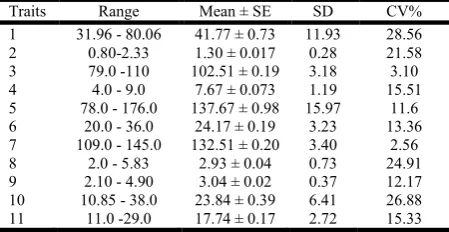
In current study, essential statistical parameters apply for the eleven quantitative traits i.e., seedling height (cm), days to 50% flowering, days to maturity, grain length (mm), grain width (mm), paddy L/B ratio, 100 seed weight (g), plant height (cm), panicle length (cm), number of productive tillers and grain yield/plant (g) (Table 1). The success of plant breeding
programs relies heavily on the existence of genetic variability in plants for a particular trait (Fakruddin et al., 2015). There is adequate genetic variations ware recorded and evaluated in various traits.
Days to 50% flowering and days to maturity readily present C.V. value not more than 10%. Frequency distribution of well known 11 quantitative traits which present in Fig. 2. The identified germplasm accessions may be used to genetic source for crop improvement.
Assessment of quantitative traits of rice germplasm accessions
Leaf Length (cm): Leaf Length exhibit high coefficient of
variation of 28.56% with range of 31.96 cm.-80.06 cm and mean of 41.77cm. More than 50% of accessions came in the
range of 46-60cm fig. 2. The highest leaf length ware measured in accession IC 377499 (80.06 cm). The average of leaf width is 1.301 cm which range from 0.80-2.33 cm. IC 301206 shows maximum leaf width and with significant grain yield i.e. 30 gm. per plant. The result of present study is similar to Sangeeta Das and Amitav Ghosh (2010). Maximum variability was found in Leaf blade. The evenly distributed narrow and short leaves can reduces proficient use of light.
Days to 50% flowering (Days): Days to 50% ranges from
[image:2.595.185.410.282.398.2]79-110 days with the average of 102.5. The trait was categorized into five groups i.e. Very early (<71 days), Early (71-90 days),
Table 1. Mean ± S.E. range, Coefficient of variation and standard deviation with important yield and yield attributing traits of rice germplasm accessions
Traits Range Mean ± SE SD CV%
1 31.96 - 80.06 41.77 ± 0.73 11.93 28.56
2 0.80-2.33 1.30 ± 0.017 0.28 21.58
3 79.0 -110 102.51 ± 0.19 3.18 3.10
4 4.0 - 9.0 7.67 ± 0.073 1.19 15.51
5 78.0 - 176.0 137.67 ± 0.98 15.97 11.6
6 20.0 - 36.0 24.17 ± 0.19 3.23 13.36
7 109.0 - 145.0 132.51 ± 0.20 3.40 2.56
8 2.0 - 5.83 2.93 ± 0.04 0.73 24.91
9 2.10 - 4.90 3.04 ± 0.02 0.37 12.17
10 10.85 - 38.0 23.84 ± 0.39 6.41 26.88
11 11.0 -29.0 17.74 ± 0.17 2.72 15.33
Note: 1. Leaf length (cm), 2. Leaf Width (cm), 3.Day to 50% Flowering, 4.Effective Tiller/plant
5. Plant Height (cm), 6.Panicle Length (cm), 7.Days to Maturity (Days), 8. L/B Ratio, 9.100 Grain Weight (gm), 10.Grain Yield/Plant (gm), 11. Seedling height (cm)
Table 2. Correlation coefficient among eleven quantitative traits of rice germplasm
Traits 1 2 3 4 5 6 7 8 9 10 11
1 1 0.275** 0.127 0.125 0.351** 0.026 0.115 - 0.069 - 0.054 0.238** -0.0174
2 0.099 0.092 0.240 0.383** 0.978 - 0.282 - 0.070 0.302** 0.002
3 0.140 0.248* 0.152 0.980 0.035 0.156 0.098 -0.051
4 0.170 0.125 0.146 - 0.113 0.060 0.375** -0.189
5 0.143 0.241* 0.022 0.138 0.390** -0.041
6 -0.148 0.054 0.095 0.049 0.013
7 0.0117 0.148 0.103 -0.052
8 0.033 -0.215* -0.028
9 0.117 0.073
10 0.027
11 1
Note: 1. Leaf length (cm), 2. Leaf Width (cm), 3.Day to 50% Flowering, 4.Effective Tiller/plant
[image:2.595.75.520.458.575.2]Medium (91-110 days), Late (111-130 days) and Very Late (>130 days). In present study all accessions belongs to medium duration i.e. 92-105 days (excluding commercial check varieties). The variation is considerably low (3.0%) may be because of most of germplasm accessions are belong to one group.
Number of effective/Productive tiller
No of productive tillers/plant showed 5.51% coefficient of variation Ali et al., 2000 have also recorded high coefficient of variability for this traits. The maximum effective tillers were recorded in IC 376585 (18 tillers/plant) while the minimum
effective tillers per plant were recorded in IC 377812 (9 tillers/plant) with grain yield 38.0gm and 21.6 gm per plant
correspondingly. The Effective tillers/plant in rice crop is a major determinant for panicle production (Miller et al., 1991, Smith et al., 2003), this traits affects total yield (Gallagher et al., 1978). Similar finding were also reported by Dutta et al., 2002.
Plant height
The mean value of plant height was measured 137.67 cm with the ranges from 78.0 to 176.0 cm and its coefficient of variation is 11.60%.The plant height was considered into five groups viz., very short (< 91 cm), short (91-110 cm), medium (111-130 cm), long (131-150 cm), very long (>150 cm) in which one accession i.e. IC 145351 showed very short, two accessions (IC 145446 and IC 145361) recorded short plant height, while generally the accessions belongs to Medium(30 accessions), long (147 accessions) and very long (76 accessions) group respectively. More than 50% of the accessions ranges from 132-159 cm. Plant height in rice is generally considered to be controlled by both qualitative and quantitative genes (Huang et al., 1996). Ashrafuzzaman et al., 2009 also considered that, this trait mainly governed by genetic constitute of the genotypes, but the ecological factors also influence the plant height.
Panicle length
Adequate quantity of variation was found in panicle length and it ranges from 20-36 cm. and average panicle length was measured 24.17 and coefficient of variation was found 13.36 cm. The maximum and minimum panicle length was recorded in IC 1454379 (36 cm) and IC 145392 (27.4 cm) with the maximum grain yield of 27.4 and 16.4 gm. per plant respectively. While it contribute positively yet maximum panicle length is not due only factor accountable for higher grain yield (Abbasi et al.,1995). The panicle length alone does not conclude the high grain yield because traits such as grain size, grain shape higher number of tiller/plants ultimately to higher grain yield (Akram et al., 1994).
Days to maturity
In present investigation maturity was ranges from (109-145 days) along with coefficient of variation 2.56%. Environmental factors mainly temperature were influence the rice flowering and maturity. The days to maturity was categorized into five
groups i.e. Very early (<100 days), Early (101-120 days), Medium (121-140 days), Late (141-160 days) and Very Late (>160 days). In present study all accessions (excluding commercial check varieties) belongs to medium duration i.e. 122-135 days. High yield desirable traits and achieve by growing of early maturing varieties because it would more efficient to daily production of carbohydrates and more efficient utilization of land (Anon, 1971). Similarly, early maturing varieties increased grain production per day, increased water use efficiency, required closed spacing to achieve yield potential, while late maturing varieties were adapted to low fertility conditions (Yoshida, 1977).
Paddy L/B ratio
In the present material paddy grain L/B ratio ranges from 2.0-5.83 with grand mean of 2.93 and coefficient of variation 24.91. The maximum and minimum L/B ratio was measured in IC 377531 (5.3 mm) and IC 300147 (2.7 mm) with grain yield 8.8 gm/plant and 29.6 gm/plant respectively. Similarly, Akram et al, 1995 also reported that rice grain can be classified into extra long, long medium and short group.
100 grain weight
In present investigation IC 377621 were measured maximum 100 grain weight 4.90 gm. and ranges from 2.10-4.90 and the coefficient of variation was recorded 12.17 Ali et al., 2000 observed maximum variation for 100-grain weight in rice ranging from 2.80 to 4.68 g.
Assessment of qualitative (Agro- morphological) traits of rice germplasm accessions
In leaf pubescence, pubescence type was more prominent i.e. 157 followed by intermediate pubescence 58 and glaborous type 43 accession. Ilhamuddin et al. (1988) found that panicle exertion was the most conspicuous character for identification of the rice cultivars.Panicle exertion have 42 well exerted, 81 accessions moderate exerted, Just exerted 106 accessions and partially exerted 29 accessions. Stigma colour with white colour has 127 accessions followed by 75 for yellow colour, 49 light purple, colour and purple 07. In Apiculus colour, out of 258 accessions, 94 accessions were white apiculus colour, 59 accessions Straw colour, 03 accession red colour, 99 accession purple and 03 accessions are with purple apex.
Out of 258 accessions, 207 accessions had awnless and 51 accessions have awns. The awns are distributed consequently short partial 45, Short full 03, long awn 01 and long full 02 accessions. Acharya et al. (1991) stated that awns appear to be equipped with physiological and biological buffers that enable them to adjust to changes in the environment. Awn color also
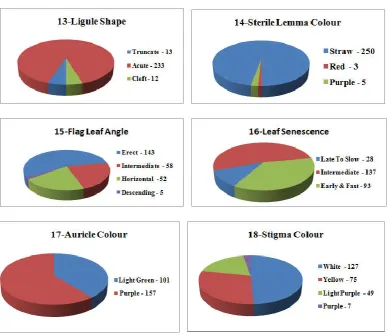
exhibited wide variation ranging from straw to different shades of brown color. While variation was high in panicle type in which compact type has 87 accessions intermediate type 97 and 74 accessions were found opened type panicle. Seed coat colour/Kernel colour had white colour for 197 accessions, 46 accessions has light brown 4 accession has brown colour accession and 11showed red seed coat colour. Hull colour exhibited considerable variation, out of 258 accessions 152 has straw colour, golden colour has 53 accession followed by purple furrow on straw 23 accession, brown furrow on straw has 18 accession, golden brown 06 and 06 accessions showed brown tawny. Threshability classified in to easy, intermediate and difficult. Out of two hundred fifty eight accessions, 127 accessions easy, intermediate 69 accessions and difficult 62 accessions. Aroma is absent in most of the accessions i.e. absent in 254 accession and present 04 accessions. The ligule shapes had 13 acute, cleft 233 and truncate 12 accessions. Flag leaf angle classified as erect, intermediate, horizontal and drooping. The wider angle more spread of leaves for light
interception, especially in the lower leaves in present study flag leaf angle had 143 accession erect type, intermediate 58, horizontal 52 accession and drooping 05 accession. Leaf senescence; were categorized in three groups i.e. early, intermediate and late, out of two hundred fifty eight accessions, 28 late & slow in which leaves were natural green, intermediate 137 accession in this yellowing for on upper leaves and early type &fast was 93 accession, in which all yellow or dead. Slow leaf senescence is a desirable trait in nitrogen responsive plant types (Beachell, 1964).Out of 258 accessions, sterile lemma were exhibited; straw colour 250 accessions and remaining red and purple 03 accessions, 05 accessions respectively.
Auricle colour
Light green in auricle colour had found in 157 and purple colour 101 accessions. The morphological characters viz., grain colour, colour of sterile lemma, awns, was also helpful and paddy varieties could be grouped into distinct classes on the basis of each of these traits. On the other hand, they may be altered by external factors. These traits should be used as secondary diagnostic characters.
Correlation
Correlation is a measure of the degree to which variable vary together or calculate of intensity of association. The correlation coefficient among ten quantitative traits of rice germplasm had been studied (Table 2) in which leaf length was positive and significant correlation to leaf width (r=0.275 at p < 0.05, 0.01), plant height (r=0.351 at p<0.05, 0.01) and also with grain yield (r=0.238 at p<0.05). Leaf width show positive correlation with panicle length r=0.383 p<0.05, 0.01) and grain yield (r=0.302 p<0.05, 0.01), however days to flowering shows only significant positive correlation with plant height (r=0.248, p<0.05) Sawant et al., 1995 also find significant positive correlation with plant height Similar results were reported by Deepa Sankar et al. (2006) and Singh et al. (2006). Effective tiller shows significant positive correlation with grain yield (r=0.375 p<0.05, 0.01). The finding of present investigation is agreement with the earlier worker viz., Venkata Laxmi et al., 2014, Deepa Shankar et al., 2006 and Ravindra babu et al., 2012; they have also recorded the positive correlation of effective tiller with yield per plant. Plant height positive and significant to days to maturity (r=0.24,p <0.05) and grain yield (r=0.390, p<0.05,0.01) similar finding were also recorded positive and significant association with grain yield per plant by the Yadav et al., 2011. L/B ratio shows negative significant correlation with grain yield (r= -0.215 p<0.05). Venkata Lakshmi et al., 2014 L/B ratio had also recorded non-significant association with grain yield per plant for character of L/B ratio.
Acknowledgments
Authors state sincere thanks to the Department of Biotechnology, Ministry of Science and Technology, Govt. Of India New Delhi for providing the pecuniary support to the DBT Network Project “Establishment of National Rice Resource Database” project and Director, NBPGR, New Delhi.
REFERENCES
Acharya, S., Srivastava, R.B. and Sethi, S.K. 1991. Impact of awns on grain yield and its components in spring wheat under ran–fed conditions. Rachis, 10: 5–6
Akhtar, M.S.1986. Path coefficient analysis in fine quality rice (Oryza sativa L.). M.Sc. Thesis. Department of Plant Breeding and Genetics, University of Agriculture Faisalabad, Pakistan.
Akram, M., Abbasi, F.M., Sagar, M.A. and Ashraf, M. 1995. Potential donors for improving grain length in Basmati Rice. J. Appl. Physiol., 5: 81–3.
Akram, M., Abbasi, F.M., Sagar, M.A. and Ashraf, M. 1994. Increasing rice productivity through better utilization of germplasm. pp: 107–14. Proceeding of a National Seminar on Genetic Resources of Cereals and their Utilization. Islamabad, Pakistan.
Ali, S.S., Jafri, S.J.H., Khan, T.Z., Mahmood A. and Butt, M.A. 2000. Heritability of yield and yield components of rice. Pakistan J. Agric.Res., 16: 89–91.
Aly, A.E. 1977. Correlation and Path coefficient analysis in some short statured rice cultivars and strains. Int. Rice Res. Newsletter, 13: 19–21.
Amirthadevarathinam, A. 1983. Genetic variability, correlation and path analysis of yield components in upland rice. Madras Agric. J., 70: 781–5.
Anon. 1971. Determination of ash which is insoluble in hydrochloric acid. Official J. Eur. Community 2155:30–31.
Ashrafuzzaman, M., Islam, M.R., Ismail, M.R., Shahidullah, S.M. and Hanafi, M.M. 2009. Evaluation of six aromatic rice varieties for yield and yield contributing characters. Int. J. Agric. Biol., 11(5): 616–620.
Barrett, B.A., and Kidwell, K.K.1998. AFLP–based genetic diversity assessment among wheat cultivars forms the Pacific Northwest. Crop Sci., 38: 1261–71.
Chang,T.T. and Tagumpay, O. 1970. Genotypic association between grain yield and six agronomic traits in a cross between rice varieties of contrasting plant types. Euphytica, 19: 356–63.
Cox, T.S., Murphy, J.P. and Rodgers, D.M. 1986. Changes in genetic diversity in the red winter wheat region s of the United States. Proc. Natl. Acad. Sci., (USA) 83: 5583–6 Crops. Tokyo: Maruzen. 135.
Deepa Sankar, P., Sheeba, A and Anbumalarmathi, J. 2006. Variability and character association studies in rice. Agric. Sci. Digest. 26 (3): 182-184.
Dhanwani, R. K., Sarawgi, A. K., Solanki, A. and Tiwari, J. K. 2013. Genetic variability analysis for various yield attributing and quality traits in rice (Oryza sativa L.), The Bioscan. 8(4): 143-1407.
Duncan, W.G. 1971. Leaf angle, leaf area, and canopy photosynthesis. Crop Sci., 11: 482–5.
Dutta R.K., Baset, Mia M.A. and Khanam. S. 2002. Plant architecture and growth characteristics of fine grain and aromatic rices and their relation with grain yield. IRC Newsletter. 51: 51–56.
Fagade, S.O., P.G. Pillai and Kehinde, J.K. 1987. Six upland rice varieties released in Nigeria. Int. Rice Res. Newsletter, 12: 5
Heritability and Genetic Advance for Yield and Yield Attributing Traits in Mutant Rice (Oryza Sativa L.). The Ecoscan. 9(1&2): 481-485, 2015
Federer, W. T. 1961. Augmented designs with one-way elimination of heterogeneity. Biometrics 17-3:447-473. Gallagher, J.N. and Biscoe, P.V. 1978. Radiation absorption,
growth and yield of cereals. J. Agric. Sci., 91: 47–60. Hirano, H., Nakamura, A., Kikuchi, F. and Komatsu, S. 1992.
Protein encoded by genes linked with semi dwarfing gene in Rice. JapanAgric. Res. Quart., 25: 223–9.
Huang, N., Courtois, B., Khush, G.S., Lin H.X., Wang G.L., Wu P. and Zheng K. 1996. Association of quantitative trait loci for plant height with major dwarfing genes in rice. Heredity. 77(2): 130–137.
Ilhamuddin, D. Rosh and M. Ahmad, 1988. Characteristics of cold tolerant rice cultivars of NWFP. Pakistan J. Agric. Res., 9: 437–9.
Jafri, S.J.H., Khan, M.A., Saddaqat, H.A. and Ali, S.S. 1994. Correlation and Path coefficient analysis in Rice. J. Agric. Res., 32: 355–62
Kurlovich, B. S. 1998. Species and intraspecific diversity of white, blue and yellow lupines. Plant Genetic Resource Newsletters. 115: 23-32.
Lakshmi, M.V., Suneetha, Yugandhar, Y. G. and Lakshmi, N.V. 2014. Correlation Studies in Rice (Oryza sativa L.). International Journal of Genetic Engineering and Biotechnology. 5(2): 121-126.
Miller, B.C., Hill, J.E. and Roberts, S.R. 1991. Plant population effects on growth and tied in water-seeded rice. Agron. J., 83(2): 291–297.
Ndour, D.1998. Tests of Agro-morphological charact erization and genetics of salt tolerance in rice (Oryza sativa L.) in the Senegal River Delta. Memory Master II, University Cheikh Anta Diop in Dakar, pp. 1-27.
Ravindra Babu, V., Shreya, K., Singh Dangi, K., Usharani, G and Siva Shankar, A. 2012. Correlation and path analysis studies in popular rice hybrids of India. International Journal of Scientific and Research Publications. 2 (3):1-5. Sarawgi, A. K., Subba Rao, L. V., Parikh, M., Sharma, B. and
Ojha, G. C. 2013. Assessment of Variability of Rice (Oryza sativa L.) Germplasm using Agro-morphological Characterization. Journal of Rice research. 6 (1):15-27. Sawant, D.S., Patil, S.L., Sadhar, B.B and Bhare, S. G.1995.
Genetic divergence, character association and path analysis in rice. J. Maharashtraagric. Univ. 20: 412-414.
Sindhumole, P. 2012. Breeding for superior protein content in rice (Oryza sativa L.). International Symposium on 100 Years of Rice Science and Looking Beyond, January 9-12, 2012, TNAU, India.
Singh, P.K., Mishra, M.N., Hore, D.K. and Verma, M.R. 2006. Genetic divergence in lowland rice of north eastern region of India. Communications inBiometry and Crop Science. 1 (1): 35-40.
Smith C.W. and Dilday R.H. 2003. Rice: Origin, history, technology, and production, 1st ed. Published by John Wiley & Sons, Inc., Hoboken, New Jersey.
Thompson, J.A., Nelson, R.L. and Vodkin, L.O. 1998. Identification of diverse soybean germplasm using RAPD markers. Crop Sci., 38: 1348–55.
Vaughan, D.A, Morishima, H. and Kadowaki, K. 2003. Diversity in the Oryza genus. Current Opinion in Pl. Biol., 6: 139–46.
Yadav, S.K., Pandey, P., Kumar, B. and Suresh, B.G. 2011. Genetic architecture, interrelationship and selection criteria for yield improvement in rice. Pakistan Journal of Biological Sciences. 14 (9): 540-545.
Yoshida, S. 1977. Rice. In: Eco physiology of Tropical Crops. P.T. Alvim and T.T. Kozlowski (eds.). Academic Press, London. pp. 57-87.