ISSN Online: 1940-9907 ISSN Print: 1940-9893
DOI: 10.4236/jssm.2018.114031 Aug. 29, 2018 455 Journal of Service Science and Management
Research on the Reform of the Review Method
of College Professional Titles Based on Point
System
Weihuang Dai
*, Xiaofang Chen
South China Business College, Guangdong University of Foreign Studies, Guangzhou, China
Abstract
Taking the confidentiality principle of professional title as the entry point, based on the existing problems of college titles, such as simple feedback me-chanism, being lack of pertinence, unfairness, etc., this paper proposes a new title review method based on the point system to change the traditional sys-tem review voting method. At the same time, the review index method is in-troduced, and the specific operation of the case is described in detail by Ana-lytic Hierarchy Process (AHP) and Precedence Chart (PC). It is hoped that through the reform of the review method, the openness and fairness of pro-fessional title review process will be further improved, and the incentive effect of college titles should be brought into play to promote the long-term devel-opment of colleges and teachers.
Keywords
Point System, College Title, Review Index, Incentive Effect
1. Introduction
On June 30th, 2017, Department of Education, Organizing Committee Office, Development and Reform Commission, Department of Finance and Depart-ment of Human Resources and Social Security of Guangdong Province jointly issued Implementation Opinions on Deepening the Reform of Simple Admin-istration and Optimization Service of Higher Education in Guangdong Province (“IODRSAOSHEGD” for short) and related guidance document. Since the in-troduction of the documents, the reform of the title of Guangdong Province has been carried out in full swing. In particular, colleges and universities that had no prior title review rights before have to undertake review rights and achieve How to cite this paper: Dai, W.H. and
Chen, X.F. (2018) Research on the Reform of the Review Method of College Profes-sional Titles Based on Point System. Jour-nal of Service Science and Management, 11, 455-465.
https://doi.org/10.4236/jssm.2018.114031
Received: April 1, 2018 Accepted: August 26, 2018 Published: August 29, 2018
Copyright © 2018 by authors and Scientific Research Publishing Inc. This work is licensed under the Creative Commons Attribution International License (CC BY 4.0).
http://creativecommons.org/licenses/by/4.0/
DOI: 10.4236/jssm.2018.114031 456 Journal of Service Science and Management smooth transitions for the titles for teaching, research, experiments, books and information, which is a question worth exploring.
According to Article 19 of Guangdong Human Resource and Employment (1996) Document No. 3 and Article 20 of Guangdong Human Resource and Employment (1998) Document No. 17, the committee members of the jury, the members of the judging panel and the staff of the daily work department of the jury shall strictly abide by six provisions, such as don’t disclose the discussion and voting situation of the jury and the judging panel; don’t accept the inquiry about the assessment situation; don’t have the obligation to report the assess-ment to the leader of the unit. In the past review activities, from the perspective of confidentiality, those applicants who failed to get titles can only know they were “unsuccessful”, but cannot know the reasons for the failures or the unsuc-cessful aspects or the striving direction. Because the previous professional review committees generally use voting methods to review each applicant, and the jury members can vote in a simple way, such as “yes” or “no”. Therefore, a lot of fac-tors, such as “personality”, “difference”, “general”, “argument” and “internal negotiation” are mixed, and the effective feedback of the review information cannot be achieved [1] [2].
According to the spirit of the “IODRSAOSHEGD” document, this paper starts from the principle of the point system, and probes into the setting of the weight of the evaluation index and the method of publicizing the evaluation informa-tion. According to different levels of colleges and universities, this paper dis-cusses in detail three cases of professional title evaluation based on the point system in the R, S and T colleges and universities, and the maneuverability of this method is mainly discussed. It provides a new train of thought and method for promoting the reform of Professional Title Evaluation in Colleges and uni-versities.
2. Point System Review Method
2.1. Point System
The point system refers to use point system for the management of teachers, use points to measure teachers’ self-worth, reflect and assess the comprehensive performance of teachers, and then link various material treatments, benefits and points, and lean toward high-scoring teachers, in order to motivate teachers’ subjective initiative and fully mobilize their enthusiasm. The core content of point system is to use points to record and evaluate the comprehensive perfor-mance of teachers and then record it with software. Point system is useful for li-felong. Connect points with the three-dimensional needs, thereby mobilize the inner motivation of teachers, let the excellent teachers not suffer losses and make “loss is a blessing” really become a reality [3].
DOI: 10.4236/jssm.2018.114031 457 Journal of Service Science and Management award, patent, dual-master quality, subject, social service, etc., each college can give different weights or points according to the actual situation. After the re-view is over, the total point of each applicant is summarized. In this way, there are both points for each sub-item and a total of points. Then, according to the situation of the posts of each college, a reasonable line is decided to confirm the final list of the applicants who get the titles and effectively combine review and employment [4].
2.2. Index Weight
The Document proposes to pay attention to the basic teaching workload, teach-ing quality, teachteach-ing reform research results, teachteach-ing awards and other teachteach-ing work performance, to overcome the tendency of only academic qualifications, only qualifications or only papers. At the same time, it is necessary to clarify the important position of the teacher’s morality and implement the “one-vote veto” system of teacher’s morality. Therefore, how to effectively implement the spirit of the Document combining with the situation of each college is an issue that deserves our in-depth study. We propose that we can explore from the perspec-tive of index weights [5]. On the one hand, the title reform overcomes the “three-dimensional” tendency of only academic qualifications, only qualified qualifications or only papers and adds new elements to the content of the review, such as, the annual teaching workload, teaching evaluation, award, patent, dual-master quality, subject, etc. On the other hand, combining with the actual situation and development direction of each college, the division of weights and points in the content of the review cannot only mean the distribution of values, but also should highlight the difficulties and differences, which cannot only ex-pand the content and scope of the review, but also motivate teachers to develop in multiple directions and take into account the promotion channels of “special-ists”, effectively using the long-term incentive mechanism for professional titles, in order to achieve a win-win situation for both teachers and colleges.
2.3. Information Feedback
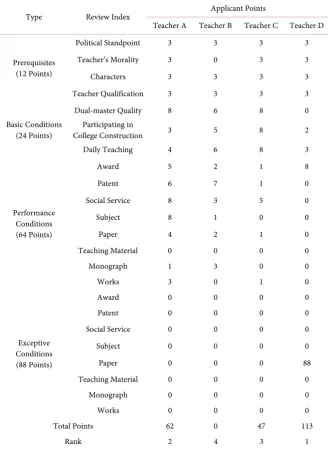
After the title review meeting is over, the results need to be announced in a timely manner. By using point system to publicize, the review information can be maximized under the premise of observing the confidentiality principle, and the applicant can be guided to carry out the next review activity. The related public content can be shown in Table 1.
DOI: 10.4236/jssm.2018.114031 458 Journal of Service Science and Management Table 1. Example of the results of point system review.
Type Review Index Applicant Points
Teacher A Teacher B Teacher C Teacher D
Prerequisites (12 Points)
Political Standpoint 3 3 3 3
Teacher’s Morality 3 0 3 3
Characters 3 3 3 3
Teacher Qualification 3 3 3 3
Basic Conditions (24 Points)
Dual-master Quality 8 6 8 0
Participating in
College Construction 3 5 8 2
Daily Teaching 4 6 8 3
Performance Conditions (64 Points)
Award 5 2 1 8
Patent 6 7 1 0
Social Service 8 3 5 0
Subject 8 1 0 0
Paper 4 2 1 0
Teaching Material 0 0 0 0
Monograph 1 3 0 0
Works 3 0 1 0
Exceptive Conditions (88 Points)
Award 0 0 0 0
Patent 0 0 0 0
Social Service 0 0 0 0
Subject 0 0 0 0
Paper 0 0 0 88
Teaching Material 0 0 0 0
Monograph 0 0 0 0
Works 0 0 0 0
Total Points 62 0 47 113
Rank 2 4 3 1
3. Specific Cases Operation
3.1. Connotation Extension and Balanced Points
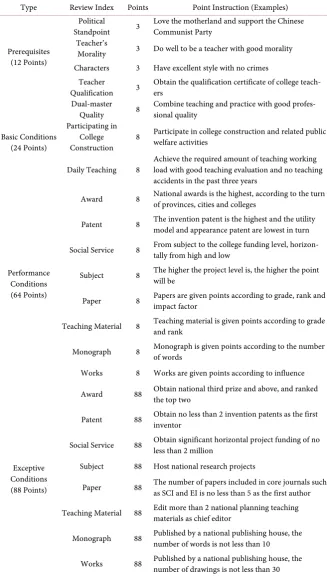
Assuming that College R has a strong comprehensive strength and is currently in a stable period of development, which does not need to emphasize the develop-ment in a certain direction, and it needs to maintain a stable growth situation in the next five years. Therefore, the college can use Table 2 as the method of re-viewing the title, that is, the equilibrium score with no index weight coefficient.
3.2. Point-To-Face Emphasis and Different Points
DOI: 10.4236/jssm.2018.114031 459 Journal of Service Science and Management Table 2. Review standards for associate professors in College R.
Type Review Index Points Point Instruction (Examples)
Prerequisites (12 Points)
Political
Standpoint 3 Love the motherland and support the Chinese Communist Party Teacher’s
Morality 3 Do well to be a teacher with good morality Characters 3 Have excellent style with no crimes
Teacher
Qualification 3 Obtain the qualification certificate of college teach-ers
Basic Conditions (24 Points)
Dual-master
Quality 8 Combine teaching and practice with good profes-sional quality Participating in
College Construction 8
Participate in college construction and related public welfare activities
Daily Teaching 8 Achieve the required amount of teaching working load with good teaching evaluation and no teaching accidents in the past three years
Performance Conditions (64 Points)
Award 8 National awards is the highest, according to the turn of provinces, cities and colleges
Patent 8 The invention patent is the highest and the utility model and appearance patent are lowest in turn
Social Service 8 From subject to the college funding level, horizon-tally from high and low
Subject 8 The higher the project level is, the higher the point will be
Paper 8 Papers are given points according to grade, rank and impact factor
Teaching Material 8 Teaching material is given points according to grade and rank
Monograph 8 Monograph is given points according to the number of words
Works 8 Works are given points according to influence
Exceptive Conditions (88 Points)
Award 88 Obtain national third prize and above, and ranked the top two
Patent 88 Obtain no less than 2 invention patents as the first inventor
Social Service 88 Obtain significant horizontal project funding of no less than 2 million
Subject 88 Host national research projects
Paper 88 The number of papers included in core journals such as SCI and EI is no less than 5 as the first author
Teaching Material 88 Edit more than 2 national planning teaching materials as chief editor
Monograph 88 Published by a national publishing house, the number of words is not less than 10
Works 88 Published by a national publishing house, the number of drawings is not less than 30
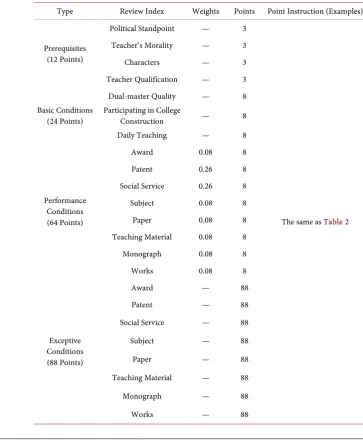
DOI: 10.4236/jssm.2018.114031 460 Journal of Service Science and Management Table 3 in reviewing title, that is, the different points. Patent and social service have the largest weighting factor of 0.26.
3.3. Weight Distribution and Scientific Evaluation
Assuming that College T is currently large in scale and it is difficult to determine the content of title review. At this point, it can be solved by comprehensively using the index evaluation method. At present, the most commonly used index evaluation methods are Analytic Hierarchy Process (AHP), Precedence Chart (PC), Percentile Ratio Method, Rank-sum ratio (RSR), Technique for Order Preference by Similarity to an Ideal Solution (TOPSIS), Fuzzy Judgment Me-thod, etc. [6]. This paper takes AHP and PC as examples to illustrate the impor-tance selection of title review for reference.
[image:6.595.173.537.298.739.2]1) Analytic Hierarchy Process (AHP)
Table 3. Review standards for associate professors in College S.
Type Review Index Weights Points Point Instruction (Examples)
Prerequisites (12 Points)
Political Standpoint — 3
The same as Table 2
Teacher’s Morality — 3
Characters — 3
Teacher Qualification — 3
Basic Conditions (24 Points)
Dual-master Quality — 8 Participating in College
Construction — 8
Daily Teaching — 8
Performance Conditions (64 Points)
Award 0.08 8
Patent 0.26 8
Social Service 0.26 8
Subject 0.08 8
Paper 0.08 8
Teaching Material 0.08 8
Monograph 0.08 8
Works 0.08 8
Exceptive Conditions (88 Points)
Award — 88
Patent — 88
Social Service — 88
Subject — 88
Paper — 88
Teaching Material — 88
Monograph — 88
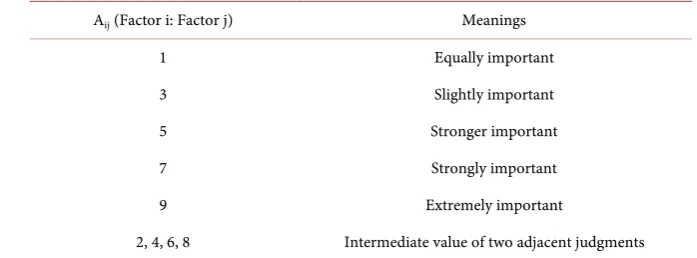
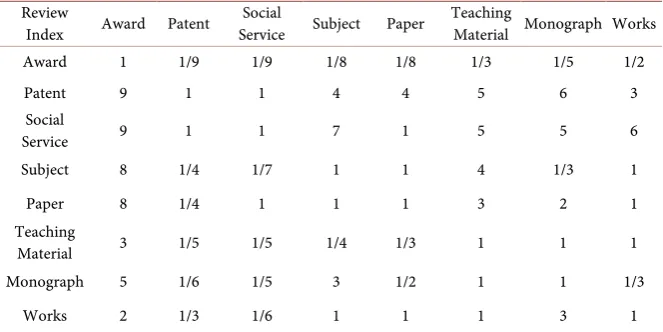
DOI: 10.4236/jssm.2018.114031 461 Journal of Service Science and Management Analytic Hierarchy Process was proposed by American operations researcher T.L. Saaty in the 1970s. It is a combination of qualitative and quantitative me-thods [7]. The expert’s subjective language judgment results are constructed into a digital matrix according to a certain numerical scale, thereby analyzing wheth-er the matrix has satisfactory consistency. If satisfied, the expwheth-ert opinion can be applied to the actual; if not, the expert opinion needs to be revised until a satis-factory consistency requirement is reached. The disadvantage is that it is limited by the number of indexes, generally no more than nine. At the same time, be-cause the meaning of the scale value is not easy to understand, it is not suitable for a wide range of investigations. AHP scale is shown in Table 4.
College T conducted a questionnaire survey of 10 experts on campus. Ac-cording to the opinions of them, the survey results are shown in Table 5.
From Table 5, the 8th order judgment matrix A can be obtained (The values of the rows and columns in Table 5 form the rows and columns of the matrix, which should be aij element in matrix A respectively). Since no high precision is required in this paper, the approximation method can be used to calculate the approximation of the eigenvalues. The steps are as follows [8]:
a) First normalize matrix A by column: ij ij , ,
(
1,2,3, ,8)
ija
b i j
a
= =
∑
;b) Normalize the matrix by row:ci =
∑
b i jij,(
, =1,2,3, ,8)
; c) Normalize ci and get the eigenvector:(
)
T
1, , ,2 8 , i i
i
c W w w w w
c
= =
∑
, W
is the approximate value of eigenvector A;
d) Find the maximum eigenvalue corresponding to the eigenvalue vector W:
(
) (
)
max 1 i , 8, 1,2,3, ,8
i i
AW
n i
n w
λ = = =
∑
.Through the calculation of the above steps, the maximum eigenvalue can be obtained λmax =8.0133884. According to the principle of hierarchical method,
the consistency of the theoretical maximum eigenvalue λmax of A and the
dif-ference of n is used to test the consistency, and the consistency index is obtained max 8.0133884 8 0.001913
1 8 1
n CI
n
λ − −
= = =
[image:7.595.192.541.590.719.2]− − , which is close to 0 with satisfactory
Table 4. AHP proportion scale.
Aij (Factor i: Factor j) Meanings
1 Equally important
3 Slightly important
5 Stronger important
7 Strongly important
9 Extremely important
DOI: 10.4236/jssm.2018.114031 462 Journal of Service Science and Management Table 5. AHP index method evaluation result.
Review
Index Award Patent Service Social Subject Paper Teaching Material Monograph Works
Award 1 1/9 1/9 1/8 1/8 1/3 1/5 1/2
Patent 9 1 1 4 4 5 6 3
Social
Service 9 1 1 7 1 5 5 6
Subject 8 1/4 1/7 1 1 4 1/3 1
Paper 8 1/4 1 1 1 3 2 1
Teaching
Material 3 1/5 1/5 1/4 1/3 1 1 1
Monograph 5 1/6 1/5 3 1/2 1 1 1/3
Works 2 1/3 1/6 1 1 1 3 1
consistency. Considering that the deviation of consistency may be caused by random reasons, when checking whether the judgment matrix has satisfactory consistency, it is also necessary to compare CI with the random consistency in-dex RI to obtain the test coefficient CR. By querying the average random consis-tency index, RI value of the 8th order matrix is 1.41, and the test coefficient
0.001913 0.001356 0.1 1.41
CI CR
RI
= = = < can be obtained. According to AHP, the
judgment matrix A passes the consistency test.
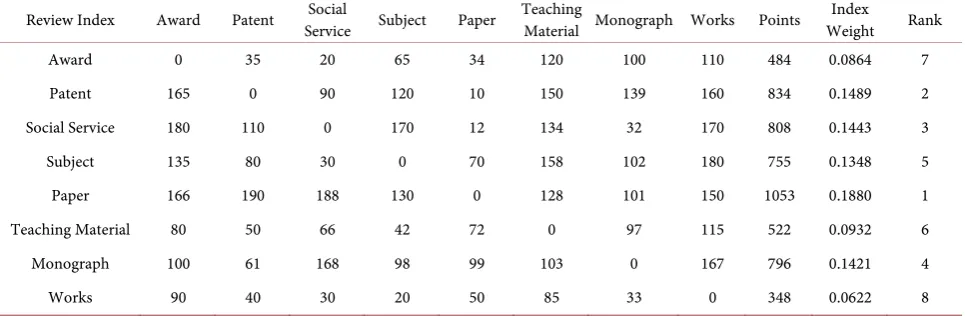
In summary, the evaluations of 10 experts are consistent and the results are credible. After obtaining the relative importance between the elements at the same level, it is possible to calculate the comprehensive importance of the ele-ments at all levels from the top to the bottom, that is, the weight of each evalua-tion index. Through calculaevalua-tion, the index weight of each evaluaevalua-tion index is shown in Table 6.
According to Table 6, it can be seen that the weights of patent, social service and paper are ranked at top 3, which means that the requirements of the three indexes are higher.
2) Precedence Chart (PC)
Precedence Chart was proposed by an American scholar P.E. Moody in 1983. It also uses the matrix method to analyze the importance of each factor and pro-vide a basis for management decision-making. The simple operation method is to use “1” and “0” to reflect the degree of importance. “1” means that one index is more important than the other, and “0” means that one index is less important than the other. Finally, the summary quantity is sorted. The larger the number is, the higher the importance is, and the smaller the number is, the lower the importance is. The advantages of this method are that the meaning is simple and clear and it can be used for large-scale data survey. The disadvantages are that it is subjective and it is not distinguishable [9] [10].
DOI: 10.4236/jssm.2018.114031 463 Journal of Service Science and Management Table 6. The weights of the indexes in AHP index evaluation.
Review Index Index Weight
Award 0.021
Patent 0.296
Social Service 0.284
Subject 0.080
Paper 0.123
Teaching Material 0.051
Monograph 0.066
Works 0.079
Table 7. PC index review results.
Review Index Award Patent Service Social Subject Paper Teaching Material Monograph Works Points Weight Index Rank
Award 0 35 20 65 34 120 100 110 484 0.0864 7
Patent 165 0 90 120 10 150 139 160 834 0.1489 2
Social Service 180 110 0 170 12 134 32 170 808 0.1443 3
Subject 135 80 30 0 70 158 102 180 755 0.1348 5
Paper 166 190 188 130 0 128 101 150 1053 0.1880 1
Teaching Material 80 50 66 42 72 0 97 115 522 0.0932 6
Monograph 100 61 168 98 99 103 0 167 796 0.1421 4
Works 90 40 30 20 50 85 33 0 348 0.0622 8
In Table 7, taking the index award as an example, the data indicates that there are 35, 20, 65, 34, 120, 100, and 110 applicants think that the award is more im-portant than patent, social service, subject, paper, teaching material, monograph and works. The award index is 484 points. Index weight is calculated by dividing the point by the sum of the points of all indexes, that is, 484/5600 = 0.0864. Oth-er indexes are calculated in the same way. According to the index weight value, it can be known that the top three indexes are paper, patent and social service.
4. Advantage Analysis of Point System Review Method
The advantages of point system review method mainly include the following three aspects:
1) Effective feedback on review information, promoting teacher development The method in Table 1 can effectively feedback the information of profes-sional title evaluation, especially for the applicants who failed to get the titles, it can effectively improve the guidance and pertinence of title review and greatly improve the openness and fairness of title review. It can promote the develop-ment of teachers to some extent.
[image:9.595.57.540.278.436.2]DOI: 10.4236/jssm.2018.114031 464 Journal of Service Science and Management problem of the separation of review and employment is solved.
The use of point system can distinguish the differences in the performance of teachers in all aspects, which effectively overcomes the vagueness of the voting system and the difficulty of the same vote. Being similar to the college entrance examination scores which is from high to low, in point system, according to how many professors and associate professors are required in each college, the cor-responding score line can be decided and the problem of difficult in review and employment is naturally solved.
3) Index weights show key points and lead the later strategic development of colleges
In the process of title review, the point system is introduced. Different index weights are set according to the situation of each college, which can lead the de-velopment direction, highlight the key points and characteristics of the devel-opment and enhance the centripetal force and cohesiveness of all personnel of the college for a period of time.
5. Conclusion
More than a year after the publication of the “IODRSAOSHEGD” document, many colleges and universities in Guangdong Province are undergoing profes-sional title review reform. South China Business College of Guangdong Univer-sity of Foreign Studies adopted the method of professional title evaluation based on the point system proposed in this paper, and achieved good results. However, the index setting and index weight of title evaluation need further study, which is the key of this professional title evaluation model. Colleges and universities can set different indexes and weights according to their own development needs and strategic orientation, enhance the incentive effect of titles and realize the two-way interaction and win-win between colleges and teachers.
Conflicts of Interest
The authors declare no conflicts of interest regarding the publication of this paper.
References
[1] Xie, F.H. (2000) Scientific Measurement and Expert Review—On the Reform of University Teachers’ Title Review. Higher Education Research, 3, 69-73.
[2] Yu, X.L. (2011) Research on the Construction of Professional Title Review System Based on Fairness. China Administration, 11, 77-80.
[3] Li, R. (2014) The Use of Point System Management in Innovative Social Manage-ment. People’s Political Consultative Conference, 2014-03-01. (03: Special Edition)
http://dzb.rmzxb.com/index.aspx?date=2014-03-01&verOrder=03&banzi=2&paper Type=rmzxb
[4] Yu, Q.D. and Wang, W.M. (2013) Examining and Rethinking: The Application of Evaluation Standards for Professional Titles in Higher Vocational Education in China. Teacher Education Research, 1, 17-21.
Inno-DOI: 10.4236/jssm.2018.114031 465 Journal of Service Science and Management
vation Capacity and Application Study. Technology and Investment, 7, 143-151.
https://doi.org/10.4236/ti.2016.74016
[6] Wang, T. (2016) Members’ Supplementary Decision-Making during the Operation of “Single-Core” Virtual R & D Team. China Human Resources Development, 10, 35-40.
[7] Raza, M.S., Fayaz, M., Ijaz, M.H., Hussain, D. and Rubab, S. (2017) Money Laun-dering Risk Evaluation of Financial Institution with AHP Model. Journal of Finan-cial Risk Management, 6,119-125. https://doi.org/10.4236/jfrm.2017.62010
[8] Tong, J. (2018) Evaluation of College Students’ Employment Quality Based on Analytic Hierarchy Process. Science and Technology Management Research, 2, 160-164.
[9] Cao, T.T., Lu, G.Z., Wang, X.H., Liu, S.J. and Zheng, T.Y. (2016) Construction of ICU Hospital Infection Risk Review Index System Based on Delphi and Excellent Sequence Diagram Method. Journal of Nursing Science, 3, 44-47.