Abstract—This research begins by reviewing relevant literature that frames the concept of perceived value in CSA and integrates this construct into a supply chain channel decision-making problem. This study investigates whether the agricultural producers in a two-echelon supply chain comprising a dominant producer and a retailer needs to introduce a direct channel by considering unit production operating cost and consumer regional difference based on the community supported agricultural(CSA) mode. The optimal pricing strategies and related profits of two partners are investigated. Analysis suggests that running a direct channel will force the retailer to reduce the retail price on the retail channel but will not influence the wholesale price on the retail channel. The producer always benefits from the direct channel not only in the decentralized supply chain but also in the coordinated supply chain but the result is adverse for the retailer. The retailer benefits only when the unit production operating cost in a direct channel is high and the regional difference among consumers is large. In such a case, a win–win outcome for the producer and the retailer can be achieved.
Index Terms—community supported agricultural, supply chain, direct channel, coordination.
I.INTRODUCTION
Community supported agricultural (CSA) mode was developed in the 1960s as a way of combining sustainable cooperation between agricultural producers and consumers through direct marketing. This could manifest as a mutual consultation contract governing the producers and sharing the risk with consumers. For example, Brown (2008)[1], Cho (2013)[2], Chen (2013)[3] and Gumirakiza J(2014)[4] have considered the ways in which this new mode could change the structure of supply chains. With the rapid development of the Internet, online selling channels have increasingly been opened for more products. Enfodesk data show that the scale of B2C marketing in China reached 240.07 billion Yuan in 2011, with a year-on-year growth rate of 130.8%. Using a direct selling channel, agricultural producers can increase the market share of their products, strengthen their bargaining power with retailers, enhance their competitiveness against other producers, and attract consumers who cannot obtain products from the retail channel. However, direct selling channels may also present competition to retailers, thus leading to channel conflict [5][6][7]. Hence, the choice of
Manuscript received Mar 12, 2015; revised July 5, 2015. This work is partly supported by the Key Research Projects of Humanities and Social Science in the University of Anhui Province (SK2014A235) and the National Natural Science Foundation of China (No. 31371533).
Yong Ye is with Logistics Engineering, Anhui Agriculture University, Hefei, 230000; Phone:(+86)-18256028950; E-mail: ([email protected]).
Zonghong Cao is with Institute of Applied Mathematics, Anhui Agricultural University, Hefei, 230000; E-mail: ([email protected]).
whether or not to sell via direct selling channels and the coordination of the dual-channel supply chains have become highly topical for supply chain managers.
Scholars worldwide have performed investigations on decision-making in dual-channel supply chains. Chiang (2003) conducted the first quantitative study on the pricing issue in dual-channel supply chains. They pointed out that producers take the direct selling channel as a means of forcing retailers to lower product prices in retail channels, thereby increasing their profits [8]. Park and Kel (2003) studied the issue of the best channel selection of suppliers. Their research showed that the dual-channel supply chain can improve the income of each supplier and the overall performance in the supply chain [9]. Under the hypothesis of the linear model, Lin and Zhang [10] obtained a result similar to that found in the literature [8] and [9]. Kawakatsu (2010) focused on an inventory decision problem with a non-linear increasing demand pattern, and considered shortage by proposing a heuristic method based on a repetitive forward rolling technique for determining the inventory policy [11].
Considering that price and service will simultaneously influence demand, Yao and Liu (2006) conducted a study in which they extended the model developed by Park and Kel [12]. The results showed that retailers raise their service level to compensate for the negative impact caused by direct selling channels opened by producers. Dumrongsiri (2008) in turn extended the preceding models to study the pricing strategy of the dual-channel supply chain, and presented the main factors influencing the opening of direct selling channels by producers [13]. These results indicated that the change in demand can exert a significant influence on producers in terms of their deciding whether to open a direct selling channel or not. Chiang and Monahan (2006) studied the issue of selecting direct selling channels from the perspective of inventory decision making [14]. Yao (2009) analyzed the optimal inventory level of the dual-channel mode under three inventory strategies [15]. Mukhopadhyay (2008) also analyzed the influence of the information sharing mechanism on channel decision, under the asymmetry of demand forecasting information and service cost information [16].
In this way, CSA provides a more responsive user experience and a lower load in the supply chain, while studies on the preceding dual-channel supply chains are mostly based on the assumption that the market requirement transfers from the retail channels to the direct selling channels. Therefore, the pricing and coordination issues under dual-channel mode are studied under the condition that the total demands of the two channels are constant.
The possibility that opening direct selling channels may influence demand is rarely considered when examining
The
Supply Chain Channel Decision Making based on
the Community Supported Agricultural Mode
Yong Ye, and Zonghong Cao
IAENG International Journal of Applied Mathematics, 46:1, IJAM_46_1_01
CSA. A direct selling channel does not have a place of origin constraint. Therefore, opening a direct selling channel can attract potential customers who cannot obtain products via retail channels owing to geographical constraints. Furthermore, producers need to invest more in the early stage and to the web to open direct selling channels. Therefore, this paper investigates the two-stage supply chain composed of retailers and dominant producers, based on the two preceding points. The conditions of opening direct selling channels by producers, and the pricing and profit of both sides under the dual-channel mode, are studied by considering the characteristics of geographical difference and the cost for product operation in direct selling channels. The influence of the direct selling channel on the profit of both sides under the integrated, decentralized, and coordinated supply chains are also analyzed.
II.BASIC MODEL
Suppose that CSA producer (M) sells product “e” to one consumer through retailer (R). The unit production cost of the product is cr; the wholesale price is wr; and the retail price is pr. As the dominant player of the Stackelberg game, the producer has the right to sell product e directly by opening an online selling channel. Similar to the literature [17], this study divides consumers into two groups: those loyal to the CSA producer and those loyal to the retailer. The former are those who buy only their preferred agricultural products. These consumers will certainly buy products from the retailer if the producer does not open an online selling channel. The latter are those who buy products only from the retailer regardless of the direct selling channel.
Suppose that εM and εR are the maximum numbers of the consumers loyal to the producer and the retailer respectively. λd is the proportion of the consumers loyal to the producer who purchase product e through the online selling channel. Subsequently, if direct selling channels are opened, λd*εM consumers will purchase product e through these channels, and (1 − λd)*εM consumers will obtain product e from the retail channels.
Given that some consumers prefer organic food from local farms, it is assumed that the maximum number of consumers with this demand is εd. Furthermore, the operating costs of the unit product in the direct selling channels are assumed to be cd, which includes the ordering cost and transportation cost. Hence, the overall cost of the unit product sold online is
cr
cd
. Finally, it is assumed that the retail online price is pd. The demands of these two kinds of channels are as follows:(1) If CSA producers do not open direct selling channels, the total market demand of product e is as follows:
)
1
)(
(
M
R
pr
D
(1)(2) If CSA producers open direct selling channels, the market demand of the retail channels (Dr) and the direct selling channels (Dd) are as follows:
)] (
) 1 ( [ ) 1
( pd M d pd pr pd
d
Dd (2) According to Formula (1) and (2), if
pe
pd
0
, thend
D
Dd
Dr
; that is, the total demand for product e will increase when the producers open the online selling channels. This means that the opening of online sellingchannels would not only transfer some consumers from the retail channels to the direct selling channels, but would also attract consumers who cannot obtain this product due to the regional factor. In the formulas, γ indicates the intensity of the competition between the two channels, wherein the value of γ does not influence the total market demand of product e.
III. SOLUTION OF THE MODEL
In this article, the pricing strategy of both sides when the producers open direct selling channels is discussed. Firstly, the conditions of opening the direct selling channels and the corresponding pricing strategies under the integrated supply chain and the decentralized supply chain are discussed. Following this, the influence of opening direct selling channels on the profit distribution of both sides under the decentralized supply chain is examined.
When the producer does not open the direct selling channels, as the dominant player of the Stackelberg game, the producer first sets the wholesale price wr for product e. Then, the retailer sets retail price pr according to wr. With the given wr, the retailer sets the optimal maximum profit as
* r
p
=(1+
βw
r)/(2
β
)
. So the optimal wholesale price is * rw
=(1+
βc
r)/(2
β
)
, wherein the corresponding profits of themanufacturer and retailer are * M
=(
ε
M+
ε
R)´
(1-
βc
r)
2/(8
β
)
and * R
=(
ε
M+
ε
R)(1-
βc
r)
2/(16
β
)
. The optimal retail priceand the profit of the supply chain under the integrated supply chain are **
e
p
=(1+
βc
r)/(2
β
)
and ** C
=(
ε
M+
ε
R)(1-
βc
r)
2/(4
β
)
if both sides are willing to cooperate.A. Integrated supply chain
If the CSA producer and the retailer are willing to integrating an integrated supply chain, the profit of this system will be:
Π
C = Dd(pd − ce − cd) + Dr(pr − cr) = (ad − bdpd + ϕpr)(pd − cr − cd) + (ae − br pr + ϕpd)(pr − cr) (3) The retail price is set as per the principle of profit maximization under the integrated supply chain (Theorem 1).
Theorem 1.
If
c
d<cd
I − max=(
b
d-
ϕ
)(1-
βc
r)/(
βb
d),
theoptimal retail prices under the integrated supply chain are
I d
p
=[1+
β
(
c
r+
c
d)]/(2
β
)
and I rp
=(1+
βc
r)/(2
β
)
.Ifmax
I
d cd
c , The integrated supply chain will not open the
direct selling channels.
Theorem 1 gives the conditions when the direct selling channels can be opened in the integrated supply chain and pricing strategies. If
c
d
[
0
,
cd
Imax]
, then direct selling channels can be opened in the integrated supply chain. It is, therefore, easy to infer thatp
dI
p
rI - that is, the direct selling price is higher than the retail price in the integrated dual-channel supply chain. While the direct selling channels contain no difference to the retail channels in the integrated supply chain, the cost of the retail channels is higher. The demands of the two channels in the integrated supply chain and the profit of this chain are :IAENG International Journal of Applied Mathematics, 46:1, IJAM_46_1_01
= {bd[1 −β(cr + cd)] −ϕ(1 −βcr)}/(2β)
= {br(1βcr) −ϕ[1 −β(cr + cd)]}/(2β)
= {br(1 −βcr)2− 2ϕ(1 −βcr)[1 −β(cr +
cd)]+ bd[1 −β(cr + cd)]2}/(4β2)
Theorem 2 is being referred to in terms of the influence of opening direct selling channels on the product demands and profit of the chain.
Theorem 2. The following equations are obtained when
]
,
0
[
max
Id
cd
c
:(1) , , ,
and ;
(2) and if cd = 0. The equality
hold up if and only if εd = 0;
(3) and if εd = 0. The equality
hold up if and only if cd = 0;
(4) and if
; otherwise, the following is
derived
when :
① and when
0
cd
cd
I1② but when
③ and when .
Theorem 2 compares product demand and profits before and after opening the direct selling channels in the integrated supply chain. Accordingly, (1) of Theorem 2 indicates that adding cd is unfavorable for the supply chain. Meanwhile, (2) and (3) of Theorem 2 indicate that the direct selling channels are not beneficial to the integrated supply chain if they bring about a smaller potential demand εd, because the direct selling channels are not different with the retail channels under the integrated supply chain. However, the cost of the products sold through direct selling channels will increase. Hence, this approach is more beneficial to the systematization of the supply chains with a larger εd and a smaller cd.
B. Decentralized supply chain
As the dominant player in the Stackelberg game, the producer will give the direct selling price as pd and the wholesale price as wr if he/she and the retailer independently make decisions. The retailer will then set its retail price pr as the follower. With pd and wr given, the profit of the retailer is as follows:
)
)(
(
ar
brpr
pd
pr
wr
R
(4)The retailer sets the optimal retail price as per the principle of profit maximization and can be obtained according to the first-order optimized condition, as follows:
)
2
/(
)
*
(
ar
br
wr
pd
br
pDr
(5) Based on formulas (2) and (5), the profit of the producer is calculated as follows:)} ]( ) 2 ( 2 [ ) )( a { 2 1 2 2 r d r d d d r r r r d r r r d r r r r r M c c p p b b w b a a b c w p b w b b b
(6)The optimal pricing strategy of the producer under the decentralized chain can be obtained according to Formula (6).
Theorem 3.
If (2 )(1- cr)/[ (2brbd- )]=CD-max d 2
2
brbd br
cd ,
the optimal direct selling price and the optimal wholesale price for the producer in the decentralized supply chains are
) )]/(2 c + (c +
[1 r d
D d
p and
w
rD
(
1
c
r)
/(
2
)
, respectively. The producer in the decentralized supply chains will not open the direct selling channels ifmax D d d c c .
The demands and profits of the two channels calculated as Theorem 3 are as follows when
c
d
c
dDmax:r r d
{b (1 c ) [1 (c +c )]}/(4 )
D
r r
D
2
r d r d r r
{(2b b
)[1
(c +c )]
b (1
c )}/(4 b )
Dd r
D
2 2
r d r d r
2 2 2
r d r r
{(2b b
)[1
(c
c )]
2 b (1
c )
[1
(c
c )]
(1
c ) }/(8
b )
D M r rb
Theorem 4. The following are obtained when
max
D d dc
c
:(1)
w
rD
w
*r,
p
rD
p
r* andp
rD
w
rD
p
r*
w
*r (2) dDdD/dcd 0, dDrD/dcd 0,0 / ) (DdDDrD dcd
d , dDM/dcd 0, and
0 / d D R dc d .
Formula (1) in Theorem 4 shows that the direct selling channels force the retailer to drop the price, whereas the producer maintains the original wholesale price. Therefore, the return of the unit product of the retailer decreases. Subsequently, formula (2) in theorem 4 indicates that the demands in the direct selling channels and the producer’s profit decrease as cd increases, whereas the demands in the retail channels and the retailer’s profit increase as cd
increases. This result indicates that the cost increase in the direct selling channels is unfavorable for the producer but favorable for the retailer.
Theorem 5. The producer will open the direct selling channels if
c
d
c
dD; otherwise, the manufacture will not.Deduction 1. In the decentralized supply chain,
(1) If εd =0, the opening of the direct selling channels by the producers is unfavorable for the retailer.
(2) If both εd and cd are relatively large, the opening of the direct selling channels is favorable for the retailer.
Moreover, a “win–win” situation is achieved through the direct selling channels.
C.Coordinated supply chain
In order to maximize profits, the dominant manufacturer often adopts a coordination strategy to encourage retailers so as to coordinate the supply chain.
I d
D
I rD
I r
0 / d I d dcdD / d 0
I d dc
dD ( )/ d 0
I r I
d D dc
D d 0 / d I C dc d * * D D
D rI
I d
* *
C I C
* *
D D
DdI rI IC *C*
* * D D D I r I d
* *
C I C
2
r d d R M
b b
>b β(ε +ε )
max 2
1
0
c
dI
c
dI
c
dI* * D D D I r I d
* *
C I C
* * D D D I r I d
* *
C I C
1
I2d d I
d
c
c
c
* * D D D I r I d * *
C I C
2 Imax
d d I
d c c
c
IAENG International Journal of Applied Mathematics, 46:1, IJAM_46_1_01
Suppose that the producer provides the agreement of the “coordination-based profit sharing” (i.e., the producer and the retailers can share the increased profits obtained by the coordination of the supply chain according to a certain proportion). Suppose also that the proportion of profits
obtained by the retailer is
[
0
,
1
]
, and that the τ value depends on the negotiation of the two sides. First, the relationship between the profit of the integrated supply chain and the profits of both sides in the decentralized supply chain before and after the opening of the direct selling channels is determined.Theorem 6. (1) If the direct selling channel is not opened, ** ** **
4
2
M RC
and ** ** ** **)
(
M R RC
.(2) If the direct selling channel is opened,
D M I
C
2
,
CI
4
MD,2
DR
DM, andD R D R D M I
C
(
)
.Accordingly, formula (1) in theorem 6 shows that the profit of the dominant producer is twice that of the retailer if the direct selling channel is not opened. In addition, formula (2) shows that the profit of the producer is higher after the opening of the direct selling channel, which indicates that the producer can profit more through the direct selling channel. The direct selling channel can be opened in the decentralized supply chain if Dmax
d d c
c . Furthermore, the direct selling channel can be opened in the integrated supply chain if cd cdImax. The influence of the opening of the
direct selling channels on the profits of the two sides in the coordinated supply chain is discussed under condition of
max I
d d c
c because max Dmax
d I
d c
c .
In the case that the producer does not open the direct selling channel and both sides have achieved the coordination of the supply chain through the “coordination-based profit sharing” agreement, formula (1) in theorem 6 shows that the coordination-based profit is
* * * * * * * * * *
)
( M R R
c
c
. Therefore, the profit of the producers is
*MC
*M*
(
1
)
C** and the profit of the retailer is * ** **C R
C
R
.In the case that the producer opens the direct selling channel and both sides have also signed the “coordination-based profit sharing” agreement, eq. (2) in theorem 6 shows that the coordination-based profit is
D R D R D M I C I
C
(
)
. Therefore, the profit ofthe producers is
DCM
DM
(
1
)
CI and that of theretailer is D
R I
C D
R DC
R
(1
) .IV. EXAMPLE ANALYSIS
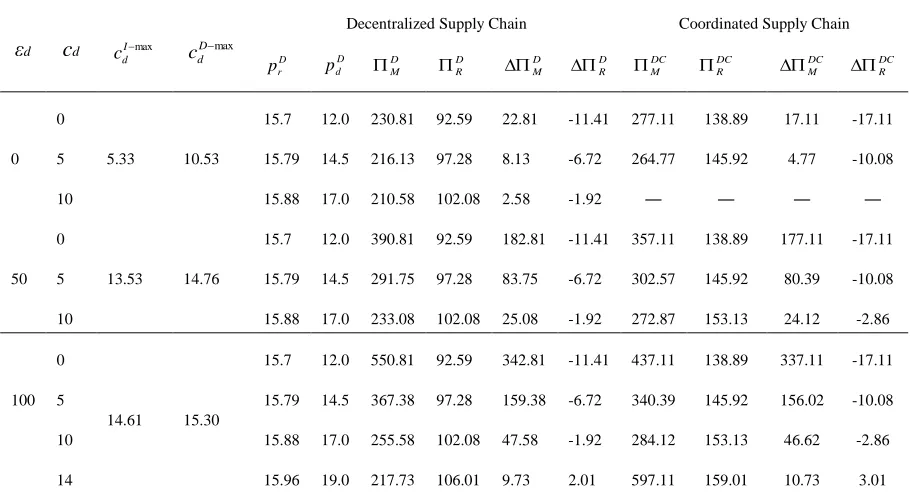
Assume that the parameters in the model are as follows: εM = 50, εR = 80, β= 0.05, cr = 4, λd = 0.1, γ = 0.01, and τ = 0.5. Table 1 shows the influence of the pricing decision and the profit presented in CSA for supply chain channel with different parameters.
The table presents the following findings:
(1) The unit product cost cd in the direct selling channel, retail prices of both channels and profit of the retailer increase, whereas the profit of the producers decreases. This
result suggests that the higher the cost, the more disadvantageous it is for the producers and the retailers.
(2) If the potential demand in the direct selling channel εd increases, the producers’ profit increases which, in turn, indicates that the acceptable “threshold” for the producer to open the direct selling channel is lowered. In other words, the producer is still willing to open the direct selling channel even if the unit product cost cd is higher. In this case, the advantages of high potential demands can offset the negative influence of the high cost.
(3) The potential demand εd in the direct selling channel has no influence on the two sides' pricing strategies and the profit of the retailer. Even though the potential demand exerts no impact on the decision making and on retailers’ profits, due to the increase of εd CSA producers will open the direct selling channel even if cd is higher. At the same time, it can be said that the higher cd is beneficial to the retailer.
(4) The beneficiary of the direct selling channel is not always the producer alone. When εd and cd are both higher (as shown in Table 1, εd =100, cd =14), the opening of the direct selling channel benefits both sides, achieving a "win-win" situation.
V.CONCLUSION
The original idea of CSA was to re-establish urban residents’ sense of connection to rural farmland, and to foster a strong sense of community and cooperation via an efficient operation, in order to then provide food security for differentiated demands. In this paper, we present a new supply chain decision model for cooperating agricultural producers with customers. A two-stage supply chain is proposed, where the dominant producers sell a certain product through a single retailer. The paper then considers how both pricing strategies and profits’ may influence CSA demands.
The results show that supply chain channel decision-making by depends on consumers’ regional differences and on CSA operational costs. A greater regional difference among consumers and a lower operational cost are both beneficial to the producer. The retailer, however, would only when customer regional differentiation and operational costs benefit are both higher. Ultimately, it was found that the CSA channel can achieve a "win-win" situation. In the face of the disadvantages wrought by the direct selling channel, the ways in which retailers can take effective measures to protect their vested interest is the direction of our future research; this includes examining variables such as retailers providing their own products or improving the product-related service level.
ACKNOWLEDGMENT
The author would like to thank the anonymous reviewers very much for their valuable suggestions on improving this paper.
REFERENCES
[1] Brown C, Miller S, “The impacts of local markets: a review of research on farmers markets and community supported agriculture
IAENG International Journal of Applied Mathematics, 46:1, IJAM_46_1_01
(CSA),” American Journal of Agricultural Economics, 90(5), pp.1298-1302, 2008.
[2] Cho S H, Tang C S, “Advance selling in a supply chain under uncertain supply and demand,” Manufacturing & Service Operations Management, 15(2),pp.305-319, 2013.
[3] Chen W, “Perceived Value in Community Supported Agriculture (CSA): A Preliminary Conceptualization, Measurement, and Nomological Validity,”British Food Journal, 115(10), pp.1428-1453, 2013.
[4] Gumirakiza J D, Curtis K R, Bosworth R, “Who Attends Farmers’ Markets and Why? Understanding Consumers and their Motivations,”
International Food and Agribusiness Management Review, 17(2), pp.65-81, 2014.
[5] Scott S, Si Z, Schumilas T, et al, “Contradictions in state-and civil society-driven developments in China’s ecological agriculture sector,”
Food Policy, 45, pp.158-166, 2014.
[6] Taticchi P, Tonelli F, Pasqualino R, “Performance measurement of sustainable supply chains: A literature review and a research agenda,”
International Journal of Productivity and Performance Management, 62(8), pp.782-804, 2013.
[7] Lee KS, Ng ICL, “Advanced sale of service capacities: a theoretical analysis of the impact of price sensitivity on pricing and capacity allocations,” Journal of Business Research, 54(3), pp.219-225, 2001. [8] Chiang W K, Chhajed D, Hess J D, “Direct marketing, indirect
profits:a strategic analysis of dual-channel supply-chain design,”
Management Science,49(1),pp.1-20, 2003.
[9] Park S Y, Keh H T, “Modeling hybrid distribution channels: a game-theoretic analysis,”Journal of Retailing and Consumer Services, 10, pp.155-167, 2003.
[10] Liu Y C, Zhang J, “The benefits of personalized pricing in a channel,”
Marketing Science, 25(1), pp. 97-105, 2006.
[11] Kawakatsu H, “Optimal retailer’s replenishment policy for seasonal products with ramp-type demand rate,” IAENG International Journal of Applied Mathematics, 40(4), pp.262-268, 2010.
[12] Yao D, Liu J, “Competitive pricing of mixed retail and e-tail distribution channels,”Omega, 33(3), pp.235-247, 2005.
[13] Dumrongsiri A, Fan M, Jain A, et al, “A supply chain model with direct and retail channels,” European Journal of Operational
Research,187 (3), pp.691-718, 2008.
[14] Chiang W K, Monahan G E, “Managing inventories in a two-echelon dual-channel supply chain,” European Journal of Operational Research, 162(2), pp.325-341, 2006.
[15] Yao D Q, Yue X H, Mukhopadhyay S K, et al, “Strategic inventory deployment for retail and e-tail stores,”Omega, 37(3), pp.646-658, 2009.
[16] Mukhopadhyay S K, Yao D Q, Yue X H, “Information sharing of value-adding retailer in a mixed channel hi-tech supply chain,”
Journal of Business Research, 61, pp.950-958, 2008.
[image:5.595.71.526.556.802.2][17] H. Kawakatsu, T. Homma and K. Sawada, “An optimal quantity discount policy for deteriorating items with a single wholesaler and two retailers,”IAENG International Journal of Applied Mathematics, 43(2), pp. 81-86, 2013.
TABLE 1
INFLUENCE OF THE PRICING DECISION AND PROFIT PRESENTED IN CSA FOR THE SUPPLY CHAIN CHANNEL.
ε
dc
dDecentralized Supply Chain Coordinated Supply Chain
0 15.7 12.0 230.81 92.59 22.81 -11.41 277.11 138.89 17.11 -17.11 0 5 5.33 10.53 15.79 14.5 216.13 97.28 8.13 -6.72 264.77 145.92 4.77 -10.08
10 15.88 17.0 210.58 102.08 2.58 -1.92 — — — —
0 15.7 12.0 390.81 92.59 182.81 -11.41 357.11 138.89 177.11 -17.11 50 5 13.53 14.76 15.79 14.5 291.75 97.28 83.75 -6.72 302.57 145.92 80.39 -10.08 10 15.88 17.0 233.08 102.08 25.08 -1.92 272.87 153.13 24.12 -2.86
0
14.61 15.30
15.7 12.0 550.81 92.59 342.81 -11.41 437.11 138.89 337.11 -17.11 100 5 15.79 14.5 367.38 97.28 159.38 -6.72 340.39 145.92 156.02 -10.08 10 15.88 17.0 255.58 102.08 47.58 -1.92 284.12 153.13 46.62 -2.86 14 15.96 19.0 217.73 106.01 9.73 2.01 597.11 159.01 10.73 3.01
max
I d
c cdDmax D r
p pdD
D M
D
R
D
M
D
R
DC
M
DC
R
DC
M
DC
R