Learning Support System of Role Words
by Using Classified Lines of Comic Scene
Yoko Nishihara, Kohei Matsuoka, and Ryosuke Yamanishi
Abstract—This paper proposes a learning support system that provides users with classified lines of comic scene to learn role words in speaking with foreign language. The role word is one of the expressions for letting people imagine one’s character. The characters are one’s age, gender, occupation, class, era, looks, appearance, personality, etc.. People use the role words according to the occasions in daily lives. People learning foreign language need to learn suitable role words for their characters. The role words are frequently used in conversations. It is difficult for people to learn the role words from conversation examples written in textbooks of foreign language because few examples are shown to learn the role words on the textbooks.
We surveyed good conversation examples for learning the role words, and found that lines of comic scene are the suitable examples of conversation. We propose a learning support system of the role words using lines of comic scene in this paper.
The proposed system takes images of comic page as input. The inputted images are processed through optical character recognition machine. Then, texts in the images of comic page are extracted. The texts include lines of comic character, explanations of story, and others relating to comic information. The system extracts lines with the role words. Then, the system classifies the extracted lines according to the included role word. The system outputs the classified lines of comic scene to system users through a visualization interface.
We had evaluation experiments to verify the efficiency of the proposed system. The experimental results showed that participants learning the role words with the proposed system made better scores in quizes of answering suitable role words than those learning with a textbook of role word.
Index Terms—Role word, Lines of comic scene, Foreign language learning, Conversation skill, Comic engineering
I. INTRODUCTION
M
ANY people are learning foreign languages that are different from their native languages. Japanese lan-guage was learned by 2,979,820 learners as one of the examples of foreign language in 2006 [1]. The number in 2015 was 3,655,024 [2] that is 1.2 times bigger than that in 2006. Other languages like Chinese and English also have been learned by many foreign learners. The needs of learning foreign languages are increasing in the world.The learners are training their skills of foreign language. Their skill levels can be evaluated by examinations like TOEIC and TOEFL for English learners. The examinations evaluate their language levels from the four points: reading, writing, listening, and speaking. The learners train their skills by exercises. For reading skills, they may read many sentences. As writing many sentences, they may improve their own writing skills. Their listening skills would be improved by listening to varied and many speeches. And, they may talk about something with others for their speaking skills. The three kinds of the skill (reading, writing, and
College of Information Science and Engineering, Ritsumeikan University, [email protected], [email protected], [email protected]
listening) of those can be trained by many learning materials. There are many documents such as news, books, and weblogs that can be used for training reading and writing skills. And, a lot of music, news programs, and TV dramas are very useful for training listening skill. A plenty of contents in the real world and the Web are available for learners of foreign language. In contrast, there are few learning materials for training speaking skill; the training of the speaking skill has been less supported. Speaking skill can not be improved by just speaking sentences one-sided, and that should be improved by talking with other people. That should be the reason why the number of training materials for the speaking skill is less. Moreover, speaking manner is different from writing manner. If words generally used in speaking are used in writing, the written sentence gives a strange impression to the readers. If words generally used in writing are used in speaking, the speech also might give too formal impression. People need to use proper words according to the situation:
role wordis one of the typical examples of such words.
A. Role Word for speaking in Foreign Language
The role word is one of the expressions for letting people imagine one’s character [3]. The characters are one’s age, gender, occupation, class, era, looks, appearance, personality, and so on. When an elderly man talks with others, he uses proper words for his character. In Japanese language, the elderly man may use “WASHI” (that equals to “I” in English) as a word concerning himself. Japanese people can imagine the character of the speaker from the phrase and the voice of “WASHI.” In another case, a little girl uses usual words that may be different from her mother, and a little boy uses also different words in his talking. Though the number of role words is different among foreign languages, people tend to use proper words and expressions according to their characters. People unconsciously have obtained the knowledge of the relationships between role words and characters in their native languages from their daily talking. However, it is hard to obtain the knowledge in foreign languages because the knowledge has not been clearly described in textbooks and learning materials.
has confirmed that the lines and images of anime are useful learning materials for living words and phrases [4]. There are several characters in general comics. Each character uses proper role words to let readers know one’s feature. That means characters merely use the same role words. Readers of comic often use lines and character’s faces to identify each character. If the readers have trouble in the identification, they may not enjoy reading the comic because the story becomes unclear. Learners might obtain the knowledge of a role word from a few comic characters in a comic. In learning role words, the learners should check many examples of such scene and must find common features of characters using the corresponding role word. Then, it is necessary to use several comics for learning to find common features. Moreover, in order to learn a role word from several comic scenes, the scenes with lines have to be classified into several groups according to the role words. The learners should do these tasks by themselves; it costs a lot of time.
B. Objective of the Paper
This paper proposes a support system for learning the role words. The system extracts role words in lines of comics, and classifies the scenes into some groups according to the role words. As far as we know, there are few systems to support learning the role words for training speaking skills. The system provides the learners with a set of classified comic scenes corresponding to the role word; the learners can learn how to use the role words. This idea can be categorized into the application of comics in comic computing [5].
Information and Communication Technology (ICT) has been utilized in foreign language education and learning [6]. Though some of them are used to support teachers in face-to-face lessons, most of them are used to promote self-learning and co-learning by learners [7]. Using ICT has realized blended learning that allows learners to use various media. Blended learning makes higher learner’s learning effect [8]. In our research, we use comic as a new medium for learning foreign language. The proposed system processes comic data by using ICTs to provide learners with them. As the first step, we try to support learner’s self-learning by the proposed system. In the future, we will also support learner’s co-learning and promote their active involvements in co-learning of foreign language.
II. PROPOSEDSYSTEM
Fig. 1 shows the outline of the proposed system. The proposed system consists of two parts: a data processing module and an interface.
In the data processing module, the system takes comic data as the input. The comic data is processed through optical character recognition machine to obtain text data of lines of comics. The system extracts role words from the obtained lines. The system classifies scenes into groups according to the extracted role word. The classified scenes are sent to the interface.
[image:2.595.314.536.58.212.2]On the interface of the proposed system, a list of the role words and classified comic scenes are visualized. The overview of the interface is shown in Fig. 2. The interface works on a Web browser. The interface has two part: a list of the role words on the left side, and comic scenes including a
Fig. 1. Outline of the proposed system
role word selected by the system user on the right side. As the system user selects a role word, the proposed system shows comic scenes including selected role word on the interface. The system user checks the images and reads the lines in the scenes to learn how to use the role word. The following sections will explain the procedures of the proposed system from input to output.
A. List of Role Words
The proposed system uses a list of role words defined in the previous study. Many academic papers and books related to the role words have been published [3], [9]. In Japanese language, most of the expressions for role words are personal pronouns and sentence-end expressions.
Table I shows the list of role words defined in [10]. Labels of roles, expressions for role words, and parts of speech are shown in the table. There are 53 labels of role word.
B. Texts of Line in Comic
The proposed system obtains texts of line from comic image data. As the experimental dataset of comics, this study uses a dataset of comics named Manga109 [11]. Manga109 dataset has been compiled by Aizawa and Yamasaki Labo-ratory of the University of Tokyo. In Manga109, 109 comics made by professional manga artists between 1970s and 2010s are collected.
The proposed system obtains text lines of comic from Manga109 through an optical character recognition machine (OCR machine). The proposed system uses Google Cloud Vision API1 as the OCR machine which has a function to
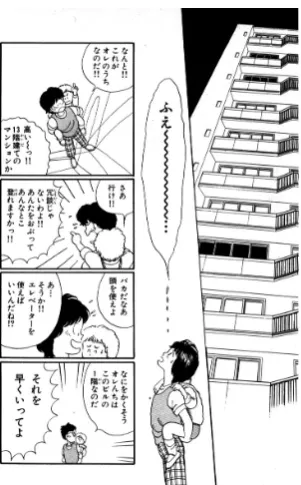
extract texts in an image. Many languages can be detected by the Vision API, and the language type is also detected automatically. As an image such as Fig. 3 is sent to the API, a recognition result is back to the console as a json format like Fig. 4. The proposed system extracts role words from the json files.
C. Role words detection and Scene classification
Some of the obtained lines include role words. The pro-posed system extracts the role words from the lines by using a parser (morphological analyzer). In the proposed system,
Fig. 2. Overview of the interface. The left frame shows the list of role words. The right frame shows the scenes including a role word selected by the system user. Each scene is from Manga109.
Fig. 3. Sample image as input to Google cloud vision api. (“Aisazuni-waIrarenai,” (c) Masako Yoshi, Manga109)
MeCab 2 and Neologd 3 are used as the parser and the
dictionary for parsing, respectively. The parser returns the parsed words and their parts of speech.
After parsing, the proposed system detects role words by
2http://taku910.github.io/mecab/
[image:3.595.98.249.415.658.2]3https://github.com/neologd/mecab-ipadic-neologd
Fig. 4. Sample result (json file) as output from Google cloud vision api when inputting a file shown in Fig. 3.
collating the list of role words shown in TABLE I. If a role word is detected in a line text, the proposed system gives the role word as a label for classification to the scene including the line text. Some of the scenes includes several role words. Then, multiple labels are given to such scenes.
The labeled scenes are classified according to the role word. If a scene has multiple labels of role word, the scene is classified into multiple groups.
III. EVALUATIONEXPERIMENT
[image:3.595.310.542.418.573.2]TABLE I
LIST OF EXAMPLES OF ROLE WORD. LABELS FOR ROLES(1ST COLUMN)
AND EXPRESSIONS FOR ROLE WORDS(2ND COLUMN)ARE SHOWN.
SOME OF ROLE WORDS ARE NOT CONTAINED IN THE PROPOSED SYSTEM
BECAUSE THERE IS NO SCENE WITH THE ROLE WORD IN THE DATASET
MANGA109.
Label for roles Expressions for role words
Countryside (おら)(さ)(じゃ)(っす)(とる)(のう)
(ばってん)(べ)(へえ)(よ)(わし)(ん)
Edo people (あたし)(あっし)(おいら)(ぜ)(だん
な)(旦那)
King and Nobleman (じゃ)
Osaka and Kansai (あかん)(あほ)(阿呆)(あんた)(貴方) (うち)(えらい)(偉い)(おます)(自分) (じゃ)(すんません)(ちゃう)(違う)(で) (でっか)(とる)(ねん)(はる)(へん)(ほ
んま)(毎度)(よっしゃ)(わし)(われ) (ん)
Okinawa people (さ)
Madam (あら)(かしこ)(こと)(ませ)(わたく
し)
Mister (あんた)(貴方)
Lady (あら)(かしら)(こと)(わたくし)
Man (あたい)(あんた)(貴方)(おいら)(お
お)(おのれ)(おれ)(きさま)(貴様)(く う)(食う)(くそ)(くらう)(さ)(ぜ)(ぞ) (わし)
Old woman (あたし)
Princess (じゃ)(わらわ)
Owari people (おる)(居る)
Woman (あたい)(あたし)(あら)(あんた)(貴
方)(ね)(の)(まあ)(よ)(わ)(わらわ)
Kamigata people (じゃ)(だんな)(旦那)
Kyushu people (ごわす)(ばってん)(良か)
Kyoto people (おす)(だす)(はる)
Court noble people (まろ)
Army (自分)(である)
People in power (ぞ)
Old man (ぞ)
Old downtown people (あたし)(あんた)(貴方)(さらば)(ぜ)
Boss (失敬)(しょくん)(諸君)(たまえ)(ぼ く)(わがはい)(我輩)(ん)
Boy (さ)(ぼく)
School girl (あら)(わ)
Old student (失敬)(しょくん)(諸君)(たまえ)(で
ある)(ぼく)(わがはい)(我輩)(ん)
Chinese (ね)
Tradesman and artisan (ごめん)(御免)(さらば)(へえ)
Nagoya people (えらい)(偉い)
Ninja (ごめん)(御免)(せっしゃ)(拙者)
Doctor (おる)(居る)(じゃ)(である)(とる)
(の)(わがはい)(我輩)(わし)
Japanese warrior (いたす)(致す)(おお)(かたじけない)
(ごめん)(御免)(さよう)(左様)(さら ば)(せっしゃ)(拙者)(ぞ)(とる)(まい る)(参る)(もうす)(申す)
Old people (あたし)(おる)(居る)(かたじけない)
(さよう)(左様)(さらば)(じゃ)(とる) (の)(のう)(もうす)(申す)(わ)(わし) (ん)
Young people (あんた)(貴方)(押忍)(自分)(っす)
(まじ)(よっしゃ)
TABLE II
ROLEWORDS USED IN THEQUIZES IN THEEXPERIMENT
Quiz 1 Quiz 2
Top 10 (さ)(ぜ) (ね)(の)(じゃ)
Middle 10 (あら)(かしら)(ぼく) (あたし)(あんた)(わし)
Bottom 10 (たまえ)(拙者)(申す) (えらい)(貴様)(わたくし)
An experimenter (the second author) coordinated the exper-iments in the following procedures.
1) The experimenter gathered participants. The partici-pants were divided into two groups: the experimental group, andthe control group.
2) The participants of the experimental group learned how to use the role words by using the proposed system. The participants of the control group learned how to use the role words by reading explanations of the role words.
3) After learning, the participants took quizes to answer proper role words.
4) The experimenter compared quiz scores between the experimental and control group.
The participants were Chinese students who were learning Japanese language. They were undergraduate students ma-joring information science and engineering in Ritsumeikan University in Japan. The number of the participants was 16. They have learned Japanese language before studying abroad. A few of them have obtained scores of JLPT like TOEIC and TOEFL for English. Both of the group had eight participants respectively.
A. Role words in the experiment
There are 53 labels of role word to learn in the proposed system. Because it might be impossible to learn all of the role words in the experiment period, the experimenter se-lected some role words for the experiment. The experimenter counted up the number of scenes for each role word, then sorted the role words according to the number of scenes. Top, middle, and bottom 10 role words were respectively selected for the experiment.
As we explained above, the participants of the control group used the explanations of the role words in learning. The explanations were prepared from the dictionary of role words [10] which were written in Japanese.
B. Quiz for Evaluating Participant Level
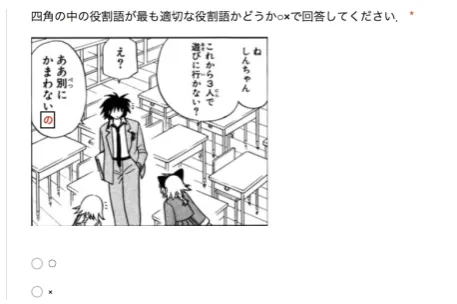
Fig. 5. Example of Chooser Quiz (“Rising girls, Hitomi Kinue Monogatari,” (c) Sakuya Hikochi, Manga109)
Fig. 6. Example of Selection Quiz (“Arisa2,” (c) Ken Yagami, Manga109)
C. Evaluated Items
We evaluated the following six items (E1 to E6) in evaluation.
E1 Averaged scores of both group of participant E2 Averaged scores for Quiz 1 of both group of
participant
E3 Averaged scores for Quiz 2 of both group of participant
E4 Averaged scores for top 10 role words of both group of participant
E5 Averaged scores for middle 10 role words of both group of participant
E6 Averaged scores for bottom 10 role words of both group of participant
Each averaged score was tested by t−test. If there is an homogeneity of variance, Student’s t−test was used. If not, Welch’s t−test was used.
D. Experimental Results
Table III shows the all averaged scores. The average of total score of the experimental group was higher than that of the control group (Student’s t−test, t= 2.56, p= 0.02<
0.05). Evaluated item E1 was verified.
The average of quiz 1 score of the experimental group was not higher than that of the control group (Student’s t−test,
t = 0.35, p = 0.72 > 0.05). Evaluated item E2 was not verified.
The average of quiz 2 score of the experimental group was higher than that of the control group (Welch’s t−test,
t= 3.52, p= 0.007<0.05). Evaluated item E3 was verified.
TABLE III
AVERAGEDSCORES OFEVALUATIONTEST. EXP.DENOTES THE EXPERIMENTAL GROUP. **DENOTES A SIGNIFICANT DIFFERENCE
VERIFIED BY T−TEST
Group Total Quiz 1 Quiz 2 Top Middle Bottom
Exp. 14.5** 6.0 8.5** 4.0 5.2** 5.2
Control 11 5.7 5.2 3 3.8 4.1
The averaged score for top 10 role words of the experi-mental group was not higher than that of the control group (Welch’s t−test,t= 2, p= 0.07>0.05). Evaluated item E4 was not verified.
The averaged score for middle 10 role words of the experimental group was higher than that of the control group (Student’s t−test, t = 2.54, p = 0.02 < 0.05). Evaluated item E5 was verified.
The averaged score for bottom 10 role words of the experimental group was not higher than that of the control group (t = 1.96, p= 0.06>0.05). Evaluated item E6 was not verified.
The evaluated item E1, E3, and E5 were verified. Next section discusses the experimental results.
IV. DISCUSSION
Experimental results showed that the averaged score of the experimental group was higher than that of the control group. Especially, the experimental group marked higher scores of Quiz 2 and of middle 10 role words.
The Quiz 2 asked participants to choose the most appro-priate role word for the shown scene from a list of four role words. Each rate of correctly answered was shown in Table IV. In Quiz 2, the experimental group correctly answered with 0.94 as the averaged rate while the control group did with 0.58 as the averaged rate. The control group marked lower rates in answering No.12, No.15, and No.17. The roles of the role words are countryside people and old man. The roles are far from the participants’ characters. Therefore, they failed to answer correctly to the questions.
The role words from middle 10 were answered correctly by the experimental group. The control group marked lower rates in answering No.3 and No.15. The role of No.3 word is madam and lady. The role is also a little far from the participants’ characters. Therefore, they failed to answer correctly to the question.
The results indicate that the proposed system can support users to learn role words which roles are far from users’ characters.
V. CONCLUSIONS
TABLE IV
CORRECTLYANSWEREDRATES FOREACHQUESTION
Quiz 1
Question Experimental G. Control G.
1(さ) 0.37 0.5
2(ぜ) 0.62 0.5
3(あら) 0.87 0.37
4(かしら) 0.87 1.00
5(ぼく) 0.75 1.00
6(たまえ) 1.00 0.75
7(拙者) 0.87 0.87
8(申す) 0.62 0.75
Average 0.75 0.72
Quiz 2
Question Experimental G. Control G.
10(じゃ) 1.00 0.87
11(ね) 1.00 0.75
12(の) 1.00 0.37
13(あたし) 1.00 0.62
14(あんた) 1.00 0.62
15(わし) 0.75 0.25
16(えらい) 1.00 0.62
17(貴様) 0.75 0.37
18(わたくし) 1.00 0.75
Average 0.94 0.58
of foreign language. Comics have a plenty of conversations of daily life. The conversations are written in lines of comic scene. We proposed a learning support system of role words with the lines of comic scene. The proposed system extracts lines of comic scene and detects role words included in the lines. Then, the system classifies comic scenes into groups according to the included role words. Each of the groups is given a role word as a label of group.
We did evaluation experiments to the proposed system. The experimental results showed that the participants who used the proposed system in learning marked higher score in quizes to answer proper role words. We found that people can use proper role words by learning with the proposed system. The experimental group marked higher scores in answering proper role words by choosing from a list of role words. The questions that were correctly answered were related to the roles that were far from the participants’ characters. The results indicate that the proposed system can support users to learn role words which roles are far from users’ characters. We note two future works. The proposed system visualizes not a scene but a whole page including a role word. Some role words may be included in a whole page. That makes the system users confusing in learning the role words. We will improve the point by extracting scenes respectively and classifying scenes into groups according to the included role word. Next, we will evaluate the level of each line by using words and grammars, and show proper scenes to the level of the system user. Our previous study can evaluates the level of lines by using the level of word and the level of grammar [12]. The two improvements may give the system users more enjoyable time to learn how to use role words.
REFERENCES
[1] J. Foundation, “Survey report on japanese-language education abroad 2006.”
[2] J. Foundation, “Survey report on japanese-language education abroad 2015.”
[3] S. Kinsui, “Yakuwarigo to nihongo kyoiku (in japanese),” Japanese Education, vol. 150, pp. 34–41, 2011.
[4] J. Shan, Y. Nishihara, R. Yamanishi, and J. Fukumoto, “Analysis of dialogues difficulty in anime comparing with jlpt listening tests,” in 21st International Conference on Knowledge-Based and Intelligent Information and Engineering Systems, vol. 112, 2017, pp. 345–352. [5] R. Yamanishi and M. Matsushita, “Comic computing: a conceptual
framework for decomposition and utilization of comic contents,” in The 6th Asian Conference on Information Systems, 2017.
[6] Y. Kiyoki, “Ubiquitous language learning environments-on campus, in the city, abroad,” inEUROCALL 2010, 2010, pp. 231–232. [7] A. Kukulska-Hulme and L. Shield, “An overview of mobile assisted
language learning: From content delivery to supported collaboration and interaction,”ReCALL, vol. 20, no. 3, pp. 271–289, 2008. [8] T. Kitazawa, M. Nagai, and J. Ueno, “Effects of an e-learning
system with a feedback system in blended learning environments of information and communication technology education at a japanese university,”Educational technology research, vol. 34, no. 1-2, pp. 181– 193, 2011.
[9] S. Kinsui, Virtual Nihongo Yakuwarigo no Nazo (in Japanese). Iwanami Syoten, 2003.
[10] S. Kinsui,Yakuwarigo Small Dictionary (in Japanese), 2014. [11] A. Fujimoto, T. Ogawa, K. Yamamoto, Y. Matsui, T. Yamasaki,
and K. Aizawa, “Manga109 dataset and creation of metadata,” in International Conference on Pattern Recognition workshop MANPU (The First International Workshop on coMics ANalysis, Processing and Understanding), 2016.