[In Press, Evolution and Human Behaviour] 1
2
Chimpanzees copy dominant and knowledgeable individuals:
3Implications for cultural diversity
45
Rachel L Kendal; Lydia M Hopper; Andrew Whiten; Sarah F Brosnan; Susan P Lambeth; 6
Steven J Schapiro; Will Hoppitt 7
8
[6450 words, including title page, main text, references & legends] 9
10
ABSTRACT 12
Evolutionary theory predicts that natural selection will fashion cognitive biases to guide 13
when, and from whom, individuals acquire social information but the precise nature of these 14
biases, especially in ecologically valid group contexts, remains unknown. We exposed four 15
captive groups of chimpanzees (Pan troglodytes) to a novel extractive foraging device and, 16
by fitting statistical models, isolated four simultaneously operating transmission biases. 17
These include biases to copy (i) higher-ranking and (ii) expert individuals, and to copy others 18
when (iii) uncertain or (iv) of low rank. High-ranking individuals were relatively un-strategic 19
in their use of acquired knowledge, which, combined with the bias for others to observe 20
them, may explain reports that high innovation rates (in juveniles and subordinates) do not 21
generate a correspondingly high frequency of traditions in chimpanzees. Given the typically 22
low rank of immigrants in chimpanzees, a ‘copying dominants’ bias may contribute to the 23
observed maintenance of distinct cultural repertoires in neighboring communities despite 24
sharing similar ecology and knowledgeable migrants. Thus, a copying dominants strategy 25
may, as often proposed for conformist transmission, and perhaps in concert with it, restrict 26
the accumulation of traditions within chimpanzee communities whilst maintaining cultural 27
diversity. 28
29
Key words: Transmission biases, Social learning strategies, Chimpanzees, Culture, Cultural 30
diversity. 31
INTRODUCTION 34
Many animals acquire information from their social environment, for example pertaining to 35
foraging, mate choice, and predator avoidance, and such social learning often underlies 36
behavioral traditions in a diverse array of taxa (see Kendal et al. 2010a and references 37
therein; Whiten et al. 1999). The strong link between theoretical and empirical work, and the 38
parallels between the social decision-making of human and non-human animals, has fuelled 39
an explosion of interest in the psychological rules that underpin social learning. As 40
highlighted by Rendell et al.’s (2011) review, interest in the decision-making involved in 41
social learning has increased dramatically in recent years, yet empirical evidence lags behind 42
theory. Social learning is not inherently adaptive, due to the risk of acquiring misinformation, 43
but natural selection has fashioned social learning heuristics that combat this problem. 44
Transmission biases (Boyd & Richerson, 1985; Henrich & McElreath, 2003; also termed 45
‘social learning strategies’ by Laland, 2004), guide what, when, and from whom, individuals 46
acquire social information (Kendal et al. 2005, 2009a; Rendell et al. 2011). For example, 47
model-based biases influence who is copied and relate to traits such as prestige (e.g. Henrich 48
& Gil-White, 2001), age (e.g. Dugatkin & Godin, 1993) and rank (e.g. Horner et al. 2010). 49
While it is widely believed that such biases are crucial for understanding both how human 50
cultures evolve and the cultural patterns of our closest primate relatives (Biro et al. 2006; 51
Haun et al. 2012; Luncz et al. 2012; Nishida et al. 2009; Reader & Laland, 2001; Rendell et 52
al. 2011), researchers currently lack clear experimental evidence for such biases (but see 53
Chudek et al. 2012, Horner et al. 2010, and van Leeuwen et al. 2013 for the beginnings of 54
this evidence base). Furthermore, researchers do not know whether transmission biases 55
operate separately or together, or, in the latter case, how they are combined. 56
Our study explored these questions by exposing four groups of captive chimpanzees (two 58
seeded with one trained mid-ranking female model each, and two without such a model) and 59
twelve asocial learning control animals to a novel extractive foraging task in which a small 60
door could be pushed right or left to retrieve a food reward. The study of how social learning 61
operates in chimpanzees is of particular significance. Since Whiten et al.’s (1999) influential 62
paper, reporting multiple traditions among wild chimpanzees, much effort has been expended 63
in understanding chimpanzee culture. Investigation of evolved transmission biases in our 64
closest living relative has the potential to shed new light on the ancestral features of 65
humanity’s ‘adaptations for culture’ (Fessler, 2011) and the selection pressures that shaped 66
them. Such data establish whether certain transmission biases are unique to humans and, 67
potentially, whether these explain humanity’s uniquely strong reliance on culture, in 68
particular, cumulative culture (Dean et al. 2012). 69
70
The spread of foraging information between chimpanzees was measured by recording - for 71
every successful task manipulation - who performed it, what method was used, and who 72
observed it. We aimed to build on the recent strides made in exploring social learning 73
processes and transmission biases in relatively naturalistic contexts (Kendal et al. 2010a). 74
Thus, in place of standard inferential tests of hypotheses, we employed pioneering new 75
analytical methods (Franz & Nunn, 2009; Hoppitt & Laland 2011; Kendal et al. 2009b, 76
2010b) and model-fitting approaches (McElreath et al. 2008) to examine which biases 77
influence chimpanzee cultural learning, focusing on ‘option’ choice (push door left or push 78
door right to retrieve a reward). 79
We then investigated the implications of the findings for understanding cultural transmission 81
and cultural diversity in wild chimpanzees, and potentially humans. For example, we attempt 82
to shed light on reports that high innovation rates (in juveniles and subordinates, Biro et al. 83
2006; Reader & Laland, 2001) do not generate a correspondingly high frequency of traditions 84
in chimpanzees (Nishida et al. 2009; Brosnan & Hopper, 2014). Similarly, we discuss how 85
transmission biases might contribute to the observed maintenance of distinct cultural 86
repertoires in neighboring chimpanzee communities despite them sharing similar ecology and 87
knowledgeable migrants (Biro et al. 2006; Luncz et al. 2012, 2014). Thus far, conformist 88
transmission has been proposed to restrict the accumulation of traditions in non-human (Haun 89
et al. 2012; Luncz et al. 2012; van de Waal et al. 2013) and human (Henrich & Boyd, 1998; 90
Pagel & Mace, 2004) primate communities, whilst maintaining cultural diversity. It remains 91
to be seen whether such propositions are valid and whether alternative transmission biases are 92
involved, either singularly or in concert with others. There is, however, reason to expect that 93
transmission biases may partially explain the lack of cross-cultural homogenization, and 94
incredible cultural diversity, observed in modern and prehistoric humans (Pagel & Mace 95
2004; Pétrequin, 1993). 96
97
METHODS 98
Subjects Fifty-four chimpanzees, housed in social groups in large enriched enclosures at the 99
Michale E. Keeling Center for Comparative Medicine and Research, UT MD Anderson 100
Cancer Center, USA (KCCMR), were the subjects. Chimpanzees were never food or water 101
deprived and the research was approved by the Institutional Animal Care and Use Committee 102
(IACUC 07-92-03887) and ethical committees of Durham and St Andrews Universities. 103
Laboratory Animal Care-International (AAALAC-I) and the research conformed to 105
guidelines of ASAB/ABS. Four chimpanzee groups were used; two (T1, T2) seeded with 106
trained models and two without (N1, N2). T1 comprised 13 chimpanzees (7 female), average 107
age 25.5 years (range: 7–44); T2 comprised 10 chimpanzees (8 female), average age 19.5 108
years (range: 9–26); N1 comprised 10 animals (6 female), average age 18.1 years (range: 9– 109
35); N2 comprised 9 chimpanzees (4 female), average age 22.3 years (range: 9–42). The 12 110
asocial adult controls (six female), were of average age 27.7 years (range: 15–44). 111
112
Apparatus A bidirectional extractive foraging task, the ‘Slide-box’ (Hopper et al. 2008, 113
2013), which consisted of a cube (32cm3) with a food chute (4cm diameter) that opened in 114
the center of the front panel was used. A door (8cm2) covered the aperture of the chute but 115
could be pushed left or right with equal ease to release a grape from the chute (Fig S1). Based 116
on observations of wild chimpanzees (Biro et al. 2003), and our previous research with 117
captive chimpanzees (e.g. Hopper et al. 2007, 2011), indicating the relative utility of different 118
classes of individuals for both training and model/demonstrator purposes, a mid-ranking adult 119
female from each T group (T1: CO, 22 years, T2: MU, 26 years) was chosen as the ‘trained 120
model.’ Observations of wild chimpanzees, suggest that it is the relative rank or age of the 121
model to an observer that is important, not necessarily their absolute rank (Biro et al., 2003). 122
Therefore we selected individuals whom were dominant enough to be observed by their 123
peers, but not so dominant that other individuals avoided them (Drea & Wallen, 1999; 124
Hopper et al. 2013). Following this, the specific mid-ranking female models were selected 125
for two reasons. First we wanted a model that could be observed easily by their group mates 126
such that close access to the apparatus was possible while the demonstrator was in action. 127
separated from their group for training sessions and were known to be fast learners. Although 129
previous captive studies of social learning with chimpanzees have used dominant females 130
(e.g., Hopper et al., 2007), other studies of social learning in primates have demonstrated that 131
younger, less dominant individuals can also represent reliable models (e.g., Hopper et al., 132
2013). Each model was trained, individually, over two 15-minute sessions, to push the door 133
(CO: right, MU: left) using positive reinforcement. By the end of the second session both 134
models were considered proficient, having pushed the door in the designated direction 30 135
times in succession during a single training session. 136
137
Procedure Groups were presented with the Slide-box on the outside of their 21.3m diameter 138
enclosures. For T groups, initially only the model chimpanzee could access the apparatus (by 139
reaching through the bars of the enclosure) to enable all group members to observe the Slide-140
box in use by the model. If non-models attempted to use the task, the experimenter pulled it 141
out of reach. During this observations-phase (two 20-minute sessions over consecutive days), 142
and the subsequent open-diffusion phase, once a chimpanzee retrieved a grape the task was 143
turned through 180° to re-set the door to the central position reducing emission of inadvertent 144
experimenter cues (e.g., stimulus or local enhancement). Once re-set, the Slide-box was 145
repositioned and re-baited in full view of any chimpanzees present. The day following the 146
final observation-phase (T groups) or immediately (N groups), the chimpanzees entered the 147
open-diffusion phase where any chimpanzee could operate the Slide-box. No subjects were 148
called by the experimenter; participation in the study was voluntary such that task 149
interactions proceeded in a pattern natural for the group. This phase continued until all group 150
members retrieved a reward 30 times: T1 (9.5 hours) and T2 (7 hours) in April 2007, N1 (10 151
those manipulating the Slide-box and appearing to observe manipulations were noted. An 153
‘observing’ chimpanzee was one that was within 1 meter of the Slide-box, with their body 154
oriented towards it, during a manipulation (Hopper et al. 2007). A ‘manipulation’ was 155
physical movement of the Slide-box door, and considered ‘unsuccessful’ or ‘successful’ 156
depending on whether a grape was obtained and eaten. 157
158
Observational data, regarding social relations, were collected for three of the groups using 159
one-hour instantaneous scan samples over several months prior to, and following, the open-160
diffusion study (SI 1.ii). For most of our analyses, however, we were interested in the rank 161
class of individuals rather than the detail of dominance hierarchies. We chose to rate 162
dominance using a categorical scale because it facilitated comparisons across the four, 163
differently sized, groups when compared to assigning individuals a rank order relative to their 164
group’s size. Thus, each member of the four groups was ranked on a three-point scale for 165
dominance (where 1 = high, 2 = mid, and 3 = low). These rankings were scored by three 166
chimpanzee experts, entirely independently of each other, who all had a minimum of two-167
years experience working with these chimpanzees; the primary experimenter (LMH), the 168
facility’s behavioral coordinator and Research Laboratory Manager (SPL) and a trainer. 169
Inter-rater agreement was high (ICC (2,1) = 0.74, P < 0.001)and on the very rare instances in 170
which the three raters did not agree, the mode rank was selected. 171
172
Finally, asocial controls were voluntarily individually tested in their inside enclosure (2.4 x 173
2.4 x 1.8m3) for 20 minutes. They observed the experimenter bait the Slide-box with a grape 174
but were not encouraged to interact with it. If they slid the door, in either direction, the task 175
177
Statistical AnalysesWe conducted four types of analysis, all of which overcome issues 178
which standard inferential statistics cannot, allowing investigation of social learning in 179
naturalistic conditions: First, we used the established option bias method (Kendal et al. 180
2009b, 2010b) to assess whether chimpanzees within a group tended to solve the task by 181
pushing the door in the same direction, as would be expected if the task solution was socially 182
transmitted within each group. Second, we used Network-Based Diffusion Analysis (Franz 183
& Nunn 2009; Hoppitt & Laland, 2011) to determine whether the first successful task 184
interaction spread within groups according to principles of directed social learning (Coussi-185
Korbel & Fragaszy, 1995) represented via social networks based on different factors (e.g. 186
affiliation, observation). Since we found no indication that the time of first solving the task 187
follows such a pattern, the results are reported in the SI (2.i) only. Third, we developed a 188
time-structured model of option choice to infer which social learning strategies were being 189
used. Finally, we ran analyses of whom observed whom, so as to determine whether 190
chimpanzees preferentially chose to watch others of a specific rank. Here we outline the latter 191
two methods, with further technical details given in the S.I.. All analyses were conducted 192
using WinBUGS 1.4 and the R statistical environment (2.13.1 (R Core Development Team 193
2011)). 194
195
For the time-structured stochastic models of option choice we adapted the approach 196
pioneered by McElreath et al. (2008) to infer the social learning strategies being used by 197
individuals, by modelling the option choices made as a function of the social information 198
available to them. Different models are fitted corresponding to different social learning 199
Information Criterion (AIC, Burnham & Anderson 1998). Since option bias was only found 201
in the direction the door was pushed, the analysis was applied to the choice of push left 202
versus push right. In the Supplementary Information we give details of all models fitted: here 203
we give an overview. The general model form had a component of asocial learning (L) and a 204
component of social information (S), with the parameter 𝛾 giving the proportion of weight 205
given to S when making a decision about option choices and 1−𝛾 giving the weight given to 206
L. For a model of asocial learning alone, we set 𝛾 =0. The exact form of the L and S 207
components was varied between the different models considered as outlined below. 208
209
For the L component we started with McElreath et al.’s (2008) model of asocial learning, 210
where an individual’s “attraction score” for option k, is updated as the individual receives 211
rewards for choosing each option. However, the chimpanzees tended to engage in long runs 212
of using an option without necessarily settling on that option as a long-term solution, as 213
would be expected under McElreath et al.’s model. Therefore, we formulated an alternative 214
model in which individuals make an initial choice of option on their first manipulation. For 215
each subsequent manipulation, given an individual is using asocial information, there is a 216
probability they will switch to the alternative option, otherwise they will stick with the option 217
they chose for their previous manipulation. 218
219
McElreath et al (2008) consider models of social learning in which each observer is sensitive 220
to the payoff received by those it observes making option choices. For our data, the reward 221
was always the same (a single grape), and so we only consider the frequency dependent 222
strategy suggested by McElreath et al. In this model a parameter f determines how nonlinear 223
choices have more chance of being copied (conformity effect) and when f<1, commonly 225
observed choices have less chance of being copied. We also considered models in which 226
copying was unbiased, where f was constrained to be 1. 227
228
We initially found strongest support for the state-switching model with frequency unbiased 229
copying (see S.I.). However, subsequent examination of plots of the data (see Fig S3 in S.I.) 230
strongly suggested that the weight given to social information decreased as chimpanzees 231
gained more experience manipulating the task. We therefore fitted an expanded model in 232
which chimpanzees were less likely to copy others if it involved switching away from an 233
option that they had used frequently in the past. This model had much more support than any 234
others considered (Akaike weight= 0.838; Table 1) so we based our inferences on this model, 235
to assess whether individuals of different rank employed different strategies of switching 236
between options, and copying others (see S.I.). 237
238
To investigate whether chimpanzees preferentially chose to watch others of a specific rank 239
we developed a model of observation to test whether chimpanzees preferred to observe 240
manipulations by others of a higher, lower or same rank. We did not treat each manipulation 241
as an independent event, since chimpanzees engaged in bouts of manipulation: if an 242
individual observed one manipulation at the task, it was more likely to observe the next one. 243
We therefore formulated a model that allowed for this autocorrelation, and within individual 244
correlation (see S.I.) and allowed us to calculate the expected long run proportion of 245
manipulations that would be expected for each combination of manipulator and observer 246
between individuals of different relative rank, allowing for individual-level sampling error 248
and autocorrelations between successive manipulations. 249
250 251
RESULTS & DISCUSSION 252
Social Learning 253
Six of twelve control chimpanzees (tested alone, hence reliant on asocial learning) interacted 254
with the task, with three first pushing the door to the right and three to the left. Across all 255
individuals, 50% of manipulations were to the right, indicating no inherent directional bias. 256
Conversely, in experimental groups (where social learning was possible) there was strong 257
evidence of a group-level bias in the option used (i.e. the direction chimpanzees pushed the 258
door to gain a food reward). This bias exceeded that expected by asocial learning alone 259
(Kendal et al. 2009b, 2010b, Option bias test: p<0.001, 100,000 randomizations of 35 260
individuals), but there was no bias in the hand(s) used by the chimpanzees to manipulate the 261
task (Option bias test: p=0.34, 100,000 randomizations of 35 individuals). In groups seeded 262
with chimpanzees trained to push the apparatus door in a specific direction, the direction 263
favored by the rest of their group matched that used by the model. In the group seeded with 264
the left variant 81.8% of manipulations were to the left, and in the group seeded with the right 265
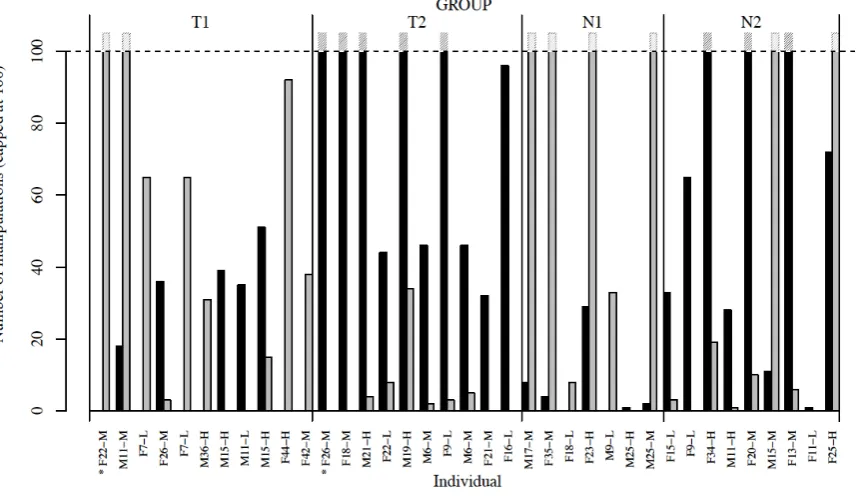
variant 90.2% of manipulations were to the right. Likewise, in unseeded groups, individuals 266
matched the direction of the first chimpanzee (or innovator) to solve the task, with 98.3% of 267
manipulations to the right in one unseeded group and 95.7% to the left in the other unseeded 268
group (Fig. 1). Thus, despite no inherent directional bias for door manipulation, the 269
involvement of social learning in the spread of the novel behavior pattern through the 270
hand-use accords with studies of wild chimpanzees (Biro et al. 2003, 2006), and is likely due 272
to existing individual hand-use preferences (Hopkins et al. 2009). We suggest that object-273
movement reenactment, a form of emulation (Hopper, 2010), underlay the diffusions. 274
Consistent with wild (Whiten et al. 1999) and captive (e.g. Franz & Matthews, 2010; Hopper 275
et al. 2011) studies, we observed high-fidelity copying (of the door strategy) sufficient to 276
allow the maintenance of arbitrary traditions in chimpanzees. The question that then arises 277
concerns the transmission biases employed by individuals in the emergence and maintenance 278
of such traditions. 279
280
[Fig 1] 281
282
Transmission Biases 283
A time structured model of option choice (push left or right) delivered inferences about 284
which social learning strategies were used. This dissected an individual’s choice into asocial 285
and social information (copying) components, with a parameter controlling the weight given 286
to each. We considered various models for each component, expanding those of McElreath et 287
al. (2008), and compared them using AIC. The final model allowed for chimpanzees that 288
engaged in runs of choosing one option, with asocial learning affecting the probability of 289
switching between options (a “state-switching” model). The best-supported statistical model 290
assumed that chimpanzees copied in proportion to the number of manipulations of each 291
option they observed. This model had more support than any others considered (Akaike 292
weight= 0.838; Table 1), including a model without social learning (∆𝐴𝐼𝐶= 91.8). While we 293
cannot rule out, or distinguish between, conformity, or anti-conformity, effects (the 95% 294
f>1 and 0<f<1 imply conformity and anti-conformity, respectively), for simplicity, we based 296
further inferences on a frequency unbiased model. Details of all models fitted (using 297
Bayesian MCMC techniques) during the subsequent model selection procedure are given in 298
the SI (2.ii). Here, we report the main results, with estimates taken from the final model, 299
which closely fitted the data (Fig 3). Estimates are the median of the posterior distribution 300
with 95% credible intervals (CI). A low posterior probability (PP) against the hypothesis 301
being reported (𝐻!) indicates strong evidence in its favor. 302
303
[Table 1] 304
305
Copy when uncertain. The model of option choice fitted the open diffusion data better when 306
it accounted for the ‘state’ of individuals, in terms of the personal information they 307
possessed. There was clear evidence that the weight given to social information decreased 308
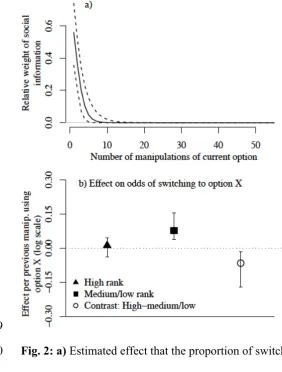
rapidly as a chimpanzee manipulated the task more (PP against 𝐻!<0.001; Figs 2a, 3 & S4). 309
The data showed evidence that social information (observations of manipulations) had a 310
decreasing effect upon the behavior of individuals as their personal information (number of 311
task manipulations) increased (Figs 2a, 3, S4). This corresponds to theoretical (Boyd & 312
Richerson, 1985) and empirical studies in humans and non-humans (Kendal et al. 2005, 313
2009a), including chimpanzees (Hirata & Morimura, 2000), that indicate a “copy when 314
uncertain” bias. This contrasts with a tendency of children, in some studies, to be influenced 315
by social information even when well-informed (Wood et al. 2013). 316
317
[Fig 2] 318
320
Copy when of low rank.The model was expanded to test for parameter differences between 321
social ranks. There was clear evidence that low- and medium-ranked individuals acquired a 322
task-opening option through copying. Eight of nine low-ranked individuals, and 11/12 of 323
medium-ranked individuals, adopted the option, in their initial choice, that they had observed 324
most. In contrast, there was an indication that high-ranked individuals gave lower weight than 325
low- and medium-ranked individuals to social information when making their initial choice 326
of option (i.e. left or right, PP against 𝐻!= 0.026), with only 7/12 choosing the option they 327
had seen most. This is despite high-ranked individuals having similar social information 328
available when they made their initial responses (see Fig S4). For later responses, there was 329
no evidence that chimpanzees of any rank gave different weight to social information (SI 330
2.ii), thus we defer discussion to the SI (3i). 331
332
There was also strong evidence that asocial learning influenced the option choices of low- 333
and ranked chimpanzees, but not high-ranked chimpanzees. Low- and medium-334
ranked individuals were more likely to switch back to an option they had used more in the 335
past (PP against 𝐻!<0.001), whereas there was little evidence for such an effect in high-336
ranked individuals (PP against 𝐻!=0.268; Figs 2b, 4). Moreover, low- and medium- ranked 337
individuals were less likely to switch away from an option they had used more in the past (PP 338
against 𝐻!<0.001), but there was little evidence for such an effect on high-ranked individuals 339
(PP against 𝐻!=0.167; Fig S2-3). Low- and medium-ranked individuals rapidly settled on a 340
preferred option, whereas high-ranked individuals vacillated for a prolonged period of time 341
(Fig S3). The apparent lack of weight given to prior experience by more dominant individuals 342
(Melis et al. 2011). Similarly, compared to subordinates, dominant individuals experience 344
less social interference when foraging, and higher energetic intake (Rands et al. 2006), so 345
they may be less averse to the risk of changing a previously successful foraging method (see 346
also Caldwell & Millen, 2010). Such findings may pertain to ongoing discussion regarding 347
conservatism in ape learning (SI 3.i) 348
349
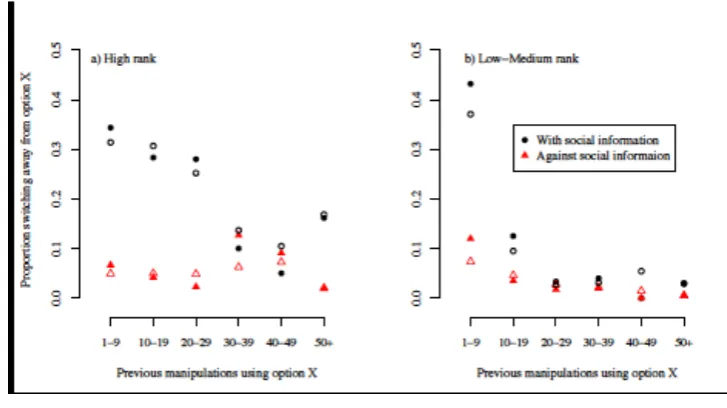
[Fig 4] 350
351
Taken together, however, these findings imply that high-ranked individuals, compared to 352
low- and medium-ranked individuals, were not strategic information users (whether asocial 353
or social), which may be consistent with reports that high-ranked individuals do not tend to 354
be the innovators in wild chimpanzees (Reader & Laland, 2001). This may be because high-355
ranked individuals are occupied with other concerns, for example the psychosocial (Sapolsky, 356
1992) and metabolic costs (Muller & Wrangham, 2004) of maintaining their rank. This may 357
ensure relatively little motivation for fine-grained (option-level) learning of novel foraging 358
methods in ranked individuals, who have priority of access to resources. Indeed, high-359
ranked individuals retrieved food from the task at the same, and higher, rates as low- and 360
medium-ranked individuals, respectively. Thus, high-ranked individuals learned to access the 361
food, but the means by which they did so was under minimal social influence. 362
363
Copy higher-ranking individuals. Further analyses of whom observed whom determined 364
whether chimpanzees displayed evidence indicative of model-based biases, by preferentially 365
choosing to watch specific others. These modelsallowed for correlation between successive 366
observed. Final models of option choice and observation were fitted using MCMC methods 368
allowing inclusion of random effects for both observer and observed individuals, thus, 369
simultaneously accounting for sampling effects at the level of individuals and behavior. For 370
example, if one high-ranked individual ‘A’ happens to produce many manipulations 371
(compared to individual ‘B’) and is observed frequently, the model allows for the fact we 372
have more information on individual A than B but does not, as a consequence, infer that 373
‘being observed frequently’ is a property of high-ranked individuals in general. Little 374
evidence was found for age or sex effects (SI 2.iv). 375
376
We found strong evidence of preferential attendance by naïve (as opposed to informed) 377
chimpanzees to individuals of higher rank, rather than those of the same rank as themselves 378
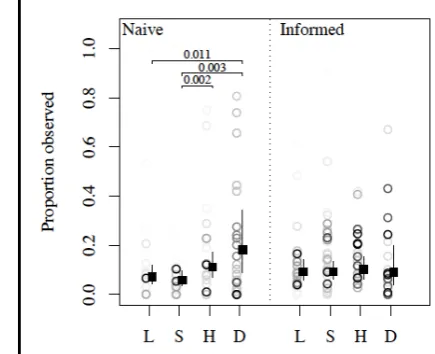
(PP against 𝐻!= 0.002; Fig. 5). Intuitively an attendance bias suggests a copying bias, and is 379
indicative of directed social learning, or transmission biases. However, although 380
understandable, previous studies (e.g., Biro et al. 2003; Ottoni et al. 2005) have made such 381
claims without assessing whether preferentially observed individuals are actually 382
correspondingly influential in determining the behavior of observers. Likely due to 383
homogeneity of option choice within groups, we found no evidence that observations of 384
individuals of different relative rank (higher, lower, same) had a quantitatively different 385
effect on option choice (see S3.iii). However, as chimpanzees rarely acquired conflicting 386
information (regarding door directionality) from individuals of different rank, we cannot rule 387
out such an effect of model rank on social information use. 388
389
Our results are, however, highly consistent with a copying bias for several reasons. Firstly, as 390
a learning function would seem to underlie the attendance bias. This corresponds to 392
observation rates of wild chimpanzee nut-cracking doubling when novel, versus familiar, nuts 393
are presented (Biro et al. 2006). Moreover, the attendance bias is a ‘choice’, rather than a 394
byproduct mediated by social dynamics. Although individuals were more likely to displace 395
task manipulators of relatively low, versus high, rank, this did not artificially inflate our 396
estimate of observation of relatively higher ranked manipulators (whilst individuals awaited 397
task access); in the model, an individual’s transition from observing to displacing another at 398
the task was not counted as “ceasing task observation.” 399
400
[Fig 5] 401
402
To our knowledge this is amongst the first evidence consistent with a ‘copy dominant 403
individuals’ bias in non-human primates, though such an effect has recently been reported in 404
young children (Flynn & Whiten 2012). A copying bias for a dominant over a subordinate 405
individual was reported in a study of two captive chimpanzee groups (Horner et al. 2010), but 406
age and skill-reputation were conflated with dominance and, unlike here, the potential for 407
sampling error (e.g., the two dominant individuals being potent models for reasons unrelated 408
to dominance, such as age or sex) was not accounted for. Consistent with our findings, Biro 409
et al. (2003, 2006) documented preferential attendance to nut-cracking and leaf-use by older, 410
or same aged, wild chimpanzees, and age may correlate with dominance in such populations 411
(Kahlenberg et al. 2008). 412
413
Copy knowledgeable individuals. There was strong evidence in the two seeded groups that 414
against 𝐻!= 0.011) or same rank (PP against 𝐻!= 0.003) than themselves, and this preference 416
was also likely greater than that for observing individuals of a higher-rank than themselves 417
(PP against 𝐻!= 0.097; Fig. 3). Again, due to homogeneity of option choice within groups, 418
we cannot confirm whether this preferential attendance had a quantitative influence on 419
behavior. With only two trained models, we cannot estimate the rate of observation of trained 420
models in general with precision. Nonetheless, our analysis indicated that it was highly 421
unlikely that we had sampled two individuals whom others watched so frequently by chance, 422
rather than the effect being a result of their trained status. Several studies have similarly 423
pointed to a transmission bias to ‘copy knowledgeable individuals.’ In humans, young 424
children discriminate between competent and incompetent models (Harris & Corriveau, 425
2011, but see Wood et al. 2012), and ‘copying experts’ enhances individual, and group, 426
accuracy (King et al. 2012). Wild vervet monkeys (Chlorocebus pygerythrus) copy foraging 427
tactics of dominant females, but not dominant males, (copying of dominants versus 428
subordinates was not assessed) possibly due to greater locale-relevant knowledge in 429
philopatric females (van de Waal et al. 2010). Similar reasoning applies to inter-specific 430
social learning of nesting sites by migrant birds observing residents (Seppänen & Forsman, 431
2007). Likewise, preferential attendance to skilled nutcrackers in naïve capuchins has been 432
reported (Ottoni et al. 2005), though this may be a by-product of their tolerance of scrounging 433
(Ottoni & Izar, 2008). Here, as all task manipulations resulted in reward, it is unlikely that 434
varying success levels of trained versus untrained individuals were responsible for the 435
attendance bias. Indeed, there was little evidence that task manipulation rate differed between 436
high- or medium-ranked individuals and trained models (Fig S5). It is possible that purposive 437
locomotion towards the task biased the attention of naïve individuals, as previously reported 438
440
Model-based biases might allow individuals to determine the ‘best’ individual to copy in a 441
given context with reasonable speed and accuracy. As individuals of higher rank than 442
observers can be assumed to be generally successful in life skills a, “copy higher-ranking 443
individuals” bias may, on the whole, be effective. A “copy knowledgeable individuals” bias 444
may further enhance performance, however. Such a hierarchy in bias-use, in this context, is 445
potentially indicated by the greater attendance bias towards trained versus relatively higher 446
ranked individuals. However, neither of these biases is likely to be as effective as copying the 447
most successful (highest payoff) individual (SI 3ii), and thus it may pay chimpanzees to use 448
model-based biases in concert. The observed patterns of preferential attendance to dominant 449
and knowledgeable individuals, and model-based biases in chimpanzees, may correspond to 450
ancestral, evolutionary precursors of prestige bias in humans (Chudek et al. 2012; Henrich & 451
Gil-White, 2001; Horner et al. 2010). 452
453
Implications for understanding cultural patterns. The indiscriminate use of available 454
information by high-ranked individuals and their tendency to vacillate between response 455
options, combined with the “copy higher-ranking individuals” bias, are likely factors limiting 456
the establishment of behavioral traditions in chimpanzees. This interpretation adds to 457
arguments that a lack of attention to low-ranking, or young, individuals explains the 458
discordance between the high frequency of innovation seen in chimpanzees - mostly by low 459
ranking individuals (Reader & Laland, 2001) or juveniles/infants (Biro et al. 2006) - and the 460
relative scarcity of reported traditions arising from innovations (Nishida et al. 2009; Brosnan 461
& Hopper, 2014). Likewise, the likelihood that immigrants enter communities at a low point 462
explanation to conformity to group traditions, (Haun et al. 2012; Luncz et al. 2012, 2014) for 464
the observation that cultural repertoires of neighboring chimpanzee communities may differ 465
despite shared knowledgeable migrants (Biro et al. 2006; Luncz et al. 2012, 2014, but see 466
Lind & Lindenfors, 2010; Nunn et al. 2009). Indeed, these findings echo those of Yeaman et 467
al. (2011) who, in an analytical model, found that opposite biases in individuals who are 468
learned from, and individuals who migrate, resulted in high cultural trait variation among 469
groups relative to a genetic model. However, the consistency of our data with chimpanzees 470
employing a “copy knowledgeable individuals” strategy complicates this interpretation; 471
females display their alternative behavioral traits for some time following immigration 472
(Luncz et al. 2014) and thus low-ranked immigrants may still be copied if they exhibit cues 473
of proficiency with new skills. This area is ripe for further investigation deploying the 474
analytical methods presented here in concert with seeding of models with different properties 475
into experimental populations. Likewise, consideration could be given to the role of 476
transmission biases in cultural patterns when individual learning may be more strongly 477
favored than it is in this study. For example, when (i) alternative traditions are not arbitrary 478
but afford differential payoffs to their users, and (ii) when there are multiple copies of the 479
novel resource available to the group. 480
481
As proposed for conformist transmission (Haun et al. 2012; Henrich & Boyd, 1998; Luncz et 482
al. 2012; Pagel & Mace, 2004; van de Waal et al. 2013), a “copy dominant individuals” bias 483
may limit the accumulation of traditions within a culture whilst at the same time maintaining 484
cultural diversity, including in modern and prehistoric humans (Henrich & Boyd, 1998; Pagel 485
& Mace, 2004; Pétrequin, 1993). Perhaps several transmission biases, acting in concert, 486
488 489
Acknowledgements 490
RLK was funded by a Royal Society Dorothy Hodgkin Fellowship; LMH by a BBSRC 491
studentship (BBS/S/K/2004/11255 supervised by AW) and, at the time of writing, is funded 492
by the Guthman Fund; WH by a BBSRC grant (BB/I007997/1); SFB by a NSF CAREER 493
award (SES 0847351) and (SES 0729244). The chimpanzee colony is supported by NIH U42 494
(RR-15090). Thanks to staff at KCCMR for their help with this study and for providing the 495
highest quality of care for the chimpanzees housed there, and to Bryan Paenitz who made the 496
Slide-box. We are grateful to Kevin Laland, Mathias Franz, Jamie Tehrani, Jeremy Kendal, 497
and Alex Mesoudi for discussion. 498
499
500
REFERENCES 501
Biro, D., Inoue-Nakamara, N., Tonooka, R., Yamakoshi, G., Sousa, C., & Matsuzawa T. 502
(2003). Cultural innovation and transmission of tool use in wild chimpanzees: 503
evidence from field experiments. Animal Cognition 6, 213-223. 504
505
Biro, D., Sousa, C., & Matsuzawa, T. (2006). Ontogeny and cultural propagation of tool use 506
by wild chimpanzees at Bossou, Guinea: Case studies in nut cracking and leaf folding. 507
In Matsuzawa, T., Tomonaga, T., and Tanaka, M. (Eds.) Cognitive Development in 508
Chimpanzees (pp. 476-508) Tokyo, Japan: Springer Verlag. 509
510
Boyd, R. & Richerson, P. (1985). Culture and the Evolutionary Process. Chicago: Chicago 511
University Press. 512
513
Brosnan, S. F. & Hopper, L. M. (2014). Psychological limits on animal innovation. Animal 514
Behaviour 92, 325-332. 515
516
Burnham, K. P. & Anderson, D. R. (2002). Model selection and multimodel inference: A 517
practical information-theoretic approach. New York: Springer. 518
519
Caldwell, C. & Millen, A. (2010). Conservatism in laboratory microsocieties: unpredictable 520
payoffs accentuate group-specific traditions. Evolution and Human Behavior 31, 123-521
130. 522
Chudek, M., Heller, S., Birch, S. & Henrich, J. (2012). Prestige-biased cultural learning: 524
bystander’s differential attention to potential models influences children’s learning. 525
Evolution & Human Behavior 33, 46-56. 526
527
Coussi-Korbel, S. & Fragaszy, D.M. (1995). On the relation between social dynamics and 528
social learning. Animal Behaviour 50, 1441-1453. 529
530
Dean, L. G., Kendal, R. L., Schapiro, S. J., Thierry, B. & Laland, K. N. (2012). Identification 531
of the social and cognitive processes underlying human cumulative culture. Science 532
335, 1114-118. 533
534
Drea, C. M. & Wallen, K. (1999). Low-status monkeys ‘play dumb’ when learning in mixed 535
social groups. Proceedings of the National Academy of Sciences of the United States 536
of America 96, 12965–12969. 537
538
Dugatkin, L. A. & Godin, J-G. J. (1993). Female mate copying in the guppy (Poecilia 539
reticulata): age-dependent effects. Behavioral Ecology 4, 289–292. 540
541
D. M. T. (2011) Twelve lessons (most of which I learned the hard way) for evolutionary 542
psychologists. In X. T. Wang and Y. -J. Su (Eds.) Thus spake evolutionary 543
psychologists (pp. 281-293) Beijing, China: Peking University Press. 544
545
Flynn, E. & Whiten, A. (2012). Experimental ‘micro-cultures’ in young children: Identifying 546
biographic, cognitive, and social predictors of information transmission. Child 547
Development 83, 911-925. 548
549
Franz, M. & Nunn, C. L. (2009). Network-based diffusion analysis: a new method for 550
detecting social learning. Proceedings of the Royal Society: B. 276, 1829-1836. 551
552
Franz, M. & Matthews, L. J. (2010). Social enhancement can create adaptive, arbitrary and 553
maladaptive cultural traditions. Proceedings of the Royal Society: B.. 277, 3363-3372. 554
555
Haun, D. B. M., Rekers, Y. & Tomasello, M. (2012). Majority biased transmission in 556
chimpanzees and human children, but not orangutans. Current Biology 22, 727-731. 557
558
Harris, P. L. & Corriveau, K. H. (2011). Young children’s selective trust in informants. 559
Philosophical Transactions of the Royal Society: B. 366, 1179-1187. 560
561
Henrich, J. & Boyd, R. (1998). The evolution of conformist transmission and the emergence 562
of between-group differences. Evolution and Human Behavior 19, 215-241. 563
564
Henrich, J. & Gil-White, F. (2001). The evolution of prestige: freely conferred deference as a 565
mechanism for enhancing the benefits of cultural transmission. Evolution and Human 566
Behavior 22, 165–196. 567
568
Henrich, J. & McElreath, R. (2003). The evolution of cultural evolution. Evolutionary 569
571
Hirata, S. & Morimura, N. (2000). Naive chimpanzees’ (Pan troglodytes) observation of 572
experienced conspecifics in a tool-using task. Journal of. Comparative Psychology 573
114, 291-296. 574
575
Hopkins, W. D., Russell, J. L., Schaeffer, J. A., Gardner, M. & Schapiro, S. J. (2009). 576
Handedness for tool use in captive chimpanzees (Pan troglodytes): Sex differences, 577
performance, heritability and comparison to the wild. Behaviour 146, 1463-1483. 578
579
Hopper, L. M. (2010). ‘Ghost’ experiments and the dissection of social learning in humans 580
and animals. Biological Reviews 85, 685-701. 581
582
Hopper, L. M., Spiteri, A., Lambeth, S. P., Schapiro, S. J., Horner, V. & Whiten, A. (2007). 583
Experimental studies of traditions and underlying transmission processes in 584
chimpanzees. Animal Behaviour 73, 1021-1032. 585
586
Hopper, L. M., Lambeth, S. P., Schapiro, S. J. & Whiten, A. (2008). Observational learning 587
in chimpanzees and children studied through ‘ghost’ conditions. Proceedings of the 588
Royal Society B 275, 835–840. 589
590
Hopper, L. M., Schapiro, S. J., Lambeth, S. P. & Brosnan, S. F. (2011). Chimpanzees’ 591
socially maintained food preferences indicate both conservatism and conformity. 592
Animal Behaviour 81, 1195-1202. 593
594
Hopper, L. M., Holmes, A. N., Williams, L. E. & Brosnan, S. F. (2013). Dissecting the 595
mechanisms of squirrel monkeys (Saimiri boliviensis) social learning. PeerJ, 1, e13. 596
597
Hoppitt, W. & Laland, K. N. (2011). Detecting social learning using networks: A users guide. 598
American Journal of Primatology 73, 834-844. 599
600
Horner, V., Proctor, D., Bonnie, K. E., Whiten, A. & de Waal, F. B. M. (2010). Prestige 601
affects cultural learning in chimpanzees. PLoS ONE 5(5), e10625. 602
603
Kahlenberg, S. M., Thompson, M. E., Muller, M. N. & Wrangham, R. W. (2008). 604
Immigration costs for female chimpanzees and male protection as an immigrant 605
counterstrategy to intrasexual aggression. Animal Behaviour 76, 1497-1509. 606
607
Kendal, R. L., Coolen, I., van Bergen, Y. & Laland, K. N. (2005). Tradeoffs in the adaptive 608
use of social and asocial learning. Advances in the Study of Behavior 35, 333-379. 609
610
Kendal, R. L., Coolen, I. & Laland, K. N. (2009a). Adaptive Trade-offs in the use of Social 611
and Personal Information. In R. Dukas, & J. M. Ratcliffe (Eds.) Cognitive ecology II 612
(pp 249-271), Chicago: University of Chicago Press. 613
614
Kendal,R. L., Kendal, J. R., Hoppitt, W. & Laland, K. N. (2009b). Identifying social learning 615
in animal populations: A new ‘option-bias’ method. PLoS ONE 4(8), e6541. 616
Kendal, R. L., Galef, B. G. & van Schaik, C. P. (2010a). Social learning research outside the 618
laboratory: How and why? Learning and Behavior 38, 187-194 619
620
Kendal, R. L., Custance, D., Kendal, J. R., Vale, G., Stoinski, T., Rakotomalala, N. I. & 621
Rasaminanana, H. (2010b). Evidence for social learning in wild lemurs (Lemur catta). 622
Learning and Behavior 38, 220-234. 623
624
King, A. J., Cheng, L., Starke, S. D., and Myatt, J. P. (2012). Is the ‘true wisdom of the 625
crowd’ to copy successful individuals? Biology Letters 8, 197-200. 626
627
Laland, K. N. (2004). Social learning strategies. Learning and Behavior 32, 4-14. 628
629 630
Lind, J. & Lindenfors, P. (2010). The number of cultural traits is correlated with female 631
group size but not with male group size in chimpanzee communities. PLoS ONE 5(3), 632
e9241. 633
634
Luncz, L. V., Mundry, R. & Boesch, C. (2012). Evidence for cultural differences between 635
neighbouring chimpanzee communities. Current Biology 22, 922-926. 636
637
Luncz, L. V. & Boesch, C. (2014). Tradition over trend: Neighbouring chimpanzee 638
communities maintain differences in cultural behaviour despite frequent immigration 639
of adult females. American Journal of Primatology 76(7), 649-657. 640
641
McElreath, R., Bell, A. V., Efferson, C., Lubell, M., Richerson, P. J. & Waring, T. (2008), 642
Beyond existence and aiming outside the laboratory: estimating frequency-dependent 643
and pay-off-biased social learning strategies. Philosophical Transactions of the Royal 644
Society: B. 363, 3515-3528. 645
646
Melis, A. P., Schneider, A-C. & Tomasello, M. (2011). Chimpanzees, Pan troglodytes, share 647
food in the same way after collaborative and individual food acquisition. Animal 648
Behaviour 82, 485-493. 649
650
Menzel, E. W. & Halperin, S. (1975). Purposive behaviour as a basis for objective 651
communication between chimpanzees. Science 189, 652-654. 652
653
Muller, M. N. & Wrangham, R. W. (2004). Dominance, cortisol and stress in wild 654
chimpanzees (Pan troglodytes schweinfurthii). Behavioral Ecology and Sociobiology 655
55, 332-340 656
657
Nishida, T., Matsusaka, T. & McGrew, W. C. (2009). Emergence, propagation or 658
disappearance of novel behavioral patterns in the habituated chimpanzees of Mahale: 659
a review. Primates 50, 23-36. 660
661
Nunn, C. L., Thrall, P. H., Bartz, K., Dasgupta, T. & Boesch, C. (2009). Do transmission 662
mechanisms or social systems drive cultural dynamics in socially structured 663
665
Ottoni, E. B., de Resende, B. D. & Izar, P. (2005). Watching the best nutcrackers: what 666
capuchin monkeys (Cebus apella) know about others’ tool-using skills. Animal 667
Cognition 24, 215-219. 668
669
Ottoni, E. B. & Izar, P. (2008). Capuchin monkey tool use: overview and implications. 670
Evolutionary Anthropology 17, 171-178. 671
672
Pagel, M. & Mace, R. (2004). The cultural wealth of nations. Nature 248, 275-278. 673
674
Pétrequin, P. (1993). North wind, south wind. Neolithic technical choices in the Jura 675
mountains, 3700-2400 BC. In P. Lemonnier (Ed.) Technological choices: 676
Transformation in material cultures since the Neolithic (pp. 36-76) London: 677
Routledge. 678
679
Rands, S. A., Pettifor, R. A., Rowcliffe, J. M. & Cowlishaw, G. (2006). Social foraging and 680
dominance relationships: the effects of socially mediated interference. Behavioral 681
Ecology and Sociobiology 60, 572-581. 682
683
Reader, S. M. & Laland, K. N. (2001). Primate innovation: Sex, age and social rank 684
differences. International Journal of Primatology 22, 787-805. 685
686
Rendell, L., Fogarty, L., Hoppitt, W. J. E., Morgan, T. J. H., Webster, M. & Laland K. N. 687
(2011). Cognitive culture: theoretical and empirical insights into social learning 688
strategies. Trends in Cognitive Sciences 15, 68-76. 689
690
Sapolsky, R. M. (1992). Cortisol concentrations and the social significance of rank instability 691
among wild baboons. Psychoneuroendicrono 17, 701-709. 692
693
Seppänen, J-T. & Forsman, J.T. (2007). Interspecific social learning: Novel preference can be 694
acquired from a competing species. Current Biology 17, 1248-1252. 695
696
van de Waal, E., Renevey, N., Favre, C. M. & Bshary, R. (2010). Selective attention to 697
philopatric models causes directed social learning in wild vervet monkeys. 698
Proceedings of the Royal Society: B. 277, 2105-2111. 699
700
van de Waal, E., Borgeaud, C. & Whiten, A. (2013). Potent social learning and conformity 701
shape a wild primate’s foraging decisions. Science 340, 483-485. 702
703
van Leeuwen, E. J. C., Cronin, K. A., Schütte, S., Call, J. & Haun, D. B. M. (2013). 704
Chimpanzees (Pan troglodytes) flexibly adjust their behaviour in order to maximize 705
payoffs, not to conform to majorities. PLoS ONE 8(11), e80945. 706
707
Whiten, A., Goodall, J., McGrew, W. C., Nishida, T., Reynolds, V., Sugiyama, Y., Tutin, C. 708
E. G., Wrangham, R. W. & Boesch, D. (1999). Cultures in chimpanzees. Nature 399, 709
682-685. 710
Wood, L. A., Kendal,R. L. & Flynn, E. G. (2012). Indirect Context dependent model-based 712
biases in cultural transmission: children’s imitation is affected by model age over 713
model knowledge state. Evolution and Human Behavior 33, 387-394. 714
715
Wood, L. A., Kendal, R. L. & Flynn, E. G. (2013). Copy me or copy you? Investigating the 716
relation between children’s personal and social learning. Cognition 127, 2013-213. 717
718
Yeaman, S., Bshary, R. & Lehmann, L. (2011). The effect of innovation and sex-specific 719
migration on neutral cultural differentiation. Animal Behaviour 82, 101-112. 720
722
Fig. 1: Number of manipulations, of each option (grey=right, black=left), by individuals in 723
each group (shown in order of acquisition), capped at 100 (see Fig S1 for all data). The x-724
axis indicates whether individuals were trained models (*), male or female (M/F), their age in 725
years, and whether of high (-H), medium (-M) or low (-L) rank. 726
729
Fig. 2: a) Estimated effect that the proportion of switches away from an option decreases 730
with the number of prior successes with that option (see also Fig. S3); b) Estimated effect of 731
prior successes on the odds of switching to an option for high and low-medium rank 732
individuals (with estimated difference between the two). Error bars give 95% credible 733
intervals (see also Fig. S2); 734
[image:29.595.51.334.97.470.2]736
Fig. 3: Fit of the model of option choice to the data. Solid points are the observed data, 737
summed across chimpanzees for each bin on the x-axis. Empty points are the predictions of 738
the model. The latter were obtained from the posterior predictive distribution for each 739
manipulation by summing the probability of a switch across the manipulations in each bin. 740
741
742
Fig. 4: Proportion of manipulations that were switches away from the option chosen for the 743
previous manipulation as a function of the number of previous manipulations using that 744
option, for high-ranking chimpanzees and low/medium-ranking chimpanzees. Points are the 745
number of switches summed across chimpanzees in bins of width five (i.e. 1-5, 6-10, etc.). 746
748
Fig. 5: The proportion of manipulations observed for each possible pair of 749
manipulator/observer, by rank of manipulator relative to observer (L: lower, S: same, H: 750
higher), and whether the observer was naïve (no prior manipulations) or informed. Instances 751
where the manipulator was a trained model (D) are plotted/modeled separately. Darker circles 752
are based on more data. Square points give the estimated long-term proportion (median of the 753
posterior distribution with 95% CI) for an average pair of chimpanzees. Posterior 754
probabilities are given for differences between ranks of <0.025 only. 755
756
757
Table 1: Akaike weights give the weight of evidence in favor of the model being that which 758
best approximates the true distribution for the dependent variable, out of those presented 759
(Burnham & Anderson, 2002). *Parameter f estimated at 0, effectively excluding social 760
learning (see text). #Parameter f estimated as very close to 1, thus frequency dependence was 761