SOCIAL LEARNING IN FISH
Nicola Atton
A Thesis Submitted for the Degree of MPhil at the
University of St. Andrews
2009
Full metadata for this item is available in the St Andrews Digital Research Repository
at:
https://research-repository.st-andrews.ac.uk/
Please use this identifier to cite or link to this item: http://hdl.handle.net/10023/946
Social Learning in Fish
Nicola Atton
Acknowledgements
I am grateful to K. N. Laland, B. G. Galef and M. M. Webster for their assistance with experiments and the production of this manuscript.
Table of Contents
Abstract 3
Introduction 3
Social learning processes 4
Social learning in fish 6
Study I 11
Abstract 11
Introduction 11
Methods 14
Results 16
Discussion 18
Study II 23
Abstract 23
Introduction 23
Methods 25
Results 28
Discussion 34
Social Learning in Fish
Abstract
Social learning is known to be a common phenomenon in fish, which they utilise under many different contexts, including foraging, mate-choice and migration. Here I review the literature on social learning in fish and present two studies. The first examines the ability of threespined sticklebacks to use social learning in the enhancement of food preferences. The second study examines the ability of both threespined sticklebacks and ninespined sticklebacks to use social learning in the avoidance of predators.
Introduction
Social learning processes
There are many processes through which social learning can occur, including local and stimulus enhancement, response facilitation, imitation, emulation and the social enhancement of food preferences. In this section I shall give a brief overview of each of these processes.
Local enhancement or stimulus enhancement
The term local enhancement was first introduced by ethologist William Thorpe. It was originally defined as “apparent imitation resulting from directing the animal's attention to a particular object or to a particular part of the environment” (Thorpe 1963, p.134). In other words, an individual's attention is attracted to a specific location by others, making them more likely to visit that location and subsequently learn something. A very similar process is stimulus enhancement whereby an individual learns something after their attention is attracted to a particular object after observing interaction with this object by others. A good example of local enhancement is found in Old World vultures,Gyps spp.. Vultures circling over a carcass attract conspecifics to the same location, despite having not seen the carcass themselves (Buckley, 1996). Another example is found in great tits, Parus major.Krebs et al. (1972) showed that a “type” of location was more likely to be interacted with after conspecifics were observed to locate food in a similar location.
Response facilitation
Imitation
The process of imitiaion can be divided into two sub-categories, contextual imitation and production imitation. Contextual imitation can be said to have occurred when “by directly through observing a demonstrator perform an action in a specific context, an observer becomes more likely to perform that action in the same context.” (Hoppitt and Laland 2008, p.117). Conversely production imitation occurs when “after observing a demonstrator perform a novel action, or novel sequence or combination of actions, that is not in its own repertoire, an observer then becomes more likely to perform that same action or sequence of actions.” (Hoppitt and Laland 2008, p. 118). Production imitation differs from contextual imitation in that the action or sequence of actions performed was not previously in the observer's repertoire. Several good examples of contextual imitation can be found in laboratory experiments using quail and pigeons (Akins and Zentall 1996; Kaiser et al. 1997; Zentall et al. 1996). In these experiments a food reward could be achieved by either stepping or pecking on a treadle. The action used by observers to receive this award was found to be dependent on the action previously demonstrated to them by conspecifics. Evidence for production imitation comes from work by Moore (1992). Moore presented data from a single grey parrot, which was demonstrated several patterns of behaviour made up of both vocal and motor behaviours, such as waving followed by saying “ciao”. The parrot learned to imitate each of these combined actions, which are highly unlikely to have already been within its repertoire.
Emulation
chimpanzees were more likely to use the method demonstrated to them, however the specific action used to complete this method was not necessarily copied exactly, suggestive of emulation rather than imitation.
Social enhancement of food preferences
This is a process of social learning by which animals can learn about the distribution and availability of different food types within their local environment by using food derived cues, such as residual odour or the metabolic by-products of ingested food to identify foods recently consumed by conspecifics (Galef and Wigmore 1983; Galef 1988). The social enhancement of food preferences is discussed in greater detail in Study I.
Social learning in fish
Investigations into animal social learning have been undertaken over a broad range of both contexts and taxa. The processes by which social learning can occur and the contexts under which it does occur has been well documented in fish (Brown and Laland 2003; 2006). Here I give a brief overview of how social learning can be utilised by fish under several different contexts.
Mate choice copying
Perhaps the most widely known example of mate choice copying is in the guppy. Dugatkin (1992) conducted a series of experiments using wild caught Trindadian guppies. Two males were secured at either end of an aquarium, with a model female residing near one of the males. A focal female was then placed into the middle of the tank and allowed to observe the males. After the model female was removed, the focal female was then allowed to swim freely within the aquarium during which time it was observed that focal females would spend a significantly larger amount of time with the male that had been near to the model female. This significance was upheld even when the male's locations were reversed after the observation period (Dugatkin 1992). Dugatkin and Godin (1992) then went on to demonstrate that the mate preference of another female guppy was influential enough to reverse previous mate choice preferences. A further study by Dugatkin and Godin (1993) revealed the interesting finding that female guppies will copy the mate choice of larger (and therefore likely to be older) females, whilst the previous mate choice of smaller females had no effect. Witte and Ryan (2002) carried out mate choice trials on both male and female sailfin mollies similar to the original experiment undertaken on guppies by Dugatkin (1992). However the trials by Witte and Ryan (2002) were implemented in-situ in the Comal River, New Braunfels, Texas. Mate-choice copying is therefore known not simply to be an artefact of the laboratory (Witte and Ryan 2002), at least in sailfin mollies.
Migration and orientation
For most fish species, biologically important locations, such as profitable foraging sites, areas safe from predators and suitable areas in which to find mates and reproduce, are all subject to environmental variation. Information as to the location of such areas can therefore not be entirely inherent and must be learned. Whilst this information can be learned asocially, it is not without risk. It may often therefore be more beneficial to learn such information via observation of and communication with others, even though this information may not be as accurate or up to date. One method for learning the location of good resources is simply to follow others and in the process learn the route for themselves. There are several experiments in which it has been demonstrated that an individual fish will follow another. For example, Reebs (2000) showed that a minority of informed golden shiners,Notemigonus crysoleucas,were able to lead a shoal of naïve conspecifics away from a preferred darker area of the tank to an expected food source. Kohler (1976) demonstrated a similar phenomenon in carp, Cyprinus carpio. A single trained individual was able to lead up to 10 conspecifics to a feeding tube in response to an acoustic stimulus. Even though this is clear evidence of informed individuals leading uninformed conspecifics to a resource, it does not signify social learning, as there is no evidence that the naïve conspecifics could remember the route or signal and relocate the resource by themselves. However, Helfman and Schultz (1984) have indicated social learning of this type. They showed that transplanted French grunts, Haemulon flavolineatum, could learn the daily migration route between the foraging and resting sites used by resident conspecifics. The transplanted individuals only needed to follow the informed residents twice before being able to navigate the route themselves in the absence of all previous residents. Migratory traditions have also been shown to be present in bluehead wrasse, Thalassoma bifascatum. Bluehead wrasse have mating-site locations which remain in place over many generations. When entire populations were removed and replaced with transplanted populations, the wrasse were observed to establish new mating sites, which remained constant over a 12 year study period (Warner 1988, 1990). This provides strong evidence of cultural variation in fish (Brown and Laland 2006).
individual guppies to follow a particular route (out of two alternatives) to a food source. After being placed in the experimental aquarium with the demonstrators once a day for 5 days, it was apparent that the observers showed a significant preference for the route demonstrated to them and consistently chose to follow this route to a food source in the absence of a demonstrator, despite there being an alternative route of equal distance and complexity. Laland and Williams (1998) then went on to demonstrate the surprising level of influence these social cues impart. They used a transmission chain design, where small shoals were trained to take one of two routes, of which one route was substantially longer and therefore more energetically costly. These trained founders in each group were then gradually replaced by naïve individuals. After three days with no original founders in the groups, the more costly route was still being utilised by those groups with founders that were trained to use it.
Foraging
Increased foraging efficiency is known to be an advantage fish can acquire from social learning. For example, when an individual discovers a food patch, the foraging behaviour of that individual will attract others to the same area through local enhancement. Juvenile Atlantic salmon,Salmo salar,dart to the water’s surface to catch prey items from their benthic foraging stations. This darting motion has been shown to be able to be used as a cue by conspecifics that food is available (Brown and Laland 2002). Fish have also been shown to use social learning to learn novel foraging behaviours. Juvenile European sea bass, Dicentrarchus labrax, after observing trained conspecifics press a lever to gain a food reward, subsequently learned this behaviour themselves (Anthouard 1987).
to predators and travel time incurred between patches to make comparisons, simply by watching others' success (Coolen et al. 2003).
Study I:
Social enhancement of food preferences
Abstract
Some animals have the capability of using food derived cues from conspecifics such as residual odour or the metabolic by-products of ingested food to indirectly learn what food types conspecifics have recently consumed. By presenting threespined sticklebacks with recently fed conspecifics, this study has shown that threespined sticklebacks are capable of this also and are able to use this information to associate a particular food type with stress and subsequently avoid consuming this food type.
Introduction
(Lupfer-Johnson & Ross 2007).
The social enhancement of food preferences has been studied most extensively in R. norvegicus. Galef and Wigmore first demonstrated this phenomenon in adult rats in 1983. It was observed that a naive rat (henceforth the observer), after interacting with a recently fed conspecific (a ‘demonstrator’), when given a choice between two novel foods, would preferentially consume the same food type as the demonstrator. Galef et al. (1988) were able to determine that it is the presence of carbon disulphide on the breath of the demonstrator rats which is the key to observer rats developing a preference for a demonstrated food type. Observers exposed to a demonstrator that had recently consumed a cinnamon flavoured diet and observers exposed to a piece of cotton batting powdered with cinnamon and in addition, moistened with CS2,both showed significant
preferences for cinnamon flavoured food. In comparison, rats exposed to a cinnamon powdered cotton batting moistened with distilled water did not exhibit a preference for cinnamon (Galef et al. 1988).
The phenomenon of socially enhanced food preferences in rats has been shown to have a strong influence on observers. Even observer rats that have been conditioned to show an aversion toward a particular food as a result of experiencing gastrointestinal distress immediately after consumption, were observed to reverse this previously learned negative response when presented with demonstrators that had eaten the same food (Galef 1986). There are several functions for which this phenomenon can be used. One is to increase the repertoire of foods available to an individual. Galef (1993) noted that observer rats were more influenced in their food choices by demonstrator rats that ate an unfamiliar food than by those that ate a familiar one. Galef (1993) points out that if the social learning of food preferences were to have a greater influence on observer rats eating foods already familiar to them, it would increase the tendency for rats to limit their diets only to foods already in their repertoire. However, with observers being influenced more by demonstrated novel food, social interactions serve as a means to expand dietary repertoires (Galef 1993).
rats may inadvertently avoid consumption of unpalatable or poisoned foods through traditions for consuming palatable alternatives. Socially learned food avoidance has also been shown to be absent in Japanese macaques, Macacca fuscata (reviewed by Visalberghi 1994). There is however, substantial evidence for the social transmission of the avoidance of foods in several avian species. For example, house sparrows, Passer domesticus were observed to consume significantly less red coloured food after watching conspecifics consume red food treated with quinine, which gave the food a bitter taste (Fryday and Grieg-Smith 1994). Another example is red-winged blackbirds, Agelaius phoeniceus, avoiding food associated with conspecifics displaying toxin-induced illness (Mason and Reidinger 1982, 1983). Also domestic layer strain chicks, Gallus g. domesticus, avoided pecking beads of the same colour to which they had previously observed conspecifics pecking at displaying a disgust reaction due to them being coated in bitter tasting methyl anthranilate (Johnston et al. 1998)
It is clear therefore that fish are able to employ a mechanism allowing them to detect and identify food cues from others. There are several hypotheses as to why this mechanism has evolved. Shoaling fishes gain a number of benefits from shoaling with individuals with a need or preference to exploit the same resources as themselves (Webster et al. 2008a). Social foragers are known to benefit from higher rates of prey detection than those foraging on their own. By shoaling with conspecifics that are exploiting the same prey type as themselves, individuals may be able to gain information about the distribution of the prey types they are exploiting by monitoring the foraging success of their shoal mates. It is also reasonable to hypothesise that unfed fish might use this source of social information to match their own prey use patterns with prospective shoal mates. It could also allow them to learn about prey types that are locally abundant, or that they have not previously encountered before, by indirectly monitoring the prey use of others.
In this experiment I tested whether or not threespined sticklebacks employ the food recognition mechanism they have been shown to possess to influence their own prey selection. It is predicted that observers will match their prey selection to the prey type previously consumed by demonstrator shoals. I also examined whether threespined sticklebacks possess the ability to avoid a prey type shown to have detrimental effects upon the demonstrators, not through illness but by placing both the observers and demonstrators under stressful conditions.
Methods
Subjects
Threespine sticklebacks of were collected from the Kinnesburn, a small estuarine river in Fife, Scotland, in October and November 2008. They were held in the laboratory in groups of 15 fish in 30 L aquaria, at 8°C under a 12 hour light / dark cycle. The fish were fed on a daily diet of bloodworm. Experiments were carried out between January and April 2009. The sex of each fish was indeterminate at the time of experimentation.
Apparatus
20cm. All vertical sides of the tanks were blacked out to prevent outside disturbance.
The second stage of the experiment was a 2x2 design, with two conditions, stressful or not stressful, and two different prey types. The tanks measured 30 x 30 cm with a water depth of 10cm. In the centre of each tank was a holding compartment measuring 5cm in diameter and 15cm in height through which both visual and olfactory cues could be transferred. Half of the tanks were placed on a white surface and half were placed on a black surface. Being housed against a white base makes the sticklebacks highly visible to aerial predators, therefore placing them in a stressful situation (see Ioannou et al. 2008). All vertical sides were shielded from outside disturbance. The two prey types used were frozen blocks of Artemia spp. and tubifex worms, Tubifex tubifex, chopped into 1mm pieces and allowed to thaw in water. Both foods were novel to the test fish. Artemia naturally occur in hypersaline conditions, while tubifex are found in silty sediments in slow flowing or still water. The fish used in this study came from a fast flowing freshwater stream with a sand and gravel substrate and are therefore unlikely to have encountered these prey types previously.
The third stage of the experiment was the test tank measuring 30 x 30 cm with a water depth of 15cm. Two petri dishes containing the two different food types (artemia and tubifex) were placed at opposite ends of the tank. There was also a cylindrical holding compartment in the centre of the tank measuring 5cm in diameter and 15cm in height through which the focal fish could receive both visual and olfactory cues about the two prey types.
Procedure
Shoals of 4 demonstrator fish, size matched to within 2mm in length of each other, were placed into the first tank and allowed to settle for 15 minutes, after which an excess amount of one of two food types was added to the water, ensuring all individuals had the opportunity to feed. All fish were deprived of food for 24 hours prior to test to ensure motivation to feed.
matched to within 2mm) contained in the holding compartment. They were left for a further hour after which the focal fish was removed and placed into the test tank. The focal fish was allowed to settle within a holding compartment for 10 minutes, after which it was released and allowed to feed from the two petri dishes containing the two different food types (artemia and tubifex) one of which was previously eaten by the demonstrator shoal. Each food type was demonstrated in equal proportion. The position of the two foods within the test tank was alternated between trials. During each trial I recorded the first food that was selected, and the number of food items of each food type that were eaten in 2 minutes following the first selection. The selection of a food item by the fish was determined by an obvious strike action within the petri dishes containing the food. If neither food was selected after 20 minutes, the trial was abandoned.
Results
White base
The non-demonstrated food was consumed by the focal fish first significantly more often when conditioned with the demonstrator shoal under stressful conditions (with a white base). 20 focal fish consumed the non-demonstrated food first, while 8 focal fish
consumed the demonstrated food first (Chi squared: χ2
[image:17.595.181.420.552.708.2]= 5.143, n = 28, P = 0.023) (Figure 1).
Figure 1: The number of times the demonstrated foods and non-demonstrated foods were consumed first
In the two minutes after the first food item was consumed, there was a trend for the non-demonstrated food to be consumed by the observers more often than the non-demonstrated food when the focal fish was conditioned with the demonstrators under stressful conditions (Wilcoxon Signed Ranks Test:Z27,1= -1.915,P= 0.055) (Figure 2).
Figure 2:The mean number of demonstrated and non-demonstrated food items consumed within two minutes after the first selection when conditioned with demonstrators on a white base.
Black base
The demonstrated and non-demonstrated prey types were equally selected first by the observers when conditioned with the demonstrator shoal in tanks with a black base, with 12 focal fish consuming the demonstrated food first and 13 focal fish consuming
the non-demonstrated food first (Chi squared: χ2
[image:18.595.197.400.556.684.2]= 0.04,df =1,P= 0.841) (Figure 3).
Figure 3: The number of times the demonstrated food and non-demonstrated foods were first to be consumed by the observers when the observers were conditioned with the demonstrators in tanks with a
In the two minutes after the first food item was consumed the number of demonstrated and non-demonstrated food items consumed by the focal fish was not significantly different when conditioned with the demonstrators in tanks with a black base (Wilcoxon Signed Ranks Test: Z24,1= -0.246, P = 0.806) (Figure 4).
Figure 4: The mean number of demonstrated and non-demonstrated food items consumed within 2 minutes after first selection when conditioned with demonstrators on a black base.
There was no difference between treatments in the number of times the focal fish
consumed the demonstrated or non demonstrated food types first (2x2 Chi Squared: χ2
= 1.3755, df = 1, P = 0.2409). However, there was a significant difference between treatments in the total number of both the demonstrated and non-demonstrated food
types consumed (2x2 Chi Squared: χ2
= 13.6117,df= 1,P= 0.0002)
Discussion
The social enhancement of food preferences is a phenomenon commonly observed in rodents and the presence of carbon disulphide on the breath alongside residual food odours is enough to influence observers to consume the same food type as a demonstrator. It is logical to assume that there might be a similar mechanism present in fish, allowing them to detect and identify food cues from demonstrators, to shoal with those that have recently consumed the same prey type as themselves and, as we have seen here, to avoid consuming the same food as a demonstrator that is exhibiting signs of stress.
Previous work in our laboratory has shown that asocial exposure to food-specific chemical cues failed to influence the prey choice of threespined sticklebacks both in the presence and absence of conspecifics (Webster at al. Unpublished). This suggests that the food-specific cues need to be expressed directly by a demonstrator in order for it to have any effect upon the prey choice of others. One possible mechanism for the transmission of food-specific cues is via waste excretion, specifically the urine. It is essential for freshwater fishes to excrete urine on a regular basis, as they have blood osmolites that are substantially greater than that of the water, resulting in a net influx of water through the gills (Brix 2002). It is already known that fish urine contains food-derived amino acids. By manipulating the diet of bullhead catfish,Ictalurus nebulosus, Bryant and Atema (1987) were able to change the behaviour patterns exhibited toward conspecifics, demonstrating that these food-derived amino acids are used in individual recognition. It may therefore also be possible that these food-derived amino acids could facilitate recognition of the source food and lead to the deterrence seen in the fish that are receiving the cues. Another mechanism by which these food cues may be transmitted is via the epidermal mucus coating (Matsumura 2004, 2007). It is known that fish skin mucus contains phosphatidylcholines which, like the food-derived amino acids, are also involved in individual recognition and may also have an effect upon diet choice (Matsumura 2007). Both of these possible mechanisms require further investigation to determine whether either, or both, of them play any role is the social transmission of food preferences, or avoidance as seen in this case.
trait for protection against predators via the concealment of shadows cast upon the body (Ruxton et al. 2004). In fish, the dark dorsal side provides cryptic colouration from aerial predators whilst the lighter ventral side provides camouflage from predators beneath them in the water. Threespined sticklebacks are therefore highly visible to aerial predators when placed in tanks with a white base, as their darker dorsal side contrasts significantly. It is generally well known that threespined sticklebacks will purposefully avoid areas of white, most likely for this very reason (see Ioannou et al. 2008). The demonstrators that were placed into tanks with the observer that had a white base were therefore highly likely to have been exhibiting some cues indicative of stress, either chemically or behaviourally, which could be detected by the observers.
Moberg (2000, p. 1) defines stress as “the biological response elicited when an individual perceives a threat to its homeostasis”. Such threats can be either physical or psychological. Indicators or symptoms of stress can take many forms. Long terms effects can include a decrease in immune function and a reduction in Darwinian fitness (BIAZA 2004). The timescale in which the observers and demonstrators were housed in the tanks with a white base, being only for an hour at a time, were not long enough to elicit these long term responses, however it is possible for short term effects to have been displayed. These can include increased cardiovascular output, changes to endocrine parameters, such as in increase in adrenaline and cortisol levels, and changes in behaviour. These effects could have been present in both the observers and the demonstrators. It is likely that the fish were able to perceive these effects in one another.
The primary response of teleost fishes to a stressful situation includes the rapid release of the stress hormones catecholamines and cortisol into the circulation (Ellis et al. 2004). The secondary response is for these stress hormones to activate a number of metabolic pathways, one of which is to increase glucose production, providing energy to vital tissues such as brain, gills and muscles (Ellis et al. 2004). Teleost fish are known to excrete cortisol into the water via the gills (Ellis et al. 2004). It is possible that the observers detect the cortisol alongside the food-derived amino acids excreted via the urine or epidermal mucus, therefore giving rise to associative learning.
learning resulting in a conditioned response when a neutral conditioned stimulus is paired with a biologically significant unconditioned stimulus (Pearce 1997). Pavlovian conditioning can result in either an excitatory or an inhibitory response and can result in a relatively permanent change in an animal’s behaviour (Pearce 1997). Only excitatory conditioning will be discussed here. One good example of excitatory conditioning is eye-blink conditioning in rabbits. Moore (1972) exposed rabbits to a short burst of an audible tone (the neutral conditioned stimulus) before receiving a mild electric shock in the cheek (the biologically significant unconditioned stimulus), the intensity of which is only enough to cause the rabbit to blink. After a number of repeats the audible tone was sufficient on its own to elicit a blink response in the rabbit.
It is also possible to shape an individual of a wide variety of different species to avoid a certain food or property of a food by making the animal ill after consumption. This type of conditioning is often very effective with a marked aversion often being observed after just a single trial (Pearce 1997). Taste-aversion conditioning often has a practical use, with sheep and cattle being able to be trained to avoid posinous plants after consuming only a small amount. Lane et al. (1990) conditioned cattle to refrain from consuming barbey larkspur, Delphinium barbeyi, a highly palatable toxic plant, responsible for a high number of cattle deaths in the mountain ranges of North America. By following ingestion of the plant with gastrointestinal distress through the injection of lithium chloride, a non-lethal gastrointestinal poison, Lane et al. (1990) were able to stop the test subjects from consumingD. Barbeyifor the two year observation period.
neutral conditioned stimulus, while the perceived signs of stress from the demonstrators would be a biologically significant unconditioned stimulus, resulting in the avoidance of that particular prey type.
An alternative hypothesis is that the food derived amino acids in the urine or epidermal mucus may have been the neutral conditioned stimulus, but instead of the biologically significant unconditioned stimulus being the perceived stress of the demonstrators, it is the stress inflicted upon the observer itself by being in a tank with a white base.
Study II:
Anti-predator behaviour
Abstract
Social cues can be highly influential in facilitating the learning of when to initiate predator avoidance behaviour. There are two mechanisms by which fish can learn about potential predators through social learning. One is the alarm pheromone, Shreckstoff, most commonly released after damage to the skin and the other is through visual cues of a fright response. It has been shown previously that fish are able to use social learning to associate a particular area with predators in the presence of Shreckstoff, however this study has shown that neither ninespined sticklebacks nor threespined sticklebacks are able to develop this association via visual cues from conspecifics alone.
Introduction
It would make evolutionary sense for anti-predator responses to be inherent and elicited on first encounter with a predator (Griffin 2004). In some cases this does occur. For example, two adjacent black circles can trigger an avoidance response in a variety of taxa with no prior experience of any predator (Coss, 1978; Csányi, 1985). However there are also advantages to be had from learning when to utilise anti-predator behaviour. An animal's environment is subject to change, creating the possibility of exposure to predators previously unencountered by ancestors. Learning about predators allows novel changes and potential threats to be recognised and responded to appropriately (Griffin 2004).
skin (Von Frisch 1938) or in some species can be released voluntarily, in which case they are labelled disturbance pheromones (Wisenden et al 1995). When such alarm or disturbance pheromones are detected by conspecifics, and in some cases heterospecifics, the receivers exhibit an anti-predator response (Brown and Godin 1997). It has also been shown that a receiver does not need to have visual communication with the emitter of the alarm cue but that exposure to the chemical alarm substances alone is enough to elicit a fright response (Magurran 1989; Suboski et al. 1990).
An alternative mechanism allowing social learning about predators is reliant on visual stimuli. It is known that the observed fright behaviour of one individual will induce a similar response in others despite them having not seen the predator themselves (Krause 1993). This phenomenon is known as the Trafalgar effect, first introduced by Treherne and Foster (1981). Shoaling fish are therefore made aware of a potential predator earlier than they would if solitary and the shoal can respond to the threat more effectively with coordinated evasion behaviour (Krause 1993). Magurran and Higham (1988) discovered that minnows, Phoxinus phoxinus, even though unable to see a predator, elicited predator avoidance behaviour upon observing the fright reaction of conspecifics to a model pike, Esox sp. It has also been shown that fish are able to learn and retain information about a novel predator, most likely through Pavlovian conditioning (Brown and Laland 2003) and therefore can be classed as learning socially. There have been several other studies in which visual stimuli elicited an anti-predator or fright response in an observer. For example both Chivers and Smith (1994) and Suboski et al. (1990) recorded that naive observers receiving visual cues of a fright response from demonstrators through a clear barrier, acquire anti-predator responses to predator cues, if experiencing them simultaneously (Griffin 2004).
exposed individual minnows to one of two habitats, with either the addition of alarm pheromones or distilled water. The minnows later elicited an antipredator response when exposed to water from these habitats alone, which had previously, but not at test, had the addition of the alarm pheromone. This therefore demonstrates that fish are able to develop associations between spatial areas and previous experience of predators being in that location. Another interesting finding from this study is that naïve minnows, previously unexposed to alarm pheromones in the two habitats, were also observed to elicit anti-predator behaviour on observation of the reactions of previously trained conspecifics. Importantly they were also shown subsequently to respond to untreated water from these habitats when tested alone, demonstrating the cultural transmission of learned recognition of habitats with high predation risk (Chivers and Smith 1995).
The social transmission of anti-predator behaviour has also been shown to occur between heterospecifics in mixed species shoals. Brook sticklebacks, Culaea inconstans,were observed to elicit a fright response on the detection of chemical alarm pheromones (Chivers et al. 1995) or through seeing fright responses (Mathis et al. 1996) of fathead minnows. It is clear therefore that fish are able to use visual stimuli to recognise when others are exhibiting anti-predator behaviour and to use this information to learn about novel threats or risky habitats.
Methods
Subjects
Threespine sticklebacks were collected from the Kinnesburn, a small estuarine river in Fife, Scotland, in October and November 2008. Ninespine sticklebacks were collected from Melton Brook, Leicester at the same time. They were held in the laboratory in groups of 15 fish in 30 L aquaria, at 8°C under a 12 hour light / dark cycle. The fish were fed on a daily diet of bloodworm. Experiments were carried out between June and August 2009.
Pilot studies
Pilot studies were carried out prior to test to ensure that the demonstrators displayed an obvious anti-predator response to which the focal fish could respond.
Apparatus
The pilot studies were carried out using two tanks measuring 10 x 30 cm with a water depth of 18cm and a sand substrate of 1cm in depth. These two tanks abutted either end of an additional tank measuring 45 x 30cm with a water depth of 18cm with a sand substrate of 1cm. All vertical sides were shielded from outside disturbance. An artificial light source was positioned directly above. A shadow was cast and moved across the top of one of the end tanks using a length of black plastic of the same proportions as the tank.
Procedure
of the test tank to which the shadow was cast was not affected. This was done by recording the behaviour of the opposite demonstrator shoal for 30 seconds immediately prior and 30 seconds immediately after the shadow being cast on the other side. The recordings were then analysed, taking into account the height at which each demonstrator occupied within the water column and the level of activity. The height was recorded by point sampling every 3 seconds the location of each fish in relation to three pre-designated areas within the water column. The levels of activity were recorded by selecting one of the individuals within the demonstrator shoal at random and recording the length of time they spent actively swimming.
Trials
Apparatus
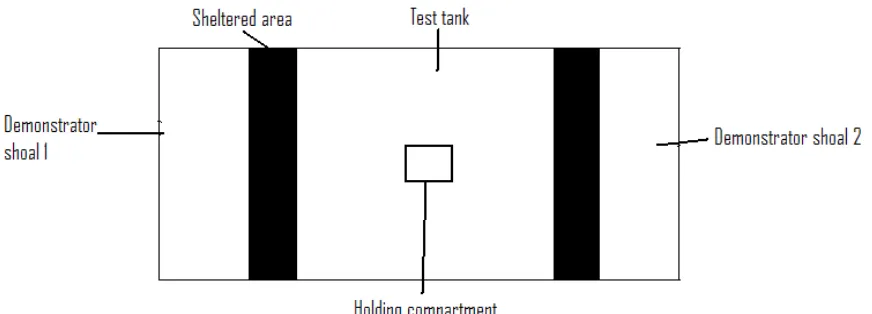
The apparatus for the trials can be seen in Figure 1. It included two tanks measuring 10 x 30 cm with a water depth of 18cm and a sand substrate of 1cm in depth. These two tanks abutted either end of an additional tank measuring 45 x 30cm with a water depth of 18cm. The central test tank had the addition of a secure, transparent central holding compartment measuring 5x5 cm, and two shaded areas measuring 10 x 30 cm at either end, adjacent to the tanks containing the demonstrators. All tanks had a sand substrate of 1cm in depth. All vertical sides and the area above the three experimental tanks were boxed in to prevent outside disturbance and to control the level of light entering the test tank. An artificial light source was located directly above the test tank. This ensured that no other shaded areas were available within the test tank, providing incentive for the observer to select either of the shaded shelter areas provided.
Procedure
aerial predator and therefore elicit an anti-predator response from the demonstrator shoal. The observer was then immediately released from the central compartment and allowed to move freely within the test tank. The observer was filmed for a period of 2 minutes, after which the observer was removed and the trial ended. If the observer did not select a shelter within two minutes, the trial was abandoned. On first detection of a potential aerial predator, a stickleback will immediately cease whatever activity it was engaged in and raise its spines. It then will either perform an evasive manoeuvre, such as a rapid swim to cover, or will remain frozen and slowly sink to the bottom of the water column (Huntingford et al 1994). As the option of swimming to cover was not available in this experiment, the demonstrator shoals performed the latter behaviour.
[image:29.595.108.544.434.591.2]Several parameters were measured from the video recordings; the latency of the focal fish to select a shelter, the first shelter chosen, the amount of time spent in the central section and each shelter, and the number of switches made by the focal fish between the two shelters. The observer was said to be in the shelter zone when the whole of its head was in the shadowed area.
Results
Pilot study
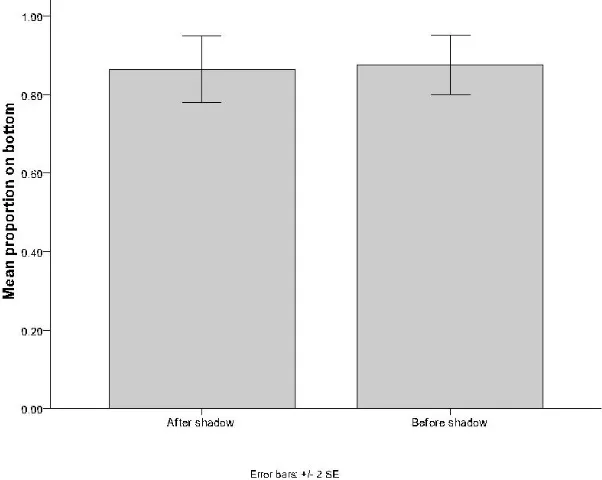
There was no significant difference observed in the behaviour of the demonstrators on the opposite side of the test tank before and after the mock predator shadow was cast with regard to location within the water column. The demonstrators were found to spend an equal proportion of time at the bottom of the water column before and after the shadow (Mann-Whitney U Test:U= 84.5,n = 12,P= 1) (Figure 2). There was also no significant difference in the mean levels of activity in the demonstrators on the opposite side of the test tank before and after the mock predator shadow was cast (Student's t Test:t= -0.728,df= 24,P= 0.473) (Figure 3).
[image:30.595.150.451.433.673.2]This shows that the demonstrator shoal at the opposite side of the test tank either could not see the shadow or the other demonstrator shoals response, or that they were not affected by it. Either way, they did not exhibit anti-predator behaviour and therefore should not have had an effect upon the observer.
Figure 2: The mean proportion of demonstrators on the opposite side of the test tank to which the mock
aerial predator shadow was cast that were found in the bottom section of the water column during a 30
second period both before and after the mock aerial predator shadow was cast over the top of the
Figure 3: The mean proportion of time the demonstrators on the opposite side of the test tank to which the
mock aerial predator shadow was cast spent actively swimming in the 30 second observation period
before and after the mock aerial predator shadow was cast over the top of the aquarium.
A significantly larger proportion of individuals were found at the bottom of the water column in the 30 second observation period after the shadow was cast than in the 30 second observation period before the shadow. This was the case for both the ninespined sticklebacks (Student's t Test: t = -4.403, df = 38,1, P = <0.0001) (Figure 4) and the threespined sticklebacks (Mann Whitney U Test:U= 36.5,n= 40,P= <0.0001) (Figure 5).
Figure 4: The mean proportion of ninespine stickleback individuals of a shoal of 5 found in the bottom
section of the water column during a 30 second period both before and after the mock aerial predator
[image:31.595.189.408.523.702.2]Figure 5: The mean number of threespine stickleback individuals of a shoal of 5 found in the bottom
section of the water column during a 30 second period both before and after the mock aerial predator
shadow was cast over the top of the aquarium.
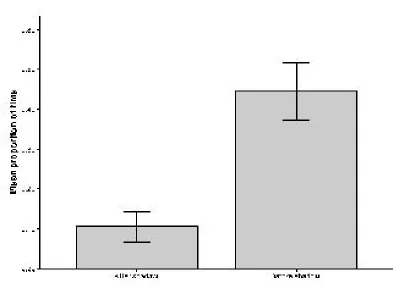
They also spent a significantly lower proportion of time actively swimming after the shadow was cast than before in the case of both the ninespined sticklebacks (Student's t Test: t = 5.896, df = 38,1, P = <0.0001) (Figure 6) and the threespined sticklebacks (Student's t Test:t= 8.248,df= 38,1,P= <0.0001) (Figure 7).
Figure 6: The mean proportion of time the ninespine stickleback demonstrator shoal spent actively
swimming in the 30 second observation period before and after the mock aerial predator shadow was cast
[image:32.595.157.446.462.691.2]Figure 7: The mean proportion of time the threespine stickleback demonstrator shoal spent actively
swimming in the 30 second observation period before and after the mock aerial predator shadow was cast
over the top of the aquarium.
This demonstrates that both the ninespined and threespined stickleback demonstrators were exhibiting an anti-predator response to the mock-predator shadow which would be visible to the observer during the test phase.
Response of the focal fish
Figure 8: The number of trials in which the ninespined stickleback observers went to either the shelter
behind which the demonstrators were exhibiting anti-predator behaviour in response to the mock aerial
predator shadow (scared) or the opposite side to which the shadow was cast (non-scared).
Figure 9: The number of trials in which the threespined stickleback observers went to either the shelter
behind which the demonstrators were exhibiting anti-predator behaviour in response to the mock aerial
predator shadow (scared) or the opposite side to which the shadow was cast (non-scared).
There was also no significant difference in the proportion of time both the focal fish spent in either sheltered area. This was observed in both ninespined sticklebacks (Wilcoxon's Signed Rank Test: Z43,1 = -0.753, P = 0.451) (Figure 10) and the
threespined sticklebacks (Wilcoxon's Signed Rank Test: Z43,1 = -0.880, P = 0.379)
[image:34.595.168.434.369.590.2]Figure 10: The mean proportion of time for which the ninespined stickleback observers spent in each
shelter goal zone. Either the shelter behind which the demonstrators were exhibiting anti-predator behaviour in response to the mock aerial predator shadow (scared) or the opposite side to which the
[image:35.595.188.411.392.568.2]shadow was cast (non-scared).
Figure 11: The mean proportion of time for which the threespined stickleback observers spent in each
shelter goal zone. Either the shelter behind which the demonstrators were exhibiting anti-predator behaviour in response to the mock aerial predator shadow (scared) or the opposite side to which the
shadow was cast (non-scared).
Discussion:
(Figures 8 and 9). Figures 10 and 11 also show that neither species spent significantly more time in either shelter. It appears therefore that even though Chivers and Smith (1994) and Suboski et al. (1990) demonstrated that sticklebacks are able to identify and respond to visual anti-predator behaviour of conspecifics, they did not use this information to select the non-threatening shelter.
The most likely explanation for the threespined and ninespined sticklebacks’ inability to select the non-threatening shelter is that they are making a trade-off between speed and accuracy. When the focal fish is in the test tank, they are exposed and directly under bright light. It is possible that the focal fish will therefore take the earliest opportunity to move into one of the shaded areas, and therefore become less visible to predators. The focal fish are therefore less likely to take the time required to assess each shelter before selection, resulting in the non-significant result seen here.
On a wider, more general, scale fish and other animals will often be faced with choosing between two conflicting behaviours and will have to make a trade-off between them. For example a possible increase in fitness by increasing foraging rates and courtship intensity could also lead to a decreased probability of survival due to increased exposure to predators and a decrease in vigilance (Magnhagen and Magurran 2008). The length of time in which an individual makes such decisions and the potential benefit that could be obtained from the information they gather during the assessment time is another such trade-off they must make when assessment time itself is costly (Krause et al 1997). One such trade-off decision has been seen here, between the speed of leaving an area in which the individual is an easy target for predators and the benefit gained from the shelters they may choose.
effect. Krause et al. (1997) found that when exposed to the fright stimulus, the test fishes significantly reduced both their response time in choosing a shoal and their ability to select the larger of the two stimulus shoals, suggesting that the benefits acquired from successfully selecting the larger of the two stimulus shoals were outweighed by the need to minimise the immediate predation risk.
References
Akins, C. K., and Zentall, T. R., 1996, Imitative learning in male Japanese quail (Coturnix japonica) using the two action method, Journal of Comparative Pyschology, 110, 316–320.
Anthouard, M., 1987, A study of social transmission in juvenileDicentrarchus labrax (Pisces, Serranidae), in an operant-conditioning situation,Behaviour,103, 266-275. Briggs, S. E., Godin, J-G. J. and Dugatkin, L. A., 1996, Mate choice copying under predation risk in the Trinidadian guppy (Poecilia reticulata), Behavioural Ecology, 7, 151-157.
British and Irish Association of Zoos and Aquariums, 2004,Zoo Research Guidelines: Monitoring Stress in Zoo Animals, Smith, T (ed), London.
Buckley, N. J., 1996, Food finding and the influence of information, local enhancement, and communal roosting on foraging success of North American vultures, The Auk,113, 473-488.
Brix, O., 2002, The physiology of living in water. In Hart, P. J. B. and Reynolds, J. D., (Eds): Handbook of fish biology and fisheries, Volume 1: Fish biology, 72 – 96, Blackwell Publishing, Oxford.
Bronstein, P. M., Levine, J. M. and Marcus, M., 1975, A rat’s first bite: The nongenetic, cross generational transfer of information, Journal of Comparative and Physiological Pyschology,89, 295-298.
Brown, G. E. and Godin, J-G. J., 1997, Anti-predator responses to conspecific and heterospecific skin extracts by threespine sticklebacks: alarm pheromones revisited, Ibid,134, 1123–1134.
Brown, C. and Laland, K. N., 2002, Social enhancement and and social inhibition of foraging behaviour in hatchery-reared Atlantic salmon, Journal of Fish Biology, 61, 987-998.
Brown, G. and Laland, K., N., 2003, Social learning in fishes: A review, Fish and Fisheries,4, 280-288.
Brown, G. and Laland, K., N., 2006, Social learning in fishes. In Brown, G. and Laland, K., N and Krause, J. (Eds), Fish Cognition and behaviour, Blackwell Publishing, Oxford, pp. 186-198.
Byrne, R. W., 1994, The evolution of intelligence. In Slater, P. J. B. and Halliday, T. R. (Eds.), Behaviour and Evolution, Cambridge University Press, Cambridge, UK. pp. 223–265.
Chivers, D. P., Brown, G. E., and Smith, R. J. F., 1995, Acquired recognition of chemical stimuli from pike, Esox lucius, by brook sticklebacks, Culaea inconstans (Osteichthyes, Gasterosteidae),Ethology, 99, 234-242.
Chivers, D. P., and Smith, R. J. F., 1994, The role of experience and chemical alarm signalling in predator recognition by fathead minnows, Pimephales promelas. Journal of Fish Biology, 44, 273-285.
Chivers, D. P., and Smith, R. J. F., 1995, Chemical recognition of risky habitats is culturally transmitted among fathead minnows, Pimephales promelas (Osteichthyes, Cyprinidae),Ethology, 99, 286-296.
Clark, R. W., 2007, Public information for solitary foragers: timber rattlesnakes use conspecific chemical cues to select ambush sites,Behavioural Ecology,18, 487-490. Coolen, I., van Bergen, Y., Day, R. L. and Laland, K. N., 2003, Species difference in adaptive use of public information in sticklebacks,Proceedings of the Royal Society of London Series B,270, 2413–2419.
Coolen, I., Ward, A. J. W., Hart, P. J. B. and Laland, K. N., 2005, Foraging nine-spined sticklebacks prefer to rely on public information over simpler social cues,Behavioural Ecology,16, 865-870.
Coss, R. G., 1978, Perceptual determinants of gaze aversion by the lesser mouse lemur (Microcebus murinus): The role of two facing eyes,Behaviour, 64, 248-270.
Csanyi, V., 1985, Ethological analysis of predator avoidance by the paradise fish (Macropodus opercularis L.): I. Recognition and learning of predators, Behaviour, 92, 227-240.
Dugatkin, L. A., 1992, Sexual selection and imitation: females copy the mate choice of others,American Naturalist,139, 1384-1489.
Dugatkin, L. A. and Godin J-G. J., 1992, Reversal of mate choice by copying in the guppy (Poecilia reticulata), Proceedings of the Royal Society of London Series B, 249, 179-184.
Dugatkin, L. A. and Godin J-G. J., 1993, Female mate choice copying in the guppy (Poecilia reticulata): age dependent effects,Behavioural Ecology,4, 289-292.
FitzGerald, G. J. and Wootton, R. J. 1996 The behavioural ecology of sticklebacks. In Behaviour of teleost fishes, 2nd edn (ed. T. J. Pitcher), pp. 537–572. Fish and fisheries series 7. London: Chapman & Hall.
Fryday, S. L. and Grieg-Smith, P. W., 1994, The effects of social learning on the food choice of the house sparrow (Passer domesticus). Behaviour, 128, 281–300.
Galef, B. G. Jr, 1986, Social interaction modifies learned aversions, sodium appetite, and both palatability and handling-time induced dietary preference in rats (Rattus norvegicus), In Zentall, T. R. and Galef, B. G. Jr, (Eds.),Social Learning: Psychological and biological perspectives,Hillsdale, NJ, Erlbaum, pp. 119-139.
Galef, B. G. Jr, 1993, Functions of social learning about food: a causal analysis of effects of diet novelty on preference transmission,Animal Behaviour,46, 257-265. Galef, B. G. Jr and Beck, M., 1985, Aversive and attractive marking of toxic and safe foods by Norway rats,Behavioural and Neural Biology,43, 298-310.
Galef, B. G. Jr., Kennett, D. J. and Stein, M., 1985, Demonstrator influence on observer diet preference: effects of simple exposure and the presence of a demonstrator,Animal Learning and Behaviour,12, 292-296.
Galef, B. G. Jr, Mason, J. R., Preti, G. and Bean, N. J., 1988, Carbon disulfide: A semiochemical mediating socially induced diet choice in rats, Physiology and Behaviour,42, 119-124.
Galef, B. G. Jr, McQuoid, L. and Whiskin, E. E., 1990, Further evidence that Norway rats do not transmit socially learned aversions to toxic baits, Animal Learning and Behaviour,18, 199-205.
Galef, B. G. Jr, Mischinger, A., and Malenfant, S., 1987, Further evidence of an information centre in Norway rats,Animal Behaviour,35, 1234-1239.
Galef, B. G. Jr. and Sherry, D. F., 1973, Mother’s milk: A medium for the transmission of cues reflecting the flavour of mother’s diet, Journal of Comparative and Physiological Pyschology,83, 374-378.
Galef, B. G. Jr. and Stein, M., 1985, Demonstrator influence on observer diet preference: Analysis of critical social interactions and olfactory signals, Animal Learning and Behaviour,13, 31-38.
Galef, B. G. Jr. and Wigmore, S. W., 1983, Transfer of information concerning distant foods: A laboratory investigation of the “information centre” hypothesis, Animal Behaviour,31, 748-758.
Gibson, R. M. and Hoglund, J., 1992, Copying and Sexual Selection,Trends in Ecology and Evolution, 7, 229-232.
Goldschmidt, T., Bakker, T. C. M. and Feuth-de Bruijn, E., 1993, Selective copying in mate choice of female sticklebacks,Animal Behaviour,45, 541-547.
Grant, J. W. and Green L. D., 1996, Mate copying versus preferences for actively courting males by Japanese medaka (Oryzias latipes),Behavioural Ecology,7, 165-167.
Griffin, A. S., 2004, Social learning about predators: A review and prospectus,Learning and Behaviour,32, 131-140.
Griffiths, S. W. and Ward, A. J. W. 2006. Learned recognition of conspecifics. In Brown, C., Laland, K. N. and Krause, J., Fish Cognition and Behaviour, Blackwell, Oxford, pp. 139-157.
Helfman, G. S. and Schultz, E. T., 1984, Social transmission of behavioural traditions in a coral reef fish,Animal Behaviour, 32, 379–384.
Hepper, P. G., 1988, Adaptive fetal learning: Prenatal exposure to garlic affects postnatal preferences,Animal Behaviour,36, 935-936.
Hoare, D. J., Ruxton, G. D., Godin, J. G. J. and Krause, J., 2000, The social organisation of free-ranging fish shoals,Oikos, 89, 546-554.
Hoogland, R. D., Mooris, D. and Tinbergen, N., 1957, The spines of sticklebacks (GasterosteusandPygosteus) as a means of defence against predators (PercaandEsox), Behaviour,10, 205–237.
Hoppitt, W., Blackburn, L., and Laland, K. N., 2007, Response facilitation in the domestic fowl.Animal Behaviour,73, 229–238.
Huntingford, F. A., Wright, P. J. and Tierney, J. F., 1994, Adaptive variation in antipredator behaviour in threespine stickleback. In Bell, M. A. and Foster, S. A. (Eds), 1994,The Evolutionary Biology of the Threespine Stickleback,Oxford University Press, Oxford, pp. 278-296.
Ioannou, C. C., Payne, M. and Krause, J., 2008, Ecological consequences of the bold-shy continuum: the effect of predator boldness on prey risk, Behavioral Ecology, 157, 177-182.
Jarvi, T., and Uglem, I., 1993, Predator training improves the antipredator behaviour of hatchery reared Atlantic salmon (Salmo salar) smolt, Nordic Journal of Freshwater Research, 68, 63-71.
Kaiser, D. H., Zentall, T. R., and Galef, B. G., Jr., 1997, Can imitation in pigeons be explained by local enhancement together with trial and error learning? Psychological Science, 8, 459–460.
Kendal, J. R., Rendell, L., Pike, T. W. and Laland, K. N., 2009, Nine-spined sticklebacks deploy a hill-climbing social learning strategy, Behavioural Ecology, 20, 238-244.
Kohler, D., 1976, The interaction between conditioned fish and naive schools of juvenile carp (Cyprinus carpio, Pisces),Behavioural Processes, 1, 267–275.
Krause, J., 1993, The effect of "Schreckstoff" on the shoaling behaviour of the minnow: A test of Hamilton's selfish herd theory,Animal Behaviour, 45, 1019-1024.
Krause, J., Godin, J. J. and Brown, G., 1996, Phenotypic variability within and between fish shoals.Ecology, 77, 1586-1591.
Krause, J., Rubenstein, D. and Brown, D., 1997, Shoal choice behaviour in fish: The relationship between assessment time and assessment quality, Behaviour, 143, 1051-1062.
Krebs, J. R., MacRoberts, M. H., and Cullen, J. M., 1972, Flocking and feeding in the great titParus major: an experimental study,Ibis, 114, 507–530.
Laland, K. N. and Williams, K., 1997, Shoaling generates social learning of foraging information in guppies,Animal Behaviour,53, 1161-1169.
Laland, K. N. and Williams, K., 1998, Social transmission of maladaptive information in the guppy,Behavioural Ecology,9,493-499.
Lane, M. A., Palphs, M. H., Olsen, J. D., Provenza, F. D. and Pfister, J. A., 1990, Conditioned Taste Aversion: Potential for reducing cattle loss to larkspur, Journal of Range Management,43, 127-131.
Magurran, A. E., 1989, Acquired recognition of predator odour in the European minnow (Phoxinus phoxinus),Ethology, 82, 216-223.
Magurran, A. E. and Higham, A., 1988, Information transfer across fish shoals under predator threat,Ethology, 78, 153-158.
Magnhagen, C. and Magurran, A. E., 2008, Decision-making and Trade-offs in Fish Behaviour. In Magnhagen, C., Braithwaite, V. A., Forsgren, E. & Kapoor, B. G. (Eds), 2008,Fish Behaviour,Science Publishers, Enfield, USA, pp. 499-523.
Marconato, A. and Bisazza, M., 1986, Males whose nests contain eggs are preferred by femaleCottus gobio, Animal Behaviour,34, 1580-1582.
red-winged blackbirds (Agelaius phoeniceus),Auk, 99, 548–554.
Mason, J. R. and Reidinger, R. F, 1983, Importance of color for methiocarb-induced food aversions in red-winged blackbird,Journal of Wildlife Management, 47, 383–393. Mathis, A., Chivers, D. P. and Smith, R. J. F., 1996, Cultural transmission of predator recognition in fishes: Intraspecific and interspecific learning, Animal Behaviour, 51, 185-201.
Matsumura, K., Matsunaga, S., and Fusetani, N., 2004, Possible involvement of phospatidylcholine in school recognition in the catfish, Plotosus lineatus, Zoological Science,21, 257-264.
Matsumura, K., Matsunaga, S., and Fusetani, N., 2007, Phosphatidylcholine profile-mediated group recognition in catfish,The Journal of Experimental Biology,210, 1992-1999.
Moberg, G. P., 2000, Biological response to stress: Implications for animal welfare.In Moberg, G. P. and Mench, J. A. (Eds),The biology of animal stress: Basic implications for animal welfare,CAB International, Wallingford, UK, 1-22.
Moore, J. W., 1972, Stimulus control: Studies of auditory generalization in the rabbit. In Pearce, J. M., 1997, Animal Learning and Cognition. An Introduction. 2nd edition, Pyschology Press, Hove, UK.
Moore, B. R., 1992, Avian movement imitation and a new form of mimicry: Tracing the evolution of a complex form of learning,Behaviour,122, 231–263.
Pearce, J. M., 1997, Animal Learning and Cognition. An Introduction. 2nd edition, Pyschology Press, Hove, UK.
Reebs, S. G., 2000, Can a minority of informed leaders determine the foraging movements of a fish shoal?,Animal behaviour,59 403 – 409.
Reynolds, J.D. and Jones, J. C., 1999, Female preference for preferred males is reversed under low oxygen conditions in the common goby (Pomatoschistus microps), Behavioural Ecology,10, 149-154.
Ridley, M. & Rechten, C., 1981, Female sticklebacks prefer to spawn with mates whose nests contain eggs,Behaviour,16, 152-161.
Ruxton, G. D., Speed, M. P. and Kelly, D. J., 2004, What, if anything, is the adaptive function of countershading?,Animal Behaviour,68, 445-451.
Schlupp, I., Marler, C. and Ryan, M. J., 1994, Benefit to male sailfin mollies of mating with heterospecific females,Science, 267, 373-374.
Schlupp, I. & Ryan, M. J., Male sailfin mollies (Poecilia latipinna) copy the mate choice of other males,Behavioural Ecology, 8, 104-107.
Smith, J. W., Benkman, C. W. and Coffey, K., 1999, The use and mis-use of public information by red crossbills,Behavioural. Ecology, 10, 54-62.
Suboski, M. D., Bain, S., Carty, A. E., McQuoid, L. M., Seelen, M. I., and Seifert, M., 1990, Alarm reaction in acquisition and social transmission of simulated-predator recognition by zebra danio fish (Brachydanio rerio), Journal of Comparative Psychology, 104, 101-112.
Templeton, J. J. and Giraldeau, L.-A., 1995, Patch assessment in foraging flocks of European starlings: evidence for the use of public information,Behavioural. Ecology,6, 65-72.
Templeton, J. J. and Giraldeau, L.-A., 1996, Vicarious sampling: the use of personal and public information by starlings foraging in a simple patchy environment, Behavioural Ecology and Sociobiology,38, 105-114.
Thorpe, W. H., 1956, Learning and Instinct in Animals, Methuen, London. In Hoppitt, W. and Laland, K. N., 2008, Social Processes Influencing Learning in Animals: A Review of the Evidence,Advances in the Study of Behaviour,38, 105-165.
Thorpe, W. H., 1963,Learning and Instinct in Animals,2nd Edition., Methuen, London. In Hoppitt, W. and Laland, K. N., 2008, Social Processes Influencing Learning in Animals: A Review of the Evidence,Advances in the Study of Behaviour,38, 105-165. Tolman, E. C., 1967a, Effect of tapping sounds on the feeding behaviour of domestic chicks.Animal Behaviour, 15, 145–148.
Tolman, E. C., 1967b, The feeding behaviour of domestic chicks as a function of the rate of pecking by a surrogate companion,Behaviour, 29, 57–62.
Treherne, J. E. and Foster, W. A., 1981, Group Transmission of predator avoidance behaviour in a marine insect: The Trafalgar effect,Animal Behaviour,29, 911-917. Valone, T.J., 1989, Group foraging, public information, and patch estimation,Oikos, 56, 357-363.
Valone, T. J. and Templeton, J. J., 2002, Public Information for the Assessment of Quality: A Widespread Social Phenomenon , Proceedings of the Royal Society of London Series B,357, 1549-1557.
Valsecchi, P and Galef, B. G. Jr., 1989, Social influences on the food preferences of house mice (Mus musculus), The International Journal of Comparative Pyschology, 2, 245-256.
Visalberghi, E., 1994, Learning process and feeding behaviour in monkeys. In Galef, B. J., Mainardi, M. And Valsecchi, P., Behavioural Aspects of Feeding: Basic and Applied Research on Mammals, Harwood Academic Publishers, Chur, Switzerland, pp. 257– 270.
Visalberghi, E. and Addessi, E., 2000, Response to changes in food palatability in tufted capuchin monkeys,Cebus apella.Animal Behaviour, 59, 231–238.
von Frisch, K., 1938, Zur Psychologie des Fische-Schwarmes,Naturwissenschaften, 26, 601-606. In Griffin, A. S., 2004, Social learning about predators: A review and prospectus,Learning and Behaviour,32, 131-140.
Ward, A. J. W., Hart, P. J. B. and Krause, J., 2004, The effects of habitat and diet-based cues on association preferences in threespined sticklebacks, Behavioral Ecology, 15, 925-929.
Ward, A. J. W., Holbrook, R. I., Krause, J. and Hart, P. J. B, 2005, Social recognition in sticklebacks: the role of direct experience and habitat cues, Behavioral Ecology and Sociobiology, 57, 575-583.
Ward, A. J. W., Webster, M. M. and Hart, P. J. B., 2007, Social recognition in wild fish populations,Proceedings of the Royal Society of London, Series B, 274, 1071-1077. Warner, R. R., 1988, Traditionality of mating-site preferences in a coral reef fish, Nature,335, 719-721.
Warner, R. R., 1990, Male versus female influences on mating-site determination in a coral-reef fish,Animal Behaviour,39, 540-548.
Webster, M. M., Goldsmith, J., Ward, A. J. W. and Hart, P. J. B., 2007, Habitat specific chemical cues influence association preferences and shoal cohesion in fish,Behavioral Ecology and Sociobiology, 62, 273-280.
Webster, M. M., Adams, E. L. and Laland, K. N., 2008(a), Diet-specific chemical cues influence association preferences and prey patch use in a shoaling fish, Animal Behaviour,76, 17-23.
Whiten, A., 1998, Imitation of the sequential structure of actions by chimpanzees (Pan trologdytes).Journal of Comparative Psychology, 112, 270–281.
Wisenden, B. D., chivers, D P and Smith, R J F, 1995, Early warning of risk in the predation sequence: a distur- bance pheromone in Iowa darters (Etheostoma exile), Journal of Chemical Ecology, 21, 1469- 1480.
Witte, D. J. and Ryan, M. J., 1998, Male body length influences female mate-choice copying in the sailfin molly (Poecilia latipinna),Behavioural Ecology,9, 534-539. Witte, D. J. and Ryan, M. J., 2002, Mate-choice copying in the sailfin molly, Poecilia latipinna, in the wild,Animal Behaviour,63, 943-949.