1
SI APPENDIX
Focus on the success of others leads to selfish behavior
Van den Berg P, Molleman L & Weissing FJ
CONTENTS
Supplementary figures
2
Interaction contexts
4
Experimental instructions
5
2
[image:2.595.72.519.105.544.2]Supplementary figures
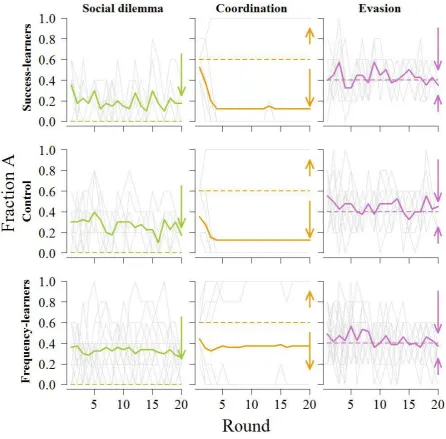
Fig. S1:
Decisions over time in Part 2 of the experiment.
Panels show the fraction of decisions that
were made for option A in all social contexts, for all three types of assorted groups. Replicate groups
are shown in grey (8 in the case of success-learners and control, 16 in the case of frequency-learners),
colored lines show averages. In case of the social dilemma and the evasion game, the dotted line
indicates the Nash-equilibrium of the one-shot version of the game; in case of the coordination game,
3
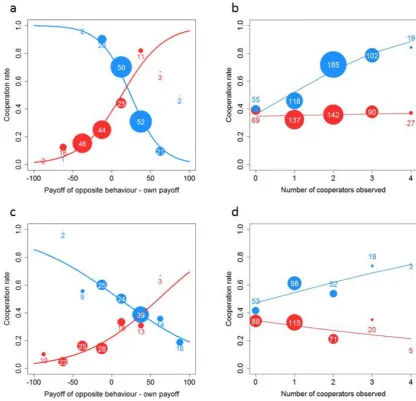
Figure S2:
Non-pooled data for the response to social information. Both the top row and the bottom
row correspond to Figure 3 from the main text, but contain only data from Part 1 and Part 2,
respectively. Graphs show probability of cooperation after viewing success-information (a and c) and
4
Interaction contexts
The basic payoff structures of the contexts were the same between both parts, but the payoffs, noise on
payoffs, and information cost in Part 2 were scaled with a factor 1.5 compared to Part 1 (here, values
for Part 1 are given). In each interaction context, payoffs of choosing respectively A and B were given
by
A
pa
1
p b
+
and
B
pc
1
p d
+
, where p denotes the fraction of subjects in
the group that chose option
A, parameters
a, b, c,
and
d
determine the structure of the interaction
context, and ε is a stochastic component, drawn from a normal distribution with mean 0 and standard
deviation σ (
20
). The stochastic component reflects the fact that the outcome of behavior is often
influenced by exogenous factors, and made it harder for the subjects to find out individually which
choice was optimal, and as a consequence, made social information more valuable.
The four interaction contexts can be described as follows. In the non-social context, payoffs did not
depend on the behavior of fellow group members (
a
b
10
and
c
d
30
). In game theoretical
terms, B dominates A in this situation, and
p
*
0
is the Nash equilibrium of the one-shot version of
the ‘game’ (technically, it is not a game, since the payoffs do not depend on the actions of others). In
the
social dilemma
context, cooperation (A) is dominated by defection (B):
a
40
c
60
and
20
0
b
d
.
Also in this case, there is a single Nash equilibrium at
p
*
0
- even though all
subjects obtain a higher payoff at
p
1
. This shows that in this context, collective interests and
individual interests are opposed to each other, like in the famous (two-player) Prisoner’s Dilemma
game. In the coordination game, the payoff of choosing one of the two options increased with the
number of others also choosing it (
a
50
c
30
and
b
30
d
90
). In this case, both
* 0
p
and
p
* 1
are Nash equilibria. However, the Nash equilibrium at
p
*
0
is Pareto superior;
the payoff to all players is higher compared to the equilibrium at
p
* 1
. There is a (dynamically
unstable) equilibrium located at
p
*
(
d
b
) / (
a b c
d
)
0.6
.
In this equilibrium (in the
experiment, when three subjects chose A and two subjects chose
B), the expected payoffs of choosing
A and choosing B were equal, but any deviation from this equilibrium leads towards either of the Nash
equilibria. In the evasion game, the payoff of choosing one of the two options decreased with the
number of others also choosing it (
a
30
c
90
and
b
50
d
30
). In this case, there
was a Nash equilibrium at
p
*
(
d
b
) / (
a b c
d
)
0.4
(when two subjects choose A and
three choose B).
5
Experimental instructions
Below are the general instructions to Part 1 and Part 2 of the experiment that the subjects received on
paper, but were also read aloud by an experimenter.
General instructions for Part 1
Welcome!
This session will last for approximately 2 hours. During the session it is not allowed to talk or communicate with the other participants. If you have a question, please raise your hand and one of us will come to you to answer it. As indicated in the invitation, this session is Part 1 of this study. You will also participate in Part 2, which is scheduled for April 2, 3, 4 and 5. At the end of this session, you will be able to indicate your availability for Part 2. On Friday March 15, we will send you an invitation for Part 2.
You will earn money in both Part 1 and Part 2 of this study. The amount you earn depends on your decisions and (sometimes) the decisions of others. The money you earn will be paid after Part 2. Please stay seated at the end of the session until your desk number is called. We will not inform any of the other participants about your earnings.
Setup
In the coming session you own an imaginary farm. You will run this farm in 4 different experiments in which you can earn points. At the end of the session, these points will be translated into real money (100 points = 1 euro). At the beginning of each experiment, you will be grouped with 4 randomly chosen other participants in the room and each is randomly labelled with a number 1-5. All experiments are anonymous; you cannot find out the real identity of the other Farmers in your group, and they cannot find this out about you. During each
experiment, your group consists of the same 5 participants, but when a new experiment starts, new groups are formed. The experiments are completely separate – what you earn in one experiment does not influence what you can earn in the other experiments. Also, it is likely that your earnings will vary between experiments.
Making decisions
Each experiment lasts for 20 Seasons. In each Season, you will make a decision how to use the land on your farm. In each experiment, you will decide between two different Crops. All Farmers in your group will make this decision at the same time.
Once all Farmers have made their decision, all Crops of all Farmers in your group are sold on the Market. This procedure is automated in the computer program. The number of points you earn (your ‘revenue’) depends on three things:
1. Crop value: one of the two Crops is worth more points. This Crop yields higher revenues on the Market. 2. Your land production: the number of Crops you produce in a Season is affected by things that you don’t
control, such as crop diseases or pests. In each Season, Farmers that make the same decision, will not receive exactly the same revenues. It will sometimes occur that a Farmer that chose the Crop with the higher value, will nevertheless get less revenues than a Farmer that chose the Crop with the lower value. However, on average, the Crop with the higher value will give higher revenues. The variation in Crop production is fully determined by chance.
3. Decisions of other Farmers: in experiment 1, your revenues are independent of the decisions of the other Farmers in your group. In experiments 2, 3 and 4, your revenues also depend on the decisions of other Farmers. How your revenues depend on your decisions and the decisions of the other Farmers in your group, is given by the ‘Market Rules’. These Rules are different in each of the experiments. The Market Rules will always be explained by the computer program at the beginning of each experiment. During an experiment, the Market Rules remain the same. Before the Seasons of an experiment start, you will fill out a short Quiz to check if you understand the Market Rules.
6
Collecting informationBefore making your decision, you can collect information about the decisions and revenues of the Farmers in your group. Two kinds of information are available about each Farmer:
i) Decision in the previous Season ii) Revenue in the previous Season
At the start of each Season, you can indicate whether or not you want to collect information. Collecting information costs 2 points. For those 2 points, you can collect up to 4 pieces of information in total. Collecting information about the decisions and revenues of other Farmers can be useful in finding out which Crops the other Farmers are producing, and which Crop has the higher value.
If you indicated not to collect information, no costs will be charged. In the first Season of each experiment, no information is available yet. At the start of the session, a test trial will make you familiar with the decision making environment on the computer screen. This test trial lasts for 5 Seasons. You cannot earn anything; the points are not worth any money. After the test trial, the experiments will start.
Time limits
In each Season (except the first of each experiment), you have 10 seconds to decide if you want to collect information about the Farmers in your group. If you have not decided within this time period, you will not get the opportunity to collect information. If you indicated ‘Yes’ (and confirmed), you have 20 seconds to decide which pieces of information you wish to collect. In the Decision screen the information you collected is shown to you, and you can make your decision how to use your land. You have 20 seconds to make this decision. If you have not decided (and confirmed your decision) within this time period, the computer program will make a random choice for you. When the Season has finished, a Results screen shows you the number of points you earned in this Season. This screen is shown to you for 10 seconds. After the Results screen, a new Season will start.
After 20 Seasons, the experiment is over, and a new experiment will be started by us. At the beginning of this new experiment, you will again be grouped with 4 randomly chosen other participants in the room and each participant is randomly labeled with a number 1-5, and the new Market Rules are explained in the computer program. After 4 experiments, the session ends.
End of the session
At the end of the series of 4 experiments, you are asked to fill out a Questionnaire. In this Questionnaire, you can also indicate your availability for Part 2. As indicated in the invitation for this experiment, you must be available for at least for blocks of Part 2. However, we encourage you to indicate availability for more than four blocks – there will be a (monetary) bonus for each extra block you are available for. Please stay seated after you finished the Questionnaire until we call your desk number.
General instructions for Part 2
Welcome!
This session will last for approximately 2 hours. During the session it is not allowed to talk or communicate with the other participants. If you have a question, please raise your hand and one of us will come to you to answer it. As you know, this is Part 2 of this study. As in Part 1, you will earn money in this Part, and the amount you earn depends on your decisions and (sometimes) the decisions of others. Your total earnings will be paid to you in cash at the end of this session. We will not inform any of the other participants about your earnings. Please stay seated at the end of this session until your desk number is called.
Setup
7
Making decisionsEach experiment lasts for 20 Trading Periods. In each Trading Period, you will make an Investment decision. You will always decide to invest in one of two different Companies. All Traders in your group will do their Investment at the same time.
Once all Traders have done their Investment, the Profit of all Traders is calculated. This procedure is automated in the computer program. The number of points you earn (your Profit) depends on three things:
1. Company performance: one of the two Companies is performing better than the other. Investing in this Company leads to higher Profits. During an experiment, it is always the same Company that performs the best.
2. Market fluctuations: the Profit you make is influenced by fluctuations of the market that you don’t control.
Because the stocks of different Traders are not sold at exactly the same moment, Traders that invest in the same Company will not make the same Profit. It can happen that a Trader that chose to invest in the better-performing Company, will nevertheless make less Profit than a Trader that chose to invest in the worse-performing Company. However, on average, Traders investing in the Company that performs better will make more Profit. The market fluctuations are completely determined by chance.
3. Decisions of other Traders: in the first experiment, your Profit is independent of the Investments of the other Traders in your group. In the other three experiments, your Profit also depends on the Investments of other Traders. How your Profit depends on your Investment decision and the Investments of the other Traders in your group, is given by the ‘Market Rules’. These Rules are different in each of the experiments. The Market Rules will always be explained by the computer program at the beginning of each experiment. During an experiment, the Market Rules remain the same. Before the Trading Periods of an experiment start, you will fill out a short Quiz to check if you understand the Market Rules.
At the end of each Trading Period, you are informed about the number of points you received (your Profit). It is also possible to lose points. The points you earn are stored in the computer memory.
Collecting information
Before making your Investment decision, you can collect information about the Investments and Profits of the Traders in your group. Two kinds of information are available about each Trader:
i) Investment decision in the previous Trading Period ii) Profit in the previous Trading Period
At the start of each Trading Period, you can indicate whether or not you want to collect information. Collecting information costs 3 points. For those 3 points, you can collect up to 4 pieces of information in total. Collecting information about the Investments and Profits of other Traders can be useful in finding out which Company the other Traders are investing in, and which Company is performing better.
If you indicated not to collect information, no costs will be charged. In the first Trading Period of each experiment, no information is available yet. At the start of the session, a test trial will make you familiar with the decision making environment on the computer screen. This test trial lasts for 5 Trading Periods. You cannot earn anything in the test trial; the points are not worth any money. After the test trial, the real experiments will start.
Time limits
In each Trading Period (except the first of each experiment), you have 10 seconds to decide if you want to collect information about the Traders in your group. If you have not decided within this time period, you will not get the opportunity to collect information. If you indicated ‘Yes’ (and clicked the ‘confirm’ button), you have 20 seconds to decide which pieces of information you wish to collect. In the Investment screen the information you collected is shown to you, and you can make your Investment decision. You have 20 seconds to make this decision. If you have not decided (and clicked the ‘confirm’ button) within this time period, the computer program will make a random choice for you. When the Trading Period has finished, a Results screen shows you the Profit you made this Trading Period. This screen is shown to you for 10 seconds. After the Results screen, a new Trading Period will start.