
Abstract— This paper reviews the current technologies used in high speed electrical machines, through an extensive survey of different topologies developed and built in industry as well as in academia for several applications. Developments in materials and components including electrical steels and copper alloys are discussed, and their impact on the machines’ operating physical boundaries is investigated. The main application areas pulling the development of high speed machines are also reviewed in an effort to better understand the typical performance requirements.
Index Terms—high speed electrical machines, high frequency electrical machines, high strength electrical steels, high frequency electrical steels, copper alloys, thermal modeling, mechanical modeling.
I. INTRODUCTION
IGH speed rotating mechanical machinery has been developed and used for a long time, and is now considered a mature and reliable technology for a number of engineering applications. Such applications include turbochargers, mechanical turbo-compounding systems, aero-engine spools, helicopter aero-engines, racing aero-engines and fuel pumps with typical operational speeds in excess of 10,000rpm and RPM√kW in excess of 1x10⁵ [1].
The drive towards research and development in high speed electrical machinery has seen a rapid growth in the last few decades, with a considerable application uptake in the last decade. It is also foreseen that this research area will be dominating electrical machine drive research, partly due to the current improvements in the enabling technologies, and partly due to the significant impact the development of these machines will make in many application areas. This is also reflected by the large number of national and international funded research programmes in this area. This paper will first overview some of the application areas where high speed
Manuscript received February 6, 2013, accepted for publication September 30, 2013.Copyright © 2013 IEEE. Personal use of this material is permitted. However, permission to use this material for any other purposes must be obtained from the IEEE by sending a request to [email protected]
D.Gerada, A. Mebarki and N.L. Brown are with the Research and Technology Department, Cummins Generator Technologies, Stamford, PE9 2NB, U.K. (email : [email protected]).
C. Gerada is with the Power Electronics, Machines and Control Group, University of Nottingham, Nottingham NG7 2RD, U.K.
A. Cavagnino and A. Boglietti are with the Dipartimento di Ingegneria Elettrica, Politecnico di Torino, 10129 Turin, Italy.
electrical machinery have been applied to and the resulting system benefits will be highlighted. A common perceived advantage of high speed machines is the reduction of system weight for a given magnitude of power conversion. This is especially desirable in mobile applications, where any savings in weight results directly in reduced fuel burn and emissions. The trend in electrifying future transport systems is creating a significant pull for advancing high speed technologies. Another commonly perceived benefit in adopting high speed machines in certain applications is the improvement in reliability as a result of the elimination of intermediate gearing (direct drives).
The research and development in this area is also fuelled by the developments in power electronic switching devices, converter topologies and control methodologies which are enabling even higher machine operating frequencies. This is in conjunction with developments in soft and hard magnetic materials, which are able to withstand higher magnitudes of mechanical stress whilst exhibiting low AC losses, which allow for higher rotor peripheral velocities and higher power densities. After reviewing the application areas for high speed electrical machinery, this paper will highlight significant recent advancements in material technology related to high speed machines. Then, different electrical machine topologies from literature will be reviewed and compared in terms of their high speed capability and performance characteristics.
II. OVERVIEW OF APPLICATIONS
In some applications high speed electrical machines directly replace existing high speed mechanical systems, while in other applications the high speed electrical machine complements the existing high speed mechanical system. This section gives an overview of the drive behind such developments for a broad range of application spectra. The list is not exhaustive but indicative of the application pull for high speed electrical machine technology.
A. High Speed Electrical Machines for the More-Electric Engine (Automotive/Power Generation)
The concept of having high performance traction machines integrated within hybrid drive-trains to improve fuel efficiency and reduce emissions is now commonplace in vehicles. Increasingly stringent emissions and fuel efficiency
David Gerada, Abdeslam Mebarki, Neil L. Brown, Chris Gerada,
Member, IEEE
Andrea Cavagnino,
Senior Member, IEEE
, and Aldo Boglietti,
Fellow, IEEE
High Speed Electrical Machines –Technologies,
Trends and Developments
M1
M2
M3
M4
requirements call for further electrification for engines being used for automotive as well as power generation applications, primarily through the use of high speed electrical machines. The potential applications of high speed electrical machines within the more electric-engine are several, as shown in Fig. 1, which lays out a family of four possible high speed electrical machines around a future engine.
[image:2.612.79.258.149.312.2]
Fig. 1. High Speed Electrical Machines for the More-Electric Engine [Cummins]
In one such application, the electrical machine is placed on the same shaft as the turbine and the compressor wheels in a turbocharger (machine M1 in Fig.1). The function of the machine is two-fold : on starting and gear shift, when there is lack of energy in the exhaust gas stream, the machine is used as a motor to speed-up the compressor to the required speed, thus reducing turbo-lag and improving driveability. At high engine loads, when there is excess energy in the exhaust, instead of opening a waste-gate valve to prevent the shaft overspeeding, the electrical machine is used as a generator. The typical integration of the electrical machine within a turbocharger is shown in Fig. 2.
Fig. 2. Electrically assisted turbocharging : integrating electrical machines within existing high speed machinery [Cummins]
Driveline efficiency can be further improved by installing an additional power turbine and high speed machine (machine M2 in Fig.1), downstream of the turbocharger to extract waste
heat from the exhaust gases, often called turbocompounding. Recovered energy is then used to supply the vehicle’s electrical loads, including the traction machine if used within a hybrid drive-train architecture.
[image:2.612.317.569.304.463.2]In internal combustion engines, exhaust gas recirculation (EGR) is used to reduce NOx emissions by routing some of the exhaust gas back into the intake air flow. In engines where the exhaust backpressure is greater than the intake air pressure, a negative pressure differential exists and hence EGR flow can be realised by simply connecting a conduit between the exhaust and intake ducts. However, in an engine having a charged intake, an unfavourable pressure differential must be overcome [2]. One way of efficiently overcoming the aforesaid problem is by introducing an EGR compressor upstream of the turbine, which is driven by a high speed motor (machine M3 in Fig.1). This reduces the pumping energy required drastically when compared to more conventional EGR systems wherein exhaust gases are drawn downstream of the turbine.
Fig. 3. High speed electrical machine used within an ORC engine [Cummins]
Higher engine fuel efficiency improvements can be gained by recovering waste-heat energy from the whole engine, rather than just from the exhaust gas stream. This is done through an Organic Rankine Cycle, whereby heat is recovered by circulating a working fluid which is then used to drive a high speed turbine and electrical generator. Fuel efficiencies over 12% have been demonstrated [3]. Fig.3. shows one such engine as developed by Cummins. The range of power-speed nodes for electrical machines developed for engine applications is very broad, ranging from 2kW 220,000rpm for a passenger car application [41], up to 150kW 35,000rpm for a prime-power generation engine.
B. Flywheel Energy Storage Systems
[image:2.612.67.272.528.654.2]the same motor is used to slow the flywheel down, converting the mechanical energy back into to electrical energy. Traditional flywheel designs have large diameters, rotate slowly and have low power and energy densities. More modern flywheels are designed to rotate at higher speeds. Such flywheels achieve higher power densities than the NiMH batteries typically used in hybrid vehicles, albeit having lower energy densities. For energy storage applications requiring high peak power output for a short amount of time (i.e. low energy), as is the case for power-assist hybrid electric vehicles, high speed flywheel storage systems offer a number of advantages over battery technologies such as a more compact solution, higher efficiency, longer lifetime and a wider operating temperature range [68]. Fig.4. shows a flywheel developed by Williams Hybrid Power, as used within the Porsche911 GT3R. This flywheel rotates at 40,000rpm and is used to generate/motor up to 120kW to the front-axle motors.
Fig. 4. High speed composite flywheel [Williams Hybrid Power]
C. High Speed Spindle Applications
The machine tool industry has also been another driver behind the development of high speed electrical machines. Conventional low-cost, high speed spindles use belt-drives, which are limited in maximum speed. Increased demands for higher rotational speeds, speed control, low vibration levels as well as power density (due to lack of space) has led to using high speed electrical machines for spindle applications. The power range and speed limits in spindle applications are very spread out, varying from 9000 rpm up to 180000 rpm, with a corresponding power approximately from 24 kW down to 1 kW.
TABLE I
TYPICAL MILLING APPLICATIONS SPEED
As reported in Table I, the maximum rotational speed achieved during the different milling applications depends on the processed material type. For grinding applications, the
machine tool rotational speeds are higher than the typical range reported in Table I, reaching speeds up to hundreds of thousands revolutions per minute in ultra-precision machining applications, such as meso-scale dimension range and mega-speed drive systems [4]. Fig.5. shows one such machine, developed by Westwind Air Bearings, with a speed of 300,000 rpm used within PCB drilling spindles.
Fig. 5. High speed 200W 300,000 rpm PCB drilling spindle [Westwind]
D. Turbomolecular Pumps
Turbomolecular pumps are another application where the speeds are increasing, and where the use of very high speed motors can be considered a suitable choice. Currently, rotational speeds up to 100,000 rpm at low powers (a few hundred watts) are the future target for this application. The turbomolecular pump is used to obtain and maintain a high vacuum. These pumps work on the principle that gas molecules can be given momentum in a desired direction by repeated collision with a moving solid surface. In a turbo pump, a rapidly spinning turbine rotor hits gas molecules from the inlet of the pump toward the exhaust in order to create or maintain a vacuum. A cross section of typical turbopump driven by a high speed motor is shown in Fig.6. These pumps are used to get a very high vacuum condition up to 10−10mbar.
This type of load demands motor performance characteristics requiring a complex design approach, far from the classical design criteria used for the standard motors. In particular, the rotor runs in a deep vacuum, with extreme thermal exchange problems [69]. In fact, the thermal dissipation can be done only by radiation. The rotor inertia contribution on the total inertia has to be as low as possible in order to simplify the balance process of the rotating parts. The torque ripple has to be very low in order to reduce the risk of mechanical resonance in the rotating system.
Fig. 6. Cross-section of turbomolecular pump driven by high speed motor [76]
Applications Speed
[image:3.612.48.298.268.368.2]E. Gas Compressor Applications
[image:4.612.57.300.359.423.2]Gas compression is needed at many places in the chemical, oil and gas industry, mainly for gathering, transmission and processing the gas downstream. Gas engines and gas turbines are traditionally used as the compressor drives. While gas fired drives are convenient for gas companies, they are becoming increasingly difficult to install due to environmental restrictions. The idea of using electric motors to drive compressors to minimize the environmental, regulatory and maintenance issues is not new, but progress in the field of high speed machines have made them more attractive. Oil free compressors have been successfully used for many years but as long as a lubrication system for the oil is still necessary for the drive, or for a gearbox, the benefits of oil-free operation cannot be fully exploited. Electric high speed drives with magnetic bearings allow the elimination of the gearbox and of the entire lubrication oil system, which leads to increased safety, increased efficiency, increased availability as well as to reduced operation and maintenance costs. Thus, the electric high speed drives are the most environmental friendly compressor drives [5]. The layout and rotor of a 10MW 20000rpm Induction Machine developed by Converteam (now GE Energy), and used within such an application are shown in Fig. 7 and Fig.8 respectively.
Fig. 7. Conventional Compressor (left) and Integrated Compressor (right)
Fig. 8. 10MW 20000rpm high speed Induction Motor used within an integrated compressor unit [GE Energy]
F. Industrial Air Compressors and Air Blowers
In many industrial applications there is an ever increasing demand for higher quality, oil-free compressed air. In the food and beverage industry, as well as in the pharmaceutical industry, any oil contamination can lead to unsafe products and consumer health hazards. In the automotive industry, oil-free air is essential to achieve a high quality finish. In the electronics industry, moisture can affect sensitive processes and cause oxidation of micro-terminal strips, resulting in
product failure. In all the aforementioned industries any oil contamination can lead to expensive product recalls and plant shutdown. High speed electrical machines which operate at powers of 100-500kW, and speeds 80-15,000 rpm, using magnetic or air bearings, are being used in the latest generation Class 0, 'oil-free', direct-drive industrial compressors, in the 4-9 bar range.
In wastewater treatment plants, the majority of power demand, over 60%, is required for the delivery of air to provide oxygen for biological treatment of waste streams and mixing to solids. Traditionally positive displacement (PD) blowers running on variable frequency drives, or geared centrifugal units equipped with inlet and outlet vanes, are used for wastewater aeration. The last decade has seen a rapid growth in the use of turbo-blowers driven by high speed motors, having higher reliability and durability, reduced noise, a 25% reduction in footprint, and more importantly claimed energy savings in excess of 35% [70] with respect to conventional blowers.
G. Microturbines
[image:4.612.325.560.469.631.2]Microturbines are small combustion turbines of a size comparable to a refrigerator, and with typical outputs of 30 kW to 400kW. They are typically used for stationary energy generation applications at sites with space limitations for power production. They are fuel-flexible machines that can run on natural gas, biogas, propane, butane, diesel, and kerosene. Microturbines have few moving parts, high efficiency, low emissions, and have waste heat utilization opportunities. They are also lightweight and compact in size. Waste heat recovery can be used in combined heat and power (CHP) systems to achieve energy efficiency levels greater than 80% [6].
Fig. 9. Typical Layout of a Micro Gas Turbine [6]
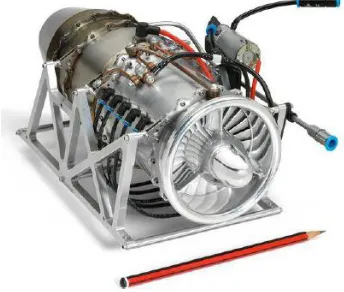
[image:4.612.53.300.544.639.2]Simple-cycle microturbines have a lower cost, higher reliability, and more heat available for CHP applications than recuperated units. Recuperated units use a sheet-metal heat exchanger that recovers some of the heat from an exhaust stream, and transfers it to the incoming air stream. The preheated air is then used in the combustion process. If the air is preheated, less fuel is necessary to raise its temperature to the required level at the turbine inlet. Recuperated units have a higher efficiency and thermal-to-electric ratio than unrecuperated units, and yield 30% to 40% fuel savings from preheating [6]. Recently there is a re-visited interest in using microturbines as a range extender within serial hybrid vehicles, as well as all-electric vehicles, as a power unit which can charge the vehicle’s batteries. Fig. 10 shows a 50kW 80000rpm microturbine developed by Bladon. It is claimed that such a technology, can be just 5% of the size, weight, and parts of an equivalent piston engine [7].
Fig. 10. 50kW 80,000 rpm Micro Gas Turbine [Bladon]
III. MATERIALS
This section gives an overview of materials suitable for high speed electrical machines, including electrical steels, copper alloys and magnets. It also describes the main developments which are key in pushing the operational boundaries of high speed electrical machinery.
A. Electrical Steels
For the stator and rotor laminations, different Silicon Iron (SiFe) and Cobalt Iron (CoFe) alloys have been considered. Cobalt Iron ensures highest saturation magnetisation, going above 2 Tesla, thus enabling highest power densities to be achieved. The actual value of saturation magnetisation for Cobalt-Iron depends on the annealing temperature, time of annealing and annealing atmosphere – in general the better the mechanical characteristics of the annealed material, the lower is the saturation magnetisation. However, even when annealed to the optimum mechanical properties, the saturation magnetisation of CoFe is still significantly higher than SiFe (around 20% higher). Whilst CoFe is significantly more
expensive compared to SiFe laminations, it is often considered for high speed machines as material mass per kW is intrinsically small, and thus not hugely significant at system level.
Another important parameter when choosing the lamination material for high speed machines is the amount of core losses generated in the lamination due to the very high fundamental and switching frequencies. For a given frequency and flux-density, the core losses are primarily influenced by the lamination thickness as well as the final annealing method. In general, the thinner the laminations the lower the core losses. Electrical Steels as thin as 0.1mm with very low core-losses, tailored specifically for high frequency applications are commercially available [8].
10JNEX900
Arnon7 NO20
35HXT590T 35HXT780T
M235-35A
35HXT680T
M270-35A Vacodur50
Vacoflux48 10JNHF600
Vacoflux17 Speed35-510
Hiperco 50HS
100 200 300 400 500 600 700 800 900
0 10 20 30 40 50 60
core loss (W/kg), 1T 400Hz
Y
ie
ld
S
tr
e
n
g
th
(
M
P
a
[image:5.612.315.552.236.386.2])
Fig. 11. Comparison of core-losses and yield strength for different high-performance electrical steels
Fig. 11 compares the mechanical yield-strength and core-loss characteristics at 1T 400Hz of commercially available grades of SiFe(♦) and CoFe (■) under their respective trade-names. It should be noted that for many of the steel grades (except those marketed specifically for their mechanical characteristics), the mechanical properties are normally typical indicative values. M270-35A and M235-35A are common 0.35mm SiFe grades with a typical yield-strength of around 350MPa and 450MPa respectively. These grades are typically used for higher performance, volume-manufactured, mainstream motors such as traction machines.
High frequency machines typically use thinner SiFe grades than 0.35mm, such as NO20 and Arnon7 respectively 0.2mm, 0.17mm thick. The core losses of the aforementioned thin-grades are superior, as shown in Fig. 11, however this is at the cost of reduced yield strength, which is typically 300-380MPa for such grades.
[image:5.612.98.270.264.410.2]aluminium copper silver CuCrZr CuNiSi
mild steel
glidcop AL60
glidcop AL25 glidcop AL15 CuBe
CuZr CuCr
0 100 200 300 400 500 600 700 800
0 20 40 60 80 100 120
conductivity relative to copper
y
ie
ld
s
tr
e
n
g
th
(MPa
)
frequencies in the stator. Conventional silicon steel sheets have a silicon content of 3.5% or less. It has long been known that the magnetic characteristics of a silicon steel sheet improve as the Si content increases, peaking at 6.5% [8]. However, it had been impractical to produce thin steel sheets with a Si content of over 3.5% because the steel tends to harden. This production problem was recently overcome through the adoption of a CVD (Chemical Vapour Deposition) process. Having such a high percentage silicon results in having a high yield strength however the material is brittle which makes it undesirable for high speed rotors. The ductility can be improved by having gradient-injection of Silicon, whereby a higher Silicon content is injected at the edges of the sheet for reduction of very-high frequency losses, and a lower Silicon content injected in the centre.
Other steel research is focused on developing very high-strength electrical steel without compromising on the ductility. The drive behind this research is primarily Interior Permanent Magnet (IPM) motors used in hybrid traction. Such motors require the bridge to be kept as small as possible to limit short-circuiting the magnet-flux (thus reducing magnet volume), however this is limited by the yield-strength of the lamination material. High yield strengths of over 800MPa can be achieved by a number of techniques such as dislocation strengthening [9], at the cost of increased iron losses. The HXT grades [10], shown in Fig.11, can achieve a very high yield strength, comparable to high-strength carbon steel, in excess of 800MPa with an elongation in excess of 18%. Fig. 11 also compares iron losses for four different types of CoFe alloys. As seen in this figure, the CoFe alloy with optimum magnetic properties Vacoflux48 has significantly lower losses than the M235-35A material for the same thickness, however its yield strength is only about 200MPa (i.e. half that of SiFe), which for the case of use in a high-speed rotor is not sufficient. In order for the CoFe to have similar yield strength (i.e. Vacodur 50 with optimum mechanical properties) as SiFe, its electromagnetic properties degrade, and the losses become comparable for both SiFe and CoFe. It is also important to note that the aforementioned CoFe grades are brittle in nature, with Vacoflux48 having 2% elongation and Vacodur50 6% elongation. The elongation is improved to 32% in Vacoflux17 which has a reduced cobalt content of 17%, albeit increasing the core losses significantly. CoFe alloys can be strengthened by alloying with Vanadium, such as Hiperco 50HS which can achieve a yield strength of over 680MPa with a 15% elongation.
B. Copper Alloys
For the case of induction machines, the rotor bar and end-ring material require careful selection. High yield strength is required at high temperatures as the bars serve a mechanical function besides the electromagnetic function. The bars also add to the stiffness of the rotor assembly, and thus help increase the critical speed of the machine. Moreover, for
Induction Machines keeping the rotor cage in a healthy condition is fundamental for operation.
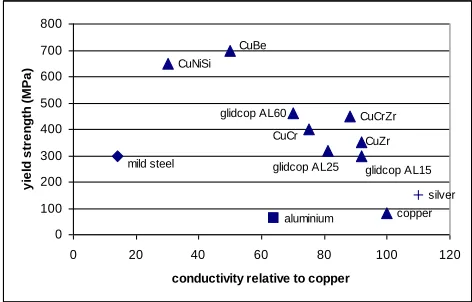
For high speed, high temperature applications, pure copper is not typically used due to its low yield strength and it softens at high temperatures. Several different types of high strength copper alloys have been utilized for high speed induction machines, such as Copper Zirconium(CuZr), Copper Beryllium(CuBe) [37] and Copper Aluminum Oxide (CuAl2O3) [23], [24], [34], [35]. Fig. 12 maps different
[image:6.612.326.562.215.366.2]materials which are considered for the rotor cage in terms of the two most important parameters for a high speed induction motor application (i.e. electrical conductivity and yield strength).
Fig. 12. Alloys for rotor cage
Copper can be strengthened substantially by alloying it with other elements, but alloying causes a significant loss in conductivity. Copper can also be strengthened by incorporating fine particles of a second phase in its matrix, causing only a relatively small loss in conductivity. The second phase can be a metal or inter-metallic compound precipitated from a solid solution by an aging treatment, or it can be non-metallic particles, such as stable oxide, added to or formed within the copper matrix. One such material, made using the internal oxidation technique is Glidcop™ from North American Hoganas, which retains its strength at elevated temperatures in excess of 300ºC.
C. Permanent Magnets
Fig. 13. Segmented magnets for rotor loss reduction [Arnold Magnets]
High speed machines typically use high energy density magnets from the NdFeB or SmCo families with a high working temperature capability. NdFeB grades alloyed with Dysprosium (Dy), meant that NdFeB magnets could go to working temperature limits up to 250ºC, such as grade N38EH. For operation above this temperature, Samarium Cobalt Sm2Co17 remains the only suitable material. Although
having a slightly lower remanence and energy product than the NdFeB magnets, typically Sm2Co17 grades can operate up to
temperatures of 350ºC, with some special grades pushing the boundary to 550ºC, at the cost of reduced remanence, as shown in Fig. 14.
Fig. 14. High temperature samarium cobalt [77]
Electrically conducting stator and rotor sleeves have also been adopted to shield the magnets from asynchronous fields. Permanent magnets are very weak in tension whilst able to withstand large compressive stress. To ensure mechanical integrity of high speed rotors, magnets are often pre-stressed using sleeves made of high strength metallic materials such as Inconel or Titanium [61]. Carbon fiber is also often used as a retention mechanism due to its superior mechanical properties. This can either be directly filament wound on the rotor assembly, or a pre-fabricated sleeve can be pressed onto the assembly.
IV. LITERATURE REVIEW ON HIGH SPEED ELECTRICAL
MACHINE TECHNOLOGIES
Over the last two decades a number of overviews on high speed electrical machine technology have been published.
Reichert et al. [71] present a set of analytical formulations relating rotor diameters to rotational speeds based on four considerations namely, (i)the mechanical stresses in the rotor, (ii)critical speeds, (iii)rotor cooling and (iv)specific power output per rotor volume. These formulations are then used to define a design window, or ‘realization area’, for high speed electrical machines. The authors also present a power speed chart, which includes limit lines for synchronous and induction machines, as well as limit areas for a number of inverter topologies. This chart is used to derive tendencies depending on the required power and speed range. At the time of writing, the authors concluded that for lowerspeeds (≤9000 rpm) and higher powers (≤30MW) the synchronous machine fed from current source inverters was the favorable solution, while for higher speeds (≤100,000 rpm) and lower powers (≤2MW), the induction machine (IM) fed from voltage source inverters was the favored solution. Permanent-Magnet (PM) machines were described as suitable for low power and high speed applications.
Canders [72] presents the use of Surface-Mount Permanent Magnet Machines (SPM) with carbon fiber banding, as a very promising design alternative for higher power, high speed applications. Suitable choice of armature current sheet is given important consideration in deriving the tangential force density (kNm/m2) limit on the rotor as a function of speed.
Keeping the design running sub-critical, the permissible rotor length is calculated and charts of power limits as a function of speed for Permanent Magnet Machines are derived.
Binder et al. [73] discuss aspects relating to the design of high speed electrical machines. The authors describe how the electromagnetic utilization factor is lower than for low speed machines, and through a literature review for built permanent magnet, induction, and homo-polar machines, empirically, a linear regression line relating the power limit to the design speed is derived. The bearing types used for developed high speed machines are also investigated.
The following sub-sections make an effort to describe high speed machines in literature which have been built and tested, including Induction Machines, Permanent Magnet Machines, Switched Reluctance Machines, and Synchronous Homopolar Machines. A comparison between the technologies demonstrates the operating domain each technology has been employed at.
A. High Speed Induction Machines
Induction Machines, due to their robust construction, are commonly used for high-speed applications. Table II, developed and expanded from that presented in [19], lists high speed induction machines published in literature, ranked in order of circumferential speed, 'vc' (m/s). From this table it is
[image:7.612.55.288.337.494.2]however such a design lacks a high conductivity path for the induced rotor currents and is thus a relatively inefficient design [11], [12]. The harmonic flux components concentrate on the surface of the rotor and cause significant losses therein which limit the overall machine power density. Moreover eddy-currents try to push the inducing magnetic field out of the rotor.
The axially-slitted solid rotor, as shown in Fig. 15b, is an improvement over the smooth solid rotor topology by axially slitting the rotor surface [13], [14]. Slitting has the effect of guiding the fundamental flux component into the rotor, while presenting a higher impedance path to the eddy-currents travelling on the rotor surface. However, slitting also increases the air-gap friction loss, which at the high speeds considered can even outweigh the reduced eddy-current loss, as well as reducing the mechanical strength of the rotor.
[image:8.612.317.560.89.593.2](a) (b) (c) (d) Fig. 15. High speed solid rotor topologies
a)smooth solid rotor b)slitted solid rotor c) coated solid rotor d) caged solid rotor
Detailed studies on axial slitting of solid rotor induction motors are presented by Aho [15] and Huppunen [16]. In these studies the number of rotor slits as well as their geometries are investigated with the aim of achieving an overall optimised design. It is noted that deep slitting provides a good torque generation capability at the cost of reduced mechanical strength. Aho recommends a slit depth of about 40-50% of the rotor radius in order to achieve a compromise between rotor strength and reduced eddy-current losses. Moreover, it is noted that odd numbers of rotor slits minimise the torque ripple as well as the rotor losses at the cost of an increased unbalanced magnetic pull.
A further improvement in the rotor is achieved by coating the solid rotor with a copper layer, thus introducing electromagnetic anisotropy [17], [18] as shown in Fig. 15c. The copper coating acts as an infinite number of rotor bars and as end-rings. Such a design is mechanically robust, and achieves higher efficiencies than the simple solid rotor topology. Fig. 16 shows a 300kW 60000rpm copper coated solid rotor Induction Machine used for an air compressor [30]. This topology is used in the highest peripheral speed machines as shown Table II, however by having a coating, the air-gap from stator iron to rotor iron is much higher than in induction machines where the copper is in bars, and hence a resulting poor power factor.
TABLE II
HIGH SPEED INDUCTION MACHINES IN LITERATURE AND INDUSTRY,RANKED
IN ORDER OF PERIPHERAL SPEED
vc
[m/s]
Rotor
Diameter
[mm]
Rotor Type Power
[kW]
Speed
[rpm]
Reference
367 70 solid coated 60 100000 [17]
342 109 solid coated 300 60000 [30]
290 - laminated 2000 15000 [36]
283 90 solid coated 60 60000 [19]
250 - laminated 8000 12000 [5]
236 90 solid caged 50 50000 [19]
204 325 solid slitted 8000 12000 [13]
193 330 solid caged 2610 11160 [31]
185 118 laminated 100 30000 [32]
182 348 laminated 6000 10000 [62]
180 39 laminated 10 90000 [35]
177 28 solid 6.3 120000 [11]
168 80 laminated 35 40000 [33]
144 90 laminated
solid coated
65 30600 [19]
138 47 laminated 11 56500 [24]
134 51 laminated 21 50000 [23]
126 200 laminated
solid caged
200 12000 [21]
126 200 solid slitted 250 12000 [16]
124 99 solid coated 12 24000 [14]
120 46 laminated 1.5 50000 [39]
102 195 solid slitted 120 10000 [15]
63 50 solid coated 0.7 24000 [19]
62 88 solid slitted 12 13500 [14]
60 25 laminated 0.075 45000 [40]
Fig. 16. 300kW 60,000 rpm copper coated solid rotor IM , Sundyne Corp. [30]
[image:8.612.55.294.271.331.2]increase power density and efficiency with respect to the coated rotor, at the cost of reduced mechanical robustness. Lahteenmaki also compares a laminated squirrel cage rotor with a copper coated solid rotor [19] for a 65kW, 30600 rpm machine, and reports higher efficiencies as well as a higher utilisation factor for the laminated rotor topology. The laminated rotor gave 39% more power for the same stator winding temperature rise.
Lateb et al. [5] also compare different types of solid rotor constructions to a laminated rotor topology, and it is reported that the laminated rotor topology has 2-3% higher efficiencies than the different solid rotor constructions, as well as a higher power factor. Similar results were reported by Ikeda et al. [21], who experimentally compared a solid caged rotor topology to a laminated rotor topology for a 200kW, 12krpm machine.
It is commonly agreed in literature that a laminated rotor should be used if is mechanically possible due to the significantly higher efficiencies. Following is an overview of what has been published related to the design of high-speed, laminated-rotor, induction machines in a chronological order. The paper by Boglietti et al. [22] was one of the first papers to discuss the complexities associated with the design of high speed laminated rotor induction machines. In [22] an overview is given of electromagnetic, thermal and mechanical design considerations, noting the typically high (compared to standard IMs) rotor-bar current densities used in high speed machines, mentioning 20A/mm2 as a typical figure for the
rotor bar current density. Boglietti also discusses the problem of high iron losses due to the high fundamental frequencies in high speed machines. This often constraints the designer to choose a relatively low flux-density in the stator teeth (1-1.1T, in comparison to 1.5-1.8T for 50Hz IM), as well as in the stator yoke (1.1-1.2T, in comparison to 1.5-1.7T for 50Hz IM). All the aforesaid issues tend to cause thermal problems given the overall small machine dimensions, which lead to a forced cooling systems as a requirement. The mechanical design issues discussed in [22] relate mainly to bearing selection, lubrication and balancing, noting the very high balancing grade required for high-speed machines.
Soong et al. [23] give a comprehensive treatment on the design of high speed IMs, describing the design and manufacturing issues by a design case study of a 21kW, 50krpm motor for a compressor application. The considerations taken when choosing the rotor bar and end ring materials are discussed, noting in particular the need for a high yield strength material for the rotor conductors, as well as describing the trade-off between different lamination heat treatments in finding a compromise between the electromagnetic and mechanical properties. Soong uses SiFe laminations for both rotor and stator, and the materials are separately heat treated after punching to achieve desired
characteristics for the rotor and stator (i.e. higher yield strength for rotor laminations and lower iron losses for stator laminations). The issue of stresses in rotor lamination material is highlighted as an important consideration, noting how the rotor bars shift the maximum stress concentration in the lamination with respect to a rotating disk. This issue is also discussed by Kim et al. [24], who describes the design of an 11kW, 56krpm IM for a centrifugal compressor, noting the use of a circular closed slot in order to minimise stresses in the rotor laminations.
Centner et al. [25],[26] discuss the steel grade used for the rotor laminations as an optimization parameter, and try to investigate the suitability, and compare using Silicon Iron (SiFe) and Cobalt Iron (CoFe) laminations for high speed induction machines. In his study Centner compares 0.2mm 'Vacoflux 50', a CoFe alloy from Vacuumschmelze GmbH to M270-35A, which is a standard, low-loss, 0.35mm SiFe sheet material. The authors built two machines for the same envelope, one made from CoFe and the other from SiFe laminations, noting that due to the higher saturation magnetization, a higher magnetic loading machine was possible in the CoFe design, resulting in a higher efficiency than the SiFe machine (91% vs. 89% at 400Hz).
[image:9.612.333.565.527.605.2]All the aforementioned high speed induction machines use a round rotor bar shape. Gerada et al. [34], [35] describe a design methodology which boosts the power density of laminated rotor Induction Machines by using drop-shaped bars instead of the conventionally used round rotor bars, together with tailoring the machine’s electrical and magnetic loadings as well as the split ratio. Drop-shaped bars allow the current density in the rotor cage to be tailored to the desired maximum rotor temperature. However, such a bar shape also increases the stresses in the laminations, and hence the use of a coupled multi-domain design environment is essential. The procedure is used to increase the power density of a 10kW 80,000rpm Induction Machine, shown in Fig. 17, for a turbocharger application.
Fig. 17. 10kW 80,000rpm laminated rotor with drop-shaped bars [Cummins]
core is used, with the end rings fixed by tie-rods. This topology is composed of two steel shaft ends and full depth laminations held together by a number of steel tie rods. The squirrel cage consists of copper short-circuit rods distributed at the periphery of the core and linked to two bronze alloy rings placed at both ends of the stack. The stack and the rings are tightened by the tie rods, also distributed at the periphery of the core and screwed into the shaft ends. This patented technology is being used commercially by Converteam SAS (now GE Energy) [5]. This motor is commercially called MGV (moteur grande vitesse), in the 3 to 30MW range from 6000 to 18000 rpm for compressors in the oil/gas industry. The mechanical/rotordynamic analysis of this topology has been treated rigorously in [29]. Such a topology allows very high peripheral speeds for laminated rotors IM to be achieved, with speeds of 250m/s reported [5].
Fig. 18. 2MW 15,000 rpm laminated IM rotor [36]
Highest peripheral speeds for laminated rotor Induction Machines are obtained by using advanced end-ring design features as well as using high strength sheet steel, which is magnetic for the rotor (i.e. not electrical steel grades). In [36], [37], analysis is presented of the advanced end-ring design features for a 2MW, 15000rpm machine, shown in Fig.18, including a non uniform cross section, hoop stress relief cuts, and an integrated joint boss, which reduces critical stress concentrations, allowing operation under a broad speed and temperature design range. For the rotor laminations, high strength aircraft-grade AISI 4130 alloy steel is mentioned [37]. This enables the rotor peripheral speed to be increased to 290m/s. Similarly in [38], the high strength magnetically permeable alloy AerMet 100 is used for the rotor laminations for a 45kW, 92500rpm machine with a peripheral speed of 240m/s.
B. High Speed Permanent Magnet Machines
Permanent Magnet (PM) machines are also popular for high speed applications, primarily because of their high efficiencies since, unlike induction machines, rotor losses can be reduced by slitting, hence the rotor temperature can be limited to lower values for distributed-winding designs. Table III lists some of the high-speed PM machines found in literature, again in order of peripheral speed.
TABLE III
HIGH SPEED PERMANENT MAGNET MACHINES IN LITERATURE AND
INDUSTRY,RANKED IN ORDER OF PERIPHERAL SPEED
*high strength laminations used †company data
Noguchi et al. [41] designed a 2kW, 220,000rpm PM machine for a turbocharger application. The rotor is made-up of a hollow parallel-magnetised ring magnet, fit on a permeable shaft and retained by a carbon-fiber bandage. An interesting feature of this motor is the rather unusual 6-slot, 2-pole concentrated wound slot-pole configuration. This winding layout gives a fundamental winding factor of 0.5 for the torque-producing harmonic, which is justified by the analysis. It is shown that the increase in copper losses due to the low winding factor far outweighs the reduction in rotor losses resulting from the more conventionally used 3-slot, 2-pole fractional slot-pole combination. This pole-combination is used also by Shigematsu et al. [44], who investigated techniques for rotor loss reduction. Moreover, the chosen slot-pole combination results in a sufficiently high inductance which allows the machine to field-weaken. Noguchi et al. also describe the design of a 1.5kW, 150,000rpm PM machine for an automotive supercharger [42], [43], which uses a similar rotor construction, slot-pole combination, but is retained by glass-fiber.
Wang et al. [45] describe the rotor design features of a 22kW, 120,000rpm PM machines with the aim of improving the rotor design for sensorless control. In this work, two rotor
vc
[m/s]
Rotor
OD
[mm]
Type sleeve Power
[kW]
Speed
[rpm]
Ref.
294 47 SPM titanium 22 120,000 [45]
288 25 SPM carbon
fiber
2 220,000 [41]
261 10 SPM titanium 1 500,000 [47]
233 89.4 IPM SiFe* 11 50,000 [62]
230 22 SPM titanium 2 200,000 [48]
201 16 SPM inconel 5 240,000 [44]
200 24.5 SPM carbon fiber
1.5 150,000 [50]
200 - SPM carbon
fiber
1100 30,000 †
192 24.5 SPM glass fiber
1.5 150,000 [42]
188 30 SPM inconel 5 120,000 Cum
mins 175 83.6 SPM carbon
fiber
40 40,000 [52]
172 16.48 SPM titanium 2 200,000 [53]
161 77 SPM carbon
fiber
40 40,000 [57]
157 6 SPM titanium 0.1 500,000 [46]
92 29.2 SPM carbon
fiber
0.5 60,000 [58]
77 83.6 IPM SiFe - 40,000 [52]
52 25 SPM none 1 40,000 [54]
51 35 SPM Inconel 1 28,000 [51]
configurations are presented : one rotor using a conventional parallel-magnetised hollow ring magnet, and the other rotor using two parallel-magnetised segments per pole. Both magnetic assemblies are fit on a shaft and are retained by a titanium sleeve. It is shown that by segmenting the parallel-magnetised magnets, both the fundamental and third-harmonic air-gap fields improve, thus making the motor better for sensorless control.
[image:11.612.42.300.352.439.2]Zwyssig et. al [46], [47] have built some of the highest rotational speed machines. In [46] the design, analysis and testing of a 100W 500000rpm PM generator for a mesoscale gas turbine is described. The rotor consists of a parallel-magnetised, solid cylindrical magnet which is held within a hollow-section of a two-part titanium shaft. The mechanical and rotordynamic considerations associated with such a setup are described. The details of this construction are shown in Fig. 19. This machine is scaled up to a 1kW 500000rpm power node [47], thus increasing the peripheral speed of the rotor. Both machines utilize a slotless stator configuration, with the intent of minimizing the rotor losses, and avoiding the use of very thin (i.e. mechanically weak) stator teeth. The same authors also develop a 100W, 1000000rpm demonstrator PM machine [4].
Fig. 19. 100W 500,000 rpm PM machine [46]
Zhao et al. [48],[49] present the design of a 2kW 200,000rpm PM motor for a reverse-turbo Brayton cycle cryocooler. Similarly to [47] a slotless stator is used, and a solid magnet is fit inside a hollow shaft. Samarium Cobalt is used due to its stability at cryogenic temperatures. An elliptical magnet is used in this prototype although no reasons are given for this. Takahashi et al. [50] discuss design considerations for a 5kW, 150,000rpm motor for a machine tool application. Important design features are investigated, particularly noting the benefits of using a large physical air-gap for high speed machines, in order to reduce the slot ripples and the resulting sleeve and magnet eddy-current losses. For the same electromagnetic design, a number of sleeve-thicknesses and materials are experimentally investigated, confirming the effectiveness of using a relatively large air-gap as well as the benefits of using low-conductivity fiber reinforced plastic for retention, with the aim of keeping the rotor losses to minimum levels. The benefits of using a low-conductivity material for magnet retention were also verified by Cho et al. [51], who compared the losses of an existing 50kW, 70,000 rpm turbo-compressor machine which uses an Inconel718 sleeve, to a
design using a Carbon Fiber sleeve, noting a six-fold reduction in rotor losses.
Binder et al. [52] provide analytical formulation for designing a carbon-fiber retention system for high-speed machines, illustrating with a 40kW, 40,000rpm case study. In the same paper, using the same power/speed node the speed limitations of using Interior Permanent Magnet (IPM) machines for magnet retention are investigated, and it is reported that using conventional strength SiFe steel grades, the maximum peripheral speed is limited to around 80m/s. Higher peripheral speeds for IPM machines can be only achieved using high strength electrical steels as described by Honda et al. [62] who achieved peripheral speeds in excess of 230m/s for an IPM. Other literature has focused on the multi-physics design approach and optimization of high speed machines, such as the work done by Pfitser [53], who designed and optimized a 2kW, 200000rpm motor and the work presented by Bianchi et al.[54]-[56], who investigated design options using different materials for a 1kW, 25000rpm motor for a machine-tool application. It is noted that for all the aforesaid machines, a surface-mount PM machine with a high strength retention sleeve material (titanium/inconel/carbon fiber/glass fiber) is almost exclusively used.
C. High Speed Switched Reluctance Machines
Albeit less common for high speed applications than Induction Machines and PM Machines, some Switched Reluctance (SR) Machines have been developed for some niche applications. The more common application area is for low-power (up to 1kW), low-cost, mass-production markets such as vacuum cleaners and air-blowers [65]-[67]. These machines are typically very simple in construction with a 4 slot, 2 pole configuration commonly used.
TABLE IV
HIGH SPEED SWITCHED RELUCTANCE MACHINES IN LITERATURE AND
INDUSTRY,RANKED IN ORDER OF RPM√kW
rpm kW rpm√kW Ref.
22200 250 3.51E+05 [63]
52000 30 2.85E+05 [64]
60000 1 6.00E+04 [65]
48000 1 4.80E+04 [66]
30000 0.6 2.32E+04 [67]
[image:11.612.322.557.522.605.2]machines found in literature. In absence of rotor dimensional details, the machines are ranked in order of rpm√kW.
D. High Speed Synchronous Homopolar Machines
[image:12.612.105.237.370.466.2]Synchronous Homopolar Machines are similar in principle to the popular Wound-Field Synchronous Machines, however in the case of the Homopolar Machines, the field winding (or magnets) is fixed to the stator rather than the rotor. Such a topology results in a simple, robust rotor structure which can be constructed from a single piece of high strength steel, and which is suitable for high speed operation. The Homopolar Machine has been investigated mainly for high speed flywheel energy storage systems [68], [75] where it is important to have low zero torque spinning losses and low rotor losses due to the machine operating in vacuum. Tsao et. al.[68] designed and tested a 30kW peak 100,000rpm, 140Wh machine, shown in Fig. 20 for an integrated flywheel. A high strength solid rotor is used for both the electromagnetic rotor as well as the energy storage accumulator. In this motor, four poles are cut into both the upper and lower parts of the rotor, with the lower poles rotated 45º with respect to the upper poles. The field winding encircles the cylindrical central portion of the rotor. The tested machine achieved an average efficiency of 83% at an average power of 9.4kW, over a speed range of 30,000 to 60,000 rpm. Maas [74] also developed a synchronous homopolar machine for a 10kW, 50000rpm flywheel system [75].
Fig. 20. 30kW peak 100,000 rpm Synchronous Homopolar Machine Rotor [68]
V. BENCHMARKING HIGH SPEED MACHINES
[image:12.612.335.570.521.618.2]With the machines listed in the literature survey, as well as other machines from a separate industry survey, Fig.21 is derived. In this figure, the power speed-nodes are plotted for all machines built and tested to the authors’ knowledge. On the same plot the rpm√kW lines are superimposed. The concept of rpm√kW, as introduced and described in [1], is a figure of merit for high speed rotating machinery. It provides a reliable ‘guide number’ to assess from combinations of speed and power the likely severity of dynamic problems such as critical speeds, high value of bearing DN, peripheral speeds and stresses, and sensitivity to good balancing [1].
In general, dynamic problems are negligible for machinery which operates below 1x10⁵ rpm√kW, and moderate for
rotating machinery which operate between 5x10⁵ rpm√kW and
1x10⁶ rpm√kW. Above this mechanical problems become
difficult to acute [1].
The following observations are noted for high speed rotating electrical machinery and summarized in Table V:
Highest rpm√kW, just in excess of 1×10⁶ is achieved
solely through solid rotor induction machine technology. This technology also achieves highest peak peripheral speeds reported, around 400m/s.
Surface PM machines with a high strength retention mechanism (typically inconel, titanium or carbon fiber) are currently limited to around 8×10⁵ rpm√kW
and peripheral speeds of 300m/s.
Laminated rotor induction machines using conventional electrical steel grades achieve an rpm√kW of around 2.5×10⁵ rpm√kW and peripheral
speeds of 185m/s.
Laminated rotor induction machines which use high strength sheet steel for laminations, such as AerMet 100 or AISI 4130 can achieve around 6×10⁵
rpm√kW. This can also be achieved using newly introduced high strength electrical steel grades with yield strength in excess of 800MPa, such as 35HXT780T. Typical peripheral speeds are in the order of 280m/s
Switched Reluctance Machines with high saturation magnetization and high yield strength VCoFe laminations achieve rpm√kW of around 3.5×10⁵ and
peripheral speeds over 200m/s.
Development of high strength steel is an enabler for Interior PM Machines to be used for higher speeds, with over 1.5×10⁵ rpm√kW and 230m/s achievable
[62].
TABLE V
SUMMARY OF HIGH SPEED MACHINE LIMITS
VI. CONCLUSION
The selection and design of electrical machine topology for high speed applications is often a complex issue which must be decided taking into close consideration the sciences involved, namely the electromagnetic, mechanical, thermal and power electronics. This paper has presented the main applications which are the drivers behind developing the
Machine Technology rpm√kW m/s
solid rotor IM 1x10⁶ 400
surface PM with sleeve (no rotor laminations) 8x10⁵ 300
laminated rotor IM with high strength SiFe 6x10⁵ 280
SR with high strength VCoFe laminations 3.5x10⁵ 210
laminated rotor IM with normal SiFe 2.5x10⁵ 185
0.1 1 10 100 1000 10000
0 50,000 100,000 150,000 200,000 250,000
speed (rpm)
P
o
w
e
r
(k
W
)
Surface PM Machine
Solid Rotor Induction Machine
Switched Reluctance Machine
Laminated Rotor Induction Machine
Interior PM Machine
technology, and through an extensive literature survey as well as in-house design experience determined the achievable rpm√kW and m/s for the considered topologies. Recent commercial availability of high strength electrical steel grades will inevitably be an enabler for laminated rotor Induction Machines and Interior PM machines to find more uses in high speed applications.
REFERENCES
[1] R.D. van Millingen, and J.D. van Millingen, “Phase Shift Torquemeters for Gas Turbine Development and Monitoring”, in Proc. International Gas Turbine and Aeroengine Congress and Expo., June 1991, pp.1-10. [2] J.S. Shao, L.K. Hwang, P.R. Miller, and S.J. Charlton, “EGR Delivery
and Control System Using Dedicated Full Authority Compressor,” U.S. Patent 6 216 460, April 17, 2001.
[3] C. Nelson, (2010, June). Exhaust Energy Recovery. Cummins Inc., IN. [Online].Available:http://www1.eere.energy.gov/vehiclesandfuels/pdfs/ merit_review_2010/high-eff_engine_tech/ace041_nelson_2010_o.pdf [4] C. Zwyssig, J.W. Kolar, and S.D. Round, “Megaspeed Drive Systems :
Pushing Beyond 1 Million r/min”, IEEE/ASME Trans. Mechatronics,
vol.14, no.5, pp.564-574, October 2009.
[5] R. Lateb, J. Enon, and L. Durantay, “High speed, High power electrical induction motor technologies for integrated compressors” in Proc. International Conference on Electrical Machines and Systems, ICEMS '09, November 2009, pp.1438 – 1442.
[6] L. Goldstein et al., “Gas-Fired Distributed Energy Resource Technology Characterizations,” National Renewable Energy Laboratory, Golden, CO, Tech. Rep. NREL/TP-620-34783, Nov. 2003.
[7] Bladon Jets Gas Turbines. [Online] Available: http://www.bladonjets.com/technology/gas-turbines
[8] K. Senda, M. Namikawa, and Y. Hayakawa, “Electrical Steels for Advanced Automobiles - Core Materials for Motors, Generators and High-Frequency Reactors,” JFE Steel Research Department, Tokyo, Tech. Rep. 4, November 2004.
[9] I. Tanaka, and H. Yashiki, “Magnetic and Mechanical Properties of Newly Developed High-Strength Nonoriented Electrical Steel,” IEEE Trans. Magnetics, vol. 46, No.2, pp. 290–293, Feb. 2010.
[10] M. Yabumoto, T. Wakisaka, N. Suzuki, C. Kaido, and T. Kubota, “Electrical Steel Sheet for Traction Motors of Hybrid/Electric Vehicles,” Nippon Steel Res. Lab., Tokyo, Tech. Rep. 87, July 2003. [11] J.R. Bumby, E. Spooner, and M. Jagiela, “ Equivalent Circuit Analysis
of Solid-Rotor Induction Machines with Reference to Turbocharger Accelerator Applications”, IEE Proceedings on Electric Power Applications, vol.153, no.3, pp.31-39, January 2006.
[12] J.R. Bumby, E. Spooner, and M. Jagiela, “Solid Rotor Induction Machines for use in Electrically-Assisted Turbochargers”, in
Proceedings ofInt. Conference on Power Electronics, Machines and Drives, PEMD '06, vol. 1, March 2006, pp.341 – 345.
[13] J. Pyrhonen, J. Nerg, P. Kurronen, and U. Lauber, “Speed, High-Output, Solid-Rotor Induction Motor Technology for Gas Compression”, IEEE Transactions on Industrial Electronics, vol.36, no.3, pp.706-713, November 2009.
[14] J. Pyrhonen, and J. Huppunen, “A New Medium Speed Solid Rotor Induction Motor for a High Speed Milling Machine”, in Proceedings of Symposium on Power Electronics, Electrical Drives and Motion, SPEEDAM '96.
[15] T. Aho, “Electromagnetic Design of a Solid Steel Rotor Motor for Demanding Operation Environments”, Ph.D. dissertation, Lappeenranta University of Technology, Lappeenranta, Finland, 2007.
[16] J. Huppunen, “High-Speed Solid-Rotor Induction Machine – Electromagnetic Calculation and Design”, Ph.D. dissertation, Lappeenranta University of Technology, Lappeenranta, Finland, 2004. [17] J. Saari, and A. Arkkio, “Losses in High Speed Asynchronous Motors”,
in Proceedings International Conference on Electrical Machines, ICEM 1994, vol. 3, Sep 1994, pp.704-708.
[18] N.D. Sharma, R. Anbarasu, J.Nataraj, A.Y. Dangore, and B.Bhattacharjee “Experimental Investigations on High Speed Solid and Composite Rotor Induction Motor”, in Proceedings International Conference on Power Electronics, Drives and Energy Systems for Industrial Growth, vol. 2, January 1996, pp.913-919.
[19] J. Lahteenmaki, “Design and Voltage Supply of High-Speed Induction Machines”, Ph.D. dissertation, Helsinki University of Technology, Espoo, Finland, 2002.
[20] J. Lahteenmaki, and V. Soitu, “Comparison of Solid Steel Rotors with a Copper Coating or with a Copper Cage for a 60kW 60,000 RPM Compressor”, in Proceedings International Conference on Electrical Machines, ICEM 2000, vol. 2, August 2000, pp.623-626.
[21] M. Ikeda, S. Sakabe, and K. Higashi, “Experimental Study of High Speed Induction Motor Varying Rotor Core Construction”, IEEE Trans. Energy Conversion, vol.5, no.1, pp.629-637, March 1990.
[22] A.Boglietti, P.Ferraris, M.Lazzari, F.Profumo, “About the design of very high frequency induction motors for spindle applications”, in IAS Annual Meeting, 1992, vol 1, October 1992, pp. 25-32.
[23] W.L. Soong, G.B. Kliman, R.N. Johnson, R.A. White, and J.E. Miller, “ Novel High-Speed Induction Motor for a Commercial Centrifugal Compressor”, IEEE Trans.Ind.App.,vol.36, no.3, pp.706-713, May 2000. [24] Y.K.Kim, M.C. Choi, K.H. Suh, Y.C. Ji, D.S. Wang “High-Speed Induction Motor Development for Small Centrifugal Compressor”, in
[image:13.612.118.515.28.259.2]Proc. International Conference on Electrical Machines and Systems, ICEMS’01, Vol. 2, August 2001, pp. 891-894.
Fig. 21. Power-speed nodes and rpm √kW
1×10⁵ rpm√kW
2.5×10⁵ rpm√kW
5×10⁵ rpm√kW
[25] M. Centner, and U. Schafer, “Optimised Design of High-Speed Induction Motors in Respect of the Electrical Steel Grade”, IEEE Trans. Industrial Electronics, vol.57, no.1, pp.288-295, January 2010. [26] M.Centner, “Entwurf und Erprobung schnelldrehender
Asynchronmaschinen unter besonderer Berücksichtigung der magnetisch aktiven Materialien”, Ph.D. dissertation, Berlin Technical University, Berlin, Germany, 2009.
[27] K. Velloso Rodrigues, J.F. Pradurat, N. Barras, and E. Thibaut, “Design of high-speed induction motors and associate inverter for direct drive centrifugal machine” in Proc. International Conference on Electrical Machines, ICEM '08, Sept. 2008, pp.1-5.
[28] P. Bawin, R. Botte, J.M. Edebouw, and D.Gilon, “Electric Motor With High Power and Rotational Speed,” U.S. Patent 5 512 792, April 30, 1996.
[29] G. Mogenier, R. Dufour, G. Ferraris Besso, L. Durantay, and N. Barras, “Identification of Lamination Stack Properties : Application to High Speed Induction Motors”, IEEE Trans. Industrial Electronics, vol.57, no.1, pp.281-287, January 2010.
[30] J.F. Gieras, and J. Saari, “Performance Calculation for a High-Speed Solid-Rotor Induction Motor”, IEEE Trans. Industrial Electronics,
vol.59, no.6, pp.2689-2700, June 2012.
[31] B.M. Wood, C.L. Olsen, G.D. Hartzo, J.C. Rama, and F.R. Szenasi, “Development of an 11000-r/min 3500-HP Induction Motor and Adjustable-Speed Drive for Refinery Service”, IEEE Transactions on Industry Applications, vol.33, no.3, pp.815-825, May 1997.
[32] F. Viggiano, and G. Schweitzer , “Active Magnetic Support and Design of High Speed Rotors for Powerful Electric Drives”, in Proceedings International Symposium on Magnetic Bearings, vol. 1, July 1992, pp.549-558.
[33] R. Siegwart, R. Larsonneur, and A. Traxler, “Design and Performance of High Speed Milling Spindle in Digitally Controlled AMB’s”, in
Proceedings Int. Symposium on Magnetic Bearings, vol. 1, August 1990, pp.197-204.
[34] D. Gerada, A. Mebarki, N.L. Brown, K.J. Bradley, and C. Gerada, “Design Aspects of High-Speed High-Power-Density Laminated-Rotor Induction Machines”, IEEE Trans. Industrial Electronics, vol.58, no.9, pp.4039-4047, September 2011.
[35] D. Gerada, A. Mebarki, N.L. Brown, H. Zhang, and C. Gerada, “Design, modelling and testing of a high speed induction machine drive” in Proc. Energy Conversion Congress and Expo., ECCE '12, Sept. 2012, pp.4649 – 4655.
[36] M. Caprio, V. Lelos, J. Herbst, and J. Upshaw, “Advanced Induction Motor Endring Design Features for High Speed Applications” in
Proceedings ofElectric Machines & Drives Conference, IEMDC '05, vol. 1, May 2005, pp.993 – 998.
[37] M. Caprio, V. Lelos, J. Herbst, S. Manifold, and H. Jordon, “High Strength Induction Machine, Rotor, Rotor Cage End Ring and Bar Joint, Rotor End Ring, and Related Methods,” U.S. Patent 7 504 756, Mar 17, 2009.
[38] M. Mekhiche et al., “High Speed Motor Drive Development for Industrial Applications”, in Proceedings ofElectric Machines & Drives Conference, IEMDC '99, vol. 1, May 1999, pp.244 – 248.
[39] M. Larsson, M. Johansson, L. Naslund and J. Hylander, “Design and evalution of high-speed induction machine”, in Proceedings ofElectric Machines & Drives Conference, IEMDC '03, vol. 1, June 2003, pp.77 – 82.
[40] R.Anbarasu et al., “Design and Experimental Investigation of High Speed Squirrel Cage Induction Motor”, in Proceedings International Conference on Power Electronics, Drives and Energy Systems for Industrial Growth, vol. 2, January 1996, pp.920-926.
[41] T. Noguchi, Y. Takata, Y. Yamashita, Y. Komatsu, and S. Ibaraki, “220000 r/min 2kW PM Motor Drive for Turocharger,” IEEJ Trans. Industry Applications, vol. 125, No.9, pp. 854–861, Sept. 2005. [42] T. Noguchi, and M. Kono, “Development of 150000r/min 1.5kW
Permanent Magnet Motor for Automotive Supercharger,” in Proc.IEEE Conf. Power Elec. And Drives, PEDS’07, Nov. 2007, pp. 183–188. [43] T. Noguchi, and T. Wada, “1.5kW, 150000r/min Ultra High-Speed PM
Motor Fed by 12V Power Supply for Automotive Supercharger,” in
Proc.European Power Elec. Conf., EPE’09, Sep. 2009, pp. 1–9. [44] K. Shigematsu, J. Oyama, T. Higuchi, T. Abe, and Y. Ueno, “The Study
of Eddy Current in Rotor and Circuit Coupling Analysis for Small Size and Ulta High Speed Motor” in Proc. Intl. Power Electronics and Motion Control Conference, IPEMC '04, Aug. 2004, pp.275-279. [45] K. Wang, M.J. Jin, J.X. Shen and H. Hao, “Study on Rotor Structure
with different magnet assembly in high-speed sensorless brushless DC
Motors”, IET Proc. Elect. Power Appl., vol.4, no.4, pp.241-248, Sep. 2010.
[46] C. Zwyssig, J.W. Kolar, W. Thaler, and M. Vohrer, “Design of a 100W, 500000 rpm Permanent-Magnet Generator for Mesoscale Gas Turbines” in Proc. Indust. Applications Conference, IAS '05, Sept. 2005, pp.253-260.
[47] C. Zwyssig, M. Duerr, D. Hassler, and J.W. Kolar, “An Ultra-High Speed, 500000rpm, 1kW Electrical Drive System” in Proc. Indust. Power Conversion Conference, PCC '07, April. 2007, pp.1577-1583
.
[48] L. Zhao et al., “A Highly Efficient 200,000RPM Permanent MagnetMotor System”, IEEE Transactions Magnetics, vol.43, no.6, pp.2528-2530, June 2007.
[49] L. Zheng et al., “Design of a Super High Speed Cryogenic Permanent Magnet Motor”, IEEE Transactions Magnetics, vol.41, no.10, pp.3823-3825, October 2005.
[50] I. Takahashi, T. Koganezawa, G. Su, and K. Ohyama, “A Super High Speed Motor Drive System by a Quasi-Current Source Inverter”, IEEE Trans. Industry Applications, vol.30, no.3, pp.683-690, May 1994. [51] H.W. Cho, S.M. Jang, and S.K. Choi, “A Design Approach to Reduce
Rotor Losses in High-Speed Permanent Magnet Machine for Turbo-Compressor”, IEEE Trans. Magnetics, vol.42, no.10, pp.3521-3523, Oct. 2006.
[52] A. Binder, T. Schneider and M. Klohr, “Fixation of Buried and Surface-Mounted Magnets in High-Speed Permanent-Magnet Synchronous Machines”, IEEE Trans. Industry Applications, vol.42, no.4, pp.1031-1037, July 2006.
[53] P.D. Pfitser, and Y. Perriard, “Very High Speed Slotless PM Motors : Analytical Modelling, Optimization, Design and Torque Measurement Methods”, IEEE Trans. Industrial Electronics, vol.57, no.1, pp.296-303, Jan 2010.
[54] N. Bianchi, S. Bolognani, and F. Luise, “Potentials and Limits of High-Speed PM Motors”, IEEE Trans. Industry Applications, vol.40, no.6, pp.1570-1578, Nov. 2004.
[55] N. Bianchi, S. Bolognani, and F. Luise, “Analysis and Design of a PM Brushless Motor for High-Speed Operations”, IEEE Trans. Energy Conversion , vol.20, no.3, pp.629-637, Sept. 2005.
[56] N. Bianchi, S. Bolognani, and F. Luise, “High Speed Drive Using a Slotless PM Motor”, IEEE Trans. Power Electronics, vol.21, no.4, pp.1083-1090, July 2006.
[57] G. Munteanu, A. Binder, T. Schneider, and B. Funieru, “No-Load Tests of a 40kW High-Speed Bearingless Permanent Magnet Synchronous Motor ” in Proc. Intl. Symp. on Power Electronics, Drives and Motion, SPEEDAM '10, Jun. 2010, pp.1460-1465.
[58] T. Schneider, J. Petersen, and A. Binder, “Influence of pole pair combinations on high-speed bearingless permanent magnet motor performance” in Proc. Power Electronics, Machines and Drives, 2008. PEMD 2008, April. 2008, pp.1460-1465.
[59] J.D. Ede, Z.Q. Zhu, and D. Howe, “Rotor Resonances of High-Speed Permanent-Magnet Brushless Machines,” IEEE Trans. Industry Applications, vol. 38, no.6, pp. 1542–1548, November 2002.
[60] D. Gerada, A. Mebarki, N.L. Brown, and C. Gerada, “Optimal Design of a High Speed Concentrated-Wound PMSM”, in Proceedings of Int. Conference on Electrical Machines and Systems, ICEMS '09, Tokyo, November 2009, pp.1-6.
[61] T. Wang, F. Wang, H. Bai and J. Xing, “Optimization Design of Rotor Structure for High Speed Permanent Magnet Machines,” in Proc.IEEE Intl. Conference on Electrical Machines and Systems, ICEMS’07, Oct. 2007, pp. 1438–1442.
[62] Y. Honda, S. Yokote, T. Higaki, and Y. Takeda, “Using the Halbach Magnet Array to Develop an Ultrahigh-Speed Spindle Motor for Machine Tools”, in IAS Annual Meeting 1997, vol 1, October 1997, pp. 56-60.
[63] E. Richter, and C. Ferreira, “Performance Evaluation of a 250kW Switched Reluctance Starter Generator”, in IAS Annual Meeting 1995, vol 1, October 1997, pp. 434-440.
[64] C.A. Ferreira, S.R. Jones, W.S. Heglund and W.D. Jones, “Detailed Design of a 30kW Switched Reluctance S/G System for a Gas Turbine Application”, IEEE Trans. Industry Applics., vol.31, no.3, pp.553-561, May 1995.
![Fig. 1. High Speed Electrical Machines for the More-Electric Engine [Cummins]](https://thumb-us.123doks.com/thumbv2/123dok_us/8689610.379631/2.612.67.272.528.654/fig-high-speed-electrical-machines-electric-engine-cummins.webp)
![Fig. 4. High speed composite flywheel [Williams Hybrid Power]](https://thumb-us.123doks.com/thumbv2/123dok_us/8689610.379631/3.612.48.298.268.368/fig-high-speed-composite-flywheel-williams-hybrid-power.webp)
![Fig. 9. Typical Layout of a Micro Gas Turbine [6]](https://thumb-us.123doks.com/thumbv2/123dok_us/8689610.379631/4.612.325.560.469.631/fig-typical-layout-micro-gas-turbine.webp)
![Fig. 13. Segmented magnets for rotor loss reduction [Arnold Magnets]](https://thumb-us.123doks.com/thumbv2/123dok_us/8689610.379631/7.612.55.288.337.494/fig-segmented-magnets-rotor-loss-reduction-arnold-magnets.webp)
![Fig. 16. 300kW 60,000 rpm copper coated solid rotor IM , Sundyne Corp. [30]](https://thumb-us.123doks.com/thumbv2/123dok_us/8689610.379631/8.612.317.560.89.593/fig-rpm-copper-coated-solid-rotor-sundyne-corp.webp)
![Fig. 17. 10kW 80,000rpm laminated rotor with drop-shaped bars [Cummins]](https://thumb-us.123doks.com/thumbv2/123dok_us/8689610.379631/9.612.333.565.527.605/fig-rpm-laminated-rotor-drop-shaped-bars-cummins.webp)
![Fig. 18. 2MW 15,000 rpm laminated IM rotor [36]](https://thumb-us.123doks.com/thumbv2/123dok_us/8689610.379631/10.612.316.571.85.417/fig-mw-rpm-laminated-im-rotor.webp)
![Fig. 19. This machine is scaled up to a 1kW 500000rpm power node [47], thus increasing the peripheral speed of the rotor](https://thumb-us.123doks.com/thumbv2/123dok_us/8689610.379631/11.612.322.557.522.605/fig-machine-scaled-power-increasing-peripheral-speed-rotor.webp)
