A FRAGMENTED WORLD
Martin A. Lipman
A Thesis Submitted for the Degree of PhD at the
University of St Andrews
2015
Full metadata for this item is available in St Andrews Research Repository
at:
http://research-repository.st-andrews.ac.uk/
Please use this identifier to cite or link to this item:
http://hdl.handle.net/10023/9498
A Fragmented World
Martin A. Lipman
This thesis is submitted for the degree of PhD
at the University of St Andrews
ii
Declarations
1. Candidate’s declarations:
I, Martin A. Lipman hereby certify that this thesis, which is approximately 78.000 words in length, has been written by me, and that it is the record of work carried out by me, or principally by myself in collaboration with others as acknowledged, and that it has not been submitted in any previous application for a higher degree.
I was admitted as a research student in September 2010 and as a candidate for the degree of PhD in September 2011; the higher study for which this is a record was carried out in the University of St Andrews between 2011 and 2015.
Date 25/2/2015 Signature of candidate ……… 2. Supervisor’s declaration:
I hereby certify that the candidate has fulfilled the conditions of the Resolution and Regulations appropriate for the degree of PhD in the University of St Andrews and that the candidate is qualified to submit this thesis in application for that degree.
iii
3. Permission for publication: (to be signed by both candidate and supervisor)
In submitting this thesis to the University of St Andrews I understand that I am giving permission for it to be made available for use in accordance with the regulations of the University Library for the time being in force, subject to any copyright vested in the work not being affected thereby. I also understand that the title and the abstract will be published, and that a copy of the work may be made and supplied to any bona fide library or research worker, that my thesis will be electronically accessible for personal or research use unless exempt by award of an embargo as requested below, and that the library has the right to migrate my thesis into new electronic forms as required to ensure continued access to the thesis. I have obtained any third-party copyright permissions that may be required in order to allow such access and migration, or have requested the appropriate embargo below.
The following is an agreed request by candidate and supervisor regarding the publication of this thesis:
PRINTED COPY
a) No embargo on print copy ELECTRONIC COPY
a) No embargo on electronic copy Date 25/2/2015
Abstract
Acknowledgements
First and foremost I would like to express my deepest gratitude to my su-pervisor, Katherine Hawley. She has been absolutely amazing. She has read and reread so much material, always with an open mind, no matter how unfamiliar the ideas explored in it, and always offering helpful comments. She taught me basic philosophical skills, about where explanations may end, about what standards we can or cannot impose on views, and about how to express matters more clearly. She was always there for personal support and advice. If I may ever supervise students myself, I can only hope that they will think as highly of me as I think of Katherine.
I’m also hugely grateful to my second supervisor, Aaron Cotnoir. He too has been absolutely amazing, pouring time and energy into me and my project. He personally taught me the technical skills I needed to develop the logical aspect of fragmentalism. His always insightful comments and caring support have been tremendously important to me during the past years. I really could not have wished for better supervision.
I owe special thanks to two friends. I’m thankful to Sander Werkhoven, for his listening ear, for being such a steady voice of common sense, and for his detailed comments on my work, which always pushed me for plausibility and clarity. And I want to thank Bruno Jacinto, for our countless hours of discussion and setting me straight on so many philosophical issues. Our discussions had a great influence on me, and my project.
significant turn in my views on tense. Kit Fine’s ‘Tense and reality’ (2005) was a major source of inspiration for this whole thesis, and his insightful comments on two talks steered me away from unfruitful avenues. Two long discussions with Gabriel Uzquiano helped me become much clearer about the motivations in play. Sarah Broadie, Derek Ball, Patrick Greenough, JC Beall, Graham Priest, Peter Sullivan, Laurie Paul, Andy Egan - they all took out time from their busy schedules to read drafts, or discuss fragmentalism. Finally, I benefited immensely from interactions with the many people based in or passing through Arch´e.
Elements fromChapter 1 andChapter 2 are forthcoming inPhilosophical Studies as ‘On Fine’s Fragmentalism’. I’m grateful for the helpful suggestions made by an anonymous referee of this journal. Parts of Chapter 1 and
Chapter 7 are forthcoming in the Australasian Journal of Philosophy as ‘Perspectival Variance and Worldly Fragmentation’. Two anonymous referees for this journal offered detailed and very helpful comments.
I would like to thank the St Andrews/Stirling Graduate Programme (SASP) for funding me the past three years, and offering such a wonder-ful intellectual environment.
Contents
Introduction 1
1 Introducing Fragmentalism 7
1.1 The possibility of worldly fragmentation . . . 7
1.2 A basic semantics for co-obtainment . . . 18
1.3 Summary and concluding remarks . . . 26
1.4 Appendix: incorporating modality . . . 27
1.5 Appendix: incorporating quantification . . . 33
2 Fine on Fragmentalism 40 2.1 Fine’s conception of fragmentalism . . . 40
2.2 Critical discussion I: on tense and truth . . . 46
2.3 Critical discussion II: on (in)coherence . . . 54
2.4 A fragmentalist A-theory . . . 60
2.5 Summary and concluding remarks . . . 65
3 Passage in a Fragmented World 66 3.1 Passage and A-theories . . . 67
3.2 A Passage theory of time . . . 72
3.3 The problem of change . . . 81
3.4 Summary and concluding remarks . . . 88
3.5 Appendix: truth-conditions . . . 91
4 Phenomenality in a Fragmented World 100
4.1 Three considerations in favour . . . 101
4.2 Phenomenal facts as appearance facts . . . 108
4.3 The problem of conflicting perspectives . . . 115
4.4 Fragmentation in the appearance facts . . . 118
4.5 Co-consciousness and split brains . . . 123
4.6 Summary and concluding remarks . . . 133
5 Colours in a Fragmented World 135 5.1 Conflicting appearances . . . 135
5.2 A fragmentalist account of colour . . . 145
5.3 Summary and concluding remarks . . . 150
6 Special Relativity in a Fragmented World 151 6.1 From Newtonian to Galilean spacetime . . . 152
6.2 From Galilean to Minkowski spacetime . . . 160
6.3 Unity, invariance, and antirealisms . . . 166
6.4 A fragmentalist account of relativity . . . 174
6.5 Relativity, tense and passage . . . 179
6.6 Summary and concluding remarks . . . 181
7 General Discussion: Perspectival Variance 183 7.1 Perspectival variance . . . 184
7.2 Other instances of perspectival variance . . . 194
7.3 Objectivity in a fragmented world . . . 200
7.4 Summary and concluding remarks . . . 207
7.5 Appendix: metaphysical relativism . . . 207
Introduction
This dissertation develops a general metaphysical view of the world. Accord-ing to this view, the world is rich in properties and fragmented in structure. The dissertation makes a plea for the intelligibility and importance of the the-oretical concept involved in this conception of the world, a notion of the co-obtainment of facts that allows for two facts to obtain without co-obtaining. If we acknowledge this possibility of worldly fragmentation, we see that the standard conception of a large range of phenomena depends on an implicit assumption about the metaphysical structure of the world, namely that the world is a thoroughly unified place, that all facts that obtain co-obtain with each other.
Much turns on the introduction of the new concept of co-obtainment. I know of no way to define this notion and yet everything is conditional on our grasp of it. This places a great burden on other means of elucidation. It will be a methodological assumption of this dissertation that we are able to make conceptual leaps and adopt concepts that are not defined in terms of concepts we already possess and that, by adopting new concepts as a result of informal elucidation, we can see things in a truly new light and improve our understanding of things. Rosen describes this process of informal elucidation as follows:
the target notion, and then somehow as a result of this barrage he cottons on. (Rosen 2006: 14).
I will employ all these forms of elucidation.1 I will offer ordinary language
paraphrases and metaphors, and will construct models that represent the difference between facts that co-obtain and facts that fail to do so. Set the-oretic models are the basis for semantic machinery from which we can read the inferential features of the proposed concept and, more generally, the log-ical structure of the fragmentalist’s conception of the world. The elucidation then continues on through the application of the concept in concrete cases.
The possibility of obtaining facts that do not need to co-obtain renders the assumption that all facts actually co-obtain substantive. I will call this the unity assumption. Not only can we make sense of a world in which it’s mistaken, there are actually many cases in which the assumption seems
mistaken. The relevant cases can be loosely described as perspectival phe-nomena: cases where there are certain conditions under which one fact seems to obtain and a different set of conditions under which another incompatible fact seems to obtain, without there being any set of conditions under which these facts all seem to co-obtain. I will discuss four such cases:
Time. It may be that from the perspective of one time, the candle seems straight and from the perspective of a different time, the same candle seems bent.
Consciousness. It may be that, from the perspective of one subject, A, there seems something it’s like when A undergoes experience, while from the perspective of another subject, B, there seems something it is like when B undergoes experience.
Colours. From the perspective of one observer, a surface may seem to be green and from the perspective of a different observer, the same surface may seem to be blue.
Relativity. From the perspective of an observer at rest, an object can seem to be moving with a constant velocity while from the perspective of an observer that moves, the same object can seem to be at rest.
These kinds of cases offer pre-theoretical support for views according to which things are as they appear to be from each of the different perspectives, and fragmentalism allows us to make sense of this. The qualifying phrase ‘from the perspective of ...’ is dropped: these facts are not taken to obtain ‘rel-ative to different perspectives’, rather, they are taken to obtain without co-obtaining. The facts that obtain across time, do not all co-obtain; the phenomenal facts that appear to obtain across subjects do not all co-obtain, and so on.
The cases of perspectival variance support the relevant fragmentalist views if we think that the way the world is given to us in experience can be evidence for the way that world is. It will thus be an epistemological assumption of this dissertation that observations - understood in a suitably loose sense - provide evidence of the nature of properties that are instanti-ated in the world. Many of the arguments that I offer in defence of various fragmentalist views will presume that experience is always at least a prima facie guide to reality.
The overall aim will be to show that the possibility of worldly fragmenta-tion bolsters certain non-standard views of various issues, that long-standing metaphysical problems can be given new solutions, and that we might gain a firmer theoretical hold on some of the most nebulous phenomena, such as the passing of time and the conscious aspect of experience. Besides the proposals of various fragmentation-based views, the overarching claim is simply that worldly fragmentation allows us to make sense of things that did not make much sense before.
a wide range of areas. The possibility that the world is fragmented and that incompatible facts obtain, requires quite a change in mindset. As long as fragmentalism is applied to one area only - say, only to time, or only to conscious experience - it will always seem somewhat of an overkill, too radical for the motivations in question, a metaphysician’s play-thing. It seemed to me that only an accumulation of cases could make for real plausibility and show that accepting worldly fragmentation is not some ad-hoc fix for some philosophical issue.
This relates to an important disclaimer. Whole dissertations can and have been written about the topics that are discussed in the chapters of this dissertation, about time, consciousness, colours, and so on. Needless to say, I cannot reach the detail that such specialized treatments reach. The main objective in each individual chapter is not a full treatment of the topic in question but to propose a fragmentalist understanding of it. This means that I will be relatively quick when I discuss worries or apparent objections to the more standard theories of these phenomena in the understanding that the worries are not meant to refute these theories but only to help motivate and shape a new contender.
Below I offer a brief overview of the individual chapters. The chapters are not stand-alone essays and typically build on what came before them. The sections that are labelled as appendices can be skipped without loss of conti-nuity but, otherwise, the chapters are meant to be read in the order in which they occur. Whenever, in citation, two dates occur separated by a slash, as in Berkeley (1713/1979), the first is the original year of publication and the second is the year of the publication whose page numbers are cited and whose details are found in the bibliography. The contents of the seven chapters are as follows.
that fragmentalism is not incoherent. The main aim is to put the fragmen-talist framework on a solid conceptual footing.
Chapter 2 discusses the characterization of fragmentalism that is offered by Kit Fine in his ‘Tense and Reality’ (2005) and which serves as a major source of inspiration of the view defended in the thesis. A critical discussion raises open questions for the conceptual machinery of Fine’s fragmentalism, and raises issues for one of Fine’s arguments in favour of his fragmentalist A-theory: the argument from truth. I then offer a formulation of a fragmentalist A-theory within the framework of Chapter 1, and show how it solves some but not all of the issues raised in the critical discussion.
Chapter 3 considers what is required for a proper understanding of a real and objective passing of time. I argue that both the standard A-theory and the fragmentalist A-theory of Chapter 2 fail to capture the passage of time. In light of this, I explore a theory of time that accepts the passage of time as the most basic temporal notion, instead of the usual A-theoretic and B-theoretic notions. This passage theory of time, as I will call it, enables us to offer a new solution to the problem of change.
Chapter 4 discusses a no-subject view of experience. First I discuss three phenomenological considerations in favour of a no-subject view and propose a way of precisifying it. The proposal is that a phenomenal fact consists in something appearing to be the case. Then I discuss a problem for the no-subject view that shows how - without resort to fragmentalism - the view leads to solipsism. In the final section, I discuss how the resulting view offers an independently plausible understanding of the unity of consciousness as well as of the disunity of consciousness that seems to arise in cases of subjects whose hemispheres have been disconnected.
Chapter 5 considers what is required for things to be genuinely coloured in the world. A well known obstacle to this is the widespread occurrence of cases where the same thing exhibits incompatible colours to different observers, even though none of these observers seems privileged over the other. I will discuss this well-known problem, and offer a fragmentalist solution to it.
of relativity predicts similar sort of cases that threaten the view that objects have lengths, shapes and masses, and that events have durations and occur in a certain kind of temporal order. I offer a fragmentalist interpretation of the relevant facts, which doesn’t have the antirealist conclusions concerning the frame-dependent properties. I also revisit the discussion of the passage of time, and show how the offered account fits with the passage theory of time offered in Chapter 3.
Chapter 1
Introducing Fragmentalism
There is a metaphysical structure to the world, and we implicitly assume that structure to be one way instead of another. We assume that the world is unified in the sense that any fact co-obtains with every other fact. Indeed, this assumption may well be part of the reason why we think that something cannot bear incompatible properties, be red all over and blue all over for example.
We do not realize that we assume that the world is unified in the relevant sense because we do not ordinarily conceptualize the relevant metaphysical structure. And yet, through the use of models and analogies, we can see that there must be such a metaphysical structure and that it could be different from the way we presume it to be. In this section we use these models and analogies to engineer a concept that latches onto this metaphysical structure, so that we can render our implicit assumption explicit and formulate an alternative view of the world, on which the world is not a unified place.
1.1
The possibility of worldly fragmentation
think that Sophie cannot be both on the left and on the right of Nora, and, given that no orientation is privileged as the one way of seeing the world as it truly is, nor is Sophie just on the left of Nora, or just on the right of her. Since there is nothing special about the case, we draw the general conclusion that there are no two-place relations of being on the left of or being on the right of instantiated by pairs of things out there in the world.
The standard response to such cases of perspectival variance is this: the ways things appear to observers in a case of perspectival variance are merely
ways things appear to observers in the relevant circumstances. They are not ways things genuinely are, that is, they do not feature in a conception of the world as it is in itself (B. Williams 1979/2005: 229). This response typifies a whole family of views. Views differ in particular on the status they assign to the ways things appear to the observers: are they perhaps not even properties that things appear to have (but then how to characterize the incompatibility between the observations?), or are they properties that we simply misattribute to things (but then whence this systematic error?), or are they properties that are somehow secondary or less-than-fully real yet such that we are somehow correct in attributing them to things (but then how to make sense of this metaphysical status hovering between the real and unreal?).1 The finer-grained differences aren’t relevant here. All that matters for our purposes is that any version of the standard response will at least deny, somehow, that things genuinely are the ways they appear to the observers.
The standard response cannot be avoided by saying that the apparent properties or relations merely turn out to have a higher adicity - that these cases simply reveal a hidden argument place. There is no such thing as ‘increasing the adicity’ of a property whilst leaving it in place. We really just deny that the apparent n-adic property or relation is instantiated and replace it with a different n+1-adic relation (see Boghossian 2006). The latter is distinct from the former, not just because it has a different adicity, but also because the n+1-adic relation doesn’t characterize the way things appear to us. Sophie and Nora appear in incompatible ways. If it simply
appeared to you that Sophie is on the left of Nora relative to you, and it appeared to me that Sophie is on the right of Nora relative to me, then there would be no incompatibility in the ways things appeared to us. But there
is such an incompatibility, and hence those three place relations aren’t the relevant ways things appear to be to us. Sophie and Nora appear to have the two-place relations, and the standard response is to deny that these are instantiated.
Why do we think that something cannot have incompatible properties, such as being round and being square? It’s not a simple question of logical form. These facts have the form of ‘a is F’ and ‘a is G’ and there’s nothing in these syntactic forms from which we can read their incompatibility. And yet we somehow see that something could not be both round and square.
Perhaps we think that something cannot be both round and square be-cause we cannot imagine what such an object would be like. If we have an image of a as round and an image of a as square, we cannot combine these two images in a single more detailed image of a. Note that we here assume that the world is a unified place: the images need to be deemed squeezable into one before their collective contents can be taken to reflect what things are possibly like.
But now ask yourself this: why couldn’t the two images just collectively depict the way the world is, why is the inconceivability of a conjoined image evidence that at most one of the images can reflect what a is like, why couldn’t the plurality of imagesas such be representative of the world? Why does the world necessarily have to be a metaphysically unified place?
this chapter and indeed, throughout the dissertation.
In order to make sense of a fragmented world, we must first learn to distinguish (1) the case in which A and B merely each obtain, and (2) the case in which they not only each obtain but also co-obtain. Again, we do not normally distinguish these cases. We assume that whenAandB each obtain, theythereby co-obtain. This leaves no room for the notion of co-obtainment that we require to make sense of a fragmented world. This notion of co-obtainment must be such that it may be the case that two facts both obtain without co-obtaining in the relevant sense. From now on, when I talk of the co-obtainment of facts, I will be referring to co-obtainment in its newly introduced sense.
The talk of co-obtainingfacts should ultimately be dispensable. It would be odd to think that we can make sense of a fragmented world only if we are committed to an ontology of facts. Instead of attributing a co-obtainment re-lation to facts, our official view will express the co-obtaining of facts directly, using a sentential connective ‘◦’. I propose we read, for instance, ‘Sophie is sitting◦ Nora is sitting’ as ‘Sophie is sittinginsofar as Nora is sitting’. This reading is admittedly not ideal. In ordinary language, the phrase ‘insofar as’ has a bare conjunctive reading but also an asymmetric reading on which the left side is in some sense explained by the right side - and it’s only the con-junctive reading that fits (though certainly doesn’t exhaust) the theoretical sense the notion is intended to have. From now on ‘insofar as’ is used only in a conjunctive sense.2 I will also occasionally resort back to talk about facts,
for ease of expression, in the understanding that this can be translated into talk about the involved objects.
What is it for facts to co-obtain; and more importantly, what is it for facts to both obtain without co-obtaining? I do not believe that there is any definition of co-obtainment; if it latches onto something in the world, it latches onto a sui generis metaphysical structure. This means that the fragmentalist incurs the important burden of elucidating the notion in other
ways. As mentioned in the introduction, I believe such elucidation proceeds on the basis of paraphrases, metaphors, analogous cases, and models.
We can start close to home and think, not of a fragmented world, but of a fragmented body of information. As Lewis pointed out, it’s plausible to think that our own beliefs are like this:
I speak from experience as the repository of a mildly inconsistent corpus. I used to think that Nassau Street ran roughly east-west; that the railroad nearby ran roughly north-south; and that the two were roughly parallel. (By ‘roughly’ I mean ‘to within 20◦’). So each sentence in an inconsistent triple was true accord-ing to my beliefs, but not everythaccord-ing was true accordaccord-ing to my beliefs. Now, what about the blatantly inconsistent conjunction of the three sentences? I say that it was not true according to my beliefs. My system of beliefs was broken into (overlapping) fragments. Different fragments came into action in different situ-ations, and the whole system of beliefs never manifested itself all at once. The first and second sentences in the inconsistent triple belonged to - were true according to - different fragments; the third belonged to both. [...] I think the same goes for other cor-pora in which inconsistencies are successfully quarantined. The corpus is fragmented. Something about the way it is stored, or something about the way it is used, keeps it from appearing all at once. It appears now as one consistent corpus, now as another. The disagreements between the fragments that appear are the inconsistencies of the corpus taken as a whole. (Lewis 1982: 436).
I think that Lewis’s description is plausible: we may believe each of an inconsistent pair of sentences without, in some sense, believing them together. And, more generally, it’s not hard to see how bodies of information can be fragmented in a certain sense. The collection of pictures was just another instance of it.
fragmented body of information about the facts. Something about the nature of the world, about the way the facts obtain, keeps the facts from obtaining all at once or all together. The world appears now as one consistent corpus of facts, now as another. The disagreements between the fragments are the inconsistencies of the world taken as a whole.
In addition to the analogy between fragmented systems of information and a fragmented world, we can resort to direct paraphrases. We may think of the co-obtainment of facts as a type of metaphysical ‘glue’ holding between the facts. When facts co-obtain, we could say that they form a unified qualitative manifestation of the objects involved, a single situation within which things are a certain way. Indeed, in the case when two facts involve the same object and the instantiations of two distinct properties, it’s the co-obtaining of these facts that is naturally understood as the co-instantiation
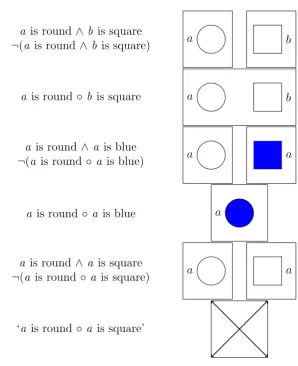
of the relevant properties. For example, ‘a is round ◦ a is blue’ describes
a as co-instantiating being round and being blue. Whenever, on the other hand, a is round and blue but not round insofar as it is blue, this is aptly imagined by imagining a as round but not blue and imagininga as blue but not round; by imagining these facts one after the other (see figure 1.1).
a is round ∧ b is square
¬(a is round ∧ b is square) a b
a is round◦ b is square a b
a is round ∧ a is blue
¬(a is round◦ a is blue) a a
a is round◦ a is blue a
a is round∧ a is square
¬(a is round ◦a is square) a a
[image:25.595.156.455.118.485.2]‘a is round ◦a is square’
Figure 1.1: Fragmentation and co-obtainment
Finally, and this is probably the most helpful way of coming to grips with co-obtainment, we can think of fragmentation in terms of ‘perspectival facts’. To return to the case of Sophie being on the left and right of Nora, we can describe this situation as:
Sophie is on the left of Nora∧Sophie is on the right of Nora∧ ¬(Sophie is on the left of Nora ◦Sophie is on the right of Nora).
Sophie is on the left of Nora and Sophie on the right of Nora, but Sophie is
side, it seems as if the earlier observed fact is no longer there. The two facts are like two sides of a coin, one side can be facing you only insofar as the other doesn’t. Facts that fail to co-obtain obtain in a perspectival way: one obtains only insofar as the other doesn’t.
We noted that the incompatibility of facts isn’t always a matter of logical form, as in the case of ‘a is round’ and ‘a is square’. But sometimes it is, as in the case of ‘a is round’ and ‘a is not round’. Call pairs of sentences one of which is the negation of the other contradicting sentences. If we not only allow that a is round and thata is square, but also thata is round and
not round, then we accept a metaphysics that requires revisions in our logic, given that - according to classical logic - a true contradiction implies that everything is the case. I don’t think that we need to take this route. We should distinguish between two kinds of conflicting facts:
‘A’ and ‘B’ state contrary facts iff they cannot both obtain, i.e. iff necessarily ¬(A∧ B).
‘A’ and ‘B’ state incompatible facts iff they cannot co-obtain, i.e. iff necessarily ¬(A◦ B).
It seems clear that contradictory sentences always state contrary facts - even for the fragmentalist: nothing can possibly be round and not round. Contra-dictory sentences stand in contrast to sentences such as ‘a round’ and ‘a is square’, neither of which is the negation of the other, and yet which clearly express facts that conflict in some way. We adopt a fragmentalist view when we think that such sentences state incompatible facts, and not contrary facts, and hence that they can both obtain (though not co-obtain).
express contradictory propositions. So, in the case of ‘the rose is red’ and ‘the rose is blue’, the colour terms would have to admit of definitions that show that they do not - contrary to what their surface structure suggests - ex-press atomic propositions but logically complex propositions that contradict one another (6.3751). But it’s implausible to believe that such definitions will always be forthcoming, indeed, that this is implausible is the well-known ‘exclusion problem’ and played a crucial role in Wittgenstein’s own abandon-ment of his Tractarian view, see in particular his ‘Some Remarks on Logical Form’ (1929). Without the implausible reductive claim about philosophi-cal analysis, we all already admit a distinction between incompatible and contradictory matters. The fragmentalist does not introduce the contrast between incompatible sentences and contradictory ones, it’s already there in any plausible philosophy of logic. The fragmentalist only takes the distinc-tion further, by revising our understanding of metaphysical incompatibility whilst leaving our understanding of contradictions in place.
We noted already that all contradictory sentences state contrary facts, but it’s also natural to hold that - vice versa - all contrary facts are stated by contradictory sentences. Note however that this isn’t obligatory. If a fragmentalist believes that ‘the box is full’ and ‘the box is empty’ state contrary facts, this doesn’t force the fragmentalist to also believe that the one sentence expresses the negation of the other - she may simply be convinced that it’s impossible that a box is both empty and full whereas, in contrast, she may be convinced that it’s possible that the box is red all over and blue all over. It’s not an in-built commitment of the fragmentalist framework that all contrariety is reflected in the logical form of the sentences stating those facts.
their logical form is not contradictory. But this worry gets things the wrong way around. Whether we think that the box can be both full and empty does not depend on what we think the correct logical form is of the sentences ‘the box is full’ and ‘the box is empty’, rather, -if the fragmentalist commits her-self to the claim that all contrary facts are stated by contradictory sentences - then what logical form should be attributed to the sentences depends on whether she thinks the box can be both full and empty. How do we decide whether ‘the box is full’ and ‘the box empty’ express atomic predications or, respectively, the proposition that the box is not empty or the proposition
that the box is not full? It seems to me that a major role is played by our metaphysical view of the world. To give a well-worn analogy: we think that the truth of the sentence ‘Nobody arrives’ is not a matter of some object, Nobody, having a certain property, arriving. We think of the truth of the sentence as as consisting in the fact that there is no person that arrives. The logical form we attribute to the content expressed by ‘Nobody arrives’ is in this way informed by our metaphysical views, in particular by the view that the world can underwrite the truth of the sentences without containing an object that is Nobody. Similarly, how ‘the box is full’ and ‘the box empty’ are eventually to be understood will depend on whether we think their truth is plausibly understood in terms of the box instantiating two properties, or whether one sentence is rather the denial of the instantiation of some prop-erty. So, if two facts are contrary whenever they are stated by contradictory sentences, this does not make the fragmentalist’s metaphysical view depend on the logical form of sentences, it rather constrains what logical form she will attribute to sentences.
This means that there are two ways in which modal space turns out to be richer than we normally assume it to be. First: for any two compatible facts, such as a’s being round and a’s being orange, it’s possible that these co-obtain and it’s possible that they fail to do so, i.e. we have it that ♦(a is round ◦ a is orange) and ♦¬(a is round ◦ a is orange).3 And, second: for
any two incompatible facts, such as a’s being round and a’s being square, it’s possible that they both obtain but impossible that they co-obtain, i.e. we have it that ♦(a is round ∧ a is square) though ¬♦(a is round ◦ a is square). When we try to imagine a round square, and fail, what we try to imagine is something that is roundinsofar as it is square. The fact that this is inconceivable, and indeed impossible, doesn’t tell against it being possible that something is round and square without also being the one insofar as it is the other.
This diverges radically from our common conception of the world. At the very least we do not think our world to be like that; we do not think that there are cases where incompatible facts obtain. We can now see that this is a substantive assumption about the actual world, which I will call the unity assumption:
The unity assumption: necessarily, if two facts obtain they co-obtain, i.e necessarily, if A and B, then A ◦B.
The world is assumed to be a unified place, and this leaves no room for incompatible facts: if two incompatible facts both obtain then, given the unity assumption, they co-obtain, but incompatible facts cannot co-obtain and hence, there can be no incompatible facts.
Our standard conception of the world is based on the unity assumption: the unity of the world is presumed and the denial of incompatible facts is deemed to be rationally demanded of us. The unity assumption is moreover not recognized for what it is, a substantive assumption about the metaphys-ical structure of reality. That it is indeed a substantive assumption should
3The diamond ‘
be granted by anyone who can make sense of the world being fragmented in the sense proposed here.
Someone might want to counter this claim about the possible fragmenta-tion of the world with a tollensing move: if it’s indeed possible that the world is fragmented, then it’s possible that two incompatible facts obtain (that♦(p ∧ q), where p and q are incompatible), but it isn’t possible that two incom-patible facts obtain and hence it isn’t possible that the world is fragmented. This objection is misguided however. If there is a way of making sense of a view, it is dialectically dubious to refuse to make sense of it, and then deny the view because it does not make sense. The proposal is to understand the incompatibility in terms of the impossibility of the co-obtainment of them to obtain (and not, as usual, as the impossibility of the conjunction of the them). Allowing that it’s metaphysically possible that facts obtain without co-obtaining thus explains how incompatible facts can obtain. Given this explanation, the proposal cannot be rejected on the grounds that it’s un-intelligible that two incompatible facts obtain. We don’t have a stalemate here, the fragmentalist has the upper hand: the fact that the orthodoxy sees no difference between conjunction and co-obtainment as introduced here ex-plains both why the tollensing move can sound reasonable as well as why it really isn’t.
One may wonder whether a framework like this should not simply accept the truth of contradictions and, if not, why not. After all when you observe Sophie and Nora, one might say that it doesn’tjust appear to you that Sophie is on the left of Nora but also that it appears to you that Sophie isnot on the right of Nora. To answer this and related worries, we need to have a closer look at the inferential role of co-obtainment.
1.2
A basic semantics for co-obtainment
seem plausible for the notion, and simply stipulate that co-obtainment is to be commutative, non-transitive, etc. We then arrive at a conception of a fragmented world through the co-obtainment facts thus stipulated. I find this first approach risky. There is no guarantee that the intuited formal features indeed come together to form the exact notion that captures the presumed fragmentation of the world.4 Besides, given that this is quite an unfamiliar
conception of the world, on what basis are we to intuit that co-obtainment is to have this or that formal feature? We are not already accustomed to reason in terms of co-obtainment as it is intended here. It is thus less risky to start with models of fragmented worlds and specify the truth conditions of co-obtain in such a way that it encodes the fragmentation that we are after. Using these models, we can then read off how the co-obtainment interacts with the logical connectives. To keep things as simple as possible, I will only set out the semantics of a very basic propositional logic that allows for the fragmentation of the world. I discuss the interaction between co-obtainment and metaphysical possibility in the first appendix to this chapter (§1.4. I discuss a first-order logic in the second appendix to this chapter (§1.5), for those who want to see a more detailed picture. The semantics goes in many ways back to the ‘discussive logic’ of Ja´skowski (1948/1969) - with the important difference that Ja´skowski’s discussive logic is paraconsistent, whereas the logic below isn’t.5
We already saw that a useful toy model for a fragmented world is a collection of images that only depict all of reality collectively: something is the case when it’s depicted in one of the images in the collection, and isn’t the case when not depicted by any of them. These images allow us to make
4What is worse, we may jumble together bits of inferential role that constitute an empty notion. Prior’s ‘tonk’ (1960) illustrates this nicely: if we stipulate that we can infer fromA, that A-tonk-B and that we can infer fromA-tonk-B thatB, then this introduced notion, call it tonk, allows us to prove anything from anything. As not everything is the case; we know that no ‘tonk facts’ obtain. Note that, when we deem the notion to be empty it seems we appeal directly to our conception of what the world is like, namely a conception on which not everything whatsoever is true, and we do not appeal to combination of the bits of inferential role.
sense of incompatible facts given that one might depict me as sitting, for example, whereas another depicts me as standing. Where I’m depicted as sitting, I’m not also depicted as standing: so for two facts to be depicted in the same picture is a good model for the co-obtaining of the depicted facts. We will now abstract from the inessential aspects of this toy model (such as its consisting of multiple images), to arrive at the following models.
Let the set of sentences S consist of atomic sentences p, q, r, ... and be such that, if A and B are sentences, so are ¬A, A∧B, A∨B and A◦B
(besides these, nothing else is in S). A model M is a pair hW, vi, where W
is a set of points and v is a function that assign either 1 or 0 to each of the atomic sentences relative to each point w in W.
The valuationv for the atomic sentences relative to points is extended to a valuation for all the sentences via the following recursive clauses (where w
ranges over points in W):
vw(A◦B) = 1 iff vw(A) = 1 and vw(B) = 1
vw(A∧B) = 1 iff vw(A) = 1 and vw(B) = 1
vw(A∨B) = 1 iff vw(A) = 1 orvw(B) = 1
vw(¬A) = 1 iff vw(A)6= 1
Truth in a model, written M A, is defined via the following recursive clauses (where p is an arbitrary atomic sentence):
M p iff ∃w(vw(p) = 1)
M A◦B iff ∃w(vw(A◦B) = 1)
M A∧B iff M A and M B
M A∨B iff M A orM B
M ¬A iff M 1A
An argument from Σ to A is valid, written Σ A, iff, for every model
M, if M Σ thenM A.6
A formula A is logically true, written A, iff, for every model M,
M A.
Note that the points correspond to the images of the toy models.7 The
v-clauses say what is true and false of each them. There are v-clauses for conjunction, disjunction, negation and co-obtainment because the logic needs to handle the embedding of logically complex sentences in co-obtainment sentences. For example, A◦(B◦C) is true in a model if A and B ◦C are true at a point, and this requires that B◦C has a truth-value at points. The same applies to A◦(¬B),A◦(B∨C) or A◦(B∧C).
Before discussing things in more detail it may help to first run through the machinery stepwise. Start with the evalations of atomic sentences relative to points and run the standard Boolean evaluations for complex sentences rela-tive to points, treating co-obtainment as conjunction. The atomic sentences and co-obtainment sentences that are true at some point in W are all true in the model. And these truths are the basis for standard Boolean evaluations of negations, conjunctions and disjunctions in the model: taking negations of things that are false in the model to be true in the model, conjunctions of two truths to be true in the model, etc.
We can use the machinery to see more clearly how the fragmentalist doesn’t require a paraconsistent logic, and to see more clearly what formal features co-obtainment has. Let me start with the former.
A sentence is true at a point if and only if its negation isn’t true there. This means that we never have a point where both a sentence and its negation are true. That is:
¬(A◦ ¬A)
6By M
Σ I mean thatM B for allB∈Σ.
It cannot be the case that something obtains insofar as it doesn’t obtain. Similarly, any sentence in our language is true in a model if and only if its negation isn’t true in the model. This means that the law of excluded middle and the law of non-contradiction hold:8
A∨ ¬A
¬(A∧ ¬A)
To illustrate an important consequence of this, consider a model where we have w1 at whichp is true butq isn’t, and w2 at whichq is true butp isn’t.
As there are points at which p and q are true, they are true in the model. This means that ¬qisn’t true in the model. But given that¬q is true at w1,
p◦ ¬q is true in the model. So here, ¬q is false, yet true insofar as pis true (i.e. ¬q is false butp◦ ¬q is true). The fragmentation gives rise to negative sentences being true insofar certain other things are true, even though they are false. You observe that Sophie is not on the right of Nora, but this is the case only insofar as Sophie is on the left of Nora.
It’s important to note that this captures a natural understanding of nega-tion in this context, reflecting how we think of local absences versus global absences. We can compare it with the way existence-at-a-location and exis-tence simpliciter interact: an object exists when there is a location at which it exists but it doesn’t fail to exist when there is a location at which it doesn’t exist. An object doesn’t exist only when there is no location at which it ex-ists. Whereas local existence suffices for global existence, local non-existence doesn’t suffice for global non-existence. There is a natural asymmetry here. The same sort of asymmetry is found, in a fragmented world, between atomic facts and their negations. When an atomic fact obtainsinsofar as other facts obtain (or ‘within a fragment’), this suffices for it to obtain simpliciter (or ‘within the world as such), but when the fact is absentinsofar as other facts
8We also have:
BA∨ ¬A
obtain (or absent ‘within a fragment’), this does not suffice for the fact to be absent simpliciter (or absent from the world at large). Put more directly: if a is F insofar as b is G, this suffices for a to be F; but if a is not F
insofar as b is G this does not suffice for a not to be F because it may still be F insofar as, say,c is H.9 There is no reason why the fragmentalist should
have a non-standard understanding of negation; and hence no reason why the fragmentalist requires a paraconsistent logic or admit true contradictions.10
It can easily be checked that the semantics is sound with regard to the deductive reasoning of classical propositional logic. To prove that the se-mantics is sound with regard to each natural deduction rule we only need to appeal to the truth in a model clauses for the relevant connectives, and the clauses above are just those of any standard semantics for classical sen-tential logic. They are the standard Boolean truth conditions. And so any soundness proof for a standard semantics for sentential logic will work here.11
Let me now turn to elucidating the formal properties and inferential role of co-obtainment. It can easily be seen from the semantics that co-obtainment is commutative and associative:
A◦B B ◦A
9Compare this to Restall (1997), who takes an atomic sentence to be false in the model when false at a point, and consequently arrives at a paraconsistent logic (which, to be sure, is precisely what he aims for).
10To be sure, this is not to say that one could not develop the notion within a para-consistent framework; it’s just to say that there is nothing in the intuitive picture that requires or of itself leads to such a treatment.
11To illustrate, consider conjunction introduction (∧I) and conjunction elimination (∧E). (∧I): IfX`AandY `B, thenX, Y `A∧B. Proof: If the last rule applied in a proof is
∧I, it ends with X, Y `(A∧B) arrived at fromX `A andY `B. Assume thatX A
and that Y B and letM be a model that satisfiesX∪Y. This is a model that satisfies
X and thus satisfies A. And it is a model that satisfies Y and thus satisfies B. By the right-to-left direction of the clause for∧,M satisfiesA∧B. So, ifXAandY B, then
X, Y A∧B.
(∧E): IfX `A∧B, thenX `A. If the last rule applied in a proof is∧E, it ends with
X `A arrived at fromX `A∧B. Assume thatX A∧B and letM be a model that satisfiesX. This is a model that satisfiesA∧B and thus, by the left-to-right clause for∧
satisfiesA. So, ifX A∧B, thenX A.
A◦(B◦C) (A◦B)◦C
The commutativity of co-obtainment is underwritten by the fact that if A
and B are true at some point, they aren’t true in some particular order. To see why co-obtainment is associative, note that if we have A◦(B ◦C) this means that there is a point w where both A and B ◦C are true (see the
v-clause for ◦), and B◦C is only true at w if both B and C are true at w. This means that all three, A,B andC are true atw, which means thatA◦B
must be true atw together with C, and hence that (A◦B)◦C is true in the model.
Co-obtainment fails to be idempotent:
A◦A2A
A2A◦A
To see why we have A◦A2A, consider a model wherep is false at w1 but
true at w2. In this model, ¬p◦ ¬p is true given that there is a point where
each is true (viz. w1). And yet¬pis not true simpliciter, given thatp is true
at w2. To see why we haveA 2A◦A, consider a model where p is true but
q is false atw1 and where pis false but q is true atw2. Here p∧q is true in
the model, but (p∧q)◦(p∧q) isn’t true, as there is no single point at which
p∧q is true.
The fact that it’s not a logical truth that a fact co-obtains with itself can seem worrying, after all, how on earth can a fact fail to co-obtain with itself? It seems however that the inference only fails for conjunctions. If
A∧B did co-obtain with itself, one expects it to characterizea unified bit of world as being such that A∧B even though it may not be characterized by
A◦B and so not not be a unified bit of world. This seems incoherence. The model theory can be complicated to accommodate the inference, but I’m not convinced that this is something that should be accommodated.
Relatedly, we have the failure of simplifying and adjunctive rules for co-obtainment:
A◦B 2A
For the failure of adjunction, consider a model where we have w1 at whichp
is true andw2at whichq is true. Herep is true andq is true because they are
atomic sentences and there are points at which they are true. Butp◦q isn’t true, given that there is no point at which p andq are both true. The failure of adjunction is of course precisely what is required, and is in some sense the core feature of co-obtainment. For the failure of simplification, consider a model where pis true at w1 and where q and ¬pare true atw2. Here q◦ ¬p
is true in the model, but ¬p is not true in the model, given thatp is true at
w1.
Co-obtainment is also non-transitive:
A◦B, B ◦C2A◦C
Consider a model where we have a point w1 at which p and q are true but
r isn’t, and a point w2 at which q and r are true but p isn’t. In such a
model, p◦q and q◦r are true, but p◦r isn’t. Put informally, the failure of transitivity allows fragments to overlap.
Some of the failures of these types of inferences are solely due to the fact that we allow any kind of sentence to be embedded in co-obtainment sentences. For example, co-obtainment sentences that only embed atomic sentences are idempotent, and there is a restricted form of simplification for atomic sentences embedded in co-obtainment claims:
p◦p p, where p is an atomic sentence.
A◦pp, wherep is an atomic sentence.
For atomic idempotence, note that if one has a point at which p is true, one thereby has a point at which p◦p is true, and vice versa. For atomic simplification note that if A◦p is true, then there is a point w at which A
and p are true, but that suffices for p to be true in the model.
A◦B A◦A
A◦(B◦C)B◦C
A◦(B∧C)2B∧C
A◦(B∧ ¬B)C
A◦B A◦(B ∨C)
A◦(B∨C)(A◦B)∨(A◦C)
(A◦B)∨(A◦C)A◦(B∨C)
A◦(B∧C)(A◦B)∧(A◦C)
(A◦B)∧(A◦C)2A◦(B∧C)
Note that we have complete distributivity for co-obtainment and disjunction but not for co-obtainment and conjunction. Next to these inferences, we may also note that, for any two sentences Aand B, at least one of these four options obtains: A◦B or A◦ ¬B or ¬A◦B or¬A◦ ¬B.
It cannot be stressed enough that the model draws out the inferential role of co-obtainment in ways we happen to find elucidating; the set-theoretic machinery is merely a heuristic tool to elucidate the logical structure of the co-obtainment notion. Sentences aren’t true ‘relative to’ or ‘at points’ in our object language, the language which reflects how the fragmentalist understands the world. The points do not correspond to anything in the fragmentalist’s ontology. Certain facts obtain insofar as other facts do, the rest is but metaphor and model.
1.3
Summary and concluding remarks
To sum up, we have established the features of co-obtainment:
A◦(B◦C) (A◦B)◦C [Associative]
A◦A2A [Non-idempotent]
A2A◦A [Non-idempotent]
A◦B, B ◦C2A◦C [Non-transitive]
A, B 2A◦B [No adjunction]
A◦B 2A [No simplication]
¬(A◦ ¬A) [LNCC]
Each of these typify characteristic features of the notion of co-obtainment as it will be understood here.
By no means is the inferential role of some notion all there is to meaning of that notion. But, at the very least, these principles constrain the application of the notion when certain truths are assumed to hold and thus helps us judge when the notion can be applied and when it can’t. The point of the informal paraphrases we saw in the previous chapter (e.g. ‘co-obtaining facts constitutes a single qualitative scene or manifestation of the objects involved’) is precisely to offer some sense of the content of the notion that goes beyond its inferential role. And, if all is well, we hopefully continue to build our understanding of what it is for facts to co-obtain when we turn to concrete applications of the framework.
1.4
Appendix: incorporating modality
ways. One choice point that arises is whether metaphysical possibility ad-mits of perspectival variance: whether something may be possible insofar as
one thing is the case, but impossible insofar as something else is the case. I do not find such variance plausible, at least not for metaphysical possibility. After all, metaphysical possibility is possibility relative to the metaphysical laws, and it seems that something only counts as ametaphysical law precisely if it applies no matter what. I’m not aware of any phenomenon that suggests or requires metaphysical possibility to be a perspectival matter. And so, I believe that metaphysical possibility does not admit of perspectival variance: all fragments agree on what is metaphysically possible and metaphysically impossible. Below I offer a semantics that reflects this decision. As I will aim to capture modality as characterized by S5, I will not use any accessibility relation in the semantics.
Let the set of sentences S consist of atomic sentences p, q, r, ... and be such that, ifAand B are sentences, so are¬A,A∧B,A◦B and ♦AandA
(besides these, nothing else is in S). A model M is a pair hF,W, vi, where:
F is a set of points,
W is a set consisting of non-empty subsets ofF and is such thatS W =
F,
v is a function that assigns either 1 or 0 to each of the atomic sentences relative to the points φ in F
One can think of F as the set of all possible fragments, and ofW as all the possible worlds that can be built from these possible fragments.12
The valuation v for the atomic sentences relative to points φ in F is extended to a valuation forall sentences relative to each pointφinF as well as to each set ω in W via the following recursive clauses (where ω ranges over points in W and φ ranges over points inF):
vφ(A◦B) = 1 iff vφ(A) = 1 and vφ(B) = 1
vφ(A∧B) = 1 iff vφ(A) = 1 and vφ(B) = 1
vφ(¬A) = 1 iff vφ(A)6= 1
vφ(♦A) = 1 iff ∃ω(vω(A) = 1)
vφ(A) = 1 iff ∀ω(vω(A) = 1)
vω(p) = 1 iff ∃φ ∈ω(vφ(p) = 1)
vω(A∧B) = 1 iff vω(A) = 1 and vω(B) = 1
vω(¬A) = 1 iff vω(A)6= 1
vω(♦A) = 1 iff ∃ω1(vω1(A) = 1)
vω(A) = 1 iff ∀ω1(vω1(A) = 1)
vω(A◦B) = 1 iff ∃φ∈ω(vφ(A◦B) = 1)
Note that the truth at a world clauses vω for the non-modal sentences
cor-respond to the truth in a model clauses of the basic semantics, and that the truth at a fragment clauses vφfor the non-modal sentences correspond to the
truth at a fragment clauses in the basic semantics (cf. §1.2).
We define validity and logical truth as follows (where Σ is a set of sen-tences):
An argument from Σ to A is valid, written Σ A, iff, for every model
M and everyω inW: if vω(Σ) = 1, thenvω(A) = 1.13
A formula A is logically true, written A, iff, for every model M and every ω inW: vω(A) = 1.
13By ‘v
This completes the model theoretic specification of the logic.
Note that the clause for the truth of♦A at a world ω is the same as the clause for the truth of ♦A at a fragment φ. This reflects the choice that metaphysical possibility is not a perspectival matter and ensures that no fragment disagrees with any other on what is possible (more on this below). The reason why the valuation v is extended simultaneously to a valuation of sentences relative to points in F and worlds in W is that we can have co-obtainment claims concerning possibilities (which are determined by what modal space is like) and modal claims concerning co-obtainment (which are determined by the fragments of the possible worlds).
The clauses may seem to have an air of circularity about them, after all, sometimes truth relative to worlds (vωrelies on truth relative to fragments (vφ
and sometimes truth relative to fragments relies on truth relative to worlds. But there is no real circularity here. It’s helpful to see the assignment of truth values in stages. At the first stage, we have the given truth values of atomic sentences relative to all possible fragments. This provides us with truth values of logically complex sentences that do not involve or embed diamonds or boxes anywhere (but embed only co-obtainments, conjunctions, etc.), relative to fragments and relative to the worlds that include these fragments. This provides us in turn with truth values of embeddings of these non-modal sentences under diamonds and boxes, relative to fragments and relative to the worlds that include these fragments. This provides us in turn with truth values of co-obtainments, conjunctions and negations of these diamond and box-embedded sentences, relative to fragments and relative to the worlds that include these fragments. This in turn provides us with truth values of embeddings of such complexes under diamonds and boxes again, relative to fragments and relative to the worlds that include these fragments. And so on. For any sentence, there is a definite stage at which it’s assigned a truth value and whenever it’s assigned a truth value at some stage we never return to it to assign it a different truth value. There is no circularity.
♦(p◦q). This is true at a worldω, i.e. vω(♦(p◦q)) = 1 whenever there
is a world ω1 such that ∃φ ∈ w1(vφ(p) = 1 and vφ(q) = 1). Put more
informally: ♦(p◦q) is true at a world if there is a world that includes a fragment at which both p and q are true.
♦p◦♦q. This is true at a world ω, i.e. vω(♦p◦♦q) = 1, when there is
a point φ inω such that vφ(♦p) = 1 and vφ(♦q) = 1. Now, vφ(♦p) = 1
if there is world ω1 such that ∃φ1 ∈ ω1(vφ1(p) = 1) and vφ(♦q) = 1 if
there is a world ω2 such that ∃φ2 ∈ ω2(vφ2(q) = 1). Put informally:
♦p◦♦qis true at a world when there is a world that includes a fragment at whichpis true and there is a world that includes a fragment at which
q is true.
(p◦♦q). This is true at a world ω, i.e. vω((p◦♦q)) = 1, when
every world ωis such that vω(p◦♦q) = 1, which is the case when every
every world ω is such that there exists a φ in ω such that vφ(p) = 1
and vφ(♦q) = 1, and the latter is the case when there is a world ω1
such thatvω1(q) = 1. Put informally: (p◦♦q) is true at a world when
every world includes a fragment at which p is true and there is a world that includes a fragment where q is true.
¬♦¬A. This is true at a world ω when ♦¬A is false at ω, which is the case when there is no world at which ¬A is true. There is no world at which ¬A is true whenever there is no world where A is false. That is to say, there is no world at which ¬Ais true whenever, for every world
ω1, vω1(A = 1). Informally: ¬♦¬A is true at a world when A is true
at all worlds. (This shows that we can define ‘necessarily A’(‘A’) as
¬♦¬A).
Note that, depending on the main connective of the sentence we encounter, we either look at worlds or the fragments included in some world.
Note also that if it’s possible thatA insofar as something else,B, obtains, then it’s thereby possible that A:
The reason is that (♦A)◦B is true at a world if it includes a fragment where both ♦A and B are true, but there is only a fragment where ♦A is true if there is a world ω where A is true, and that also suffices for ♦A to be true at the world the fragment is part of.
Vice versa, if it’s possible thatA, and someB obtains insofar asC obtains, then both B (and C) and the co-obtainment ofB and C co-obtain with the possibility that A. That is:
♦A, B◦C (♦A)◦B (and ♦A, B◦C (♦A)◦C)
♦A, B◦C ♦A◦(B◦C)
If there is a world ω at which A is true, then it’s true at each possible fragment that there is a world ω at which Ais true, and hence♦A is true at each fragment. If B◦C is true, then there is also a fragment whereB and C
is true and, given that ♦A is true at each fragment, ♦A will be true at the fragment where B and C are true, and hence co-obtain with each of them, as well as with their co-obtainment B◦C.
For much the same reason, if two things are each possible, then the one is possible insofar as the other is possible:
♦A∧♦B ♦A◦♦B
If♦A∧♦B thenAis true at some world and hence♦Ais true at all fragments, and similarly B is true at some world and hence♦B is true at all fragments as well, and hence all fragments in all worlds are such that both ♦Aand ♦B
are true at them, which suffices for ♦A◦♦B to be true in any world. We thus have a restricted form of the unity assumption, holding only for modal facts: there is no fragmentation in what is metaphysically possible or not.
fragmented. What is possible (and necessary) is assumed to be an invariant matter, all fragments look across the same modal space in the very same way.
1.5
Appendix: incorporating quantification
When we consider the way co-obtainment interacts with quantification, this time the choice arises whether existence can be a perspectivally variant mat-ter or not, that is, whether something may exist insofar as certain things are the case, yet fail to exist insofar as certain other things are the case. This time I think we should decide in favour of variance and allow fragments to disagree about what exists. After all, on what grounds would we assume an asymmetry between existing and having a property? Moreover, we will have some occasion to resort to the perspectival variance of existence in ap-plications of fragmentalism. As things are complicated enough, I will only consider the first-order extension of the basic semantics instead of the modal extension discussed in the previous appendix.
The vocabulary of the language now comprises the following elements:
variables: v0, v1,v2, ...
constants: k0, k1, k2, ...
for every natural number n≥0, n-place predicates P0
n, Pn1, Pn2, ...
connectives: ◦,∧,∨,¬
quantifiers: ∀, ∃
brackets: (, )
I will use x, y, z for arbitrary variables, and a, b, c for arbitrary constants. I will useFn,Gn,Hn for arbitraryn-place predicates. I will omit the subscript
in cases where it is clear from context. Any constant or variable is called a
term.
Ift1, ...,tn are any terms and F is anyn-place predicate, F t1...tnis an
atomic formula.
IfAandB are formulas, so are the following: (A◦B), (A∧B), (A∨B), (¬A).
If A is any formula, and x is a variable, then ∀xA, ∃xA are formulas.
Nothing else is a formula.
I will omit outer brackets in formulas from now on. Any occurrence of a variable in an atomic formula is said to be free. The free occurrences of variables in ¬A,A∧B,A∨B,A◦B are just the free occurrences of variables in A and B. And, the free occurrences of variables in a quantified formula,
∀xAor∃xAare the variables other thanxthat are free inA. If an occurrence of a variable is not free in a formulaA, then it is said to bebound. A formula with no free variables is said to be closed. Ax(a) is the formula obtained by
substituting a for each free occurence of x inA.
A model M for the language is a triple hD, W, vi, where:
D is a domain of quantification,
W is a set of points,
v assigns:
(1) to each constant a of the language a member v(a) =d in D, (2) to each point w inW a subset ofD, so v(w)⊆D,
(3) to each n-place predicate F, relative to each point w in W, a subset of v(w)n.
Intuitively, v(a) is the object named by a, vw(F) the set of n-tuples that
satisfy F at point w (and which may vary from point to point), and v(w) is the domain at point w. I will write v(w) as Dw, the domain of point w.
is not the denotation of any constant in the language even though it’s in the extension of predicates in that language. To nevertheless capture the right truth conditions for the quantifiers, we will specify the truth conditions in terms of possible extensions of the language. If M is some model for a language, then we can consider extensions of that model in which a name c, which is not already in the language, is added to the language and given a denotation by v. I will write Mc
d for an extended model in which v assigns
c the denotation d, and which is otherwise exactly likeM. I will say that an object d satisfies a formula Ax in a model M, written M Ax[d], to mean
that, if we were to add a name and assign itdas denotation, this name would satisfy Ax. That is:
M Ax[d] iff MdcAx(c)
Similarly, I will write vw(Ax[d]) = 1 in M to mean that vw(Ax(c)) = 1 in
Mc
d. That is to say, the valuation v determines that an object d satisfies a
formulaAx in a model M if and only if an extension ofM in which v assigns
d to cis such that vw(Ax(c)) = 1.
Given these stipulations,v is recursively extended to assign 1 or 0 to each formula relative to each point w in W:
vw(F a1...an) = 1 iff hv(a1), ..., v(an)i ∈vw(F)
vw(A◦B) = 1 iff vw(A) = 1 and vw(B) = 1
vw(A∧B) = 1 iff vw(A) = 1 and vw(B) = 1
vw(A∨B) = 1 iff vw(A) = 1 orvw(B) = 1
vw(¬A) = 1 iff vw(A)6= 1
vw(∃xA) = 1 iff for some d∈Dw,vw(Ax[d]) = 1
vw(∀xA) = 1 iff for all d∈Dw, vw(Ax[d]) = 1
I will call these the v-clauses for the connectives.
M F a1...an iff ∃w(vw(F a1...an) = 1)
M A◦B iff ∃w(vw(A◦B) = 1)
M ¬A iff M 1A
M A∧B iff M A and M B
M A∨B iff M A orM B
M ∃xA iff for some d∈D, M Ax[d]
M ∀xA iff for all d∈D, M Ax[d]
Finally, we understand validity and logical truth in the usual way (where Σ is a set of sentences):
An argument from Σ to A is valid, written Σ A, iff, for every model
M, if M Σ thenM A.
A formula A is logically true, written A, iff, for every model M,
M A.
Thus far the semantics.
To see the semantic machinery at work, consider how the model deter-mines various kinds of formulas of a language to be true in the model:
F a. This is an atomic sentence, and hence true if there is some point
w at which it is true, i.e. if there is a point where a is in the extension of F.14
¬F a. This is true if F a is false. F a is false if there is no point at which F a is true, which is the case whena is not in the extension ofF
anywhere.
F a◦Ga. This is true if there is a point at which both F a and Ga are true, i.e. if there is a single point wherea is in the extension of both F
and G.
F a∧Ga. This is true if bothF aandGaare true. F aandGaare both true if there is a point for each at which it is true (and this does not have to be the same point).
F a◦ ¬Ga. This is true if there is a point at which both F a and ¬Ga
are true. And ¬Ga is true at a point if Gais false at that point.
∃xF x. This is true if there is some objectd such thatF[d] is true. The truth of the latter is determined in virtue of the corresponding atomic formula in extended models: it is true if in any extension that assigns
d the name c, F c is true, and since this is an atomic sentence, this is the case if there is a point in the extended model at which F c is true.
¬∃x¬F x. This is true if ∃x¬F x is false. ∃x¬F x is false if there is no object d which is such that ¬F[d] is true. This in turn means that, for every object d∈D,F[d] is true, i.e. every object is in the extension of
F at some point. (Of course, this means that ∀xF xis true. Indeed it can be checked that we can, more generally, define ∀xA as ¬∃x¬A).
A ◦ ∀xF x. This is true if there is a point w where A is true and where ∀xF x is true (i.e. if ∃w(vw(A) = 1 and vw(∀xF x) = 1). Now
vw(∀xF x) = 1 if and only if, for all d∈Dw,d is in the extension of F
relative to w. (Note that we are only concerned withDw here and not
D).
The last of these implies the failure of an important inference. Everything may be such that B insofar as certain things are the case, and yet not everything may be such that B, that is:
A◦ ∀xB 2∀xB