Delivered by Ingenta
IP : 138.251.149.173 On: Tue, 22 May 2018 11:59:58
Copyright The Policy Press
This article is distributed under the terms of the Creative Commons Attribution 4.0 license (http://creativecommons.org/licenses/by/4.0/) which permits adaptation, alteration, reproduction and distribution without further permission provided the original
work is attributed. The derivative works do not need to be licensed on the same terms.
Why, whose, what and how? A framework for
knowledge mobilisers
Vicky Ward, [email protected] University of Leeds, UK
Knowledge mobilisers (people who move knowledge into action) face a number of challenges. These include making sense of diverse definitions, navigating through fragmented literature and identifying helpful models and tools. This paper presents a framework designed to help. Based on a review of 47 knowledge mobilisation models, it consists of four questions: Why is knowledge being mobilised? Whose knowledge is being mobilised? What type of knowledge is being mobilised? How is knowledge being mobilised? These questions and accompanying categories can help knowledge mobilisers reflect on, communicate and evaluate their aims and objectives, increasing clarity and understanding across the field.
Key words knowledge mobilisation • framework • review • knowledge brokers
To cite this article: Ward, V (2017) Why, whose, what and how? A framework for knowledge mobilisers, Evidence & Policy, vol 13 no 3, 477–97, DOI: 10.1332/174426416X14634763278725
Introduction
Knowledge mobilisation is the latest in a long list of terms which relate to the process of moving knowledge to where it can be most useful. The continual emergence of new terminology reflects the seemingly exponential growth of both research and practical activity in the field (Oborn et al, 2013; Ferlie et al, 2012; Evidence & Policy,
2014; Greenhalgh and Wieringa, 2011). As part of this landscape, schemes to develop a new generation of knowledge mobilisers – individuals with the skills and practical abilities to move knowledge into action – are on the up. In the UK these include National Institute of Health Research Knowledge Mobilisation Research Fellowships (www.nihr.ac.uk/funding/knowledge-mobilisation-research-fellowships.htm), Health Foundation Improvement Science Fellowships (www.health.org.uk/areas-of-work/ programmes/improvement-science-fellowships) and Knowledge Transfer Partnership Associates (http://ktp.innovateuk.org). Roles for knowledge mobilisers have also multiplied, and include researchers-in-residence (Marshall et al, 2014), diffusion fellows (Rowley, 2012), knowledge brokers (Wright, 2013; Chew et al, 2013; Lightowler
Delivered by Ingenta
IP : 138.251.149.173 On: Tue, 22 May 2018 11:59:58
Copyright The Policy Press
and Knight, 2013) and community of practice facilitators (Henry and Mackenzie, 2012; Kislov et al, 2012). In Canada, especially, there has been an explosion in the number and scope of specialist knowledge mobilisation positions across health and other organisations (see www.ktecop.ca/category/careers). Within this landscape, it appears that knowledge mobilisation is starting to become a legitimate career choice.
New knowledge mobilisers face a number of difficult and related tasks. These include how to make sense of the diverse and contested definitions and terms for knowledge mobilisation (McKibbon et al, 2010; Greenhalgh and Wieringa, 2011), how to navigate their way through the fragmented literature (Ferlie et al, 2012; Ward et al, 2012), and how to identify theories, models and frameworks which might be helpful to them (Redman et al, 2015). Because knowledge mobilisation means different things to different people it can also be difficult for new knowledge mobilisers to identify and clarify their role and communicate this effectively. This increases the risk of misunderstandings and misalignment between knowledge mobilisers and those they are working with.
This paper sets out a framework designed to help with these tasks. Based on the results of a comprehensive review of knowledge mobilisation models, the framework consists of four key questions, each of which maps onto a range of categories and indicative models. It is designed to help those involved in knowledge mobilisation to reflect on their personal and/or project-related aims and objectives in a structured way and provide a pointer towards models and sets of literature which best fit those aims and objectives. In the next section I outline the methods used to develop the framework before moving on to present the framework in more detail. I conclude by discussing how the framework might be used in a range of settings.
Methods
In June 2014, as part of an ongoing research project, I undertook a literature review aiming to identify models which could shed light on the processes involved in mobilising practice-based knowledge (http://medhealth.leeds.ac.uk/ mobilisinghealthandsocialcareknowledge). Various authors have highlighted the difficulty of reviewing papers in this field (Tabak et al, 2012; Contandriopoulos et al, 2010; McKibbon et al, 2012), leading me to choose a broad, yet systematic approach, which involved deliberately identifying a wide range of knowledge mobilisation models before selecting those which focused on practice-based knowledge. It is this first, broader part of the review which I draw on in this paper.
Delivered by Ingenta
IP : 138.251.149.173 On: Tue, 22 May 2018 11:59:58
Copyright The Policy Press
Table 1: Literature review search strategy
Search terms ((‘knowledge trans*’ OR ‘knowledge exchange’ OR ‘knowledge mobil*’) AND (framework OR model)) NOT (‘guideline implement*’ OR ‘clinical guideline*’) Databases Web of Science (all databases); Scopus (health sciences, social science &
humanities); ASSIA; Social Services abstracts; ERIC; PAIS international; Embase; PsycInfo; HMIC
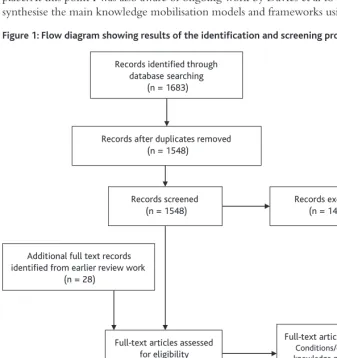
Next, I screened titles and abstracts to identify papers which presented models of the active processes involved in mobilising knowledge between parties. I excluded papers which focused on describing the conditions or context for knowledge mobilisation. At this stage, I also expanded the search results to include models from previous review work that met my inclusion criteria (Ward et al, 2009). Figure 1 below shows the searching and filtering process.
[image:3.488.47.384.300.658.2]I identified 47 papers which I read in detail and summarised. Summaries included details about the setting that the model was developed / applied in, how it was developed and the boundary / parties across which knowledge mobilisation was taking place. At this point I was also aware of ongoing work by Davies et al to identify and synthesise the main knowledge mobilisation models and frameworks using a review
Figure 1: Flow diagram showing results of the identification and screening process
Records identified through database searching
(n = 1683)
Records after duplicates removed (n = 1548)
Records screened (n = 1548)
Records excluded (n = 1477)
Full-text articles assessed for eligibility
(n = 99)
Full-text articles excluded:
Conditions/context for knowledge mobilisation
(n = 52)
Studies included and summarised/synthesised
(n = 47) Additional full text records
Delivered by Ingenta
IP : 138.251.149.173 On: Tue, 22 May 2018 11:59:58
Copyright The Policy Press
of reviews approach (Davies et al, 2015). I cross-checked the models I had identified with their emerging results and confirmed that they had not identified any further models which met my inclusion criteria.
Finally, I engaged in a process of sense-making which involved reading and re-reading both the summaries and the original papers to gain a sense of the commonalities and distinguishing features of the models. Using something akin to a thematic analysis approach involving cross-comparison across all 47 models, I developed a set of 16 tentative categories (or codes), which I grouped under four overarching labels (or themes). I checked the validity of these categories by re-applying them to the original models and, since I was working as a lone researcher, informally discussing them with knowledge mobilisation colleagues based at other universities. Once I had completed this process I operationalised the labels as questions.
Results
I identified 47 knowledge mobilisation models which met my inclusion criteria (nine from my previous work and a further 38 from the new searches). Twenty-seven of these models related to knowledge mobilisation within healthcare, 16 in business and management, two in social care, one in public policymaking and one in evaluation research. Between them, these models covered 16 separate categories, which can be grouped under four overarching questions:
• why is knowledge being mobilised? • whose knowledge is being mobilised?
• what type of knowledge is being mobilised? and • how is knowledge being mobilised?
In the following sections I explain these questions and categories in more detail and illustrate the types of model which relate to each category. Appendix A which accompanies this article shows how the categories relate to each of the 47 models.
Why mobilise knowledge?
The first set of categories relates to the purpose of mobilising knowledge operationalised as ‘why is knowledge being mobilised?’. Debates and discussion about the purpose of knowledge mobilisation are central to much of the literature, with these largely focusing on conceptual distinctions between different types of knowledge use. Drawing on the work of Carol Weiss, distinctions have been made between instrumental / knowledge-driven use, political / symbolic use, tactical use and conceptual use, leading to an increasing recognition of the complexity of knowledge use and the interconnectedness of different types of use within individual change processes (Davies et al, 2015).
Delivered by Ingenta
IP : 138.251.149.173 On: Tue, 22 May 2018 11:59:58
Copyright The Policy Press
Ironically, whilst espousing the importance of determining the intended outcome of mobilising knowledge, I found that the majority of the models I identified were not explicit about the tangible outcomes which they could help to achieve or the type of knowledge use which they represented. By examining the context in which the models were developed and/or the setting in which they were being used, however, it was possible to identify a set of categories relating to the tangible outcomes to which the models might lend themselves. Five categories were developed in this way.
• To develop local solutions to practice-based problems (So)
• To develop new policies, programmes and/or recommendations (Po) • To adopt / implement clearly defined practices and policies (Imp) • To change practices and behaviours (Ch)
• To produce useful research / scientific knowledge (Kno)
In terms of the type of knowledge use which the models represented, it was both more difficult and seemed less appropriate to categorise them in this way, since this is less likely to be immediately helpful for novice knowledge mobilisers who are trying to bring about change in a defined setting.
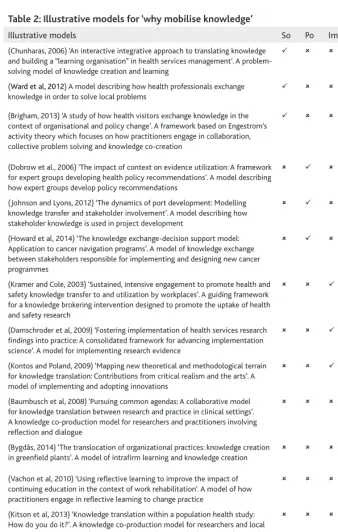
The five categories which were developed tended to be mutually exclusive, meaning that it was possible to assign one category to each model. Table 2 below shows illustrative models for each category.
Whose knowledge?
The second set of categories relates to the source or donor of knowledge and can be operationalised as ‘Whose knowledge is being mobilised?’. Initially a more obvious categorisation appeared to be the audience or recipient of knowledge, since a number of well-known models and authors encourage knowledge mobilisers down this path (Lavis et al, 2003; Berwick, 2003; Damschroder et al, 2009). As I read and re-read the models, however, it became clear that this was less likely to be helpful for a number of reasons. First, focusing on knowledge receivers suggests that knowledge is a product which is to be translated into practice, yet this remains the source of considerable debate (Greenhalgh, 2010) and is at odds with observations of the fluid, multidirectional nature of knowledge mobilisation (Ward et al, 2012). Second, many of the identified models themselves took a collaborative or co-productive view of knowledge mobilisation involving the continual shaping and re-shaping of knowledge between parties, meaning that it wasn’t possible to categorise them according to the knowledge recipient. Third, some of the identified models focused on multiple or generic recipients and weren’t specific about who knowledge was to be mobilised to.
Between them, the models covered five distinct groups of knowledge donors:
• professional knowledge producers who produce empirical and/or theoretical knowledge and evidence (KPs)
• frontline practitioners and service providers responsible for delivering services to members of the public (Pra)
Delivered by Ingenta
IP : 138.251.149.173 On: Tue, 22 May 2018 11:59:58
[image:6.488.46.384.120.652.2]Copyright The Policy Press
Table 2: Illustrative models for ‘why mobilise knowledge’
Illustrative models So Po Imp Ch Kno
(Chunharas, 2006) ‘An interactive integrative approach to translating knowledge and building a “learning organisation” in health services management’. A problem-solving model of knowledge creation and learning
(Ward et al, 2012) A model describing how health professionals exchange knowledge in order to solve local problems
(Brigham, 2013) ‘A study of how health visitors exchange knowledge in the context of organisational and policy change’. A framework based on Engestrom’s activity theory which focuses on how practitioners engage in collaboration, collective problem solving and knowledge co-creation
(Dobrow et al., 2006) ‘The impact of context on evidence utilization: A framework for expert groups developing health policy recommendations’. A model describing how expert groups develop policy recommendations
(Johnson and Lyons, 2012) ‘The dynamics of port development: Modelling knowledge transfer and stakeholder involvement’. A model describing how stakeholder knowledge is used in project development
(Howard et al, 2014) ‘The knowledge exchange-decision support model: Application to cancer navigation programs’. A model of knowledge exchange between stakeholders responsible for implementing and designing new cancer programmes
(Kramer and Cole, 2003) ‘Sustained, intensive engagement to promote health and safety knowledge transfer to and utilization by workplaces’. A guiding framework for a knowledge brokering intervention designed to promote the uptake of health and safety research
(Damschroder et al, 2009) ‘Fostering implementation of health services research findings into practice: A consolidated framework for advancing implementation science’. A model for implementing research evidence
(Kontos and Poland, 2009) ‘Mapping new theoretical and methodological terrain for knowledge translation: Contributions from critical realism and the arts’. A model of implementing and adopting innovations
(Baumbusch et al, 2008) ‘Pursuing common agendas: A collaborative model for knowledge translation between research and practice in clinical settings’. A knowledge co-production model for researchers and practitioners involving reflection and dialogue
(Bygdås, 2014) ‘The translocation of organizational practices: knowledge creation in greenfield plants’. A model of intrafirm learning and knowledge creation
(Vachon et al, 2010) ‘Using reflective learning to improve the impact of continuing education in the context of work rehabilitation’. A model of how practitioners engage in reflective learning to change practice
(Kitson et al, 2013) ‘Knowledge translation within a population health study: How do you do it?’. A knowledge co-production model for researchers and local community participants focusing on the translation and adaptation of research into a locally usable intervention
(Smits and Champagne, 2008) ‘Assessment of the theoretical underpinnings of practical participatory evaluation’. A model of interactive data production and knowledge co-construction
(Tran et al, 2009) ‘Engaging policy makers in road safety research in Malaysia: A theoretical and contextual analysis’. A model of engagement in order to produce useful research
• decision makers responsible for commissioning services and/or designing local/ regional/national policies and strategies (DMs)
Delivered by Ingenta
IP : 138.251.149.173 On: Tue, 22 May 2018 11:59:58
[image:7.488.44.383.206.647.2]Copyright The Policy Press
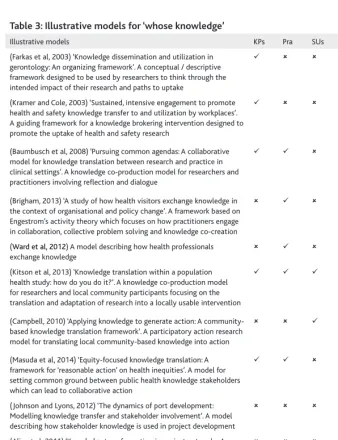
Table 3: Illustrative models for ‘whose knowledge’
Illustrative models KPs Pra SUs DMs Dev
(Farkas et al, 2003) ‘Knowledge dissemination and utilization in gerontology: An organizing framework’. A conceptual / descriptive framework designed to be used by researchers to think through the intended impact of their research and paths to uptake
(Kramer and Cole, 2003) ‘Sustained, intensive engagement to promote health and safety knowledge transfer to and utilization by workplaces’. A guiding framework for a knowledge brokering intervention designed to promote the uptake of health and safety research
(Baumbusch et al, 2008) ‘Pursuing common agendas: A collaborative model for knowledge translation between research and practice in clinical settings’. A knowledge co-production model for researchers and practitioners involving reflection and dialogue
(Brigham, 2013) ‘A study of how health visitors exchange knowledge in the context of organisational and policy change’. A framework based on Engestrom’s activity theory which focuses on how practitioners engage in collaboration, collective problem solving and knowledge co-creation
(Ward et al, 2012) A model describing how health professionals exchange knowledge
(Kitson et al, 2013) ‘Knowledge translation within a population health study: how do you do it?’. A knowledge co-production model for researchers and local community participants focusing on the translation and adaptation of research into a locally usable intervention
(Campbell, 2010) ‘Applying knowledge to generate action: A community-based knowledge translation framework’. A participatory action research model for translating local community-based knowledge into action
(Masuda et al, 2014) ‘Equity-focused knowledge translation: A framework for ‘reasonable action’ on health inequities’. A model for setting common ground between public health knowledge stakeholders which can lead to collaborative action
(Johnson and Lyons, 2012) ‘The dynamics of port development: Modelling knowledge transfer and stakeholder involvement’. A model describing how stakeholder knowledge is used in project development
(Alin et al, 2011) ‘Knowledge transformation in project networks: A speech act level cross-boundary analysis’. A model of how stakeholder knowledge is transformed and used in multi-agency projects
(Berends et al, 2011) ‘Thinking along: A process for tapping into knowledge across boundaries’. A model describing how product developers seek and access knowledge from one another
(Frank and Ribeiro, 2014) ‘An integrative model for knowledge transfer between new product development project teams’. A model of how knowledge is created and applied within product development teams
Some models focused on the mobilisation of knowledge from a single group of donors (for example, frontline public service providers), whilst others focused on the mobilisation and exchange of knowledge from multiple parties, meaning that unlike the first set of categories, these were not mutually exclusive. Table 3 below shows illustrative models for this set of categories.
Delivered by Ingenta
IP : 138.251.149.173 On: Tue, 22 May 2018 11:59:58
Copyright The Policy Press
pattern (Davison et al, 2015), with the authors identifying only one model which focuses on mobilising community-based knowledge (Jardine and Furgal, 2010). This chimes with observations about the lack of attention paid to mobilising service user and patient knowledge (Boaz et al, 2015; Davies et al, 2015).
What type of knowledge?
The third set of categories relates to the definition of knowledge and can be operationalised as ‘What type of knowledge is being mobilised?’. Despite the best efforts of some authors to raise awareness and prompt debate about alternative theoretical and philosophical notions of knowledge (Greenhalgh, 2010; Greenhalgh and Wieringa, 2011), much of the knowledge mobilisation literature is curiously silent on this topic. Assumptions about the nature of knowledge also tend to remain unarticulated in knowledge mobilisation practice, causing confusion about what it is that practitioners are trying to mobilise, how they might best go about it and how it should be evaluated (Fazey et al, 2013).
Unsurprisingly, assumptions about knowledge were also deeply embedded and often unarticulated in the models that I identified, but through reading and re-reading them (and at times reading between the lines) it soon became clear that they were focusing on three very different types of knowledge, representing Aristotle’s ancient distinction between episteme, techne and phronesis (Flyvbjerg, 2001).
• Scientific / factual knowledge – research findings, quality and performance data, population data and statistics, evaluation data (Sc)
• Technical knowledge – practical skills, experiences and expertise (T) • Practical wisdom – professional judgments, values, beliefs (Wi)
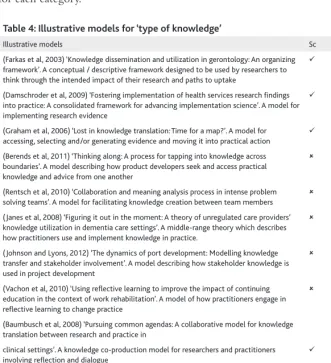
As with the first set of categories, some models focused on the mobilisation of one knowledge type, whilst others covered multiple types. Table 4 below shows a set of illustrative models for each category.
How is knowledge mobilised?
The final set of categories relates to knowledge mobilisation techniques and methods operationalised as ‘how is knowledge being mobilised?’. Knowledge mobilisation techniques and methods are a well-covered topic across the literature and are, understandably, one of the main interests for both new and established knowledge mobilisers (Armstrong et al, 2013; Bhogal et al, 2011; Brouwers et al, 2011), suggesting that it would be appropriate to categorise the models in this way.
Delivered by Ingenta
IP : 138.251.149.173 On: Tue, 22 May 2018 11:59:58
[image:9.488.51.382.242.605.2]Copyright The Policy Press
Table 4: Illustrative models for ‘type of knowledge’
Illustrative models Sc T Wi
(Farkas et al, 2003) ‘Knowledge dissemination and utilization in gerontology: An organizing framework’. A conceptual / descriptive framework designed to be used by researchers to think through the intended impact of their research and paths to uptake
(Damschroder et al, 2009) ‘Fostering implementation of health services research findings into practice: A consolidated framework for advancing implementation science’. A model for implementing research evidence
(Graham et al, 2006) ‘Lost in knowledge translation: Time for a map?’. A model for accessing, selecting and/or generating evidence and moving it into practical action
(Berends et al, 2011) ‘Thinking along: A process for tapping into knowledge across boundaries’. A model describing how product developers seek and access practical knowledge and advice from one another
(Rentsch et al, 2010) ‘Collaboration and meaning analysis process in intense problem solving teams’. A model for facilitating knowledge creation between team members
(Janes et al, 2008) ‘Figuring it out in the moment: A theory of unregulated care providers’ knowledge utilization in dementia care settings’. A middle-range theory which describes how practitioners use and implement knowledge in practice.
(Johnson and Lyons, 2012) ‘The dynamics of port development: Modelling knowledge transfer and stakeholder involvement’. A model describing how stakeholder knowledge is used in project development
(Vachon et al, 2010) ‘Using reflective learning to improve the impact of continuing education in the context of work rehabilitation’. A model of how practitioners engage in reflective learning to change practice
(Baumbusch et al, 2008) ‘Pursuing common agendas: A collaborative model for knowledge translation between research and practice in
clinical settings’. A knowledge co-production model for researchers and practitioners involving reflection and dialogue
(Dobrow et al, 2006) ‘The impact of context on evidence utilization: A framework for expert groups developing health policy recommendations’. A model describing how expert groups develop policy recommendations
(McWilliam et al, 2009) ‘Evolving the theory and praxis of knowledge translation through social interaction: A social phenomenological study’. A participatory action knowledge translation model focusing on how evidence-based strategies are implemented
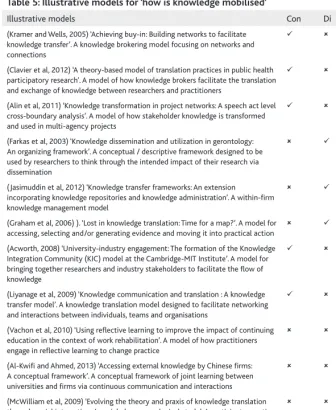
little detail about the specific methods for mobilising knowledge. They did, however, link to three fairly broad approaches to knowledge mobilisation.
• Making connections between knowledge stakeholders and actors by establishing and brokering relationships (Con)
• Disseminating and synthesising knowledge via online databases, communication strategies and evidence synthesis services (Di)
• Facilitating interactive learning and co-production via participatory research projects and action learning sets (Int)
Delivered by Ingenta
IP : 138.251.149.173 On: Tue, 22 May 2018 11:59:58
[image:10.488.47.383.66.476.2]Copyright The Policy Press
Table 5: Illustrative models for ‘how is knowledge mobilised’
Illustrative models Con Di Int
(Kramer and Wells, 2005) ‘Achieving buy-in: Building networks to facilitate knowledge transfer’. A knowledge brokering model focusing on networks and connections
(Clavier et al, 2012) ‘A theory-based model of translation practices in public health participatory research’. A model of how knowledge brokers facilitate the translation and exchange of knowledge between researchers and practitioners
(Alin et al, 2011) ‘Knowledge transformation in project networks: A speech act level cross-boundary analysis’. A model of how stakeholder knowledge is transformed and used in multi-agency projects
(Farkas et al, 2003) ‘Knowledge dissemination and utilization in gerontology: An organizing framework’. A conceptual / descriptive framework designed to be used by researchers to think through the intended impact of their research via dissemination
(Jasimuddin et al, 2012) ‘Knowledge transfer frameworks: An extension
incorporating knowledge repositories and knowledge administration’. A within-firm knowledge management model
(Graham et al, 2006) ). ‘Lost in knowledge translation: Time for a map?’. A model for accessing, selecting and/or generating evidence and moving it into practical action
(Acworth, 2008) ‘University-industry engagement: The formation of the Knowledge Integration Community (KIC) model at the Cambridge-MIT Institute’. A model for bringing together researchers and industry stakeholders to facilitate the flow of knowledge
(Liyanage et al, 2009) ‘Knowledge communication and translation : A knowledge transfer model’. A knowledge translation model designed to facilitate networking and interactions between individuals, teams and organisations
(Vachon et al, 2010) ‘Using reflective learning to improve the impact of continuing education in the context of work rehabilitation’. A model of how practitioners engage in reflective learning to change practice
(Al-Kwifi and Ahmed, 2013) ‘Accessing external knowledge by Chinese firms: A conceptual framework’. A conceptual framework of joint learning between universities and firms via continuous communication and interactions
(McWilliam et al, 2009) ‘Evolving the theory and praxis of knowledge translation through social interaction: A social phenomenological study’. A participatory action knowledge translation model focusing on how evidence-based strategies are implemented
(Palmer and Kramlich, 2011) ‘An introduction to the multisystem model of knowledge integration and translation’. A model for supporting healthcare practitioners to engage in reflective inquiry in order to generate, integrate and translate knowledge
Discussion / conclusion
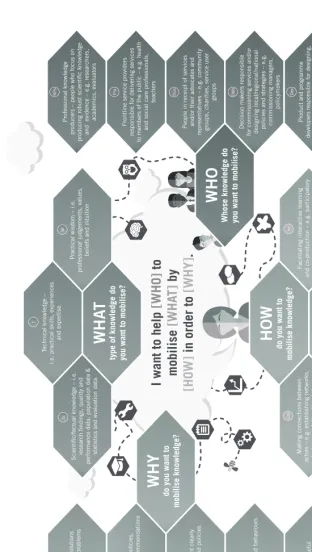
In this paper I set out to describe a framework to help knowledge mobilisers identify and clarify their role, situate themselves and their work in relation to the diverse and contested definitions of knowledge mobilisation, navigate their way through the fragmented literature and identify models which might be helpful to them. The complete framework is shown in Figure 2 below. In this final section I consider in more detail how the framework can help with these tasks and set out a range of potential uses.
Delivered by Ingenta
IP : 138.251.149.173 On: Tue, 22 May 2018 11:59:58
Copyright The Policy Press
work I considered whether this might be possible but discarded the idea for a number of reasons. First, I found it wasn’t possible to assign a single label to the majority of the models that I identified because the categories interacted in different ways and often overlapped. Kramer et al’s model, for instance (Kramer and Cole, 2003; Kramer and Wells, 2005), focuses on the mobilisation of scientific knowledge produced by researchers, but unlike some other models (for example, Farkas et al, 2003) they see this as occurring via establishing connections and relationships. Second, in my discussions with other knowledge mobilisation colleagues, I detected a good deal of resistance to the idea of being ‘labelled’ because this does not allow for contextual differences (https://kmbresearcher.wordpress.com/2015/04/16/what-kind-of-knowledge-mobiliser-are-you).
Finally, typologies are typically developed by drawing on a range of theoretical and empirical materials. Davies et al’s ‘archetypes’ of knowledge mobilisation practice (Davies et al, 2015), for instance, were developed by applying conceptual categories drawn from the literature to practice-based accounts of the types of knowledge mobilisation activities in which funding agencies engage. This type of empirical material was not available to me, meaning that it was not possible to develop an overarching typology, although future work could explore whether this would be feasible and appropriate.
Personal reflection and learning
The framework poses a number of questions which could be used by knowledge mobilisers as the basis for self-reflection and learning. By asking themselves questions about ‘why do I want to mobilise knowledge’, ‘whose knowledge do I want to mobilise’ and ‘what type of knowledge do I want to mobilise’, knowledge mobilisers can gain a valuable insight into their intrinsic motivations, beliefs and ethos (that is, their own tacit knowledge), as well as a pointer towards relevant literature and methods. These personal insights are difficult to come by and tend to be skirted over in traditional training schemes, many of which focus on practical activities, tools and approaches (Champagne et al, 2014; Meissner et al, 2013). Yet they are crucial aspects of developing expertise in any given topic, especially those which concern human behaviour and interactions (Bondi et al, 2011). Personal motivations and beliefs also underpin traits such as enthusiasm, commitment, courage and creativity, all of which are recognised as important qualities for knowledge mobilisers (Phipps and Morton, 2013). The framework could, therefore, help knowledge mobilisers to develop a greater awareness of the situations and contexts in which they are most likely to be both comfortable and successful.
Team / project development
Delivered by Ingenta
IP : 138.251.149.173 On: Tue, 22 May 2018 11:59:58
Copyright The Policy Press
Figur
e 2:
Wh
y,
w
hose,
w
hat
, how fr
amework f
or knowledg
e mobiliser
[image:12.488.61.374.106.659.2]Delivered by Ingenta
IP : 138.251.149.173 On: Tue, 22 May 2018 11:59:58
Copyright The Policy Press
purpose, which has been shown to be one of the key enablers of inter-professional teamwork (Hills et al, 2007; Harris et al, 2013). The questions posed by the framework provide an opportunity for alternative views and perspectives to be articulated and aired, increasing the likelihood (but not guaranteeing) that common ground can be found and built upon. Second, asking ‘what are we trying to do here?’ is also one of the fundamental aspects of designing and planning any new project, and is especially important in a developing field such as knowledge mobilisation. The framework questions can also enable the development and articulation of a logical and coherent set of goals, aims and objectives for new knowledge mobilisation projects.
Networking and communicating with others
As well as enabling knowledge mobilisers to reflect on their own stance, motivations, aims and objectives the framework also offers a mechanism for enabling them to communicate these more clearly to others. The difficulties of explaining and communicating knowledge mobilisation concepts to others are felt keenly by many knowledge mobilisers (Davies et al, 2015). So too is the difficulty of finding like-minded knowledge mobilisers thanks to the range of conceptualisations and stances within the field itself. This can result in knowledge mobilisers finding that their interests are misaligned with those they are working with and/or that they have become isolated (Wright, 2013; Chew et al, 2013). By providing a clear framework for articulating and communicating their role, the questions may help to reduce these risks for knowledge mobilisers.
Evaluating knowledge mobilisation
If the framework questions can be used to facilitate the development and articulation of a logical and coherent set of goals, aims and objectives for knowledge mobilisation projects, they can also be used as the basis for evaluating such projects. As I have already discussed, evaluation and monitoring has become one of the most encouraged sets of activities within knowledge mobilisation, and the majority of models include this. Unfortunately, there are relatively few tools and mechanisms for evaluating knowledge mobilisation projects, partly because there is such disparity across the field (Fazey et al, 2014). Evaluation researchers are quick to point out that without a clear sense of the aims and objectives of an intervention or project, evaluation is all but impossible (Patton, 2011). This means that although the framework does not offer an easy set of methods or tools for evaluating knowledge mobilisation initiatives, it can provide some basic building blocks for determining and planning suitable evaluation strategies.
Identifying relevant literature, tools and approaches
Delivered by Ingenta
IP : 138.251.149.173 On: Tue, 22 May 2018 11:59:58
Copyright The Policy Press
literature. Observations about the diverse and contested nature of the literature are commonplace, along with observations about the difficulty of searching and reviewing this literature (Tabak et al, 2012; Contandriopoulos et al, 2010; McKibbon et al, 2012). The questions contained in the framework could inform the development of better search strategies to enable knowledge mobilisers to identify sources and resources most relevant to their work, and filter out those which do not fit with their current stance, aims or objectives.
In this paper I have described a practical framework for knowledge mobilisers based on a series of questions: Why is knowledge being mobilised? Whose knowledge is being mobilised? What type of knowledge is being mobilised? How is knowledge being mobilised? Taken together these questions and the accompanying categories can be used to develop a clear, standardised description, which could increase clarity and understanding across the field of knowledge mobilisation and act as a starting point for new knowledge mobilisers to think more clearly about their role.
Acknowledgements
Vicky Ward is funded by a National Institute for Health Research Knowledge Mobilisation Research Fellowship. This article represents independent research funded by NIHR. The views expressed are those of the author and not necessarily those of the NHS, the NIHR or the Department of Health.
References
Acworth, EB, 2008, University-industry engagement: The formation of the Knowledge Integration Community (KIC) model at the Cambridge-MIT Institute, Research
Policy 37, 1241–54
Al-Kwifi, O, Ahmed, ZU, 2013, Accessing external knowledge by Chinese firms: A conceptual framework, Technology Management in China 8, 5–17
Alin, P, Taylor, JE, Smeds, R, 2011, Knowledge transformation in project networks: A speech act level cross-boundary analysis, Project Management Journal 42, 58–75 Armstrong, R, Waters, E, Dobbins, M, Anderson, L, Moore, L, Petticrew, M, Clark, R,
Pettman, T L, Burns, C, Moodie, M, Conning, R, Swinburn, B, 2013, Knowledge translation strategies to improve the use of evidence in public health decision making in local government: Intervention design and implementation plan, Implementation
Science 8
Baumbusch, JL, Kirkham, SR, Khan, KB, McDonald, H, Semeniuk, P, Tan, E, Anderson, JM, 2008, Pursuing common agendas: A collaborative model for knowledge translation between research and practice in clinical settings, Research in Nursing
and Health 31, 130–40
Berends, H, Garud, R, DeBackere, K, Weggeman, M, 2011, Thinking along: A process for tapping into knowledge across boundaries, International Journal of Technology
Management 53, 69–88
Berwick, DM, 2003, Disseminating innovations in health care, American Medical
Association 289, 1969–75
Delivered by Ingenta
IP : 138.251.149.173 On: Tue, 22 May 2018 11:59:58
Copyright The Policy Press
Boaz, A, Locock, L, Ward, V, 2015, Whose evidence is it anyway?, Evidence & Policy 11, 2, 145–48
Bondi, L, Carr, D, Clark, C, Clegg, C, 2011, Towards professional wisdom: Practical
deliberation in the people professions, Farnham: Ashgate
Brigham, LL, 2013, A study of how health visitors exchange knowledge in the context of organisational and policy change, Knowledge Management 12, 17–31
Brouwers, MC, Makarski, J, Garcia, K, Bouseh, S, Hafid, T, 2011, Improving cancer control in Canada one case at a time: The ‘knowledge translation in cancer’ casebook,
Current Oncology 18, 76–83
Bygdås, AL, 2014, The translocation of organizational practices: Knowledge creation in Greenfield Plants, Learning Organization 21, 83–97
Campbell, B, 2010, Applying knowledge to generate action: A community-based knowledge translation framework, Continuing Education in the Health Professions 30, 65–71
Champagne, F, Lemieux-Charles, L, Duranceau, M-F, Mackean, G, Reay, T, 2014, Organizational impact of evidence-informed decision making training initiatives: A case study comparison of two approaches, Implementation Science 9
Chew, S, Armstrong, N, Martin, G, 2013, Institutionalising knowledge brokering as a sustainable knowledge translation solution in healthcare: How can it work in practice? Evidence & Policy 9, 335–51
Chunharas, S, 2006, An interactive integrative approach to translating knowledge and building a ‘learning organization’ in health services management, Bulletin of
the World Health Organization 84, 8, 652–7
Clavier, C, Senechal, Y, Vibert, S, Potvin, L, 2012, A theory-based model of translation practices in public health participatory research, Sociology of Health & Illness 34, 791–805
Colquhoun, H, Leeman, J, Michie, S, Lokker, C, Bragge, P, Hempel, S, McKibbon, KA, Peters, G-JY, Stevens, KR, Wilson, MG, Grimshaw, J, 2014, Towards a common terminology: A simplified framework of interventions to promote and integrate evidence into health practices, systems, and policies, Implementation Science 9 Contandriopoulos, D, Lemire, M, Denis, J-L, Tremblay, E, 2010, Knowledge exchange
processes in organizations and policy arenas: A narrative systematic review of the literature, Milbank Quarterly 88, 444–83
Damschroder, L, Aron, D, Keith, R, Kirsh, S, Alexander, J, Lowery, J, 2009, Fostering implementation of health services research findings into practice: A consolidated framework for advancing implementation science, Implementation Science 4, 50 Davies, HTO, Powell, AE, Nutley, S, 2015, Mobilising knowledge to improve UK
health care: Learning from other countries and other sectors, a multimethod mapping study, Health Services and Delivery Research 3, 27
Davison, C, Ndumbe-Eyoh, S, Clement, C, 2015, Critical examination of knowledge to action models and implications for promoting health equity, International Journal
for Equity in Health 14, 49
Dobrow, MJ, Goel, V, Lemieux-Charles, L, Black, NA, 2006, The impact of context on evidence utilization: A framework for expert groups developing health policy recommendations, Social Science & Medicine 63, 7, 1811–24
Delivered by Ingenta
IP : 138.251.149.173 On: Tue, 22 May 2018 11:59:58
Copyright The Policy Press
Farkas, M, Jette, AM, Tennstedt, S, Haley, SM, Quinn, V, 2003, Knowledge dissemination and utilization in gerontology: An organizing framework, The Gerontologist 43, 47–56 Fazey, I, Bunse, L, Msika, J, Pinke, M, Preedy, K, Evely, AC, Lambert, E, Hastings, E,
Morris, S, Reed, MS, 2014, Evaluating knowledge exchange in interdisciplinary and multi-stakeholder research, Global Environmental Change–Human and Policy
Dimensions 25, 204–20
Fazey, I, Evely, AC, Reed, MS, Stringer, LC, Kruijsen, J, White, PCL, Newsham, A, Jin, L, Cortazzi, M, Phillipson, J, Blackstock, K, Entwistle, N, Sheate, W, Armstrong, F, Blackmore, C, Fazey, J, Ingram, J, Gregson, J, Lowe, P, Morton, S, Trevitt, C, 2013, Knowledge exchange: A review and research agenda for environmental management,
Environmental Conservation 40, 19–36
Ferlie, E, Crilly, T, Jashapara, A, Peckham, A, 2012, Knowledge mobilisation in healthcare: A critical review of health sector and generic management literature,
Social Science and Medicine 74, 1297–1304
Flyvbjerg, B, 2001, Making social science matter: Why social inquiry fails and how it can
succeed again, Cambridge: University of Cambridge
Frank, AG, Ribeiro, JLD, 2014, An integrative model for knowledge transfer between new product development project teams, Knowledge Management Research and Practice 12, 215–25
Graham, ID, Logan, J, Harrison, MB, Straus, SE, Tetroe, J, Caswell, W, Robinson, N, 2006, Lost in knowledge translation: Time for a map?, Continuing Education in the
Health Professions 26, 1, 13–24
Greenhalgh, T, 2010, What is this knowledge that we seek to ‘exchange’?, Milbank
Quarterly 88, 492–99
Greenhalgh, T, Wieringa, S, 2011, Is it time to drop the ‘knowledge translation’ metaphor? A critical literature review, Royal Society of Medicine 104, 501–09 Harris, R, Sims, S, Hewitt, G, Joy, M, Brearley, S, Cloud, G, Drennan, V, Greenwood,
N, Jones, F, Kalra, L, Mackenzie, A, Ross, F, 2013, Interprofessional teamwork across
stroke care pathways: Outcomes and patient and carer experience, Southampton: NIHR
Service Delivery and Organisation programme
Henry, A, Mackenzie, S, 2012, Brokering communities of practice: A model of knowledge exchange and academic-practitioner collaboration developed in the context of community policing, Police Practice and Research 13, 315–28
Hills, M, Mullett, J, Carroll, S, 2007, Community-based participatory action research: Transforming multidisciplinary practice in primary health care, Pan American Journal
of Public Health 21, 125–35
Howard, AF, Smillie, K, Chan, V, Cook, S, Kazanjian, A, 2014, The knowledge exchange-decision support model: Application to cancer navigation programs, Supportive Care
in Cancer 22, 367–74
Janes, N, Sidani, S, Cott, C, Rappolt, S, 2008, Figuring it out in the moment: A theory of unregulated care providers’ knowledge utilization in dementia care settings,
Worldviews on Evidence-Based Nursing 5, 13–24
Jardine, C, Furgal, C, 2010, Knowledge translation with northern aboriginal communities: A case study, Canadian Journal of Nursing Research 42, 119–27 Jasimuddin, SM, Connell, N, Klein, JH, 2012, Knowledge transfer frameworks: An
extension incorporating knowledge repositories and knowledge administration,
Delivered by Ingenta
IP : 138.251.149.173 On: Tue, 22 May 2018 11:59:58
Copyright The Policy Press
Johnson, P, Lyons, K, 2012, The dynamics of port development: Modelling knowledge transfer and stakeholder involvement, Tourism 60, 15–28
Kislov, R, Walshe, K, Harvey, G, 2012, Managing boundaries in primary care service improvement: A developmental approach to communities of practice, Implementation
Science 7
Kitson, A, Powell, K, Hoon, E, Newbury, J, Wilson, A, Beilby, J, 2013, Knowledge translation within a population health study: How do you do it?, Implementation
Science 8
Kontos, PC, Poland, BD, 2009, Mapping new theoretical and methodological terrain for knowledge translation: Contributions from critical realism and the arts,
Implementation Science 4
Kramer, DM, Cole, DC, 2003, Sustained, intensive engagement to promote health and safety knowledge transfer to and utilization by workplaces, Science Communication 25, 1, 56–82
Kramer, DM, Wells, RP, 2005, Achieving buy-in: Building networks to facilitate knowledge transfer, Science Communication 26, 4, 428–44
Lavis, JN, Robertson, D, Woodside, JM, Mcleod, CB, Abelson, J, 2003, How can research organizations more effectively transfer research knowledge to decision makers? Milbank Quarterly 81, 221
Lightowler, C, Knight, C, 2013, Sustaining knowledge exchange and research impact in the social sciences and humanities: Investing in knowledge broker roles in UK universities, Evidence & Policy 9, 317–34
Liyanage, C, Elhag, T, Ballal, T, Li, Q, 2009, Knowledge communication and translation: A knowledge transfer model, Knowledge Management 13, 118–31
Marshall, M, Pagel, C, French, C, Utley, M, Allwood, D, Fulop, N, Pope, C, Banks, V, Goldmann, A, 2014, Moving improvement research closer to practice: The researcher-in-residence model, BMJ Quality and Safety
Masuda, JR, Zupancic, T, Crighton, E, Muhajarine, N, Phipps, E, 2014, Equity-focused knowledge translation: A framework for ‘reasonable action’ on health inequities,
International Journal of Public Health 59, 457–64
McKibbon, KA, Lokker, C, Wilczynski, NL, Ciliska, D, Dobbins, M, Davis, DA, Haynes, RB, Straus, SE, 2010, A cross-sectional study of the number and frequency of terms used to refer to knowledge translation in a body of health literature in 2006: A Tower of Babel?, Implementation Science, 5
Mckibbon, KA, Lokker, C, Wilczynski, NL, Haynes, RB, Ciliska, D, Dobbins, M, Davis, DA, Straus, SE, 2012, Search filters can find some but not all knowledge translation articles in MEDLINE: An analytic survey, Clinical Epidemiology 65, 651–9
McWilliam, C, Kothari, A, Ward-Griffin, C, Forbes, D, Leipert, B, South West Community Care Access Centre Home Care Collaboration, 2009, Evolving the theory and praxis of knowledge translation through social interaction: A social phenomenological study, Implementation Science 4, 26
Meissner, HI, Glasgow, RE, Vinson, CA, Chambers, D, Brownson, RC, Green, LW, Ammerman, AS, Weiner, BJ, Mittman, B, 2013, The US training institute for dissemination and implementation research in health, Implementation Science, 8 Oborn, E, Barrett, M, Racko, G, 2013, Knowledge translation in healthcare:
Incorporating theories of learning and knowledge from the management literature,
Delivered by Ingenta
IP : 138.251.149.173 On: Tue, 22 May 2018 11:59:58
Copyright The Policy Press
Oldham, G, Mclean, R, 1997, Approaches to knowledge-brokering,www.iisd.org/ pdf/2001/networks_knowledge_brokering.pdf
Palmer, D, Kramlich, D, 2011 An introduction to the multisystem model of knowledge integration and translation, Advances in Nursing Science 34, 29–38
Patton, MQ, 2011, Developmental evaluation: Applying complexity concepts to enhance
innovation and use, New York: Guilford Press
Phipps, D, Morton, S, 2013, Qualities of knowledge brokers: Reflections from practice,
Evidence & Policy 9, 255–65
Redman, S, Turner, T, Davies, H, Williamson, A, Haynes, A, Brennan, S, Milat, A, O’Connor, D, Blyth, F, Jorm, L, Green, S, 2015, The SPIRIT Action Framework: A structured approach to selecting and testing strategies to increase the use of research in policy, Social Science & Medicine 136–7, 147–55
Rentsch, JR, Mello, AL, Delise, LA, 2010, Collaboration and meaning analysis process in intense problem solving teams, Theoretical Issues in Ergonomics Science 11, 287–303 Rowley, E, 2012, Protocol for a qualitative study exploring the roles of ‘Diffusion
Fellows’ in bridging the research to practice gap in the Nottinghamshire, Derbyshire and Lincolnshire Collaboration for Leadership in Applied Health Research and Care (CLAHRC–NDL), BMJ Open, 2
Smits, PA, Champagne, F, 2008, An assessment of the theoretical underpinnings of practical participatory evaluation, American Journal of Evaluation 29, 427–42 Tabak, RG, Khoong, EC, Chambers, DA, Brownson, RC, 2012, Bridging research and
practice models for dissemination and implementation research, American Journal
of Preventive Medicine 43, 337–50
Tran, NI, Hyder, AA, Kulanthayan, S, Singh, S, Umar, RSR, 2009, Engaging policy makers in road safety research in Malaysia: A theoretical and contextual analysis,
Health Policy 90, 58–65
Vachon, B, Durand, M-J, Leblanc, J, 2010, Using reflective learning to improve the impact of continuing education in the context of work rehabilitation, Advances in
Health Sciences Education 15, 329–48
Walter, I, Nutley, S, Davies, H, 2005, What works to promote evidence-based practice? A cross-sector review, Evidence & Policy 1, 335–64
Ward, V, House, A, Hamer, S, 2009, Developing a framework for transferring knowledge into action: A thematic analysis of the literature, Health Services Research and Policy 14, 156–64
Ward, V, Smith, S, House, A, Hamer, S, 2012, Exploring knowledge exchange: A useful framework for practice and policy, Social Science and Medicine 74, 297–304
Wright, N, 2013, First-time knowledge brokers in health care: The experiences of nurses and allied health professionals of bridging the research-practice gap, Evidence
Delivered by Ingenta
IP : 138.251.149.173 On: Tue, 22 May 2018 11:59:58
Copyright The Policy Press
Knowledg
e
mobilisation models
W hy Whose What How So Po Imp Ch Kno KPs Pr a SUs DMs Dev Sc T Wi Co n Di Int A cwor th, 2008
Aita et al
, 2007
Alin et al
, 2011 Al-K wifi and Ahmed, 2013 Ander
son et al
, 1999 W ar
d et al
, 2012 W ar d, 2009 Baumbusc
h et al
, 2008 Beesle y and C ooper , 2008 Ber
ends et al
, 2011 Br igham, 2013 Bygdås, 2014 Campbell , 2010 Ch unhar as, 2006 Cla
vier et al
, 2012 A ppendix
The table below shows how eac
h o
f the 47 knowledg
e mobilisation models wer
e categ
or
Delivered by Ingenta
IP : 138.251.149.173 On: Tue, 22 May 2018 11:59:58
Copyright The Policy Press
Knowledg
e
mobilisation models
W hy Whose What How So Po Imp Ch Kno KPs Pr a SUs DMs Dev Sc T Wi Co n Di Int C ontandr iopoulos et al , 2010 Damsc hr
oder et al
, 2009
Deas et al
, 2013 Dobr
ow et al
, 2006
Ellwood et al
, 2013
Farkas et al
, 2003 Fournier , 2012 Fr
ank and Ribeir
o, 2014 Gr
aham et al
, 2006 How ar
d et al
, 2014
Janes et al.,
2008 Jasim
uddin et al
, 2012 Johns
on and L
yons, 2012 Kits
on et al
, 2013
Kontos and P
Delivered by Ingenta
IP : 138.251.149.173 On: Tue, 22 May 2018 11:59:58
Copyright The Policy Press
Knowledg
e
mobilisation models
W hy Whose What How So Po Imp Ch Kno KPs Pr a SUs DMs Dev Sc T Wi Co n Di Int Lane, 2012 Leung , 2009 Liy anag
e et al
, 2009
Masuda et al
, 2014 McW
illiam et al
, 2009 Nar teh, 2008
Palmer and Kramlic
h, 2011 Rentsc
h et al
, 2010 Ringber g and Reihlen, 2008
Smits and Champagne,
2008 Stev ens, 2004
Swinburn et al
, 2005 Tr
an et al
, 2009 V ac
hon et al