doi:10.4236/jmf.2011.12003 Published Online August 2011 (http://www.SciRP.org/journal/jmf)
On Some Class of Distance Functions for Measuring
Portfolio Efficiency
Carlos Barros1, Walter Briec2, Hermann Ratsimbanierana2 1
School of Economics and Management, Technical University of Lisbon, Lisbon, Portugal 2
Centre d’Analyse de l’Efficience et Performance en Économie et Management, University of Perpignan, Perpignan, France
E-mail: [email protected],{briec, hermann.ratsimbanierana}@univ-perp.fr Received May 19,2011; revised July 22, 2011; accepted August 1, 2011
Abstract
Morey and Morey [1] have developed an approach for gauging portfolio efficiencies in the context of the Markowitz model. Following some recent contributions [2,3], this paper analyzes the axiomatic properties of distance functions extending an earlier approach proposed by Morey and Morey. The paper also focuses on the hyperbolic measure and the McFadden gauge function [4]. Among other things, overall, allocative and portfolio improvements possibilities (in term of return expansion or/and risk contraction) based upon the in-direct mean-variance utility function are analyzed. Along this line, duality results are established in each case. This enables us to calculate the degree of risk aversion maximizing the investor indirect mean-variance util-ity function in either return expansion or risk contraction. An empirical illustration is provided and reveal ranking of preferred risks aversion for some “CAC40” assets.
Keywords: Distance Functions, Portfolio Selection, Efficient Frontier, Dualities, Risk Aversion
1. Introduction
Distance functions, have been introduced by Shephard to measure by Shephard [5] for efficiency measurement ei- ther in input or output orientation. At the same time, Markowitz [6,7] has formulated the mean-variance model, a mathematical approach for determining the optimal riskreturn trade-off for portfolio selection. This approach is based upon quadratic programming. However, its computational cost was very high. Hence, Sharpe [8,9] had developed the simplified diagonal model and later formulated the capital asset pricing model (CAPM) with Lintner [10]. Markowitz [11] criticized the relation be-tween risk and excess returns described by the linear model due to Sharpe and Lintner. He argued that differ-ent expected returns might surely be obtained from the same risk structure.
Nevertheless, the mean-variance approach is the cor- nerstone of portfolio management and risk assessment. The purpose of this paper is to provide a general taxon-omy of ratio-based performance indicator for risk man-agement. This contribution extends the analysis proposed by Morey and Morey [1] and also provides a new look at some more recent contributions. In [2,3] a general
framework was introduced that is based upon the short-age function a concept introduced by Luenberger [12] in
microeconomic analysis. Transposed in a portfolio opti-mization context, this function looks for possible simul-taneous improvement of return and reduction of risk in the direction of a vector g. Though this approach gener-alizes that of Morey and Morey in the mean-variance space, the choice of a direction remains much arbitrary. In this paper, we make other investigations about meas-ures involving a proportionate improvement of risk and return. It is shown that the measure proposed by Morey and Morey satisfies a special type of duality, termed “fractional duality”. It is also established that one can obtain a duality result linking the indirect mean-variance utility both to the hyperbolic measure and the McFadden gauge function [4]. Some mathematical programs are also proposed and we propose a procedure to measure the risk aversion from the Khum and Tucker multipliers.
C. BARROS ET AL.
16
0
This paper is organized as follow. In Section 2, suc- cinctly presents the basic tools of the portfolio manage- ment approach proposed in Briec et al. [2]. Section 3
focusses on the distance function proposed by Morey and Morey. We then study some of their more appealing properties. Duality results are analyzed in Section 4 and allow us to decompose efficiency following the Farrell approach [13]. Hence, the preferred risk aversion in input or output orientation can be computed. Sources of per-formances change are discussed in Section 5. Section 6 introduces an indicator based under the Thomson metric to measure the impact on the performance of managerial constraint. In the next section the dual properties of hy-perbolic measures and McFadden gauge are analyzed. They are compared to the return oriented measure. The last section provides an empirical illustration with some “CAC40”. A concludingsection outlines conclusions and possible extensions.
2. Efficient Frontier and Portfolio
Management
This section introduces main ideas of the portfolio selec-tion problem. Let us consider a market with n financial
assets. Note E[Ri] for i = 1, ..., n the expected return of
the asset i and the covariance matrix of these assets such
that i j, i j for i, j {∈ 1, ..., n}. A
portfo-lio is an combination of one or more of these assets. Their proportions may be represented by the vector x =
(x1, x2, ..., xn) with and xi > 0 if short sales is
not allowed. ,
Cov R R
1
n
x 1
i i
It is assumed throughout the paper that economic con-straints (Pogues [14], Rudd and Rosenberg [15]) are lin-ear functions of the asset weights. Thus, the set of the admissible portfolios may be written as follow :
1
: 1,
n n
A i
i
x x Ax , (2.1)
where A is an affine m × n map whose the range on
is a subset of . If Ax is null for all x∈ then we
say that short-sales are allowed. In such a case, the set of admissible portfolios is extended from the unit simplex to an unbounded hyperplane. In general, the constraint
Ax ≥ 0 represents the economic and managerial
con-straints the manager must deal with. The return of port-folio x is 1 i. The expected return and its
variance can be defined as follows: 1
n
i
x E
m
R x
n
x
n i x Ri
n i
E R
Ri and , respec-tively. For the sake of simplicity, let us denote
x
Cov R i,Rj, n
i jx xi j Var R
x E R x
and
x Var R x
. (2.2)In addition, we consider the map
de-fined by
2 :
A
,
x x x (2.3)
See for instance [20] for more details about mean- variance approaches and stochastic dominance. The return and the variance are continuous in x. Hence
A is a compact subset of . Following the Markowitz ap-proach, the subset2
A is important to identify the efficient portfolios. However, it is not convex and, conse-quently, this subset cannot be used for a quadratic pro-gramming approach. Briec, Lesourd and Kerstens [2] have extended the subset
A as follows:
A
DR A (2.4)
It is important to notice that DRA is convex.
Equiva-lently, one has:
2
, :
, , ,
A
A
DR r m
x r m x x
(2.5)
This set is not only compatible with the definition in Markowitz [6], it guarantees a minimum variance of the feasible portfolios analogously to a “Free-Disposal Hull”. The subset of the all the mean-variance points that are not strictly dominated is termed the “efficient frontier”. It is useful to define the efficient portfolios from the above definition.
Definition 2.1.The set of the weakly efficient portfo-lios nthe simplex is defined as:
: , ,
,
M A
A
x x x r m
r m DR
For a given degree of risk aversion, Markowitz [6] de-fined the following utility function to compute the cor-responding efficient portfolio.
,
A
U x x x
where 0 and 0 . The following program maximize this mean-variance utility function.
,
1 max
. . 0 1, 0
A
n
i i
U x x x
s t Ax
x x
where the ratio
0,
stands for risk aver-sion.3. Portfolio Efficiency Measures
17
3.1. The Morey and Morey Distance Functions
Two distance functions were introduced by Morey and Morey to gauge portfolio performance. The first function computes the maximum expansion of the mean of return for a given level of risk. The map A
:
1,
RE
D x
defined as:
sup
:
,
A
RE
D x x x DRA
0
(3.1)
is called the Morey return expansion distance function. It is easy to see that this measure has some drawbacks for portfolios whose the return is not positive. Thus, we shall restrict its domain to the subset of defined by:
:
A x A x . (3.2) Focusing on the risk contraction, the map A :
RC
D
0,1 defined by:
inf
:
,
A
RC
D x x x DRA (3.3)
is called the Morey risk contraction distance function. Notice that this function may be zero valued when there is a riskless asset whose the variance is 0. We propose some of their elementary properties which are essentials in portfolio performance gauging. To simplify the nota-tions, we introduce the partial order defined by:
,
,
x y x x y y . (3.4)
Proposition 3.1.Let A RE
D be the mean expansion re-turn distance defined in (3.1). A
RE
D has the following properties:
i) 1 A
A RE
x D x
1
A M
ii) RC
,
x y
A iii) , if
D x (Weak efficiency).
x y then A
A
RE RE
D y D x (Weak monotonicity).
iv) A RE
D is continuous on A.
Proof. Let us prove i). The first inequality is
immedi-ate. From the definition of the representation set, if then the subset
x
, A: ,
,
C x v e DR v e x x
is bounded. It trivially follows that DRE
x
. Toprove ii), assume that . In such a case,
there exists some
M
A
x
v e, DRA such that
v e,
x , x
. But, from Definition (3.1), itimmedi-ately follows that . Consequently, it can be
deduced that
1
D x
1
A A RE
M
RE A . To prove the
converse, assume that . We get:
D x
A
x
1A RE
D x
x ,DRE x x
x , x
.It can immediately be deduced that M
A
x
. Letus prove iii). x y, A, if
y x and
y
x then DREA
y DREA
x . From the notationsabove, we have C x
C y
, for all x y, A.Con-sequently,
: x , x DRA
:
y ,
y
DRA
, and the result follows. We end by proving iv). Let: A
T DR R be the function defined by
,m
sup
:
r,
DRA
T r m
Since DRA is convex and satisfies the free disposal rule,
it is easy to show the continuity of T (see Shephard [5]).
Hence A
RE
D x is continuous on A.
The next result analyzes the case where the distance function involves a risk contraction of portfolios.
Proposition 3.2.Let A RC
D be the risk contraction dis-tance function defined in (3.3). We have the following properties.
i) If there is no riskless asset then 0 A
1 RCD x
ii) For all x A, DRC
x 1
1A A
RE
D x
x
M
A (Weak efficiency)
iii) x y, A , A
A
RC RCx y D y D x (Weak monotinicity).
iv) A RC
D is continuous on A.
Proof. With obvious changes, the proofs are similar to
those of Proposition (3.1).
3.2. The Efficiency Improvement Possibility Function
To gauge portfolio efficiency, Briec, Lesourd and Ker-stens [2] have introduced a variation of the shortage function which computes simultaneously risk reduction and expected return improvement. For a portfolio x in DR, the direction of the shortage function is determined
by the vector g = (−gV, gE). Formally, this efficiency
im-provement possibility function is defined by:
V
g
DR
1
i
i
R
R
sup ; g ,
g
S x x x E (3.5)
The following quadratic program computes the maxi-mum percentage improvement of the portfolio yk:
1
=1
=1 max . . ( )
, = 1, 0, =
n
k E i
i
n
k V i
i
i i
i n
s t y g x E
y g x V
Ax b x x i n
For more details of the basic properties about this function, see for instance Briec et al. [2].
3.3. Hyperbolic and McFadden Distance Function
18 C. BARROS ET AL.
variance graph. We analyze the basic properties and establish a duality result. Measuring efficiency in a portfolio context accounts the possible return improve- ments and/or risk contractions. In the following, we in- troduce two specific measures. The first one, called hy- perbolic distance function, computes the maximum si- multaneous shrinkage and expansion of the risk and ex- pected return respectively. It is defined as:
1
( ) = sup : ( ( ), ( ))
A H
D x x x DR
A
(3.6) We also introduce the McFadden gauge that computes the maximum proportionate expansion of the risk and expected return respectively:
( ) = sup{ : ( ( ), ( )) }
A
MF A
G x x x DR (3.7)
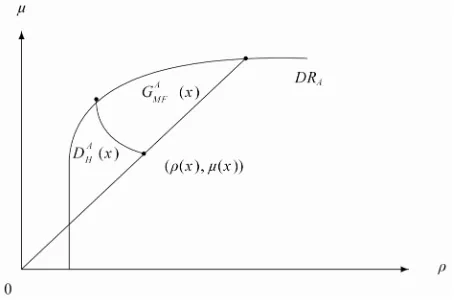
We propose some of their elementary properties which are essentials in portfolio performance gauging. Figure 1 illustrate the basic ideas behind the definitions above. The “hyperbolic distance function” simultaneously invol- ves a contraction of the risk and an expansion of the expected return. The “McFadden gauge function” is very different because it computes simultaneously the maxi- mum expansion of the risk and the expected return of investors.
Proposition 3.3. The map A H
D defined in (3.1) has the following properties:
i) A( ) < H
x D x
( ) 0x
ii) if , then A( ) = 1 M( )
H A
D x x (Weak
efficiency).
iii) x y, , if x y then (Weak monotonicity).
( ) ( )
A A
H H
D y D x
iv) A H
D is continuous on A.
Proof. The proofs are very similar to those concerning
the maximum risk expansion distance function and thus it is omitted.
[image:4.595.59.287.545.695.2]The mathematical program, one need to solve is the following:
Figure 1. Hyperbolic Distance Function and McFadden Gauge.
=1, , =1
=1
( ) = max . . ( )
1 ( )
= 1, 0.
A H
n
i i
i n
i j i j i j
n
i i
D y
s t y x E R
y
x Ax
x x
}
(PH)
The next result analyzes the case where the distance function involves a risk contraction of portfolios. In the following we denote ( A ) = { : A < .
MF A MF
G x G
A
Proposition 3.4. Let MF be the map defined in (3.3).
We have the following properties.
G
i) If ( ) > 0x then GMFA ( ) <x .
( )
M
ii) A ( ) = 1
MF x
, ,
x y
A
G x (Weak efficiency) iii) A
( ( ), ( )) ( ( ), ( )) A ( ) A ( )
MF MF
y y x x G y G x
.
Proof. i) Since A is a compact set it follows that
( A)
A MF
G x
is a compact subset of . Therefore it is norm bounded. Consequently, by definition, is bounded in its return dimension. Thus . ii) Clearly,
if then the point ( (
2
A MF
G x
A
DR
<
( )) ( )
),
( ) = 1 x x lies on the
upper part of the mean-variance frontier. However, all these frontier points are efficient which ends the proof. The proof of iii) is immediate.
Notice that, in general, the gauge function is not continuous on A. Moreover, it does not characterize
the weak efficient frontier. The next result offers a comparison between all the distance functions introduced in the paper.
Lemma 3.5. For all x A and such that ( ) > 0x , we have: A( ) A A ( ).
H R
D x D E( )x GMF x
Proof. Clearly, we have the inclusion
1
: ( ),x ( )x DRA { : ( ( ),x ( ))x DRA}
,
hence we obtain the first inequality. To prove the second one, fix = A ( ). By definition
RE
D x ( ( ), x ( ))x DRA.
However, by construction DRA=DRA(). Since
1
, we then deduce that ( ( ), x ( ))x DRA. Thus,
A MF
G ( )x which ends the proof.
Suppose that ( ) > 0 y , the mathematical program
one should compute is the following:
=1, , =1
=1
( ) = max
. . ( )
( )
= 1, 0.
A MF
n
i i
i n
i j i j i j
n
i i G y
s t y x E R
y x
x Ax
19
4. Duality and Graph Distance Functions
Following our earlier results, we establish a link between these distance functions and the indirect mean-variance utility function, except for the shortage function which has already been discussed in [2]. The indirect mean- variance utility gives the portfolio which achieves a maximal utility of an agent given his (her) risk aversion. Thus, fixing some parameters , , it is well known that an efficient portfolio maximizing the utility can be calculated using standard procedures of quadratic optimi- zation. The mean-variance indirect utility function is
defined by A: 2 by:
V
x
( , ) = sup{ ( ) ( ) : }
A
A
V x x (4.1)
This function associates to the pair ( , ) , which stands for the risk aversion, the maximal utility level a fund manager can expect.
4.1. Morey and Morey Fractional Duality
Morey and Morey’s approach allows to distinguish two dual relations with the indirect mean-variance utility functions. They are expressed in term of return expansion and risk contraction respectively. We show that the distance functions we have introduced can be related to the maximisation of this utility functions with an optimal degree of risk aversion. Following Briec, Kerstens and Lesourd [2], duality results allows a decomposition of efficiency measures. This is done paralleling an earlier concept due to Farrell [13] in a production theory context. However, in view of the nature of the tools they used, these duality results have an additive structure, while the measure proposed by Morey and Morey has a multiplica- tive one. In this subsection, we shall prove that the distance functions proposed by Morey and Morey also have a dual interpretation based upon the indirect mean- variance utility function.
4.1.1. Efficiency Decompositions
Given portfolio, the overall return expansion is the ratio computed as its maximum return by its return value independently of the asset price information. Suppose that ( ) > 0 x , i.e. x A. The overall return expansion
(ORE) index is then defined as the quantity: ( , , )
= sup{ : ( ) ( ) ( , )}.
RE
A O x
x x V
(4.2)
Hence, one can equivalently write
( , ) ( )
( , , ) =
( )
A
RE
V O x
x
x
(4.3)
The allocative return expansion ARE index corres-
ponds to the portfolio reallocation required to achieve the maximum of the the indirect mean-variance utility. It is defined as follow:
( , , ) = ( , , ) A ( )
RE RE RE
A x O x D x
)
(4.4) The portfolio return expansion (PRE index t is the
quantity:
( ) = A ( )
RE RE
P x D x . (4.5)
The Farrell decomposition is then, by definition:
( , , ) = ( , , ) ( )
RE RE RE
O x A x P x . (4.6)
Using a symmetrical approach, one can introduce an overall risk contraction ( RC) index, an allocative risk
contraction (
O RE
A ) index and a portfolio risk contraction
(PRC) index. The overall risk contraction (ORC) index
defined as follows:
( , , )
= inf : ( ) ( ) ( ) ( , ) .
RC
A
O x
x x V
(4.7)
Equivalently, one has:
( ) ( , ) ( , , ) =
( )
A
RC
x V O x
x
(4.8)
The allocative risk contraction index is
( , , ) = ( , , ) A ( )
RC RC RC
A x O x D x , (4.9)
and the portfolio risk-contraction index is:
( ) = A ( )
RC RC
P x D x . (4.10)
By definition, we have:
( , , ) = ( , , ) ( )
RC RC RC
O x A x P x (4.11)
If the overall risk contraction RC RC then we
have an efficient portfolio and the allocative risk contrac- tion is certainly equal to one.
= =
O P 1
= 1
RC
A
4.1.2. Implicit Risk Aversion
Duality between indirect utility functions and Morey and Morey’s distance functions involves an implicit risk aversion which makes the selected portfolio optimal re- garding to the mean-variance utility function.
Allocative return expansion may change with respect to the risks aversion parameter. Given portfolio, one can calculate by how much the level of = / needs to be increased to optimize overall portfolio efficiency. The earlier decompositions show that Allocative return ex- pansion is greater than zero excepted whenever the selected portfolio lies on the indifference curve of the mean-variance utility function at its optimal level. Hence,
if = *
MRE
O , we have:
( , ) = ( ) ( )
A
20 C. BARROS ET AL.
It follows that:
( , ) ( ) =
( )
A
V
x
x (4.13)
It follows that * A ( ). Hence, we have: RE
D x
( , ) ( ) ( )
( )
A A
RE
V D x
x
x . (4.14)
Proposition 4.1. For all portfolio x A such that
( ) > 0x
, we have
( , ) ( )
( ) = inf : ( , ) 0 ( )
A
RE
V x
D x
x
)}
.
Proof. From its definition, the representation set that is
convex, then it is the intersection of all its supporting hyperplanes (see [2]). Hence, we have:
2 ( , ) 0
= {( , ) : A( ,
A
DR v e e v V
.We can equivalently write
( ) = inf{ : ( ( ), ( )) }
A RE
D x x x DRA .
Let us denote ( , ) = {( , ) 2: A
H v e evV
( , )} for all ( , ) 0 . It follows that
2 ( , ) 0
( ) = inf : ( ( ), ( )) \ ( , )
A RE
D x x x H
. Since
( , ) ( )
inf{ : ( ( ), ( )) ( , )} =
( )
A V
x x H
b x
x ,
we immediately deduce the result.
Paralleling the approach above, one can consider the situation where the risk of a given portfolio is contracted while fixing the returns at an arbitrary level. Following, Farrell decompositions, Allocative risk contraction is equal to one if a portfolio maximizes the mean variance- utility function. In such a case the Overall risk contraction is equal to one. Hence, in general, if we have * =
RC
O
,
we have
*
*
( , ) = ( ) ( ) ( ) ( , ) = .
( )
A
A
V x x
x V x
(4.15)
Therefore, we deduce that
( ) ( , )
( )
( )
A A
RC
x V D x
x
(4.16)
In the next result, we show that one can go a bit further by establishing the following duality result:
Proposition 4.2. For all portfolio x A, we have
( ) ( , )
( ) = sup : ( , ) 0 ( )
A A
RC
x V D x
x
)}
.
Proof. From the definition of the representation set we
have: = ( , ) 0{( , ) 2: A( ,
A
DR
v e evV .We can equivalently write
( ) = sup{ : ( ( ), ( )) }
A
RC A
D x x x DR .
It follows that
2 ( , ) 0
( ) = sup : ( ( ), ( )) \ ( , )
A RC
D x x x H
,where ( , ) = {( , ) 2: A( , )}
H v e evV
) 0
for
all ( , . Since
( ) ( , )
sup{ : ( ( ), ( )) ( , )} =
( )
A x V
x x H
x
,
we immediately deduce the result.
4.1.3. Computing the Implicit Risk Aversion Degree In this subsection we show how to compute the implicit risk aversion. First, we define the mathematical programs one should deal with to compute the distance functions. Notice that though these programs have some analogies to those proposed in [16] and its subsequent development, they are not non-parametric [17,18]. In fact the frontier has a quadratic functional representation and, conse- quently the model is parametric. An illustration is pro- posed in [19,20], where a stochastic frontier approach is proposed. However, the piecewise approximation ob- tained from the projection onto the frontier is a non- parametric estimation of the disposal representation set (see [2]). The following programs where first proposed by [1]. In the risk-oriented case we have, for all portfolio
:
y
=1, , =1
=1
( ) = min . . ( ) ( )
= 1, 0.
A RC
n
i i
i n
i j i j i j
n
i i
D y
s t y x E R
y x
x Ax x
(PRC)
In the return-oriented case, if ( ) > 0y , we have:
=1, , =1
=1
( ) = max . . ( ) ( )
= 1, 0.
A RE
n
i i
i n
i j i j i j
n
i i
D y
s t y x E R
y x x
x Ax
(PRE)
21
aversion can be deduced from the Kuhn-Tucker multi- pliers of the above programs. Two set valued maps taking into account either a risk-contraction or a return-expan- sion distance function are now introduced.
Definition 4.3. The set-valued map : A 2 2
defined by
( ) ( , )
( ) = argmax : ( , ) 0 ( )
A
RC
x V x
x
is called the adjusted risk-contraction function. The set- valued map : A 2 2 defined by
( , ) ( )
( ) = argmin : ( , ) 0 ( )
A
RE
V x
x
x
is called the adjusted return-expansion function.
Notice that, in the return oriented case, we have limited our definition to A that is a portfolio subset of
. These definitions allow to provide a formal definition of the implicit risk aversion.
Definition 4.4. Suppose that the maps RC and RE are single-valued at x . The implicit risk-aversion degree in the risk oriented and return oriented case are defined respectively by:
,1
,2 ( ) ( ) =
( )
RC RC
RC
x RA x
x
and
,1
,2 ( ) ( ) =
( )
RE RE
RE
x RA x
x
.
In the case where RC and RE are not single- valued at x, we say the the risk aversion is undefined.
The next result shows that the Kunh-Tucker Multi- pliers of the mathematical programs above can be used to find the implicit risk aversion.
Proposition 4.5. Suppose that the maps RC is single- valued at x . Let (RC,RC) denotes the Kuhn-Tucker multipliers of the first and second constraints of Program (PRC), respectively. We have
( ) = ( , )
RC x RC RC
and ( ) = RC
RC
RC
RA x
.
Proof. To prove this result, we use an earlier result due
to Briec et al. [2] who used the shortage function SgA
that is defined for a given portfolio x by:
( ) = sup{ : ( ( ) , ( ) ) }
A
g v e
S x x g x g DRA
Setting, gv = ( ) x and ge = 0, we obtain:
( ) = 1 ( )
A A
g R
S x DC x .
However, from [2], we have:
( , ) 0
( , ) ( ) ( ) ( ) = inf
A A
g
v e
V x
S x
g g
x
.
Since gv = ( ) x and ge = 0, we have
( , ) 0
( , ) ( ) ( ) ( ) = inf
( )
A A
g
V x
S x
x
x
. (4.17)
Making an elementary transformation, we obtain:
( ) ( , )
( ) = 1 sup : ( , ) 0 ( )
A A
g
x V S x
x
.
Hence, from Proposition 4.2 the solution of the dual optimization program in (4.17) is identical to RC( )x .
However, from [2], this solution coïncides with the Kuhn and Tucker multiplier. If the dual solution is unique the result follows.
Proposition 4.6. Suppose that the maps RE is single- valued at x A
. Let (RE,RE) denotes the Kuhn- Tucker multipliers of the first and second constraints of Program (PRE), respectively. We have
( ) = ( , )
RE x RE RE
, and ( ) = RE
RE
RE
RA x
.
Proof. The proof is similar to that of Proposition using
[2] and setting, gv= 0 and ge= ( ) x .
4.2. Hyperbolic and McFadden Distance Functions and Duality Result
We can also establish duality between these distance functions and the indirect mean-variance utility function.
Proposition 4.7. For all portfolio x A such that
( ) > 0x
, we have
2 1/ 2
( , ) 0
( ) =
[ ( , ) 4 ( ) ( )]] ( , ) .
inf
2 ( )
A H
A A
D x
V x x V
x
Proof. From the definition of the representation set we
have:
2 ( , ) 0
= {( , ) : A( , )
A v e
DR v e e v V }
.We can equivalently write
1
( ) = inf : ( ( ), ( ))
A
H A
D x x x DR
.
Let us denote ( , ) = {( , ) 2: A
H v e evV
( , )} for all ( , ) 0 . It follows that
2 ( , ) 0
1
( ) = inf : ( ( ), ( )) \ ( , )
A H
D x x x H
.Solving a second order equation yields:
2
2 1/ 2
1
inf : ( ( ), ( )) \ ( , )
[ ( , ) 4 ( ) ( )] ( , )
= .
2 ( )
A A
x x H
V x x V
x
C. BARROS ET AL.
22
2 H , )
Since 2
( , ) 0 ( , ) 0 \ H( , ) = \ (
, weimmediately deduce the result.
A simpler duality result can be established regarding to the McFadden Gauge function [4].
Proposition 4.8. For all portfolio x such that ( )x
, we have
> 0
( , ) 0 ,
( , ) ( ) = inf
( ) A A
MF A
V G x
U x
.
Proof. The result is immediate using the fact that, if
( A ) MF
xdom G , there is at least some halfspace H( ,
)
such that
2
, ( , ) inf{ : ( ( ), ( )) \ ( , )} =
( )
A
A
V
x x H
U x
.
5. Impact of Managerial Constraints on
Portfolio Selection and Short Sales
This section analyzes how performance measurement varies regarding to the managerial constraints summa- rized by the constraint . First, notice that if for all , then the set of portfolio is defined by
0
Ax
= 0
Ax xn
0
1
= n: n
i i
x x
1
. (5.1)
Since in such a case the map A is identically null,
we replace the subscript “A”, with “ ”. Suppose is
an affine map defined on . Let be the set of all the affine maps defined on A. In the following, for all
, we denote
0
B
n
,
A B AB if AxBx for all x
. Next, we introduce a specific measure inspired from the Thomson metric that has some similarities to the well known Hilbert projective metric.
n
Definition 5.1. The map de- fined by
: [1,
RC
]
( , ) = sup ( , )
RC x
x A B
A B d
A B where
( ) ( ) ( , ) = max ,
( ) ( )
A B
RC RC
x B A
RC RC
D x D x d A B
D x D x
is called the risk oriented distance between A and . B
Typically, dx is inspired from the Thomson metric,
because it computes from a radial projection the maxi- mum difference at a between A and . The main
difference comes from the fact that the Thomson metric computes the distance between two points. Hence,
B
x
d
allows to define the map that measures some kind of distance between two sets of managerial constraints. By virtue of its nature, this index takes values greater than one for portfolios whose the efficiency score is
affected by the managerial constraints. If the metric is equal to one for each portfolio of a sample, then the efficiency scores are not affected by the managerial constraints. However, this does not mean that the effi- cient frontiers respectively obtained from
A and is
identical. An interesting case arise in the situation where
B
A is the identity map (that is A=I
) and is
identically null. In such a case this measure allows to compare the situations with and without short sale and we not . The following properties are trivial:
B
= 0
B
BA
Lemma 5.2. Suppose that A B= . i) If then
( ) ( )
D x D x
( , ) = inf ma
x A B
A B
x
A RC B RC RC
=
ii) If A B
then RC( , ) =A B .
> 1 = 1
[image:8.595.316.541.386.497.2] [image:8.595.312.537.555.707.2]iii) If RC( , )A B then A B.
Figure 2 depicts the idea the measure is based on. In line with [14,15], the efficient frontier is modified ac- cording to the managerial constraints an investor is dealing with. Hence, the performance of portfolios is also modified by shift of the frontier. In particular, this measure is useful to test the impact of short sales impact on the performance of a given portfolio x. In such a
case, we have:
0
, RC I RC 0
( ) ( ,0) = max
( )
I RC
RC
D x d I
D x
( ) ( )
D x D x
x
)
, (5.2)
and
0
( ,0) = inf
RC
x I
( ,0
x
I d I
. (5.3)
Since, I 0, we have
( ,0) = sup
RC x
x I ( ,0)
I d I
. (5.4)
If there exists some portfolio y 0 such that ( )y
= ( ) x and ( ) < y DRCI ( ) (x ) ) > 1
x
then it is easy to see that RC . Hence, in this situation, the possibi- lity of short sales enables decision makers to find a risk- ( ,0I
23
] less portfolio. A similar approach is possible when one looks for possible improvement of the return.
Definition 5.3. The map de- fined by
: [1,
RC
( , ) = sup ( , )
RE x
x A B
A B A B
where
( ) ( )
( , ) = max ,
( ) ( )
A B
RE RE
x B A
RE RE
D x D x A B
D x D x
(5.5)
is called the risk oriented distance between A and . B
Lemma 5.4. The following properties are also trivial. Suppose that A B =
A
. i) If B then
( )
( , ) = sup max
( )
B RE
RE A
x A B RE
D x A B
D x
ii) If A=B
then RE( , ) = 1A B .
> 1 =
iii) If RE( , )A B then A B.
This measure is useful to test whether or not the short sales impact the return expansion given some portfolio
x. In such a case, we have:
0 0
( ) ( )
( ,0) = max ,
( ) ( )
I
RE RE
x I
RE RE
D x D x I
D x D x
, (5.6)
and since, I 0, we have ( ,0) =sup ( ,0)
RE x
x I
I I
. (5.7)
If there exists some portfolio y 0 such that ( )y
= ( ) x and , then it is easy to see
that RC . Hence, in this situation, the possibi-
lity of short sales enables decision makers to find a riskless portfolio.
( ) ( ) < (
I RE
D x x
0) > 1
)
y
( ,I
In general, it is difficult to compute the map RE( ,A and
)
B RC( , )A B . However, one can compute an
approximation based upon each specific asset. By
construction, we have i, for where
=1, ,n is the canonical basis of . This we do by
defining
( ) =i
R e R i= 1,
n
,n
{ }ei i
1, ,
( ,0) max ( ,0)
i
RC e
i n
I d I
and (5.8)
1, ,
( ,0) max ( ,0)
i
RE e
i n
I I
. (5.9)
To analyse the case where there are short sales, an approach based upon quadratic programming may be used. However, since the optimization constraints are binding, it is possible to give a solution in closed form for *, * and *
x .
6. Empirical Illustration
This section presents a numerical example. It is shown
that some key contributions of this paper can be easily implemented using standard methods of quadratic pro- gramming. The data are obtained from the CAC 40 monthly stocks over a period running from January 1984 to December 2008. For each of the 38 stocks, we have calculated monthly expected returns, covariances, varian- ces with a monthly percentage return. After computing the efficient frontier, we set parameters = 1 and =
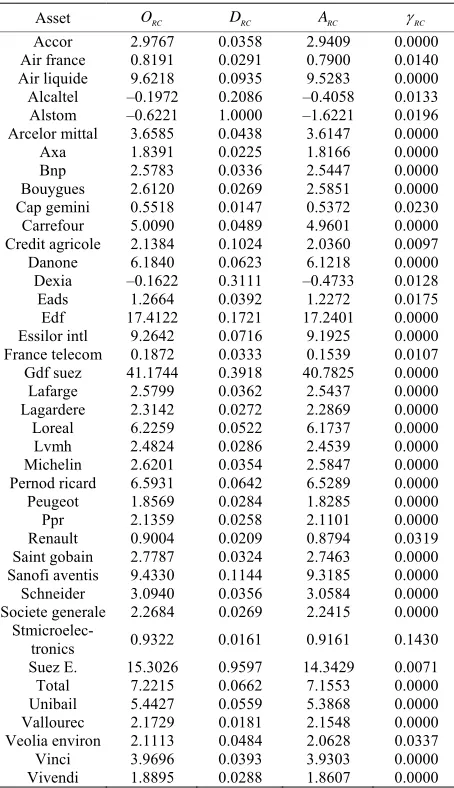
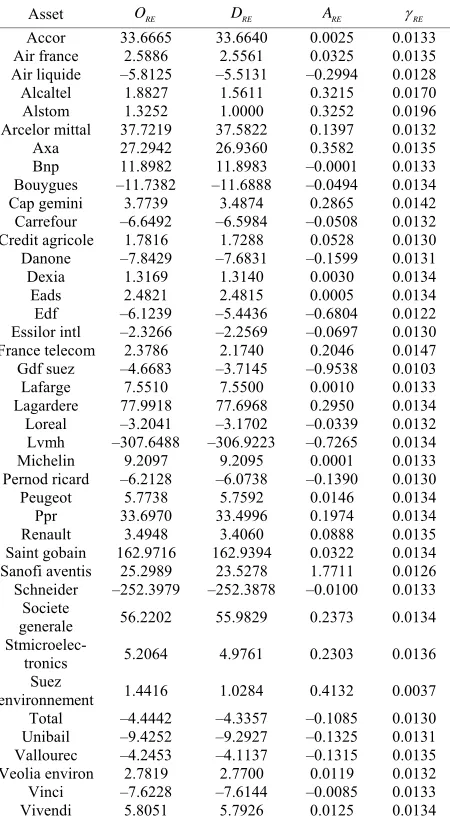
. Below, Tables 1 and 2 respectively summarize in the risk oriented and return oriented cases the decompo- sition of monthly performances for each asset. Remember that overall efficiency looks for a global improvement of a title following a chosen direction. Hence, it can be decomposed in two parts reflecting portfolio efficiency and allocative efficiency.
2
[image:9.595.309.536.320.714.2]As it is shown in Table 1, asset 1 (Accor) has a low return and therefore it is too risky. The investor can
Table 1. Decomposition of “CAC 40” performance (Risk Oriented).
Asset ORC DRC ARC RC
Accor 2.9767 0.0358 2.9409 0.0000 Air france 0.8191 0.0291 0.7900 0.0140 Air liquide 9.6218 0.0935 9.5283 0.0000 Alcaltel –0.1972 0.2086 –0.4058 0.0133 Alstom –0.6221 1.0000 –1.6221 0.0196 Arcelor mittal 3.6585 0.0438 3.6147 0.0000
Axa 1.8391 0.0225 1.8166 0.0000 Bnp 2.5783 0.0336 2.5447 0.0000 Bouygues 2.6120 0.0269 2.5851 0.0000 Cap gemini 0.5518 0.0147 0.5372 0.0230 Carrefour 5.0090 0.0489 4.9601 0.0000 Credit agricole 2.1384 0.1024 2.0360 0.0097 Danone 6.1840 0.0623 6.1218 0.0000 Dexia –0.1622 0.3111 –0.4733 0.0128
Eads 1.2664 0.0392 1.2272 0.0175 Edf 17.4122 0.1721 17.2401 0.0000 Essilor intl 9.2642 0.0716 9.1925 0.0000 France telecom 0.1872 0.0333 0.1539 0.0107 Gdf suez 41.1744 0.3918 40.7825 0.0000
Lafarge 2.5799 0.0362 2.5437 0.0000 Lagardere 2.3142 0.0272 2.2869 0.0000 Loreal 6.2259 0.0522 6.1737 0.0000 Lvmh 2.4824 0.0286 2.4539 0.0000 Michelin 2.6201 0.0354 2.5847 0.0000 Pernod ricard 6.5931 0.0642 6.5289 0.0000 Peugeot 1.8569 0.0284 1.8285 0.0000 Ppr 2.1359 0.0258 2.1101 0.0000 Renault 0.9004 0.0209 0.8794 0.0319 Saint gobain 2.7787 0.0324 2.7463 0.0000 Sanofi aventis 9.4330 0.1144 9.3185 0.0000 Schneider 3.0940 0.0356 3.0584 0.0000 Societe generale 2.2684 0.0269 2.2415 0.0000
Stmicroelec-tronics 0.9322 0.0161 0.9161 0.1430 Suez E. 15.3026 0.9597 14.3429 0.0071
24 C. BARROS ET AL.
Table 2. Decomposition of “CAC 40” performance (Return Oriented).
Asset ORE DRE ARE RE
Accor 33.6665 33.6640 0.0025 0.0133 Air france 2.5886 2.5561 0.0325 0.0135 Air liquide –5.8125 –5.5131 –0.2994 0.0128
Alcaltel 1.8827 1.5611 0.3215 0.0170 Alstom 1.3252 1.0000 0.3252 0.0196 Arcelor mittal 37.7219 37.5822 0.1397 0.0132
Axa 27.2942 26.9360 0.3582 0.0135 Bnp 11.8982 11.8983 –0.0001 0.0133 Bouygues –11.7382 –11.6888 –0.0494 0.0134 Cap gemini 3.7739 3.4874 0.2865 0.0142
Carrefour –6.6492 –6.5984 –0.0508 0.0132 Credit agricole 1.7816 1.7288 0.0528 0.0130
Danone –7.8429 –7.6831 –0.1599 0.0131 Dexia 1.3169 1.3140 0.0030 0.0134
Eads 2.4821 2.4815 0.0005 0.0134 Edf –6.1239 –5.4436 –0.6804 0.0122 Essilor intl –2.3266 –2.2569 –0.0697 0.0130 France telecom 2.3786 2.1740 0.2046 0.0147 Gdf suez –4.6683 –3.7145 –0.9538 0.0103
Lafarge 7.5510 7.5500 0.0010 0.0133 Lagardere 77.9918 77.6968 0.2950 0.0134
Loreal –3.2041 –3.1702 –0.0339 0.0132 Lvmh –307.6488 –306.9223 –0.7265 0.0134 Michelin 9.2097 9.2095 0.0001 0.0133 Pernod ricard –6.2128 –6.0738 –0.1390 0.0130
Peugeot 5.7738 5.7592 0.0146 0.0134 Ppr 33.6970 33.4996 0.1974 0.0134 Renault 3.4948 3.4060 0.0888 0.0135 Saint gobain 162.9716 162.9394 0.0322 0.0134 Sanofi aventis 25.2989 23.5278 1.7711 0.0126
Schneider –252.3979 –252.3878 –0.0100 0.0133 Societe
generale 56.2202 55.9829 0.2373 0.0134
Stmicroelec-tronics 5.2064 4.9761 0.2303 0.0136 Suez
environnement 1.4416 1.0284 0.4132 0.0037 Total –4.4442 –4.3357 –0.1085 0.0130 Unibail –9.4252 –9.2927 –0.1325 0.0131 Vallourec –4.2453 –4.1137 –0.1315 0.0135 Veolia environ 2.7819 2.7700 0.0119 0.0132
Vinci –7.6228 –7.6144 –0.0085 0.0133 Vivendi 5.8051 5.7926 0.0125 0.0134
choose an efficient portfolio that is less risky and does not require risk-taking (
0,036% = 0
RC
). Considering
only risk aversion, it is possible to pursue reduction of risk to maximize the utility of a portfolio but, due to the market imperfections, this result cannot be achieved without short sales.
In the return expansion case, the first asset is less efficient (Table 2) than is the risk oriented case. Given the same level of risk, it should be 50 times more
profitable ( ). However, technically, we
can only select a portfolio that produces 33 times more
important return ( ). The market imperfec-
tions again limits this return improvement ( ). Here, the investor must take 6 units of risk to increase his (or her) return of a one unit amount (
= 33.6665
RE O
= 3
RE
D 3.6641
= 0.0025 RE
A
= 0.0133
RE
).
Table 3 details implicit risk aversion of risk reduction
Table 3. Implicit Risk Aversion.
Asset Risk Oriented Return Oriented
RC
RC RC RE RE RE
Accor 0.000 1.000 0.000 0.006 0.482 0.013 Air france 0.000 0.011 0.014 0.008 0.613 0.013 Air liquide 0.000 1.000 0.000 0.003 0.284 0.012 Alcaltel 0.006 0.462 0.013 0.020 1.197 0.017 Alstom 0.030 1.534 0.019 0.030 1.534 0.019 Arcelor mittal 0.000 1.000 0.000 0.005 0.433 0.013 Axa 0.000 1.000 0.000 0.008 0.616 0.013 Bnp 0.000 1.000 0.000 0.006 0.499 0.013 Bouygues 0.000 1.000 0.000 0.007 0.561 0.013 Cap gemini 0.000 0.008 0.023 0.012 0.846 0.014 Carrefour 0.000 1.000 0.000 0.005 0.408 0.013 Credit agricole 0.000 0.014 0.009 0.004 0.332 0.013 Danone 0.000 1.000 0.000 0.004 0.358 0.013 Dexia 0.003 0.287 0.012 0.007 0.542 0.013 Eads 0.000 0.010 0.017 0.006 0.509 0.013 Edf 0.000 1.000 0.000 0.002 0.195 0.012 Essilor intl 0.000 1.000 0.000 0.004 0.331 0.013
France
telecom 0.001 0.105 0.010 0.013 0.890 0.014 Gdf suez 0.000 1.000 0.000 0.001 0.095 0.010 Lafarge 0.000 1.000 0.000 0.006 0.480 0.013 Lagardere 0.000 1.000 0.000 0.007 0.557 0.013 Loreal 0.000 1.000 0.000 0.005 0.394 0.013 Lvmh 0.000 1.000 0.000 0.007 0.543 0.013 Michelin 0.000 1.000 0.000 0.006 0.485 0.013 Pernod ricard 0.000 1.000 0.000 0.004 0.352 0.013 Peugeot 0.000 1.000 0.000 0.007 0.545 0.013 Ppr 0.000 1.000 0.000 0.007 0.573 0.013 Renault 0.000 0.006 0.031 0.009 0.668 0.013 Saint gobain 0.000 1.000 0.000 0.006 0.509 0.013 Sanofi aventis 0.000 1.000 0.000 0.003 0.252 0.012 Schneider 0.000 1.000 0.000 0.006 0.484 0.013
Societe
generale 0.000 1.000 0.000 0.007 0.561 0.013
Stmicroelec-tronics 0.000 0.001 0.143 0.009 0.733 0.013 Suez E. 0.000 0.017 0.007 0.000 0.021 0.003 Total 0.000 1.000 0.000 0.004 0.346 0.013 Unibail 0.000 1.000 0.000 0.005 0.380 0.013 Vallourec 0.000 1.000 0.000 0.009 0.689 0.013 Veolia environ 0.000 0.006 0.033 0.005 0.429 0.013 Vinci 0.000 1.000 0.000 0.006 0.459 0.013 Vivendi 0.000 1.000 0.000 0.007 0.541 0.013
and return expansion for each asset. Note that some assets have a negative performance indicator. This can be explained by the fact that they have a negative return. The portfolio may have a greater risk than their expected returns and their respective utility functions measures the potential loss of each invested euro. This is not consistent with the objective of maximizing behaviour the investors have and, in such a case, allocative efficiency makes no sense.
[image:10.595.60.285.106.515.2]25
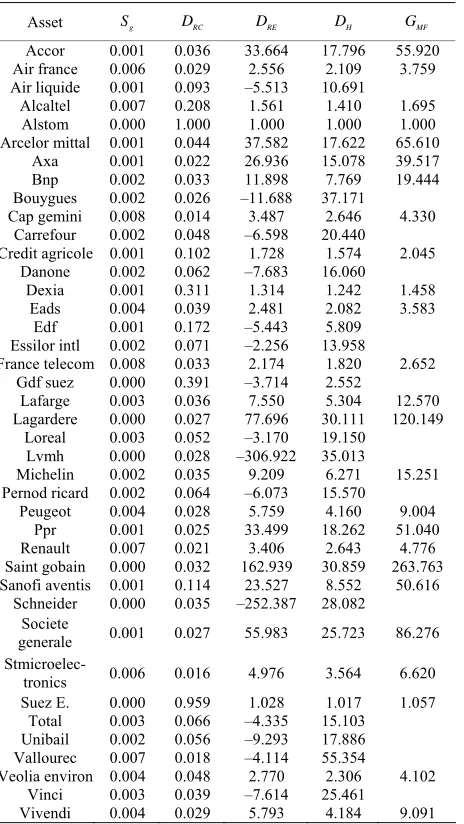
Table 4. “CAC 40” Efficiencies.
Asset Sg DRC DRE DH GMF
Accor 0.001 0.036 33.664 17.796 55.920 Air france 0.006 0.029 2.556 2.109 3.759 Air liquide 0.001 0.093 –5.513 10.691
Alcaltel 0.007 0.208 1.561 1.410 1.695 Alstom 0.000 1.000 1.000 1.000 1.000 Arcelor mittal 0.001 0.044 37.582 17.622 65.610
Axa 0.001 0.022 26.936 15.078 39.517 Bnp 0.002 0.033 11.898 7.769 19.444 Bouygues 0.002 0.026 –11.688 37.171
Cap gemini 0.008 0.014 3.487 2.646 4.330 Carrefour 0.002 0.048 –6.598 20.440 Credit agricole 0.001 0.102 1.728 1.574 2.045
Danone 0.002 0.062 –7.683 16.060 Dexia 0.001 0.311 1.314 1.242 1.458
Eads 0.004 0.039 2.481 2.082 3.583 Edf 0.001 0.172 –5.443 5.809 Essilor intl 0.002 0.071 –2.256 13.958
France telecom 0.008 0.033 2.174 1.820 2.652 Gdf suez 0.000 0.391 –3.714 2.552
Lafarge 0.003 0.036 7.550 5.304 12.570 Lagardere 0.000 0.027 77.696 30.111 120.149
Loreal 0.003 0.052 –3.170 19.150 Lvmh 0.000 0.028 –306.922 35.013 Michelin 0.002 0.035 9.209 6.271 15.251 Pernod ricard 0.002 0.064 –6.073 15.570
Peugeot 0.004 0.028 5.759 4.160 9.004 Ppr 0.001 0.025 33.499 18.262 51.040 Renault 0.007 0.021 3.406 2.643 4.776 Saint gobain 0.000 0.032 162.939 30.859 263.763 Sanofi aventis 0.001 0.114 23.527 8.552 50.616
Schneider 0.000 0.035 –252.387 28.082 Societe
generale 0.001 0.027 55.983 25.723 86.276
Stmicroelec-tronics 0.006 0.016 4.976 3.564 6.620 Suez E. 0.000 0.959 1.028 1.017 1.057
Total 0.003 0.066 –4.335 15.103 Unibail 0.002 0.056 –9.293 17.886 Vallourec 0.007 0.018 –4.114 55.354 Veolia environ 0.004 0.048 2.770 2.306 4.102
Vinci 0.003 0.039 –7.614 25.461 Vivendi 0.004 0.029 5.793 4.184 9.091
also much more risk (56 more times for asset 1) are involved with the McFadden Gauge [4].
Intuitively, this last measure may be use for a risk- lover manager. The mean return expansion function is suitable for risk-neutral investor. Risk averse manager may be appreciate by risk contraction, hyperbolic or shortage functions.
Finally, regarding to all the results calculated in Table 4, il clearly appears that the efficient frontier is entirely characterized by two funds: Asset 5 (Alsthom) and Asset 34 (Suez environment). This is an illustration, of the two funds theorem.
7. Conclusions
This paper has analyzed duality relations between the indirect mean-variance utility function and a broad class
of portfolio efficiency measures. It has been shown that such approaches are useful to measure the impact of managerial constraints on the performance. In addition, the implicit risk aversion of an optimal solution can be deduced from the Kuhn-Tucker optimality conditions.
8. References
[1] M. R. Morey and R. C. Morey, “Mutual Fund Perform-ance Appraisals: A Multi-horizon Perspective with En-dogenous Benchmarking,” Omega, Vol. 27, No. 2, 1999,
pp. 241-258. doi:10.1016/S0305-0483(98)00043-7 [2] W. Briec, K. Kerstens and J.-B. Lesourd, “Single Period
Markowitz Portfolio Selection, Performance Gauging and Duality: A Variation on Luenberger’s Shortage Func-tion,” Journal of Optimization Theory and Applications,
Vol. 120, No. 1, 2004, pp. 1-27.
doi:10.1023/B:JOTA.0000012730.36740.bb
[3] W. Briec, K. Kerstens and O. Jokung, “Mean-Variance- Skewness Portfolio Performance Gauging: A General Shortage Function and Dual Approach,” Management Science, Vol. 53, No. 1, 2007, pp. 135-149.
doi:10.1287/mnsc.1060.0596
[4] D. McFadden, “Cost, Revenue, and Profit Functions,” In: M. Fuss and D. McFadden, Eds., Production Economics:
A Dual Approach to Theory and Applications,
Amster-dam, North-Holland, Vol. 1, 1978, pp. 3-109.
[5] R. W. Shephard, “Cost and Production Functions,” Princeton University Press, Princeton, 1953.
[6] H. Markowitz, “Portfolio Selection,” Journal of Finance,
Vol. 7, No. 1, 1952, pp. 77-91. doi:10.2307/2975974
[7] H. Markowitz, “Portfolio Selection: Efficient Diversifica-tion of Investments,” John Wiley, New York, 1959. [8] W. Sharpe, “A Simplified Model for Portfolio Analysis,”
Management Science, Vol. 9, No. 2, 1963, pp. 277-293.
doi:10.1287/mnsc.9.2.277
[9] W. Sharpe, “Capital Asset Prices: A Theory of Market Equilibrium under Condition of Risk,” Journal of Fi-nance, Vol. 19, No. 3, 1964, pp. 425-442.
doi:10.2307/2977928
[10] J. Lintner, “The Valuation of Risk Assets and the Selec-tion of Risky Investment in Stock Portfolios and Capital Budgets,” Review of Economics and Statistics, Vol. 47,
No. 1, 1965, pp. 13-37. doi:10.2307/1924119
[11] H. Markowitz, “CAPM Investors do Not Get Paid for Bearing Risk: A Linear Relation does Not Imply Payment for Risk,” Journal of Portfolio Management, Vol. 34, No.
2, 2008, pp. 91-96.
[12] D. G. Luenberger, “Microeconomic Theory,” McGraw Hill, Boston, 1995.
[13] M. Farrell, “The Measurement of Productive Efficiency,”
Journal of the Royal Statistical Society, Vol. 120, No. 3,
1957, pp. 253-281. doi:10.2307/2343100
![Figure 2 depicts the idea the measure is based on. In line with [14,15], the efficient frontier is modified ac- cording to the managerial constraints an investor is dealing with](https://thumb-us.123doks.com/thumbv2/123dok_us/9088074.405680/8.595.312.537.555.707/figure-depicts-efficient-frontier-modified-managerial-constraints-investor.webp)