Abstract—In today’s product development, the use of templates to reuse knowledge and existing design solutions is well-established. Most CAD systems offer functions for defining and storing design knowledge, but user-friendly classification and structuring is still a matter of research. As a consequence, the retrieval of existing templates is challenging and instead of reusing design knowledge in successive development projects, new design solutions have to be created. In this paper an approach to structure Feature Templates is introduced. The approach is based on the generic product structure, which provides extensive contextual information about possible applications of templates. By integrating structural information about Feature Templates into the product structure, reuse of existing design knowledge can be improved. The approach is exemplarily applied to the assembly of a planetary gear and an elastomer coupling.
Index Terms—feature, knowledge based engineering, product family, product structure, template
I. INTRODUCTION
HE usage of templates to reuse knowledge and design solutions is a common knowledge based engineering (KBE) approach within today’s product development. Most modern CAD systems provide functions to define Feature Templates (FT) and to store and manage them in libraries. In this context, FT represent a creation logic for defining geometry models. The creation logic is depending on parameters, which can be changed by the designer to create different instances of FT. While defining FT is becoming more and more popular, the consequent reuse is still rare due to two main reasons: The first reason is that geometry definition of FT is insufficient to be instantiated in a different context. The second and more frequent reason is that structuring of FT and their libraries are lacking a methodical approach and thus FT cannot be retrieved by other designers.
Manuscript received July 10, 2013; revised July 20, 2013.
A. Christ is with Technische Universität Darmstadt, Department of Computer Integrated Design, Darmstadt, Hesse, Germany (phone: +49-6151-16-3771; fax: +49-6151-16-6854; e-mail: [email protected]).
V. Wenzel is with Technische Universität Darmstadt, Department of Computer Integrated Design, Darmstadt, Hesse, Germany (e-mail: [email protected]).
A. Faath is with Technische Universität Darmstadt, Darmstadt, Hesse, Germany (e-mail: [email protected]).
R. Anderl is with Technische Universität Darmstadt, Department of Computer Integrated Design, Darmstadt, Hesse, Germany (e-mail: [email protected]).
In this paper a methodical approach to support the structuring process of FT is introduced. The approach combines the product structure, hierarchically representing assemblies and parts of a product or a product family, with the FT library structure as it exists in modern CAD systems. The main goal of the approach is to provide a structuring guideline for FT, which enables linking FT and product structure and which can be comprehended equally well by designers defining FT and designers using them. The usage of FT is most promising in adaptive design, where mainly geometrical details or shape-defining parameters are varied, while the product structure remains basically unchanged. This invariance of the product structure and its comprehensibility for all involved designers supports the integration of FT. Both elements together, the product structure and the FT library structure, define a matrix that allows representing
a)relations between different parts of the product structure,
b) relations between different Feature Templates, and c) relations between parts and Feature Templates. The capabilities of the approach are illustrated by an example of the product family “planetary gears”, which contains several FT highlighting the different types of relations a), b) and c).
The paper shows how the usage of existing and already digitalized knowledge can be enhanced by following a methodical approach for structuring FT. The conceptual approach is independent of any software. But both product structures and FT libraries are accessible in CAD/PDM software and pave the way for a sample implementation.
II. RELATED WORK
The approach described in this paper belongs to the field of knowledge-based engineering (KBE). Its main goal is the integration of Features Templates in product structures via a proper mapping. This enables the consistent reuse of Feature Templates and established design solutions, but also the integration of expert knowledge through Feature Templates. In this chapter a brief overview about relevant subjects will be given and the essential terms will be defined.
A. Product Structure
The product structure is a structured presentation of a product. It describes the sub-elements of a product and their
Integration of Feature Templates in Product
Structures Improves Knowledge Reuse
Alexander Christ, Volkmar Wenzel, Andreas Faath, and Reiner Anderl
interdependencies in a structured composition. The assignment of elements is realized by product characteristics and interfaces [1].
In professional literature there exist a wide range of definitions for the term product structure and it is often used as a hypernym. Tichem and Storm define product structure as “a context-dependent description of the composition of the product out of elements and relations between the elements.”[2] Wu and Kimura call the realization of product function the main objective of designing a product structure [3]. According to Salonen different views on the product structured have to be taken in consideration [4]. Product structures are used in several areas, for example as functional structure, relational model or assembly hierarchy. They can also be transformed into other forms, like a bill of material or serve as reference in variant management [2], [5], [6].
[image:2.595.306.546.114.259.2]There are several approaches to represent product structures, usually with the help of pedigrees. Common structures are simple string, hierarchic order and network. Based on graph theory the structure consists of nodes. The topmost node has only outputs and is called root. Inner nodes contain inputs and outputs. Nodes that only contain inputs are called leaves [7], [8]. A schematic structure with the chosen naming convention is shown in Fig. 1.
Fig. 1. Node naming convention [7], [8]
For the approach described in this paper a proper definition of the term product structure is necessary. Schuh, Assmus and Zancul describe product structure as a structured definition of the relations between modules and parts of a product [9]. This definition is adopted in this paper. Modules and parts are arranged in a hierarchic structure, whereby modules summarize parts on lower levels of the product structure. An example of a conceptual hierarchical product structure is illustrated in Fig 2.
Fig. 2. Hierarchical product structure
[image:2.595.48.202.387.486.2]In CAD systems assemblies and product structures are usually presented as a hierarchical structure. An example of a specific product structure modeled with the CAD system Siemens NX is shown in Fig. 3.
Fig. 3. Product structure in CAD system (NX)
B. Feature Technology and Templates
The feature technology plays a major role in virtual product development. Features enable users to create models fast and simple by providing predefined design objects. Besides geometry information they can also contain semantics. Therefore, a feature can be seen as an aggregation of different properties and characteristics [10]-[13]. In this context Weber defines features as „technical information items which represent one or more products in the (technical) region of interest.” [14]
In current 3D-CAD systems features depict areas of a part and assign information to them. They are described by parameters and consist of arbitrarily complex structure information. Features can be made up of several objects or features. Depending on the area of application, features can be classified in several ways, e.g. material adding and material removing features. A common classification is the following: form features, body features, operational features and enumerative features. There are system-defined and user-defined features (UDF). Both are stored in feature libraries [15].
KBE templates are parametric models enriched with design knowledge. They are able to store design intent and adapt themselves to their environment, e.g. in a CAD model. Templates use rules, formulas and further KBE elements to formalize knowledge. They enable the uniform description and management of all essential product and process information. Through an instantiation templates can be put in a specific context. With templates established solutions and systems can be integrated in a new product design [16], [17].
[image:2.595.50.284.636.760.2]process. This allows the reuse of expert knowledge and the integration of downstream process chains. Benefits are a shorter time to market, cost reduction and a continuous enhancement of the design maturity. Both, features and templates are well-established in industry and science today. Reusable Feature Templates are approved knowledge based engineering approaches [11], [16].
C. Feature Templates
Nowadays, features are often used in the form of Feature Templates. These templates are made up of predefined CAD features and stored as new Feature Templates with an immutable structure and changeable parameters. They are also referred to as user-defined features (UDF). Feature Templates are an aggregation of attributes and constraints, enriched with engineering knowledge, to specify the overall shape. With Feature Templates reusable geometry elements from below the component level to complex geometric elements consisting of multiple parts can be defined. Since Feature Templates can be created in every established CAD system, they offer a convenient design environment [18], [19].
Feature Templates are mostly deployed as reusable parts in variant and adaptive design. They are templates for application-specific features. Through a well-formed definition of parameters and constraints they can adapt themselves intelligently. With this, FT can be treated like system-defined features. For the integration in several models a suitable definition of references and interfaces is needed. Only geometry elements and parameters function as inputs. FT enable a reliable product development based on standardization and modularization below the part level and the integration of expert knowledge from different domains. They are suitable for modifications, maintenance and reusability. The consistent application of KBE technologies reduces the design effort and leads to cost savings [11], [20], [21].
D. Knowledge Based Engineering
Knowledge Based Engineering enables the consistent reuse of design solutions and sharing of expert knowledge. KBE objectives are to save time and to reduce cost in product development by automating repetitive design tasks. Therefore KBE systems capture and store knowledge from different domains about products and processes. This expert knowledge can then be reused to solve design problems [22], [23]. Verhagen et al. give a good overview about existing methodologies and systems [23]. MOKA [24], [25], KNOMAD [26] and KOMPRESSA [27] are common representatives.
Although a lot of research has been done towards KBE in the last decades, there is still a need to develop systems that support designers with expert knowledge from different domains of the product life cycle. Chandrasegaran et al. reflect the importance of knowledge representation in design systems. They also address reasons for the low acceptance of
knowledge-based systems. Current KBE systems fall short to integrate knowledge properly. Often the knowledge is only captured partially and is not represented in a formalized manner. The appropriate storage in knowledge repositories is also a yet unsolved problem [28].
Szykman et al. mention the need for supporting the capture, reuse and formal representation of expert knowledge. This requires mechanisms to encode, index and retrieve knowledge. Current KBE systems are often to complex, have a bad usability and show gaps in their representation ability. They usually work only in a specific IT environment, while international and cross-company product development is usually performed in a heterogeneous software tool environment [29]-[31].
These shortcomings prevent the comprehensive spreading and application of knowledge-based systems. Many individual and customized solutions have been developed, but they only focus on specific business cases or work only for a single enterprise. Until now there couldn’t be established a general methodology. To solve this problem more research effort has to be applied. Partial improvements are always possible and they pave the way for a holistic solution. One improvement is the mapping of Feature Templates to parts of the product structure. Expert knowledge is associated to Feature Templates and they can be stored suitably in a knowledge repository, e.g. a product lifecycle management (PLM) system [32].
III. CONCEPT
In today’s product development not just particular products are designed, but mostly product families with different versions and variants of the same product. They are characterized by similar shape, functionality and very often share the same generic product structure. Within such a product family, the usage of FT enables the harmonized storage, administration and, most important, the reuse of existing knowledge and design solutions. In modern CAD systems FT can be stored and managed in libraries, offering insufficient functions for classifying FT and for backtracking instances of used FT. Thus, existing FT and possible application parts cannot be found easily and instead of using existing FT, new variants and design solutions are created. To enhance the knowledge reuse, an approach for a structured classification and managing of FT is introduced here.
In research there already exist approaches to define relationships between features and parts of a product structure. Shah and Rogers have developed a concept for feature-based assembly modeling [33], [34]. A framework for assembly design that enables the creation and management of several design alternatives as well as the integration of knowledge has been introduced by Jounghyun and Szykman [35]. He, Song and Wang use a feature-based structure concept model to combine parts and components into a generalized assembly, which can be seen as an abstraction of the product structure [36]. A lot of other concepts have been developed for integrating features in assembly resp. product structures. Although many approaches are promising, no general concept or method could become prevalent so far.
Ontologies are one way to represent and reuse knowledge. Knowledge can easily be integrated in ontologies, but for complex structures they tend to confusion and it can be difficult to extract knowledge. For our approach a specialized graphical user interface would be required. An interim solution could be provided by ontology editors, like Protégé [37], but in the long run a specialized software tool has to be developed [38], [39]. Hence, ontologies should not be used for our approach.
A. Requirements
Based on the need for a solution that integrates Feature Templates, and with this knowledge, in product structures requirements have to be defined. The following requirements represent the most important ones for the concept.
Requirement 1
The concept shall enable a simple integration of Feature Templates in different product structures.
Requirement 2
The procedure of integrating Feature Templates shall be independent from the respective product structure and shall be able to be done intuitively.
Requirement 3
An integration of hierarchic product structures is intended. Requirement 4
The concept shall be based on product family-dependent product structures.
Requirement 5
Variant and adaptive design are the main scope. It has to be ensured that the concept is not merely limited to existing products.
Requirement 6
The concept shall enable the reuse of Feature Templates in different products as much as possible.
Requirement 7
To reduce complexity parts and Feature Templates should occur as few as possible.
Requirement 8
The structure of the concept should be chart- or matrix-based.
Requirement 9
Dependencies between parts of a product and Feature Templates have to be visualized.
Requirement 10
The concept should have a good and intuitive usability. Therefore it is necessary to ensure clarity and unambiguity. Requirement 11
The concept should be independent of a specific software. These requirements serve as criteria for the evaluation of the concept. Therefore, the concept will be checked against the requirements and their fulfillment will be estimated.
B. Conceptual Approach
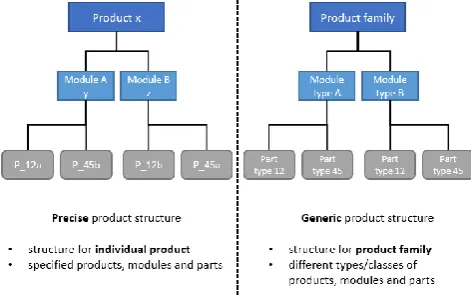
[image:4.595.307.543.546.694.2]The approach is based on the generic product structure of a product. This structure contains different hierarchical levels and several FT, which can be applied to products of the product family. A generic product structure represents the structure of an entire product family and shows, which types or classes of modules and parts are used in products of a product family. The opposite of the generic product structure is the precise product structure, which shows the particular modules and parts which together form a particular product. While elements in the precise product structure refer to the specific instance of a part or module, elements in the generic product structure refer to the type of module or part that is used in every product of the product family. Fig. 4 provides an overview about the difference between precise and generic product structures.
Fig. 4. Precise and generic product structure
The precise product structure only offers information about one particular product and the use of templates within. The generic product structure instead offers information about possible applications of existing templates within a broad range of similar products. In the following will be explained, how generic product structure and FT can be used to create a structure that allows comprehending which FT can be applied as instances to which parts of the product family.
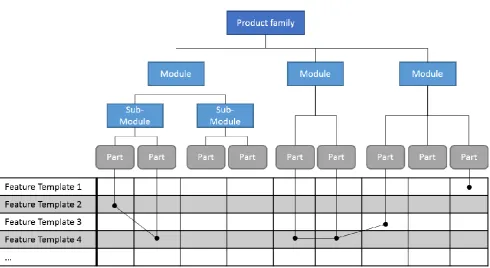
The concept follows a matrix based approach. The previously introduced generic product structure and the list of existing FT are merged to form a matrix table, which is called Part-Template-Matrix (PTM). On the horizontal axis, elements of the generic product structure are outlined. Each element of the product structure on the lowest hierarchical level is assigned to a particular column. This ensures that all relations between FT and parts can be represented, but no relations between FT and non-geometric elements, e.g. modules or subassemblies. On the vertical axis, each existing FT applicable to the related generic product structure is assigned to a particular line of the matrix. This list can be derived from the list of FT as it is structured in the library of the CAD system. Although it is not necessary for the introduction of this concept, this list should be sorted, e.g. according to the FT classification, in order to achieve a proper usability.
The Part-Template-Matrix for a sample generic product structure is shown in Fig. 5. Within each product of the product family, three modules can be found. The first module contains two sub-modules containing two parts each, and the remaining two modules contain two and three parts. In total, nine parts can be found in the product structure and are assigned to nine columns. Furthermore, four sample Feature Templates can be applied to parts within the product structure.
[image:5.595.54.545.439.707.2]To visualize relations between FT and parts, a vertical line is drawn in the column of the according part to the line of the FT which can be instantiated there. These links are not only created if a FT has been instantiated in this place in the past, but also if future applications are possible and promising. FT that can be instantiated multiple times (or at different positions) in the same part, are also listed only once. Due to this simplification possible multiple applications of the same FT may not be represented in the matrix, but it supports the simplicity and clarity of the matrix. While vertical lines represent relations between parts and FT, horizontal lines display relations between parts within the same module or even between parts of different modules. These lines illustrate, that a relation between two parts can geometrically be defined by using the same or two corresponding FT. The sample of the planetary gear and the elastomer shaft coupling clarify the meaning of different types of lines in the matrix.
IV. SAMPLE APPLICATION
[image:6.595.315.540.59.186.2]The approach has been prototypically implemented with a sample of a planetary gear and an elastomer shaft coupling, see Fig. 6. Before the sample implementation of the concept will be explained, a short overview of the sample assembly is given. All geometry models have been created with Siemens NX 7.5.
Fig. 6. Planetary gear with coupling
A planetary or epicycle gear consists of the coaxial parts sun wheel, carrier wheel, ring and a set of planetary wheels. Carrier, ring and sun can equally be used as input or output side of the gear. The gear transmission ratio is a result of the different dimensions of planet, ring and sun wheel.
[image:6.595.48.283.150.291.2]The planetary gear is prone to axial shocks. Reducing them to a minimum is the function of the elastomer shaft coupling. The coupling itself (see Fig. 7) consists of two shaft hubs and an elastomer ring lying in between the hubs. While torque can be transmitted nearly without losses, axial shocks are absorbed by the elastomer ring.
Fig. 7. Elastomer shaft coupling
The planetary gear and the shaft coupling can be seen as a product family. Dimensions of the entire gear, the shafts, the wheels or the shaft coupling and even the number of planets can be varied due to changing requirements. For instance, for transmitting a higher torque the diameter of the shafts have to be chosen bigger or the number of planets in the planet set could be changed from three to four. Different variants of the gear also result from different transmission ratios, which is depending on the relative radius of the sun wheel and the planets. Possible variants of the assembly planetary gear with different requirements for transmitting torque are illustrated in Fig. 8. Nevertheless, the product structure remains unchanged for all variants.
Fig. 8. Variants of planetary gear
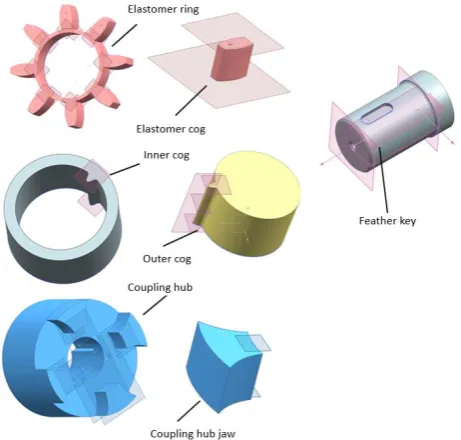
[image:6.595.307.538.385.605.2]To define the geometry of this planetary gear and coupling, several Feature Templates have been created: An elastomer cog to attach to the ring, inner and outer cog for gear wheels, a feather key for joining shaft and hub, and a coupling hub jaw for the shaft coupling hub. All Feature Templates have been modeled as User Defined Features with the CAD system Siemens NX 7.5 and are stored in the UDF library. They were defined as full-parametric models and allow both automatically adapting to contextual constraints and modification of parameters by users. The exemplary variants of the planetary gear in Fig. 8 were all created using the same templates. The modeled Feature Templates are shown in Fig. 9.
Fig. 9. Feature Templates of planetary gear and coupling
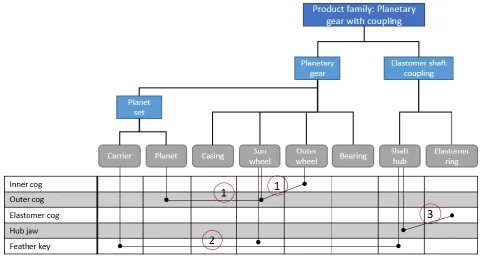
[image:6.595.81.250.471.580.2]Fig. 10. Part-Template-Matrix for the planetary gear with coupling
The Part-Template-Matrix allows not only representing possible applications of FT by means of vertical lines. Dependencies between parts of the same and also different modules, which are corresponding to each other, can be represented, too. To highlight such dependencies, two corresponding possible applications indicated by a point in the matrix are linked with a line.
In the example of the planetary gear and the coupling, the dependencies between parts (see number 1-3 in Fig. 10) are defined by two corresponding Feature Templates:
1. The function of the carrier is to carry the planets and to transmit torque from the planets to the output of the gear. To join the shaft of the carrier with the coupling a feather key is used. Both feather keys on shaft and hub require the same dimensions to fit. On Feature Template level, this dependency is realized by linking both instances of the same feather key template to the same parameters. 2. Sun wheel, planets and outer wheel are the parts
involved in the gear movement and enable torque transmission. The cogs of all wheels need to be harmonized to allow an ideal roll motion. Here Feature Templates for inner and outer cog are depending on the same set of parameters defining the cog dimensions.
3. Elastomer ring and shaft hubs always form a consistent module with corresponding dimensions of equal shaft radius and matching hub jaws and elastomer cogs. These interfering dimensions are controlled by a set of parameters controlling both parameters of the module itself and the Feature Template hub jaw and elastomer cog.
The example of the planetary gear shows that representing three kinds of relations is possible:
a) Relations between Feature Templates (vertical lines) and parts of the assembly, which are represented by the vertical lines in the Part-Template-Matrix. b) Relations between different parts, which are defined
by two corresponding instances of the same or different Feature Template. These relations are represented by links between nodes in the Part-Template-Matrix (numbered links 1-3 in Fig. 10).
c) Relations between different Feature Templates. Links between nodes indicate a relation between two parts in a generic product structure. Based on the possibility to control different instances of Feature Templates by the same set of parameters and thus to create a consistent geometry, the numbered links 1-3 in Fig. 10 also indicate an applicability of two or more corresponding Feature Templates to other product structures.
V. EVALUATION OF THE CONCEPT
TABLE I
REQUIREMENTS AND THEIR FULFILLMENT
No. Requirement Fulfillment
1 Simple Integration of Feature
Templates +
2 Intuitive procedure o
3 Integration of hierarchic product
structures +
4 Based on product family-dependent
product structures +
5 Not limited to existing products + 6 Enable the reuse of FT in different
products +
7 No multiple occurrence of parts and
FT -
8 Chart- or matrix-based structure + 9 Visualization of dependencies + 10 Good and intuitive usability o 11 Independence of a specific software +
The Part-Template-Matrix enables the simple integration of Feature Templates, due to the matrix-based structure. It is applicable to different product structures, but for each product one matrix is needed. The assignment of Feature Templates to parts is a relative easy task for product designers. Capturing all dependencies between Feature Templates used in a product is a serious challenge even for design experts. Therefore, the procedure of creating a specific Part-Template-Matrix is not always as intuitive as desired.
As the Part-Template-Matrix enables the reuse of Feature Templates in different products, it can efficiently be applied in variant and adaptive design. It is used for existing and new products as well as for whole product families. One of the main advantages of the Part-Template-Matrix is the visualization of affiliations and dependencies between parts and Feature Templates. Feature Templates get instantiated by an entry in the matrix where the respective Feature Template and part intersect. Dependencies between different Feature Templates are visualized by lines. Through the integration of hierarchic product structures relations between parts and modules of a product are represented.
Although the visualization of dependencies is a main advantage of the Part-Template-Matrix, clarity and unambiguity are limited for highly complex product structures. Through the integration of hierarchic product structures parts normally occur multiple times. All Feature Templates only appear once. As mentioned above, the difficulty of creating a PTM depends on the complexity of the product structure and the number of relations. Nevertheless, a prepared Part-Template-Matrix gives engineers a quick and suitable overview combined with a good and intuitive usability. The Part-Template-Matrix is independent from a specific software. The application is independent from specific program skills and license fees.
VI. CONCLUSION AND OUTLOOK
Benefit of the Part-Template-Matrix is a structured visualization of dependencies and affiliations between Feature Templates, parts and modules of a product. Most of all the PTM gives a proper overview, which Feature Template is used in which part and of the relations between Feature Templates. PTM enables a clear assignment of features resp. Feature Templates to single parts of the product structure. This simplifies the reuse of expert knowledge, which is stored in the Feature Templates.
The Part-Template-Matrix provides a reasonable design aid, since a matching between existing geometry and required Feature Templates can easily and quickly be visualized. Fast access to Feature Templates saves time and their reuse leads to a constant quality in the design process. Dead files are avoided, as the availability of a Feature Template is captured and processed in a defined product context. Through the consistent use of Feature Templates variant reduction and an establishment of geometry standards can be achieved.
The applicability of the PTM concept is demonstrated by the use of a planetary gear and an elastomer shaft coupling. The sample application shows that the clarity of the chosen matrix-based approach is sometimes limited, if the product structure is highly complex and the same Feature Templates are used in several parts. To provide a remedy, a decrease of the product structure’s complexity is conceivable, e.g. through a modularization of the product.
Future research will concentrate on the development of methods and tools for a further integration of Feature Templates. The development of a feature structure similar to product structure is intended as well as the assignment of both structures. The generation of a feature structure would require an appropriate classification of Feature Templates. Another research issue is the multi-usage of Feature Templates in a single part. Therefore, the Part-Template-Matrix has to be enhanced. The application of a number scheme and a color code are conceivable. The integration of KBE methods and tools into a Product Data Management (PDM) system allows the reuse of established design solutions. Nevertheless, it can be difficult to get the relevant information for feature based modeling out of the PDM system [32]. The central storage of Feature Templates would improve the knowledge capturing. Therefore, the prototypical linkage of the Part-Template-Matrix to a PDM system is planned.
REFERENCES
[1] VDI 2209, “3D product modelling. Technical and organizational requirements,” Procedures, tools, and applications. Cost-effective practical use. Berlin. Beuth Verlag, 2009.
[2] M. Tichem and T. Storm, “Designer support for product structuring - development of a DFX tool within the design coordination framework,” Computers in Industry, Volume 33, Issues 2-3, 1997 pp. 155-163.
[4] N. V. Salonen, “Dynamic product structure configuration of superimposed part structure solutions,” International Journal on Interactive Design and Manufacturing (IJIDeM), Volume 1, Issue 4, 2007, pp. 185-194.
[5] B. Agard and S. Bassetto, “Modular design of product families for quality and cost,” International Journal of Production Research, Vol. 51, No. 6, 2013, pp. 1648-1667.
[6] E. Nurcahya, “Configuration instead of new design using reference product structures,” The Future of Product Development. Proceedings of the 17th CIRP Design Conference, F. L. Krause, ed., 2007, pp. 125-134.
[7] L. Ibarra, “A fully dynamic graph algorithm for recognizing interval graphs,” WALCOM, Algorithms and Computation. Third International Workshop, S. Das, and R. Uehara, eds., Kolkata, India, 2007, pp. 190-201.
[8] S. Nakano, R. Uehara and T. Uno, “A new approach to graph recognition and applications to Distance-Hereditary graphs,” Journal of Computer Science and Technology, Volume 24, Issue 3, 2009, pp. 517-533.
[9] G. Schuh, D. Assmus and E. Zancul, “Product structuring - the core discipline of product lifecycle management,” 13th CIRP International Conference on Life Cycle Engineering, 2006.
[10] K. Case and M. S. Hounsell, “Feature modelling. A validation methodology and its evaluation,” Journal of Materials Processing Technology, Volume 107, Issues 1-3, 2000, pp. 15-23.
[11] VDI 2218, “Information technology in product development. Feature Technology,“ Berlin. Beuth Verlag, 2012.
[12] X. Chen and C. M. Hoffmann, “On editability of feature-based design,” Computer-Aided Design, Volume 27, No. 12, 1995, pp. 905-914.
[13] D. C. Anderson and T. C. Chang, “Geometric reasoning in feature based design and process planning,” Computer Graphics, 14(2), 1990, pp. 225-235.
[14] C. Weber, “What is a feature and what is its use? - Results of FEMEX Working Group I,” 29th International Symposium on Automotive Technology and Automation 1996 (ISATA 96), Florence/Italy, pp. 109-116.
[15] R. Anderl, “New information technologies in industrial activity of the enterprises (IAE),” Manufacturing Technologies for Machines of the Future. 21st Century Technologies, Part III, A. Dashchenko, 2003, pp. 461-513.
[16] A. Katzenbach, W. Bergholz and A. Rolinger, “Knowledge-based design - An integrated approach,” The Future of Product Development. Proceedings of the 17th CIRP Design Conference, F. L. Krause, ed., 2007, pp. 13-22.
[17] O. Kuhn, T. Dusch, P. Ghodus and P. Collet, “Framework for the support of knowledge-based engineering template update,” Computers in Industry, Volume 63, Issue 5, 2012, pp. 423-432. [18] C. M. Hoffmann and R. J. Joan-Arinyo, “On user-defined features,”
Computer-Aided Design, Vol. 30, No. 5, 1998, pp. 321-332. [19] V. Wenzel, A. Christ, J. T. Jagenberg, D. Strang, R. Anderl and T.
Bornkessel, “Functional shape elements integrating design and manufacturing knowledge,” Smart Product Engineering. Proceedings of the 23rd CIRP Design Conference, M. Abramovici, and R. Stark, eds., Bochum, Germany, 2013, pp. 969-978.
[20] R. Bidarra, and W. F. Bronsvoort, “Semantic feature modelling,” Computer-Aided Design, Volume 32, Issue 3, 2000, pp. 201-225. [21] R. Xiao, Y. Zu and S. Mei, “Creative product configuration design
driven by functional features,” Journal of Manufacturing Systems, Volume 31, Issue 1, 2012, pp. 69-75.
[22] D. Cooper and G. LaRocca, “Knowledge-based techniques for developing engineering applications in the 21st Century,” Proceedings of the 7th AIAA Aviation Technology, Integration, and Operations Conference (ATIO), Belfast, 2007.
[23] W. J. C. Verhagen, P. Bermell-Garcia, R. E. C. van Dijk and R. Curran, “A critical review of knowledge-based engineering: An identification of research challenges,” Advanced Engineering Informatics, Volume 26, Issue 1, 2011, pp. 5-15.
[24] K. Oldham, S. Kneebone, M. Callot, A. Murton and R. Brimble, “MOKA - A Methodology and tools Oriented to Knowledge-based engineering Applications,” Shaping the ICT-solutions for the Next Century, 1998, pp. 198-207.
[25] P. Sainter, K. Oldham, A. Larkin, A. Murton and R. Brimble, “Product knowledge management within knowledge-based engineering systems,” Proceedings of the ASME 2000 Design Engineering Technical Conference (DETC), Baltimore.
[26] R. Curran, W. J. C. Verhagen, M. J. L. van Tooren and T. H. van der Laan, „A multidisciplinary methodology for knowledge based
engineering: KNOMAD,” Expert Systems with Applications, Volume 37, Issue 11, 2010, pp. 7336-7350.
[27] P. Lovett and C. Bancroft, “Knowledge transfer for knowledge based engineering,” Proceedings of Technology Transfer and Innovation Conference (TTI), London, 2000.
[28] S. K. Chandrasegaran, K. Ramani, R. D. Sriram, I. Horvath, A. Bernard, R. F. Harik and W. Gao, “The evolution, challenges, and future of knowledge representation in product design systems,” Computer-Aided Design, Volume 45, Issue 2, 2013 pp. 204-228. [29] S. Szykman, R. D. Sriram and W. C. Regli, „The role of knowledge
in next-generation product development systems,” Journal of Computing and Information Science in Engineering, Volume 1, Issue 1, 2001, pp. 3-11.
[30] S. Szykman, “Architecture and implementation of a design repository system,” Proceedings of DETC2002, DETC2002/CIE-34463, Montreal, Canada.
[31] B. Bettig and V. Bapat, “Integrating multiple information representations in a single CAD/CAM/CAE environment,” Engineering with Computers, Volume 22, Issue 1, 2006, pp. 11-23. [32] D. Pugliese, G. Colombo and M. S. Spurio, “About the integration
between KBE and PLM,” Advances in Life Cycle Engineering for Sustainable Manufacturing Business, Proceedings of the 14th CIRP Conference on Life Cycle Engineering, Tokyo, 2007, pp. 131-136. [33] J. J. Shah and M. T. Rogers, “Assembly modeling as an extension of
feature-based design,” Research in Engineering Design, Volume 5, Issue 3-4, 1993, pp. 218-237.
[34] J. J. Shah, “Assessment of feature technology,” Computer-Aided Design, Volume 23, No. 5, 1991, pp. 331-343.
[35] G. Jounghyun and S. Szykman, “Combining interactive exploration and optimization for assembly design,” Proceedings of the 1996 ASME Design Engineering Technical Conference and Computers in Engineering Conference, Irvine, California, Paper no. 96-DETC/DAC-1482.
[36] B. He, W. Song, Y. Wang, “A feature-based approach towards an integrated product model in intelligent design,” The International Journal of Advanced Manufacturing Technology, 2013.
[37] Stanford Center for Biomedical Informatics Research, The Protégé Project, 2013, http://protege.stanford.edu/.
[38] V.-C. Liang, C. J. J. Paredis, “A port ontology for conceptual design of systems,” Journal of Computing and Information Science in Engineering, Volume 4, Issue 3, 2004, pp. 206-217.
![Fig. 1. Node naming convention [7], [8]](https://thumb-us.123doks.com/thumbv2/123dok_us/472865.545510/2.595.48.202.387.486/fig-node-naming-convention.webp)