Dead wood is a sustainable basic component of natural forest. During the whole period of phylogenetic evolu-tion, natural forests have developed a specific rich and balanced spectrum of organisms that are dependent on each other and on external and internal environment. Dead wood has become the focus of attention especially in connection with research on natural forests and reserves of biodiversity.
Scientific research on dead wood accelerated at the end of the 80’s of the 20th century. The papers focused on its significance in forest ecosystems (ALBRECHT 1991; KÖHLER 1990; SCHMITT 1993; UTSCHICK 1991) and on its quantification in natural and virgin forests as well (ERDMANN-WILKE 1997; KORPEĽ 1989, 1995; MEYER
et al. 1998; MEYER 1999; RÖHRIG 1991; SANIGA, SCHÜTZ 2001a,b). The papers dealing with the course of dead wood within the development cycle of virgin forests have not been published so far. STÖCKER (1999) made a particular trial. He tried to describe the course of necro-mass increase and decline within the development cycle of spruce natural forest. The attempts like this require long-term necromass observations and measurements within the virgin forest development cycle. Such values are available in the Slovak virgin forest rests where a sys-tematic research has been carried out for 30–50 years. The research includes virgin forests from 1st to 7th altitudinal zone and it is performed by Department of Silviculture at the Faculty of Forestry in Zvolen (KORPEĽ 1995; SANIGA
1999a,b).
The long-term dynamic balance of forest ecosystems was retained through specific proportionality of living
and dead components. A part of organic dendromass that is represented by standing and dead trees at various decay stages is also a sustained part of the integrated group. In these forests ecosystems without any anthropogenic influ-ence in remote areas, specific and typical proportionality of volume and structure of necromass was obtained and specified. Wood necromass has a specific potential share in balance and forest ecosystem stability. Dead wood has its course of increase and decline within the development cycle similar to the living dendromass course character-ised by maximum production at the optimum stage.
METHODS RESEARCH OBJECTS
To find out the course and determination of dependence according to particular developmental stages, measure-ments of necromass in chosen Slovak natural forests from 1st to 7th altitudinal vegetation zone were used. These natu-ral forests are as follows:
– National Nature Reserve Boky (tree species composi-tion: sessile oak and Turkey oak),
– National Nature Reserve Sitno (tree species composi-tion: beech, sycamore maple, hornbeam, ash, lime, fir), – National Nature Reserve Havešová, Rožok, Kyjov (tree
species composition: beech),
– National Nature Reserve Stužica (tree species composi-tion: beech, fir),
– National Nature Reserve Hrončokovský grúň (tree spe-cies composition: beech, maple, ash, elm, fir, spruce),
Relation of dead wood course within the development cycle
of selected virgin forests in Slovakia
M. S
ANIGA1, J. P. S
CHÜTZ21
Technical University, Faculty of Forestry, Zvolen, Slovak Republic
2ETH Zurich, Faculty of Forestry, Zurich, Switzerland
ABSTRACT: Following measurements of dead wood (20 to 40 years) at various developmental stages of the life cycle of selected virgin forests of the 1st to 7th altitudinal zone the relation of its course was derived. The dynamics and course of dead wood in the life
cycle of virgin forests were best represented by a polynomial of the third degree. An analysis confirmed that virgin forests consisting of stable tree species with approximately the same physical age (Boky) showed small differences between maximal increase and decrease in necromass during the whole development cycle. Virgin forests at sites rich in nutrients consisting of several tree species with various physical age had high values of necromass during their whole development cycle. Spruce stands at the upper forest boundary also had a relatively high ratio of necromass at the advanced optimum stage.
Keywords: dead wood; development cycle; virgin forest; developmental stages
– National Nature Reserve Badín virgin forest (tree spe-cies composition: beech, fir),
– National Nature Reserve Dobroč virgin forest (tree species composition: beech, fir, spruce),
– National Nature Reserve Poľana (tree species composi-tion: spruce),
– National Nature Reserve Kosodrevina (tree species composition: spruce).
National Nature Reserve Boky
The reserve with an area of 176.5 ha is situated in the south-eastern part of the Kremnické Mts. on a south and south-west oriented steep slope with a gradient of 25–40°, at the altitude of 280–590 m above sea level. The average annual temperature is 7.5°C, average annual precipitation 720 mm. The parent rock is built of andesite agglomer-ates where different soil depth, detritus and stone field were formed by uneven weathering. Brown forest soil is a dominant soil type. At the bottom of the slope and in side terrain depressions immature soil occurs on gravel-rock detritus and in a stone field.
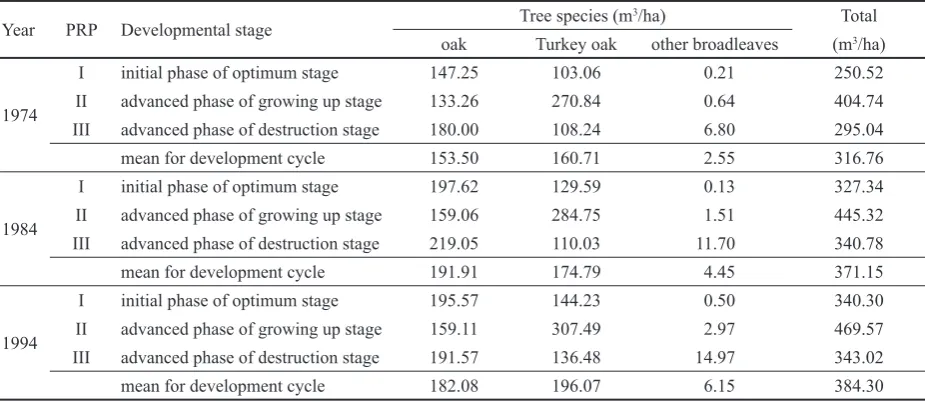
In the upper parts of the slope below the crest forest type group (ftg) Corneto-Quercetum with subgroups CoQ carpineum, CoQ acerosum, CoQ pubescentosum is dominant. Pubescent oak is ecologically represented by Turkey oak (Q. cerris) with its northernmost contiguous occurrence. In 1974, 1984 and 1994 measurements of necromass were made at particular stages of the virgin forest development cycle.
National Nature Reserve Sitno
This reserve with an area of 45.5 ha is situated at the crest and below the crest steeps of Sitno Mts. with a gradient of 25–30° (Štiavnické Mts.), 750–1,010 m a.s.l. The parent rock is built of andesite agglomerates. The soil type is Dystric Cambisol associated with Rank-ers of various depths formed by andesite agglomerate landslide. The average annual temperature is 6°C, ave-rage annual precipitation 850 mm. In the south and south-west facing part, which covers around 2/3 of the total reserve area, ftg Querceto-Fagetum with mosaic occurrence of subgroup QF tiliosum and ftg Tilieto-Aceretum. In respect to the rugged terrain in connec-tion with sudden changes in site condiconnec-tions, species composition and structure of reserve original stands are changing. In 1977, 1987 and 1998 measurements of necromass at particular stages of the virgin forest development cycle were made.
National Nature Reserve Havešová
The reserve with an area of 171.32 ha is situated in Eastern Slovakia in the Bukovské Mts. with a gradient of 25–35%, in the zone of Krosno flysch at the altitude of 500–650 m a.s.l. The soil type is brown forest mesotrophic soil, medium deep to deep, stony, slightly humic. Accord-ing to the climate it belongs to a moderately warm zone with average annual precipitation 700–800 mm and aver-age annual temperature 7°C.
Three forest type groups occur in the reserve: Fagetum pauper (Dentaria bulbifera-Prenanthes purpure-nudum type), Fagetum typicum (Carex pilosa-Asperula odo-rata-Dentaria bulbifera-Prenanthes purpurea type) and Fagetum tiliosum (Carex pilosa-Asperula odorata-Mer-curialis perennis type and Asperula odorata-Merodorata-Mer-curialis perennis-Dentaria enneaphylos type). In 1979, 1989 and 1999 measurements of necromass at particular stages of the virgin forest development cycle were made.
National Nature Reserve Rožok
It is situated in Eastern Slovakia in the Bukovské Mts. area at the altitude of 500–790 m a.s.l, mainly on the north oriented slopes with an area of 67.1 ha. Prevailing gradient of slope is 40–50%. The average annual temperature is 7°C, average annual precipitation 780 mm. The parent rock is dominantly built of sandstone, a smaller part of the area is built of argillaceous shales. Mesotrophic brown forest soil is a dominant soil type. The soil in the upper layer is sandy loam, humic, in the lower layer loamy to clay-loamy with gravel. Fagetum pauper forest type group with Dentaria bulbifera nudum as a dominant type of phytocenosis co-vers around 85% of the virgin forest area. In 1979, 1989 and 1999 measurements of necromass at particular stages of the virgin forest development cycle were made.
National Nature Reserve Kyjov
This virgin forest reserve with an area of 53.4 ha is situ-ated in Eastern Slovakia in the north-west part of Vihorlat Mts. below the Kyjov summit at the altitude of 700–820 m a.s.l., on a moderate north and north-west facing slope. The average annual temperature is 6°C, average annual precipitation 750–800 mm. The parent rock is built of andesite. The soil type is brown forest soil, sandy loam soil, rich in basic nutrients, deep, moderately deep in areas below the crest, slightly acid. Fagetum pauper forest type group with Dentaria bulbifera nudum as a dominant type of phytocenosis is prevailing. In 1963, 1973, 1983 and 1993 measurements of necromass at particular stages of the virgin forest development cycle were made.
National Nature Reserve Hrončokovský grúň It is s situated in the Poľana Mts., at the altitude of 600–950 m a.s.l. with an area of 54 ha. North-east to east slope orientation with a gradient of 30–45° is dominant.
The average annual temperature is 5°C, average annual precipitation 800–850 mm. The parent rock is built of an-desite tuff agglomerate and pyroclastic anan-desite rocks. Un-saturated brown forest soil is a dominant soil type.
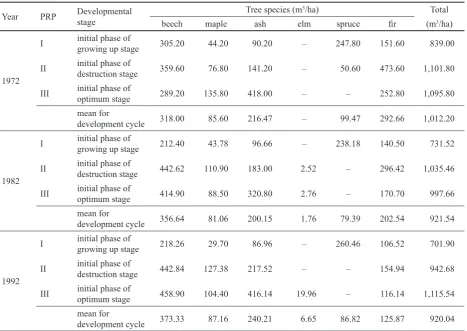
Four forest type groups occur in the reserve: Abieto-Fagetum, Fageto-Abietum, Fageto-Aceretum and Fraxi-neto-Aceretum. In 1972, 1982 and 1992 measurements of necromass at particular stages of the virgin forest develop-ment cycle were made.
National Nature Reserve Stužica
with the largest area of virgin forest in the 4th beech and 5th fir-beech forest altitudinal vegetation zone. It is situated in the Bukovské Mts., in the north-eastern part of Slovakia, at the border between the West and East Carpathian Mts. at the altitude of 650–1,220 m a.s.l.
Permanent research plots are situated at the altitude of 650–900 m a.s.l. from spring area to upper reach of Stužica river. Around 70% of the reserve area face the south and around 30% face the north; 20–50% slope. The average annual temperature is 5–6°C, average annual pre-cipitation 850–1,000 mm. The parent rock are sandstone and taupe shales. Brown forest soil is dominant.
Fagetum typicum forest type group with Asperula odorata-Dentaria bulbifera as a dominant type of phy-tocenosis is prevailing. In 1971, 1981, 1991 and 2001 measurements of necromass at particular stages of the virgin forest development cycle were made.
National Nature Reserve Badín virgin forest The virgin forest is situated in the Kremnické Mts. at the altitude of 700–850 m a.s.l. with total area of 30.70 ha. North to north-east exposition with a gradient of 20–40% is dominant.
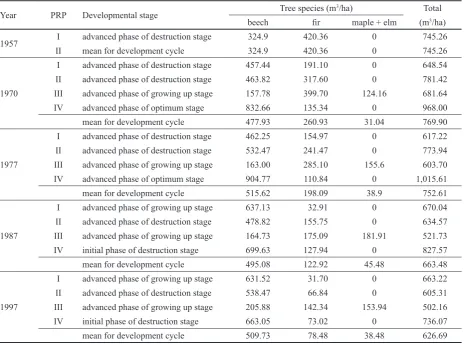
The average annual temperature is 5.5–6°C; average annual precipitation is 850–900 mm. The parent rock is built of tuffs and andesite agglomerates. Saturated brown forest soil is a dominant soil type. Fagetum typicum (70% of the virgin forest area) is a dominant forest type group. In this part of forest four permanent research plots (PRP) are situated. In 1957, 1970, 1977, 1987 and 1997 measure-ments of necromass at particular stages of the virgin forest development cycle were made.
National Nature Reserve Dobroč virgin forest The virgin forest is situated in the western part of Slo-venské rudohorie Mts. at the altitude of 720–1,000 m a.s.l. The original area of 49.88 ha (in 1913) was enlarge to 101.82 ha. West exposition with a gradient of 30–50%.
The average annual temperature is 4.5–5°C; average annual precipitation is 890–960 mm. The parent rock is built of compressed granodiorites, granites and siliceous diorites.
Unsaturated brown forest soils with Abieto-Fagetum as a dominant forest type group (70%) where all permanent research plots are situated. Filices-Asperula odorata-Oxa-lis acetosella-Lamium galeobdolon are dominant forest types. The permanent research plots are situated on the original area of virgin forest. In 1958,1968,1978,1988 and 1998 measurements of necromass at particular stages of the virgin forest development cycle were made.
National Nature Reserve Poľana
This reserve with an area of 658.8 ha is situated at the crest and below the crest of Poľana Mts. with a gradient of 25–30° (Štiavnické Mts.), at the relatively wide range of the altitude 560–1,458 m a.s.l. The parent rock is built of pyroclastic andesite rocks and andesite agglomerate tuffs. East and west exposition is dominant. The average
annual temperature is 4–4.5°C; average annual precipita-tion is 900–1,000 mm.
Sorbeto-Picetum forest type group with the forest type Vaccinium myrthillus-Calamagrostis villosa-Homogyne alpina-Adenostyles alliariae and Acereto-Piceetum is dominant. In these conditions three permanent research plots are situated. In 1974, 1984 and 1994 measurements of necromass at particular stages of the virgin forest de-velopment cycle were made.
National Nature Reserve Kosodrevina Spruce stands with the virgin forest character are situ-ated on the southern slope of Chopok Mts. at the altitude of 1,380–1,430 m a.s.l. South exposition, slope 30–35%. The average annual temperature is 1.5–2°C; average an-nual precipitation is 1,150–1,200 mm. The parent rock is built of crystalline rocks. The soil type is moderate humic podzolic soil. The soil is shallow to moderately deep, strongly stony, moist, moderately acid. According to forest typology a part of PRP belongs to the forest type group Sorbeto-Piceetum and phytocenosis type Vacci-nium myrthillus-Calamagrostis villosa-Homogyne alpina (PRP No. 1 and 2) and Vaccinium myrthillus-Dryopteris spinulosa asp. Dilatata-Homogyne alpina (PRP No. 3). In 1976, 1986 and 1996 measurements of necromass at particular stages of the virgin forest development cycle were conducted.
METHODS OF EVALUATION
To determine the necromass dynamics within the life cy-cle of virgin forest we used determination of the whole pe-riod of the life cycle of particular virgin forests according to KORPEĽ (1995). The values of measured necromass at the particular developmental stages and years of measure-ment were attributed to the respective time periods within the whole period of the life cycle of individual virgin forest. Models of Slovak virgin forest by KORPEĽ (1989, 1995) were used as an example for location of necromass with the time increment of 10 years within the virgin forest development cycle. The necromass was differenti-ated neither according to the degree of decay nor accord-ing to the ratio of standaccord-ing dead and lyaccord-ing wood.
The dependence of increase or decrease in dead wood on time was assessed by a set of functions. For fitting the dependence the polynomial function of the 3rd degree was used. It delivered the best coincidence with the course of necromass as well as the highest correlation coefficient.
RESULTS
National Nature Reserve Boky
de-cline of sessile oak trees and Turkey oak trees and about high ecological stability of virgin forest. Small-area de-struction is still slowed down by Turkey oak, whose physi-cal age is longer than that of sessile oak. It is explained by the fact that Turkey oak is not so much attacked by fungi at the end of its life as sessile oak. Because Turkey oak composition is almost the same as that of sessile oak, which dies sooner, the accumulation of necromass slows down at places that are at the destruction stage (Fig. 1).
The low ratio of necromass during the whole develop-ment cycle of virgin forest is caused by relatively low biomass values that are determined by the soil poor in
nutrients (Table 1) where PRP are situated. This indicator together with gradual decline of trees that are at the die-back phase or attacked by fungi, are significant elements of continuous necromass course with its relatively low and stable values.
National Nature Reserve Sitno
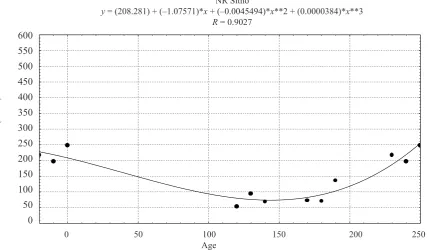
The main tree species of the virgin forest life cycle on PRP No. 2 is beech together with sycamore maple. The physical age of beech and sycamore maple is nearly the same – 250 years. The necromass course is different from the previous virgin forest. The values of necromass at the NR Boky
y=(58,7261)+(0,3957116)*x+(-0,0067938)*x**2+(0,0000184)*x**3 R=0,59858
Age
N
e
c
ro
m
a
s
s
m
3 .h
a
-1
0 50 100 150 200 250 300 350 400 450 500 550 600
0 50 100 150 200 250 300
Fig.1: Addiction of necromass volume within the developmental cycle in virgin forest Boky
0 50 100 150 200 250 300
600 550 500 450 400 350 300 250 200 150 100 50 0
NR Boky
y = (58.7261) + (0.3957116)*x + (–0.0067938)*x**2 + (0.0000184)*x**3 R = 0.59858
Age
Necromass (m
[image:4.595.87.518.80.325.2]3/ha)
Fig. 1. The course of necromass volume within the development cycle in Boky virgin forest
Table 1. Structure of living trees over 7cm volume in Boky virgin forest according to developmental stages
Year PRP Developmental stage Tree species (m3/ha) Total
oak Turkey oak other broadleaves (m3/ha)
1974
I initial phase of optimum stage 147.25 103.06 0.21 250.52
II advanced phase of growing up stage 133.26 270.84 0.64 404.74
III advanced phase of destruction stage 180.00 108.24 6.80 295.04
mean for development cycle 153.50 160.71 2.55 316.76
1984
I initial phase of optimum stage 197.62 129.59 0.13 327.34
II advanced phase of growing up stage 159.06 284.75 1.51 445.32
III advanced phase of destruction stage 219.05 110.03 11.70 340.78
mean for development cycle 191.91 174.79 4.45 371.15
1994
I initial phase of optimum stage 195.57 144.23 0.50 340.30
II advanced phase of growing up stage 159.11 307.49 2.97 469.57
III advanced phase of destruction stage 191.57 136.48 14.97 343.02
[image:4.595.74.537.554.755.2]growing-up stage and at the destruction stage, which are relatively high, are very similar. A broad spectrum of the tree species composition (8 tree species), where the
[image:5.595.60.523.72.415.2]physi-cal age of some species (hornbeam) is 130–150 years and of others (oak, fir) more than 300 years (Table 2), is the reason for this fact. It influences the necromass increase Table 2. Structure of living trees over 7cm volume in Sitno virgin forest according to developmental stages
Year PRP Developmental stage
Tree species (m3/ha)
Total (m3/ha)
beech oak maple horn-beam ash lime broadleavesother fir
1977
I advanced phase of destruction stage 253.66 152.24 40.12 19.40 73.76 32.60 0.00 33.10 604.88
II initial phase of optimum stage 183.06 68.18 239.56 133.62 13.96 2.54 0.00 20.46 661.38
III advanced phase of growing up stage 156.74 54.08 60.82 18.74 73.76 70.14 5.96 90.12 530.36 mean for development
cycle 197.82 91.50 113.50 57.25 53.83 35.09 1.99 47.89 598.87
1987
I advanced phase of destruction stage 262.15 119.13 46.44 18.60 47.96 34.20 0.00 31.23 559.71
II initial phase of optimum stage 197.51 46.12 255.48 71.41 14.09 3.13 0.00 18.74 606.48
III advanced phase of growing up stage 195.06 67.44 76.07 21.20 90.17 91.88 0.00 73.87 615.69 mean for development
cycle 218.24 77.56 126.00 37.07 50.74 43.07 0.00 41.28 593.96
1998
I advanced phase of destruction stage 167.21 50.88 34.73 12.00 35.97 33.96 0.00 11.02 345.77
II initial phase of optimum stage 141.50 32.18 207.21 31.18 12.79 2.23 0.09 17.67 444.85
III advanced phase of growing up stage 183.57 56.76 76.29 18.14 99.98 95.01 3.51 83.84 617.10 mean for development
cycle 164.08 46.61 106.08 20.44 49.58 43.73 1.20 37.51 469.23
NR Sitno
y=(208,281)+(-1,07571)*x+(-0,0045494)*x**2+(0,0000384)*x**3 R=0,9027
age
n
e
c
ro
m
a
s
s
m
3 .h
a
-1
0 50 100 150 200 250 300 350 400 450 500 550 600
0 50 100 150 200 250
Fig.2: Addiction of necromass volume within the developmental cycle in virgin forest Sitno 600
550 500 450 400 350 300 250 200 150 100 50 0
0 50 100 150 200 250
Age
Necromass (m
3/ha)
NR Sitno
y = (208.281) + (–1.07571)*x + (–0.0045494)*x**2 + (0.0000384)*x**3 R = 0.9027
[image:5.595.72.504.486.736.2]during the whole development cycle of virgin forest in such a way that drops-out occur either at the end of the destruction stage (hornbeam) or at the beginning of the growing-up stage of the second development cycle (oak, fir). We considered the fact across the virgin forest area at the beginning of the growing-up stage after oak trees dropped out, its natural seeding and advance growth took over. It is possible only if oak trees of previous generations of virgin forest can be found in the groups (0.1 ha).
Higher values of necromass are caused by a relatively high volume of biomass during the whole development cycle. The relation approximated by a polynomial function of the 3rd degree has a high value of correlation coefficient R = 0.90 (Fig. 2). On the other hand, large differences between the optimum stage and destruction stage, and be-tween the optimum stage and growing-up stage are caused by the phase of tree species seeing out whose physical age is shorter than the physical age of beech, which together with maple determines the period of the development cycle of virgin forest. The necromass existence at the optimum stage is determined by the left-vers of fir trees whose time of decomposition is too long, 50–60 years. Dropping out of fir at the optimum stage means an increase in beech and maple growth as a response to empty growing space resulting in a higher volume increment of both tree species. On the other hand, under these ecological conditions fir regeneration is good. Fir is a continuous element almost during the whole development cycle of virgin forest. The continuity of tree species formation that are not determinant elements of the virgin forest development cycle is paradoxically given by the ecological conditions these tree species created them-selves by gradual expansion of growing space or stand canopy at the advanced phase of the destruction stage.
National Nature Reserves Havešová, Rožok, Kyjov They are beech virgin forests of the East Carpathian Mts., very similar or identical by their natural conditions. Thus, all measurements of all three reserves were collected to a common relation to better characterise necromass within the development cycle of beech virgin forest. By fitting the necromass course within the development cycle by a polynomial function of the 3rd degree relatively close relations were confirmed. Correlation coefficient R = 0.47 is significant. The course of the curve is gradual and the highest decline is between 150 and 170 years (the opti-mum stage). A relatively high volume of necromass at the optimum stage is connected with the fact that this stage takes a relatively short time of 30–40 years and the last remnants of the biggest beech trees that dropped out at the growing-up stage are getting to the optimum stage by their necromass. As their decomposition time is 30–35 years, they are present on the area during the whole period of this stage. These beech virgin forests are characterised by soils rich in nutrients which in turn cause shallow root systems of beech trees. In spite of their good physiological vitality and relatively considerable height of 44–46 m most beech trees are uprooted by wind at the initial phase of the optimum stage. This phenomenon causes an increase in necromass also at the optimum stage when under reference conditions the necromass does not increase (Fig. 3).
National Nature Reserve Stužica
The course of necromass within the development cycle in Stužica virgin forest is similar to that in Boky virgin forest. Correlation coefficient is R = 0.95 (Fig. 4). Besides the dominant composition of beech and fir as associated tree species (Table 3) the course of curve is characterised
Haveová, Rozok, Kyjov
y=(142,3246)+(1,9948)*x+(-0,028985)*x**2+(0,0000907)*x**3 R=0,4694
Age
N
e
c
ro
m
a
s
s
m
3 .h
a
-1
0 50 100 150 200 250 300 350 400 450 500 550 600
[image:6.595.83.506.467.734.2]50 100 150 200
Fig.3: Addiction of necromass volume within the developmental cycle in virgin forests Haveová, Rozok, Kyjov
600 550 500 450 400 350 300 250 200 150 100 50 0
50 100 150 200
Age
Necromass (m
3/ha)
Havešová, Rožok, Kyjov
y = (142.3246) + (1.9948)*x + (–0.028985)*x**2 + (0.0000907)*x**3 R = 0.4694
by small differences between the minimum and maximum. The necromass increase at the growing-up stage is mainly caused by a decline of fir of the previous generation of the virgin forest life cycle. The optimum stage takes a very short time of 30–40 years in this reserve. Due to this fact the fir necromass, which drops out at the final phase of the growing-up stage, is maintained in the virgin forest. During the period of fir decline of 50–55 years it drifts into the initial phase of the destruction stage.
For this tree species composition we can state that there does not occur a jump increase in necromass except the fir composition higher than 10–15%. The soils poorer in nutrients in comparison with the soils in beech virgin for-ests of Eastern Slovakia or Badín virgin forest explain this fact. Lower nutrient contents result in deeper root systems of beech trees. These beech trees are not uprooted but they drop out in the virgin forest in consequence of their physi-cal life. Fir is the second factor that shares in higher beech stability. Fir by its mainly single tree mixture and good
root system is a significant stability element of this virgin forest (Table 3). This forest shows good signs of nutrient balance from the point of view of necromass course during the whole development cycle of virgin forest.
[image:7.595.57.525.71.502.2]National Nature Reserve Badín virgin forest More than 70% of Badín virgin forest area belongs to the forest type group Fagetum typicum according to typological classification. Fir is only an associated tree species in this type. Permanent research plots are situ-ated at the boundary of this forest altitudinal zone, that means the length of development cycle is determined by beech as the main tree species of virgin forest (Table 4). The soils in Badín virgin forest were also formed on the base of andesite, very rich in nutrients similarly like in beech virgin forests of the East Carpathian Mts. These soils modify the flat shape of the beech root system. The necromass course within the development cycle is rather different from previous virgin forests. The change in shape Table 3. Structure of living trees over 7cm volume in Stužica virgin forest according to developmental stages
Year PRP Developmental stage Tree species (m3/ha) Total
beech fir maple (m3/ha)
1971
I initial phase of growing up stage 558.81 2.43 5.58 563.82
II advanced phase of growing up stage 396.19 168.19 – 564.38
III initial phase of destruction stage 477.95 71.07 – 549.02
IV advanced phase of destruction stage 601.66 29.19 29.87 660.72
V optimum stage 535.44 65.52 0.87 601.83
VI advanced phase of growing up stage 564.49 136.74 7.67 708.90
mean for development cycle 521.49 78.86 7.33 608.11
1981
I initial phase of growing up stage 643.75 0.65 9.92 654.32
II advanced phase of growing up stage 445.66 228.72 – 674.38
III initial phase of destruction stage 426.63 91.36 – 517.99
IV advanced phase of destruction stage 616.18 19.44 19.94 655.56
V optimum stage 535.51 61.49 0.82 597.82
VI advanced phase of growing up stage 585.66 95.76 8.64 690.06
mean for development cycle 542.23 82.90 6.56 631.69
1991
I initial phase of growing up stage 627.19 0.86 – 628.05
II advanced phase of growing up stage 412.84 107.16 – 520.00
III initial phase of destruction stage 477.70 81.42 – 559.12
IV advanced phase of destruction stage 675.77 11.59 – 687.36
V optimum stage 512.94 22.76 – 535.70
VI advanced phase of growing up stage 648.52 68.14 – 716.66
mean for development cycle 559.16 48.66 – 607.82
2001
I initial phase of growing up stage 676.08 0.75 – 676.83
II advanced phase of growing up stage 435.61 45.30 – 480.91
III initial phase of destruction stage 505.59 86.36 – 591.95
IV advanced phase of destruction stage 606.26 13.11 – 619.37
V optimum stage 575.32 7.70 – 583.02
VI advanced phase of growing up stage 569.97 91.78 – 661.75
is caused by a high volume ratio of fir and its decline at the growing-up stage (Table 4) in 1970–1997 or at the begin-ning of the optimum stage, which takes 30–40 years. In
this virgin forest such situations are common, as PRP III shows, when strong wind uprooted physiologically vital beech trees before the final phase of growing old. The
NR Stuzica
y=(39,1201)+(2,42746)*x+(-0,0210095)*x**2+(0,0000501)*x**3 R=0,9501
Age
N
e
c
ro
m
a
s
s
m
3 .h
a
-1
0 50 100 150 200 250 300 350 400 450 500 550 600
[image:8.595.86.511.59.303.2]50 100 150 200 250
Fig.4: Addiction of necromass volume within the developmental cycle in virgin forest Stuzica
600 550 500 450 400 350 300 250 200 150 100 50 0
Necromass (m
3/ha)
50 100 150 200 250
NR Stužica
y = (39.1201) + (2.42746)*x + (–0.0210095)*x**2 + (0.0000501)*x**3 R = 0.9501
Age
Fig. 4. The course of necromass volume within the development cycle in Stužica virgin forest
Table 4. Structure of living trees over 7cm volume in Badín virgin forest according to developmental stages
Year PRP Developmental stage Tree species (m3/ha) Total
beech fir maple + elm (m3/ha)
1957 I advanced phase of destruction stage 324.9 420.36 0 745.26
II mean for development cycle 324.9 420.36 0 745.26
1970
I advanced phase of destruction stage 457.44 191.10 0 648.54
II advanced phase of destruction stage 463.82 317.60 0 781.42
III advanced phase of growing up stage 157.78 399.70 124.16 681.64
IV advanced phase of optimum stage 832.66 135.34 0 968.00
mean for development cycle 477.93 260.93 31.04 769.90
1977
I advanced phase of destruction stage 462.25 154.97 0 617.22
II advanced phase of destruction stage 532.47 241.47 0 773.94
III advanced phase of growing up stage 163.00 285.10 155.6 603.70
IV advanced phase of optimum stage 904.77 110.84 0 1,015.61
mean for development cycle 515.62 198.09 38.9 752.61
1987
I advanced phase of growing up stage 637.13 32.91 0 670.04
II advanced phase of destruction stage 478.82 155.75 0 634.57
III advanced phase of growing up stage 164.73 175.09 181.91 521.73
IV initial phase of destruction stage 699.63 127.94 0 827.57
mean for development cycle 495.08 122.92 45.48 663.48
1997
I advanced phase of growing up stage 631.52 31.70 0 663.22
II advanced phase of destruction stage 538.47 66.84 0 605.31
III advanced phase of growing up stage 205.88 142.34 153.94 502.16
IV initial phase of destruction stage 663.05 73.02 0 736.07
[image:8.595.75.540.412.756.2]polynomial function of the 3rd degree y= 262.8 + 0.306x + 0.0043x2 – 0.000023x3 has a statistically significant cor-relation coefficient R = 0.40.
The high absolute ratio of necromass in the virgin forest reflects its high volume production (Table 4). Production at the growing-up stage is conditioned by the high volume
NR Badín
y=(262,79)+(0,306304)*x+(0,0043372)*x**2+(-0,0000235)*x**3 R=0,4045
Age
N
e
c
ro
m
a
s
s
m
3 .h
a
-1
0 50 100 150 200 250 300 350 400 450 500 550 600
[image:9.595.89.499.59.311.2]0 50 100 150 200 250
Fig.5: Addiction of necromass volume within the developmental cycle in virgin forest Badín
600 550 500 450 400 350 300 250 200 150 100 50 0
Necromass (m
3/ha)
0 50 100 150 200 250
NR Badín
y = (262.79) + (0.306304)*x + (0.0043372)*x**2 + (–0.0000235)*x**3 R = 0.4045
Age
Fig. 5. The course of necromass volume within the development cycle in Badín virgin forest
Table 5. Structure of living trees over 7cm volume in Hrončokovský grúň virgin forest according to developmental stages
Year PRP Developmental stage Tree species (m3/ha) Total
beech maple ash elm spruce fir (m3/ha)
1972
I initial phase of growing up stage 305.20 44.20 90.20 – 247.80 151.60 839.00
II initial phase of destruction stage 359.60 76.80 141.20 – 50.60 473.60 1,101.80
III initial phase of optimum stage 289.20 135.80 418.00 – – 252.80 1,095.80 mean for
development cycle 318.00 85.60 216.47 – 99.47 292.66 1,012.20
1982
I initial phase of growing up stage 212.40 43.78 96.66 – 238.18 140.50 731.52
II initial phase of destruction stage 442.62 110.90 183.00 2.52 – 296.42 1,035.46
III initial phase of optimum stage 414.90 88.50 320.80 2.76 – 170.70 997.66 mean for
development cycle 356.64 81.06 200.15 1.76 79.39 202.54 921.54
1992
I initial phase of growing up stage 218.26 29.70 86.96 – 260.46 106.52 701.90
II initial phase of destruction stage 442.84 127.38 217.52 – – 154.94 942.68
III initial phase of optimum stage 458.90 104.40 416.14 19.96 – 116.14 1,115.54 mean for
[image:9.595.59.527.424.755.2]ratio of fir. A gradual increase in necromass at the opti-mum stage and at the beginning of the destruction stage is caused by a partial transfer of a part of fir necromass where the whole process of decomposition did not occur and by necromass of uprooted but still vital beech trees in consequence of their flat root systems and small crowns.
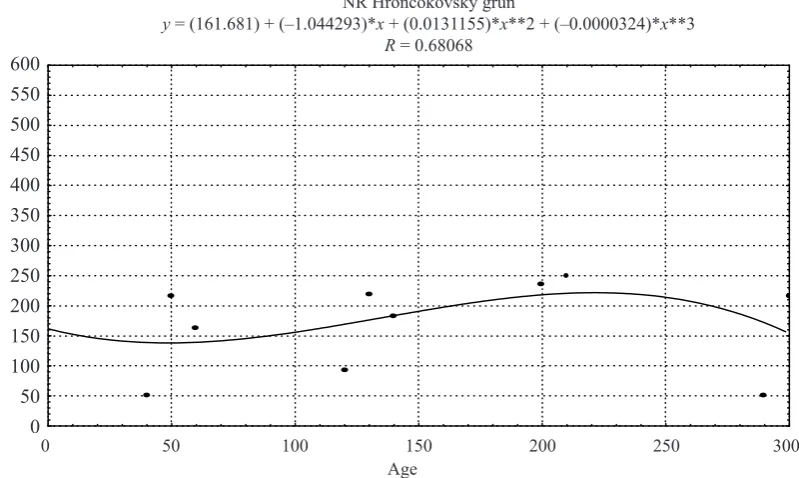
National Nature Reserve Hrončokovský grúň The necromass course within the development cycle of virgin forest, which was determined to be 250 years, has a different character in National Nature Reserve Sitno. The correlation coefficient R = 0.68 is statistically sig-nificant (Fig. 6). The first information is a slow decay or a small increase in necromass during the whole develop-ment cycle. The second fact is a high volume of necromass during the whole development cycle. Approximately the same volume ratio of coniferous trees (spruce, fir) and broadleaves (Table 5) is the reason. The number of trees of particular tree species is different. The average volume of fir living trees is in the range of 15–20 m3, beech and maple 8–12 m3. On the basis of this fact, beech is the basic tree species of the virgin forest. Beech fills up the produc-tive space in the virgin forest and together with sycamore maple is a determinant tree species of development cycle. Fir and spruce, whose physical age is 350–400 years, take share in the necromass at the growing-up stage and at the optimum stage, respectively, of the next development cycle. An increase in their necromass at these stages of virgin forest development cycle means the balance of necromass during the whole development cycle of this virgin forest (Table 5, Fig. 6).
The balance of necromass during the growing-up stage and its moderate increase at the optimum stage are con-nected with fir. Fir drops out gradually at the growing-up
stage and determines the necromass value at a relatively balanced level. Because the time of fir decomposition in this reserve is relatively long (55–60 years), together with spruce it is shifting to the optimum stage. Due to this fact the course of necromass curve is rather untypical. On the contrary, it is necessary to mention that there are good con-ditions for germination, survival, outliving and grow-up of seedlings during the destruction stage and at the initial phase of the growing-up stage. By this, fir takes share in biomass and also in necromass volume almost in the whole development cycle of virgin forest. Hrončokovský grúň virgin forest, which represents a relatively balanced cycle of nutrients by its tree species composition, comes back through accumulation and decomposition of necro-mass. Due to high ecological stability and stable living mode this type of natural forest ecosystem ranks among the most balanced ecosystems in terms of production and functions.
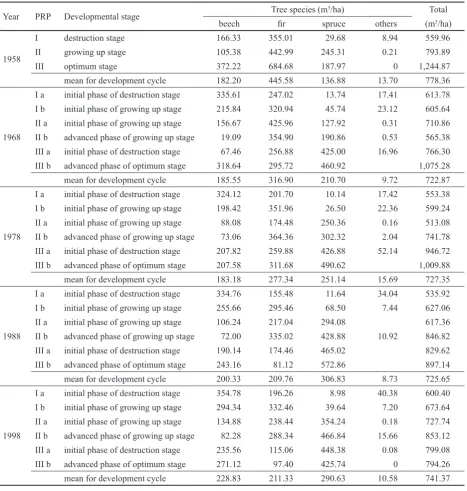
National Nature Reserve Dobroč virgin forest This reserve contains two tree species that by their physical age determine the period of development cycle to be 400 years. They are fir and spruce. As for the origin and course of necromass, beech has a similar role like fir in the Badín virgin forest (Table 6). The necromass course expressed by a polynomial function of the 3rd degree and correlation coefficient R = 0.56 is at the higher volume level than in Badín virgin forest (Fig. 7). There are two reasons for this fact. One reason is the highest bio-mass production of all Slovak virgin forests. The other reason for high necromass volume within the develop-ment cycle is the presence of beech, whose physical age is in the range of 220–230 years. Due to abiotic factors (wind) most beech trees drop out at their physical age of
NR Hroncokovs ký grun
y=(161,681)+(-1,044293)*x+(0,0131155)*x**2+(-0,0000324)*x**3 R=0,68068
Age
N
e
c
ro
m
a
ss
m
3 .h
a
-1
0 50 100 150 200 250 300 350 400 450 500 550 600
[image:10.595.99.499.59.298.2]0 50 100 150 200 250 300
Fig.6: Addiction of necrom as s volum e within the developm ental cycle in virgin fores t Hron
NR Hrončokovský grúň
y = (161.681) + (–1.044293)*x + (0.0131155)*x**2 + (–0.0000324)*x**3 R = 0.68068
600 550 500 450 400 350 300 250 200 150 100 50 0
Necromass (m
3/ha)
0 50 100 150 200 250 300
Age
150–170 years, which leads to an increase in necromass at the final phase of the growing-up stage. This trend continues at the initial phase of the optimum stage. On the contrary, by its second generation beech participates in the biomass volume at the destruction stage when the necromass created by gradual spruce and fir decay increases (Table 6). Decline and increase with maximal difference of 120–130 m3/ha characterise the whole necromass course.
The relatively high ratio of beech and its dieback at the optimum stage create a typical necromass course in this virgin forest. Sudden decline of spruce, faster than the mass decline of fir, results in a significant increase in necromass within the whole destruction stage.
National Nature Reserve Poľana
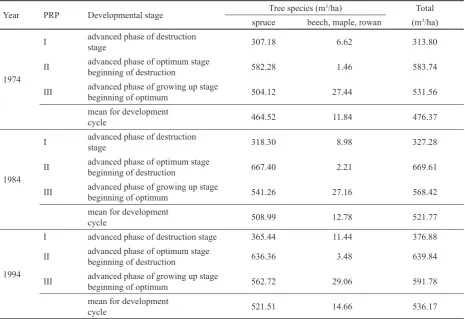
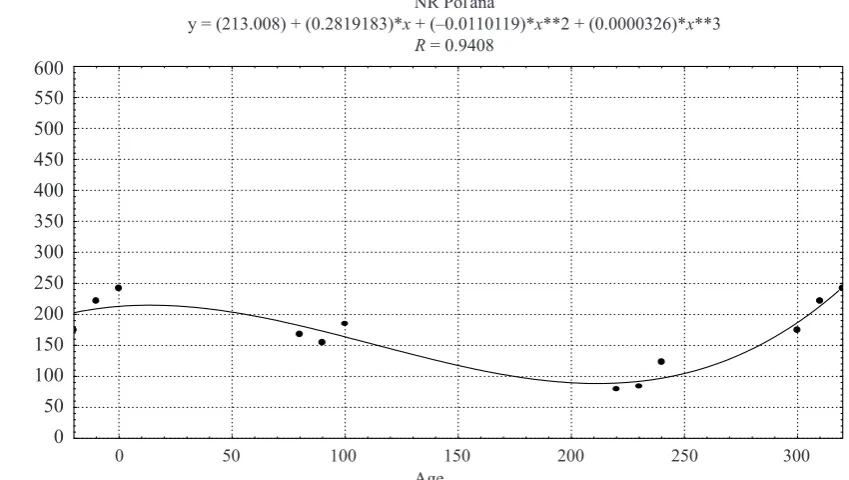
[image:11.595.58.526.71.563.2]Spruce is a determinant tree species of development cycle in this virgin forest (Table 7). The necromass course, when the period of development cycle is 350 years, as shown in Fig. 8, is fitted by a polynomial function of the 3rd degree with the correlation coefficient R = 0.94. Total volume of necromass, which is lower than in Dobroč virgin forest, is determined by the biomass volume that is essentially lower as a result of tree species composition and altitude (Table 7). The necromass course shows the following facts. An increase in necromass at the growing-up stage is influenced by the phase of dieback and decline of spruce trees of previous generation that die generally Table 6. Structure of living trees over 7cm volume in Dobroč virgin forest according to developmental stages
Year PRP Developmental stage Tree species (m3/ha) Total
beech fir spruce others (m3/ha)
1958
I destruction stage 166.33 355.01 29.68 8.94 559.96
II growing up stage 105.38 442.99 245.31 0.21 793.89
III optimum stage 372.22 684.68 187.97 0 1,244.87
mean for development cycle 182.20 445.58 136.88 13.70 778.36
1968
I a initial phase of destruction stage 335.61 247.02 13.74 17.41 613.78 I b initial phase of growing up stage 215.84 320.94 45.74 23.12 605.64 II a initial phase of growing up stage 156.67 425.96 127.92 0.31 710.86 II b advanced phase of growing up stage 19.09 354.90 190.86 0.53 565.38 III a initial phase of destruction stage 67.46 256.88 425.00 16.96 766.30 III b advanced phase of optimum stage 318.64 295.72 460.92 1,075.28
mean for development cycle 185.55 316.90 210.70 9.72 722.87
1978
I a initial phase of destruction stage 324.12 201.70 10.14 17.42 553.38 I b initial phase of growing up stage 198.42 351.96 26.50 22.36 599.24 II a initial phase of growing up stage 88.08 174.48 250.36 0.16 513.08 II b advanced phase of growing up stage 73.06 364.36 302.32 2.04 741.78 III a initial phase of destruction stage 207.82 259.88 426.88 52.14 946.72 III b advanced phase of optimum stage 207.58 311.68 490.62 1,009.88
mean for development cycle 183.18 277.34 251.14 15.69 727.35
1988
I a initial phase of destruction stage 334.76 155.48 11.64 34.04 535.92 I b initial phase of growing up stage 255.66 295.46 68.50 7.44 627.06
II a initial phase of growing up stage 106.24 217.04 294.08 617.36
II b advanced phase of growing up stage 72.00 335.02 428.88 10.92 846.82 III a initial phase of destruction stage 190.14 174.46 465.02 829.62
III b advanced phase of optimum stage 243.16 81.12 572.86 897.14
mean for development cycle 200.33 209.76 306.83 8.73 725.65
1998
I a initial phase of destruction stage 354.78 196.26 8.98 40.38 600.40 I b initial phase of growing up stage 294.34 332.46 39.64 7.20 673.64 II a initial phase of growing up stage 134.88 238.44 354.24 0.18 727.74 II b advanced phase of growing up stage 82.28 288.34 466.84 15.66 853.12 III a initial phase of destruction stage 235.56 115.06 448.38 0.08 799.08
III b advanced phase of optimum stage 271.12 97.40 425.74 0 794.26
while still standing. It is obvious because their volume is 14–16 m3 and the time of decomposition is 50–55 years. A decline is that never reaches the zero value typical of the optimum stage. Particular trees whose volume is
sub-stituted by the growth potential of the remaining living trees also die at this stage. It is represented by the second peak of parabola till sudden destruction at the end of development cycle.
NR Dobroc
y=(309,3913)+(-1,827507)*x+(0,0112581)*x**2+(-0,0000161)*x**3 R=0,5595
Age
N
e
c
ro
m
a
s
s
m
3 .h
a
-1
0 50 100 150 200 250 300 350 400 450 500 550 600
[image:12.595.93.511.60.305.2]50 100 150 200 250 300 350 400
Fig.7: Addiction of necromass volume within the developmental cycle in virgin fo NR Dobroč
y = (309.3913) + (–1.3827507)*x + (0.0112581)*x**2 + (–0.0000161)*x**3 R = 0.5595
600 550 500 450 400 350 300 250 200 150 100 50 0
Necromass (m
3/ha)
50 100 150 200 250 300 350 400
Age
Fig. 7. The course of necromass volume within the development cycle in Dobroč virgin forest
Table 7. Structure of living trees over 7cm volume in Poľana virgin forest according to developmental stages
Year PRP Developmental stage Tree species (m3/ha) Total
spruce beech, maple, rowan (m3/ha)
1974
I advanced phase of destruction stage 307.18 6.62 313.80
II advanced phase of optimum stage beginning of destruction 582.28 1.46 583.74
III advanced phase of growing up stage beginning of optimum 504.12 27.44 531.56 mean for development
cycle 464.52 11.84 476.37
1984
I advanced phase of destruction stage 318.30 8.98 327.28
II advanced phase of optimum stage beginning of destruction 667.40 2.21 669.61
III advanced phase of growing up stage beginning of optimum 541.26 27.16 568.42 mean for development
cycle 508.99 12.78 521.77
1994
I advanced phase of destruction stage 365.44 11.44 376.88
II advanced phase of optimum stage beginning of destruction 636.36 3.48 639.84
III advanced phase of growing up stage beginning of optimum 562.72 29.06 591.78 mean for development
[image:12.595.72.538.436.755.2]National Nature Reserve Kosodrevina The spruce virgin forest in Kosodrevina virgin forest in the Low Tatras Mts. has a similar course of the polyno-mial function of the 3rd degree with correlation coefficient R = 0.77 (Fig. 9). The values of necromass during the development cycle are lower than in Poľana virgin for-est. It is in connection with lower total volume production of biomass at the higher altitude of 1,350–1,400 m a.s.l. (Table 8). Because of area decay (wind) in this virgin forest, with increase in necromass at the initial phase of the grow-up stage, the process of necromass decomposition takes place during the whole destruction stage and at the initial phase of the growing-up stage. Also in this spruce virgin
forest at the optimum stage big spruce trees sometimes drop out, which increases the necromass considerably by their dendromass, thus not reaching the zero level.
Decline or uprooting of individual spruce trees does not cause transition to the destruction stage. The virgin forest is able to fill up the growing space gradually for a long period, so the ecological conditions for the next generation growth are not suitable.
CONCLUSION
The following conclusions can be drawn on the basis of necromass course analyses in selected types of Slovak virgin forests:
Age
0 50 100 150 200 250 300
NR Poľana
y = (213.008) + (0.2819183)*x + (–0.0110119)*x**2 + (0.0000326)*x**3 R = 0.9408
600 550 500 450 400 350 300 250 200 150 100 50 0
NR Polana
y=(213,008)+(0,2819183)*x+(-0,0110119)*x**2+(0,0000326)*x**3 R=0,9408
Age
N
e
c
ro
m
a
s
s
m
3 .h
a
-1
0 50 100 150 200 250 300 350 400 450 500 550 600
[image:13.595.73.498.59.299.2]0 50 100 150 200 250 300
Fig.8: Addiction of necromass volume within the developmental cycle in virgin forest Polan
Necromass (m
3/ha)
Fig. 8. The course of necromass volume within the development cycle in Poľana virgin forest
Table 8. Structure of living trees over 7cm volume in Chopok-Kosodrevina virgin forest according to developmental stages
Year PRP Developmental stage Tree species (m3/ha) Total
spruce rowan + beech (m3/ha)
1976
I advanced phase of growing up stage 463.80 1.57 465.37
II advanced phase of destruction stage 515.68 6.92 522.60
III advanced phase of optimum stage 782.42 1.20 783.62
mean for development cycle 587.30 3.23 590.53
1986
I advanced phase of growing up stage 494.02 1.97 495.99
II advanced phase of destruction stage 476.80 7.35 484.15
III advanced phase of optimum stage 803.40 1.48 804.88
mean for development cycle 591.41 3.60 595.01
1996
I advanced phase of growing up stage 505.56 1.43 506.99
II advanced phase of destruction stage 441.30 8.35 449.65
III advanced phase of optimum stage 815.52 0.53 816.05
[image:13.595.59.523.554.755.2]In the virgin forest consisting of two tree species with almost the same physical age and ecological requirements characterised by high stability, destruction and consistent decline of individual trees at the growing-up stage create a low gradual course of necromass with its minimum at the optimum stage.
In the virgin forest consisting of several tree species in the 3rd altitudinal vegetation zone with various length of their physical age, an increase in necromass during the development cycle is significantly higher and at the optimum stage it has essentially higher absolute values. It is caused by an increase in necromass of fir which gets to the phase of its seeing out at the optimum stage of the second development cycle of virgin forest. Tree species determining the length of development cycle (beech, sycamore maple) have approximately the same age of physical survival.
Hrončokovský grúň virgin forest has the most differenti-ated tree species composition (6 tree species) among the virgin forests at the boundary between 4th and 5th altitu-dinal vegetation zone. High values of necromass during the development cycle were obtained in this virgin forest. Similarly like in the previous virgin forest the highest in-crease was obtained at the optimum stage. It is especially due to fir which dies at the second development cycle of virgin forest. Beech virgin forests are very heterogene-ous from the point of view of necromass course within the development cycle. The lower values of correlation coefficients confirm this fact. Relatively high values of necromass at the optimum stage are connected with beech short period and long process of decomposition. Balanced values of necromass in Stužica virgin forest and high and statistically significant correlation coefficient R = 0.95 confirm high stability and gradual beech decline during the destruction stage and the growing-up stage. The
nec-NR Chopok-Kosodrevina
y=(162,0656)+(-2,22454)*x+(0,0174946)*x**2+(-0,0000336)*x**3 R=0,7737
Age
N
e
c
ro
m
a
s
s
m
3 .h
a
-1
0 50 100 150 200 250 300 350 400 450 500 550 600
[image:14.595.89.512.56.290.2]0 50 100 150 200 250
Fig.9: Addiction of necromass volume within the developmental cycle in virgin forest Chopok-Kosodrevin
600 550 500 450 400 350 300 250 200 150 100 50 0
NR Chopok-Kosodrevina
y = (162.0656) + (–2.22454)*x + (0.0174946)*x**2 + (–0.0000336)*x**3 R = 0.7737
Necromass (m
3/ha)
0 50 100 150 200 250
Age
Fig. 9. The course of necromass volume within the development cycle in Chopok-Kosodrevina virgin forest
romass increase at the optimum stage is connected with seeing out of fir from the previous development cycle of virgin forest. In Badín virgin forest high heterogeneity of necromass course within development cycles is deter-mined by a significant fir increase, uprooting of physiolog-ically and physphysiolog-ically vital beech trees due to their shallow root systems and sudden gusts of wind. This phenomenon in the virgin forests in connection with climatic changes will be a part of the influence on necromass increase in the future. Dobroč virgin forest has a more balanced course of necromass and its increase at the optimum stage is mainly caused by beech decline and seldom fir decline.
Spruce virgin forest Poľana, according to site condi-tions, is characterised by its stability. By this, the course of necromass increase and decrease is characteristic of this virgin forest type. In spruce virgin forest Kosodrevina situated near to the upper forest limit (1,450 m a.s.l.) wind is a significant phenomenon. The necromass course is sig-nificantly changed by wind and at the optimum stage its volume increases by uprooting of physiologically vital trees.
The obtained relation should provide valid data for necromass volume determination in forests with various dominant functions.
References
ALBRECHT L., 1990. Grundlage, Ziele und Methodik der waldökologischen Forschung in Naturwaldereservaten. Diss. Forstwiss. Fak. Universität München: 161.
ALBRECHT L., 1991. Die Bedeutung des toten Holzes im Wald. Forstwiss. Cbl., 110: 106–113.
KÖHLER F., 1990. Anmerkungen zur ökologischen Bedeutung des Alt- und Totholzes in Naturwaldzellen. Seminarbericht Naturschutzzentrum NRW, 10: 14–18.
KORPEĽ Š., 1989. Pralesy Slovenska. Bratislava, Veda, SAV: 248.
KORPEĽ Š., 1995. Die Urwälder der Westkarpaten. Stuttgart, Föscher: 310.
MEYER P., BALCAR P., KÖBLEL M., SCHULTE U., 1998.
Entwicklung der Baumarten- und Struktur-diversität in Bu-chen-Naturwaldereservaten. Symposium Buchen-Naturwalde-reservate – Unsere Urwälder von Morgen, 29. 9.–2.10. 1998, Bad Driburg: 87–99.
MEYER P., 1999. Totholzuntersuchungen in nordwest deutschen Naturwälden Metodik und erste Ergebnisse. Forstwiss. Cbl., 113: 167, 180.
RÖHRIG E., 1991. Totholz im Wald. Forstl. Umsch., 34: 259–270.
SANIGA M., 1999a. Štruktúra, produkčné pomery a regeneračné procesy Badínskeho pralesa. J. For. Sci., 45: 121–130.
SANIGA M., 1999b.Štruktúra, produkčné pomery a regeneračné procesy Dobročského pralesa. Ved. Štúd., 2/1999/A: 64. SANIGA M., SCHÜTZ J.P., 2001a. Dynamik des Totholzes in
zwei gemischten Urwäldern der Westkarpaten im pflanzen-geographischen Bereich der Tannen- und Buchen-wälder in verschiedenen Entwicklungsstadien. Schweiz. Z. Forstwes., 152: 407–416.
SANIGA M., SCHÜTZ J.P., 2001b. Dynamic of changes in dead wood share in selected beech virgin forest in Slovakia within their development cycle. J. For. Sci., 47: 557–565.
SCHMITT M., 1992. Buchen-Totholz als Lebensraum für xylo-bionte Käfer. Waldhygiene, 19: 97–191.
STÖCKER G., 1999. Merkmale und Tipisierung vo liegenden Totholz in Urwäldern und Naturwäldern mit Fichte und Kiefer Beitr. Forstwirtsch. U. Landsch. Ökol., 33: 24–32.
UTSCHICK H., 1991. Beziehungen zwischen Totholzreichtum und Vogelwelt in Wirtschaftwäldern. Forstwiss. Cbl., 110: 135–148.
Received 11 October 2002
Závislosť priebehu mŕtveho dreva v rámci vývojového cyklu vybraných pralesov
Slovenska
M. SANIGA1, J. P. SCHÜTZ2
1Technická univerzita, Lesnícka fakulta, Zvolen, Slovenská republika
2ETH, Lesnícka fakulta, Zürich, Švajčiarsko
ABSTRAKT: Na základe meraní mŕtveho dreva (20–40 rokov) v rôznych vývojových štádiách životného cyklu vybraných pralesov 1.–7. lesného vegetačného stupňa sa odvodil vzťah jeho priebehu. Ako najvhodnejší sa ukázal polynom tretieho stupňa, ktorý najlepšie charakterizuje dynamiku vzniku a priebehu mŕtveho dreva v životnom cykle pralesov. Analýza potvrdila, že pralesy vytvorené zo stabilných drevín, ktoré dosahujú približne rovnaký fyzický vek (Boky), majú malé rozdiely medzi maximálnym vzostupom a poklesom nekromasy v celom vývojovom cykle. Pralesy na živinovo bohatých stanovištiach tvorené viacerými drevinami odlišného fyzického veku majú vysoké hodnoty nekromasy v priebehu ich celého vývojového cyklu. Smrekové pralesy na hornej hranici lesa majú pomerne vysoký podiel nekromasy aj v pokročilom štádiu optima.
Kľúčové slová: mŕtve drevo; vývojový cyklus; prales; vývojové štádiá
Predmetom analýzy bolo overenie závislosti objemu mŕtveho dreva zisteného pri výskume vybratých prale-sov Slovenska v rámci ich vývojového cyklu. Výskum sa uskutočnil v pralesoch od 1. do 7. lesného vegetačného stupňa. Jednalo sa o nasledovné pralesy: Národná prírodná rezervácia (NPR) Boky, NPR Sitno, NPR Havešová, NPR Rožok, NPR Kyjov, NPR Hrončokovský grúň, NPR Stužica, NPR Badínsky prales, NPR Dobročský prales, NPR Poľana, NPR Kosodrevina. Pre odvodenie závislosti priebehu vzniku a kumulácie mŕtveho dreva v rámci vývojového cyklu sle-dovaných pralesov boli využité merania za obdobie 20 až 40 rokov a bol použitý celý rad kriviek. Z nich bol vybratý
polynom 3. stupňa, ktorý najlepšie kopíroval priebeh objemu mŕtveho dreva v rámci vývojového cyklu pralesa.
Na základe analýzy priebehu nekromasy vo vybraných typoch pralesov Slovenska možno vysloviť nasledovné závery:
V pralese tvorenom viacerými drevinami v 3. lesnom vegetačnom stupni s rôznou dĺžkou ich fyzického veku, pričom dreviny určujúce dĺžku vývojového cyklu (buk, javor horský) majú približne rovnaký vek fyzického dožívania, je nárast nekromasy v priebehu vývojového cyklu významne väčší a v štádiu optima má podstatne väčšie absolútne hodnoty, čo je spôsobené nárastom nekromasy jedle, ktorá sa dostáva do fázy svojho dožívania v druhom vývojovom cykle pralesa v štádiu optima.
Prales Hrončokovský grúň, ktorý svojou drevinovou štruktúrou (šesť drevín) patrí medzi drevinovo najpestrejšie pralesy na rozhraní 4. a 5. lesného vegetačného stupňa, má vysoké hodnoty nekromasy v celom vývojovom cykle. Po-dobne ako v predchádzajúcom pralese má najvyšší nárast mŕtveho dreva v štádiu optima. Tento nárast spôsobuje hlavne jedľa, ktorá odumiera v druhom vývojovom cykle pralesa. Bukové pralesy sú z pohľadu priebehu nekromasy v rámci ich vývojového cyklu významne rôznorodé, o čom svedčí aj relatívne najnižší index korelácie. Pomer-ne vysoké hodnoty Pomer-nekromasy v štádiu optima súvisia s jeho krátkou dobou a dlhým procesom dekompozície buka. Vyrovnané hodnoty nekromasy v pralese Stužica s vysokým a štatisticky významným indexom korelácie R = 0,95 svedčia o jeho vysokej stabilite a postupnom
odumieraní buka v priebehu štádia rozpadu a štádia dorastania. Nárast nekromasy v štádiu optima súvisí s dožívaním jedle z predchádzajúceho vývojového cyklu pralesa. V prípade Badínskeho pralesa je vysoká rozrôznenosť priebehu nekromasy v rámci vývojového cyklu daná okrem významného nárastu jedle vyvrátením fyziologicky a fyzicky vitálnych bukov z dôvodu ich plytkého zakorenenia a náhleho nárazového vetra. Tento fenomén v pralese bude v súvislosti s klimatic-kými zmenami do budúcnosti súčasťou vplyvu na nárast nekromasy. Dobročský prales má priebeh nekromasy vyrovnanejší a jej nárast v štádiu optima je spôsobený predovšetkým odumretím buka a sporadickým odumie-raním predovšetkým jedle.
Smrekový prales Poľana sa vyznačuje z pohľadu svojich stanovištných podmienok stabilitou, čím sa stáva priebeh nárastu a poklesu nekromasy charakteristický pre tento typ pralesa. V smrekovom pralese Kosodrevina, ktorý sa nachádza v blízkosti hornej hranice lesa (1 450 m n. m.), sa prejavuje vplyv vetra, ktorý významne mení priebeh nekromasy a už v štádiu optima dochádza cez vyvrátenie fyziologicky vitálnych stromov ku jej nárastu.
Zistené závislosti by mali byť vodítkom pre stanovenie množstva nekromasy v lesoch s rôznou dominantnou funkciou.
Corresponding author:
Prof. Ing. MILAN SANIGA, DrSc., Technická univerzita, Lesnícka fakulta, T. G. Masaryka 24, 960 53 Zvolen, Slovenská republika